




Archaeological context
The Xajay, Pahñu and East Room H1
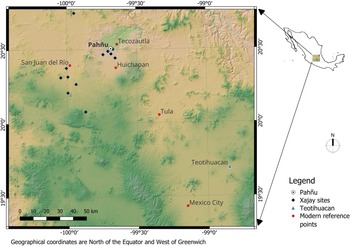
Pahñu is a site with monumental architecture belonging to the Xajay culture, who inhabited the northwest of the Mezquital Valley, 180 km northwest of present-day Mexico City, from 350 to 1000 AD. Xajay settlements are characterized by their emplacement on the edge of plateaus, reason why they are also known as the Culture of the Mesas (Figure 1). Other cultural traits of the Xajay are the presence of petroglyphs surrounding their ceremonial centers, the predominant use of local raw materials such as tuff, basalt, and rhyolite, as well as calcrete and mud floors (Farías Pelayo and Castañeda Gómez del Campo Reference Farías Pelayo, Castañeda Gómez del Campo, López Aguilar and López Hernández2014; Farías Pelayo Reference Farías Pelayo, López Aguilar and López Hernández2015).
Xajay sites.

Pahñu, the most important of the Xajay sites, had two periods of occupation. The first one was during the Mesoamerican Classic period, from 350 to 550 AD, and was characterized by the construction of its first buildings, as well as its contemporaneity and autonomy from Teotihuacan, the dominant political entity of central Mexico at the time. During the second period, starting in 550–650 AD, an active construction program was undertaken at Pahñu, where buildings were expanded and remodeled, and there was also a mixture of cultural traditions that resulted from population movements following the collapse of Teotihuacan (Castañeda Gómez del Campo Reference Castañeda Gómez del Campo, López Aguilar and López Hernández2015; Farías Pelayo and Castañeda Gómez del Campo Reference Farías Pelayo, Castañeda Gómez del Campo, López Aguilar and López Hernández2014).
The construction events at Pahñu resulted in a spatial organization where buildings were distributed around plazas, clearly exemplified by the Main Group. However, the large buildings did not cover the entire site. Particularly, in the east of the plateau there are stone alignments and remnants of double walls that correspond to rooms of smaller dimensions (Farías et al. Reference Farías Pelayo, López Aguilar, Gómez Ensastegui and López Arias2022).
The excavation of one of the rooms—East Room H1—(Figure 2) was chosen to contribute to the understanding of the function of the east zone of the plateau and its relationship with the rest of the architectural complexes. The initial objectives of its excavation were to identify its shape, dimensions, function and, of course, to define the stratigraphic sequence of the events that took place in and around the room.
General layout of burials of East Room H1. The red dotted lines indicate the location of the cumulative sections mentioned below. The bones belonging to Group M are shown in a tenuous manner because, although they were excavated, they were not considered in the analysis presented in this paper.

Explorations carried out between 2019 and 2022 revealed a room of approximately 9 × 7 m. Although the passage of time and erosion have caused some damage—resulting in the loss of the southeast corner of the room—a portico and the access in the southern part were clearly recognized. Inside the room, a small quadrangular altar was identified very close to the access, while in the northeast corner there was a hearth. The room was built with the purpose of housing skeletal remains, most likely belonging to dignitaries, and performing the ritual activities related to them. (Farías et al. Reference Farías Pelayo, López Aguilar and García Kobeh2020, Reference Farías Pelayo, López Aguilar, Gómez Ensastegui and López Arias2022; Gómez et al. Reference Gómez Ensastegui, López Arias, Farías Pelayo and López Aguilar2023).
Excavation data of East Room H1 yielded a stratigraphic sequence that could be divided into six phases, starting with 1) the bedrock, 2) its adaptation and the construction of the structure, 3) the use surfaces where daily human activities took place, 4) the construction of the cists and their use for human burials, 5) the termination rituals of the room—its burning, destruction, and closure—ending in 6) the natural events of erosion, sedimentation, and soil formation that occurred once the room was abandoned (Farías et al. Reference Farías Pelayo, López Aguilar and García Kobeh2020, Reference Farías Pelayo, López Aguilar, Gómez Ensastegui and López Arias2022; Gómez et al. Reference Gómez Ensastegui, López Arias, Farías Pelayo and López Aguilar2023).Footnote 1
For the burial of the remains of their dignitaries, the Xajay built three pairs of contiguous cists against the northern inner wall of East Room H1, with separations made of faceted tuff cobbles and mortarFootnote 2 . The arrangement of the ensemble of cists formed a rectangle with three funerary boxes, or cists, to the north and three to the south. During the excavation process, each cist was named as a Group followed by an arbitrary letter for its identification. So far, five Groups have been excavated: L, M, P, A, and C (Figure 2). In each of the excavated cists, more than one depositional event containing skeletal remains was identified, which is evidence of the complexity of the funerary practices of the Xajay.
The skeletal remains in Groups A and L have a shared history in the stratigraphic sequence. Once the Xajay built the walls defining the limits of both cists, a mud plaster was placed to cover the inner surfaces and was later broken. Group A was recovered from the southern part and comprises the bones of a multiple burial: an adult torso, two disarticulated skulls, as well as the burned remains of an infant. In the northern part occupied by Group L, some small bones were placed on the plaster, significantly, the distal part of a foot. Subsequently, stones with size of cobbles were placed to divide the space into two cists. Then the Xajay filled the whole area with tuff stones and pumice. Subsequently, in the northern cist, corresponding to Group L, they broke the tuff and pumice backfill to make a multiple secondary burial that was finally sealed with faceted cobbles.
Osteological and spatial analysis of skeletal remains
An archaeotanatological approach (Duday Reference Duday, Malvido, Pereira and Tiesler1997, Reference Duday2009; Pereira Reference Pereira, Serrano Sánchez and Terrazas Mata2007) was used for the analysis of the human remains where taphonomic, osteological, and spatial aspects were considered. The osteological analysis involved the determination of the Minimum Number of Individuals, the calculation of the Maximum Preservation Rate, and the identification of second-order osteological relationships.
The Minimum Number of Individuals was 16: 12 adults and 4 infants. On the other hand, the Maximum Preservation Rate, i.e., the relative proportion of which type of bones are more and better represented, resulted, among other things, in an overrepresentation of long bones, particularly femurs (Farías et al. Reference Farías Pelayo, Gómez Ensastegui and Lona Sánchez2023). Both results are preliminary as they will surely be modified when the remains that may appear in the unexcavated cist are included.
Since most of the skeletal remains correspond to multiple and secondary burials, that is the bones of individuals that were moved to a different location where decomposition took place, the laboratory analysis focused on the identification of second-order relationships. This type of relationship seeks to identify the remains of the same individual through criteria such as joint contiguity, fragment bonding, degree of maturation, and sharing the same pathological characteristics, as well as the identification of symmetrical bones (Duday Reference Duday, Malvido, Pereira and Tiesler1997; Pereira Reference Pereira, Serrano Sánchez and Terrazas Mata2007).
Based on the osteological information, a spatial analysis was carried out with the objectives of detecting the intentional shifting of the remains of identified individuals, as well as the existence of specific preferred areas for the deposition of certain bones. The analysis revealed that displacements of the remains occurred within the cists in which they were originally deposited. This assertion is based on the finding of bones of the same individual within the same funerary box, particularly of infants and some adult individuals. In addition, the possibility of displacements between cists and even outside of them is not ruled out. This is inferred from the identification of some bones with evidence of exposure to fire, but without finding the source of combustion, residues of charcoal, or black stains on the ground. In other words, these bones were burned outside the cists. Another data from which the movements between cists or even outside of East Room H1 can be inferred is the over-representation of femurs, which would indicate that some of them could have been brought from other burials; while the low representativeness of radii would indicate, for example, that these were perhaps intentionally selected and moved outside East Room H1 (Farías et al. Reference Farías Pelayo, Gómez Ensastegui and Lona Sánchez2023).
Although the analysis of the skeletal remains provided clues as to what occurred in the funerary context, there were still unanswered questions. In the first place, there was uncertainty as to the probable dates of the burials. Since Pahñu had two occupation periods, it was necessary to know to which one of these the burials belonged. Secondly, spatial analysis indicated the existence of two types of displacements of skeletal remains: within and outside of the cists. However, as the strata of the cists do not overlap, it was necessary to resort to absolute dating methods to refine the stratigraphic sequence.
The stratigraphic sequence and its explanatory limits
Stratigraphy is one of the main tools archaeologists use to establish the sequence of events and to understand what happened in the excavated area. However, stratigraphy has two explanatory limitations.
The first arises when there are stratigraphic units that do not overlap. The order of events is established by the translation of the physical contacts of the stratigraphic units into time using the law of stratigraphic succession. If the strata do not overlap, then there may be alternative interpretations: they can be contemporaneous, one can predate the other, or vice versa. In this case, Harris (Reference Harris1989) suggests considering permutations, which are all possible combinations in the order of those events that do not overlap, but without affecting the overall order of the stratigraphic sequence. Material analysis or dating can be used to evaluate which of the permutations is the most plausible (Harris Reference Harris1989).
The second limitation of stratigraphic analysis has to do with the time span of the events. The order of the stratigraphic units is sequential, i.e., it only indicates which event happened first and which later but does not indicate how much time elapsed between one and the other. This limitation is not exclusive to stratigraphy but is general for any form of relative dating.
Samples
To overcome the explanatory limitations mentioned above and to be able to refine the stratigraphic sequence, we combined the analysis of charcoal, bones, and teeth from burials with AMS radiocarbon dating. The questions that we hoped to resolve were the following: when was East Room H1 built, to what period do the burials found in it correspond, and what was the order in the sequence of deposition of the skeletal remains inside the cists? On one hand, the analysis of the charcoal gives us clues about the construction of East Room H1 and the selection and use of natural resources. On the other hand, the analysis of the skeletal remains helps us to understand the funerary customs of the Xajay. Finally, radiocarbon dating provides absolute anchor points to events that occurred during the 700 years of occupation of Pahñu.
Particularly, for the analysis of the stratigraphic sequence of events in the cists, we rely on the elaboration of cumulative sections, as well as on the Harris Matrix. The cumulative sections were made in a north-south direction to facilitate the comparison of what happened in the cists. The information obtained, together with the results of radiocarbon dating, bring us closer to understand the use of East Room H1 in time.
Charcoal
As mentioned, a hearth in an excellent state of preservation was excavated in the inner northeast corner of East Room H1, next to the mortuary cists. Likewise, charcoal fragments of different sizes were recovered and found on the mud plaster covering the floor of the room. The charred wood was the result of the burning of the building as part of its termination rituals.
It is worth noting that similar events have been identified in other structures at Pahñu. The clearest example is in Structure H, which is located ten meters west of East Room H1. In both buildings, the charred wood was found on the floors over blackish and whitish stains indicating continuous burning.
An anthracological analysis of the charred wood is being carried out at present to identify the plant species used as timber construction material. The analysis procedure is based mainly on microscopic observations to identify the structure of the samples. First, optical microscopy is used to recognize the family and then samples are selected for analysis with scanning electron microscopy (SEM) to identify the species.
The results obtained so far indicate that the charred wood found on the mud floor belongs to the conifer family. Most conifers tend to have needle or scale-like leaves, are perennial, and have resiniferous canals in their structure. In addition, they are monoecious species, i.e., they have only one stem, which makes them ideal for construction. A well-known example of conifers are pines which are found in forests in the intermediate sierras and highlands surrounding the Mezquital Valley. Paleoclimatic studies support that in the years when East Room H1 was built, pine forests reached a lower elevation, and therefore were located closer to Pahñu than they are today (López Aguilar Reference López Aguilar, Cervantes and López Aguilar2015).
Unfortunately, due to lab constraints, we could only process one charcoal sample for carbon dating. Also, bear in mind that pines have a long lifespan, which may introduce some uncertainty in radiocarbon dating results. Nevertheless, these results give us a valuable starting point for our analysis.
Skeletal remains
The selection of the sample of teeth and bone remains considered several aspects. In the first place, samples were obtained from different stratigraphic units making sure that they did not belong to the same individual. So, preferred samples were obtained from skulls, particularly dental pieces, and, as far as possible, from labile joints, which indicate that putrefaction occurred in the place where it was deposited. If in any case, the above criteria could not be followed due to the characteristics of the context, the sample selected was that which the osteological analysis indicated that did not belong to an already represented individual.
Methods and results
Selected charcoal, teeth, and bone samples were dated at the AMS LEMA Laboratory of the Physics Institute of the Universidad Nacional Autónoma de México (UNAM).
Teeth were processed to extract ultra-filtered collagen, following a modified Longin method (Longin Reference Longin1971; Solís et al. Reference Solís, Pérez-Andrade, Rodríguez-Ceja, Solís-Meza, Méndez, Chávez-Lomelí, Martínez-Carrillo and Mondragón2017). Samples were cleaned in an ultrasonic bath; then they were crushed in a mortar. An HCl 0.5M bath at room temperature was applied to dissolve the mineral phase and remove carbonates, and the gelatinization procedure was carried out with HCl 0.001 M at 100°C. Dissolved collagen was filtered using a Millipore Amicon Ultra 30 KDa filter (Merck), to remove the low molecular weight contaminants and degraded collagen fibers. Finally, samples were freeze-dried.
Charcoal samples were cleaned in ultrasonic bath; then they were treated with an acid-base-acid protocol to eliminate carbonates, organic contamination and CO2 from the atmosphere that could have been absorbed during the alkaline bath (Goh and Molloy Reference Goh and Molloy1972).
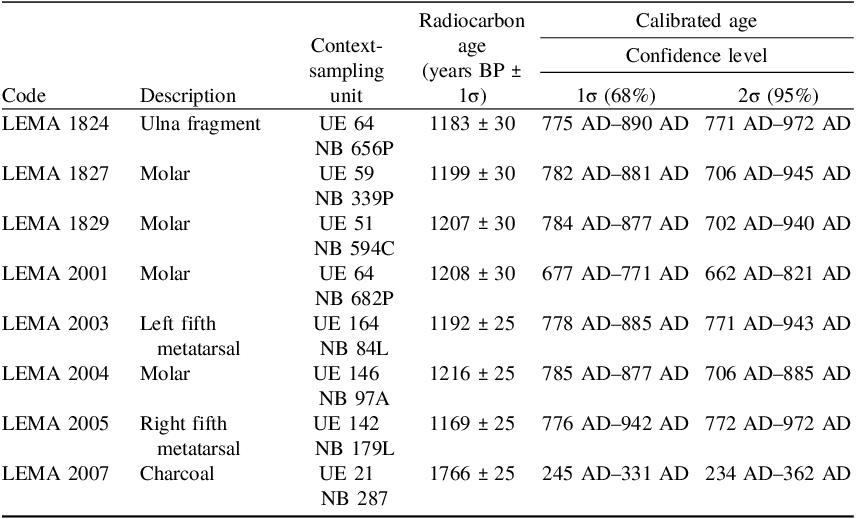
Graphite targets were obtained from cleaned samples by combustion in an automatized graphitization equipment (AGE3, Ion Plus) (Wacker et al. Reference Wacker, Němec and Bourquin2010). Next, they were pressed in aluminum cathodes and measured in the 1 MV AMS system from High Voltage Engineering Europa (HVEE) (Solís et al. Reference Solís, Chávez-Lomelí, Ortiz, Huerta, Andrade and Barrios2014). Obtained Conventional Ages (Before Present) were corrected for the variations of 14C in the atmosphere through time, with the OxCal v4.2.4 calibration program (Bronk Ramsey Reference Bronk Ramsey2009), and then calibrated using the IntCal20 calibration curve (Reimer et al. Reference Reimer, Austin, Bard, Bayliss, Blackwell, Ramsey, Butzin, Cheng, Edwards, Friedrich, Grootes, Guilderson, Hajdas, Heaton, Hogg, Hughen, Kromer, Manning, Muscheler, Palmer, Pearson, van der Plicht, Reimer, Richards, Scott, Southon, Turney, Wacker, Adolphi, Büntgen, Capano, Fahrni, Fogtmann-Schulz, Friedrich, Köhler, Kudsk, Miyake, Olsen, Reinig, Sakamoto, Sookdeo and Talamo2020) to obtain ages cal BC–AD, with confidence levels of 68% (1σ) and 95% (2σ) (Table 1 and Figure 4).
Results of AMS radiocarbon dating performed in Pahñu’s samples. The dated fraction was Ultrafiltered Collagen from molar or tooth and charcoal

Discussion
Radiocarbon dating of the charcoal sample LEMA 2007 yielded a date of cal. 234–362 AD. The data obtained so far indicate that the room may have been built during the Classic period and that they used coniferous wood, most likely from nearby forests, as beams to build the roof of the Room. The roofs were used and maintained during the lifespan of East Room H1 until they were destroyed and recycled for the burning event during its termination closure.
From Group L, samples were taken from a metatarsal of an articulated foot that was placed on the mud plaster (sample LEMA 2005), as well as from another metatarsal from the last burial of the cist (sample LEMA 2003) giving date ranges of cal. 772–972 AD and cal. 771–943 AD respectively.
The two dates obtained from Group L samples are very similar. One sample came from a metatarsal of an articulated foot, which implies that the putrefaction of soft tissues occurred in situ on the plaster that covered the bottom of the cist. Its dating cal. 772–972 AD gives a very certain time of deposition and of course, the dates in which that surface was used. By terminus post quem, all subsequent events happened after the deposition of the foot. Taking this fact into consideration, the dating of the last multiple burial of Group L (cal. 771–943 AD), would be a residual date, that is to say, it is not the original date of deposition. Nevertheless, given the great similarity in the dating of Group L bones, stratigraphic and spatial analysis allows to infer that this finding is due to displacements of the bodies within the cist which was used repeatedly in a short period of time.
Sample LEMA 2004, a molar from one of the disarticulated skulls of Group A yielded a date of cal. 706–885 AD. This date is not necessarily indicative of the time of deposition. Since Group A was covered by a tuff and pumice fill, in which a secondary burial dated to cal. 771–943 AD was subsequently deposited (LEMA 2003), the resulting date of the burial of Group A should be earlier than that date, which in fact it is. Nevertheless, considering that the articulated foot on the mud plaster in Group L is stratigraphically speaking earlier than the molar of the skull from Group A, every single event after the deposition of the foot (772–972 AD), as mentioned above, should be later than that date. Therefore, the date of the molar from the skull of Group A (706–885 AD) is also a residual date (Figure 3a).
(a) Groups L and A. (b) Group P and Group C.

Phase Model in OxCal.

The stratigraphic sequence of Group P indicates five depositional events. The earliest was not excavated and the subsequent one did not contain bones. The next stratigraphic unit had a ceramic offering in the corners of the east side and there were many bone fragments, most of them severely damaged. The fourth event was characterized by numerous skeletal remains, mostly disarticulated, including skulls, long bones, and ribs. It also contained an obsidian pedunculated knife. The fifth event had the fewest bones.
Bone samples were obtained from the third (UE64) and fourth (UE59) depositional events.Footnote 3 From the oldest, a dental piece attached to a mandible (sample LEMA 2001) was dated to cal. 662–821 AD and a long bone, (LEMA 1824), to cal. 771–972 AD. Considering that the most recent date is that which dates the context, by terminus post quem (Harris Reference Harris1989; Barker Reference Barker1993) any stratigraphic unit deposited after this one is later than cal. 771–972 AD. A dental piece attached to a skull (LEMA 1827) recovered from the most recent stratigraphic unit dated to cal. 706–945 AD. Thus, it appears that both the mandible and the skull are “residual bones”: the death of the individuals was before the creation of the deposit where they were found. Again, the movements of the skeletal remains of the individuals explain why older bones are found in more recent stratigraphic units (Figure 3b).
Two stratigraphic units with bones were detected in the cist occupied by Group C. The oldest one contained foot bones and small fragments of other bones. In the most recent depositional event, the space was first occupied by the remains of a woman that were partially shifted to the south to later place the primary burial of a female individual who was covered in the north by the rest of the remains of the first woman.
In Group C, a tooth from the woman of the primary burial was sampled (LEMA 1829) and gave a calibrated age of cal. 702–940 AD. Because the sample comes from a primary burial found in the most recent stratigraphic unit, the dating is representative of the last time the cist was used. Since the cist occupied by Group C is located just south of that occupied by Group P, the southern cist is earlier than the northern one (Figure 3b).
Conclusions
Stratigraphic analysis is an excellent tool to identify the sequence of the events that occurred in an excavated area, but it becomes even more powerful when it is combined with data obtained from archaeological materials. The analysis of charred wood and bone remains, through interdisciplinary work, has allowed us to refine the sequence and temporality of the events that occurred in East Room H1 of Pahñu.
The charred wood of East Room H1 fell on the mud floors. The stratigraphic analysis indicated that the burning event corresponded to the termination rituals of the building. The charcoal analysis results confirm that conifers were used as beams for the roof and that its construction was in cal. 234–362 AD or later, during the Mesoamerican Classic.
The excavation of East Room H1 identified the cists destined to house human remains. The dating of the bones found in the cists supports that the burials are from the second phase of the occupation of Pahñu. Likewise, the dating indicates a constant and intensive use of the mortuary space between 700–940 AD and 770–970 AD.
The sequence of events detected from bone analysis indicated that the bodies of the deceased were laid in the cists and after some time they were shifted inside their cists, some bones moved between them, and even removed and taken elsewhere. Some bones were also brought from outside of East Room H1, particularly femurs. Dating establishes that these movements occurred between 700–940 AD and 770–970 AD and may even be earlier, as indicated by the dating of a “residual bone” (cal. 662–821 AD). Finally, dating showed that the southern Group C cist (702–940 AD) is earlier than both cists located to the north, which are contemporary (771–972 AD).
Thus, interdisciplinary study of the archaeological context and materials, with the participation of physicists, archaeologists, and physical anthropologists, enhances the joint story told by the earth, the bones, the charcoal, and time.
Acknowledgments
The authors thank Arcadio Huerta Hernández for maintenance and operation of the LEMA AMS system, and Sergio Martínez González for laboratory assistance.
We would also like to thank Fundación Stresser-Péan for the funding provided for the analysis of the skeletal remains.



 Open access

