


1. Introduction
The increasing complexity and interconnectedness of product and system design – driven by technological, societal, and organizational developments – creates challenges in evaluating designed artifacts and analyzing human-product interaction and human behavior. Traditional lab and field studies are reaching their limits (Reference Kjeldskov and SkovKjeldskov & Skov, 2014; Reference Schmidt, Alt and MäkeläSchmidt et al., 2021), and ‘traditional’ research methodologies, such as questionnaires, interviews, and observations, often fall short of addressing these complexities of real-world scenarios, requiring innovative research approaches (Reference Hevner, March, Park and RamHevner et al., 2004). Technology-driven tools, such as biometric measurement tools and eye-tracking, get increasingly integrated into engineering design and ethnography research approaches (Reference Escudero-Mancebo, Fernández-Villalobos, Martín-Llorente and Martínez-MonésEscudero-Mancebo et al., 2023; Reference Thoring, Mueller and Badke-SchaubThoring et al., 2015). Data collection techniques are advancing alongside a blurring of the lines between lab and field studies. The increasing complexities and challenges research studies are facing lead to a shift towards hybrid research approaches like living labs (Reference Akasaka, Mitake, Watanabe and ShimomuraAkasaka et al., 2022) and ‘in the wild’ studies (Reference Crabtree, Tolmie, Chamberlain, Chamberlain and CrabtreeCrabtree et al., 2020), in which typical characteristics of lab and field studies blend into each other. However, there is no one-fits-all solution, and comparatively little attention is given to the research environments - the physical spaces where studies take place - in these hybrid approaches (Reference Dreyer, McTeague and ThoringDreyer et al., 2025). Within this evolving landscape of alternative research approaches, design exhibitions provide a unique spatial context and opportunity to conduct multi-method, technology-driven, controlled experiments in a fairly naturalistic setting while simultaneously investigating designed artifacts, human-product interaction, and human behavior.
This study explores the strengths and limitations of utilizing exhibitions as research environments through a case study during Munich Creative Business Week (MCBW) in early 2024. Specifically, a research experiment was integrated into a design exhibition on biophilic workspace design to analyze how biophilic-inspired workspace designs support specific work modes. A multi-method, technology-driven research approach was used to analyze user experience and behavior. The hybrid event format – combining an exhibition with a research experiment, referred to as an ‘exhibition-experiment’ throughout this paper – was developed and conducted by a team of design researchers in collaboration with two architecture student groups from the Technical University of Munich (TUM). To assess the potential of exhibition-experiments, the case study centers on the following research question: What are the strengths and limitations of conducting controlled experiments in exhibition spaces?
A focus group discussion with the researchers developing the exhibition-experiment was conducted to evaluate the potential value of exhibition-experiments as research and public engagement events. Additionally, multiple data sources were collected and analyzed regarding the event-like nature of the exhibition-experiment. The findings provide insights regarding conducting research experiments within an exhibition context and highlight the benefits and trade-offs associated with exhibition-experiments as a hybrid research format between lab and field studies. Furthermore, the study explored using biometric wearables and 2D/3D camera systems as observational tools in this context. The aim of the case study is to inspire and guide future research in exhibition spaces. While this paper’s preliminary focus is on the exhibition-experiment approach, detailed results concerning the exhibition-experiment on biophilic-inspired workspace will be the subject of further publications.
2. Theoretical background
Choosing an appropriate research approach and environment is a process of trading off various benefits and drawbacks, particularly for experimental studies. Increasing complexities - driven by technological, societal, and organizational developments - make this choice even harder. Since experiments play a crucial role in design research and typically occur in lab or field settings (Reference Cash, Hicks and CulleyCash et al., 2013), new research approaches and environments should be identified to better address these complexities.
Experimental research can be classified into lab, field, and hybrid approaches, each with unique benefits and limitations regarding control, realism, and reproducibility. Lab studies are commonly associated with a controlled setup and an artificial environment where participants get studied outside their typical contexts (Reference Maselli, Gordon, Eluchans, Lancia, Thiery, Moretti, Cisek and PezzuloMaselli et al., 2023). Further, their fixed design supports the usage of advanced technology-driven research tools (Reference Dreyer, McTeague and ThoringDreyer et al., 2025). Therefore, lab studies allow high internal validity (Reference Wilson, Aronson, Carlsmith, Fiske, Gilbert and LindzeyWilson et al., 2010), enable fine-grain experimental control of variables, and facilitate the examination of causal effects (Reference Schmidt, Alt and MäkeläSchmidt et al., 2021). However, laboratory studies also encounter challenges and limitations, especially when studying real-world contexts and user behaviors (Reference Ho, Gray and SpenceHo et al., 2014), as participants may adapt their behavior when observed. Therefore, the artificial nature of lab studies reduces their ecological validity (Reference LevineLevine, 2018).
In contrast, field studies occur in naturalistic settings, capturing authentic user behavior and interactions in their natural environment (Reference Robinson, Segal and SharpRobinson et al., 2007). They are widely spread, especially in ethnographic studies (Reference ButtonButton, 2000) and design research, while focusing on observing and analyzing individuals in a context (Reference Hammersley and AtkinsonHammersley & Atkinson, 2019) through ‘traditional’ research methods. However, a shift towards using more technology-driven research methods can also be seen here. Further, field studies can uncover usability issues and user experiences that may be challenging to detect in lab settings. The naturalistic approach enhances ecological validity (Reference Keizer, Lindenberg and StegKeizer et al., 2014) by making findings more applicable to real-world contexts. However, limited control and randomization introduce biases and affect the generalizability of field studies (Reference Kjeldskov and SkovKjeldskov & Skov, 2014). Further, their context-specific design makes causal relationships harder to establish (Reference ButtonButton, 2000). However, these challenges also strengthen credibility and reduce bias (Reference ManerManer, 2016).
Various hybrid formats have emerged in recent years to bridge the gap between field and lab studies. One example are living labs, are real-life research environments (Reference Akasaka, Mitake, Watanabe and ShimomuraAkasaka et al., 2022), which allow researchers to study phenomena in natural settings. However, they primarily validate new technologies and services (Reference Niitamo, Kulkki, Eriksson and HribernikNiitamo et al., 2006) rather than examine designed artifacts, human-product interaction, or human behavior. Similarly, ‘in the wild’ approaches in design and human-computer interaction research emphasize studying and developing technologies in real-world contexts rather than in controlled environments (Reference Crabtree, Tolmie, Chamberlain, Chamberlain and CrabtreeCrabtree et al., 2020). While these methods offer promising research approaches and environments alongside others, there remains a need to balance experimental control and the application of technology-driven research tools with the advantages of naturalistic settings. Given these challenges and the fact that the design research community seeks to move beyond traditional lab setups, this study explores design exhibitions as an alternative research environment.
To better understand why we explored research experiments within design exhibitions, it is worthwhile to briefly look at recent developments in museums and exhibition spaces. Over the past decade, museums and exhibitions have been seen more as spaces for presenting established information than as places for knowledge creation (Reference BjerregaardBjerregaard, 2020). Nevertheless, museums engage in diverse research activities, from studies on art collections to collaborative research with communities (Reference SigfúsdóttirSigfúsdóttir, 2022), primarily anchored in the social sciences. This often goes unnoticed by the public as exhibitions and museums rarely get associated with being an environment in which research takes place. In recent years, exhibitions and museums have shifted from static displays to interactive, technology-driven experiences, enhancing visitor engagement and knowledge production (Reference Yang and GuoYang & Guo, 2023). Exhibitions have become dynamic spaces where curators, artists, and visitors collaborate and experiment while fostering research on visitor experiences and interactions within these environments (Reference Martella, Miraglia, Frost, Cattani and Van SteenMartella et al., 2017). This kind of research is often rooted in human-computer interaction. It explores, for example, visitor interactions with new exhibition formats (Reference Maye, McDermott, Ciolfi and AvramMaye et al., 2014) or the impact of technology on galleries and visitors (Reference Hornecker and CiolfiHornecker & Ciolfi, 2019). These developments indicate that exhibition spaces can become living laboratories and research spaces, bridging the gap between art, science, and technology (Reference Muller, Edmonds and ConnellMuller et al., 2006). Thus, we conceptualize exhibition spaces as potential hybrid research environments that can support bridging the gap between lab and field studies, as they blend lab-like control with the contextual richness of field studies.
While existing research highlights museums and exhibitions as valuable spaces for diverse forms of research, further exploration beyond exhibition-specific topics is required. To explore the potential of exhibitions as spaces for design research, we conducted a technology-driven design research experiment in a design exhibition, analyzing its benefits and trade-offs for studying human behavior.
3. Methodology
A single case study was conducted on an exhibition-experiment during a large design event to explore the strengths and limitations of a design exhibition space used for a technology-driven design research experiment. This approach was chosen to examine the case within its authentic context (Reference YinYin, 2018) and understand it in-depth (Reference Creswell and CreswellCreswell & Creswell, 2018). To gather insights into the strengths and limitations of exhibition-experiments, a focus group discussion was conducted, and additional data, including visual materials, platform analytics, and participant demographics, was collected. Incorporating different data sources allowed for the triangulation of the generated insights.
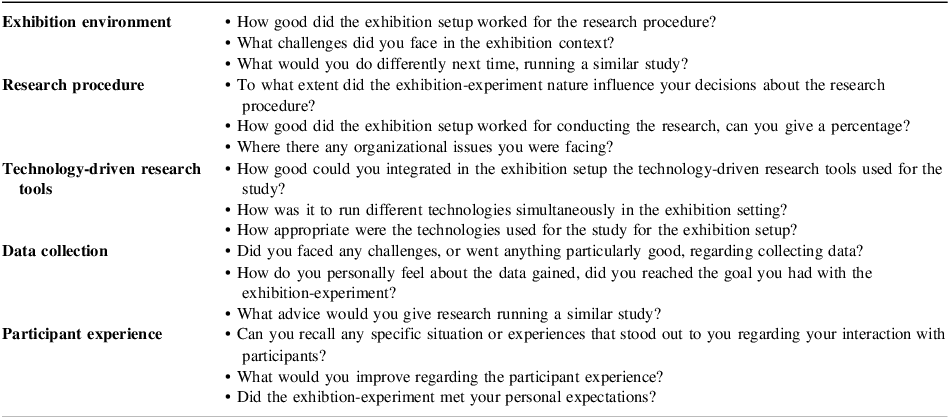
The focus group discussion was conducted with two researchers involved in developing and executing the exhibition-experiment. This approach was chosen to leverage interaction and communication among the researchers to generate valuable insights (Reference KitzingerKitzinger, 1995), understand the researchers’ perspectives, uncover challenges, and get in-depth insights (Reference Brinkmann and KvaleBrinkmann & Kvale, 2015) about the exhibition-experiments execution. An interview guide with closed and open-ended questions was developed beforehand to allow for the exploration of potential unexpected findings. Further, the interview was semi-structured, allowing flexibility in adjusting the questions’ order based on the interviewee’s responses. The interview covered the following topics: Exhibition environment, research procedure, technology-driven research tools, data collection, and participant experience. Table 1 offers an exemplary overview of the interview questions asked.
Exemplary interview questions

The focus group interview took place in person, took 107 minutes, was recorded with obtained consent of the interviewees, transcribed, and analyzed through a thematic analysis in two phases. First, the transcript was inductively coded with a qualitative data analysis software (ATLAS.ti). Second, strengths and limitations associated with the identified themes were derived and put in relation to each other. Third, these themes were systematically organized within the predefined interview categories. However, the interview categories did not reflect the insights gained through the other studied data sources, necessitating adding a participants category. Further, the identified themes and corresponding strengths and limitations support the positioning of exhibition-experiments compared to other lab types and environments. Notably, the focus group discussion was conducted before the researchers became co-authors of this paper to avoid bias.
In addition, further data from the exhibition-experiment was collected to provide a comprehensive view of the research experiment and exhibition environment. These data included photos, floorplans, a list of research technologies, an overview of procedures, quantitative data from platforms like the event homepage, Eventbrite, and Instagram, and demographic data (gender, age, profession) of participants. The data collected especially underpins the case description. Additionally, the quantitative data from the event booking and advertising platforms was analyzed using descriptive statistics to assess event reach, sign-ups, participation, and the effectiveness of different advertising methods.
4. Case description
4.1. Project context and aims
Overview and setting
The examined case was a hybrid event termed an ‘exhibition-experiment’ where a controlled study took place within a public design exhibition. Members of the public could book appointments to work in a neutral working space and one of two biophilic-inspired workspaces designed to evoke specific emotions and physical responses, using products and interiors inspired by nature. During their slot, participants used the rooms as private workspaces for self-chosen tasks while passive sensors recorded them. As an exhibition, the event aimed to showcase the work of the students who created the spaces. As an experiment, the event aimed to measure the emotional and physical impact of the space on its occupants. The exhibition-experiment took place during Munich Creative Business Week (mcbw) in early 2024, titled ‘Biophilic Workspace: Open Office’, and lasted six days.
Design project and biophilic-inspired workspaces
The workspaces that served as the exhibited objects and experimental stimuli during the event resulted from a one-semester design project for architecture master students titled ‘Biophilic Workspace’ at the Technical University of Munich (TUM). Students were tasked in the project to explore the potential of biophilic design in creative spaces and workplace environments, developing a range of design interventions from small-scale accessories to furniture, leading into three biophilic-inspired workspaces themed to encourage activating, relaxing, and focused work, and finally realized in three 3m x 3m room-within-a-room spaces. Two of these workspaces were implemented into the exhibition experiment: one for reflective thinking, which was designed to create a relaxing atmosphere, and another one for activating work, see Figure 1.
Aims of the exhibition
The exhibition showcased the biophilic-inspired workspaces and product designs developed by the students of the ‘Biophilic Workspace’ design project. The exhibition was designed by a second group of master’s students tasked with creating an exhibition for a large design event that facilitated both the experiment and the exhibition approach. The goal was to create a welcoming atmosphere and seamless participant experience. A two-day workshop introduced the students to the exhibition spaces, the ‘Biophilic Workspace’ project, and the planned research experiment. Following this, the students designed the exhibition with distinct areas supporting the various research phases and a participant roadmap based on the research procedure, see Figure 2.
Aims of the experiment
The experiment examined whether the students’ designs could effectively influence participants’ work modes by ‘activating’ or ‘relaxing’ while working inside one of the biophilic-inspired workspaces. This was done for two purposes. Firstly, to extend knowledge about the relationship between physical workspaces and their occupants; and secondly, to evaluate if the designers of the biophilic-inspired spaces successfully elicited states of activation and relaxation and, in doing so, further develop triangulation methods suitable for evaluating user experience in interior spaces.
Room designs: relaxing room (left), activating room (middle), neutral room (right)

4.2. Experiment and event procedure
Experiment design and visitor experience
A controlled experiment was conducted to compare the extent of activation or relaxation experienced by participants in the neutral room and one of the intervention rooms (activating or relaxing). Each participant was randomly assigned to spend time in either (i) the neutral and activating room or (ii) the neutral and relaxing room. Participants entered the neutral room first and then one of the intervention rooms, spending time in only two of the three rooms. The participants’ time in each space was split into a 5-minute rest period – sitting down and observing the space to establish a baseline – and a 25-minute free-work period in which the participants were allowed to work on their own tasks in any way they liked. The experiment was conducted outside exhibition hours to minimize distraction and interference between visitors and participants. However, it was not entirely possible to prevent occasional exhibition visitors from passing by. Further, each room entrance was closed with a noticeboard on castors once a participant was studied inside the room to minimize distractions and provide privacy for participants.
Participants
For the exhibition-experiment, 30 participants could be gathered through online advertisements on the design events homepage, Instagram, and a round mail sent to former students. Participants signed up for a specific time slot in advance through an online event platform called Eventbrite to ensure a controlled number of participants at any given time. Based on the demographic data collected, the study attracted a diverse pool in terms of gender, age, and professional background: 17 women and 13 men; 2 aged 18-24, 14 aged 25-34, 6 aged 35-44, 5 aged 45-54, 2 aged 55-64, and 1 aged 65+. Professionally, the group included 7 architecture professionals, 6 in management, 5 in design, 5 students, 4 researchers, 2 in IT, and 1 in administration.
Procedure
A research protocol was developed to outline the participant’s journey, detail the procedure, and guide the exhibition design. The research protocol, see Figure 2, is divided into four phases:
-
Phase 1: Arrival and Briefing (15 minutes). (A) The participant arrives at the exhibition space and (B) gets welcomed by a study conductor at the front desk, (C) receives an introduction to the study, signs the GDPR consent form, gets assigned a unique participant ID, completes an initial survey on a tablet, and (D) gets equipped with a biometric wearable wristband.
-
Phase 2: Experiment Part One (30 minutes). (E) The participant gets escorted to a neutral room, where (F) he/she spends five minutes sitting down and acclimating (G) before working on personal tasks for 25 minutes. Afterward, (H) the research conductor returns and hands the post-room survey to the participant, who completes it before moving further.
-
Phase 3: Experiment Part Two (30 minutes). (I1/I2) The participant gets guided to either the relaxing or activating room, alternating for balance. (J1/J2) After acclimating again for five minutes while sitting down, (K1/K2) he/she works for 25 minutes on personal tasks. (L1/L2) Then, the research conductor returns and asks the participant to complete a post-room survey identical to the neutral room survey.
-
Phase 4: Debriefing (5 minutes). (M) The participant gets escorted back to the front desk, debriefed, (N) unequipped from the biometric wristband, (O) and given a leaflet with his/her participant ID and instructions for accessing his/her results, (P) and the participant is sent off.
The four phases summarize the study protocol for the exhibition-experiment. It is important to note that throughout the experiment, two participants took part at the same time – one in the neutral room and the other in either the relaxing or activating room – while a third was introduced to the study. This allowed a higher participant turnover. The experiment was primarily conducted by a group of students trained on the study protocol, with two students present on-site to run the exhibition-experiment.
Exhibition design and research procedure: floor plan with participant roadmap (left), entry area (top middle), relaxing and activating room (top right), neutral room and front desk (bottom middle), waiting area (bottom right)

Measures and equipment
Methods triangulation was used to measure participants’ arousal (activation) and relaxation (deactivation). Figure 3 gives an overview of the technology setup in the exhibition space. Emotional arousal was measured using the Activation-Deactivation Checklist (AD-ACL) (Reference ThayerThayer, 1986). Physiological arousal was measured via physiological signals, recorded via Empatica Embrace Plus wristbands, which captured six types of raw data, including heart interbeat interval, blood volume pulse, electrodermal activity, temperature, accelerometer values, and step count. The wristbands were paired via Bluetooth to Samsung Galaxy A9 8.7 inch tablets. Physical activity was tracked using 2D and 3D video. GoPro Hero 11 Black cameras with wide-angle Max Lens recorded top-down 2D video from the ceiling, while Orbbec Femto Mega cameras captured depth and RGB 3D video, positioned to face the desk in each room and connected to laptops with external hard drives in a ‘tech corner’ behind each room. The same tablets connected to the Empatica wristbands were also used to administer the GDPR form and conduct a pre-study and post-room survey for each room, all operated via Google Forms.
Floor plan with setup (left), tech corner (top middle), 3D video camera (top right), 2D video camera (bottom middle), biometric wristbands and tablets (bottom right)

5. Results
The case study results include subjective and objective insights from the focus group discussion and the analysis of various data sources. These insights reveal the strengths and limitations of the exhibition-experiment. The following paragraphs provide an overview, and Figure 4 summarizes these findings.
Exhibition environment
The exhibition design and the exhibition context provided an aesthetically appealing, fairly naturalistic real-world environment, enabling smooth research execution and the evaluation of a three room setup within a large space. According to the researchers, such a setup is unique and rare, especially in university research with limited funding, which often occurs in smaller, allocated spaces. However, incorporating all research procedure steps within a single exhibition space introduced certain limitations, such as distractions from background noise and less control over environmental factors like temperature and humidity. At the same time, the naturalistic setup was beneficial as it contributed to a higher ecological validity from the researchers’ point of view. Further, the room-on-room concept provided a predefined, comparable research area; however, the single neutral room became a bottleneck, particularly when participants arrived late due to a tight study schedule.
Research procedure
The exhibition-experiment development required close collaboration and knowledge exchange between the researchers and the exhibition designers to create a spatial exhibition setting supporting a smooth research procedure. To optimize the research procedure and to seamlessly integrate the technology into the exhibition design, researchers and designers collaborated from the early stages of the research study’s development, following an iterative approach. This led to a quite smooth research execution from the researchers’ viewpoint. However, the tight scheduling of the participants and exhibition setting also introduced challenges, such as late arrivals, participant preferences for space use, background noise during transitions, and when participants wanted a quick chat after the study. The researchers noted that the lack of buffer gaps in their scheduling was especially a bottleneck. While an efficient participant schedule is important, incorporating buffer gaps could help reduce stress during the overall study execution, and a pilot study could have helped to refine the turnaround times.
Technology-driven research tools
The technology-driven research tools provided flexibility and integrated smoothly into the exhibition, ensuring minimal intrusion and flexibility. However, a careful pre-selection was necessary to fit the exhibition context and research objectives. The biometric wristbands proved particularly suitable, user-friendly, and unobtrusive, as they resemble a smartwatch. However, proper placement is important to ensure high-quality data collection. Two observational cameras, one as a backup, are crucial for covering unexpected issues. The researchers recommend using at least one camera to identify inaccuracies and strengthen the setup, even if not intended for primary data collection. Additional cameras covering the entire exhibition space could further enhance insights into external influences. Using tablets for surveys made data collection more straightforward than using laptops or paper-based surveys. Providing multiple tablets ensured the smooth running of several participants simultaneously. Using less intrusive research tools also enhanced accessibility and contributed to a positive participant experience. Informal conversations between the researchers and participants revealed that many participants became so immersed in their tasks that they forgot about the technology, supporting the naturalistic approach. Some even forgot to return the biometric wristbands, indicating the technology’s unobtrusive nature. Researchers concluded that accessibility was not a concern and that the technologies used did not noticeably influence participant behavior. However, they would avoid adding more technology to prevent disrupting the participant experience but, if needed, would prioritize non-intrusive like further cameras, sensors, or eye-tracking.
Data collection
Regarding data collection, a certain degree of experimental control could be achieved by having three rooms of identical size, the same research tools, and a consistent research procedure to follow. However, a pilot study - skipped due to time constraints - could have led to better research data quality and prevented issues like incorrect camera angles, charging problems, and inconsistent wristband attachment. The strong collaboration and exchange between researchers and exhibition designers have contributed to the well-designed research that effectively supported the data collection. While using less intrusive research tools and unavoidable environmental distractions affected research data quality, the naturalistic setting improved external validity and generalizability.
Participant experience
The researchers’ goal of providing a favorable participant experience within the exhibition-experiments influenced the study planning, as the researchers made multiple decisions focusing on the participants’ perspectives. This led to trade-offs in the study design and a less strict research protocol than in a typical lab setting, e.g., by limiting the study’s complexity. The self-directed nature of the experimental task encouraged participants to behave naturally. The unpredictability of this and the participants’ natural behavior added realism to the study, reflecting real-world conditions and enhancing ecological validity and generalizability. Further, it supported an engaging and meaningful participant experience. Informal discussions between the researchers and the participants indicated that this approach contributed positively to their experience. However, the researchers emphasized the importance of not over-accommodating participants in a way that compromises the study’s objectives.
Participants
The event character of the exhibition-experiment influenced the participant pool positively, attracting many interested individuals, including highly skilled participants, resulting in a more diverse group than expected. However, the event character also brings uncertainties regarding the participants, such as unpredictable attendance, variable demographics, and difficulty controlling variables like participants’ eating or sleeping habits. A strategic oversupply approach addressed some of these, offering three times the usual number of participation slots than the target participant number. Over the six study days, 72 slots were available, with 73.6% booked online. However, only 41.6% of all slots were finally filled, highlighting a significant no-show rate and emphasizing the importance of strategic oversupply. In addition, using online advertisements for participant recruitment was generally effective, though its effectiveness varied across platforms, as indicated by quantitative data. The event was promoted through the event homepage (250 people), Instagram (4302), Eventbrite (59), and a round mail (178), reaching a total of 5181 people. Of these, 392 visited the Eventbrite page, 53 ordered tickets, and 30 attended the study (0.52% of those reached). Even though Instagram achieved the highest reach, it generated only 24 clicks to the booking page, making the event homepage and internal channels more effective for driving engagement and participant recruitment.
Strengths and limitations of exhibition-experiment

6. Discussion
Contribution and relation to prior work
The case study identified 18 trade-offs for the exhibition-experiment, each showcasing strengths and corresponding limitations. Strengths include a diverse participant pool, unobtrusive technology for data collection, and a favorable participant experience. Limitations involve reduced control over extraneous variables, experimental tasks, and participants. Exhibition-experiments can be seen as hybrid approaches that allow some experimental control over variables through predefined spaces, advanced setups, and structured procedures like lab studies. At the same time, they offer a more naturalistic environment like field studies, which enables examining human-product interaction and human behavior in a real-world context (Reference Ho, Gray and SpenceHo et al., 2014). On the one hand, the research environment and protocol are less controlled than in lab studies, enabling participants to engage in self-directed tasks, like in field studies. On the other hand, some controlled observations are possible, like in lab studies, while fostering natural interactions, unlike field studies, which often lack experimental control (Reference Kjeldskov and SkovKjeldskov & Skov, 2014). However, exhibition-experiments also face challenges, such as participant uncertainty and the necessity to balance the participant experience with the research objectives. However, the built-in participant pool from event attendees reduces recruitment efforts and increases participant engagement while supporting public engagement with science and design by getting audiences who may typically not engage with research. Given these unique characteristics, exhibition-experiments can be seen as a hybrid approach between lab and field studies. However, the data collected during the case study has not yet been fully analyzed. Therefore, the framing of the exhibition-experiment presented here only reflects the point of view according to current knowledge and must be critically reexamined once the data analysis is complete. Nevertheless, this study should encourage further exploration of exhibitions as controlled yet naturalistic research environments and contribute to the broader discussion on more diverse research approaches.
Development of an exhibition-experiment
To enhance the generalizability of the insights from the case study, preliminary recommendations for developing exhibition-experiments can be outlined, informing researchers who want to run an exhibition-experiment in the future. The following steps are an initial guide: (1) Clearly define the research question, (2) select an appropriate event or exhibition that aligns with the research objectives, and (3) choose a suitable exhibition space. Once the previous steps have been established, the general framework of the exhibition-experiment is set. (4) Next, develop the research procedure in detail, decide on the research methodology, and consider whether to incorporate technology-driven research tools. (5) At this stage, exhibition designers should get involved, if they have not already, as the development of the research procedure, the exhibition design, and a favorable participant experience require close collaboration and an iterative process. (6) Once the exhibition design and research procedure are planned, a pilot study should be run in the exhibition space or a similar environment. This step helps to identify potential bottlenecks in the research procedure, participants’ time scheduling, and exhibition design. Further, individuals who might later support the research execution can be trained. (7) Next, the research procedure and exhibition setup should be improved and finalized based on the gained insights from the pilot study. (8) Once this has happened, the exhibition-experiment can be advertised, a participant sign-up can be introduced, and the exhibition-experiment be conducted.
Implications for design research
The case study insights reveal that exhibition-experiments may serve as a hybrid research approach balancing experimental control and naturalistic settings in engineering design research. They provide a way to study artifacts, human behavior, and human-product interaction while using technology-driven research tools in a more naturalistic setting. Mimicking everyday environments an contribute to more generalizability and ecological validity of the findings. However, exhibition-experiments come with certain limitations alongside their benefits. The research should align with a distinct event, and uncertainties and a possibly higher planning effort must be considered. Further, they engage a specific but diverse audience while extending design research beyond academia to a broader community. Overall, exhibition-experiments present opportunities and challenges, expanding the range of possible research approaches for design research, and are worth further exploration.
7. Conclusion
The case study presented contributes to the ongoing discussion on exploring alternative research approaches and environments in engineering design research alongside traditional ones by showcasing an initial attempt to conduct technology-driven design research within a design exhibition. It explores exhibition-experiments as a potential hybrid approach between lab and field studies by outlining the strengths and limitations of this approach. It aims to encourage researchers to further explore exhibition-experiments as a controlled yet naturalistic research approach.
The key strength of this case study is the insights generated through the researchers’ perspective on the exhibition-experiment. However, it is limited by the lack of input from other stakeholders involved in the study, such as participants and the student groups. Nevertheless, the insights gained provide an initial understanding of the exhibition-experiment’s strengths and limitations. Future research could benefit from including these additional viewpoints and exploring exhibition-experiments as an alternative to lab and field studies by exploring various research approaches, from examining spatial concepts to evaluating designed artifacts and human-product interactions. Larger-scale experiments could further reveal how space and participant numbers influence outcomes. All of this could contribute to the development of design principles for exhibition-experiments. Future work must also analyze the data collected in the exhibition-experiment to understand if the research approach suited the research objective and gain deeper insights into the suitability of exhibition spaces as research environments. As this analysis is not covered in this paper, we will address this in an extended version in the future.
Overall, this study is an initial attempt to explore the strengths and limitations of exhibition-experiments for engineering design research. It contributes to the discussion on the need for more diverse research approaches and aims to encourage researchers to explore novel approaches beyond traditional ones.


 Open access

