


Introduction
During the last decade there has been a large increase in the use of the tools of geophysical exploration to examine the nature of the ice within ice sheets and other glaciers. A primary reason for this has been the impact of electromagnetic methods for study of the ice, which has been felt in two ways. First, these methods can themselves be used to investigate some of the properties of the ice. Second, the advent of radio-echo sounding has eliminated the need for large numbers of seismic soundings, while at the same time producing much more detailed ice-thickness information, thus making it possible to turn seismic techniques with increased effectiveness to the study of the ice itself. In this review we will be concerned with the use of techniques of geophysical exploration to study various properties of the firn layers and solid ice of glaciers. Radio-echo sounding methods are covered principally by Robin (1975^]). Not considered here (except for a brief comment on a new electromagnetic interference method) are geophysical means of determining the ice thickness, which are well enough known already. Direct measurement of physical properties on ice samples, while extremely important, are beyond the scope of this discussion. Because of the author’s experience, the discussion will show an inevitable bias toward applications to ice sheets, but many of the techniques are readily applicable to smaller glaciers as well.
Anisotropy
A prime example of the new direction of geophysical examination of the ice is the study of anisotropy. Deviations from a random distribution of ice crystal axes in polycrystalline ice produce a dependence of velocities and amplitudes of seismic and electromagnetic waves on direction of polarization and on direction of propagation through the ice. Since ice fabrics are intimately related to the strain history of the ice, measurements of anisotropy are of great potential value in the study of ice dynamics.
Seismic body waves
The study of seismic wave propagation shows particular promise for the examination of anisotropy because in ice, except when temperatures within a few tenths of a degree of the melting point produce water at crystal boundaries, the elastic properties are very closely defined. The effects of pressure, even at the bottom of the thickest ice sheet, are negligible, and temperature corrections are easily applied.
Wave velocities vary about 3&12% over the 60 deg range of temperatures found in glaciers and ice sheets. The temperature coefficient of velocity for compressional (P) waves measured in the laboratory by Reference RobinRobin (1958) has been confirmed by field measurements. A recent, and probably the best, determination, using carefully screened field measurements, yielded a coefficient of —2.30±0.17 m/s deg (Reference KohnenKohnen, 1974). The temperature coefficient of velocity for shear (S) waves is less well determined, but is probably within 20% of —1.2 m/s deg (Reference KohnenKohnen, 1974; Reference Brockamp and PistorBrockamp and Querfurth, 1965). Since the temperature of the ice in the field is generally quite well known (except at depth in ice sheets), temperature corrections to observed velocities on cold glaciers can usually be accurately applied. On temperate glaciers the situation is less favorable because velocities can vary over a range of several hundred meters per second depending on crystal-boundary water content. Nevertheless, the techniques to be described can in principle be used locally to examine dependence of wave velocities on direction of propagation.
Curves of wave velocities in a single crystal of ice as a function of the angle between the c-axis and the propagation direction, as observed or calculated by several authors (Röthlis-berger, 1972) are closely alike when normalized to observed field values for randomly-oriented polycrystalline ice. Typical velocity curves for the P wave, the SE wave polarized in the plane defined by the direction of propagation and the c-axis (the extraordinary wave), and the SO wave polarized perpendicular to that plane (the ordinary wave) are shown in Figure 1 together with the isotropic polycrystalline averages. The maximum deviation from the isotropic mean is about 5% for P waves and more than 10% for SE waves. Figure 1 would apply not only to a single crystal but also to a polycrystalline region in which the c-axes were all perfectly aligned. In reality, of course, perfect alignment is not found, but in strongly oriented polycrystalline ice the velocity variations, though diminished, are still ample for detection in field measurements. Potentially, at least, S waves are particularly well suited to the study of anisotropy because there are two types of waves which exhibit decidedly different characteristics with one, the SE wave, showing a large velocity range.
Phase velocities (dashed lines) and wave velocities (solid lines) in a single crystal of ice at —10° C as a function of direction of propagation. V1: P wave; V2: extraordinary S wave; V3; ordinary S wave. Upper and lower horizontal lines represent S-wave and P-wave velocities, respectively, in isotropic, polycrystalline ice. From Reference Bentley and CraryBentley (1971[b]).

Striking evidence of anisotropy comes from seismic refraction shooting. (For an extensive discussion see Bentley, 1971 [b].) The travel time curves of Figure 2a show increases in velocity for both S and P waves but at distinctly different depths. This phenomenon is appropriate for layered anisotropic ice, but would be very difficult to explain in terms of an isotropic model, since proportional changes in the P- and S-wave velocities would then be expected.
Examples of refraction and reflection shooting in anisotropic ice. (a) Curves of reduced travel time (i.e. travel time minus distance/V0, where V0 = 3 860 m/s for P waves and 1949 m/s for S waves) showing normal and high velocity P waves (open circles) and S waves (solid points), (b) P-wave velocities from wide-angle reflection shooting (open circles) with two possible model fits (solid lines), (c) S-wave velocities from converted P-S reflections. In (a) and (c) short vertical (horizontal) lines through points indicate horizontal longitudinal (transverse) motion. From Bentley (1971)[b]).

Birefringence in shear-wave propagation is another clear proof of anisotropy. Figure 3 shows vertically and horizontally polarized S waves arriving at different times on a refraction profile near “Byrd” station. Satisfactory explanation of these arrivals was only possible on the basis of a bi-modal distribution of ice-crystal c-axes, revealed in cores from the deep “Byrd” station drill hole (Bentley, 1972).
Section of refraction seismogram from “Byrd” station, Antarctica showing longitudinally (SV) and transversely (SH) polarized shear waves. Traces correspond to individual geophones spaced sequentially 30 m apart. Total travel time: about 6.6s; distance: 12.5 km; charge: 135 kg. Timing lines are 0.01 s apart. From Reference Bentley and OdishawBentley (1964).

Refraction studies can only show increases in wave velocity with depth. Regions where the velocities decrease can be examined by wide-angle reflection shooting which, although yielding only average velocities through the ice, has the advantage of involving a changing obliquity relative to ice-crystal axes. An example of model fitting assuming perfect crystal alignment within discrete layers is shown in Figure 2b.
Converted P to S reflections also can be useful. S waves of both types generally result from an incident P wave. A good example is shown in Figure 2c. The directions of motion, as well as the variation of velocity with angle of incidence, provide constraints upon acceptable anisotropic models.
S waves from explosive sources are much more difficult to use than P waves since an explosion produces shear motion with an unpredictable and uncontrollable mixture of both polarizations. Upon reflection each type of incident S wave in turn gives rise to waves of both types, resulting in four reflected S waves and a very complicated pattern indeed. It would be much easier to use reflected shear waves if waves of a single polarization could be generated.
Another promising reflection method is the comparison of radio and seismic echo times. There is no direct evidence on the variations of electromagnetic wave velocity normal and parallel to the c-axis in the frequency range of radio-echo sounding, but the difference is probably less than 1%, the upper limit indicated in experiments at 2 700 MHz (personal communication from W. B. Westphal to J. W. Reference CloughClough in 1974). For this reason, it is probable that variations in the ratio of radio to seismic echo limes, if the reflecting surface is the same for both, arise chiefly from variations in seismic wave velocity. High-speed vertically-traveling P waves in East Antarctica have been suggested by Reference CloughClough and Bentley (1970) on this basis, but their interpretation suffers from uncertainty about the common identity of the reflecting surfaces. New evidence from the Ross Ice Shelf (personal communication from J. D. Robertson), where this uncertainty is not present, suggests a P-wave velocity 5% higher than would be expected for isotropic ice (Figure 4), but appropriate to propagation parallel to the f-axes in strongly oriented ice. This is consistent with the vertical preferred c-axis orientation that has been observed in the deep drill hole at “Little America” (Reference GowGow, 1963).
Difference between ice thicknesses on the Ross Ice Shelf measured by radio-echo sounding and by seismic sounding assuming velocities for isotropic ice. Straight line corresponds to a 5% underestimate in the P-wave velocity.

Amplitudes of seismic waves, as well as velocities and polarizations, are important indicators of anisotropy. For example, there is frequent conversion of P waves to S waves upon reflection from the base of the ice at vertical incidence (Figure 2c). At a smooth boundary between two isotropic media there is no conversion from P to S at vertical incidence. However, theoretical analysis shows that conversion up to 80% in amplitude occurs when the axis of symmetry in transversely isotropic ice is inclined 40° or 50° to the normal (personal communication from H. K. Acharya). Only an SE wave should be produced, so the polarization of the reflected S wave should reveal the azimuth of the axis of symmetry. Although some conversion from P to S at a rough boundary might be expected, the amount should be small and the occurrence erratic. Therefore, the regular occurrence in West Antarctica of P-S conversions at normal incidence almost surely indicates anisotropic ice with an inclined axis of symmetry at the base of the ice.
Velocity measurements from seismic shooting are greatly enhanced by direct comparison with observations in drill holes. Such a comparison for P waves was made in the deep drill hole at “Byrd” station, Antarctica (Fig. 5) (Bentley, 1972) and more should be obtained whenever possible. Ultrasonic logging in drill holes also provides a continuous variation with depth of a quantity that depends upon the fabric, which itself can be observed only at discrete intervals. It is important to extend logging measurements to include S waves.
P-wave velocities measured by logging in the deep drill hole at “Byrd” station, Antarctica (solid line). From Bentley (1972).

From the seismic studies of anisotropy that have been carried out to date, two facts are clear. First, there is considerable ambiguity in interpretation of observed results when P waves alone are used. Second, in attempting to use S waves, the theoretical models often become so complex that it is impossible to decipher the results. It would clearly be of great value to have a mechanism of generating shear waves which would produce enough energy to be useful for long refraction and deep reflection shooting, and at the same time would make it possible to control the orientation of the shear-wave motion.
Such a generator has now been developed (personal communication from R. M. Turpening) although not yet tested on ice. The technique is to fire a military mortar horizontally; the recoil generates a strong shear wave and relatively weak compressional wave. The weakness of early compressional energy on the horizontal channels allows exceptionally clear identification of both vertically and horizontally polarized shear waves. Good generation of Love waves has also been observed.
Since the recoil generates transversely and longitudinally polarized shear waves in perpendicular directions, one can, by proper orientation of the firing line, generate the desired type of wave along a pre-determined azimuth. With control of the plane of polarization, it should be possible to determine velocities and reflection coefficients separately for the two S waves as well as for P waves, thus effectively tripling the information available from P waves alone.
Another benefit that could come from a shear-wave generator is a field determination of the shear-wave velocity in natural glacier ice at very cold temperatures, such as are found on the cast Antarctic plateau. Interference from compressional motion has heretofore prevented the observation of any shear-wave velocities on refraction profiles at such cold temperatures.
Seismic surface waves
Surface-wave dispersion depends primarily upon the velocity and density structure in the upper part of a glacier or ice sheet. Comparison between observed and calculated dispersion should, in principle, reveal anisotropy in the medium. However, difficulties arise in calculating theoretical dispersion curves because of the extremely rapid variations in properties in the upper part of a firn zone which could invalidate the usual assumption that the velocity and density gradients can be satisfactorily approximated by a series of homogeneous isotropic layers. Unfortunately, no direct evaluation of the validity of the layered approximation to a firn zone has yet been made.
Using the layered approximation, Reference RobinsonRobinson (1968) found broad agreement between theory and observation at sites on the South Polar plateau, but the variation of shear-wave velocity with depth was not known with an accuracy sufficient for close comparison. At sites on the Ross Ice Shelf, where the velocities are better known, he found major differences at three out of four sites (e.g. Fig, 6a) which he attributed to 15 to 20% anisotropy associated with the gross structure of the firn. However, at a fourth site on the Ross Ice Shelf, the theoretical and observed dispersion show very close agreement (Fig. 6b). There is no apparent reason why the structural anisotropy should not be present at this site also. The wide variation in results suggests that some factor has not been taken into account.
Rayleigh-wave dispersion data and theoretical curves at two sites on the Ross he Shelf. From Robinson (1968).

H. K. Acharya (personal communication) has recently calculated a theoretical Rayleigh-wave curve for Marie Byrd Land by direct numerical integration of the equations of motion, thus avoiding the layered approximation. In contrast with an earlier approximate analysis, he finds good agreement between the theoretical curves and observed dispersion with no indication of anisotropy.
Electromagnetic waves
Anisotropy in the dielectric constant in ice crystals at frequencies in the radio-echo-sounding band (10-1 000 MHz) is probably not enough to produce an observable effect on travel times, but significant polarization effects could occur. For example, a layer only 100 m thick with an anisotropy of 1% in the dielectric constant would suffice to produce elliptical polarization. Reference KlugaKluga and others (1973) found that elliptical polarization in bottom-reflected signals is common south of Molodezhnaya in cast Antarctica, and that an orientation of the transmitting antenna usually exists for which the rotation of polarization is minimal. This strongly suggests the effect of anisotropic ice.
Clough (unpublished) reports on an experiment conducted in an area of stressed ice on Skelton Glacier in Antarctica. Measurements of reflection amplitude were repeated at 22.5° intervals in azimuth with successively parallel, perpendicular (cross-polarized) and collinear orientations of the sounding antennas. If elliptical polarization arising from an inclined preferred orientation of the caxes occurs, the cross-polarization should be minimum when the dipoles are aligned parallel or perpendicular to the vertical plane containing the preferred orientation, and maximum at 45° to these positions. The experimental results (Fig. 7) suggest such a pattern relative to a plane with an orientation roughly parallel (or perpendicular) to the flow line in the glacier.
Radio-echo amplitudes as a function of the direction between transmitting and receiving antennas at a site on the Skelton Glacier, Antarctica. From Clough (unpublished).

A second experiment was conducted a few kilometers down-stream with the results shown in Figure 8. The depolarized component is much weaker and there is no apparent dependence of amplitude on azimuthal angle.
Radio-echo amplitudes as a function of the direction between transmitting and receiving antennas ai a site a few kilometers down-stream from that of Figure 7. From Clough (unpublished).

Sharp changes in crystal orientation may produce significant reflection coefficients if the anisotropy is as high as 1% (Clough, unpublished). For such a boundary the reflectivity should depend strongly upon the direction of polarization of the incident wave. A possible example of this from an internal echo in the Skelton Glacier is shown in Figure 9.
Radia-echo amplitudes as a function of the direction between transmitting and receiving antennas at a site on the Skelton Glacier, Antarctica. From Clough (unpublished).

Clearly, before quantitative measurements of anisotropy can be made using radio-wave polarization effects, the actual dielectric constants parallel and perpendicular to the c-axis in a single crystal at frequencies in the vicinity of 100 MHz need to be measured. The many occurrences of polarization phenomena, however, hold out the expectation that this will be a fruitful line of investigation in the future.
Anelasticity
Only a few measurements of the absorption of elastic energy in glaciers have been made. Rayleigh scattering is the major mechanism of attenuation at sufficiently high frequencies, but the frequency above which scattering dominates varies widely with the nature of the ice. Reference WestphalWestphal (1965) measured the attenuation coefficient of ice in a temperate valley glacier by spectral analysis of a pressure pulse from a small explosion. He found scattering to predominate in the coarsely crystalline, bubbly ice at frequencies above 5 kHz. On the other hand, sketchy measurements by Reference Millecamps and LafargueMillecamps and Lafargue (1957) in finer-grained ice on the Mer de Glace suggested an internal friction mechanism for frequencies between 65 and 500 kHz.
A few studies of the attenuation of P waves at frequencies of the order of 100 Hz, where Rayleigh scattering is unimportant, have been carried out as by-products of seismic refraction and reflection measurements in ice sheets (Robin, 1958; Reference Brockamp and KohnenBrockamp and Kohnen, 1967; Kohnen, 1970; Bentley, 1971[c]). Recently, refraction measurements were carried out by Kohnen (Bentley and Kohnen, in press) with a specific emphasis on the determination of the attenuation of P waves. The primary difficulty in interpreting refraction results is the extreme sensitivity of the observed attenuation to small variations in the seismic velocity gradient. Thus, attenuation can be determined from refraction studies only where very careful velocity measurements are also made. On the other hand, refraction measurements have the advantage of being assignable to a particular temperature, whereas reflection measurements involve attenuation at temperatures characteristic of the whole range in the ice sheet.
A summary of estimates of internal friction based on both refraction and reflection studies is shown in Figure 10. Also shown are curves derived from laboratory measurements of internal friction by Reference KuroiwaKuroiwa {1964), the parameter being the ionic impurity content in the solution from which the ice was prepared. The agreement of most of the field results with the laboratory measurements is satisfactory for an ionic impurity concentration in the ice itself of 1.5 to 2 μ eq/l; that concentration was found by direct analyses on snow and ice samples from “Byrd” station {for details see Bentley and Kohnen (in press)). The few exceptions, from refraction shooting on the high interior part of the Greenland ice sheet, are discrepant probably because of inadequate knowledge of the seismic velocity gradient. There is no evidence that any damping mechanism other than molecular relaxation in the ice is important below about —20° C; at higher temperatures grain-boundary friction becomes important.
Field determinations of internal friction as a function of temperature compared with curves from data in Kuroiwa (1964) Solid curves indicate measurements on laboratory ice with Cm as indicated; dashed curves indicate measurements on ice from an Antarctic iceberg (A), and from the Greenland ice sheet (G). Sources of data: large solid circle with error bar, refraction shooting in Antarctica (Bentley and Kohnen, in press); B & K, reflection shooting in Greenland (Brockamp and Kohnen, 1967); K, refraction shooting in Greenland (Kohnen, 1970); B, reflection shooting in west Antarctica (Bentley, 1971[c] reinterpreted); R, upper bar, reflection shooting in east Antarctica (Robin, 1958); R, lower box, Robin’s data reinterpreted. From Bentley and Kohnen (in press).

Seismic absorption measurements could be substantially improved. Particularly useful would be greater geophone spread-lengths or, better yet, dual spreads, permitting greater precision in determining amplitude changes and frequencies. Spectral analysis would be enhanced by magnetic tape recording. Development of energy sources of widely varying frequencies would permit searches for the lower-frequency boundary of scattering, a potential means of determining grain sizes. Attenuation measurements on S waves may become possible using a powerful recoil source.
Dielectric constant (see also the review in this symposium by Reference Glen and ParenGlen and Paren (1975))
Generally speaking, the dielectric constant of a lossy medium can be expressed as a complex number: 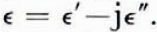 At the frequencies of radio-echo sounding, ϵ" is small compared to ϵ’; then ϵ’ determines the speed with which electromagnetic waves travel through the ice, and ϵ" determines the absorption loss. However, at frequencies near the relaxation peak, generally in the VLF (kilohertz) range, that separation is not possible.
Determinations of the dielectric constant in connection with radio-echo sounding are discussed by Robin (1975[a]). I will discuss here some VLF- and RF-interferometrir measurements.
VLF measurements
Effective average values of the complex dielectric constant in the Antarctic ice near “Byrd” station have been calculated using measurements of phase and amplitude of VLF emissions from the 34 km long antenna near “Byrd” station (Reference Peden, Peden, Webber and ChandlerPeden and others, 1972). The results of these studies at frequencies between 5 and 20 kHz, can be fitted fairly well with a section of a semi-circle on a Cole-Cole plot, i.e. by assuming a simple relaxation spectrum (Fig. 11) that corresponds to a single relaxation frequency of about 2.5 kHz. This would correspond to an effective mean temperature in pure ice (defined as that temperature which, in an isothermal ice sheet, would most nearly result in the observed dielectric permittivity) of about —10° C (Reference Auty and ColeAuty and Cole, 1952). Although the actual mean temperature in the ice sheet at “Byrd” station is colder, that is a reasonable effective mean in view of the exponential increase in absorption to be expected with increasing temperature in the lower part of the ice sheet. Measurements at frequencies below 5 kHz were prevented in Peden’s experiments by instrumental limitations.
Dielectric properties of the Antarctic ice sheet in the VLF band. From Peden and others (1972).

More recently, Reference Rogers and PedenRogers and Peden (1973) measured the VLF electrical properties of the ice sheet in situ by lowering a 3 in dipole probe into the deep drill hole at “Byrd” station and measuring probe admittances. Measurements at five frequencies between 1.25 and 20 kHz showed increasing deviation from values for pure ice at frequencies below 5 kHz (e.g. Fig. 12) (cf. Reference Fitzgerald and ParenFitzgerald and Paren, 1975). Measurements in deep drill holes are of great interest, and should certainly be carried out in other drill holes in ice wherever possible.
Measured dielectric constant in the deep drill hole at “Byrd” station, Antarctica, at 1.25 kHz. From Rogers and Peden (1973).

Another measurement of the bulk dielectric loss in the Antarctic ice sheet comes from a study of attenuation in long-range VLF transmission along paths that cross the Antarctic ice sheet (Reference Crary and CrombieCrary and Crombie, 1972). Large excess attenuation rates found over these paths are attributed to losses in the Antarctic ice, leading to an estimate of the dielectric constant (|ϵ|) at a frequency of 16 kHz in the range of 10 to 50. This is not a closely denned value, and the range is high compared to the estimate of Peden and others (1972) of about 7 at 16 kHz. Nevertheless, it is an interesting approach to an average dielectric constant over a long path; perhaps the measurements can be refined in the future.
Interferomelry
Radio-frequency interferometry can be used as a method of measurement of the dielectric properties of ice in situ. Waves propagate from a transmitter on the ice surface to a separated receiver along paths just above and just below the surface. Since the two waves travel at different speeds, an interference pattern that depends upon the dielectric constant of the ice develops (Reference Hermance and GudmandsenHermance, 1970). Application of this method to measurements on the Athabasca Glacier, using frequencies from 1 to 10 MHz (e.g. Fig. 13), led to reasonable estimates of both ϵ’ and ϵ" (Reference Hermance and StrangwayHermance and Strangway, 1971; Reference Strangway, Strangway, Simmons, LaTorraca, Watts, Bannister, Baker, Redman and RossiterStrangway, and others, 1974).
Experimental radio-signal amplitudes on Athabasca Glacier compared with theoretical curves for  and 3.2. Frequency x lass-tangent products for each set of curves from top to bottom before the first interference minimum are 0.4, n.fi, 0.8 and 1.0, respectively. From Hermance and Strangway (1971).

A closely related method of determining the dielectric properties of ice in situ, is called the "wave-tilt" method. The electric field of a wave transmitted from a vertical antenna will remain vertical only if the ground is a perfect conductor. If it is not, a horizontal component develops, the angle between the resultant vector and the vertical being known as the angle of tilt. The variation of the angle of tilt as a function of distance from the transmitter depends upon, and can be used to measure, the properties of the subsurface material. The wave-tilt method has proven useful on lake ice (Blomquist, 1970), but application to glaciers has not yet been reported.
Another interferometric technique makes use of a bore hole (Robin, i975[b]). By measuring the distance between interference fringes as a dipole antenna is lowered into a bore hole, the wavelength of the radio waves, and hence their velocity, can be determined. Because of the sensitivity of the interference method this technique offers the hope of high accuracy.
The interference method can also be used to measure ice thickness, since a secondary interference pattern will be formed upon arrival of the reflection from the bottom of the ice. The application of this technique to the Athabasca Glacier yielded results which are in general agreement with other thickness determinations (Strangway and others, 1974). It is not apparent, however, that this method has any particular advantage over standard pulse echo sounding. A bottom echo strong enough to produce an observable interference pattern at a few megahertz should be observable, with less likelihood of ambiguity in the interpretation, as a reflected pulse in the 100 MHz range, except in the unlikely case of a strongly frequency-dependent reflectivity. Perhaps the method has applicability to thin ice where the bottom reflection cannot be easily resolved from the outgoing pulse, although in that case it may be difficult to differentiate between the interference pattern due to the waves traveling just above and just below the surface and the pattern resulting from the bottom reflection.
D.C. Resistivity (see also Glen and Paren, 1975)
There has been little activity in the application of D.C. resistivity techniques to the study of glaciers in the last few years. The situation stands about as it did at the time of a review article by Röthlisbergcr (1967). The large differences in resistivity in polar ice sheets, polar ice shelves, and valley glaciers are still not well explained. If the reasons for these differences were better known in terms of the physical characteristics of the ice, the value of resistivity profiles on ice would probably increase. There is still considerable potential value for the determination of temperature as a function of depth if an activation energy is assumed, or conversely, in situ determination of the activation energy given a measured temperature-depth profile (Reference Hochstein and RiskHochstein and Risk, 1967). Resistivity profiles were completed near the projected drill-hole site on the Ross Ice Shelf during the 1973-74 season with these applications in mind, but data have not yet been analyzed.
Density
Until recently, it has not appeared possible to determine density-depth variations from geophysical measurements with sufficient accuracy for practical use. Past investigations have yielded no single relationship between density and seismic wave velocity which applies generally to dry firn Linear relationships found by Robin (1958) and Bennett (1972) differ substantially from each other, and most seismic refraction measurements do not lead to a linear relationship at all (Reference RöthlisbergerRöthlisberger, 1972), nor is there reason to expect one. Radio-wave velocities might show a better-defined dependence on density (Reference Robin, Robin, Evans and BaileyRobin and others, 1969), but they decrease with depth in the firn zone, making direct measurement difficult. Attempts based upon reflections from internal layers have not yet proven successful.
Recently, however, a new approach has been developed which shows considerable promise. It has been found that most curves of P-wave velocity gradient versus depth can be fitted on semi-logarithmic plots by sequences of three or four straight lines of substantially different slope (Brockamp and Pistor, 1968; Kohnen and Bentley, 1973; Robertson and Bentley, 1975). Although the values of the slopes vary from place to place, the depths at which they change correlate with changes in the densification process.
In the most extensive analysis (Robertson and Bentley, 1975), 43 out of 50 west Antarctic profiles of velocity gradient versus depth could be satisfactorily fit by sequences of straight lines (a sampling is shown in Figure 14). On each profile one change in slope (B in Figure 14) appears to correlate with the "critical depth" of densification, and another (D in Figure 14) probably corresponds to the firn: ice boundary. Where accumulation rates were relatively high, an additional abrupt change in the slopes appears at an intermediate depth of around 30 m (c in Figure 14), corresponding to the high-density end of the range in which Reference Ramseier and PavlakRamseier and Pavlak (1964) found that compressive viscosity was nearly independent of density. These studies suggest that density-depth curves can be determined from seismic shooting combined with densification theory, with the further possibility of estimating the mean annual snow accumulation.
The discovery that semi-logarithmic plots of wave velocity gradient versus depth usually consist of linear segments, has led also to a new and more successful examination of the direct relationship between velocity and density. Upon the reasonable assumption that the derivative of the porosity with respect to load is negatively proportional to porosity, a power-law relationship between P-wave velocity V p and density p can be developed (Kohnen, 1972). The remarkable result found by Kohnen is that an equation with a single set of constants (including the velocity of P waves in solid ice (V p)i is valid over the entire range of snow densities:

(Kohnen, 1972). Kohncn evaluates the constants on the basis of data from “Byrd” station alone, and then shows a good fit to almost all other data. Particularly striking is the agreement between measured and calculated densities in an anomalous region between 20 and 50 m depth at "Little America" station.
Accumulation Rate
Some success has been obtained in deriving accumulation rates directly from observed seismic data. Reference BehrendtBehrendt {1965) found that within a region of widely variable accumulation rates but nearly uniform temperature in Antarctica the seismic velocity at a distance of 200 m on a short refraction profile could be used as a predictor of accumulation rate with a standard deviation of 45 kg/m2 year.
An important extension of Behrendt’s method has been made by Kohnen (1971), who increased the range of applicability by applying a temperature correction. He relates accumulation rate Ȧ to the depth ź at which the P-wave velocity reaches 3 800 m/s, a depth near the base of the zone of densification that can be determined within a few meters from refraction shooting. The least-square regression-line fit to data from thirteen stations in Antarctica and Greenland,

where θ is the Celsius temperature, appears to be useful as a predictor of Ȧ with a standard deviation of about 5% (Figure 15) although il has not yet been applied to data other than those upon which it was based. A difficulty with Kohnen’s method is that the depth z’ is greater than is normally reached by short refraction profiles. It would be interesting to see whether, following Reference BehrendtBehrendt (1965), an equally good fit could be obtained using the P-wave velocity at a constant shot-receiver distance within the common profile length. Using a constant distance has the additional advantage of eliminating the need for integration of the travel-time curves.
P-wave velocity gradient versus depth at Antarctic seismic stations. From Robertson and Bentley (1975).

Accumulation rate versus temperature-corrected depth at which the P-wave velocity readies 3 800 m/s, at sites in Greenland and Antarctica. From Kohnen (1971).

Another promising method of determining accumulation makes use of the lime intercept of the travel-time line for waves propagating in fully densified ice beneath the firn zone (unpublished work by C. R, Bentley). Since the intercept is equal to the time interval between successive surface-reflected multiples, it can be determined from a single long refraction shot, for which an accurate shot instant is not even required. As it is a measure of total travel time through the region of firn densification, the intercept should bear a close relationship to the integrated density-depth profile, and therefore to the temperature and accumulation rate. Least-square regression analysis of data from west Antarctic traverses, omitting stations where shallow anisotropy was indicated by refraction velocity measurements, leads to the equations

(t p)0 are the uncorrected and corrected intercepts, respectively. Ȧ is plotted as a function of (t p)0 ′ in Figure 16. Error bars represent ±15% of the accumulation rate, an estimate of the standard error in determining long-term mean rates from measurements in snow pits (Reference GiovinettoGiovinetto, 1964). (The value of accumulation rate for “Byrd” station is an 89 year mean (Reference GowGow, 1961) known without significant error.) For all points except two the scatter is no more than could be explained completely by that error. It is quite possible, therefore, that a long-term mean accumulation rate can be estimated more accurately from Equation (1) than from pit measurements, provided it is possible to recognize anomalous values of the intercept.
Accumulation rate versus temperature-corrected time intercept from refraction shunting in West Antarctica.

That proviso may seriously limit the applicability of both this method and Kohnen’s. Nevertheless, the fact that the methods potentially yield long-term average accumulation rates, makes them worthy of further examination.
Internal Inhomogeneities
So far we have considered the applications of exploration geophysics to ice that is homogeneous, except for the strong inhomogeneity in the upper layer of an accumulation zone. There are, however, discontinuities in glaciers and ice sheets that are detectable by geophysical means. The most striking are in the upper part of the ice sheet as seen in radio-echo sounding (Robin, 1975[a]).
Basal layer
Another internal discontinuity of wide-spread extent in the west Antarctic ice sheet, detected by seismic reflections (Figure 17), occurs a few hundred meters above the base of the ice (Bentley, 1971[c]). The reverberative, incoherent, and variable characteristics of the reflections lead to the conclusion that they probably arise mostly from morainal debris, although in a few instances the reflector may be the top of a zone of ice at the melting point. Unfortunately, observation of this weak echo requires a combination of deep ice (to delay the echo) and relatively warm temperatures (for rapid decay of seismic surface noise) probably found only on the thick, low-lying ice sheet of the west Antarctic interior.
Seismograms showing reflections from the basal layer in the west Antarctic ice sheet (Re). Scale factors are factors by which Re amplitudes should be multiplied to reduce all records to a common hase. From Bentley (1971)[c]).

Brine-soaked zone
Brine soaking, which may be of great importance on ice shelves, has been particularly well documented on the McMurdo Ice Shelf. Pronounced radio-echo reflections from the brine layer there (Reference SwithinbankSwithinbank, 1970; Clough, 1973) (Fig. 18) make it possible 10 map the eastern extent of brine penetration with an accuracy of a few meters. Electrical resistivity profiles have yielded information about the thickness of the strongly conducting brine layer, although the resolving power for alternating layers of high and low conductivity is not very great (Hochstein and Risk, 1967).
Radio echograms across the brine-layer boundary, McMurda Ice Shelf Reflection from the bottom of the ice is at about 1.1 μs; reflection from the top of the brine layer is at about 0.4 μs. From Clough (1973).

Bottom crevasses
Probable bottom crevasses (presumably filled with frozen sea-water) have been detected recently by radio-echo sounding on the Ross Ice Shelf (Clough, 1974). Bottom crevasses are interesting as indicators of the dynamic history of the ice in which they are found, and as possible models of magma injection beneath oceanic spreading centers (personal communication from J, Weertman). For further discussion see Clough (1975).
Surface elevation change
Secular variations of gravity have been used to determine changes in the surface elevation of ice sheets (Behrendt, 1967; Bentley, 1971[a]; Reference BuddBudd, 1969). The standard error in a measurement of gravity difference between a base station and a field point is of the order of 0.1 mgal, corresponding to an elevation change of 0.3 m, so repeated measurements over 10 or 20 years are capable of measuring vertical motions of a few centimeters per year. Because corrections for horizontal movement need to be made, the gravitational method is particularly suited to thick, slowly moving ice sheets, whose horizontal gravity gradients, which necessarily arise from features beneath the ice, are smooth.
Conclusion
Electromagnetic and elastic wave propagation techniques together constitute a powerful approach to the study of the internal properties of glaciers and ice sheets. Studies which were carried on some years ago on the basis of seismic P waves alone, have benefitted enormously from the advent of radio waves of controllable polarization. In the future, one may hope that another comparable improvement in effectiveness, particularly in the study of anisotropy, will arise from the availability of strong shear waves of controllable polarization. To complement surface observations, as well as for their inherent interest, as many geophysical measurements as possible should be made in deep drill holes and on core samples. With this combination of "remote sensing" and "ground truth", "radio-elastic introscopy" of glaciers and ice sheets should have a bright future.
Discussion (Paper not read. Questions fielded by J. W. Clough in the absence of the author)
J. W. GLEN, W. J. FITZGERALD AND J. G. PAREN: There is considerable overlap between the review of Glen and Paren (1975) and that of Bentley, when discussing electrical properties. In particular the VLF measurements by Peden and co-workers at “Byrd” station are discussed. Their data are shown in Bentley’s Figure 11 for which Bentley repeats their statement that they are fitted to a section of a semi-circle on a Cole-Cole plot corresponding to a single relaxation frequency of 2.5 kHz and to a temperature of pure ice near —10° C. However, Glen and Paren have shown that the conductivity that may be derived from the information in the Cole-Cole plot of Peden and others (1972) is independent of frequency at low frequency and then falls away inexplicably at the highest frequency. Fitzgerald and Paren (1975) find the same value of the conductivity in ice drilled from “Byrd” station at a temperature of near —30° C but the frequency dependence is very slight.
Second, Glen and Paren (1975) discuss the D.C. resistivity of ice in greater detail than is given in this paper. We believe that the temperature dependence of the D.C. conductivity in ice of typical conductivity  is best taken from the data of figure 4 of Glen and Paren (1975). The measurements of Hochstein and Risk (1967) tended to be on ice of higher conductivity and thus these measurements on the cores from the Ross Ice Shelf may not be relevant to cold polar ice sheets. It is important that measurements on cores in the high-temperature range are conducted in such a way that conductivity paths down the air-ice surface are excluded.
T. HUGHES: I understand that a major reason for the lack of success in determining the isostatic equilibrium of Antarctica by gravity measurements is that the ice-sheet elevations along geophysical traverses were often not known to accuracies better than 50 m. Now airborne radio-echo traverses can provide ice-sheet elevations accurate to perhaps 5 m Would you recommend re-tracing the overland traverse routes to obtain aerial radio-echo elevations so that overland traverse gravity data can be re-analysed to make reliable isostasy calculations?
J. W. CLOUGH: No. The navigational uncertainty combined with changes in elevation since the ground traverses were made would probably rule out any improvement in accuracy. Aside from this, most of the gravity measurements are not well tied to known gravity base stations.
D. J. DREWRY: Mention has been made of detection of a low amplitude P-wave in parts of Marie Byrd Land which has been interpreted, with caution, as generated by a morainal layer. Is there any possibility of being able to detect such morainal material in East Antarctica in the future through cither new interpretations or new techniques?
CLOUGH: I do not know. Perhaps the use of the new shear wave generator will allow us to learn more about these features and conditions at the glacier bed.
GLEN: Bentley has emphasized the desirability of making dielectric measurements in other drill holes similar to those at “Byrd”. I would agree, but as mentioned by Fitzgerald and Paren (1975), the “Byrd” results do not agree with other measurements on polar glacier ice, and as we suspect this may be due to the process of boring, it is important that care be taken to report what conditions have occurred in the bore hole during and after drilling, and in particular the exact nature of any fluid used. In view of the existing discrepancy, and to test which results are appropriate for use in remote sensing, some other in situ measurements on polar ice would also be most valuable.



