




Introduction
In The Faith of the American Soldier, Stephen Mansfield describes a prayer service that took place before a mission. As several Marines huddled together in full combat gear, Mansfield recounts: ‘They want[ed] to present [their gear] before their God and ask His blessing on each item. During what follows, some will hold their rifle aloft as though to say, “Here, O Lord, receive this weapon into your service.”’Footnote 1 Led by no formal liturgy or chaplain, this ritual evolved from a simple prayer meeting into something more elaborate with elements from the different denominations represented.Footnote 2 Hymns were interspersed with Scripture readings; Psalm 51 formed the words of their confession. Mansfield comments: ‘They have discussed the fact that when the people of God sinned in the Old Testament, their armies met with defeat. They would not have their sins do likewise, so they quote together from David’s ancient song of repentance.’Footnote 3 Following this, the participants recited a few verses from Psalm 144, which are filled with martial imagery: ‘Praise be the LORD my Rock, who trains my hands for war, and my fingers for battle’ (Psalm 144: 1, NIV).Footnote 4 The other verses recited (144: 2, 5–6) include other pertinent images of protection in battle: fortress, stronghold, deliverer, shield. The makeshift service ended with a declaration of Joshua 1: 9: ‘Be strong and courageous.’ Some Marines kissed their ‘Shields of Strength’ dog tags which have the same words engraved on them. These soldiers were now ready for battle.
The Marines, however, omitted parts of Psalm 144. While verses 7–15 were probably excluded due to length, they also omitted verses 3–4, which dramatically shift the tone of the prayer: ‘Lord, what are human beings that you care for them, mere mortals that you think of them? They are like a breath; their days are like a fleeting shadow’ (Psalm 144: 3–4). The psalmist is awestruck by God’s provision in light of the extreme incongruity between humankind’s frailty and the Lord. These are hardly the inspiring words needed before battle, even if they are a chillingly prescient comment on the mixed success of America in Iraq and Afghanistan. The Marines, however, seemed unconcerned or unwilling to wrestle with the theological implications of this ancient psalm, skipping to verses 5–6 in which the psalmist calls on God to act as a divine warrior to save him: ‘Part your heavens, Lord, and come down; touch the mountains, so that they smoke. Send forth lightning and scatter the enemy; shoot your arrows and rout them.’ This was understandable: this was war.
This vignette illustrates how, for those on the battlefield, Holy Scripture had become a multi-purpose tool. Its theological and psychological utility is found in its endless adaptability: the Psalms become a talisman to ward off evil, a ritual script to pray, a language to articulate wartime violence, and a promise of divine protection. However, this word of God is double-edged. These divine promises can be broken. Those who wished to wrestle with the apparent incongruities between promise and reality had an arsenal of psalms they could fire back. In war, Scripture either becomes the armour of God or an ‘engine against th’ Almighty’.Footnote 5
As they had in earlier conflicts in which Americans were involved, such as the First and Second World Wars, Christianity and American civil religion had a firm hand in shaping US foreign policy in the twenty-first century.Footnote 6 The invasion of Iraq in 2003 was framed in religious terms by President George W. Bush and others, and Christianity and the Bible provided much-needed ideological support.Footnote 7 While religious attitudes towards the war changed over time and varied across denominational, political and ethnic lines, US churches played an outsized role, whether in advocating for or protesting against the war, often making their case using biblical and theological arguments such as the ‘Just War’ tradition. Following the 2003 invasion, US service members adopted a wartime faith that was developed on the battlefield. Many exhibited their faith through their prayers, or carried it in the material form of Bibles, devotionals and talismanic objects. While some service members experienced God and discovered faith during deployment, others lost it to trauma, moral injury, and the pain of returning home.
A growing body of research has explored the role of religion in wartime during earlier American conflicts,Footnote 8 as well as the impact of religion on the military experiences of groups such as evangelicals.Footnote 9 In the field of psychology, there is a developing interest in the effect of religion in war, in repatriation rituals, and in the rehabilitation of veterans.Footnote 10 However, most sociological studies focus either on the build-up to the Iraq invasion in 2003, or on the early years of the War on Terror in Afghanistan and Iraq (2001–6), primarily examining the influence of evangelical Christianity and American civil religion on political discourse and foreign policy.Footnote 11 One major study ignored religion altogether.Footnote 12 In the public discourse, many veterans have written memoirs or spoken publicly (or both) about their battlefield experiences and their struggles with faith, guilt, moral injury, and post-traumatic stress disorder (PTSD) upon returning home.Footnote 13 Despite the valuable insights gained from various disciplines, these perspectives remain unintegrated with veterans’ experiences, leaving a significant gap in understanding how wartime religion impacts politics, society and military personnel.Footnote 14
While accounts of soldiers praying before battle are ubiquitous in history, my argument is that the particularly Christian example offered by Mansfield, with its emphasis on biblical texts, strongly resonates with other examples found during the Iraq War. This is no outlier, but a representative and sincere expression of religion and, particularly, of a Christian faith forged and formed on the battlefield. This article offers a modest step towards integrating these perspectives and examines how American service members, chaplains and churches engaged with Scripture by exploring the varied reception of the Psalms during the Iraq War (2003–11). Drawing examples from memoirs, sermons, interviews with veterans, and other digital media, I will first analyse how the Psalms were used during the conflicts by categorizing them into four approaches. Secondly, I will argue that the conspicuous absence of certain psalms with profound theological utility (for example, lament and imprecatory psalms) reveals the often-unseen influence of Christian charities and publishers, and their efforts to shape the American service member according to a particular theological vision. These wartime examples will deepen our understanding of the close, reciprocal relationship between the church and the military.
The Psalms on the Battlefield
In the numerous examples from memoirs, sermons, and other digital media from the Iraq War, a small selection of psalms repeatedly emerge. While space precludes me from addressing every example featuring a psalm, the following accounts which draw on Psalms 18, 91, 121 and 144 are a representative sample.Footnote 15 The wartime utilization of these psalms can be categorized in four ways. The first uses the material text itself as a talismanic object which wards off evil. The second describes how the Psalms are used for apotropaic prayers. The third adopts a triumphalist tone when appropriating the Psalms. Finally, the fourth approaches the Psalms with a dialectic of doubt which engages in critical reflection on the horrors of war, the reality of trauma, and the effect of moral injury.
Texts as Talismans
Assigned to the 82nd Airborne, Sean Dickson was deployed to Iraq during the early months of Operation Iraqi Freedom in 2003. On one mission, he was stationed on a rooftop when he and his unit suddenly began taking fire:
Dickson ran up to an iron gate and positioned his rifle on top, shooting back at the attackers. ‘I never saw or heard a single bullet come by me, but I heard this overwhelming voice telling me to move, that this wasn’t a safe place and I had to move,’ Dickson says. He did, finding a new position behind a wall. The firefight raged on for twenty minutes more until reinforcements were called in. After the battle, the men walked back to the wall where it all began and saw the entire area was riddled with bullet holes. Yet no one got hit. Dickson looked at the gate he’d initially hidden behind, the position where he sensed God warning him of imminent danger. ‘All around the gate were bullet holes, but right where my chest had leaned up against it were thirteen dents,’ he says. ‘This gate in no way should have stopped a single bullet, not 762s.’ And still on his chest plate, where it had been ever since leaving Kuwait, was his copy of Psalm 91, an ancient prayer for God’s protection. Dickson has no doubt God was looking out for him.Footnote 16
Psalm 91 is rich in imagery and metaphors that speak of divine deliverance from evil. Unlike some other psalms that are attributed to a particular writer (usually David), this work is anonymous, allowing for its wide use on the battlefield. The first two verses are written from the psalmist’s perspective, while verses 3–13 shift to address the reader: you are assured of the Lord’s presence and protection. The psalm only hints at the dangers which might befall the listener: snares, pestilence, terrors of the night, arrows by day, and destruction at midday. This final threat is taken up in the Septuagint as the ‘noonday demon’ and later expanded in Jewish tradition.Footnote 17 Perhaps most potent for the lone infantry soldier in the thick of battle, verse 7 suggests that ‘a thousand may fall at your side, ten thousand at your right hand, but it will not come near you.’ Instead, the psalm’s addressee will see only the punishment of the wicked. Verse 11 promises angels to guard the righteous; verse 13 triumphantly assures the reader that they will tread and trample their foes underfoot, here imaged as lions and serpents. Within Christian interpretation, these words may point to Christ trampling over death, and the Christian’s own victory over sin.Footnote 18 The final three verses provide the reader with God’s own perspective: they are assured once more of God’s comforting presence, divine intervention and provision of a long life.
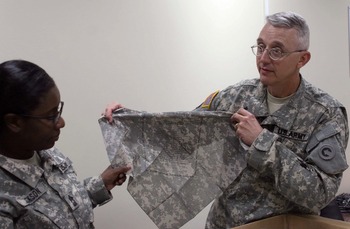
It is known that ancient readers inscribed these words on amulets and incantation bowls to ward off demonic forces,Footnote 19 and modern soldiers continue to use them in similar ways.Footnote 20 While it was the gate that stopped these bullets, Dickson interpreted his survival as a miracle, attributing it to the psalm and to God. We are not told what form Dickson’s copy of Psalm 91 took, but perhaps it was in the form of a bandana (Figure 1).
A Psalm 91 Bandana. Photograph credit: Michele Hammonds, in ‘Gift from the Heart’, Defense Visual Information Distribution Service, 29 October 2007, online at: <https://www.dvidshub.net/news/13452/gift-heart>, accessed 27 October 2025. Image in the Public Domain. The appearance of U.S. Department of Defense (DoW) visual information does not imply or constitute DoW endorsement.

Jill Boyce, a civilian, was responsible for creating and distributing over a million Psalm 91 bandanas to the troops. Her mission began with a vision in January 2003, two months before the invasion of Iraq:
I had a dream that I was in Iraq in the middle of fighting between our soldiers and Saddam Hussein’s. The next day, I envisioned a bandana with Psalm 91 written down the middle. I researched and found out that Psalm 91 was the Soldier’s Prayer and that many lives had been saved through it in previous wars. I found a way to have some printed and was able to give Psalm 91 Bandanas to troops deploying from Fort Hood on the first day of deployment in March, 2003.Footnote 21
While this camouflaged bandana had functionality, its real purpose was spiritual. The encouraging words could be worn into battle and serve as a reminder to pray.
Army Captain Nick Catechis of the 15th Transportation Company was deployed to Iraq at Christmas 2004 for a year’s tour. Catechis and his company were responsible for delivering supplies between Baghdad airport and Abu Gharib prison, which at the time was a dangerous route, since the conflict had transitioned to an insurgency and Improvised Explosive Devices (IEDs) were becoming an ever-present danger. His mother, Judith, purchased Psalm 91 bandanas for his entire company (about 150 members). Reportedly, the soldiers prayed the psalm every day. Despite coming under mortar fire, ambushes, and being hit with IEDs, there were no casualties through this deployment.Footnote 22
Another story comes from Darrin Crowder, a member of the Green Berets. In June 2004, he was walking with fellow soldiers on base when a rocket struck feet away from them. The blast killed one the men beside him and shrapnel tore through Crowder’s left side. Other soldiers rushed to help him. Later in hospital, he noticed that one of the tourniquets that had saved his life was one of these Psalm 91 bandanas. Through the blood, he could still make out some of the verses.Footnote 23 Crowder reported that this psalm brought him comfort in the face of losing a dear friend.
Jill Boyce’s bandanas would be purchased and distributed by other non-profit organizations such as Operation Bandana, founded in 2006 by Mary Gray.Footnote 24 In a video describing Operation Bandana, Gray connected the phrase ‘the snare of the fowler’ (Psalm 91: 3) to IEDs and roadside bombs.Footnote 25 In that same video, Mike Hoyt, the senior chaplain of US forces in Iraq, displayed his own Psalm 91 bandana and recounts that when he gives these bandanas to soldiers, ‘It becomes a hallowed relic for them.’ By 2016, the charity testified to having distributed 280,255 bandanas.Footnote 26
This was not the first conflict in which Psalm 91 reportedly saved lives. During the First World War, legend tells of the 91st Infantry Brigade of the American Expeditionary Forces (AEF) who fought in some of the bloodiest battles of the war, notably the Meuse-Argonne offensive which resulted in some 120,000 American casualties.Footnote 27 This 91st Brigade prayed everyday using printed copies of Psalm 91. The result: not one single casualty.Footnote 28 There is, however, no truth to this legend: not only was there never any 91st Infantry Brigade in the AEF, but the 91st division who fought in those same reported battles had a similar rate of casualties to any other force.Footnote 29 Nonetheless, it was this legend of the Soldier’s Psalm that inspired Jill Boyce to print Psalm 91 on bandanas and distribute them to soldiers. The legend might be responsible for saving Darrin Crowder’s life.
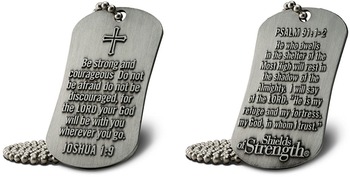
Psalms and other scriptural passages appear on a variety of material objects. One talisman takes the form of a challenge coin, small coins which are usually given to service members after they have participated in a large operation or special mission. One can be purchased for the low price of $17.79, plus shipping and handling. On one side, an angel watches with outstretched arms over three soldiers. The American flag flies next to the Christian flag at the bottom. On the reverse is Psalm 91: 10–11.Footnote 30 Another challenge coin by American Defenders of Freedom combines several tropes: Psalm 91; Isaiah 41: 10 (‘Do not fear, for I am with you’); the words ‘be strong and courageous’ (Joshua 1: 9); a cross; and the meaningless Latin phrase Regnorum Deus Noster (‘Our God of Kingdoms’).Footnote 31 Another example is found in the Shields of Strength dog tag which was mentioned in Mansfield’s account (Figure 2). This example has Psalm 91 :1–2 and Joshua 1: 9 on the front and back.Footnote 32 Other products feature the American flag, and other verses and slogans.
‘Psalm 91: 1–2/Joshua 1: 9 Antique Finish Dog Tag Necklace’, Shields of Strength, online at: <https://www.shieldsofstrength.com/psalm-91-1-2-joshua-1-9-antique-finish-dog-tag-necklace/>, accessed 27 October 2025. Reproduced with permission from Shields of Strength.

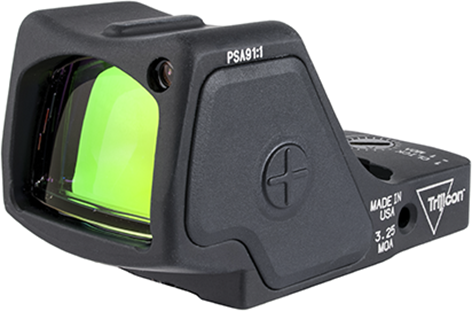
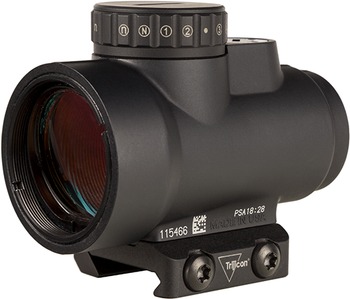
A final example comes from a gun sight manufacturer called Trijicon (Figures 3–4).Footnote 33 The company, probably best known for their ACOG sight, was one of the largest suppliers of gun sights to the US military during the War on Terror.Footnote 34 Most of their products feature Bible verse references, a practice started by their devout Christian founder, Glyn Bindon. The selected verses often contain imagery of light or sight, which connects to the optical technology of the sights, verses such as ‘I am the Light of the World’ (John 8: 12). Several of the references come from the Psalms: Psalm 18: 28; 27: 1; 34: 3; 76: 4; 91: 1; 119: 105. Following complaints of First Amendment violations in 2010, Trijicon removed the Bible references from the products sold to the military.Footnote 35 This example differs slightly from the others in that these gun sights were issued to the infantry, and therefore do not represent a talisman in every instance. Nonetheless, all these examples illustrate the use of objects inscribed with scriptural verses for protection on the battlefield, as well as the efforts of Christians to get them there.
‘Trijicon RMR® HD Reflex Sight’, online at: <https://www.trijicon.com/products/details/rmhd2-c-3200002>, accessed 27 October 2025. Reproduced with permission.

‘Trijicon MRO® Reflex Sight’, online at: <https://www.trijicon.com/products/details/mro-c-2200051>, accessed 27 October 2025. Reproduced with permission.

Apotropaic Prayers
These talismanic examples are closely tied to the second category: apotropaic prayer. While the first category emphasized the material object, the second foregrounds the words of the psalm, using them as a script for prayer to secure divine protection. In a 2003 video, US army chaplain Hardie Higgins explained that he purchased cards with Psalm 91 printed on them for everyone in the 130th Engineer Brigade.Footnote 36 Not only did he always carry such a card with him, but he also made sure every vehicle was stocked with one, and that the soldiers prayed Psalm 91 daily. The effect, Higgins proclaims, was that there was not one single casualty during their tour. Like the apocryphal story from the First World War, Higgins’s no-casualty tour was secured through daily prayer. Unlike the earlier story, though, Higgins’s testimony is accurate: during their initial deployment, the 130th Brigade suffered no losses.Footnote 37
As already noted, the apotropaic and talismanic uses of Psalm 91 have a long history in Jewish and Christian traditions. Higgins’s story, like that of Nick Catechis, blends these two tropes. The material object in the form of a prayer card is as crucial to receiving divine protection as is praying the words. The psalm becomes a script, and the talisman ensures the soldier will remember the words. It is beyond the scope of this article to detail the rich reception history of Psalm 91, but it will suffice to note that none of these examples from the Iraq War is innovative. To use the Psalms as talismans or as apotropaic prayers is to join in a long interpretative tradition.
Triumphalist Tones
The third category appropriates the language of the Psalms to articulate wartime experiences. It differs from the previous examples: while both apotropaic prayers and talismanic objects inscribed with biblical texts emphasized protection from great evil, readings that adopt a triumphalist tone stress the great salvation from evil. Often these examples focus on the miraculous or unexplainable nature of the deliverance.
Serving in OIF, chaplain Carey Cash of the 1st Battalion, 5th Marines, recounts numerous miraculous stories in his memoir, A Table in the Presence (the title itself a reference to Psalm 23).Footnote 38 Many of these episodes occurred as US forces fought to capture Saddam Hussein’s presidential palace in central Baghdad, a battle that would leave seventy-six marines wounded and at least two killed in action.Footnote 39 Even so, Cash was certain that angels were watching over the Marines of the 1st Battalion. He reports story after story of the unexplainable: RPGs mysteriously swerving to avoid the Marines, bullets missing their mark at point-blank range, or enemy soldiers who threw down their weapons and fled despite having taken a Marine by surprise.Footnote 40 All these narrow escapes were described by Cash and others using the language of the Psalms, and specifically their promises of angelic intervention (Psalm 91: 11–12: ‘For he will command his angels concerning you to guard you in all your ways; they will lift you up in their hands, so that you will not strike your foot against a stone’). Cash recalls how one wounded soldier interpreted his battlefield experience: ‘for him that injury symbolized the triumph that he and so many others had experienced … . Dawson grinned, “remember those angels, the ones your wife talked about … the legions? They were there, surrounding us, protecting us, defending us. I should be dead, Chaplain, but God was with me.”’Footnote 41
In another miraculous account, an RPG exploded inside a Humvee with four Marines inside. Yet no one was killed or even injured. They just kept driving. Cash writes:
As they drove, Jackway couldn’t seem to get the words of a psalm out of his head—a scripture he had read time and time again in preparation for going off to war. His heart leapt as he experienced its newfound power and meaning as never before: ‘I will set him on high, because he has known My name. He shall call upon Me, and I will answer him. With long life I will satisfy him, and show him My salvation’ (Psalm 91: 14–16).Footnote 42
Reflecting on his own experience, Cash connects the Marine Corps motto, Semper Fidelis, to his belief that it is God who is always faithful. God had supernaturally protected these Marines from the dangers listed in Psalm 91 and empowered them for battle.Footnote 43 He writes:
Scripture tells us that God has the heart of a warrior. He equips those who find themselves on a battlefield with every bit of physical, emotional, and spiritual strength necessary to defeat the Enemy. Perhaps the Psalmist says it best:
For who is God, except the LORD? And who is a rock, except our God? It is God who arms me with strength, and makes my way perfect. He makes my feet like the feet of deer, and sets me on my high places. He teaches my hands to make war, so that my arms can bend a bow of bronze … . For by You I can run against a troop, by my God I can leap over a wall … . You have armed me with strength for the battle; You have subdued under me those who rose up against me (Ps 18: 31–34, 29, 39).Footnote 44
The superscription of Psalm 18, which is not present in every modern Bible, places the psalm within a wartime context in which David was delivered from his enemies.Footnote 45 Like Psalm 144, it is replete with martial imagery. The psalmist begins by praising the Lord for delivering him from his enemies and from death (vv. 3–6). Verses 7–15 speak of Israel’s God as a divine warrior, a storm god, and even a dragon (Psalm 18: 8, 15, ET).Footnote 46 In verses 20–8, the psalmist proclaims that divine rescue has come as a result of his righteousness and moral purity. The focus shifts in verse 27 to themes of divine empowerment for battle. The psalmist is swift and sure-footed like the deer; his hands strengthened for battle. He is victorious over his enemies thanks to God’s help.
Like Psalm 144, not every verse in Psalm 18 can be straightforwardly appropriated in times of conflict. This is illustrated by Cash’s puzzling selection and ellipsis: he quotes from verses 31–4, jumps back to 29, and then forward to verse 39. What is one to make of this strange choice? There is an interpretive problem in verse 35 that is represented by the different translations. While the NIV reads ‘your help has made me great’, other versions like the one from which Cash was quoting have ‘your gentleness has made me great’ (AV, NKJV, ESV, NRSV).Footnote 47 Gentleness would be a very strange attribute in a psalm about defeating your enemies. Furthermore, verses 37–8 speak of wounding and annihilating the enemy, while the psalm’s concluding verses praise the Lord for granting vengeance to the psalmist. It appears that Cash could not square these dissonant themes with each other, much less with his own experiences, and chose to quote selectively from the psalm. This example hints at the difficulty of applying certain psalms on the battlefield, as well as the complicated relationship between soldiers and Scripture.
Continuing to discuss how God empowered his men for battle, Cash writes:
All of them, and so many others who experienced victory in Iraq, acknowledged that God was their source of strength and courage. It was God who fitted them with the skills of weaponry and leadership. It was God who helped them discern how and when to use a weapon; how and when to employ the lives of their men in the face of danger. King David said it himself thousands of years ago: ‘Blessed be the LORD my Rock, who trains my hands for war, And my fingers for battle …’ (Psalm 144: 1).Footnote 48
When read in this way, the Psalms provide the language in which the miraculous and unexplainable experiences of battle can be articulated. This understanding also gives the reader a certain assurance that God had been, and will continue to be, on their side. These experiences profoundly affected Cash and his Marines. One soldier was even baptized in Saddam’s palace following these events. Cash describes the baptism using the words from Psalm 23: God had set ‘a table in the presence’ of the enemy.Footnote 49
Quite a different example comes from Army Staff Sergeant Christopher Taffoya. A few days after the invasion began, Taffoya turned to Psalm 91 as he prepared for his first night jump. There he interpreted the imagery of verses 5–6 not as the danger from which he needed protection, but as the danger he himself represented to his enemies.
It seemed to tell me, ‘Do not fear what you were about to do, because you’re going to be the terror of the night, and when day comes, you will be the arrow that flies by day. So what do you have to fear?’ After that, this unbelievable calmness came over me. It’s like God was sitting next to me saying it’s going to be alright.Footnote 50
However, it was not just American soldiers who were praying the Psalms. A Christian Iraqi family remembered praying Psalm 91 for protection as the US bombed Baghdad as part of their ‘shock and awe’ campaign in March 2003.Footnote 51 While these examples demonstrate the Psalms’ influence on wartime experiences, they may also gesture towards the effect wartime experiences can have on the interpretation and use of the Psalms. How you pray these psalms will depend on which side you are on, and whether you are dropping the bombs or seeking safety from them.
Dialectic Doubt
The fourth category is rather different from the previous three. This reads the Psalms not as offering assurances of protection and divine favour, but instead as offering opportunities for critical reflection in light of difficult and challenging lived experiences. These reflections recognize that the horrors of war and trauma associated with combat can overcome even the most comforting words of sacred texts. Yet these are not outright rejections of God or religion, but constitute a profound engagement with the subject matter of faith.
In an essay entitled ‘Sin Eater’, army chaplain David Peters reflects on his time in Iraq (2005–06) as a profound demonstration and narrative explanation of Moral Injury.Footnote 52 He writes about Psalm 91 and a familiar talisman:
Soldiers are superstitious, and they all carry at least one charm to ward off their own death. They carry handkerchiefs with the words from Psalm 91 printed on them … We fold the Psalm 91 bandanas in quarters and place them in our helmets, on top of the pictures of our trucks or lovers. Maybe the psalm will protect our heads from death or a traumatic brain injury. Maybe they’ll just absorb our blood.Footnote 53
Peters noted something that is surprisingly absent in the previous accounts: that Psalm 91: 11–12 is quoted in the Gospels. These are the words that Satan uses as he tempts Jesus to demonstrate his identity and power by jumping off the temple (Matthew 4: 5–7; Luke 4: 9–11: “‘He will command his angels concerning you to guard you carefully; they will lift you up in their hands, so that you will not strike your foot against a stone”’). Peters rearticulated the death of Jesus by alluding to the words of Psalm 91:
A few years later when Jesus hangs on the cross, God turns his face away from his bleeding son. He cries out, ‘My God, my God, why have you forsaken me?’Footnote 54 No one comes to his rescue. A thousand stand on that day in Jerusalem, watching him die slowly. Only one man falls and not one angel comes to save him.Footnote 55
Jesus’s death functions then as a counter-narrative to the psalm: God doesn’t always come to the rescue of those He loves. Peters goes on to describe a harrowing scene of medics and engineers cleaning up a destroyed and bloodied vehicle. The bandanas in this case had not offered protection.
Reflecting on his experience, Peters recalled how, home from deployment and recently divorced, he stood on his balcony in sombre meditation:
Like Abram in the Old Testament, I look up to the sky and question the God who promised me a good marriage. I tell him I had damn near done everything I was supposed to do and now everything is a fucking mess. My voice rises from the whisper of my mind and I speak. I yell at the Master of the Universe and tell him I don’t like what happened. I taunt him for how he turned his Almighty back on me when I needed him most. I rail on, ‘Don’t you care that she left me? Don’t you want us together?’ There is nothing but silence. I know the answer, but I can’t believe it. I know that God loves my ex-wife as much as he loves me. I feel most betrayed by this thought. Whose side is God on in a war? Whose side is he on in a divorce?Footnote 56
For Peters, this was the betrayal and alienation that came from the ‘shattering effect of war.’Footnote 57 The essay continues with Peters describing how his faith underwent a massive transformation due to his experiences on deployment. It was both the horrors and the mundane realities of war that fractured his belief in God.
Another example of dialectic doubt comes from army chaplain Roger Benimoff. His memoir, Faith under Fire, covers his second deployment to Iraq in 2005–6. In the first few weeks, he laments, he had to provide ‘more memorial ceremonies than preaching.’Footnote 58 Following an IED attack on a vehicle which resulted in the death of four soldiers, Benimoff used Psalm 121, ‘one he knew by heart’, to offer hope to the grieving soldiers.Footnote 59 Part of Benimoff’s strategy for dealing with these emotions was to follow an unspoken rule: ‘don’t let the grief sink in or you will sink with it.’Footnote 60
Benimoff’s journey continued after deployment where he worked with wounded veterans at Walter Reed Medical Center as a chaplain. It was their trauma and being confronted with his own grief that finally broke him. After experiencing symptoms of PTSD and questioning his faith, Benimoff was eventually referred to a Veterans Affairs care facility, where he was able to access the help he needed. Afterwards, he would return to chaplaincy at Walter Reed Medical Center with a renewed but changed faith. Reflecting on his faith journey he writes:
There was a prayer I thought of often, one I had used when standing in the Iraqi sands with soldiers who had just survived an attack, but had lost friends who weren’t so lucky. Psalm 121: 1–8: ‘My help comes from the LORD, the Maker of heaven and earth. He will not let your foot slip he who watches over you will not slumber.’ … But my foot had slipped. Some may blame my crisis of faith on PTSD, but that’s too easy. Faith is something, by its very nature, that should be tested. I had thought that if there was a test, it would come in Iraq, a world of blood and tears, lost friends, near misses, and body after body shipped home in cheap wooden caskets. The fault lines started appearing there, but I didn’t crack. There was no time to think and too much adrenaline. My problems happened after I got home, to our warm house here on this cul-de-sac, surrounded by my wife and my boys and the ever-present sounds, not of guns, but of the neighbourhood kids playing outside our front door. War zones have a way of traveling home with you.Footnote 61
Benimoff’s faith has been deeply impacted by his wartime experiences. Consequently, or perhaps in tandem, the way he engaged with and understood Scripture had been fundamentally altered by his experience of combat and the time thereafter. Evidenced by the six-fold repetition of the words ‘watch’, ‘keep’ or ‘guard’ in Psalm 121, the central theme is of God’s protection. The words of the psalm had initially brought Benimoff comfort, but the repeated exposure to violence, trauma and loss transformed the meaning of the words entirely. Just as Peters had questioned whether the God of the psalmist was on one side or the other, Benimoff came to doubt whether God would keep His promises:
How could God have been watching over us? I returned and they didn’t return. How can I say God protected me when the other guys didn’t come back? … I couldn’t stand to hear that phrase any longer — ‘God was watching over me.’ He wasn’t watching over the good men I knew in Iraq. Faith was the center of my life yet it failed to explain why I came home and those soldiers did not.Footnote 62
While the other three approaches appropriated the language of the Psalms to make sense of battlefield experiences, approaching the text with a dialectic doubt means that the direction of influence goes the other way. It is the realities and horrors of war that impact the believer’s understanding of the Psalms.
Selective Psalter: A Conspicuous Absence
It is not difficult to understand why service members would take comfort in the words of these psalms. They are filled with imagery that invoke protection and deliverance. Some of them, such as Psalm 18, explicitly ask for God’s intervention on the battlefield or for strength to overcome one’s enemies. In others, the language is generic and can be appropriated in a variety of situations. The anonymity of the author and addressee may also be a factor, contributing to these psalms being found so often on the battlefield. However, three additional observations can be made concerning the theological utility of these psalms.
First, the majority of the martial language found in these psalms is defensive in nature. God is described as a fortress, stronghold, shield, and buckler (Psalm 18: 2; 90: 2, 4; 144: 2). There are only two examples in these psalms of offensive weapons: lightning is described as God’s arrows (Psalm 18: 14; 144: 6). Secondly, these psalms are reticent in describing the enemy. The opponent is often described using vague, generic and underdetermined language. Psalm 91, for example, mentions only a ‘fowler’ (v. 3) and the ‘wicked’ (v. 8), couching most of threats in non-human language: pestilence (vv. 3, 6), terror of the night (v. 5), arrow (v. 5), plague (v. 6), lion and cobra/serpent (v. 13).
Thirdly and most surprisingly, is the apparent absence of other psalms that might seem at first sight to be more germane to a service member during wartime. There are plenty of psalms that include violent imagery, speak of the destruction of the wicked, or offer imprecatory language against the psalmist’s enemies. These psalms speak of God as a divine warrior, explicitly identify the enemy as wicked, and pray for their destruction. One example is Psalm 94, which begins: ‘O LORD, God of Vengeance, O God of Vengeance shine forth’ (Psalm 94: 1 ESV). The wicked and their evil deeds are then the focus for several verses. Similarly, psalms that denigrate the enemy or which feature imprecations against them seem not to have been widely used.Footnote 63 The same is also true of psalms of lament.Footnote 64 These offer the raw vocabulary of pain and anger. They give the reader an opportunity to be honest with themselves and with God. These include verses like: ‘How long, LORD? Will you forget me forever? How long will you hide your face from me?’ (Psalm 13: 1); and ‘But now you have rejected and humbled us; you no longer go out with our armies … You gave us up to be devoured like sheep and have scattered us among the nations’ (Psalm 44: 9, 11).Footnote 65 Rather than turn to these psalms to process their grief, the chaplains discussed above turned instead to psalms that emphasize God’s presence, provision and protection, even when leading memorial services. Psalms with direct geographical connection to the battlefield are also missing. Psalm 137 begins ‘by the rivers of Babylon, there we sat and wept’ (137: 1). One might imagine that this psalm could have been used to provide comfort for those who lost friends during the siege of Saddam’s palace, located on those same rivers. Yet these psalms, which might seem to be useful on the battlefield, are conspicuous by their absence.
Assessing the Psalms during the War
Perhaps this absence is best understood by exploring how service members accessed Scripture, and particularly the Psalms, during the war. Most of the materials were physical: there were relatively few digital resources in the early 2000s. This placed restraints (such as weight, size and colour) on what the solider could carry. Despite these necessary considerations, it appears that service members had ready access to the Bible and to a variety of religious materials that included or emphasized the Psalms. For example, the Defense Logistics Agency (DLA) is responsible for supplying the armed forces with weapons, uniforms, food supplies, and even tanks. Chaplains would use the DLA to order religious materials such as communion elements, crucifixes, vestments and books. From 2006 until 2009, the DLA shipped approximately 85,000 English Bibles, along with 5,000 Hebrew Bibles and 33,000 Qur’ans.Footnote 66 This data, however, is incomplete and does not provide a clear picture of the availability of religious materials.Footnote 67
More substantially, churches and Christian charities distributed Bibles and religious materials to military personnel. Access to the Psalms came through complete or partial Bibles provided by chaplains or donated by organizations like the American Bible Society or Campus Crusade for Christ (CRU). Those deployed might receive camouflaged military editions of the Bible. These did not always include the whole text: for instance, those distributed by Gideon’s International contained only the New Testament, Psalms and Proverbs. Though data on total donated Bibles is lacking, one estimate is revealing: from the 9/11 attacks to the start of Operation Iraqi Freedom, CRU donated nearly 400,000 Bibles to the armed forces, about one for every four service members.Footnote 68
American troops had additional access to a wide array of resources that often featured selected psalms. Some publications followed established norms set by previous generations of publishers in their decisions about which texts to include. Through republishing and distribution, the new generation reaffirmed these decisions and reinforced a particular set of texts that would be used on the battlefield. Chaplains could rely on worship liturgies that featured readings and hymns from the Psalms. The Armed Forces Prayer Book, published in 1951 by the Episcopal Church USA, featured a dozen or more psalms, including Psalm 91 and Psalm 121.Footnote 69 Similarly, the Devotional Field Book, published by the US Marine Corps in 2004, contained in its Old Testament section the full text of Psalm 91, along with ten other psalms.Footnote 70 The revised version, published in 2012, included a devotional section called ‘key verses in times of need’, which included excerpts from Psalm 18, 91, 121, 144 for times ‘when disaster threatens’ or ‘when you need to feel protection’.Footnote 71 Service members could also encounter the Psalms through publications like Strength for Service to God and Country, a collection of devotionals written during the Second World War but republished in 2000.Footnote 72 Along with daily devotional texts, it features a basic Scripture reading plan for the year. Casual readers could glimpse Psalm 91 printed on the inside cover of the book, and the more dedicated readers would encounter Psalm 121 no less than ten times in the reading plan. Between 2001 and 2009, roughly 400,000 copies of this work were shipped to the US armed forces.Footnote 73 Additionally, popular books such as Rick Warren’s Purpose Driven Life could be gifted, purchased or donated, and were shipped to anyone who wanted them.Footnote 74 These books also quote or reference Scripture. Service members would also encounter psalms from personal letters from the home front. Numerous charitable organizations like Operation Bandana sent care packages, objects, letters, and prayers to the troops.Footnote 75 Cash recounts dozens of similar letters that are filled with encouraging messages, including two which referenced Psalm 91.Footnote 76 Crucially, many of these materials could be passed on or regifted to another service member as needed.
Conclusion: Theological Utility and the American Church’s Model Soldier
In this article I have argued for the presence and availability of the Psalms on the battlefield during the Iraq War. I have sketched an outline of the varied ways these psalms were used and appropriated by US service members and chaplains. Their words were used to comfort soldiers in times of danger and to articulate their wartime experiences. The Word also became material – inscribed on bandanas, prayer cards, on rifle scopes – to ward off evil and provided the ritual script for earnest prayers. The ones who asked for protection, however, were not always granted it; prayer did not always work. The words could just as easily create a crisis of faith as they could provide comfort.
The prevalence of the particular psalms that appear in these examples is entirely understandable in a context of war. They speak of God’s protection and empowerment in battle, articulate the hope of angelic intervention for the righteous, and affirm a promise of God’s presence. As such, these psalms have high theological utility for a warrior. In the examples of Psalm 18 and 144, we saw that verses which contained dissonant themes of gentleness or death – that is, verses with low theological utility in the battlefield context – were simply omitted. It is apparent that soldiers are more likely to use only what is meaningful and functional in the context of war. There are reasons that soldiers are not quoting from Leviticus, or contemplating the vanity of life with Ecclesiastes. Nonetheless, the choice of psalms is selective: there are plenty of psalms that would appear just as meaningful, if not more so, to a soldier on a battlefield. For instance, one might expect that psalms that offered a chaplain the language to grieve their fallen comrades or to curse their enemies would provide far greater theological utility, but this does not appear to be the case.
One reason why these psalms do not appear as often (if at all) as the psalms given in the above examples relates to the decisions made by Christian publishers and non-profit organizations. These groups produced and distributed the type of materials they thought would be useful on the battlefield. While most service members did have access to a complete Bible, many of the more widely available (and also physically lighter) publications offered them a wartime ‘canon within the canon’ which privileged certain psalms over others. In addition, other Christians were sending letters or items, like the bandanas, that often featured a limited range of psalms, including 18, 91, 121 and 144. In their hour of need, those on the front line found comfort and courage in words that they had encountered repeatedly.Footnote 77
The decision to privilege some psalms over others might also indicate something about the American church’s subconscious desire for a particular type of warrior. Just as Jill Boyce’s dream inspired her to create the Psalm 91 bandana, so did this vision of the model American service member inform which Bible passages were published and distributed. By providing ritual scripts, symbols and talismans, these organizations unwittingly shaped the theological imagination of the US armed forces according to their own vision of what a soldier should be: valiant, but not vindictive; battle-hardened, but not blood-thirsty; courageous, even as they pray for God’s help; honouring their dead, but not lamenting for them. Above all, they are good and fighting for a righteous cause. This appears to have been effective, for the biblical texts that were published and provided became the very prayers offered on the battlefield. While future research might explore the oral histories of US service members and broader sociological trends on wartime religion, these examples of the Psalms during the Iraq War show their importance to soldiers. They also reveal the often-unseen influence of Christian organizations in shaping the relationship between the church and the military.

 Open access

