

Context of discovery
In 2005, discoveries in central Alborz (northern Iran) by the French-Iranian Paleoanthropological Program (FIPP) led to the identification of a small lithic assemblage with apparent Palaeolithic affinities at Moghanak (Tehran Province) (Reference Chevrier, Berillon, Asgari Khaneghah, Antoine, Bahain and ZeitounChevrier et al. 2006; Reference Berillon, Asgari Khaneghah, Antoine, Bahain, Chevrier, Zeitoun, Aminzadeh, Beheshti, Ebadollahi and NochadiBerillon et al. 2007a). The findspots were located in Tehran province on Quaternary terraces south of the Alborz Mountains at around1850m above sea level (Berillon et al. 2007a), and extended several hundred metres along the river banks of the River Do Âb.
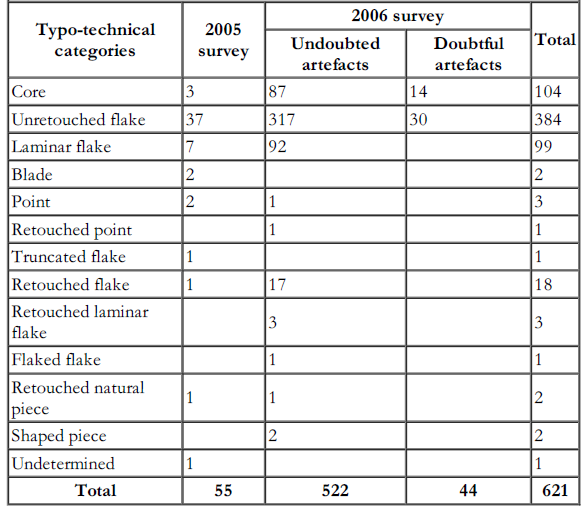
The 2005 survey recovered 55 lithic artefacts from four terrace remnants at the south-eastern limit of the formation. A techno-cultural attribution was proposed (Reference Chevrier, Berillon, Asgari Khaneghah, Antoine, Bahain and ZeitounChevrier et al. 2006): the assemblage was clearly dominated by debitage (Table 1) with hard percussion and with different levels of technical ability. The presence of points and volumetrically well-mastered artefacts supported the hypothesis of Mousterian affinities. As a result, sequences of reduction with low levels of ability — dominant in the collection — were attributed to a period preceding or contemporaneous with the Mousterian. However, their potential attribution to earlier or more recent periods could have not been rejected. In order to complete these preliminary elements, a large systematic survey project was organised.

New survey and revision of hypotheses
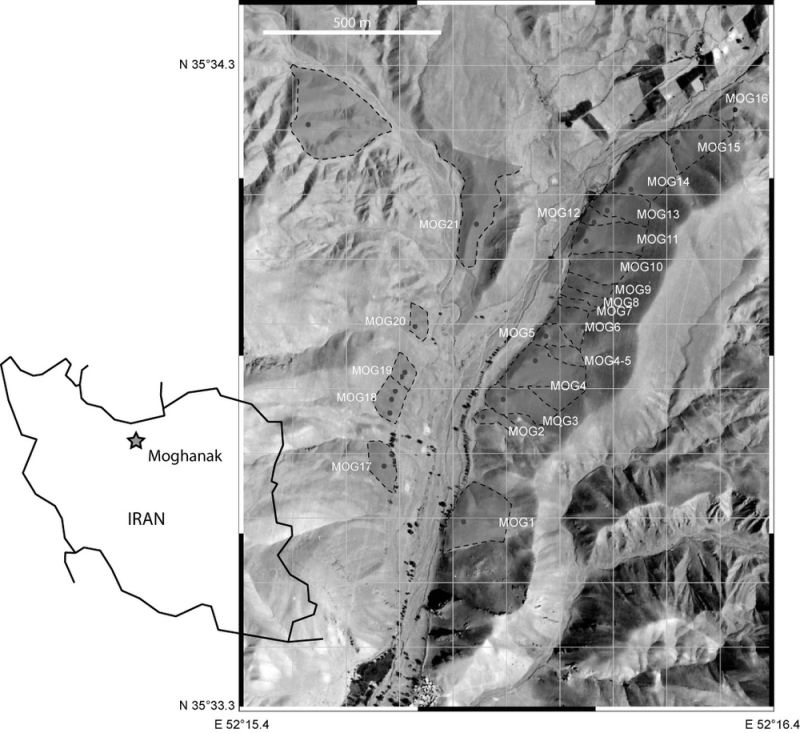
In 2006, more widespread systematic survey at Moghanak yielded new data on the alluvial formations and the technocultural attribution of the assemblage (Reference Berillon, Asgari Khaneghah, Antoine, Bahain, Chevrier, Zeitoun, Aminzadeh, Beheshti, Ebadollahi and NochadiBerillon et al. 2007b) (Figure 1). The survey area extended over 224 278m2 on both sides of the Do Âb River and its tributary to the north. In total, 21 sites were identified, each corresponding to a remnant of the same terrace, and an assemblage of 566 objects was collected. The distribution of artefacts varied across the formation and this could correspond to distinct phases of occupation (Berillon et al. 2007b).
Location of the Moghanak prehistoric site, Quaternary Terrace and 21 localities.

Unfortunately, the chronostratigraphic context remains uncertain. Only a few geological observations — high-energy deposits covered with thin colluvium — support the hypothesis that the material was deposited after the formation of the terrace. Different surface states (patina, wear) are observed on the artefacts and these may correspond to distinct episodes of deposition. The raw materials are purely local and include chert, quartzite and limestone available on the terraces and in the river bed.
Assemblage
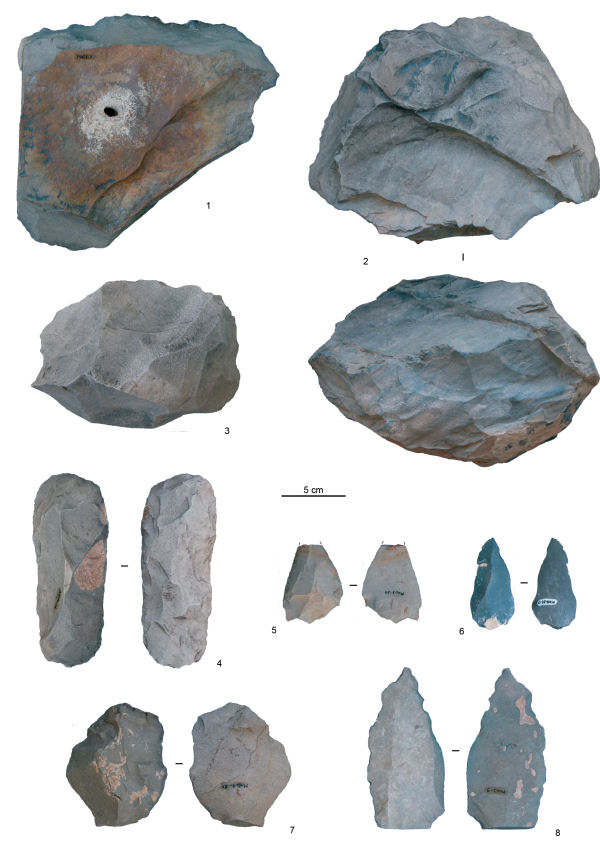
The new assemblage added 78 additional cores, with a fairly low level of technological ability (Figure 2, nos. 1–3). Mousterian characteristics seem to be confirmed (Figure 2, nos. 5, 6 & 8), particularly by a Mousterian point at site 3 (Figure 2, no. 5). This locality had previously produced lithic artefacts with Mousterian affinities. However, the recovery of what appeared to be two preforms of axe at sites 3 and 14 (Figure 2, no. 4) supports the attribution of a part of the collection to the Neolithic.
Moghanak: lithic pieces collected during the 2006 survey. 1–3) cores; 4) axe preform attributed to the Neolithic; 5) 'Mousterian point'; 6 & 8) points; 7) flake (photographs: FIPP 2006).

In summary, different periods and different production systems are clearly identified in Moghanak assemblage. The presence of both Mousterian and Neolithic is attested by several key artefacts. The majority of the remaining material belongs to fairly simple reduction systems (Figure 2, nos. 1–3 & 7). It is therefore risky to assign these reduction sequences to one precise period. The lack of chronostratigraphic context and the secondary position of the artefacts constitute a major problem. Many newly discovered assemblages in Iran are in the same situation (Reference Roustaei, Vahdati Nasab, Biglari, Heydari, Clark and LindlyRoustaei et al. 2004; Reference Jamialahmadi, H. Vahdati Nasab and BeshkaniJamialahmadi et al. 2008; Reference Alibaigi and KhosraviAlibaigi & Khosravi 2009; Reference Vahdati Nasab, Mollasalehi, Saeedpour and JamshidiVahdati Nasab et al. 2009): it is therefore difficult to make comparisons while the artefacts remain poorly diagnostic. The discovery of Iranian Lower and Middle Paleolithic sites with a good chronostratigraphic context is expected and would deeply renew the knowledge of those periods in Central Asia.
Acknowledgements
We thank the French Ministry of Foreign and European Affairs, the Cultural Center of the French Embassy in Iran, the Iranian National Science Foundation, the Iranian Center for Archaeological Reserach, the Research Institute of the Faculty of Social Sciences, University of Tehran and the Archeological Center of the Tehran Province.