

Premise
Comparative politics, as a discipline of academic inquiry, can be described as a driver for the democratization of countries or other places—usually infra-level political units such as subnational regions or cities—to achieve a more democratic world, a world in other words with a greater quality or amount of “democraticity” (Reference LandemoreLandemore 2020). And while such a grand, civilizational project sounds salubrious at first take, it, after decades of criticism, has come to be rather far less than that (Cf. Kurki and Hobson 2011). Indeed, the democratization project has fallen flat on its face due to the irrefutable fact that it, the United States, the European Union, the so-called West, has been promulgating its own preferred formulations or models of democracy (for they are not singular nor absolutely agreed upon by the members of those porous camps) to the exclusion of the formulations or models of the Others (e.g., de Sousa Santos and Mendes 2020; Tully et. al. 2022), the non-Western, the “Global South,” the rest, the majority of the world's people, in fact. Democracy as “exported” from whatever the West is has been, quite legitimately, tripped up.
The stakes in this matter are high. We know from the now vast “crisis” literature that some forms of democracy embodied in institutions at various levels of political practice, in some quarters of the world, are in dire straits—so much so that Heiko Maas, foreign minister for Germany, has recently called for a “Marshall Plan for Democracy” to be forged between both the United States and the European Union. What are we to do in a world where the so-called firmaments of democracy, bastions of its form and shining cities of its practice, have lost their footing, have seen their bastions breached, their cities now shadowed by their own smoke as they burn? Some direction is needed if only to keep arguably non-democratic alternatives, such as those illiberal nightmares like technocratic and neoliberal authoritarianisms, at bay.
We find ourselves, therefore, and if recent literature is to be believed (e.g., Hendriks et al. 2020; Reference KeaneKeane 2020; Reference SawardSaward 2021; Reference StasavageStasavage, 2020), in a moment of awakening about democracy as a concept. Does it mean just one thing like elections or representation? No. Was it the invention of ancient Greeks and perfected by Europeans or their colonial satellites? No. Are there many forms of democracy? Yes. Are some forms of democracy common to humanity across time and space and language? Yes. Are some forms of democracy the products of invention, experimentation, and political practice by certain people, in certain times, in certain corners of the world? Yes. Can these forms be used, mixed or blended together, to deepen a polity's democracy credentials? It is likely, but only ramping up current experimentation on this very question—through, for example, policy labs, clinical studies with students or the wider public, and live testing in villages or city districts—will tell.
Oddly, talk of this type is nothing new. The Norwegian philosopher Reference NaessArne Naess (1956), for example, was writing about “the democracies” in the 1950s, so too Reference McKeonRichard McKeon (1951) and Reference ChristophersenJens Christophersen (1966), as were certain international civil servants with UNESCO who commissioned a survey on the meanings of democracy in the world in 1949 (see UNESCO 1949). The UNESCO survey was undertaken to try to provide clarity over the meaning of democracy as, according to C. B. MacPherson (cited in Graham 2019: 4), that word came to mean opposite things after the fall of the Second Reich in 1918. The Nazi usurpation of referenda (which they rigged) and attempts to dress their regime in democratic clothing, but also the broader Fascistic threat to white male liberal democracy (for it was not so liberal for women and many non-white minority groups in the United States, for instance, but it was still better than what the Fascists countered with), were obviously of grave concern for the United Nations. But so, too, was the resumption of the prewar conceptual stoush between liberal democracy and communist democracy in the late 1940s—this conceptual fight between the United States and the Soviet Union would come to be one of the hinges that kept turning in their Cold War. So, some conceptual clarity for democracy was sought in the hopes of avoiding further conflict. Here, a quote from UNESCO's 1949 survey (it was part of question #5), drives home the point:
The opinion has become very widespread that there is no such thing as “democracy” in general, but only a long series of “democracies”, differing with different historical, social and psychological conditions: there is Athenian democracy, medieval democracy, bourgeois democracy, proletarian democracy, soviet democracy, but no “general democracy.”
As Reference Bettelheim and McKeonCharles Bettelheim (1951) wrote, two years later, “it can hardly be denied that the term democracy is ambiguous.”
We, or perhaps the comparativists or, perhaps broader still, the quantitativists, seem to have lost sight of that. As the decades rolled on from 1945, we began to see the rise of what Giovanni Sartori (1962, po. 437) termed the “terminological war” over democracy, its meaning, origin, and correct practice (note the troubling singularism here). The UNESCO survey on the meaning of democracy and resulting analysis by Naess, whose book on the study fell into obscurity, did not work. Case in point was the Cold War struggle over exactly democracy's meaning between the United States and the Soviet Union: was democracy to parse to liberal-republicanism or to mass representative majoritarianism in the world, tout court? Neither, as it turned out.
We are left instead with many possibilities for what can parse to democracy that exist in the irreducibly global category of ideas and practices of it, some of which are not even tied to the human species (e.g. as found among non-human animals), and, crucially, that are not definable or practiced as tyranny, autocracy, monocracy, oligarchy, manocracy, theocracy or any of the non-democracies that make up the ecology of the governances and the types of government and institutional practices they necessitate.
The purpose of this discussion, then, is to explore what this “awakened” position means for democratization in this freshly unsettled world, across cultures, languages, and political spaces, where hegemony over the concept of democracy has dissolved, or is (at risk of) dissolving depending on your perspective, and we are left only with possibilities.
*
Gagnon: Professor Schaffer, what do you make of this premise?
Schaffer: I find much here to agree with. I think you're right that the concept of democracy warrants rethinking, a task that has taken on a new urgency, at least in the United States, where I live. I also applaud how you recognize that we live in a moment of possibility, especially if one is alive and open to the plurality of ideas and practices that exist in this big world. We—whoever “we” are, since there are a multitude of “we's” in this world—can use the experiences of other peoples and polities to reveal to us the parochialness of our own understandings and enrich or expand our political imagination. Looking beyond ourselves can help us denaturalize what we take for granted, nourish our creativity, and make it easier for us to change our lot.
But since we are talking about the concept of democracy, I would add that the project of rethinking could benefit from attending to the conceptual issues involved. How do we conceptualize that plurality? My own view is that there is a danger in speaking of some “global” notion of democracy because I don't think such a thing exists, at least if we're looking across languages and cultures. My research on understandings of demokaraasi in Senegal and demokrasya in the Philippines has convinced me of that. By failing to recognize conceptual diversity, we risk fundamentally misrecognizing what we see. One might look at a Senegalese voter who casts their ballot as instructed by an elder or religious leader and see that voter as an incompetent democrat. But I would argue that such a voter may instead be playing a different game with different aims and rules. What looks like incompetent play in the game of democracy can actually be a sophisticated move in a different sort of game, the game of demokrasya, in which maintaining solid relationships is paramount.
And I'm not sure that speaking of “democracies” in the plural helps us sidestep entirely the danger of misrecognition. Once we posit that there are varieties of democracy, we are tempted to seek out the properties common to all those varieties. It's analogous to apples. Once we accept that there are apples—varieties of apples—we are tempted to look for the essential features of appleness which make all varieties belong in that single bushel of “apples.” To mitigate this problem—what I've called the problem of “universalism”—I prefer to speak about “rough equivalents” of democracy in other languages: demokaraasi in Wolof, demokrasya in Tagalog, demokratia in Greek, minzhu in Chinese, and so on (Reference SchafferSchaffer 2016). Among and between these conceptual rough equivalents are complicated patterns of similarity and difference—Wittgensteinian family resemblances, if you like.
I might seem nitpicky in preferring, say, Athenian “demokratia” over Athenian “democracy,” but I would argue that marking the distinction between democracy and demokratia keeps our eyes open to the fact that we are talking about different forms of life and conditions of possibility. Athenian demokratia, as Reference ConnellyJoan Connelly (2014) teaches us, would have been impossible without the specifically Athenian myths and religious practices which animated it. That's not to say that we have nothing to learn from revisiting ancient Athens. On the contrary, I find much wisdom in the Greek conviction, reported by Aristotle, that elections undermined the equality of demokratia because they were so easily tilted by money and power. I also think there have been some fascinating attempts to revive and adapt the ancient practice of sortition as an alternative to elections, as David Van Raybrouck (2018), among others, has documented. But at the same time, I wonder about the limits of such experiments and the degree to which they can work when unmoored from the communitarian religious ethos of the ancient polis. These are genuine questions that I really don't know the answer to. But to even ask them requires acknowledging that we're talking about substantially different ways of life. I like using the Greek term because it keeps reminding me of that fact.
I think it's also worth emphasizing—as you wisely do—that even if electoral/procedural understandings of democracy have been hegemonic both in the foreign policy establishment of countries like the United States and within comparative politics, other understandings of democracy abound. We need look no further than everyday ways of using the word “democracy.” In American English, people use “democracy” to mean inclusive participation in all sorts of activities, whether it be the “band democracy” of a musical performance or the “hardwood democracy” of a basketball game. Such uses convey the idea that each player gets their turn, whether it be to solo or score points. Interesting to me is what's omitted: it's irrelevant who decided that each player should each have a turn or even if a conscious decision was made at all. What matters is the egalitarian outcome: each has a moment to shine. In contrast to the procedural ways in which many American political scientists conceive of democracy, one can see here an American understanding that has nothing to do with procedures. Even such a small example as this suggests to me that we (again, whoever “we” are) need not learn only from other peoples and places. We can also benefit from interrogating more carefully the everyday things we ourselves say and do. So, whether we look beyond ourselves or at ourselves, I think we would do well to democratize our thinking about democracy.
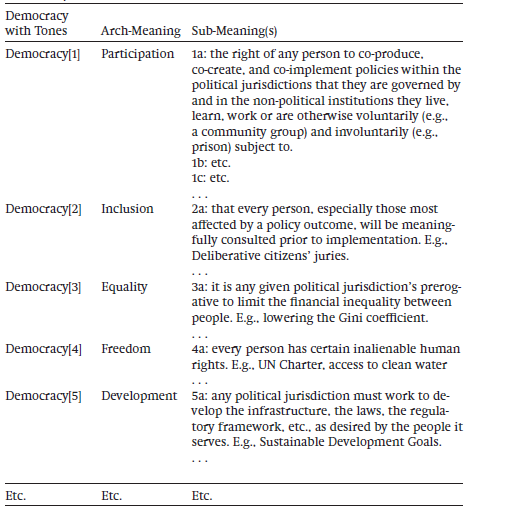
Gagnon: Your emphasis on cultural anchors and careful attention to the meanings of democracy, but also why we should refer to those meanings distinctly, in lexical forms (e.g., demokratia, minzhu, etc.), makes me wonder if we should be formalizing a language system for democracy to assist this approach. For example, in English, we could try to write the concept with “tones,” as it is done in pinyin when learning Mandarin. The following table gives a quick example of what I've in mind:

Such a table should, I think, also include the Romanized spelling of non-English terms, some of which you've already mentioned (e.g., minzhu), which may also require “arch” and “sub” differentiation as given in the foregoing table. Importantly, this formalization is not meant to shut the door on debate over the meanings of democracy but rather the opposite: it is done to capture the meanings, demonstrate their diversity, point them to cultural (spatial, temporal, linguistic, cultural) anchors, and offer people a quick way of identifying what they mean by “democracy” or the area of meaning they are working within or between in cases of creative democratization, innovative democratic design, and neological democracy. There is too the aspect of personal discovery should a person simply peruse the table as they may uncover meanings of democracy that resonate with them or that don't—many today are, like Aristotle, repulsed by voting.
One model I am thinking of, and I'm not certain that it's the best one given its distance from/lack of involvement by lay persons (that is, lay relative to their epistemic community), is the International Commission on Stratigraphy who regulate the International Chronostratigraphic Chart, which helps us discuss, hopefully agree on, and think of the Earth's geologic time. See, for reference, how popular talk of the Anthropocene is now. That burgeoning discourse is, I think, happening by grace of the stratigraphic commission's work. If such a commission or assembly were to exist for democracy/demokratia/minzhu/et cetera, it could, perhaps, do the same by providing detailed, evidence-based (factual) accounts and definitions of democracy, that have been carefully deliberated upon by a diverse body of commissioners and “accepted” by them as being sufficiently democratic. This detailed record could point democrats around the globe (persons interested in, say, democratizing democracy) into previously unimagined directions by, quite literally, expanding their knowledge of what democracy was, is and can be.
What do you think of such a direction? Is it a valid or even desirable build from your contribution?
Schaffer: Expanding the political imagination of one's own community by looking around the world for new ideas and inspirations seems to me to be a worthwhile endeavor, as I've already indicated. I'm less certain about the value of cataloging the various meanings in short dictionary-like entries that detach those meanings from the practices and lived experiences which co-constitute them. What gets stripped away is context—an account that is circumstance-attached and embedded in deeper structures of significance, what Gilbert Reference RyleRyle (1971, 465–496), and Clifford Reference GeertzGeertz (1973, 9–12) after him, referred to as “thick” description. An overly thin account doesn't provide much stuff on which to feed one's thinking.
I also worry about the idea of setting up a commission to decide what counts as sufficiently “democratic,” for such a task would run up against the problem of universalism that I was just speaking about, for it presumes some objective or trans-cultural standard of democracy on which everyone might agree. The kind of gatekeeping you describe, I fear, would also severely circumscribe in advance what might be learned. Rather than devoting one's energies to asking in some general and abstract way whether, say, sortition is “sufficiently democratic,” wouldn't it be more enriching to just leave Australian English speakers to ask how they might reflect on that ancient Greek practice to expand their thinking about democracy, Chinese speakers to ask how they might reflect on that practice to expand their thinking about minzhu, and so on? That would be a way to democratize how knowledge about demokratia (or demokaraasi, demokrasya, and the like) is put to use. And just to be clear, I would in no way expect there to be a consensus among Australian English speakers or Chinese speakers about the conclusions they reach.
Gagnon: That's a very stimulating direction to be working from. I'm trying to realize a means (associative, institutional) that could support your normative encouragement here. So, to formalize, we have x number of meanings of or for “democracy/minzhu/manapori/etc.” in the world, and it should be our work to make them available for all communities to consider. It is an act of invitation and not of policing. As you say, it is not our duty to tell people what counts as democracy or what is sufficiently democratic but rather to provide thick, contextually driven, descriptions of meanings as we find them so that others can make their own minds up about them. It seems to me that this would require, as you say, much less a dictionary and more an encyclopedia, like Wikipedia, where articles appear in as many languages as possible, are multimedial (e.g., including, where available, video, audio), and are as inclusive as possible for those who cannot “see” or “hear.” To accomplish this, we would need to wield arts and techniques known more to anthropologists, ethnologists, cultural sociologists, social historians, and so forth, as democratic theorists tend to be pretty circumscriptive in their ways, about what counts as democracy and, consequently, what doesn't. We'll need to keep working more trans-disciplinarily as Michael Reference SawardSaward (2021) has of late been encouraging the field to do. Is there anything that you would add to this, to such a project? And, if I may ask, what goods do you expect to come out of this work, should it ever come to be well-realized?
Schaffer: I've two thoughts. The first is just to note that scholars, including some from political science, have already produced a handful of relatively thick accounts of democracy and its rough equivalents—though some are thicker than others. Even if we limit ourselves to students of the contemporary world, examples include Ahmed Reference KhananiKhanani (2021) on the meaning of dimuqrāṭyya to conservative Muslims in Morocco, Michaelle Reference BrowersBrowers (2006) on democracy in Arab political thought, Mikael Reference KarlströmKarlström (1996) on the meaning of eddembe ery'obuntu to rural Bagandans in Uganda, Ann Reference FrechetteFrechette (2007) on the meaning of mangtso to Tibetans in exile, Tamas Reference WellsWells (2021) on narratives of democracy in Myanmar, Yoshihiko Reference SekiSeki (1978) on minshu shugi in postwar Japan, Mukulika Reference BanerjeeBanerjee (2021) on the cultivation of democracy in agrarian India, Marcy Brink-Danan (2009) on debates among Turkish Jews over the meaning of democracy, and my own work on demokaraasi (Reference SchafferSchaffer 1998) and demokrasya (Reference SchafferSchaffer 2014). Not all of these authors are fully attentive to the conceptual muddying introduced by translating rough equivalents as “democracy,” but I think each has much to offer nonetheless. You wouldn't have to start from scratch.
My second thought is that the endeavor you describe could—in addition or alternatively—serve as an opportunity to amplify the voices of democracy/demokrasya/minzhu, et cetera, practitioners themselves and not just present their ideas and practices as refracted through academic lenses. There is a newly launched website devoted to the environment that tries to do just that called living-language-land (https://living-language-land.org/). As the organizers explain, the website is intended to be “a platform to minority and endangered language-holders to share a word and story that reflects a relationship to land and nature. It is about enlarging the lexicon we can all draw from in reflecting on those relationships.” The entries are short and not all that contextualized. Still, I find the project compelling, especially in its effort to decolonize and democratize knowledge production by inviting people from local communities to craft their own contributions. How much autonomy they actually have in doing so, I don't know. But in its conception at least, the project goes beyond what a purely academic-sourced endeavor might achieve and could serve as a different sort of model for what you envision.
What would I expect, in terms of outcomes, of the encyclopedic endeavor you describe, perhaps one modeled loosely on living-language-land? It's not for me to say how people should utilize such a resource—that's the point of democratizing how knowledge is used, isn't it? My only hope is that it might expand people's political imagination and inspire political creativity.
Gagnon: I'm with you. So let's say we've begun this good work on an inclusive platform (a voice of me still wants democratic theorists and philosophers involved for “quality control”, to identify impostor concepts if at all possible, offer edits, build research networks, and so forth—it must be from the episto- and meritocrats in my network) and we are actively communicating this novel democracy resource to potential users. This, I wager, is the site of our next difficulty: increasing uptake by non-specialists and large “pro-democracy” supporters and exporters like the UNDP, National/European Endowment for Democracy, Carnegie Foundation, the OECD, et cetera, who often have neo-Platonic understandings of what democracy is (elections or deliberation) and how it should be done (like the “modern West”). Can you offer guidance, from your experience, of how to increase uptake by non-specialists and large institutions? The vision I presently hold of a future democracy resource—which comes from giving your words much pause for thought over many weeks—has well-edited and collaborative articles, videos, audio files, images, music, an open-access democracy library, and so forth, that tries its best to offer culturally anchored, and thick descriptions, of democracy/demokratia/minzhu/et cetera, to as diverse an audience as possible. But my worry is that such a large, collaborative, effort will fall into some chamber of silence, to be ignored by those whom we are working so hard to reach. What would it take for the UNDP or UNESCO, for instance, to draw from our work of the future? Patience, persistence, luck, and hope, or something else? Let me end here by saying, in the same breath, that proselytizing like this feels weird—but I suppose that's part of what (some) academics do.
Schaffer: If you're interested in reaching what you call “pro-democracy supporters and exporters,” you might adopt some of the strategies used by researchers affiliated with the Global Barometer Project, which undertook its own initiatives to discover what democracy means around the world. While I'm highly skeptical of their conclusions and critical of the methods they used to arrive at them—something I've discussed elsewhere (Reference SchafferSchaffer 2014)—I admire their efforts to publicize their findings and reach policy-maker and stakeholder audiences. Beyond putting out a number of academic publications, they held press conferences and debriefed government officials, among other things. They made that kind of outreach a priority.
All the same, I wonder how receptive such audiences would actually be to the type of project you—we—have been imagining in this conversation, so I think your fears about a chamber of silence are well founded. After all, liberal-democratic government officials and people vested in the democracy export industry—and it really is an industry—don't have much incentive to substantially rethink democracy. They do pretty well with the liberal-democratic status quo. In fact, I suspect that one reason why Global Barometer researchers were relatively successful in publicizing their findings about democracy is that those findings affirmed and justified the policy objectives of the US government and its allies. A bottom line finding of Global Barometer was that everyone around the world holds similar liberal views of democracy—a premise shared, notably, by the administration of George W. Bush in the run up to the invasion of Iraq and its (failed) attempt to install liberal democracy there (Reference Dalton, Doh C. and WillyDalton et al. 2007; Reference SmithSmith 2007). My guess is that those who profit or benefit most from sustaining or exporting liberal arrangements would be the least likely to respond favorably to your invitation to reimagine. For that reason, I would encourage you to hold tight onto your commitment to touch broader, dare I say, more democratic audiences, though I'm not sure what strategies might work best to maximize your chances of uptake by them.
Gagnon: In wrapping this discussion, three thoughts come to mind. The first is that you have clarified an enormous labor in the study of democracy, which, I think, requires a funded institution to pursue. If this gets up in future, it could generate plenty of research, teaching/training, and communication opportunities for academics and practitioners alike to participate in and benefit from. The second is that the study of democracy—a varied discipline characterized by numerous fields of scholarship (e.g., theory, democratization, comparison)—has a public relations problem. I think the deliberative democrats are setting the example for the adherents to other models of democracy to follow because “the deliberators” have been successful in generating partnerships with governments, businesses, filmmakers, activists, political parties, and even, more recently, the OECD. The Economist, The Washington Post, and even more science-focused journalists are presenting deliberation these days to their respective audiences as papers—from democratic theorists—have appeared of late in Science and Nature. But maybe that's because deliberation has always fit comfortably enough within the logics of liberal conceptions of democracy: it bolts right onto representation, elections, parliamentarism, and participatory policy formation. So maybe I'm wrong and it just won't be the same for the adherents of demokrasya or manapori or “flatpack democracy,” for instance. This brings me to the third, and last, thought, which is that if we don't have an institution promoting this or that lesser known concept of democracy or a “foreign” rough equivalent of a potentially useful democratic practice (so, the status quo), and should following the deliberative democrats’ methods for public engagement prove fruitless (a future risk), then we are left with the need to think out of the box to try to drum up interest in, say, the varieties of minzhu or “really radical democracy.” Here democracy scholars and democracy practitioners may need to adopt “guerilla marketing” (Reference Roxas, Donald M., Eugene C., Francis C. and Florabel C.Roxas et al. 2020) strategies to get the word out: this could include the social-media equivalent of pamphleteering (neo J.S. Mill style), leaving QR-codes or “tags” in high-traffic public areas (to hopefully connect with curious passersby), or breaking cultural norms in public events—within the rule of the law—to get attention and make an impact (Cruella de Vil style). I'm quoting Disney now, although for the third thought it could have been Camus (L'homme révolté/The Rebel) or Derrida (Rogues), so perhaps it's best for me to stop here.
I wanted to end by asking if you could offer democracy researchers advice on conducting research in the field. How, for example, should one make connections with, say, scholars and practitioners in Africa, Central Asia, the Caribbean or the so-called indigenous “fourth world”? How did it work for you in Senegal or the Philippines for instance?
Schaffer: My advice? Above all, treat everyone and everything with regard. That may sound obvious, but you'd be surprised. To give just one example, I was horrified to learn from researchers at a Dakar research institute that an affiliated French linguist, upon his departure from Senegal, had stolen several hard-to-find nineteenth-century Wolof-French dictionaries from their collection. When interacting or working with people who've been previously burned by foreign scholars, I've found that making connections can require a lot of trust building, which can't be rushed. It's vital to demonstrate concretely, genuinely, and repeatedly that one isn't out to steal, exploit, or disrespect. One can also try to help out. In the case of the institute, I helped replace some of the stolen originals with photocopies. I didn't do that for instrumental reasons or in a calculated way; I just felt sickened by what the French scholar had done. But in retrospect, I think it did reduce the researchers’ wariness of me. By the time I finished my fieldwork, they had become incredibly supportive of the work I was doing.
It's also important to be aware that one's own priorities and perspectives may not always match up exactly with those of local researchers or activists. Some Senegalese scholars I met were involved in generating Wolof-language civic education materials; their goal was to teach non-schooled Wolof speakers how to become better democratic citizens rather than asking, as I did, what practices of demokaraasi such people were already engaging in. Several middle-class civil-society organizers in the Philippines I collaborated with were more concerned with educating lower-class voters how to “correctly” weigh their electoral choices than asking what might be learned from those at the lower end of the social hierarchy. While I greatly respected all of the researchers and activists I came to know in both countries, some—though not all, for sure—were less interested than I was in exploring and seeing value in how rag makers, peanut farmers, and street vendors understand concepts like demokaraasi and demokrasya. In my view, there's much to learn about such concepts from those at the bottom or on the margins of society. I'm reminded of Astra Taylor's documentary What Is Democracy? One of the things I love about it is that she interviews not only professors and politicians, but also refugees, a barber recently released from prison, and schoolkids dismissively treated by their teachers and school administrators. Those who are excluded often have much wisdom to share—if others would only listen.

 Open access

