


Introduction
The landscape of university research has undergone profound transformation in the twenty-first century, blurring boundaries between academic inquiry, commercial application and public policy (Etzkowitz and Zhou Reference Etzkowitz and Zhou2017). Universities now sit at the centre of innovation ecosystems (Cai et al. Reference Cai, Ma and Chen2020), where academic freedom intersects with market demands and governmental priorities, reflecting broader shifts in the knowledge society that position universities as engines of growth, technological innovation and societal problem-solving (Etzkowitz et al. Reference Etzkowitz, Germain-Alamartine, Keel, Kumar, Smith and Albats2019; Galvao et al. Reference Galvao, Mascarenhas, Marques, Ferreira and Ratten2019). The ‘Triple-helix’ of university–industry–government relations has expanded opportunities for collaboration and knowledge transfer but also introduced new forms of risk that challenge traditional academic norms and institutional arrangements. Institutions must therefore navigate competing demands for research excellence, commercial relevance and policy alignment while maintaining their core mission (Etzkowitz and Leydesdorff Reference Etzkowitz and Leydesdorff2000; Fernandes et al. Reference Fernandes, Domingues, Tereso, Micán and Araújo2023; Fulop and Couchman Reference Fulop and Couchman2006).
These developments have created complex, multi-stakeholder risk environments with competing objectives and uncertain outcomes. Risks manifest across individual, organizational and system levels and can cascade to undermine academic integrity and collaborative effectiveness. The rise of ‘academic capitalism’ – with its performance metrics, rankings and commercialization pressures – has intensified such tensions with traditional scholarly values (Harman Reference Harman2001; Prigge Reference Prigge2005; Slaughter and Rhoades Reference Slaughter and Rhoades2004). At their core, these challenges reflect institutional pluralism: multiple institutional logics simultaneously press upon universities – professional (scholarly autonomy and peer review), market (efficiency and revenue), state (public accountability) and, at the interfaces, community/sustainability (open science and societal engagement) (Greenwood et al. Reference Greenwood, Raynard, Kodeih, Micelotta and Lounsbury2011; Cai and Mountford Reference Cai and Mountford2022). Traditional risk-management routines, designed for single-sector organizations, are poorly suited to such multi-logic settings (Bleiklie et al. Reference Bleiklie, Enders and Lepori2017).
Despite the growing importance of university–industry–government collaboration, scholarship on risk in university research remains fragmented and theoretically underdeveloped. Much of the literature either examines operational risks within organizational partnerships or surveys policy challenges at the system level. It rarely connects these layers through the lens of interacting institutional logics that shape both risk formation and mitigation (Ankrah and Al-Tabbaa Reference Ankrah and Al-Tabbaa2015; Rybnicek and Königsgruber Reference Rybnicek and Königsgruber2019).
At the organizational level, universities face a persistent tension in balancing academic freedom with commercial and policy imperatives, as well as with the objectives of sustainable development (Berman Reference Berman2012; Cai, Pinheiro et al. Reference Cai, Pinna and van der Wende2025). Institutions are expected to excel in scholarship, generate economic value and serve public interests – often with limited guidance on how to adjudicate conflicts among these goals (Ocasio et al. Reference Ocasio, Thornton, Lounsbury, Greenwood, Oliver, Lawrence and Meyer2017). These tensions intensify in collaborative settings, where multiple logics intersect and collide, calling for what Pache and Santos (Reference Pache and Santos2013) term ‘selective coupling’ – the calibrated adoption of practices from competing logics without wholesale conversion.
At the system level, the multi-stakeholder character of contemporary innovation ecosystems complicates risk identification and governance, requiring coordination mechanisms that span organizational and policy boundaries (Leydesdorff and Zawdie Reference Leydesdorff and Zawdie2010). Legacy governance designed for relatively autonomous academic organizations struggles to accommodate the hybridity and boundary-spanning demands of present-day research partnerships (Perkmann et al. Reference Perkmann, Salandra, Tartari, McKelvey and Hughes2021). The consequence is too often ad hoc, partner-specific risk routines that leave systemic vulnerabilities unaddressed and fail to harness the performance advantages of institutional diversity (Guston Reference Guston2001; Carlile Reference Carlile2004).
Furthermore, the limited integration of institutional logics theory with the Triple-helix framework represents a significant gap in current understanding (Leydesdorff and Zawdie Reference Leydesdorff and Zawdie2010). While both theoretical perspectives offer valuable insights into university–industry–government relations, their separate development has prevented the emergence of comprehensive frameworks that can address the full complexity of contemporary research environments. Recent work by scholars such as Lattu and Cai (Reference Lattu and Cai2023) and Cai and Etzkowitz (Reference Cai and Etzkowitz2020) has begun to explore these intersections. These studies suggest that the academic, market and state logics respectively associated with university, industry and government, constitute the core institutional complexity and dynamics in higher education, yet a comprehensive integration remains lacking.
To address the research gaps of (i) fragmented, operational- or system-level accounts of risk that overlook cross-level interactions, (ii) the limited integration of Triple-helix and institutional logics perspectives; and (iii) the absence of a comprehensive framework to understand and mitigate risks in university research, we raise two critical research questions.
RQ1. How do professional, market and state institutional logics interact to shape risks in university research within the Triple-helix framework?
RQ2. How can effective Triple-helix interactions mitigate these risks through hybrid governance strategies and institutional adaptation?
To avoid conflating disparate issues (e.g., identity strain, mission drift, policy overload), this article defines risk in university research as the likelihood that interactions among university, industry and government – mediated by academic/professional, market and state logics – produce outcomes that undermine scholarly integrity, collaborative effectiveness or public value.
This study is a conceptual, integrative review using abductive synthesis (Timmermans and Tavory Reference Timmermans and Tavory2012). Evidence was assembled through a purposive, narrative search with iterative ‘pearl-growing’ (backward/forward citation tracing). The search proceeded until additional sources yielded diminishing returns and rarely introduced substantively new mechanisms, an approach suitable for conceptual consolidation and distinct from protocol-driven systematic reviews (Jesson et al. Reference Jesson, Matheson and Lacey2011). Specifically, abductive analysis informed the development of the cross-level risk framework and its triple-temporal mitigation design.
Theoretical Foundation: Triple-helix Model and Institutional Logics Theory
The Triple-helix Model: Evolution and Contemporary Relevance
Emerging in the mid-1990s, the Triple-helix framework theorized innovation as the outcome of evolving relationships among universities, industry and government in knowledge-based economies, moving beyond linear, sector-separated models towards dynamic interaction and partially overlapping roles (Etzkowitz and Leydesdorff Reference Etzkowitz and Leydesdorff1995). Relative to Clark’s (Reference Clark1983) triangle of coordination – which foregrounds governance balances within higher education systems (state–market–academic steering) – the Triple-helix places greater emphasis on cultural–institutional reconfiguration and role change across spheres, aligning with innovation systems thinking while adding an account of how institutional arrangements co-evolve to shape innovative outcomes.
Building on this tradition, Cai and Etzkowitz (Reference Cai and Etzkowitz2020) systematize five rationales that render the model analytically robust: (1) complex relations among innovation actors can be both reduced and preserved through Simmel’s social geometry of triads; (2) the engine of change lies in actors ‘taking the role of the other’ (e.g. universities adopting entrepreneurial functions, firms engaging in knowledge production, governments orchestrating boundary-spanning platforms); (3) evolution requires pre-structuring and coordination rather than spontaneity alone; (4) effective configurations blend top-down steering with bottom-up initiative; and (5) enabling conditions – such as regulation, intermediaries and shared norms – stabilize sustained collaboration. Together these rationales explain why and how Triple-helix arrangements yield innovation advantages.
The Triple-helix model is therefore not merely metaphorical but a generative mechanism through which hybrid capacities emerge. Universities extend into venture support and technology transfer, industry contributes to knowledge creation and government establishes rules and platforms that catalyse cross-boundary problem-solving. These developments coincide with the proliferation of intermediaries, such as science parks and technology transfer offices, which institutionalize collaboration (Cai and Etzkowitz Reference Cai and Etzkowitz2020).
Later elaborations (Carayannis and Campbell Reference Carayannis and Campbell2009, Reference Carayannis and Campbell2010) have expanded the core triad to include civil society (Quadruple helix) and the natural environment (Quintuple helix), but recent theorizing recommends a ‘Neo-triple helix’ synthesis (Cai Reference Cai2022): retain the three-sphere core for analytical focus while absorbing insights from the extensions to keep policy analysis tractable under contemporary complexity. This approach preserves conceptual clarity without ignoring today’s plural governance challenges.
Institutional Logics Theory in Higher Education
Institutional logics theory originated with Friedland and Alford (Reference Friedland, Alford, Powell and DiMaggio1991), who sought to connect macro-level institutional analysis with micro-level organizational behaviour. They characterize an institutional logic as ‘a set of material practices and symbolic constructions which constitute [an institutional order’s] organizing principles and which is available to organizations and individuals to elaborate’ (Friedland and Alford Reference Friedland, Alford, Powell and DiMaggio1991: 248). This definition underscores the dual material–symbolic nature of logics and how they shape both organizational conduct and individual action.
Subsequent work formalized the perspective and showed its particular value for analysing complex settings where norms and belief systems collide (Thornton et al. Reference Thornton, Ocasio and Lounsbury2012). In higher education, the lens clarifies how universities navigate competing expectations while maintaining institutional identity – balancing scientific/professional norms with market incentives and state accountability (Lepori Reference Lepori, Huisman and Tight2016). Recent reviews indicate the breadth of this pluralism, identifying numerous coexisting logics at play in universities and higher-education systems (Cai and Mountford Reference Cai and Mountford2022).
The framework explains how distinct logics orient priorities, resource allocation and performance metrics. Unlike earlier institutional theories focused on isomorphism, institutional logics foreground plurality and conflict, a crucial insight for universities that must routinely reconcile academic/professional, market and state logics, while increasingly engaging community and sustainability considerations in research and engagement agendas (Lattu and Cai Reference Lattu and Cai2023; Cai and Mountford Reference Cai and Mountford2022).
A growing literature examines hybrid logics, in which elements from different institutional orders are combined to manage complexity. For instance, market–professional hybrids emerge when academics uphold professional standards yet adopt market-oriented valuation and performance practices; professional–bureaucratic hybrids fuse collegial authority with state-like procedures and standardization (e.g., ‘efficient collegiality’). Such hybrids illustrate how field-level practices recombine societal logics to stabilize collaboration and coordinate action in multi-actor university settings (Mountford and Cai Reference Mountford and Cai2023).
Three Core Logics in University Research
University research is influenced by multiple institutional logics. Alongside the classic triad of academic/professional, market and state, scholars also note community, corporate, religious, family and hybrid field-level logics, with growing attention to sustainability and open science (often as emergent or hybrid forms) (Thornton et al. Reference Thornton, Ocasio and Lounsbury2012; Cai and Mountford Reference Cai and Mountford2022). This study focuses on the academic/professional, market and state logics because comparative reviews show that these three generate the most pervasive institutional complexity and normative tensions in higher education, especially where research integrity, commercialization and public accountability intersect (Cai and Mountford Reference Cai and Mountford2022; Mountford and Cai Reference Mountford and Cai2023). Related repertoires such as community/sustainability and open science are therefore treated as interface dynamics within the triad that can amplify or moderate tensions (e.g. openness vs. sovereignty), rather than as separate core logics for the purposes of this framework.
Academic/professional logic
Rooted in professional autonomy, this logic prioritizes scholarly independence and the advancement of fundamental knowledge. It sustains research integrity through peer review, methodological rigour and intellectual honesty, and it values long-term enquiry even when immediate application is uncertain (Clark Reference Clark1983; Henkel Reference Henkel2005). It aligns with Merton’s CUDOS ethos – communalism, universalism, disinterestedness and organized scepticism – which articulates the normative foundations of science (Merton Reference Merton and Storer1973).
Market logic
This logic emphasizes commercial application and economic value creation. It evaluates research by return on investment, market potential and competitive advantage, and it incentivizes translational outputs via intellectual property, technology transfer and industry partnership. Its rising salience in universities is documented under ‘academic capitalism’ (Slaughter and Rhoades Reference Slaughter and Rhoades2004) and in syntheses of academic engagement and commercialization (Perkmann et al. Reference Perkmann, Salandra, Tartari, McKelvey and Hughes2021).
State logic
Centred on regulation, accountability for public funding and wider societal benefit, this logic steers research towards strategic priorities (e.g. competitiveness, social welfare and sustainability) through funding instruments, evaluation regimes and ethical governance. In the Triple-helix, governments act as rule makers and conveners, shaping collaboration across spheres (Etzkowitz and Leydesdorff Reference Etzkowitz and Leydesdorff2000); policy analyses show how performance- and mission-oriented funding align university research with public purposes under transparent accountability (OECD 2019).
Integration of Triple-helix and Institutional Logics
Integrating the Triple-helix and institutional logics perspectives offers a stronger account of university–industry–government relations than either lens alone. The Triple-helix provides a structural view of multi-actor collaboration and role reconfiguration across spheres (Etzkowitz and Leydesdorff Reference Etzkowitz and Leydesdorff2000), while the institutional logics perspective explains the cultural–cognitive repertoires that orient actors’ priorities and practices (Thornton et al. Reference Thornton, Ocasio and Lounsbury2012). Brought together, they clarify not only who collaborates and through which structures, but also how meaning systems are negotiated, aligned or resisted during collaboration.
The rationale for integration is straightforward: Triple-helix interactions necessarily bring distinct logics into contact. Universities are primarily guided by professional–scientific norms, industry by market-oriented valuation and government by state logics of regulation and public accountability (Thornton et al. Reference Thornton, Ocasio and Lounsbury2012; Etzkowitz and Leydesdorff Reference Etzkowitz and Leydesdorff2000). Collaboration therefore hinges on processes that translate and reconcile these logics. Cai (Reference Cai, Charles, Nieth, Coenen and Cinar2026) shows that, across paradigm shifts from ‘ivory tower’ to entrepreneurial and, more recently, sustainable entrepreneurial universities, professional, market, state and community/sustainability repertoires collide and are recombined through hybrid logics. These hybrids are sustained by bridging ideologies and institutionalized practices that stabilize collaboration while safeguarding academic values.
Crucially, integration is not about eliminating tensions but about navigating them through concrete mechanisms. First, organizations deploy selective coupling to accommodate competing priorities – structuring differentiated units or processes (e.g. basic research, applied institutes, technology transfer) so that each aligns with a dominant logic while maintaining overall coherence (Pache and Santos Reference Pache and Santos2013). Second, boundary organizations and infrastructures provide interfaces where translation and negotiation occur, including technology transfer offices, industry liaison units, collaborative centres and codified instruments such as MoUs, data-sharing protocols, IP templates and conflict-of-interest rules (Guston Reference Guston2001). Third, role-taking routines – cross-appointments, secondments and joint evaluation rubrics, operationalize what Cai and Etzkowitz (Reference Cai and Etzkowitz2020) describe as ‘taking the role of the other’, enabling actors to adopt partners’ expectations without abandoning their home logic. Fourth, hybrid logics help reconcile normative clashes: the ‘scholarship of engagement’ combines academic rigour with societal relevance (Boyer Reference Boyer1996); ‘responsible innovation’ aligns scientific openness, anticipation and reflexivity with policy and market demands (Stilgoe et al. Reference Stilgoe, Owen and Macnaghten2013); and ‘translational research’ connects fundamental inquiry to application pathways without collapsing one into the other (Woolf Reference Woolf2008).
Integrating these perspectives also sharpens how we understand ‘institutional complexity’. When multiple logics coexist, organizations tend to develop patterned responses – compartmentalization, selective coupling or synthesis – to keep collaboration workable (Greenwood et al. Reference Greenwood, Raynard, Kodeih, Micelotta and Lounsbury2011). In university research, such responses underpin durable Triple-helix arrangements by aligning evaluation, openness and IP regimes with academic integrity and public accountability (Etzkowitz and Leydesdorff Reference Etzkowitz and Leydesdorff2000). In short, combining the two frameworks explains both the structural design of collaboration and the logic-bridging work – mechanisms, routines and hybridizations – that make it effective over time.
Understanding Risks in University Research: A Multi-level Institutional Logics Analysis
Universities sit at the meeting point of three forces: the academic world (knowledge and peer review), the market (products, funding and competition) and the state (laws, audits and public goals). This section explains how risks show up for individual researchers, for the organization (the university) and in the wider system (policies and international rules). It then shows how these risks connect across levels.
Individual-level Risk Formation
Working with industry and government changes how researchers choose topics, where to publish and whom to work with. Three everyday pressures are especially common.
First, hybrid settings create identity strain and role ambiguity as norms of openness meet appropriation and accountability. This involves value dissonance (share vs. protect), role conflict (independent scholar, contract deliverer, public steward) and routine micro-dilemmas over preprints vs. patents, authorship vs. background IP and confidentiality vs. data sharing – forcing constant ‘script switching’ across academic, commercial and regulatory expectations and raising the risk of misunderstanding (Lam Reference Lam2010; Henkel Reference Henkel2005; Perkmann et al. Reference Perkmann, Salandra, Tartari, McKelvey and Hughes2021).
Second, metrics and performance targets increasingly shape behaviour. Classic academic ideals (often summarized as CUDOS) are giving way, some argue, to a more instrumental ethos (‘DECAY’) that rewards what is fast, countable or market-facing (Macfarlane Reference Macfarlane2024). When rankings and indicators dominate, they can quietly steer methods, venues and timing towards what is easiest to measure rather than what is most valuable for knowledge (Hicks et al. Reference Hicks, Wouters, Waltman, De Rijcke and Rafols2015; Wilsdon Reference Wilsdon2015).
Third, career rewards are unclear for boundary-spanning work. Activities such as co-developing tools with firms, building datasets with government, or managing partnerships often matter greatly but do not always count strongly in promotion compared with disciplinary articles. This mismatch can deter researchers from sustained collaboration because they fear it will not be recognized at tenure or appointment (Gulbrandsen and Smeby Reference Gulbrandsen and Smeby2005).
Taken together, these pressures mean that risks for individuals arise where academic values, market needs and public rules pull in different directions: identities feel stretched, roles are ambiguous, metrics nudge choices and career recognition lags behind contribution.
Organizational-level Risk Dynamics
Inside a university, academic values, market demands and public rules must be coordinated within one organization. This produces several recurring risks that affect structures, incentives and day-to-day work.
First, there is a coordination risk: different units operate with different expectations, decision rules and timelines. When collegial deliberation meets partner or funder deadlines, projects can stall or fragment because there is no shared pace or process (Greenwood et al. Reference Greenwood, Raynard, Kodeih, Micelotta and Lounsbury2011).
Second, funding-mix volatility creates a resource allocation risk. As income sources and policy priorities shift, attention swings between blue-sky and near-market work, which can hollow out core capabilities when short-term revenues dominate (Lepori et al. Reference Lepori, Jongbloed and Hicks2023; Slaughter and Rhoades Reference Slaughter and Rhoades2004).
Third, poorly steered project growth leads to a mission drift risk. Portfolios that accrete opportunistically – rather than being actively balanced – tilt towards immediate deliverables and crowd out longer-term academic goals (Krücken et al. Reference Krücken, Blümel and Kloke2013).
Fourth, divergent criteria across units generate a structural misalignment risk. Departments, applied centres and technology transfer offices may each follow their own logic; without tight fit at the interfaces, silo effects and internal contradictions multiply (Perkmann et al. Reference Perkmann, Salandra, Tartari, McKelvey and Hughes2021; Pache and Santos Reference Pache and Santos2013).
Finally, collaboration across boundaries brings a people system risk. Gaps in liaison roles, shared protocols and recognition criteria can penalize interdisciplinary and applied contributors, discouraging participation even when the institution claims to value it (Barry et al. Reference Barry, Born and Weszkalnys2008; Tapper and Palfreyman Reference Tapper and Palfreyman2010).
Systemic-level Risk Emergence
Outside the university, laws, funding rules and oversight systems create the incentive ‘weather’ that research must operate in. These system-level features shape how universities and their partners behave, often in ways that individual projects cannot control.
First, policy, assessment and compliance regimes set the targets everyone must hit. When metrics and audits multiply, people naturally prioritize what is counted, which can squeeze out bolder, higher-risk ideas if failure is penalized (Power Reference Power1999; Shore and Wright Reference Shore and Wright2015; Hicks et al. Reference Hicks, Wouters, Waltman, De Rijcke and Rafols2015; Wilsdon Reference Wilsdon2015).
Second, market-style tools (e.g. vouchers, performance pay, competition models) often do not fit higher education’s public-good role and status dynamics. Because knowledge is hard to price and reputation matters, price-like incentives can misfire, creating fairness and efficiency problems (Marginson Reference Marginson2013).
Third, system-wide shifts in incentives can tilt research portfolios toward safer or more commercial work. Reliance on third-stream income and some grant rules encourages incremental projects with quick payoffs, crowding out exploratory or high-variance research that is essential for breakthroughs (Slaughter and Rhoades Reference Slaughter and Rhoades2004; Azoulay et al. Reference Azoulay, Graff Zivin and Manso2011; Sarewitz Reference Sarewitz2016).
Fourth, open science vs. proprietary collaboration creates rule clashes unless timing is carefully managed. If IP, data-sharing and publication policies are not sequenced, partners can end up in conflict; with clear protocols, openness and appropriation can work together rather than against each other (Lattu and Cai Reference Lattu and Cai2023).
Fifth, geopolitical controls – export rules, due-diligence checks and partner screening – raise the cost and risk of international work. These constraints add uncertainty, slow projects and can fracture global research networks that normally boost quality and impact (Cai, Pinna and van der Wende Reference Cai, Pinna and van der Wende2025; OECD 2019).
Risk Interdependencies and Amplification Effects
Risks at the individual, organizational and system levels rarely stay put. They travel through routines, incentives and shared services, so a small change in one place can snowball elsewhere. Understanding these links explains why a ‘local fix’ can create wider side effects.
Vertical cascades (top-down and bottom-up)
When a new national assessment rule or security policy is introduced, universities adjust budgets, timelines and reporting; these shifts then shape researchers’ daily choices about topics, data and publication timing. The reverse also occurs: when many individuals start chasing countable outputs, those patterns aggregate and push organizations and policymakers to lean even more on the same indicators, reinforcing the cycle (Etzkowitz and Leydesdorff Reference Etzkowitz and Leydesdorff2000; Greenwood et al. Reference Greenwood, Raynard, Kodeih, Micelotta and Lounsbury2011; Wilsdon Reference Wilsdon2015).
Horizontal spillovers across units and partners
A strict stance on data access in one project can delay others that share the same contracts office, ethics board or IT system. Because inter-organizational work depends on joint milestones and shared infrastructure, a bottleneck in one unit or partner often becomes a delay for many (Perkmann et al. Reference Perkmann, Salandra, Tartari, McKelvey and Hughes2021; Ring and Van de Ven Reference Ring and Van de Ven1994).
Self-reinforcing loops and lock-in
Extra audits meant to catch small issues can generate more findings, which justifies even more auditing, raising admin load and nudging people toward safer, less innovative choices – an ‘audit spiral’ (Power Reference Power1999; Shore and Wright Reference Shore and Wright2015). Similarly, as portfolios tilt toward near-market projects, they attract more of the same funding and expertise, making it progressively harder to rebalance toward exploratory work (Slaughter and Rhoades Reference Slaughter and Rhoades2004).
Thresholds, timing and non-linear effects
Interdependencies can look harmless until a deadline, review or external event pushes the system past a tipping point. For example, a minor change to disclosure timing may be manageable early on but can cause a contract breach close to delivery; likewise, a new export control list can abruptly halt routine collaborations (Kuhlmann et al. Reference Kuhlmann, Stegmaier and Konrad2019; OECD 2019).
Early warning signs that risks are spreading
Watch for growing agreement cycle times and rework, rising dispute rates over authorship/IP/data, sudden swings toward one funder or topic area and bursts of policy or audit ‘exceptions’. These are practical signals that problems are being amplified rather than contained (Hicks et al. Reference Hicks, Wouters, Waltman, De Rijcke and Rafols2015; Greenwood et al. Reference Greenwood, Raynard, Kodeih, Micelotta and Lounsbury2011).
Risk Mitigation Through Triple-helix Interactions: A Triple-temporal Framework
Short-Term Relational Mitigation Approaches
Short-term relational approaches target immediate frictions and trust deficits that commonly arise when actors bring different institutional logics into the same project. They draw on ‘institutional work’ that deliberately shapes interactions and meanings in the near term (Lawrence and Suddaby Reference Lawrence, Suddaby, Clegg, Hardy, Lawrence and Nord2006) and on cross-sector collaboration research showing that many risks originate in misaligned expectations, weak communication routines and low trust (Bryson et al. Reference Bryson, Crosby and Stone2015; Perkmann et al. Reference Perkmann, Salandra, Tartari, McKelvey and Hughes2021). By stabilizing relationships quickly, these measures create the conditions for subsequent structural and institutional change.
Shared-purpose resets
A rapid way to defuse logic clashes is to re-centre collaboration on a higher-order public purpose that multiple logics can endorse (e.g. climate resilience, public health). Collaborative governance studies emphasize that early agreement on a ‘common purpose’ reduces conflict and coordination costs (Vangen and Huxham Reference Vangen and Huxham2012; Bryson et al. Reference Bryson, Crosby and Stone2015). Purpose framing can be operationalized through time-boxed co-design sessions that convert diverse goals into a minimal, shared theory of change and near-term deliverables.
Engaged scholarship framing
Boyer’s ‘scholarship of engagement’ provides an academically legitimate narrative for joint work, linking rigour and societal relevance and thereby easing reputational risk for academics while reassuring external partners about impact (Boyer Reference Boyer1996).
‘Moments of community’
Intensive but temporary interaction forums – regular, structured but informal meetings that surface assumptions, constraints and timelines – help partners translate across logics, build rapport and pre-empt misunderstandings (Parker and Hackett Reference Parker and Hackett2012).
Trust-building protocols
Trust is a central determinant of collaborative performance and a safeguard against opportunism (Zaheer et al. Reference Zaheer, McEvily and Perrone1998; Ring and Van de Ven Reference Ring and Van de Ven1994). Short-term protocols include: rapid conflict resolution paths, expectation management charters (scope, milestones, authorship/IP intent) and transparency devices (shared risk registers; open decision logs). Evidence from public–private collaboration shows that such devices improve perceived fairness and reduce collaboration failure (Edelenbos and Klijn Reference Edelenbos and Klijn2007).
Boundary-spanning capacity
Quickly deployable roles and organizations help translate across institutional repertoires. Boundary organizations, such as technology transfer offices (TTOs), liaison units and collaborative research centres, and designated boundary spanners broker expectations, codify templates (MoUs, data-sharing, IP clauses) and maintain relational continuity (Guston Reference Guston2001; Williams Reference Williams2012). These mechanisms enable partners to ‘take the role of the other’ without abandoning their home logic, lowering near-term coordination risk.
Taken together, these short-term, relational measures reduce immediate transaction hazards, align expectations and establish a workable platform for the medium-term structural arrangements and longer-term institutional adjustments that follow.
Mid-term Structural Mitigation Mechanisms
Mid-term structural mechanisms create formal arrangements and governance frameworks that accommodate multiple institutional logics while sustaining operational effectiveness. They bridge the gap between short-term relational fixes and longer-term institutional change by installing stable structures for collaboration across organizational and sectoral boundaries (Perkmann et al. Reference Perkmann, Salandra, Tartari, McKelvey and Hughes2021; OECD 2019).
Bridging strategies
Formal partnership architectures link academic and business worlds through joint research centres, shared facilities and structured collaboration agreements that routinize knowledge exchange and align project selection, IP and dissemination ex ante (Etzkowitz and Leydesdorff Reference Etzkowitz and Leydesdorff2000; Boardman and Gray Reference Boardman and Gray2010; Narayan et al. Reference Narayan, Northcott and Parker2017). These designs provide repeat-use interfaces that reduce coordination costs and clarify expectations across logics.
Hybrid organizational forms
To manage institutional plurality, universities increasingly employ hybrids that combine elements from academic, market and state logics – such as university–industry consortia, public–private partnerships and interdisciplinary research institutes. Organizational theory shows hybrids can reconcile competing demands when their subunits and routines are purposefully configured (Pache and Santos Reference Pache and Santos2013); higher-education studies document how research centres and collaboration platforms institutionalize such configurations (Boardman and Gray Reference Boardman and Gray2010; Geuna and Muscio Reference Geuna and Muscio2009).
Buffering strategies
Structural ‘buffers’ protect core academic work from external volatility by decoupling certain activities while keeping channels for exchange open. Classic responses include creating distinct units (e.g. technology transfer offices or applied institutes), ring-fencing funding streams and sequencing disclosure to manage IP versus publication timing (Narayan et al. Reference Narayan, Northcott and Parker2017; Geuna and Muscio Reference Geuna and Muscio2009). Buffering limits value conflict spillovers without severing collaboration.
Governance frameworks
Mid-term risk mitigation depends on governance systems that align resources, metrics and decision rights with hybrid objectives. Evidence and policy syntheses emphasize the need for resource-allocation rules that recognize diverse outputs, performance systems that value both scholarly and translational results and participatory decision processes that represent key stakeholders while preserving efficiency (Perkmann et al. Reference Perkmann, Salandra, Tartari, McKelvey and Hughes2021; OECD 2019).
Selective coupling as design principle
‘Selective coupling’ offers a practical blueprint: different organizational parts respond to distinct institutional demands yet are coordinated to maintain overall coherence (Pache and Santos Reference Pache and Santos2013). In university research, this typically means differentiated evaluation criteria for basic research, applied projects and technology transfer, under a common umbrella of academic integrity and public accountability.
Taken together, these mid-term mechanisms institutionalize collaboration, reduce transaction hazards and create predictable interfaces between logics – preparing the ground for longer-horizon cultural and rule changes.
Long-term Institutional Transformation Strategies
Long-term strategies target the institutional arrangements that shape university–industry–government relations. They recognize that durable risk mitigation requires changes to the underlying logics, norms and rule systems that generate conflict (Lawrence and Suddaby Reference Lawrence, Suddaby, Clegg, Hardy, Lawrence and Nord2006). Although necessarily slow and complex, such shifts can realign incentives and expectations across spheres, enabling more harmonious and productive collaboration.
Institutional entrepreneurship
Purposeful actors can create, maintain or change institutions by mobilizing resources, building coalitions and reframing field meanings (Battilana et al. Reference Battilana, Leca and Boxenbaum2009). In university research, boundary-spanning academics and managers often occupy positions that expose them to multiple logics and motivate integrative solutions, for example by redesigning authorship/IP norms or establishing new collaboration templates that reduce coordination risk.
Hybrid logics
Long-run transformation commonly proceeds via the articulation of hybrid logics that reconcile professional, market and state priorities. ‘Responsible innovation’ combines scientific rigour with anticipation, reflexivity and responsiveness to societal goals, offering a normative compass for re-designing research governance and partnership practices over time (Owen et al. Reference Owen, Macnaghten and Stilgoe2012; Stilgoe et al. Reference Stilgoe, Owen and Macnaghten2013).
Open science as institutional change
Open-science movements seek to reshape incentives and infrastructures around transparency, sharing and participation. Evidence from university–industry projects shows these ambitions both complement and conflict with commercial logics, requiring new protocols for data, IP and publication (Lattu and Cai Reference Lattu and Cai2023). At policy level, the European Commission’s agenda of ‘open innovation, open science, open to the world’ outlines system-wide levers – standards, funding and assessment – through which openness can be institutionalized (European Commission 2016).
Bricolage, translation and practice-driven change
Beyond ‘grand’ reforms, field change often accumulates from local problem solving in which actors recombine elements from multiple institutional repertoires – a process institutional theory terms bricolage or translation (Smets et al. Reference Smets, Morris and Greenwood2012). Such practice-driven adjustments (e.g. staged disclosure routines, joint evaluation rubrics) gradually sediment into rules and role expectations, altering the field’s ‘default’ collaboration templates.
Cultural transformation and evaluation reform
Shifting research culture is pivotal to sustaining collaboration without eroding academic values. Boyer’s ‘scholarship of engagement’ reframes legitimacy around rigorous, societally relevant inquiry (Boyer Reference Boyer1996). Evaluation frameworks must reinforce, not corrode, these norms: the Leiden Manifesto sets principles for using metrics responsibly (Hicks et al. Reference Hicks, Wouters, Waltman, De Rijcke and Rafols2015), and DORA urges institutions and funders to reduce over-reliance on journal-based indicators in assessment, supporting more plural conceptions of quality and impact (DORA 2012).
Taken together, these long-term strategies reconfigure meanings, rules and capacities so that collaboration becomes both effective and norm-consistent, reducing systemic sources of risk while preserving the core purposes of the university.
Integration Across Temporal Dimensions: Triple-temporal Framework
Rather than treating short-, mid- and long-term measures as silos, the triple-temporal framework specifies how they interlock. It is a choreography in which near-term interaction routines seed structural platforms, which in turn enable rule and norm change – then cycle back as new institutions lower the cost of future collaboration. This staged but iterative approach aligns with ‘institutional work’ and with the ‘tentative governance’ of complex systems (Lawrence and Suddaby Reference Lawrence, Suddaby, Clegg, Hardy, Lawrence and Nord2006; Kuhlmann et al. Reference Kuhlmann, Stegmaier and Konrad2019).
Handover from relationships to structures (‘from talk to tools’)
Early trust, shared purpose and issue-resolution routines provide design inputs for formal arrangements. Insights from these interactions are translated into standardized agreements, decision rights and boundary roles, reducing coordination costs and ambiguity (Vangen and Huxham Reference Vangen and Huxham2012; Bryson et al. Reference Bryson, Crosby and Stone2015; Perkmann et al. Reference Perkmann, Salandra, Tartari, McKelvey and Hughes2021). ‘Selective coupling’ then allocates different demands to appropriate subunits while preserving overall coherence (Pache and Santos Reference Pache and Santos2013).
Structural platforms as launchpads for institutional change
Once in place, centres, templates and boundary units create repeat-use interfaces where new evaluative criteria, disclosure norms and IP regimes can be piloted and scaled. This provides a pragmatic path to field-level shifts, including responsible-innovation routines that reconcile scientific rigour with responsiveness to societal goals (Stilgoe et al. Reference Stilgoe, Owen and Macnaghten2013; European Commission 2016).
Institutional settlements that ‘reset’ the next cycle
As rules and norms stabilize, they feed back to the relational layer – clarifying expectations ex ante and lowering transaction hazards in new projects. Iterative review (‘plan–do–learn–adapt’) keeps the stack responsive: relationship data inform structural redesign; structural performance informs institutional adjustments; institutional changes re-shape relational scripts (Ring and Van de Ven Reference Ring and Van de Ven1994; Kuhlmann et al. Reference Kuhlmann, Stegmaier and Konrad2019).
Operational cadence
Practically, the framework works as a cadence: (i) initiate and learn (relational pilots and diagnostics), (ii) institutionalize what works (structural codification and selective coupling); and (iii) embed and adjust (metric and rule reform). Running these loops continuously builds adaptive capacity for emerging risks while safeguarding academic integrity and public value.
Connecting the Risk Framework and Mitigation Design
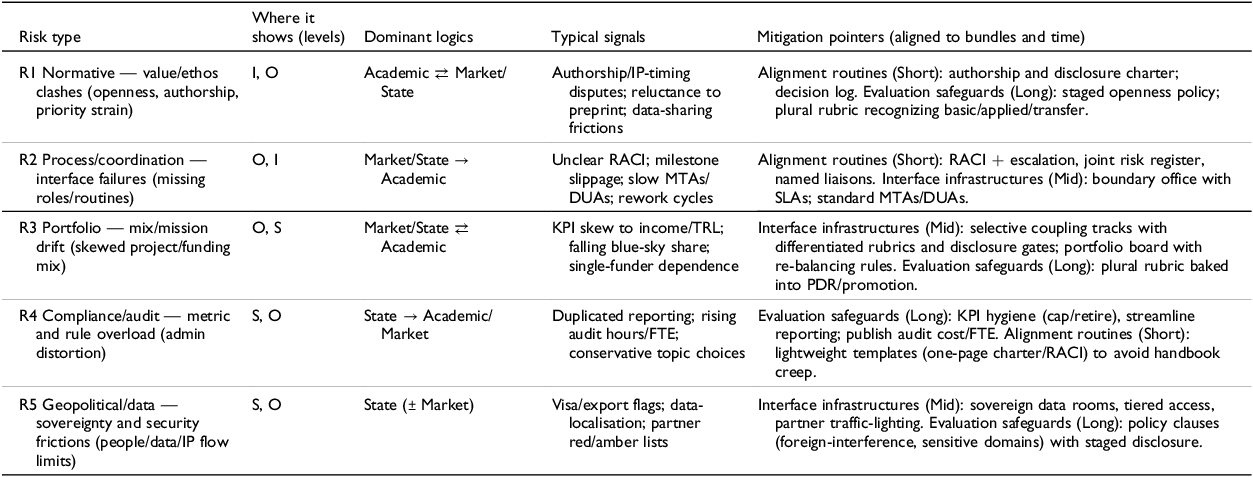
This article offers a conceptual integration that links logics-as-risk formation – how academic/professional, market and state logics generate distinct mechanisms at individual, organizational and system levels – to triadic governance-as-mitigation – how university–industry–government interactions can be choreographed (Table 1). The novelty lies in the triple-temporal sequencing of interventions: short-term alignment routines, mid-term interface infrastructures and long-term rule/norm resets. This sequencing connects diagnosis to action over time and avoids piecemeal fixes. Practically, the framework consolidates familiar devices (e.g., boundary organizations, differentiated evaluation, staged openness) into a coherent choreography that can be implemented, monitored and iterated.
Typology of risks with matched mitigation measures

Abbreviations: I = Individual; O = Organizational; S = System; IP = Intellectual Property; RACI = Responsible, Accountable, Consulted, Informed (role-clarity matrix); MTA = Material Transfer Agreement; DUA = Data Use Agreement; SLA = Service-Level Agreement; KPI = Key Performance Indicator; TRL = Technology Readiness Level; FTE = Full-Time Equivalent; PDR = Performance and Development Review.
Logic tags: ‘X → Y’ = X dominates; ‘X ⇄ Y’ = tension/duality.
It further distils the contribution into two tightly coupled elements: (1) a cross-level risk taxonomy keyed to dominant logics; and (2) a mechanism-to-mitigation choreography that aligns short-, mid- and long-term responses. Rather than treating ‘risk’ as a catch-all, we classify five recurrent types and use this concise map both as a diagnostic checklist and as a crosswalk to the three mitigation bundles developed earlier.
Conclusion
This article is the first to connect university–industry–government relations with an institutional logics perspective to produce a time-sequenced mitigation design. It integrates two strands: (i) logics-as-risk formation – how professional, market and state logics generate distinct risks at individual, organizational and system levels; and (ii) triadic governance-as-mitigation – how university–industry–government interactions can be coordinated. In answer to the research questions, the article identifies recurrent risk mechanisms and their cross-level cascades, and specifies which Triple-helix interactions and boundary roles mitigate which risks. It further demonstrates that sequencing interventions across short-, mid- and long-term horizons reduces spillovers, reconciles openness with sovereignty and mission demands, and improves overall system coherence.
The contributions are threefold. First, the study moves beyond fragmented or purely system-level analyses by developing a multi-level framework that shows how risks co-emerge and cascade across levels (Greenwood et al. Reference Greenwood, Raynard, Kodeih, Micelotta and Lounsbury2011; Zietsma et al. Reference Zietsma, Groenewegen, Logue and Hinings2017). Second, it systematically integrates the Triple-helix (Etzkowitz and Zhou Reference Etzkowitz and Zhou2017) with institutional logics (Thornton et al. Reference Thornton, Ocasio and Lounsbury2012), specifying how boundary organizations and boundary-spanning roles (e.g. TTOs, data-stewardship and research-integrity units) support ‘taking the role of the other’ and enable system-level coordination (Perkmann et al. Reference Perkmann, Salandra, Tartari, McKelvey and Hughes2021). Third, it proposes a triple-temporal design that maps risks to short-, mid- and long-term interventions and makes their feedback loops explicit, responding to calls for more temporally sensitive treatments of institutional complexity and hybrid governance (Battilana et al. Reference Battilana, Leca and Boxenbaum2009; Pache and Santos Reference Pache and Santos2013).
The study also carries practical implications. For university leaders, it provides tools to map risks and design governance structures that balance academic integrity with external collaboration. Policymakers can draw lessons about the unintended effects of single-logic policy instruments and instead design polycentric frameworks that accommodate pluralism. Industry partners gain insights into academic logics and can develop partnership models that respect scholarly values while pursuing commercial objectives. Research administrators can apply the triple-temporal approach to structure multi-stakeholder projects, institutionalizing trust-building mechanisms and hybrid arrangements.
Nevertheless, limitations remain. The conceptual nature of this study requires empirical validation, and the focus on Western higher education systems limits global applicability. Future research should employ comparative designs across national contexts to explore cultural differences in how institutional logics interact. Longitudinal studies could trace the evolution of hybrid logics and their role in sustaining resilience. Sector-specific inquiries might assess how digital transformation and geopolitical shifts reshape risk perceptions. In these ways, future scholarship can refine and extend the theoretical and practical contributions offered here.
Yuzhuo Cai is a professor in the Department of Education Policy and Leadership and Co-Director of the Global Research Institute for Finnish, European and Global South Education (GRIFE) at The Education University of Hong Kong (EdUHK). Prior to joining EdUHK, Professor Cai spent over two decades at Tampere University in Finland. He holds editorial roles including Co-Editor-in-Chief of Triple Helix and Co-Editor of the Journal of Studies in International Education. His research focuses on university–society relations through the lenses of organizational theory and international perspectives. He is listed among Stanford University’s Top 1% Scientist Rankings in the field of education. As Principal Investigator of the NEXT-UP project, he led the consortium in securing a €2.9 million Horizon Europe grant.

 Open access

