


1. Introduction
Journalist Thomas Frank famously argued that the Republican party convinced working class people to care more about “cultural wedge issues” than Republican economic stances that are against their interests (Frank, Reference Frank2004). In his reply, political scientist Larry Bartels argued that the “political significance” of cultural issues has increased more among highly educated voters (Bartels, Reference Bartels2006). This debate has become more important in light of a new debate over why low-education white voters have shifted toward the Republican party, with some scholars blaming economic factors (Autor et al., Reference Autor, Dorn, Hanson and Majlesi2020), others blaming cultural factors (Sides et al., Reference Sides, Tesler and Vavreck2019), and still others implicating both (Marble, Reference Marble2023).
In this paper, we ask how voter priorities vary by income and education. Do low-income or low-education voters care more about “economic” or “cultural” issues compared to high-income and high-education voters? This question speaks directly to debates over the importance of class in the United States, and whether parties have used wedge issues to change allegiances. It is also relevant to a larger literature on whether lower-income people are represented as well as higher-income people (e.g., Gilens, Reference Gilens2012; Ellis, Reference Ellis2017; Bartels, Reference Bartels2018). If these groups care about different policies, than this has implications for how we would expect them to be represented as well as how we might evaluate their representation (Traber et al., Reference Traber, Hanni, Giger and Breunig2022).
We depart from Bartels (Reference Bartels2006) in using a measure of “what people care about” based on choice experiments. Our approach avoids two problems that are pervasive in the most common approaches to measuring the intensity of preferences. Measures that ask people to report what they find important suffer from the fact that people find introspection difficult (Niemi and Bartels, Reference Niemi and Bartels1985; Bartle and Laycock, Reference Bartle and Laycock2012; Hanretty et al., Reference Hanretty, Lauderdale and Vivyan2020). Measures that use choices in actual elections struggle to separate the many factors that are at play in those elections, and can't assess factors that aren't at play. For these reasons a budding literature uses choice experiments to measure the intensity of issue preferences (Hanretty et al., Reference Hanretty, Lauderdale and Vivyan2020; Leeper and Robison, Reference Leeper and Robison2020; Sides et al., Reference Sides, Tausanovitch and Vavreck2023; Alvarez and Morrier, Reference Alvarez and Morrier2024).
Here we use the “revealed importance” measure from Sides et al. (Reference Sides, Tausanovitch and Vavreck2023). These measures are based on conjoint experiments, which ask respondents to choose between objects with randomly assigned attributes. In this case the objects are two opposing states of the world, and the attributes are the individual political outcomes that they are comprised of. Conjoint analysis allows us to measure the effect of a given political outcome on the choice of outcome sets. Policies that respondents care more about will have a greater effect on the choice. The magnitude of the effect can be used as a measure of the average intensity of preferences.
Contrary to our expectations, the results contradict the claim that income and education are strongly related to priorities. Despite a lot of variation in the degree to which people care about different issues, there is not much variation across social classes. The priorities of high school educated people, and people in families making less than $ 50, 000 per year are highly correlated with the priorities of college educated people and people in families making more than $ 100, 000.
2. Data and methods
This paper uses conjoint analysis to measure the revealed importance of issues, using the same methods and underlying data as Sides et al. (Reference Sides, Tausanovitch and Vavreck2023). Survey respondents are presented with ten questions that ask them which of two sets of political outcomes they prefer. By randomizing the political outcomes that are contained in each set, we can measure the effect of those outcomes on the choice of sets. The more intense a given respondents’ preferences are with respect to a particular outcome, the greater the effect it has on their choice of set.Footnote 1
Forty-four of the outcomes are policies with only two options: either enact the policy or do not, for example, “Enact Medicare-for-all” or “Do not enact Medicare-for-all.” One of these outcomes concerns whether the president should be impeached. The remaining 14 outcomes concern the election of people with various identities, for instance “A female President is elected” or “A male President is elected.” These outcomes concern the race, gender, sexual preference, and trans/cisgender identification of either a member of Congress or the President. The design of the instrument encourages respondent to consider these outcomes as independent states of the world rather than thinking about their implications for other sorts of outcomes. Appendix A has a full accounting of the political outcomes that were included.
In each experiment, four attributes are chosen at random, and each set is randomly assigned a position on each attribute. Only attributes that differ between the two sets are shown to the respondent, and experiments with less than two distinct positions are redrawn. This results in experiments that have between two and four attributes. For a small number of attributes that could logically conflict with one another (i.e., not allowing abortion under any circumstances but allowing late term abortion), only one of the attributes may appear as part of the same experiment.
Figure 1 gives an example of what this looks like with three attributes. The instrument deliberately eschews the features of a real-world election, asking respondents to simply choose between two states of the world. Attributes are randomly assigned, often forcing respondents to choose between conflicting ideological directions. For instance, in this example a left-leaning respondent who supports “government-run healthcare” and “a path to citizenship for undocumented immigrants brought here as children,” could choose only one of those. A right-leaning respondent who supports neither would have to accept one.
Example of the conjoint experiment with three policies.

The standard approach to conjoint analysis estimates the causal effect of the listed attributes on the choice (Hainmueller et al., Reference Hainmueller, Hopkins and Yamamoto2013). These effects capture the preferences of the respondents for the political outcomes as well as the intensity of those preferences (Abramson et al., Reference Abramson, Koçak and Magazinnik2022). Respondents in these experiments were also asked their position on each policy attribute (attributes concerning candidate demographics are excluded). In order to calculate revealed importance, we will condition on these policy positions. The resulting estimates will answer the question “given a particular stance on policy X, how much more likely is a respondent to choose set A if it contains their preferred stance on X?” Policies that respondents care more about will have a greater effect.
In many conjoint designs, different preferences for the reference category can lead to misleading interpretations of the effect (Leeper et al., Reference Leeper, Hobolt and Tilley2019). This is not the case here, due to the choice between two sets. Since both policy sets are randomized, a positive effect indicates a greater than 50 percent chance of selecting the set in question.
The survey was fielded as part of Nationscape (Tausanovitch and Vavreck, Reference Tausanovitch and Vavreck2021). Nationscape interviewed roughly 6250 respondents per week, and began on July 18th, 2019. The data for this project use surveys fielded from July 18th, 2019, to April 15th, 2021, for a total of 494,169 respondents. Each person was asked to make ten choices between policy sets, for a total of 4,941,690 choice pairs (9,883,380 policy sets).Footnote 2
3. Results
Figure 2 graphs the pooled average effects from the conjoint analysis for all 58 political outcomes (44 policies, 14 identity considerations).Footnote 3 These are the same estimates that can be found in Sides et al. (Reference Sides, Tausanovitch and Vavreck2023). The outcomes are listed on the y-axis. Appendix A maps the shorthand labels used in the graph on to the actual outcomes. The x-axis shows the size of the effect. They are estimated using regression models with standard errors clustered by individual. These effects, often called the Average Marginal Component Effects or AMCEs, can be interpreted as the expected difference in the probability of selecting Set A and Set B if Set A contains the outcome in question and Set B contains something else. Or equivalently if Set B contains the outcome and Set A does not. In most cases this is just a policy and the lack thereof. For instance, take the most popular policy on the list. If a set contains “Require background checks for all gun purchases” and the other set contains “Do not broaden circumstances that require background checks for gun purchases” then the average respondent is 24 percentage points more likely to choose that set, all else equal. So on average, respondents choose the set that has “Do not broaden circumstances” 38 percent of the time, and the set that has “Require background checks” 62 percent of the time. This policy is denoted by “universal gun background checks” on the y-axis.
Effects of political outcomes on choice.

Similarly, the least popular policy is “Separate children from their parents when parents can be prosecuted for illegal entry into the US,” denoted by “separate immigrant children” in the graph. Respondents are 25 percentage points less likely to choose a set that contains this policy than a set that contains “Do not separate children from their parents when parents can be prosecuted for illegal entry into the US.”
These effects capture the likelihood that a policy is chosen. However, they conflate the positions of the respondents and the intensity of their preferences. For instance, sets containing the outcome “Impeach President Trump” are no more or less likely to be chosen. However, we might think that people feel quite strongly about this policy, and indeed we will see that they do. The almost-zero effect is driven by the fact that roughly equal proportions of the sample support and oppose impeaching the president, and it is of roughly equal importance to both groups.
Fourteen outcomes on this graph are different from the rest. “White president,” “black president,” “latino president,” “asian president,” “female president,” “gay president,” and “transgender president” all refer to electing a President with a set of identity characteristics. These outcomes concern electing a president with a given race, gender, sexual orientation, and trans/cisgender identity. They are meant to capture identity-driven views that respondents may weight against policy outcomes. Each has two possible options, for example, “Elect a male President,” or “Elect a female President,” with the exception of race. If one set contains “Elect a white President” (“white president”) then the other set contains one of “Elect a black/Latino/Asian President,” chosen at random. For all of the above, rows with “MC” instead of “president” refer to “Elect a [BLANK] member of Congress in your district.” For these outcomes, we have no questions on the survey that explicitly ask whether the respondent prefers the outcome, so we will not be able to condition on preferences.
Figure 3 shows the AMCEs again, but this time separated out by income and education. The left panel shows the effect for respondents living in households making over $ 100, 000 per year in black, and the effects for respondents living in households making less than $ 500, 000 per year in blue. These groups both represent roughly a third of the population during the period of the data collection. The right panel shows the effects for respondents with a college degree in black, and the effects for respondents with a high school education or less in green. These groups are about 40 percent and about 30 percent of the population, respectively. The lines represent 95 percent confidence intervals for the effects.
Effects of political outcomes on choice by income and education level. Items are ordered by the black dots which are high income and college education and above, respectively. Blue triangles are low income and green triangles are high school education or below.

In these graphs we see a surprising amount of similarity across groups, but also some major differences. Lower-income people are much more likely than high-income people to choose sets that include a federal jobs guarantee, an increase in the minimum wage, some form of government provided insurance, debt-free college, and allowing the ten commandments to be displayed in public buildings. Respondents with a high school education or less are also more likely to support these things, although to a lesser degree with the social welfare policies and to a greater degree with allowing the ten commandments. They are also less supportive of abortion, gun control, and the environment.
As argued by Frank (Reference Frank2004), people with less education are more likely than those with higher educations to support traditional policies such as gun rights, pro-life views, opposing environmental programs, and expanding the role of religion in the public sphere. However, the crux of Reference FrankFrank's (Reference Frank2004) argument is that conservatives have been made to care more about these issues than others. This graph does not speak to that question, because it does not condition on the positions of the respondents. So the effects reflect both the degree of intensity as well as the proportion of people in each group who support the outcome in question.
Figure 4 shows the results for different income categories when we condition on the position of the respondent. The left panel contrasts the effects for high income (in black) and low income (in blue) when the respondent agrees with the outcome. The right panel contrasts the effects for high income and low income when the respondent disagrees with the outcome. The left panel is coded in the direction of the set that contains the negation of the outcome, so all effects should be positive.
Effects of agreement on choice, by income. Items are ordered by the black dots which are high income. Blue triangles are low income. Estimates from the left panel are based on respondents who agree with the policy in question, and estimates from the right panel are based on respondents who disagree with the policy in question.

These estimates are revealed importance measures that reflect the intensity of respondent preferences. Conditional on agreeing with “Build a wall on the Southern border,” respondents are about 28 percent more likely to choose the set that contains this outcome. However, conditional on agreeing with “Shift from a more family-based to a more merit-based immigration system,” respondents are only 11 percent more likely to choose the set that contains this outcome. In other words, respondents who agree that a wall should be built feel very strongly that it should on average, and are likely to choose on this basis. On average, respondents that agree with a merit-based immigration system do not feel as strongly about it, and are a lot less likely to choose on this basis.
There is clearly a lot of variation in respondent intensity across different policies, and these differences are often statistically significant. So it is remarkable how similar low- and high-income people are with respect to the intensity of their preferences. In 57 out of 88 possible cases there is a statistically significant difference, but the average significant difference is only 4.7 percentage points. Low-income people who support slave reparations feel more strongly about it than high-income people who support reparations. Low-income people who oppose federal health insurance, oppose health subsidies, or oppose repealing the estate tax feel less strongly than high-income people do. The correlation between the revealed preferences of low/high-income respondents is 0.9.
Figure 5 shows the association between the revealed importance of issues for low- and high-income people who agree with the policy in question (in the left panel) and disagree with the policy in question (in the right panel). In both cases the priorities of low- and high-income people are highly correlated, with correlations of 0.9 and 0.93, respectively. Lower-income people have a slight tendency to give lower weight to policies they disagree with, as reflected in the fact that the regression line in the right panel is higher than the 45 degree line.
Revealed importance for high-income versus low-income respondents. Estimates from the left panel are based on respondents who agree with the policy in question, and estimates from the right panel are based on respondents who disagree with the policy in question. The y-axis indicates the conditional AMCE for high-income people and the x-axis indicates the conditional AMCE for low-income people. Standard errors are for the interaction between the effect of the policy attribute and income. The blue line is the Deming regression line.

Figure 6 shows the results for different education categories. Here there is a similar number of differences that reach conventional levels of statistical significance (56), with an average significant difference of 5.2 percentage points. Again, the overall degree of similarity is quite close, with a correlation of 0.88 between the effects across education levels. The differences do not avail themselves of a simple explanation. The largest difference is for a universal job guarantee. Sixty percent of college educated respondents who disagree with this policy choose the set that does not include it. However, 54 percent of high school educated respondents who disagree with this policy choose the set that does not include it. High school educated respondents are less intense with respect to health care and the environment. Like in the results for income groups, the most important policy items with regard to revealed preference across both high- and low-education respondents are the marquee partisan policy divisions of the day: impeaching Trump, abortion bans, gun restrictions, and major immigration-related policies.
Effects of agreement on choice, by education. Items are ordered by the black dots which are people with at least a college education. Green triangles are people with a high school education or less. Estimates from the left panel are based on respondents who agree with the policy in question, and estimates from the right panel are based on respondents who disagree with the policy in question.

Figure 7 shows the association for the two sets of estimates. For respondents who agree with the policies in question, the correlation between the revealed importance for high-education people and low-education people is 0.86. For respondents who disagree with these policies, the correlation is 0.91. In most cases, we cannot reject the hypothesis that the points lie on the regression line, and differences are small in most of the remaining cases.
Revealed importance for high-education versus low-education respondents. Estimates from the left panel are based on respondents who agree with the policy in question, and estimates from the right panel are based on respondents who disagree with the policy in question. The y-axis indicates the conditional AMCE for high-education people and the x-axis indicates the conditional AMCE for low-education people. Standard errors are for the interaction between the effect of the policy attribute and education. The green line is the Deming regression line.

Claims about the working class often center on the priority that they give to economic or social welfare issues. Either it is claimed that these issues are especially important to working class people (e.g., McCarty et al., Reference McCarty, Poole and Rosenthal2016) or that they do not give these issues enough priority (e.g., Frank, Reference Frank2004). Table 1 evaluates the hypothesis that lower-income or education people place differential revealed importance on issues that are related to social welfare, labor, economic policy, or redistribution. We split the correlation between the revealed preferences of high/low-income/education respondents by policy item class (redistributive or non-redistributive), which we present alongside the pooled correlations. The differences between correlations are small but suggest that respondents of differing social class are more aligned on redistributive than non-redistributive issues.Footnote 4
Correlations for high/low income/education revealed preferences, by policy class

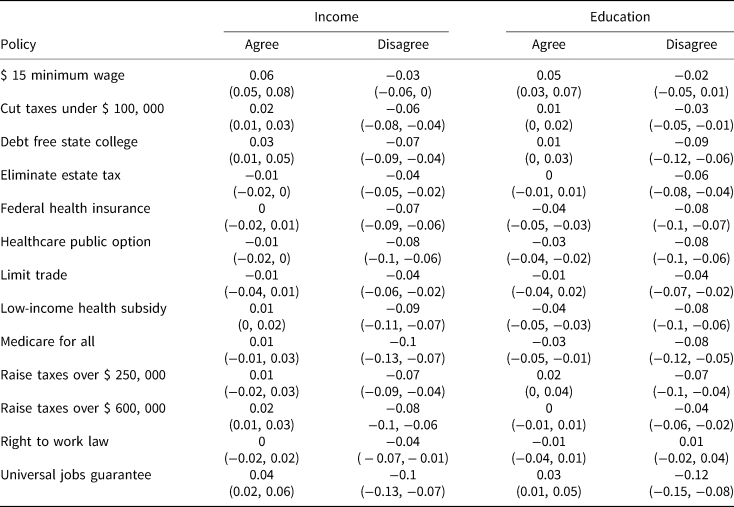
We delve further into potential differences in Table 2, where we present issue-by-issue revealed preferences differences for redistributive policies. The largest effect in this table is –.12, for low-education people who disagree with a universal jobs guarantee. This indicates that lower-income people who hold this view are 12 percent less likely to choose a set of policies on this basis.
Issue-specific differences in revealed importance by income and education

95 percent confidence intervals in parentheses. Positive values indicate that lower income (columns 1 and 2) or education (columns 3 and 4) voters care more about the issue in question. Columns 1 and 3 refer to voters who agree with the more redistributive side of the issue in question, and columns 2 and 4 refer to voters who disagree. The more redistributive side of the issue is the affirmative side in every case except for eliminating the estate tax or implementing a “right to work” law.
Due to the very large sample size, some of these effects are statistically significant, but all are small. When low-income people agree with a policy that expands social welfare, redistribution, or labor rights, they more often care more than high-income people, rather than less. Low-education people care more in six cases and less in six cases than high-education people. When low-income and low-education people disagree with a redistributive policy, they often care less about their position than high-income and high-education people do. In short there is little consistent evidence that low-income or low-education people care more about redistribution.
Many of the claims that have been made about the priorities of “working class” people concern Republicans specifically. Classic work in political economy emphasizes material self-interest as a motivator of political behavior (Meltzer and Richard, Reference Meltzer and Richard1978), leading to an expectation that lower-income people will coalesce around left-leaning parties or candidates. This makes the existence of working class Republicans a puzzle to be explained. In his exchange with Bartels (Reference Bartels2006), Frank (Reference Frank2005) argues that education is a better indicator of the “working class” and claims it is these voters who are “duped” by an emphasis on “culture war” issues into supporting the Republican party.Footnote 5
Figure 8 shows the effects for Republicans only by education level, again conditioning on the position of the respondent. The results are not meaningfully different from the results in Figure 7, with correlations of 0.85 and 0.93. Just as among voters generally, Republicans appear not to have major differences in revealed importance across lines of income and education.
Revealed importance for high-education versus low-education respondents for Republicans only. Estimates from the left panel are based on respondents who agree with the policy in question, and estimates from the right panel are based on respondents who disagree with the policy in question. The y-axis indicates the conditional AMCE for high-education people and the x-axis indicates the conditional AMCE for low-education people. Standard errors are for the interaction between the effect of the policy attribute and education. The green line is the Deming regression line.

4. Conclusion
It is indeed the case that richer people have different political views on average than poorer people (Gelman, Reference Gelman2008), and the same applies to college educated people and people with a high school education or less.Footnote 6 However, with regard to the 44 policy issues under study here, income and education are not strongly associated with differences in what people care about. The revealed importance of issues for high- and low-income and education people are highly correlated. Differences in priorities cannot account for the fact that many low-income and low-education voters support the Republican party, in tension with their material interests. Lower-income and education voters care about as much about so-called “cultural” issues as their higher-income and education counterparts. In other words, values do not appear to be “luxury goods” (Enke et al., Reference Enke, Polborn and Wu2022).
There is a voluminous debate in political science, political economy, and psychology about the role of economic self-interest as a driver of behavior (e.g., Kramer, Reference Kramer1971; Meltzer and Richard, Reference Meltzer and Richard1981; Feldman, Reference Feldman1982; Lewis-Beck, Reference Lewis-Beck1985; Sears and Funk, Reference Sears and Funk1990). The evidence here cannot resolve this debate, nor can it distinguish between self-interested and group-interested behavior. Our evidence is solely about the importance accorded to the public policy issues under study, and so does not address the importance various groups place on economic outcomes, for instance. However, this evidence squarely challenges the idea that lower-income or education people are either particularly swayed by economic issues, or that their current political alignment depends on them being particularly swayed by non-economic issues (Frank, Reference Frank2004). Lower-income and education people prioritize issues similarly to other people.
These results do not imply that variation in priorities doesn't matter. This paper reaffirms that there is substantial variation in priorities across issues and even between some demographic groups (such as party or race—see Appendix E). This could have important implications for political representation, and the possibility of differential responsiveness to policy priorities remains. Our results imply, however, that income and educational strata have a lot in common when it comes to their policy priorities.
Supplementary material
The supplementary material for this article can be found at https://doi.org/10.1017/psrm.2024.71. To obtain replication material for this article, https://doi.org/10.7910/DVN/PDX8M1
Acknowledgements
Data for this study are from Nationscape, a partnership between the UCLA Principal Investigators and the Democracy Fund, fielded by LUCID. Thanks are due to all involved, particularly our fellow members of the UCLA-based team: Alex Rossell Hayes, Aaron Rudkin, Tyler Reny, and Lynn Vavreck.
Financial support
This research was supported by the Democracy Fund and the Klarman Family Foundation.
Competing interests
None.




 Open access

