

Introduction
Healthcare workers (HCWs) often encounter demanding and distressing situations that require a unique set of skills and qualities to navigate these challenges effectively (Pipe et al. Reference Pipe, Buchda, Launder, Hudak, Hulvey, Karns and Pandergast2012). Empathy and compassion are two key qualities to help manage these situations and are essential for providing high quality, patient-centred care (Barker et al. Reference Barker, Leach and Levett-Jones2023).
Empathy is the understanding of a patient’s emotions, concerns and situations (Klimecki et al. Reference Klimecki, Leiberg, Lamm and Singer2013). Empathy and understanding the patient’s perspective are essential to building rapport and trust, which in turn positively influences the therapeutic relationship health outcomes (Yu et al. Reference Yu, Tan, Le, Tang, Liaw, Tierney, Ho, Lim, Lim, R., Chia and Low2022). Viewing pained facial expression alone, without direct exposure to painful stimuli, activated brain regions related to pain empathy, including the insula and cingulate cortices (Xiong et al. Reference Xiong, Fu, Wu, Zhang, Wu, Shi and Wu2019). As is explained below, these areas are associated with emotional regulation, perception and awareness.
According to Maslach et al. burnout is a ‘psychological syndrome’ that emerges due to chronic stress (Maslach & Leiter Reference Maslach and Leiter2016). It is widely assumed that empathy comes naturally to healthcare providers given the caring nature of the job, but often unacknowledged is its potential to contribute to burnout (Gleichgerrcht & Decety Reference Gleichgerrcht and Decety2013).
Burnout can lead to a myriad of consequences of both a personal and professional nature. Personally, it can manifest as overwhelming emotional exhaustion, cynicism, and detachment. Professionally, it can contribute to diminished morale, a feeling of ineffectiveness and a noticeable absence of accomplishment. Balancing empathy and burnout prove a significant challenge for those working in healthcare where demanding and distressing situations are frequently encountered (Maslach & Leiter Reference Maslach and Leiter2016).
Compassion on the other hand, takes empathy a step further. According to Klimecki et al. Reference Klimecki, Leiberg, Ricard and Singer(2014) compassion is a ‘feeling of concern for the suffering of others’ and is usually associated with ‘the motivation to help’ (Klimecki et al. Reference Klimecki, Leiberg, Ricard and Singer2014). Compassion is an action-oriented response to empathy and is classified as an emotional response and motivator of altruistic behaviour (Desbordes et al. Reference Desbordes, Negi, Pace, Wallace, Raison and Schwartz2012). Engaging in compassionate behaviour has been associated with enhanced psychological and physical wellbeing, which in turn protects against chronic stress and burnout (Lee et al. Reference Lee, Govind, Ramsey, Wu, Daly, Liu, Tu, Paulus, Thomas and Jeste2021) (Santarnecchi et al. Reference Santarnecchi, D’Arista, Egiziano, Gardi, Petrosino, Vatti, Reda and Rossi2014).
Compassion also enhances the patient experience, improves patient outcomes and is important in building trust and rapport (Barker et al. Reference Barker, Leach and Levett-Jones2023). The positive effect of compassion may counterbalance and mitigate the potential adverse effects stemming from empathy (Klimecki et al. Reference Klimecki, Leiberg, Ricard and Singer2014).
Desbordes et al. (Reference Desbordes, Negi, Pace, Wallace, Raison and Schwartz2012) state that compassion can be built upon with ‘compassion-focused meditation training.’ Compassion-focused meditation is fundamentally connected to and includes the practices of meditation and mindfulness (Hofmann et al. Reference Hofmann, Grossman and Hinton2011).
Neuroscience of meditation
Research has provided valuable insights into tangible neurological changes that occur in the brain as a result of meditation and mindfulness practices (Santarnecchi et al. Reference Santarnecchi, D’Arista, Egiziano, Gardi, Petrosino, Vatti, Reda and Rossi2014). Understanding the neuroscience of meditation provides valuable insights into the potential cognitive, emotional, and physiological benefits associated with meditation. Meditation is a taught skill that can be developed by ‘turning attention or awareness to stay on a single object, sound, concept or experience’ (Leung et al. Reference Leung, Chan, Yin, Lee, So and Lee2013). The purpose of these practices is to cultivate well-being and emotional balance (Lutz et al. Reference Lutz, Slagter, Dunne and Davidson2008). Compassion-focused training is a targeted approach designed to develop or sustain compassion and enhance emotional regulation (Desbordes et al. Reference Desbordes, Negi, Pace, Wallace, Raison and Schwartz2012). Encouraging healthcare professionals to actively participate in compassion-focused training has the potential to yield numerous benefits, positively impacting both individual wellbeing and the quality of patient care.
Developments in imaging and neuroscience
Neuroimaging, particularly functional Magnetic Resonance Imaging (fMRI) has offered valuable insights into the brain responses related to cognitive-emotional function by indirectly measuring neural metabolism through fluctuations in the blood oxygen level dependent signals. This coupled activity is referred to as ‘neurovascular coupling’ (Hillman Reference Hillman2014)
This scoping review aims to explore the neurological changes that are associated with compassion-focused meditation training. Evidence gathered in these reviewed articles use fMRI to identify neurological changes in specific regions of the brain, and each display a variety of different changes, likely due to the marked variation in protocol and participant populations. Understanding these changes may provide valuable insights into the underlying basis of compassion and reinforce its particular value in healthcare settings.
Methods
An initial search for relevant literature suggested a paucity of research on the effects of compassion focused meditation on the brain. A scoping review methodology was thus employed.
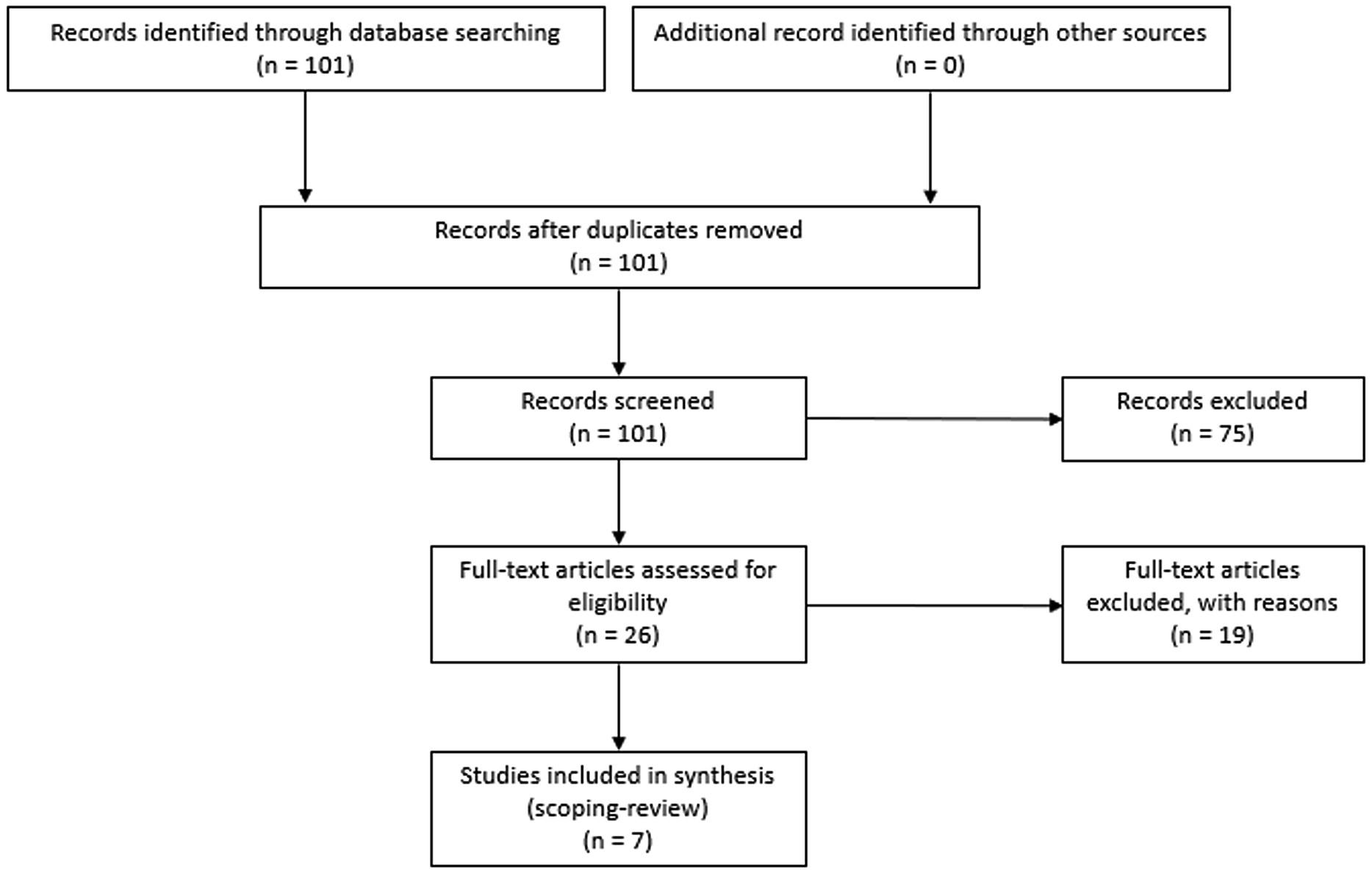
Three electronic databases were searched, PubMed, Medline (Ovid) and APA Psychology using the search terms. In the initial search, 101 articles were identified. A review of the titles and abstracts was conducted, followed by review in full against the inclusion criteria. 26 full text articles were assessed, 7 of which were identified for the review (Fig. 1).
Flow diagram of study selection process.

Inclusion and exclusion criteria were established following a brief review of the existing literature to map the field. This included papers which described structural changes in the brain associated with meditation, with focus on compassion. Papers were excluded if the study included a participant population with any history of cognitive impairments, substance abuse or psychiatric illnesses, excluding depression and social anxiety. Literature profiling the longitudinal effects of meditation on brain structure in the ageing population were also excluded.
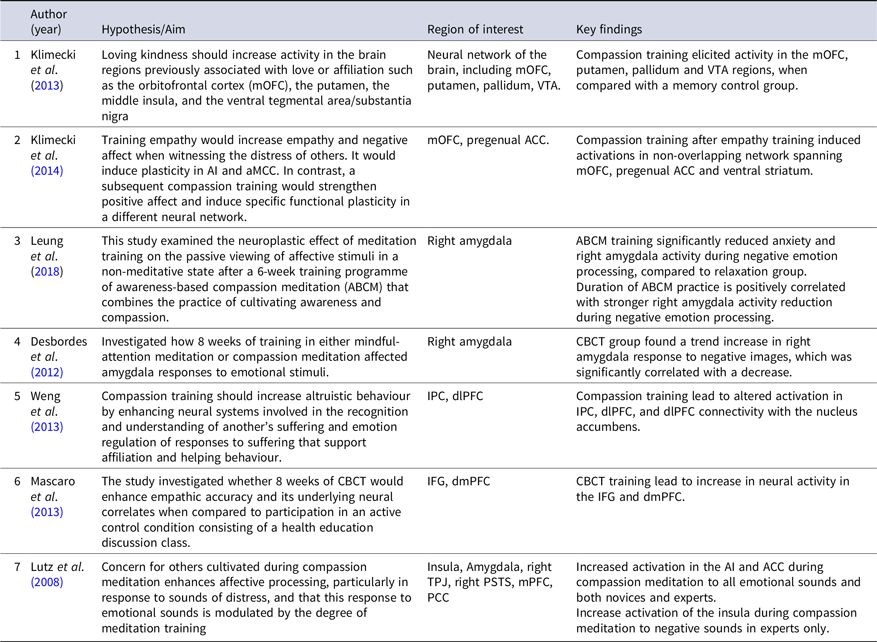
A standardised method was used to first extract study characteristics including authors, publication year, participant characteristics, meditation training instructions, method of data collection and radiology scan details, focusing on time between meditation training and final brain scanning, as shown in table 1. The data was divided into three headings – hypothesis/aim of the study, region of interest during the scanning process and key findings of the study, as shown in Table 2.
Overview of the papers selected for this scoping review (N = 7)

AI, Anterior Insula; ACC, Anterior Cingulate Cortex; ABCM, Awareness based compassion mediation; CBCT, Cognitive-based compassion training; COM, Compassion Therapy; dlPFC, dorsal lateral prefrontal cortex; dmPFC, dorsal medial prefrontal cortex; fMRI, functional Magnetic Resonance Imaging; HE, people in distress; IFC, Inferios Frontal Gyrus; IPC, Inferior Parietal Cortex; LE, baseline normal activities; MAT, Mindful Attention Training; mOFC, medial Orbital Frontal Cortex; NAcc, nucleus accumbens; pACC, pregenual Anterior Cingulate Cortex; REP, Reappraisal Therapy; RMET, Reading the Mind in the Eyes Test; STS, superior temporal sulcus.
The ‘Redistribution Game’ involved a simulation which involved unfair distribution of value to a victim (which the participants were told was another live player) and a choice to redistribute the subject’s own wealth at a personal cost to the subject themselves.
Data selection and summary

ABCM, awareness-based compassion meditation; ACC, Anterior Cingulate Cortex; AI, Anterior Insula; aMCC, anterior midcingulate cortex; CBCT, Cognitive-based compassion training; dmPFC, dorsal medial prefrontal cortex; dlPFC, dorsal lateral prefrontal cortex; IFG, inferior frontal gyrus; IPC, inferior parietal cortex; mOFC, medial Orbital Frontal Cortex; PCP, posterior cingulate cortex; pFC, pre-frontal cortex; PSTS, posterior superior temporal sulcus; TPJ, temporal-parietal junction; VTA, ventral tegmental area.
Results
Study characteristics
There were seven studies included in this scoping review. Whilst all utilised fMRI to investigate the effect of compassion training on brain activity, the studies varied in terms of participant population and methodology. Some used visual stimuli while others used audio stimuli to depict affective information during testing of compassion meditation. Six studies had a relatively small sample size, limiting the statistical power, with two studies only recruiting a single gender. All studies also had a short training period, ranging from a day to three weeks; the standard meditation training duration is considered 8 weeks.
fMRI activity changes
As outlined in Table 1, the included papers saw activation changes in the anterior cingulate cortex (ACC), insula, amygdala, medial prefrontal cortex (mPFC), medial orbitofrontal cortex (mOFC), and the dopamine system.
Anterior cingulate cortex (ACC)
Klimecki et al., investigated the effects of compassion training on brain activity, as assessed through fMRI, originally in 2013 and then followed up this paper, one year later, in 2014 in order to substantiate their findings. In their follow up paper, Klimecki et al. Reference Klimecki, Leiberg, Ricard and Singer2014, found self-reported empathy ratings for emotional videos were higher in the group that underwent compassion training, compared to the group that did not. Further to this, empathy training amplified negative affect, which can broadly be described as feelings of emotional distress, while compassion training restored positive feelings and lowered negative reactions to baseline levels. Accompanying these affect findings, they found increased activations in the pregenual ACC as a result of compassion training (z = 4.26, cluster size 1605, p < 0.05).
In 2008, Lutz et al., assessed brain activity through fMRI in experts in compassion meditation and novices, who practiced compassion meditation for an hour a day for one week. They found an increase in compassionate response to all emotional sounds, which presented as increased activation in the ACC (F = 28.06) in both novices (p < 0.0005) and experts (p < 0.005). The ACC has been shown to project to the temporo-parietal junction (TPJ), which was also implicated in the Lutz study. They found greater activation of the TPJ, in response to sounds during compassion training, compared to when at rest, an effect strongly modulated by expertise (F = 18.5, t = 4.6, p < 0.0005).
Insula
The Lutz group also identified increased activation in the anterior insula (AI) during compassion meditation in both novices and experts (F = 27.2, p < 0.0005). In their original paper, Klimecki et al. (Reference Klimecki, Leiberg, Lamm and Singer2013) studied affective plasticity in healthy adults by measuring their responses to witnessing the distress of others. Using independent t-tests, they found that following empathy training, participants rated low emotion videos as higher on the empathy scale compared to the group that did not have compassion training. To further this, the high emotion videos elicited stronger activation in the posterior insula than the low emotion videos (z = 4.59, cluster size = 12, p < 0.05). Further implicating the role of the insula in compassion, Klimecki et al. (Reference Klimecki, Leiberg, Lamm and Singer2013), also observed activation in the AI during both empathy and compassion training (Klimecki et al. Reference Klimecki, Leiberg, Ricard and Singer2014).
Amygdala
Leung et al. (Reference Leung, Lau, Chan, Wong, Fung and Lee2018) and Desbordes et al., specified the right amygdala as a region of interest prior to the start of their investigation. Desbordes et al., investigated the differences between two compassion training techniques, Mindful Attention Training (MAT), and Cognitive-based compassion training (CBCT). When investigating their MAT group, they observed a decrease in right amygdala activation in response to positive emotional stimuli (p = 0.012, t = −3.00, df = 11) and a trend increase in activation in response to negative emotional stimuli (p = 0.011, t = −3.06, df = 11). While this increase was not significant at the group level (p > 0.1), a correlation analysis indicated that increased amygdala activation occurred in the subjects who had reported the most hours of practice. However, this did not reach statistical significance (r = 0.46, p = 0.13, N = 12). In their CBCT training group, no amygdala changes reached significance, however, trends for decreased right amygdala activation in response to positive valence images (p = 0.085, t = −1.89, df = 11) and increase right amygdala activation in response to negative images in subjects who reported the greatest number of hours of practice time (r = 0.46, p = 0.13, N = 12), were seen.
In 2018, Leung et al., investigated the difference in anxiety levels between an awareness-based compassion meditation (ABCM) group and a control group. They found at baseline, no difference in anxiety levels between participants in the two groups, however, following ABCM training, found the ABCM group to have less anxiety than controls. These decreases in anxiety were concurrent with observed specific neuroplastic effects in the right amygdala during negative emotion processing, where right amygdala activity was reduced (p = 0.014, t = 4.21).
Medial prefrontal cortex (mPFC)
When investigating the effect of compassion training on neural activity, Mascaro et al. Reference Mascaro, Rilling, Tenzin Negi and Raison(2013), looked at how CBCT altered scores on an empathic accuracy task, the Reading the Mind in the Eyes Test (RMET), and how this correlated with fMRI findings. The CBCT group scored higher on the RMET (p < 0.03) and this occurred concurrently with increased activity in the dmPFC (F(19) = 6.16, p < 0.05, η2 = 0.25), left IFG (F(19) = 7.05, p < 0.02, η2 = 0.27) and left STS (F(19) = 4.20, p < 0.06, η2 = 0.18) compared to the control group (Mascaro et al. Reference Mascaro, Rilling, Tenzin Negi and Raison2013).
Implementing a different measurement of compassion, through the ‘Redistribution game’, Weng et al., saw a redistribution of wealth of 31% in the control group compared to 51% in the compassion training group. These behavioural changes occurred concomitantly with greater activation of the right inferior parietal cortex (IPC) (p < 0.01) and dorsolateral prefrontal cortex (dlPFC), in the compassion training group, compared to the control group. (Weng et al. Reference Weng, Fox, Shackman, Stodola, Caldwell, Olson, Rogers and Davidson2013). The activation changes in these two regions were highly coupled in both the compassion and the control group (compassion group r (18) = 0.92, p < 0.001; control group r (19) = 0.79, p < 0.001) and both differentially predicted scores in the redistribution game, which were reflective of higher compassion levels.
Medial orbitofrontal cortex (mOFC)
The role of the mOFC is implicated in this scoping review by both the original and follow up Klimecki papers. In 2012, Klimecki identified increased activation in the mOFC after compassion training (z = 5.7, p < 0.05), which was further substantiated by the same group in 2014, when they found that compassion training induced non-overlapping brain changes in the mOFC (z = 4.26, cluster size 1605, p < 0.05).
The dopamine system
Various components of the dopamine system are implicated throughout this review. Only Klimecki et al., outlined the ventral tegmental area (VTA) as a region of interest prior to the start of their investigation and they observed heightened activation in the VTA after compassion training. However, Leung et al. (Reference Leung, Lau, Chan, Wong, Fung and Lee2018) also found increased activity in the VTA, indicating positive affect enhancement. The VTA, a region located in the midbrain, contains dopaminergic neurons that project to nucleus accumbens (NAcc).
Weng et al., found that connectivity between the dlPFC and the NAcc was predicted by display of compassionate behaviours in the ‘Redistribution game’. Within the compassion training group, those who showed increased dlPFC/NAcc connectivity displayed greater levels of compassionate behaviours (t = 1.85, sr = 0.27, p = 0.07), after training, whereas the control group, who showed increased dlPFC/NAcc connectivity displayed lower levels of compassionate behaviours (t = −2.87, sr = −0.41, p < .01).
In their original paper, Klimecki et al., found that for expert practitioners, who practiced all three compassion-enhancing techniques, the generation of strong (when compared to weak) feelings of compassion was associated with greater activation in the caudate (z > 8.21, cluster size = 7825, p < 0.05). Although, the SMA is not strictly part of the dopamine system, it does have connections with dopaminergic pathways and is modulated by dopamine activity and showed similar activation profiles. Both the left and the right SMAs had greater activation in these expert practitioners in the generation of strong feelings of compassion (SMA) (SMA-R: z > 8.21, p < 0.05; SMA-L: z > 8.21, cluster size 1059, p < 0.05).
Discussion
Compassion is a complex emotional and behavioural response, involving various brain regions and neural networks (Novak et al. Reference Novak, Malinakova, Mikoska, van Dijk and Tavel2022). This scoping review contributes to our knowledge of how the brain adapts to emotional experiences and stress through interconnected mechanisms. The reviewed studies examined a total of 284 participants and found various neurological changes in regions of the brain underlying the neuroscience of compassion. These regions include the amygdala, the AI, mPFC, mOFC, and structures within the dopamine system.
Amygdala
The amygdala, a component of the limbic system, is a multifaceted structure, with functions primarily linked to the regulation of emotions, especially in relation to stress, fear, and pleasure (Phelps Reference Phelps2006). Electrical stimulation of the amygdala, in humans, triggers fear and anxiety responses, while lesions seem to inhibit certain, but not all, unconditioned fear responses (Roddy et al. Reference Roddy D, Kelly, Farrell, Doolin, Roman, Nasa, Frodl, Harkin, O’Mara, O’Hanlon and O’Keane2021; Sah et al. Reference Sah, Faber, Lopez De Armentia and Power2003). The amygdala is also implicated in social and emotional processing. It may play a role in detecting and responding to emotional cues in others (Anderson & Phelps Reference Anderson and Phelps2000), therefore, contributing to empathetic responses and compassionate behaviour. Beyond this involvement, the amygdala contributes to social and emotional learning (Roddy et al. Reference Roddy D, Kelly, Farrell, Doolin, Roman, Nasa, Frodl, Harkin, O’Mara, O’Hanlon and O’Keane2021). Several studies have observed changes in amygdala activity in response to environmental input and learning, as supported by Desbordes et al. (Reference Desbordes, Negi, Pace, Wallace, Raison and Schwartz2012) and Leung et al. (Reference Leung, Lau, Chan, Wong, Fung and Lee2018).
Anterior insula
A previous meta-analysis, of 162 fMRI studies, found that alongside the amygdala, the AI is one of the most activated regions in the study of emotions (Kober et al. Reference Kober, Barrett, Joseph, Bliss-Moreau, Lindquist and Wager2008) and it is considered part of the limbic system (Seth Reference Seth2013). Previous findings have suggested that the AI is similarly activated during both self-experienced pain and during observed or implied pain in others (Singer et al. Reference Singer, Seymour, O’Doherty, Kaube, Dolan and Frith2004; Botvinick et al. Reference Botvinick, Jha, Bylsma, Fabian, Solomon and Prkachin2005; Jackson et al. Reference Jackson, Brunet, Meltzoff and Decety2006). This suggestion of shared circuitry for self-pain and third-person pain leans towards the involvement of the AI in empathy. The AI has strong functional and structural connections to the ACC, which can be considered the limbic motor cortex (Medford & Critchley Reference Medford and Critchley2010; Levins et al. Reference Levins, Drago, Roman, Martin, King, Murphy, Gallagher, Barry, O’Hanlon and Roddy2019) and therefore, this implicates AI involvement, not only in empathy, but also in compassion processing. The literature within this scoping review reinforced these findings with Klimecki et al. Reference Klimecki, Leiberg, Lamm and Singer(2013) observing activation in the AI during both empathy and compassion training (Klimecki et al. Reference Klimecki, Leiberg, Ricard and Singer2014).
Prefrontal regions
It has been suggested that when AI activation levels are high enough, the mPFC is activated (Masten et al. Reference Masten, Morelli and Eisenberger2011). The mPFC, composed of the medial precentral area, ACC, prelimbic cortex and infralimbic cortex (Xu et al. Reference Xu, Chen, Li, Xing and Lu2019), has connections to key emotional limbic areas (Roddy et al. Reference Roddy, Roman, Rooney, Andrews, Farrell, Doolin, Levins, Tozzi, Tierney, Barry, Frodl, O’Keane and O’Hanlon2018; Roddy & O’Keane Reference Markowitsch, Emmans, Irle, Streicher and Preilowski2019) and has been shown to have a role in compassion, which is substantiated in this scoping review. Mascaro et al. Reference Mascaro, Rilling, Tenzin Negi and Raison(2013) observed increased activity in the dmPFC and left inferior frontal gyrus (IFG) in the CBCT group, reinforcing its role in compassion (Mascaro et al. Reference Mascaro, Rilling, Tenzin Negi and Raison2013). Weng et al. Reference Weng, Fox, Shackman, Stodola, Caldwell, Olson, Rogers and Davidson(2013) also observed altruistic changes, in the form of higher scores in the compassion group, compared to the control group, in their virtual redistribution game. The compassion training group saw a redistribution of wealth of 51% compared to just 31% in the control group. This behavioural change occurred concomitantly with activation of the right IPC and dlPFC, implicating the role of these regions in the execution of compassionate behaviours (Weng et al. Reference Weng, Fox, Shackman, Stodola, Caldwell, Olson, Rogers and Davidson2013). These results indicate that fronto-parietal executive control networks could be engaged following exposure to compassion training, aiming to regulate emotions and foster altruistic actions. Furthermore, the mOFC, which has shown increased activity following empathetic care (Ashar et al. Reference Ashar, Andrews-Hanna, Dimidjian and Wager2017), is also implicated in this scoping review.
Klimecki et al. (Reference Klimecki, Leiberg, Lamm and Singer2013) identified increased activation in the mOFC after compassion training. This areas contribute to social cognition, empathy and decision making related to compassionate behaviour and appear to increase in activity following exercises that are thought to build compassionate behaviour.
Anterior cingulate cortex
With the ACC being such a multifaceted cortex, it is difficult to define a universal function, however, we can further sub-divided the ACC into gyral (ACCg) and sulcal (ACCs) regions. The ACCs, otherwise known as the dorsal ACC, has direct projections to the spinal cord and various other motor areas (Vogt & Gabriel Reference Vogt and Gabriel1993), implicating its involvement in the movement side of emotion. Klimecki et al. Reference Klimecki, Leiberg, Ricard and Singer(2014), found increased activations in the pregenual ACC, considered part of ACCg, as a result of compassion training. The ACCg has been shown to project to the temporo-parietal junction (TPJ) and dorsomedial prefrontal cortex (Seltzer & Pandya Reference Seltzer and Pandya1989; Markowitsch et al. Reference Markowitsch, Emmans, Irle, Streicher and Preilowski1985; Roddy et al. Reference Roddy, Roman, Nasa, Gazzaz, Zainy, Burke, Staines, Kelleher, O’Neill, Clarke, O’Hanlon and Cannon2022), areas which have been strongly implicated in processing the mental states of others (Frith & Frith Reference Frith and Frith2006). (Lutz et al., Reference Lutz, Slagter, Dunne and Davidson2008, further substantiated the role of TPJ in compassionate behaviours)
The role of dopamine
The dopamine system, a neural conductor of mood regulation, centres around key regions like the substantia nigra and VTA. Beyond its role in motor control, the substantia nigra, housing dopamine-producing neurons, extends its reach into emotional domains via the mesocortical pathway (Radwan et al. Reference Radwan, Liu and Chaudhury2019). Adjacent to the substantia nigra, the VTA serves as a centre for dopamine activity, projecting neurons to various brain regions, including the striatum and amygdala. This neural network integrates key structures such as the striatum, comprising the caudate nucleus and putamen, which play roles in motor function and reward processing. Additionally, it encompasses the nucleus accumbens (NAcc), further contributing to its significance in cognitive and behavioural regulation.
Dopaminergic input into the amygdala is implicated in regulating the salience of stimuli, finely tuning stress responses (Lee & Kim Reference Lee and Kim2016). Through this mechanism, dopamine helps maintain the balance between heightened alertness and emotional well-being during stress. Klimecki et al. (Reference Klimecki, Leiberg, Lamm and Singer2013) and Leung et al. (Reference Leung, Lau, Chan, Wong, Fung and Lee2018) observed heightened VTA activation following compassion training, indicative of enhanced positive affect.
Moreover, Klimecki et al. (Reference Klimecki, Leiberg, Lamm and Singer2013) revealed increased activation in both the left and right supplementary motor areas (SMAs) among expert practitioners when generating strong feelings of compassion. The SMA, integral to various aspects of motor behaviour, including planning and executing actions, may underpin compassionate acts, reflecting the orchestration of supportive behaviours. Additionally, the SMA’s involvement in motor learning and outcome monitoring suggests its role in processing the positive outcomes of compassionate actions.
Traditionally associated with reward processing, including social rewards, the NAcc plays a role in motivating prosocial behaviours elicited by compassionate feelings (Radwan et al. Reference Radwan, Liu and Chaudhury2019). Supporting this, Weng et al., demonstrates the role of NAcc in reinforcing the rewarding aspects of compassionate behaviour by exhibiting increased dlPFC/NAcc connectivity and heightened compassionate behaviour post-training.
Collectively, these findings illuminate the intricate interplay between the dopamine system, neural connectivity, and compassionate behaviour, providing insights into the neural mechanisms underlying compassion training and its implications for emotional regulation and prosocial engagement.
Conclusion
In the field of compassion-focused interventions, there is growing interest in understanding how practices such as meditation and mindfulness can influence brain function. It has been shown to increase the volume and density of hippocampal grey matter in the brain and has a positive effect in white matter promoting fibre integrity (Luders et al. Reference Luders, Kurth, Toga, Narr and Gaser2013). When applied to healthcare professionals, meditation and mindfulness have been shown to be a valuable tool for reducing stress and promoting overall well being, necessary to navigate the demands of their roles, fostering a resilience and balanced approach to both work and life (Strauss et al. Reference Strauss, Gu, Montero-Marin, Whittington, Chapman and Kuyken2021).
Through this scoping review, compassion training has been found to bring about notable changes in key brain regions associated with emotional processing, regulation, and decision-making. For instance, the amygdala, shows decreased reactivity to distressing stimuli following compassion training, indicating improved emotional regulation. This change interacts with the AI, resulting in a heightened sensitivity to others’ emotions, facilitating a deeper understanding of suffering, which is essential for providing compassionate care. The mPFC and mOFC work together to understand perspectives and make empathetic decisions, promoting patient-centred care. Finally, the dopamine system, important for mood regulation and reward processing, integrates with these regions, reinforcing the positive aspects of compassionate behaviours and increasing motivation.
There were several limitations of this scoping review, the main limitation being the heterogeneity of the reviewed studies in methodology and participant pool. Some studies used visual stimuli while others audio stimuli to depict affective information during testing the effects of compassion meditation. It is unclear if these differing stimuli produce different brain activation. To further this, most of the studies had a relatively small sample size, limiting the statistical power, with two studies only recruiting a single gender. Whilst recruiting a single gender removes the need to account for sex-based variability, it is more difficult to extrapolate these results to the general population. All studies also had a short training period, ranging from a day to three weeks; the standard meditation training duration is considered 6-8 weeks. The majority of studies highlighted the importance of future longitudinal work that consider differences in the participant population, determine the length of compassion training needed to have sustained behavioural effects and map out the behavioural and activation changes that occur after longer intervention. Despite its many strengths, fMRI technology also carries inherent limitations, including susceptibility to motion artefacts, potential confounding variables, and challenges in interpreting neural correlates of behaviour.
This scoping review highlights that compassion-focused training can lead to significant neurological changes which interconnect to bolster overall well-being, resilience, and compassionate care among healthcare professionals. While there are clear advantages to incorporating this training into healthcare education, further investigation is necessary to establish conclusive evidence of its sustained and cost-effective benefit. Expanding upon current findings, future research should investigate the long-term effects of compassion training on brain structure and function and how this translates in a healthcare setting, with regards to quality of care. Examining how consistent practice influences neurological changes over time can provide valuable insights into how this impacts the well-being of healthcare professionals and the quality of care they provide. Methodology should also be expanded to include other forms of neuroimaging.
Competing interests
The authors declare none.
Funding support
This research received no specific grant from any funding agency, commercial or not-for-profit sectors.
Ethical standard
The authors assert that all procedures contributing to this work comply with the ethical standards of the relevant national and institutional committee on human experimentation and with the Helsinki Declaration of 1975, as revised in 2008.


 Open access

