


1. Introduction: The philosophical significance of comparison
[H]ow a and b can be kept separate and at the same time be brought together in the spaceless, partitionless field of thought, is the impenetrable and unparalleled mystery of consciousness.
Borden P. Bowne (Reference Bowne1886, 119)Observations about comparison played an important role in philosophical arguments in ancient Greek and Indian philosophy for the simplicity and supersensibility of the soul.Footnote 1 Centuries later, post-Kantian philosophers saw in the notion of comparison the key to an answer to Kant’s criticism of arguments for the simplicity of the soul. The rough idea of the argument from comparison is that comparing is a basic activity that can only be performed by a metaphysically simple “performer.” In the nineteenth century, the argument gained prominence mainly in the form in which Hermann Lotze (1817–81) presented it.Footnote 2
Lotze’s argument from comparison impressed many. To name a few prominent examples: Hermann Ulrici (1806–84) endorsed the argument in his Leib und Seele (Reference Ulrici1866, 315–16). Later, in his Psychology from an Empirical Standpoint (1874, 159 [II, 226])), Franz Brentano (1838–1917), the grandfather of phenomenology, developed Lotze’s argument further. The founder of personalism (and reader of Lotze), Borden Parker Bowne (1847–1910), repeated Lotze’s argument in his Introduction to Psychological Theory (1886, 119–20). Footnote 3 Last, but not least, the young Russell endorsed the argument:
Any comparison of ideas requires absolute unity of subject which compares. Hence Lotze derives substantiality of soul. (This seems to me a valid ground.) (Russell [1898] Reference Russell2020, 68; my emphasis).
Now, Lotze would have balked at the claim that he had derived the substantiality of soul. To see this, let’s consider how Lotze himself presented the conclusion of the argument from comparison:
Any comparison of two ideas, which ends by our finding their contents like or unlike, presupposes the absolutely indivisible unity of that which compares them: it must be one and the same thing which, first forms the idea of a, then that of b, and which at the same time is conscious of the nature and extent of the difference between them. […] This then is what we mean by the unity of consciousness; and it is this that we regard as the sufficient ground [Rechtsgrund] for assuming an indivisible soul. ([1879] Reference Lotze1912, 423–24 [477–78]; my emphasis.)Footnote 4
The argument is supposed to establish as its primary conclusion a truth about the kind of unity consciousness is. Lotze (see, for example, [1879] Reference Lotze1912, 457 [515–16]) gives examples of simultaneous awareness of different qualities such as colour, temperature, scent, and sound and such multiple awareness seem to be the normal case. Is our consciousness therefore a unity in which prior parts corresponding to each property are combined to a whole or not? Lotze’s primary conclusion was that consciousness is an “indivisible unity” that is not composed of parts. This is taken to imply a secondary conclusion that there is an indivisible soul.Footnote 5 However, Lotze ([1879] Reference Lotze1912, sec. 243) argued in some detail that the indivisibility of the soul does not imply its substantiality.Footnote 6 Hence, Russell misconstrued the intended conclusion.
In this paper I set aside Lotze’s secondary conclusion and focus on his primary conclusion. One reason to do so is that the step from the primary to the secondary conclusion is problematic. Why not go for a different conclusion that avoids a soul or ego?
If you must end by simply saying that your ‘Ego’, whilst being neither the idea of m nor the idea of n, yet knows and compares both, why not allow your pulse of thought, which is neither the thing m nor the thing n, to know and compare both directly? ’Tis but a question of how to name the facts least artificially. (James Reference James1890 I, 500–1)
Maybe the gap identified here by James can be filled, but exploring this issue requires a different paper.
My main reason to focus on Lotze’s primary conclusion is a point of independent philosophical interest. It is directly linked to the debate in the metaphysics of consciousness about whether the consciousness of a human being at a time is composed of parts. The “bottom-up” view answers YES.Footnote 7 The view must provide an answer to the question in virtue of what do some mental phenomena compose the consciousness (of a human being) at a time?Footnote 8 In contrast, the “top-down” approach to the unity of consciousness takes consciousness at a time to be a primitive unit of experience.Footnote 9 The “top-down” approach avoids the question of composition but, in turn, must articulate a conception of complexity for consciousness that is compatible with it not being composed out of parts. Dainton (Reference Dainton, Schneider and Velmans2017a, 511) suggests, with reference to nineteenth-century philosophers such as Bergson and James, that phenomenal interpenetration is a strong reason for the top-down view: what it is like to be visually aware of a green meadow depends on (all) other experiences that accompany it.
Lotze’s argument from comparison is an attempt to provide a different reason for the top-down view that consciousness is a primitive unity. The argument eschews appeal to phenomenal character and its conclusion is stronger than that of the arguments Dainton has in mind: consciousness is not conceived as a complex of interdependent mental phenomena. It really is indivisible; there are no parts, interdependent or not. For example, Lotze’s PhD student Carl Stumpf (1848–1936) said in his lectures:Footnote 10
Even the simultaneous presence of several elements in the same consciousness is a metaphor, a hypostatisation of the elements. We have one state in which we can distinguish by abstraction different sides. (Stumpf Reference Stumpf1906–7, 235)Footnote 11
This needs more explanation, which I provide in section 9.
Lotze’s argument is philosophically important. Is it defensible? As far as I am aware, the argument from comparison, as it figures in the work of Lotze, has not been investigated in detail.Footnote 12 In this paper, I will fill this gap and assess whether the argument makes a good case for the primary conclusion. I draw on Brentano’s development of Lotze’s argument because Brentano teased out important details and defended the core premise of the argument in an imaginative way.
The plan of the paper is as follows: I start by setting Lotze’s argument from comparison in its historical context. In so doing, I shall link it to Kant’s discussion of the question of whether aggregates can think (section 2) and to Herbart’s psychology (section 3). In section 4, I work through Lotze’s characterisations of comparing in order to extract from them the main features of comparing. In section 5, I reconstruct Lotze’s argument from comparison by drawing on intuitions about comparing as an activity of people. In section 6, I defend the main premise of the argument with the help of Brentano. Section 7 considers Lotze’s main contribution to the development of the argument from comparison: he argued, again drawing on features of comparison, that progress in physics gives us no reason to expect an account of how mental acts “sum” or “combine” to one unity that supports comparisons. This argument will bear on Herbart’s view. I will then unpack Lotze’s view that consciousness is an indivisible unity further (sections 8 and 9).
2. The Kantian background: Can aggregates think?
An important part of the background of Lotze’s argument from comparison is Kant’s treatment of the paralogism of simplicity in the first edition of the Critique. Footnote 13 Lotze ([1879] Reference Lotze1912, 428 [483]) explicitly states that he is responding to the paralogism of substantiality from the first edition of the Critique. I therefore take it to be plausible and supported by Lotze’s way of framing the arguments that he addresses the paralogisms as they occur in the first edition.
The target of Kant’s discussion of the paralogism of simplicity is a particular kind of argument intended to establish the simplicity of a thinking thing (soul) from premises about properties of thinking. Forms of this argument can be found in Wolff and other rationalists such as Mendelssohn, as well as in Kant’s own earlier work.Footnote 14
Kant’s choice of illustrative examples owes much to Mendelssohn’s dialogue Phaedon oder über die Unsterblichkeit der Seele. Footnote 15 In this dialogue, Mendelssohn’s protagonist Socrates argues that a complex soul cannot have the power to think. Mendelssohn motivates his view by considering the relation between syllables and sentences (Mendelssohn [1767] Reference Mendelssohn and Brasch1881, 211). There are properties of sentences that are composed of syllables that cannot be inferred solely from the properties of the syllables they contain. If we only had a list of syllables and knew their properties, we would not be able to understand the sentences made from them. Mendelssohn (213) goes on to argue that similar things are true of thoughts and concepts. Assume, for the sake of argument, that the content of a proposition is made up of several concepts. If each of these concepts were entertained by a different thinking part, none of these parts, nor their sum, would entertain the whole propositional content. Hence, under this assumption, we could neither “remember, nor ponder, nor compare, nor think, nay be the same person that we were a moment ago” (213; my translation). Mendelssohn listed here central cognitive abilities, among them comparing that an aggregate of thinking parts cannot have. His further claim that such an aggregate cannot be a person that persists from one moment to another depends on further assumptions about aggregates. In the following, only Mendelssohn’s argument about cognitive abilities will be of interest.
Comparing also already played an important role in Christian Wolff’s argument for the simplicity of the soul. Wolff argued that no movement of a machine (an organised aggregate of parts) can be thinking. A thought not only concerns objects, but in thinking of an object the thinker “holds it apart from itself and presents the difference from itself at the same time” (Wolff Reference Wolff1747, 462). Presenting and recognizing relations such as difference involves comparison, and the machine is not supposed to be able to compare its own states with previous ones and things distinct from them.Footnote 16 Wolff seems to take it to be obvious that an aggregate cannot compare. As we will see in due course, this view is in need of clarification and further argument, which Lotze et al. aimed to provide.
In the first edition of the Critique, Kant (Reference Kant and Timmermann1781, A352) utilised Mendelssohn’s analogy to introduce the argument he wants to undermine. Recall: Mendelssohn argued via a linguistic example. For example, if Dick and Harriet each write a word of the verse “Me, We,” neither of them has written the verse “Me, We” (Muhammad Ali). Similarly, if there were thinking parts each of which entertained only a part of a complex presentation, no part would entertain the complex presentation. Hence, a complex thinker cannot think complex thoughts. Since we can entertain such thoughts, we are simple thinkers. Or so the rationalist psychologists argue.
Kant responded as follows:
[T]he unity of a thought consisting of many representations is collective, and, as far as mere concepts are concerned, it can be related to the collective unity of the substances cooperating in it (as the movement of a body is the composite movement of all its parts) just as easily as to the absolute unity of the subject. Thus there can be no insight into the necessity of presupposing a simple substance for a composite of thought according to the rule of identity. (Reference Kant and Timmermann1781, A353)
It is not a conceptual truth that a thought can only be the act of a simple thinker. The opposite impression is due to a misleading feature of the verse analogy. Yes, if Harriet inscribing “We” and Dick inscribing “Me” are unrelated events, they would not constitute an inscription of the verse “Me, We.” But if Harriet writes “We” after and because Dick has written “Me,” on the same piece of paper in the right position, they will have written the verse together, although neither of them has done so alone.Footnote 17 Nothing in the notion of thinking a complex content rules out its similarity to an activity that some things do together. Hence, the rationalist argument for simplicity gives us no reason to believe in a simple thinker.
3. The Herbartian background: Mental mechanics
Lotze’s argument not only responded to Kant, but also to Herbart’s view about the unity of consciousness.Footnote 18 Let’s have a look at the points that are important for our discussion.
According to Kant (Reference Kant and Timmermann1788, B134–35), representations are combined by an action of the understanding to the unity of consciousness. Kant writes that the unity of this action is at the same time the unity of consciousness (B138). Without a combining action there is no unity of consciousness. The unity of consciousness is (i) necessary for unified representations of objects and (ii) itself due to an activity of the understanding.
Herbart took (ii) to be a “great error”:
Kant remarked that the unity of consciousness is the condition under which alone the manifold of a given intuition can be unified into the concept of an object. The: I think, must be able to accompany all my presentations. Otherwise they would not constantly belong to me. — Unfortunately Kant connected this with a great error in that he wanted to infer the connection of presentations (without proof) from an action of synthesis and a consciousness of this synthesis. Herein lies the first reason of the manifold confusions of the most recent philosophy […]. (Herbart Reference Herbart1821, 23)
What’s wrong with Kant’s view of the unity of consciousness? Herbart (Reference Herbart1825, 167-70.) argued against Kant that a special act of synthesis is redundant. An outline of Herbart’s position will be sufficient for the purposes of this paper. Herbart’s view of the unity of consciousness depends on his substance metaphysics. There are simple mental substances or souls. In virtue of its simplicity, a soul can be conscious of only one presentation; if different presentations are in one soul, they start to interact and outcompete each other so as to be the sole occupant of consciousness.Footnote 19 Just as extended substances have force, presentations have strength. and strongest presentation “pushes” incompatible, weaker presentations out of consciousness and merges with compatible weaker one’s (see Herbart [Reference Herbart1824, 323]). When this process of inhibition and strengthening has run its course, only one presentation is left. The end state of the competition is what Herbart called “the unity of consciousness.”
For Herbart (Reference Herbart1825, 169), the unity of the soul [die Einheit der Seele], together with causal laws and the strength of the competing presentations, fully explains the unity of consciousness. The unity of consciousness does not require a distinctive action of synthesis; it comes about by interactions of presentations in one soul according to causal laws. Herbart is a “bottom-up” theorist about consciousness. The unity of consciousness is a “psychological free lunch” from the relations between the presentations under consideration.
Herbart’s psychology relies on strong metaphysical assumptions. When expounding his argument, Lotze did not attack these assumptions directly, but argued that even if there were a simple substance, the interactions between presentations would not constitute a unity of the kind consciousness is. More in section 7.
4. Lotze on comparing
Lotze argued against both Kant and Herbart on the basis of observations about comparing. Hence, I will start by introducing the notion of comparing, as Lotze understood it, in more detail.Footnote 20
What is comparing? The noun ‘comparison’ has a product/process ambiguity.Footnote 21 The expression ‘the comparison of a and b’ can refer to the activity of comparing (“The comparison took an hour”) or the product of this activity. Lotze is sometimes explicit that the process sense is intended. Comparing is supposed to be a mental activity that cannot be defined, but Lotze undertook to describe comparing in such a way “that everyone may confirm in his inner experience [comparing’s] reality” (Lotze [1879] Reference Lotze1912, 472 [532]; my translation). The description he offered for this purpose, as he himself pointed out, needs to be taken with a pinch of salt for, as we shall see, the terminology drawn from the movement of bodies does not literally apply here.
According to Lotze, comparing is only possible,
if one and the same activity at once holds a and b together and holds them apart, but yet, in passing from a to b or from b to a, is conscious of the change caused in its transitions: and it is in this way that the new third idea $ \mathrm{Y} $
arises, the idea of definite degree of qualitative likeness or unlikeness between a and b. (Lotze [1879] Reference Lotze1912, 471 [531])
$ \mathrm{Y} $
arises, the idea of definite degree of qualitative likeness or unlikeness between a and b. (Lotze [1879] Reference Lotze1912, 471 [531])
Lotze speaks of comparing as if it were conscious of itself. I will set aside the problems raised by this remark as they are not important for my discussion. Let us highlight two features of Lotze’s description.
First, passing from a to b; passing from b to a. This movement metaphor makes good sense and helps link the concept of comparing to our own experience. Imagine that you see two slightly different shades of blue on a page: blue1 and blue2. In order to establish whether one shade is darker than the other, you need to be aware of both blue1 and blue2 and move your visual attention from one to the other
T1: blue1 is the focus of my attention; blue2 is in the background.
T2: blue2 is the focus of my attention; blue1 is in the background.
The change between T1 and T2 is intended by you and its results committed to memory. If all goes well, you can come to a view about whether one shade is darker than another.Footnote 22
Second, “hold a and b together as well as hold them apart”: any case of comparing is an activity which requires one to be simultaneously aware of several things together. At any time, you are aware of both colours, but only one is in the foreground; the other is in the background. For comparing to be possible, the representations of the objects to be compared need, at least in the basic case, to be in one consciousness. Footnote 23
Stumpf gave a neat definition of comparing based on Lotze’s description:
One calls comparing a perceiving of relations in virtue of once or repeatedly returning [Vergegenwärtigung] to the corresponding sensory contents where attention moves back and forth between them until the relation is recognised clearly and distinctly. (Stumpf Reference Stumpf1939, 229)
Two further points about comparing need to be mentioned. First, Lotze and others speak as if the things compared are presentations and/or that they are mental acts directed upon something. Consider, for example:
Any comparison of two ideas which ends by finding their contents like or unlike, […] (Lotze [1879] Reference Lotze1912, 423 [477]; my emphasis.)
The relata of the comparing relation are here supposed to be ideas or presentations, but the result of comparing is a view of the relation between the contents of these presentations—that is, the objects they present.Footnote 24 While Lotze held that the mind compares presentations, he went on to say that in comparing we fix our attention on several things that are not presentations.
The tension disappears if we take into account that Lotze suggests a relational view of experience:
[It] is impossible to sense [empfinden] in general without sensing something [irgend etwas], or, to speak more correctly, without feeling in some particular way [erwie], as e.g. in the ways which we call red or sweet, hard or warm […] ([1858] Reference Lotze1923, 694 [319])Footnote 25
There is no perceptual experience without a content, a quality, sensed. Our commonsense view is that the colours we see, the tones we hear, etc. are the objects of perceptual experience and comparison. But we can only compare them if we perceive or episodically remember our perceptions. While the vehicles of comparing are presentations, its objects are their contents. I take it that this is what Lotze has in mind when he goes back and forth between presentations and contents.
Lotze is no direct realist: he at least hints at an adverbial conception of experience when he writes that one speaks more correctly when one says that red is a way of sensing. Fortunately, we don’t need to settle for our purposes whether experience is relational or adverbial. If the argument from comparison is convincing, it works on either view, and would show that comparing requires “indivisible consciousness” either of several qualities or of several modes together. This result is even independent of the reality of relations. Even if our “awareness of relations” is illusory and relations are not part of fundamental reality, this illusion requires indivisible consciousness of the alleged relata.
Second, for Lotze and his followers comparing yields nonconceptual, perceptual awareness of a relation holding between objects (or at least experience as of relations).Footnote 26 The assumption that there is experience of relations between objects is controversial. Tye considers taking awareness of relations in perception as a starting point for his view, only to set this idea aside. Why?
Suppose I see both the apple and the banana at the same time. I am aware of—I experience—the redness of the apple; likewise for the yellowness of the banana. But am I aware of—do I experience—the difference in color between the two? (Tye Reference Tye2007, 288)
Tye says NO. To be aware of the difference in colour between the apple and the banana one must be aware that the apple and the banana differ in colour. Tye (289) goes on to suggest that this awareness-that is just the judgment that the apple and the banana differ in colour made on the basis of the experience of the colours.
Lotze took a different view. The acts of relating and comparing are “the seeds [Keimen] of all judging […]” (Lotze [1856] Reference Lotze1923, 164 [183–84]). The seed of a tree is not a tree; the seeds of all judging are not judgments. Lotze’s (Reference Lotze1881, 42 [24]) reason for distinguishing between comparing and judging is his view that we acquire all (general) concepts by comparing particulars. If we add to this view the assumption that in judgement one exercises concepts, comparing must be prior to judgement.
Lotze’s account of concept acquisition may be controversial, but the view that comparing is distinct from judging seems independently plausible. There are at least three plausible differences between comparing and judging:
-
(i) Comparing is an activity that takes up time, while judging is a punctiform event—one cannot judge for some time.
-
(ii) The activity of comparing is distinct from mental states such as believing (knowing) that p.
-
(iii) Comparing a and b only involves perception of a and b together and “moving” one’s selective attention between them. Prima facie, one can perceive and attend to the objects perceived without exercising concepts.
In comparing, one improves one’s awareness of a relation, and the result of comparing is distinct awareness of a relation R.Footnote 27 Comparing a and b neither is nor results in propositional knowledge that a and b are R-related. As we will see, one might have this knowledge without even being in a position to have compared a and b.
Comparison is also different from object perception. Lotze frequently described comparing as of higher order than perceiving (see, for example, Lotze [1879] Reference Lotze1912, 471 [531]).Footnote 28 Perceiving several things together is necessary but insufficient for comparing. I can perceive two colours, many planets, etc. and it is perceptually obvious to me that I perceive several things without comparing them.Footnote 29 Comparing is one step up from perceiving because it requires the coordinated exercise of selective attention when perceiving.
In sum: comparing is a perceptual activity in which attention is exercised. Its result—the comparison—is not a judgement that a relation holds, but rather distinct perceptual awareness of the relation holding between the relata. Such awareness may form the basis of a judgement that ascribes the relation to some things, but is not itself such a judgement. The nonpropositional character of comparison (in the product sense) will become important in the next sections.
5. The argument from comparing: Lotze
With the results of section 4 in mind, we can now clarify the part of Lotze’s argument from comparing that bears on the unity of consciousness. Lotze wrote,
[I]n this act of relating and comparing, […] lies the true meaning of the unity of consciousness. ([1856] Reference Lotze1923, 165–66 [183–84])
If I compare two shades of blue, I must “move” my attention between them: I am focally aware of the blue1 while I am also aware of blue2 and so on. At any time, there is one consciousness of both shades together, yet at different times different shades are selectively attended. According to Lotze, this consciousness of both shades together is “the unity of consciousness”; it is a primitive unity not composed out consciousness of blue1 and consciousness of blue2 “distributed” over different thinking parts. I will expound the implied view of the unity of consciousness in section 8. But first let’s explore Lotze’s argument further.
If the requisite consciousness of blue1 and blue2 together were composed out of parts, a thinking part that has awareness of blue1 and a distinct thinking part that has awareness of blue2 could together form an aggregate that possesses this consciousness and compares the shades. Together they could become aware of the relation between the shades. Lotze denied that such collaborative comparing is possible, therefore consciousness of some things together cannot be factored into parts:
Hardly anyone will be inclined to regard these acts of a relating and comparing knowledge as performed by an aggregate of several [eines Aggregates mehrerer]. ([1856] Reference Lotze1923, 166 [185].)
Why are we not so inclined?
In the case of assertion, actions of different people amount to a joint assertion when and because these actions were causally integrated. Now, people can of course jointly attend to some things. Consider a parent, Otto, and a child, Matilda, together attending to the movements of the lion in the enclosure. Otto and Matilda are jointly attending because, in part, the fact that Otto attends and continues to attend to the lion’s movement is caused by Matilda’s attending to the lion’s movements (and vice versa).Footnote 30
But can Otto and Matilda’s joint attention bring about that they together acquire distinct awareness of a relation? They could form a plan together: we need to determine the relation between the shade of blue on the left wall and the shade of blue on the right wall. Let us compare them. I will attend to the shade of blue on the left and you will attend to the shade on the right until we have distinct awareness of the relation.
This plan will not work. Otto and Matilda can coordinate their acts of perceptual attention to the colours, but their coordinated acts of attention do not result in distinct awareness of the relation between the colours. Neither Otto nor Matilda come to be perceptually aware of the relation between the colours, nor do they together have this awareness. There is no entity—no group or aggregate—that has perceptual awareness of the relation. For example, Matilda and Otto together cannot demonstratively refer to the relation. They cannot say “That relation is the one we are after” and pick out the relation in perception and distinguish it from other relations, etc.
Otto and Matilda can of course exchange information about the shades of blue on the left and the right. Matilda can say, “The shade on the left looks rather light,” and Otto can say, “The shade on the right looks rather dark.” When each accepts the utterance of the other, each can come to know that the shade on the left is lighter than the shade on the right. If there are no defeating circumstances, both of them know that the shade on the left is lighter than the shade on the right and they know that they both know this proposition. However, such propositional knowledge is not what Lotze was after. In the previous section, it became clear that comparison is supposed to result in distinct awareness of a relation between objects. Matilda and Otto acquire propositional knowledge together by combining their individual knowledge of the shades. Yet, they can’t arrive at perceptual awareness of the relation even when their attention is causally integrated.
In sum: comparing, in Lotze’s sense, cannot be a joint activity. Hence, the consciousness on which it is based can equally not be factored into parts: it is as Lotze says “indivisible.” The fact that comparing is not a joint activity makes the indivisibility of consciousness plausible, and the indivisibility of consciousness yields an explanation of why comparing can only be a “one-person” activity.
6. The multimodal argument from comparing: Brentano
Brentano read the first volume of Lotze’s Microcosmos while working on his Psychology from an Empirical Standpoint. In a letter to Stumpf (8.5.1871, 48), Brentano expressed “admiration and joy” for many points in Lotze’s book. Brentano’s chapter on the unity of consciousness in his Psychology indeed follows closely Lotze’s discussion of this topic in Microcosmos.
Brentano focused on multimodal comparing. He outlined a thought experiment that supports the intuitive judgement that even suitably related thinkers (thinking parts) lack joint awareness of relations.Footnote 31 First, Brentano observes that,
We do compare colours which we see with sounds which we hear; indeed, this happens every time we recognize that they are different phenomena. How would this presentation of their difference be possible if the presentations of colour and sound belonged to a different reality? (Brentano Reference Brentano and Kraus1874, 159 [I, 226])
Can one “attribute such a presentation [of the relation between colour and sound] to both of them [the thinking parts] taken together?” (159). Brentano answers that to do so would be ridiculous:
In fact, it would be like saying that, of course, neither a blind man nor a deaf man could compare colours with sounds, but if one sees and the other hears, the two together can recognize the relationship. And why does this seem so absurd? Because the cognition which compares them is a real objective unity [wirklich sachliche Einheit], but when we combine the acts of the blind man and the deaf man, we always get a mere collective and never a unitary real thing. Whether they are apart or close together makes no difference; not even if they permanently keep house together; no, not if they were Siamese twins, or more than Siamese twins, and were inseparably grown together, would it make the assumption any more possible. (Brentano Reference Brentano and Kraus1874, 159 [I, 226])Footnote 32
The congenitally blind man, Tiresias, and the congenitally deaf man, Thomas, cannot compare colour and sound together. They cannot arrive together at distinct awareness of the relation of difference that holds between the sound only Tiresias hears and the colour only Thomas sees. Even if Thomas and Tiresias communicate with each other, this will not enable them to possess together a distinct awareness of this relation. For example, even if Thomas and Tiresias collaborate, they are not able to identify new instances of the relation between the sound and the colour when the blind man hears further sounds and the deaf man sees new colours.
Allowing Thomas and Tiresias to communicate does not bring about joint awareness of sound and colour that sustains comparing. In fact, Brentano argues, no relation between them will suffice for this feat. Whatever relation we choose—Thomas and Tiresias can merge their bodies, stand in telepathic contact etc.—the obtaining of this relation will not suffice to compose the visual sensation of Thomas and the auditory sensation of Tiresias such that they together can compare colours and sounds and become aware of the relations between them. In a chapter with the telling title ‘What it is like for two to become one,’ Roelofs envisages a further iteration of Brentano’s scenario. The brains of two people R1 and R2, are wired in such a way that the experience of one causes an experience of the other (and the other way around):
For instance, when one of the participants perceives something, the signals received by the other may activate a memory of a similar thing perceived in the past, and the signals of this memory received by the first may then contextualize and color their perception of this new thing just as their own memories would. (Roelofs Reference Roelofs2019, 281)
Thomas’s and Tiresias’s brain could not be wired in such a way that Thomas’s perceiving scarlet activated episodic memory of a similar colour in Tiresias which then gave rise to similar memory in Thomas. Tiresias lacks episodic memories of colour perception. The causal integration envisaged is not achievable and it is doubtful whether reliable correlation of associations across perceivers enables comparing in the first place.
We can clarify the thought that animates Brentano’s version of the argument from comparison by using the notion of a principle of unity.Footnote 33 For some activities we know their principle of unity, that is, we can fill in the dots in a schema like:
What it is for activity A to take place is for … (specification of sub-activities) to have the property/stand in the relation … (specification of property/relation).
For example, what it is for a piano-playing to take place is for a series of key-pressings to occur in a particular pattern. Prima facie, if there is such a principle of unity, the unified activities can be performed by different agents. Brentano’s thought experiment elicits the intuition that we are not only ignorant of a principle of unity for comparing, we find asking for a principle of unity “absurd” because it is obvious that there is no such principle.
Brentano concluded that (multimodal) comparing of a colour and a tone cannot be composed from hearing and attending to the tone and seeing and attending to the colour. Both colour and tone must be perceived in one “indivisible” consciousness:
Only if sound and colour are presented jointly, in one and the same reality, is it conceivable that they can be compared with one another. (Brentano Reference Brentano and Kraus1874, 159 [I, 226])
The same reality is the indivisible consciousness. In it both sound and colour are jointly presented: one simple thing presents several qualities. As in the case of a plural demonstrative such as ‘these,’ the presentation of the many is not due to the fact that the representing vehicle or state is a complex of singular presentations. I will expound this thought further in section 8.
7. The argument from comparison and the composition of forces
So far Lotze and Brentano have argued that according to our common sense conception, comparing and joint awareness have no principle of unity: they are simple activities or states. But couldn’t science discover new relations or collective properties that could unify some presentations to consciousness of several things together? Lotze’s distinctive contribution to the development of the argument from comparison is to address this question.
In his Medicinische Psychologie, Lotze considered whether one could “construe the unity of consciousness out of a manifold of mutually dependent states” (Reference Lotze1852, 16). This is exactly what Herbart and his followers attempted to do: different presentations combine to one unified mental state in virtue of standing in causal relations. Lotze took the parallelogram of forces to provide a “tempting analogy” that fuels an “unfulfillable hope” that such a construction is possible:
The composition of physical movements in accordance with the parallelogram of forces is a tempting analogy whose usually imprecise expression stirs up the unfulfillable hope [of taking the unity of consciousness to be constituted by a plurality of states that depend on each other]. Two movements should generate a third movement that is no less simple than they. So why should the inner mental states of the nerve elements, their sensations, their feelings, their strivings, that are constantly interacting with similar states of their neighbours, not generate the simple stream of a total consciousness that, similar to a resulting movement, must always give us the seeming of unity, although it is created from infinitely many components? (Reference Lotze1852, 16–17; my emphasis)
According to Newtonian mechanics, two forces that are applied to one point combine by vector addition. A force that applies at a point is represented by an arrow whose direction represents the direction of the force and whose length is proportional to the force’s magnitude. If two forces, f and g, are applied to the same point, the forces combine to a new force represented by an arrow from the point that is the diagonal of the parallelogram whose adjacent sides are the arrows f and g. The direction of the new arrow and its length is determined by the direction of the arrows that represent the two active forces.
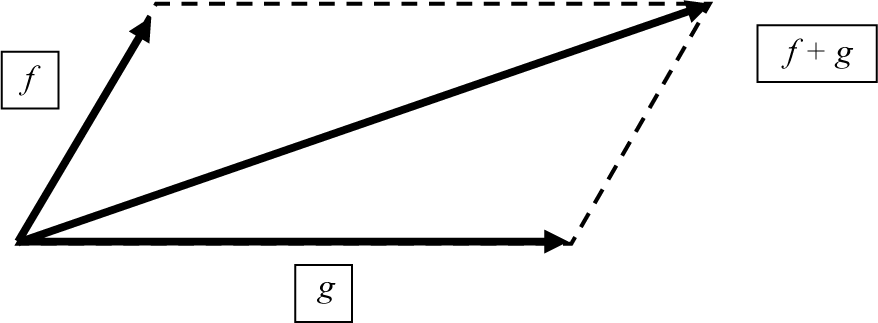
It is important to note that one cannot work back from the resulting arrow to the arrows whose product it is. The resulting arrow represents a new force that does not contain the forces from whose combination it was generated. This combination principle is called ‘the parallelogram of forces.’
The parallelogram of forces is a scientifically established principle of unity. It tells us how several forces sum to a new force. Considering the parallelogram of forces fuels the “unfulfillable” hope for a principle of unity according to which presentations or sensations “sum” in the same or a similar manner as forces do.Footnote 34
Why did Lotze deem such a hope to be unfulfillable? The summation of forces requires a simple point to which the forces are applied. The proposal that presentations sum like physical forces has not identified a mental simple of which one could say that the constituent presentations act on it. More importantly, the result of the summation of several forces does not contain the summed forces: one cannot retrieve or discern them in the new complex presentation. However, we have introspective knowledge that sensations of different qualities are in one consciousness and yet remain distinct:
Consciousness nowhere shows anything resembling what we see in nature, viz. the resultant of two forces producing at one time a state of rest, at another a third intermediate motion, in which they have become merged beyond recognition. Our ideas preserve through all the vicissitudes through which they pass the same content as formerly, and we never find that in our recollection the images of two colours blend into the compound image of a third, or the sensations of two tones mingle into that of a simple intermediate tone, or the impressions of pain and of pleasure neutralize each other so as to form the rest of an indifferent state. ([1856] Reference Lotze1923, 163–64 [183])
Recall: when comparing a and b, a and b must be held together as well as apart (Lotze [1879] Reference Lotze1912, 471 [531]). Because a as well as b are in one consciousness yet appear distinct, we can compare them and perceive relations between them.Footnote 35 According to Lotze, it is the fact that the presentations are “held apart as well as together” that (a) quashes the hope to find a principle of unity analogous to the parallelogram of forces and (b) refutes the Herbartians.
(a): We know how summation of forces works in physics. We also know that the unity of consciousness is not a sum of presentations in this sense. My seeing a colour and hearing a tone don’t merge to consciousness of a new hybrid quality. They sensed qualities remain distinct and distinguishable. Otherwise we could not compare these objects and recognise relations between them. The hope that science will discover a principle of unity for consciousness that is like the parallelogram of forces is therefore based on a false analogy. Rather, we should expect that the unity of consciousness has no principle of unity of this kind. Since our commonsense conception also does not provide a different principle of unity, we should acknowledge that consciousness is not a complex.
(b): When we compare colours etc., we must (i) ‘keep them apart’ and (ii) ‘have them in one consciousness’. According to Herbart, (ii) is not possible without one colour perception inhibiting the other, thereby making the comparison impossible. But comparing colours, sounds etc. is possible. Therefore, Herbart’s view of the unity of consciousness as the result of interactions between presentations in one substance gets the introspective observations about comparing wrong.
Let us sum up the discussion of the argument from comparison. The argument from comparison shows that there are mental activities and states that neither have nor need a principle of unity, and that it is unwarranted to hope for the discovery of such a principle. The activity of comparing and the required joint consciousness of the compared objects can therefore not be a multiplicity in the sense in which cooking a three-course meal can be a multiplicity: an activity that consists in several coordinated activities (see Lotze [1856] Reference Lotze1923, 166 [185]).
8. The “true meaning” of the unity of consciousness
What kind of unity is the unity of consciousness? In section 6, an initial answer to this question emerged. One can only compare sensory qualities if they are at the same time in the same indivisible consciousness. If the consciousness were composed out of seeing blue1 and seeing blue2, we could not compare the shades. This suggests that consciousness is a simple state that is directed on many objects (qualities) simultaneously.
We can shed further light on Lotze’s view by relating it to conceptions of the unity of consciousness that informed his work. An important reference point here is Kant’s distinction between wholes that have analytic and wholes that have synthetic unity.Footnote 36
First, wholes that have analytic unity or aggregates are wholes where the parts are prior to the whole and the whole is the result of adding or combining parts.Footnote 37 A locomotive, for example, is a Kantian aggregate. The parts exist prior to the locomotive; we can imagine the parts arriving one after the other and then being assembled into the locomotive. I will call such parts ‘components.’
What makes some things that can exist in isolation into one aggregate? There is a principle of unity for them of the kind introduced in section 5. Consider Marshall’s (Reference Marshall2010, 15) example of a film crew: What makes John, Fred, Tom, and Bill into one film crew? Prima facie, it is the fact that they together, but not individually, shoot a film. But that does not yet make them members of one film crew. They must make one and the same film together to be part of the same film crew. So, some people are part of a film crew if there is one and the same single effect—making the same film—that they together bring about.
Second, wholes that have synthetic unity or systems are wholes where the whole is prior to the parts. Kant frequently put forward space as an example of such a whole. Space is supposed to be one thing—a unity that has spaces as parts, but,
if one speaks of many spaces, one understands by that only parts of one and the same unique space. And these parts cannot as it were precede the single all-encompassing space as its components (from which its composition would be possible), but are rather thought only in it. It is essentially single; the manifold in it, this also the general concept of spaces in general, rests merely on limitation. (A25/B39)
We speak of adding seventy cubic foot of space to a room. But the seventy-cubic-foot portion of space is not a part of space as a brick is part of a wall. The parts don’t precede space, a totality, and we can only form concepts or representations of such parts by limiting or dividing space. Kant (A438/B466) therefore said that space should not be called a compositum, but a totum. In a totum, the parts are “only possible only in the whole.” Brentano (Reference Brentano and Kraus1874, 157 [I, 223]) called such parts ‘divisives’—parts that can only be arrived at by dividing a whole that is prior to them.
I will not take a stand here on whether Kant is right that space has synthetic unity, but Kant’s remarks about space are instructive for the unity of consciousness.
For aggregates, one can identify principles of unity that articulate a joint property some things must have to constitute a unity. There can be no such principles for a synthetic unity like space. For such wholes, we need principles of division or limitation that specify how to impose limitations on the whole to arrive at its parts. How does one limit the space to a subspace? There are many possible methods of limiting space. For example, we limited space by its relation to parts of our bodies: the common cubit was the length of the forearm from the elbow to the tip of the middle finger. Hence, we might discern a region of space by means of our forearms and elbows and measure it in cubits. This is rather impractical, but, in general, we can systematically delimit space by something that occupies some space, and here bodies, in particular our bodies, are important.Footnote 38
Lotze takes the argument from comparison to establish that consciousness has synthetic unity: consciousness is “an absolutely indivisible unity.”Footnote 39 It is not composed out of parts; there is no principle of unity for it. For this reason, Stumpf (see quote in the introduction) said that that one speaks metaphorically when one says that there are “several elements” in consciousness. Yet, in some sense, consciousness is articulated into elements or divisives.Footnote 40 Lotzeans like Stumpf need to specify a principle of division that applies to the unity of consciousness. I will outline their approach in the next section.
9. Can an indivisible unity be complex?
Stumpf gave a helpful illustration of how we can arrive at parts (partial functions) of consciousness by abstraction:
[The unity of consciousness] shows a certain similarity with the unity of the visual field […] insofar as in both cases it is possible to highlight one part of the whole for consciousness. This is the source of intellectual and emotional partial functions the psychologists talk about. (Stumpf Reference Stumpf1939, 25)
Like space in general, my visual field appears extended to me. In it, many objects standing in relations are given to me. Space can be divided into parts with respect to things occupying space. What enables us to selectively attend to a portion of our visual field is that it is occupied by objects or can be related to such objects. Imagine that you have a visual experience as of a black dog in a meadow. If you selectively attend to the dog, you have arrived “by abstraction”’ at a part of your visual field, namely the portion of your visual field occupied by the dog.
Stumpf takes the partitioning the visual field as a model for how one can articulate the unity of consciousness into elements or parts. When I am simultaneously conscious of a colour and a note, I can describe my ‘indivisible’ consciousness both as ‘hearing a note’ and ‘seeing a colour’. Footnote 41 In giving such descriptions one makes an abstraction, says Stumpf (see again quote in the introduction), in one of the literal senses of abstraction: to abstract a property is “to present it to the mind apart from the other properties that usually go along with it in nature” (Bain quoted in OED entry). Footnote 42 This view of abstraction as forming a selective or partial conception is suggested by the idea that selective attention is the method of abstraction. If I selectively attend to something, I present it apart from other objects even if these “go along with it in nature. ” I can think, for example, of my consciousness as the consciousness of this (musical) note in virtue of attending to it. If I think of it in this way, I have discerned in it an auditory sensation. But we know from the argument from comparison, the sensation is not a component of the consciousness in which it can be distinguished. Just as a simple object such as a geometrical point can both be described as the left-neighbor of a and the right-neighbor of b in virtue of standing in these relations, our indivisible consciousness can fall under selective concepts which we form by attending selectively to objects we are simultaneously aware of.
10. Conclusion
Lotze articulated a form of the top-down view. His reason to take consciousness to be a primitive unity is the argument from comparison. The argument shows that consciousness must comprehend some things without fusing them into a new one, yet consciousness is not composed out of the things that can be compared. It lacks a principle of unity. From Lotze’s perspective, it is a mistake to ask what relation must obtain between mental phenomena for them to compose one unity.Footnote 43 The more fruitful approach is to look for principles of division or limitation.
Acknowledgments
I am grateful to John Callanan and Marco Fiocco for discussion and especially to Jessica Leech for extensive comments and feedback. I would also like to thank the anonymous referees for very helpful comments that led to significant changes.
Mark Textor is professor of philosophy in King’s College London. He works on history of analytic philosophy, Austrian philosophy, and philosophy of mind and language.

 Open access

