





Introduction
Everyone’s healthcare needs are important, regardless of “background, culture, belief, age, gender, diagnosis, disability, economic status, or even ethnicity” (Department of Health, UK 2008). However, evidence highlights that there are significant unmet needs and disparities in ethnic minority (EM) families’ experiences of palliative care (Calanzani et al. Reference Calanzani, Koffman and Higginson2013).
Population predictions show that as the migration rate increases, the number and proportion of people from EM groups will rise in developed countries (UNDESA-PD 2020). As a result, there will be an increasing number of EM children who will require children’s palliative care (CPC). About 21 million children worldwide require palliative care each year, including more than 8 million with serious medical conditions that call for specialist treatment (Connor et al. Reference Connor, Downing and Marston2017). Every year globally, significant health-related issues claim the lives of over 2.5 million children (Knaul et al. Reference Knaul, Farmer and Krakauer2018). Specialist CPC services are needed for these children and their families (Chambers Reference Chambers2018), some of whom may have unique needs due to their ethnicity (Bajwah et al. Reference Bajwah, Koffman and Hussain2021).
CPC also referred to as pediatric palliative care is an active and family-centered approach to care for children with life-limiting or life-threatening conditions, from diagnosis or recognition until death and bereavement (Chambers Reference Chambers2018; WHO 1998, 2018a). Family-centered childcare is an integral part of CPC which has progressed from addressing the needs of the child as an individual to having “parental presence” (Smith and Coleman Reference Smith and Coleman2010; Tatterton and Walshe Reference Tatterton and Walshe2019) where healthcare workers have open conversations with them and consider the family needs and preferences. Providing family-centered care should go beyond the involvement of family members to capture the social environment of the family by recognizing and understanding everyone’s experiences including their cultural and religious preferences (Tatterton et al. Reference Tatterton, Honour and Lyon2021). With the increasing EM populations within countries, there is an increasing diversity in religious and cultural beliefs which could influence the experiences of EM families accessing palliative care services.
Ethnicity and culture are noted to impact patterns of “life-threatening conditions, illness experiences, healthcare-seeking behavior, and access to healthcare services” (Chidiac et al. Reference Chidiac, Feuer and Flatley2020). As the EM population increases, a growing concern continues to rise about how to serve the EM communities living with and dying from advanced disease, and their families (Koffman Reference Koffman2014), when families are confronted with multifaceted factors that may interplay with their access to quality CPC (Clancy et al. Reference Clancy, Taylor and Bradbury-Jones2020). Understanding the experiences of families from different backgrounds is essential (Fu et al. Reference Fu, Chiong and Ngiam2022) to provide high-quality family-centered CPC. An insight into their experience is needed to improve healthcare providers’ ability to align their support with the families’ perspectives and needs. Consequently, this paper reports on a meta-synthesis undertaken to provide insight into how families from EM backgrounds experience CPC by answering the question; “What are the experiences of EM families of CPC across developed countries?”
Methods
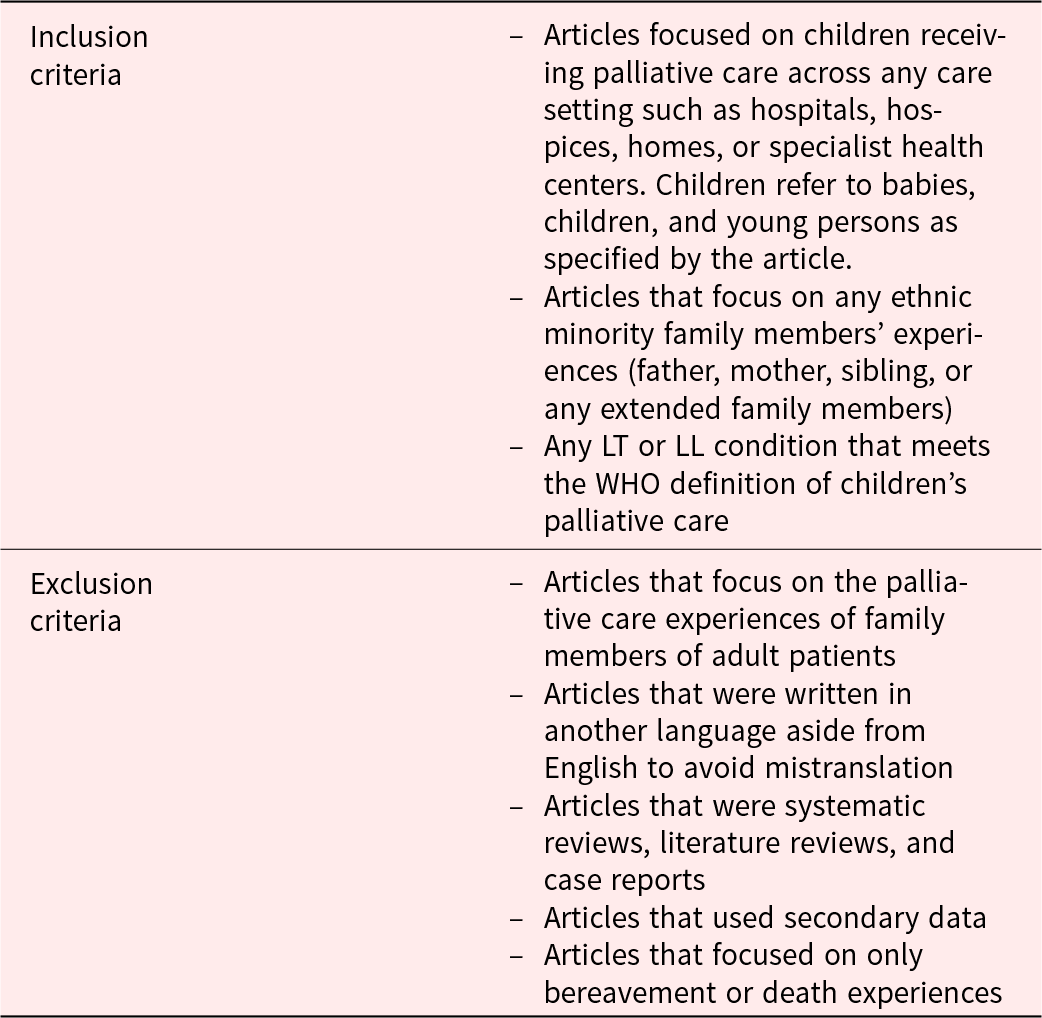
The protocol for this study was registered with the PROSPERO (CRD42022362597) register. The study targeted children accessing palliative care in all settings across different high-income countries (see inclusion and exclusion criteria in Table 1). In this study, the word children represents babies, children, and young people as described in the articles under review.
Inclusion and exclusion criteria

Search strategy
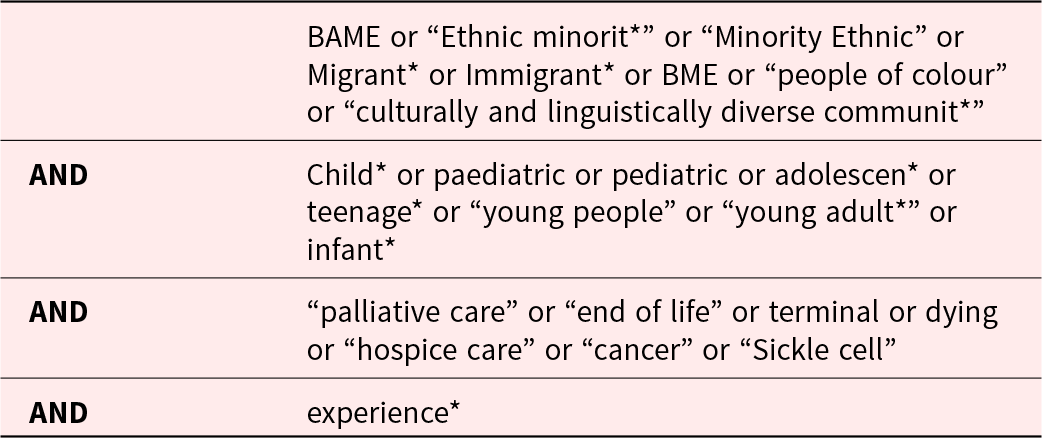
Six databases (Scopus, Medline, Web of Science, APA PsycINFO, CINAHL, and Global Health) were searched first in June 2022 and then again in December 2022 with additional search terms (Sickle cell and Cancer). Additionally, gray literature was searched using Google Advance, but none was identified. Due to the lack of studies, no time limiter was applied. The search strategy and development of search terms were undertaken with support from the University Subject Librarian. Search terms are shown in Table 2.
Search terms

Search outcome
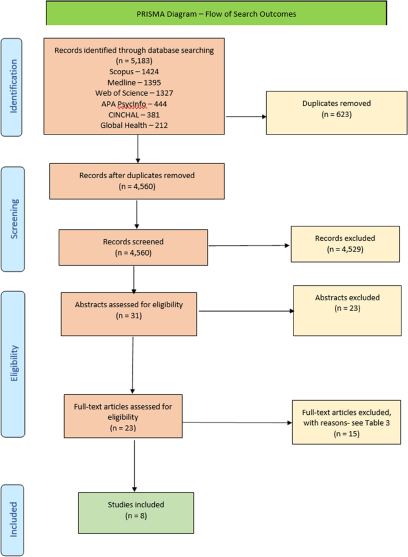
Searches yielded 5183 articles which were exported into Endnote X9.2. After duplicate removal, 4560 articles were screened against the inclusion and exclusion criteria by titles and abstracts, excluding 4529 articles. The 31 articles left were assessed for eligibility, and 23 articles were further excluded, leaving 8 articles that met the inclusion criteria. Two of the articles selected were developed from 1 study using the same dataset but with different findings (Kvarme et al. Reference Kvarme, Albertini-Früh and Brekke2016; Kvarme et al. Reference Kvarme, Alebertini-Früh and Lidèn2017). Please see Figure 1 for the Preferred Reporting Items for Systematic reviews and Meta-Analyses (PRISMA) diagram showing the flow of search outcomes. Only studies with a qualitative design that fit the inclusion criteria were found.
PRISMA diagram – flow of search outcomes.

Quality appraisal
Critical Appraisal Skills Programme (2018) for qualitative studies was used to appraise the quality of the 8 articles, first by the main author (ACI) and by the second and third authors (MT and MH-C). This tool is concise and has questions that cover the areas required for an effective analysis of study findings (Nadelson and Nadelson Reference Nadelson and Nadelson2014). The overall quality of the articles was rated high given that most of the responses to the questions across all the articles were “yes” showing they have valid and precise results, with study relevance. None were rejected based on quality. In line with the meta-synthesis approach, 8 articles that were rated good quality were included in the review.
Data extraction and analysis
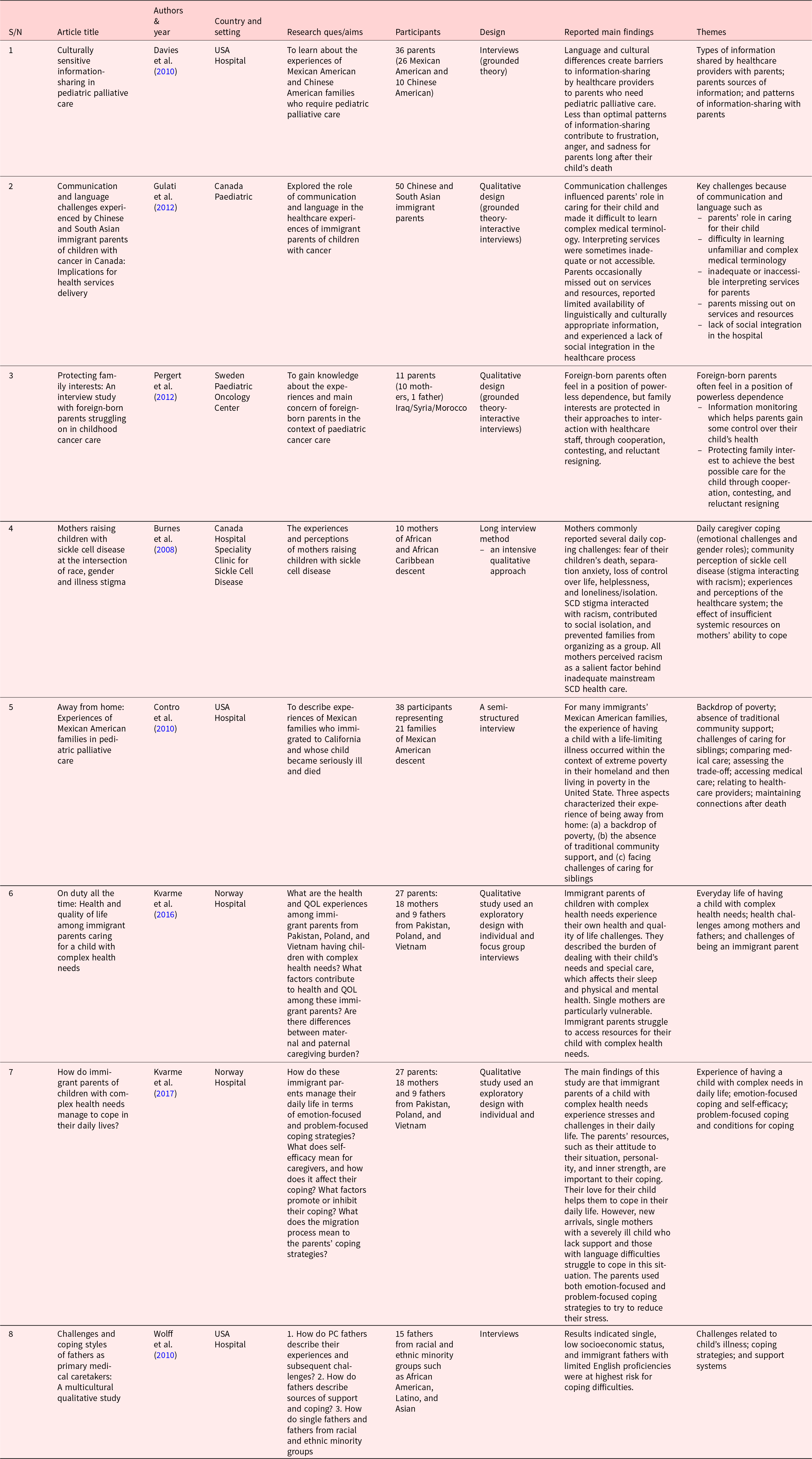
The authors read and reread the articles, extracted key concepts, and compared findings across the studies. An extraction table using Microsoft Excel (refer to Table 3) was used to extract study characteristics from the articles included. Following data extraction, a qualitative meta‐synthesis approach (Dawson Reference Dawson and Liamputtong2019; Lachal et al. Reference Lachal, Revah-Levy and Orri2017; Melendez-Torres et al. Reference Melendez-Torres, Grant and Bonell2015) was used to synthesize findings across the identified studies. The approach was chosen as it allows the reinterpretation of qualitative data, builds a new interpretation, and provides a deeper understanding of a phenomenon (Atkins et al. Reference Atkins, Lewin and Smith2008; Grant and Booth Reference Grant and Booth2009). Four levels of operation in reciprocal translation (Melendez-Torres et al. Reference Melendez-Torres, Grant and Bonell2015; Noblit and Hare Reference Noblit and Hare1988) were used. These include the use of “visual representation” to visualize how themes connect within and across the studies; “key paper integration” to expand and refine emerging patterns from studies; “data reduction and thematic extraction” through back-and-forth review, clustering, and interpretation of themes; and “line-by-line coding” where phrases were coded, and emerging themes identified. Succinct thematic headings were finally developed to capture appropriate broad meaning. The final themes were checked and validated by all the authors to ensure rigor in the process.
Study characteristics

Results
The 8 articles included in this review were all qualitative design and came from 4 developed countries, the United States of America (n = 3), Canada (n = 2), Norway (n = 2), and Sweden (n = 1). All articles explored the experiences of EM families who accessed CPC. A total of 187 participants (parents) were involved across the studies from diverse EM groups of Mexican, Pakistani, Polish, German, Russian, Syrian, Iraqi, Moroccan, Finnish, Serbian Vietnamese, African, African Caribbean, Chinese, and South Asian descent.
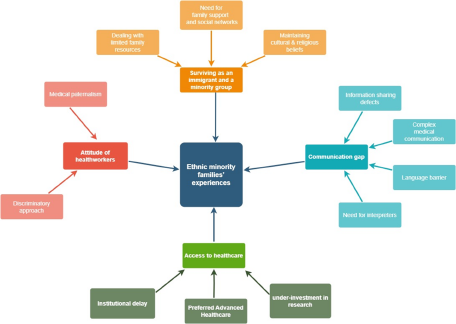
Four major themes were identified: communication gaps, access to services, the attitude of health workers, and surviving as an immigrant and a minority group. These themes are summarized in Figure 2 highlighting factors that influence the experiences of EM families in CPC.
Factors influencing ethnic minority families’ experiences of children’s palliative care.

Theme 1: Communication gaps
EM families mentioned poor communication as part of their experiences while accessing CPC (Contro et al. Reference Contro, Davies and Larson2010; Davies et al. Reference Davies, Contro and Larson2010; Gulati et al. Reference Gulati, Watt and Shaw2012; Pergert et al. Reference Pergert, Ekblad and Björk2012). The study showed that communication had a major impact on the experience of EM families. This is related to language barriers and miscommunication when no language barriers exist. Parents found it helpful when staff in the hospital spoke the same language as it helps them to overcome their language barriers (Gulati et al. Reference Gulati, Watt and Shaw2012).
I would tell the doctors myself when I didn’t understand something, and they would say that we will call Dr. [name] – she is an Indian, Muslim doctor. … Speaks Punjabi and Urdu. … She explains everything in our language so that there is no misunderstanding left. (p. 575)
However, in other cases, parents did not have anyone to interpret for them even if services were available (Davies et al. Reference Davies, Contro and Larson2010).
One mother declared, From the beginning, they should have told us there were interpreters. If they had, I could have asked for one. (p. e861)
Having a language barrier was believed to influence parents’ decision-making regarding their child’s health (Contro et al. Reference Contro, Davies and Larson2010; Davies et al. Reference Davies, Contro and Larson2010; Gulati et al. Reference Gulati, Watt and Shaw2012; Pergert et al. Reference Pergert, Ekblad and Björk2012). Obstacles created by language differences impacted on how parents presented their opinions and views, especially in matters affecting their child’s care (Pergert et al. Reference Pergert, Ekblad and Björk2012).
I didn’t have such a great role [in the treatment decision for my sick child] because I can’t speak the language so I couldn’t exercise my role. (p. 3)
Some parents, due to the language barrier, felt unable to provide appropriate feedback, felt powerless, and fearful during communication (Davies et al. Reference Davies, Contro and Larson2010).
We don’t know what answers to give, if what they’re going to do will be good, or if it will bring consequences we don’t know about. Mostly, the impotence due to the language barrier … there are many terms we don’t understand. They might be simple, but since their language differs from ours, that made me feel impotent. Also fearful … fear was always there. (p. e862)
Even when parents did not experience language barriers, they faced poor communication, often receiving no information regarding available wider services both within and outside the hospital. As a result, parents did not access such services (e.g. basic hospital amenities, access to social workers and interpreters) which were designed to support them. One mother stated she was unaware that she could ask for the services of a social worker (Davies et al. Reference Davies, Contro and Larson2010). Being unaware of support services can limit families and affect their experiences during the care process. “From the beginning, they should have told us there were interpreters. If they had, I could have asked for one, so that I could have understood better. And I could have made myself understood” (p. e861).
A lack of communication led to some parents feeling ignored and not included, when they do not get the information and feedback they needed from the Doctors about their child’s condition (Davies et al. Reference Davies, Contro and Larson2010).
[Two doctors] were talking for at least 45 minutes. It was a very long conversation, but still, they did not give me an answer. They should tell me about the situation not just say, ‘That’s it.’ [My son] was in great pain. … We didn’t know what we were waiting for. We went to the hospital in the morning, and he died at 5:00. We waited the whole day. (p. e861)
In some cases, miscommunication left the families confused about the different care providers they met on their journey and not knowing exactly who to approach when they needed more information (Contro et al. Reference Contro, Davies and Larson2010; Davies et al. Reference Davies, Contro and Larson2010).
“So, I would always tell her, There must be somebody here we can communicate with. Who is in charge of the baby?” So, the changes confused us a lot because well, they’d say, “Ask so-and-so doctor. Ask the nurse first.” Then no, “ask the person in charge or your social worker” (Contro et al. Reference Contro, Davies and Larson2010) (p. 195).
Having numerous care providers also led to conflicting information being given to the parents about their child’s condition.
One doctor would explain one thing to us. Then another doctor would explain a different thing. So, we never knew which doctor was the main one. We never understood how the organization works. (Davies et al. Reference Davies, Contro and Larson2010) (p. e861)
Complex medical terminology used by physicians was one of the key communication challenges experienced by parents (Contro et al. Reference Contro, Davies and Larson2010; Gulati et al. Reference Gulati, Watt and Shaw2012). Some parents were not familiar with medical terms and would not understand them, except when translated into simple terms (Gulati et al. Reference Gulati, Watt and Shaw2012).
When they told me, Hodgkin, I said to myself, ‘Okay what is a Hodgkin?’ So, I didn’t take it very seriously because I say, ‘Okay it’s a Hodgkin Disease—it’s like a cough and cold or something.’ … Then when they [said] it’s one type of cancer, that’s when it hit me! (p. 575)
Other parents found it difficult when they could not learn more about their child’s illness because they could not completely comprehend and communicate with the healthcare professionals on matters about their child’s care plan (Gulati et al. Reference Gulati, Watt and Shaw2012).
[T]he hardest moment was the very beginning; I really wanted to know more about [child’s] situation, but because of this [language] aspect I couldn’t really understand. … [C]ouldn’t get the information that I wanted. … The hospital gave me all of the reports, and they also assigned an interpreter. But it’s myself who didn’t understand it. (p. 574)
Theme 2: Access to health services
Many parents discussed their experiences of accessing services and resources to support them whilst their child was receiving palliative care (Burnes et al. Reference Burnes, Antle and Williams2008; Contro et al. Reference Contro, Davies and Larson2010; Davies et al. Reference Davies, Contro and Larson2010; Gulati et al. Reference Gulati, Watt and Shaw2012; Kvarme et al. Reference Kvarme, Albertini-Früh and Brekke2016). Their experiences included delays in access (Contro et al. Reference Contro, Davies and Larson2010; Kvarme et al. Reference Kvarme, Albertini-Früh and Brekke2016). Experiencing delays was explained by a mother who was a single parent trying to access respite care (Kvarme et al. Reference Kvarme, Albertini-Früh and Brekke2016),
Now finally after 4 to 5 years I received respite care for one of my sick children and it was a struggle with the municipal, they would not understand the case. They would not understand how I felt and how hard it was for me as a single mother with two sick children. (p. 367)
Some families believed there is under-investment in research examining conditions that are more prevalent in EM populations such as sickle cell disease, which influenced their access to best practices for the condition (Burnes et al. Reference Burnes, Antle and Williams2008) which 1 mother described as systemic racism.
Another mother expressed her anger with the delay in the progress of the treatment for sickle cell disease due to the lack of research (Burnes et al. Reference Burnes, Antle and Williams2008).
I get angry because when I had her I thought okay, by the time she’s this age there will be a cure or something to stop the pain, something that works. It just seems like instead of going forward we’re going backwards. I don’t see the research …. We shouldn’t be at the stage we’re at now where there are no statistics on how many kids in Canada have the disease …. So for the funding, it’s not always something sickle cell gets. (pp. 215–6)
However, some parents appreciated their access to advanced palliative care in their new country compared to what would have been available in their home country (Contro et al. Reference Contro, Davies and Larson2010). One mother believed that this enabled her to spend quality time with her sick child. “I thank God that it was ‘here’ [USA] because at least I feel that although I had a very short time to be with her and get to know her, I saw her. I held her, I hugged her, I kissed her, I was with her” (p. 193).
Another mother described how the health care provided in her new country prolonged her daughter’s life than she would have had in her home country (Contro et al. Reference Contro, Davies and Larson2010).
‘In Mexico, I don’t think she would have lived more than one day’ … ‘I can say they have more advantages here for everything. Because of that, I think he had better chances here [USA], if they were going to do something for my baby.’ (p. 194)
Theme 3: Attitude of health workers
Parents shared their experiences regarding the attitude of healthcare providers while accessing palliative care for their children (Contro et al. Reference Contro, Davies and Larson2010; Davies et al. Reference Davies, Contro and Larson2010; Pergert et al. Reference Pergert, Ekblad and Björk2012). Some families experienced discrimination by health workers which they believed was due to their ethnicity (Davies et al. Reference Davies, Contro and Larson2010; Pergert et al. Reference Pergert, Ekblad and Björk2012).
They looked down on us. I saw how they treat other Americans, they treat them very politely, and I do not think they were friends. (Contro et al. Reference Contro, Davies and Larson2010) (p. 195)
Another parent described how she felt more comfortable with some healthcare workers than she did with others (Davies et al. Reference Davies, Contro and Larson2010).
‘He told me the same thing [as the first doctor] but from a different viewpoint because he understood I knew what’s going on. It was much less harsh.’ I felt more comfortable with this doctor. (p. e862)
Some parents complained due to the discrimination they experienced when accessing health care (Pergert et al. Reference Pergert, Ekblad and Björk2012).
We were very badly treated actually … sometimes you can see as a foreigner that it is a little bit unfair …. Then we came there for the third time in a week … and her father said that you have to shout at them, you have to tell them that they should examine your daughter properly. (p. 4)
A mother expressed her displeasure when she perceived being persuaded into accepting the physician’s decisions (Pergert et al. Reference Pergert, Ekblad and Björk2012).
Both I and my husband were very irritated by them [physicians] … they tried to persuade us and tell us how we should do this. What could we do? … the only thing that I could say then was this; ‘if you do not have that experience … this is not a guinea pig who you can just try and try on, so to say, so if there is anywhere else where he could get a better treatment. It’s a pity; he’s just a small child, to have to expose him to this.’ That was the only thing that I could say … I felt like a butchered bird. (p. 5)
Theme 4: Absence of support and social isolation
Some EM families expressed issues they face while coping with a sick child (Contro et al. Reference Contro, Davies and Larson2010; Wolff et al. Reference Wolff, Pak and Meeske2010). These ranged from limited financial support to difficulty practicing their cultural and religious beliefs, and the need for family support and a social network.
An immigrant father, who had no partner or extended family members in his new country, mentioned struggling to balance work and childcare. This resulted in him missing too many days of work, leading to his termination, and exacerbating his financial difficulties (Wolff et al. Reference Wolff, Pak and Meeske2010, 209).
Some immigrants arrive in their new country with limited financial resources and with the hope of finding opportunities to improve their standard of living. One mother shared her inability to provide basic needs for her children even while in her home country, which was the backdrop of her immigration to a new country (Contro et al. Reference Contro, Davies and Larson2010).
“I came back (to the United States) because you have no idea how hard it is in Mexico. My kids would cry for a glass of juice: ‘Mom, give me juice.’ How am I going to give you some. There’s none here” (p. 190). “In Mexico, you need money for everything, and I think my son wouldn’t have lasted there” (p.194).
Another mother stressed that if they were in their home country and given their financial status, the child would have been buried not cremated as it provides the opportunity to honor the dead according to the provisions of their religious rites. The mother recounted being forced to cremate their child in the country against their wishes due to the cost of burial in their new country or the cost of sending the body down to their home country (Contro et al. Reference Contro, Davies and Larson2010).
Well, they called us after and told us we had to go to one of those places where they cremate them. They asked if we wanted to bury her here. So, it depended on the cost. It’s more expensive to bury the body whole than to bury it cremated. We looked into sending the body to Mexico, but given our financial situation, we weren’t able to do that. So we decided to have her cremated and they gave us the ashes about a week later. For us over there [Mexico], it’s not very common to be cremated. They bury the body and at their anniversary, they pay tribute to them. They take them flowers; some people take them every weekend. In November, we celebrate the day of the Holy Dead. We go and we stay there one night. We call it ‘Vigil Day.’ We go and stay there one whole night. We take them fruit, bread, or candy, whatever they liked most. (p. 197)
Visiting religious leaders with a sick child was a major concern that could not be met in their new country. In addition, some EM families complained of being alone while taking care of their sick child in the new country and they needed support and interaction of family and friends (Burnes et al. Reference Burnes, Antle and Williams2008; Contro et al. Reference Contro, Davies and Larson2010; Gulati et al. Reference Gulati, Watt and Shaw2012; Kvarme et al. Reference Kvarme, Albertini-Früh and Brekke2016, Reference Kvarme, Alebertini-Früh and Lidèn2017; Pergert et al. Reference Pergert, Ekblad and Björk2012; Wolff et al. Reference Wolff, Pak and Meeske2010). One parent went further to state that visits from family and friends are regarded as a “big support” and relieve the feeling of loneliness (Contro et al. Reference Contro, Davies and Larson2010).
When someone is sick there [in Mexico], the first thing we do is to take them to a priest. People go visit us and the patient. If they can’t see the patient, they visit the parents, the relatives. And it’s a big support …. The pain you feel as parents nobody is going to take away, but it makes the load a little lighter when a lot of people are behind you telling you, ‘Hang in there. I went through something similar.’ But not here (in the United States), because the two of us are alone. (p. 191)
Some parents expressed difficulty getting the emotional support they needed in their new environment because they were a minority group (Gulati et al. Reference Gulati, Watt and Shaw2012).
If we were to express our feelings, our English proficiency might not be high enough. If they were all Chinese that would be better. … For those more emotional issues, sharing your feelings, you might feel that no matter how good your English was, you might still have trouble expressing them. (p. 576)
Some parents discussed how they self-imposed social isolation due to the stigma associated with the life-limiting condition their child had, which they perceive affects people from their ethnic group. One mother discussed how other parents with children diagnosed with sickle cell disease tended to withdraw from the public eye to avoid being stigmatized (Burnes et al. Reference Burnes, Antle and Williams2008).
“I find a lot of parents can still be like my family’s got Sickle Cell Disease, so we shouldn’t let many people know because it will stigmatize us” (p. 215). Another mother emphasized, “And it’s simply because it’s a disease that affects minorities” (p. 215).
Discussion
This paper reports on a meta-synthesis undertaken to provide insight into how families from EM backgrounds experience CPC by answering the question; “What are the experiences of EM families of CPC across developed countries?” One of the consistent themes found across the selected studies was related to unmet needs around communication gaps between EM families and healthcare providers. Communication had a major impact on how families experienced CPC. Another theme was EM families’ struggle for access to resources mixed with the bliss of having advanced healthcare services. The last 2 themes highlighted the families’ experiences of the “attitude of health workers” and the “absence of support and social isolation.”
This review shows that some EM parents received little or no information regarding available services both within and outside the hospital which makes them feel abandoned or ignored by healthcare staff (Davies et al. Reference Davies, Contro and Larson2010) causing them to also miss out on certain services (Gulati et al. Reference Gulati, Watt and Shaw2012). However, families acknowledged receiving information about their child’s condition but seemed to be left confused when they received varied and complex information from diverse healthcare workers involved in their child’s care (Contro et al. Reference Contro, Davies and Larson2010; Davies et al. Reference Davies, Contro and Larson2010). Poor communication between hospital professionals and family carers has been a common complaint in several studies (Caswell et al. Reference Caswell, Pollock and Harwood2015; Jangland et al. Reference Jangland, Gunningberg and Carlsson2009; Kwame and Petrucka Reference Kwame and Petrucka2021), hence Anderson et al. (Reference Anderson, Bloch and Armstrong2019) after reviewing communication between healthcare professionals and relatives of patients approaching the end-of-life, suggested the need to train healthcare professionals on strategies to improve communication with families of patients. Another study that explored communication challenges in maternity care for immigrant women in rural Alberta, revealed immigrant women experience these communication challenges which affect their access to health care (Higginbottom et al. Reference Higginbottom, Safipour and Yohani2015). Families rely heavily on information provided by health professionals to make end-of-life decisions for their children (Fu et al. Reference Fu, Chiong and Ngiam2022; Mayeda and Ward Reference Mayeda and Ward2019), therefore, it is imperative to improve clinical communication practices when working with EMs.
Language differences (Gulati et al. Reference Gulati, Watt and Shaw2012; Pergert et al. Reference Pergert, Ekblad and Björk2012) and being unaware of the availability of interpreters (Davies et al. Reference Davies, Contro and Larson2010; Gulati et al. Reference Gulati, Watt and Shaw2012; Wolff et al. Reference Wolff, Pak and Meeske2010) were mentioned as obstacles to communication that can impact how parents present their opinions and views, during their child’s care (Pergert et al. Reference Pergert, Ekblad and Björk2012). Language barriers pose a challenge to family-centered care (Patriksson et al. Reference Patriksson, Nilsson and Wigert2019; Stephen Reference Stephen2021). Previous research has also identified a key barrier as a lack of interpreters or even qualified interpreters (Brassart et al. Reference Brassart, Prévost and Bétrisey2017; Clancy et al. Reference Clancy, Taylor and Bradbury-Jones2020; Fellin et al. Reference Fellin, King and Esses2013; Green et al. Reference Green, Jerzmanowska and Green2018). Just as seen in this review, family members are being used as interpreters and this has raised ethical concerns about the disclosure, confidentiality, and accuracy of the information translated (Green et al. Reference Green, Jerzmanowska and Green2018). The lack of provision or the use of inadequately trained interpreters makes it harder for families to explain their worries about their child’s health (Beauchamp et al. Reference Beauchamp, Amorim and Wunderlich2022) fostering ineffective communication between physicians and EM families.
EM parents struggle through unfamiliar procedures, and experience poor treatment and delays while trying to access healthcare resources and services (Contro et al. Reference Contro, Davies and Larson2010; Kvarme et al. Reference Kvarme, Albertini-Früh and Brekke2016). Although the general population experiences the struggle with this bureaucracy especially around waiting times and delays while accessing healthcare (Thorlby et al. Reference Thorlby, Gardner and Turton2019), the etiology of EM experiences of the health system is multifaceted, comprising social and economic determinants, which are compounded by discriminatory practices and systemic and institutionalized racism (NHS Race and Health Observatory Priorities 2023). Evidence has shown the existence of systemic racism in healthcare research (Gravlee Reference Gravlee2009; Powell et al. Reference Powell, Njoku and Elangovan2022; Redwood and Gill Reference Redwood and Gill2013) which is reinforced by individual or social ideologies, social and political factors, institutions, etc. (Banaji et al. Reference Banaji, Fiske and Massey2021; Gee and Ford Reference Gee and Ford2011; Powell Reference Powell2008). The leadership of research commissioning bodies, for instance, determines how research questions are formulated, what data informs them, and which populations are involved (Hardeman and Karbeah Reference Hardeman and Karbeah2020; Powell et al. Reference Powell, Njoku and Elangovan2022). If the structural factors of health inequities within the healthcare system are to be addressed, health research and funding must represent population diversity (Powell et al. Reference Hardeman and Karbeah2022).
Also highlighted were EM families’ complaints about the attitude of healthcare providers (Contro et al. Reference Contro, Davies and Larson2010; Davies et al. Reference Davies, Contro and Larson2010; Pergert et al. Reference Pergert, Ekblad and Björk2012). Some perceived healthcare providers as being unfair (Pergert et al. Reference Pergert, Ekblad and Björk2012), insensitive to their culture and religion, and discriminatory which can lead to their reluctance and contest instead of cooperation (Davies et al. Reference Davies, Contro and Larson2010; Pergert et al. Reference Pergert, Ekblad and Björk2012). Studies have reported that parents from the EM population are influenced by their cultural norms and beliefs, and unique family dynamics (Kapadia et al. Reference Kapadia, Zhang and Salway2022; Papoudi et al. Reference Papoudi, Jørgensen and Guldberg2021; Wang and Kearney Reference Wang and Kearney2013), and they frequently encounter challenges accessing the health and social care systems due to culturally insensitive healthcare workers (Lindsay et al. Reference Lindsay, Tétrault and Desmaris2014). Generally, patients value compassionate health workers who genuinely care about their well-being and are sensitive to their needs (Attum et al. Reference Attum, Hafiz and Malik2023; Cheraghi et al. Reference Cheraghi, Esmaeili and Salsali2017), and this should be put into consideration in training healthcare professionals who are culturally competent in dealing with people from EM groups.
There was also an interplay between EM families’ culture, spiritual ties, and emotional needs. The influence of culture and spirituality on healthcare decisions can manifest in various ways, such as affecting choices related to dietary practices, reduction of anxiety, medication usage, gender preferences for healthcare providers, and adherence to rigid prayer schedules that may potentially conflict with medical treatment (Campos and Heejung Reference Campos and Heejung2017; Swihart et al. Reference Swihart, Yarrarapu and Martin2022). Studies have also shown that ritual activities can help bereaved families acknowledge the death, cope with their sorrow, accept the loss, maintain a connection with the dead, and still go on with their lives (Brooten et al. Reference Brooten, Youngblut and Charles2016; Gudmundsdottir and Chesla Reference Gudmundsdottir and Chesla2006; Weeks Reference Weeks2004). Understanding how families use their culture, faith, religion, and spirituality to manage their pain and improve their quality of life would be beneficial for healthcare professionals in understanding how to support families more effectively (Bekke-Hansen et al. Reference Bekke-Hansen, Pedersen and Thygesen2014; Wachholtz and Pearce Reference Wachholtz and Pearce2009). Also, there is a need for more flexibility in the CPC settings to facilitate families to adopt their cultural traditions and religious beliefs whilst the child is being cared for and following their death.
Implications for further research
As seen from the diverse literatures reviewed, there are varied settings where CPC can be provided such as hospitals/hospices/homes/special health centers. It will be vital to explore EM families’ experiences based on the setting where the CPC is received, to see if there is a setting-based experience and possible impact care. Understanding this can provide the basis for improving setting-specific practices and interventions for EM families accessing CPC, and situations where CPC is provided across multiple settings.
This review highlighted some met and unmet needs of families accessing CPC across developed countries. Further research is needed to explore in-depth the religious and cultural needs of EM families accessing CPC in the UK to provide a more complete picture of any requirements they may have and how they can be supported more by health professionals.
This review showed a gap in research on the experiences of EM families of CPC in several developed countries. Specifically, no research was found exploring the CPC experiences of EM families in the UK. Also, considering the different structures of CPC existing across different countries, families’ experiences will vary depending on the organization of the healthcare systems they live in. Therefore, it is important to further investigate and understand the experiences and needs of EMs accessing CPC in the UK, given their increasing population.
Recommendations
The study showed that cultural sensitivity and improved communication can lead to better health outcomes, patient satisfaction, and efficient healthcare resource utilization for EM families accessing CPC. To achieve these goals, healthcare professionals need to be trained to be culturally sensitive both in communication and attitude to build trust and foster collaboration with EM families.
From the study, it is evident that there is a global paucity of data on EMs’ experiences of CPC. To address this, it is essential to ensure that healthcare policies, research, and funding in CPC are representative of the diversity of the population. By taking these steps, we can work toward creating a more equitable and inclusive healthcare system that benefits everyone.
This study showed that participating in cultural and religious practices can help families cope with their child’s illness and maintain a sense of normalcy. To support families in this regard, care policies in CPC settings should be more flexible and accommodating of cultural and religious practices, both during the child’s treatment and after their passing. This will allow families to honor their traditions and beliefs while providing the best possible care for their children.
Strengths and study limitations
The strength of this study is that it explored qualitative studies drawing from them rich and in-depth data on EM families’ lived experiences. It prioritized understanding EM families’ experiences of CPC given the paucity of research data in this area. The study revealed that EM family experiences of CPC arise from their met and unmet needs for the service and when these families’ needs are left unmet it limits their involvement in their child’s care.
The study explored the experiences of all EM groups, without emphasizing any specific ethnicity or country. Thus, the findings may not reflect the unique experiences of specific EM groups. However, the study offers valuable information that can guide further study and inform CPC policies and practices.
This study examined only 8 articles from 4 different countries, so it may not represent EM experiences of CPC in developed countries that are not within this study. Nevertheless, the provided data can serve as a foundation for future research investigations, thus adding to the existing knowledge in this field.
To ensure maximum inclusivity of studies, the term “children” was utilized as referenced in the reviewed articles, given the varying age ranges across CPC services. Consequently, the study findings may not be limited to children aged 0–19 years; however, it contributes to enhancing palliative care provisions for all children.
Conclusion
It is evident from this review that EM family experiences of CPC arise from their met and unmet needs for the service. These needs seem to be exacerbated by factors such as communication barriers, and accessibility of healthcare resources and services, coupled with the attitude of health workers, absence of support and social isolation. In providing EM parents with high-quality care, bridging the gap created by communication, diverse cultures, and religion is a crucial component of care. Understanding information shared through proper communication strategy, and healthcare workers learning to regard the EM families’ traditions and religions can promote a trusting relationship between the family and healthcare workers.
A “one-size-fits-all” approach to healthcare can lead to cultural and religious insensitivity and communication breakdowns, which may leave EM families feeling marginalized. When families’ needs while accessing CPC are left unmet it restricts their full participation in their child’s healthcare and may lead to disempowerment during the care process. For optimal CPC for EM families, a culturally sensitive care guideline is imperative. It must meet their unique cultural, religious, and linguistic needs, enabling healthcare providers to offer effective support and care.
Competing interests
None declared.

 Open access

