

Introduction
Western Arnhem Land in northern Australia (Fig. 1) is globally well known for its abundance of spectacular rock paintings, stunning paintings on sheets of bark collected by non-Aboriginal people since the mid 1800s and, most recently, paintings on paper made by generations of Aboriginal artists. Besides depictions of human figures, important fauna and, occasionally flora, a variety of powerful Ancestral Beings and spiritual entities feature in the art. A large range of creation and other stories can be told with the rock art and continue to be told with paintings on bark and paper, as well as lessons about conduct, hunting, animal behaviour, spirituality and other important aspects of heritage and tradition (May Reference May2006; Taçon Reference Taçon1989a,Reference Taçonb; Taylor Reference Taylor1996). All three mediums have also been used to convey information about the arrival and ongoing impact of outsiders from Asia (Macassans and Chinese) and Europe (mainly British) (e.g. May et al. Reference May, Taçon, Wesley and Travers2010; Reference May, Taçon, Jalandoni, Goldhahn, Wesley, Tsang and Mangiru2021; Taçon et al. Reference Taçon, May, Fallon, Travers, Wesley and Lamilami2010; Wesley Reference Wesley2013).
Map of western Arnhem Land with key locations mentioned in the text. (Map: Andrea Jalandoni.)

The earliest identifiable depictions of mythical beings in the rock art are creatures with animal heads and human-like bodies in the Dynamic Figure style of rock art (see Chaloupka Reference Chaloupka1993; Taçon & Chippindale Reference Taçon, Chippindale and Helskog2001), about 12,000 years of age (Taçon et al. Reference Taçon, May and Lamilami2020, 218). In the rock-art styles that followed Dynamic Figures, a range of other mythical beings were portrayed in conjunction with animal-headed beings, including highly composite and powerful creatures such as Rainbow Serpents with macropod heads in the Yam Figure style (Taçon et al. Reference Taçon, Wilson and Chippindale1996). In the Maliwawa style of rock painting (Taçon et al. Reference Taçon, May and Lamilami2020), animals also began to be depicted as if participating in or watching human ceremony and new sorts of human and animal compositions were made, including highly distinctive back-to-back figures consisting of two human-like figures or animals of the same species next to each other facing in opposite directions.
Over time, additional mythological figures appeared in the rock art of western Arnhem Land, such as Namarrkon the Lightning Man, Namande spirits, Namarkaiin and Mimih (Taçon Reference Taçon1989a,Reference Taçonb), and back-to-back figures continued to be painted, usually human-like forms and macropods. Some human-like doubles were joined at the back rather than side-by-side, but also face in opposite directions, including spirits fully joined at the back and Nakurrurndilhba or ‘Split-man’ joined at the bottom of the back (see below). However, back-to-back figures are generally rare compared to other subjects. Some of the earliest surviving bark paintings are of back-to-back figures and these compositions continue to be painted today on paper along with related double or split figures that are connected to each other through their backs or lower torsos. All paintings with ethnographic information indicate that back-to-back or ‘double’ figures relate to powerful Ancestral Beings that are the subject of ceremony or are spirits to be feared, such as malevolent spirits that reside in Arnhem Land landscapes that can harm or kill people.
In this paper, the origin and significance of the back-to-back painting manner of depiction and related story-telling tradition is explored, as well as its development over thousands of years through the Holocene and its recent and contemporary expression. We take an informed (ethnographic) approach to interpret recent paintings on bark or paper, with statements from and discussion with artists and other Aboriginal Traditional Owners. We then use this information, as well as other published ethnographic accounts, to shed light on the possible meaning of similar images at western Arnhem Land rock-art sites from various time periods.
Rock paintings
Between 6000 and 9400 years ago, back-to-back figures, both human-like and animal, first appear in the Arnhem Land rock-art record in three related styles in different regions. In the northwest of Arnhem Land, many back-to-back figures were painted in rock-shelters in the Maliwawa style, while in the central and southern regions of western Arnhem Land/Kakadu they were painted in the Yam Figure style of the same time period. In between, and also from the same time period, some back-to-back human-like figures were painted in the Northern Running Figures style (for the rock art chronology, see Taçon et al. Reference Taçon, May and Lamilami2020, 218). This was a period of increasing climate change and rising sea levels that resulted in much change to both the physical and social Arnhem Land environments, as well as rock art (see e.g. Taçon & Brockwell Reference Taçon and Brockwell1995).
Maliwawa back-to-back figures include human-like figures, macropods and rare bilby depictions (Taçon et al. Reference Taçon, May and Lamilami2020, 213, fig. 6). On one rock-shelter wall, two back-to-back Maliwawa human-like figures were depicted bending over and one of them holds a snake by its tail (Taçon et al. Reference Taçon, May and Lamilami2020, 215). In another shelter, back-to-back human-like figures and a third figure are bending over with hands near their heads and lines coming from their faces suggestive of vomiting (Taçon et al. Reference Taçon, May and Lamilami2020, 217, fig. 12). In a third shelter there are two sets of back-to-back macropods and a set of back-to-back human figures on the ceiling. Three other sites have paintings of back-to-back macropods (Taçon et al. Reference Taçon, May and Lamilami2020, 212 fig. 3, 215) and at one site there are rare depictions of three bilbies, two of which are back-to-back (Taçon et al. Reference Taçon, May and Lamilami2020, 213, fig. 6).
In the Yam Figure style, there are at least two sets of back-to-back Rainbow Serpents (Berry Reference Berry2011, 18, fig. 9; Taçon et al. Reference Taçon, Wilson and Chippindale1996, 112, fig. 11), various back-to-back birds (e.g. Fig. 2 and Berry Reference Berry2011, 57, fig. 50) and occasional back-to-back human-like figures (e.g. Berry Reference Berry2011, 71, fig. 68). A Yam Figure style Rainbow Serpent painted in a rock shelter at Deaf Adder Gorge in Kakadu National Park has a number of flying foxes hanging from trailing lines that come off its neck, including a pair that are back-to-back (Fig. 3). The Northern Running Figure style also has some back-to-back human figures in what appear to be ritual scenes with other figures (e.g. see middle of Jones & May Reference Jones and May2015, 55, fig. 2). Thus, the adoption of back-to back figure compositions occurred right across western Arnhem Land in three different regional rock-art styles during the same time period, 6000–9400 years ago (e.g. see maps in Hammond Reference Hammond2019, 216: Yam Figures; Jones & May Reference Jones and May2015, 56: Northern Running Figures; Taçon et al. Reference Taçon, May and Lamilami2020, 209: Maliwawa Figures).
Yam Figure style back-to-back birds, Deaf Adder Gorge, Arnhem Land. (Photograph: Paul S.C. Taçon.)

Yam Figure style back-to-back flying foxes hanging from a trailing line from the neck of a Rainbow Serpent along with other flying foxes, Deaf Adder Gorge, Arnhem Land. (Photograph: Paul S.C. Taçon.)

A single depiction of a two-headed thylacine-like creature can also be found in a rock-shelter in Kakadu National Park. It has a head at each end rather than a head and hindquarters (Fig. 4). At Djuwarr, in Kakadu National Park's Deaf Adder Gorge, there is a large, solid red painting of a Rainbow Serpent that has a snake body, human-like head, breasts, an arm and a leg. Two small back-to-back male human figures stand in the middle of her looped snake body (Fig. 5). The composition relates to a very important story about the Rainbow Serpent Ancestral Being swallowing two boys and their father Gulinj (Flying Fox Man) rescuing them (Taçon Reference Taçon1989, 262–4). Bark painter Jimmy Nganjmirra produced a strikingly similar painting on a large sheet of bark over a metre high called ‘Rainbow Serpent’ in 1978 (Fig. 6). Although the story was not collected when it was sold, it certainly must be the same as that of the rock painting, given how similar they are. It is common for western Arnhem Land artists to produce bark paintings of rock art they have seen in the past; the re-creations stimulated by the recollection of having visited certain sites.
Double-headed ‘thylacine’ rock painting, Kakadu National Park. (Photograph: Paul S.C. Taçon.)

Djuwarr Rainbow Serpent with back-to-back human male figures, Deaf Adder Gorge, Kakadu National Park. (Photograph: Paul S.C. Taçon.)

Jimmy Nganjmirra's Rainbow Serpent bark painting, similar to the Djuwarr rock paintings. (Paul S.C. Taçon collection. Photograph: Paul S.C. Taçon.)

Recent post-contact rock paintings of back-to-back figures include back-to-back white human figures at a Namunidjbuk Estate rock-shelter, northeast Arnhem Land, back-to-back white stick figures next to a warrior painting by prolific rock painter Nayombolmi at Djalandjal, Kakadu National Park (Chaloupka Reference Chaloupka1993, 188, fig. 209), a second composition by Nayombolmi of a ‘split man’ (Nakurrurndilhba) back-to-back figure about to have intercourse with a normal female figure, two back-to-back malevolent female spirits at Nanguluwurr, Kakadu (Hayward et al. Reference Hayward, May, Goldhahn, Jalandoni and Taçon2021, 422, fig. 11) and back-to-back human female figures and birds at a number of Awunbarna (Mount Borradaile) sites. There are also large back-to-back macropods of unknown age at Djidbidjidbi (Mount Brockman, Kakadu), Djarrng (Taçon et al. Reference Taçon, May, Wesley, Jalandoni, Tsang and Mangiru2021) and elsewhere, as well as two back-to-back macropods holding dilly bags and sticks about six kilometres north of Lightning Dreaming in the middle of Kakadu. Macropods holding these material culture items are associated with the mythological origin of the Wubarr ceremony (see e.g. Goldhahn et al. Reference Goldhahn, Biyalwanga and May2021). Maddock (Reference Maddock1970) interpreted rock paintings of back-to-back male and female kangaroos at Gudabubi:m in Dalabon Country, southern Arnhem Land, in relation to Wubarr ceremonial dances. Djarrng also has a unique pair of back-to-back introduced water buffalo (May et al. Reference May, Taçon, Jalandoni, Goldhahn, Wesley, Tsang and Mangiru2021; Taçon et al. Reference Taçon, May, Wesley, Jalandoni, Tsang and Mangiru2021).
Bark paintings and paintings on paper
The earliest surviving bark painting of back-to-back figures (Fig. 7) was collected at Port Essington by Naval Surgeon Richard Tilston before his death in 1849. In his will he left his collection to the Haslar Hospital Museum near Portsmouth, and it arrived in 1851. Several objects were later transferred to the British Museum, London (Simpson Reference Simpson2020, 244–5). The description on the British Museum website is ‘Painting on bark showing two anthropomorphic figures in white pigment. The figure on the left appears to be female with breasts depicted; the right-hand figure is male showing male genitalia. Both figures have tongues sticking out’ (www.britishmuseum.org/collection/object/E_Oc1973-Q-17). This, along with a string-like object dangling from the female's vagina, suggests they are spirit figures. However, paired male/female figures can relate to Kunabibi and Wubar ceremony stories.
Early 1800s bark painting with back-to-back male and female figures. (Courtesy of the British Museum, museum number Q73.Oc.17.)

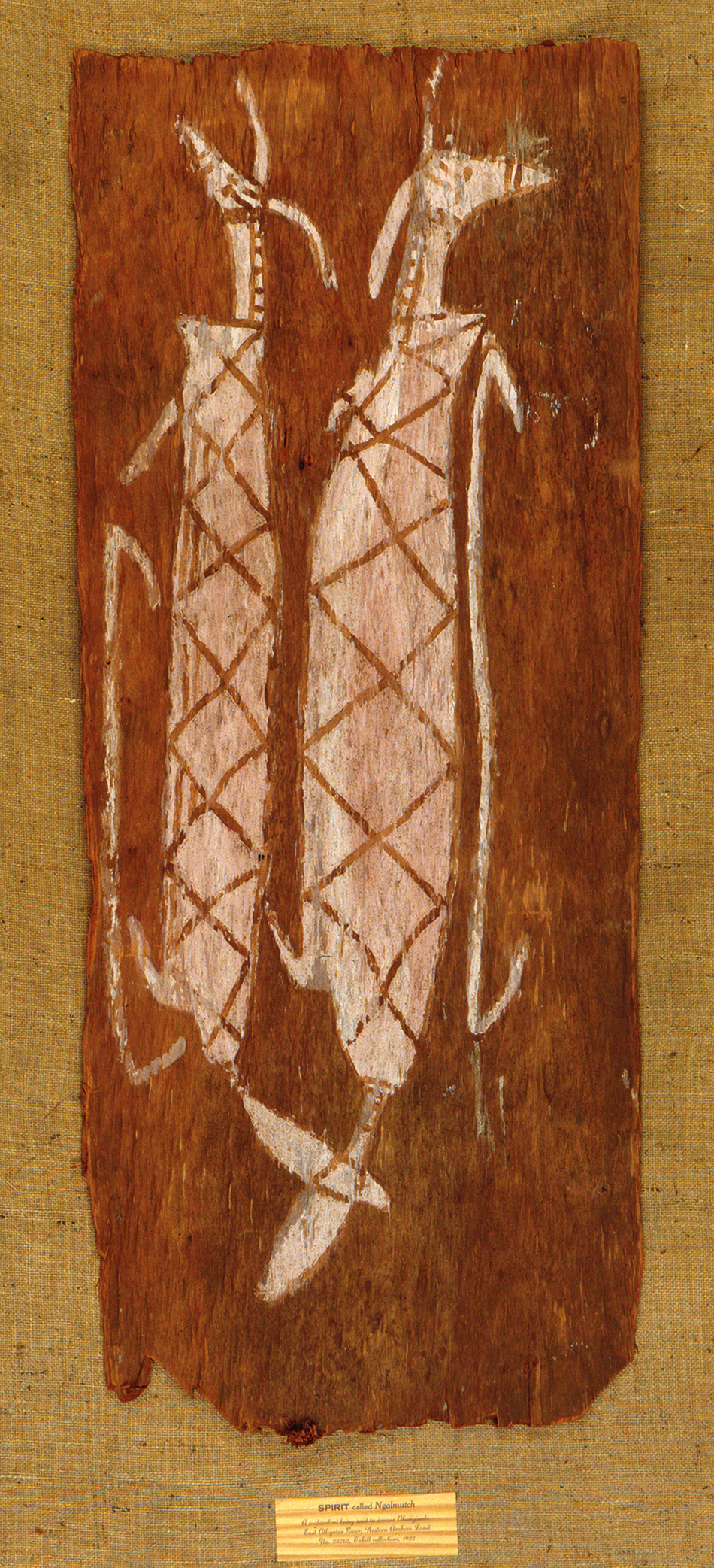
The next oldest bark painting (Fig. 8) is from the 1922 Spencer/Cahill Collection in Museums Victoria, collected in the East Alligator River area (museum number X28762). The painting consists of two back-to-back Rainbow Serpents described as ‘Evil spirit called Ngalmutch or Numeregi which eats natives’ (for discussion about the Numereji, see Spencer Reference Spencer1928, 776–91). This painting reproduces a rock painting at Injalak Hill (at Gunbalanya, also known as Oenpelli) of a single Rainbow Snake accompanied by symmetrically arranged ‘hooked sticks’. This is another example of an artist painting an important local story that is also imprinted on the landscape for the early collectors Baldwin Spencer and Paddy Cahill.
Paddy Cahill bark painting of back-to-back Rainbow Serpents, collected in 1922. (Courtesy Museums Victoria, museum number X28762).
Charles Mountford collected a number of bark paintings while on the American-Australian Scientific Expedition to Arnhem Land in 1948. One of the barks has back-to-back male figures described as the ‘Double-men, Barun-barun’:
The two mythical men, the Barun-barun, being permanently joined down the back, have to move together. Their home is a large cavern in the Arnhem Land plateau at a place called Tjeraidui, a long way to the north-east of Oenpelli. During mythical times the Barun-barun used to sit all day long in this cavern, manufacturing the large stone spear-heads for which the aborigines of Arnhem Land are well known. In those times the Barun-barun used to teach the medicine-men how to make these stone spear-heads, the medicine-men in turn passing that knowledge on to the aborigines.
The Barun-barun still live in the cave at Tjeraidui, but they no longer allow anyone to visit them. Should an aboriginal be foolish as to go near their cave, the Barun-barun kill him with one of their stone spears. These spirit people live solely on the flesh of kangaroos, which they kill with the only hunting weapon they possess, their stone-headed spears.
Plate 55F depicts the double-men, Barun-barun, wearing a feather head-dress. The heart-shaped design above their heads is the cave at Tjeraidui, and the designs, two on one side and one on the other, are stars which are associated in some unknown way with these mythical beings. (Mountford Reference Mountford1956, 200; see also pl. 55F on p. 198)
The world-renowned artist Yirawala incorporated many back-to-back figures in his bark painting compositions, with a number published by Sandra Holmes (Reference Holmes1992). All have high mythological status and often are in ceremony scenes. For instance, there are two sitting back-to-back human figures in the lower left-hand corner of a Maraian (Mardaiyan) Series bark painting (Holmes Reference Holmes1992, pl. 16) described as ‘Cult heroes singing Maraian’ (Holmes Reference Holmes1992, 137). Another bark painting (Holmes Reference Holmes1992, pl. 20) has two sets of back-to-back sitting human figures as well as other sitting human figures. The painting is described as ‘Custodians of the sacred objects in worshipful contemplation of the objects in the “shade” on the ceremony ground’ (Holmes Reference Holmes1992, 138). A third bark painting (Holmes Reference Holmes1992, pl. 106) has two sitting back-to-back female figures described as ‘Girls in dilly bag’, part of the story of a giant cannibal called Mowani. The girls were two sisters captured by Mowani:
The elder sister was pregnant and was resting on a lower tree branch when Mowani appeared. There was no escape and the giant knocked her down, killing her instantly. The other girl was captured and stuffed into the giant's dilly bag with her dead sister. (Holmes Reference Holmes1992, 148)
A fourth painting (Holmes Reference Holmes1992, pl. 108) has two standing female back-to-back figures with two other figures either side described as ‘Spirits of the dead mother and her baby return to her mother and grandmother, who mourn over them’ (Holmes Reference Holmes1992, 149). In a fifth bark painting (Holmes Reference Holmes1992, pl. 129) there are four pairs of back-to-back upside-down flying foxes described as ‘Ubar ceremony: flying foxes’ and ‘Showing male and female, Dua and Jiritja flying foxes, hanging upside down in a tree’.
In 1991, Thompson Yulidjirri painted an Ubar ceremony scene with two back-to-back human figures sitting on a log below the key Ancestral Beings associated with the Ubar in their animal forms (Dyer Reference Dyer and Dyer1994, 123, pl. 45). In the 1970s, Thompson Yulidjirri painted a Rainbow Serpent surrounding two back-to-back human figures. This painting relates to the widespread story of young male initiates being taken and swallowed by the Serpent and the Djuwarr rock-painting story described above.
Fred Didjbaralkka Narroldol produced a bark painting of two back-to-back Rainbow Serpents with a third Rainbow Serpent superimposed over top of the one on the left side, called ‘Three Rainbow Snakes’ (Brody Reference Brody1984, 39). Brody (Reference Brody1984, 74) states ‘Didjbaralkka has painted Ngalyod in three snake manifestations of awesome appearance and fierce expression — reflecting perhaps the fear in which the Rainbow Snake is held in its role as an agent of punishment and destruction’. Djawida Nadjongorle also made back-to-back Rainbow Serpents paintings on paper while other artists have depicted some back-to-back yawk yawk mermaid-like spirit figures.
Besides making paintings of Rainbow Serpents, Bruce Nabegyo painted various other powerful Ancestral Beings on bark and paper, for instance, Nardir. In the Injalak Arts painting database, Bruce's Nardir painting is described as follows:
Nardir was a spirit being who lived in western Arnhem Land. He was a ‘witch doctor’ and the string around his elbows signifies that he was a ‘clever man’, versed in magic and able to change his form from man to bird or beast. In this painting he is shown as a double figure, a smaller figure with his larger shadow behind. On his left and right are painted rocks, the barramundi and file snake being the food he was carrying. He is also shown with his implements; fire sticks, hunting tools and dilly bag. Nardir was travelling from the Gunbalanya area east to a place called Karparri. He was planning to visit a group of people who were camped there and his intention was to kill them. As he drew close he saw Kunyikuwimi (the Rainbow Serpent) rising from the ground who had just destroyed all the people by turning them to stone. Nardir also turned to stone, standing with his hand raised between two rocks as shown in the painting. At his feet Bruce has painted a small billabong in Kaparri which is at the base of rocks in which the original rock painting of Nardir can be seen.
Bruce Nabegyo also produced a limited edition etching of an Ancestral Being called ‘Crippled Man’ as a back-to-back figure (Fig. 9):
A long time ago, there was a crippled man living in the Coopers Creek area, near Mt Borradaile, north of Oenpelli, in western Arnhem Land. This old man had sores all over his body and his eyes where (sic) blind. A woman had been promised to him as a wife but she did not like him. She would not sleep with him, even for one night and kept running away with her boyfriend …
All the other people did not like him either. His camp was some distance from the others and he got lonely and cried for help, ‘Can somebody give me food or water? Can somebody help me?’ But the other people did not want the humbug and left him alone, saying he could stay by himself until he died …
Namorrodoh (a malevolent magic man) came to him and brought him water, yams, fish and sugar bag. ‘I'll help you,’ he told the crippled man … So Namorrodoh helped the crippled man to walk to a pond and he cleaned himself up with water. Namorrodoh healed his sores and his eye and said, ‘You can use my weapons: spears, an axe, and club.’ The man who was no longer crippled, chased the people who had treated him like rubbish. He killed them all, and then he killed his promised wife and her boyfriend with the club. After that, he went to live with Namorrodoh.
Senior Traditional Owner for Awunbarna, Charlie Mungulda (pers. comm. to PSCT, 27 September 2018), stated this was a very important Dreamtime creation story for his Amurdak-speaking people. His version is slightly different, but also features a vengeful Ancestral Being who killed people who treated him badly. In his version they transformed into birds and created significant parts of the Awunbarna landscape:
The story about the creation of Mount Borradaile mountain involves a man named Mouldai who killed his grandson. He put the boy's body in a dilly bag and then the bag into the water of the nearby lagoon. It was surrounded by a big mob of fish. The grandfather was supposed to babysit but didn't want to so he killed his grandson and went away. The boy's mother and father were looking for the boy and Mouldai told them to bring the dilly bag out of the water and bring the fish up to him. Then they found the body in the dilly bag and knew Mouldai had killed the boy. After they found the boy's body they broke Mouldai's arms and legs to punish him and he became crippled. Mouldai then sent a big flood to drown all the people. People turned into birds and flew away—egrets and whistling ducks. One of the whistling ducks turned and flew into the side of Mount Borradaile mountain, creating the big cave. After they broke Moudai's arms and legs he crawled all the way up to Nimbuwah and brought the Dreaming waters back to flood and drown everyone.
In 1970, David Milaybuma produced a bark painting of two back-to-back women called ‘Two sisters’, which now resides in the National Gallery of Victoria collection. Its story was not collected, but there is a story associated with a 2002 painting on paper by Bruce Nabegeyo called ‘Crippled Woman’ (Fig. 10). Benson (Isaiah) Nagurrgurrba (pers. comm. to AR, 2020) told us its name is Ngalgordo Ngalgordo and said:
The story is on Injalak Hill near where a man (tourist) had a heart attack. The woman had a promised husband, she ran away from him, she didn't like him, and had a man already. So he cursed her, back in the old time, the Dreamtime, if you did something wrong, they'd kill you straight away, these days nothing happens.
Also in 1970, Kunwinjku artist Bilinyara Nabegeyo painted dancing back-to-back Mimih spirits in ceremony with nested diamond Mardaiyan designs on their bodies. In recent years, Maath Maralngurra and Gavin Namarnyilk have each made a few paintings of an Ancestral Being known as Nakurrurndilhba (Split Man). The label on the back of them states:
Nakurrurndilhba is a spirit which is usually depicted with a kangaroo head. It lives in the hollow tree logs and is carrying a black poisonous snake possibly a taipan. It eats the snake raw. Only ‘clever men’ can see him. He lives in the tree, when we see dogs holding the tree and barking, they can see the spirit and we know he's there. His body is split in two and joined at the hips, he has one arm and one leg on each side, but two heads. Old people saw him a long time ago, but nobody knows how he got like that.
Gavin's father, Robert Namarnyilk, has also painted the figure at least twice, including one called ‘Ancestor: Split Man, a Nakurrurndilhba or clever figure’ made in 2006 and another in 2021 (Fig. 11). Bardayal Nadjamerrek, Gavin's maternal grandfather and Maath's maternal grandfather through sisters, also includes a depiction of Nakurrurndilhba amongst other figures in a printed etching called ‘Nayuyungi and Nakurrurndilhba’. The Nakurrurndilhba story is originally from him. A number of other artists have also used back-to-back figures in their works, with the aforementioned artists serving as an example of the ways in which this subject matter remains important for artists today.
Bruce Nabegyo's ‘Crippled Man’ back-to-back Ancestral Being. (Paul S.C. Taçon collection. Photograph: Paul S.C. Taçon).

Bruce Nabegeyo's ‘Crippled Woman’, Ngalgordo Ngalgordo. (Sally K. May collection. Photograph: Sally K. May.)

Robert Namarnyilk's ‘Ancestor: Split Man, a Nakurrurndilhba or clever figure’ (Paul S.C. Taçon collection. Photograph: Paul S.C. Taçon.)

Discussion and significance
Back-to-back animals, humans and objects, as well as double-headed creatures, are rare in Australian rock art, historic paintings and contemporary art beyond western Arnhem Land. Exceptions include an unusual composition of closely aligned back-to-back multi-barb spears at a rock-art site in the Kimberley, Western Australia (Walsh & Morwood Reference Walsh and Morwood1999, 50) and Tommy McRae's late nineteenth-century drawings of men engaged in ceremony. Figures are shown in various poses but some face others while they are at the same time back-to-back to further figures. Scenes of European squatters or drunken revellers also include back-to-back figures (see examples in Sayers Reference Sayers1994).
Back-to-back animal or human figures are also rare in world rock art, but a few notable exceptions include the spotted horses of Peche Merle (Clottes Reference Clottes.2008, 86–7), a single pair of back-to-back bison at Lascaux (Clottes Reference Clottes.2008, 118–19) and one set of back-to-back rhinos at Chauvet (Clottes Reference Clottes.2008, 45), all in French caves. In the Stadsaal Caves (Matjiesrivier) of the Cederberg region of South Africa there are two sets of back-to-back elephants painted in solid orange-red (Penn-Clarke et al. Reference Penn-Clarke, Deacon, Wiltshire, Browning and du Plessis2020, 5, fig. 4C). These back-to-back animal paintings convey a sense of power, but they also are unusual in that they are isolated examples rather than part of a long tradition. Back-to-back animals also appear in superimpositions such as at the Cussac Cave's ‘Grand Panel’ in the Dordogne region of France where back-to-back bison are placed over a pair of back-to-back horses, an occurrence that Feruglio et al. (Reference Feruglio, Bourdier, Delluc, Mora, Aujoulat and Jaubert2019, 10) suggest is part of a ‘narrative’. On the other hand, animals and humans facing each other are both more widespread and frequent in world rock art.
In various places and periods of the past, some monsters were depicted with two heads, such as Sumerian double-headed gods (Deedes Reference Deedes1935), Mesopotamian, Hittite and later double-headed eagles (Chariton Reference Chariton2011), the ancient Greek two-headed dog Orthrus (Syropoulos Reference Syropoulos2018, 92–4), the ancient Egyptian god Nehebkau who sometimes was depicted with two snake heads or as a serpent with human arms and legs (Shorter Reference Shorter1935) and Janus, the two-faced Roman god of doors, gates, passageways, transitions, beginnings and endings (Davenport Reference Davenport2018). In all cases they are powerful beings, often to be feared. For double-headed gods, Deedes (Reference Deedes1935, 243) concluded:
Babylonia seems from the evidence to be its place of origin, and it appears later in Asia Minor, whose culture was greatly influenced by that of Babylonia. From Asia Minor the double-headed god passed through the Aegean to Greece, and thence to Italy and Europe. Through-out its travels in time and space the double head continued to be associated only with gods, or with kings who were divine and who suffered the ritual death and rebirth for the welfare of their people.
As presented above, there is a range of different types of back-to-back or double figures that were painted in western Arnhem Land, Australia from over 9000 years ago to the present, as well as some double-headed animals. From western Arnhem Land ethnographic information associated with paintings of back-to-back human figures and animals on bark and paper, collected from 1922 to the present (the earlier bark collected from Port Essington lacks ethnographic information), back-to back figures are consistently said to be powerful spiritual and/or Ancestral Beings. Some are associated with sacred Mardaiyan, Ubar and other ceremonies, are custodians of sacred objects, are initiates surrounded by a Rainbow Serpent or are dangerous spirits to be avoided. There are also back-to back Rainbow Serpents in the rock-art record and back-to-back flying foxes associated with Rainbow Serpents in the Yam Figure style. Back-to-back macropods (usually kangaroos) are the most frequent back-to-back animals at rock-art sites and this may be related to ceremonies (Maddock Reference Maddock1970) or the bringing of ceremonies to certain places. For instance, Chaloupka et al. (Reference Chaloupka, Kapirigi, Nayidji and Namingum1985, 91), in a discussion about the meeting of Ancestral Beings from across Arnhem Land in part of the escarpment valley of Deaf Adder Creek, state ‘There was Nadjamulu and Nadjamborro, the male and female plains kangaroos (Macropus antilopinus), who are now known as kandagidj and kandalburru’. They met other Ancestral Beings and ‘talked about the ceremonies which some of them were carrying. Nadjamulu said that he and his mate were looking for the right places to leave the lorrkon and ubarr ceremonies’ (Chaloupka et al. Reference Chaloupka, Kapirigi, Nayidji and Namingum1985, 91).
Specific types of back-to-back (double) human-like figures in recent paintings with ethnographic information include:
(a) Split Man, Nakurrurndilhba, a spirit figure and clever man associated with various places
(b) Crippled Man, Mouldai, associated with Awunbarna
(c) Crippled Woman, Ngalgordo Ngalgordo, associated with Injalak Hill
(d) Two male initiate brothers, often referred to as Gunlanj's (Flying Fox Man's) sons, captured by the Rainbow Serpents
(e) Two sisters (as painted by David Milaybuma)
(f) The double men, Barun-barun, from a cave at Tjeraidui, northeast of Gunbalanya (Oenpelli)
(g) Nardir spirit figure and clever man, associated with Kaparri where there is a rock painting image (also painted by Bruce Nabegeyo).
There are also a number of stories associated with double-headed beings, such as two-headed Rainbow Serpents, a two-headed crocodile (Kumoken Kodjbokenh, painted by Dennis Naroldol among others), a two-headed turtle story (Ngalmangiyi Djang, Long-Necked Turtle Dreaming, painted by Maath Maralngurra) and other double-headed creatures. In each case, these creatures should be avoided and/or serve as a warning.
A major creation event told by Kuninjku says that Yingarna, the ‘biggest’ and first Rainbow Serpent, gave birth to Ngalyod, the ‘smaller’ male Rainbow Serpent and Ngalkunburriyaymi, more like a woman with a fish tail (Taylor Reference Taylor1990). Bark paintings of two-headed, or conjoined, Rainbow Serpents can be interpreted as this original creation event. The paintings capture the Ancestral Being in the act of transforming, since these Beings had the power to change their shape. When other creator Beings merged with the Rainbow Serpent at the close of the creation period, this can be imagined as another kind of double-bodied figure.
Humans, too, are conceived to have a doubled aspect. Kuninjku say that humans have two souls: the kunmalng or sacred spirit belongs to the Ancestral realm and derives from the waters of clan wells; and the kunwaral or ‘shadow’. Some powerful individuals may send their kunwaral to journey, separate from their body, at night. Upon death, the kunmalng is ceremonially assisted to return to the waters of clan sites while the kunwaral lingers near the body until the completion of mortuary ceremonies when it may then travel to live in dark forests. This understanding may help to generate paintings which show humans with doubled form, with two sets of limbs or genitalia (see Kupka Reference Kupka1972). Other meanings of the term kunwaral relate to the production of a copy image, or representation, in a painting or, these days, through photography.
The term kunwaral can also be used to refer to a reflection in water and so its use also carries a sense of this other kind of doubling. There are occasional paintings where artists have painted a figure, such as a surface-gliding insect, coupled with their reflection. The original exists in the ‘outside’ or quotidian world while the reflection in the water becomes part of the ‘inside’ realm of the Ancestral Beings. The surface of Ancestral wells is a primary interface between these outside and inside realms. These are sites of Ancestral power. Senior landowners can approach these places, with the appropriate cautions, and speak to the spirits of the Ancestors and the Djang (Ancestral power) that reside inside the waters at these places. The separation between these realms is partially collapsed when humans re-enact the creative activities of the Ancestral Beings in ceremony.
The more specific reference of some back-to-back imagery is to ceremonial scenes comprised of symmetrically arranged paired dancers who enact Ancestral creation events. Back-to-back imagery is also conceptually linked to paired, and symmetric, facing dancers. As documented above, dance episodes including these aesthetic forms recur in multiple western Arnhem Land ceremonies, especially Ubar and Mardaiyan. Contemporary local people look to the exact species of the subjects to read the particular creation event and relevant ceremony. The interpretation thus rests upon knowledge realms that are restricted based on gender difference, ceremonial experience, and age grading.
Conclusion
In western Arnhem Land, past and present, it seems doubles are to be revered. Depictions of double or back-to-back animals and human-like figures, or double-headed animals, whether in rock art, on sheets of bark or today on paper are interpreted as powerful Ancestral Beings that can bring harm, can be called upon for ceremony or used to tell significant stories of creation, the Dreamtime, Aboriginal tradition, law and ceremony. For instance, in the period in which back-to-back figures were first painted in western Arnhem Land, 6000–9400 years ago (see Taçon et al. Reference Taçon, May and Lamilami2020 for dating), back-to-back human-like figures feature in a complex Northern Running Figures ritual/ceremony scene (Jones & May Reference Jones and May2015, 55, fig. 2), consist of or are associated with Rainbow Serpents in the Yam Figure style and often when in Maliwawa scenes appear to be grabbing snakes by the tail, vomiting and doing other curious things. Creatures unusual for western Arnhem land, such as bilbies, are also shown back-to-back in the Maliwawa style, along with more common macropods. In more recent rock art, various sorts of paired human-like figures are evident, as well as, again, macropods. Interestingly, initially feared introduced water buffalo, often early on referred to as ‘Devil-devil’ (Leichhardt Reference Leichhardt1847, 519), also were painted back-to-back in an early contact period composition. And the double word ‘Devil-devil’ or ‘Debbil-debbil’ has been used across western Arnhem since Europeans arrived to refer to a range of powerful, often harmful, spirits (e.g. Dyer Reference Dyer1962, 9).
The period of 6000–9400 years ago was a time of much change to both the physical and social Arnhem Land environments due to climate change and rising sea levels (Williams et al. Reference Williams, Ulm, Sapienza, Lewis and Turney2018). It also was a time when great stories of creation, destruction and transformation of not only the land but also Ancestral Beings, people and animals were born and depicted as paintings in rock-shelters (Taçon et al. Reference Taçon, May and Lamilami2020). Back-to-back figures, double-headed creatures and composite beings such as Rainbow Serpents were especially powerful and important, playing key roles in the changes that occurred, and often were associated with great floods. These stories were passed down through many generations and new depictions were made at rock-art sites and on bark. They continue to underpin much contemporary painting and story-telling, providing traditional narrative and meaning to new generations today.
Acknowledgements
We thank the many Aboriginal artists and Traditional Owners we have worked with across western Arnhem Land over the past few decades. Thanks to Injalak Arts for supporting this research and to the individual artists for allowing us to share stories and photographs of their artworks. This research has been supported by Australian Research Council grants DP160101832, FL160100123 and SR200200062 administered by Griffith University, Queensland.


 Open access

