


1. Introduction
Design methods play an important role in supporting designing. They help in reducing errors, shorten product development time, and improve the overall quality of products (Reference Geis, Bierhals, Schuster, Badke-Schaub and BirkhoferGeis et al., 2008). However, methods are not used often because they are perceived to be complex, abstract, theoretical, require much effort to implement, their immediate benefit is not perceived, and little training and support is provided for practicing methods (Reference Wallace and BirkhoferWallace, 2011). To improve the dissemination of design methods, facilitate appropriate selection, correct use, and provide information in a compact manner, repositories of design methods are developed (Reference Acharya, Chatty, Ranjan, Ghadge, Bharath and ChakrabartiAcharya et al., 2018; Reference Vroom and OliemanVroom & Olieman, 2010). Reference Mayookh, Srinivasan, Chakrabarti and SinghMayookh and Srinivasan (2023) reviewed 16 repositories of design methods, and based on this review, proposed the need for a user-centric “enhanced” repository of design methods to aid design practice and pedagogy. To create a user-centric information structure of this repository and design methods within this repository, the challenges faced by the stakeholders of this enhanced repository, i.e., design students, design practitioners, and design educators, with respect to understanding, using, and teaching (for educators) design methods, are elicited through empirical studies (Reference Mayookh and SrinivasanMayookh & Srinivasan, 2024, Reference Mayookh and Srinivasan2025a, Reference Mayookh and Srinivasan2026). To quell the challenges, features of the enhanced repository, including the information structure of design methods within the repository, will be derived from the challenges. In this research, a novel information structure of design methods for the enhanced repository is developed based on the identified challenges and validated for its efficacy to aid designing.
2. Literature review and research questions
Although design methods were developed to aid tasks in designing, there have been many challenges in understanding, using, and teaching them. Reference Hjartarson, Daalhuizen and GustafssonHjartarson et al. (2021) reported that students find design methods “overly complicated” and restrictive in their design work. Students face challenges in understanding the correct use of methods in the context of the courses, where they are taught methods, and how to use methods in a “productive” way. Hjartarson et al. also reported that due to lack of repeated experience of using the methods, students are unable to build a proper understanding and competence to use methods. According to Reference Birkhöfer, Kloberdanz, Berger and SauerBirkhöfer et al. (2002), students generally have poor practical experience and therefore design without sufficient knowledge. This lack of experience makes it difficult for them to understand and estimate the value and merit of design methods. Reference Jänsch and BirkhoferJänsch & Birkhofer (2004) stated that students face challenges in relating a design method to a design task, and verify the quality of the results of using the method. They also reported that students do not understand the nature of design methods and are unable to adapt a method to a new design task. Reference Mayookh and SrinivasanMayookh and Srinivasan (2024) listed the following reasons for the challenges faced by students in understanding design methods: less practice or less time for practice, and confusion in steps for method implementation; and the following challenges in using design methods: constraints like budget, time, and human resource constraints; inability to connect examples to the context of the problem; and less practice. Reference Geis, Bierhals, Schuster, Badke-Schaub and BirkhoferGeis et al. (2008) attributed the poor use of design methods to complexity of design methods, theoretical overload in users caused by methods, requirement of considerable effort on users’ side to implement design methods, and therefore, users are unable to see the merits of using methods.
Reference Mayookh, Srinivasan, Chakrabarti and SinghMayookh and Srinivasan (2023) reviewed 16 repositories of design methods using 7 criteria: intended purpose of repository, number of design methods included, ontologies used to structure repository and information within design methods, accessibility of repository, supplementary aids provided, modality of methods’ description, and unique features of the repository to aid design practice and pedagogy. They reported the need for an enhanced repository to support design practice and pedagogy which has: a user-centric structure, is openly accessible, supports both design practice and pedagogy, and provides information through multiple modalities (text, image, and video). This review was followed by an empirical review of 9 repositories of design methods, where 15 design students explored and used the given repositories for solving design tasks (Reference Mayookh and SrinivasanMayookh & Srinivasan, 2025b). Only repositories of design methods with open access could be used in the empirical review. Based on this review, it was found that there is a need for: a detailed information on methods, including examples of implementation, where information is represented using text, images, and videos; visual support to communicate methods within design phases; easy navigation through repository; proper structuring of information within repository and methods; downloadable information on methods; easy-to-understand method filters and provision to search methods through text-based prompts; and good readability. For this repository to be user-centric, its features need to be based on the needs of its prospective users (design students, practitioners and educators). So, empirical studies were conducted to elicit the challenges faced by design students, practitioners, and educators in understanding, using, and teaching design methods (Reference Mayookh and SrinivasanMayookh & Srinivasan, 2024, Reference Mayookh and Srinivasan2025a, Reference Mayookh and Srinivasan2026). It was found that the design students face the following challenges: confusion in steps of method implementation, working with constraints (such as budget, time, and human resources), selecting methods for a design task for a given problem context, and ambiguity about the skills needed to use a particular method. The design practitioners reported the following challenges: constraints (such as time, budget, and human resources) imposed by companies or clients, and resource management such as team management, working with teammates, time management, and budget management. The design educators reported the following challenges: lack of methods/information on methods for a given task; scarcity of examples of method use; confusion among students related to the correct situation, domain, and design phase of method use. Furthermore, these stakeholders, collectively wish to have the following features in the enhanced repository: a mechanism for method recommendation based on the context of the design problem (such as discipline of the problem, and constraints such as time, budget and available human resources; method input; method output; skills required), examples of method implementation from industry and a variety of contexts (design situations, disciplines, design phases), videographic/pictorial information with less textual information, detailed information on design methods (such as time required for execution, number of people required, material and stationery required, input, output, related methods, alternate methods, degree of difficulty, and method context), and method arrangement within the repository to have a proper structure, reliable (source of) information/literature such as books, and research papers, multilingual information, and standardization of terms, i.e., a common vocabulary/language in design. To mitigate the challenges faced in understanding and using design methods, a new information structure of design methods is needed. The objective of this study is to develop and validate a novel information structure for design methods within the enhanced repository. This information structure is validated in terms of its efficacy to mitigate the challenges faced in understanding and using design methods.
3. Research methodology
The research methodology to develop and validate the information structure of design methods is described in this section.
3.1. Development of information structure
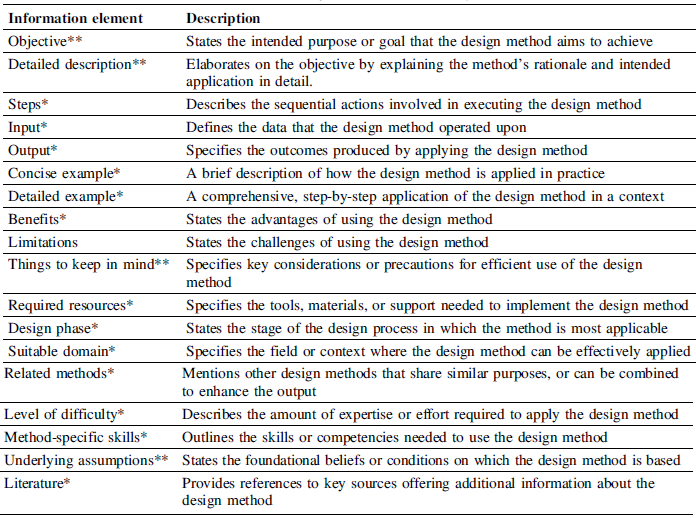
The needs derived and the challenges identified from the earlier studies (Reference Mayookh and SrinivasanMayookh & Srinivasan, 2023, Reference Mayookh and Srinivasan2024, Reference Mayookh and Srinivasan2025a, Reference Mayookh and Srinivasan2025b, Reference Mayookh and Srinivasan2026) are clustered into themes based on similarity. The relevant themes are then translated into features of the information structure of the enhanced repository. Each of these features aims at mitigating the challenges and needs represented by the corresponding theme. These features, along with the features expected by the stakeholders in the enhanced repository (see Section 2), form the basis for the design of the information structure. Some features are directly translated into the information elements of the structure, while others are aimed at improving the information quality, and supporting ease of understanding and using methods. Further, additional elements are incorporated in the information structure beyond its user-centric components, as these elements are essential for enabling stakeholders to better understand, use, and teach design methods. Both these user-centric and paternalistic information elements are mentioned in Table 3.
3.2. Validation of information structure
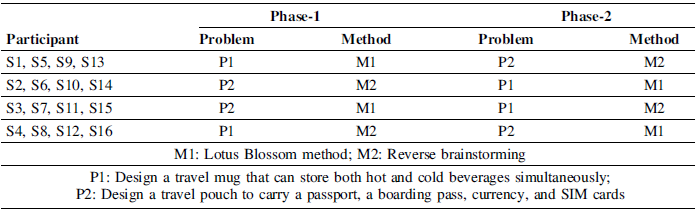
An experiment is designed to validate the efficacy of the proposed new information structure, i.e., its ability to support the understanding and use of design methods. In this experiment, 16 design students (S1-S16) from a design school of a Centrally Funded Technical Institution (CFTI) in India are given two design problems (P1, P2) and are instructed to individually generate solutions using two ideation methods (M1, M2) one after another, as shown in Table 1. These students have undertaken at least one course on learning and implementing design methods. The information on these methods is organised using the proposed information structure and is shared with the students. Along with the design problems, a list of pain-points and pleasure-points is provided to use while generating the solutions. The students are instructed to document their procedure of using the methods on a response sheet. They are given the flexibility to use either sketches or words to describe their solutions. The information of the design methods, formatted as per the proposed information structure, is displayed on a computer monitor placed in front of them. At the end of both the phases of the experiment, an interview is conducted, during which the students are enquired about the challenges they face in understanding and using a given design method, the aspects they liked or disliked about the method, and whether there was any information they needed that was not available in the given method. The interview is recorded with the participants’ permission. Neither the interview nor the experiment is timed.
Design of experiment

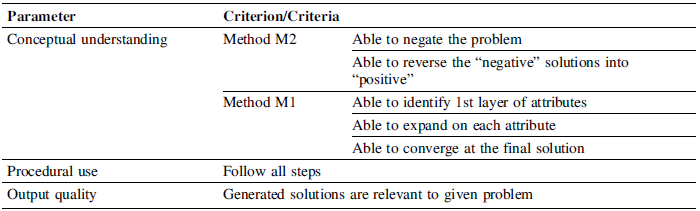
The process documented by the students for generating solutions using the given ideation method, in both phases 1 and 2, is analysed based on the following parameters: (a) Conceptual Understanding, (b) Procedural Use, and (c) Output Quality. These parameters are assigned a set of success criteria (see Table 2). The success criteria for each parameter remained the same for the solutions generated using both design methods, except for Conceptual Understanding, which depends on the design and aim of the method itself. Each generated solution and the corresponding process followed are scored on a scale of 0-2 (0: does not fulfil criterion; 1: fulfils criterion partially; 2: fulfils criterion completely). The scoring is done, independently, by the first author, along with an expert who has experience in research into and teaching design methods. The interview responses of the participants and the findings from the analysis of the solutions generated by students on the response sheets are triangulated to identify the percentage agreement between the two sets of data and to draw conclusions on the efficacy of the proposed information structure.
Success criteria for each analysis parameter

4. Findings
4.1. Information structure for design methods
The features for information structure derived from the studies (Reference Mayookh, Srinivasan, Chakrabarti and SinghMayookh & Srinivasan, 2023, Reference Mayookh and Srinivasan2024, Reference Mayookh and Srinivasan2025a, Reference Mayookh and Srinivasan2025b, Reference Mayookh and Srinivasan2026), as explained in Section 3.1, are as follows: (a) simple to understand and use, (b) detailed info, (c) real examples on a variety of contexts, (d) related literature, (e) downloadability, (f) reliable/trusted sources of info, (g) multilingual, (h) easy to access and interactive, and (i) various attributes reported by participants: steps, benefits, limitations, context of use, skills needed, combinable and alternate methods, underlying assumptions, and level of difficulty. Table 3 shows the various elements of the information structure with their brief description. The features that directly translate into information elements are (c), (d), and (i), while the remaining features aim to improve information quality and support ease of understanding and using methods. The given design methods, M1 and M2, are organized according to this information structure as shown in Figure 1 (a) and (b) (see Appendix A for details on M1 and M2). This information on methods is used in the experiment to validate the information structure.
Description of information elements in the developed information structure (*: user-centric elements; **: paternalistic elements)

4.2. Findings from interviews
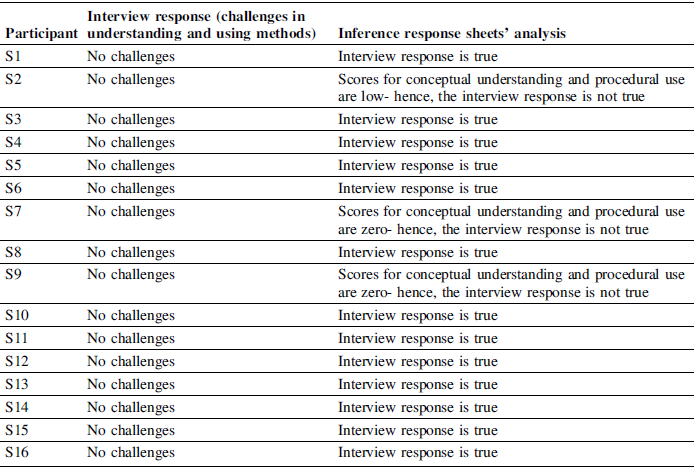
The recordings of the interviews are transcribed and analysed to identify the challenges faced by the students in understanding, using, elements they liked or disliked, and whether there was any missing information in the given design methods organised as per the proposed information structure. The summary of the interviews is documented in Table 4.
Summary of interview responses of participants

4.3. Analysis of response sheet
The students’ interview responses are corroborated with the process followed in their problem-solving; the process is documented in the sheets of paper given to them. This analysis of the response sheet is conducted by the first author and one expert, separately for both design methods using the analysis parameters listed in Table 2. Due to the rating being ordinal and the number of raters being 2, weighted Cohen’s Kappa is used to evaluate inter-rater reliability separately for the solutions generated through methods M1 and M2, across all participants (Reference Landis and KochLandis & Koch, 1977). Weighted Cohen’s Kappa is found to be 0.666 and 0.614 for the solutions generated using M1 and M2, respectively, indicating substantial agreement between the raters’ ratings, as pointed out by Reference Landis and KochLandis & Koch (1977).
The interview responses of the participants regarding the challenges they faced in understanding and using design methods are compared with the outcomes of their response sheets. The observations are presented in Table 5. These observations indicate that 81.2% of the participants did not face any challenges in understanding and using the given design methods organised with the proposed information structure.
Validation of interview responses

4.4. List of improvements
The analysis of interview data also helped identify the following improvements needed to further refine the information structure: (a) reduce the amount of text to reduce information of a method, (b) provide more examples for a variety of contexts in which a method can be used, (c) segregate various information elements and images, (d) improve the visual appeal of a structured design method, (e) provide a map or a flowchart of the various steps in a method, (f) provide information in a videographic format, (g) need support to check whether a method is used correctly, and (h) information elements (other than examples) explained through illustrations and images.
5. Discussion
This study presents the development of a novel user-centric information structure of design methods, based on the findings from earlier studies (Reference Mayookh, Srinivasan, Chakrabarti and SinghMayookh & Srinivasan, 2023, Reference Mayookh and Srinivasan2024, Reference Mayookh and Srinivasan2025a, Reference Mayookh and Srinivasan2025b, Reference Mayookh and Srinivasan2026), and validates it through an experiment involving 16 design students. It is observed that 81.2% of the participants faced no challenges in understanding and using the given design methods, which were structured according to the proposed information structure. Furthermore, a list of refinements to the proposed information structure has also been identified. The contribution of this work lies in the systematic identification and organization of information elements based on the needs of our stakeholders (i.e., design students, practitioner, and educators). We believe that organization of information of methods as per the needs of the stakeholders will help better use of design methods.
The following elements of the proposed information structure are similar to the elements in the existing repositories (Reference Mayookh, Srinivasan, Chakrabarti and SinghMayookh & Srinivasan, 2023): Objective, description, steps, examples/case studies, benefits, limitations, method input and output, similar methods, and references/literature. The remaining information elements (level of difficulty, method-specific skills, underlying assumptions, suitable domain, things to keep in mind, and multiple examples of varying degree of complexity and based on different contexts) are not present in the existing repositories. Table 6 shows a broad comparison.
A major limitation of this research is the limited number of participants in the experiment (16), and all these participants are from the same design school in India. Only the data showing the use of a method and of interviews is analysed; the quality of solutions generated using the given methods is not analysed or benchmarked yet. The information structure needs to be validated with other prospective users of the enhanced repository, i.e., design practitioners and educators.
Comparison of information structures

6. Summary, conclusion, and future work
An information structure for design methods is developed based on the findings from (Reference Mayookh, Srinivasan, Chakrabarti and SinghMayookh & Srinivasan, 2023, Reference Mayookh and Srinivasan2024, Reference Mayookh and Srinivasan2025a, Reference Mayookh and Srinivasan2025b, Reference Mayookh and Srinivasan2026), consisting of the following information elements: Objective, detailed description, steps, input, output, concise example, detailed example, benefits, limitations, things to keep in mind, required resources, design phase, suitable domain, related methods, level of difficulty, method specific skills, underlying assumptions, and literature. This information structure is validated for its efficacy, i.e., ease of understanding and using design methods based upon this information structure. To achieve this, an experiment was conducted with 16 design students, who were given 2 design problems and 2 ideation methods to generate solutions for these problems. The same set of problems and methods was used across participants, but in varying combinations. The students documented their solutions and were interviewed at the end of the experiment to identify the challenges they faced in understanding and using the given design methods. Their documented solutions were rated on 3 parameters by 2 raters. This analysis of solutions was used to triangulate the students’ interview responses. All students reported having faced no challenges in understanding and using design methods during the interview; however, triangulation revealed that 81.2% of the responses were accurate. Furthermore, a list of improvements for the information structure was derived from the interview responses of the students: (a) reduce the amount of text to reduce information of a method, (b) provide more examples for a variety of contexts in which a method can be used, (c) segregate information elements and images, (d) improve the visual appeal of a structured design method, (e) provide a map or a flowchart of the various steps in a method, (f) provide information in a videographic format, (g) need support to check whether a method is used correctly, and (h) Information elements (other than examples) explained through illustrations and images.
In the future, existing design methods across all generic design phases (i.e., need identification, concept generation, concept evaluation, prototyping, and testing) will be redeveloped based on this validated information structure. A collection of these methods will be a part of the envisioned enhanced repository of design methods to support design practice and pedagogy.
Appendix A The following are the links to the information on the design methods:
-
• Lotus Blossom (M1):
https://1drv.ms/b/c/EDB8F7937B6CDE5B/IQAtpioEvGmzTae2NaHdnWk_AU-lOfS2sKgNydlVjbtCBnY?e=qqDIEA
-
• Reverse Brainstorming (M2):
https://1drv.ms/b/c/EDB8F7937B6CDE5B/IQCO-bKiNSlhR7F-ygadfqEpATwzXYI3AweTikj50rqifHo?e=8I7yL1



 Open access

