





1. Introduction
Rice and wheat are among the most important food crops worldwide (Seck et al., Reference Seck, Diagne, Mohanty and Wopereis2012). The history of rice cultivation dates back to its invention 10,000 years ago in southern China (Peng et al., Reference Peng, Shi, Xue, Xiao, Zhong, Ma and Bing2010; Huang et al., Reference Huang2012). Notably, rice farming is more labor-intensive than crops such as wheat or corn, requiring extensive collaboration for building and maintaining complex irrigation systems (Buck, Reference Buck1935; Fei, Reference Fei1939).Footnote 1 Not surprisingly, research on the history of rice cultivation suggests that rice farming may have shaped the psychology, cognition, and cultural attitudes of the Chinese people over generations (Nisbett, Reference Nisbett2004). More recently, Chen et al. Reference Chen, James Kai and Chicheng(2020) document the enduring influence of China’s Keju system (a civil service examination system in Imperial China) on contemporary educational outcomes. These findings are in line with the literature on cultural transmission in which certain cultural values can persist across generations (see, e.g., Nunn & Wantchekon, Reference Nunn and Wantchekon2011; Nunn, Reference Nunn2012; Alesina et al., Reference Alesina, Giuliano and Nunn2013).
In their highly influential paper, Talhelm et al. Reference Talhelm, Zhang, Oishi, Shimin, Duan, Lan and Kitayama(2014) demonstrate that the culture of rice farming (i.e., social norms and values shaped by the practice of rice farming) fosters interdependent and holistic thinking styles, even among individuals with no direct farming experience. In a recent paper, Zhou et al. Reference Zhou, Alysandratos and Naef(2023) find that this rice culture enhances cooperative behavior in a laboratory public goods game (PGG). Further supporting these findings, Ge et al. Reference Ge, He and Sarangi2024 use survey data from the Chinese Household Income Project (CHIP) to demonstrate that rice culture promotes cooperative behavior more broadly.Footnote 2
Building on existing evidence on cultural transmission on the lasting influence of rice farming, we offer a hypothesis linking rice culture to individual preference delivering a consequentialist perspective on how rice culture may influence collective economic outcomes.
Social Efficiency Orientation (SEO) Hypothesis: Rice culture promotes the individual’s preference for social efficiency.
The SEO hypothesis is tested in two studies, one involving a controlled laboratory experiment while the other uses data from the China Family Panel Studies (CFPS), a large-scale, nationally representative survey in China.
The laboratory experiment (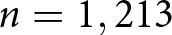 $n=1,213$ subjects in China) is based on seven two-player games: Andreoni and Miller Reference Andreoni and Miller(2002) Dictator Game (AMDG), Trust Game (TG), Sequential Prisoner’s Dilemma Game (SPDG), Jealousy Game (JG), Ultimatum Game (UG), and randomized Ultimatum Game (RUG), in addition to PGG. The study involves student participants from varying rice culture backgrounds recruited in Beijing.Footnote 3, Footnote 4 For each game, we examine how individuals’ behavior can affect the social surplus shared between both players. We then formulate specific predictions on how a rice culture may shape behaviors in each game, resulting in seven distinct predictions in total. Our findings support the SEO hypothesis in five out of seven predictions, specifically in the Jealousy Game (JG), Trust Game (TG), Sequential Prisoner’s Dilemma Game (SPDG), part of the Andreoni-Miller Dictator Game (AMDG), and the Public Goods Game (PGG).
In our second study, we test the SEO hypothesis using data from CFPS which includes questions on helping behaviors across several items or scenarios. Consistent with the SEO hypothesis, we find that respondents’ overall likelihood of providing help (aggregated across all items) increases with the influence of rice culture. Additionally, this effect appears more pronounced for items where the impact of helping on social surplus is less ambiguous.
To our knowledge, this study and that of Zhou et al. Reference Zhou, Alysandratos and Naef(2023) are among the few that experimentally demonstrate how culture, shaped by agricultural practices, can influence economic decision-making by influencing social preferences. In a related study, Chew et al. Reference Chew, Ebstein and Yunfeng(2023a) find that individuals’ aversion to risk decreases with rice culture. Their findings support the cushion hypothesis (Hsee & Weber, Reference Hsee and Weber2019), which posits that individuals in collectivist cultures experience a form of social insurance through their social networks, providing a “cushion” against risks. While the cushion hypothesis describes the presence of this social insurance effect, it remains silent on why rice culture fosters a willingness to cushion against risk. Here, our SEO hypothesis offers an explanation, proposing that rice culture induces individuals to perceive helping behavior as being socially efficient, thereby reinforcing the preference for mutual support in risky situations. Finally, our study contributes to the growing literature that shows that efficiency preferences may not be universal but shaped by economic institutions instead (e.g., Gächter et al., Reference Gächter, Herrmann and Thöni2010; Henrich et al., Reference Henrich, Boyd, Bowles, Camerer, Fehr, Gintis and McElreath2019; Bowles & Gintis, Reference Bowles and Gintis2002).
In addition to offering a mechanism for understanding rice culture, our study contributes to the literature on efficiency motivation in social preferences. Charness and Rabin Reference Charness and Rabin(2002) show that social surplus significantly influences prosocial behavior, alongside factors such as “warm glow” (Andreoni, Reference Andreoni1989; Andreoni & Miller, Reference Andreoni and Miller2002), inequality aversion (e.g., Fehr & Schmidt, Reference Fehr and Schmidt1999), and reciprocity (e.g., Dufwenberg & Kirchsteiger, Reference Dufwenberg and Kirchsteiger2004; Rabin, Reference Rabin1993). People tend to choose the option to maximize payoffs for all participants, even if this sometimes means incurring a personal income loss or increasing income inequality. This behavior relates directly to our SEO hypothesis underpinning the importance of culture in shaping social preference through its influence on individual preference for social efficiency.
2. Laboratory study
Background. This study is part of a broader project investigating the influence of genetics and culture on economic decision-making. The experiment was conducted over two waves in 2010 and 2012 in Beijing, recruiting from the Chinese student cohort (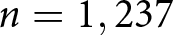 $n=1,237$ subjects) at several leading universities (e.g. Peking University, Tsinghua University, Renmin University, Beijing Normal University, Beijing University of Posts and Telecommunications, and China University of Mining and Technology etc.).Footnote 5 Subjects made decisions across a series of anonymous pen-and-paper economic decision-making tasks, organized into three categories: (i) individual decisions involving risky lotteries, (ii) two-player social games, and (iii) two-player contest.Footnote 6 At the end of the experiment, two random tasks (one from category (i) and one from categories (ii) or (iii)) were selected for cash payment i.e., their decisions in those rounds were converted to cash. This procedure ensures that it is incentive-compatible for subjects to truthfully and carefully consider their decisions in each task. The mean amount received was ¥320. Subjects also contributed 20 ml of blood. Social-demographic details were collected in the post-experiment survey. The study was approved by the Institutional Review Board of the National University of Singapore.
2.1. Social efficiency orientation and behavior in social games
We use all experimental data from the two-player social games (category (ii)) to investigate the Social Efficiency Orientation (SEO) hypothesis. Here, all subjects were presented with the decision tasks in the following order: Andreoni-Miller Dictator Game (AMDG), Ultimatum Game (UG), Randomized Ultimatum Game (RUG), Jealousy Game (JG), Trust Game (TG), Sequential Prisoners’ Dilemma Game (SPDG), and the Public Goods Game (PGG).
In the following, we will first introduce the measure of rice culture. Thereafter, we will detail each of the aforementioned social games and discuss the relevant SEO hypothesis predictions for each game.
2.1.1. Rice farming culture
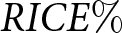
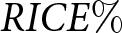
Following Talhelm et al. Reference Talhelm, Zhang, Oishi, Shimin, Duan, Lan and Kitayama(2014), we use the proportion of cultivated land dedicated to rice farming in 1996 in subjects’ birth provinces (hereafter known as 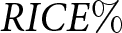 $RICE\%$) as a proxy for their rice culture. We excluded 24 subjects from Xinjiang province from our analysis due to the region’s strong herding culture. This left us with 1,213 (48% female) Han Chinese subjects from 28 provinces. Most subjects (mean age 21.15 years; SD = 3.41) were second or third year undergraduate students and 96% of subjects were not born in Beijing (these subjects have lived in Beijing for an average of 2.36 years; SD = 1.48). This suggests that most subjects should have developed some understanding of the prevailing social norms in Beijing.
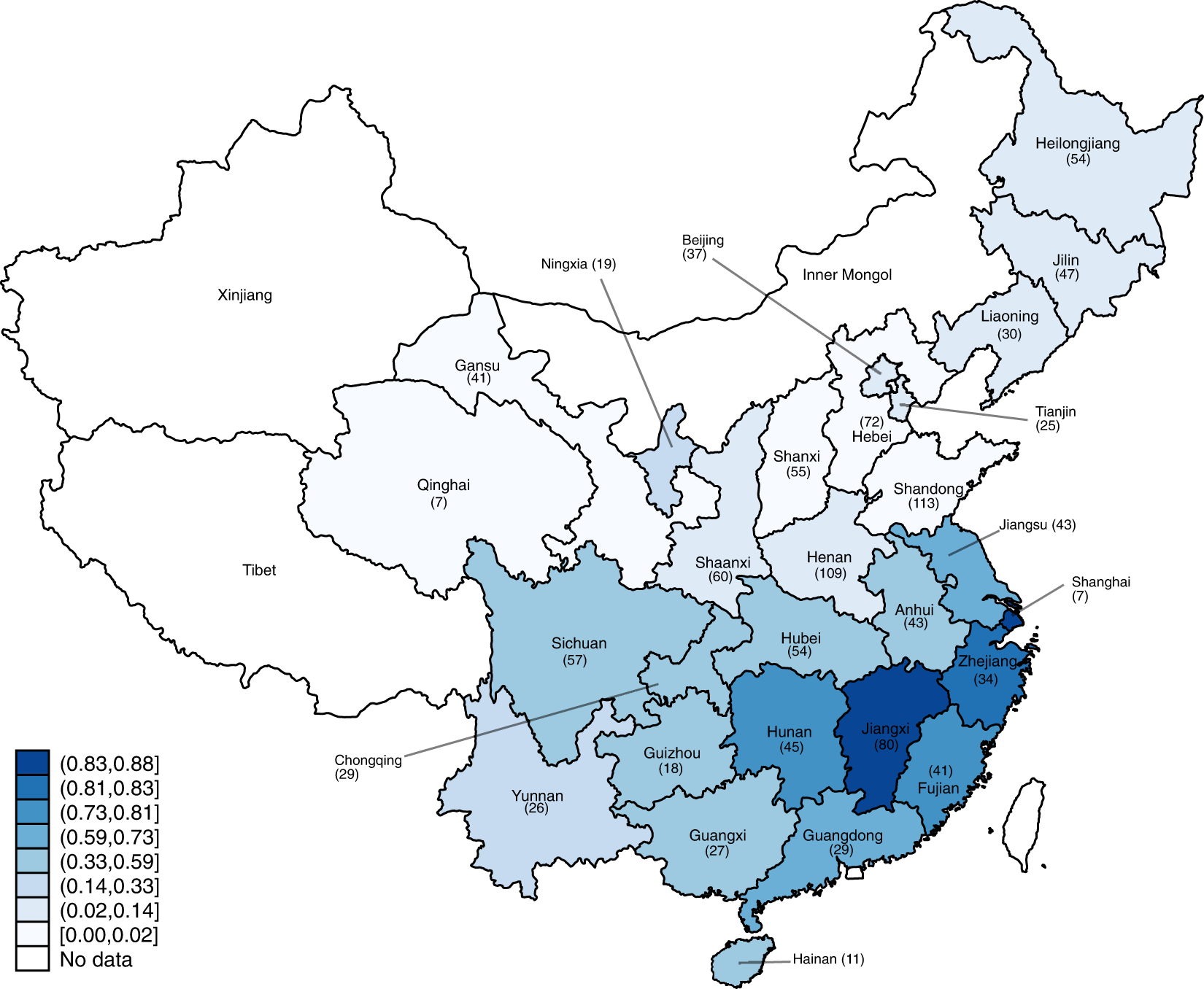
The map on Figure 1 details the number of subjects from each province (indicated in parentheses) alongside the measure of rice culture (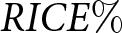 $RICE\%$). We note that no single province contributes more than 10% of the total sample. Furthermore, rice farming is expectedly more intensive in the southern regions, particularly those closer to the Yangtze River.
Rice farming in mainland China.
2.1.2. Social games
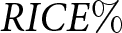
We use the “strategy method” (Selten, Reference Selten and Sauermann1967; Brandts & Charness, Reference Brandts and Charness2011) for instances where players’ decisions in the two-player social game depend on their role: subjects submit contingent decisions for all roles in the game. While subjects’ behavior in each of the social games may be influenced by a wide range of social preferences and strategic considerations, our discussion will focus on the role of the social surplus. the total payoff available to both players. The Social Efficiency Orientation (SEO) hypothesis posits that the culture of rice farming will influence subjects’ preferences for outcomes that enhance the social surplus. As such, we should expect 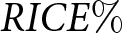 $RICE\%$ to influence subjects’ propensity to choose actions that improve the social surplus, even at the expense of their own individual payoffs.
In the following, we provide an overview of each social game, followed by a discussion on how, in some games, the role of social surplus can be isolated and examined. Building on this, Table 1 summarizes the seven predictions derived from the SEO hypothesis regarding behaviors across the various social games. These predictions will guide our empirical analysis.
Social efficient orientation predicted behaviors

Note: Here, 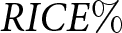 $RICE\%$ refers to province-level proportion of cultivated land dedicated to rice farming in 1996. Subjects played two versions of the Ultimatum Game. the standard version (UG) and the randomized version (RUG) where the proposer’s decision is randomly determined.
γ: Dictator’s normalized offer in the R ≠ 1 AMDG scenario minus their normalized offer in the R = 1 AMDG scenario.
Jealousy Game (JG): Player A decides how much of ¥120 Player B will receive, without receiving payoff from her own decision – the social surplus increases with the amount Player B receives. SEO hypothesis predicts that the amount received by Player B will increase with 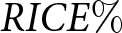 $RICE\%$ (Prediction 1).
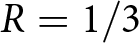
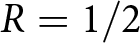
Andreoni-Miller Dictator Game (AMDG): Player A (the Dictator) encounters five Dictator Game scenarios, each differing by her endowment and the “price” of offers to Player B (the receiver) – the amount allocated to Player B is multiplied by the factor  $R=1/3, 1/2, 1, 2, 3$ and Player A keeps any amount not allocated to Player B.Footnote 7 The social surplus increases and decreases with offers when R > 1 and R < 1, respectively, but remains unaffected in the R = 1 case. Subjects’ allocations to the other participants in different scenarios reflect the interplay between their efficiency orientation and their altruistic preference. Focusing on the former, we use subjects’ allocations in the R = 1 scenario as a baseline measure of altruistic preferences: let γ represent a subject’s normalized allocation in the R ≠ 1 scenario minus their normalized allocation in the R = 1 scenario. Here, γ > 0 (resp. γ < 0) indicates that the subject allocates a proportionally larger (resp. smaller) portion of her endowment in the R ≠ 1 scenario relative to the R = 1 scenario. This measure allows us to infer the extent to which subjects adjust their allocations based on efficiency considerations, controlling for altruistic motives, proxied by the R = 1 scenario behavior. The SEO hypothesis predicts that γ will increase with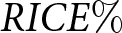 $RICE\%$ when R > 1 (Prediction 2). When R < 1, while γ is expected to decrease with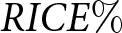 $RICE\%$ (Prediction 3).Footnote 8 The SEO hypothesis provides no specific predictions for the R = 1 case, as the social surplus remains constant for all offers.
Public Goods Game (PGG): Each player is endowed with ¥80 and must decide how much to contribute to a common pool. Contributions are multiplied by 1.6, and the total is then equally divided between the two players. Contributions increase the social surplus and serve as a measure of cooperativeness (e.g., Ledyard, Reference Ledyard, John and Alvin1995; Fehr & Gächter, Reference Fehr and Gächter2000). The SEO hypothesis predicts that contributions in the PGG will increase with 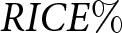 $RICE\%$ (Prediction 4).
Trust Game (TG): Player A (trustor) is endowed with ¥80 and decides on the amount of money – a measure of trust – to send to Player B (trustee). Player B will receive thrice the sent amount and then has to decide how much of this amount to send back – a measure of trustworthiness – to Player A.Footnote 9 The overall size of the social surplus increases with the amount that Player A sends to Player B and the SEO hypothesis predicts that the sent amount will increase with 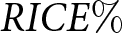 $RICE\%$ (Prediction 5). The SEO hypothesis provides no specific predictions for the trustee’s behavior, as the social surplus remains constant for all return amounts.
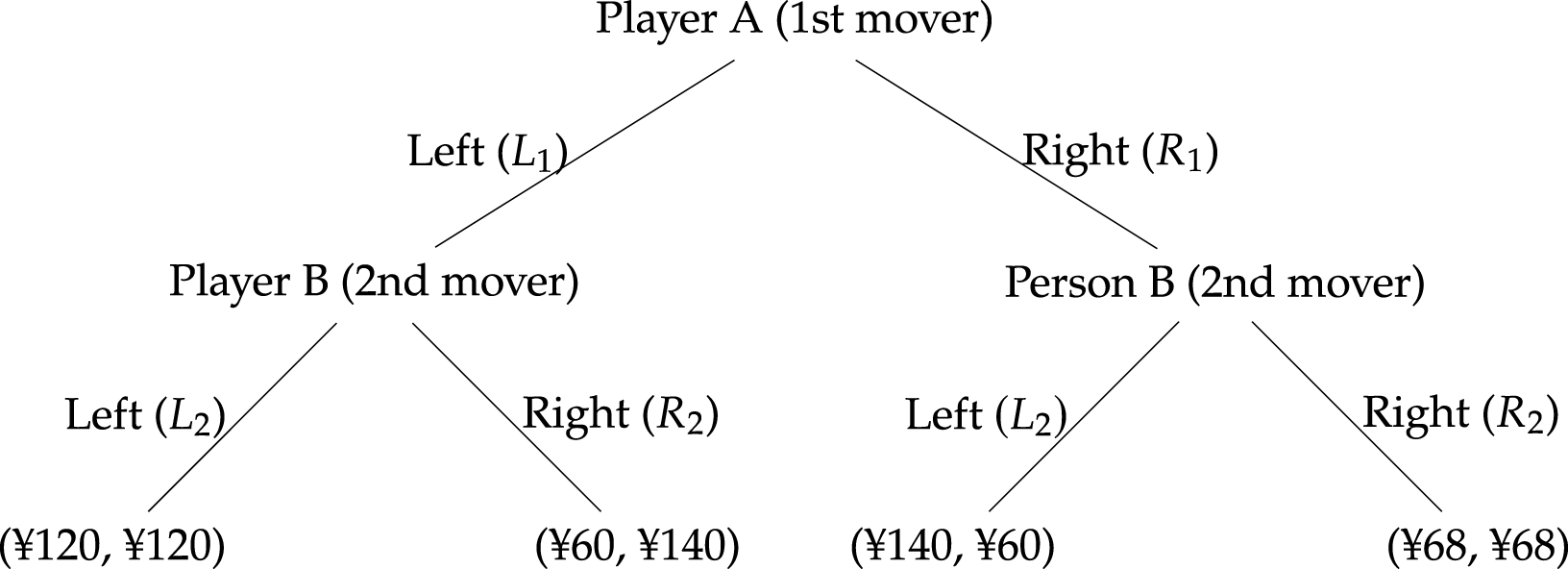
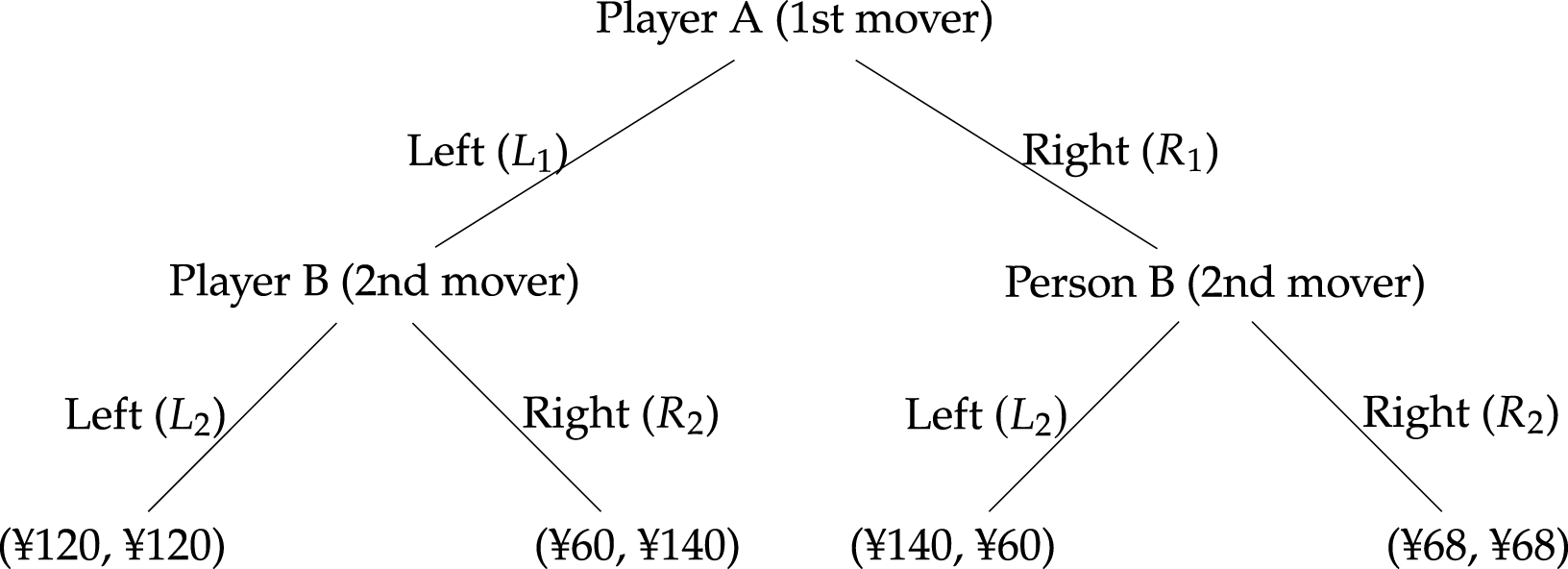
Sequential Prisoners’ Dilemma Game (SPDG): Figure 2 details the game. Player A (the first mover) first decides on whether to move Left (L 1) or Right (R 1). Moving Left generates a larger social surplus, irrespective of Player B’s subsequent decision – Player A can strictly increase her own payoffs by moving Right. Player B (the second mover) observes Player A’s decision and thereafter decides on whether to move Left (L 2) or Right (R 2). Similarly, Player B’s strategy of unconditionally choosing Left ( $L_2L_2$) will also maximize the social surplus. Indeed, the $L_2L_2$ strategy prioritizes joint payoffs for both players over the possibility of greater individual gains for Player B with always choosing Right ( $R_2R_2$). Subjects make decisions in advance for both roles, specifying whether they would choose L 1 or R 1 as Player A and their conditional strategy as Player B ( $L_2L_2$, $R_2R_2$, $L_2R_2$, or $R_2L_2$). Since the SPDG requires contingent choices for both players, it is necessary to evaluate these decisions jointly, as they interact to influence the overall social surplus, effectively “nesting” both Player A’s and Player B’s choices within the same game. According to the SEO hypothesis, the likelihood of selecting L 1 as Player A and $L_2L_2$ as Player B will increase with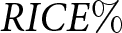 $RICE\%$ (Prediction 6).
Sequential Prisoners’ Dilemma Game (SPDG).
Ultimatum Game Paradigm: Each subject participates in two versions of the Ultimatum Game: the standard version (UG) and the randomized version (RUG). In the standard UG, Player A (Proposer) is endowed with ¥120 and decides how much to offer Player B (Responder), who then chooses to accept or reject the offer. The randomized version (RUG), only differs in that Proposer’s offer is determined by a random device (uniform weights to each integer from 0 to 120). Whilst, Responders’ decision in both games may also be influenced by equity and reciprocity considerations, the latter may feature less prominently in the RUG, since the proposer’s offer is exogenously determined. In the experiment, subjects decide on their offer amount as Player A in the UG and the minimum acceptance offer (MAO) as player B in the UG and RUG – Player B will reject any offers below the MAO. A lower MAO is efficiency enhancing in both the UG and RUG, since it decreases the chance of a rejection. Given the broad similarities, we compute the subjects’ average MAO over the UG and RUG. The SEO hypothesis predicts that the average MAO will decrease with 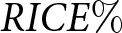 $RICE\%$ (Prediction 7). The SEO hypothesis provides no specific predictions for the proposer’s behavior, as the social surplus remains constant for all offers.
2.2. Results
For brevity, we report the summary statistics for all social games in the Appendix. To test the seven SEO hypothesis predictions in Table 1, we use the following linear regression model:
 \begin{equation*}
G_{i,p} = \alpha + \beta RICE\% + \lambda W_p + \eta X_{i,p} + \varepsilon_{i,p}
\end{equation*}
\begin{equation*}
G_{i,p} = \alpha + \beta RICE\% + \lambda W_p + \eta X_{i,p} + \varepsilon_{i,p}
\end{equation*} The regression model controls for province-specific factors, Wp, such as per capita GDP, population density, and the agricultural sector’s share of GDP (all measured in 1996), as well as individual-level variables,  $X_{i,p}$, including gender and whether the individual’s parents are employed in the agricultural sector. We normalized all relevant dependent variables, $G_{i,p}$, by subjects’ endowment in the respective games. In the AMDG, we compute the subjects’ average γ index under the R < 1 (i.e., $R=1/3,1/2$) and R > 1 (i.e.,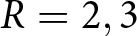 $R=2,3$) scenarios. Finally, we apply the Benjamini-Hochberg procedure (Benjamini & Hochberg, Reference Benjamini and Hochberg1995) to control for multiple hypotheses testing (seven hypotheses evaluated).
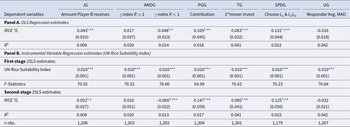
The relevant OLS estimates are reported in Panel A of Table 2 (the full regression results on the influence of 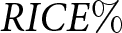 $RICE\%$ on all behaviors in the social games are reported in the Appendix). The findings are summarized as follows. The amount Player B receives in the JG increases significantly (p = 0.036) with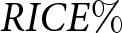 $RICE\%$. Turning our attention to the AMDG, we observe the γ index to increase (p = 0.645) and decrease (p = 0.050) with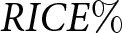 $RICE\%$ when R > 1 and R < 1, respectively. However, only the latter is weakly significant.Footnote 10 The average contribution of ¥49.3 in the PGG, which is 61.6% of the endowment, reflects a strong level of cooperativeness. Contributions in the PGG increase significantly (p = 0.022) with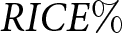 $RICE\%$. The amount sent by TG trustors increases significantly (p = 0.015) with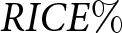 $RICE\%$. In the SPDG, the likelihood of subjects choosing L 1 as player A and $L_2L_2$ as player B increases significantly (p = 0.006) with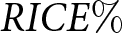 $RICE\%$. Finally, in the ultimatum game paradigm, we observe responders’ average minimum acceptance offer (over the UG and RUG) to decrease with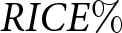 $RICE\%$ (p = 0.401), though not at any reasonable significance levels.Footnote 11 The above findings are robust to the Benjamini and Hochberg Reference Benjamini and Hochberg(1995) multiple hypotheses testing corrections.
OLS and IV regression estimates (two players social games)
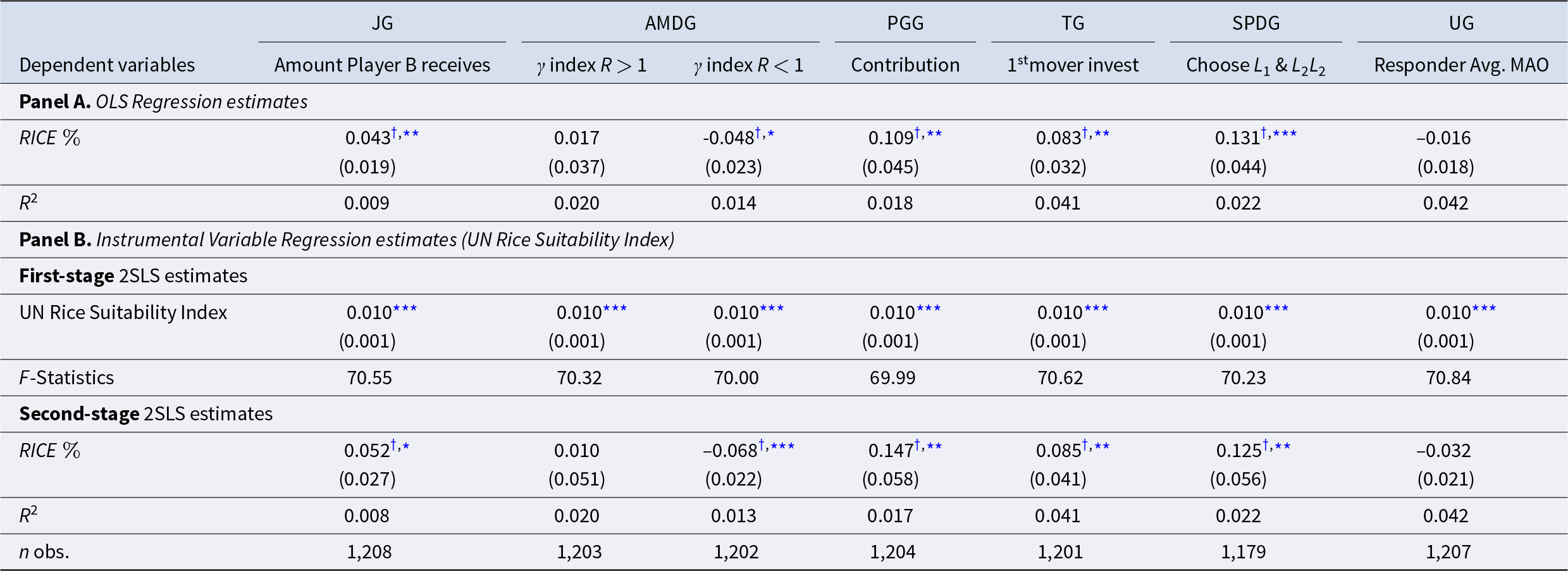
Note: Here, 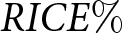 $RICE\%$ refers to the subjects’ birth-province proportion of cultivated land dedicated to rice farming in 1996. All regressions include province-level controls for per capita GDP in 1996, population density in 1996, and the agricultural sector share of GDP in 1996, and subject controls for gender and whether parents are employed in the agricultural sector – all estimates are reported in the Appendix. Missing observations are due to illegible decision submissions. Standard errors (in parentheses) are clustered at the province level (28 provinces).
γ index: Dictator’s normalized offer in the R ≠ 1 AMDG scenario minus their normalized offer in the R = 1 AMDG scenario.
*** p-values: 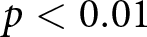 $p \lt 0.01$; **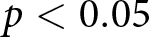 $p \lt 0.05$; *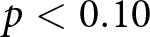 $p \lt 0.10$. $^{\dagger}$ significant after Benjamini and Hochberg Reference Benjamini and Hochberg(1995) multiple-hypothesis corrections (7 corrections) at the false discovery rate of 0.10.
We can also analyse subjects’ conditional decisions in the SPDG. Conditional on choosing  $L_2L_2$ as Player B, we find subjects’ likelihood of choosing L 1 to increase significantly (p = 0.001, n = 342) with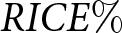 $RICE\%$. Conditional on choosing L 1 as Player A, we similarly find subjects’ likelihood of choosing $L_2L_2$ to increase significantly (p = 0.021, n = 708) with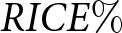 $RICE\%$.
Finally, we find no significant influence of 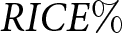 $RICE\%$ on choices that do not affect the social surplus in the various social games: AMDG offers when R = 1 (p = 0.499), amount returned by trustees in the TG (p = 0.953), and proposers’ offers in the UG (p = 0.596). These findings lead us to the following result.
Result 1 Consistent with the SEO hypothesis, rice culture (i) increases the amount Player B receives in the Jealousy Game, (ii) increases contributions in the Public Goods Game, (iii) increases the amount sent by trustors in the Trust Game, (iv) decreases inefficient offers in the Andreoni-Miller Dictator Game, and (v) increases the likelihood of making an efficient move in the sequential Prisoner’s Dilemma Game.
Result 1 is robust to controls for the number of years lived in Beijing (see column (2) and column (5) from Table A2 to Table A8 in the Appendix for details). Interestingly, the analysis shows that subjects’ acclimatization into Beijing’s culture, proxied by the length of time they had lived there, does not seem to have an effect on their behavior.
The SEO hypothesis posits that the labor-intensive nature of rice cultivation and the need for collective irrigation systems fosters a culture that prioritizes collective welfare, or social surplus, over individual gains. Indeed, we observe correlations between behavior in social games and 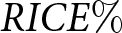 $RICE\%$ that are consistent with this hypothesis. However, there are natural concerns about reverse causality: communities with a pre-existing culture of collectivism or a preference for prioritizing social surplus may be more inclined to engage in rice farming. Additionally, there could be unobserved factors, such as shared cultural heritage or local governance institutions, that simultaneously influence both rice farming and preferences for social surplus. To address these concerns, we adopt the approach of Talhelm et al. Reference Talhelm, Zhang, Oishi, Shimin, Duan, Lan and Kitayama(2014) and Zhou et al. Reference Zhou, Alysandratos and Naef(2023), using the UN Rice Suitability Index, based on exogenous geographic and climatic conditions favorable for rice cultivation, as an instrumental variable for rice culture (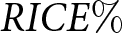 $RICE\%$).Footnote 12
The IV regression estimates are reported in Panel B of Table 2 – the F-statistics for the first-stage regression is around 70, indicating that the UN Rice Suitability Index is a strong instrument for 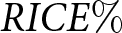 $RICE\%$. More importantly, we see that Result 1 is robust to the instrumental variable analysis: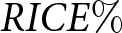 $RICE\%$ is positively correlated with the amount Player B receives in the JG (p = 0.050), contributions in the PGG (p = 0.012), amount sent by trustors in the TG (p = 0.038), and the likelihood of choosing L 1 and choosing $L_2L_2$ in the SPDG (p = 0.025), and negatively correlated (p = 0.001) with the γ index for the R < 1 scenarios in the AMDG. Again the findings are robust to the Benjamini-Hochberg multiple hypotheses testing corrections.
One concern with using the UN Rice Suitability Index as an instrumental variable (IV) is that it may not fully satisfy the exclusion restriction – the rice suitability index is a function of a set of geo-climatic conditions, which may affect cooperative behavior through channels other than rice farming. To address this, we follow Alesina et al. Reference Alesina, Giuliano and Nunn(2013) and check the robustness of the IV estimates by controlling for additional covariates that may be correlated with the UN Rice Suitability Index. We added more controls on land characteristics including province-level terrain slope, soil depth, and land cover pattern (Fischer et al., Reference Fischer, Velthuizen, Shah and Nachtergaele2002; Zhou et al., Reference Zhou, Alysandratos and Naef2023), and the Human Development Index (HDI) in 2008 following Talhelm et al. Reference Talhelm, Zhang, Oishi, Shimin, Duan, Lan and Kitayama(2014). We show in the Appendix (column (6) from Table A2 to Table A8) that the IV estimates are robust to the inclusion of these additional controls.
Gender Differences. The OLS regression estimates on Table 2 find the amount Player B receives in the JG (p = 0.033), γ index (p = 0.001) for the R > 1 case in the AMDG, PGG contributions (p = 0.054), first-mover offers in the TG (p = 0.001), likelihood of choosing L 1 as first-mover and  $L_2L_2$ as second-mover in the SPDG (p = 0.001), and average MAO in the UG (p = 0.001) to be significantly lower for females relative to males. Conversely, we find the γ index for the R < 1 case of the AMDG to be significantly higher for females relative to males. Together, these observations reveal a gender difference in preferences for the social efficient outcome which is in line with findings in the literature e.g.,
Andreoni & Vesterlund Reference Andreoni and Vesterlund(2001); Chew et al. Reference Chew, Ebstein, Israel, Lei and Tang(2023b).
$L_2L_2$ as second-mover in the SPDG (p = 0.001), and average MAO in the UG (p = 0.001) to be significantly lower for females relative to males. Conversely, we find the γ index for the R < 1 case of the AMDG to be significantly higher for females relative to males. Together, these observations reveal a gender difference in preferences for the social efficient outcome which is in line with findings in the literature e.g.,
Andreoni & Vesterlund Reference Andreoni and Vesterlund(2001); Chew et al. Reference Chew, Ebstein, Israel, Lei and Tang(2023b).
2.3. Discussions
The SEO hypothesis focuses on the role of social surplus in the various social games. The implications of players’ decisions on the social surplus are “salient” in the JG, PGG, TG (first-mover), where we find support for the SEO hypothesis, as expected. In contrast, the social surplus component may be relatively less prominent in the Ultimatum Game paradigm where the game dynamics focuses more on fairness and equity concerns rather than on efficiency or maximizing joint payoffs. Here, responders may be more concerned with getting a “fair deal” rather than the efficiency consequences of their decision.
In fact, equity concerns may also explain the mixed support for the SEO hypothesis in the AMDG. Suppose that Dictators in the AMDG exhibit efficiency preferences and also equity preferences, in that they dislike ending up with less money than the receivers. For R = 2 and R = 3 scenarios, a Dictator will receive less than the receiver if she offers more than 0.33 or 0.12 proportion of her endowment, respectively. Thus, fairness preferences counteract efficiency preferences, constraining the Dictator’s offer and possibly explaining the null findings for the R > 1 scenario SEO hypothesis prediction (Prediction 2).Footnote 13 In contrast, the corresponding thresholds for the 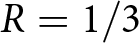 $R=1/3$ and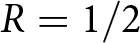 $R=1/2$ cases are 0.75 and 0.66, respectively – levels that may be too high for equity preferences to significantly impact the Dictator’s behavior.
Our findings are subject to several limitations. Notably, we did not inquire about the duration that subjects had lived in their birth-province. This leaves us with limited information about their intensity of exposure to rice culture. In addition, the behavioral experiments were conducted between 2010 and 2012. Given the potential for evolving patterns in our findings over time, additional experimental work will be invaluable in future studies.
3. CFPS study
Building on Result 1, we now test the SEO hypothesis outside of the laboratory. To do so, we utilize data from the China Family Panel Studies (CFPS), a large-scale nationally representative survey targeting 16,000 Chinese households in 25 provinces (Xie & Hu, Reference Xie and Jingwei2014). The 2010 wave of the CFPS includes two questions regarding individuals’ experiences in asking and giving help:
(A) Have you asked for others’ help with any of the following up to now?
1. Borrow money; 2. Child’s schooling; 3. Illness (see a doctor); 4. Job search; 5. Child’s job search; 6. None of these.
(B) Has anyone asked you for help with any of the following up to now?
1. Borrow money; 2. Child’s schooling; 3. Illness (see a doctor); 4. Job search; 5. Child’s job search; 6. None of these.
If a respondent acknowledges an item (e.g., borrowing money, child’s schooling, illness, job search, or child’s job search), the surveyor will then ask if the respondent actually followed through in the specified area (e.g., whether the respondent helped with a job search when asked). Additionally, the data includes information on each respondent’s province of birth, allowing us to examine the influence of rice culture on respondents’ self-reported likelihood of providing help.
Providing help in some of the above items can be interpreted as at least efficiency-enhancing behavior – such interpretations may be more ambiguous in other items. The efficiency-enhancing aspects of lending money, helping with child schooling or seeing a doctor may be highly context dependent. For instance, a respondent might perceive lending money as efficiency-enhancing only if it is used to benefit the collective group rather than for individual purposes like paying down personal debt. In contrast, job search assistance may be perceived to be efficiency-enhancing because it boosts collective resources by helping individuals secure employment.
3.1. Empirical strategy
We first examine respondents’ overall likelihood of providing help (i.e., the extensive margins, referring to whether they offer help at all. To measure this, we construct a dummy variable, Give_Help, which takes the value of 1 if the respondent reports having provided help in any of the specified items, and 0 otherwise. Given that an individual’s propensity to offer help may be influenced by whether she has received help, we also construct a dummy variable, Get_Help, set to 1 if the respondent reports receiving help for any item, and 0 otherwise. To examine the intensive margin, we create a Help_Index (ranging from 1 to 5) that counts the number of items with which the respondent has provided help. This index is constructed only for respondents whose Give_Help variable is equal to 1. The SEO hypothesis predicts that respondents’ likelihood of giving help (Give_Help) and extent of helping (Help_Index) will increase with 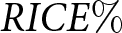 $RICE\%$. We next study respondents’ likelihood of providing help for each specific item (i.e., item-specific extensive margins, referring to whether they provide help for particular types of assistance). To do so, we create dummy variable for each item that is 1 when the respondents offer help for that item and otherwise 0. The SEO hypothesis predicts that respondents’ likelihood of giving help for each item will increase with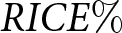 $RICE\%$. As previously discussed, it is plausible that item-specific helping likelihood is more evidential when it concerns job search.
3.2. Results
We again report the data summary statistics in the Appendix. Panel A of Table 3 details the OLS estimates for the study of respondents’ overall likelihood of providing help and their extent of helping. We observe some tentative evidence that Give_Help and Help_Index increase with 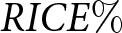 $RICE\%$. This relationship becomes clearer when using the UN Rice Suitability Index as an instrument for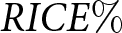 $RICE\%$ in Panel B: we observe Give_Help (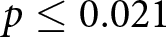 $p\leq 0.021$) and Help_Index (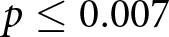 $p\leq 0.007$) to significantly increase with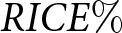 $RICE\%$. Finally, we expectedly see both Give_Help and Help_Index to be highly correlated with Get_Help (p < 0.001).
OLS and IV regression estimates (CFPS data, overall all items)
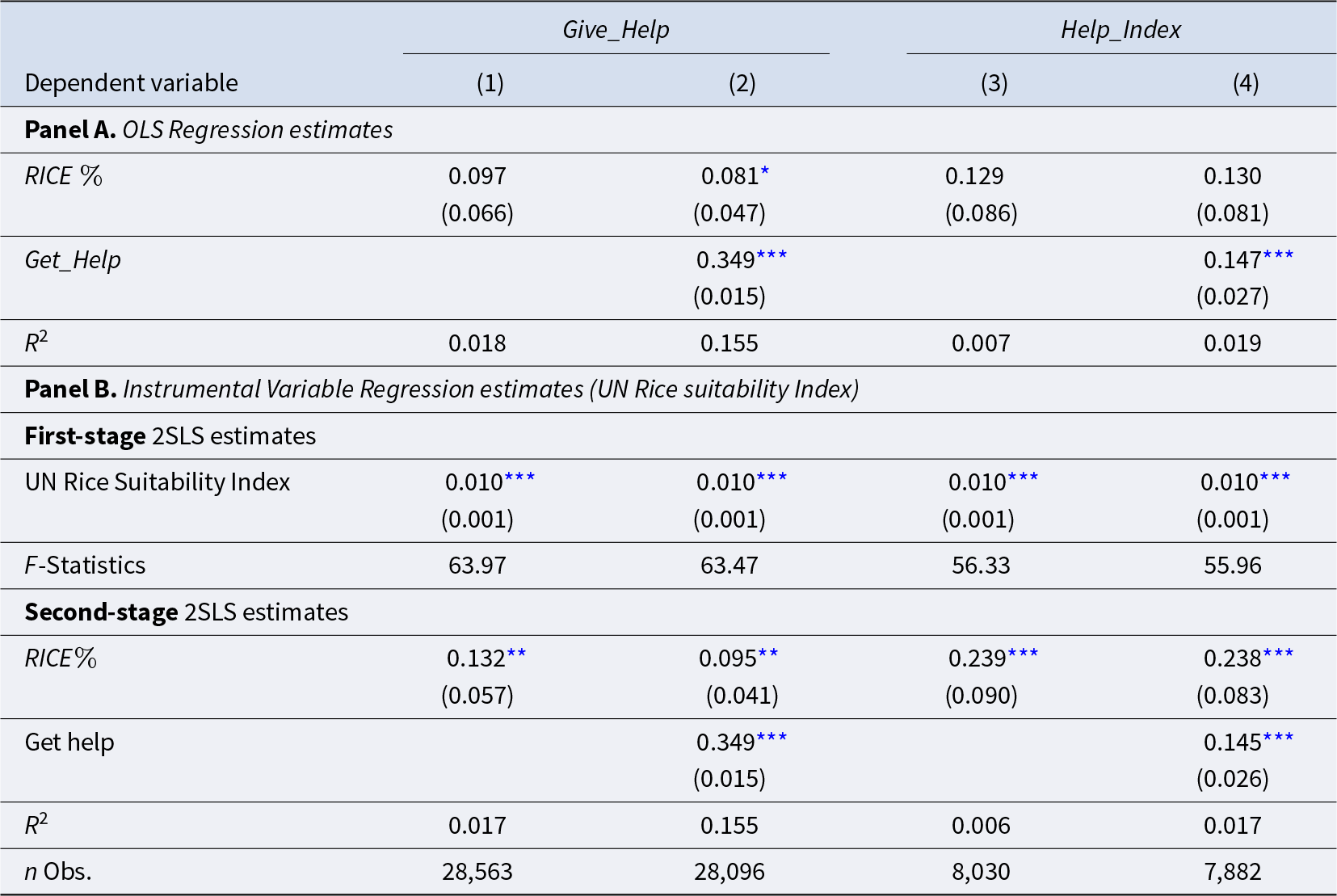
Note: Here, Give_Help (resp. Get_Help) is a situation dummy corresponding to whether respondent provided (resp. received) help to at least one of the surveyed items. Building on this, Help_Index (between 1 to 5) counts the number of items that the respondent had offered help in. 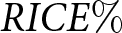 $RICE\%$ refers to the respondents’ birth-province proportion of cultivated land dedicated to rice farming in 1996. All regressions include province-level controls for per capita GDP in 1996, population density in 1996, and the agricultural sector share of GDP in 1996, and subject-level controls for gender, rural or urban residence, and family income – all estimates are reported in the Appendix. Standard errors (in parentheses) are clustered at the province level (28 provinces).
*** p-values: p < 0.01; **p < 0.05; *p < 0.10.
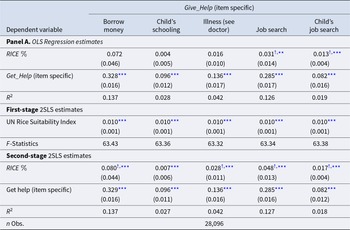
Building on the above, Panel A of Table 4 details the corresponding OLS estimates for the item-specific likelihood of providing help. Here, we see that respondents’ likelihood of providing help is significantly increasing with 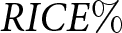 $RICE\%$ when it concerns job search (p = 0.017) and child’s job search (p = 0.006). The influence of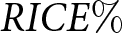 $RICE\%$ is also positive when concerning borrowing money (p = 0.125), child’s schooling (p = 0.184), and see the doctor (p = 0.108), though not at any reasonable significance level. Importantly, the above findings are robust to the IV estimations (see Panel B of Table 4) and the Benjamini-Hochberg multiple hypotheses testing corrections (5 tests applied). This leads us to our next result:
Result 2 Consistent with the social efficiency hypothesis, rice culture increases the likelihood of individuals to offer help.
OLS and IV regression estimates (CFPS, Item specific)
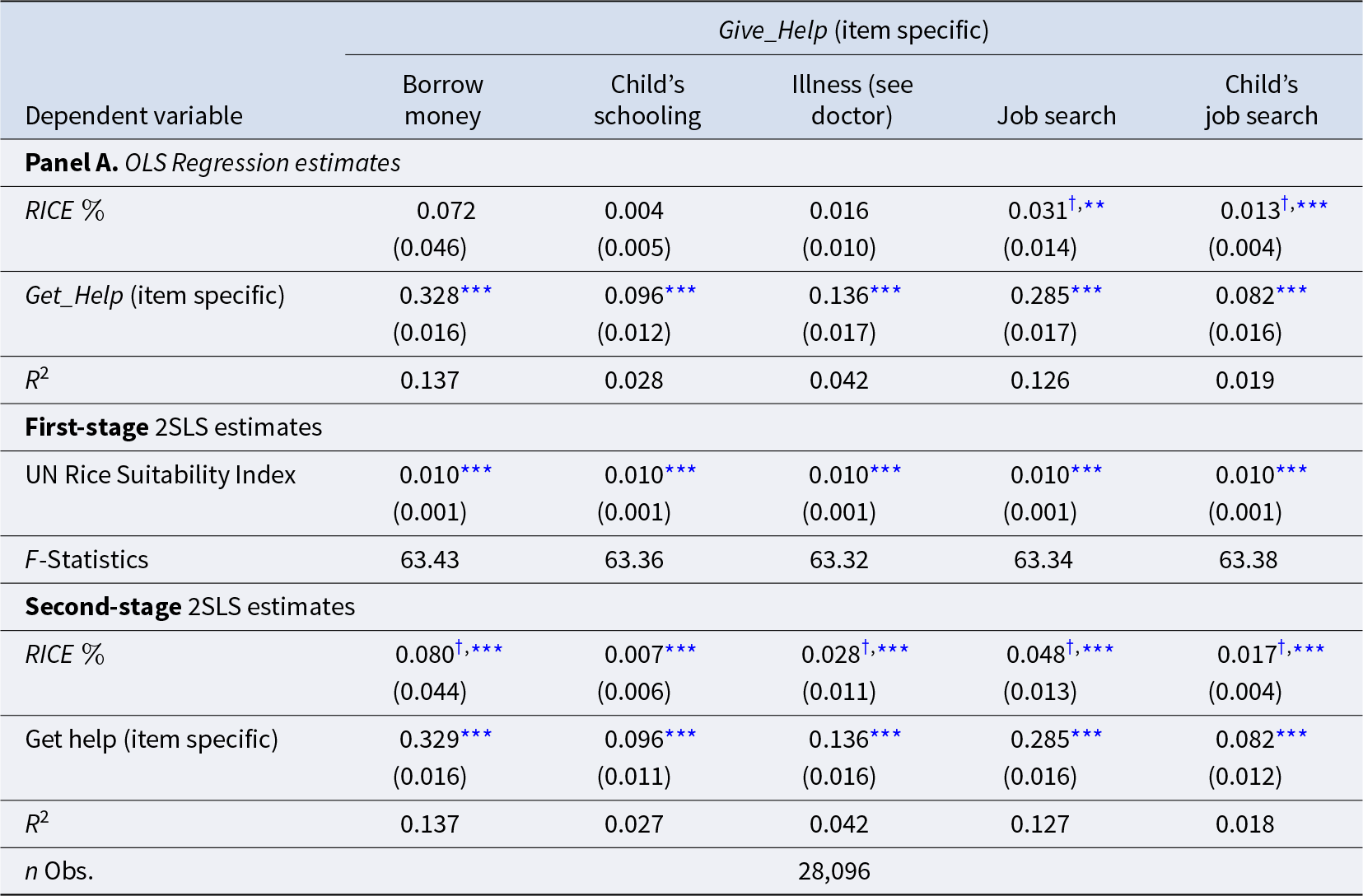
Note: Here, Give_Help (resp. Get_Help) is a situation dummy corresponding to whether respondent provided (resp. received) help in the specific surveyed items. 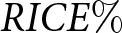 $RICE\%$ refers to the respondents’ birth-province proportion of cultivated land dedicated to rice farming in 1996. All regressions include province-level controls for per capita GDP in 1996, population density in 1996, and the agricultural sector share of GDP in 1996, and subject-level controls for gender, rural or urban residence, and family income – all estimates are reported in the Appendix. Standard errors (in parentheses) are clustered at the province level (28 provinces).
*** p-values: p < 0.01; **p < 0.05; *p < 0.10.
† significant after Benjamini and Hochberg Reference Benjamini and Hochberg(1995) multiple-hypothesis corrections (5 corrections) at the false discovery rate of 0.10.
3.3. Discussions
A natural limitation of the CFPS analysis is that it relies on self-reported responses, unlike the experimental setup in our laboratory study, where we can observe participants’ actual decisions and precisely define social surplus. The Social Efficiency Orientation (SEO) hypothesis proposes that helping behavior arises from an intrinsic motivation to maximize collective welfare, a value deeply embedded in rice culture. Alternatively, helping behavior may be driven by an extrinsic motivation to conform to social expectations and avoid sanctions for non-cooperative actions.
This alternative explanation is captured by the concept of “cultural tightness” (e.g., Gelfand et al., Reference Gelfand, Nishii and Raver2006; Gelfand et al., Reference Gelfand2011), which refers to the extent to which social norms and rules are clearly defined and strictly enforced within a society. In high-tightness societies, there is a strong emphasis on conformity and rule adherence, often reinforced by punishments or sanctions for deviations. Furthermore, Talhelm and English Reference Talhelm and English(2020) find rice culture to be correlated with measure of cultural tightness.
We further re-ran the OLS analysis in Tables 3 and 4, substituting 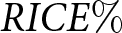 $RICE\%$ with the provincial-level measure of cultural tightness. The results (available upon request) indicate no significant effect of cultural tightness (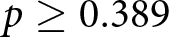 $p \geq 0.389$) on any of the relevant OLS estimates. We speculate that while tight cultures promote conformity and adherence to social norms, helping behavior may be more influenced by factors such as mutual benefit, shared goals, or a preference for social efficiency – factors that do not necessarily align with strict norm enforcement. More importantly, this lends further support to the SEO hypothesis.
4. Conclusion
Using seven social games, we experimentally tested our SEO hypothesis on the persistent influence of rice culture on people who have an intrinsic preference for social efficiency. The results indicate that individuals from regions with higher rice farming ratios are more likely to exhibit behaviors that maximize social surplus in these games. Supplementary measures of help behavior from CFPS further support the SEO hypothesis.
Our research offers new evidence suggesting a causal link between rice culture and individual efficiency-enhancing behavior, complementing existing findings from Talhelm et al. Reference Talhelm, Zhang, Oishi, Shimin, Duan, Lan and Kitayama(2014); Zhou et al. Reference Zhou, Alysandratos and Naef(2023) and Ge et al. (Reference Ge, He and Sarangi2024). The persistent effect of cultural values is often attributed to social learning where individuals adopt values from those around them. However, a less explored channel is genetic inheritance (e.g., Henrich & Broesch, Reference Henrich and Broesch2011; Richerson & Boyd, Reference Richerson and Boyd2008). This points to the value of seeking a deeper understanding into the roots of SEO in follow-up research focusing on the possible interaction between rice culture and human population genetics.
Supplementary material
The supplementary material for this article can be found at https://doi.org/10.1017/eec.2025.10013.
Replication Packages
To obtain replication material for this article, https://doi.org/10.17605/OSF.IO/T67SY.
Acknowledgements
We thank Chunhui Chen, Gui Xue, Xing Zhang, Anne Chong, Rong Tang, and Yushi Jiang for assistance in data collection, Roy Chen, Songfa Zhong, Jessica Pan, Juin Kuan Chong, Changcheng Song, and Xing Zhang for helpful comments and suggestions. This study was supported by grants from the National Science Foundation of China (key project no. 72033006), AXA Research Fund, John Templeton Foundation (ID: 21240), and the Ministry of Education of Singapore.






 Open access

