

A week after the January 2015 publication of the new Planetary Boundaries article in Science, the updated version of the framework made its public debut before the global financial and political elites that had descended upon Davos for that year’s installment of the World Economic Forum (WEF). The aristocratic resort of Davos has long been internationally known as a site of mystique and the worship of health and wealth, and the setting at Schatzalp of the European sanatorium overlooking the village below in Thomas Mann’s novel The Magic Mountain (1924) that won him a Nobel Prize. A century later, the small town nestled in the Swiss Alps is primarily known as a playground of elites and mega-influencers, and the home of the WEF, arguably one of the central players of the world in its globalized era – and of the small subspecies of Homo sapiens that has been baptized “Davos Man.”Footnote 1
Aiming high in terms of potential political impact, and surfing on previous waves of success in both its science and its communication, the Stockholm Resilience Centre (SRC) hosted no less than seven sessions at the 2015 WEF meeting in Davos. Representatives of the SRC were there to promote Planetary Boundaries 2.0 as well as a popular science book by Johan Rockström (Figure 8.1) and the renowned Swedish nature photographer Mattias Klum. Rockström, Klum and the SRC framed Big World, Small Planet: Abundance within Planetary Boundaries as a contribution to a “new narrative of world growth within Earth’s limits.”Footnote 2 The wider context was the upcoming Paris climate conference and the adoption of the UN Sustainable Development Goals (SDGs), scheduled for later in 2015, “the most important year of environmental decisions in decades.” Like the conceptual framework it drew upon, Big World, Small Planet combined scientific data with the deployment of vivid, often tropical, nature imagery – this time in the form of Klum’s photography – in evoking a planetary human environment. Despite having been pushed to the brink of critical boundaries for safe habitation, this environment still held the hope of rehabilitation and a return to a Holocene-like state of stability.
Johan Rockström at the 2008 Tällberg Forum, just over a year before the publication in Nature of the first Planetary Boundaries paper, for which he was the lead author. At the time director of the Stockholm Environment Institute and co-director, with Carl Folke, of the SRC, Rockström went on to lead the Potsdam Institute for Climate Impact Research and, as a “meta-specialist” on a wide range of environmental issues, has become a prominent public voice for sustainable development.

Rockström and Klum also employed a variety of by then well-established SRC themes and concepts straddling science and governance, including “planetary stewardship”, “reconnecting to the biosphere”, and the idea of a “good Anthropocene.” The latter was an ostensibly attainable outcome, as implied by the book’s quasi-Cornucopian title. The word “abundance” also echoed contemporary works of techno-optimism, signaling a more Lynasian than Hamiltonian outlook on the prospect of expansion for the human enterprise on a planet that was certainly not without limits, but that remaining within them could offer more to many, provided it was done in the right way. According to Rockström and Klum, “Abundance within planetary boundaries requires a deep mind-shift. Not growth without limits. Not limits to growth, but growth within limits.”Footnote 3
Planetary Metaphysics?
The outreach efforts at Davos and beyond had a background. The massive impacts and lively debates that followed the 2009 Planetary Boundaries paper turned the PB research initiative into a more or less permanent field of activity at the SRC. Soon after the article’s publication, Sarah Cornell, a British marine and atmospheric chemist, was hired by the SRC to coordinate Planetary Boundaries-related research, which became a de facto line of research in its own right. An early area of focus was to translate the PB framework into potential policy practices, again taking advantage of Stockholm’s convening power to organize workshops and launch multiple-author papers, occasionally bringing the Nature article co-authors into the scheme. A great deal of additional research was pursued in Stockholm to refine the work, make the quantifications more robust, and introduce data for possible new boundaries that were not part of the original framework.Footnote 4 After five years, the time was considered right to take a major step forward and publish a new, comprehensive version of the framework. This initiative, including the publication and the thinking behind the updated version of planetary boundaries, reflected many important aspects of the ongoing shifts in environmental governance, both before and after the 2009 Nature piece.
Coupling evocative concepts with big data and powerful imagery has proven to be an effective science communication strategy as demonstrated by the extraordinary diffusion of the Planetary Boundaries framework, not only in scientific journals but also in the lexicon of environmental politics and activism. The release of the 2015 edition of the framework coincided with the publication of another scientific article that, like the iconic Planetary Boundaries diagram, encompassed dramatic, data-derived visualizations of humanity’s mounting impact on the Earth system. Named after a concept that emerged at a 2005 conference on the history of the human–environment relationship in Dahlem, Berlin, a revised version of the so-called Great Acceleration graphsFootnote 5 was published in The Anthropocene Review the day after the Planetary Boundaries paper appeared in Science.
In “The Trajectory of the Anthropocene: The Great Acceleration,” two sets of twelve hockey stick-style graphs depicted an array of socio-economic drivers. They included population, real GDP, energy consumption – and selected Earth system disruptions – atmospheric CO2 concentration, ozone depletion, and ocean acidification – that had been rapidly rising in virtual lockstep with one another during the decades following World War II. That period, which some consider co-temporaneous with the onset of the Anthropocene, was dubbed The Great Acceleration by Dahlem participants John McNeill, Paul Crutzen, and Will Steffen in their 2007 article in Ambio (Chapter 7) where the concept first appeared in print. It has since become a key conceptual tool for explaining and periodizing the recent past – as well as assigning blame for environmental crisis – among members of the global change community.
Will Steffen (Figure 8.2), an SRC fellow and former director of the International Geosphere Biosphere Programme (IGBP), was the lead author of both January 2015 articles that updated the Planetary Boundaries framework and the Great Acceleration graphs – the latter described as a “planetary dashboard” by the heuristically attuned science communicators at the SRC. Two of the other co-authors of the Great Acceleration article were Stockholm-based expatriates who, like Steffen, held long-term affiliations with the IGBP. Marine chemist Wendy Broadgate was deputy director of the Programme for fifteen years before becoming founding director of the global hub in Stockholm for Future Earth, which in 2015 supplanted the IGBP and the other member organizations of the Earth System Science Partnership. This institution, too, found its home in the Academy of Sciences building adjacent to the Stockholm University campus.
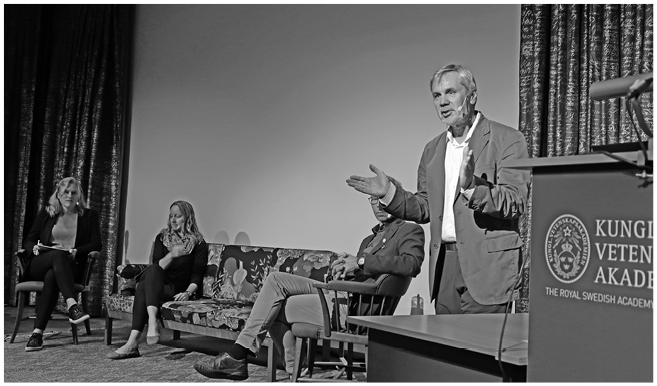
Climate scientist Will Steffen (right) on stage in the Beijer Hall at the Royal Swedish Academy of Sciences during the tenth anniversary celebration of the Planetary Boundaries framework in 2019. Executive director of the Stockholm-based IGBP from 1998 to 2004 and a world-class science communicator, Steffen, who passed away in 2023, was instrumental in the development and popularization of Earth system science and the Anthropocene concept: He was also the lead author of the second Planetary Boundaries article, published in Science in 2015. Also depicted, left to right: Line Gordon, Belinda Reyers, and Johan Rockström.
Owen Gaffney was the communications director at IGBP and went on to lead the Resilience Centre’s international media strategies, while also holding an affiliation with Future Earth. His dual role – mirroring in a sense the public engagement of scientists such as Johan Rockström – as a media expert and global sustainability analyst reflects the high degree of integration between science and communications at leading Stockholm institutions like the SRC and IGBP. Some of Gaffney’s other activities and affiliations can, moreover, provide additional insight into the ways in which scientific products have been conceived, perhaps even packaged, for communication purposes. He is for instance an associate of the non-profit organization Globaïa that specializes in data visualizations combining art, science, and narrative – including concepts like the Anthropocene, the Ecosphere, and Big History – to “inspire a ‘big picture’ understanding of our home planet.” Through its connections to Stockholm, Globaïa was entrusted to produce the opening “Welcome to the Anthropocene” film for the 2012 Rio+20 Conference and provided data visualizations for the Netflix documentary “Breaking Boundaries” (2021) based on the Planetary Boundaries framework. Gaffney also co-authored its accompanying volume with the same title (see Chapter 7).
Indicative of a decidedly positive outlook on high-technology solutions to sustainability challenges among some key members of the Stockholm network, Gaffney is also on the faculty of Singularity University. This institution, not precisely a “university” as usually understood but rather a global think tank, was founded by the prominent futurist Ray Kurzweil and the engineer-entrepreneur Peter Diamandis. The latter is also well known for being the co-author of Abundance: The Future Is Better Than You Think, a 2012 bestseller on the potential of exponential technologies such as artificial intelligence and quantum computing for solving many of humanity’s most intractable problems.
It could also be expected to find this eco-modernist line of exegesis percolating in the wake of Planetary Boundaries thought. As we have seen, Mark Lynas had already preached the eco-modernist gospel in The God Species (2011). What was needed to deal with the Anthropocene challenges was not less technology or less modern civilization, less urbanization, less nuclear power, or, for that matter, less energy – just smarter versions of all of the above and more in order to create a cybernetic super-sphere operated by a much more capable and well-equipped humankind. This kind of futurist thinking was far from novel – it has roots in Francis Bacon’s Solomon House utopia (1625), or in Charles Fourier’s super-rational phalanstères (1816) – the word itself a mix between the French words phalang, a long military flank, and monastère, a monastery, perhaps a congenial place for finally escaping the ordinary world of contradictions and conflict. Or, for that matter, in utopias by Edward Bellamy and H. G. Wells in the decades around the turn of the twentieth century.Footnote 6 More recently, the Cold War version of technological ultra-optimism was suggested by the wizard mathematician John von Neumann at the Institute for Advanced Study in Princeton. He spectacularly argued that global warming could be increased by reducing Arctic ice sheets with a combination of nuclear blasts and soot. There may be downsides – “to make a new ice age in order to annoy others, or a new tropical, ‘interglacial’ age in order to please everybody, is not necessarily a rational program” – but all stones must be turned.Footnote 7 Certainly Promethean, not at all Soterian.
Enter Gaia
There was a metaphysical ring to much of these future anticipations, perhaps to be expected in Early Modern thought, but still lingering on in the era of “the environment.” It did not go away just because science had become more solid and numbers introduced. On the contrary, after initial work in the 1960s, James Lovelock, who died at the age of 103 in 2022, proposed his hypothesis of a self-regulating “Gaia,” named after the Greek goddess of the Earth, in the early 1970s. Based on ideas developed over a long career as a missile scientist, thinking deeply about feedback loops in ballistic trajectories, Lovelock, in collaboration with biologist Lynn Margulis, author of The Symbiotic Earth (1998), conceived of the entire planet as a huge living organism, evolving under Darwinian laws.Footnote 8 Their first common piece was published in 1974 in Tellus, Carl-Gustaf Rossby’s Stockholm-based meteorology journal that had expanded its remit to also encompass broader ideas of biogeochemistry.Footnote 9 On this Earth, humans were just another species, no more or less special than termites, and Gaia would simply shrug them off if they were threatening her long-term survival.
Gaia thought is vast and complex and has strong scientific strands, but it also includes streaks of teleology in the eyes of many of its critics over the years, of whom Richard Dawkins, the Oxford biologist, and Paul Crutzen have been the most vocal. There were also many well-respected defenders of the idea, among them UK physicist Tim Lenton, a PB co-author who had specialized in research on tipping points and planetary equilibrium models.Footnote 10 In response to the critique, Lovelock and Margulis sharpened their thinking and revised the Gaia concept in several publications, with Lovelock emphasizing the hypothesis framing of the Gaia concept in 1979 and subsequently shifting towards a considerably more mathematized “theory” formulation in 1990.Footnote 11
Central to Gaia thinking are ideas of homeostasis, a wonderful equilibrium that can be repeated on ever higher levels of complexity and self-awareness, or spirituality. Earlier expressions of the idea can be found in Russian scientific thought, interestingly by proto-Anthropocene biogeochemist Vladimir Vernadsky, and similar works, as outlined at that time in a book by Helan Jaworski, Le Géon ou la Terre vivante (1928); the Earth was a living organism, a Terre vivante.Footnote 12 In an ultimate instance, this line of thought can be traced back to versions of idealism and not least ideas presented by spiritual Russian visionary Anna Helena Blavatsky, founder of the International Theosophical Society in 1875. A far cry from science-based global environmental governance, it may seem, but big, often controversial, ideas have a tendency of “always creeping in,” as the French historian Lucien Febvre put it in his very early and insightful analysis of the concept of “environment,” La Terre et l’évolution humaine: Introduction géographique à l’histoire (1922), translated as A Geographical Introduction to History (1925).Footnote 13 For Febvre, environment meant freedom, in contrast to the predominant geographical determinism of the day, where environment typically meant hard natural barriers, a steering force for both individual humans and entire societies.Footnote 14
Perhaps it is also precisely in philosophical and political concepts such as “freedom” and “determinism” that we should seek the roots of the protracted fighting over Planetary Boundaries. What the eco-modernists wanted was actually not the boundaries. They by and large sided with the critical opinion that rose up against the Limits to Growth report from the Club of Rome in 1972 – one of several earlier attempts to introduce limits into the politics of resources and environment and arguably the most famous. Limits was distinctly neo-Malthusian in its perspective and was heavily criticized by economists for disregarding the inherent capacity of economies to innovate, increase productivity, and thereby improve resource efficiency. The following decades seemed to justify their view. Wealth kept growing and resource scarcity did not materialize. But the economists were only partly right.Footnote 15 On the planetary scale, impacts did in fact grow. Hence the Anthropocene, hence the unbroken Keeling curve of CO2 emissions, and hence the volatility and geopolitical criticality of oil, gas, and strategic minerals, involved in literally every major armed conflict on earth. Hence, the massive spread of natural resource extractivism during the Great Acceleration, which propelled strong linkages to the rapidly expanding financial sector, constantly on the lookout for investment objects upon which to build capital.Footnote 16 The eco-modernist “good Anthropocene” was essentially a new version of the 1970s anti-Limits to Growth argument. Let technological capitalism reign, and it will once again make sure that we do not need to restrict economic growth, reduce consumption, or temper consumerism.
This is an argument that requires a great many models and mathematics as well as some reassuring guesswork. It nonetheless risks being unconvincing. It is more effective rhetorically to provide a consistent narrative that shows how the trade-off between resource depletion and wealth production is constantly taking humanity to a better position. Ideas are needed. Eco-modernism itself is an ideology that feeds upon the seeming absoluteness that the Planetary Boundaries provide. The boundaries are not political products; they are, in a sense, God-given, properties of the Earth, and to observe them makes a lot of sense. Even more so for what follows: the freedom of capitalism to operate within these boundaries – the “level playing field,” a recurring turn of phrase in the communications of some, but not all, of the PB spokespersons.
The Neoliberal Specter
Another strand of the PB debate used the very same idea to critique the framework. The boundaries may be reasonable and scientifically sound, yet for some – including the green movement, climate activists, many environmental scientists as well as some scholars in the social sciences and humanities, ethicists and theologians – it was the lack of a level playing field that was the problem. This entailed the same old Darwinist view of competition where the richer countries, and in each country, the wealthy, could continue to take advantage of their privileges and skew politics in their favour. The level playing field is a metaphor, and also an idea. In reality, it can be defined in many ways. The level playing field was a way to suggest that inside the boundaries, societies were free to choose. In fact, the global community was also free to allocate operating space to actors, including states and firms. But the critics in this camp, politically more to the left or “liberal” in US parlance (eco-modernists would typically lean to the right, neoliberal or conservative), were skeptical. Would this be governance with enough clout, they asked? Would it support directionality, or would it just provide a green light for the same actors – states, firms, technologies, fuels, and resources – that had created all the problems? What guarantees were there that these actors would actually change course or be ejected from the competition?
When PB2 was being prepared, this embrace from the right and critique from the left had sunk in among the core team in Stockholm and their associates around the world. They may have perceived the debate differently, with some of the authors engaging in technical and scientific debates surrounding individual boundaries and their scientific foundation. That was one line of defense. But the other, and potentially more problematic issue, was over the politics of the boundary concept. The fact that the Global South and the developing countries were skeptical of the libertarian/Darwinist slant of the approach was a drawback. It didn’t help that both Rockström and Gaffney, and other PB advocates, signed appellations to include limits thinking within the UN SDGs.Footnote 17 Will Steffen, the lead author of the follow-up article in Science, took the critique seriously enough to engage in an in-depth revision. The Science article included a section on equity issues, or rather the lack of them in the framework. It was also now carefully stated that the framework did not offer any advice on how to reach the goals. The following excerpt could be seen as a wider framing and a caveat, but also as a signal of a desire to escape from the ideological stalemate that Planetary Boundaries found itself in.
The PB approach is embedded in this emerging social context, but it does not suggest how to maneuver within the safe operating space in the quest for global sustainability. For example, the PB framework does not as yet account for the regional distribution of the impact or its historical patterns. Nor does the PB framework take into account the deeper issues of equity and causation. The current levels of the boundary processes, and the transgressions of boundaries that have already occurred, are unevenly caused by different human societies and different social groups. The wealth benefits that these transgressions have brought are also unevenly distributed socially and geographically. It is easy to foresee that uneven distribution of causation and benefits will continue, and these differentials must surely be addressed for a Holocene-like Earth-system state to be successfully legitimated and maintained. However, the PB framework as currently construed provides no guidance as to how this may be achieved [although some potential synergies have been noted (54)], and it cannot readily be used to make choices between pathways for piecemeal maneuvering within the safe operating space or more radical shifts of global governance (93).Footnote 18
This move was probably necessary to build and maintain trust among the large portions of key audiences for which equity issues and distributional politics were of major concern. That Will Steffen was keen to explore these issues he had already demonstrated by co-authoring a paper with Mark Stafford-Smith, an Australian behavioral ecologist, on the relationship between PB and equity, arguing that the rich countries in fact had much to win by increasing global equity. Stafford-Smith had been vice chair of the IGBP Scientific Committee and also co-chair of the 2012 Planet Under Pressure: New Knowledge Towards Solutions conference on global environmental change during the lead up to Rio+20 in 2012. These were contexts that Steffen too worked within. It was also in the same period that Oxford economist Kate Raworth’s “Doughnut Economics” ideas began penetrating the PB framework, suggesting that social and economic sustainability should be given due attention in the struggle taking place within the boundaries.Footnote 19
This debate may seem slightly off the mark; wasn’t it supposed to be about saving the planet? If so why all this tinkering on the sidelines? Other aspects became so central because they were directly related to the position of the “governance” in environmental governance. The Stockholm tradition had always been about keeping science at the core, just as the PB framework insisted. So far so good. But it was also a Stockholm tradition to deliver advice for policy and for the common good. This entailed turning to politics and society, and raising a call for action, or at least an invitation to a discussion about what could be done about the problem at hand. In this regard, PB was a different kind of animal. It shifted the focus to an entirely new arena: a commercial one, and possibly a civic one. It was no longer a consensus that was sought. Rather the opposite. As the 2015 Science article honestly stated: “… the PB framework does not as yet account for the regional distribution of the impact or its historical patterns. Nor does the PB framework take into account the deeper issues of equity and causation.”Footnote 20 This may also explain why the developing world remained unconvinced, and why they in the end vetoed the proposed inclusion of PB and Anthropocene-related language in the UN SDGs.
In that respect, the 2015 Science article served a function of reconciliation and modification. Partly, the issue was one of communication. PB was a vague enough framework as to be presented in very different ways. The “level playing field” language was one that signaled a business approach, but perhaps also more generally a neoliberal perspective. Neoliberalism isn’t often talked about in the context of sustainability and environmental protection. That is a mistake. Just like in almost any other policy area in the last two decades of the twentieth century, environment and climate were also affected by these ideas.
Since the 1980s, a range of literature has arrived proposing new measures in environmental protection. Many of the mechanisms were derived from economics: the polluter pays principle, road tolls and congestion fees to reduce traffic, public-private partnerships to share costs and increase efficiency in infrastructure, carbon offsetting schemes, monetarized ecosystem services, market-based certification schemes, economic compensation to species-rich countries for not cutting down rainforests, and many others. In structure and logic, these ideas and steering instruments can be described as a set of specialized applications of the basic tenets of market liberalism on the environmental realm, where in the past civic engagement and political intervention had been the dominating modes of action, in both cases typically with strong links to science. In Sweden, such tying together of actors and interests had suited the Swedish model well.
There is no comprehensive history of the neo-liberalization of environment, just as there isn’t any proper, full-scale history of environmental governance.Footnote 21 But we must surely consider the former as a part of the latter, alongside more state-centric and less market-oriented versions of environmental governance. Lacking a standard version of this history, we can still look back upon the Dutch political scientist Maarten Hajer’s very influential book from 1995, The Politics of Environmental Discourse: Ecological Modernization and the Policy Process. It includes a brief historical account of earlier versions of environmental governance and is worth revisiting, since it was for several years the most cited work that at the same time both launched and attempted to explain why and how environmental politics are also a politics of modernization. It explains convincingly what a major shift it was that began in earnest in the 1980s. A core element of the book is the view of “ecological modernization” as a new way of talking about environmental challenges. Language is important, not simply a choice of words, but as clearly reflecting a different way of thinking about environmental challenges. Above all, Hajer did not pit the environment against economic growth, development, or capitalism, but rather put forward the de facto argument that environmental management can be seen as a “positive sum game.”
Hajer devoted a full chapter to the historiography of this line of thought. He depicted a breakthrough moment in the early 1970s when the environment gained traction with the 1972 Stockholm Conference and the simultaneous experience of two emblematic publications that year, the Club of Rome’s Limits to Growth report, and Blueprint for Survival, juxtaposed in Hajer’s narrative as respectively elitist and modernist (LTG), and radical with streaks of civilizational critique (BFS). He suggested that in the 1970s and 1980s, these positions converged under the influence of major institutions like the Organisation for Economic Co-operation and Development (OECD) and the United Nations Environment Programme (UNEP) taking up the modernist paradigm.Footnote 22 The World Conservation Strategy (1980) and, above all, the OECD International Conference on Environment and Economics of June 1984 are presented as milestones in this evolution. The WCS report was the joint product of “moderate NGOs,” such as the International Union for the Conservation of Nature and the World Wildlife Fund, together with UNEP, and was written in collaboration with the FAO and UNESCO. The major conclusion of the 1984 OECD Conference was that “the environment and the economy, if properly managed, are mutually reinforcing; and are supportive of and supported by technological innovation.”Footnote 23 A characteristic summary statement in Hajer’s presentation reads thus: “The positive‐sum game format that became characteristic of ecological modernization was simply born out of necessity: for environmental policies to survive they needed to work with the grain of the time. What is more, environmental politics was not only positioned as non‐contradictory to economic policy, it was also suggested as a potential instrument for economic recovery.”Footnote 24
The convergence, Hajer argued, was further facilitated by the fact that both 1972 reports departed from the same gloomy computerized predictions, and also the fact that both sides in this modernization debate had concrete ideas and solutions that gained ground in policy. The Blueprinters argued for public transport, smarter technologies, and an ecotax, all ideas with a future. The Club of Rome argued, back then, that in the ultimate instance, continued growth and consumerism were necessary; it was a matter of avoiding the negative consequences. The World Commission on Environment and Development (the Brundtland Commission), whose report Our Common Future appeared in 1987, crowned this evolution of compromises with a politically convenient conceptualization of how to save the environment with continued development, including for the developing countries.
This third way, so zu sagen, of avoiding the dilemma of having to choose between a safe and healthy planet and a prosperous future for mankind comes across as the central feature of Hajer’s version of environmental modernization. He does not talk about neoliberalism at all. Ideologically, he instead locates this line of modernization in a reformist, social-democratic tradition of crisis solving and responsible progressivist thought. He mentions mid-twentieth-century economists such as John Maynard Keynes and the welfare- and equity-oriented Dutch Nobel Laureate Jan Tinbergen as influential background thinkers, and draws deeper intellectual roots to nineteenth-century economic and environmental philosophers John Stuart Mill and George Perkins Marsh. He also cites the multiple North-South development commissions and reports from the late 1970s and early 1980s, chaired by social democrats like Willy Brandt and Olof Palme to which Brundtland and her 1987 report can be seen as a successor. It may be mentioned that Hajer worked within the world of Dutch politics, had government commissions, and co-authored a political program for the Social Democratic Party.Footnote 25
It is hard not to notice the incompleteness of Hajer’s historiography, and writing within the framework of a PhD dissertation at Oxford University in the early 1990s obviously set some limits for what was possible. Several lacunae stand out. The first is the rise of neoliberal policy instruments, not least in economics, that receive no attention from Hajer. Likewise, ideas and results from Earth Systems science are entirely absent, unsurprisingly, since it was early in their ascent at the time Hajer was writing. Still, his insightful analysis shows that a middle-way trade-off between growth/development and environment was also considered possible, although as neoliberalism expanded, its toolbox of market-oriented instruments followed suit.
For Sweden, this analysis should be no surprise. There had always been an element of pragmatism to Swedish environmental policy. It can be traced to debates on forestry in the nineteenth century and to heated discussions about water pollution around 1900. In both cases, the interests of industry were satisfied first, and for forestry, production-oriented conservation legislation was introduced in 1903. Nature reserves and other such restraints were kept at a minimum, except in high mountain areas above the tree line. The fact that national parks in Sweden established early and extensive in size was rather because the largest parks could be located beyond areas of productive forestry and agriculture.Footnote 26
This pattern has been consistent throughout the twentieth century. Landmark decisions such as the repeated expansion of hydroelectric power, harnessing cherished river rapids, were continued up until the 1980s. Nuclear energy was expanded by parliament after a split referendum in 1980. The decision was to phase nuclear energy out by 2010, but over 60 percent of the capacity remains in operation well into the 2020s. The current plan is to keep nuclear power as a significant part of Sweden’s energy output until mid-century, and several political parties argue that it should be re-expanded to facilitate the green transition. Right-wing parties in fact won the 2022 election on a distinctly pro-nuclear platform (albeit with the narrowest possible margin; more on this in Chapter 9). In an attempt to present “Environmental Dissonances in the Swedish Welfare State,” two environmental historians have recently identified this pattern of erring on the side of least friction with industry and growth as being predominant in Sweden, and in this they are in line with earlier research (see also Chapter 2).Footnote 27
Extending Planetary Boundaries – Doughnut Thinking
This backdrop is essential to understand the evolution of the new influential turn of Stockholm-based environmental science and policy after 2000. The need to link scientific work with the new economic and political trends that prevailed under globalization was real, as was the increasing institutional density of think tanks and university-based centers that struggled to make their voices heard. In this era of stiffening competition for influence and resources, some groups and institutions opted to stay intra muros and get on with their scientific work. Those who wanted to remain interactive and influential, or were newcomers with such ambitions, had to comply with the rules of the game. The latter certainly applied for the SRC, which in that regard became not just a new arrival on the Swedish scene but also one with unusually high expectations to take on an outreach and policy-oriented position. This was surely facilitated by the fact that the Centre started out in alliance with two well-established players on the Swedish scene: the Academy of Sciences, which had made its own environmental turn in the early 1970s, and the Stockholm Environment Institute. The SRC was also from the beginning well connected with an array of international networks and institutions, including within the UN system, and was keen on rapidly expanding its reach into the realms of business and policy.
This is rewarding and demanding at the same time, and it requires several skills that conventional academic institutions do not always possess. The SRC did, or quickly developed them. In fact, it was one of the few points of critique in William Clark’s 2009 start-up review (Chapter 7): that the SRC needed to find a strategy for its work with stakeholders and policy. Outreach would within a few years become an important aspect of the Centre’s activities. With scientists working in close collaboration with media specialists in producing knowledge adapted for both scientific and public consumption, skillful science communication at the SRC and other Stockholm institutions has been a significant factor in the popularization of concepts such as Planetary Boundaries, the Great Acceleration, and the Anthropocene. What is more, the emphasis on visualizations has not only made the scientific and policy-oriented messages contained in these and other concepts more media-friendly and accessible to non-specialist audiences, but it has even also facilitated new synthetic paradigms that have expanded their applicability to other disciplines and societal sectors.
Developments surrounding PB played out internationally, which is not to say that other Swedish scientists or policy actors were silent. All along, there was significant research taking place at universities and institutes across the country, some of it with considerable influence. The physical resource theory group at Chalmers University of Technology, linked in turn to several other groups at Gothenburg University (economics, climate science), was among those. Other important natural science research environments engaged with PB included the ecology departments at the universities of Lund, Uppsala, and Umeå. Political scientists contributed, with Stockholm University as a key player. Work in history and other strands of the humanities was taking shape at the KTH Environmental Humanities Laboratory in Stockholm. A stronghold for climate-oriented social science was established at Linköping University. If anything, environment and climate gained academic ground in many institutions, but did so in increasingly diverse ways. Since “environment” started to appear on university curricula in the 1960s, the academic setting has become more uniform, and almost exclusively disciplinary-based. In the new century, academic specializations and departmental boundaries have meant increasingly less. Issue orientation and capacity for dialogue to raise institutional and economic support from extra muros have become ever more important. Unavoidably, what it means to be a Swedish or a Stockholm voice in the world of global environmental governance has not remained static. In fact, it could be argued that many institutions were not able to make that transition, while others did so successfully. Various actors have navigated these changes in society and academia differently, and with different degrees of impact.
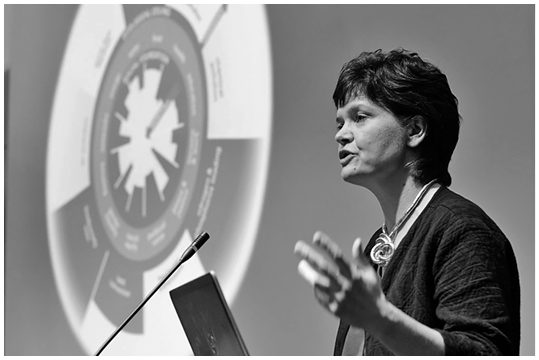
The most prominent and impactful of the conceptual modifications to the PB idea has undoubtedly been “Doughnut Economics,” a framework derived from the Planetary Boundaries diagram by the abovementioned Kate Raworth (Figure 8.3). The self-described “renegade economist” added a set of socio-economic boundaries to the environmental limits of Rockström and colleagues to create an aspirational operating space for humanity that was both safe and just. Planetary Boundaries has also in recent years converged with the Club of Rome’s pioneering scenario analysis paradigm, the Limits to Growth, generally considered the first attempt to systematically model human–environment interactions at the global level by using the World3 computer model developed by researchers at MIT in the early 1970s. For the Club of Rome’s fiftieth anniversary in 2018, the SRC – together with the Norwegian Business School’s Jörgen Randers, one of the original co-authors of the 1972 LTG report – was commissioned to perform a scenario analysis employing a global system model called Earth3. Similar to the juxtaposition of Planetary Boundaries with the idea of abundance in Big World, Small Planet, the 2018 SRC-Club of Rome report regarded the nine boundaries as a set of non-negotiable environmental limits within which the seventeen UN SDGs of Agenda 2030 could be realized. Like Raworth’s Doughnut Economics framework, the Earth3 model links socio-economic and biophysical processes in mapping pathways for achieving the SDGs by 2030 and 2050 while remaining safely inside planetary boundaries.
A strong critic of conventional economics, “renegade economist” Kate Raworth created the Doughnut Economics model that combines a set of human development indicators – the inner ring of the doughnut – with outer environmental limits determined by the Planetary Boundaries framework. The space in between is what she calls a safe and just space for humanity.
The SRC-Club of Rome collaboration was an example of a growing engagement with structural economic issues and an emerging entente with institutions concerned with the future of global capitalism among some sustainability scholars associated with Stockholm. This came about during the tenure of Anders Wijkman as the Club of Rome’s co-president between 2012 and 2018. A former politician and Secretary General of the Swedish Red Cross and the Swedish Society for Nature Conservation, Wijkman has since the 1970s been an influential voice in Sweden on issues related to the environment and sustainable development. In 2012, he co-authored with Johan Rockström a Report to the Club of Rome called Bankrupting Nature: Denying Our Planetary Boundaries. In the report, Wijkman and Rockström applied a Planetary Boundaries perspective to traditional Club concerns such as resource depletion and population growth, while calling for transforming the prevailing model of economic growth based on what they considered excessive consumption as measured by the environmentally suspect metric of Gross Domestic Product.
It was also during this period that Rockström became increasingly involved with the World Economic Forum, thus gaining further visibility that helped catapult him into the TIME Magazine 2023 list of the world’s 100 most influential people, following Greta Thunberg’s inclusion in 2019.Footnote 28 The WEF is another organization of economic and political elites that, like the Club of Rome, was founded in the years before the 1972 Stockholm Conference – a time when the global economic system that emerged during the postwar era began to be called into question, due in part to the mounting environmental impacts of the Great Acceleration. Recent research on the WEF has pointed to its combined role of think tank and ideological platform for a particular form of opinion-making. Not fully a view from nowhere, what can be considered a “Davos consensus” of financial and political elites typically favors free market-oriented agendas. But it also reflects an increasing engagement with contemporary concerns. By the 2010s, the Stockholm story extended even to this frosty and lofty place, high above the muddy terrain of ordinary politics.Footnote 29
Rockström became a regular participant in the work of the World Economic Forum, a “voice of science” at the annual Davos meetings, and a recurring contributor to the WEF website. In a column posted in conjunction with the 2016 WEF, Rockström conditionally endorsed the concept of the Fourth Industrial Revolution – the theme of that year’s Davos meeting. The idea of 4IR, conceived as a moment of historic transformation based on rapidly increasing interconnectivity and the integration of exponential technologies in all aspects of society, had been popularized in 2015 by WEF founder and Executive Chairman Klaus Schwab in an article in Foreign Affairs. Rockström’s endorsement of 4IR was predicated on the possibility that the dramatic enhancement of human agency it entailed could be enacted equitably and sustainably. Planetary Boundaries was to serve as a benchmark for ensuring an ecologically resilient safe operating space for humanity in an Anthropocene world that was increasingly dominated by algorithms and an array of advanced technologies such as automation and the Internet of things.
In Breaking Boundaries, the 2021 book by Rockström and Owen Gaffney that the Netflix documentary was based upon, a cutting-edge technology at the core of the 4IR concept – artificial intelligence – was classified as one of a number of “novel entities.” According to the authors, these had been introduced into humanity’s operating space and posed a potential risk to people and planet if not properly managed. Yet Gaffney and Rockström are in general sanguine on the critical role of technology, citing the fourth industrial revolution and calling the technological revolution of recent years a potentially positive tipping point that could countervail the trajectory toward catastrophic Earth system tipping points embarked upon during the Great Acceleration. In the chapter “Taming the Technosphere,” they even explore a range of geoengineering options, describing measures such as cloud seeding, deploying giant sunshades, and atmospheric sulfur injection as extremely high-risk technological interventions – some of which, they argue, will likely have to be considered, perhaps a decade into the future, because of the unmanageable risks the Earth will soon face.
Greta – And “Davos Man”
A less extreme way forward is put forth in the foreword of Breaking Boundaries by the Swedish climate activist Greta Thunberg (Figure 8.4). Her method for addressing the climate crisis centers on science communication: educating oneself on the issue and spreading knowledge to others in order to create a critical mass of awareness that will in turn lead to broad-based action. In her first in-person public address – at a climate action concert in Stockholm on September 7, 2018, three weeks into her famous school strike – Thunberg began her short speech by referring to Johan Rockström’s warning that the world had to drastically lower the trajectory of CO2 emissions by 2020 if the 2°C target of the Paris Agreement was to be met. A week later, as her international notoriety continued to expand exponentially, Thunberg posted an English-language video message on Twitter in which she strongly criticized Sweden for its outsized ecological footprint and invoked planetary boundaries in demanding that developed countries reduce their excessive consumption levels to keep the Earth within habitable limits.
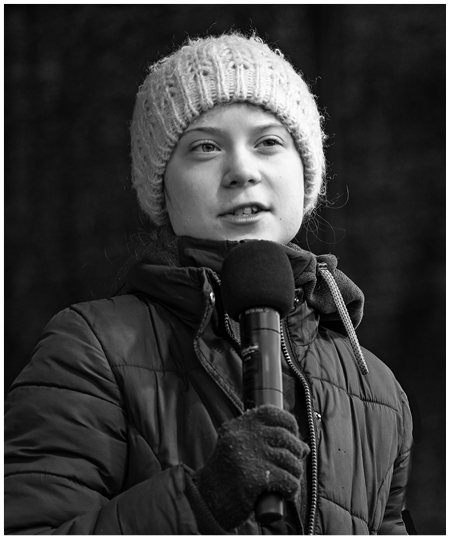
Climate activist Greta Thunberg started her School Strike for Climate by the steps of the Swedish parliament on August 20, 2018. Following a summer of record-breaking heat and wildfires and three weeks before national elections in Sweden, her solo school strike soon became a global youth movement under the banner of Fridays for Future. Thunberg is a distant relative of Svante Arrhenius, the Swedish chemist who in 1896 calculated the effect of carbon dioxide emissions on global surface temperature. In demanding political action to combat climate change, Thunberg has consistently called for decisionmakers to “listen to the science,” particularly that of the IPCC.
Sweden’s political class was in fact the initial target of Thunberg’s intervention in the climate debate. Her public writing debut in May 2018 – several months before she sparked the Fridays for Future global youth movement – came in a debate article in the daily newspaper Svenska Dagbladet. In the article, she condemned Swedish climate policy and challenged Sweden’s self-conception, perhaps even national conceit, as a progressive and pioneering country (föregångsland) due to its high per capita carbon emissions. Several months later, in the lead up to the September 2018 national elections in Sweden, following a summer of record-breaking heatwaves, Thunberg on August 20 initiated without fanfare her school strike for the climate on the steps of the Swedish parliament.
Thunberg continued to champion climate science, particularly the work of the Intergovernmental Panel on Climate Change (IPCC), as her public profile as the world’s leading climate activist soared during the autumn of 2018. Her perhaps most impactful speech was delivered at the September 2019 UN Climate Action Summit in New York, where she wielded IPCC data in admonishing world leaders for ignoring climate science and continuing to pursue business as usual pathways predicated on the idea of eternal economic growth. Several days earlier, in testimony to the US House Committee on the Global Climate Crisis, she had in lieu of a written statement submitted the 2018 IPCC Special Report on Global Warming of 1.5°C, telling the Committee, “I don’t want you to listen to me, I want you to listen to the scientists.” Her inclination to communicate science to power has been consistent across a range of high-profile gatherings of global elites. But, after all, what is it that the scientists say? Having come so far in this book, we have noted that their solutions can vary, and that they sometimes touch upon fundamental divides on values and political philosophy. What is it that “scientists” recommend politicians (ultimately: voters) to do?
In addition to polemical speeches at consecutive COP meetings and other climate events, Thunberg also followed Rockström’s lead in speaking at the World Economic Forum in 2018, 2019, and 2020 for an audience that was unlikely to share Thunberg’s commitment to climate justice and transformative change of global capitalism. Whether or not the inclusion of voices such as those of Thunberg and Rockström – both listed as WEF contributors on the Forum’s website – signals a genuine shift in thinking among the Davos corporate and political elite is at this point unclear. Are the “Davos men,” perhaps also some of its women, sincere in their oft-espoused allegiance to trendy “Environment, Social and Governance” ideals, or are they simply attempting to coopt critical perspectives on climate, environment, and sustainability issues and thereby sidestep transformative changes to prevailing economic structures? Whither Davos, whither the world?
Our Planet, Our Future – Nobel Linings
Publicly communicating science to a broad, if not elite, range of government and private sector stakeholders has, since approximately the turn of the millennium, become a core activity for a cadre of environmental experts connected to Stockholm. The epistemological commitments and conceptual repertoires of these activist Earth System and sustainability scientists have, in parallel, led to a predominantly planetary framing of the environmental governance challenges facing humanity as a whole in the near and longer-term future. Leveraging Sweden’s arguably most prominent international brand in connecting science to policy imperatives, some leading members of the Stockholm network organized the first Nobel Prize Summit in 2021 to promote the idea of planetary stewardship and address what they identified as the interlinked “supranational crises” of climate, ecology, information, and inequality.
The “Our Planet, Our Future” summit was convened in April 2021 by the Nobel Foundation in association with the US National Academy of Science, the Stockholm Resilience Centre, the Beijer Institute, and the Potsdam Institute of Climate Impact Research, where Johan Rockström had several years earlier taken over as director after Hans Joachim Schellnhuber. Originally meant to take place in Washington, DC, the year before, the summit was rescheduled and moved online due to the coronavirus pandemic. The purpose of the meeting was to advance a transformative agenda at the outset of the 2020s, a decade the organizers considered critical for combating the climate crisis and implementing the UN SDGs. The three-day virtual event brought together Nobel laureates and other international experts, as well as representatives of business, government, and advocacy groups. It featured interventions by Al Gore, Mexican climate activist Xiye Bastida, and the Dalai Lama of Tibet.
The intellectual foundation for the summit took the form of a seventy-two-page white paper published by the Beijer Institute. Synthesizing the broad spectrum of Stockholm’s twenty-first century conceptual canon, Our Future in the Anthropocene Biosphere: Global Sustainability and Resilient Societies emphasized the embeddedness of humankind in an Earth system that was increasingly prone to extreme events, a situation exacerbated by human activities that have reduced resilience in social-ecological systems. Ranging well beyond the realms of resilience and Earth System science, the Beijer report – authored by Carl Folke with support from some twenty colleagues affiliated with Stockholm – not only outlined the problems of climate change and biodiversity loss but also touched upon non-scientific topics. These comprised inequality and inequity, social media and social innovation, and even the notion of narratives as instruments of societal change. An overarching theme and ambition of the white paper, a condensed version of which was published in Ambio, was the promotion of transformation – a somewhat elusive and ambiguous idea that over the past decade has spread from sustainability discourse into general political language, particularly in the European Union.Footnote 30
This tendency to invoke transformation – and the sweeping societal and technological changes it implies – without taking the realities of local and international politics explicitly into account points to an inherent weakness within the genre of ostensibly policy-oriented scientific literature that Stockholm has specialized in. While diagnosing drivers of environmental change and leveling general critiques of, for example, CO2 emissions and excessive consumption in industrialized countries, the lack of precision in specifying concrete policy alternatives, in particular political contexts, has obscured to some extent the inevitable sacrifices and economic tradeoffs entailed by the transformation of societies and the global system. Furthermore, the cacophony of concepts marshaled in papers like the Beijer report risks rendering the manifold implications and imperatives of transformation less, rather than more, intelligible for the range of stakeholders that experts associated with Stockholm have otherwise sought to reach with their scientific insights. Perhaps William Clark in his start-up review saw a pattern that goes even deeper than he himself might have thought. There may still be reason to think carefully about directionality and the choice of stakeholders when a wider societal impact is on the agenda.
Is the Green State Hollowing Out?
Already well into the Agenda 2030 decade, the end of which should ideally see the SDGs achieved, it is clear that one of the environmental policy innovations that still draws the most attention to Stockholm and Sweden is the Planetary Boundaries concept. Like the Anthropocene idea that preceded it, Planetary Boundaries is now in its third decade, and both concepts continue to extend their reach well beyond scientific circles. The other high-profile innovation originating in Stockholm this century is the aforementioned Fridays for Future movement initiated by Greta Thunberg as recently as 2018. Interestingly, although these scientific and social interventions share many features and ideas, they each represent the far end of a spectrum. One is a singular planetary framework with little attention paid to details on the level of what German philosopher Jürgen Habermas, precisely in opposition to the large “system,” called “the life world.”Footnote 31 The other end is a loosely structured popular movement rooted in the frustration, pain, and longing for justice of millions of young people feeling a personal responsibility for not just their own personal life world but for those of all others as well. Both positions at either end of the spectrum are rooted in traditions that run deep in Swedish history as we have seen throughout this book.
Perhaps most interesting, however, and somewhat worrisome, is the nagging observation that there seems to be little common ground between these two peripheral phenomena, systemic meta-expertise, and on the ground activism. Much of the middle ground where most day-to-day politics takes place, and which used to be the strength of the Swedish green model when it first emerged in the post-war decades, has in recent years been on a path of incrementally hollowing out. PB is at its core a scientific approach on the planetary level, drawing its insights and policy ideas from an understanding of the operations and constraints of the Earth System, a massive abstraction that we can only speak to through the intermediary of scientific instruments, data, and equations. On the other end, we find a youth movement, vocal and committed but with an unclear relationship to the general opinion of the societies where it developed a following, largely in Europe. Between these very active frontlines, we used to find capable social and political institutions that could absorb the energies from various edges of society. Over the last few decades, these institutions have certainly become more numerous, at times suggesting the appearance of what some scholars have called a “green state.” This is of course encouraging. But are they potent, do they deliver, and are they functional? Are we currently witnessing an emerging green twist on “the hollowing out of the state,” an epithet and phenomenon typically linked to the rise of neoliberalism and the expansion of markets at the expense of the state and its institutions?
This “hollowing out of the green state” is not only true for Sweden but it is also true for Sweden, which makes the appearance of Sweden as an environmental Great Power very different now from what it was half a century ago. In Chapter 9, we will take stock of what has been learned in this book so far, and attempt to draw out some implications for the remainder of the Agenda 2030 decade and beyond. This entails taking into account the very bleak global situation, with a recent global pandemic, war and conflict, economic volatility, trends toward less democracy and more autocracy on all continents, and, sadly, most environmental and climate indicators still moving in the wrong direction. Perhaps above all, it means widening the scope and examining what seems to have been an enduring weak spot in most places, Sweden not excepted. Namely the difficulties in productively linking the deepening insights into how the human–Earth relationship is actually playing out on different scales, from the micro and local levels to those of the planetary and Earth system. An understanding of such interlinked systems is of little use if it is not applied by those with the capacity to implement far-reaching change.


 Open access