





Introduction
What makes politicians personally invested in climate issues? With the consequences of climate change intensifying and predicted future consequences becoming more severe, climate issues are an increasingly salient topic around the globe. Especially for younger citizens, climate change has become one of the most important political issues and has led to a multitude of prominent social movements, like Fridays for Future, influencing voters and politicians (Barrie, Fleming and Rowan Reference Barrie, Fleming and Rowan2023; Parth et al., Reference Parth, Weiss, Firat and Eberhardt2020; Schürmann Reference Schürmann2024; Schwörer Reference Schwörer2023). While we know that young and green party politicians speak more on climate issues (Debus and Himmelrath Reference Debus and Himmelrath2022; Debus and Tosun Reference Debus and Tosun2021), it is unclear whether they do so mostly for electoral reasons or if they are genuinely committed to climate protection. Disentangling these motivations is crucial for a deeper understanding of representation on climate issues and MPs’ personal motivations during climate policymaking.
I argue that young members of parliament (MPs) and MPs from green and other leftist parties are more emotionally invested in climate issues and that the emotional investment in climate issues has increased over time for all MPs. The increasing severity of climate change makes younger politicians more likely to experience more severe consequences during their life, likely increasing their personal investment in climate politics. Because politicians select into parties based on their personal beliefs, MPs of green and other leftist parties should be more invested in climate issues. Lastly, the growing severity of climate change over recent years likely drives a general rise in the personal investment of politicians in climate issues across the board.
I use data on the emotional engagement of MPs during speeches in the German Bundestag from 2011 to 2020 measured via vocal pitch from Rittmann (Reference Rittmann2024). This measure is used to investigate the emotional engagement of politicians with the topics of their speeches, distinguishing it from strategic uses of emotional language (eg Yildirim Reference Yildirim2025). Similar research finds that female MPs are more emotionally engaged when speaking about women’s issues in parliament, compared to other topics (Dietrich, Hayes and O’Brien Reference Dietrich, Hayes and O’Brien2019; Rittmann Reference Rittmann2024). I employ a transformer-based language model to classify speeches mentioning climate issues. I estimate the within-MP effect of a speech mentioning climate issues on emotional engagement, individually and in combination with the MP’s age, their party affiliation, and the year of the speech.
I find that MPs are overall more emotionally engaged when giving speeches mentioning climate issues with this effect increasing over time, but without differences between MPs of different ages or party affiliations. While climate speeches are only slightly more emotionally engaged in the beginning, over time, MPs become more engaged when speaking on climate issues compared to other topics, exceeding the size of findings for emotional engagement of female MPs with women’s issues (Dietrich et al. Reference Dietrich, Hayes and O’Brien2019; Rittmann Reference Rittmann2024). These results are robust to different specifications.
These findings have important implications for understanding the personal engagement of politicians with climate issues. Emotional engagement of politicians with climate issues has increased together with the growing public salience and urgency of the topic, suggesting politicians are also increasingly invested in this topic, mirroring overall salience (Schwörer Reference Schwörer2023). The absence of differences for age or party affiliation of MPs, however, suggests that emotional engagement with climate issues does not necessarily only result from a strong preference for climate action. Instead, conservative and right-wing MPs, while speaking less on climate issues, are also emotionally engaged when doing so, implying that opposition to increased climate action also increases emotional engagement (Widmann Reference Widmann2025). This means that the relationship of legislators’ personal characteristics is not necessarily the same with the volume of legislative activity as with the personal engagement with a given issue.
Legislator characteristics and legislative behavior
Although politicians are strategic actors relying heavily on their party (Martin and Strøm Reference Martin and Strom2023; Mayhew Reference Mayhew2004), their personal backgrounds exert a strong influence on their political activities, even compared to other politicians of their party (Burden Reference Burden2007). Previous research finds effects of politicians’ personal characteristics on their legislative behavior, attitudes, and influence on policy outcomes across factors like gender (eg Bäck and Debus Reference Bäck and Debus2019; Castanho Silva, Bruno and Wäckerle Reference Castanho Silva, Pullan and Wäckerle2025; Freund and Shomer Reference Freund and Shomer2025; Hargrave Reference Hargrave2024), migrant background (Bäck and Debus Reference Bäck and Debus2020; Saalfeld and Bischof Reference Saalfeld and Bischof2013), social class (Carnes and Lupu Reference Carnes and Lupu2023), age (Debus and Himmelrath Reference Debus and Himmelrath2022), or disability (Reher Reference Reher2022), especially early in their careers (Bailer et al. Reference Bailer, Breunig, Giger and Wüst2022). MPs give more speeches (Back and Debus Reference Bäck and Debus2019, Reference Bäck and Debus2020; Debus and Himmelrath Reference Debus and Himmelrath2022), ask more parliamentary questions (Saalfeld and Bischof Reference Saalfeld and Bischof2013), and hold differing attitudes (Debus and Wurthmann Reference Debus and Constantin Wurthmann2024; Reher Reference Reher2022) on topics associated with their personal characteristics but also raise the interests of their group during debates not traditionally associated with said group (Hargrave Reference Hargrave2024).
Despite plentiful research showing a connection between politicians’ personal characteristics and their behavior, it is often unclear if these patterns are mainly driven by intrinsic motivations or external influence. Specifically, three strands of explanations have been put forward why politicians with certain characteristics focus more on certain issues: genuine interest, stereotypes, and electoral considerations.
The personal background of a politician creates specific experiences for them, giving them a unique perspective on the interests and struggles of their group, influencing their positions and priorities (Burden Reference Burden2007; Mansbridge Reference Mansbridge1999; Phillips Reference Phillips1995). For example, migrant-origin politicians experiencing ethnic discrimination firsthand may be motivated to address these issues. The connection between politicians’ personal characteristics and their legislative activities may thus stem from genuine interest based on their personal experiences.
Stereotypes toward social groups may, however, also influence the connection between politicians’ background and their legislative activities, beyond genuine interest. Social role theory (Koenig and Eagly Reference Koenig and Eagly2014) states that people hold stereotypes toward social groups shaping their expectations regarding the behavior of group members. If group members deviate from the behavior stereotypically associated with their group, this deviation from their social role may be punished by others. Members of these groups internalize these stereotypes, adjusting their behavior to avoid deviance (Wood and Eagly Reference Wood and Eagly2012). Female politicians may be expected to focus their legislative activity on stereotypically ‘feminine’ issue areas like healthcare with biased leadership appointing them mostly to these policy areas, while voters punish female politicians who deviate from these stereotypes (Eagly and Karau Reference Eagly and Karau2002; Krook and O’Brien Reference Krook and O’Brien2012; Reynolds Reference Reynolds1999).
Politicians with certain characteristics may also focus on specific issues because they are seen by the electorate as more credible representatives on these issues, giving them an electoral advantage. Debus and Himmelrath (Reference Debus and Himmelrath2022) argue that young politicians may be seen as more credible advocates of climate protection. Consequently, focusing more on climate issues may be beneficial for younger politicians and their parties to gather votes and public support, motivating party leaders to assign them to these issues.
Scholars have used different approaches to differentiate if the connection between politicians’ personal characteristics and their legislative behavior is mainly driven by genuine motivation or external pressure. One approach studies whether MPs from specific social groups are more likely to mention the interests or perspectives of their group even when speaking on other topics. Here, Hargrave (Reference Hargrave2024) finds that female MPs of all levels of experience raise the perspectives of women more often than male MPs, especially on topics not considered stereotypically female domains. This indicates that female MPs are genuinely interested in representing the perspective of women beyond their focus on specific topics.
Another approach focuses not on what MPs say but rather how they say it. Specifically, this approach studies emotional engagement of MPs during speeches through variations in their vocal pitch (Dietrich et al. Reference Dietrich, Hayes and O’Brien2019; Rask Reference Rask2024; Rittmann Reference Rittmann2024). The advantage of this approach is that emotional intensity is a more accurate description of legislators’ genuine commitment to a topic, compared to their choice of when to speak and what words to use. Choosing what to speak on, with what words, is easy to manipulate for professional politicians and is subject to control by party leadership. Vocal pitch and the emotional engagement it is a symptom of are however harder to manipulate and therefore likely a more accurate measurement of legislators’ genuine commitment to a topic (Dietrich et al. Reference Dietrich, Hayes and O’Brien2019). Using this approach, scholars find that female legislators in the United States and Germany are more emotionally engaged during speeches mentioning women’s issues, compared to their other speeches, while the same effect is not found for male MPs (Dietrich et al. Reference Dietrich, Hayes and O’Brien2019; Rittmann Reference Rittmann2024). Other scholars have also used vocal pitch to investigate whether MPs are more emotionally engaged when talking directly to a radical right party (Arnold and Küpfer Reference Arnold and Küpfer2024).
Sources of emotional engagement with climate issues
Climate politics are one of the most polarized topics on the political agenda of recent years (Coffé, Crawley and Givens Reference Coffé, Crawley and Givens2026; Otteni and Weisskircher Reference Otteni and Weisskircher2022; Tallent Reference Tallent2025). In contrast to other topics, climate issues are however also strongly tied to emotional dynamics (Crulli and Zulianello Reference Crulli and Zulianello2025; Fisher et al. Reference Fisher, Kenny, Poortinga, Böhm and Steg2022; Smith and Leiserowitz Reference Smith and Leiserowitz2014; Swim et al. Reference Swim, Aviste, Lengieza and Fasano2022 Wang et al. Reference Wang, Leviston, Hurlstone, Lawrence and Walker2018). Climate change presents a direct threat to the lives of many people (Thiery et al. Reference Thiery2021) often evoking emotions of worry (Lewandowski et al. Reference Lewandowski2024; Swim et al. Reference Swim, Aviste, Lengieza and Fasano2022; Wang et al. Reference Wang, Leviston, Hurlstone, Lawrence and Walker2018) but also of anger about inaction regarding this issue (Swim et al. Reference Swim, Aviste, Lengieza and Fasano2022). The emotions of an individual toward climate change, in turn, strongly predict their support for climate protection policies (Bouman et al. Reference Bouman, Verschoor, Albers, Böhm, Fisher, Poortinga, Whitmarsh and Steg2020; Goldberg et al. Reference Goldberg, Gustafson, Ballew, Rosenthal and Leiserowitz2021; Lewandowski et al. Reference Lewandowski2024; Smith and Leiserowitz Reference Smith and Leiserowitz2014), making them a relevant object of inquiry for political scientists.
There are multiple reasons why younger MPs would put a stronger focus on climate issues in their legislative activities and be more intrinsically committed to them, compared to older MPs. The consequences of climate change will not unfold all at the same time, rather their severity will increase over the coming decades, meaning that younger generations will experience more severe climate disasters than older generations (Thiery et al. Reference Thiery2021). Relatedly, young people are more likely to feel emotions of worry and anger regarding climate change (Swim et al. Reference Swim, Aviste, Lengieza and Fasano2022) and be climate activists (Penker Reference Penker2024), show stronger support for climate protection (Lorenzini, Monsch and Rosset Reference Lorenzini, Monsch and Rosset2021; Parth et al., Reference Parth, Weiss, Firat and Eberhardt2020), and attach higher importance to climate policy relative to other issues (Munger and Plutzer Reference Munger and Plutzer2024; Reinbold et al. Reference Reinbold, Kurz, Schleehauf, Fröhle and Jäckle2025). Younger MPs should share these concerns of their young peers, increasing their intrinsic motivation to address topics relating to climate issues in the hope of not experiencing the more severe potential outcomes during their own life.
Debus and Himmelrath (Reference Debus and Himmelrath2022) find that younger MPs speak more on climate issues, arguing that this finding could be driven by electoral incentives. Young MPs could act as more credible advocates of climate protection, harnessing votes by focusing on climate issues, especially from younger voters who care about these topics (Lorenzini et al. Reference Lorenzini, Monsch and Rosset2021; Parth et al., Reference Parth, Weiss, Firat and Eberhardt2020; Penker Reference Penker2024). Party leaders may also think of younger MPs as more suitable speakers on climate change and thus assign them to speak on these issues, even if a young MP is not particularly invested in climate issues. These proposed external motivations do not contradict genuine commitment but rather add to it. Like female MPs who in part seem to be pressured to speak more on ‘feminine’ topics due to voter and party expectations (Hargrave Reference Hargrave2024) but still show genuine personal interest in these issues (Dietrich et al. Reference Dietrich, Hayes and O’Brien2019; Hargrave Reference Hargrave2024; Rittmann Reference Rittmann2024), I expect a similar dynamic for young MPs and climate issues. While they may also speak on these issues because their party leaders tell them to and it gains them voter support, the potential consequences during their life should also give them a personal interest in the topic, leading them to be more emotionally engaged when speaking on climate issues.
Older politicians might also be emotionally invested in climate change as it threatens people they care about, like their children or future generations generally (Wang et al. Reference Wang, Leviston, Hurlstone, Lawrence and Walker2018). Still, this emotional engagement should be relatively stronger among directly threatened younger MPs, supported by younger individuals being more worried about climate issues, compared to older generations (Swim et al. Reference Swim, Aviste, Lengieza and Fasano2022).
Hypothesis 1: The younger an MP is, the higher their emotional engagement when giving a speech mentioning climate issues, compared to other speeches.
Politicians from leftist and green parties should also be more emotionally engaged when speaking on climate issues due to the alignment of their personal ideological background with their party. Politicians likely select into parties that reflect their core values and ideological convictions. Left-wing or green parties are the parties pushing climate issues in parliament (Debus and Tosun Reference Debus and Tosun2021) and featuring them more prominently during their campaigns (Farstad Reference Farstad2018), while their supporters most strongly favor climate protection (Coffé et al. Reference Coffé, Crawley and Givens2026; Dickinson and Hobolt Reference Dickinson and Hobolt2025). Their candidates should have a preexisting commitment to climate protection and sustainability (Walgrave and Soontjens Reference Walgrave and Soontjens2025), which shapes their emotional connection to climate issues. This personal background, like activism, education, or exposure to climate concerns, leads these politicians to attach more importance to preventing climate change than their counterparts in centrist or right-wing parties. Their selection into green or other leftist platforms likely reflects their ideological affinity for climate policies. Thus, attaching high value to climate action is likely engrained in their political identity.
I therefore expect that politicians from green and other leftist parties do not only advocate for climate action because their electorate demands it but also because of personal commitment to the topic, making them more emotionally invested in these issues. The voters of green and other leftist parties are more worried about climate change (Fisher et al. Reference Fisher, Kenny, Poortinga, Böhm and Steg2022) and demand more policies enhancing climate protection compared to voters further to the right (Coffé et al. Reference Coffé, Crawley and Givens2026; Crulli and Zulianello Reference Crulli and Zulianello2025), giving these parties a strong electoral incentive to advocate for more climate action, compared to more conservative parties. However, because the MPs from green and other leftist parties have likely selected into these parties due to their own personal convictions, they should share these preferences with the voters of their parties. Consequently, I expect that the emotional engagement during speeches on climate issues is greater for politicians from green and other leftist parties, compared to their colleagues from parties further to the right.
Hypothesis 2: The effect of speaking on climate issues on the emotional engagement during the speech is stronger for MPs from green and other leftist parties than for conservative or right-wing parties.
Climate change has intensified over recent years, manifesting in more frequent and severe climate disasters such as hurricanes, droughts, and wildfires, increasing the prominence of climate issues in the political discourse and the urgency of measures to diminish further climate change. Although climate change has presented a known issue for decades, it was previously considered less pressing. Recently, public debate around climate change has intensified, with increasing climate worries among voters (Swim et al. Reference Swim, Aviste, Lengieza and Fasano2022), more widespread climate activism (Penker Reference Penker2024; Tosun and Debus Reference Tosun, Debus, Tobin, Paterson and VanDeveer2025), like Fridays for Future, gaining global relevance and with climate disasters affecting political attitudes (Kalatzi Pantera, Dafni and Bakaki Reference Kalatzi Pantera, Böhmelt and Bakaki2022). This growing prominence has led to an increased salience of climate issues in the manifestos (Schwörer Reference Schwörer2023) and press releases (Dicksinson and Hobolt Reference Dickinson and Hobolt2025) of mainstream parties. In public debate, the term climate change is increasingly being replaced by climate catastrophe and climate breakdown and motions to declare a climate emergency being put on the legislative agenda in multiple countries (Barrie et al. Reference Barrie, Fleming and Rowan2023).
As climate impacts become more evident, political leaders will become more emotionally engaged in their rhetoric on the issue. The intensification of climate crises has not only made the science of climate change more undeniable but also has brought greater public awareness and urgency. This leads politicians to shift their discourse from abstract policy talk to more emotionally charged appeals that reflect their own growing anxiety and that of their constituents. Although most politicians are more economically well situated (Carnes and Lupu Reference Carnes and Lupu2023), I expect them to also be personally concerned about the growing threat of climate change. This should translate into increasing emotional engagement when speaking on climate issues, in addition to a stronger emphasis due to a growing salience of climate issues in the general population.
Hypothesis 3: The effect of speaking on climate issues on the emotional engagement during the speech has increased over time.
Data and methods
I build on the data from Rittmann (Reference Rittmann2024), containing speeches in the German Bundestag between 2011 and 2020, covering a similar time frame as Debus and Himmelrath (Reference Debus and Himmelrath2022) enabling direct comparability. Germany’s multiparty system also contains many MPs across various parties covering clear pro- and anti-climate protection stances and a sufficient societal salience of climate issues (Tosun and Debus Reference Tosun, Debus, Tobin, Paterson and VanDeveer2025). The Bundestag thus presents an environment where climate issues are relevant but discussed from different standpoints while also connecting directly to prior research.
This dataset contains variables on the level of emotional engagement measured via vocal pitch, the MP’s age at the time of the speech, and the full text of the speech, with a total of 33,253 observations at the speech level. As the dependent variable, I use the vocal pitch of the speaker during the speech as a measure of emotional engagement. As independent variables, I use the numerical age of the MP, their party affiliation, and the year of the speech. Also, I include a dummy variable indicating whether a speech mentioned climate issues (1) or not (0).
Emotional engagement and vocal pitch
Measuring the emotional engagement of an individual without directly surveying them is a difficult task. For text data, like transcribed speeches, it is possible to focus on the use of words that indicate emotions (eg Osnabrügge, Hobolt and Rodon Reference Osnabrügge, Hobolt and Rodon2021; Widmann and Wich Reference Widmann and Wich2023). For professional politicians, this approach does however have its limits. Since politicians communicate strategically and professionally, distinguishing their genuine emotional commitment from strategic use of emotional language (Yildirim Reference Yildirim2025), using only text, is hard to impossible.
A promising approach to study the genuine emotional engagement of people, with application to politicians, has been to study other data sources, like vocal characteristics, that can be more telling of an individual’s emotions. Especially, variations in vocal pitch have been established as a vocal characteristic that can be used to measure an individual’s emotional engagement/intensity at the time of speaking. Originally discovered and validated by research in psychology (Puts, Gaulin and Verdolini Reference Puts, Gaulin and Verdolini2006), this measure of emotional engagement is used in political science to study emotional engagement during legislative debates (Arnold and Küpfer Reference Arnold and Küpfer2024; Dietrich et al. Reference Dietrich, Hayes and O’Brien2019; Rask Reference Rask2024; Rittmann Reference Rittmann2024), applying audio-processing software to speeches. To estimate whether a speaker is more emotionally engaged than usual, one compares their vocal pitch during a speech to their average vocal pitch during all their other speeches. Using vocal pitch to measure the emotional engagement of politicians with topics they are speaking on has major advantages over text data. Vocal pitch is substantially harder to manipulate or fake. This means that increased vocal pitch better represents genuine emotional engagement of the speaker with the topic. For an in-depth discussion of vocal pitch relative to other measures of emotional engagement and more technical details on studying vocal pitch during parliamentary speeches, see Dietrich et al. (Reference Dietrich, Hayes and O’Brien2019).
Importantly, this approach cannot distinguish discrete emotions like anger, fear, or joy, which is possible with various text-based approaches (eg Wang et al. Reference Wang, Leviston, Hurlstone, Lawrence and Walker2018; Widmann and Wich Reference Widmann and Wich2023; Yildirim Reference Yildirim2025). As politicians are known to make use of emotional language strategically (eg Nai Reference Nai2021; Yildirim Reference Yildirim2025), using vocal pitch to measure emotional engagement, which is substantially harder to manipulate, provides important upsides.
Classifying speeches on climate issues
Following Dietrich et al. (Reference Dietrich, Hayes and O’Brien2019) and Rittmann (Reference Rittmann2024), the hypothesized effect should not only manifest for speeches with the topic of interest (in my case climate issues) as their main topic, but rather all speeches that mention the topic of interest. Mentioning the target topic, that is, connecting the speech to the target topic, should evoke the emotional reaction in the speaking MP, leading to an increase in vocal pitch.
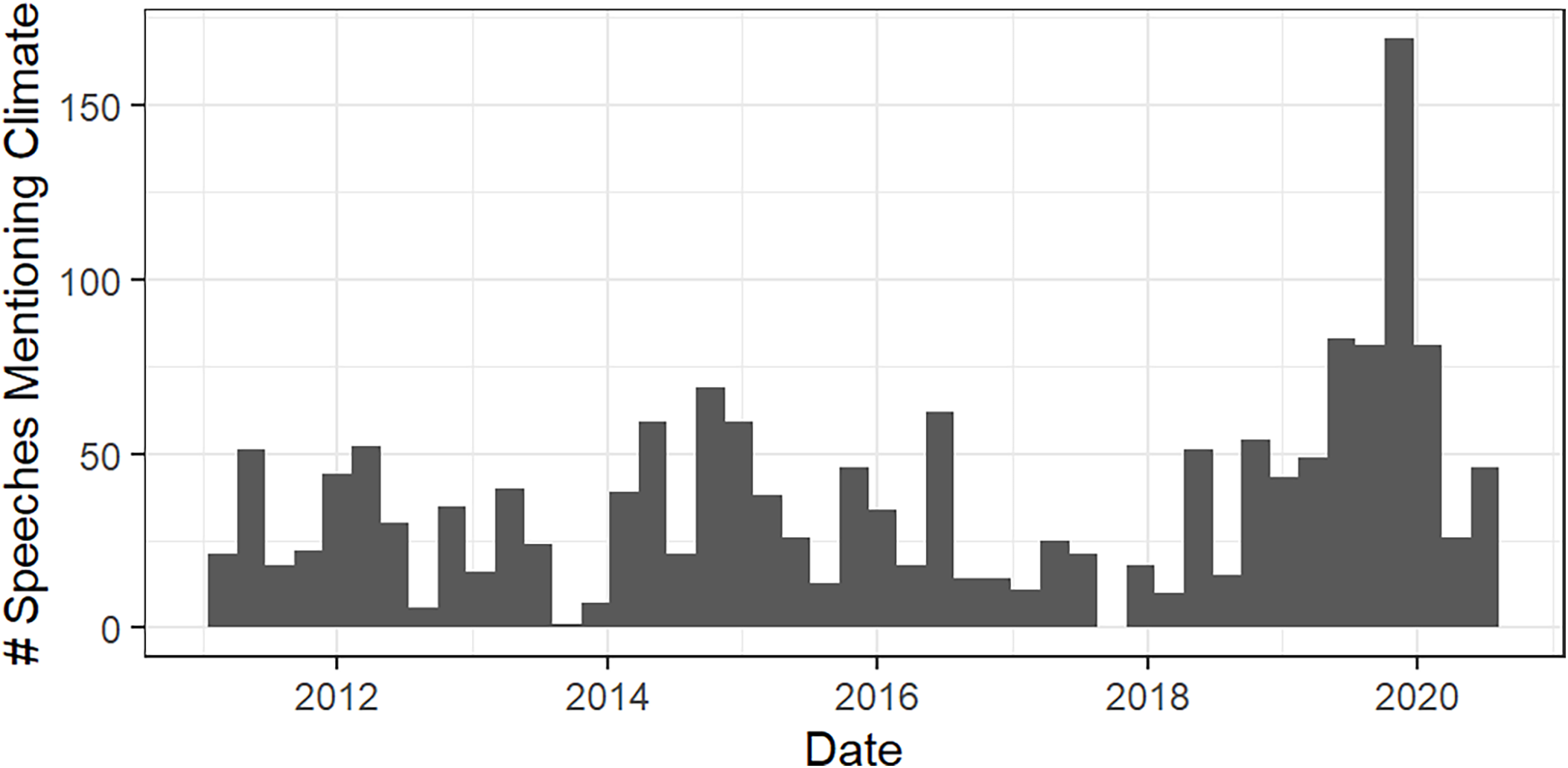
I use a pretrained transformer-based language model by Isermann (Reference Isermann2024) to classify all individual sentences of speeches on whether they mention climate issues (more detail in the online Appendix). These models are ideal for classification tasks due to their contextual understanding of the text, compared to bag-of-words approaches (see Timodena and Vallejo Vera Reference Timodena and Vallejo Vera2025). I consider every speech with more than a 10% of sentences on climate issues as mentioning climate issues, avoiding false positives. Using this approach, I identify 1,675 of 33,278 speeches (roughly 5%) in the dataset as mentioning climate issues. Figure 1 shows the distribution of speeches mentioning climate issues over time, with additional descriptives in the Appendix. With increasing salience of climate issues, the number of speeches mentioning them has also increased (Debus and Himmelrath Reference Debus and Himmelrath2022).
Distribution of speeches mentioning climate issues over time.

Analysis
Like Rittmann (Reference Rittmann2024), I employ ordinary least squares (OLS) regression models with legislator fixed effects, estimating within-speaker variation of emotional engagement when speaking on climate issues, compared to other topics. These fixed-effects rule out the possibility of personal characteristics, like gender, varying between legislators confounding the effect of speaking on a topic and emotional engagement. I exclude speeches below 50 words in length.
As the dependent variable, I use the vocal pitch measured per speech, z-standardized at the MP level. This eliminates differences between MPs in general levels and range of vocal pitch. The z-standardization also eliminates potential concerns that some MPs may be more easily emotionally engaged than others. This makes MPs with different distributions of vocal pitch comparable regarding their emotional activation during speeches.
As the main explanatory variables, I include a continuous variable for the speaker’s age, individual party dummies with the christian-democratic union (CDU) as the baseline, the year of the speech, and a dummy variable indicating whether the speech mentioned climate issues.
I first run one baseline model without interaction to estimate the general effect of a speech mentioning climate issues on emotional engagement. To estimate whether the effect of a speech mentioning climate issues on legislators’ emotional engagement varies based on age, party membership, or the year of the speech, I interact the dummy indicating mentions of climate issues with the respective other variable of interest in additional models.
I therefore do not analyze whether speeches on the topic of climate change are delivered with higher vocal pitch and greater emotional engagement across MPs, because other factors, like age, may both influence the likelihood that an MP speaks on climate issues and their general level of vocal pitch. Instead, I analyze whether the same MP speaks with greater emotional engagement when giving a speech on climate issues, compared to other topics, and whether this difference in emotional engagement between climate and other topics is greater for younger MPs compared to older MPs, between different parties or across time.
Results
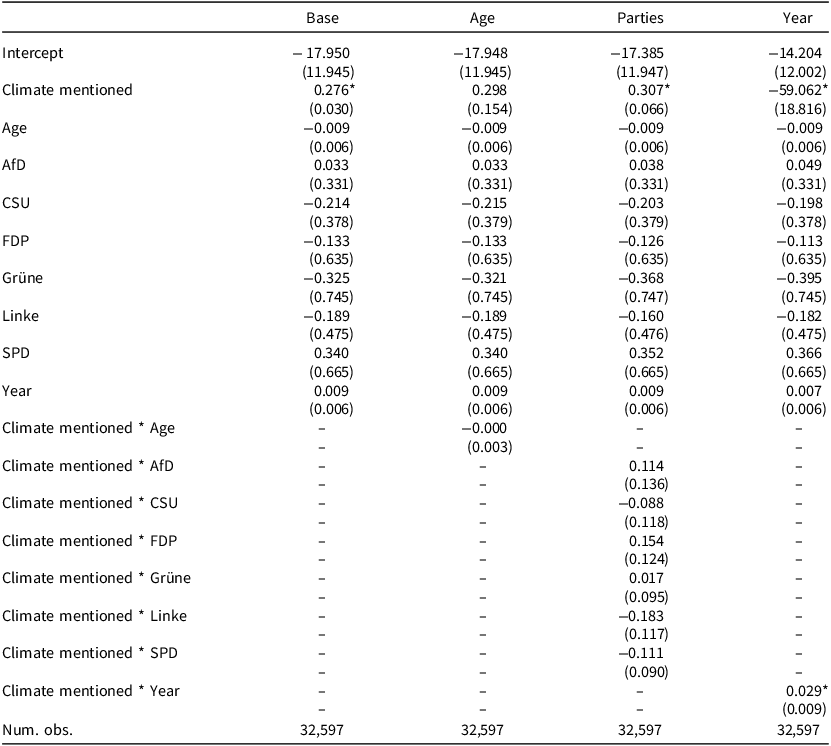
In the base model (see Table 1 for all outputs), I find a systematic positive effect of a speech mentioning climate issues on emotional engagement, indicating that legislators are overall more emotionally engaged when speaking on climate issues, compared to when they speak on different topics. This provides first evidence that climate issues are an emotionally engaging topic for many legislators, given that this effect is present when pooling legislators. This pooled effect of mentioning climate issues on emotional engagement is about 0.28 standard deviations, which is larger than the effects of mentioning women’s issues on the emotional engagement of female legislators in previous studies (Dietrich et al. Reference Dietrich, Hayes and O’Brien2019; Rittmann Reference Rittmann2024).
Effects on emotional intensity when speaking on climate issues

All models are OLS models. AfD = Alternative for Germany; CSU = Christian Social Union; FDP = Free Democratic Party; Grüne = Green Party; Linke = Left Party; SPD = Social Democratic Party of Germany.
In the interaction models, neither MPs’ age nor their party affiliation systematically affects how emotionally engaged they are during speeches mentioning climate issues. This indicates that MPs across age groups and parties are similarly emotionally engaged when speaking on climate issues. One possible explanation is that MPs may not only be emotionally engaged when speaking on climate issues because they are passionate in their pro-climate action stance, but also because they strongly oppose climate action. This may be the case for right-wing or conservative MPs who prefer to prioritize economic growth over climate protection and may feel strong negative emotions toward the proponents of climate actions, leading to their emotional engagement when giving speeches on the matter (Rittmann, Ringwald and Nyhuis Reference Rittmann, Ringwald and Nyhuis2025; Widmann Reference Widmann2025).
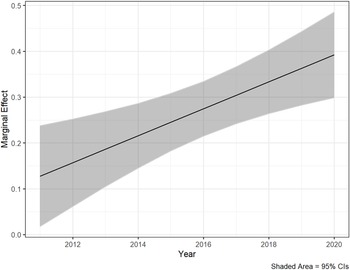
The positive and significant interaction between time and a speech mentioning climate issues indicates that the effect of a speech mentioning climate issues on the emotional engagement of the speaker has increased over time. To better demonstrate this effect, Figure 2 shows the marginal effect of a speech mentioning climate issues on emotional engagement of the speaker over time. In 2011, the model only predicts a small difference in emotional engagement between speeches that mention climate issues and those that do not, around 0.12 standard deviations. Over time, speeches mentioning climate issues show a systematically higher vocal pitch. In 2020, speeches mentioning climate issues have on average more than 0.35 standard deviations of increased vocal pitch, indicating strong emotional engagement with climate issues.
Marginal effect of a speech mentioning the climate on emotional engagement over time.

I test the robustness of results in a series of ways. First, I re-run all analyses using different cut-offs for classifying speeches as mentioning climate issues and a continuous measure of the prevalence of climate issues in speeches. Second, I re-run all analyses including additional control variables that vary within MPs and potentially relate to speaking on climate issues and emotional activation, that is, party leadership, parliamentary experience, and government-opposition status. In the same models, I also add data on received interruptions as they might serve as vessels of opposition activity toward climate policy (Diener Reference Diener2025; Koch Reference Koch2025) and could anger the speaking MP. Lastly, I re-run the analyses only with MPs who gave at least three speeches mentioning and not mentioning climate issues each. The substantial findings are robust to these tests with partially larger effects for speeches with higher prominence of climate issues (see online Appendix).
Conclusion
This research note investigates how the emotional engagement of legislators with climate issues varies depending on their age, party affiliation, and the time of their speech. I argue that young legislators should be more emotionally engaged when speaking on climate issues, being more likely to experience severe consequences of climate change. Additionally, politicians from left-leaning parties should be more emotionally engaged when discussing climate issues due to their ideological interest in climate action. Further, I expect increasing emotional engagement with climate issues over time due to the rising urgency of climate change. I use data on emotional engagement measured via vocal pitch collected by Rittmann (Reference Rittmann2024) in the German Bundestag from 2011 to 2020 and classify speeches mentioning climate issues using a transformer-based language model. I estimate the within-MP effect of speaking on climate issues on emotional engagement. In aggregate, politicians are more emotionally engaged when giving a speech mentioning climate issues, whereas this effect does not vary based on age or party affiliation. The emotional engagement with climate issues has, however, substantially increased over the studied time frame.
The absence of systematic differences between age groups in emotional engagement with climate issues is important for understanding the connection between climate policymaking and legislator characteristics. While young legislators give more speeches on climate issues (Debus and Himmelrath Reference Debus and Himmelrath2022), they are no more emotionally invested in these topics than their older colleagues due to all emotional engagement among all MPs, contrasting with women’s issues where only female MPs are emotionally engaged (Dietrich et al. Reference Dietrich, Hayes and O’Brien2019; Rittmann Reference Rittmann2024). Young MPs may thus speak more on climate issues due to electoral strategies (Debus and Himmelrath Reference Debus and Himmelrath2022) and party leadership decisions rather than greater genuine commitment. Another possible explanation is that parenthood leads MPs to consider future consequences beyond their own lifetime, increasing engagement with climate issues (Wang et al. Reference Wang, Leviston, Hurlstone, Lawrence and Walker2018). Due to lacking information about the family situation of MPs, this should be investigated in future research. Alternatively, emotional engagement measured via vocal pitch could capture emotional investment stemming both from strong pro-climate attitudes and opposition toward climate activism among older MPs.
The absence of party differences in MPs’ emotional engagement with climate issues also supports the notion that this emotional engagement stems from strong emotions favoring and opposing climate action (Widmann Reference Widmann2025), revealing a dimension of parties’ engagement with climate issues that salience (Debus and Tosun Reference Debus and Tosun2021) does not capture. Whereas MPs of left or green parties may be emotionally engaged because they strongly favor climate action, MPs from conservative and right-wing parties may feel anger due to growing opposition to climate action (Coffé et al. Reference Coffé, Crawley and Givens2026) and their preference for economic growth over climate protection. Studying emotional engagement during pro- and anti-climate protection speeches or sub-themes of climate issues is therefore a promising avenue for future inquiry.
The increasing emotional engagement with climate issues between 2011 and 2020 suggests that, as climate change becomes a more pressing issue (Parth et al., Reference Parth, Weiss, Firat and Eberhardt2020), legislators’ emotional engagement has increased, similar to climate emotions in the population (Swim et al. Reference Swim, Aviste, Lengieza and Fasano2022).
It is possible that this effect is not unique to climate issues but extends to other hot topics like immigration or the Russia–Ukraine war. Future research should thus test if the patterns found in this paper extend to other salient topics.
Supplementary material
The supplementary material for this article can be found at https://doi.org/10.1017/S1475676526101224
Data availability statement
The data and code necessary to replicate the analyses presented in this paper are available in the Harvard Dataverse under the following link https://doi.org/10.7910/DVN/LFSPRX
Acknowledgments
I am grateful for the insightful comments of the three anonymous reviewers and the editor’s guidance at EJPR. In addition, I want to thank Maaike Zeelen for her excellent research assistance and Sean Carey, Marc Debus, Stefan Eschenwecker, Lukas Isermann, Jan Menzner, Nina Osenbrügge, Sven-Oliver Proksch, Marc Ratkovic, Robin Rauner, Oliver Rittmann, Frieder Rodewald, Lena Stephan, and Lukas Warode as well as the participants of the ECPR Standing Group on Parliaments Summer School 2024, the CDSS Workshop Fall 2024, and Comptext 2025 for their valuable comments on this paper.
Funding statement
This work was supported by the University of Mannheim’s Graduate School of Economic and Social Sciences.
Competing interests
The author reports no conflict of interest.


 Open access

