

“An Assembly functions as an ordered, organic whole only by finding its invisible principle of order and spontaneous organization within a system of roles.”
—Giovanni Sartori
Introduction
Parliamentary role theory, introduced in the 1960s, is a theoretical framework for understanding how legislatures function and how parliamentarians behave. At its core, a role refers to societal expectations that constrain and give meaning to individual behavior within organizations and political institutions (Bates, Reference Bates2021). Applied to legislatures, roles help structure deputies’ experiences and render their conduct predictable enough to enable coordination among colleagues (Wahlke et al., Reference Wahlke, Eulau, Buchanan and Ferguson1962). As Sartori (Reference Sartori1989: 233) observed, role theory aims to “open the black box” of legislative processes, illustrating how assemblies mediate diverging preferences and transform societal inputs into policy outputs.
Since its origins, role theory has shifted its focus, moving from the analysis of the legislature’s internal functioning (Wahlke et al., Reference Wahlke, Eulau, Buchanan and Ferguson1962) to the study of legislative behavior (for a review, see Andeweg, Reference Andeweg, Martin, Saalfeld and Strøm2014). Over time, role theory has moved beyond “its sociological roots” to embrace a more rational choice perspective (Strøm, Reference Strøm1997), in which parliamentary role is treated as a strategic choice that deputies make to pursue career goals such as re-candidacy, reelection, and access to party or legislative office. In this perspective, Strøm (Reference Strøm, Blomgren and Rozenberg2012: 87) defines a parliamentary role as a “consistent pattern of political behavior” that functions as “an endogenous prescription” for how Members of Parliament (MPs) operate to maximize career outcomes.
This “strategic” conception, as defined by Strøm (Reference Strøm1997, Reference Strøm, Blomgren and Rozenberg2012), aligns closely with mainstream literature on electoral incentives and legislative behavior and with the canonical assumption in legislative studies that legislators are primarily “single-minded seekers of re-election” (Mayhew, Reference Mayhew1974). However, while earlier studies examined the relationship between specific legislative activities and career advancement (e.g. Bromo et al., Reference Bromo, Gambacciani and Improta2025), the link between parliamentary roles and career outcomes remains underexplored. This article addresses this gap by empirically testing Strøm’s strategic approach to role theory, asking whether MPs’ role choices correlate with subsequent career outcomes.
To test this argument, the article examines the Italian Chamber of Deputies during the 17th legislature (2013–2018), considering the attainment of re-election and of legislative and governmental office in the 18th term as career objectives. Italy represents a suitable case for examining these expectations because the party system remained sufficiently stable across the two legislatures. As a result, all MPs, to varying degrees according to their party affiliations, could in principle compete for re-election and legislative or governmental office in the subsequent term. The only exception is Brothers of Italy, which remained in opposition throughout the 18th legislature. Combined with previous research on role theory in the Italian Chamber of Deputies (Russo, Reference Russo2013, Reference Russo2022), this makes the Italian case appropriate for assessing Strøm’s expectations in a party-centered parliamentary setting.
Drawing on a new dataset of MPs’ activities, the article identifies roles through a two-step cluster analysis and assesses their relationship with career outcomes through multinomial logit models. Contrary to Strøm’s expectations, the results show no significant link between role type and career advancement. By contrast, parliamentary roles are more closely related to seniority, local political experience, and prior office-holding. This suggests that, in the Italian case, parliamentary roles are shaped less by forward-looking career calculation than by accumulated political experience.
The following sections first detail Strøm’s approach and justify the empirical activities, then present the methodology, findings, discussion, and conclusion.
The strategic approach to parliamentary role theory
The strategic approach to role theory was introduced by Strøm in 1997 and 2012 to adapt role theory to the principles of rational-choice neo-institutionalism (Andeweg, Reference Andeweg, Martin, Saalfeld and Strøm2014). In developing this perspective, Strøm (Reference Strøm, Blomgren and Rozenberg2012: 85) reinterprets the sociological concept of role as “constraints on individual behavior” to hypothesize that parliamentarians rationally select into a role to optimize their likelihood of re-candidacy, re-election, or advancement to party or legislative office. Building on Mayhew’s (Reference Mayhew1974) depiction of legislators as “single-minded seekers of reelection,” Strøm views legislative behavior, including role choice, as a strategy to achieve career objectives. According to Strøm, the primary goals that MPs pursue through their roles are re-election and re-candidacy; once these are secured, they then seek to obtain party or legislative office.
For Strøm (Reference Strøm1997: 161–64), role choice occurs at the beginning of a legislative term, when parliamentarians assess institutional rules and their available parliamentary and extra-parliamentary resources. Institutional rules define the constraints under which deputies operate. Deputies seeking re-election, for example, will pay particular attention to party nomination rules and to the degree of personal voting allowed by the electoral system, whereas those aiming for legislative office will look more closely at parliamentary rules of procedure, such as the majority thresholds required for election. Resources, in turn, shape which activities are less costly and therefore more efficient to pursue. In making this assessment, deputies may draw on ties with journalists, access to funding, prior legislative experience, policy expertise, or other assets that facilitate the pursuit of particular activities.
The role adopted by parliamentarians will tend to reflect one of the functions performed by the legislature (Gambacciani, Reference Gambacciani2025). Accordingly, parliamentarians can choose, for example, the role of “constituency members,” “party delegates,” “parliamentary men,” “specialists,” or “show horses.” The chosen role, whatever it might be, serves as a strategic “game plan” that guides how parliamentarians allocate their scarce resources across parliamentary activities (Strøm, Reference Strøm, Blomgren and Rozenberg2012: 88). For example, “constituency members” and “specialists,” according to their roles, will tend to focus on local issues or specific policy areas (Russo, Reference Russo2022), whereas “show horses” are more likely to combine limited legislative engagement with exceptional media visibility (Payne, Reference Payne1980).Footnote 1
Given that roles represent “consistent patterns of political behavior” (Strøm, Reference Strøm, Blomgren and Rozenberg2012: 87), they can be identified through quantitative analysis of parliamentary activities (Jenny and Müller, Reference Jenny, Müller, Blomgren and Rozenberg2012; Russo, Reference Russo2013) or through speech content (Nelson, Reference Nelson2025). At the end of this identification process, the total number of roles should not exceed four or five, as roles are best conceptualized as archetypal patterns of behavior that colleagues can easily recognize (Woshinsky, Reference Woshinsky1973).
Despite offering a parsimonious conceptualization of legislative behavior, the main limitation of the strategic approach is its emphasis on instrumental rationality, which leads to neglecting other important factors considered in role theory (Andeweg, Reference Andeweg, Martin, Saalfeld and Strøm2014). By doing so, it overlooks the influence of legislative practice (e.g. Wahlke et al., Reference Wahlke, Eulau, Buchanan and Ferguson1962), members’ institutional position in the legislature (e.g. Searing, Reference Searing1994), and the process of member socialization within an assembly. For instance, Matthews’ work, “U.S. Senators and Their World” (1960), emphasized the impact of socialization on role selection, illustrating how activities such as the frequency of constituency services, committee attendance, and opportunities to speak in the chamber were largely influenced by a member’s seniority and the assembly’s established practices.
Despite these limitations, Strøm’s strategic approach to role theory remains one of the most cited theoretical frameworks in legislative studies as it links parliamentary behavior to clear assumptions about political ambition, institutional incentives, and career goals. Yet, as Strøm himself acknowledges (Reference Strøm, Blomgren and Rozenberg2012: 99), this approach simplifies reality, since “the motivations of legislators are more complex than what any simple scheme can capture.” This observation raises a central empirical question: do such strategic roles truly exist? The next section applies Strøm’s framework to the Italian case, identifying the parliamentary activities most likely to be strategic and then subjecting them to cluster analysis.
Strategic activities in Italy
In Strøm’s approach, the process of identifying roles is context-dependent, since parliamentarians’ strategies depend on their available resources and the rules governing re-election and access to legislative offices. In the Italian case study of 2013–2018, parties were the primary gatekeepers to these goals. The mixed Italian electoral laws used in the 2018 election (the legge Rosato) did not allow preferential voting or splitting the vote between the SMD candidate and the party list. Furthermore, the rules of procedure of the Chamber of Deputies stipulate that, for legislative offices, a simple or absolute majority is sufficient for election. Consequently, although some parties involve party members or regional branches in compiling candidate lists, this rarely encourages parliamentarians to pursue personal vote strategies in roll-call votes (Rombi and Seddone, Reference Rombi and Seddone2017).
Given the Italian party-centered context (Viganò, Reference Viganò2024), I focus on four activities: constituency service, bill initiation, policy specialization, and press visibility. These activities are not assumed to be mechanically linked to a specific career outcome. Rather, they identify four main dimensions along which MPs may invest their scarce resources while performing different parliamentary functions. They capture observable parliamentary investments that MPs can vary during their term depending on their prior resources, such as local political ties, policy expertise, access to media, or previous institutional positions. In a party-centered setting such as Italy, all four activities may also operate as potentially valuable signals to party leaders (Marangoni and Russo, Reference Marangoni and Russo2018). They can signal, respectively, territorial rootedness, legislative competence, issue expertise, or public visibility, all of which may increase a deputy’s value within the party (Bromo et al., Reference Bromo, Gambacciani and Improta2025).
Building on this rationale, and in line with previous studies of the Italian case that reconstruct parliamentary roles through behavioral indicators (Russo, Reference Russo2013, Reference Russo2022), I developed four indices. These indices are summarized in Appendix Table S1.1. The territoriality index (IT) captures the concentration of written questions on local issues. The specialization index (IS) captures the concentration of written questions within specific policy areas. The productivity index (IP) captures bill activism relative to party peers. The visibility index (IV) captures press visibility relative to party peers. Together, these indices measure four distinct dimensions of parliamentary investment: constituency service, specialization, legislative activism, and media presence.
Following Russo (Reference Russo2013), these indices were linked to each deputy of the 17th legislature who submitted at least one question or bill, yielding a population of 506 deputies. Together, they provide the empirical foundation for the cluster analysis used to identify distinct strategic roles in the Italian Chamber of Deputies.
Roles in the Italian Chamber of Deputies (2013–2018)
This section describes the parliamentary roles identified through cluster analysis based on the four indices introduced above. I adopted the squared Euclidean distance as the proximity measure and the Ward method as the agglomeration procedure for the cluster analysis (see Appendix S4). I chose these two methods because they were the most robust for the distributions of the indices (Appendix S2) and their correlations (Appendix S3). Apart from the visibility index, all indices displayed non-normal distributions, included outliers, and generally lacked strong linear correlations.
Following the application of these techniques and guided by the dendrogram and the Duda/Hart stopping rule, the agglomeration method identified three distinct clusters (Appendix S5). To refine these initial groupings, the k-means technique was applied, with its centroids initialized using those identified by Ward’s agglomeration. The iterative k-means procedure reassigned deputies across clusters, optimizing membership based on proximity to updated centroids. This two-step approach, consistent with the principles of two-step cluster analysis (Punj and Stewart, Reference Punj and Stewart1983), produced three clusters of similar size while effectively accounting for outliers.
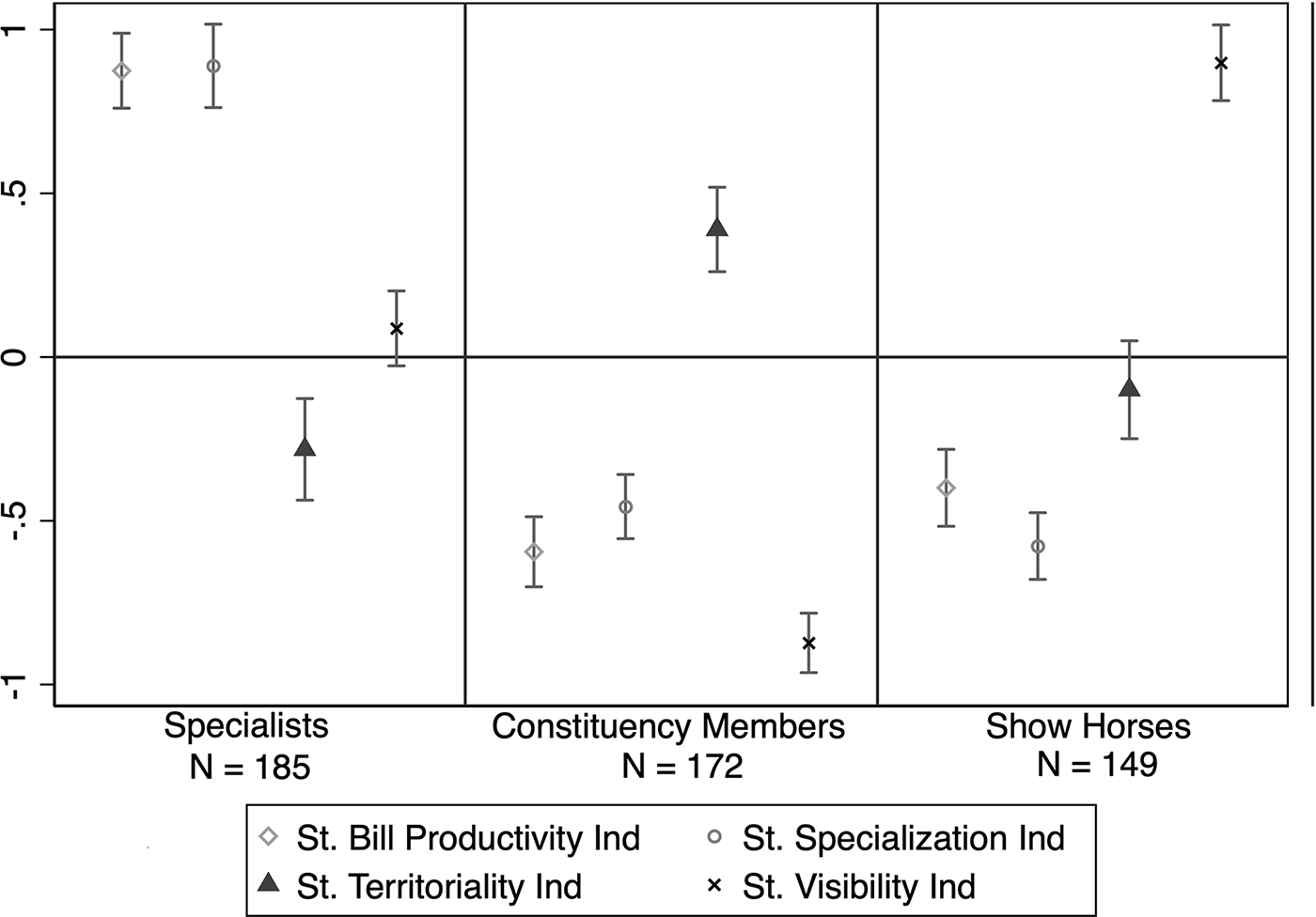
Once every parliamentarian was assigned to a cluster, I evaluated their substantive interpretability by comparing them with roles described in prior literature. Following standard role theory practices (Jenny and Müller, Reference Jenny, Müller, Blomgren and Rozenberg2012; Russo, Reference Russo2013), I examined the means and variation in the standardized indices (zIP, zIS, zIT, and zIV). Figure 1 presents the average profile of each role. Confidence intervals that do not cross the zero line indicate that, for that index, the cluster mean differs significantly from the overall population mean.
Cluster profiles and role frequencies.

Based on these results and following previous role theory applications, I assigned the labels “Constituency Members” (N = 172), “Specialists” (N = 185), and “Show Horses” (N = 149) to the three clusters identified by the cluster analysis.
The first two clusters represent two roles already found and described in the Italian case study (Russo, Reference Russo2013, Reference Russo2022). The “Constituency Members” cluster is characterized by a statistically significantly high score on the territoriality index (zIT) and statistically significantly low scores on all the other indices. These distributions suggest a strong focus on local issues and constituency-oriented activities, corresponding to the definition of the constituency member role (Searing, Reference Searing1994). The “Specialists” cluster, instead, exhibits notably and statistically significantly high scores on the specialization (zIS) and bill productivity (zIP) indices. This reflects a focus on legislative work and policy expertise, consistent with a role aimed at improving legislation or gaining influence (e.g. Russo, Reference Russo2013). Finally, the “Show Horses” cluster is distinguished by exceptionally high scores on the visibility index (zIV), coupled with low scores on all the other indices. This role label directly mirrors Payne’ss (Reference Payne1980) identification of “Show Horses” in the U.S. House of Representatives, a group of legislators prioritizing media presence over more traditional legislative activities.Footnote 2
Since these three roles capture different bundles of parliamentary activity, they should not be expected to relate equally to all career outcomes. Constituency Members should be most closely linked to re-election, because constituency-oriented activities and local rootedness may help newcomer deputies build a reputation as territorial representatives, thereby strengthening both their own electoral viability and their party’s standing in the district (Shomer, Reference Shomer2009; Marangoni and Russo, Reference Marangoni and Russo2018). Specialists, by contrast, should be associated above all with legislative office, because specialization and bill activism signal competence, diligence, and legislative usefulness, qualities that may be rewarded with positions inside the parliamentary arena (Chiru and Gherghina, Reference Chiru and Gherghina2019). Show Horses, finally, represent a profile more plausibly associated with a later phase of a parliamentary career, when MPs have already accumulated reputation and internal standing and thus have less need to invest in intensive day-to-day parliamentary activity (Bailer and Ohmura, Reference Bailer and Ohmura2018). At this stage, cultivating media visibility may serve to enhance their public profile and their value to party leaders, thereby increasing their chances of obtaining a governmental office (Payne, Reference Payne1980).
Having empirically identified parliamentary roles, the subsequent section delves into their theoretical implications by testing Strøm’s approach and considering an alternative explanation for the observed patterns of role adoption.
Findings
To test Strøm’s hypothesis, I focus on three subsequent career outcomes in the 18th legislature: re-election, legislative office, and governmental office. Re-election is coded as whether a deputy was returned to the Chamber of Deputies in the subsequent legislature. Legislative office refers to the attainment of a formal parliamentary position, including offices in the Chamber, in standing committees, or in parliamentary groups. Governmental office is coded for deputies who entered government as ministers or junior ministers. I do not include party office among the outcomes because Italian parties, especially newer ones, differ too widely in their organizational structures to allow meaningful comparison (Vittori, Reference Vittori2021).
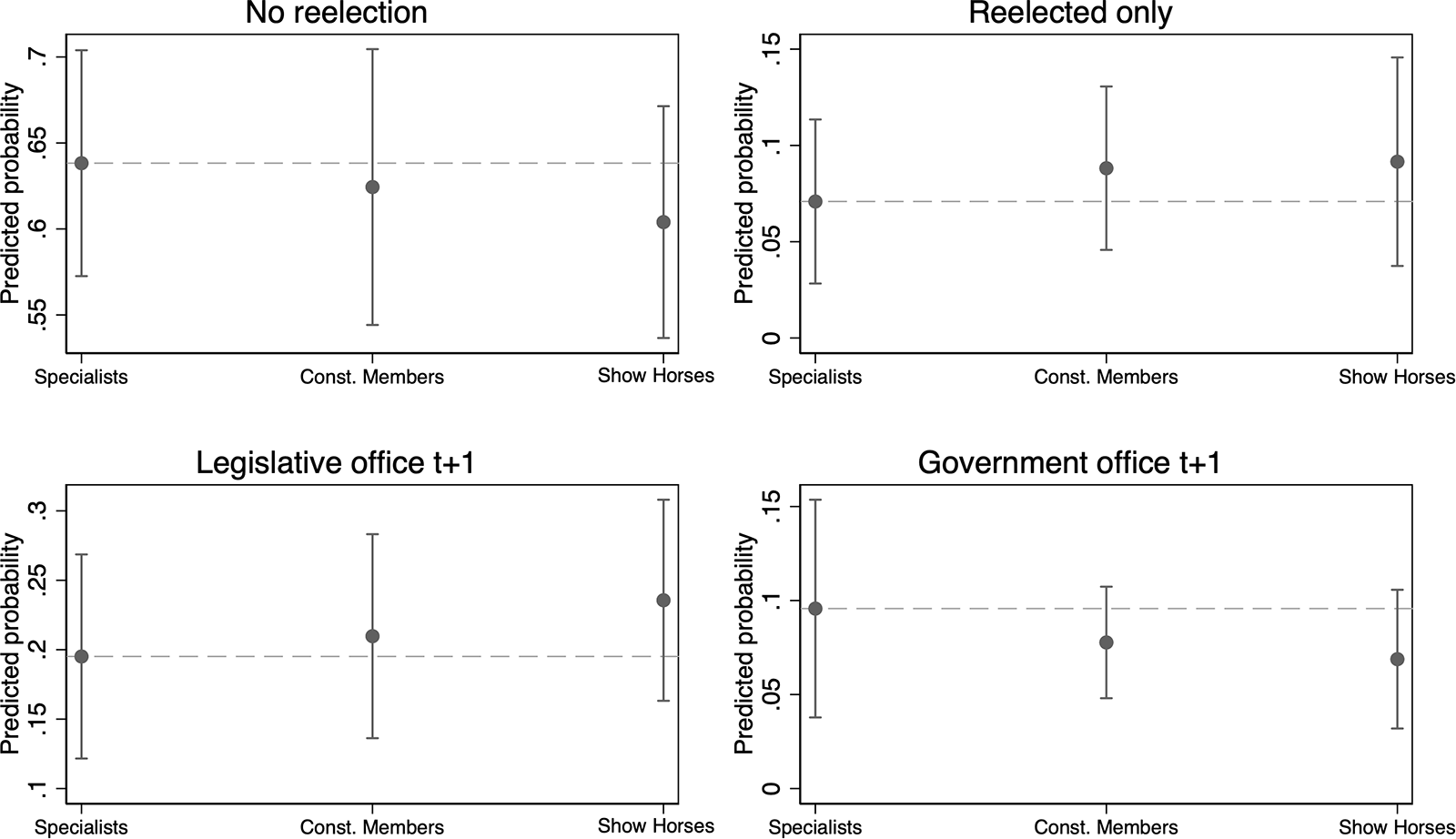
I then estimate a multinomial logit model with career outcomes as the dependent variable and parliamentary role membership as the main predictor. The dependent variable is coded as a mutually exclusive and hierarchical categorical variable. Deputies who were not returned to the Chamber are coded as 0; deputies who were re-elected without office are coded as 1; deputies who attained a legislative office are coded as 2; and deputies who entered government are coded as 3. Deputies who were re-elected and subsequently attained legislative or governmental office are assigned to the highest career outcome they achieved. As a result, 316 deputies were not re-elected, 42 were re-elected without office, 107 attained legislative office, and 41 attained governmental office. The model also includes prior local experience, parachuted candidacy, tenure, previous legislative office, previous governmental office, graduation, gender, and party controls. These covariates capture prior political resources and party-specific opportunity structures that may shape subsequent career advancement.Footnote 3 Among these, party controls are particularly important because access to career goals, especially governmental offices, was not evenly distributed across parties in the 18th legislature. Figure 2 reports the predicted probabilities of each career outcome by parliamentary role. The dashed horizontal line in each panel indicates the predicted probability for Specialists, which serves as the reference role category. The full multinomial logit results, including relative risk ratios and raw coefficients, are reported in Appendix S7. Appendix S7 also reports reduced specifications with fewer covariates, including a role-only model, to address concerns about model complexity and degrees of freedom.
Predicted probabilities of career outcomes by parliamentary role.

Figure 2 Long description
The image A showing a plot titled No reelection. The horizontal axis categories are Specialists, Const. Members, Show Horses. The vertical axis label reads Predicted probability, with tick labels 0.0, 0.1, 0.2, 0.3. Three points with vertical error bars are shown. The Specialists point is near 0.2. The Const. Members point is near 0.2. The Show Horses point is near 0.1. The Specialists and Const. Members points are higher than the Show Horses point. The image B showing a plot titled Reelected only. The horizontal axis categories are Specialists, Const. Members, Show Horses. The vertical axis label reads Predicted probability, with tick labels 0.0, 0.05, 0.10, 0.15. Three points with vertical error bars are shown. The Specialists point is near 0.05. The Const. Members point is near 0.10. The Show Horses point is near 0.10. The Const. Members and Show Horses points are higher than the Specialists point. The image C showing a plot titled Legislative office t plus 1. The horizontal axis categories are Specialists, Const. Members, Show Horses. The vertical axis label reads Predicted probability, with tick labels 0.0, 0.05, 0.10, 0.15. Three points with vertical error bars are shown. The Specialists point is near 0.05. The Const. Members point is near 0.05. The Show Horses point is near 0.10. The Show Horses point is higher than the Specialists and Const. Members points. The image D showing a plot titled Government office t plus 1. The horizontal axis categories are Specialists, Const. Members, Show Horses. The vertical axis label reads Predicted probability, with tick labels 0.0, 0.05, 0.10, 0.15. Three points with vertical error bars are shown. The Specialists point is near 0.05. The Const. Members point is near 0.10. The Show Horses point is near 0.10. The Const. Members and Show Horses points are higher than the Specialists point. Across all four plots, the same three role categories are compared using single points with vertical error bars for each category and each plot shows a different career outcome title.
The multinomial logit results do not support Strøm’s expectations. Neither Constituency Members nor Show Horses differ significantly from Specialists in their probability of re-election, legislative office, or governmental office.Footnote 4 Confidence intervals largely overlap across role categories, and the dashed line representing the predicted probability for Specialists crosses the confidence intervals of both Constituency Members and Show Horses in each career-outcome panel. The coefficients associated with role membership remain substantively modest and statistically insignificant across all outcomes. By contrast, some prior political resources matter more clearly. Holding a legislative office in the 17th legislature significantly reduces the probability of no re-election, while holding a previous governmental office significantly reduces the probability of attaining a legislative office in the subsequent term. The overall picture, therefore, is that parliamentary roles do not significantly predict subsequent career outcomes, even when MPs are compared conditional on prior resources and party-specific opportunities.
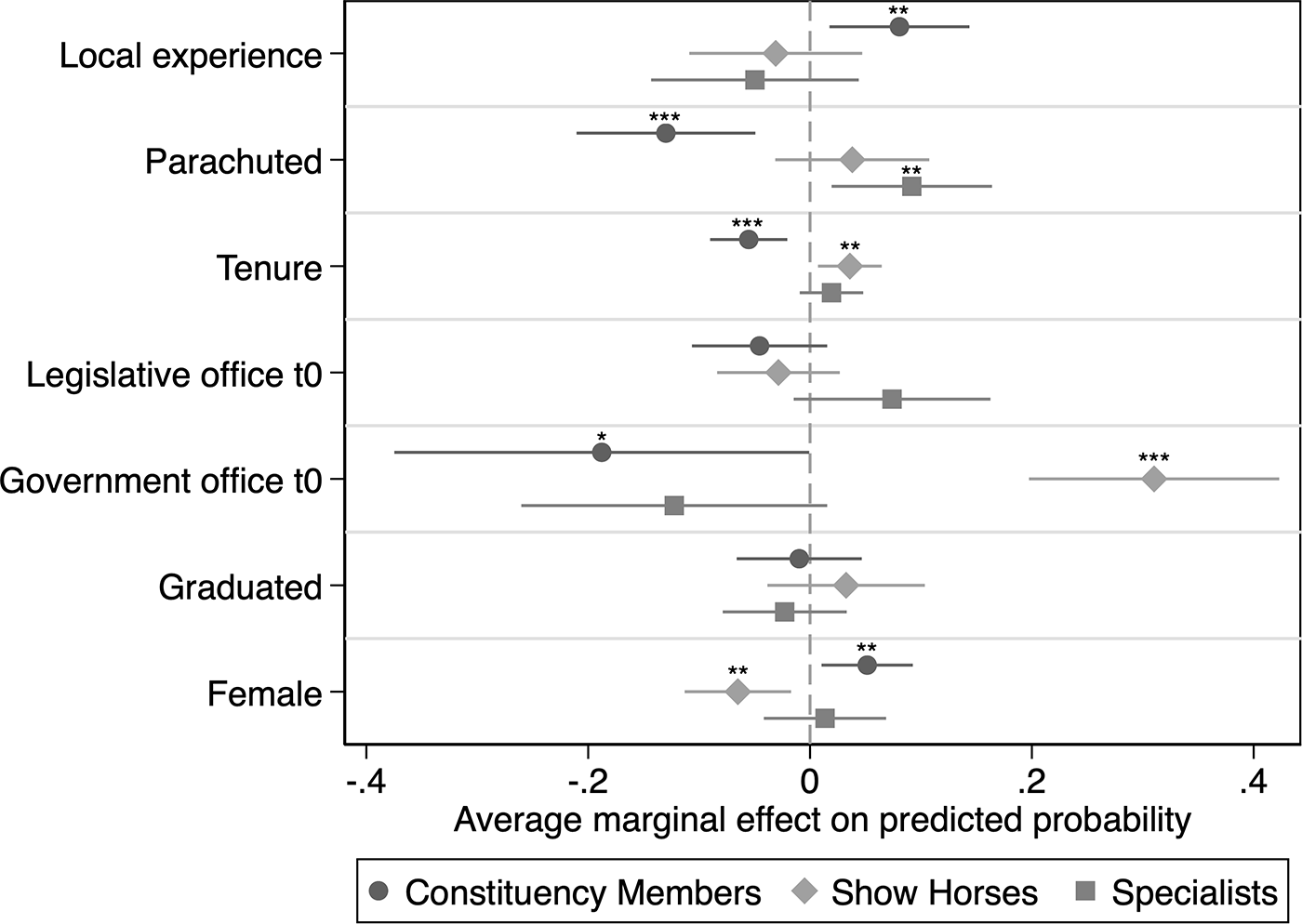
From a theoretical standpoint, these results are consistent with alternative theoretical approaches to role theory, indicating that deputies can engage in activities for reasons unrelated to reelection goals (Wahlke et al., Reference Wahlke, Eulau, Buchanan and Ferguson1962; Searing, Reference Searing1994). In this perspective, factors that receive less emphasis in Strøm’s framework, such as institutional practices and prior political experience, may play a decisive role in shaping parliamentary behavior. To examine this possibility, Figure 3 reports average marginal effects from a second multinomial logit model in which parliamentary role is treated as the dependent variable and deputies’ prior political experiences are included as predictors. The figure shows how each covariate changes the predicted probability of adopting each parliamentary role. The full numerical average marginal effects, raw coefficients, and reduced specifications for this role-adoption model are reported in Appendix S8.
Average marginal effects for parliamentary role adoption.

Figure 3 Long description
Average marginal effect on predicted probability A dot and whisker plot with three marker types shown in a legend: Constituency Members, Show Horses and Specialists. Each row shows three point estimates with horizontal whiskers. The x-axis is labeled Average marginal effect on predicted probability. Tick labels shown are minus 0.4, minus 0.2, 0, 0.2 and 0.4. The y-axis lists eight covariates from top to bottom: Local experience, Parachuted, Tenure, Legislative office to, Government office to, Graduated, Female. Local experience: three points are shown near 0, with one point slightly to the right of 0 and two points slightly to the left of 0. Parachuted: one point is left of 0 near minus 0.2 with three asterisks above it; two points are right of 0 near 0.1 to 0.2, with one of these having three asterisks. Tenure: three points are close to 0, with one slightly left of 0 and two slightly right of 0. Legislative office to: three points are close to 0, with one slightly left of 0 and two slightly right of 0. Government office to: one point is far to the right near 0.35 with three asterisks; the other two points are left of 0, one near minus 0.2 and one near minus 0.1. Graduated: three points are close to 0, with one slightly left of 0 and two slightly right of 0. Female: three points are close to 0, with one slightly left of 0 and two slightly right of 0.
The results show that role adoption is more closely related to accumulated experience and pre-existing resources than to forward-looking career calculation. Tenure significantly decreases the likelihood of adopting the Constituency Member role, suggesting that longer-serving deputies are less likely to invest in constituency-oriented activity. Prior local experience increases the likelihood of being a Constituency Member, whereas parachuted deputies are significantly less likely to fall into this cluster. Holding governmental office during the legislature also shifts deputies away from constituency-oriented activity and toward the Show Horse profile, consistent with the idea that more senior or already prominent politicians rely more heavily on public visibility than on routine parliamentary work. These findings, particularly the effects for “parachuted deputies” and “prior local experience,” are consistent with previous research (Russo, Reference Russo2013, Reference Russo2022), suggesting that constituency-oriented activity in Italy is shaped primarily by deputies’ ties to their electoral districts. Taken together, they indicate that role choice is guided less by forward-looking career calculation than by accumulated national and local political experience and by institutional position (Russo, Reference Russo2022).
Conclusions
This study undertook an empirical test of Strøm’s strategic approach, identifying three distinct parliamentary roles through cluster analysis of deputies’ activities. At the heart of Strøm’s contribution was an effort to merge role theory with a rational choice perspective by building a more flexible neo-institutionalist framework. Yet, this analysis does not support his hypothesis. The article found no statistically significant link between the roles deputies adopt and their subsequent career outcomes. Instead, role choice appears shaped primarily by deputies’ seniority and political experience. From this perspective, the Italian case is more consistent with approaches to role theory that place less emphasis on a strategic reading of parliamentary roles.
This study contributes to comparative politics – particularly legislative studies – by directly engaging with Strøm’s strategic role theory. While this analysis follows the logic of Strøm’s framework, the aim is not to generate universally generalizable findings but to provide a contextually grounded account of how Strøm’s assumptions operate within a specific institutional setting. Future research could build on this null finding to further develop Strøm’s strategic approach to role theory.
Funding
This research received no specific grant from any public or private funding agency.
Data
The replication dataset is available at https://dataverse.harvard.edu/dataset.xhtml?persistentId=doi:10.7910/DVN/CWWTMM.
Supplementary material
The supplementary material for this article can be found at https://doi.org/10.1017/ipo.2026.10092.
Acknowledgements
This article draws on my PhD thesis. I am grateful to those who contributed to this research at that time. I also thank Edoardo Viganò, Francesco Bromo, and Prof. Luca Pinto for their comments on earlier versions of the manuscript. I made use of ChatGPT (OpenAI) to assist with language editing and the revision of phrasing in this manuscript. All arguments, interpretations, and conclusions are solely the responsibility of the author.
Competing interests
The author declares none.


 Open access

