




Introduction
Biological invasions of exotic insects represent a major challenge for both natural and human-altered ecosystems. They seriously impact biodiversity (Pimentel et al., Reference Pimentel, Lach, Zuniga and Morrison2000), and are considered to be one of the main features of global change (Vitousek et al., Reference Vitousek, D’antonio, Loope, Rejmanek and Westbrooks1997). Invasive species represent a growing threat to world food security and the global economy due to their negative effects on agriculture (Eschen et al., Reference Eschen, Beale, Bonnin, Constantine, Duah and Finch2021). Despite the implementation of strict quarantine measures, numerous tephritid fruit fly invasions have been reported worldwide (Duyck et al., Reference Duyck, Jourdan and Mille2022). The Tephritidae family is therefore the subject of many Pest Risk Analyses (PRA). Dacus frontalis (Becker, 1922) (Diptera: Tephritidae) is an invasive species affecting fruit production in Africa (AL-Jorany, Reference AL-Jorany2013; El Harym and Belqat, Reference El Harym and Belqat2017; Hafsi et al., Reference Hafsi, Abbes, Harbi, Ben Othmen, Limem and Elimem2015). In recent years, climate warming has reduced climatic barriers to pest establishment. Consequently, D. frontalis has gradually spread, expanding its geographical distribution from Mediterranean regions, such as Tunisia and Algeria, to other areas (Elghadi and Port, Reference Elghadi, Port, Perez-Staples, Diaz-Fleischer, Montoya and Vera2019; Foottit and Adler, Reference Foottit and Adler2009; Hafsi et al., Reference Hafsi, Abbes, Harbi, Ben Othmen, Limem and Elimem2015). Though not yet established, this tephritid species was recently intercepted recently in Europe and classified as a regulated species in the European Union (Rousse et al., Reference Rousse, Taddei, Mouttet, Lethmayer, Blümel and Gottsberger2024). Global warming creates suitable environmental conditions for the translocation of D. frontalis from tropical areas to temperate regions, previously thought to be too cold to allow population persistence. Thus, it has emerged as a serious pest that threatens Cucurbitaceae production in temperate regions (Hafsi et al., Reference Hafsi, Abbes, Duyck and Chermiti2024, Reference Hafsi, Abbes, Harbi, Ben Othmen, Limem and Elimem2015; Rousse et al., Reference Rousse, Taddei, Mouttet, Lethmayer, Blümel and Gottsberger2024).
In of the event of invasions by phytophagous insects, the question of predicting host range is particularly important (Bellamy et al., Reference Bellamy, Sisterson and Walse2013). The establishment of new exotic phytophagous insects in new regions could mitigated by the successful implementation of integrated pest management (Walsh et al., Reference Walsh, Bolda, Goodhue, Dreves, Lee and Bruck2011). A better understanding of host specialisation and the varietal susceptibility of the preferred host crops could help predict which plants are likely to be attacked by a given pest. This is particularly important from an applied perspective given that in complex cropping systems, there is often a variety of different available hosts.
In most phytophagous insects, larvae are often less mobile than adults. Thus, the success of larval development depends on the quality of the plant chosen by the adult (Jaenike, Reference Jaenike1978). Female have access to many different resources of variable nutritional value for larvae. Therefore, we would expect high selection pressure for female oviposition behaviour to maximise offspring fitness (Jaenike, Reference Jaenike1978). This scenario has often been considered in the context of the preference–performance hypothesis (PPH) also known as the ‘mother knows best’ principle (Jaenike, Reference Jaenike1978; Valladares and Lawton, Reference Valladares and Lawton1991). Although the PPH predicts a positive correlation between female oviposition preference and larval performance, this is not always the case (Keeler and Chew, Reference Keeler and Chew2008). Investigating the relationships between the host fruit species and D. frontalis oviposition behaviour and offspring performance could further our understanding of the insect–plant interactions underlying successful establishment on a host plant in a new environment.
In the field, female preference and larval performance are affected by a variety of biotic and abiotic factors. These include chemical and visual cues, natural enemy avoidance, plant nutrient compounds, and secondary metabolites, as well as the nutritional requirements linked to the insect life stages (Thorsteinson, Reference Thorsteinson1960; Webster and Cardé, Reference Webster and Cardé2017). In tephritid species, host selection behaviour may be affected by the pericarp firmness, fruit odour, colour, and shape (Brévault and Quilici, Reference Brévault and Quilici2007; Jaleel et al., Reference Jaleel, He and Lü2019). While visual and tactile stimuli are important in female choice (Balagawi et al., Reference Balagawi, Vijaysegaran, Drew and Raghu2005; Piñero et al., Reference Piñero, Jácome, Vargas and Prokopy2006), olfaction is primarily used to locate host plants (Dalby‐Ball and Meats, Reference Dalby‐Ball and Meats2000). In addition, the nutritional status, toxins and secondary metabolites of the host can affect offspring fitness and fruit fly development (Balagawi et al., Reference Balagawi, Vijaysegaran, Drew and Raghu2005; Rattanapun et al., Reference Rattanapun, Amornsak and Clarke2009; Hafsi et al., Reference Hafsi, Facon, Ravigné, Chiroleu, Quilici and Chermiti2016). Host fruit provide tephritids with an array of vital resources. In particular, carbohydrates and lipids represent key aspects of fruit composition, which are known to affect larval survival in polyphagous and oligophagous tephritid species (Awmack and Leather, Reference Awmack and Leather2002; Hafsi et al., Reference Hafsi, Facon, Ravigné, Chiroleu, Quilici and Chermiti2016).
Few studies have explored interactions between D. frontalis and its host plant, and only adult emergence from field-collected fruits has been monitored (AL-Jorany, Reference AL-Jorany2013; Elghadi and Port, Reference Elghadi, Port, Perez-Staples, Diaz-Fleischer, Montoya and Vera2019; Hafsi et al., Reference Hafsi, Abbes, Harbi, Ben Othmen, Limem and Elimem2015; White and Elson-Harris, Reference White and Elson-Harris1992). The present study examined the relationship between female preferences and larval performance in D. frontalis, based on a confirmed protocol developed in previous studies (Charlery de La Masseliere et al., Reference Charlery de La Masseliere, Facon, Hafsi and Duyck2017; Hafsi et al., Reference Hafsi, Facon, Ravigné, Chiroleu, Quilici and Chermiti2016; Lauciello et al., Reference Lauciello, Mille, Hafsi, Jacob and Duyck2024). The first step was to study the oviposition behaviour and larval performance of a Tunisian population of D. frontalis on wild and cultivated cucurbitaceous fruit present in Tunisia. The phenology and correlated nutrient composition of different cucurbit fruit species on host specialisation of D. frontalis was then analysed. The general patterns observed for this specialist phytophagous insect were analysed in the light of the PPH.
Materials and methods
Insect rearing
The initial colony of D. frontalis was obtained from infested cucumber fruit (Cucumis sativus L.) collected in the field in the Kairouan area (Tunisia) in 2015. Insects were then reared at Laboratory of Entomology at High Agronomic Institute of Chott-Mariem (Tunisia). Prior to the start of the experiments, D. frontalis flies were reared for five generations in Perspex rearing cages (90 × 90 × 90 cm). the cage had a cloth sleeve opening at the front and were maintained under controlled conditions (photoperiod:12:12 L:D; temperature: 25 ± 1°C and relative humidity: 70%), in climatic chambers using non-infested cucumber fruit as described in Hafsi et al (Reference Hafsi, Abbes, Duyck and Chermiti2024). The adult flies were fed on a protein: sugar mix (3:1) media and water was provided ad libitum. Adult flies were provided with fresh non-infested cucumber fruits for laying their eggs. Infested fruit was removed from cages after 24 h, placed in plastic containers with sand at the bottom as a pupation, and kept till pupation. Resulting pupae were sieved using a mesh screen and kept in a new cage for emergence.
Experimental fruit species
Female oviposition and larval performance experiments were conducted to assess the preference–performance relationship using five cultivated (zucchini, cucumber, pumpkin, melon, and watermelon) and two wild Cucurbitaceae (squirting cucumber and bitter apple) host plant species (Table 1). This choice aligned with White and Elson-Harris (Reference White and Elson-Harris1992), who indicated that these host fruit species might be suitable host for egg laying and for the larval development of D. frontalis. The chosen cultivated host plant species were planted and grown in a greenhouse on the farm of the High Agronomic Institute of Chott-Mariem (Tunisia), using an organic crop production system to produce healthy undamaged fruit. Plants were watered regularly, as required, and no additional fertiliser was added. We did not use transgenic fruit species in the experiments. No insecticide treatments were applied to seeds or plants. Undamaged wild fruit was collected in the field during the fruiting season and examined in the laboratory for the presence of tephritid larvae and oviposition puncture.
Weight, water content, and total suspended solids (TSS) (n = 6) of the five cultivated and the two wild Cucurbitaceae host–plant species according to their phenological stage of maturity

Three classes of each fruit species were categorised as a function of their phenological maturity stage, as described in Table 1. The ‘green’ category represented all fruit at 3–5 days after fruit setting, and was characterised by lower weights. The ‘intermediate’ category included all fruit of 15–18 days after fruit setting and was characterised by medium weights. The ‘ripe’ category regrouped all fruits at ripening stage, characterised by higher weights. For wild Cucurbitaceae fruit species, experiments were only conducted with green and intermediate fruit because ripe fruit could not be collected at that time of year, for logistical reasons. Ten fruit per host species and per phenological stage of maturity (Table 1) were selected and measured for weight, size, water, and sugar content. Fruits were weighed using a standard electronic digital precision balance (Sartorius, CP64). Sugar content was measured from a drop of fruit juice, collected from mixed fruit pulp, using a handheld refractometer (COMECTA® NR 151 Mod. Spain).
Larval performance
The larval performance of D. frontalis was studied on seven fruit species using forced infestations. For each replicate, fruit was weighed and washed, then small incisions (size: 1.5 × 0.2 × 0.2 cm) were made randomly at the surface to allow the introduction of the neonate larvae (<2 h old) into the pulp. The neonate larvae were carefully introduced, using a fine brush and a binocular microscope (Leica® EZ4, Germany). Larvae density was adjusted according to host fruit weight, i.e. one larva per 10 g of fruit, to avoid intraspecific competition according to preliminary data. Each infested fruit species was set in a shallow pan with sand. Pan size different depending on the size of the tested fruit. The pan was then covered with a cloth sleeve to allow pupation. Ten replicates of each fruit species were carried out. Since temperature has a pronounced influence on tephritid larval development (Duyck and Quilici, Reference Duyck and Quilici2002), all the experiments were conducted in environmental chambers at a constant temperature of 25°C. Larval performance was measured in term of larval survival, larval duration, and pupal weight. Every 48 h, all cups were checked to collect pupae. Larval survival was recorded as the number of pupae recovered from each host. Larval duration was estimated by the time taken from inoculation to pupation. Each individual pupa was weighted using a precision balance (Sartorius® Germany, accuracy: 10−4 g). A single performance trait combining the three larval life history traits (survival × pupal weight/developmental duration) (Facon et al., Reference Facon, Hafsi, Charlery De La Masselière, Robin, Massol and Dubart2021; Lauciello et al., Reference Lauciello, Mille, Hafsi, Jacob and Duyck2024), was used as a measure of larval performance. Thus, we were able to study the correlation between larval performance and fruit nutrient status and compare female preference.
Female preference
The female preference of D. frontalis was tested for the seven host fruit species, using choice and non-choice experiments (Charlery de La Masseliere et al., Reference Charlery de La Masseliere, Facon, Hafsi and Duyck2017). Female preference was only tested in relation to olfactory cues (volatile fruit emissions), using artificial oviposition devices. These consisted of yellow table tennis balls (4 cm diameter), cut in half and pierced with 48 evenly spaced holes (approximately 0.9–1.2 mm), inserted into a plastic base of suitable diameter. Before each experiment, all devices were washed with a detergent (TFD4, Dominique Dutscher SAS, Brumath, France), rinsed with water, and dried. For oviposition preference, mated females aged 20–30 days were used. Females were fed on a sugar and yeast diet. Water was provided ad libitum during the experiments.
Oviposition preference in the non-choice experiment: This trial was performed using five cultivated fruit at three stages of maturity and two wild fruit species at two stages of maturity. For each replicate, five gravid D. frontalis females were placed in a cubic cage (30 × 30 × 30 cm), which contained two egg-laying devices for 24 h. One device contained a piece of fruit, including pulp and peel, while the other was empty and was considered the negative control, since no eggs were found in these devices. A piece of wet yellow sponge was put between the two devices to avoid dehydration. Eggs laid in the different devices were collected after 24 h and counted to assess the oviposition preference regarding the seven host fruit tested. For each fruit species combination, six replicates were conducted.
Oviposition preference in a choice experiment: This trial was performed on the seven cultivated and wild fruit species in the green category. Ten D. frontalis females were placed in a cubic cage (90 × 90 × 90 cm) with seven devices containing a piece of fruit from a different species and an empty device (a negative control). After 24 h, eggs in each device were counted. This experiment was conducted with 12 replicates.
Statistical analysis
All statistical analyses were carried out using R version 3.6.1. (R Development Core Team, 2008). The normality and homogeneity of all data were checked using the Shapiro–Wilk and Bartlett tests, respectively. Larval performance: survival, development time, and pupal weight were analysed using the two-way ANOVA as a function of host fruit species, stage of maturity and interaction between these two variables.
Larval performance and water or soluble sugar contents relationships were fitted with a linear mixed model (estimated using REML and nloptwrap optimiser), including fruit species and maturity stage as random effects.
Female preference: the number of eggs laid in choice and non-choice tests was analysed using the generalized linear model (GLM) with Poisson error (Log link), as a function of fruit species and/or the stage of fruit maturity. The number of eggs laid under no choice conditions was used as an estimate of oviposition preference. A Poisson log-linear model (analysis of deviance with Poisson error), was used to analyse preference–performance relationships between larval performance and female oviposition (expressed by the number of eggs) on the same fruit and maturity. Overdispersion was accounted for using a quasi-Poisson model, rather than a Poisson model in R (O’Hara and Kotze, Reference O’Hara and Kotze2010).
Results
Larval performance
Larval survival rates differed significantly depending on the fruit species (F 6, 6267 = 85.1, p < 0.001) and fruit maturity stage (F2 , 6267 = 334.6, p < 0.001). The interaction between fruit species and stage of maturity was also significant (F 12, 6267 = 16.2, p < 0.001) (fig. 1A). Larvae of D. frontalis were able to survive on all tested cucurbitaceous species, with exception of squirting cucumber. Dacus frontalis had a larval survival rate ranging from 2% to 75%, with the highest survival rate observed on the two maturity stages of bitter apple. The comparison between the different stages of fruit maturity in the same host fruit species revealed that the highest survival rate for D. frontalis was on the green category.
(A) Larval survival, (B) larval development time, and (C) pupal weight (10−4 g) of Dacus frontalis reared on five cultivated and two wild Cucurbitaceae host plant species. Each cultivated fruit species was tested at three stages of fruit maturity (green, intermediate, and ripe). The two wild fruit species were only tested at green and intermediate stages of maturity. Values are mean ± SE.

Pupal weight differed significantly between fruit species (F 5, 1410 = 79.8, p < 0.001) and between the different stages of host fruit maturity (F 2, 1410 = 63.2, p < 0.001). The interaction between fruit species and the stage of fruits maturity was also significant (F 8, 1410 = 7.2, p < 0.001) (fig. 1B). The lowest pupal weights (75.97 × 10⁻⁴ g) were observed on bitter apple, which also had the highest survival rates. In cultivated cucurbitaceous fruit, the pupal weight of D. frontalis was highest on melon and zucchini. When comparing the different stages of maturity for the same host fruit species, D. frontalis had the highest pupal weight (173.29 × 10⁻⁴ g) on the green category of pumpkin, zucchini, melon, and watermelon.
The larval development period differed significantly between fruit species (F 5, 1410 = 95.1, p < 0.001) and between the different stages of fruit maturity (F 2, 1410 = 66.8, p < 0.001). The interaction between fruit species and the stage of fruit maturity was also significant (F 8, 1410 = 11.2, p < 0.001) (fig. 1C). In our trial, D. frontalis larvae had significantly longer development time on the wild cucurbitaceous fruit species compared to the cultivated fruit species (fig. 1C), with the exception for cucumber. Regarding the different stage of maturity of the same fruit species, the larval development time (fig. 1C) of D. frontalis was significantly shorter for the green category than for the intermediate and ripe categories.
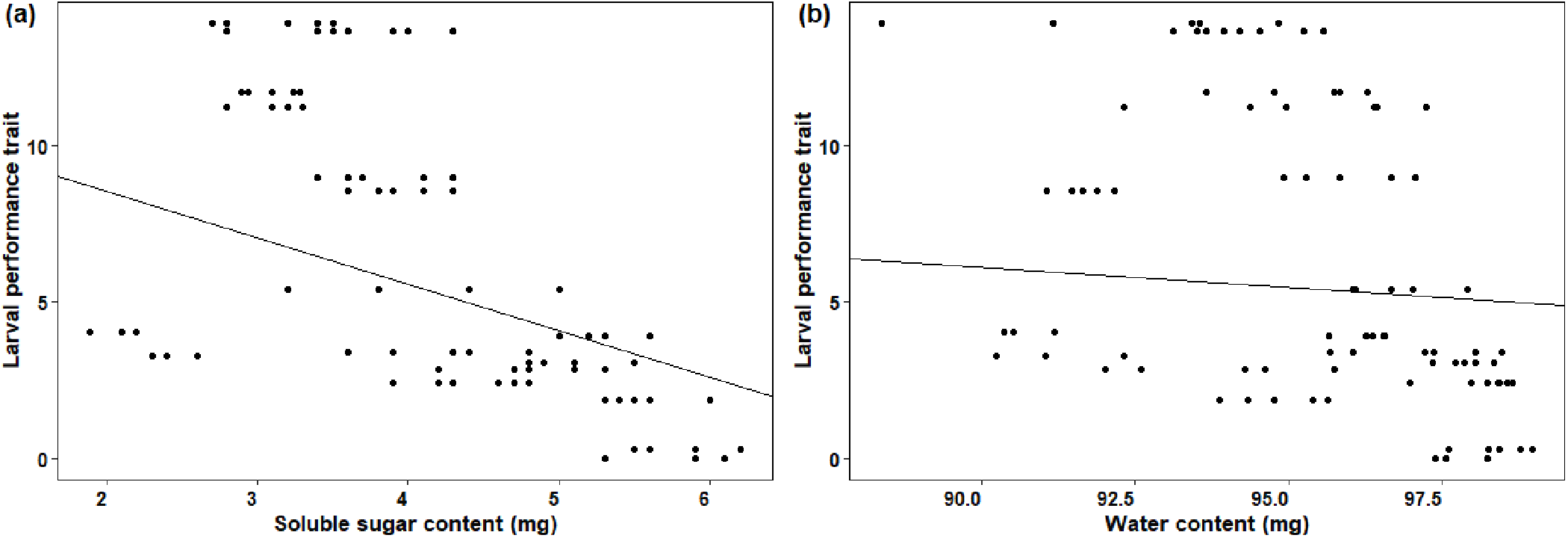
The larval performance trait decreased significantly with higher soluble sugar contents (estimate = − 1.49; confidence interval [CI]: −2.26, − 0.71; p < 0.001; marginal R 2 = 0.094; conditional R 2 = 0.889). In contrast, it did not differ significantly with regard to fruit water content (estimate = – 0.13; CI: − 0.43, 0.18; p = 0.410; marginal R 2 = 0.003; conditional R 2 = 0.888) (fig. 2).
Relationship between larval performance trait (survival × pupal weight/developmental duration) and soluble sugar contents (A) or water contents (B) as predicted by mixed effect regression for Dacus frontalis reared on seven cultivated and wild host fruit species belonging to the Cucurbitaceae family at different stages of maturity. We built a linear regression, based on the results of the fitted models where fruit species and stage of maturity were included as random effects for sugar (p < 0.001, R 2 = 0.094) and water content (p = 0.410, R 2 = 0.003).

Female preference
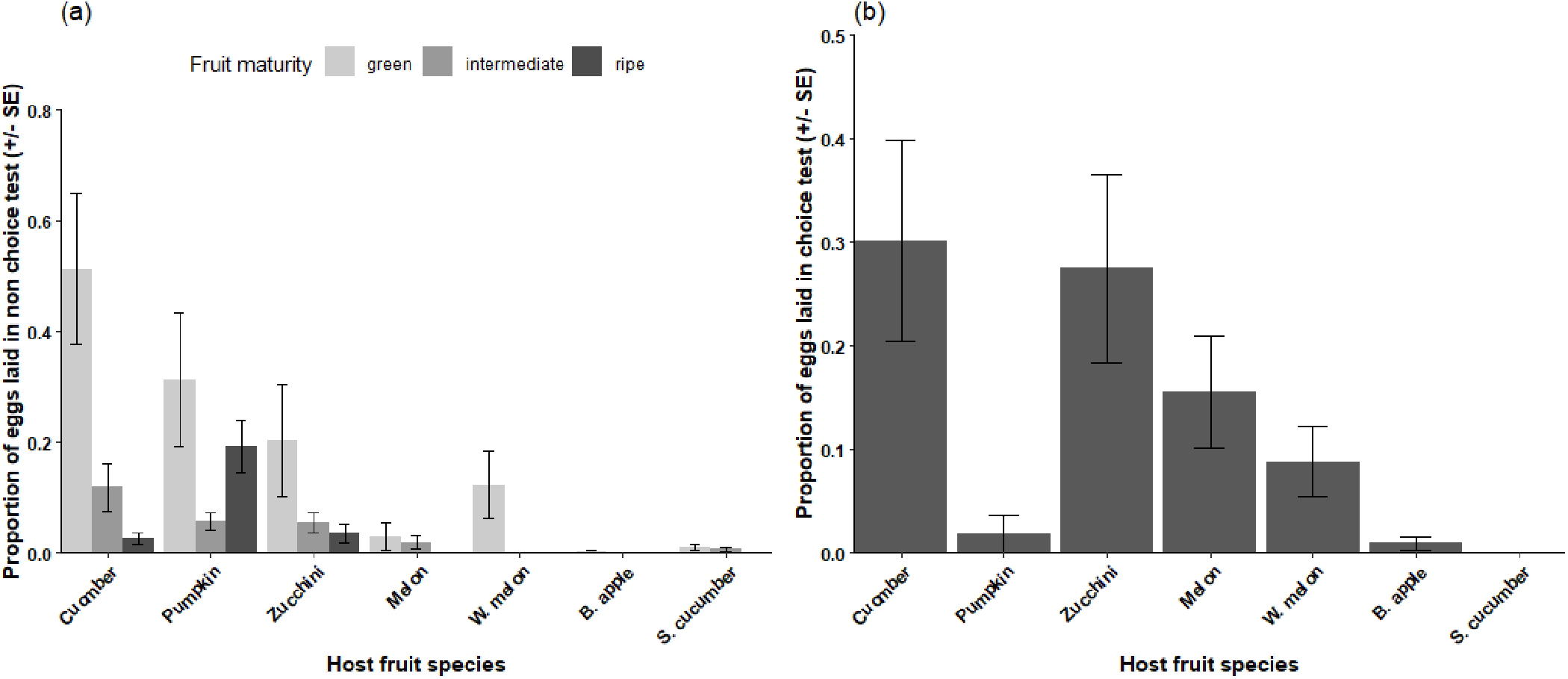
The mean number of eggs laid by D. frontalis females in the no-choice assays differed significantly between fruit species (ΔDev 6, 125 = 1213.8, p < 0.001) and between the different stages of fruit maturity (ΔDev 2, 125 = 760.3, p < 0.001). The interaction between these two parameters is significant (ΔDev 12, 125 = 596.29, p < 0.001) (fig. 3A). On the tested fruit species, the lowest number of eggs was observed on oviposition devices containing the wild cucurbitaceous species, with no eggs in the case of bitter apple. In cultivated cucurbitaceous fruits, the highest number of eggs was laid on the oviposition device containing cucumber (48 eggs/female) and the lowest on that containing melon fruit, where there was no oviposition (fig. 3A). Regarding the different classes of the same host fruit species, D. frontalis lay the highest number of eggs on the oviposition devices containing fruit belonging to the green category.
Proportion of eggs laid by gravid females of Dacus frontalis in cultivated and wild host fruit species belonging to the Cucurbitaceae family occurring in Tunisia during (A) a non-choice test at different stages of host fruit maturity (green, intermediate, and ripe) and (B) a choice test on green tested fruit.

The mean number of eggs laid by D. frontalis females in the choice trials differed significantly between fruit species (ΔDev 7, 95 = 529.2, p < 0.001) (fig. 3B). On the fruit species tested, the lowest number of eggs was observed on the oviposition devices containing wild cucurbitaceous species. No eggs were laid in the devices filled with bitter apple (fig. 3B). In cultivated cucurbitaceous fruit, the highest number of eggs was laid in the oviposition devices containing cucumber and the lowest in those with pumpkin fruit. However, D. frontalis females exhibit significant (ΔDev 7, 95 = 529.2, p < 0.001) oviposition preferences between the cucurbitaceous species tested. In choice trials, D. frontalis females preferred oviposition devices with cucumber and zucchini for egg laying. No preference was observed in the case of squirting cucumber (fig. 3B).
Preference–performance
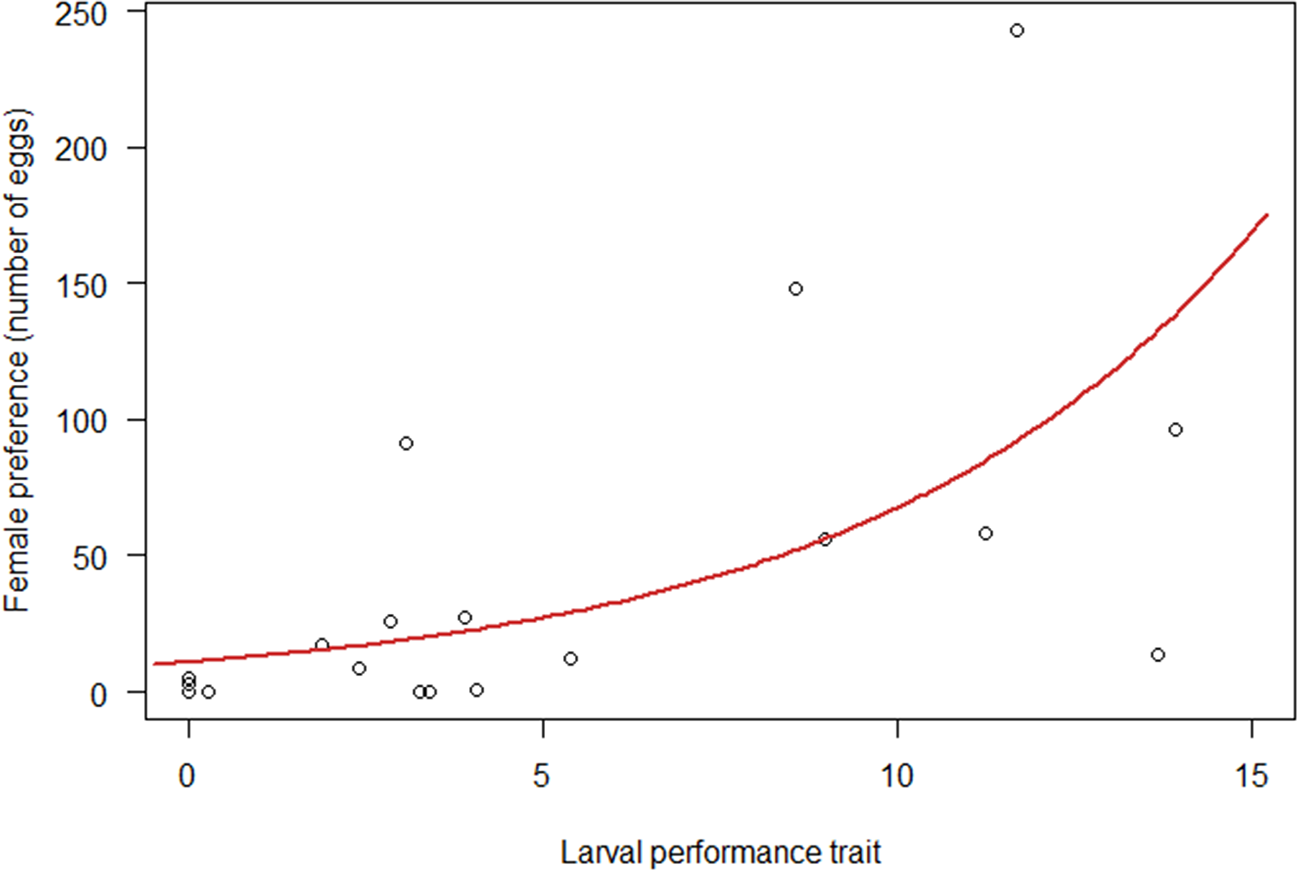
The larval performance trait (survival × pupal weight/development duration) differed significantly different between host fruit species (F 6, 6285 = 54, p < 0.001), host fruit maturity (F 2, 6285 = 579, p < 0.001) and the interaction between the two factors (F 12, 6285 = 18, p < 0.001) (fig. 4). There was a significant correlation between female preference and larval performance (R 2 = 0.350, p = 0.002) (fig. 5). Females of D. frontalis were able to choose fruit that promoted high larval performance, such as cucumber, pumpkin, zucchini, and watermelon, particularly at the green stage. The highest correlation between larval performance and oviposition preferences for D. frontalis was on cucumber fruit, which was used to rear flies in the laboratory.
Female preference in non-choice test and larval performance trait (survival × pupal weight/developmental duration) for Dacus frontalis at different stages of fruit maturity (green, intermediate, and ripe) for five cultivated and two wild host fruit species belonging to the Cucurbitaceae family and found in Tunisia.

Relationship between female preference (number of eggs laid in non-choice test) and larval performance trait (survival × pupal weight/developmental duration) (R 2 = 0.350, p = 0.002) for Dacus frontalis at different stages of fruit maturity (green, intermediate, and ripe) for five cultivated and two wild host fruit species belonging to the Cucurbitaceae family and found in Tunisia.

Discussion and conclusion
Our results revealed that the larval performances and oviposition preference of D. frontalis depends on the host fruit species and stage of fruit maturity. Females preferred laying eggs on oviposition devices that contained green and intermediate fruit rather than ripe fruit. Larval growth was superior in green fruit. There was a strong positive correlation between the female oviposition preference of D. frontalis and offspring performance at immature stages development. The best larval performance was observed on most preferred host, cucumber, particularly on the green and unripe fruit, which tend to be characterised by a low carbohydrate content (Handley et al., Reference Handley, Pharr and McFeeters1983).
Larvae of D. frontalis were able to survive on cultivated and wild fruit belonging to different species in the Cucurbitaceae family, except in the case of squirting cucumber. l = Larval performance varied depending on the host plant species and fruit maturity. These finding have already been shown in laboratory studies for other specialist and generalist Tephritidae species (Clarke et al., Reference Clarke, Armstrong, Carmichael, Milne, Raghu and Roderick2005; Duyck et al., Reference Duyck, David, Pavoine and Quilici2008; Ekesi et al., Reference Ekesi, Mohamed and Chang2014; Hafsi et al., Reference Hafsi, Facon, Ravigné, Chiroleu, Quilici and Chermiti2016). The host plants in our trial were not equally suitable for larval development. They can be classified from poor to good hosts as follows: bitter apple, zucchini, melon, cucumber, watermelon, pumpkin, and squirting cucumber. It is clear that the host plant’s stage of maturity influences the larval performance of D. frontalis. Green cultivated Cucurbitaceae fruit are the best host with the highest survival rate for D. frontalis. Similar findings have been reported for other tephritid species (Rattanapun et al., Reference Rattanapun, Amornsak and Clarke2009). These results suggest that the high survival rate of D. frontalis on green and unripe fruit may allow this fruit fly to develop earlier, thus avoiding competition from other species (Tephritidae or other species).
Although many host plants can sustain the full development of D. frontalis, host quality plays a major role in differential larval survival (Hafsi et al., Reference Hafsi, Facon, Ravigné, Chiroleu, Quilici and Chermiti2016; Krainacker et al., Reference Krainacker, Carey and Vargas1987). Dacus frontalis larvae were reared under constant laboratory conditions on seven host fruit (wild and cultivated), with different nutritional compositions. Larval performance differed significantly between fruit species, suggesting that fruit nutritive value impacted the individual fitness of D. frontalis. The nutritional content of the larval diet has a significant effect on larval performance. It also has an impact on the number of adult fruit flies produced (Hafsi et al., Reference Hafsi, Facon, Ravigné, Chiroleu, Quilici and Chermiti2016; Roeder and Behmer, Reference Roeder and Behmer2014) and can explain the differential trophic niche for the fruit fly community in the same area (Hafsi et al., Reference Hafsi, Facon, Ravigné, Chiroleu, Quilici and Chermiti2016).
Contrary to generalists, specialist tephritid species are less impacted by the toxicity of their host plant’s secondary metabolites (Ali and Agrawal, Reference Ali and Agrawal2012). This could explain why D. frontalis larvae survive in bitter apple (with lowest pupal weight) which is known to contain toxic compounds and secondary metabolites that are harmful to animals that are harmful for animals (Kandibane et al., Reference Kandibane, Seerisha, Thulasi and Prakash2020; Li et al., Reference Li, Munawar, Saeed, Shen, Khan and Noreen2022) such as flavonoids, alkaloids, and phenols (Hussain et al., Reference Hussain, Rathore, Sattar, Chatha, Sarker and Gilani2014). The same tendency was observed in another specialist tephritid species, Neoceratitis cyanescens (Bezzi, 1933) (Brévault et al., Reference Brévault, Duyck and Quilici2008). The ability to exploit toxic hosts may cause harm to insects. For example, secondary metabolites, particularly steroid alkaloids, are known to interact with the ecdysteroid: Juvenile Hormone balance, with a negative impact on larval survival and pupal weight (Erbout et al., Reference Erbout, De Meyer, Vangestel and Lens2009; Thummel and Chory, Reference Thummel and Chory2002). This was shown for the generalist tephritid species, Ceratitis fasciventris (Bezzi) (Erbout et al., Reference Erbout, De Meyer, Vangestel and Lens2009). It was also demonstrated in our study on D. frontalis. This species can exploit toxic hosts, such as bitter apple, but their pupae are lighter. This characteristic of may allow D. frontalis may allow the species to avoid competition, predation, and parasitism on its host plant.
The results revealed that D. frontalis females had clear ovipositional preferences for cultivated cucurbitaceous fruit, especially cucumber compared to the wild fruit species tested. The oviposition preference depended on the stage of host fruit development. We observed that females preferred laying eggs on young green and unripe cultivated Cucurbitaceae fruit than on intermediate and ripe fruit. This pattern was observed in other Dacini species, which are also cucurbitaceous fruit specialist that are found in the same area. In some cases, these species are even capable of laying their eggs in either the vegetative part of the plant (stems) or in the floral organs (Ryckewaert et al., Reference Ryckewaert, Deguine, Brévault and Vayssières2010; Vayssières and Carel, Reference Vayssières and Carel1999; Vayssières et al., Reference Vayssières, Carel, Coubès and Duyck2008).
Host specialisation has been studied in tephritid species. Results show that the relationship between preference and performance increases with diet specialisation (Charlery de La Masseliere et al., Reference Charlery de La Masseliere, Facon, Hafsi and Duyck2017; Facon et al., Reference Facon, Hafsi, Charlery De La Masselière, Robin, Massol and Dubart2021; Fitt, Reference Fitt1986; Lauciello et al., Reference Lauciello, Mille, Hafsi, Jacob and Duyck2024). Studies reveal that the specialised species belonging to the Dacus genus prefer laying eggs on hosts suitable for their larval development (Fitt, Reference Fitt1986). Consistent with the optimal oviposition theory (Jaenike, Reference Jaenike1978a), our results demonstrated that D. frontalis females preferred to oviposit on young fruit species to optimise larval performance. This preference for young green host fruit, which are often softer and contain sufficient nutrients for larval development, indicates that D. frontalis females may have the capacity to choose suitable novel host plants. This supports the ‘mother knows best’ hypothesis.
Our finding indicates that cucumber is highly preferred by D. frontalis and that larvae performed perform well on cucumber, particularly in young fruit, compared to the other crops tested. This is consistent with historical field evidence, which shows that cucumber was the first host plant attacked by this tephritid species when it invaded Tunisia (Hafsi et al., Reference Hafsi, Abbes, Harbi, Ben Othmen, Limem and Elimem2015). Flies may appear as soon as host plant start flowering. This pattern was observed in other cucurbitaceous tephritid species in the laboratory and in the field (Atiama-Nurbel et al., Reference Atiama-Nurbel, Deguine, Douraguia Quessary and Quilici2010; Vayssières and Carel, Reference Vayssières and Carel1999). Results from laboratory trials have shown that these fruits do not constitute an efficient alternative host for D. frontalis in the field because females are unable to oviposit on the fruit pericarp due to its firmness. However, bitter apple and squirting cucumber may be important multiplication reservoirs, if mammals or birds accidentally damage the fruit, leaving openings for egg laying (Tracey et al., Reference Tracey, Mary, Hart, Saunders and Sinclair2007). In this case, presence of bitter apple as a host plant between cropping periods may be problematic. Bitter apple can support the larval development of D. frontalis and, thus, contribute to its renewed establishment in the field in the following season. The presence of wild host plants is an important consideration when developing pest management programmes for tephritids.
By examining the ecosystems where a species has become successfully established, it is possible to demonstrate that the availability and abundance of suitable host plants is important. It is undeniably the most crucial preliminary factor that will allow an exotic phytophagous insect to survive in a new habitat, on condition that it can tolerate the new climate (Niemelä and Mattson, Reference Niemelä and Mattson1996). Our study documents the fundamental dietary niche of D. frontalis and demonstrates that a good host for larvae is also the female’s preferred host. Our findings confirm the positive preference–performance relationship that has been demonstrated for specialist tephritid species (Charlery de La Masseliere et al., Reference Charlery de La Masseliere, Facon, Hafsi and Duyck2017; Lauciello et al., Reference Lauciello, Mille, Hafsi, Jacob and Duyck2024). We suggest that D. frontalis females prefer a low risk site with the best quality food to ensure that their offspring can develop to optimum fitness. Predicting the interactions between insects and their fundamental host range is essential for predicting invasions using PRA and associated quarantine procedures. It could help limit the consequences of invasions, by proposing adequate management techniques to control future invasive pests.
Acknowledgements
This publication was produced with the financial support of the European Union in the framework of the ENI Cross-Border Cooperation Programme Italy–Tunisia 2014–2020, through the INTEMAR project-IS_2.1_073 Innovations in the integrated control of insect pests and pathogens recently introduced on vegetable crops. Its content is the sole responsibility of the project beneficiary and does not necessarily reflect the opinions of the European Union and those of the Managing Authority. This study used the facilities provided by the High Agronomic Institute of Chott-Mariem, University of Sousse, Tunisia.
Competing interests
The authors declare no conflict of interest.




 Open access

