

Research concerning populism has, almost exclusively, focused on the so-called ‘supply side’ of politics: populist ideology (for example, Stanley Reference Stanley2008), populist rhetoric (for example, Rooduijn and Pauwels Reference Rooduijn and Pauwels2011) and the societal developments explaining the rise of presumably populist parties (for example, Boomgaarden and Vliegenthart Reference Boomgaarden and Vliegenthart2007). This article follows a different track. It investigates the extent of the acceptance of (core elements) of populism among the electorate. Very little is known about the distribution of populist attitudes in the population. We will argue that the spread of populist attitudes cannot be deduced from the success of (presumably) populist parties, but can only be mapped on the basis of a measurement of populist attitudes. There have been previous attempts at scale-development in order to measure populist attitudes (for example, Akkerman et al. Reference Akkerman, Mudde and Zaslove2014; Hawkins et al. Reference Hawkins, Riding and Mudde2012). This article seeks to study the distribution of populism in the adult population of Flanders on the basis of a scale measuring that attitude. The available literature on the possible causes of populism is used to explain who shows affinity for populism.
A Minimalist Definition of Populism
Most studies of populism follow an indirect path to the object of their inquiries. They first classify parties as populist on the basis of their points of view and rhetoric, then study the nature of populism by looking at the discourse, strategies and programmes of those parties or their main representatives (for example, Jagers and Walgrave Reference Jagers and Walgrave2007; Mudde Reference Mudde2007). That approach focuses on parties and politicians as cultural entrepreneurs who address and positively resonate with values and sentiments held by a part of the population and make manifest and discursively articulated what, without their activity, would probably remain more latent and less clearly articulated. Although illuminating, that approach also has its limitations. First, while populism is to some degree the product of cultural or political entrepreneurs it is unlikely that these actors create such a political position ex nihilo. They have to address and positively resonate with sentiments and views already held in some form by a significant part of the population (Zaller Reference Zaller1992: ch. 2). It can be assumed that there is a substratum of opinions in the population that is both the result and the condition of such political entrepreneurship. It is that substratum we want to measure.
Second, populism is often described as a ‘thin ideology’ (Mudde Reference Mudde2004; Stanley Reference Stanley2008; Wiles Reference Wiles1969; for a review of the relevant literature, see Lucardie Reference Lucardie2010). Such a conceptualization accommodates the observation that populism can combine with different deep ideologies, can be leftist (as is often the case in Latin America – Hawkins Reference Hawkins2009) or rightist, as is predominantly the case in contemporary Europe. That makes it difficult to discern the extent of populism of the electorate of specific parties because this electorate is always recruited on the basis of several issues and concerns or, in the words of Mény and Surel (Reference Mény and Surel2002: 17): ‘it is precisely by identifying populism with specific programmes or ideology that we miss out on its crucial specificity’. When analysing the nature of populism on the basis of party rhetoric, it is impossible to separate populism proper from the other standpoints of the party concerned. This highlights the importance of measuring populism at the level of the voter, independently of party preference, in order to see how widespread it is and what kind of people hold populist convictions.
There is a surprising consensus on the core propositions of populism as a thin ideology: ‘One component is always present: the idea that the people are always far better than their rulers and that rulers often betray the interests and preferences of the people’ (Pasquino Reference Pasquino2008: 20). Populism emphasizes the difference and distance between straight-thinking ‘ordinary people’ and the distant, unworldly, even corrupt, elite (or establishment, intellectuals, experts, politicians and so on) (Canovan Reference Canovan1999: 3; Elchardus Reference Elchardus2002; Hawkins Reference Hawkins2009: 1043–4; Mudde Reference Mudde2004: 544, 547; Mudde Reference Mudde2007: 23; Stanley Reference Stanley2008: 102).
The crucial reference point for populism then is ‘the people’ (Diani Reference Diani1996: 1059), in European populist discourse often rendered as the ‘ordinary people’, ‘the normal folk’. Some authors claim that this reference point inevitably leads to negative feelings with regard to what is considered strange, not part of their ‘own people’ (for example, Taggart Reference Taggart2000: 95–8). Anti-immigrant positions and ethnocentrism do not, however, appear to be a ubiquitous aspect of populism (Pauwels Reference Pauwels2010: 1009). The reference to the people and the ordinary people should not, moreover, be taken as a reference to a clearly delimited group of people (Canovan Reference Canovan1984). Some people, particularly those with a lower level of education, are more likely to vote for parties considered populist (Bovens and Wille Reference Bovens and Wille2009), yet the ‘ordinary people’ appear less as a specific group that can be delineated on the basis of socioeconomic or sociocultural characteristics, more as a concept that primarily refers to a certain way of thinking, to a set of perceptions and propositions about society and politics. The latter are presented as homogeneous, carried wholesale by the ordinary people. Thus a deep divide is conjured between those who accept this way of viewing and thinking about the world – the ordinary folk – and those who do not: the elite, the establishment, the intellectuals (Stanley Reference Stanley2008: 102). That way of thinking – common sense – is established not only as the desirable way of thinking, but also as the only truly democratically legitimate foundation for policy (Diani Reference Diani1996; Mudde Reference Mudde2004: 547). In that way populism is able to structure social and political space, divide it between us and them, between friend and enemy (Canovan Reference Canovan1984; Taggart Reference Taggart2002: 77).
Authors using a minimalist definition of populism focus on those elements of populism that are always present in discursive formulations of populist ideology and in populist rhetoric, regardless of the context (for example, Mudde Reference Mudde2004; Rooduijn et al. Reference Rooduijn, De Lange and van der Brug2012). They identify two such elements that can be considered as the core of populism as a thin ideology. The first is the centrality and elevated status of ‘the people’ or more precisely ‘the ordinary people’ (the term ‘people centrism’ has been used to denote this trait). The second core trait of the thin ideology of populism is articulated on the basis of that vertical view of the social structure: the betrayal of the ordinary people by an elite that uses its power to its own advantage, neglecting and ignoring the worries and needs of the ordinary people (the anti-establishment stand). Some authors suggest that one should add a third element: the idea of a leader who incarnates the people and speaks common sense (for example, Betz and Johnson Reference Betz and Johnson2004; Mény and Surel Reference Mény and Surel2002). That element, however, does not seem to be sufficiently present in the discourses that can be considered as examples of populism (Mudde Reference Mudde2004: 560). When it is present in the European context it seems to be characteristic of right-wing populism. This trait was therefore not retained as a core element attempt to measure support for populism.
Explaining the Susceptibility for Populism
Because populism has not often been studied as a thin ideology or attitude, explanations for variations in the degree to which people adhere to the core populist propositions are scarce. Many authors explain the rise of populism as a reaction to the fast and disturbing changes that have taken place as a consequence of globalization, the mediatization of politics and the encompassing processes of detraditionalization (for example, Betz Reference Betz1990; Calhoun Reference Calhoun1988; Kriesi et al. Reference Kriesi, Grande, Lachat, Dolezal, Bornschier and Frey2006). Taken together these processes seem to explain, on the one hand, why certain groups experience difficulties (become the ‘losers of modernization’), and on the other, why in a political world transformed by the mass media and the mediatization of politics, they express their worries by political means other than the established parties (Dalton Reference Dalton2000; Elchardus Reference Elchardus2002; Kriesi et al. Reference Kriesi, Grande, Lachat, Dolezal, Bornschier and Frey2006).
A core element of that explanation is that populism is an attitude typical for people who suffer from being confronted with overwhelming and disorienting change and/or who have been placed in a weak and vulnerable economic position because of such changes (Betz Reference Betz1990; see also Heitmeyer Reference Heitmeyer1997; Honneth Reference Honneth1994; Schroer Reference Schroer2000).Footnote 1 On the basis of that thesis one expects that people in a weak and vulnerable economic position will be more likely to opt for populism (Hypothesis 1). Following a similar reasoning, one expects that people with a low level of education, due to their weak position in the knowledge society, will support populism (Hypothesis 2).
The reason for expecting populism to be particularly attractive to people with low levels of education and in weak economic positions is their personal vulnerability. Many political and sociological theories do indeed anchor democratic politics in the lives of the citizens by considering politics as the expression of interests. Individuals experience the conditions under which they live and, based on that experience, form interests (needs, wishes and so on) that in turn guide their political behaviour. This proposition has been empirically challenged (Feldman Reference Feldman1981; Kinder and Kiewit Reference Kinder and Kiewit1984; Mutz Reference Mutz1998; Sears and Funk Reference Sears and Funk1990), and the accumulating research findings indicate that the link between the personal situation and political choices is not as straightforward. Political choices appear less influenced by ‘egocentric motives’ related to the personal life situation, more by ‘sociotropic considerations’ concerning the way society is evolving and is likely to evolve as a consequence of the political choices that are made. Diana Mutz (Reference Mutz1998: 131) summarized this finding by speaking of the ‘compartmentalization of personal and national judgement’. That attitude can also be described as persistent republicanism or the tendency to overcome particularism and particularistic interests in judging public affairs, or, to put it differently, the ability and willingness to separate judgements about one’s personal welfare from judgements about the common good and the state of society at large. The importance of this insight, for the formation of political judgements and political choices is that the evaluation of one’s situation can be based on personal experience, while the evaluation of the state of society and the probable impact of one’s political choices on that state are likely to be influenced by conceptions of justice, of what ought to be, as well as by information gathering and hence by factors which influence the kind of information gathered and the way this information is interpreted.
When applied to the case of populism, the thesis of persistent republicanism implies two hypotheses.
First, one expects not that economic vulnerability as such, but an interpretation of that vulnerability that relates it to a view of a just society will lead to populism. This implies that the economic position will not have a direct effect on populism, and that its effect will be mediated by an interpretation (Hypothesis 3). Feelings of relative deprivation can provide such an interpretation (Elchardus and Spruyt Reference Elchardus and Spruyt2012). The feelings of relative deprivation explain the person’s own vulnerability and weak position as a consequence of injustice, as a form of discrimination against ‘people like us’, who in this society ‘never get what they deserve’ (Derks Reference Derks2006; Hogg et al. Reference Hogg, Meehan and Farquharson2010). This dovetails with the claim that one of the appealing characteristics of populism follows from its capacity to define enemies (Canovan Reference Canovan1984; Taggart Reference Taggart2002: 77). We therefore expect people with feelings of relative deprivation to be more likely to see society as divided into themselves (the people) and the elite, and thus to be more susceptible to the thin ideology of populism (Hypothesis 4). Because economically vulnerable persons are more likely to develop feelings of relative deprivation as a strategy to maintain self-respect, we expect relative deprivation to mainly or completely explain the relation between the economic position and populism (Hypothesis 3).
Secondly, the thesis of persistent republicanism also implies that perceptions of how society is doing will be a much more important influence on populism than the evaluation of how one is doing personally. This is expected because the thesis of persistent republicanism holds that people pass judgement on public affairs (for instance in adopting the populist propositions) not primarily on the basis of personal experience and interests, but by taking into account the societal consequences of their position and by gathering and interpreting information that allows them to judge those consequences. The thesis of persistent republicanism, however, suggests that people’s political choices are not so much influenced by their personal experiences, by the evaluation of or satisfaction with their personal life, but on the basis of their evaluation of how society is doing and what should and could be done about that (Elchardus Reference Elchardus2011). A negative view of how society is evolving need not be based on personal experience, but can also and is likely to be based on how the development of society is perceived on the basis of the information gathered and the interpretation of that information. The view of how society is doing or how society is evolving is also central to Taggart’s notion (2002: 67–8) of ‘heartland’ as an important element of populism. Heartland is a retrospective though ahistorical, diffuse and romanticized construction of an ideal world with which the present society is unfavourably compared. As a feeling rather than a well-thought-out idea, heartland refers to the world/society we have lost.Footnote 2 According to Taggart, populist appeal is rooted in nostalgia and the conviction that a better world has been lost (Bauman Reference Bauman2001; Betz and Johnson Reference Betz and Johnson2004). The thesis of persistent republicanism suggests that people will take their view of how society is doing as a basis for political choices. People who see decline, a lost heartland, are likely to blame the political establishment for the decline and they will be more likely than others to opt for populism: to emphasize the distance between we the ordinary people and the elite, to blame the latter for the perceived decline and to put hope in common sense and the ordinary people to redress the situation. For Taggart, nostalgia for a lost heartland and the perception of decline in the present day are close to the core of populism. In both cases one expects a negative view of the state of society – declinism – to be strongly and positively related to populism (Hypothesis 5).Footnote 3
The other implication of persistent republicanism is that personal satisfaction will have no or only a weak effect on populism (Hypothesis 6).
Many factors can influence the gathering and interpretation of information. In this article we will look at the influence of (the level of) education. There are of course many different ways in which education can influence populism, directly or indirectly (Kingston et al. Reference Kingston, Hubbard, Lapp, Schroeder and Wilson2003). To the extent that low educational attainment can be seen as an indicator of vulnerability, it can influence populism. Education can also exert its influence via the way information is gathered and/or interpreted. One of these is a consequence of the socializing effects of education, its contribution to civic knowledge and to the formation of interpretative communities that select different media content and interpret that content in different ways. Another mechanism could be a kind of revolt of the less educated against a political establishment that consists almost entirely of highly educated people. Bovens and Wille (Reference Bovens and Wille2009) suggest such a mechanism when they present populism as a reaction against the ‘diploma democracy’. In the same vein, several authors (for example, Kingston et al. Reference Kingston, Hubbard, Lapp, Schroeder and Wilson2003; Stubager Reference Stubager2009) suggest that the level of education is becoming the object of a form of identity and consciousness. If that is the case, then this form of group consciousness could very well express itself in the identification with the ‘ordinary people’ and the adoption of populism as a thin ideology expressing that consciousness. We will not try to evaluate the predictive power of those different possible mechanisms in our model, but they all make it plausible that, even after controlling for the effects of vulnerability and declinism, a direct effect of education on populism will be observed in our models (confirmation of Hypothesis 2).
The perception of society and of how society is doing is also central to the thinking of those authors who explain populism on the basis of resentment, anomie, cultural uncertainty or other aspects of social malaise (for example, Betz Reference Betz1990; Calhoun Reference Calhoun1988). The model will also control for the effects of feelings of relative deprivation and of anomie. In the way anomie is measured, feelings such as ‘Everything has become so complex today that I no longer know what to do’ and ‘I no longer understand what is happening in the world today’ are central. Therefore, feelings of anomie can be considered to express a longing for a more manageable, predictable and reliable world (Calhoun Reference Calhoun1988). Many authors consider that experience – the uncertainty, insecurity, feelings of loss created by the combined effects of detraditionalization, economic uncertainty, the individualization of risks and the increasing responsibilization of individuals – to be an important explanation for the rise of populism (Heitmeyer Reference Heitmeyer1997; Honneth Reference Honneth1994). This line of theorizing implies strong positive effects of feelings of anomie on populism (Hypothesis 7).
Data and Operationalization
Measuring the Explanatory Variables
In order to answer our research questions we rely on data gathered in a study of social differences in happiness and satisfaction with life (see Elchardus and Smits Reference Elchardus and Smits2007). The questionnaire of that survey contained a very large number of items tapping into personal views on people’s own life, as well as their perceptions of the state of society, which renders this database very suitable for the purposes of the present analysis. The data were collected in the spring of 2006 by way of a written questionnaire in a pure random sample of the Belgian population aged 18 to 80, drawn on the basis of the National Register. Subsequent comparisons with population data revealed that younger people, males and the less educated were somewhat underrepresented in our sample. Therefore, weights based on the combination of age (7 cat.), gender and educational level (5 cat.) are used (70 coefficients were calculated. Four of the 70 coefficients are greater than 2; the highest equals 2.82). In this analysis, we only used the Dutch-speaking (Flemish) part of the population because the linguistic communities of Belgium have separate political parties for the Dutch-speaking and French-speaking parts of the population. As a consequence the political landscapes in the two regions differ substantially, making it problematic to estimate models for Belgium as a whole. As our focus here is not on regional differences and Flanders is known to have a ‘textbook case’ of a populist party (see Jagers and Walgrave Reference Jagers and Walgrave2007), we decided to focus on the Flemish data.
The economic position is measured on the basis of five variables: monthly disposable family income (10 categories), the amount of money the family can save monthly (seven categories), home ownership (three categories: no owner, owner still paying loan, owner), ever been unemployed for a year or longer, (last) occupation (EGP classification, eight categories). A non-linear principal component analysis revealed one dimension with eigenvalue above 1 (Cronbach’s alpha: 0.702). High values on this index correspond to a strong economic position.
The educational level is measured as the highest level attained. For respondents still at school, their current grades or level of education were considered as the highest diploma obtained. For both groups, educational levels are coded in four categories: primary education or lower, lower secondary education, higher secondary education and higher (post-secondary) education.
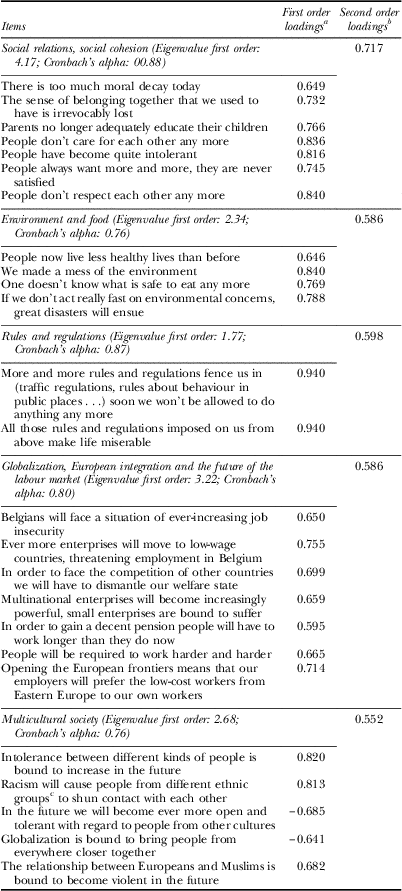
Satisfaction with life is measured with the question: ‘All things considered, how satisfied are you with your life as a whole nowadays?’ (0–10). We also experimented with a more complex second-order measure of satisfaction with life based on 36 items. As the results turned out to be very similar and as including the complex indicator in the structural equation model increased model complexity enormously, we decided to rely on the single-item measure. Anomie is measured with four items that point to the fast societal changes and express the feeling of not being able to deal with such change (see Table A.1 in the Appendix). Feelings of relative deprivation are measured with seven items that express the feeling of belonging to a group that is deprived in our society. The seven-item scale used does not specify a group with which people compare themselves, but rather suggests comparisons between the respondents and generalized others. The items do not contain any reference to politics or politicians. Higher scores on the deprivation scale indicate stronger feelings of deprivation (see Table A.1 in the Appendix). Declinism was measured on the basis of 25 statements, none of which referred to the personal life of the respondent. The statements are related to various themes: the evolution of sociability (values, norms, social cohesion), of the environment, the extent to which life is regulated by rules, (the economic consequences of) globalization, the evolution of the labour market, of the welfare state and the multicultural society. Each theme forms a scale that measures the evaluation of the perceived evolution of society with regard to that theme. The scores are higher the more negative the evaluation or the higher the belief in decline on all fronts (see Table A.2 in the Appendix).
Measuring Populism as an Attitude
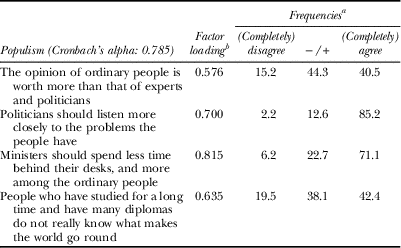
Our populism scale consists of four items (Table 1). Items 1 to 3 clearly articulate a people-centrist view of politics, centred on a sharp distinction between ‘ordinary people’ and politicians. Item 1 distinguishes itself from items 2 and 3 by introducing a normative element (that is, worthier). Items 2 and 3 claim that contemporary politicians are out of touch and do not really understand what is going on among ordinary people. Listening more closely to the people is presented as the only solution for this situation. Item 4, as well as item 2 in a milder form, articulates an anti-elitist position. Mudde and Rovira Kaltwasser (Reference Mudde and Rovira Kaltwasser2013: 151) consider anti-elitism a necessary albeit not sufficient element of populism; Rooduijn and Pauwels (Reference Rooduijn and Pauwels2011: 1278) consider it a ‘pretty good indicator of populism’. We therefore included it, as well as the items gauging people centrism. The specific formulation of the items is informed by recent concerns about the dominance of the higher-educated in all forms of political participation (for example, Bovens and Wille Reference Bovens and Wille2009). In Flanders, this concern was brought to the political scene by a politician whom Mudde (Reference Mudde2004: 255) described as ‘prime exponent of left-wing government populism’ (Steve Stevaert, former president of the Socialist Party). The anti-establishment component in the discourse of that politician articulates the idea that contemporary politicians obtained many diplomas but attended ‘the university of life’ insufficiently and hence have lost touch with the common people and their reality (as expressed in items 2 and 4 in Table 1).
Frequencies and Scale Properties of Items Tapping Populism among People Aged 18–80 Living in Flanders, 2006 (N: 2,330)

Notes: aThe respondents could choose from five categories to evaluate the statements; for ease of presentation they have been collapsed into three categories in the table.
bEstimated by the confirmatory factor analysis as presented in Table 2 (Model 2).
In recent years, scholars have started to develop attitude scales to measure support for populism among voters (for example, Akkerman et al. Reference Akkerman, Mudde and Zaslove2014; Hawkins et al. Reference Hawkins, Riding and Mudde2012). Compared with those attempts, the items used in our survey do not tap the ‘harder’ expressions of the anti-establishment component but only cover, besides the people-centrism component, a softer version of anti-establishment feelings. We took this option for two reasons. First, authors writing on populism differ in the emphasis placed on the anti-establishment component. The discourse Mudde (Reference Mudde2004) refers to as an example of left-wing government populism certainly does not contain what Hawkins (Reference Hawkins2009) calls a Manichaean element, referring to a cosmic struggle between good and evil, which is typical of the harsher forms of anti-establishment feelings. Moreover, part of the discussion between authors who claim that current politics is characterized by a populist Zeitgeist (for example, Mudde Reference Mudde2004) and those who reject that thesis (for example, Rooduijn et al. Reference Rooduijn, De Lange and van der Brug2012) concentrate precisely on the weight given to (the harsher forms of) the anti-establishment component. Akkerman and colleagues (2014) and Hawkins et al. (Reference Hawkins, Riding and Mudde2012) engaged in scale development with the purpose of evaluating the Zeitgeist thesis and determining how populist people actually are. In that case it might make sense to include very extreme items. Our purpose is somewhat different. We are primarily interested in the variation in susceptibility to populist feelings and in the social and attitudinal anchorage of populist attitudes. For that purpose the harshness of the item formulation is of secondary importance, because we do not have the ambition to say in some absolute way how populist the population is, but more modestly to compare the populism of different segments of the same population.
Secondly, at the empirical level Akkerman et al. (Reference Akkerman, Mudde and Zaslove2014) found, in contrast to studies based on data from the US (see Hawkins et al. Reference Hawkins, Riding and Mudde2012), that a strong formulation of views of a Manichaean division of society between good and evil did not load on their populism scale. This clearly illustrates that the boundaries of the populist attitude with respect to (the harsher forms of) the anti-establishment component are not fully understood, rendering it reasonable and prudent to focus primarily on the people-centrism component and on moderate rather than radical versions of the anti-establishment component. This option should, of course, be kept in mind when interpreting the findings.
The four items used in the population survey (see Table 1) enjoy great support in Flemish public opinion. Of the respondents, 70–80 per cent agree with statements urging the politicians to be more attuned to the problems as perceived by the ordinary people and to their way of thinking. About 40 per cent agree with the more radical statements that highly educated people do not know how things really work and that the opinion of ordinary folk is worth more than that of experts and politicians.
Testing the Hypotheses
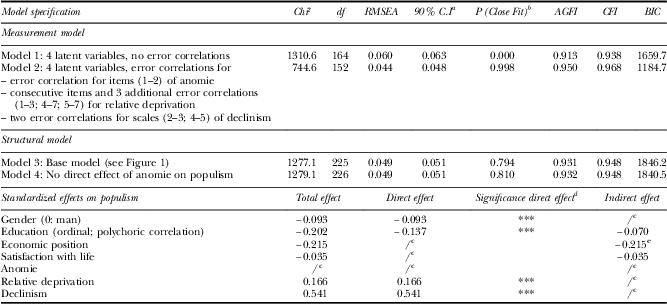
Structural equation modelling with latent variables is used to test the hypotheses (see Table 2). The analysis proceeded in two steps. The first was intended to verify whether the four core theoretical concepts (declinism, anomie, relative deprivation and populism) can be empirically sufficiently distinguished from each other.Footnote 4 A model in which the various indicators only loaded on the corresponding construct and neither cross-loadings nor relations between error terms were allowed, did not fit the data (Model 1). The restrictions imposed in that case are, of course, overly severe. Measurement theory indicates that correlated error terms between items adjacent in the questionnaire have to be allowed (Bratt Reference Bratt2002). When this was done for the relative deprivation scale, six more correlations between error terms of items from the same scale had to be allowed in order to obtain a fitting model that distinguishes anomie, relative deprivation, declinism and populism (Model 2). We use this measurement model as our baseline model to specify a model that incorporates our hypotheses (see Figure 1). We also included controls for age and gender. Age has no effect whatsoever and the variable was dropped from the analysis presented here. Gender has a modest but statistically significant direct effect (men are more prone to populism than women, β: −0.093).
Conceptual Path Diagram Structural Equation Model for Populism
Fit Statistics and Parameter Estimates Structural Equation Model for the Susceptibility for Populism in Flanders (18–80 years; N: 2,330)
Notes: aUpper limit 90% confidence interval RMSEA.
bProbability that RMSEA<0.050.
cEqualized to zero.
dSignificance levels: ***: P<0.001.
eβeconomic position – satisfaction of life: 0.251; βeconomic position – anomie: −0.278; βeconomic position – relative deprivation: −0.295; βeconomic position – declinism: −0.335.
Estimates of saturated models (not reproduced here) that assume that all the hypotheses hold indicated that the direct effects of economic position and satisfaction with personal life on populism were close to zero and insignificant. Therefore a structural model was developed that already incorporated the rejection of these hypotheses: no direct effect of economic position on populism (reject Hypothesis 1 and confirm Hypothesis 3), no effect of personal satisfaction on populism (reject Hypothesis 6), but an effect of the evaluation of how society is doing (declinism) (accept Hypothesis 4). The model further allows for direct effects of anomie (accept Hypothesis 7), relative deprivation (accept Hypothesis 4) and level of education (accept Hypothesis 2). That model (Model 3) has an acceptable fit. It can, however, be significantly improved by rejecting Hypothesis 7 and by allowing no direct effect of anomie on populism (Model 4).
The parameters of this model (Model 4), which explains no less than 49.5 per cent of the variance in populism, are presented in Table 2. They show that while there is no direct effect of economic position on populism, an indirect influence of the economic position (β: −0.22) is realized because a weak economic position or economic vulnerability makes it more likely that people will develop feelings of relative deprivation and adhere to a declinist view of the evolution of society. The indirect effect of economic position is realized not only via the development of feelings of relative deprivation, but also because it makes it more likely that people will hold a declinist view of how society is evolving.
The evaluation of how society is doing – declinism or the longing for the heartland – and feelings of relative deprivation both have very strong direct effects on populism. The effect of declinism is particularly strong (β: 0.54). People who believe that society is caught in a downward spiral apparently blame the political elite for that state of affairs and react with populism, opposing common sense to the alleged expertise of the elite. Also, people who feel relatively deprived and unfairly treated by society embrace the core propositions of populism. Hypotheses 4 and 5 are clearly confirmed.
Conclusion and Discussion
Populism appears primarily as a reaction to a societal diagnosis. It is in the first place a consequence of declinism. Many people feel that their society is in decline, unable to live up to the new challenges posed by growing internal diversity and globalization. They feel that the patterns of sociability, the welfare provisions, economic regulations and democratic, political capacity that supported the good life are being eroded and undermined; that the growing diversity creates a tension-laden and conflict-ridden society. The decline, perceived by many, is blamed on the establishment politicians or rather, because no convincing solution to those problems is offered by the political establishment, people turn to populism, to belief in the solutions offered by common sense, which are often at odds with the analysis of established parties, intellectuals and elites. These presumed solutions can be exploited by populist politicians. Populist politicians and parties are those that give the impression of listening to this hope and of embodying it in what can be perceived as a solution (such as combating Islam, decreasing diversity, strengthening our borders, getting the European Union off our backs, returning to respect, to the values and norms that used to sustain the fulfilling life and the good society). In this sense, paradoxically, populism appears as a politics of hope – some would undoubtedly say a desperate politics of hope – a politics that expresses the hope that where established parties and elites have failed, ordinary folk, common sense and the politicians who give them voice can find solutions, halt the decline, return to the heartland, to a society that in retrospect – a no doubt partly nostalgic and romanticized retrospect – seems good and just.
That observation dovetails with the theory of persistent republicanism. People do not make great political choices such as for or against the political establishment, for or against participation in the electoral process, for the thin ideology of populism or for one of the deep ideologies, on the basis of personal worries, satisfactions and dissatisfaction. This is underscored by the complete absence of a direct effect of the satisfaction with personal life on populism. People clearly make such choices on the basis of a vision of the good society and the way to get there or get back there (Elchardus Reference Elchardus2011).
The same conclusion emerges from the strong effect of relative deprivation. People do not opt for populism because they feel anomic or are economically vulnerable; they only opt for populism from the moment they deal with their vulnerability by adopting a discourse or a theory that presents society as unjust and interprets their personal situation as the consequence of that injustice. Contemporary populism, then, appears primarily as the political reaction of an egalitarian society that perceives itself as being in decline.
In order to use powerful multivariate techniques, we have imposed a causal ordering on our variables. Plausible reasons can be given for that ordering, but it seems to point towards the existence of mutual influence between declinism, relative deprivation and populism: that the sense of decline or feelings of relative deprivation can drive people to populist parties and populist politicians and that the discourse of those parties and politicians is likely to increase their sense of decline and of the injustice of their plight. The conclusion that can be drawn from the present article is that a better understanding of the development of feelings of relative deprivation, and especially of declinism, will constitute a major step towards explaining the rise of populism.
Appendix
Frequencies and Scale Properties of Items Tapping Anomie and Feelings of Relative Deprivation Among People Aged 18–80 Living in Flanders, 2006 (N: 2,330)

a The respondents could choose from five categories to evaluate the statements; for ease of presentation they were collapsed into three categories in the table.
b Estimated by the confirmatory factor analysis as presented in Table 2 (Model 2).
Evaluation of Society: Declinism, People Living in Flanders Aged 18–80 (N: 2,330)
a Principal axis factoring used. Missing values were imputed for respondents who had a valid answer for the majority of items.
b Estimated by the confirmatory factor model in Table 2 (Model 2).
c The original Dutch does not say ‘different ethnic groups’ but different ‘volkeren’, the connotation of which is better rendered by ‘ethnic groups’ than by ‘populations’ or ‘peoples’.
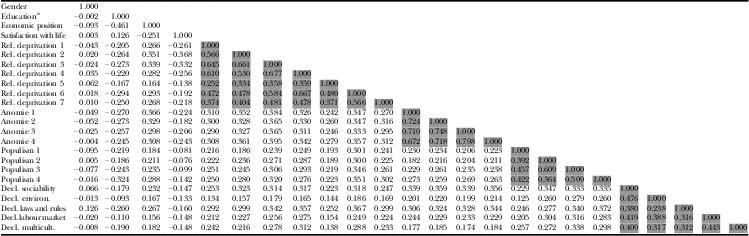
Pearson’s Correlations between All Variables Included in the Analysis
Note: aOrdinal variable with four categories: correlations with this variable are polychoric correlations.