




1. Introduction
Post-pandemic, a multifold increase in global food insecurity from 122 to over 700 million, undermines efforts to alleviate global hunger by 2030 to achieve Sustainable Development Goal (SDG) 2 (UNDP, 2020). Despite collective efforts, the global food insecurity prevalence in 2022 stagnated at 29.6%, (FAO et al., 2023). Whereas in the United States, household food insecurity in 2022 increased from 10.2 to 12.8%, affecting 170 million households, and severe food security rose from 3.8 to 5.1% (USDA, Reference USDA2024). Worst affected thus far are the impoverished households with single mothers, and the Black and Hispanic communities (USDA, Reference USDA2024). The implications – inadequate nutrition, ill-health, financial challenges, expenditure for medication over food, poor disease management – are profound (Berkowitz et al., Reference Berkowitz, Baggett, Wexler, Huskey and Wee2013; Laraia, Reference Laraia2013; Leung & Zhou, Reference Leung and Zhou2020).
A sustainable food system strives to ensure food and nutrition security while achieving economic, social, and environmental sustainability. Food banks directly complement a sustainable food system by recovering and redistributing food to address food security, simultaneously preventing food waste (H. Nguyen, Reference Nguyen2018). Food banks in the United States provide significant support to local food pantries partnering with federal nutrition programs, such as SNAP-Ed and WIC, and the United States Department of Agriculture (USDA), and community-based organizations (Federal Register, 2018). Since the inception of food banks, the concept of health has evolved to encompass existential well-being, the ability to cope with life’s challenges, and an environment with more chronic conditions (Bircher, Reference Bircher2005; Krahn et al., Reference Krahn, Robinson, Murray, Havercamp, Havercamp, Andridge, Arnold, Barnhill, Bodle, Boerner, Bonardi, Bourne, Brown, Buck, Burkett, Chapman, Cobranchi, Cole, Davies and Witwer2021). Alongside hunger relief, food banks thus have a myriad of roles in advancing SDGs, building resilient communities, addressing child hunger, enhancing nutrition, responding to crises, and meeting chronic health needs (FAO, 2023).
In the context of changing disease burden and food insecurity, SDG goals could be achievable through a resilient food system, capacitated for maximum food production, to address hunger and poverty among marginalized populations, improve health and nutrition, and ensure environmental sustainability. This bearing of multiple responsibilities exposes food banks to unique challenges. The rising demand for food assistance in the United States, paralleled by an upsurge in chronic conditions, necessitates a clear understanding of challenges and opportunities in US food banks (Laraia, Reference Laraia2013). The systematic scoping review aims to (i) identify and characterize the challenges in US food banks and (ii) ascertain the potential opportunities in the food banks to build a sustainable food system.
2. Methods
The research question that propelled the review is: What challenges do US food banks face related to systems, resources, participants, and their well-being, and what opportunities have been documented to develop a sustainable and resilient food system? We systematically performed a scoping review to map the key challenges underpinning the US food banks, following the guidelines by Arksey and O’Malley (2005), and the recommendations by Levac (Levac, Reference Levac, Colquhoun and O’Brien2010; Westphaln et al., Reference Westphaln, Regoeczi, Masotya, Vazquez-Westphaln, Lounsbury, McDavid, Lee, Johnson and Ronis2021). A preliminary search was conducted in PubMed, Cochrane database for systematic reviews, and JBI Evidence Synthesis to ensure no systematic scoping reviews are underway on this topic. Using the Joanna Briggs Institute (JBI) guide (Hadie, Reference Hadie2024), the PCC framework was used to select the P: Population: Food banks in the US, C: Concept: (i) Challenges related to operations, resources, emergencies, beneficiaries, health, and disease. (ii) Opportunities to address the challenges included technology, partnerships, and operations management, reducing food waste, and policy reforms. C: Context: To examine challenges that will affect sustainability and resilience, the review explored food assistance settings such as food banks, pantries, community-based, not-for-profit organizations, food rescue systems, and the conditions in which they operate within the US social, economic, and policy environments. Selected literature was reported per the Preferred Reporting Items for Systematic Reviews and Meta-analyses (PRISMA) guidelines for scoping systematic reviews.
2.1. Screening of articles
Eligibility criteria: The selection criteria included articles that were peer-reviewed and published in the English language that studied US food banks or food pantries (FP), different stakeholders, challenges pertaining to finance, structure, administration, distribution, or operations, and health initiatives, among adults in different settings. Quantitative, qualitative, and intervention studies that explored challenges at baseline were included. Studies from countries other than the United States, outside the defined time frame, and other food service settings were excluded.
2.2. Search strategy
After identifying the MeSH terms and keywords [Food banks” OR “Food pantries” OR “US” OR “Challenges”], a literature search was performed in (N = 5) electronic search engines/databases, ScienceDirect, Embase, Web of Science, PubMed, and Cochrane Library. Filters for time frames between 2013 and 2025 (12 years), published in the English language, were applied.
The search strategy was developed in consultation with the University Library, and three terms, namely problem, program, and location, relevant to the study objective were utilized for the search. The details of the search and its syntax are provided in Supplementary File 1.
2.3. Selection of relevant studies
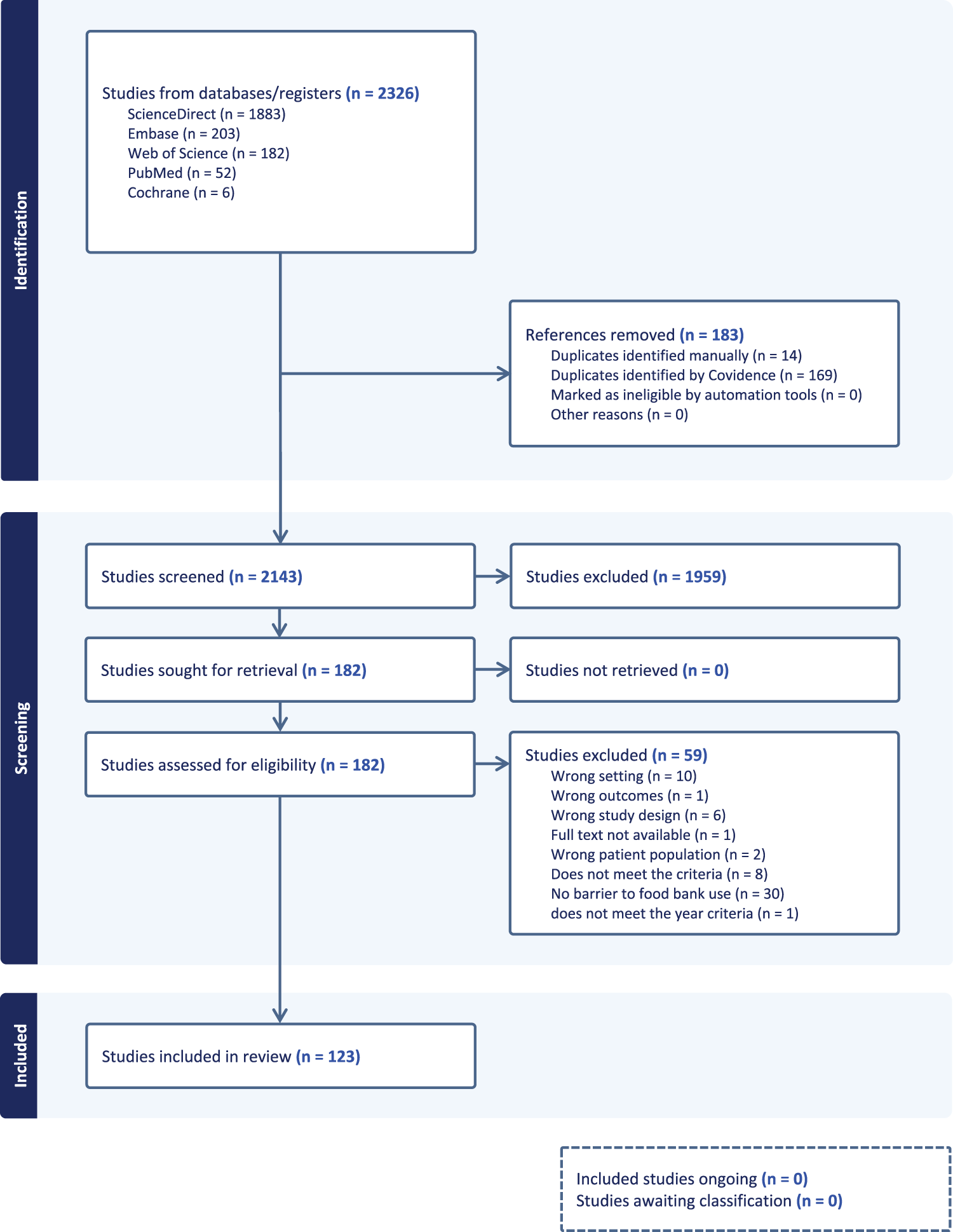
All search results were exported to Covidence Review Manager for automated de-duplication. Through the databases, 2326 articles were imported to Covidence review manager for screening. Post-deduplication of 183 articles (169 by Covidence and 14 by manual method), 2143 articles were screened. Two researchers (N.O., V.A.) under the guidance of A.J. and D.D. independently screened the titles and abstracts against the eligibility criteria, and full texts were downloaded.
Reference lists of the selected articles were searched for additional relevant articles. Articles with conflicts were resolved by A.J. and D.D. The results of the search were discussed within the team, A.J., D.D., and disagreements in the article selection were resolved through discussion. The screening yielded 123 articles that were included for the review.
The PRISMA guidelines for the selection of studies are given in Figure 1:
Preferred Reporting Items for Systematic Reviews (PRISMA) flow diagram of literature search and study selection process.

Quality assessment of selected studies: The quality of the selected studies was scored using a validated Quality Assessment Tool for Studies with Diverse Designs (QATSDD), with 16 characteristics. Each characteristic was given a score between 0 and 3, where 0 represented ‘not at all’, 1 – slightly, 2 – moderately, and 3 – complete. In systematic reviews, the QATSDD tool is useful for critically appraising studies with varying methodologies and qualitative or quantitative study designs (Fenton et al., Reference Fenton, Lauckner and Gilbert2015).
3. Results
3.1. Description of selected studies
States, cities, and towns represented in the review: The selected studies represented diverse US states, including Arkansas, Texas, Tennessee, Connecticut, Florida, Massachusetts, Indiana, Minnesota, Mississippi, West Virginia, New York, and Virginia. Some of the cities represented were Atlanta, Houston, Los Angeles, New York City, Silicon Valley, and smaller mid-sized communities such as Hartford, Hialeah in Florida, Holyoke in Massachusetts, Morgantown, and the South Bronx. The wide range of selection covered varied economic backgrounds, with rural–urban variances, levels of employment, that impact access and affordability to foods, and safety net coverages.
Food bank models: The food bank models represented varied supply chain structures, with sources ranging from donations, farms, retail recovery, and USDA-funded programs. The services were offered through community and health care partnerships. The program implementation policy varied in different states. The distribution of food pantry services is given in Figure 2.
Distribution of the types of food pantries in the selected literature (N = 123).

Distribution of study designs: In all, N = 123 studies were selected for the review. The distribution of selected studies under different domains is presented in the Sankey plot (Figure 3). Of the 123 selected articles, almost an equal number covered operations (n = 26), and challenges pertaining to nutrition and health (n = 25), followed by beneficiaries (n = 20), strategies to improve operations (n = 16), emergencies (n = 15), resources (n = 14), and chronic diseases (n = 7). Among the study designs, qualitative studies dominated the search results (N = 31), followed by quantitative (N = 28), program modelling (N = 21), evaluation (N = 19), mixed methods (N = 14), policy or conceptual framework (N = 7), and environmental/geographic and mapping studies (N = 3). The distribution of study designs is presented in Figure 4.
Sankey plot shows the distribution of studies per the domains.

Distribution of studies by their study designs (N = 123).

Quality assessment: The QATSDD scores gave the following results: The study designs, the items used in the quality assessment, and the scores of the selected articles are provided in Supplementary File 2. Quality assessment identified a lack of a theoretical framework in most of the studies. A few qualitative studies had small sample sizes <10 without a mention of the saturation of the information received through interviews, and these were scored lower in the assessment. In addition, most of the studies used self-designed questionnaires that were pretested but not validated. Online surveys and telephone interviews were scored as zero for participant engagement. Criteria for scoring that did not match the study design were scored as ‘not applicable’. For instance, reviews, opinions, or position papers were not scored for sample size or their representativeness. After applying the criteria, 62% of the selected studies scored between 70 and 100, reflecting good study quality. The quality of the articles was determined to describe the studies and was not used in the selection process.
3.2. Challenges in US food banks identified from the selected studies
The systematic search of the literature identified and categorized the challenges in the US food banks under the following themes: (a) Beneficiaries (b) Resources, (c) Operations, (d) Supply chain, (e) Challenges during emergencies, (f) Challenges associated with the implementation of nutrition and health interventions, and (g) Challenges associated with chronic disease management (Figure 3). The results summarize the opportunities under each challenge for further research and action.
(a) Challenges faced by beneficiaries and stakeholders: Of the selected articles, N = 20 presented challenges faced by participants and stakeholders. Brady and coworkers (Brady et al., Reference Brady, Askelson, Thompson, Kersten and Hopkins2022) discussed the challenges faced by beneficiaries in general, while others addressed specific groups such as older adults, refugees, ethnic minorities, people with disabilities, and universities. Each population group studied had certain unique challenges, while a few others overlapped.
Aging population: Participants above 60 years of age have specific nutritional needs and access to healthy foods. Limited resources and capacity in rural communities posed distribution challenges for the service providers (Villa et al., Reference Villa, Murugesan, Phillips, Drake and Smith2022). A study among 9477 participants in Maricopa County, Arizona, to assessed the utilization of mobile food pantries. Results indicated a higher odd of the aging population benefiting from the services. Other large surveys focused on financial well-being as a determinant of food insecurity, ill health and increased nutrition requirements, no specific analyses among the elderly were performed (Gundersen et al., Reference Gundersen, Brooks and Hernandez2025; Waring et al., Reference Waring, Caspi, Jeri-Wahrhaftig, Horkachuck and Kapoor2023; Wright et al., Reference Wright, Tooze, Bailey, Liu, Rivera, McCormack, Stluka, Franzen-Castle, Henne, Mehrle, Remley and Eicher-Miller2020).
Addressing inequality and stigma: The economic value of the services provided through fd assistance to over 20 billion annually draws criticism for not addressing the fundamental issues of poverty and inequality. The population benefiting from these services suffers from inadequate finances, to meet their housing, food, and health needs beyond the scope of food bank services. The stark inequality in access owing to high poverty, racial disparities, and financial inequalities, and geographic disparities further leave the marginalized communities underserved (Fitzpatrick et al., Reference Fitzpatrick, Willis, Obermaier and Wahls2024; Hathaway, Reference Hathaway2025). Work by Sanchez and coworkers highlighted the suboptimal nutritional environment in rural settings that lacked initiatives for healthy eating behaviors through effective nudges. In these settings, the supply versus demand had been a major concern, combined with issues of reduced personnel and infrastructure (Sánchez et al., Reference Sánchez, Díaz Rios and Payán2024a). This calls for integrated services and partnerships to efficiently meet the needs of the beneficiaries, recognizing their dignity. The systems that were created to address hunger unintentionally create economic hierarchy, fostering dependency. Dignity concerns manifest when stringent eligibility criteria disqualify the poor and deny their right to food. SNAP ineligibility in farmers’ markets in East Tennessee and exposure to processed foods is a documented example (Russomanno & Jabson, Reference Russomanno and Jabson2016). Allowing clients to choose their foods improved the shopping experience, increased autonomy, and restored dignity (Vardhan Sharma & Leonard, Reference Vardhan Sharma and Leonard2024). People who are disabled, refugees, and LGBT communities suffer physical, cultural, and language barriers and a high risk of discrimination (Jones et al., Reference Jones, Christaldi and Cuy Castellanos2022).
Co-dependence on services: One of the major concerns is the weaning away of beneficiaries even after improved financial status. With respect to participants’ challenges, navigating multiple programs was complicated, mainly for mothers of young children. Yet, co-dependence improved networking with peers, cultural organizations (Enriquez et al., Reference Enriquez, Pradhananga and Niroula2025). and filled supply chain gaps in rural settings (Khadka et al., Reference Khadka, Adjeroh, Nduaguba and Kelly2024), increased access and utilisation of other allied services such as housing, counseling, and financial aid (Jefferson et al., Reference Jefferson, Cafer and Mann2024; Pradhananga et al., Reference Pradhananga, Niroula, Enriquez, McKinley and Houghtaling2025; Treloar et al., Reference Treloar, Taylor and Bell2024a, Reference Treloar, Taylor and Bell2024b).
Educational institutions: Ensuring campus food insecurity necessitates collaboration between educators, and health professionals. However, much needs to be improved in this area, from the estimation of prevailing conditions of food and nutrition security to factors associated with poor utilization. Existing measures do not capture the social, emotional, and functional dimensions (Sklar et al., Reference Sklar, Chodur, Kemp, Fetter and Scherr2025; Vaterlaus et al., Reference Vaterlaus, Cottle, Vaterlaus and Gibbons2018). Students with low-income, first-generation minority students, international students, students with families, who do not have transportation, are more vulnerable (Tran et al., Reference Tran, Kohli, Sreenivasan, Chom, Dhaani and Rosete2025). The food environment in institutions the challenges vary per the management and administration. Inflow of funds has a major bearing on sustainability (Hagedorn-Hatfield et al., Reference Hagedorn-Hatfield, Richards, Qamar, Hood, Landry, Savoie-Roskos, Vogelzang, Machado, OoNorasak, Cuite, Heying, Patton-López and Snelling2022) Low nutrition literacy among students, limited finances, and stigma, prevented optimal utilization of services (Alston et al., Reference Alston, Powell, O’Briant, Thompson, Dowdy, Mendenhall and Jomaa2023; El Zein et al., Reference El Zein, Mathews, House and Shelnutt2018; Zein et al., Reference Zein, Vilaro, Shelnutt, Walsh-Childers and Mathews2022).
The above synthesis confirms that the needs of different demographics are unique. Some of the strategies tested include the needs assessment for better provision of services. Assessing food deserts provides an opportunity to ensure food access. Evidence suggests a participant-centric approach with the incorporation of participant preference to practice inclusivity while planning and delivering programs, well supported by policies, would be a step toward addressing beneficiaries’ challenges. Improved communication, addressing specific health needs, flexible hours of operation to meet student needs, and engaging students in the program are sustainable strategies for enhanced services.
(b) Resource challenges: Human resources, finances, time, and infrastructure have been widely studied under food bank resources. Limitations in resources affect the efficient delivery of services. The nature of funding in makes resource constraints inevitable.
i. Fiscal limitations: Financial challenges arise due to the reliance of food banks on donations (Bella et al., Reference Bella, Borowski and Stathopoulos2024; Mohan et al., Reference Mohan, Gopalakrishnan and Mizzi2013). Per the criteria of federal assistance, a significant proportion of the population is eligible for food assistance. Furthermore, emergencies such as the pandemic witnessed an increase in food poverty due to income loss, and those previously dependent on school meals suffered as schools were shut (Blessley & Mudambi, Reference Blessley and Mudambi2022a; Kaplan et al., Reference Kaplan, Kirk, Lich, Palde, Van Allen, Nantz, Leuthart, Robeson, Davis, Blekking, Healey, Czebotar, Babb and Knudsen2020). Considering the scale of the program, limited budgets and high costs of operations are inevitable in food banks, which increases the costs for maintaining quality of infrastructure for food collection, storage, maintaining food safety standards, and distribution (Björklund et al., Reference Björklund, Gillström and Kovács2025; Nye et al., Reference Nye, Totoni and Bischoff2025). Besides, food banks were started as supply-driven programs to redistribute excess food. When the demand for food assistance increased, changes in federal assistance brought an array of private players. The benefit of this partnership has been mutual. While this increased the opportunity to maintain sufficient resources for the food banks, and combined planning of operations, the private agencies benefited from tax waivers. Thus, partnerships could lead to improved utilization, resolve overlapping services, and reduce food wastage. However, partnerships that are ill-fitting or poorly managed, could make the mission delivery complicated (Lowrey & Boyer, Reference Lowrey and Boyer2024; Michelini et al., Reference Michelini, Principato and Iasevoli2018; Ruffini et al., Reference Ruffini, Öztürk and Pekgün2025).
ii. Human resource limitations: Volunteer dependent service affects a program delivery. Unpaid services are fragile and fluctuate service delivery (Bella et al., Reference Bella, Borowski and Stathopoulos2024). During the pandemic, serious human resource deficiencies were experienced in food banks that affected workflow, distribution delays, and quality of services (Azhar et al., Reference Azhar, Ross, Keller, Weed and Acevedo2024; Castro et al., Reference Castro, White, Ishdorj, Thompson and Dave2021). Work done by Butler and coworkers tested specialty box programs, and emphasized that human resources are key for sustainability and scalability of the program (Butler et al., Reference Butler, Rollinson, Glover and Carmenia2023). Efforts to meet specialised nutrition requirements require skilled personnel (Hollis-Hansen et al., Reference Hollis-Hansen, Pruitt, Turcios, Haskins, Valles, Hoang, Nguyen and Cooksey-Stowers2024). Partnerships and community-based participatory approaches that addressed human resource limitations were found effective in addressing resource gaps and improving social service utilization in South Bronx (Azhar et al., Reference Azhar, Ross, Keller, Weed and Acevedo2024).
iii. Infrastructure challenges: Food banks aim to distribute food equitably but face operational challenges in maintaining geographic equity. Spatiotemporal inequities are evident in rural communities where demand and supply imbalances persist (McCarthy et al., Reference McCarthy, Mcgalliard and Niles2023). Regional variation in fresh produce, long transportation times, and lack of refrigerated storage are infrastructural challenges that impede equitable distribution (Bacon & Baker, Reference Bacon and Baker2017; Bayly et al., Reference Bayly, Pustz, Stopka, Metzger and Waters2025; Bella et al., Reference Bella, Borowski and Stathopoulos2024; Wetherill et al., Reference Wetherill, White, Rivera and Seligman2019). On the contrary, despite resources being well managed, poor perception of participants on the quality of services provided, and the reliability of volunteer-driven services that affect equitable access, reflects in the utilization of services. Inefficient use of resources could be an outcome of providing culturally inappropriate foods, which in turn may lead to food wastage (Robinson et al., Reference Robinson, Baker, Harwood and Diekmann2020). For example, if the food provided is not culturally appropriate, it may not be selected from the pantries. Additionally, poor time management could result in wastage and loss of perishable food, which leaves a heavy carbon footprint. Thus, supply chain optimization is key to addressing disparities and improving utilization of resources (Orgut et al., Reference Orgut, Brock, Davis, Ivy, Jiang, Morgan, Uzsoy, Hale and Middleton2016; Orgut & Lodree, Reference Orgut and Lodree2023).
iv. Management solutions to address resource challenges: Few research articles offer directions to address resource challenges. Use of technology, training staff for specialized distribution, and tailoring services for client preferences are feasible solutions. Ataseven suggests streghtening partnerships to build a resilient supply chain that supports internal integration, which complements external relationships with involvement of community organizations. This will attract financial support for the sustainability of services (Ataseven et al., Reference Ataseven, Nair and Ferguson2020). Effective communications between partners, workforce and adaptive management are crucial for improved operations (Azevedo et al., Reference Azevedo, Haupt and Markoski2022).
Policies to regulate the quality of food donations received, including restrictions on the type of food or sources of donations, provides an opportunity to improve the quality of food donations (Hudak et al., Reference Hudak, Friedman, Johnson and Benjamin-Neelon2020). However, programs fear decline of resources with strict policies. The uncertainty of donations could be overcome by the prediction model proposed by Paul and coworkers, by classifying, clustering, and forecasting donations (Davis et al., Reference Davis, Jiang, Morgan, Nuamah and Terry2016).
(c) Challenges during the COVID-19 pandemic: Two main challenges emerged, (i) rising food insecurity and (ii) vulnerability of the food system.
Rising food insecurity: The pandemic witnessed an upsurge in the number of food insecure households that turned food insecure. Almost one-third of the population (29%) experienced severe food insecurity. The quality of diets per recommendation was met by < 30% of the population. Food shortage, long waiting hours, restricted food choices, quality of received food, and lack of knowledge of food preparation were some concerns experienced during the pandemic (Blessley & Mudambi, Reference Blessley and Mudambi2022b; Jones et al., Reference Jones, Christaldi and Cuy Castellanos2022). Families with younger children, college students, low-income communities, communities of color, those with special dietary needs, children dependent on school meals, and families that lost jobs, were worst affected due to the restrictions imposed (Alston et al., Reference Alston, Powell, O’Briant, Thompson, Dowdy, Mendenhall and Jomaa2023; Tran et al., Reference Tran, Kohli, Sreenivasan, Chom, Dhaani and Rosete2025; Treloar et al., Reference Treloar, Taylor and Bell2024b, Reference Treloar, Taylor and Bell2024a). The challenge of the food bank is to meet the food and nutrient needs of the population and rise to the occasion during emergencies (Orgut et al., Reference Orgut, Brock, Davis, Ivy, Jiang, Morgan, Uzsoy, Hale and Middleton2016). The emergency food channels saw an increase in food supply, from food distributors and retailers contracted by the USDA. The Farmers to Families Food Box program distributed up to USD 4 billion worth of agricultural products to food banks and pantries, ensuring that individuals and families had access to food, reflecting the positive outcomes of progressive partnerships (Blackmon et al., Reference Blackmon, Chan, Carbral, Chintapally, Dhara, Felix, Jagdish, Konakalla, Labana, McIlvain, Stone, Tang, Torres and Wu2021).
Vulnerability of the food system: The COVID-19 pandemic like other emergencies exposed systemic vulnerabilities and revealed opportunities to strengthen food access. Three major issues with supply chain were documented: (a) Reaching the vulnerable was a regional challenge as the Emergency Food Transfers (EFTs) were significantly lower in neighborhoods with poor housing and transportation (Chakraborty et al., Reference Chakraborty, Aun and Schober2023; Hasnain et al., Reference Hasnain, Walton, Odubela, McConnell, Davis, Ivy, Jiang, Coan, Islam and Mpere2023). (b) Supply chain issues surfaced, due to fewer donations and exhaustion of supplies due to panic buying. Poor coordination between pick-up and delivery, lack of storage space, inability to maintain low temperatures in the delivery trucks, and restrictions on food redistribution contributed to food waste (Immel et al., Reference Immel, Sipos, Khan and Errett2021). (c) Quality of foods: There was no control over receiving foods that had crossed expiration dates and food banks had less freedom to voice their needs for fear of losing donors. Disparity between clients’ needs and donations received, and lack of sufficient storage are some of the additional constraints (Waring et al., Reference Waring, Caspi, Jeri-Wahrhaftig, Horkachuck and Kapoor2023). Staffing concerns were related to the need for well-trained staff, lack of cultural representation, limited food supply, and more time to screen the received goods (Sánchez et al., Reference Sánchez, Díaz Rios and Payán2024b). With service providers were at increased risk of infection during the pandemic due to exposure (Parks et al., Reference Parks, Nugent, Fleischhacker and Yaroch2020).
Despite challenges, few opportunities provided scope for improvement. The lack of appropriate measurements for efficiency during emergencies, led to the development of a tool by Clay and co-workers (Clay et al., Reference Clay, Koyratty, Rogus, Colón-Ramos, Hossan, Josephson, Neff, Zack, Bliss and Niles2023), that measured the multidimensional need during disasters, and its content validity was proven to be significantly high. Needs assessments in the future would benefit from this tool to streamline interventions during emergencies The new policies implemented during the pandemic should be incremental, at a larger scale, and not limited to emergencies (Bryant & Follett, Reference Bryant and Follett2022). Some successful strategies included new safety measures, improved food distribution process, volunteerism and staffing, and remote delivery of nutrition education, combined with a hybrid model for other services, improved efficiency (Azevedo et al., Reference Azevedo, Haupt and Markoski2022; Butler et al., Reference Butler, Rollinson, Glover and Carmenia2023). Community-based organizations and local producers collaborating with policymakers could enhance resources and advance circular food practices to prevent food wastage, for improved human and environmental health (Apanovich et al., Reference Apanovich, Okyere, Mensah and Mensah2025).
(d) Operational challenges: Operational challenges in food banks have been further categorized under Equity, Effectiveness, and Efficiency:
Food banks’ operations differ from humanitarian aid. The optimal functioning of the food banks is often measured using the three Es: equity, efficiency, and effectiveness. These indicators are influenced by resources and their allocation.
Equity: Equity here means that SNAP and WIC participants should have equitable access to healthy foods (Russomanno & Jabson Tree, Reference Russomanno and Jabson Tree2020). The fundamental nature of food banks’ dependency on donations affects equitable distribution. Budgetary constraints that affect storage and distribution, in turn affect equitable distribution, specially when people above poverty line also benefit from these programs (Brenton et al., Reference Brenton, Tindall, Glanz and Virudachalam2025; Khadka et al., Reference Khadka, Adjeroh, Nduaguba and Kelly2024). The uncertainty in the amount of food received and distributed impacts equitable distribution, turning away clients (Sengul Orgut et al., Reference Sengul Orgut, Ivy, Uzsoy and Hale2018; Terhaar et al., Reference Terhaar, Barnidge, Somheil and Bednarek2025). One of the major challenges is that the evaluation of performance assessment is often biased towards supply and operations, thereby restricting research or innovation to identify and address gaps related to equitable distribution (Hathaway, Reference Hathaway2025; Scherer et al., Reference Scherer, Cárdenas, Russo, Ahn, Chan, Lanza, Mei, Mehmood and Yi2025). Poverty-based approaches were easier to measure hunger and identify food deserts. Integration with technology could identify areas with increased need and poor access to improve the equity and efficiency of services in rural and underserved settings (Alkaabneh et al., Reference Alkaabneh, Shehadeh and Diabat2023; Orgut et al., Reference Orgut, Brock, Davis, Ivy, Jiang, Morgan, Uzsoy, Hale and Middleton2016; Orgut & Lodree, Reference Orgut and Lodree2023). Another strategy that showed a positive outcome were the client choice pantries, which encouraged dignity in food choice, where participants could select based on opportunities and time available for food preparation (Vardhan Sharma & Leonard, Reference Vardhan Sharma and Leonard2024).
Effectiveness: Effectiveness is linked to organizational capacity. Food waste is equated with poor effectiveness and stale food distribution reflects the poor infrastructure. Studies show nearly one-half of the pantries discard unsafe food. Masked by distribution as an primary objective, other attributes such as the quality of food, client’s safety, and health received less priority. To address this Levi and coworkers suggest nutrition standards as bench mark for effectiveness (Levi et al., Reference Levi, Schwartz, Campbell, Martin and Seligman2022). To improve efficiency, improving infrastructure for storage, not accepting expired food from donors, and providing a favorable nutrition environment, with nutrition labelling and awareness, will enable the distribution of healthy and safe food consistently (Long et al., Reference Long, Narcisse, Rowland, Faitak, Caspi, Gittelsohn and McElfish2020; Roth et al., Reference Roth, Feldman, Schwartz and Prelip2024).
Efficiency: Efficiency is not restricted to coverage. Food banks provide an average of 2 million Kg of food to more than 40,000 clients each month. Food assistance programs have an average of 8 workers and 3081 volunteers. In addition to food, these organizations provide other services such as clothing, childcare, and clinical services. Measurement of efficiency should cover efficient management of the uncertainty of donations through estimating supermarket surpluses, addressing poor nutrition quality through improved quality assessment and management techniques (Akkerman et al., Reference Akkerman, Buisman, Cruijssen, de Leeuw and Haijema2023; Davis et al., Reference Davis, Jiang, Morgan, Nuamah and Terry2016). Innovations in supply chain, such as forecasting donations, equity in distribution, food upcycling models that prevent food waste, and ensure robust optimization, are other tested strategies (Kizildag et al., Reference Kizildag, Okumus and Hutchinson2015; Okumus et al., Reference Okumus, Taheri, Giritlioglu and Gannon2020; Shaheen et al., Reference Shaheen, Azadegan and Davis2023; Sharmile et al., Reference Sharmile, Nuamah, Davis, Samanlioglu, Jiang and Crain2025; Sucharitha & Lee, Reference Sucharitha and Lee2019; Zou et al., Reference Zou, Sharma, Pekgün and Ahire2025).
Operational approaches: Opportunities for improving effectiveness and efficiency have been tested across many studies. A client-centric approach would benefit than an operations-centric approach to meet the needs of diverse populations, keeping their cultural diversity, language barriers, and health needs as a priority (Gundersen et al., Reference Gundersen, Brooks and Hernandez2025; Hamilton et al., Reference Hamilton, Morrow, Davis, Morgan, Ivy, Jiang, Chi and Hilliard2025; Hazzard et al., Reference Hazzard, Kunin-Batson, Trofholz, Noser, de Brito, Pitera and Berge2024). For instance, the demand for specific types of food, such as meat, dairy, and vegetables, can be met with non-food donations to meet their health needs and prevent food waste (Gharehyakheh & Sadeghiamirshahidi, Reference Gharehyakheh and Sadeghiamirshahidi2018). Furthermore, process innovations help to address resource scarcity, product innovations address supply gaps, while marketing innovations deal with limited resources. Among the optimization models, the assignment and distribution model was tested to minimize waste and proved successful. Leveraging tools for tracking, coordinating, forecasting, modelling, and the use of dynamic programming strengthened decision-making to balance equity, efficiency, and effectiveness (Alkaabneh et al., Reference Alkaabneh, Diabat and Gao2021; Elmes et al., Reference Elmes, Mendoza-Abarca and Hersh2016).Transportation strategies such as rescheduling, multicriteria routing, and weekly scheduling prevented spoilage and ensured maximum coverage (Sengul Orgut et al., Reference Sengul Orgut, Ivy, Uzsoy and Hale2018). These operational strategies apply innovation for optimization of services (Figure 5).
Operational strategies for a client centric and nutrition focused operations model.

(e) Challenges associated with the implementation of nutrition and health interventions: Ensuring the health and nutrition of those who benefit from food banks is an ethical obligation.
i. Addressing health disparities: The participants in food assistance programs are typically the working poor or those who suffer from food poverty (Anderson, Reference Anderson2013; Chiu et al., Reference Chiu, Brooks and An2016). Gunderson’s work recognized that the client’s choice of cheap foods was the result of prioritizing essential expenses such as housing and health care, a pattern frequently observed among ethnic minorities (Gundersen et al., Reference Gundersen, Brooks and Hernandez2025).
Healthy versus processed food: Lack of written nutrition policies allows easy inflow of unhealthy foods in pantries (Campbell et al., Reference Campbell, Ross and Webb2013; Handforth et al., Reference Handforth, Hennink and Schwartz2013; Houghtaling et al., Reference Houghtaling, Short, Long, Steeves, Isack, Flournoy, Cawrse, August, Summerfelt and Calloway2025). Similarly, not all pantries have nutritional experts on the panel, which impedes implementation quality (Akers Hanson & Campbell, Reference Akers Hanson and Campbell2023; Byker Shanks, Reference Byker Shanks2017; Campbell et al., Reference Campbell, Ross and Webb2013; Caspi et al., Reference Caspi, Davey, Barsness, Wolfson, Peterson and Pratt2021). In practice, the value of food distributed is equated to efficiency rather than the quality of food, with added confusion due to proliferating standards and guidelines (Levi et al., Reference Levi, Schwartz, Campbell, Martin and Seligman2022). For instance, the incoming foods were tracked using technology and categorized into 30 groups, but not as per nutritional quality, leading to incongruence between guidelines and practice (Nguyen et al., Reference Nguyen, Kownacki, Skaradzinski, Streitmatter, Acevedo, Ericson, Hager and McCaffrey2023). Even in settings that demonstrated positive observations in fruits and vegetable distribution, finer observations identified onions and potatoes as the major foods under the vegetable group. Also, most of the government supplies of fruits were in canned form. As bread is categorized under grains, the inventory recorded it so (Barone et al., Reference Barone, Krummel and Lee2020; Ross et al., Reference Ross, Webb, Campbell and Crawford2013). Lack of knowledge of healthy foods, among beneficiaries, especially nutritional needs for specific diseases, and cultural and family practices, were identified as barriers to making healthy choices from the distributed food (Oliver et al., Reference Oliver, McKeever, Shenkman and Diewald2020; Wetherill et al., Reference Wetherill, White, Rivera and Seligman2019). Lack of quality and safety concerns of the distributed foods affect utilization of services (Cordeiro et al., Reference Cordeiro, Sibeko and Nelson-Peterman2018; Mousa & Freeland-Graves, Reference Mousa and Freeland-Graves2017; Nye et al., Reference Nye, Totoni and Bischoff2025). Furthermore, the food security of the household determines the nutrient intake. Studies suggest that an increase in the number of visits to the food pantry was significantly associated with the diet quality (Handforth et al., Reference Handforth, Hennink and Schwartz2013; Liu et al., Reference Liu, Tooze, Zhang, Leidy, Bailey, Wright, Ma, Stluka, Remley, McCormack, Franzen-Castle, Henne, Mehrle and Eicher-Miller2020, Reference Liu, Zhang, Remley and Eicher-Miller2019; Martinez et al., Reference Martinez, Chodur, Esaryk, Kaladijian, Ritchie and Grandner2022).
Strategies to improve nutrition and health interventions: New strategies for the evaluation of the quality of foods have been proposed and tested. Nutrient-rich food index or healthy eating research guidelines, assessed through a ‘nutritional score’ or employing the Reach, Effectiveness, Adoption, Implementation, Maintenance (RE-AIM) framework for Supporting Wellness at Pantries (SWAP) are a few tested strategies (Bryant & Follett, Reference Bryant and Follett2022; Eicher-Miller et al., Reference Eicher-Miller, Wright, Tooze, Craig, Liu, Bailey, McCormack, Stluka, Franzen-Castle, Henne, Mehrle and Remley2022; Gombi-Vaca & Schwartz, Reference Gombi-Vaca and Schwartz2023; Helmick et al., Reference Helmick, Yaroch, Parks, Estabrooks and Hill2019; Morales et al., Reference Morales, Vicente, LaMonaca, Rios, Cunningham, Higginbottom, Mathios, Werlin, Cramer, Santilli and O’Connor Duffany2023; Seidel et al., Reference Seidel, Laquatra, Woods and Sharrard2015). Measures to strengthen the community’s awareness included improved local food environments through food demonstrations, choice models, signage, access to nutritionists, and accommodating the special needs of those suffering from chronic diseases, and the establishment of standards for nutritious food distribution (Bush-Kaufman et al., Reference Bush-Kaufman, Barale, Walsh and Sero2019; Hollis-Hansen et al., Reference Hollis-Hansen, Pruitt, Turcios, Haskins, Valles, Hoang, Nguyen and Cooksey-Stowers2024; Jones et al., Reference Jones, Christaldi and Cuy Castellanos2022; Koh et al., Reference Koh, Bharel and Henderson2016; Levi et al., Reference Levi, Schwartz, Campbell, Martin and Seligman2022; Wright et al., Reference Wright, Tooze, Bailey, Liu, Rivera, McCormack, Stluka, Franzen-Castle, Henne, Mehrle, Remley and Eicher-Miller2020). Network design and food upcycling model offer environmentally safe and nutritional solutions to address health and nutritional needs (Ghahremani-Nahr et al., Reference Ghahremani-Nahr, Ghaderi and Kian2023, Reference Ghahremani-Nahr, Kian and Ghaderi2025). With the increasing health needs of the clients, strengthening partnerships between healthcare systems and community-based charitable food systems, and redefining state policies provide direction for future action (Hudak et al., Reference Hudak, Friedman, Johnson and Benjamin-Neelon2022; Long et al., Reference Long, Narcisse, Rowland, Faitak, Caspi, Gittelsohn and McElfish2020). Practical implications for health-centric pantry operations are provided in Supplementary File 3.
(f) Challenges associated with food assistance programs and chronic disease management: The association between food insecurity, diet quality, and obesity as an outcome of poor diet quality of the distributed foods is well documented (Almohamad et al., Reference Almohamad, Dave, Calloway, Li and Sharma2024; Kaiser & Cafer, Reference Kaiser and Cafer2018; Robaina & Martin, Reference Robaina and Martin2013; Stowers et al., Reference Stowers, Marfo, Gurganus, Gans, Kumanyika and Schwartz2020). Foods for restrictive diets were not often available to those with chronic conditions. SNAP participants need improved access to specific foods to manage chronic diseases. Examples of positive changes have been documented with the distribution of sodium-restricted foods (Quinn et al., Reference Quinn, Ortiz, Titzer, Houston-Shimizu and Jones-Smith2021; Vaterlaus et al., Reference Vaterlaus, Cottle, Vaterlaus and Gibbons2018). The underlying problems are related to the non-profit nature of food banks and their reliance on donations. Thus, education of donors about the needs of beneficiaries would be a viable option for receiving need-based foods. This challenge could be specifically overcome by including personnel trained in nutrition to guide the service providers. Referral food pantries started in urban regions could be extended to rural settings where the need to manage chronic diseases has emerged. Studies have highlighted the desires of people with diabetes to have fruits, vegetables, and protein-rich foods, and offering healthy choices showed improved clinical outcomes (Ippolito et al., Reference Ippolito, Lyles, Prendergast, Marshall, Waxman and Seligman2017; Seligman et al., Reference Seligman, Levi, Ridberg, Smith, Hills and Waxman2022). Another gap is the lack of food preparation skills and misconceptions about healthy foods that emphasize the need for nutrition education (Short et al., Reference Short, Sharma, Thompson, Taren, Gonzalez and Hingle2022). To curb the inflow of unhealthy food from donors, the need for a strong federal emergency food policy and programming is recognized, tailored for state, client, and setting-specific needs (Stowers et al., Reference Stowers, Marfo, Gurganus, Gans, Kumanyika and Schwartz2020). Inviting funds for food banks and allowing food bank-led purchasing are strategies that could meet the disease-specific needs of beneficiaries.
4. Discussion
Divided into six sections, this review outlines the challenges faced by food banks in the United States: categorized under operational limitations, resource constraints, and challenges related to beneficiaries and stakeholders, emergencies, and adapting to the emerging landscape of chronic diseases. Existing literature revealed limited work in the areas of emerging chronic diseases, despite a wealth of studies on nutrition and health. Opportunities include modeling to improve the efficiency of services, framing policies for equitable distribution, and strategies to serve the new food-insecure groups during emergencies. Critical inefficiencies emerged that will require structural and operational changes to efficiently address the nutritional and health needs.
The increase in the number of beneficiaries raises relevant ethical questions about fostering poverty (Parr et al., Reference Parr, Hawkins and Dayson2021). Furthermore, there is a lack of definition for stigma associated with food poverty, racial discrimination, and its associated consequences (Brennan-Tovey et al., Reference Brennan-Tovey, Board and Fulton2023; Earnshaw & Karpyn, Reference Earnshaw and Karpyn2020; Marriott et al., Reference Marriott, Fiechtner, Birk, Taitelbaum, Odoms-Young, Wilson, Clay and Zack2022). While alleviating hunger, it is critical to address the structural drivers of poverty. The complexity of hunger, poverty, and chronic disease could be addressed by increasing awareness about the right dietary choices. Population sub-groups, such as older adults and people with disabilities, have specific nutritional needs (Brady et al., Reference Brady, Askelson, Thompson, Kersten and Hopkins2022; Hosseini, Reference Hosseini2017; Stepman et al., Reference Stepman, Uyttendaele, De Boeck and Jacxsens2018). Integrating nutrition education to empower participants and caregivers unfolds as the key community intervention to foster healthy eating.
5. Policy framework for foodbank operations
Despite the challenges, the food banks serve as excellent platforms to lay the foundation for a sustainable food system. Policy intervention, integrated with defined nutritional and health guidelines, improved resources, and operations, will reorient the charitable food system to a sustainable one. Lack of a consistent definition of a formal or informal food policy is distinct. If available, it is often a blurred line between health and nutritional requirements. A policy framework specific to food bank operations should aim to achieve an equitable food distribution system founded on ethical, social, and ecological principles (Okumus, Reference Okumus2021).
Summarizing the challenges across the reviewed domains: resources, supply chain, emergencies, health, nutrition, and chronic disease needs of populations, the following policy framework has been proposed (Figure 6).
Policy framework for food bank operations.

The policy framework envisions equitable distribution and client-centered assistance. Governance at national, regional, and county levels, well guided by experts from management, health and nutrition, ethics, and technology, will ensure evidence-based actions, feasible to be rolled out through programs. While the policy efforts focus on food bank operations, in the long term, they will contribute to building a sustainable and circular food system.
Ethical: Policies to address hunger, while accepting only healthy foods, ensuring a transparent supply chain, prioritizing the vulnerable, and providing evidence-based health and nutrition interventions will lay the foundation for ethical food assistance.
Ecological: Partnering with local farmers and producers will encourage a circular food system, minimize transportation costs, and prevent food wastage. Working closely with community agencies will unfurl local resources and design need-based interventions. Reliance on whole foods and fresh produce will minimize the distribution of processed foods, curb greenhouse gas emissions and support environmental health (Bucknum & Bentzel, Reference Bucknum, Bentzel, S. E. and A. M.2019; DeVerteuil, Reference DeVerteuil2015; Tarasuk et al., Reference Tarasuk, Dachner, Hamelin, Ostry, Williams, Bosckei, Poland and Raine2014).
Social: To move toward a system of self-sufficiency, efforts to build community resilience, particularly among local farmers, is the principal alternative. Linking farms would bring fresh, nutritious foods, promote diversity of food in food banks, and facilitate the redistribution of surplus foods. This farm-to-fork strategy would support farmers, bridge rural-urban gaps, and improve food and nutrition security.
Operational: To improve efficiency and ethical operations, it is critical to draft a purchase and donation agreement. This preliminary step will enhance clarity between donors, suppliers, and food banks in establishing standards for foods received and distributed. Novel resource management techniques, defining volunteer responsibilities, forecasting donations, and using a linear programming model for equitable distribution of resources have been widely tested (Akers Hanson & Campbell, Reference Akers Hanson and Campbell2023; Esmaeilidouki et al., Reference Esmaeilidouki, Rambe, Ardestani-Jaafari, Li and Marcolin2023). The COVID experience recognized the importance of strengthening the linkages between the local food systems to build a resilient and sustainable supply chain. Strengthening infrastructure, effective communication between stakeholders, and training staff were key learnings, not just to tide over emergencies but to be consistently equipped at all times (Sharma et al., Reference Sharma, Lin, Okumus, Kesa, Jeyakumar and Impellitteri2022). Investing in resolving transportation issues should be an essential element to improve access to healthy food. Rolling out strategies for long-term health outcomes will reorient the “band-aid’ approach of food assistance to a client health-centric approach.
The nexus between food poverty and ill health necessitates nutrition and health interventions. Despite the policies to guide operations, limitations persist in employing nutrition and health initiatives through the food banks. The above policy framework provides structured goals under the identified domains with practical actions. It offers the advantage of decision-making at national, regional, and county levels, guided by common standards to progress toward the common goal.
5.1. Strengths and limitations
The scoping nature of the review allowed a comprehensive and systematic search, which improved the quality of evidence. Reiterating evidence enabled the identification of new areas for research and practice. However, our work is not free from limitations. The exhaustive collective approach of the review resulted in overlap in relevant functional domains. Selection and categorization into themes are likely to have introduced bias. Furthermore, we studied the challenges of food banks and pantries together, despite their inherent variation in the scale of operations, which limits generalizability. Also, the findings of the review are limited to published literature as we have excluded theses, posters, and other grey literature. While exhaustive literature gives an overarching summary of the challenges and the possible research directions, a systematic search to address individual challenges in further research could provide specific directions to problems. Meta-analysis was not performed with quantitative data, as the purpose was not to test the effect of interventions.
5.2. Implications for future research
The spectrum of challenges described in the review points to new directions for research and intervention. Testing partnerships offers to address issues related to resources, ownership of tasks, and efficiency in services. However, not all partnerships are smooth, and this calls for testing strategies to strengthen linkages. Identifying novel sources of surplus food, such as food service settings, where excess food is wasted, would be worthwhile to address food insecurity alongside environmental health. Technology appears to offer feasible strategies to improve operations; however, the capacity of urban and rural pantries to utilize them needs to be tested. Building infrastructure and training will build the capacity of the systems. Questions on philanthropy growth because of the food banks’ functions, deviating from a welfare state, can be addressed through programs that invest in chronic disease prevention and management (Almohamad et al., Reference Almohamad, Dave, Calloway, Li and Sharma2024; Robaina & Martin, Reference Robaina and Martin2013; Stowers et al., Reference Stowers, Marfo, Gurganus, Gans, Kumanyika and Schwartz2020).
6. Conclusion
This systematic literature review highlighted the challenges in the US food banks, providing opportunities for research. To move past characterization, evidence-based approaches are needed to plan appropriate interventions. The ‘right to food’ needs to be expanded to ‘right to healthy and nutritious food’ promoting a client-centered approach. However, policy alone may not significantly change the health of populations. Food pantries serve as excellent platforms for awareness programs partnering with the health system, academia, and research. Advocacy efforts and capacity building of stakeholders at different levels are essential to inculcate ownership and propel positive changes. Testing an innovative supply chain, including local farmers and producers, will expand partnerships and allow building natural and healthy resources. New strategies should test solutions that address issues related to transportation, ill health, disability, and age barriers that prevent access to healthy food. Integrating evaluation with program delivery will identify gaps alongside participant needs. Prioritizing the needs of the vulnerable sections, maintaining an efficient supply chain, expanding and investing in partnerships with local farmers and producers, setting benchmarks in the delivery of services, and improving resilience, require serious consideration. While enabling operations, it is fundamental to invest in improved agriculture to improve food and nutrition security by supplying fresh produce. Strengthening the community’s capacity to make healthy food choices through food banks would be a preventive approach. Additionally, increasing partnerships with healthcare systems could help manage diseases. Program delivery policies show promise and provide research directions. Given the changing food environment, one of the key takeaways from the review is the importance of food banks adapting to the growing health needs of the population associated with food insecurity.
Supplementary material
The supplementary material for this article can be found at https://doi.org/10.1017/sus.2026.10049.
Author contributions
N.O. and V.A. performed the literature search in the Covidence software under the supervision of A.J. and D.D. D.D. performed the quality assessment of the selected studies A.J. wrote the manuscript. A.J. and S.N. performed the search manually during the first phase of the review. The manuscript was reviewed, and corrections were made per the suggestions given by T.B. and H.G.
Funding statement
The authors thank the University of Nevada, Reno - Extension, Department of Nutrition, and Experiment Station for their support through the seed grant (PG 23,331 and PG 23,357.
Competing interests
The authors declare no conflict of interest.


 Open access

