


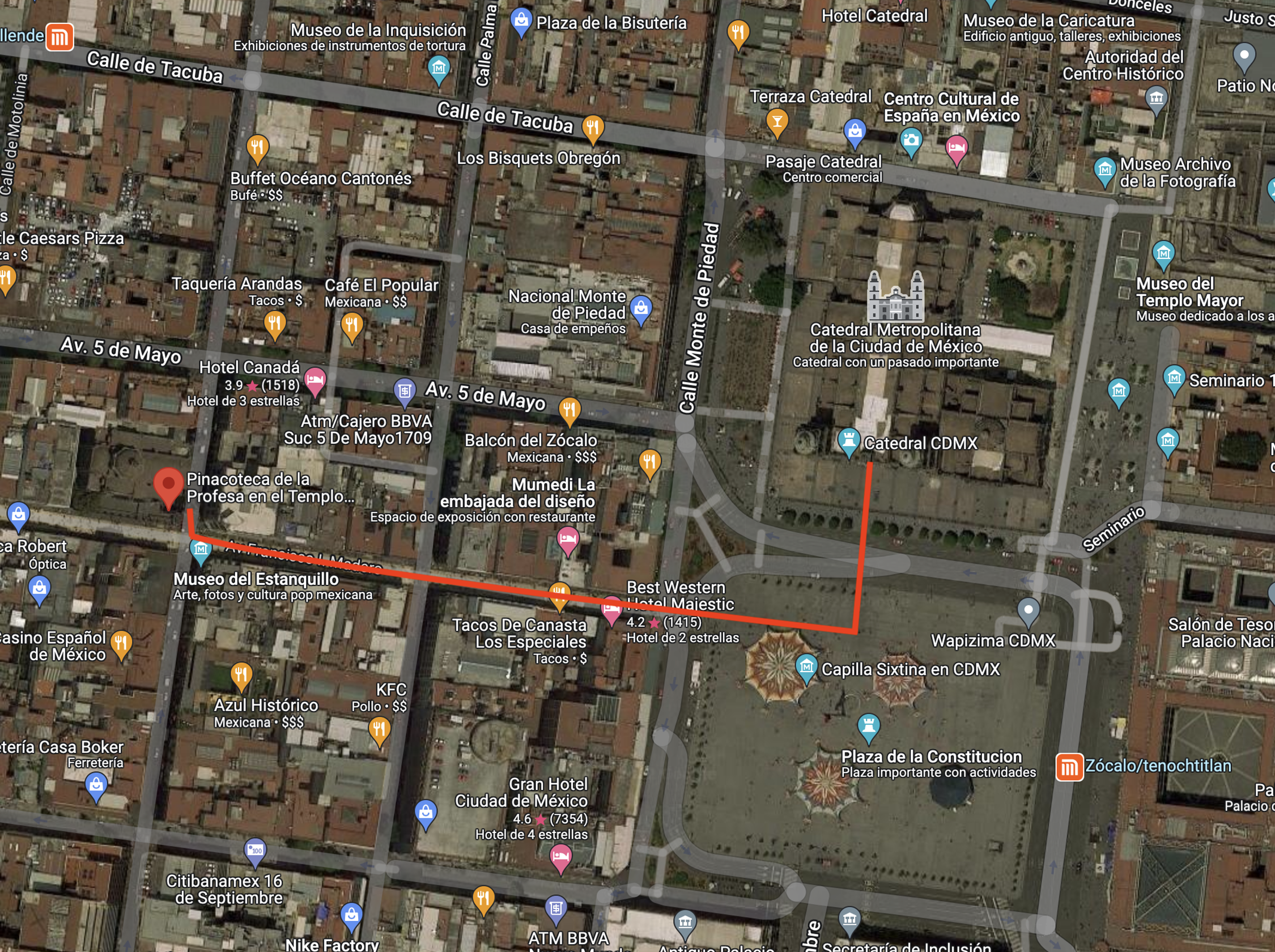
Entre el 30 de julio y el 7 de agosto de 1610, la Ciudad de México festejó, con grandes espectáculos, la beatificación de Ignacio de Loyola, celebrada en Roma el 27 de julio del año anterior (Pérez de Rivas [1576–1655] Reference Pérez de Rivas1896, 1:242–261).Footnote 1 El 31 de julio, el día principal de las festividades, se trasladó el Santísimo Sacramento de la Catedral a la nueva iglesia jesuita, La Profesa (Figura 1), que se consagraría ese día. Para este traslado se marcó una ruta (Figura 2) suntuosamente decorada. Por ejemplo, veinticuatro arcos hechos de ramos, ofrecidos por veinticuatro grupos indígenas, perfilaban el trayecto. Estos arcos estaban colmados de animales vivos: “conejos, liebres, palomas, tórtolas, patos, y garzas” (249).Footnote 2 Según la relación que ha quedado de las fiestas, el evento fue tan concurrido que “no se podía romper por las calles, sino que como olas andaban unas veces atrás y otras adelante” (249). Como toda fiesta barroca, las festividades estarían repletas de “invenciones… ingeniosas”, como los arcos. En este caso, tan “ingeniosas” que, según la relación, “se duda haberse visto cosa semejante en este Reino” y “no se acuerda México haber visto cosa semejante” (245, 249). Entre las “invenciones” más ingeniosas, a sazón del autor de la relación, estuvieron las numerosas performances que elaboraron múltiples grupos de “morenos criollos” y un grupo de africanos supuestamente “nuevamente traídos á este Reino de diversas provincias de Etiopia”: dos con “reyes negros”, ocho “danzas”, y, en el último día de las fiestas, una sortija.Footnote 3
Anónimo, La Profesa, ca. 1910. Cortesía de la Fototeca Nacional, Pachuca de Soto, México. Reproducción autorizada por el Instituto Nacional de Antropología e Historia, Ciudad de México.

El texto de la relación de esta celebración aparece en el libro V, capítulo 4, de la primera crónica de los jesuitas en México, Corónica y historia religiosa de la Compañía de Jesús de México en Nueva España (probablemente terminada hacia 1650), del jesuita Andrés Pérez de Rivas (1576–1655). Mientras que varios informes de la época dan una valoración negativa de la práctica de reyes negros entre los afromexicanos, este texto y otro, Festín (de 1640), nos permiten ver las prácticas culturales y sociales que desarrollaron los afromexicanos durante la época de la unión ibérica (1580–1640).Footnote 4
Antes de proceder hay que señalar que la escasez de fuentes primarias sobre la población negra de la Ciudad de México durante esta época dificulta el análisis de esta cultura. Aparte de estas dos fuentes positivas (la relación de las fiestas jesuitas de 1610 y Festín), la mayoría de las fuentes que sobreviven vienen de quejas de virreyes, alcaldes, regidores y procuradores, tanto civiles como eclesiásticos, contra las prácticas culturales y sociales de los afromexicanos (ver, por ejemplo, Valerio Reference Valerio2021a, Reference Valerio2021b, Reference Valerio2022, 80–125). Es a través de estas fuentes acusatorias, como el famoso informe de un desconocido alcalde de la Audiencia sobre la supuesta conspiración negra de 1612 —que arguye que los afromexicanos eligieron reyes y reinas para la monarquía africana que inaugurarían tras matar a todos los hombres españoles, violar las españolas jóvenes y esclavizar la población indígena (Chimalpahin [1589–1615] Reference Chimalpahin and Tena2001, 289–290)—,Footnote 5 que se conocen las prácticas culturales y sociales, particularmente la de reyes negros, de los afromexicanos (ver Castañeda García Reference Castañeda García2021, 65–76; Germeten Reference Germeten2006, 71–103; Masferrer León Reference Masferrer León2011; Ngou-Mve Reference Ngou-Mve2019, 137–146, 165–173; Tardieu Reference Tardieu2017, 229–274). La relación de las fiestas jesuitas de 1610 —que no se ha estudiado antes—, por ende, nos ofrece una oportunidad singular de aproximarnos a las prácticas culturales y sociales de los afromexicanos de esta época.
Los ejemplos de los que me ocupo aquí muestran cómo los afromexicanos interactuaron con la cultura barroca, mezclando o reinterpretando elementos que posteriormente se asociarían con la cultura afrocolonial de América.Footnote 6 Dada la escasez de fuentes, mi análisis es muchas veces especulativo, ya que no hay otra forma de saber ciertas cosas. En el caso mexicano hay más preguntas que respuestas. Pero no por ello deberíamos dejar de hacerlas. También es comparativo, al tratarse de una tradición que se hizo sentir en todo el Atlántico, desde Nueva Inglaterra hasta Buenos Aires (Piersen Reference Piersen1988, 117–128; Borucki Reference Borucki2015, 99–105; Fogelman y Goldberg Reference Fogelman, Goldberg, McKnight and Garofalo2009). Se trata, en fin, de interpretación textual, y no de indagación histórica. Espero con ello gozar de cierta libertad especulativa, dada la falta de fuentes que nos permita reconstruir los preparativos de las performances. Se trata, además, del análisis de prácticas culturales y de cultura material a través del texto. Espero ensayar una metodología imitable, particularmente para los estudios literarios y culturales coloniales latinoamericanos, que han prestado muy poca atención a la cultura negra colonial (Díaz Reference Díaz and Salles-Reese2005).
La presencia negra en el México colonial se ha estudiado bastante. Sin embargo, no se le ha prestado atención a la cultura festiva de los afromexicanos. Ni aquellos que han estudiado el informe de 1612 (Martínez Reference Martínez2004; Nemser Reference Nemser2017), ni aquellos que han estudiado las cofradías afromexicanas (Castañeda García Reference Castañeda García and Vera2012, Reference Castañeda García, Gila, Morales and Martínez2014, Reference Castañeda García and Casares2015a, Reference Castañeda García, Juárez and Fonseca2015b; Germeten Reference Germeten2006; Masferrer León Reference Masferrer León2011), se han detenido en sus prácticas festivas. Esto ha implicado que este aspecto de la experiencia colonial afromexicana no haya recibido ninguna atención hasta el momento, desatendiendo, en ello, una forma importante de agencia social, política, cultural y económica, de resistencia y de leer otras fuentes que hablan de reyes negros. Las prácticas festivas afromexicanas muestran, por ejemplo, que los afromexicanos supieron crear un espacio de vitalidad política, social y cultural que le dio sentido a su vida más allá del trabajo, de la esclavitud y del castigo. Tampoco se le ha prestado atención a los estudios de la fiesta barroca (Bravo Reference Bravo and García2014; Castañeda 2005; Gonzalbo Aizpuru Reference Gonzalbo Aizpuru1993, Reference Gonzalbo Aizpuru and Báez2018).
Mientras que es bien conocido el trabajo de los jesuitas con la población negra de Sudamérica (Olsen Reference Olsen2004), es poco estudiado su trabajo con la población negra de México. Como la relación de las fiestas de la que nos ocupamos aquí, las primeras misivas jesuitas mexicanas nos dicen que estos trabajaban con la población negra de la ciudad (Sociedad de Jesús [1570–1602] 1956, 1:296, 437, 529). Este trabajo misionario parece haberse limitado a la catequesis, sin embargo, a diferencia de las otras órdenes religiosas masculinas de la ciudad, los jesuitas no albergaron ninguna cofradía negra. No obstante, con el estímulo de los dominicos en un caso, la población negra de la ciudad se esmeró y sobresalió en estas fiestas, según nos cuenta la relación. Asimismo, tampoco se ha estudiado la presencia negra en las fiestas jesuitas, mientras que se han estudiado otros aspectos de ellas (Arellano Reference Arellano2008, Reference Arellano2013). Las fiestas jesuitas de las que nos ocupamos aquí nos permiten una primera aproximación a este tema.
Población afromexicana, 1580–1640
Los primeros afrodescendientes llegaron a México con Hernán Cortés. Es bien conocido el caso de Juan Garrido y otros (Restall Reference Restall2000). Estos primeros “conquistadores negros” y “negros ladinos” — que traían conocimiento y cultura tanto ibérica como africana desde la península, África y El Caribe— desempeñaron las primeras actividades culturales y sociales negras de la región, como la agricultura y la ranchería (Sluyter Reference Sluyter2012, 19–60; Valerio Reference Valerio2021a). Los primeros africanos en llegar esclavizados procedían del África occidental. Estos también se incorporaron y desarrollaron prácticas sociales y culturales, como cofradías (Aguirre Beltrán [1946] Reference Aguirre Beltrán1989, 15–32, 99–129; Germeten Reference Germeten2006).
El periodo de la unión ibérica marca un momento importante de la formación cultural y social negra de la Nueva España. Pues es durante este periodo que se esclaviza la cantidad más grande de africanos (doscientos mil) hacia México (ver Aguirre Beltrán [1946] Reference Aguirre Beltrán1989, 33–48; Palmer Reference Palmer1976, 6–35). Durante este periodo predominaron los africanos de Angola (ver Aguirre Beltrán [1946] Reference Aguirre Beltrán1989, 130–152; Ngou-Mve Reference Ngou-Mve1994). Esto tiene implicaciones para las prácticas culturales y sociales que desarrollan. Pues si bien las cofradías negras y mulatas comienzan a aparecer en el archivo novohispano en 1568 (Valerio Reference Valerio2021b), aumentarán a partir de la llegada de esta población. En 1572, por ejemplo, parecen solo existir dos cofradías, la dos mencionadas en un informe del virrey Martín Enríquez de Almanza (1568–1580), San Nicolás del Monte Calvario y Nuestra Señora de la Concepción.Footnote 7 Para 1610, habrá nueve, y el informe de la supuesta conspiración negra de 1612, sugiere que las nuevas en su mayoría están integradas por angolanos (“Relación del alçamiento” 1612). Que esta población funde cofradías poco después de su llegada a México, como anotan los estudiosos, concuerda con el hecho de que ya conocía el catolicismo y las cofradías en África (ver al respeto Dewulf 2022, 35–88; Reference Dewulf2017, 27–46; Fromont Reference Fromont2014, Reference Fromont2022; Heywood y Thornton Reference Heywood and Thornton2007; Mello e Souza Reference Mello e Souza2002, 43–96; Reginaldo Reference Reginaldo2011, 27–96; Thornton Reference Thornton1992, Reference Thornton1998).
A pesar de su tono acusatorio, el informe de la supuesta conspiración negra de 1612 —y otro de 1609 que veremos más adelante— nos da una buena idea de la vida social que llevaban los afromexicanos a principios del siglo XVII: “El numero grande de negros y mulatos, cabtivos y libres que hay en este Reyno … y particularmente en la Çiudad de Mexico que se multiplica asi con los que naçen en la tierra como los que se traen de guinea … y la libertad y licencia conque esta gente a proçedido, por el rregalo y buen tratamiento que tienen, vestidos y trajes costosos, bayles, casamientos, cofradias, y entierros, y las libres casas en que viben de por si atrevida y viciosamente y que ni libre ni captiuos se ocupan en oficios” (fol. 158).
De aquí no hemos de concluir que la vida negra era toda júbilo y goce, sino que la población negra de la ciudad hizo vida social, y no dejó que la esclavitud, el trabajo, el racismo y el terror de estado le impidiera llevar una vida con ocasiones alegres y algunos que otros pequeños lujos (Earle Reference Earle, Riello and Rublack2019; Terrazas Williams Reference Terrazas Williams2021).Footnote 8 Como la institución que les permitía a los afromexicanos reunirse, formar comunidad, cuidar de los vivos y los muertos y, entre otras cosas, recaudar fondos, la cofradía era el centro de esa vida.
Cofradías afromexicanas
Las cofradías negras surgen en la península ibérica en el siglo XV. A finales del siglo XIV, el arzobispo de Sevilla, Gonzalo Mena Roelas (1393–1401) funda una cofradía para el cuidado de negros ancianos (Moreno Reference Moreno1997; Fracchia Reference Fracchia2019, 48–55; Rowe Reference Rowe2019, 46–86). En 1455, un grupo de negros libres fundó una cofradía en Barcelona y en 1472 se fundó otra en Valencia (Armenteros Martínez; Blumenthal). En Lisboa, los dominicos admitieron afroibéricos en las cofradías del rosario que habían fundado a partir de la segunda mitad del siglo XV (Lahon Reference Lahon2012; Fonseca Reference Fonseca2016). En el siglo XVI, estos afrolisboetas fundaron sus propias cofradías del rosario. En el mismo siglo, aparecieron otras dos cofradías negras en Sevilla.
No sabemos cuándo se fundó la primera cofradía afromexicana, pero estas comienzan a aparecer en el archivo novohispano en 1572, cuando Martín Enríquez les negó a dos cofradías —una negra, otra mulata— las licencias que pedían para fundar hospitales (Valerio Reference Valerio2021a). A finales del siglo XVI, las autoridades coloniales trataron de suprimir las cofradías afromexicanas que se habían fundado en los conventos de la ciudad (Valerio Reference Valerio2021b). Martín Eríquez, por ejemplo, consideraba que las cofradías de negros “traya[n] incoveniente[s]”.Footnote 9 Además, en 1598, el regidor y procurador mayor de la Ciudad de México, Guillén Brondat, se quejó de dos tipos de abusos que a su ver cometían los negros de la ciudad. Uno era llevar cuchillos de carniceros —lo que acordaría con la profesión de ganadero común entre los afromexicanos de la época, como los mulatos que pidieron licencia para el hospital en 1568— y el otro “aver hecho juntas y conciliabulos so color de una cofradía en el convento de Santo Domingo San Agustin Ospital de Nuestra Señora y desamparados y para esto tienen su caxa que llaman del tesoro con tres llaves y su tesorero mayordomo escribano prioste y allí juntan suma y cantidad de pesos de oro rrobando a sus amos y a los vezinos desta dicha ciudad” (Actas del cabildo [1524–1809] 1889–1911, 14:115). Y en 1601, el cabildo de la ciudad mandó hacer cumplir una supuesta cédula real de 1570 que ordenaba “que no haya cofradías de negros” (14:277). Esta cédula, de 1575, y no de 1570, solicitada por Martín Enríquez, sin embargo, solo prohibía las procesiones de las cofradías negras disciplinantes de la ciudad.Footnote 10
En la ausencia de otras fuentes, y a pesar de su tono acusatorio, la queja de Brondat de 1598 nos permite ver las cofradías afromexicanas que estaban activas en la Ciudad de México a finales del siglo XVI, y que aparecerán en documentos posteriores, como la relación de las fiestas jesuitas de 1610 de la que nos ocupamos aquí (Tabla 1). Por ejemplo, la cofradía en el “Ospital de Nuestra Señora” se refiere a la cofradía de Nuestra Señora de la Concepción, la mejor documentada, que se encargaba de los afromexicanos enfermos en el hospital del mismo nombre, fundado por Hernán Cortés (ver Germeten Reference Germeten, McKnight and Garofalo2009; Masferrer León Reference Masferrer León2011). La cofradía en el convento agustino —contra la cual Martín Enríquez había conseguido la cédula de 1575— fue acusada numerosas veces por salir en procesión de penitentes sin licencia del arzobispo o del virrey.Footnote 11 El hospital de los desamparados fue un hospital fundado por el médico de cabecera de los dominicos, Pedro López, para “tres generos de gentes que ningun hospital las querran curar que son mestizos mulatos y negros libres o esclavos”.Footnote 12 Por último, la cofradía del Santo Cristo de la Expiración y Santo Sepulcro, en el convento dominico de la ciudad y que se dedicaba a los entierros (Ojea [1550–1576] 1889–1911, 10), aparecerá en las fiestas jesuitas de 1610.
Cofradías negras en la Ciudad de México en 1610

Nota: Tomado de Germeten, Black Blood Brothers, 83.
A pesar de las tentativas oficiales de suprimir las cofradías afromexicanas, estas sobrevivieron. Esto sin lugar a duda se debió al respaldo que recibieron de las órdenes religiosas de la ciudad, pues como vemos en la Tabla 1 la mayoría se encontraban en los conventos masculinos de la ciudad. En las fiestas de 1610 que estudiamos, vemos cómo los dominicos —con una historia de apoyo a las cofradías negras que se remonta a la península ibérica tardomedieval— inculcaron a la cofradía en su convento a participar en las celebraciones. Esta lo hizo por agradecimiento a los dominicos y a los jesuitas, que aunque no albergaron cofradía negra, ministraron a los negros de la Ciudad de México (Sociedad de Jesús [1570–1602] 1956, 1:296, 437, 529). De esta forma la cofradía le agradecía a ambas órdenes por su apoyo a la vez que refortalecía su relación con ambas.
Reyes negros festivos en el atlántico ibérico
Aparte de los roles sociales —como cuidar de los enfermos y enterrar a los difuntos— que las cofradías negras desempeñaron, también sirvieron de espacio cultural para los afromexicanos, como muestra el texto del que nos ocupamos. Los reyes negros están asociados a las cofradías negras —que normalmente elegían sus mayordomos y sus esposas rey y reina— desde su primera aparición en el archivo. Pues cuando se fundó la primera cofradía negra de Lisboa, en 1565, esta postuló en sus reglas que se eligieran anualmente “principe, reys, duque, condes, marquezes, cardeal & quaes quer outras dignidades”.Footnote 13 Según Jeroen Dewulf (Reference Dewulf2022, 30), esta práctica surge como imitación de una tradición ya practicada por los europeos. Sin embargo, los estudiosos de esta tradición en Brasil —donde aún perdura y donde más se ha estudiado— también insisten en que surge como una imitación de la pompa real del Reino del Congo (del cual formaba parte Angola en la temprana modernidad) (Mello e Souza Reference Mello e Souza2002; Hunold Lara Reference Hunold Lara2007; Fromont Reference Fromont2013). Estas dos hipótesis no tienen que ser mutuamente excluyentes. Los afroibéricos y los afrolatinoamericanos coloniales pudieron combinar y reinterpretar ambas prácticas, transformándolas en una nueva tradición que se identificaría con la diáspora africana (ver, por ejemplo, Borucki Reference Borucki2015, 99–105; Dewulf Reference Dewulf2017; Fogelman y Goldberg Reference Fogelman, Goldberg, McKnight and Garofalo2009; Fromont Reference Fromont2013; Howard Reference Howard1998; Kiddy Reference Kiddy2007; Lund Drolet Reference Lund Drolet1987; Mello e Souza Reference Mello e Souza2002; Piersen Reference Piersen1988, 117–128; Valerio Reference Valerio2022; Walker Reference Walker2015).
Como en otras latitudes, los reyes negros serán problemáticos en México. En 1612, por ejemplo, varias cofradías de la ciudad fueron acusadas de elegir reyes y reinas como parte de una conspiración negra contra el gobierno español (“Relación del alçamiento” 1612; Germeten Reference Germeten2006, 71–103; Masferrer León Reference Masferrer León2011). Los eventos de 1612, comenzaron en 1611 cuando una esclava murió tras recibir una paliza de su amo (Martínez Reference Martínez2004; Nemser Reference Nemser2017). En protesta, las cofradías de la ciudad salieron con el cuerpo de la difunta reclamando justicia a la puerta de las autoridades más importantes del virreinato —la Audiencia y el arzobispo, ya que en ese momento no había virrey. La Audiencia respondió ordenando vender o exiliando a los líderes de las cofradías que habían organizado la manifestación, entre ellos el mayordomo/rey, Diego, de una de las dos cofradías negras —el informe no dice cuál— en el convento mercedario. Esto implicó que la cofradía tuviera que reemplazar a Diego. En la cuaresma de 1612, el nuevo mayordomo/rey de la cofradía, Pablo, se enfermó y murió. Por consecuente, la cofradía tuvo que elegir mayordomo/rey nuevamente.
El informe oficial de estos eventos presenta todo esto como parte de una conspiración contra el gobierno español. Según el informe “Fue por principal y cabeça en esta sedicion un negro Angola, mayoral de la mesma cofradia, esclavo de Juan Carvajal Clerigo llamado Pablo brioso y demas determinaron que otros, casado con una negra de Chritval Henriquez Mercader que estas habia de ser Rey y reyna” (fol. 161r), y “Ayudo mucho y esforço con estos negros en el alçamiento Isabel mulata esclava de Luis Maldonado de Corral Regidor de Mexico que se persuadio avia de ser Reyna, y un mulato libre moço del Alcalde de corte Don Francisco de leoz Rey” (fol. 161v).
En esta ocasión se ejecutaron treinta y cinco afromexicanos (siete mujeres y veintiocho hombres). No sabemos entonces si el informe se escribió de la forma que se escribió para justificar las ejecuciones, o si refleja, de forma distorsionada, eventos reales.Footnote 14
Como las instituciones que se encargaron del cuidado de los negros y de sus entierros, las cofradías negras surgen como un estado dentro de un estado. Su forma de gobierno —una mesa ejecutiva— le daba una calidad corporativa. A pesar de ser sospechosas por las autoridades coloniales y vigiladas por los frailes que las hospedaban, gozaban de autonomía para determinar sus prioridades devocionales, así como políticas, sociales y culturales. Eran el espacio más soberano que tenían los afromexicanos, fuera del cimarronaje. Y como ha señalado Pablo Miguel Sierra Silva (Reference Sierra Silva2019), la población urbana —con numerosos lazos afectivos y relaciones sociales y económicas en la ciudad— prefería las cofradías al cimarronaje (159–164). Los reyes negros confraternales expresan esta soberanía simbólica y políticamente. Era por ello que resultaban peligrosas la mayoría de las veces, exceptuando solamente el espacio festivo oficialmente sancionado.
Más relevante al texto que nos ocupa, a principios de 1609, el alcalde del crimen de la Audiencia Luís López de Azoca —que se sospecha autor también del informe de 1612 (Querol y Roso 1935)— despachó un informe al Consejo de Indias donde se quejaba de una fiesta que celebró un grupo de afromexicanos la Nochebuena de 1608.Footnote 15 Según el alcalde,
la dicha noche vispera de navidad en casa desta dicha negra libre [Melchiora de Monterrey] ubo muy gran junta de negros y mulatos negras y mulatas, y que allí al dicho negro Martin, sentado en una silla puesta sobre una tarima, y al honbro debajo de un dorzel, y un sitial de canto, y los pies puestos en un cojín de terciopelo el dicho Francisco de Loya, repostero del virrey, le puso una corona harmada [sic] sobre un arco guarnecida de oropel, e hincado de rodillas y descubierto, y abiéndosela puesto dixo el dicho mulato, “Biba el rey”, en alta voz, y los demás negros y mulatos que allí estavan rrespondieron todos “Biba y rey”. (fols. 1v–2r)
Quizás como la queja de Brondat anteriormente citada nos da a conocer las cofradías negras de la ciudad, las palabras de López Azoca a su vez ilustren cómo se daba la coronación de los reyes negros entre los afromexicanos. Sin embargo, a diferencia de otras instancias conocidas, este ejemplo parece tener un elemento rabeliano, burlesco, más secular (Bakhtin), donde los afromexicanos se burlan de —o imitan a— sus amos. Esto queda claro en una supuesta cédula real que López de Azoca reproduce: “La reyna manda que sea presa dona Ysabel de Castilla por yrrespetable que hizo gestos a un grande delante de su magestad. Fecho en mi corte a veynte y seis de diziembre de mil y seiscientos y ocho años. Yo, escribano, don Diego de Alcazar, secretario del Marques del Puño en Rostro” (fol. 2r).
Pero esto no bastó para que López de Azoca, como el resto de la ciudad, viera los eventos como “borracheras” o “cosas de negros” (Torquemada [1615] Reference Torquemada1723, 1:759), arrestando e interrogando (y quizás haciendo torturar) a treinta y seis personas (fols. 5v–6v).Footnote 16
López de Azoca recurrió al Consejo de Indias, tras ser despreciado por sus colegas en la Audiencia, porque consideraba el asunto “negosio gravissimo y en que rrequiere exenplar y gran castigo en todos”. Aunque López de Azoca quizás no vio la coronación como el acto inicial de una conspiración negra, en su informe pasó de hablar de la fiesta a hablar de los cimarrones, postulando que “sera nessesario si v. mag. dello fuere servido que con gente y applicacion de confianza se procuren reduzir y traher al servicio de sus amos estos negros conforme a la cantidad que cada uno tubiere y si no se quisiere rendar [sic] que los puedan matar libremente porque muy peor sera y de mayor dano si ellos se alzan” (fols. 2v–3r).
De tal forma López de Azoca asoció los eventos de la Ciudad de México con el cimarronaje que en ese momento en México tenía un nombre, Yanga, que había fundado un pueblo libre en 1579 (Pérez de Rivas [1576–1655] Reference Pérez de Rivas1896, 1:282–294). En 1609, las tropas españolas perderían la guerra contra Yanga. Como ha señalado Daniel Nemser (Reference Nemser2017), López de Azoca y el autor del informe de 1612 están proyectando sobre la Ciudad de México y su población el miedo y la ansiedad que Yanga y el cimarronaje producía en ellos (352).
En este complicado contexto, los reyes negros de 1610 resultan sorprendentes y suscitan numerosas preguntas. ¿Por qué escogieron esta performance, especialmente dado el antecedente del año anterior?Footnote 17 Una posible respuesta es un deseo de mostrarle a las autoridades coloniales y al público en general que estas performances no constituían la gran amenaza que las autoridades decían. En cuyo caso se trataría de una apuesta arriesgada pero audaz, que no sabemos si las autoridades coloniales recibieron con el mismo beneplácito que el autor de la relación. Pues se trató de algo que jugaba con la frontera de lo legal y de lo subversivo; algo que no será posible, sino hasta años o décadas después de 1612.Footnote 18 Esta respuesta quizás sirva para el primer grupo, y no para el segundo, que supuestamente estaba compuesto de africanos recién esclavizados. Estos tendrían otras razones, quizás nacidas de la inocencia, o tal vez las mismas.
Lo que sí queda claro y asombra en ambos ejemplos es la interacción con la cultura barroca. Así que quizás no importe atenernos a preguntar por los porqués, y resulte más productivo prestar atención al cómo, al espectáculo que se nos presenta. Es lo poco que la escasez de fuentes nos permite, pero no por ello menos significativo, pues quizás nos descubra —en síntesis— la cultura afrobarroca de México y la soberanía negra que su escenificación puso en escena.
“Reyes salvajes” y la cultura del Barroco
Pasamos así a la primera performance de reyes negros. Según la relación,
En saliendo la procesión de la iglesia [catedral], la hizo reparar cuarenta y cuatro piezas que se dispararon junto á un hermoso castillo de siete varas en alto, y de cantería bien fingida que los morenos criollos de una cofradía que tienen en el convento del gloriosísimo Padre Santo Domingo, movidos por aquellos Padres (que en esta ocasión se esmeraron en hacernos favor), y también de la devoción que los mismos morenos tienen a Nuestro Santo Padre [Ignacio], le ofrecían esta invención. Tiraban este castillo que venía armado sobre cuatro secretas ruedas, veinticuatro salvajes vestidos de cerdas largas de pies á cabeza y máscaras muy al propio: delante de él venía en hombros de otros cuatro salvajes vestidos de cerdas el rey del castillo, en una silla con maza y traje muy al natural; el cual, puesto delante del Santísimo Sacramento, tocando con la maza el castillo disparó grande número de cohetes, y se rasgó un globo ó nube en que remataba pintada de hermosos celajes descubriendo dos niños, el uno en traje de la Virgen Santísima y el otro de Nuestro Padre San Ignacio. […] Entonces el rey salvaje en media docena de octavas, dijo: cómo estando retirado allá en los bosques, oyó recostado desde su cabaña el eco de las fiestas que al santo se hacían en México. Pero no hallándose, como que era tan pobre, con más rico caudal, ofrecía aquel castillo: abrióse al punto una puerta de él, por donde salieron otros doce salvajes muy bien aderezados que hicieron una danza muy curiosa que fue alegrando la procesión. (250)
Lo primero a resaltar aquí es que esta performance la hizo una cofradía, la del Santo Cristo de la Expiración y Santo Sepulcro, en el convento dominico, una entidad tan problemática para las autoridades coloniales como los reyes negros. Esta performance, entonces, constituye un doble reto, un juego con dos elementos ambivalentes en el escenario político colonial. El texto es importante porque se trata del único texto celebratorio mexicano que vincula las cofradías a los reyes negros fuera de una querella. Esto a su vez revela que las cofradías afromexicanas compartían este elemento con las cofradías negras del Atlántico ibérico. Lo segundo a resaltar es que se trata de un grupo de “morenos criollos”, o sea, nacidos y criados en México. Exceptuando la segunda performance, el autor de la relación siempre llama a los afromexicanos en las fiestas “morenos criollos”. Es por ello que este texto es una buena muestra de la cultura barroca afromexicana.
Tratándose entonces de morenos criollos, ¿por qué escogieron hacerlo como salvajes?Footnote 19 Aunque como se indicó antes, esta respuesta es especulativa, es esta performance como salvajes la que subraya su capacidad para lo barroco. Pues la doble subalternización que ponen en escena —como morenos criollos y como salvajes— subraya su habilidad de hablar el lenguaje barroco de lo exótico. Si bien lo exótico se ha visto como un proceso de alterización del Otro no europeo (Mason), aquí tenemos un ejemplo de lo que Mary Louise Pratt (Reference Pratt1991, 35) ha llamado autoetnografía, es decir, cuando un grupo se presenta a sí mismo “de una forma que juega con representaciones que otros han hecho del grupo”.Footnote 20 Esta autoetnografía parece necesaria para hacer la performance legible para el Otro no negro. En otras palabras, el grupo parece estar haciendo una muestra que refleja el exotismo que el público espera de ellos.
Sin embargo esta no era la única opción disponible, por ejemplo, en 1631 un grupo de mulatos limeños escenificaron el rapto de Elena y la guerra de Troya para las fiestas que hizo esa ciudad con motivo del nacimiento del Príncipe Baltasar Carlos (ver Carvajal y Robles [1632] Reference Carvajal y Robles1950; Jouve Martín Reference Jouve Martín2007). De hecho, como veremos en breve, este u otro grupo de morenos criollos hizo una performance muy europea, una sortija, en el último día de las festividades. La elección de esta performance de reyes negros como la primera, entonces, resulta significativa y parece sugerir lo que he propuesto antes, que buscaban mostrarles a las autoridades coloniales y al público en general que las performances de reyes negros no constituían la gran amenaza que las autoridades decían. No se trata, sin embargo, de una performance totalmente salvaje, pues mezcla lo salvaje —que a su vez es verdaderamente barroco, a la vez que también es afrodiaspórico— con lo visiblemente barroco, el carro sacramental.
Resulta igualmente significativo que esta cofradía negra gozara del privilegio de transportar el Santísimo Sacramento. No hay nada en el texto o en las fuentes existentes que nos permitan discernir por qué fue escogida, solo podemos especular. La lógica dicta varias posibilidades, no necesariamente excluyente las unas de las otras. O fueron los únicos o los primeros en ofrecerse para ello, o los jesuitas sabían que contaban con los recursos para hacerlo mejor, o los dominicos se lo consiguieron. Aquí resulta más importante el castillo que consiguieron para ello. No sabemos si fue prestado, propio o hecho para la ocasión. Si prestado, ¿de quién? ¿De la catedral? De ser prestado podría subrayar las buenas relaciones que sostenía esta cofradía con otros grupos de la ciudad. Si era propio quizás indique que esta cofradía participaba en el Corpus anualmente. Sabemos que el cabildo contrataba grupos negros para estas fiestas anualmente (Actas de cabildo [1524–1809] 1889–1911, 17:180, 335, 18:79, 296). Si fue hecho para la ocasión, lo que parece el caso por el detalle de la esfera celeste, aunque pudo añadirse para la ocasión, el castillo subrayaría los recursos de los que disponía esta cofradía para construir o mandar a construir este carro barroco, que comparado con otros que conocemos de España y Perú (ver Bautista de Valda Reference Bautista de Valda1663; Dean Reference Dean1996, Reference Dean1999), parece singular en su forma. Por último, el uso de fuegos artificiales subraya cómo esta cofradía sabía hablar el lenguaje del barroco y contaba con los recursos para ello. Los fuegos artificiales se convirtieron en un lenguaje central del barroco (Eguiluz Romero Reference Eguiluz Romero and Bernal2021). Servían para deslumbrar al público y subrayar el poder adquisitivo del anfitrión. Aquí los morenos criollos supieron hablar este idioma luminoso y sonoro con admirable destreza.
Las ocho danzas que hubo y, en particular la sortija, subrayan aún más los recursos que la comunidad negra de la ciudad desplazó en estas fiestas. Según la relación, “Luego [después de la segunda performance] entraron ocho danzas de los morenos, cada una tan artificiosa que pedía particular memoria, y se le debía á esta buena gente que con extraña devoción gastó su pobre caudal en sacar vestidos nuevos de damasco y sedas, todos ellos tan bien aderezados, que así por esto, como por los ingenios de las danzas, curiosidad de los vestidos, y són de las flautas y tamboriles, no poco alegraron la procesión” (250–251).
Mientras que podemos decir muy poco sobre estas danzas —excepto quizás que debieron incluir elementos afroatlánticos—, cabe notar que el autor reconoce instrumentos musicales transculturales —flautas y tamboriles. En cuanto a la sortija, nos dice el autor de la relación que
Pareciéndoles á los morenos criollos de esta ciudad y nacidos en ella, que no habían mostrado bastantemente lo mucho que estimaban al buen oficio que con ellos hace la Compañía en doctrinarlos y ayudarlos en orden á la salvación de sus almas, y no contentándose con las invenciones y gastos que hicieron el día principal de esta fiesta, quisieron, remedando á los españoles [que habían hecho otra sortija], correr ellos también otra sortija. Para esto, publicaron su cartel, señalaron y pusieron premios, hicieron leyes y nombraron jueces. Estos días todos era sacar libreas, inventar trazas, imaginar invenciones, con tanto afecto y conato, que algunos de sus amos, aunque los veían ocupados en tantas fiestas, pero sabida la causa, lo llevaban con mucho gusto; llegó el día para que esto señalaron, y junta gran muchedumbre de gente, corrieron su sortija con tan buenos vestidos, letras y invenciones, que los españoles se admiraron de verlos. (259)
Por un lado, el autor quiere resaltar que los jesuitas se ganaron estas ofrendas con su trabajo misionero con la población negra de la ciudad —aunque pocos otros escritos jesuitas den constancia de ello (ver Sociedad de Jesús [1570–1602] 1956)—, felicitándose así por su propio trabajo. Por el otro, podemos ver la autonomía económica y cultural que la comunidad negra de la ciudad magníficamente puso en escena. Pero lo que distingue las performances negras de las otras durante las festividades, son los reyes negros, una tradición afroatlántica que transciende estos eventos.
Pasando a la segunda performance de reyes negros, entonces, según la relación, Acabada de ver esta [primera] invención al punto encontró la procesión con otra, asimismo de morenos, nuevamente traídos á este Reino de diversas provincias de Etiopia, traían un elefante de maravillosa grandeza y gracia. Espantó ver su figura y forma tan al natural retratada. Toda esta gran máquina estaba armada sobre unas ruedas que con facilidad se movían. En lo alto de este animal estaba sentado un moreno en forma de rey, con su cetro en la mano y corona en la cabeza, representando muy al vivo al de Etiopia. Era cosa maravillosa, cómo esta gran bestia venía á reconocer y hacer reverencia á la Soberana Majestad de Dios Nuestro Señor, puesta debajo de aquellos accidentes; hizo luego una hermosa retirada hacia fuera para dar lugar á la gente y hacer lo que no causó menos gusto que admiración, porque todo el vientre del elefante que era hueco y muy capaz, á la manera del otro caballo de Troya que estaba lleno de soldados, éste lo estaba lleno de cohetes, morteruelos y bombas, á quienes pegando fuego por un secreta cuerda alquitranada, antes que por de fuera se viese dispararon allá dentro dos bombas, y rompiendo el mismo vientre del elefante salieron con un ímpetu y velocidad grande, así por él como por los ojos y trompa, tantos cohetes, que fue cosa que puso admiración y dio mucho gusto. (250–251)
Si este grupo estaba compuesto de “morenos, nuevamente traídos á este Reino de diversas provincias de Etiopia”, como dice la relación, esto quizás marcaría el espacio atlántico como un espacio cultural compartido, donde algo africano puede resultar de fácil traducción en otras orillas. Por otro lado, mientras que el informe de la supuesta conspiración negra de 1612 dice que la presunta trama se descubrió por dos portugueses que conocían “la lengua angolana”, de esta forma tratando de señalar a angolanos recién esclavizados o no aculturados como líderes de la conspiración, con la descripción de esta performance el autor de la relación da una imagen positiva de los africanos recién esclavizados. Estos, por implicación, son amenos al trabajo misionario de los jesuitas —que también se encontraban en Angola— y dispuestos a celebrar su gran día con ellos.
No obstante, esta performance en concreto no tuvo paralelos, sino precedentes, europeos. Por ejemplo, en 1554, cuando Felipe II (r. 1556–1598) estuvo de paso por Benavente, Zamora, en camino a Inglaterra para contraer nupcias con su prima hermana, María I de Inglaterra (1554–1558), fue entretenido con varias performances por el duque de esa localidad, entre las cuales figuró una muy parecida a la que acabamos de ver en la Ciudad de México en 1610. Según la relación que hizo un lacayo, Andrés Muñoz, del príncipe Don Carlos, que acompañaba al rey: “Fué la primera [invención] que entró un poderoso elefante, muy al propio y por lindo estilo hecho, que era un cuartago en quien la cabeza d’este lleva armada la del elefante con el cuello y manos, y el otro medio cuerpo en las ancas, tan al natural, que era cosa maravillosa verle. Encima del cual iba un moreno, con una camisa sola vestido, y el brazo derecho arremangado con un venablo en la mano, imitando en la postura y traje á los indios de las partes de África del Occéano” (Muñoz [1554] Reference Muñoz1877, 45).Footnote 21
Varios estudiosos han argumentado que esta tradición se desarrolló en imitación de embajadas africanas en Europa (Ndiaye Reference Ndiaye2020; Lowe Reference Lowe2007). También formaba parte de las performances llamadas desfile de las cuatro partes del mundo (ver, por ejemplo, Arizzoli y Cline Horowitz Reference Arizzoli and Horowitz2021; Welch Reference Welch2017). Así en 1626, por ejemplo, cuando la Ópera Real de París puso en escena una ópera donde los líderes del mundo rendían homenaje al rey de Francia (Le Grand Bal de la Douairière de Billebahaut), esta incluyó un embajador africano que se va a parecer al segundo rey negro de México (Figura 3).
Mapa. Probable ruta de la procesión (línea roja). Google Maps.
Daniel Rabel, Entrada del cacique y su séquito, para Le Grand Bal de la Douairière de Billebahaut, Paris, 1626. Cortesía de la Biblioteca Nacional de Francia.

No obstante, el ejemplo mexicano anteriormente citado es singular por sus elementos barrocos. Como el primero, se trata de una compleja máquina que anda sobre ruedas y que explota en jubilosos fuegos artificiales. No es un elefante, es un caballo de Troya festivo, repleto de cohetes, morteruelos y bombas. Si sus ejecutores eran africanos recién esclavizados, esto, o mostraría un conocimiento profundo del lenguaje festivo barroco, o la intervención de una mano más diestra en esta cultura. En resumen, podemos aplicar la metáfora del caballo de Troya a las prácticas festivas afromexicanas en cuanto, tanto en el período colonial como hoy, invitan a repensar la barbarie y la impotencia que teóricamente suponía la negritud en la época.
Conclusión
Los ejemplos mexicanos aquí explorados diferencian los reyes negros afromexicanos de los otros contextos. En Brasil, por ejemplo, los reyes hacían (y aún hacen) un desfile, se sientan a recibir honor, mientras un grupo representa una danza marcial (ver Dewulf Reference Dewulf2017; Fromont Reference Fromont2013; Kiddy Reference Kiddy2007; Mello e Souza Reference Mello e Souza2002). Sin embargo, no aparecen con los elementos barrocos que hemos visto aquí. Lo que sí tienen en común con el resto del Atlántico los ejemplos mexicanos son las cofradías como las instituciones que albergaban esta tradición afrodiaspórica.Footnote 22 Asimismo, tienen en común con el resto del Atlántico la existencia liminal entre lo aceptable y lo subversivo.
Las dos performances, pero especialmente la primera, subrayan los recursos y relaciones que los afromexicanos podían poner en acción para deslumbrar a la Ciudad de México. Muestran que las cofradías servían de espacio y razón de estos recursos y relaciones. Muestran, además, que la tradición afrodiaspórica de reyes negros formó parte central de la cultural que los afromexicanos desarrollaron, dándole su propio matiz mexicano. Y, por último, que los afromexicanos no fueron ajenos a la cultura del barroco, sino que supieron interactuar con ella y valerse de ella para escenificar su soberanía.


 Open access

