

Investigations at sites across northwestern Honduras—inside and outside of the Maya area—have revealed a wide diversity of food practices and ingredients. We see a dynamic overlap between the foodways of Maya societies to the north and Ulúa Valley societies just to the south, with northwestern Honduras serving as a sort of crossroads between culinary traditions. The trajectories of individual ingredients are not straightforward, however: some culinary elements were never adopted in regions where they were readily available (considering the flow of other species and materials), whereas other culinary elements were quickly adopted but sometimes in novel ways.
When looking across the Maya landscape, we see evidence that bears out Scott Fedick's description (Reference Fedick and Fedick1996:14) of a “managed mosaic,” although when he edited his seminal volume in 1996, only a small handful of actual paleoethnobotanical studies had been completed (Bloom et al. Reference Bloom, Pohl, Buttleman, Wiseman, Covich, Miksicek, Ball and Stein1983; Cliff and Crane Reference Cliff, Crane, McAnany and Isaacs1989; Hammond and Miksicek Reference Hammond and Miksicek1981; Hather and Hammond Reference Hather and Hammond1994; Lentz Reference Lentz1991; McKillop Reference McKillop1994; Miksicek Reference Miksicek, Turner and Harrison1983, Reference Miksicek and Hammond1991; Turner and Miksicek Reference Turner and Miksicek1984). In the intervening years, the work of David Lentz at the Joya de Cerén and Aguateca sites has given us fine-grained views of foodways under conditions of rapid abandonment. Meanwhile, paleoethnobotanical work at a host of other Maya sites has provided insight into food practices (e.g., Cagnato and Ponce Reference Cagnato and Ponce2017; Lentz Reference Lentz and White1999; Lentz et al. Reference Lentz, Ramírez and Griscom1997; McKillop Reference McKillop and Fedick1996; Morehart and Helmke Reference Morehart and Helmke2008; Simms et al. Reference Simms, Berna and Bey2013), human–environmental relationships (e.g., Abramiuk et al. Reference Abramiuk, Dunham, Cummings, Yost and Pesek2011; Crane Reference Crane and Fedick1996; Hageman and Goldstein Reference Hageman and Goldstein2009; Lentz and Hockaday Reference Lentz and Hockaday2009; Lentz et al. Reference Lentz, Sally Woods, Murph and Robin2012; McNeil Reference McNeil2012; McNeil et al. Reference McNeil, Burney and Burney2010; Pohl et al. Reference Pohl, Pope, Jones, Jacob, Piperno, DeFrance, Lentz, Gifford, Danforth and Kathryn Josserand1996; Sheets et al. Reference Sheets, Christine Dixon and Blanford2011, Reference Sheets, Lentz, Piperno, Jones, Dixon, Maloof and Hood2012; Trabanino García Reference Trabanino García2008, Reference Trabanino García, Arroyo, Aragón and Mejía2012a; Wyatt Reference Wyatt2008), and ritualized practices (e.g., Bozarth and Guderjan Reference Bozarth and Guderjan2004; Goldstein and Hageman Reference Goldstein, Hageman, Staller and Carrasco2010; Lentz et al. Reference Lentz, Jason Yaeger and Ashmore2005; McNeil Reference McNeil2006; Morehart and Butler Reference Morehart and Butler2010; Trabanino García and Núñez Reference Trabanino García and Núñez2013).
In this article, we compare cuisines from several ancient communities in northwestern Honduras. The work we present here includes new data from a scan of 207 macrobotanical samples and microbotanical analysis of residues from 22 artifacts, all recovered from areas within and nearby the Maya site of Río Amarillo. We compare our new findings from the Río Amarillo area with those from the nearby Maya site of Copan and several Ulúa Valley sites (100 km distant), using previously published datasets. Given variations in data collection methods by each researcher and the limitations of samples in each study, we focus on the presence and absence of various taxa across the northwestern Honduras region while acknowledging that differences between these datasets may also be attributable to varying taphonomic regimes and, of course, variations in human practice.
The wealth of botanical data available in northwestern Honduras has already led to provocative interpretations about the movement and sharing of foodstuffs, alongside other recent research into shared principles of culinary equipment (Hendon Reference Hendon and Ardren2020) and architecture (see the following discussion). The three areas we compare in this article have very similar ecologies with nearly identical plant availability. Although paleoethnobotanical analysis is ongoing, preliminary data suggest that people in each area were not only embedded in different historical traditions but may have also manifested different plant preferences.
Plants on the Move
When we follow the itineraries of different taxa, we see plants making their way into the landscape through a variety of human tactics and strategies (somewhat in the sense of Michel de Certeau [Reference de Certeau1984]). These pathways include formal trade, required tribute, and neighborly exchange. Plants also flow through human households, as seeds and cuttings pass along from parents to children and move into other households through intermarriage and migration. The iterative practices linked to these plants (sensu Judith Butler Reference Butler1997) unfold across time and space, as migrants replicate past practices in new and sometimes very foreign ecologies. In the Caribbean (Berman and Pearsall Reference Berman and Pearsall2008; Siegel et al. Reference Siegel, Jones, Pearsall, Dunning, Farrell, Duncan, Curtis and Singh2015), this process has been described as “transporting landscape,” where the incorporation of familiar plants or plant practices in new places is a mode of re-creating homelands in new territories. Plants also shift into new social contexts when people create novel recipes using traditional ingredients or adhere to traditional recipes using new ingredients (Morell-Hart Reference Morell-Hart2020a). Such efforts add variety to repetitive cuisine or re-create treasured foodstuffs with substituted plants.
Through all of these processes, we see both concordances and disjunctures when we consider food ingredients, food meanings, and food practices. First, we find cases where culinary practices and meanings are the same, but the taxa are substituted. For example, for bean makers there is enormous variety in what constitutes the appropriate herbal inclusion. Bay leaves, epazote, or oregano has been proclaimed by friends of the authors as absolutely and without a doubt the core and critical ingredient for flavoring beans properly. Moreover, different regions of contemporary Mesoamerica have their favorites—the red beans in baleadas so popular in Honduras are distinct from the refried pintos in northern Mexico, which are distinct from the stewed black beans found throughout Guatemala.
Moreover, meanings change, even where culinary taxa and practices remain the same. In the highlands, pine (Pinus spp.) is a common fuel and construction source, whereas in the northern lowlands it has been cited as an indispensable component of ritualized practice yet is more rarely found overall (Dussol et al. Reference Dussol, Michelle Elliott and Michelet2016; Lentz et al. Reference Lentz, Jason Yaeger and Ashmore2005; Morehart et al. Reference Morehart, Lentz and Prufer2005). At Copan, on the eastern margins of the Maya area, pine was the primary ritual wood but was also favored for household activities and thus is very abundant overall in botanical assemblages (McNeil Reference McNeil2006:116). In some cases pine was treasured for its fragrant smoke, in other cases it was a daily mainstay of simple cookfires, and in yet other cases it contributed heavily to both ritualized and quotidian practice. The “ingredients” and the activities were the same—pine wood was burned—but the meanings sometimes differed significantly from region to region. This semiotic difference was likely related to the relative local scarcity of pine tree stands, among other factors, and the effects of this local scarcity on perceived value.
Finally, we have cases where the meanings and taxa were the same, but culinary practices changed. Maize (Zea mays) for many centuries appears to have been used primarily in tamales and atoles and only in late stages for tortillas (Brumfiel Reference Brumfiel, Gero and Conkey1991). As Elizabeth Brumfiel noted, this difference in maize preparation had enormous implications for labor, even though the staple ingredient itself—maize—remained consistent. Furthermore, David Webster and coauthors (Reference Webster, Benz, Blake, Lesure, de Tapia, Sheets and Wendt2011) argued that maize (and its progenitor, teosinte) may have first been tended and consumed for nongrain purposes as a green vegetable or sugary stalk (see also Smalley et al. Reference Smalley, Blake, Chavez, DeBoer, Eubanks, Gremillion, Anne Katzenberg, Oyuela-Caycedo, Pearsall and Piperno2003).
Over time, plants were on the move, and they were not bundled into a single agricultural “package” crossing the landscape. They trickled northward or southward at varying paces and for various reasons. What were staples in some places became novelties in other areas, and vice versa. In addition to the difficulty of approaching ingredients as objects with entangled biographies, the very nature of physical consumption complicates interpretation even further. Some ingredients, like cacao, were elements with active meanings instead of simply inert ingredients: they were equal parts sign and sustenance (McNeil Reference McNeil, Staller and Carrasco2010; Morell-Hart Reference Morell-Hart and Ardren2020b).
Northwestern Honduras Arrivals
Researchers have carefully tracked many plant taxa from their likely origins to their introduction into new environments throughout the Americas (Supplemental Table 1). Maize was first domesticated in the Balsas region of central Mexico (Hufford et al. Reference Hufford, Martínez-Meyer, Gaut, Eguiarte and Tenaillon2012; Piperno et al. Reference Piperno, Ranere, Irene Holst and Dickau2009) and then spread as far north as Canada and as far south as Chile. Domesticated maize likely arrived in northwestern Honduras from the north, although it is possible that it made its way south first and looped back northward. Domesticated beans and squashes have multiple origin points, both in Mesoamerica and South America, with some squash domestication posited for North America (Chacón Sánchez et al. Reference Chacón Sánchez, Pickersgill and Debouck2005; Lombardo et al. Reference Lombardo, Iriarte, Hilbert, Ruiz-Pérez, Capriles and Veit2020; Martínez et al. Reference Martínez, Lema, Capparelli, Bartoli, Anido and Iván Pérez2018; Pickersgill Reference Pickersgill2007, Reference Pickersgill, Lira, Casas and Blancas2016). Thus far, the earliest archaeobotanical specimens of these taxa in Honduras were recovered from Early Formative period deposits at El Gigante cave (Scheffler et al. Reference Scheffler, Hirth and Hasemann2012), although maize or teosinte pollen grains may have been identified in Archaic period deposits from western Honduras (Rue Reference Rue1989).
Prized fruit trees also arrived in Honduras from a variety of locations. Cacao (Theobroma cacao) likely traveled from the Amazon basin to Mesoamerica as a domesticate or proto-domesticate—perhaps initially for its fruit—and was then cultivated in Mesoamerica (Clement et al. Reference Clement, de Cristo-Araújo, D'Eeckenbrugge, Alves Pereira and Picanço-Rodrigues2010). Cacao beans eventually made their way as far north as Chaco Canyon in northern New Mexico (Crown and Hurst Reference Crown and Jeffrey Hurst2009), though the actual growing range of cacao trees ends much farther to the south. Cultivated palm tree genera including coyol (Acrocomia spp.), cohune (Attalea cohune), and peach (Bactris sp.) have diverse origins. The domesticated peach palm likely comes from South America (Clement et al. Reference Clement, de Cristo-Araújo, D'Eeckenbrugge, Alves Pereira and Picanço-Rodrigues2010; Lombardo et al. Reference Lombardo, Iriarte, Hilbert, Ruiz-Pérez, Capriles and Veit2020), the coyol is likely from Brazil specifically (Lanes et al. Reference Lanes, Motoike, Kuki, Nick and Freitas2014), and the cohune seems to have been naturally distributed along the entire Pacific coast of Mexico and into Central America (Grellar Reference Grellar and Lentz2000). Avocado (Persea americana) and hogplum (Spondias sp.) appear first at El Gigante in the Early Archaic period, whereas custard apple (Annona sp.) and hackberry (Celtis sp.) appear in Middle Archaic deposits at the site (Scheffler et al. Reference Scheffler, Hirth and Hasemann2012).
Root and tuber crops were also extensively transported across early landscapes and persist in contemporary gardens (Poot-Matu et al. Reference Poot-Matu, Hidalgo, Moreno, Camero and Cortés2002). Sweet potato (Ipomoea batatas) may have had two separate points of domestication—in Mesoamerica and in South America (Roullier et al. Reference Roullier, Duputié, Wennekes, Benoit, Bringas, Rossel, Tay, McKey and Lebot2013). Manioc (Manihot esculenta) appears to have been domesticated in the Amazon Basin, the home of its closest wild relative, and then moved northward (Olsen and Schaal Reference Olsen and Schaal2001). Domesticated lerén (Calathea allouia) also likely originated in northern or central South America (Piperno Reference Piperno2011), although non-domesticated Calathea species are widely dispersed in Central America. The use of domesticated lerén in contemporary times is more frequently documented in northern South America and the Caribbean than in Mesoamerica (Chandler-Ezell et al. Reference Chandler-Ezell, Pearsall and Zeidler2006; Lombardo et al. Reference Lombardo, Iriarte, Hilbert, Ruiz-Pérez, Capriles and Veit2020; Martin and Cabanillas Reference Martin and Cabanillas1976; Poot-Matu et al. Reference Poot-Matu, Hidalgo, Moreno, Camero and Cortés2002). Similarly, achira (Canna edulis) is more commonly recovered from ancient South American culinary contexts (Piperno Reference Piperno2011; Ugent et al. Reference Ugent, Pozorski and Pozorski1984) than from those in Mesoamerica, although the plant is frequently used in contemporary times as an ornamental. Cultivated arrowroot (Maranta arundinacea), first domesticated in South America (Piperno Reference Piperno2011), has been documented archaeologically in the northern Yucatan (Simms Reference Simms2014), and wild species of Maranta occur throughout Central America (Pickersgill Reference Pickersgill, Lira, Casas and Blancas2016). The difficulty of recovering root and tuber remains in semitropical Mesoamerican environments has been noted since at least the 1950s (Bronson Reference Bronson1966), and thus the importance of these crop plants has likely been underestimated.
It is no surprise that many of these delicious plants were passed along, from hand to hand and family to family, eventually making their way into Honduran gardens and fields. But some plants appear to have bypassed certain areas, while others took root in a variety of places. We turn now to the presence and absence of these diverse ingredients at archaeological sites in northwestern Honduras.
Cuisine of the Copan Area
Cuisine at Copan has been studied for several decades. Given the work of (coauthor) Cameron McNeil (Reference McNeil2006, Reference McNeil, Staller and Carrasco2010, Reference McNeil2012), David Lentz (Reference Lentz1991), and B. L. Turner and Charles Miksicek (Reference Turner and Miksicek1984), this is one of the best-studied regions—botanically speaking—in Mesoamerica. Michael Haslam (Reference Haslam, Hart and Wallis2003, Reference Haslam2006) also carried out residue analysis of 150 lithic tools, though his studies targeted maize starch grains only. In addition to the study of botanical residues, there have been skeletal analyses directed at nutrition (Reed Reference Reed and Sobolik1994; Storey Reference Storey and White1999; Whittington Reference Whittington and White1999; Whittington and Reed Reference Whittington, Reed, Whittington and Reed1997), chemical residue analyses, and other analyses directed toward understanding paleoecology (Rue et al. Reference Rue, Webster and Traverse2002). Although all of these investigations are important contributions to our understanding of foodways and ethnoecology, we focus our comparisons on work by McNeil, Lentz, and Turner and Miksicek, because these datasets can best be compared to those from the Ulúa Valley and Río Amarillo areas.
Maize, coyol, peach and cohune palms, cacao, various squashes (Cucurbita sp. and Sechium sp.), chile pepper (Capsicum annum), and the common domesticated bean Phaseolus sp.) have all been recovered as macrobotanical remains, pollen, or both at Copan. Copan residents also extensively used various herbaceous species and secondary growth species such as bean family trees and mint family annuals. Wild grape (Vitis sp.) has been documented, along with hogplum (Spondias sp.), avocado (Persea sp.), hackberry (Celtis sp.), guava (Psidium guajava), and nance (Byrsonima crassifolia). In terms of root and tuber crops, no lerén, achira, sweet potato, arrowroot, or manioc has thus far been documented at the site of Copan, although these absences likely correspond with the small number of systematic microbotanical analyses of artifacts.
Cuisine of the Ulúa Valley
At sites around the Ulúa Valley, just two valleys away from Copan, we find not only some significant differences in cuisine but also many expected similarities. This region includes four sites—Puerto Escondido, Currusté, Los Naranjos, and Cerro Palenque—where one author of this article carried out previous research (Morell-Hart Reference Morell-Hart2011, Reference Morell-Hart, Guedes, Marston and Warinner2015a; Morell-Hart et al. Reference Morell-Hart, Joyce and Henderson2014, Reference Morell-Hart, Joyce, Henderson and Cane2019). Though only within a few days’ walking distance of Copan, the Ulúa Valley sites were not inhabited by Maya people, as indicated by the distinct artifact and architectural evidence. Instead, these communities may have been populated by ancestors of the Lenca-speaking people who were living in the Ulúa Valley at the time of Spanish contact (Sheptak Reference Sheptak, Pezzarossi and Sheptak2019). Although from different groups and likely speaking different languages, people in these two regions exchanged goods regularly as trade partners (see Hendon Reference Hendon2010; Joyce Reference Joyce, Willey and Boone1988, Reference Joyce1991; Lopiparo et al. Reference Lopiparo, Joyce, Hendon, López Varela and Foias2005).
In the Ulúa Valley sites, analyses have focused on starches, phytoliths, and seeds. As at Copan, maize, chile, common domesticated beans, and squash emerged from Ulúa samples, although there was no evidence of chayote squash (Sechium sp.) such as that found at Copan. Cohune and coyol palms were encountered, but no peach palm. As at Copan, people at these sites used various herbaceous species and secondary growth species such as bean family (Fabaceae) perennials and mint family (Lamiaceae) annuals. Evidence of cacao was recovered from ceramic vessels using chemical analysis (Henderson and Joyce Reference Henderson, Joyce and McNeil2006; Henderson et al. Reference Henderson, Joyce, Hall, Jeffrey Hurst and McGovern2007; Joyce and Henderson Reference Joyce, Henderson, Staller and Carrasco2010) but did not emerge in microscopic analyses. In terms of other succulent fruits, avocado, hackberry, and nance were found both in the Copan and Ulúa Valley samples, but hogplum, guava, and wild grape were not documented in the Ulúa Valley area. Other fruits appeared, however, including various cactus fruits (Cactaceae spp., Mammillaria sp.) and papaya (Carica papaya)—all absent from Copan samples. Furthermore, a wide array of root and tuber crops emerged from the Ulúa Valley residues, including lerén (Calathea sp.), achira (Canna edulis), sweet potato (Ipomoea batatas), arrowroot (Maranta arundinacea), and manioc (Manihot esculenta), all absent thus far from the large Maya center.
Cuisine of the Río Amarillo Area
In the Río Amarillo area (Figure 1), people shared certain culinary traditions with residents of Copan and the Ulúa Valley, as well as enjoyed some unique elements. The botanical residues of foodstuffs described in this section come from three nearby sites in the Río Amarillo area of the Copan Valley: the Río Amarillo site center, Site 29, and Site 5. These areas have been under investigation by this article's coauthors Cameron McNeil and Edy Barrios for more than a decade (Barrios Reference Barrios2014, Reference Barrios2015; McNeil and Barrios Reference McNeil and Barrios2012, Reference McNeil and Barrios2013, Reference McNeil and Barrios2014).
Map of sites in northwestern Honduras with paleoethnobotanical datasets addressed in the text: Maya sites in Río Amarillo and Copan areas; Ulúa Valley sites of Currusté, Puerto Escondido, Los Naranjos, and Cerro Palenque.

The Río Amarillo site center is a Type 4 site, defined here as having elite households, complex mound groupings of 40 or more, one or more plazas, sculptures, and constructions with high-quality shaped stone and vaulted ceilings (Webster et al. Reference Webster, Freter and Gonlin2000:31 based on Willey and Leventhal Reference Willey, Leventhal and Hammond1979:82–83). The Río Amarillo site center lies 20 km to the east of Copan, a Type 5 urban site with an enormous civic–ceremonial complex. Site 29, formerly known as Río Blanco, lies between Río Amarillo (1.7 km distant) and the nearby site of Quebrada Piedras Negras (1.2 km distant). This site was the target of a salvage archaeology project in preparation for a contemporary airstrip. Excavations at Site 29 revealed two patio groups with four structures. Site 5 of the Río Amarillo East Pocket of the Copan Valley is found to the north around a hill near the site center of Río Amarillo. It consists of a series of household groups, some of which demonstrate an uninterrupted occupation from the Late Classic period through the Early Postclassic period. Although the structure style and artifacts are largely Maya, some architectural anomalies are more reminiscent of structures and platforms found farther into Honduras.
The new archaeobotanical evidence we present here draws from analyses of bulk flotation samples and artifact residues, in which we identified food starches, phytoliths, and seeds. The macrobotanical residues in our study all come from flotation samples obtained from Site 5, and the microbotanical residues come from all three sites. In this section we also describe very briefly the methods of microbotanical and macrobotanical recovery.
Charred Remains of Food Residues
The scan of Site 5 macrobotanical remains by Morell-Hart (Reference Morell-Hart2015c) yielded a wide assortment of botanical materials (Figure 2). A minimum of 42 species were identified in the samples from at least 22 different families (Supplemental Table 1), revealing diverse ethnobotanical practices including foodways. Even with the limitations of rapid scanning analysis, this range of botanical species demonstrates broad human–plant interactions in the Río Amarillo region, interactions not related wholly to cultivation and the use of domesticated species.
Selected macrobotanical remains recovered from flotation samples at Site 5 of the Río Amarillo area: wild grape, maize, ramon, amaranth family. (a) Vitis sp. seed (sample RA-2011-M1318); (b) Zea mays caryopses (sample RA-2011-M752); (c) Brosimum alicastrum pericarp (3 views; sample RA-2011-M255); and (d) Amaranthaceae sp. seeds (sample RA-2011-M1318). Photos by Shanti Morell-Hart. (Color online)
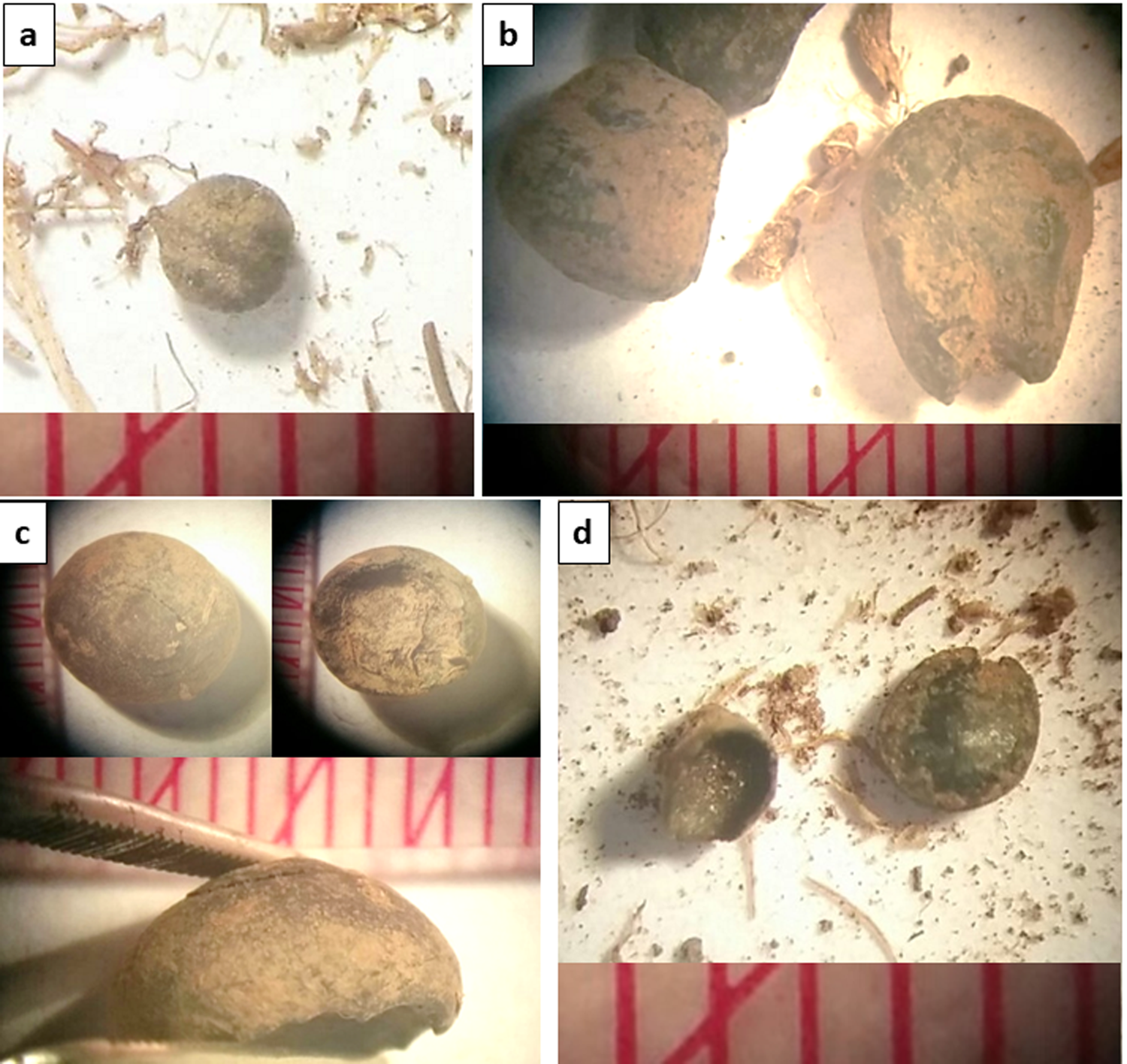
In terms of common crop plants, a great deal of maize was recovered from the light fraction samples, including both charred kernels and cupules; common domesticated beans were present in small quantities. There were no seeds or seed fragments consistent with cacao, chile peppers, or squash. In addition to the expected annual crop plants, several palm family (Arecaceae) endocarp fragments were recovered, some likely from coyol and others from cohune. In terms of non-domesticated herbaceous species, catchfly (Silene sp.), goosefoot (Chenopodium sp.), passionflower (Passiflora sp.), false pennyroyal (Hedeoma sp.), goosegrass (Eleusine sp.), wood sorrel (Oxalis sp.), evening primrose (Oenothera sp.), and skullcap (Scutellaria sp.) were all recovered. Other taxa included plants in the families of amaranth, aster, bean, ceiba, borage, cotton, rose, morning glory, nightshades, poppy, grass (including foxtail, millet, and goosegrass genera), and mint (including false pennyroyal). Identified fruit species included nance, hogplum, wild grape, pincushion cactus, and ramon. This roster of economic species was amplified using methods to recover microbotanical residues.
Microscopic Food Residues
During the 2015 field season, microbotanical residues were extracted at the laboratory at Copan from 51 artifacts, including groundstone, chipped-stone tools, and ceramic sherds representing a variety of vessel morphologies. These extractions resulted in a dataset of 153 samples, after taking a dry wash, wet wash, and sonicated wash sample from each artifact. The first and third washes identify material related to surrounding matrices and artifact use, respectively, whereas the second wash tracks the movement of material between the artifact and surrounding sediments. In the laboratory analyses, Morell-Hart (Reference Morell-Hart2015b) and Pugliese (Reference Pugliese2020) targeted plant residues including starches, phytoliths, and other botanical detritus. Here, we discuss findings from residue extractions of 22 of the 51 artifacts: four ceramic vessel sherds, a retouched chert flake, a machacador, five manos, two metates, seven obsidian blade fragments, an obsidian flake, and an obsidian microblade (Supplemental Table 2). We focus on evidence from the sonicated residues, because this is the material most likely associated with artifact use.
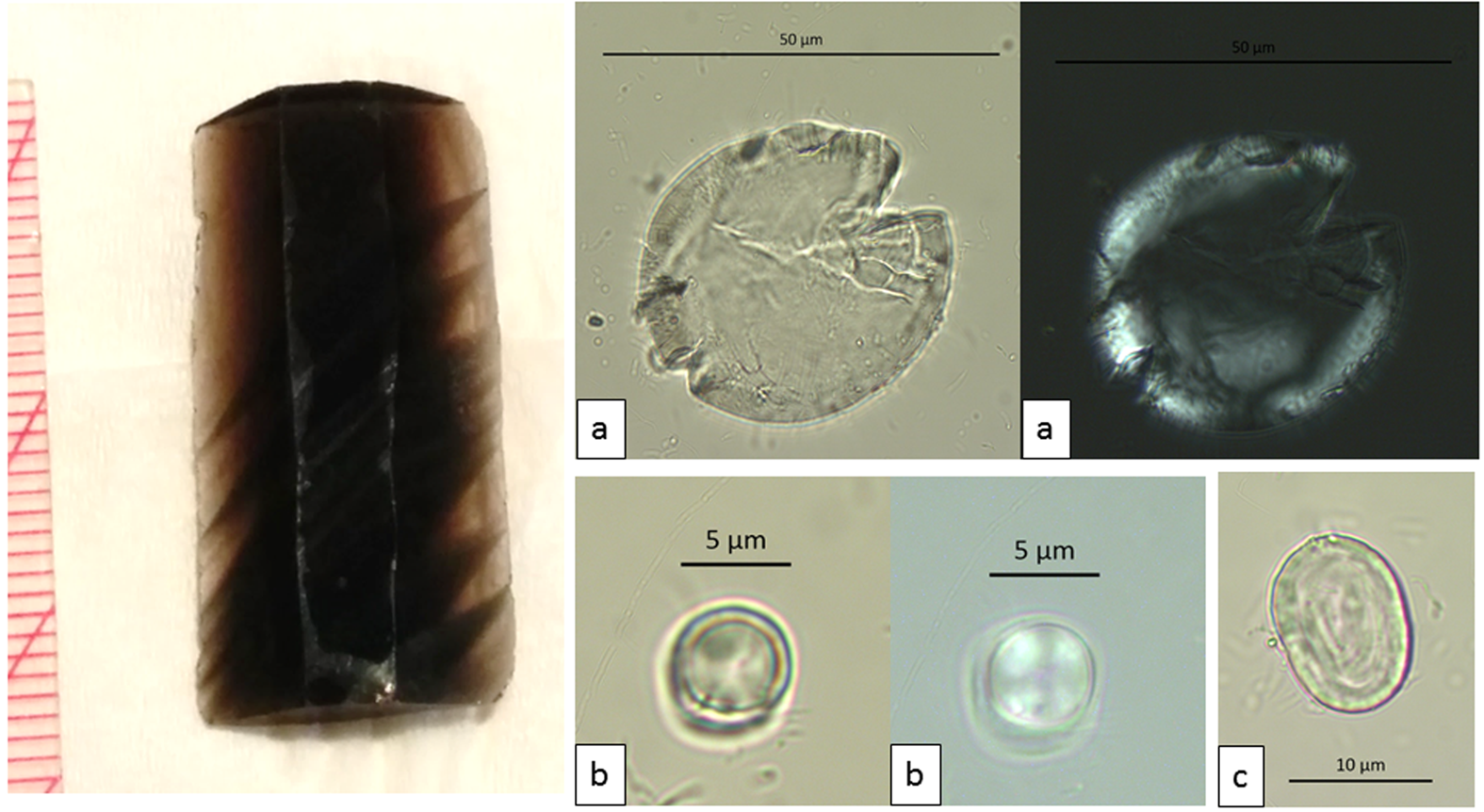
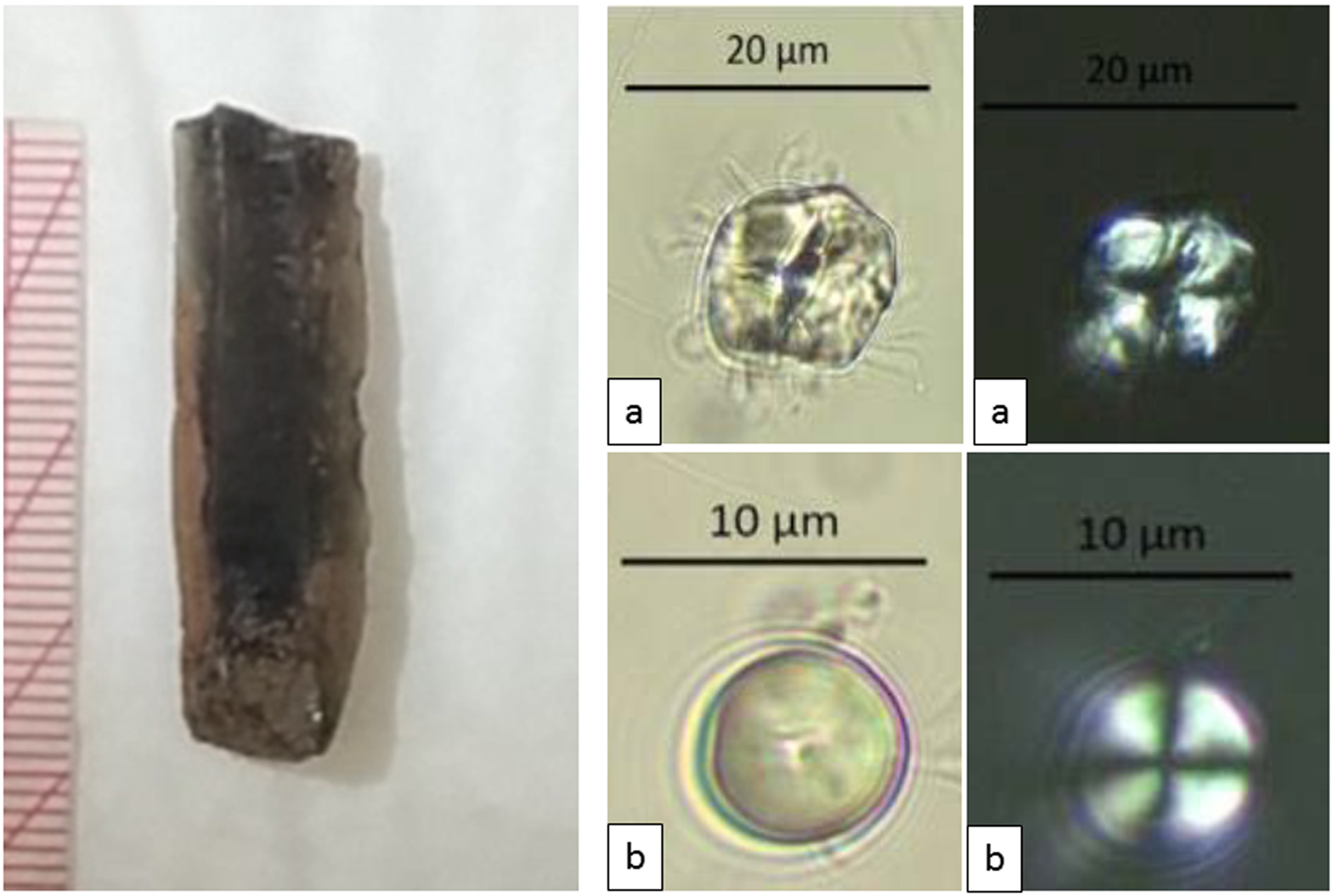
A minimum of 34 taxa from at least 12 identified families were revealed in these analyses (Figures 3–5). In terms of culinary ingredients, 12 artifacts yielded potential culinary taxa. These taxa include milpa annual crop plants (maize and beans), palm family species, non-domesticated plants with edible flowers (costus) and fruits (hackberry), and tentatively identified root and tuber foods (lerén, sweet potato, and achira). Two ceramic artifacts (#15 and #16), an obsidian blade (#28), and a chert retouched flake (#51) yielded palm family phytoliths, taxa potentially overlapping with the cohune and coyol endocarp fragments noted in the macrobotanical scan. Tentatively identified edible root and tuber plants included lerén genus (Calathea sp.) phytoliths recovered from a ceramic artifact (#15), a damaged achira (Canna sp.) starch grain from an obsidian blade (#29), and sweet potato (Ipomoea batatas) starch grains from a different obsidian blade (#32). The edible flower taxon Costaceae sp. was identified as a phytolith on an obsidian blade (#28), whereas hackberry phytoliths were noted on a mano (#48). Only one bean family starch grain was positively identified, on an obsidian blade (#28), but starch grains were also tentatively identified on another obsidian blade (#29) and a ceramic artifact (#16). Maize was most ubiquitous, appearing on two artifacts (machacador #3; ceramic #12) as phytoliths and four obsidian blades (#28, #30, #32, #36) as starch grains. One maize starch grain was also tentatively identified on an obsidian microblade (#39).
Selected Río Amarillo area microbotanical residues recovered from obsidian blade #28 (RA-ESQNW-PATA-S37-U14-N3-MICROBOT2-SO): (a) maize (Zea mays) starch grains (partially obscured); (b) costus family (Costaceae) phytolith; and (c) Fabaceae (bean family) starch grain. Photos by Shanti Morell-Hart. (Color online)

Selected Río Amarillo area microbotanical residues recovered from obsidian blade #29 (RA-S2-U15-N2-MICROBOT1-SO): (a) achira (cf. Canna) starch grain (damaged); (b) unknown damaged starch grain; and (c) bean family (Fabaceae) starch grain. Photos by Shanti Morell-Hart. (Color online)
Selected Río Amarillo area microbotanical residues recovered from obsidian blade #32 (RA-P2C-S9-U5-N4-MICROBOT1-SO): (a) maize starch grain and (b) sweet potato (cf. Ipomoea batatas) starch grain (damaged). Photos by Shanti Morell-Hart. (Color online)
Uses of Culinary Equipment
In terms of culinary equipment, there were some surprising results. One mano had the greatest variety of material (at least four distinct taxa) but few identifiable taxa and none of the expected culinary taxa, including maize. The metates, in contrast to the mano, yielded no identifiable starch grains or phytoliths, following a pattern one author (Morell-Hart) has noted at many other sites in southeastern Mesoamerica. This odd phenomenon is likely a taphonomic issue, caused by the frequent reuse of metates as building materials and the high porosity of the basalt and limestone used in making these grinding stones. The machacador (#3) yielded maize leaf phytoliths, likely related to the pounding of maize leaves for unknown reasons, perhaps medicinal, along with other Panicoideae subfamily leaf phytoliths.
Only three of the ceramic vessels sampled yielded potential culinary species. The small jar (cantaro, #12) contained maize, one bowl (cuenco, #15) contained palm phytoliths and potentially lerén, and the cylindrical vessel (#16) contained palm phytoliths and potential bean family starch grains. These vessels appeared more consistent with serving and preparation than with storage (vessels are generally larger) or cooking (they are generally scorch-marked). The identified palm phytoliths originate in leaves, not fruits, so it is likely that the presence of palm in these vessels is related more to serving (basketry, etc.) or preparation (utensils, etc.) than direct consumption.
Chipped-stone tools on average yielded the largest number of identifiable microremains. Obsidian blades, as has been noted elsewhere (Morell-Hart et al. Reference Morell-Hart, Joyce and Henderson2014, Reference Morell-Hart, Joyce, Henderson and Cane2019), appeared to have the greatest variety of uses (Figures 3–5). A set of residues from one blade alone (#28) contained phytoliths from the palm and costus families, as well as starch grains from the bean family and maize. Maize starch was recovered from two other blades (#30, #32), likely indicating the fairly frequent use of blades in processing maize foodstuffs. These starch grains were both undamaged (#28, #30) and damaged (#32), probably indicating that people used these blades for processing both cooked (e.g., tamales) and uncooked (e.g., young corn) maize foods. A fourth obsidian blade (#29) contained only damaged starch grains, some from the bean family and one enormous starch grain likely from achira. The microbotanical evidence here points toward the use of this obsidian blade for processing cooked foods, perhaps cooked achira rhizomes and beans. The chert retouched flake (#51) appears to have been used only for palm leaf processing, given the phytoliths recovered, whereas the obsidian macroblade (#39) residues contained a tentatively identified maize starch grain.
Cuisines at the Crossroads
When we make side-by-side comparisons of northwestern Honduras sites, unsurprisingly the Río Amarillo area has a great deal in common with nearby Copan and some overlap with typical culinary practices at Ulúa Valley sites (Supplemental Table 2). All three areas show evidence of annual milpa crops of maize and beans, but residues of the chile peppers and squashes are found only at Copan and the Ulúa Valley sites and not in the Río Amarillo area. Cohune palm endocarps were recovered from both the Río Amarillo and Ulúa Valley sites. But no peach palm residues have appeared at the Río Amarillo area like those found at Copan, and coyol palm endocarps have only tentatively been identified during excavations in the Río Amarillo area (in this case, Site 5), in contrast to the Ulúa Valley locations where palm fruits were relatively abundant. In terms of root and tuber crops, manioc and arrowroot are both absent from the Río Amarillo area and Copan, and we have only one tentative identification of lerén thus far at Río Amarillo, whereas Ulúa Valley sites have evidence of all three. However, the Río Amarillo area does have sweet potato in common with Ulúa Valley sites and is the only site in the region with any evidence of achira.
In terms of other fruit species, we have evidence that Río Amarillo area residents enjoyed hogplums and wild grapes as they did at Copan but not in the Ulúa Valley. They also enjoyed cactus fruits and nances like the residents of Ulúa Valley sites but not of Copan. There is no evidence of papaya and scant evidence of custard apple in the Maya sites, unlike the Ulúa sites where both plants were found. Meanwhile, residents of Copan are thus far unique in the use of chayote squash and avocado. Ramon, like achira, represents a taxon unique to the Río Amarillo area. Cacao is so far absent at Río Amarillo sites, unlike the other two areas, but chemical signature or palynological analysis may change this picture as well. Hackberries appear to have been enjoyed across northwestern Honduras and were recovered from all these sites. Many other herbaceous species still await detailed identifications, but as with the other two areas the Río Amarillo area demonstrates extensive use of wild, managed, and fallow-dwelling taxa.
Almost all of the identified food plants were found in Classic Period deposits, whereas no taxa were present only in the Formative Period (Supplemental Table 2). Ramon and potentially achira were only recovered in Early Postclassic deposits and only in the Río Amarillo area. A few food plants are found across Formative, Classic, and Early Postclassic residues (common bean, maize, and palm fruits all from all three areas and possibly lerén and sweet potato).
Much work is still pending at Río Amarillo area sites in terms of microbotanical and macrobotanical analysis. The current picture of culinary ingredients may change after more artifact extractions have been analyzed and more flotation samples have been scanned. Even so, our comparison of plant ubiquities paints a picture of culinary practice that cannot be cleaved neatly into “Maya” and “non-Maya.” We see the overlap of rich food heritages and the sharing of food knowledge and plant species, indicating persistence in culinary traditions and the development of fusion foods. Our findings situate northwestern Honduras at a crossroads of culinary practices, between more western sites in the Maya heartland and more eastern sites in probable ancestral Lenca territories.
More broadly, we see northwestern Honduras situated at the intersection of culinary practices between Mesoamerican societies to the north and Central and South American societies to the south. Lerén, for example, is popular in northern South America but virtually unused in the heart of Mesoamerica. Its presence in northwestern Honduras may mark a sort of culinary boundary—though a boundary only for this foodstuff. In contrast, yam species—recovered at the Maya sites of Kiuic farther to the north (Simms Reference Simms2014) and Chinikihá farther to the west (Trabanino García Reference Trabanino García, Arroyo, Aragón and Mejía2012a, Reference Trabanino García and Stuardo2012b)—have not been identified in any of the northwestern Honduras paleoethnobotanical records. Manioc, chile pepper, and maize—all crops noted at the northwestern Honduras sites—were identified at the site of Barillas in central Nicaragua (Ciofalo et al. Reference Ciofalo, Donner, Hofman and Geurds2020) and at Joya de Cerén in El Salvador (Farahani, Chiou, Harkey, et al. Reference Farahani, Chiou, Harkey, Hastorf, Lentz and Sheets2017). In this way, frontiers between culture regions appear blurred, and we see the culinary paths of plants as they make their way from the south northward and from the north southward. Some plants stop in northwestern Honduras, while others simply pass through.
Payson Sheets (Reference Sheets2000), working at the site of Joya de Cerén in El Salvador, has described the movements of goods through different sorts of economies—vertical, village, and household. Julia Hendon (Reference Hendon and Ardren2020) identified great culinary overlap between the Ulúa and Copan areas in faunal resources; in the use of culinary equipment such as metates, manos, and obsidian blades; and in ceramic vessels, suggesting some of the movement of goods described by Sheets (Reference Sheets2000). We find similar movements for the plants of northwestern Honduras, even though plants are generally less visible components of the archaeological record. As with durable artifacts, the movement and use of plants had to do with ideologies of the ruling class (Beliaev et al. Reference Beliaev, Davletshin, Tokovinine, Staller and Carrasco2010; McNeil Reference McNeil, Staller and Carrasco2010; Morehart et al. Reference Morehart, Lentz and Prufer2005; Stuart Reference Stuart and McNeil2006), local dynamics (Fedick Reference Fedick, Mathews and Guderjan2017; Guderjan et al. Reference Guderjan, Luzzadder-Beach, Beach, Bozarth, Krause, Mathews and Guderjan2017; Lentz Reference Lentz1991; Lentz et al. Reference Lentz, Lane, Thompson, Inomata and Triadan2014), and everyday household activities (Dedrick Reference Dedrick2014; Farahani, Chiou, Cuthrell, et al. Reference Farahani, Chiou, Cuthrell, Harkey, Morell-Hart, Hastorf, Sheets, Sayre and Bruno2017; Farahani, Chiou, Harkey, et al. Reference Farahani, Chiou, Harkey, Hastorf, Lentz and Sheets2017; Simms Reference Simms2014).
Alongside macroscale perspectives, through the microtransactions of the day to day—what was eaten and who shared it—we can trace parallel or intersecting relationships usually tracked through more durable goods such as obsidian, jade, and ceramics. “We only trust people who eat what we eat,” noted Rigoberta Menchú Tum to Elisabeth Burgos-Debray (Reference Burgos-Debray1983:xvii). The sharing of foodstuffs, whether through trade, tribute, migration, or intermarriage, testifies to a set of culinary relationships that are not distant from politico-economic relations (Appadurai Reference Appadurai1981, Reference Appadurai1988). In ancient northwestern Honduras, people may have marked regional political affiliations and conflicts as much through expressions of food as through texts carved into stone and painted onto ceramic.
Acknowledgments
We would like to thank the very many seasonal staff, volunteers, and students who contributed their efforts to the various projects referenced in this article. Shanti Morell-Hart also thanks Rosemary Joyce, Julia Hendon, John Henderson, and Jeanne Lopiparo, the project directors of Ulúa Valley sites referenced in this study. We are grateful to the Instituto Hondureño de Antropología e Historia (IHAH), which granted all permits for our research, both in the field and the laboratory. Funding for some of this research came from the National Science Foundation (funded project #1431002), the Stahl Fund of the Archaeological Research Facility, and a Research Assistantship in the Humanities (UC Berkeley). Infrastructure at the McMaster Paleoethnobotanical Research Facility (MPERF) was funded by the Canada Foundation for Innovation (Project #34522). An earlier version of this article was presented at the SAA symposium “The Copan Kingdom and Its Political Interactions along the Southeastern Maya Frontier,” organized by Cameron McNeil and Edy Barrios, and we thank the discussant Loa Traxler for providing helpful commentary during this session. Additional editorial comments were provided by four anonymous reviewers, and we are grateful for their suggestions to improve the manuscript.
Data Availability Statement
All primary data were generated by the authors or are available in published literature where referenced. The primary Río Amarillo data (tabular, imagery) on which this article is based are held by the authors and are available to interested researchers on request to the lead author. Microbotanical residues were analyzed on disposable slides at the McMaster Paleoethnobotanical Research Facility. Macrobotanical residues are housed in the archaeology laboratory at Copán Ruinas, Honduras, and correspond with the PRARA and PARAC materials curated by project directors Cameron McNeil and Edy Barrios.
Supplemental Materials
To view supplemental material for this article, please visit https://doi.org/10.1017/laq.2021.34.
Supplemental Table 1. Taxa Identified in Scanned Macrobotanical Samples from Río Amarillo.
Supplemental Table 2. Microbotanical Samples from the Río Amarillo Area.


 Open access

