




No CrossRef data available.
Spotlight on the trophic response of crop plants under shade temporal fluctuation
Published online by Cambridge University Press: 24 June 2026
Abstract

The emergence of complex cropping systems involving dual land use raises new questions regarding plant growth under intermittent shade conditions. Recent meta-analyses have investigated the dose–response relationships of several plant traits to light availability, highlighting the strong interest in understanding plant responses to light temporal variation. However, these studies also reveal significant gaps in our knowledge, particularly concerning plant responses to low-light conditions and the determinants of crop yield under shade. In this context, physiological mechanisms related to photosynthesis, growth, reproduction and, more broadly, carbon allocation appear to play a central role. This article emphasizes the major implications of carbon allocation, storage and use under prolonged and fluctuating shaded conditions for crop production.
Information
- Type
- Insights
- Information
- Creative Commons

 This is an Open Access article, distributed under the terms of the Creative Commons Attribution licence (https://creativecommons.org/licenses/by/4.0), which permits unrestricted re-use, distribution and reproduction, provided the original article is properly cited.
- Copyright
- © Institut national de recherche pour l’agriculture, l’alimentation et l’environnement (INRAE), 2026. Published by Cambridge University Press in association with John Innes Centre
Footnotes
Associate Editor: Dr. Daphne Ezer
References
Atlan, A., Hornoy, B., Delerue, F., Gonzalez, M., Pierre, J.-S., & Tarayre, M. (2015). Phenotypic plasticity in reproductive traits of the perennial shrub Ulex europaeus in response to shading: A multi-year monitoring of cultivated clones. PLoS One, 10(9), e0137500. https://doi.org/10.1371/journal.pone.0137500
Google Scholar
Ballaré, C. L., & Pierik, R. (2017). The shade-avoidance syndrome: Multiple signals and ecological consequences. Plant, Cell & Environment, 40(11), 2530–2543. https://doi.org/10.1111/pce.12914
Google Scholar
Barron-Gafford, G. A., Pavao-Zuckerman, M. A., Minor, R. L., Sutter, L. F., Barnett-Moreno, I., Blackett, D. T., Thompson, M., Dimond, K., Gerlak, A. K., Nabhan, G. P., & Macknick, J. E. (2019). Agrivoltaics provide mutual benefits across the food–energy–water nexus in drylands. Nature Sustainability, 2(9), 848–855. https://doi.org/10.1038/s41893-019-0364-5
Google Scholar
Bloom, A. J., Chapin, F. S., & Mooney, H. A. (1985). Resource limitation in plants-an economic analogy. Annual Review of Ecology, Evolution, and Systematics, 16, 363–392. https://doi.org/10.1146/annurev.es.16.110185.002051
Google Scholar
Calabrese, E. J., & Blain, R. B. (2009). Hormesis and plant biology. Environmental Pollution, 157(1), 42–48. https://doi.org/10.1016/j.envpol.2008.07.028
Google Scholar
Dodd, M. B., McGowan, A. W., Power, I. L., & Thorrold, B. S. (2005). Effects of variation in shade level, shade duration and light quality on perennial pastures. New Zealand Journal of Agricultural Research, 48(4), 531–543. https://doi.org/10.1080/00288233.2005.9513686
Google Scholar
Donald, C. M. (1968). The breeding of crop ideotypes. Euphytica, 17(3), 385–403. https://doi.org/10.1007/BF00056241
Google Scholar
Durand, M., Matule, B., Burgess, A. J., & Robson, T. M. (2021). Sunfleck properties from time series of fluctuating light. Agricultural and Forest Meteorology, 308-309, 108554. https://doi.org/10.1016/j.agrformet.2021.108554
Google Scholar
Durand, M., Stangl, Z. R., Salmon, Y., Burgess, A. J., Murchie, E. H., & Robson, T. M. (2022). Sunflecks in the upper canopy: Dynamics of light-use efficiency in sun and shade leaves of Fagus sylvatica
. New Phytologist, 235(4), 1365–1378. https://doi.org/10.1111/nph.18222
Google Scholar
Edouard, S., Combes, D., Van Iseghem, M., Ng Wing Tin, M., & Escobar-Gutiérrez, A. J. (2023). Increasing land productivity with agriphotovoltaics: Application to an alfalfa field. Applied Energy, 329, 120207. https://doi.org/10.1016/j.apenergy.2022.120207
Google Scholar
Emmerson, R. A., Davey, P., Kandjoze, M., Bechtold, U., Zabet, N. R., & Lawson, T. (2025). DNA methylation contributes to plant acclimation to naturally fluctuating light. The New Phytologist, 248(5), 2361–2375. https://doi.org/10.1111/nph.70567
Google Scholar
Giertych, M. J., Karolewski, P., & Oleksyn, J. (2015). Carbon allocation in seedlings of deciduous tree species depends on their shade tolerance. Acta Physiologiae Plantarum, 37(10), 216. https://doi.org/10.1007/s11738-015-1965-x
Google Scholar
Golan, G., Weiner, J., Zhao, Y., & Schnurbusch, T. (2024). Agroecological genetics of biomass allocation in wheat uncovers genotype interactions with canopy shade and plant size. New Phytologist, 242(1), 107–120. https://doi.org/10.1111/nph.19576
Google Scholar
Kala, C. P. (2025). Agroforestry in a changing climate: Challenges, opportunities and solutions. Ecological Frontiers, 45(2), 269–276. https://doi.org/10.1016/j.ecofro.2024.11.003
Google Scholar
Laub, M., Pataczek, L., Feuerbacher, A., Zikeli, S., & Högy, P. (2022). Contrasting yield responses at varying levels of shade suggest different suitability of crops for dual land-use systems: A meta-analysis. Agronomy for Sustainable Development, 42(3), 51. https://doi.org/10.1007/s13593-022-00783-7
Google Scholar
Lescroart, L., Boudon, F., Granier, C., Dingkuhn, M., & Perez, R. P. A. (2026). Beyond light quantity: Intermittent shading affects growth and yield more than constant shading in rice cultivars. Environmental and Experimental Botany, 241, 106301. https://doi.org/10.1016/j.envexpbot.2025.106301
Google Scholar
Liang, X.-G., Chen, H.-M., Pan, Y.-Q., Wang, Z.-W., Huang, C., Chen, Z.-Y., Tang, W., Chen, X.-M., Shen, S., & Zhou, S.-L. (2025). Yield more in the shadow: Mitigating shading-induced yield penalty of maize via optimizing source-sink carbon partitioning. European Journal of Agronomy, 162, 127421. https://doi.org/10.1016/j.eja.2024.127421
Google Scholar
Malézieux, E., Crozat, Y., Dupraz, C., Laurans, M., Makowski, D., Ozier-Lafontaine, H., Rapidel, B., De Tourdonnet, S., & Valantin-Morison, M. (2009). Mixing plant species in cropping systems: Concepts, tools and models: A review. In Lichtfouse, E., Navarrete, M., Debaeke, P., Véronique, S., & Alberola, C. (Eds.), Sustainable agriculture (p. 329–353). Springer Netherlands. https://doi.org/10.1007/978-90-481-2666-8_22
Google Scholar
Monteith, John Lennox et al. (1977). Climate and the efficiency of crop production in Britain. Philosophical Transactions of the Royal Society of London B. Biological Sciences, 281(980), 277–294. https://doi.org/10.1098/rstb.1977.0140
Google Scholar
Niinemets, Ü., & Valladares, F. (2004). Photosynthetic acclimation to simultaneous and interacting environmental stresses along natural light gradients: Optimality and constraints. Plant Biology, 6(3), 254–268. https://doi.org/10.1055/s-2004-817881
Google Scholar
Niinemets, Ü., & Valladares, F. (2006). TOLERANCE TO SHADE, DROUGHT, AND WATERLOGGING OF TEMPERATE NORTHERN HEMISPHERE TREES AND SHRUBS. Ecological Monographs, 76(4), 521–547. https://doi.org/10.1890/0012-9615(2006)076%5B0521:TTSDAW%5D2.0.CO;2
Google Scholar
Niinemets, Ü., Keenan, T. F., & Hallik, L. (2015). A worldwide analysis of within-canopy variations in leaf structural, chemical and physiological traits across plant functional types. New Phytologist, 205, 973–993.Google Scholar
Owston, N. (2025). Lie-ins or early bedtimes : Do either affect how grasses perform in solar parks? [Master’s Thesis, Lancaster University]. https://doi.org/10.17635/lancaster/thesis/3090
Google Scholar
Pearcy, R. W., & Way, D. A. (2012). Two decades of sunfleck research: Looking back to move forward. Tree Physiology, 32(9), 1059–1061. https://doi.org/10.1093/treephys/tps084
Google Scholar
Perez, RPA et al. (2024). Combining modeling and experimental approaches for developing rice–oil palm agroforestry systems. Journal of Experimental Botany, 75(13), 4074–4092. https://doi.org/10.1093/jxb/erae137
Google Scholar
Poorter, H., Niinemets, Ü., Ntagkas, N., Siebenkäs, A., Mäenpää, M., Matsubara, S., & Pons, T. L. (2019). A meta-analysis of plant responses to light intensity for 70 traits ranging from molecules to whole plant performance. New Phytologist, 223(3), 1073–1105. https://doi.org/10.1111/nph.15754
Google Scholar
Poorter, H., Niklas, K. J., Reich, P. B., Oleksyn, J., Poot, P., & Mommer, L. (2012). Biomass allocation to leaves, stems and roots: Meta-analyses of interspecific variation and environmental control. New Phytologist, 193(1), 30–50. https://doi.org/10.1111/j.1469-8137.2011.03952.x
Google Scholar
Porcar-Castell, A., & Palmroth, S. (2012). Modelling photosynthesis in highly dynamic environments: The case of sunflecks. Tree Physiology, 32(9), 1062–1065. https://doi.org/10.1093/treephys/tps085
Google Scholar
Toledo, C., & Scognamiglio, A. (2021). Agrivoltaic systems design and assessment: A critical review, and a descriptive model towards a sustainable landscape vision (three-dimensional Agrivoltaic patterns). Sustainability, 13(12), 6871. https://doi.org/10.3390/su13126871
Google Scholar
Varella, A. C., Moot, D., Pollock, K., Peri, P., & Lucas, R. (2011). Do light and alfalfa responses to cloth and slatted shade represent those measured under an agroforestry system? Agrofor Syst. Agroforestry Systems, 81, 157–173. https://doi.org/10.1007/s10457-010-9319-6
Google Scholar
Yajima, D., Toyoda, T., Kirimura, M., Araki, K., Ota, Y., & Nishioka, K. (2023). Agrivoltaic system: Estimation of photosynthetic photon flux density under solar panels based on solar irradiation data using all-climate solar spectrum model. Cleaner Engineering and Technology, 12, 100594. https://doi.org/10.1016/j.clet.2022.100594
Google Scholar
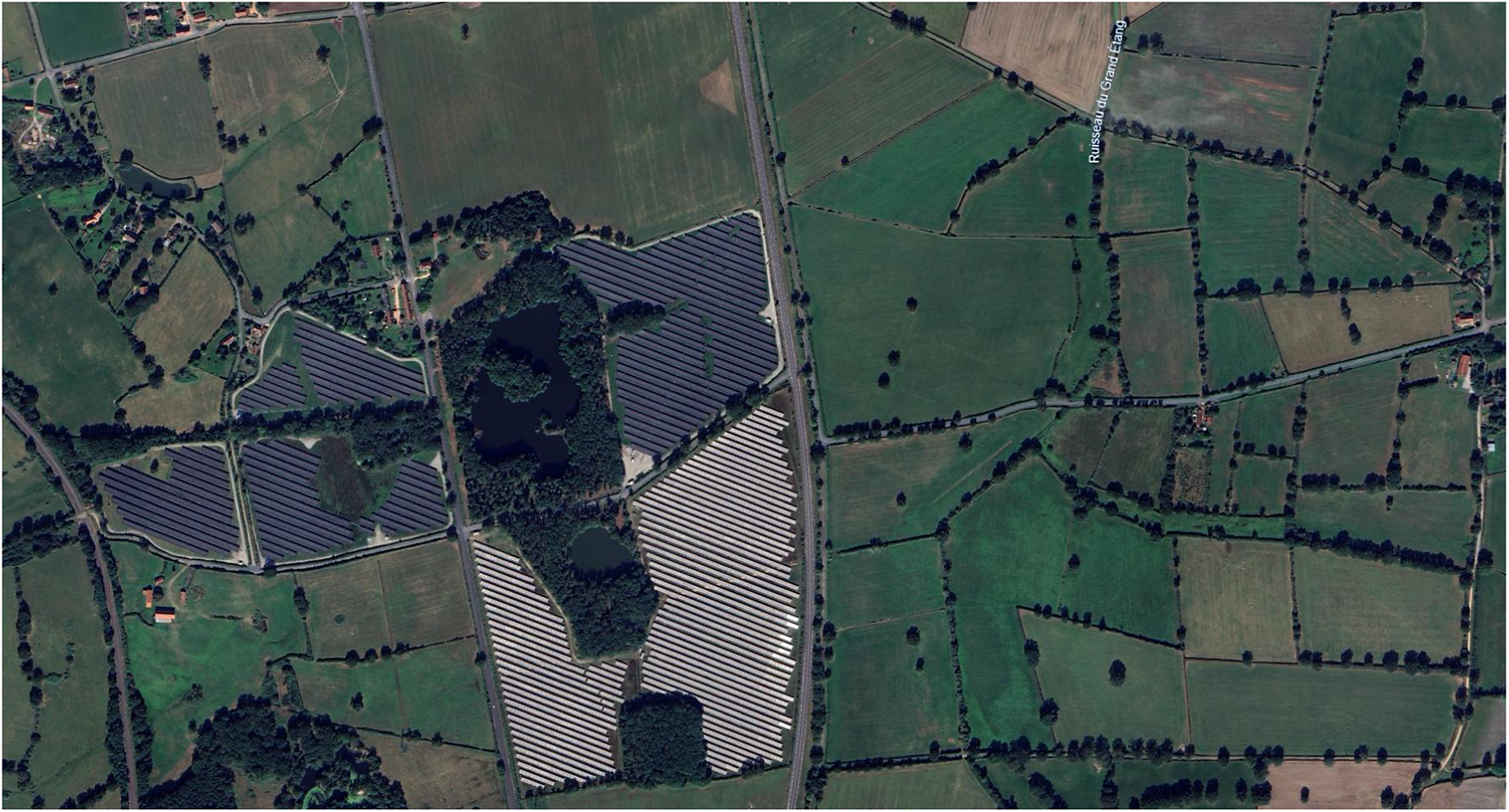
Figure 1. Agricultural landscape incorporating a photovoltaic power station, forest, livestock farming and arable crops, separated by hedgerows. (46°18′49″ N, 2°44′39″ E). Source: Google Earth, © Google, September 16, 2024.Figure 1. long description.
Author comment: Spotlight on the trophic response of crop plants under shade temporal fluctuation — R0/PR1
Published online by Cambridge University Press:
24 June 2026
DOI:
https://doi.org/10.1017/qpb.2026.10049.pr1
[Opens in a new window] Revision round: 0
Role: author
Comments
Dear Editor,
I am pleased to submit my Insight article entitled “Spotlight on the trophic response of crop plants under shade temporal fluctuation” for consideration for publication in Quantitative Plant Biology.
The development of complex cropping systems involving dual land use (agroforestry, agrivoltaic systems, intrcropping) has renewed interest in understanding crop performance under low light and shading. While recent meta-analyses have clarified dose–response relationships between plant traits and light availability, they also highlight substantial knowledge gaps, particularly regarding crop responses to temporal fluctuation of light, i.e under intermittent and/or prolonged shade conditions. In this Insight paper, I argue that trophic responses and carbon partitioning are central to understanding how fluctuating shade conditions shape crop performance and ultimately determine yield.
I believe this contribution aligns closely with the journal’s scope. This manuscript is original, has not been published previously, and is not under consideration elsewhere.
Thank you for considering this submission. I look forward to your response.
Sincerely,
Nicolas Dusart
Review: Spotlight on the trophic response of crop plants under shade temporal fluctuation — R0/PR2
Published online by Cambridge University Press:
24 June 2026
DOI:
https://doi.org/10.1017/qpb.2026.10049.pr2
[Opens in a new window]
Date of review:
03 March 2026
Revision round: 0
Role: reviewer
Recommendation/decision: minor-revision
Conflict of interest statement
Reviewer declares none.
Comments
This insight provides a concise overview of the literature relating to fluctuations in light/shade in agricultural systems and suggests how dual land use may impact this. The author discusses the factors that are linked to shading, including light intensity and timing of exposure, linking these to relevant plant physiological traits.
There are some instances where the intended meaning is unclear:
-“such as cloud cover affecting stomatal conductance (Vialet-Chabrand et al. 2017)”. This paper attributes some fluctuations in light to cloud cover, but does not directly attribute changes in stomatal conductance to changes in light caused by cloud cover. Maybe reword this to put less emphasis on the cloud cover and more on the diurnal fluctuations for a range of reasons.
-“For perennial plant, comparing tree seedling shade tolerant vs light demanding revealed”- do you mean shade tolerance vs light demanding varieties?
-“Shading duration significantly influenced pasture yield”- you later go on to mention legume abundance, is this the crop in the pasture studied?
-"This study suggests that agroecological practices may drive the selection of
less competitive individual plants, thereby enhancing overall population yield"- I think this would benefit from some further explanation, it is not currently clear to me how selection of less competitive plants could enhance yield. Do you mean that there has been selection for plants that compete less for resources e.g. light (so shade neighbours less), therefore reducing competition between individuals within the population and so increasing overall yield?
Additional comments:
- from the introductory paragraph, I was expecting the theme of dual land use to thread through the manuscript. It isn’t entirely clear how dual land use is impacting some of the parameters mentioned
Other than these, I found the insight enjoyable and thought-provoking
Review: Spotlight on the trophic response of crop plants under shade temporal fluctuation — R0/PR3
Conflict of interest statement
Reviewer declares none.
Comments
I enjoyed reading this perspective and I think the authors discuss a very important aspect on light (patterns and intensity) and plant growth.
One thing that could improve this manuscript would be to discuss a recent finding on how changes in light patters (fluctuating light vs square light) leads to more epigenetic changes (mainly in transposable elements) compared to changes in light intensity (low vs high); see PMID:40974118.
Review: Spotlight on the trophic response of crop plants under shade temporal fluctuation — R0/PR4
Conflict of interest statement
Reviewer declares none.
Comments
This is a nice insight paper offering a fresh perspective on plant responses to shade. However, the main message of the manuscript escapes me a bit: what should we prioritize exactly in terms of research to most efficiently advance our knowledge on crop growth under intermittent shade conditions? Maybe a conclusion paragraph would be useful. I also have a number of minor comments:
- Terminology such as relay cropping, intercropping should be defined at first use
- R/FR ratio should be spelled out at first use (it is spelled out later in the text)
- The manuscript could benefit from proofreading by a native English speaker. Given the lack of line numbers in the manuscript, it is difficult to list the errors, but they frequently involve using singular terms where plurals should be used.
- ‘… the authors explored a large database of plant traits related to anatomy, morphology, physiology growth or reproduction express as dose response curve against DLI’. I assume this should be ‘a large database of plant traits related to anatomy, morphology, physiology, growth or reproduction expressed as dose response curves against DLI’.
- ‘…across crop types, yield responses to shading differ significantly and can be classified into three categories…’ should be ‘…across crop types, yield responses to shading differ significantly and crop types can be classified into three categories…’.
- ‘up to approx. 40% reduction solar radiation (RSR)’ should be ‘up to approx. 40% reduction in solar radiation (RSR)’.
- ‘For perennial plant, comparing tree seedling shade tolerant vs light demanding revealed a partitioning difference between compartment with more height growth and storage for shade tolerant (Giertych et al. 2015).’ : I do not understand this sentence.
- ‘Similarly, a two-year agrivoltaic experiment on alfalfa revealed variable yield responses between years, likely linked to differences in water availability (Edouard et al. 2023).’ : how does this link to shading responses ?
- ‘Current research highlights the lack of data for large response amplitudes, particularly under low-light conditions.’ : what is meant with ‘large response amplitudes’ ?
Recommendation: Spotlight on the trophic response of crop plants under shade temporal fluctuation — R0/PR5
Published online by Cambridge University Press:
24 June 2026
DOI:
https://doi.org/10.1017/qpb.2026.10049.pr5
[Opens in a new window]
Date of review:
23 March 2026
Revision round: 0
Role: Associate Editor
Recommendation/decision: minor-revision
Comments
Please see the minor revisions suggested by the review. Please especially consider addressing the question posed by the third reviewer: “ what should we prioritize exactly in terms of research to most efficiently advance our knowledge on crop growth under intermittent shade conditions?”
Decision: Spotlight on the trophic response of crop plants under shade temporal fluctuation — R0/PR6
Published online by Cambridge University Press:
24 June 2026
DOI:
https://doi.org/10.1017/qpb.2026.10049.pr6
[Opens in a new window] Revision round: 0
Role: Editor in Chief
Recommendation/decision: minor-revision
Comments
No accompanying comment.
Author comment: Spotlight on the trophic response of crop plants under shade temporal fluctuation — R1/PR7
Published online by Cambridge University Press:
24 June 2026
DOI:
https://doi.org/10.1017/qpb.2026.10049.pr7
[Opens in a new window] Revision round: 1
Role: author
Comments
No accompanying comment.
Review: Spotlight on the trophic response of crop plants under shade temporal fluctuation — R1/PR8
Published online by Cambridge University Press:
24 June 2026
DOI:
https://doi.org/10.1017/qpb.2026.10049.pr8
[Opens in a new window]
Date of review:
16 April 2026
Revision round: 1
Role: reviewer
Recommendation/decision: accept
Conflict of interest statement
Reviewer declares none.
Comments
Thank you for your revisions, all my comments have been addressed. I have one very minor point; on line 165 you refer to the study utilising “chamber experiments” which is not the case. I suggest just removing the word “chamber” or replacing this with “controlled”/similar if you want to make the point that this was a laboratory experiment
Review: Spotlight on the trophic response of crop plants under shade temporal fluctuation — R1/PR9
Conflict of interest statement
Reviewer declares none.
Comments
The authors addressed my comment
Recommendation: Spotlight on the trophic response of crop plants under shade temporal fluctuation — R1/PR10
Published online by Cambridge University Press:
24 June 2026
DOI:
https://doi.org/10.1017/qpb.2026.10049.pr10
[Opens in a new window]
Date of review:
24 May 2026
Revision round: 1
Role: Associate Editor
Recommendation/decision: accept
Comments
No accompanying comment.
Decision: Spotlight on the trophic response of crop plants under shade temporal fluctuation — R1/PR11
Published online by Cambridge University Press:
24 June 2026
DOI:
https://doi.org/10.1017/qpb.2026.10049.pr11
[Opens in a new window] Revision round: 1
Role: Editor in Chief
Recommendation/decision: accept
Comments
No accompanying comment.
 You have
Access
You have
Access
 Open access
For several years now, under the combined influence of climate change and economic needs, dual land use systems have been promoted (Kala, Reference Kala2025; Malézieux et al., Reference Malézieux, Crozat, Dupraz, Laurans, Makowski, Ozier-Lafontaine, Rapidel, De Tourdonnet, Valantin-Morison, Lichtfouse, Navarrete, Debaeke, Véronique and Alberola2009; Toledo & Scognamiglio, Reference Toledo and Scognamiglio2021). These systems incorporate service plants for intercropping (growing multiple crops together at the same time), relay cropping (introducing a second crop before the first one is harvested), agroforestry or energy production through solar panel installation (Figure 1). During domestication and breeding, crop plants were selected under light regimes characterized by full sunlight and dense plant stands (Donald, Reference Donald1968). Recent research has shifted towards examining crop responses to shade, particularly within complex cropping systems. This paradigm shift requires careful consideration of the characteristics of the whole microclimate and its impact on plant physiological responses. The development of these systems has generated and will generate a large amount of data for quantitative analysis.
Agricultural landscape incorporating a photovoltaic power station, forest, livestock farming and arable crops, separated by hedgerows. (46°18′49″ N, 2°44′39″ E). Source: Google Earth, © Google, September 16, 2024.
Figure 1. Long description
The aerial view is centered on a large P V power station composed of several distinct clusters of dark solar panels. At the heart of the installation is a dense, dark green forest patch containing a small body of water. To the East of the solar clusters, the landscape transitions into a mosaic of bright green agricultural fields and livestock pastures. These fields are strictly partitioned by a network of dark green hedgerows and narrow tree lines, creating a grid-like pattern. A prominent North-South road bisects the image, separating the primary solar installation from the eastern arable lands. In the Northwest and Southwest corners, small clusters of farm buildings and residential structures are visible, connected by thin access roads. The Ruisseau du Grand Etang stream is labeled in the Northeast quadrant, cutting through the hedgerow-lined fields.
Behind the notion of shading lies a multitude of different conditions, linked in particular to spatial and temporal fluctuations depending on the type of system. On a spatial scale, starting with the plant, the architecture and morphogenesis of leaves influence light interception (Niinemets & Valladares, Reference Niinemets and Valladares2004). The light quality is also modified by the plant canopy, which results in a change in the red/far-red (R/FR) ratio, probably the most studied photomorphogenic signal in plants (Ballaré & Pierik, Reference Ballaré and Pierik2017). Within the stand, competition between neighbouring plants creates heterogeneities in canopy cover (Perez et al., Reference Perez2024), which can be found in agroforestry and with photovoltaic panels on another spatial scale. On a temporal scale, shading can be linked to different time steps: (i) infra-hourly, such as sunflecks (brief bursts of light through canopy gaps) requiring rapid photosynthetic induction (Durand et al., Reference Durand, Matule, Burgess and Robson2021); (ii) daily, resulting from solar trajectory and light interception by neighbouring obstacles (plant, structure, cloud, etc.); and (iii) seasonal, depending on the sun’s path, which triggers a long-term physiological acclimation. In this respect, agroforestry and photovoltaic panels (excluding automated shade structures) differ: tree shading varies throughout the seasons according to their phenology, which can generate competition for soil resources, while photovoltaic panels, which are fixed, undergo variations linked solely to the seasonal path of the sun, without competition for other resources. This difference requires the shade to be carefully characterized according to the systems under study.
The characterization of shade is intrinsically linked to classical light measurements, ranging from the overall energy budget (W.m-2) to the assessment of photosynthetic photon flux density (PPFD, μmol.m-2s-1). Considering the total energy balance (short and long waves) allows a more complete representation of light impact on temperature, transpiration and photosynthesis. In addition, specific wavelengths, such as ultraviolet radiation or the R/FR ratio, can strongly influence plant development and may also be considered for their photomorphogenic effects (for review, see Ballaré & Pierik, Reference Ballaré and Pierik2017). However, most studies on light intensity focus on the 400–700 nm waveband, which corresponds to photosynthetically active radiation and is integrated into PPFD measurements. To account for the temporal variability of light over the day, PPFD is commonly integrated into the daily light integral (DLI, mol·m-2·d-1). Numerous plant traits have been shown to correlate more strongly with DLI than with instantaneous PPFD values measured at a specific time point (Monteith, Reference Monteith1977; Niinemets et al., Reference Niinemets, Keenan and Hallik2015).
Regarding the timing of shade exposure and sun–shade transitions during the day, multiple sun–shade transitions can occur (Varella et al., Reference Varella, Moot, Pollock, Peri and Lucas2011; Yajima et al., Reference Yajima, Toyoda, Kirimura, Araki, Ota and Nishioka2023). These transitions depend on the systems under study and on the orientation of structures that generate shading. A recent work on the timing of shade exposure (morning vs. afternoon) under similar daily light integrals (DLIs) has revealed differences in biomass accumulation among pasture species (Owston, Reference Owston2025). This challenges the general assumption that shade tolerance can be predicted solely from plant responses to uniform reductions in light. Gas-exchange kinetic properties, which determine how rapidly photosynthesis reaches full capacity following shade-to-sun transitions, are therefore critical (Durand et al., Reference Durand, Stangl, Salmon, Burgess, Murchie and Robson2022; Pearcy & Way, Reference Pearcy and Way2012; Porcar-Castell & Palmroth, Reference Porcar-Castell and Palmroth2012). These processes remain underexplored in agrivoltaic and agroforestry systems, raising new and challenging questions. How does intermittent shading modulate plant responses to low light, particularly carbon assimilation and integrated physiological responses? Do identical low DLI values but contrasting shading interruption patterns elicit similar plant responses? To address these questions, it is essential to place short-term responses within a broader plant response to light.
In the meta-analysis of Poorter et al. (Reference Poorter, Niinemets, Ntagkas, Siebenkäs, Mäenpää, Matsubara and Pons2019), the authors explored a large database of plant traits related to anatomy, morphology, physiology, growth or reproduction expressed as dose–response curves against DLI. Approximately 40% of the 70 variables considered show a saturating response to light. At high light conditions, some responses are probably associated with oxidative stress or metabolic limitation. Interestingly, their approach enables us to identify some gaps in our knowledge. No differences in plasticity were detected between shade-tolerant and light-demanding species. However, higher leaf mass area and/or tissue density in shade-tolerant species supports the stress-tolerance hypothesis, that is, a greater allocation of resources to defence and storage. Although their data did not provide evidence of carbon maximization per time unit, a positive carbon gain is, of course, essential in the long term. The underlying insight into the regulation of long-term responses of phenotypic traits is poor, and this is particularly true for C limitation at low light. It seems to me that this specific area is of particular concern for perennial plants in shade systems. Plant reproduction is also an understudied process in response to DLI, mainly because the time required for seed or fruit production often exceeds the duration of most experiments. Nevertheless, it emerges as one of the most plastic traits (Poorter et al., Reference Poorter, Niinemets, Ntagkas, Siebenkäs, Mäenpää, Matsubara and Pons2019). This process is of particular interest because of its crucial role in yield determination for numerous crops, including wheat, berries and fruit trees. To go further, the authors also raise an important ecological question: “What exactly causes light-demanding species to succumb under low light conditions, and why do shade-tolerant species perform so much better?” (Poorter et al., Reference Poorter, Niinemets, Ntagkas, Siebenkäs, Mäenpää, Matsubara and Pons2019). Building on this, I would add the question of whether carbon reserves and their allocation play a central role in plant responses to shading, particularly in their interactions with other biotic and abiotic environmental factors. These aspects warrant a dedicated discussion of plant responses to multiple stresses. In the present Insight, it will be kept brief. Studies have highlighted functional trade-offs between light and drought tolerance (Niinemets & Valladares, Reference Niinemets and Valladares2006). Beyond this trade-off, modifications of the energy balance directly influence organ temperature and plant water use. Agrivoltaic systems illustrate how structural shading modifies plant energy balance, reducing thermal stress and ultimately buffering drought impacts (Barron-Gafford et al., Reference Barron-Gafford, Pavao-Zuckerman, Minor, Sutter, Barnett-Moreno, Blackett, Thompson, Dimond, Gerlak, Nabhan and Macknick2019).
In a recent meta-analysis on crop yield responses to shading, Laub et al. (Reference Laub, Pataczek, Feuerbacher, Zikeli and Högy2022) hypothesized that, across crop types, yield responses to shading differ significantly. They proposed to classify crops into three categories: shade-benefiting, shade-tolerant and shade-susceptible. Shade-benefiting crops are defined as those exhibiting an increase in yield under low levels of shading, with yield declines occurring only at higher shading intensities, a pattern reminiscent of hormesis (Calabrese & Blain, Reference Calabrese and Blain2009). The results of Laub et al. (Reference Laub, Pataczek, Feuerbacher, Zikeli and Högy2022) indicate that crop responses to shading vary by type. Berries, fruits and fruity vegetables can benefit from moderate shade, up to ~40% reduction in solar radiation (RSR). Forages, leafy vegetables and tuber/root crops show limited yield losses under low shading (20% RSR), whereas maize and grain legumes are highly shade-sensitive. This type of response curve could be useful for determining the association and shading level in a dual-land use system. Beyond the observed yield responses to shading, a critical question concerns the parameters used to define and quantify yield. Does yield primarily reflect total biomass production, fruit yield or the accumulation of storage organs? The French idiom “to compare cabbages and carrots” highlights this issue, as yield may be characterized by fundamentally different biomass compartments, vegetative versus reproductive tissues, leaves versus fruits or below-ground storage organs and expressed in different units, such as fresh mass versus dry mass. These distinctions may partly explain differences in yield losses among crops, particularly between those whose yield is expressed as dry matter and those measured as fresh biomass. Yet, ultimately, they represent comparable physiological and functional responses across crop plants.
From my point of view, carbon allocation and partitioning at the whole plant level are central to this question. Taking into account the developmental stage, carbon allocation for growth or reproduction seems essential. For instance, a decline in the yield of maize under shading has been linked to alterations in the source-sink allocation (Liang et al., Reference Liang, Chen, Pan, Wang, Huang, Chen, Tang, Chen, Shen and Zhou2025). For perennial plants, comparing shade-tolerant versus light-demanding tree seedling revealed a partitioning difference between compartments, with the shade-tolerant species having more height growth and storage (Giertych et al., Reference Giertych, Karolewski and Oleksyn2015). Shading duration significantly influenced mixed pasture yield, which declined by about 10% after 3 months and by up to 50% after 12 months at 80% shade (Dodd et al., Reference Dodd, McGowan, Power and Thorrold2005). In addition, shading strongly altered pasture species composition, reducing legume abundance while favouring grasses (Dodd et al., Reference Dodd, McGowan, Power and Thorrold2005). Long-term effects are largely missing from existing studies. In both meta-analyses (Laub et al., Reference Laub, Pataczek, Feuerbacher, Zikeli and Högy2022; Poorter et al., Reference Poorter, Niinemets, Ntagkas, Siebenkäs, Mäenpää, Matsubara and Pons2019), most studies relied on data collected over one or two years or were based on short-term controlled experiments. As a result, the long-term effects of shading remain poorly understood. Only a limited number of studies have investigated the effects of shading over multiple years. Atlan et al. (Reference Atlan, Hornoy, Delerue, Gonzalez, Pierre and Tarayre2015) showed that 2 years of shading induced a strong but reversible reduction in flowering in common gorse. This raised questions around the long-term evolution of perennial crops (fruit trees, grapes, pasture, etc.) in these systems. Otherwise, a 2-year agrivoltaic experiment on alfalfa revealed variable yield responses between years, likely linked to differences in water availability (Edouard et al., Reference Edouard, Combes, Van Iseghem, Ng Wing Tin and Escobar-Gutiérrez2023). Shading decreased the yield by itself, but when combined with drought, it mitigated the effect of the water deficit on the yield (Edouard et al., Reference Edouard, Combes, Van Iseghem, Ng Wing Tin and Escobar-Gutiérrez2023). Even if shade reduces yield, it may counteract the effects of stochastic extreme events (e.g., drought and heat wave), making the agroecosystem more robust. But long-term experiments are needed to understand the effects of hazards and shade.
The optimal partitioning theory (also referred to as the functional equilibrium hypothesis) predicts that plants adjust biomass allocation toward the organ responsible for acquiring the most limiting resource in order to maximize growth (Bloom et al., Reference Bloom, Chapin and Mooney1985; Poorter et al., Reference Poorter, Niklas, Reich, Oleksyn, Poot and Mommer2012). In low-light conditions, aboveground biomass is favoured at the expense of belowground parts. However, such a shift may reduce the capacity of the plant to acquire other essential resources, such as nitrogen or water. Moreover, an increase in the leaf area or the aboveground biomass may intensify competition for light within the stand, potentially constraining overall growth. Golan et al. (Reference Golan, Weiner, Zhao and Schnurbusch2024) proposed a conceptual framework for investigating the genetic determinants that underlie resource allocation strategies in wheat under canopy shade conditions. This study suggests that agroecological practices may drive the selection of less competitive individual plants, thereby enhancing overall population yield (Donald, Reference Donald1968; Golan et al., Reference Golan, Weiner, Zhao and Schnurbusch2024). In the wheat case, an ideotype that prioritizes grain filling by sacrificing resources that would be used for competitive structures (such as leaves and stems) results from a trade-off between plant density/competition and production. This could benefit from an intercropping system, for example, cereal and legume.
Light intensity and shading generate dose–response curves for many physiological parameters. By definition, there is an optimal light level for crops, which can vary among species and across spatial contexts. Precisely determining which parameters control plasticity and, ultimately, yield is of primary importance in this expanding field of research. Current research highlights the lack of data for large response amplitudes, from low to high light, particularly under fluctuating low-light conditions. Consequently, future research should explore plant responses to light across a much wider range of intensities and various temporal fluctuations. Regarding intermittent shading, experiments comparing natural fluctuating light regimes with traditional square light have revealed a strong epigenetic regulation in Arabidopsis thaliana (Emmerson et al., Reference Emmerson, Davey, Kandjoze, Bechtold, Zabet and Lawson2025). These changes are associated with the regulation of genes involved in photosynthetic efficiency. A more recent work on rice has shown that intermittent shading leads to greater yield losses (~5–10% more than those caused by a simple reduction in light intensity), likely due to a decreased photosynthetic efficiency and an amplification of stress avoidance responses (Lescroart et al., Reference Lescroart, Boudon, Granier, Dingkuhn and Perez2026).
We should prioritize the characterization of daily and infra-hourly light patterns in different systems. Light quantitative data from various systems, notably agrivoltaic ones, could be used. This will also involve unravelling the effects of this intermittency on gas exchange dynamics, which could ultimately impact plant development. Whole-plant carbon balance plays a central role in these processes, and for perennial crops, long-term studies are needed to assess carbon starvation and plant mortality under shading. Finally, the system should be considered as a whole: there may be trade-offs between optimizing crop yield through shade manipulation and maximizing the overall economic performance of the system. Accepting a short-term or local yield loss may, in some cases, provide greater benefits by increasing system resilience to environmental stresses (pest, drought, heat wave, freezing events, etc.).
Open peer review
To view the open peer review materials for this article, please visit https://doi.org/10.1017/qpb.2026.10049.
Acknowledgements
The author is grateful to Didier Combes and Romain Barillot for their insightful discussions and careful revision of the manuscript. The author also wishes to thank Aline Zanin (La Plume d’Aline) for her thorough proofreading and correction of the manuscript.
Competing interest
The author declares none.
Data availability statement
No data or code were developed for this manuscript.
AI contributions
During the revision of this work, the author used ChatGPT and DeepL in order to improve language. After using these tools, the author reviewed the content as needed and took full responsibility for it.
Author contributions
N.D. conceived and wrote the manuscript.
Funding statement
This work did not receive any specific grant.