

It has been said that “everything that's old is new again,” and in this commentary we examine environmental sustainability with an eye on history. Not surprisingly, many of today's global environmental issues are the same problems that have dogged society for thousands of years and, remarkably, many of the proposed solutions are the same tired, unimaginative standbys, too. For example, society started using water to dispose of sanitary waste more than 2,000 years ago, and today we continue to use our waters to convey sanitary waste, only now we spend energy and resources to clean the water because we are running out. First, it was oxygen demand, then pathogens, then nutrients, and now drugs, hormones, and personal care products. What if these pollutants never reached our waters to start? What if the low-flow toilet was the no-flow toilet?
Environmental sustainability is a new expression in our environmental lexicon, and the call has been a crescendo for 25 years. But how many practitioners, politicians, managers, scientists, or people on the street actually know what environmental sustainability means or when it originated? Unlike the term Brownfield, which has a formal definition [United States (US) Environmental Protection Agency, 2009], sustainability means different things to different constituencies. Businesses, not-for-profits, nongovernment organizations (NGOs), and colleges and universities are all vying to be green or environmentally sustainable. Report cards and certifications have become popular tools, some for good (McIntosh et al., Reference McIntosh, Gaalswyk, Keniry and Eagan2008; US Green Building Council/Leadership in Energy and Environmental Design, 2009) and some just advertising ploys to drum up business, or “Greenwash,” for otherwise unsustainable practices (McGinn, Reference McGinn2009; Rockefeller Philanthropy Advisors/Sustainable Endowment Institute, 2009). Many of these carefully crafted tools ensure a predictable result without consideration of the true meaning of sustainability. The greenwashing problem is becoming so egregious that the US Federal Trade Commission is poised to issue rules for advertising.
One of the first contemporary uses of the term environmental sustainability, and probably the most commonly cited definition, came from the World Commission on Environment and Development—the Brundtland Commission—which defined environmental sustainability as “[m]eeting the needs of the present without compromising the ability of future generations to meet their own needs” (Brundtland, Reference Brundtland1987). This elegantly sounding, but intentionally vague, definition rankles few because the key word needs is not anchored by anything real or measurable. Barbier (Reference Barbier1987) refined and clarified the definition by using a simple Venn diagram to demonstrate the need to address the economic, social, and environmental domains to achieve sustainability (Figure 1). This represented an improvement, seemingly putting the environment on the same footing as societal needs and the economy. In Reference Elkington1994, Elkington coined the term triple bottom line, borrowing and expanding Barbier's ideas and calling for a new accounting to measure the success of business based upon the three pillars: people, planet, and profit. Savitz and Weber (Reference Savitz and Weber2006) provide a map for achieving sustainability in the business world, but not-for-profits, NGOs, and colleges and universities can use the same principles.
Barbier's model of sustainability.

Since the Brundtland Commission report, there have been many calls for sustainability, including the Kyoto Accord and the United Nations (UN) Millennium Declaration (UN General Assembly, 2000), which underscored the importance of the concept to global society by adopting environmental sustainability as one of its Millennium Development Goals. Without diminishing their impact and importance, the Brundtland definition and subsequent refinements are just reincarnations of ideas that have been part of Western culture for centuries. Most categories of environmental problems, such as water pollution, soil erosion and degradation, or energy shortages, are not new either, and return almost predictably throughout history. However, what is new is that now we see the collection of environmental problems confronting society not as independent manifestations, but as complex interwoven issues that require systems thinking and even new tools to solve (Ford, Reference Ford1999; Orr, Reference Orr2006; Richmond, Reference Richmond2005).
As an example, look at soil erosion and loss of fertility, a long-standing global problem (Diamond, Reference Diamond2005; Mann, Reference Mann2006; Steinberg, Reference Steinberg2002). In the US during Colonial times, Jared Eliot published Essays on Field Husbandry in 1760, which criticized farming practices in New England and encouraged farmers to maintain and improve the fertility of their land (Grasso, Reference Grasso1993). James Fenimore Cooper argued in The Pioneers published in 1823 that people must be stewards of nature and conserve the earth's resources. Solomon Drowne, a well-to-do physician and botanist, published The Farmers Guide in 1824, in which he described the causes and control measures for agricultural soil loss (Spofford, Reference Spofford1900). Later, in 1860, Alabama physician N.T. Sorsby, concerned about soil loss in the South, wrote Horizontal Plowing and Hillside Ditching, a treatise on erosion control (Helms, Reference Helms1991). Erosion and soil degradation remain among the most serious problems threatening sustainable agriculture, but now we recognize the role of agriculture in the degradation of water quality, in loss of marine ecosystems, and as a major contributor to greenhouse gases. We have also rediscovered the intimate connection between agriculture and sanitation: putting carbon, nitrogen, and phosphorus into our water bodies makes little sense. The nearly ubiquitous low-flow toilet does not really solve a problem because nutrients and carbon still are not returned to the farm, and the real culprit behind water shortages is not water for direct human use but water withdrawal for irrigation. The interest in urban food production (cf. Nestle, Reference Nestle2007) shows an increasing awareness in the relationships between the consumer and producer.
Looking at another case, the problem of deforestation, which has been around since before Roman times, was the cause of the first “energy crisis.” By medieval times, much of Europe's forest cover was lost to building material and agriculture clearing, but mainly for fuel wood (Williams, Reference Williams2003). At the start of World War I, four economists considered the effects of deforestation on the wealth and economic fortunes of nations (Ely et al., Reference Ely, Hess, Leith and Carver1917). More importantly, their essays with a clear message of conservation, waste elimination, and resource reuse are mirrored in the current ideas about sustainability expressed by Barbier, Orr, Lovins, Elkington, and many leaders in the sustainability movement. They discussed social capital, natural capital (resources and environmental degradation), and economic capital. They tied the economic decline of nations to the intemperate use of natural resources such as timber, water, minerals, and energy.
By the end of the 19th century, under the influence of writers such as Emerson, Thoreau, and Muir, society became concerned with three main environmental issues: (1) disappearing wilderness, (2) increasing industrial pollution, and (3) dwindling natural resources. The Conservation Movement gained traction during this period, advocating stewardship and the wise use of natural resources as contrasted to strict protectionism. Theodore Roosevelt, George Perkins Marsh and, later, Gifford Pinchot championed this approach that is remarkably similar to the Brundtland Commission's view of environmental sustainability. Marsh's work The Earth as Modified by Human Action published in 1874 helped influence the New York State legislature to establish Adirondack Park in 1892. The park is an example of the conservation of resources for the future through managed use (Sleicher, Reference Sleicher1960; State of New York, 1999).
By the beginning of the 20th century, the Progressive Movement was well entrenched, and muckraking journalism was the fashion among the growing urban middle class. Popular national magazines such as McClure's, The Cosmopolitan, and The Independent published articles on the environmental and social abuses by corporate giants such as Standard Oil, pollution, and unsanitary conditions in the meat-packing industry, and unhealthy conditions and environmental degradation caused by the coal industry. Popular outrage also was fueled by books such as Upton Sinclair's The Jungle (1906) and Ida Tarbell's The History of the Standard Oil Company (1904). This is reflected currently by the interest in all things green by such magazines as Time, Newsweek, and Forbes. Today we have Al Gore's An Inconvenient Truth (2006), Marion Nestle's Food Politics (Reference Nestle2007), and Thomas Friedman's Hot, Flat and Crowded: Why the World Needs a Green Revolution, and How It Can Revolutionize America (2008), along with dozens of other books outlining our environmental missteps.
World War I and the excesses of the 1920s diverted our attention from environmental issues, but the Dust Bowl and economic collapse in the 1930s reignited concerns. The Dust Bowl was in large part a result of unsustainable agricultural practices on the High Plains west of the 100th meridian (Eagan, Reference Eagan2006). Unfortunately, the solutions we adopted, such as widespread use of irrigation supported by technologies such as water mining and large dams, are not proving to be sustainable either. The High Plains aquifer is rapidly being depleted, and dams trap the Rocky Mountain sediment that helped sustain the wetlands of the Mississippi River delta (Sophocleos, Reference Sophocleos2004).
A decade would pass before the environment would again become a central issue for the American public, but World War II demonstrated that changing habits and adaptation are possible to bring about a common good. Reduce, reuse, and recycle are not new concepts, they are habits in many parts of the world, and, as recently as WWII, they were promoted diligently in the US, as posters indicate (Figure 2). The default position in vogue today, because of its minimal effect on how industry traditionally operates, is to recycle. It is however, the least effective of the three strategies.
Reduce, reuse, recycle: an idea at least 70 years old.

One of the points that Savitz and Weber (Reference Savitz and Weber2006) make in their book is the importance of considering the stakeholders. So what do the stakeholders think? In its annual environment poll, Gallup shows that about 70% of Americans participate in or are sympathetic toward environmental activism, and this proportion has been relatively constant over time (Dunlap, Reference Dunlap2007). The poll further shows that 43% contribute financial support to environmental organizations but only 19% are active participants. In the wake of these findings, it is tempting to surmise that we are continuing to educate our youth about the environment so that they can make well-informed decisions. However, the most recent National Wildlife Federation campus environmental surveys (McIntosh et al., Reference McIntosh, Gaalswyk, Keniry and Eagan2008) show that only 4% of colleges and universities require students to take a course on the environment, and that represents a decline from 8% in 2001. A survey at Loyola University Chicago, where more than 90% of the undergraduates take at least one course with environmental content before graduation, found that 89% identified climate change as the most pressing environmental issue facing society, but only 40% of those felt they knew enough to make informed decisions about actions to reduce greenhouse gas emissions.
Several points are clear. First, the increasing scientific knowledge about sustainability has not led to a clearer exposition of the environmental, social, and economic issues or their solutions. In fact, it may increasingly distance society from sustainability initiatives when it comes time to vote, and polls have shown this to be the case (Dunlap, Reference Dunlap2007). Although global climate change may be a matter of significant concern to most Americans, in national elections it does not even rank in the top 10 issues of concern to them.
Second, although people share broad common values, they often have more narrowly focused specific goals. The result is a dilution of strength and influence. For instance, during the past half century, the rate of establishment of environmental organizations has gone from 8–10 per year to more than 100 per year (Brulle and Jenkins, Reference Brulle and Jenkins2006). They all compete for money, the public's support and a sympathetic ear in Washington, statehouses, or local governments.
A third issue articulated by Shellenberger and Nordhaus (Reference Shellenberger and Nordhaus2005, Reference Shellenberger and Nordhaus2004; Speth, Reference Speth2008; Nordhaus and Shellenberger, Reference Nordhaus and Shellenberger2007) is the entrenched unwillingness of advocacy groups to link environmental issues to the broader concept of sustainability, which also includes social, economic, and moral issues. Ironically, the linkage between the social, economic, and environmental domains is exactly what the Brundtland Commission meant by their definition of sustainability. Rather than focusing on the concept that environmental problems can be solved while balancing social needs such as health care and economic concerns such as job creation, environmental organizations frequently resort to fearmongering and negativism. This approach has not worked.
To achieve sustainability we need to identify the key environmental, social, and economic issues that lead to problems. This starts by asking the right questions. For example, if we are concerned about energy consumption and mobile source emissions, then we should start by asking why we are traveling so much, not whether we can make more efficient vehicles, use alternative fuels, or put a catalytic converter on the end of the tailpipe? If we are concerned about heating and cooling our living spaces, we should start by asking why our living spaces have grown so big, not whether we can make more efficient furnaces or increase the R value (thermal resistance) of the insulation.
Next, we must break down the traditional barriers between disciplines so that we may assemble multitalented teams to work on the complex problems society faces. At Loyola University Chicago, sustainability is seen as a focal point for many studies, and we have created an innovative course, Solutions to Environmental Problems (STEP), that does just that. Over several semesters, we assemble teams of faculty, researchers, and students from across the university from colleagues in the sciences, social sciences, business, education, communications, humanities, and the fine arts to address a problem such as urban food systems or converting waste to energy. This model needs to be exported to businesses and NGOs so that truly sustainable practices may be developed. DePaul University is addressing sustainability in several ways, particularly through the efforts of its Institute for Nature and Culture (INC, http://las.depaul.edu/inc/About/index.asp), which was created to foster collaboration among the disciplines and among researchers, conservation practitioners, and the general public on behalf of our environmental future. INC's mission is to develop a new environmentalism capable of providing the means for negotiating a healthy, sustainable relationship between humans and the rest of nature.
Better environmental awareness also must be part of the package needed to solve global problems. Citizenship carries responsibility, and our citizens must all have a fundamental knowledge of science, society, and the economy before specializing in a chosen field. Without this knowledge, how can we expect the fundamental changes needed for a sustainable future to be enacted? Sustainability should be a unifying principle around which we educate our citizens.
Is society destined to continue the historical pattern of environmental brinksmanship with environmental sustainability just the latest rallying cry? We now have the environmental, economic, and social understanding to redirect our trajectory toward sustainability, and history shows that we can muster the will to change our ways when the threat to our society is great. Why do we continue this Sisyphean behavior, wasting talent and time, endlessly re-solving the same problems? Technology will be part of the solution to our current problems, as will increasing environmental awareness, helping us out of our latest pickle, but in the long run the solution requires a fundamental change in human values and behaviors to prevent these problems from recurring. We have reservations about this. The traits that have enabled humans to be the dominant species on Earth are the same ones that compel us to overexploit the environment. Let us hope that our collective hubris is not our undoing.
The articles in this issue of Environmental Practice represent a cross section of the different meanings, interpretations, and applications of sustainability. For example, in the context of federal environmental policy, the language of the National Environmental Policy Act of 1969 (NEPA) is concordant with the general tenets of sustainability—notably the intergenerational concept of preserving our environment and its resources for the use and enjoyment of future generations. NAEP member and noted NEPA author, Charles Eccleston recognizes this concordance and suggests the use of an integrated NEPA-EMS (Environmental Management System) as an efficient mechanism for evaluating and implementing federal agency actions. He points out that the concept of sustainable development, representing one perspective of the broader issue of sustainability, often lacks a method for evaluating and implementing sustainable development plans, and he believes that the integrated NEPA-EMS is a useful method for federal agencies to use for developing and evaluating the success of sustainable development plans and programs.
In our role as academics, we (Eames and Montgomery) are extensively involved in assessing the academic quality and rigor of our respective environmental programs at Loyola and DePaul. What learning outcomes do we want our graduates in environmental science and environmental studies to master? How do we measure these outcomes? Should there be core competency guidelines for environmental education programs in higher education? This latter question is addressed by Shirley Vincent and Will Focht, who present selected findings from a study commissioned by the Council of Environmental Deans and Directors (CEDD). Their survey of existing environmental programs in higher education revealed markedly different curricular emphases, depending on the mission and values of the institution (e.g., liberal arts focus vs. research intensive focus). They conclude that sustainability could serve as a unifying paradigm for designing environmental curricula and for developing flexible core competencies for environmental education programs. Fifteen years ago, the hot button issue swirling around university and college campuses was diversity and multiculturalism. Today's hot button issue is sustainability, as witnessed by the proliferation of new degree programs and organizations, such as the Association for the Advancement of Sustainability in Higher Education, devoted to promoting sustainability across the curriculum. Kim McNamara, Dean of Student Development at Olympic College in Shelton, Washington, evaluated the factors essential for leading a successful change effort to promote sustainability in higher education, as well as the processes that guide higher education in efforts to institutionalize sustainable changes. Her study provides robust evidence of higher education's leading role in exploring the various facets of sustainability and in providing sustainable solutions. John Cusick presents an interesting case study on the role and importance of sustainability education, in particular UNESCO's Education for Sustainable Development, in promoting diplomacy, cultivating leadership skills, and fostering environmental stewardship among undergraduate and graduate students. He concludes that leadership skills cultivated via experiential environmental education opportunities can be transformative to individuals and are a necessary first step toward effective environmental stewardship.
With the recently concluded climate talks in Copenhagen, the topic of how to measure greenhouse gas (GHG) emissions has received widespread attention among scientists, policy makers, and the media. An increasing number of institutions of higher education are conducting GHG inventories as a baseline measure of environmental impact and sustainability. Cynthia Klein-Banai and her coauthors present the results of their GHG inventory conducted at the University of Illinois in Chicago (UIC). As universities and corporations wrestle with the issue of how to control emissions, these authors demonstrate quite clearly that a GHG inventory is a useful tool in the sustainability “tool box” for establishing goals and strategies for reducing emissions and for measuring progress toward achieving these goals.
The editorial office of NAEP is committed to promoting student membership in NAEP, as well as encouraging their authorship of manuscripts for submission to Environmental Practice. Maggie Murdoch, a recent graduate from the University of Washington's Program on the Environment, presents a case study of Seattle's attempts to legislate a green fee on disposable bags. When she first submitted her manuscript to the editorial office for review, the Seattle City government had already passed legislation that placed a $0.20 fee on paper or plastic bags. By the time she submitted her revised manuscript, the bag fee had been overturned as part of a public referendum. Such is the pace of change sometimes in the political arena! Ms. Murdoch worked as an unpaid intern in the office of Seattle City Council President Richard Conlin, the bill's sponsor. During this time, she gained firsthand knowledge of the role and influence of various constituencies in the policy-making process, concluding that, for bag fee legislation to be successful, educational materials must be developed that associate the behavior to be corrected with the environmental problem and that explain why the fee is the most cost-effective solution.
The mission of the US Army has evolved beyond merely providing for our national defense, to include environmental stewardship and now sustainability. In their commentary, Thomas Lillie and John Fittipaldi, Fellows at the Army Environmental Policy Institute (AEPI), present a cogent historical background of sustainability, as well as the results of the army's use of the Global Reporting Initiative (GRI) guidelines to establish baseline conditions for monitoring progress toward integrating sustainability into army operations, systems, installations, and community engagements. Already several military installations have achieved marked decreases in the volume of solid and hazardous waste discharges. Sustainability has been fully embraced by army senior management and is being touted as a force multiplier, a set of practices that can increase the combat potential of a military unit and enhance the probability of a successful mission.
Aware that sustainability is still viewed with suspicion by environmental professionals and practitioners, we asked our friend Robert Sliwinski, a member of the Board of the Illinois Association of Environmental Professionals, to provide his perspective on this issue. Mr. Sliwinski portrays sustainability as vague, ambiguous, unpalatable, and the new “global buzzword of the 2000s.” While he embraces the “Think Globally, Act Locally” aspect of sustainability, he argues that that the term needs to be condensed to a more local level for it to be usable, defendable, and marketable by and for environmental professionals. Do you agree with his viewpoint? Let us know.
James Montgomery is serving as the lead editor of Environmental Practice for 2010. He and Dan Carroll, the managing editor, are currently reviewing articles submitted for the special issue devoted to the 40th anniversary of the passage of NEPA. This issue will appear in June 2010. The September 2010 issue has no specific theme. We would welcome interesting, timely, and provocative articles from NAEP members covering a variety of issues. In particular, we would welcome articles dealing with environmental ethics and the future of the environmental professions for entry-level candidates. James Montgomery and NAEP Board member Paul Looney are coordinating a special thematic issue on water for December 2010. As always, the Editorial Office welcomes your feedback and suggestions for future issues of the journal.
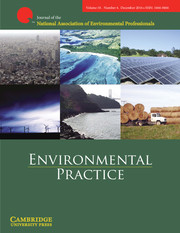
This issue of Environmental Practice rolls out a “new look”! The editorial office and Cambridge University Press have modernized the appearance of the journal with a new cover and enhanced the table of contents with updated article categories. These changes will not only fit the tone of Environmental Practice's new look, but also better reflect the existing content of the contributions we publish. The cover consists of a mosaic of images representing some of the issues and problems, including protection of natural resources, sustainability, water quality, and urban issues that environmental professionals and practitioners are called upon to address and solve. The table of contents has been modified to include some new article categories. There remain two broad categories of articles: (a) full-length manuscripts that require peer review and (b) non-peer-review pieces. Peer-reviewed manuscripts are subdivided into two types: (a) Research Articles and (b) Environmental Reviews and Case Studies. Non-peer-reviewed manuscripts are subdivided into three types: (a) Reviews, (b) Perspectives from the Field, and (c) Dialogue. Both categories of manuscripts are important to the readers of the journal, and we strive to include all types of manuscripts in each journal issue.



