





Introduction
In 2023, the United Autoworkers of America started striking against Ford, Stellantis, and GM, calling for increased wages, an end to the tiered employment system, and a 32-hour work week. The manufacturers in their place cited concerns over foreign non-union competitors as a reason for being unable to meet labour’s demands, highlighting the indirect importance of international trade for the strike. Furthermore, Democratic President Joe Biden’s 2022 Inflation Reduction Act loomed over the dispute, as those manufacturing electric vehicles are not covered by UAW’s collective bargaining protections as are those manufacturing gasoline-fuelled cars. While the Democratic Party has in recent history aligned itself with workers and unions more than their Republican counterparts, some in the labour movement feel aggrieved with the Democrats when they pursue pro-business policies. Former UAW President Bob King once said that ‘UAW members feel abandoned by the Democratic Party,’ citing Bill Clinton’s support for free trade and NAFTA as particularly sore sticking points for the industrial workers represented by UAW (Snyder and Bikales Reference Snyder and Bikales2023). To what extent are the 2023 UAW strike and the American labour movement’s frustrations with the Democratic Party generalisable to the politics surrounding labour strikes in general? What is the role of globalisation in explaining labour organising and collective action?
The globalisation of production and consistently high levels of international trade over the past three decades have put considerable strain on workers in the OECD. Unable to compete with world prices in low-skilled manufacturing, many labourers in high-wage economies have lost their jobs and seen their wages stagnate (Autor, Dorn and Hanson Reference Autor, Dorn and Hanson2013). Labour’s grievances with left-wing parties that support free trade are therefore no surprise. Yet simultaneously, as Figure 1 indicates,Footnote 1 over time there has been a decrease in strike incidence across the OECD and EU, both regarding long-term averages and top spikes, though with significant variation across countries. While globalisation improves aggregate welfare, gains are not equally distributed across trading states or within them. Depending on local contexts and technological specialisation, globalisation can pit low-productivity firms against high-productivity firms (Osgood, Tingley, Bernauer et al. Reference Osgood, Tingley, Bernauer, Kim, Milner and Spilker2017), export-oriented industries against import-competing industries (Hiscox Reference Hiscox2001), or labour, land, and capital against one another in domestic politics (Rogowski Reference Rogowski1987).
Strike incidence in the OECD over time.

While there exists a rapidly growing literature on the political consequences of strikes and labour union organising (Hertel-Fernandez Reference Hertel-Fernandez2025; Hertel-Fernandez, Naidu and Reich Reference Hertel-Fernandez, Naidu and Reich2021; Kim, Kim and Villegas Reference Kim, Kim and Villegas2020; Lyon and Schaffner Reference Lyon and Schaffner2021; Rennwald and Pontusson Reference Rennwald and Pontusson2021), comparatively few scholars have examined what political factors might cause labour strikes (Hamann, Johnston and Kelly Reference Hamann, Johnston and Kelly2012). This is despite the fact that strikes are a fundamentally political affair, attracting either support or condemnation from political actors, and taking place within the context of political institutions that determine under which conditions strikes can take place lawfully. Labour unions have historically been highly politically active in advanced democracies (Ahlquist and Levi Reference Ahlquist and Levi2013; Hamman, Johnston and Kelly Reference Hamann, Johnston and Kelly2012; Höltmann, Borbáth and Hutter Reference Höltmann, Borbáth and Hutter2025; Johnston, Hamman and Field Reference Johnston, Hamann and Field2021; Kerrissey and Schofer Reference Kerrissey and Schofer2018; Pilati Reference Pilati2025), and thus, this lacuna in the literature stands out. This research note makes a contribution to the political economy of labour literature by looking at how labour strikes, government partisanship, and globalisation interact with one another.
Specifically, I examine the conditional effect of left-wing party representation in government on labour strikes as a function of international trade penetration. I argue and show that, at low levels of international trade relative to GDP, countries with governments with higher representation of left-wing parties have fewer and less intense strikes, as generally predicted by the classical literature (Alvarez, Garrett and Lange Reference Alvarez, Garrett and Lange1991; Korpi and Shalev Reference Korpi and Shalev1979). Left-wing parties maintain close ties with labour movements and are able to pursue policies that benefit labour, thus addressing these groups’ interests. Even when conflicts do arise, left-wing parties’ connections with unions allow them to resolve strikes earlier, thus leading to fewer working days lost. These results are generally in line with research that looks at general strikes, rather than strikes more broadly (Hamann, Johnston and Kelly Reference Hamann, Johnston and Kelly2012). However, at high levels of international trade’s importance for the economy, this effect attenuates, as left-wing parties in government must take into consideration how pro-labour policies would affect international competitiveness. When governments are limited by the constraints of the global economy, their ability to address the concerns of organised labour dwindles. Therefore, there is a conditional effect of the openness of the economy on partisan resource mobilisation in favour of workers. The research note shows support for this theoretical assertion using an unbalanced panel data set of 36 OECD and EU countries between 1960 and 2022.
This note therefore builds upon several important literatures in political science, most notably the political context that determines social organising and collective action (Abouharb and Fordham Reference Abouharb and Fordham2020; Ahlquist and Levi Reference Ahlquist and Levi2013; Bucci Reference Bucci2023; Heersink and Lacombe Reference Heersink and Lacombe2025; Höltmann, Borbáth and Hutter Reference Höltmann, Borbáth and Hutter2025). It also investigates the changing nature of modern left-wing parties and their ties with labour unions (Hadziabdic Reference Hadziabdic2025; Häusermann, Kitschelt, Mosimann et al. Reference Häusermann, Kitschelt, Mosimann, Rehm, Häusermann and Kitschelt2024; Kim Reference Kim2025; Mosimann, Rennwald and Zimmermann Reference Mosimann, Rennwald and Zimmermann2018; Osgood Reference Osgood2023; Rennwald and Pontusson Reference Rennwald and Pontusson2021; Taschwer, Ennser-Jedenastik and Reidinger Reference Taschwer, Ennser-Jedenastik and Reidinger2025) and the political consequences of economic globalisation (Clark, Khoban and Zucker Reference Clark, Khoban and Zucker2025; Milner Reference Milner2021; Owen Reference Owen2017; Rickard Reference Rickard2022; Swank and Betz Reference Swank and Betz2003). While the consequences of globalisation have typically been studied in terms of electoral outcomes or changed preferences from voters at large, this research note highlights how changes in exposure to the global economy modify the relationship between left-wing parties and labour movements, leading to a change in strike activity.
Literature review
In line with the increased prevalence and voice of the labour movement, the past years have seen an increase in scholarly attention on this topic in political science. As public support for unions in the United States has reached its highest level since the 1960s (Bucci Reference Bucci2023), several authors have looked at how strikes affect public opinion. Zooming in on the 2018 teacher walkout in the United States, Hertel-Fernandez, Naidu and Reich (Reference Hertel-Fernandez, Naidu and Reich2021) find that parents of affected children have higher support for unionisation and express greater interest in labour action to improve working conditions. Unions can change behaviour as well as opinion: Lyon and Schaffner (Reference Lyon and Schaffner2021) find that state-wide union prevalence and social ties to unions can lead non-members to engage more in collective forms of political participation. However, effects may be conditional on circumstantial factors, such as the sector of employment: focusing on the 2019 grocery store strike, Hertel-Fernandez (Reference Hertel-Fernandez2025) finds only a limited effect of strike exposure on changes in attitudes and behaviours related to the labour movement. Under the right circumstances, labour strikes can affect public policy as well as public opinion and behaviour. Focusing on Latin America, Kim, Kim and Villegas (Reference Kim, Kim and Villegas2020) find that the confluence of labour strikes and mass protests can motivate governments to expand social spending.
Of particular interest for this paper due to its focus on globalisation as a cause of strike activity is work by Abouharb and Fordham (Reference Abouharb and Fordham2020). Focusing on America, they find that states that experience greater uncertainty from exposure to trade also experience more strikes than states where the effect is less ambiguous. This is because uncertainty muddles the ability of workers and firms to reach a state of equilibrium (ie a deal between negotiating parties) without costly action. When both sides are uncertain about the prospective gains and willingness to bear costs of the other, and knowing each side has an incentive to misrepresent their true negotiation parameters, resolution without escalation becomes less likely. Uncertainty therefore drives union activity. Building on work by Tsebelis and Lange (Reference Tsebelis, Lange and Sanford1995), Piazza (Reference Piazza2005) relatedly argues that the effect of globalisation on strike activity is mediated by pre-existing union density. In places where globalisation creates uncertainty between workers and employers about union strength – either because strong unions weaken or weak unions strengthen – strike incidence increases as neither organised labour nor firms pre-empt strikes by agreeing to a bargain. The ‘moderate union strength’ hypothesis is similarly endorsed by Lindvall (Reference Lindvall2013), though he focuses on neither globalisation nor partisanship. While important contributions to the study of globalisation and union organising, these studies hold constant circumstantial political factors, thus potentially obscuring important heterogeneous effects.
By contrast, Hamann, Johnston and Kelly (Reference Hamann, Johnston and Kelly2012) do look at the political determinants of union activity, though without considering the role played by the position of the state in the global economy. They find that general strikes against the government are less likely when unions are incorporated into the policy-making process, when social-democratic parties are dominant, and when governments hold a minority in parliament. Although general strikes, being aimed directly at governments, are overtly political, total strike activity is also likely affected by politics, as labour-friendly administrations can pursue policies that address labour’s demands. Schmidt (Reference Schmidt and Weber2001) and Cooper, Ellem and Wright (Reference Cooper, Ellem, Wright, Head and Crowley2015) both find that labour movements have a window of opportunity to affect policy directly when left-wing governments are in power but are often made outsiders under conservative rule. Strikes become necessary under the latter condition, but under the former, unions have an inside track to affect policy. A similar argument comes from Brandl and Traxler (Reference Brandl and Traxler2010), who analyse labour action as a strategic choice of union leadership that faces divergent pressures from rank-and-file members, employers, and political elites. Ceteris paribus, unions prefer to achieve their aims without militant action but can only do so when left-wing governments are in power. Furthermore, they look at globalisation, arguing that economic openness could dampen union activity due to the territorial limits of state regulation in an open economy. However, they do not explicitly model the interaction between government partisanship and openness, though such an interactive effect is implied by their various hypotheses. By contrast, Kwon and Pontusson (Reference Kwon and Pontusson2010) examine how union density and globalisation interact to lead to partisan convergence or divergence in social spending. They find that globalisation leads to government convergence in socio-economic policy, as also argued in this paper, but only when union strength is weak. It should be noted here that union strength itself could be a consequence of exposure to globalisation.
Pilati (Reference Pilati2025) similarly focuses on political factors. Drawing on a rich dataset of labour and social action occurring in Italy, they show that militant union activity increases as legislation affecting workers’ rights, wages, working conditions, and precarious employment are being discussed by the government. They also find that ‘the political orientation of elites may influence how unions and non-worker actors respond, as their reactions may differ depending on whether the government is right-wing or left-wing, due to unions’ historical political ties with certain parties’ (Pilati, Reference Pilati2025: 15). While the aforementioned studies look at either general strikes (Hamann, Johnston and Kelly Reference Hamann, Johnston and Kelly2012; Lindvall Reference Lindvall2013) or workplace economic strikes (Abouharb and Fordham Reference Abouharb and Fordham2020; Brand and Traxler Reference Brandl and Traxler2010; Piazza Reference Piazza2005), Höltmann, Borbáth and Hutter (Reference Höltmann, Borbáth and Hutter2025) examine under which circumstances unions pursue one or the other. They find an inverted relationship between union strength and corporatism and the prevalence of general strikes and broader protest. This suggests that unions are more likely to stick to workplace activity when national institutions make this the best way for them to improve their societal support.
Previous contributions have separately studied the consequences of government partisanship and globalisation in isolation for strike activity and labour organising. However, the extent to which these things might interact is unclear based on the existing literature. While this interaction is not tested in the studies discussed above, they provide a solid foundation on which to build hypotheses regarding this interaction. In the following section, I theorise how economic globalisation, especially trade penetration, might interact with government partisanship in changing union activity and labour strikes.
Theory and hypotheses
Because left-wing parties are more closely aligned with the labour movement and unions, one could reasonably expect strike activity to be lower when left-wing parties are in power. Left-wing governments face fewer politically motivated general strikes on average (Hamann, Johnston and Kelly Reference Hamann, Johnston and Kelly2012). They also have more leeway to pursue their preferred policies and can achieve strong macroeconomic performance when labour unions are strong (Alvarez, Garrett and Lange Reference Alvarez, Garrett and Lange1991). Governments controlled by left-wing parties will pursue labour market and industrial policies broadly in line with the preferences of their constituents, historically workers and unions, including active labour market policies, health and safety regulations, and social protections (Martin and Swank Reference Martin and Swank2004; Nelson Reference Nelson2013). Therefore, there will be a lower incentive to engage in strike activity: militancy is pursued only when peaceful means of achieving unions’ aims are expected to yield worse payoffs (Brandl and Traxler Reference Brandl and Traxler2010).
As noted by Alvarez, Garret and Lange (Reference Alvarez, Garrett and Lange1991: 542), ‘unions’ expectations about the types of policies governments may pursue are likely to have significant consequences for the behaviour of labour movements’, and ‘policies preferred by leftist governments will provide incentives for unions voluntarily to restrain their market militancy’ (ibid: 540). Even when conflicts do emerge, labour unions have an inside track with left-wing parties through their recruitment pipeline: leadership positions in labour movements and unions are a comparatively common background for left-wing politicians (Ellis, Horowitz and Stam Reference Ellis, Horowitz and Stam2015). This means conflicts could be resolved through informal channels, rather than strikes (Schmidt Reference Schmidt and Weber2001). All things equal, it is therefore reasonable to assume that governments dominated by left-wing parties will see decreased strike activity, not just as it regards politically motivated general strikes (Hamann, Johnston and Kelly Reference Hamann, Johnston and Kelly2012; Lindvall Reference Lindvall2013; Pilati Reference Pilati2025) but economic strike activity as well, due to the types of policies they typically pursue. These observations are broadly in line with seminal work on power resource theory, which states that left-wing governing parties are able and willing to mobilise government resources to support organised labour in its demands vis-à-vis employers (Korpi and Shalev Reference Korpi and Shalev1979).
However, the ability of left-wing governments to respond to the demands of labour is constrained by external factors. In the context of increasing economic globalisation, concerns over firms relocating production abroad and competing on international markets may keep governments from effectively addressing workers’ concerns. While the so-called ‘race to the bottom’ argument has received mixed empirical support (Mosely Reference Mosley2017a, Reference Mosley2017c; Mosley and Uno Reference Mosley and Uno2007; Urpelainen Reference Urpelainen2010), it is also true that the possibility of offshore production has improved the bargaining position of firms and investors over states and workers (Levy Reference Levy2005; Owen Reference Owen2017; Rickard Reference Rickard2022). Furthermore, even without active government regulation, a strong labour movement in and of itself might lead firms to pick up shop and relocate. In the context of global value chains and ‘arm-length production’, this issue has been especially salient (Mosley Reference Mosley2017b). If the marginal utility of moving or outsourcing production to a location with low wages, poor rights protections, and acquiescent labour exceeds the marginal utility of not moving while paying high wages and adhering to local labour rights, firms have a strong incentive to do so in a competitive, open economy.
Globalisation and free trade are therefore salient topics with those in the labour movement and could be associated with increased strike activity as workers protest their increased uncertainty and precarity (Abouharb and Fordham Reference Abouharb and Fordham2020; Piazza Reference Piazza2005). As noted above, in a closed economy left-wing parties can pursue policies in line with the interests of labour and side with them in tripartite decision making. Such policies help take away push factors for unions to engage in strike activity (Brandl and Traxler Reference Brandl and Traxler2010; Hamann, Johnston and Kelly Reference Hamann, Johnston and Kelly2012). However, as openness to the global economy increases, the ability of left-wing governments to pursue these policies dwindles. As trade penetration expands, firms can more easily relocate abroad, benefit from cheap labour, and export products back to home markets. Left-wing governments, who have an incentive to keep employment opportunities at home, are likely to give policy concessions to firms to promote job creation in an open economy (Shin Reference Shin2017). However, such concessions may run counter to the wider preferences of unionised labour. Indeed, as noted by Piazza (Reference Piazza2005: 295, emphasis added):
‘The adoption by states of ‘globally capital friendly’ policy, in turn, places wage pressures on domestic public sector employees as government policymakers hasten to implement fiscal austerity plans. These changes have implications for domestic workers across all sectors should government policymakers choose to also reform wage-setting and workplace institutions that bolster unionization or high wages in an attempt to provide business-friendly environments for globally footloose capital’.
However under a situation with a left-wing government and low levels of trade penetration, unions need not go on strike to achieve favourable working conditions (Brandl and Traxler Reference Brandl and Traxler2010; Cooper, Ellem and Wright Reference Cooper, Ellem, Wright, Head and Crowley2015; Martin and Swank Reference Martin and Swank2004; Nelson Reference Nelson2013; Schmidt Reference Schmidt and Weber2001); at high levels of trade penetration, this will no longer be the case. To keep firms from relocating abroad, left-wing governments will need to provide them policy concessions that they otherwise would not be willing to give. This is borne out by empirical evidence in other studies of government partisanship and open economy politics. For example, Pinto (Reference Pinto2013) finds that left-wing governments are more likely to adopt policies that incentivise foreign direct investment, looking to bring high-productivity jobs into the country. Similarly, Shin (Reference Shin2017) finds that left-wing governments, while imposing higher tax rates on firms than right-wing governments, impose fewer restrictions on shifting profits abroad to incentivise firms to keep employment levels up. In the post-1990 period, which was also characterised by decreasing unionisation rates, the convergence of socio-economic policy from left- and right-wing governments is generally attributed to the dual pressures of globalisation and union decline (Kwon and Pontusson Reference Kwon and Pontusson2010; Rodrik Reference Rodrik1997). Subsequently, while economic strike activity is likely lower under left-wing than right-wing governments in a closed economy, in an open economy this need not apply due to the competitive pressures of global markets.
In addition to pursuing pro-labour union policies, left-wing parties typically also implement generous welfare state regimes and active labour market policies. While such policies attenuate the effect of free trade on populist backlash, they do not fully neutralise it (Swank and Betz Reference Swank and Betz2003). All things equal, workers prefer gainful employment over being on welfare due to the stigma associated with the latter (Handler and Hollingsworth Reference Handler and Hollingsworth1969). Another reason workers will prefer employment in industry union jobs over welfare or employment in precarious service jobs is the economic security and benefits associated with the former. While welfare and job transitioning can cushion the negative effects of job loss, they do not fully replace its economic benefits or social-psychological appeal, especially for male workers (Clark, Khoban and Zucker Reference Clark, Khoban and Zucker2025). Furthermore, changes in the left’s position on free trade and welfare become salient for workers as left-wing parties change their electoral tactics, as exemplified by the New Labour movement in the United Kingdom and the pivot of social-democratic parties to the ‘Third Way’ ideology more broadly (Kim Reference Kim2025).
Considering the above, this note tests for the conditional effect of globalisation on the relationship between government partisanship and labour strikes, which moves beyond the current literature by integrating these two causes of labour (dis)satisfaction into a single framework.
Hypothesis: Countries with more left-wing party representation in government will have lower levels of strike activity, but this relationship is attenuated by international trade penetration.
Data
This research note uses data from the Comparative Political Data Set (Armingeon et al. Reference Armingeon, Engler, Leemann and Weisstanner2024a, Reference Armingeon, Engler, Leemann and Weisstanner2024b), which covers 23 OECD countries between 1960 and 1990 and 36 OECD and EU countries between 1990 and 2022. The main dependent variable of interest is the number of working days lost due to strike activity per 1000 workers in a given country-year. The main independent variables of interest are total trade (imports and exports) as percentage of GDP (in percentage points) and the proportion of cabinet posts held by left-wing parties (in percentage points). Additional controls include real GDP growth in current US dollars, inflation, and unemployment. CPDS sources these variables from the ILO, Penn World Tables, the OECD, and AMECO, as well as calculations by the CPDS authors themselves. In addition, the empirical analysis includes country and year-fixed effects, and cluster standard errors at the country level. Models are estimated using ordinary least squares regression. A table with an overview of descriptive statistics is provided in the Online Appendix, section E.
All control variables are selected in line with best practices recommended by the methodological literature, selecting on prior common causes of the dependent and independent variables, while avoiding post-treatment bias (Wysocki, Lawson and Rhemtulla Reference Wysocki, Lawson and Rhemtulla2022). The main threat to inference would be if despite this selection, prior common causes of strike activity and left-wing government representation would continue to exist. In such a case, correlation would exist between the dependent and independent variables on account of their prior common cause instead of a direct causal relationship. Similarly, the inclusion in the covariates of ‘bad controls’, such as those that are affected by the independent variables, might bias the estimates (Agnoline, Colantone and Stanig Reference Agnolin, Colantone and Stanig2025). A further discussion of the selection of control variables is included in the Online Appendix. In addition to the included variables and further robustness extensions in the Online Appendix, country- and year-fixed effects account for baseline differences between states and non-linear time trends.
Results
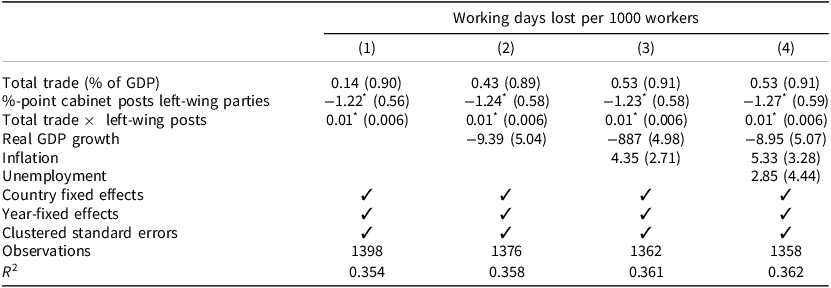
Results of the OLS estimations are shown in Table 1. As the main effect of interest is the interactive effect, it bears pointing out that the correct evaluation of its constituent components is the effect of that variable on the outcome when the other term of the interaction is kept at zero. By and large, the estimations in Table 1 support the theory and hypothesis articulated earlier. The point estimate of left-wing representation in government is negative and statistically significant, indicating that left-wing governments decrease the prevalence and intensity of labour strikes when international trade levels are low. However, the interactive effect of left-wing posts and total trade as % of GDP is positive and statistically significant. As trade’s importance for the national economy increases, the diminishing effect of left-wing party representation on strike intensity attenuates and could possibly flip from negative to positive. To show whether it does within the range of the explanatory variable, I next turn to a marginal effects visualisation of these results, which more clearly shows how the constitutive components of the interaction combine with one another and the dependent variable than does the table on its own.
Government partisanship, international trade, and strike intensity

*p < 0.05, **p < 0.01, ***p < 0.001.
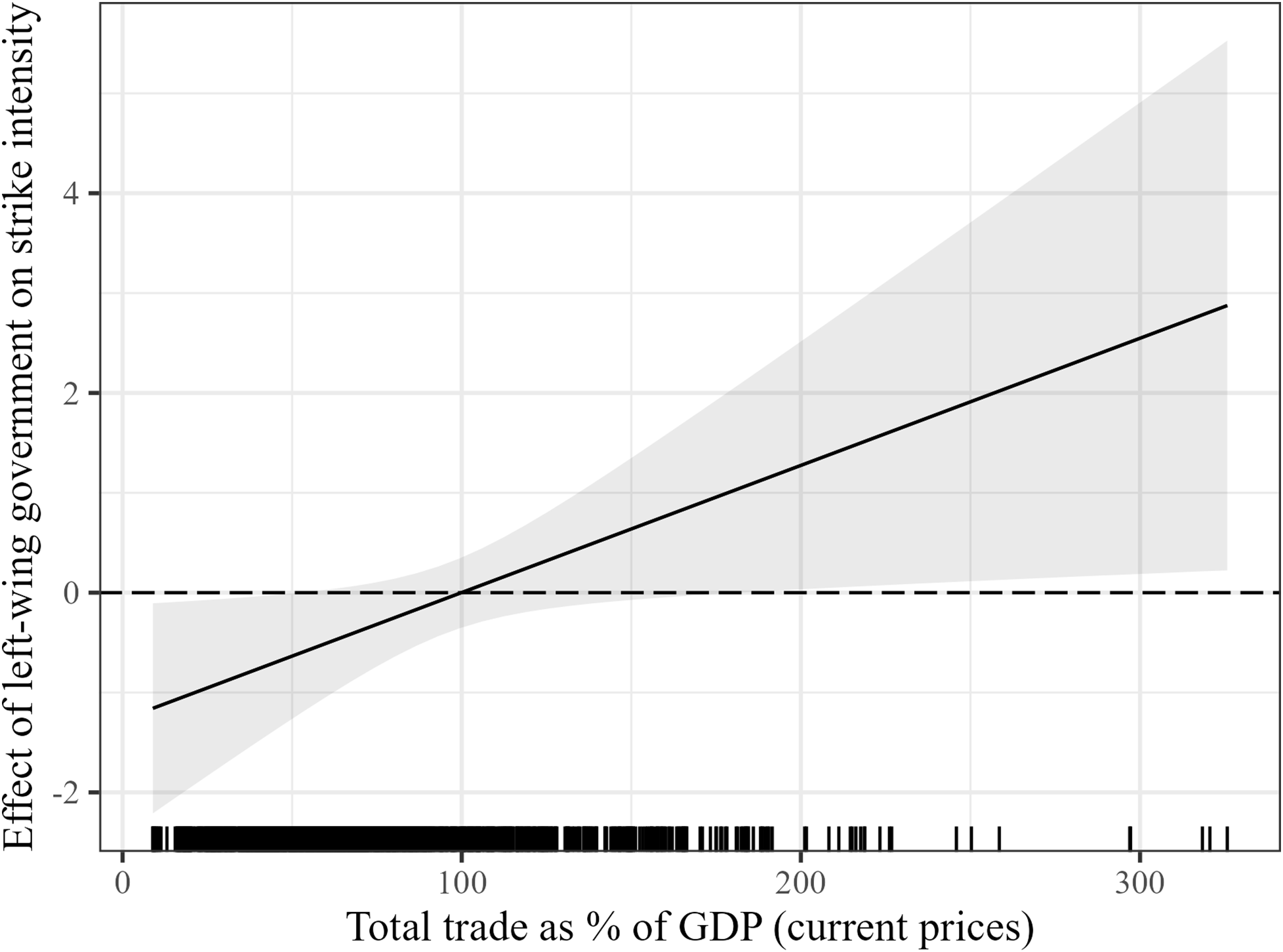
Figure 2 visualises the interactive effect of Model 4 in Table 1. The x-axis plots trade as % of GDP in current US dollars, and the y-axis plots the slope of the effect of left-wing party representation in government on working days lost per 1000 workers. At low levels of international trade’s importance for the national economy, this effect is negative and statistically distinguishable from zero, indicating governments with greater shares of left-wing parties in cabinet positions experience fewer strikes. This provides support for the hypothesis and power resource theory more generally (Korpi and Shalev Reference Korpi and Shalev1979). However, when total trade as % of GDP surpasses the 100-mark, the point estimate flips, providing support for the interactive component of the hypothesis. While the majority of observations in the data have values of less than 100 on this variable, a bit more than a quarter of all observations still fall above it, making this a meaningful category. Taken together, these findings suggest that the ability of left-wing governments to respond to the demands of organised labour may be conditional on economic globalisation and international trade.
Marginal effect of government partisanship on strike intensity by trade penetration.

How substantively meaningful are these results? Note that the left-wing government variable is measured on a 0–100 scale, where 0 indicates no left-wing ministers and 100 indicates that all government ministers are members of a left-wing party. Meanwhile, the interquartile range of the dependent variable is 115.5 (see Appendix E.1). At low levels of trade penetration, moving from a government without left-wing ministers to a government controlled solely by the left in expectation moves the expected number of working days lost due to strikes per 1000 workers a distance equal to the difference between the 75th and the 25th percentile: a major change. By contrast, as trade becomes more important for the domestic economy, this effect gradually attenuates and ultimately disappears.
To test the robustness of the results presented above, several extensions are reported in the Online Appendix. As shown in Figures A1 and A2, effects are robust to choosing left-wing government party representation in parliament (either as share of governing parties or all parties) instead of government portfolio representation. Figures B1 and B2 indicate that results are not driven by any one country. When removing specific countries from the data, results remain in the same direction and p-values never drop below 0.075 for either the unconditional partisanship effect or the interactive effect. Next, Figure C1 shows the marginal effect of left-wing government on strike intensity when total trade as percentage of GDP is log-transformed to mitigate concerns about high leverage observations. As the historical connection that exists between organised labour and labour parties may not exist between organised labour and green parties (which are also coded as left-wing by CPDS), Figure D1 shows the marginal effect of left-wing government on strike intensity by trade penetration when omitting green parties from the coding of left-wing government. Results do not meaningfully change in either C1 or D1. These extensions notwithstanding, the research design presented here remains limited by the regular selection-on-observables assumptions. Endogeneity and omitted, unobservable confounders cannot be fully ruled out. As such, caution with the interpretation of the results is warranted.
Conclusion and discussion
This research note has provided a novel contribution to the international political economy of labour literature. It shows that the representation of left-wing parties in national governments decreases strike incidence and intensity at low levels of trade penetration, but this effect is attenuated at high levels of trade penetration. These results are both statistically and substantively meaningful. Zooming out, they also matter for a world of increasing globalisation of production and international trade, especially as the embedded liberalism compact between government, employers, and employees has waned in the post-Cold War era. While traditionally labour unions and left-wing parties were natural allies and strikes occurred less frequently under left-wing governments (Brandl and Traxler Reference Brandl and Traxler2010; Cooper, Ellem and Wright Reference Cooper, Ellem, Wright, Head and Crowley2015; Hamman, Johnston and Kelly Reference Hamann, Johnston and Kelly2012; Schmidt Reference Schmidt and Weber2001), the findings presented here suggest that this relationship is dependent on the level of globalisation in the domestic economy. When workers are negatively affected by trade penetration, this attenuates their positive relationship with left-wing parties, not only in terms of their support for left-wing parties at the ballot box (Kim Reference Kim2025; Milner Reference Milner2021; Rennwald and Pontusson Reference Rennwald and Pontusson2021) but also in terms of labour organising more generally. These observations provide support for existing contributions drawing on power resource theory (Alvarez, Garrett and Lange Reference Alvarez, Garrett and Lange1991; Korpi and Shalev Reference Korpi and Shalev1979) but suggest that exposure to global economic pressures is an important scope condition for the ability of left-wing parties to pursue pro-labour policies.
Nevertheless, some cautionary notes about the findings’ external validity, in both geographic and temporal scope, are warranted. Regarding geographic scope, the data on which this note’s findings are based come predominantly from Western, democratic states, where unions are largely independent from governments or can affect parties directly. However, the historical experience of many other states is one where unions are tools of government or party control, such as with the so-called ‘charro’ unions in Mexico under the rule of the PRI. Where historical relations between unions and left-wing parties do not follow the model outlined in this note’s theory section, results may not necessarily be the same.
There could also be temporal heterogeneity in these effects. Of particular interest here are the new forms of unionisation that have become prevalent in the United States and Europe. Although labour unions have traditionally been prevalent in manufacturing sectors and industry, unionisation rates in these areas have declined over time, in a way that mirrors and is related to the decline of centre-left parties (Kim Reference Kim2025; Milner Reference Milner2021; Rennwald and Pontusson Reference Rennwald and Pontusson2021). Instead, contemporary unionisation drives and strike activity in the West have been more prevalent in industries like services (eg Amazon warehouse and Starbucks organising drives), creative industries (eg SAG-AFTRA strikes), and public employment. Median education levels among union members have concurrently risen (Byun and Korpi Reference Byun and Korpi2025). Unlike manufacturing, which suffers from trade competition, workers in these industries typically do not compete with imports but instead gain from lower consumer prices as access to global markets expands (Iversen and Wren Reference Iversen and Wren1998). How globalisation and government partisanship affect labour activity in emerging and developing economies, as well as economies dominated by service industries, therefore remains an open question.
Acknowledgements
For comments on a prior version of this paper, I thank editor Alessandro Nai and six anonymous reviewers. I thank Seung-Uk Huh for literature suggestions on the link between government partisanship and business-friendly policies in open economies. Any remaining errors are attributable to the author and the author only.
Supplementary material
The supplementary material for this article can be found at https://doi.org/10.1017/S1475676526101029
Data availability statement
All data associated with this research note will be published as an online appendix by the European Journal of Political Research.
Competing interests
The author declares no conflict of interest that could have affected the content of the paper.
Funding statement
No funding received.



 Open access

