




1 Introduction
Adult speakers rely on a variety of metaphors to talk about time (Lakoff & Johnson, Reference Lakoff and Johnson1980; Lakoff & Kovecses, Reference Lakoff, Kovecses, Holland and Quinn1987). Among these, spatial metaphors constitute one such subsystem of metaphors that structures our concept of time across different languages of the world (Evans, Reference Evans2004; Iwasaki, Reference Iwasaki2009; Lewandowski & Özçalışkan, Reference Lewandowski and Özçalışkan2023; Moore, Reference Moore2000, Reference Moore2006; Özçalışkan, Reference Özçalışkan2003, Reference Özçalışkan2004). However, we know relatively less about the developmental trajectory with which spatial metaphors for time are learned by children, particularly in languages other than English. In this study, we focused on children learning Mandarin Chinese (Chinese hereafter) – a language that shows greater variability in its metaphorical expression of time – compared to English. We asked whether 3- to 8-year-old children learning Chinese would or would not follow a path similar to the one previously observed for their English-speaking peers (Stites & Özçalışkan, Reference Stites and Özçalışkan2013) in learning spatial metaphors for time.
1.1 Spatial metaphors for time in adult speech
Spatial metaphors for time are prevalent in adult speech. Adults frequently rely on physical experiences (e.g., motion in space) to structure and express abstract concepts, such as time (Cappelle, Reference Cappelle2009; Lakoff & Johnson, Reference Lakoff and Johnson1980; Özçalışkan, Reference Özçalışkan2003, Reference Özçalışkan2005a; Pitt & Casasanto, Reference Pitt and Casasanto2022). The most commonly used spatial metaphors for time in English include: (1) MOVING-TIME, in which time moves in relation to a stationary observer (e.g., “winter approaches”); (2) MOVING-EGO, in which observer of time (i.e., ego) moves in relation to a stationary time point (e.g. “we approach winter”); and (3) SEQUENCE-AS-RELATIVE-POSITION-ON-A-PATH (hereafter sequence-as-position), in which events in time move in relation to one another independent of the observer of time (e.g., “winter follows autumn”; Moore, Reference Moore2000 & Reference Moore2006; Stites & Özçalışkan, Reference Stites and Özçalışkan2013).
These three metaphors are also commonly observed in languages other than English, including Chinese (Lai & Boroditsky, Reference Lai and Boroditsky2013; Yu, Reference Yu2012; Zhou & Fan, Reference Zhou and Fan2015). Similar to English speakers, Chinese speakers also structure the metaphorical motion of time as spatial motion, using the same three metaphor types. However, different from English speakers – who rely primarily on the horizontal axis to describe time’s movement (past located either to the back or left of the speaker’s body) – Chinese speakers use both the horizontal axis (sagittal: front to back or lateral: left to right) and the vertical axis (top to down) – situating the past on either the front (or even sometimes the back), the left, or the top of their bodies. In fact, the word for the day before yesterday is “前天 qiántiān = front day” and the word for the day after tomorrow is “后天 hòutiān = behind day” in Chinese, thus placing time along a sagittal axis with past in the front and future in the back of the speaker’s body (Yu, Reference Yu2012). Chinese speakers also use the left-to-right horizontal axis (i.e., lateral) to express time’s movement (e.g., 左手过去, 右手未来 zuǒshǒu guòqù, yòushǒu wèilái = in your left hand lies the past and in your right hand is the future; Chen, Reference Chen2021), placing past in the left and future on the right side of their bodies. In addition, different from English speakers, Chinese speakers also rely on the vertical axis in locating past and future times. For example, the word for last month is “上个月 shànggèyuè = upper month” and the word for next month is “下个月 xiàgèyuè = lower month” in Chinese, situating past on the top and future on the bottom portion of their bodies (Hong et al., Reference Hong, He, Tillman, Zhao and Deng2017).
Earlier work that examined the relative production of time metaphors in Chinese showed mixed results on the speakers’ use of the horizontal and vertical axes. In a series of studies, Boroditsky (Reference Boroditsky2001; Reference Boroditsky, Love, McRae and Sloutsky2008) and Boroditsky et al. (Reference Boroditsky, Fuhrman and McCormick2011) found that Chinese speakers talked about time vertically more often than English speakers. However, Chen (Reference Chen2007) failed to replicate Boroditsky’s (Reference Boroditsky2001) findings, showing that Chinese speakers used horizontal spatial metaphors (particularly along the sagittal axis) more frequently than vertical ones to describe time’s movement. At the same time, a more recent study (Chen, Reference Chen2021) showed that Chinese speakers express time vertically more often than both French and English speakers. These results thus suggest that the expression of time in adult speech in Chinese shows more variability, particularly compared to English speakers who only rely on the horizontal axis.
Only a few studies investigated adult Chinese speakers’ comprehension or production of the three types of time metaphors. In a comprehension test, Huang and Hsieh (Reference Huang, Hsieh, Chae, Choe, Jun, Jun and Yoo2007) found that Chinese-English bilinguals processed ego-moving metaphors better when they were tested in Chinese – their native language, but processed time-moving metaphors better in English, their second language. This aligns well with earlier research which showed that native English speakers comprehend ego-moving metaphors more quickly than time-moving metaphors (Gentner et al., Reference Gentner, Imai and Boroditsky2002). There is no existing work that has yet examined either comprehension or production of sequence-as-position time metaphors in Chinese, highlighting it as an area that is in need of further research.
1.2 Spatial metaphors for time in child speech
Children start talking about metaphors around age 2 (Billow, Reference Billow1981). They initially use simple perceptual metaphors to draw comparisons between entities that have similar features – first without the explicit comparison marker “like” (e.g., “ice-cream cone” + point at mushroom) and later on, with the word “like” (e.g., “Mushroom is like an ice-cream cone”; Billow, Reference Billow1975, Reference Billow1981; Epstein & Gamlin, Reference Epstein and Gamlin1994; Vosniadou & Ortony, Reference Vosniadou and Ortony1983; Özçalışkan & Goldin-Meadow, Reference Özçalışkan, Goldin-Meadow, Kristianssen, Achard, Dirven and de Mendoza2006; Özçalışkan et al., Reference Özçalışkan, Goldin-Meadow, Gentner and Mylander2009). These early perceptual metaphors lead the way for increasingly more complex structural metaphors, beginning around age 5, a time point when children begin to express relational commonalities between distinct entities and/or domains (e.g., texture to personality: “the guard is a hard rock”; physical motion to abstract motion: “she soars with joy”; Özçalışkan, Reference Özçalışkan2005b; Stites & Özçalışkan, Reference Stites and Özçalışkan2013; Winner et al., Reference Winner, Rosenstiel and Gardner1976). Importantly, the mastery of structural metaphors spans over a longer developmental timeline, extending all the way to middle school years (Asch & Nerlove, Reference Asch, Nerlove, Kaplan and Wapner1960; Vosniadou, Reference Vosniadou1987; Winner, Reference Winner1979; Winner et al., Reference Winner, Rosenstiel and Gardner1976). For example, in explaining the metaphorical statement, “a cloud is like a sponge,” five-year-old children typically rely on feature-based similarities between objects (e.g., “Both clouds and sponges are round and fluffy”), while older children also produce more relational explanations (e.g., “Both clouds and sponges contain water”; Asch & Nerlove, Reference Asch, Nerlove, Kaplan and Wapner1960; Cicone et al., Reference Cicone, Gardner and Winner1981; Gentner, Reference Gentner1988; Schecter & Broughton, Reference Schecter and Broughton1991; Winner et al., Reference Winner, Rosenstiel and Gardner1976; see Özçalışkan, Reference Özçalışkan and Hogan2010, Reference Özçalışkan, Brooks, Kempe and Golson2014 for reviews). However, most of this earlier work focused on English learners (but see Özçalışkan, Reference Özçalışkan2005b; Cheng et al., Reference Cheng, Guan, Zhang, Zhan, Liu, Wang, Yu and Peng2024 for exceptions), leaving the applicability of these patterns to other languages largely unexamined.
Children’s comprehension and production of spatial metaphors for time –as a subcategory of structural metaphors – received considerable attention in the field in the past two decades. One early study (Özçalışkan, Reference Özçalışkan2004, Reference Özçalışkan2005b, Reference Özçalışkan2007) examined moving-time metaphors (along with similar metaphors for mental and bodily states) among children learning either English or Turkish, probing them either with lexical support (e.g., forced-choice response for the meaning of a metaphor embedded in a story) or without lexical support (e.g., free response for metaphorical statements; e.g., “Can time jump from moment to moment?”/“Can ideas run through your mind?”). The results showed that children – learning either English or Turkish – begin to understand moving time metaphors around age 4–5 and to explain them around age 5–6.
A later study (Stites & Özçalışkan, Reference Stites and Özçalışkan2013, expanding on this earlier work, examined 3- to 6-year-old children’s comprehension and explanation of the three subtypes of spatial metaphors for time (moving-time, moving-ego, sequence-as-position) in English. Similar to Özçalışkan’s findings, results showed the early emergence of metaphorical abilities. At the same time, children also showed an effect of metaphor type in both their comprehension and explanation of spatial metaphors for time, with earlier mastery of moving-time and moving-ego metaphors than sequence-as-position metaphors (Stites & Özçalışkan, Reference Stites and Özçalışkan2013; see also Stites & Özçalışkan, Reference Stites and Özçalışkan2021). Apart from this study, there is no other work that has extended these findings to another language. As such, we do not yet know whether the observed patterns are unique to English or are applicable to a broader set of the world’s languages.
2 Current study
Previous research suggests that children grasp spatial metaphors for time at a young age. English-speaking children understand moving-time and moving-ego metaphors by age 3–4 and can explain them by age 5–6 (Özçalışkan, Reference Özçalışkan2005a, Reference Özçalışkan2007; Stites & Özçalışkan, Reference Stites and Özçalışkan2013). Research also suggests that English-speaking children show later comprehension of sequence-as-position metaphors that require a third-person perspective (observer of time instead of experiencer of time), a difference that is likely an outcome of the greater cognitive demand such metaphors might impose on children, particularly at the early ages (Stites & Özçalışkan, Reference Stites and Özçalışkan2013). Different from English, the metaphorical organisation of time may present additional challenges for Chinese children, particularly for sequence-as-position metaphors. This disparity stems from the unique linguistic landscape of Chinese. Unlike English, where time metaphors predominantly follow a horizontal axis, Chinese speakers use both vertical and horizontal axes when describing time (Sun & Zhang, Reference Sun and Zhang2021; Yu, Reference Yu2012). In addition, when relying on the horizontal axis, adult Chinese speakers locate the future in three different ways, by placing it either behind, ahead of (Yu, Reference Yu1998, Reference Yu2012) or to the right of their bodies (Chen, Reference Chen2021). Children learning English typically rely only on the horizontal axis, locating the future either on the front (sagittal) or the right (lateral) of their bodies (Stites & Özçalışkan, Reference Stites and Özçalışkan2013). Moreover, unlike Chinese, in English, the sagittal (e.g., “future ahead”, “years back”) but not the lateral axis is lexicalized. For example, there is no expression such as “the rightward month” or “leftward year” in English, highlighting the lack of the use of the left-right axis in lexicalizing metaphorical motion of time in English (Radden, Reference Radden, Baumgarten, Böttger, Motz and Probst2004; Santiago et al., Reference Santiago, Lupiáñez, Pérez and Funes2007). Chinese, on the other hand, lexicalizes time metaphors across both types of horizontal axes, including the sagittal (e.g., 前年 qián nián = front year: the year before last year; 后年 hòu nián = back year: the year after next year) and the lateral (e.g., 左手历史右手未来 zuǒ shǒu lì shǐ, yòu shǒu wèi lái = left hand history right hand future: past history and future times) axes. Chinese speakers also lexicalize time along the vertical axis (e.g., 上个学期 shàng ge xuéqī = up semester: last semester & 下个学期 xià ge xuéqī = down semester: next semester). This variability, in turn, might result in greater difficulties for children in mastering time metaphors in Chinese, particularly compared to English speakers and in tasks where there is less lexical support (e.g., explanations).
In this study, we focused on 60 children learning Chinese as their native language at the ages 3–4, 5–6, and 7–8; and asked two questions. We first focused on children’s metaphor comprehension and asked whether the type of metaphor (moving-time, moving-ego, sequence-as-position) would have an effect on the developmental changes in children’s comprehension of time metaphors. We predicted that children learning Chinese would improve their comprehension over time; but they would also show lower levels of comprehension for sequence-as-position metaphors at each age compared to moving-time and moving-ego spatial metaphors, based on earlier work with children learning English (Stites & Özçalışkan, Reference Stites and Özçalışkan2013).
We next focused on children’s metaphor production and asked whether the type of metaphor (moving-time, moving-ego, sequence-as-position) would have an effect on the developmental changes in children’s explanation of spatial metaphors for time. Similar to comprehension, we expected an effect of metaphor type, namely that children learning Chinese would show greater difficulty in explaining sequence-as-position metaphors compared to moving-time and moving-ego spatial metaphors – also based on earlier work with English learners (Stites & Özçalışkan, Reference Stites and Özçalışkan2013).
Given the greater variability in the expression of time metaphors in Chinese (particularly as compared to English), we also expected that children learning Chinese might also show slightly later achievement of metaphorical abilities in both their comprehension and explanation of spatial metaphors for time, as compared to earlier work on children learning English.
3 Methods
3.1 Participants
The sample consisted of 60 children, equally divided into 3 age groups, including 3- to 4-year-olds (Mage = 3;11, range = 3;1–4;10, 12 boys), 5- to 6-year-olds (Mage= 5;8, range = 5;0–6;11, 11 boys), and 7- to 8-year-olds (Mage= 7;4, range = 7;0–8;8, 11 boys), all learning Chinese as their native language. The age range and sample size (n=20/age group) were based on an earlier study (Stites & Özçalışkan, Reference Stites and Özçalışkan2013) that showed significant changes (ps < .001) in English-speaking children’s metaphor comprehension and production abilities, with medium to large effect sizes (comprehension: η2 p = .47; explanation: η2 p = .32). All children were attending preschools or elementary schools in a city in Northeastern China at the time of our observations. The three age groups were comparable in family education, with 80%–85% of parents with college degrees in each group. None of the children were learning another language; but they all spoke the local Dalian dialect of Chinese at the time of our observations. The Dalian dialect, or Dalian Mandarin – primarily spoken in the urban area of Dalian City in Northeastern China – is part of a major Sinitic Mandarin language family that is very similar to Mandarin Chinese (Bi & Chen, Reference Bi and Chen2022; Fong, Reference Fong2004). The recruitment and data collection protocol were approved by an Institutional Review Board at a research university in the United States and parents provided consent prior to their children’s participation in the study.
3.2 Procedure for data collection
Each child was interviewed individually in their school by a native Chinese speaker. During the interview, each child completed (1) a metaphor explanation task and (2) a metaphor comprehension task, each of which is described below. Both tasks were based on earlier work with children learning English (Stites & Özçalışkan, Reference Stites and Özçalışkan2013). Children first completed the free-response metaphor explanation task, followed by the forced-choice metaphor comprehension task to ensure that children’s explanations were not affected by the forced-choice responses in the metaphor comprehension task. All responses were videorecorded.
Metaphor explanation task: The children were presented with 6 open-ended questions about different motion metaphors for time, one at a time and in counterbalanced order. Each question contained one of the three metaphor types for time (i.e., moving-time, moving-ego, sequence-as-position), with two questions for each metaphor type; see Table 1 for the interview questions in original Chinese and their translations to English. The experimenter further probed each child to justify their response to each question (e.g., Tell me more, why do you think that is?)
Interview questions for the metaphor explanation task (metaphors are underlined)

Table 1. Long description
The table is organized into three sections based on metaphor types. Each row contains a numbered question in Chinese on the left and its English translation on the right.
* Moving time section:
- Question 1: Let’s say you are at home with mommy playing. And your mommy says: Summer is coming. What do you think she means?
- Question 2: If I told you that following our time together, I will give you a sticker, when do you think you will get your sticker?
* Moving ego section:
- Question 3: Let’s say you are playing outside, and your daddy says: We are getting closer to dinnertime. What do you think he means?
- Question 4: Let’s say you had breakfast, and you went out to play ball. And then you played with blocks. Do you think you got closer to lunchtime when you started playing with blocks? If affirmative, How?
* Sequence-as-position section:
- Question 5: What would it mean if someone told you that dessert follows dinner?
- Question 6: Can different times follow each other, like in a line? For example, can bedtime follow dinnertime? If affirmative, How does it follow?
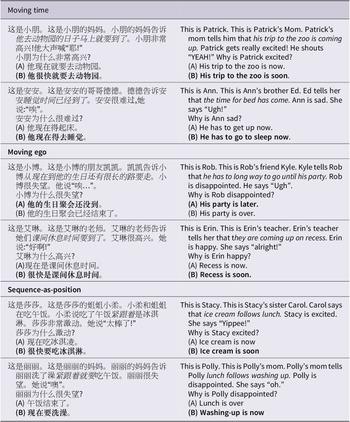
Metaphor comprehension task: Each child was presented with 6 short stories, one at a time and in counterbalanced order. Each story contained one of the three metaphor types for time (i.e., moving-time, moving-ego, and sequence-as-position), with two stories for each metaphor type. Each story was presented with black and white drawings of the two main characters in the story to increase the child’s engagement with the content of the stories; see Table 2 for the stimulus stories in original Chinese and their translations to English.
Stimulus stories for the metaphor comprehension task (metaphors are underlined, correct choices are bolded)

Table 2. Long description
The table contains two columns: the left column provides the stimulus story and multiple-choice questions in Chinese, and the right column provides the English translation. Metaphors are italicized and correct answers are bolded.
* Moving time section:
1. Patrick's story: His mom says his trip to the zoo is coming up. Question: Why is Patrick excited? Correct answer: (B) His trip to the zoo is soon.
2. Ann's story: Her brother says the time for bed has come. Question: Why is Ann sad? Correct answer: (B) He has to go to sleep now.
* Moving ego section:
1. Rob's story: His friend says he has a long way to go until his party. Question: Why is Rob disappointed? Correct answer: (A) His party is later.
2. Erin's story: Her teacher says they are coming up on recess. Question: Why is Erin happy? Correct answer: (B) Recess is soon.
* Sequence-as-position section:
1. Stacy's story: Her sister says ice cream follows lunch. Question: Why is Stacy excited? Correct answer: (B) Ice cream is soon.
2. Polly's story: Her mom says lunch follows washing up. Question: Why is Polly disappointed? Correct answer: (B) Washing-up is now.
The child was told that s/he would hear several short stories about different people and that after each story s/he would help two puppets (i.e., a dragon and a frog) understand the story. Before each story, the experimenter placed two drawings on the table, depicting the two characters in each story. The experimenter then read each story aloud to the child. Each story ended with the experimenter asking the puppets a question about the meaning of the metaphor used in the story. The two puppets were present in front of the child. One of the puppets provided a correct answer, while the other answered incorrectly. The child was then asked to help by choosing the puppet that gave the correct answer. Each puppet provided the correct answer half of the time, setting chance performance at 50%. The order of the correct choices (first vs. second choice) was counterbalanced across stories and children.
3.3 Procedure for scoring, reliability, and data analysis
Children’s response to each interview question in the metaphor explanation task was assessed on a 3-point scale as either 0 (irrelevant explanation), 1 (semi-relevant explanation), or 2 (relevant explanation). Irrelevant explanations included responses where the child provided answers that did not focus on the metaphor for time (e.g., Stimulus story: “你说冰淇淋在吃晚饭以后, 是什么意思?= What would it mean if someone told you that dessert is after dinner? ” Answer: “不许吃冰淇淋。= (I am) not allowed to eat ice cream”). Semi-relevant explanations consisted of responses that included partial information about the metaphor for time (e.g., Answer: “因为冰淇淋是零食, 不容易消化的, 所以不能先吃。= Because ice cream is a snack; it’s difficult to digest. So can’t eat first.”). Relevant explanations consisted of responses that directly focused on the metaphor for time (e.g., Answer: “先吃晚饭, 然后再吃冰淇淋。= Eat dinner first, then eat ice cream.”).Footnote 1 Reliability on the coding of the relevance for the explanations was assessed with a second coder on a randomly selected 20% of data in each age group, which showed 90% agreement between coders.
Children’s responses to each forced-choice question in the metaphor comprehension task was assessed on a binary scale as either 0 (incorrect response) or 1 (correct response). Incorrect responses included either the choice of the puppet with the incorrect answer or the lack of a choice between the two puppets. Correct responses included the choice of the puppet with the correct answer.
We tallied each child’s responses in the explanation and comprehension tasks separately for each metaphor type (score range of 0–4 for explanation and 0–2 for comprehension). We analyzed scores with two separate mixed two-way ANOVAs, with age (3–4-, 5–6-, 7–8-year-olds) as a between-subjects factor and metaphor type (moving-time, moving-ego, sequence-as-position) as a within-subject factor, separately for responses in the metaphor explanation and metaphor comprehension tasks. ANOVAs allowed us to test both main and interaction effects in our two outcome measures. At the same time, however, given the small sample size and the unique characteristics of our measurements, understanding the distribution of the variables was crucial for selecting an appropriate statistical analysis. Visual inspection of QQ plots, coupled with the Shapiro-Wilk test, revealed significant departures from normality in all dependent variables (p-values < 0.01). Consequently, non-parametric statistical tests were employed for subsequent analyses. We therefore further confirmed the patterns of statistical results we obtained for ANOVAs with a set of non-parametric tests (i.e., Kruskal-Wallis, Kendal’s W test), which showed the same patterns of statistical significance as the ANOVAs.
4 Results
We first examined children’s comprehension of metaphors for time. Children’s responses showed an effect of age (F(2, 57) = 36.142, p = .000, η2 p = .559 ), but no effect of metaphor type (F(2, 114) = 0.208, p = .813) or an interaction between age and metaphor type (F(4, 114) = 1.119, p = .351). As can be seen in Figure 1A, children’s metaphor comprehension improved with age, with children in the oldest age group (ages 7–8) performing significantly better than both of the younger age groups (Bonferroni, ps <.003); this pattern remained similar across all three metaphor types (moving-time, moving-ego, or sequence-as-position).Footnote 2
Mean scores of metaphor comprehension & metaphor explanation.

Figure 1. Long description
Panel 1 A, titled Metaphor Comprehension, has a Y axis labeled Mean Comprehension Score ranging from 0 to 2 and an X axis labeled Age in Years with categories 3 to 4, 5 to 6, and 7 to 8. Three lines are plotted. Moving Time, a black dotted line, starts at 0.8, rises to 1.3, and ends at 1.85. Moving Ego, a solid grey line, starts at 1.1, stays flat at 1.1, and rises to 1.7. Sequence as Position, a solid red line, starts at 1.05, rises to 1.25, and ends at 1.8. All points include vertical error bars.
Panel 1 B, titled Metaphor Explanation, has a Y axis labeled Mean Explanation Score ranging from 0 to 4 and the same X axis. Moving Time, the black dotted line, starts at 1.9, rises to 2.5, and ends at 3.25. Moving Ego, the solid grey line, starts at 1.8, rises to 2.55, and ends at 3.35. Sequence as Position, the solid red line, starts significantly lower at 0.7, rises to 1.55, and ends at 2.4. All data points show a linear increase with age.
We next examined developmental changes in children’s metaphorical explanations for time. Similar to comprehension, our analysis showed an effect of age (F(2, 57) = 13.482, p = .000, η2p = .321), with children in the oldest age group (7–8) providing better explanations than both groups of younger children (Bonferroni, ps <.005). Different from comprehension, children’s explanations showed an effect of metaphor type (F(2, 114 = 19.322, p = .000, η2p = .253), but no interaction with age (F(4, 114) = .156, p = .960). As can be seen in Figure 1B, children showed better performance in explaining the metaphors for moving-time and moving-ego than sequence-as-position metaphors across all ages (Bonferroni, ps < .05)Footnote 3; see Table 3 for sample explanations children provided for each metaphor type.
Examples of children’s explanations for the metaphorical motion of time by metaphor type and age (years; months provided in brackets)

Table 3. Long description
The table is divided into three primary sections.
1. Moving time: The experimenter asks what it means when mommy says Summer is coming. Responses include a 4 year 7 month old saying go out with mom and dad; a 5 year 3 month old noting the weather will become warmer; and an 8 year 0 month old explaining that summer and summer vacation are coming so they can play.
2. Moving ego: The experimenter asks what it means when daddy says We are getting closer to dinnertime. Responses include a 4 year 11 month old saying eat; a 5 year 3 month old saying the time is too long so dinner has arrived; and a 7 year 7 month old saying they will be eating dinner soon.
3. Sequence as position: The experimenter asks if different times can follow each other in a line, such as bedtime following dinnertime. Responses include a 3 year 7 month old saying can't; a 5 year 9 month old saying can't because they must watch T V and brush teeth; and an 8 year 5 month old saying can, go to bed after eating dinner.
Each entry includes the original Chinese text and the English translation. A note at the bottom defines C as child and E as experimenter.
Note. C: child; E: experimenter
5 Discussion
English learners can understand and explain spatial metaphors for time at an early age (Özçalışkan, Reference Özçalışkan2005b, Reference Özçalışkan2007); but this early understanding also shows variability by metaphor type, with earlier mastery of moving-time (e.g., winter approaches) and moving-ego (e.g., we approach winter) metaphors than sequence-as-position metaphors (e.g., “winter follows autumn”; Stites & Özçalışkan, Reference Stites and Özçalışkan2013). In this study, we asked whether this pattern remains similar for children learning Chinese – a language that shows greater variability in its spatial metaphors for time (Chen, Reference Chen2021; Hong et al., Reference Hong, He, Tillman, Zhao and Deng2017). Our findings showed that 3- to 8-year-old children learning Chinese improved in both their comprehension and explanation of all three metaphor types akin to children learning English. The type of metaphor also had an effect on children’s performance – an effect that was only evident in the metaphorical explanations.
5.1 Age matters in understanding and explaining spatial metaphors for time
Children learning Chinese showed improvements in their comprehension and explanation of metaphors of time – a pattern consistent with earlier work on children learning Chinese (e.g., Cheng et al., Reference Cheng, Guan, Zhang, Zhan, Liu, Wang, Yu and Peng2024). However, Chinese learners showed above chance performance in their metaphorical abilities by age 7–8, approximately two years later than their English learning peers (Özçalışkan, Reference Özçalışkan2004, Reference Özçalışkan2007; Stites & Özçalışkan, Reference Stites and Özçalışkan2013).
What might explain the later mastery of spatial metaphors for time in Chinese? One possible explanation – as aforementioned in the introduction – could be the greater variability in the structure of time metaphors in Chinese. Spatial metaphors in Chinese can be explained both horizontally (Boroditsky, Reference Boroditsky2001) and vertically (Hong et al., Reference Hong, He, Tillman, Zhao and Deng2017). In fact, horizontal time metaphors – particularly the ones using a sagittal axis (e.g., “前年qiánnián front-year = the year before last year”) – and vertical time metaphors (e.g., “上午 shàngwǔ above-noon = morning”) frequently co-exist in Chinese speakers’ daily language production (Hong et al., Reference Hong, He, Tillman, Zhao and Deng2017). Moreover, time metaphors that use a horizontal sagittal axis line can be expressed from two different perspectives: (1) the front-as-the-past: what happened in the past could be in front of the observer (e.g., “前天 qiántiān front-day = the day before yesterday”) (Yu, Reference Yu2012), and (2) the front-as-the future: what happens in the future could be in front of the observer (e.g., “往前看 wǎngqián kàn towards-front-look = look at the front/focus on the future”) (Alverson, Reference Alverson1994; Yu, Reference Yu2012). Consequently, mastery of spatial metaphors for time might place greater cognitive demands on its speakers – particularly at the early ages – thus resulting in more extended time in its mastery. Future studies that examine how frequency of different spatial metaphors for time in adult input to children relates to children’s comprehension and explanation of similar metaphors can shed further light on this possibility.
Another possible explanation could be the nature of the spatial time metaphors in Chinese. In earlier work Cheng at el. (Reference Cheng, Guan, Zhang, Zhan, Liu, Wang, Yu and Peng2024) examined Chinese children’s comprehension of perceptual metaphors with high- vs. low-saliency (e.g., high-saliency metaphor: “星星是眼睛 xīngxīng shì yǎnjīng = stars are eyes” vs. “low-saliency metaphor: 彩虹是拱桥 cǎihóng shì gǒngqiáo = rainbows are arch bridges”), defining saliency across a set of criteria, including conventionality, familiarity, prototypicality, and frequency (Giora, Reference Giora1997). For example, children were expected to have greater difficulty with metaphors with low-saliency (e.g., “rainbows are arch bridges”) because of the rare occurrence and lower familiarity of rainbows in China. Indeed, the authors did find that Chinese children’s metaphorical abilities increased with age, with better performance for high-saliency metaphors by age 5 and for low-saliency metaphors by age 8. Structural metaphors for time that we included in our study might be similar to the high-saliency metaphors in this earlier work. Such metaphors are introduced late to Chinese childrenFootnote 4 and are thus less familiar particularly to young Chinese children, also marking their mastery at a later point in time. However, similar to Cheng et al. (Reference Cheng, Guan, Zhang, Zhan, Liu, Wang, Yu and Peng2024), our study focused on a subset of metaphorical expressions in Chinese. As such, future work that examines metaphor development across a broader set of metaphor types in Chinese is needed to more firmly establish overall developmental trajectory of metaphorical ability in this group of learners.
The later mastery of metaphors among Chinese learners might also be related to broader language learning trends in Chinese. We know from earlier work that Chinese learners show overall mastery of their native language around age 6–7 (Peng & Chen, Reference Peng, Chen, Liu, Tsao and Li2020) – an achievement that might be necessary to set the stage for children’s ability to grasp metaphorical expressions in their language. We also know from earlier work that Chinese learners experience difficulties learning the Chinese orthographic system at a young age; they do not understand radical marking–the basic indexing component of a Chinese character which appears as part of a character – until early elementary school years (ages 6–7; e.g., Luo et al., Reference Luo, Chen, Deacon and Li2011; Wei et al., Reference Wei, Bi, Chen, Liu, Weng and Wydell2014). For example, 亻is the “person” radical marker indicating that the lexical character is human (e.g., 你nǐ = you; 他 tā = he/him). As spatial metaphors for time, particularly moving ego and moving time, require locating time or its movement in relation to a person (i.e., human), the later mastery of radical marking for “human” in Chinese might contribute to the later achievement of such metaphors in Chinese, as compared to English.
The Chinese writing system also uses a logographic script that differs significantly from the English alphabetic writing system (Tan et al., Reference Tan, Liu, Perfetti, Spinks, Fox and Gao2001). In addition, Chinese speakers rely on a phonemic writing system (i.e., the Chinese romanization) to represent the pronunciation of characters (Li, Reference Li2019). This, in turn, presents additional challenges for learning the writing system in Chinese. In fact, earlier work has shown that preschool children learning English perform better than their Chinese peers in identifying spatially transformed words in an alphabetic orthography – a system that is also used in the Chinese phonemic writing system. This thus suggests that young Chinese children were not as familiar as their English-learning peers with the orthographic system of their language, largely due to the relatively more complex orthography of Chinese that relies on both logographic and phonemic systems (Miller, Reference Miller, Li, Gaffney and Packard2002; Miller et al., Reference Miller, Li and Zhang2001). Even though the writing system of a language may not directly affect the comprehension and production of spatial metaphors for time, it has an indirect effect, influencing children’s early metalinguistic development (Miller, Reference Miller, Li, Gaffney and Packard2002). In fact, as shown in earlier work, young children who perform poorly on metalinguistic tasks also show difficulties in explaining metaphorical concepts – an effect that can be observed all the way to early adolescence years (Asch & Nerlove, Reference Asch, Nerlove, Kaplan and Wapner1960; Cometa & Eson, Reference Cometa and Eson1978; Smith, Reference Smith1976). Future cross-linguistic studies that examine the potential links between metalinguistic skills, literacy, and metaphor comprehension-explanation can shed further light on the link between these three potentially related language abilities.
5.2 Metaphor type matters in explaining spatial metaphor types for time
We know from earlier work that English-speaking children show greater difficulty with sequence-as-position metaphors in both their comprehension and explanation of such metaphors (Stites & Özçalışkan, Reference Stites and Özçalışkan2013). In our study, Chinese children showed this difficulty as well, but only in the explanation of such metaphors. But why do children show greater difficulty with sequence-as-position metaphors – not only in English but also in Chinese?
The sequence-as-position is cognitively more challenging than moving-time and moving-ego metaphors because it involves two events and an implicit observer instead of only two events; it also involves a less embodied conception of time and draws on a third-person perspective on time, making it more difficult for children (Stites & Özçalışkan, Reference Stites and Özçalışkan2013) who rely heavily on first-person sensorimotor experiences to form knowledge (Barsalou, Reference Barsalou2008).
This difficulty is further compounded when we examine the structure of time in Chinese. In explaining the sequence-as-position metaphor in English, the focus is on the two events (e.g., ice cream and dinner in “ice cream follows dinner”) and not the observer. However, Chinese presents a more complex picture, as the observer of time could also be inserted into the sequence-as-position metaphor. For example, when Chinese speakers describe a time-as-sequence event (e.g., “冰淇淋在晚饭后 bīngqílín zài wǎnfàn hòu = ice cream is behind dinner”), the observer of time could also be located between the two activities on a horizontal line, such that ice cream is in front of the observer and dinner is behind the observer, and not necessarily outside the timeline as in English. As such when presented with such a metaphor, Chinese children had to decide between these two alternative meanings, which might make the task more difficult for them to explain – particularly during their explanations as it requires an additional task of verbalising their grasp of the different scenarios. In fact, this might be the reason why we did not see an effect of metaphor type in comprehension in Chinese. Despite the ambiguity of the perspective (1st person or 3rd person) of the observer (or ego), the forced choice comprehension prompts did not include the information of the observer with regards to the time’s movement. As such, Chinese learners did not need to go through all possible scenarios, regardless of whether the time was vertical or horizontal, whether the past was in front or behind, and whether the human referent was on the axis, thus making sequence-as-position metaphor similar in difficulty to the other two metaphor types in the lexically-supported comprehension task. All of these scenarios, however, were possibilities for the children in the explanation task, thus resulting in lower performance on the explanation of sequence-as-position metaphors compared to the other two metaphor types. Future studies, that elicit more extended justifications for children’s forced-choice responses in the comprehension task and free responses in the explanation task could shed further light on this possibility by identifying the type of cognitive reasoning children might be employing in the metaphorical tasks.
In summary, our results showed that children steadily improved their grasp of metaphors for time, akin to earlier work with children learning English, but with a 2-year lag in both comprehension and explanation of metaphors. We also found an effect of metaphor type for children’s explanation but not comprehension of metaphors – a pattern that was partially aligned with earlier work on English learners. Our results thus provide further empirical support for the developmental trajectory of children learning moving-time, moving-ego metaphors before sequence-as-position metaphors in another language, namely Chinese that shows greater variability in its expression of spatial metaphors for time. Overall, our findings highlight that the metaphorical structure of a domain in one’s language (i.e., how time is linguistically organized in a given language) influences the timing but not the trajectory of children’s metaphor development in learning spatial metaphors for time.
Acknowledgments
We thank Jingxuan Qiu for helping with the data collection. We thank all the participants for their participation.
Competing interests
The authors declare none.



 Open access

