

Introduction
Leadership has been increasingly stressed in modern society (Liden et al. Reference Liden, Wang and Wang2025). Corporations as well as public organizations are expected to recruit strong leaders who are able to manage external as well as internal challenges. Universities are no exceptions. Their leadership has been in focus in the public debate as well as in the research community. In academia, several studies have thus focused on the working conditions of university leaders (e.g. Bargh et al. Reference Bargh, Bocok, Scott and Smith2000; Engwall and Eriksson Lindvall Reference Engwall, Eriksson Lindvall and Tengblad2012; Middlehurst Reference Middlehurst2010). These studies in turn have created an interest in the recruitment of these leaders. On this topic, based on quantitative data and interviews with former university leaders, Goodall, in her monograph Socrates in the Board Room (Reference Goodall2009), demonstrated that top-ranked universities are led by distinguished scholars. She also provided broad evidence of the selection of leaders in UK universities. In a later study, Loomes et al. (Reference Loomes, Owens and McCarthy2019) offered results regarding the selection of university leaders in Australia, thereby particularly pointing out the increasing use of search consultants. Furthermore, Barbato (Reference Barbato2023) has presented results regarding the recruitment of top academic leaders in 98 UK universities across 20 years, concluding that despite new public management and internationalization of higher education, leader profiles have remained rather stable.
Yet another study (Engwall Reference Engwall2014) addressed the issue of university top leader recruitments by analysing the appointment of 165 such leaders at Swedish universities and university colleges from 1960 to 2011. The results pointed to (1) a decreasing length of tenure; (2) an increasing share of external recruitments; (3) an increasing share of female leaders; and (4) an increasing share of leaders from the natural sciences and the life sciences. As this study was restricted to Sweden during a limited period, there are reasons to put it, and the other studies mentioned above, in context in terms of both space and time. Therefore, this article will present the results from an analysis of the recruitment of top leaders in six top-ranked universities from the United States, the United Kingdom and Scandinavia from 1900 to 2025. First, the article will present the methodology. Then will follow the results for developments over time, variations between universities and the most recent recruitments. Finally, conclusions and expectations for the future will be presented.
Methodology
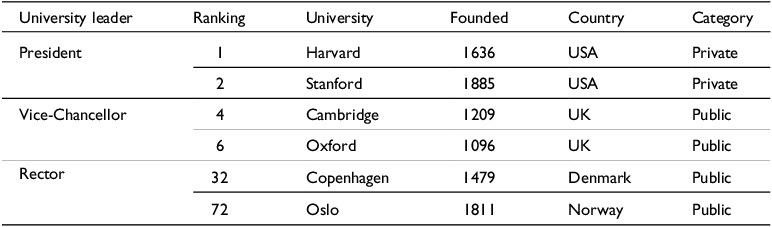
At the outset of this study, it is appropriate to point out that titles of academic top leaders vary. In the United States they are mainly labelled President, while in the United Kingdom and the Commonwealth their title is Vice-Chancellor.Footnote a In non-English speaking countries, it is common to use the title, Rector. This difference in labelling university top leaders will here be used as the basis for sampling universities. Using the 2024 Academic Ranking of World Universities (ARWU), two universities in each category have been selected. Presidents as leaders are thereby represented by the two universities at the very top: Harvard University and Stanford University, both private institutions in the United States (Table 1). For vice-chancellors in the UK, the University of Cambridge and University of Oxford, ranked four and six, are selected. Rectors as leaders are represented by the two Scandinavian public universities, the University of Copenhagen in Denmark and the University of Oslo in Norway placed 32nd and 72nd in the AWRU ranking, respectively. Three of these institutions (Cambridge, Oxford and Copenhagen) have medieval origins, while Harvard was founded in the seventeenth century and the other two (Stanford and Oslo) in the nineteenth century.
Selected universities

Data regarding the top leaders for the period of study (1900‒2025) have been collected from the websites of the six universities (Harvard University 2025a, Stanford University 2025a, University of Cambridge 2025a, University of Oxford 2025a, Københavns Universitet 2025a and Universitetet i Oslo 2025a). This data collection provided a total of 184 recruitments, 178 of them before the current six leaders were recruited. In analysing all the recruitments, the focus will first be on developments over time, asking to what extent the following variables have changed:
-
• Number of recruitments
-
• Length of tenure
-
• Recruitment ages
-
• Selection of females
-
• Recruitment of leaders from STEM and Medicine (STEMM)
-
• Selection of externals
The same variables will also be used in the comparisons between the six institutions.
Overall Developments in the 1900-2025 Period
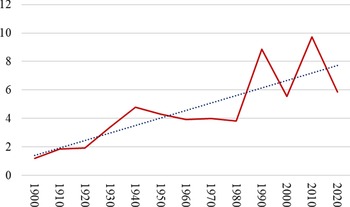
In terms of the number of recruitments per decade (Figure 1), there has been an obvious decline from above 20 per decade in the early twentieth century to between five and ten in the present decade. This decline is the clear reflection of an increase in the longer tenures of the top leaders from below two years in the first few decades to six years in the 2020s (Figure 2). For the length of tenure, it is particularly worth noting that, while there was a relatively smooth increase for this variable in the decades up until the 1980s, the following decades exhibited more dramatic changes. As will be demonstrated below, this was an effect of the European universities abandoning the principle of taking turns during a shorter period and increased pressures on university leaders, sometimes leading to resignations.
Number of recruitments per decade.

Average length of tenure of leaders per decade (in years).

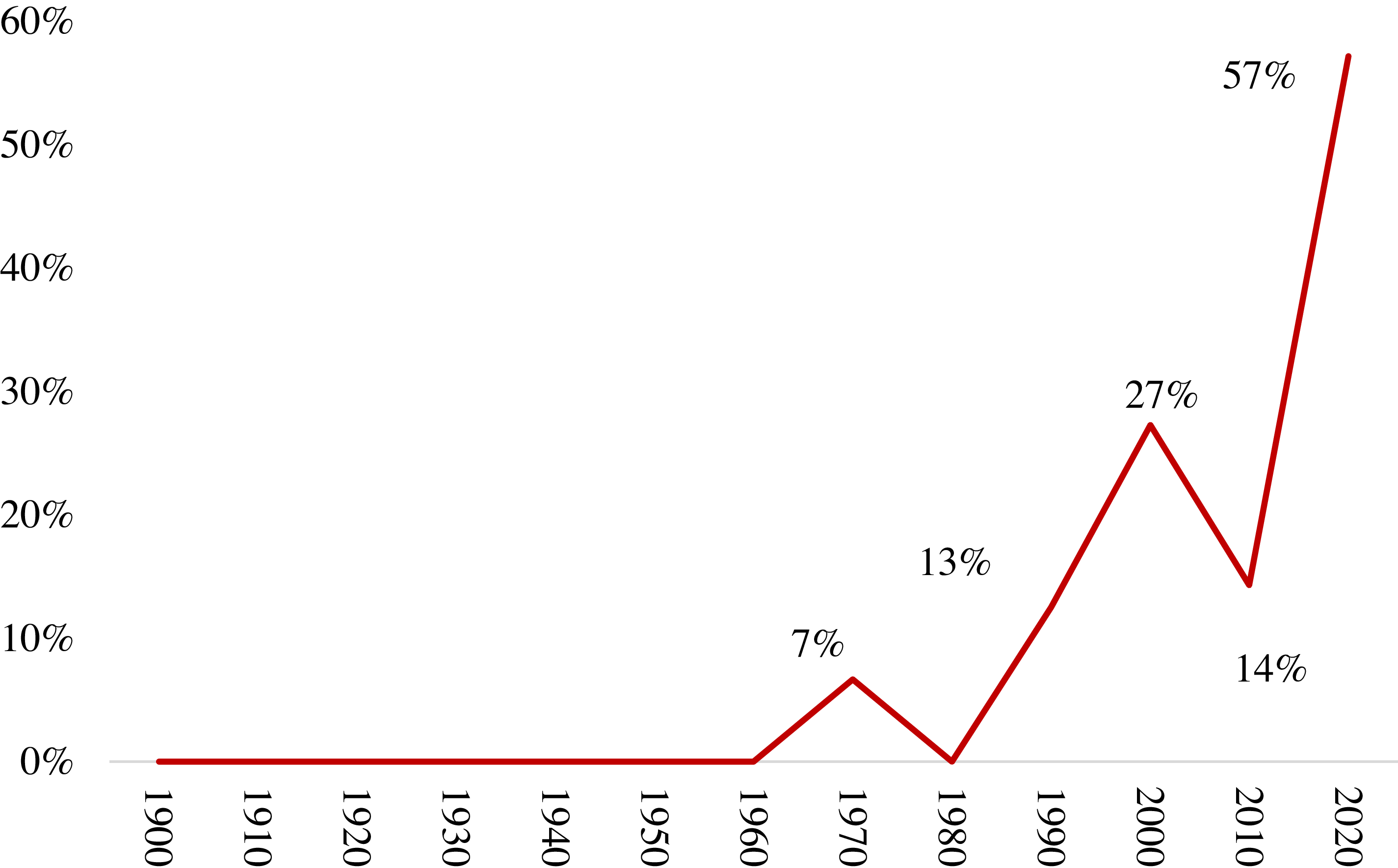
As regards the age of the leaders recruited, there has been a slightly decreasing trend from an average of 58 years with a lowest value in 2000 of 54 years and a highest value of 61 in the 1950s (Figure 3). Over time, variation in age has thus not been very great. A more dramatic change could be observed for the recruitment of female leaders (Figure 4). No female leaders were recruited before the 1970s, when one of the 15 leaders recruited (7%) was a woman. By the 2000s the share had increased to three out of 11 (27%) and in the 2020s to four out of seven (57%). All in all, the decades after the turn of this century have thus meant a breakthrough for female academic leadership within the six universities. As will be further demonstrated below, in 2025 among the selected institutions only Stanford has not had a woman at the top.
Age of leaders at recruitment per decade.

Share of female recruitments of leaders per decade.

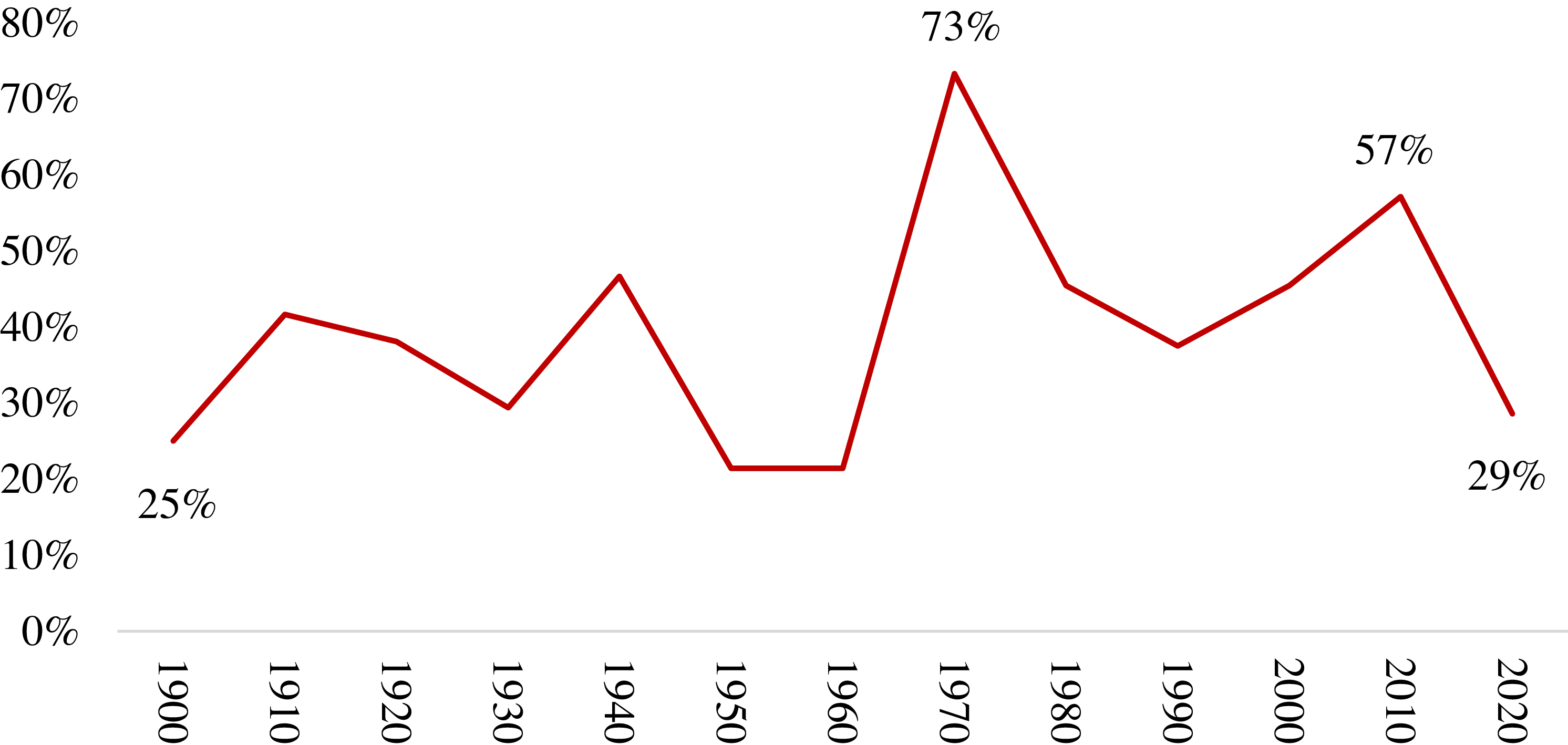
Regarding the disciplinary background of the top leaders, with only two exceptions ‒ the 1970s and the 2010s ‒ STEMM recruitments have been below 50% (Figure 5). For the other decades, the Humanities and Social Sciences (Law included) have dominated. Among these non-STEMM recruitments, the Humanities have faced a decline from the beginning of the last century, while the Social Sciences have steadily gained in representation, from 9% in the 1980s to 71% in the 2020s.
Share of STEMM recruitments per decade.

From the 1990s, there is not only a change in the disciplinary background of those recruited but also an increase in terms of the selection of external candidates (Figure 6). Until the 1990s, there were only a few cases of external recruitments, around 10% and below. From the 1990s a market for academic top leaders seems to have developed. A peak occurred in the 2010s, when 71% of the leaders were recruited from outside the institution. So far, in the 2020s, only one external recruitment (14%) has occurred.
Share of external recruitments per decade.

As regards the development over the decades from the 1900s to the 2020s, the results presented so far thus mean that:
-
• The number of recruitments has decreased.
-
• The length of the tenure period has increased.
-
• The recruitment age has decreased slightly.
-
• The selection of females has increased, particularly during the last few decades.
-
• The recruitment of STEMM persons has decreased from a peak in the 1970s.
-
• The selection of externals has increased since the 1990s.
Variations Across Universities
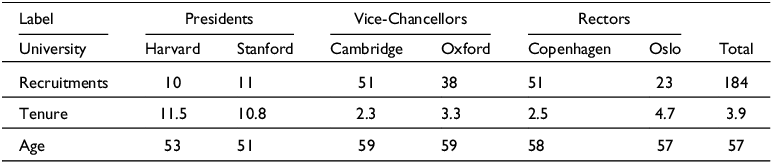
An analysis of the variations across the six universities points to an obvious difference in the recruitment between the US presidents, on the one hand, and the European vice-chancellors and rectors, on the other hand (Table 2).
Number of recruitments, length of tenure (average in years) and age at recruitment (average in years)

At Harvard and Stanford, the number of recruitments has been considerably lower than at Cambridge, Oxford, Copenhagen and Oslo. The former had 10 and 11 recruitments, respectively, while Cambridge and Copenhagen had as many as 51, Oxford had 38 and Oslo 23. Obviously, this is also reflected in the average length of tenure: above 10 years for Harvard and Stanford, whereas the others have had tenures that are substantially lower. These differences are the result of the aforementioned long-time practice of European professors to take turns as institutional leaders for shorter periods. At Cambridge, two years was the standard until 1992 when the mandate of the law professor Sir David Williams was prolonged until 1996, giving him ‒ as the first full-time vice-chancellor ‒ a tenure of seven years. Oxford had the practice of three years (with a few exceptions), which was prolonged to four years in the period 1969‒1997. In the latter year, Oxford switched to seven years as the historian Sir Colin Lucas took office. An exception occurred with his successor John Hood, who stepped down after five years after considerable internal resistance. Copenhagen had only one-year mandates for a long time. This practice changed in 1936 when the professor of medicine, Carl Edvard Bloch, led the university for six years. After him, tenures have varied from two years to 12 years. Oslo, finally, had varying lengths of tenure from two years (twice in the 1910s, once each in the 1970s and in the 1990s) to eight years for the most recent rectors. As a result, its average is above the other three other European universities.
The recruitments at Harvard and Stanford do not differ solely in terms of number and length of tenure. The recruited presidents were also younger than their European counterparts. While the latter on average were in their late 50s, the presidents at the two US universities were in their early 50s, which of course facilitated their longer tenures. The chemistry professor James Bryant Conant, who was Harvard president for 20 years between 1933 and 1953, was just 40 when he took office, and the law professor Derek Curtis Bok, president between 1971 and 1991, was 41. Presidents in their early 40s at Stanford were the professor of medicine Ray Lyman Wilbur, aged 41 with a tenure of 27 years, and the historian J.E. Wallace Sterling, aged 43, with a tenure of 19 years. The oldest to take office as Harvard president is the present one, Alan M. Garber, who was 69 at the time of his appointment.Footnote b As will further be developed below, this was an emergency recruitment.
As shown above, the recruitment of female leaders, externals and non-STEMM leaders increased for the total population in recent decades. As regards the various institutions, Harvard scores at the top, although still at a low level, with respect to the percentage of female leaders: two out of the ten recruitments (Table 3). The first one to be selected was the history professor Drew Gilpin Faust in 2007, who also was the first Harvard president since 1672 without a degree from Harvard. Her tenure lasted 11 years. Much shorter was the time of service for the second female Harvard president, Claudine Gay, who had to resign after only half a year (see further below).
Share of females among the recruited

As for Stanford, the male dominance has been total, while the four European universities have had some female leaders. Since 1975, Cambridge has had three female vice-chancellors. First there was the chemistry professor Dame Alice Rosemary Murray, President of New Hall, with a two-year tenure. Second, in 2003, was Dame Alison Richard, professor of anthropology and previous provost of Yale 1994‒2002, who stayed in office for seven years. The third and latest one is the present vice-chancellor Deborah Prentice, appointed in 2023 with a background as professor of psychology, faculty dean at Cambridge in 2014‒2017 and provost at Princeton 2017‒2023.
Oxford did not recruit a female vice-chancellor until 2010. The selected leader was Louise Richardson, professor of political science, former vice-chancellor at St Andrews in Scotland and dean at Harvard. When she stepped down after seven years, she was succeeded by another woman: Irene Tracey, professor of neuroscience and former warden of Merton College.
Among the Scandinavian universities, Copenhagen has only recruited one female rector, the law professor Linda Nielsen, who was recruited in 2002 and stayed for three years. In Oslo, another law professor, Lucy Smith, was recruited as the first female in 1993. After a tenure of five years, she was succeeded by five male rectors. However, in 2025, the University of Oslo elected another female law professor: Ragnhild Hennum (see further below).
All in all, the six universities have recruited ten women as leaders: Cambridge three times, Harvard, Oxford and Oslo twice, Copenhagen once and Stanford never. The first female recruitment occurred at Cambridge in 1975 and the second at Oslo in 1993, while the other eight happened after the turn of the century. A peak occurred, as shown in Figure 4, in the present decade, when 57% of the recruitments led to the appointment of a female leader.
In terms of STEMM background (Table 4), it was demonstrated above for the whole period that on average about four out of ten recruited leaders had such a background. However, Stanford and Oslo outnumber the other four institutions, with more than half of the recruited leaders having a STEMM background. Copenhagen and Cambridge have shares just below 50% (47% and 41%, respectively), while Oxford and Harvard are both on the lower side with 11% and 20%, respectively. The other side of this state of affairs is that both Oxford and Harvard have had high shares of leaders from the Humanities and the Social Sciences. In terms of the differences between Harvard and Stanford, a likely explanation is that Stanford had an engineering school from its start, while Harvard only got its engineering school in the twenty-first century.
Share of STEMM background among the recruited

As for the recruitment of externals, Figure 6 demonstrated that something happened from the 1990s onwards, with a peak in the 2010s. In this respect, we see again that the two US universities differ from the European ones (Table 5). Harvard and Stanford exhibit shares of external recruitments around one-third and above, while the corresponding figure for Cambridge, Oxford and Copenhagen is around one-tenth and for Oslo zero. However, looking at numbers and not shares ‒ which are highly dependent on the number of recruitments ‒ Copenhagen is at the top with six externals, followed by Stanford with five, Cambridge with four, and Harvard and Oxford with three external recruitments.
Share of externals among the recruited

At Harvard, the first external President during the twentieth century to be recruited was Nathan Marsh Pusey, a professor of literature. He was selected in 1953 after having been the President of Lawrence College from 1944 to 1953. Later external recruitments were the literature professor Neil L. Rudenstine between 1991 and 2001 ‒ at the time of his recruitment executive vice-president of the Andrew W. Mellon Foundation ‒ and Lawrence H. Summers between 2001 and 2006. However, the latter was a homecomer, since he was a former Harvard professor, who since 1991 had worked with the World Bank and the Treasury.
Stanford had an early external recruitment in 1910 when the geology professor John Casper Branner from Indiana University took office. It was then not until 1949 that the head of the Huntington Library and Art Gallery J.E. Wallace Sterling became President. In 1968 he was succeeded by another external, the chemistry professor and president of Rice University, Kenneth S. Pitzer. Due to student unrest, he stepped down after only two years to be succeeded by two internals. After them, Gerhard Casper, a law professor and provost at the University of Chicago, was then the third external Stanford president to hold office during the 1992‒2000 period. After the 16-year presidency of the internally recruited computer scientist John Hennessy, in 2016 Stanford recruited the president of Rockefeller University, Marc Tessier-Lavigne, a neuroscientist, who had earlier been at Stanford. Due to allegations of manipulations in published articles, he resigned in 2023.
Cambridge had a long tradition of internal leaders, which is related to the principle discussed above for faculty members to take turns as vice-chancellor. However, in 2003, Cambridge converted to external recruitments. The first such person to be recruited was Dame Alison Richard mentioned above. She was followed in 2010 by Sir Leszek Borysiewicz, the chief executive of the Medical Research Council of the United Kingdom. In 2017, after his seven-year tenure, Cambridge brought in Stephen Toope, who had been president of the University of British Columbia (2006‒2014) and who at the time of his recruitment was director of the Munk School of Global Affairs and Public Policy at the University of Toronto. After Toope’s retirement, Cambridge turned to the United States to recruit Deborah Prentice from Princeton, also mentioned above. However, she was already well-known to Cambridge as a faculty dean, 2014‒2017.
Like Cambridge, Oxford long kept the tradition of selecting vice-chancellors among its faculty members. The first external to be appointed was John Hood, a businessman from New Zealand, who had been vice-chancellor of the University of Auckland between 1999 and 2004. His ambitions to reform Oxford were met with resistance, and he resigned after five years in 2009. Nevertheless, Oxford continued to search outside the university for its next vice-chancellor. Hood’s successor was Andrew D. Hamilton, professor of chemistry and provost at Yale. As he stepped down in 2016, he became the president of New York University. Hamilton was succeeded by Louise Richardson, mentioned above, who became the first female leader of Oxford, followed by another woman who was an internal candidate: the above-mentioned Irene Tracey.
In Copenhagen there were five early external recruitments in the 1910s and the 1930s, four of whom came from the Hospital of the Realm, an institution close to the university. It was then not until 2017 that the microbiologist Henrik Caspar Wegener, director of the Royal Veterinary and Agricultural University was recruited. He was the first rector in Copenhagen who had not been educated at the university he headed. In contrast to the others, the University of Oslo has never recruited outside the university, a circumstance that is associated with its recruitment processes (see further below).
The above implies that the two US universities recruited outsiders much earlier than the Europeans. For the latter, a change occurred after the turn of the present century. It appears that rankings and the influence of New Public Management were important factors behind this change.
In terms of the differences between the six institutions, it can be concluded that:
-
• The number of recruitments has been much lower at Harvard and Stanford.
-
• The length of tenure has been much longer at Harvard and Stanford.
-
• The recruitment age has been lower at Harvard and Stanford.
-
• Since 1975, female leaders have been recruited to all universities except Stanford, with Cambridge at the top (three), followed by Harvard, Oxford and Oslo (two) and Copenhagen (one).
-
• Stanford and Oslo have had a majority of STEMM leaders, Copenhagen and Cambridge close to 50%, while Harvard and Oxford have had low shares.
-
• Harvard and Stanford have been earlier to recruit leaders from the outside, while Cambridge, Oxford and Copenhagen started that practice after the turn of this century and Oslo has not yet recruited outside the university at all.
Recent Recruitments
After having provided results regarding the overall development over time for the six universities and for each of them specifically, this article will now turn to the most recent processes for the selection of top leaders.
Presidents
At Harvard, presidents are selected through a process led by the Harvard Corporation in consultation with the Board of Overseers. The Corporation sets up a search committee, which seeks input from faculty, students, staff, alumni, and other stakeholders. Candidates are identified and selected by the committee, which maintains confidentiality. The final selection is made by the Harvard Corporation. This model was last applied in 2024, when the then President, Claudine Gay, had to resign after holding office less than a year. The reasons were her comments about antisemitism on campus and allegations of plagiarism (Lawrence Reference Lawrence2024). Upon her resignation, Alan M. Garber, a 69-year-old professor of Health Care Policy, Harvard provost since 2011, was first appointed interim President and became the permanent President after half a year with a tenure until the end of the 2026–2027 academic year (Harvard University 2025b). In this way, Harvard got an experienced president, who combines long administrative experience with expertise in both economics and medicine. The attacks from the White House have shown that such a background is to the benefit of Harvard. Both Garber’s fights with Donald Trump and the resignation of Claudine Gay demonstrate how the positions of university presidents have become much more exposed to external forces.
A resignation was also the background for the latest recruitment of Stanford president. In this case, Marc Tessier- Lavigne, a neuroscientist, who was recruited from the presidency of Rockefeller University in 2016, had to step down after a report from the Trustees concluding that in several of his co-authored papers ‘there was apparent manipulation of research data by others’ (Nietzel Reference Nietzel2023). After Tessier-Lavigne’s resignation, Richard Saller, a classicist and former dean of the Stanford School of Humanities and Sciences, in his early 70s, served as interim President. As the University was searching for a permanent successor, it could base this work on its Founding Grant document and its formulation that it is the task of the Board of Trustees to ‘appoint a President of the University, who shall not be one of their number, and to remove him at will’ (Stanford University 1983: 5). In compliance with this, the position was advertised, and a search committee was set up. It consisted of 20 members: eight trustees (all Stanford alumni), eight faculty members, one student, one postdoctoral fellow, one additional alumnus and a staff person. During the process they reached out to professors and students and alumni in listening sessions as well as through a survey, to solicit input. The committee searched for views on the desired qualities of the next president without responding to names. The process was strictly confidential in order not to discourage good candidates from applying. The outcome was the selection of Jonathan Levin, a 52-year-old insider, economics professor and the dean of the Stanford Business School. He had been a student of the Nobel Laureate Bengt Holmström at MIT, winner of the John Bates Clark Medal in 2011, and a Stanford faculty member since 2000 with considerable administrative experience (Stanford University 2025b).
Vice-Chancellors
According to Chapter III of the Statutes of the University of Cambridge (2023: 18) the vice-chancellor ‘shall be appointed by the Regent House on the nomination of the Council who may nominate any person of their choice’. The significant body is thus the Council, which is ‘the principal executive and policy-making body of the University’. It consists of the chancellor, the vice-chancellor, 16 elected academic members, four external members and three students, with the vice-chancellor as chair. As mentioned, the Council’s nomination has to be approved by the Regent House, the University’s governing body, consisting of more than 7,200 members (academic, senior research and senior administrative staff of the university and colleges), an approval which appears to be a mere formality (University of Cambridge 2023, 2025b).
In terms of tenure, the Statutes establish that the vice-chancellor shall be appointed for five years with the possibility of an extension of two years, thus seven years in total. The last recruitment at Cambridge was the result of the decision of the then vice-chancellor Stephen Toope, a professor of law, to step down after concluding his first five years (2017‒2022) to become president and CEO of the Canadian Institute for Advanced Research (CIFAR). In this way he returned to his home country, from which he had been recruited after having been president of the University of British Columbia. His recruitment thus demonstrates the emergence of a market for Anglo-American university leaders. Further evidence is provided by the selection of his successor, the psychology professor Deborah Prentice, who had served as faculty dean at Cambridge from 2014 to 2017 but at the time of her recruitment in 2023 had been provost at Princeton since 2017. She was not only a homecomer but also contributed to the increasing numbers of female leaders in the 2020s.
The University of Oxford has procedures similar to those at Cambridge. The significant group for identifying a candidate is a committee consisting of the chancellor, four persons, who are not members of the Council, elected by the Congregation, three persons elected by the Council, one person elected by each of the divisional boards, the chair of the Conference of Colleges, and a member who is not a member of the Council elected by the Conference of Colleges, in total 11 members. Two students and one early career staff member are invited as observers. This committee has the task of finding and proposing a candidate for the vice-chancellorship to the Council, which consists of 26 members and provisionally three co-opted members. Nine are ex-officio members, five are external members and 12 members of the Congregation are elected by the Council. As the Council agrees on the proposal of the committee, it submits the name of the selected candidate for approval to the Congregation, a body consisting of ‘about 5,000 members, comprising academic staff, heads and other members of governing bodies of colleges and societies and senior research, computing, library and administrative staff’. The proposal ‘shall be deemed approved unless it is rejected with at least 125 members voting in favour of rejection’ (University of Oxford 2025b).
As at Cambridge, the maximum tenure at Oxford is set to seven years. This was also the time spent in office of the vice-chancellor before the last recruitment, the political science professor Louise Richardson, who had a career as executive dean of the Radcliffe Institute for Advanced Study at Harvard University (2001‒2009) and was vice-chancellor of the University of St Andrews (2009‒2015). She is thus another example of an emerging flow of academic leaders across the Atlantic. Irish by birth, she returned to the United States after her vice-chancellorship at Oxford to take up the position as president of the Carnegie Corporation of New York.
As Richardson’s successor, Oxford selected in 2023 the 57-year-old professor of neuroscience, Irene Tracey. This meant that the university chose another woman but an insider. Tracey had been at Oxford since 1997 and had been warden of Merton College, Oxford and pro-vice chancellor. She was the first insider after three outsiders in a row (John Hood, Andrew D. Hamilton and Louise Richardson), a circumstance she pointed out in her speech at the admission ceremony (Tracey Reference Tracey2023):
I stand here today, as surprised as no doubt you are, that after a lengthy global search this University, my University, elected a local girl – in every sense of the phrase – to be your next Vice-Chancellor. To be entrusted with this role fills me with immeasurable pride.
Rectors
At the University of Copenhagen, the recruitment of rectors is regulated by the University Act of 2018. It states that it is the University Board that ‘appoints and dismisses the Rector and appoints and dismisses the University’s other senior management on the recommendation of the Rector’ (Bekendtgørelse af lov om universiteter (universitetsloven), §10, my translation from the Danish). The University Board comprises academic staff, including employed PhD students, technical and administrative staff and students. However, the majority of the members are external. This implies a certain, though limited, collegial influence. It should be noted, however, that there are limitations in the law regarding the background of the rector, who ‘must be a recognized researcher in one of the university’s subject areas and have insight into the education sector [and] have experience in the management and organization of research environments and […] have insight into a university’s activities and interaction with the surrounding society’ (§14, my translation from the Danish). Nothing is said about the length of tenure.
The latest transition at the University of Copenhagen was prompted by the retirement of the professor of microbiology Henrik Caspar Wegener at the age of 66 after holding the office of rector for five years with an extension of three years, eight years in total. As a professor of veterinary medicine, before his appointment to the Rectorate he had been director of research at the Danish Institute for Food Research and pro-rector at the Technical University of Denmark. As his successor, the University Board chose in 2025 the 52-year-old economics professor David Dreyer Lassen. It thereby selected an insider, who had been pro-rector for Science and Innovation since 2021 (Københavns Universitet 2025b).
At the University of Oslo, the process is much more open than at the other five universities, and also more open than in many other Norwegian universities that do not have elected leaders (see further Universitetet i Oslo 2025b). The process is managed by a specially appointed election committee. To this body, groups of at least 20 faculty members and students are invited to propose candidates for the posts as rector and pro-rector. In addition, candidates are identified by a search committee appointed by the University Board. All nominees are required to have professorial competence, and, although it is not a requirement, it is stated that it is an advantage for candidates to have experience of leadership in knowledge-based organizations and in administration. At a point in time decided by the election committee, the names of candidates are made public. After that, the proposed teams of rector and pro-rector have to present themselves to faculty members and students. A period follows during which faculty members and students can vote for their preferred team. The votes of faculty members are given the weight of 75%, and the votes of students are given 25%.
The most recent election of a rector at the University of Oslo occurred in spring 2025. The chemistry professor Svein Stølen, aged 65, had stepped down after eight years, which is the limit for tenure according to the rules at the University of Oslo. In the election of his successor, three teams were competing: the two professors of medicine, Hanne Flinstad Harbo and Giske Ursin, and the law professor Ragnhild Hennum. It meant that three women around the age of 60 were competing for the rectorate. The outcome of the election was that Ragnhild Hennum ‒ vice-rector from 2009 to 2014 and pro-rector from 2014 to 2017 ‒ got 53% of the votes, while Hanne Flinstad Harbo and Giske Ursin received 31% and 16%, respectively. As a result, Ragnhild Hennum and her fellow candidate for pro-rector, the professor of geology Bjørn Jamtveit, were appointed to lead the University of Oslo (Universitetet i Oslo 2025c).
Comparing Recruitments
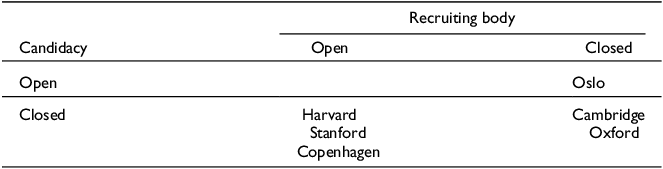
From the above it is clear that the recruitment processes at the six universities differ in terms of the openness of the recruiting bodies and the candidacies (Table 6). Cambridge and Oxford are, according to their present rules, closed in terms of both the recruiting body and the candidacy (lower right corner of Table 6). Their processes are run inside the universities with internal search committees and decision bodies. They are also characterized by keeping candidates confidential. The latter is in strong contrast to the University of Oslo (top right corner of Table 6), which is completely open about the candidates. Like Cambridge and Oxford, the Norwegians do not include externals in the recruiting body.
The different recruitment models

Harvard, Stanford and Copenhagen (lower left corner of Table 6) share the closed principle regarding candidates with Cambridge and Oxford. Names of candidates are kept within limited circles. However, at the same time, the three institutions differ from their two UK counterparts by including externals in the recruiting bodies. None of the institutions under study are open in terms of both the candidacies and the recruiting body (top left corner of Table 6).
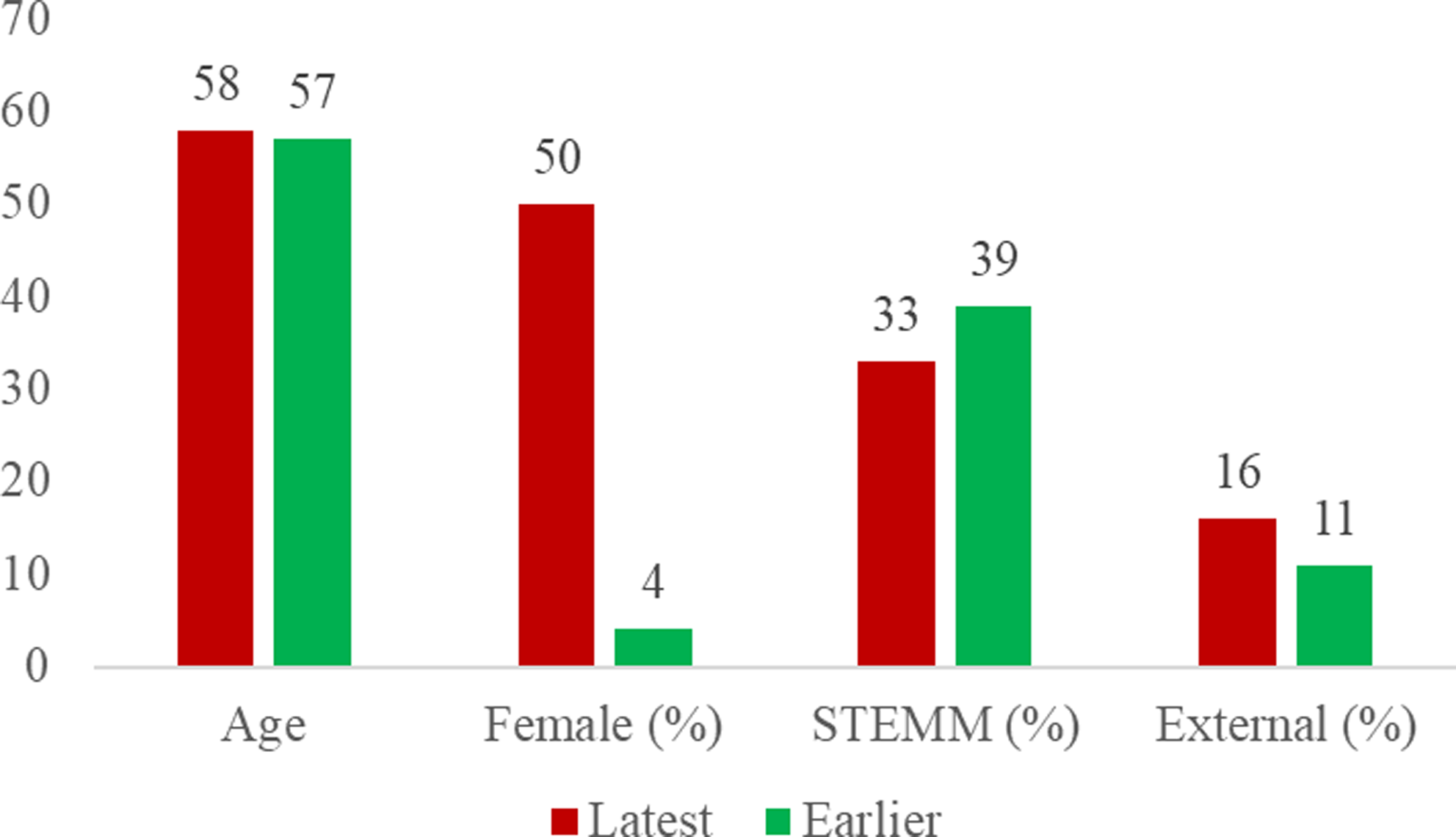
Comparing the latest recruitments with the earlier ones (Figure 7), it is evident that the average age was almost the same as earlier, while the share of female leaders has increased considerably. While they were only 4% among the earlier appointments, half of the latest recruited leaders were female. The share of STEMM was somewhat lower and the share of externals somewhat higher. The share of externals was still rather low.
A comparison between latest recruitments and earlier ones.

Conclusions
The results in this article of the analysis of the recruitment of leaders in six top universities during the last 125 years has demonstrated that the number of recruitments has decreased, while the average length of tenure has increased. This has been a result of the Europeans adapting to the US institutions by abandoning the earlier practice where professors took turns as leaders for shorter periods. Recruitment ages have decreased only slightly, while the share of STEMM, with exceptions for two decades (the 1970s and the 2010s), has been below 50%. The most remarkable changes, in addition to the extension of the tenures for European leaders, have been the increase in the recruitment of female leaders and externals. The recruitment of women started as early as 1975 at Cambridge, followed by Oslo in 1993 and the rest ‒ with the exception of Stanford ‒ in the current century with a 50% female share among the latest recruitments. In terms of externals, Harvard, Stanford and Copenhagen were early with such recruitments. They were followed by Cambridge and Oxford with recruitments from an emerging Anglo-American job market. Needless to say, Cambridge and Oxford are special in the United Kingdom and not representative of all British universities.
The analysis of the most recent recruitments has demonstrated how the six institutions differ in terms of the openness of candidacies and recruiting bodies. Here, Cambridge and Oxford exhibit closedness in both respects, while Harvard, Stanford and Copenhagen keep the secrecy of candidates but include externals in their recruiting bodies. Oslo is a special case by recruiting rectors through an open competitive process with a closed recruitment body. However, it should be noted that this model is not representative of all institutions of higher education in Norway, where many institutions recruit their leaders through a closed process.
It has been evident from the above that the US institutions practised a more corporate-like model much earlier than their European counterparts by recruiting younger leaders, who to a larger extent are externals and who are given longer tenures. There has also been evidence of an adaptation of the Europeans to the North Americans. There are reasons to believe that this process will continue. Thus, it can be expected that search consultants will play an increasing role and that mobility among institutions will increase. The continued development of an Anglo-American market for academic leaders seems particularly probable. Similarly, the increasing recruitment of female leaders is likely to continue.
This article has reported on the recruitment of leaders in a rather limited population of universities. It is therefore important to continue studies of the recruitment of top academic leaders. One next step would be to extend the population of the universities by including more institutions on the list of the Academic Ranking of World Universities (ARWU). Another would be to systematically investigate the principles for recruitment in different countries. For both, it seems appropriate to focus on the last five decades, as they appear to have been a turning-point in the recruitment of academic leaders.
Acknowledgements
I am grateful to Jürgen Enders, Peter Scott and Francisco Ramirez for valuable comments on an earlier version of the paper. I am grateful to Robert Kaplan for sharing information on the recruitment process at Harvard University and to Francisco Ramirez for sharing information on the recruitment process at Stanford University.
Lars Engwall is professor emeritus of management at Uppsala University, Sweden. His research has been directed towards the production and diffusion of management ideas, particularly in media companies, banks and academic institutions. Among his recent publications, mention can be made of Corporate Governance in Action (ed. Routledge, 2019), Missions of Universities (ed. Springer, 2020), and Internationalization of Higher Education and Research (ed. Springer, 2024). He is an elected member of several learned societies and has received honorary degrees from Åbo Akademi University and Stockholm School of Economics.







 Open access

