

1. Introduction
With the fast-growing Hispanic, Asian, and other racial and ethnic minority populations, the United States is effectively transitioning to a so-called “majority-minority” nation. Accordingly, anti-minority sentiments, exacerbated by deepening economic grievances and political polarization, have become a central feature of American society and politics. While recent scholarship has started to highlight the prevalence and political implications of anti-immigrant and anti-Hispanic sentiments (Brown, Reference Brown2013; Hajnal and Rivera, Reference Hajnal and Rivera2014), relatively little attention has been paid to anti-Asian racism, an increasingly salient aspect of American race relations today. The recent rise of anti-China political rhetoric, coupled with the politicization of the COVID-19 pandemic, has resulted in an exponential growth in the number of hate crimes against Asians in the United States. In 2020, at the height of the global pandemic, major American cities witnessed a 149 percent increase in hate crimes and violence against people of Asian descent (Choi and Lee, Reference Choi and Lee2021; Reny and Barreto, Reference Reny and Barreto2022). Subtler forms of anti-Asian hate, ranging from verbal threats to workplace discrimination, have also become pervasive: According to Stop AAPI Hate, over 10,000 anti-Asian hate incidents have been reported across the country between March 2020 and December 2021.
Such explicit displays of anti-Asian racism should have come as a shock to many Americans who hold that Asian Americans, often referred to as a “model minority,” would be relatively free from racial violence and discrimination. Despite the seemingly positive and benign “model minority” stereotype, however, Asian Americans have historically been subjected to socio-political exclusion, recurring hate crimes, and more fundamentally, deep-seated racial animus. As scholars of Asian American studies have noted, while Asians have been valorized as a “model minority” (Wu Reference Wu2013), they have simultaneously been ostracized in American society as “perpetual foreigners” (Kim, Reference Kim1999, 107). During periods of conflicts with foreign Asian powers, Asian Americans have repeatedly been questioned for their loyalty to the nation and, as we witness today, often targeted for racialized violence.
Against the backdrop of deepening Sino-American tensions, Asian Americans are yet again being victimized by targeted discrimination and violence, encountering such deep-rooted prejudices in their everyday lives (Jeung and Lee, Reference Jeung and Lee2021). Despite the increasing visibility of racial prejudices against this fast-growing minority population in America, the literatures on American race relations have yet to produce a systematic and empirical assessment of contemporary racialized attitudes toward Asian Americans (Lin et al., Reference Lin, Kwan, Cheung and Fiske2005). Established studies on racial resentment, on the one hand, have exclusively focused on white racial attitudes toward African Americans (Kinder and Sanders, Reference Kinder and Sanders1996). On the other hand, more recent studies have begun to address the call for going “beyond black and white” (Kim, Reference Kim1999; Stephens-Dougan, Reference Stephens-Dougan2021) by examining resentment against Muslim (Lajevardi, Reference Lajevardi2020), Hispanic (Ramirez and Peterson, Reference Ramirez and Peterson2020; Ocampo et al., Reference Ocampo, Garcia-Rios and Gutierrez2021), and Native Americans (Beauvais, Reference Beauvais2021; Foxworth and Boulding, Reference Foxworth and Boulding2022), but have fallen short of fully investigating anti-Asian racial resentment. As a result, the literature still lacks shared measures of racial attitudes toward Asian Americans, a prerequisite for answering the following important questions: How widespread and strong are negative sentiments against Asian Americans? Do such resentful feelings co-exist with the perception of Asian Americans as a “model minority”? How do racialized views of Asian Americans affect the political attitudes and policy preferences of the American public?
To answer these questions, we employ two quantitative measures of contemporary racialized attitudes towards Asian Americans: The Asian American resentment (AAR) and the model minority stereotype (MMS) scales.Footnote 1 Using two rounds of original national surveys, we first demonstrate the validity of these measures and utilize them to examine the structure of racialized views toward Asian Americans. We find that while most Americans embrace the model minority image of Asian Americans, a significant portion of the public still views them in negative light, perceiving them as overly competitive and un-American. We also answer the question of who feels more resentful toward Asian Americans and who perceives them as a “model minority,” by probing the demographic and dispositional correlates of the two measures. We then show that the two racial tropes, as measured by AAR and MMS, have distinct effects on mass support for public policies that affect the Asian American community. Taken together, the present work provides robust empirical tools to study the complex and multi-faceted mass racial attitudes toward Asians and their far-reaching political implications in an increasingly diverse and polarized American society (Brensinger and Sotoudeh, Reference Brensinger and Sotoudeh2022).
The remainder of the paper proceeds as follows. We begin by situating the racialization of Asian Americans within the historical context of race relations in the United States. In so doing, we also review how the existing literature has analyzed the political logic and structure of racialized views toward Asian Americans. We then introduce the original AAR and MMS scales and present empirical findings with data from two national surveys. We conclude by discussing the limitations of the current study and avenues for future research.
2. Yellow peril versus model minority
The “yellow peril” discourse—one of the most prominent racial tropes that shape American perceptions of Asians to this date—has a long history. It was most virulent in Europe and America in the mid-19th century, when expanding Western imperial powers came into intense encounters with East Asia, particularly Japan and China (Tchen and Yeats, Reference Tchen and Yeats2013; Frayling, Reference Frayling2014). The German Kaiser Wilhelm II (who ruled from 1888–1918) played an important role in the initial construction of the yellow peril discourse (Han and Marwecki, Reference Han and Marwecki2023). Calling for unified European efforts to invade China, he propagated the idea that Europe might one day fall into the hands of “die Gelbe Gefahr” (the “Yellow Peril”), ceding its global hegemony to the Asiatic people (Lyman, Reference Lyman2000). Such racialized views gained even greater currency in Western countries after the Russo-Japanese War in 1905—a historic event portrayed as the first time a “yellow” nation defeated a “white” one (Suzuki, Reference Suzuki2009). The rise of the Japanese empire further consolidated this yellow peril fear, which materialized into brutal and inhumane tactics among fighting nations during the Pacific War (Dower, Reference Dower1987) and the mass internment of Japanese Americans in the United States (Finkelman, Reference Finkelman2014).
Where the Chinese are concerned, the yellow peril trope was deeply tied to their migration history and the subsequent threat perceived by Anglo-European settler societies (Ngai, Reference Ngai2021). The ceding of Hong Kong to Britain in 1842 created an opportunity for Chinese labor to be exported to gold mines in California and Australia (McKeown, Reference McKeown2010). The influx of Chinese immigrants to the white settler societies, however, provoked intense racialized competition between Chinese and white laborers during the Gold Rush, culminating in the legislation of anti-Chinese immigration laws in both places (Pfaelzer, Reference Pfaelzer2007; Lew-Williams, Reference Lew-Williams2018; Chang, Reference Chang2019). Willing to work for low wages and driven for economic success, Chinese immigrants were resented as “unbeatable competitors” who pose grave economic threats to white Americans (Murphy, Reference Murphy2005).
Their perceived cultural differences exacerbated the threat perception: the Chinese were viewed as “uncivilized rice-eating men” who had “neither the rights nor responsibilities of masculine “beef-eating” [White] men” (Lake and Reynolds, Reference Lake and Reynolds2008, 27). Throughout this period, the typical portrayal of the “Chinamen” in the popular image of Fu Manchu was a “cunning” and “sinister” entity, the embodiment of the yellow peril (Mayer, Reference Mayer2013). This racialized fear of Asians continued to shape American immigration policy through the 1924 Immigration Act, which further excluded all people of Asian origin from migrating to the United States (Hirobe, Reference Hirobe2001; Lee, Reference Lee2003).
This deep-rooted yellow peril trope continues to frame contemporary mass racial sentiments toward Asian Americans (Han, Reference Han2022). Although less explicit and at times dormant, the racialized fear of Asians repeatedly became more prominent during times of foreign policy crisis involving East Asia in the post-World War II period. The Korean and Vietnam Wars in the 1950s and 60s and the rise of Japan as an economic threat in the 1980s were all accompanied by surging domestic racism and violence against Asians in the United States (Moeller, Reference Moeller1996; Morris, Reference Morris2011).
At the same time, another powerful discourse that portrayed Asian Americans as a “model minority” emerged in the early years of the Cold War (Hsu, Reference Hsu2017). The term “model minority” characterized Asian Americans as “well-assimilated, upwardly mobile, politically non-threatening, and definitely not black” (Wu Reference Wu2013, 2). By overgeneralizing Asian American economic success, this model minority trope depicted Asian Americans as a homogeneous group distinct from other racial minorities—especially African Americans who, according to the story, have yet to “work their way up” and continue causing troubles in society.Footnote 2 As Lee (Reference Lee, Zhou and Gatewood2007) points out, this narrative served several political purposes. Domestically, this discourse was conveniently used to show blacks that conformity would be rewarded while absolving responsibility for domestic systemic and institutionalized racism—a political counter-discourse against the civil rights movement in the 60s. Internationally, the narrative was employed as a diplomatic tool for the ideological competition with the Soviet Union, promoting the United States as “a liberal democratic state where people of color could enjoy equal rights and upward mobility” (Lee, Reference Lee, Zhou and Gatewood2007, 469).
The post-World War II immigration policy further contributed to strengthening the model minority image of Asian Americans: by giving preferential treatment to skilled immigrants, the United States admitted a disproportionately large number of well-educated and high-income Asian immigrants (Junn, Reference Junn2007). Thus, seemingly positive stereotypes toward the Asians, such as “quiet dignity,” “hard work,” and “good citizenship” were touted as reasons why this population did not end up as “criminals in slums” (Wu Reference Wu2013, 243). Asian Americans suddenly became the success story of the “American dream” (Lew, Reference Lew, Tozer, Gallegos, Henry, Greiner and Price2010), having outpaced others in school performance and in the labor force. In many ways, these stereotypes have also created self-internalization of such myths among the Asian Americans themselves (Yi and Todd, Reference Yi and Todd2021).
Notwithstanding such seemingly positive model minority stereotypes, the yellow peril trope has persisted (Maddux et al., Reference Maddux, Galinsky, Cuddy and Polifroni2008). For Asian Americans, their assimilation to American society continue to be racialized (Lee and Kye, Reference Lee and Kye2016; Hong Reference Hong2021), and they are often viewed with a mixture of admiration, envy, and resentment (Fiske et al., Reference Fiske, Cuddy, Glick and Xu2002). Kim (Reference Kim1999) most famously analyzed this distinct multi-dimensional racialization of Asian Americans, arguing that the group is racially triangulated between white and black Americans. On the one hand, Asian Americans are valorized as a “model minority” vis-à-vis African Americans, to the effect of creating a racial wedge between the two minority groups. By being ostracized as “perpetual foreigners,” on the other hand, Asian Americans are simultaneously marginalized as outsiders and a latent threat to “mainstream” American society (Kim, Reference Kim1999; Kawai, Reference Kawai2005; Xu and Lee, Reference Xu and Lee2013).
Such a complex racialization of Asian Americans, according to Kim (Reference Kim1999), serves to reinforce white racial power, insulating it from minority encroachment and challenge. The racialized outgroup's presumed competence, in other words, can become a source of racial animus, particularly in the context of perceived inter-group competition (Lin et al., Reference Lin, Kwan, Cheung and Fiske2005; Maddux et al., Reference Maddux, Galinsky, Cuddy and Polifroni2008). In fact, these two seemingly contradictory yet closely inter-connected racial tropes continue to shape mass racialized views of Asian Americans.Footnote 3 In a way, such complexity is similar to how hostile and benevolent sexism coexist to justify gender inequality, whereby a subjectively favorable, chivalrous ideology that offers protection and affection to women who embrace conventional roles coexists with antipathy toward women who are viewed as usurping men's power (Glick and Fiske, Reference Glick and Fiske1996, Reference Glick and Fiske2001).
As a way to conceptualize the structure or configuration of American racial attitudes toward the minority group, Figure 1 presents three stylized models depicting how the two racial tropes—the “yellow peril” and “model minority”– might relate to each other. The first model on the left indicates a negative correlation between the two by which viewing Asian Americans as a model minority predicts lower levels of negative sentiment against the minority group. By the same logic, those who hold resentful sentiment against Asians would be less likely to endorse the seemingly positive group image. The second model in the middle posits that the two racial tropes would rather be orthogonal to each other—people might view Asian Americans in a negative or positive light, but one racialized imagery does not necessarily implicate the other. The third model shows a positive association between the two racial tropes: for example, those who subscribe to one racial trope are also likely to employ the other trope in their views of Asian Americans. Overall, we expect to find in our surveys some supporting evidence for this last model, with a sizable proportion of the American public either embracing or rejecting the two racial tropes simultaneously. On the one hand, based on our discussion on the continued salience of the two racial tropes, many people would likely hold the ambivalent, Janus-faced views of Asian Americans, expressing their comfort with both racial prejudices against the minority population. On the other hand, we also expect to find a significant portion of the population rejecting both racial tropes as prejudiced and thus inaccurate depictions of Asian Americans.
Three models of relationships between the “model minority” and “yellow peril” tropes of Asian Americans.

3. Measuring racialized attitudes toward Asian Americans
To empirically investigate the configuration and political effects of racialized views toward Asian Americans, we need a valid measure that accurately taps into the key dimensions of the two racial tropes discussed above. Besides the most widely utilized symbolic racismFootnote 4 or racial resentment scale (Kinder and Sanders, Reference Kinder and Sanders1996), which specifically captures anti-black racial resentment, scholars have often relied on two conventional measures of attitudes toward racial minorities in the United States: racial stereotypes and feeling thermometer scales (Sides and Gross, Reference Sides and Gross2013; Hajnal and Rivera, Reference Hajnal and Rivera2014). As Lajevardi and Abrajano (Reference Lajevardi and Abrajano2019) point out, however, these scales fall short of fully reflecting the specific contexts and contents of racialized sentiments toward racial and ethnic minorities other than African Americans in the United States. Most notably, the stereotype measures were originally developed to assess the racialized perception of African Americans as “lazy,” “unintelligent,” and “violent.” Other existing scales that have been proposed as alternatives to the racial resentment scale, such as the DeSante and Smith (Reference DeSante and Smith2020) “FIRE” battery, are designed to cover more comprehensive aspects of mass racial attitudes but are still ill-equipped to capture the distinct racialization of specific minority groups such as Asian Americans.Footnote 5
More recently, against the backdrop of growing racial diversity and calls for going beyond the “black-white binary” in the race scholarship (Jardina, Reference Jardina2019; Stephens-Dougan, Reference Stephens-Dougan2021), researchers have begun to propose new measures of racialized resentment against other marginalized ethnic and racial groups. Lajevardi (Reference Lajevardi2020), for example, developed the Muslim American resentment scale to operationalize the increasingly salient and politicized negative sentiment against the Muslim population. A group of scholars have also proposed novel measures of racial animus against Latinos in the country, which the existing measures of racial resentment and stereotypes fail to fully capture (Ramirez and Peterson, Reference Ramirez and Peterson2020). Adding to this literature, Foxworth and Boulding (Reference Foxworth and Boulding2022) tested a new scale of racial resentment against Native Americans to document the continued salience of hostility and discrimination against the indigenous population.
To explain the development of a new measure of racial animus toward Latinos in the United States, Ramirez and Peterson (Reference Ramirez and Peterson2020, xvi), for example, point out that “[distinct from racial animus toward African Americans,] negative attitudes about Latinos are grounded in concerns about language, culture, immigration, criminality, and country of origin.” Similarly, Lajevardi (Reference Lajevardi2020) focuses on the widespread view of Muslim Americans as an unassimilable foreign threat who “lack[s] basic English language skills,” “tend[s] to be more violent than other people,” and “should be subject to more surveillance than others.”Footnote 6 The recent literature on American race and ethnic politics, in other words, has increasingly focused on different forms of racial tropes held against diverse minority groups, moving beyond the conventional anti-black racial resentment by which “prejudice [was] expressed in the language of American individualism” (Kinder and Sanders, Reference Kinder and Sanders1996, 105–106).Footnote 7
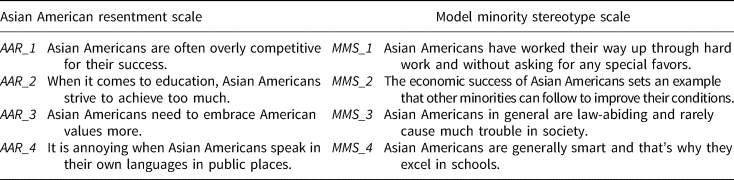
In line with this latest scholarship, we propose and test two measures of mass racialized attitudes toward Asian Americans: Asian American resentment (AAR) and model minority stereotype (MMS) scales, whose detailed item wordings are summarized in Table 1.Footnote 8 We constructed these two, four-item scales to assess the extent to which individuals embrace the two abovementioned racial tropes associated with Asian Americans, namely the racialized perception of the group as “yellow peril” and “model minority.”
Asian American resentment and model minority stereotype scales: item wordings

To construct the AAR scale, we build primarily on two existing scales of Asian American stereotypes in social psychology (Ho and Jackson, Reference Ho and Jackson2001; Lin et al., Reference Lin, Kwan, Cheung and Fiske2005). Ho and Jackson (Reference Ho and Jackson2001) employ a scale that covers both positive and negative stereotypes against Asian Americans, while Lin et al. (Reference Lin, Kwan, Cheung and Fiske2005) develop the Scale of Anti-Asian American Stereotypes (SAAS), which focuses on excessive competence and low sociability as primary dimensions of anti-Asian racial prejudice. While these two scales cover a wide range of racialized images of Asian Americans, we extract and modify some of the scale's items to capture the two key pillars of the yellow peril racial trope: Asians as competitive and economically threatening (e.g., “Asian Americans are often overly competitive for their success”), and Asians as unassimilable to American society (e.g., “Asian Americans need to embrace American values more”). The final four scale items can be found in the left panel of Table 1.Footnote 9
We also constructed the MMS battery to reflect both the contextual specificity and comprehensive aspects of the model minority racial trope: the first two items describe Asians as having achieved economic success “through hard work and without asking for special favors,” setting “an example that other minorities can follow.” The other two items depict the group as “law-abiding” and “generally smart” (see the right panel of Table 1). Both scales were answered with a 5-point Likert scale ranging from “strongly agree” to “strongly disagree.” Taken together, our scales assess the extent to which individual Americans accept or reject the two most salient racialized depictions of the minority group.
4. Data and methods
To test the validity and predictive power of our proposed scales, we rely on data from two original national surveys. We conducted the first survey in October 2021 and the second one in January 2022, using national samples of the U.S. population that were well balanced on key demographic covariates, recruited by Lucid (n = 1847) and Dynata (previously Survey Sampling International; n = 1010) respectively.Footnote 10 By utilizing two rounds of separate surveys with diverse national samples, we provide further credence to the validity and predictive power of our two measures of racial attitudes toward Asian Americans. For our analyses, we include all respondents who identified as white, black, or Hispanic/Latino Americans, believing that it is important to examine racialized views toward Asian Americans among both whites and non-whites.Footnote 11
In addition to the two original scales, we included the same standard measures of symbolic racism, racial group favorability, social dominance orientation (SDO), and white racial identity in both surveys. In the Dynata survey, we added four standard racial stereotype questions (“hardworking-lazy”, “intelligent-unintelligent”, “violent-peaceful”, “trustworthy-untrustworthy”) answered on a 7-point scale (Sides and Gross, Reference Sides and Gross2013). Along with the favorability question, we utilize the stereotype scales to further test the validity of our measures of racial attitudes toward Asian Americans. Table A.1 displays summary statistics of all the key measures included in the two surveys. Finally, we incorporated open-ended questions to the Dynata survey, allowing respondents to express their reactions to each scale item (see Figure A.6). For both surveys, we also included a range of racial policy preference questions measuring support for public policies concerning Asian or black Americans, which will be explained in detail in the next section.
5. Findings
5.1 Configuration of racialized views toward Asian Americans
To begin with, data from both surveys confirm the theorized dimensionality of mass racialized sentiments toward Asian Americans, anchored at one end by the resentful view of Asians as a foreign and competitive threat and on the other by the seemingly positive projection of the group as a “model minority.” Here we start by presenting the main empirical results of the principal component analysis (PCA), exploratory factor analysis (EFA), and confirmatory factor analysis (CFA) which all suggest the expected configuration of public views toward Asians in the United States. We first employ PCA to convert observed responses to the eight statements (four items each for the AAR and MMS scales) into a reduced set of composite variables, known as principal components, that best explains the variance in such responses. As also summarized in Figure A.1.2, we find that the first two principal components in both surveys have eigenvalues above 1, respectively explaining 38 percent (37 percent) and 21 percent (26 percent) of the total variance.Footnote 12 This analysis suggests that the respondents' views toward Asian Americans are structured by underlying dimensions that basically align with the two distinct racial tropes discussed above. Results from the EFA, visualized in the same figure, provide a consistent story: two estimated factors explain a relatively large proportion of the variance in responses to the eight scale items. Results from the CFA also confirm that each scale item significantly loads onto its respective higher-order factor.Footnote 13 Given the scale reliability, we then calculate the composite AAR and MMS scores by averaging the four items for each scale and use these aggregate scores for the rest of the analyses below.
The above findings suggest that the AAR and MMS scales perform well in capturing the two distinct dimensions of racialized views toward Asian Americans. How do these two key components relate to each other? As shown in Figure 2 again, the confirmatory factor analysis reveals that the two higher-order factors, corresponding to AAR and MMS respectively, are significantly and positively correlated, albeit at a moderate level (r = 0.36). Examining the inter-item correlations on the right side of Figure 2, we find that such positive correlations are found across almost all combinations of the eight scale items but are especially strong between the perception that Asians are smart (MMS_4) on the one hand and the view of the group as overly competitive (AAR_1), over-achieving (AAR_2), and un-American (AAR_3) on the other. Those who agree that Asian Americans' relative economic success sets an example for other minorities (MMS_2) also tend to feel negative sentiments toward the group, most readily accepting the view that Asians are competitive (AAR_1) and should embrace American values more (AAR_3).
Confirmatory factor analysis and inter-item correlations.
Note: The figure displays the key parameter estimates from a confirmatory factor analysis (the left panel) and Pearson correlation coefficients among the eight scale items (the right panel) from the Dynata survey. * p < 0.05. ** p < 0.01. *** p < 0.001. Results from the Lucid survey can be found in Figure A.1.

Using the composite AAR and MMS scales, again we observe a positive and statistically significant association between the two scales (r = 0.29) across both surveys, as shown in the left panels of Figures A.2.1 and A.2.2. On the right panels, we can see that up to one-third of the respondents scored high on both AAR and MMS, agreeing or strongly agreeing with the scale items (25.6 percent in the Dynata survey and 32.8 percent in the Lucid survey). Conversely, about one-fourth of the respondents scored low on both scales (27.9 percent and 24.4 percent respectively in each survey). In other words, for over half of the American public, the two racial tropes tend to go hand in hand, with higher (lower) levels of one scale associated with higher (lower) levels of the other and thus providing some support for the last model in Figure 1.
As discussed previously, we posited that the two racialized views function to triangulate Asian Americans between different racial groups by subjecting them simultaneously to relative valorization (as a “model minority”) and marginalization (as competitive outsiders to American society). The data thus suggest that almost one-third of ordinary Americans subscribe to such ambivalent, Janus-faced racialization of Asian Americans while another 25 percent reject both racial tropes as inaccurate depictions of the minority group.
At the same time, we find that about 40 percent of the respondents readily accept the model minority trope (scoring high on MMS) while refusing to embrace the resentful views (low on AAR) (41 percent and 35.1 percent in each survey). Only a small minority, however, scored high on AAR while scoring low on MMS (5.4 percent and 7.6 percent). This result indicates that most Americans are still willing to accept the model minority stereotypes of Asian Americans, due in part to its ostensibly positive and benign depiction of the group.
5.2 Correlates of AAR and MMS
After we have examined the overall structure of racialized views toward Asian Americans, we turn to the following question in this section: Who is more likely to hold resentful sentiments toward Asian Americans or perceive the group as the “model minority”? Figure 3 visualizes correlations between the respondents' levels of AAR and key individual demographic and dispositional traits, which also allow us to test the convergent validityFootnote 14 of the two scales. First, as expected, those who feel less favorable and hold more negative stereotypes toward Asian Americans are significantly more likely to score higher on AAR. Next, among all variables, some of the key related dispositional and psychological traits were found to be the strongest predictors of resentful sentiments toward the minority group: Higher levels of ethnocentrism and social dominance orientation—generalized conservative views on inter-group relations—are significantly associated with higher levels of AAR, indicating that Americans predisposed to in-group favoritism and social hierarchy in general are more likely to hold negative views of Asians in the country. Racial conservatism, as captured by white racial identity and anti-black racial resentment, is also found to be strongly associated with higher levels of AAR.
Demographic and dispositional correlates of AAR.
Note: The figure displays scatter plots and correlations between AAR and demographic and dispositional traits. The plots include smoothed loess lines with shaded bands indicating 95 percent confidence intervals and Pearson correlation coefficients with p values. The results are based on the Dynata sample, and the replicated results with the Lucid sample can be found.

Interestingly, political ideology and party identification are found to be unrelated to AAR, suggesting that anti-Asian sentiments are distributed across all political orientations and are not especially salient among conservatives and Republicans.Footnote 15 We find, however, that levels of financial stress exert some palpable effects on anti-Asian feelings, most likely by inflating perceived inter-group competition and provoking a sense of envy and resentment toward the group. Finally, higher levels of education and income are found to be positively correlated with higher AAR scores. This result might be at least partially driven by individuals who have more direct experiences in competing with Asian Americans in higher education and job markets.
Figure 4, in turn, shows correlations between levels of MMS and the same demographic and dispositional traits. First, individuals who feel warmer and hold fewer negative stereotypes toward Asian Americans are significantly more likely to view them as a “model minority.” This finding again suggests that many ordinary Americans accept the racial trope as a positive and benign depiction of the minority group. The data further reveals, however, that those who embrace such racialized view also tend to be more racially conservative and favor social hierarchy in general. As discussed earlier, the model minority racial trope, despite its ostensibly positive tone, has been promoted to perpetuate the “myth” of Asian American success and thereby downplaying the persistence of racial inequality in the United States (Yi and Museus, Reference Yi, Museus, Stone, Dennis, Rizova, Smith and Hou2015). Our findings seem to align with this insight, as higher levels of racial conservatism and SDO significantly predict higher MMS scores.
Demographic and dispositional correlates of MMS.
Note: The figure displays scatter plots and correlations between AAR and demographic and dispositional traits (Dynata sample). The plots include smoothed loess lines with shaded bands indicating 95 percent confidence intervals and Pearson correlation coefficients with p values.

In Figure A.5, we additionally show the close connection between the model minority racial trope and anti-black racial resentment: Across the two surveys, we find that all the four items of the MMS scale are significantly and positively associated with the resentful view of African Americans as violating the values of hard work and individualism. Most notably, those who subscribe to the model minority racial trope of Asian Americans are also more likely to believe that African Americans should do the same “without any special favors” and “could be just as well off as Whites” “if Blacks would only try harder.” This result provides preliminary empirical support for the conventional argument in the literature (e.g., Kim Reference Kim1999; Lee Reference Lee, Zhou and Gatewood2007) that the model minority racial trope serves to justify racialized resentment toward African Americans.
Finally, we again find null effects for political ideology and party identification, which suggest that political orientations do not predispose individuals toward accepting or rejecting the model minority racial trope. Levels of financial stress also have no effects on MMS scores. Finally, we find that higher levels of education and income significantly predict higher levels of MMS. More educated and higher-income individuals, in other words, tend to have more ambivalent views of Asian Americans, considering them simultaneously as a competitive threat and a “model minority.”
5.3 Effects on racial policy preferences
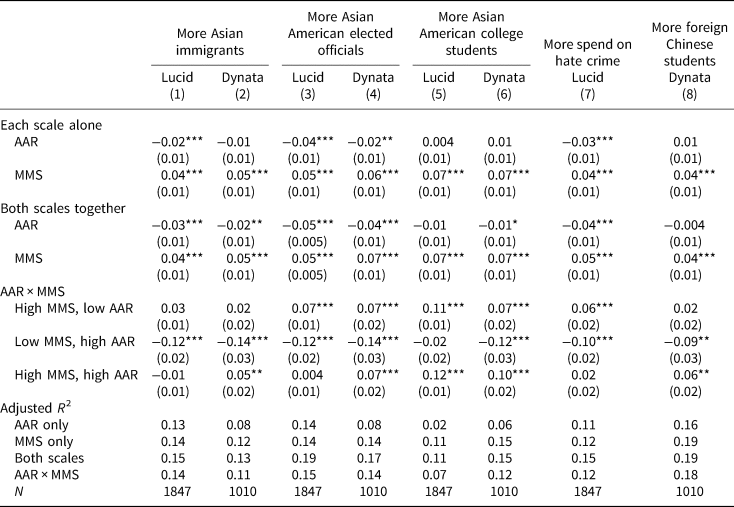
Finally, we analyzed the effects of AAR and MMS on support for public policies that affect Asian Americans. Across the two surveys, we measured levels of mass support for policies that promote increased numbers of Asian immigrants, Asian American elected officials, Asian American students in top universities, foreign Chinese college students, and more federal spending on addressing anti-Asian hate crimes.Footnote 16 As summarized in Table 2, we ran a series of OLS regression models, with AAR and MMS scales entered alone, together, or jointly as combinations of high versus low levels.Footnote 17 Across these different specifications, we can observe that higher levels of AAR significantly lowered mass support for pro-Asian public policies while higher levels of MMS significantly predict increased support for Asian Americans. Whether entered alone or together with MMS, a unit increase in AAR leads to about 2 to 4 percentage points decrease in the level of support for the racialized policy measures. MMS exerts opposite effects on policy preferences, with one unit increase in MMS associated with an approximate 4 to 7 percentage points increase in the level of public support for the same policies.
AAR, MMS, and support for pro-Asian public policies

Note: OLS regression coefficients with standard errors in parentheses. Outcome measures are recoded 0–1. Each model controls for demographic covariates, ideology, and party identification. Both AAR and MMS are standardized for comparison of effect sizes. Full results can be found in the appendix. See Tables A.14.2 and A.14.3 for the same results with Black and Hispanic respondents only. *p < 0.05. **p < 0.01. ***p < 0.001.
The same effects are observed when we compare the policy preferences among subgroups with different combined levels of AAR and MMS. As shown in Table 2, individuals in the “high MMS and low AAR” subgroup are about 3 to 11 percentage points more likely to support the pro-Asian policies than those in the baseline “low MMS and low AAR” group. Conversely, those scoring low on MMS but high on AAR (“low MMS and high AAR”) are significantly less likely to support such policies by approximately 9 to 13 percentage points, translating their resentful sentiment directly into more conservative racial policy preferences. Interestingly, those who score high on both AAR and MMS are significantly more likely to support the pro-Asian policy measures, suggesting that the model minority stereotype racial trope exerts more pronounced effects than anti-Asian racial resentment when it comes to public policy preference formation.
When it comes to predicting racial policy opinion, how do these two novel scales compare in performance to the standard feeling thermometer and stereotype scales that have conventionally been used as shorthand measures for assessing racial attitudes toward Asian Americans? As summarized in Table A.9.1, we ran the main models with the feeling thermometer and stereotype measuresFootnote 18 as predictors, finding that all the four stereotype measures (violent/untrustworthy/intelligent/hardworking) consistently fail to predict pro-Asian public policy preferences and that our proposed measures, especially when used together, perform as well as or in some cases slightly better than the feeling thermometer scale. Additionally, as demonstrated in Tables A.9.2 and A.9.3, the AAR and MMS effects we see in Table 2 persist even after accounting for the feeling thermometer scores. This further supports our claim that the proposed scales effectively capture the distinct content and impacts of racial attitudes toward Asian Americans, beyond what is measured by the general favorability index.
6. Discussion
In this paper, we proposed two novel measures of contemporary Asian American racial tropes and utilized them to empirically investigate the structure and political effects of such racialized views toward the minority population in the United States. Based on two rounds of national surveys, we first demonstrated the continued popularity of the two racial tropes among the American public—over 30 percent of respondents agree with the characterization of Asian Americans as foreign and overly competitive while almost 70 percent accept the view of the group as a “model minority.” Furthermore, these two seemingly contradictory racial tropes appear to go hand in hand for many ordinary Americans: Almost one-third of respondents subscribe to both racial tropes simultaneously. This Janus-faced racialization of Asian Americans thus reflects the complexity of racialized politics regarding the Asians in American society: while conveniently projected as a role model to other minorities, Asian Americans remain marginalized as “perpetual foreigners” whose presumed competence concurrently stokes racialized fear and envy. We additionally showed, however, that despite such interconnection, the two racial tropes have opposite effects on mass racial policy preferences: Those who hold resentful views of Asian Americans are less likely to support public policies that benefit the group while individuals who embrace the model minority trope are more supportive of such policies.
Several limitations in the scope of the paper suggest promising avenues for future research. First, while this study provided a “snapshot” of contemporary racialized attitudes toward Asian Americans, future studies can examine the extent to which the two racial tropes might interact with each other in a more dynamic fashion. For example, for those who perceive Asian Americans as a model minority, under what conditions would they feel threatened by and become resentful of the racial group? Relatedly, for those who view Asian Americans simultaneously as a model minority and a competitive threat, when do they become less supportive of pro-Asian public policies? Future research can thus identify the contexts and policy domains under which such racial prejudices come to exert stronger effects on policy preferences. The exponential growth of anti-Asian hate crimes during the COVID-19 pandemic has aptly demonstrated the continued vulnerability of Asian Americans to racial animus and violence. More research needs to be conducted to examine whether and how such changing social and political environments induce stronger effects of racial resentment on mass political attitudes and behavior.
Second, our data reveal interesting patterns of connections between the model minority stereotype toward Asians and anti-black racial resentment, which merit a further investigation. As mentioned above and summarized in Figure A.5, first of all, those who score higher on the MMS scale are significantly more likely to believe in the classic resentful view of African Americans as “not trying hard enough” and having to “[work] their way up” like other minorities. When it comes to actual public policies that explicitly favor African Americans, however, MMS positively predicts support for these benevolent policies toward the minority group (see Table A.10). One possible interpretation of this result is that subscribing to the model minority trope, while being significantly correlated with anti-black resentment as hypothesized in the literature (Kim, Reference Kim1999; Lee Reference Lee, Zhou and Gatewood2007; Wu Reference Wu2013), nevertheless does not necessarily translate to reduced policy support for African Americans. In short, we suggest that more studies are needed to examine the conditions under which the model minority racial trope interacts with racial politics toward African Americans.
Similarly, MMS consistently predicts pro-Asian policy support in our surveys. For this outcome, we suspect this might mean for many Americans, the success of the Asian Americans as model minority should be celebrated, and there is need for even more pro-Asian policies in the country. As discussed previously, the model minority discourse was intitally used to show blacks that conformity would be rewarded while absolving responsibility for domestic racism. Thus, our finding might confirm such a racial preference in the United States. Elsewhere, studies on benevolent sexism also has a similar finding, whereby people with benevolent sexist attitudes do support certain gender equality policies, albeit only in specific areas (Hideg and Ferris, Reference Hideg and Ferris2016).
Future studies can also expand the scope of our inquiry by examining the potential effects of racialized sentiments on a broader range of political behavior such as candidate evaluation, vote choice, and party identification. Lajevardi and Abrajano (Reference Lajevardi and Abrajano2019) find that anti-Muslim racial resentment, above and beyond other anti-minority sentiments, exerted palpable effects on the support for Trump in the 2016 Presidential election. Scholars can also probe the relevance of racial animus against Asians in predicting vote choices in both 2016 and 2020, especially given the centrality of anti-China political rhetoric during the Trump campaigns. Building on a recent study by Hajnal and Rivera (Reference Hajnal and Rivera2014) on the role of anti-immigrant and anti-Latino sentiments in shifting white Americans away from the Democratic Party, researchers can also utilize our validated measures of Asian American racial tropes to probe whether attitudes toward Asians predict the American public's changing partisan identities.
In this paper, we have examined the relatively overlooked dimension of American racial and ethnic politics by focusing on the complex and multi-faceted mass racial attitudes toward Asian Americans. As American society is grappling with more explicit and politicized racial fault lines, and at a time when the Asian American community is increasingly concerned about targeted violence, our work directly unravels the peculiar ways in which Asians have been racialized in the United States. With more scholars now working on the issues of Asian American politics, our findings set the stage for more empirical work on the structure and political implications of racial attitudes toward the minority group in an increasingly diverse American society.
Declarations
The authors declare no conflict of interests.
Supplementary material
The supplementary material for this article can be found at https://doi.org/10.1017/psrm.2024.65. To obtain replication material for this article, https://doi.org/10.7910/DVN/897CMJ





 Open access

