

Introduction
State-society relations in Belarus have always been somewhat different from those in other post-Soviet countries since President Alyaksandr Lukashenka took power in 1994. Over many years, they were characterized by a particular welfare state model that ensured socio-political stability in the country. In this way, the regime built by Lukashenka sought to compensate for the lack of political liberties and participation in the country. There was a tacit consensus that economic stability and security were privileged over individual rights and civic activism.
Nevertheless, the welfare state model was challenged by repeated deep recessions in the decade from 2010. As a result, the socio-economic situation in the country started to deteriorate, with salaries and pensions stagnating, unofficial unemployment rising, and labor migration increasing. State authorities, however, remained reform-resistant and failed to address these problems.
The state-society-relationship has been further strained by the authorities’ mishandling of the Covid-19 pandemic and the fraudulent presidential election in August 2020, which proved to be a catalyst for the eruption of mass protests in the country. The disbelief in the blatantly falsified election results was much more pronounced than in previous presidential elections. People had witnessed the long lines of citizens willing to sign up for and support oppositional candidates. Moreover, falling approval rates for President Lukashenka were an open secret, despite the ban on public polls. A crucial factor in the subsequent developments was the candidacy of Sviatlana Tsikhanouskaya. She stepped in for her arrested husband, gathering around her a team of female campaigners of other banned/arrested candidates, and eventually claiming victory in the elections. She and her supporters were pivotal for the protest mobilization in the post-electoral period.
They were helped by the fact that more and more people had gathered protest experience in previous years, for example during the 2017 protests against a decree on the prevention of so-called “social parasitism”, effectively sanctioning the unemployed. This prompted a nationwide outcry across social strata and generations. The factors for the decline of the societal consensus have therefore been manifold and cannot be reduced to the events of 2020. Wider parts of society, especially younger generations, had already become increasingly discontent with various presidential initiativesFootnote 1 in the years before the elections.
In the Belarusian case, existing scholarship on the state-society relationship has tended to deal with the phenomenon in the framework of regime theory. Different labels have been used to describe the ruling system, such as “sultanism” (Eke and Kuzio Reference Eke and Kuzio2000), “pre-emptive authoritarianism” (Silitsky Reference Silitsky2005; Stoner, McFaul, and Bunce Reference Stoner, McFaul and Bunce2010), “(neo) patrimonialism” (Hale Reference Hale2015; Way Reference Way2015), “electoral authoritarianism” (Bedford Reference Bedford2017) and “adaptive authoritarianism” (Frear Reference Frear2018). With regard to the fusion of the political and economic domains in terms of a limited access order, notions like “rent-seeking regime” (Pikulik Reference Pikulik and Magyar2019) as well as “distributional authoritarianism” (Wilson Reference Wilson2016; Dimitrova et al. Reference Dimitrova, Mazepus, Toshkov, Chulitskaya and Ramasheuskaya2020) have been chosen. In the context of nation- and identity-building processes, state-society frictions have been described as “national nihilism,” with interpretations ranging from a “neo-Soviet narrative” to an “emerging civic awareness” (Marples Reference Marples1999; Bekus Reference Bekus2010; Buhr, Shadurski, and Hoffman Reference Buhr, Shadurski and Hoffman2011). While the civilian dimension of Belarusian society, social movements and protests has been widely researched, the different patterns of regime response or the way authorities mobilize forces themselves have been discussed to a much lesser extent.
Over the past decade, Belarus has developed into a state predominantly driven by security concerns. This is not unusual for an authoritarian state that has passed its zenith (see Haggard and Kaufman Reference Haggard and Kaufman2016; Geddes, Wright, and Frantz Reference Geddes, Wright and Frantz2018). Correspondingly, authorities have increasingly invested in the domestic security structures − to a disproportionate extent compared with neighboring states.
As a result, the tight and exclusive relationship that Lukashenka has maintained with the security structures has gained in importance ever since 2020. Already before 2020, personalities from these structures had become more important at the highest level of state governance. Hence, they have a strong say in how the state deals with societal resistance. This is reflected in a changed security discourse. The trend towards an increased “securitization” of the Belarusian state has been ongoing but became more apparent in 2020.
There are signs that the Russian attack on Ukraine and the new role Belarus has found itself in, as an assistant to the aggressor, has made the situation for Lukashenka much more difficult. On the one hand, he has to uphold the morale of the Belarusian troops and on the other, he needs to conceal the fact that he has lost control of the Russian military deployments on Belarusian soil (Charter 97 2022) Lukashenka has been put under immense pressure by Putin to agree to accelerating the unification between the two countries and upgrading the Belarusian armed forces in view of a potential direct Belarusian intervention in the war. Publicly, he has paid lip service to Putin in order to preserve loyalty within the alliance with Russia, which remains the only close ally of Belarus. However, it remains to be seen whether Lukashenka is really prepared to go down with Russia, should Ukraine win the war, or whether he would seek to keep a back door open, by latently continuing to oppose a permanent Russian military deployment and, ultimately, incorporation by the big neighbor.
The intention of this article is not to describe the structure and mentality behind the security apparatus, which has partly been realized elsewhere (for example, Porotnikov Reference Porotnikov2019; Marin Reference Marin2020; Sivitsky Reference Sivitsky2020; Bohdan Reference Bohdan2020), but to identify indicators for the “securitization” of state power structures and corresponding measures that guide authorities in their endeavor to counteract societal resistance. Securitization theory, a concept originally framed by the Copenhagen School implying the transformation of policy issues and fields into security-relevant subjects (Buzan, Wæver, and de Wilde Reference Buzan, Wæver and de Wilde1998), will provide a prism for the analysis.
The article relies on document analysis, the results of nationwide surveys conducted by the Centre for East European and International Studies (ZOiS) in 2020 and 2021, statistical data, and problem-centered interviews conducted by the author with various actors on the ground and via e-mail between 2017 and 2020.Footnote 2 The first part of the article deals with the gradual shift in state priorities towards a prioritization of domestic security due to changing economic conditions and perceptions of threat. The second part is dedicated to a detailed analysis of the transforming state security discourse in the light of “securitization theory,” the way it is used to reinforce loyalty among the security structures, and the increased influence of the “siloviki” in high state offices. The instruments deployed by the state to mobilize security structures in order to confront societal resistance are the focus of the third and final part.
As in most countries, the security apparatus in Belarus is a closed system. In this case, it can rightly be described as a “black box.” Studying this topic is complicated and delicate. Therefore, the author − unlike journalists − was not able to conduct interviews with officials from security organs or collect data in this realm. To compensate for this, accounts of civic activists with pertinent personal experience, assessments of experts in the field, open-source data and intelligence, as well as survey results were used to complement the picture.
Shifting State Priorities and Perceptions
Failure to Address Socio-Economic Problems
In Belarus, the concept of the Soviet-era welfare state model (sometimes described as the “social contract”) has long been considered one of the main reasons for socio-political stability in the country (see various contributions in Haiduk, Rakova, and Silitski Reference Haiduk, Rakova and Silitski2009). By means of a policy of redistribution that was meant to share the benefits of an economic surplus across all strata of society, the aim was to maintain a balance between economic gains and social welfare needs. In Korosteleva’s words, the regime learned “to survive by emulating consensus between the regime’s performance and perceived societal needs” (2012, 43).
The paternalist nature of the “Belarusian model” under Lukashenka no longer corresponds to the liberal economic values of wider parts of the population (Douglas et al. Reference Douglas, Elsner, Krawatzek, Langbein and Sasse2021, 22–23). Until the mid-2000s, large parts of the population benefited from the Soviet-type social protection in Belarus (Chubrik et al. Reference Chubrik, Haiduk, Pelipas, Shymanovich and Tochitskaya2009, 35). Consumer prices were controlled, the costs of public utilities subsidized, and state-owned enterprises as well as trade unions were in charge of maintaining jobs and the social infrastructure (Chulitskaya and Matonytė Reference Chulitskaya and Matonytė2018, 542). However, as early as 2004, individual contracts with workers were introduced instead of collective agreements (The Bullet 2020), and in 2007 major reforms of the social protection system entailed restrictions to the general provision of social benefits (Chubrik et al. Reference Chubrik, Haiduk, Pelipas, Shymanovich and Tochitskaya2009, 36–37). As a result of severe economic recessions, the government began to introduce neo-liberal policies and slowly dismantle the welfare state and social obligations to its citizens. This was accompanied by a tight monetary policy whose side effects were stagnating salaries and pensions as well as rising unemployment and labor migration. In 2016, a pension reform was announced that foresaw an increase of the retirement age. Reasonable by international standards, it was nevertheless criticized that the minimum eligibility period had also been increased, in some cases retroactively, and that years spent in military service, university studies, or on maternity leave no longer counted towards the pension. A watershed event came in 2015 with the introduction of Decree No. 3 on “social dependency,” a tax for the unemployed that work less than 183 days per year. This initiative triggered the first nationwide social protests in spring 2017, when unemployed Belarusians began to receive letters from the authorities. The project was quietly abandoned in 2018. Beyond concrete actions, the state’s social security discourse also began to change from 2006 on. Lukashenka started to underline the notion of personal responsibility and the limitations to the social obligations of the state. Many of the unpopular neoliberal steps were usually implemented in the aftermath of elections and not mentioned during the campaigns (Chulitskaya and Matonytė Reference Chulitskaya and Matonytė2018, 547).
The current perception of a worsening socio-economic situation in Belarus is reflected in particular in concerns about one’s personal financial situation. ZOiS surveys have repeatedly confirmed that over 80 percent of respondents are “very concerned” or “somewhat concerned” about what would happen to their personal finances (Douglas et al. Reference Douglas, Elsner, Krawatzek, Langbein and Sasse2021, 22; Krawatzek Reference Krawatzek2021). This is a high share when compared to the OECD average of 40 percent in non-crisis situations, and to countries in times of political turmoil like Moldova in 2020, where those that express concern are below 50 percent (OECD 2020). These concerns are not without reason: the economic situation in Belarus is strained. Insecurities about the future of energy subsidies have increased the dependence of the dominant oil-refining industry on Russia. The outlook has worsened since the imposition of additional sanctions since March 2022 (European Commission 2022). The trends in Belarus’s external trade and exports were slightly reversed in 2021. However, the country’s budget deficit is expected to grow again in 2022 and the effect of sanctions is likely to be severe (German Economic Team Belarus 2022). The Covid-19 pandemic, the domestic political crisis, and the Russo-Ukrainian War have amplified many of these problems. The Belarusian authorities in turn have failed to address their underlying structural causes and their effects on Belarusian citizens.
Against this background, it is not astonishing that Belarusian citizens have lost their confidence in the state and its capacities with regard to social protection:
Today it is the irony of fate: Everything that the Belarusian regime was so proud of − the high standard of its social benefits − has as such not become part of its social policies. Everything that existed, let’s say ten years ago, in terms of social policies, has essentially been liquidated. This happened against the background of declining wages and pensions. There is nothing but declarations that we are a social state…I don’t want to say that there is nothing of it left, but it is far from comparable to what was there in the beginning. This concerns public healthcare, education [ … ] (Yarashuk Reference Yarashuk2017).
The Belarusian welfare state model used to rely extensively on externally generated energy rents (in the form of access to Russian oil and gas subsidies), which were meant to fund social policy. This arrangement made it possible for Belarus to avoid a massive restructuring of the economy, the closure of inefficient factories, and mass unemployment (Balmaceda Reference Balmaceda2014). In addition, energy rents have been an essential prerequisite for the financing of the silovye struktury and hence the regime’s survival (Feduta Reference Feduta2005, 422). The maintenance of the “power vertical” gradually became more important for the regime. It eventually led to the emergence of a subsidized and pampered elite group that lives in a different world from the rest of society.
Privileges for “Siloviki”
For a long time, it appeared to be entirely acceptable to the Belarusian population that state-sector employees, particularly members of the security apparatus, receive a higher pension than ordinary citizens, since they are responsible for ensuring the security and stability of the state.Footnote 3 In 2017, former security sector employees received another 40 percent pension increase: “They [the regime’s elites] understand that there are protests ahead. The security structures – representing the power vertical – are now the only group still supporting the current regime” (Lyabedska Reference Lyabedska2017). However, by 2019 this acceptance could no longer be taken for granted (see figure 1 below).
Views on higher pensions for state employees
Source: Urban/ IPM Research Center (Reference Urban2019)

This picture somewhat changed in December 2020, when ZOiS conducted one of the first nationwide surveys after the mass protests. Respondents were asked to share their views on a range of political and economic issues, among them the treatment of state employees and members of the security structures in relation to other citizens with regard to pensions and benefits (on a scale from 1 to 10, with 1 being equivalent to equal treatment and 10 acceptance of certain privileges, see figure 2 below).
Views on benefits for state employees and members of the security structures
Source: ZOiS Belarus Survey (Douglas et al. Reference Douglas, Elsner, Krawatzek, Langbein and Sasse2021), N=2004 (Age 16-64)

At the end of 2020, almost 62 percent of the respondents (scale 1–4) were of the opinion that state employees and security personnel should be treated the same as other citizens, while 27 percent (scale 6–10) tended to find certain privileges, such as higher pensions and benefits, acceptable.
Changing Threat Perceptions and Domestic Destabilization Scenarios
Besides economic developments, there was another factor at play in the shift in state priorities: the start of the Russian-Ukrainian conflict in 2014 and the resulting Russian-Western standoff. This led to significant changes in Belarus’s national defense planning and military build-up as well as in its general threat perceptions (Sivitsky Reference Sivitsky2020). Lukashenka has never fully trusted Russian president Vladimir Putin. However, after 2014 he became even more distrustful and made increasing efforts to emancipate Belarus from Russia’s grip and forge ties with the West. In 2020, he was obliged to seek closer relations with the Kremlin again. This has intensified since the Russian assault on Ukraine in February 2022 to the degree that, according to experts, Belarus has given up on its sovereignty (Karbalevich Reference Karbalevich2022).
In December 2014, the government adopted a new five-year Defense Plan and a new directive on state defense, addressing changes in the regional political-military situation and obliging the military to give equal consideration to security threats from the west and the east as well as “hybrid” threats. The aim was to implement a “360 degrees” concept (Karbalevich Reference Karbalevich2022). In addition, in 2015, the Belarusian Ministry of Defense was tasked with developing a new military doctrine, adopted in July 2016, revising the previous version, which dated back to 2001. One of the main goals of this doctrine was to gird the country against a dual threat of “color revolutions” from within and “hybrid warfare” from outside (IISS 2019, 179). While most neighboring countries increased their external defense budgets in reaction to the Ukraine crisis, Belarus instead decided to reorganize its armed forces and invest more in its military sovereignty and autonomy from external actors (Bohdan Reference Bohdan2019). Among others, additional financial resources were allocated to the border protection troops (directly subordinate to the Council of Ministers), which, besides being part of the armed forces, can also perform law enforcement functions (Tut.by 2020). It is one of the best equipped paramilitary units in Belarus (Bohdan Reference Bohdan2020, 170).
The national security apparatus has been on alert and not just since President Lukashenka de facto lost the presidential elections in August 2020. Even before that the authorities had begun to prepare for scenarios of domestic destabilization. In December 2019, the president signed a new National Defense Plan (Belta 2019; Belarus Security Blog 2020) focusing on the development of an independent national security architecture. Another priority identified in the new concept for the development of the armed forces (2020–2030) is the prevention of domestic instability, reflecting scenarios of how modern military conflicts unfold (Sivitsky Reference Sivitsky2020). As the former state secretary of the Security Council of Belarus Stanislav Zas explained, “additional attention was put on the question of destabilization inside the country, which is also a matter of defense. That is the reality of our times: Everything begins with a destabilization of the domestic situation, which can then provoke an internal armed conflict” (Belta 2019).
Accounts of previous mass protests, for example following the presidential elections in 2006 and 2010, testify to similar concerns of and preparations by the authorities beforehand. On the eve of the election in 2006, for example, mobile phone users in Minsk received text messages warning them against attending demonstrations organized by the opposition. The chief of the State Security Committee at the time, General Sukharenko, publicly announced that all participants of unauthorized public actions during or after the election would be charged under the Terrorist Act and could be subject to 20 years imprisonment (Zarakhovich Reference Zarakhovich2006; Korosteleva Reference Korosteleva2012, 45). On March 19, 2006, the day of the election, Lukashenka recalled to full alert all paramilitary forces at hand in order to counteract any civilian insurgence. However, none of these forces were ultimately deployed, or even seen on the streets (Korosteleva Reference Korosteleva2012, 46).
In 2019, the political and regulatory prerequisites were hence created for the domestic use of the armed forces, notably by means of newly established rapid reaction forces (Bohdan Reference Bohdan2020, 174). Some of them were presumably deployed in the aftermath of the presidential election to suppress the protest movements, especially in the west of the country (Ria Novosti 2020). In the past, the army’s main value was to be a bargaining chip in the relationship with Russia. The air defense forces in particular were of importance also for Russia’s defense, which explains why, in contrast to other military branches, this service took on greater significance and was allocated more resources (Bohdan Reference Bohdan2020, 168).
Fundamental changes have taken place since the Russian invasion of Ukraine in February 2022. Although the Belarusian president initially tried to support peace negotiations in Belarus, he could not conceal the fact that the Russian Federation used Belarusian state territory for its attacks on Ukraine.Footnote 4 Some observers have noted that the Belarus-Russia Union State Military Doctrine, signed on November 4, 2021, and released prior to the two countries’ joint strategic-operational military exercise Soyuznaya Reshimost (Allied Resolve) from February 10–20, 2022, had foreshadowed not only the exercise itself but also the impending hostilities. The doctrine implied that the Union State had entered a “period of growing threat” and this wording, in Russian military parlance, refers to the phase intermediately prior to the “initial period of war” (McDermott Reference McDermott2022).
Unlike the previous version of the Union State Military Doctrine, from 2001, this new document also explicitly names the North Atlantic Treaty Organization (NATO) as a threat to the security of the Union State (Voyennaya Doktrina Soyuznogo Gosudarstva, Chapter 2.14, November 5, 2021). Contrary to statements by the late Belarusian Foreign Minister Vladimir Makei, Defense Minister Victor Khrenin announced on February 20 (four days prior to the invasion) that Russian troops would stay in Belarus indefinitely. This undergirded assumptions about Belarus’s ostensible loss of sovereignty while depicting Lukashenka as a surrogate leader (Ioffe Reference Ioffe2022).
Prioritization of Domestic Security
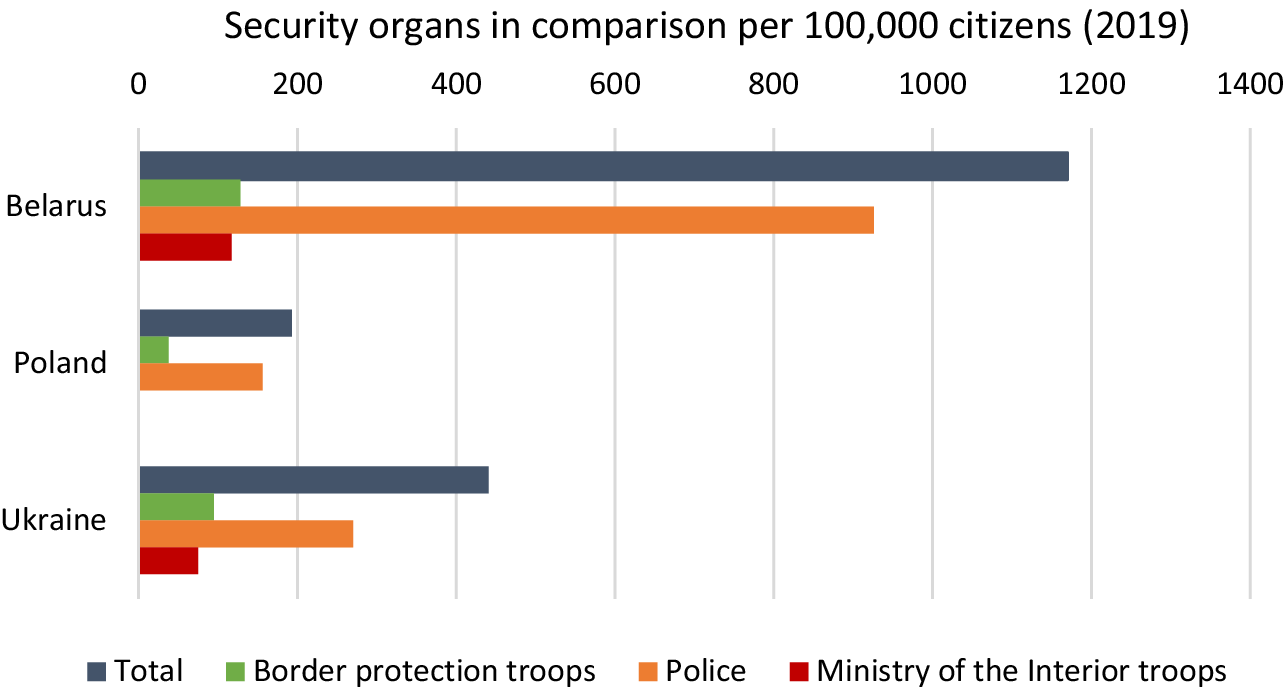
Given the dramatic changes in the regional and global geopolitical situation, it remains to be seen whether the previous prioritization of domestic security (see IISS 2019, 179) will be sustained. As of 2021, Belarus still maintained a larger number of militsiya (87,000) and internal troops (11,000) than members of the armed forces (45,000) (IISS 2021, 183–184). Although the exact numbers of police and MVD troops are classified (Spasyuk Reference Spasyuk2018), estimates show that the country has one of the highest rates of internal security personnel in Europe. In direct comparison with its more populous neighbors Poland and Ukraine, Belarus has a disproportionately high number of internal security organs (see figure 3 below).
Security organs in comparison (Belarus, Poland, Ukraine)
Source: International Institute for Strategic Studies (2021)
How this fact is perceived in society, is reflected in the following quote: “We take the third place in the world in terms of the number of ‘siloviki’ per capita. But these people do not produce anything” (Zelko Reference Zelko2017). A large proportion of the state budget is traditionally spent on domestic security (third largest budget item after defense and healthcare). The entire security apparatus has been growing continuously over the past decade, as have the budgets of both the MVD (Ministry of Internal Affairs) and the KGB (Committee of State Security) (Radio Svaboda 2018, see also figure 4 below).
Development of the Belarusian domestic security budget
Source: Ministry of Finance of the Republic of Belarus (2021)

In sum, according to the Global Militarization Index 2020 (Mutschler and Bales Reference Mutschler and Bales2020), Belarus is among the top twenty countries for militarization, understood as the allocation of a particularly high proportion of resources to security compared with other sectors.
“Securitization” of State Politics
Belarusian Security Discourse
In terms of the “guns vs. butter” model,Footnote 5 Belarusian authorities seem to have made the long-term decision to invest more in strengthening government structures and domestic security than in producing goods or boosting social welfare. As noted by Wilson, the old paradigm of keeping a balance between the subsidy regime with Russia and the foreign policy game was past history by 2014 at the latest: “The maintenance of statehood and national security [had] suddenly become a much more prominent part of [Lukashenka’s] governing formula … ” (Reference Wilson2016, 78).
From the perspective of “securitization theory,” citizen-state relations are described as the “tension between the state as a protector of its citizens’ security and the state as a threat to its own individuals” (Buzan Reference Buzan1991, 43ff.). In contemporary Belarus the balance has tilted more and more towards the state as a source of threat. Yet, Belarus represents an exemplary case, in accordance with critical security studies and the “constructivist turn” (Checkel Reference Checkel1998), of how intertwined security policies are with changing norms, ideas, and identity. Therefore, securitization concepts (Buzan, Wæver, and de Wilde Reference Buzan, Wæver and de Wilde1998; Balzacq Reference Balzacq2011; Butler Reference Butler2019) provide a promising avenue to analyze the way the Belarusian regime has sought to secure its own survival, particularly since August 2020. Evidently, this is not a process that only began in 2020 (maybe it was an essential element of Lukashenka’s rule from the outset), but in that year it did manifest itself more clearly than ever before.
In line with this approach, security cannot be analyzed as a given reality, but through processes produced by speech acts (Buzan, Wæver, and de Wilde Reference Buzan, Wæver and de Wilde1998). These acts are context-dependent and articulated by decision-making agents with power directed at a distinct audience (Balzacq Reference Balzacq2011). The key issue is for whom security becomes a consideration in relation to whom (Buzan, Wæver, and de Wilde Reference Buzan, Wæver and de Wilde1998, 18). Threats are defined in relation to a referent object. They are successful when they eventually lead to the legitimate adoption of exceptional political measures as a means of assuring security (Buzan, Wæver, and de Wilde Reference Buzan, Wæver and de Wilde1998, 27). Thus, the issue is moved from the sphere of normal politics into the realm of emergency politics, where it is no longer dealt with by the rules and regulations of normal politics, but by the ones of emergency politics (Buzan, Wæver, and de Wilde Reference Buzan, Wæver and de Wilde1998, 24–26).
The securitizing actor frames the security issue as an existential threat to the referent object, thereby generating endorsement of emergency measures beyond rules that would otherwise bind (Buzan, Wæver, and de Wilde Reference Buzan, Wæver and de Wilde1998, 5). Such emergency measures, in the Belarusian case, gave state officials the right to use whatever means necessary to confront the threat.
In the Belarusian context, in the course of 2020 the security structures were elevated to referent objects in their own right, since from the regime’s perspective they were the guarantor for the preservation of state sovereignty and were themselves threatened by a situation that undermined the rules, norms, and institutions that had constituted the regime hitherto. In other words, the regime directly securitized its own survival.
While in official discourse, Lukashenka traditionally spoke of existential threats to the entire Belarusian nation and addressed the citizenry and state population at large, in his speeches following the mass protests of 2020 he restricted the target audience to his followers, deliberately excluding regime opponents. The president and his fellow decision-makers targeted the inner circle of the security apparatus to frame and construct the threat of domestic destabilization, which then allowed them to justify extraordinary measures and strengthen loyalty from the security structures. This rhetoric changed again in late 2020, when Lukashenka pretended that the “crisis situation” had been overcome and a “color revolution” thwarted.
Thus, in his addresses to the security organs, Lukashenka communicated that there was a point of no return, in the sense that if this problem (of suppressing the protests) was not tackled, everything else would become irrelevant. In a way, agency and audience here became blurred, since the “siloviki” embodied not only the enacting power but also the audience and the referent object in one. A threat to the ruling regime was hence framed as a threat to Belarusian statehood in its totality.
In front of this audience, Lukashenka politicized and securitized the vulnerability of Belarusian statehood and the individual risks this would imply:
I want to make my position clear. It is unchanging: our duty to present and future generations is to preserve the country. And we will do it, no matter what it takes. We will preserve it for all of us, our children and grandchildren. This is the main task for me and you. A historical mission, if you like. I want to tell you something openly and honestly and I want them [the opposition] to hear it: if uniformed services had not done their work, if on those August days they had faltered, we would be living in a different country today. And it is a big question whether we would still be alive and whether the country would have survived. (Lukashenka during a meeting with the special police force of the Minsk City Police Department on December 30, 2020 (Belta 2021a))
In the immediate post-electoral period, Lukashenka sought to blame and securitize external factors and threats as the principal cause for the domestic political crisis: “They want to topple this government and replace it with another one that would ask a foreign country to send troops in support … ” (Lukashenka blaming the West for stirring up demonstrations against him in the hope of turning Belarus into a “bridgehead against Russia,” August 29, 2020, quoted in Bellamy (Reference Bellamy2020)).
In particular, Poland became a recurrent theme of takeover scenarios, even to the point of incriminating and repressing the ethnic Polish community in Belarus (RFE/RL 2021): “Because we cannot be calm about Poland’s intention to grab the whole of Belarus. You know that they will fail even if NATO in its entirety invades Belarus. Even if we stand alone, they will fail. We will all die for our country. God forbid of course” (Lukashenka on October 29, 2020, during a meeting to which he summoned several officials in order to appoint his aides for the Brest and Grodno oblasts, as well as the city of Minsk (Belta 2020a)).
Lukashenka subsequently made considerable efforts to address several audiences simultaneously – domestic and foreign – among them the Russian president and the Russian nation, which he framed as another referent object:
There is a need to contact Putin so that I can talk to him now, because it is not a threat to just Belarus anymore [ … ]. Defending Belarus today is no less than defending our entire space, the union state, and an example to others [ … ]. Those who roam the streets, most of them do not understand this. (Lukashenka on August 15, 2020 (Reuters 2021)).
Soon, Lukashenka started to broaden the scope of his securitizing moves in order to address other member states of the Collective Security Treaty Organisation (CSTO) as well. During a session of the CSTO Council he drew attention to the behavior of Poland and the Baltic States against Belarus:
They are directly proposing that we change the power, the laws and social values and benchmarks. In the case of non-agreement, they are threatening to impose sanctions, to destroy the economy and infrastructure, to change the moral-ethical foundations of our societies. There are no doubts anymore that the civil peace and integrity of Belarus was and is at stake. (Lukashenka on December 2, 2020 (Belta 2020b)).
Securitizing moves were made not only by Lukashenka himself but also by numerous other state representatives, among them the chief of the Committee of State Security, Ivan Tertel: “It is apparent that there are attempts to exert pressure on our judicial and law enforcement systems on the part of foreign states, including with the use of the diplomatic corps.” In addition, he pointed to the financing of destructive activities in Belarus “in the interests of other states” and alluded to assaults planned by the BYPOL initiative.Footnote 6 (Tertel on March 10, 2021 (Belta 2021b)
Members of government-affiliated think tanks backed up the official statements:
But the tensions and the threat that originates abroad and targets Belarus will only grow stronger because the goals have not been achieved, those people are enraged about the state and the entire state system. This is why they will use every method to achieve their goals, split the Belarusian society, and discredit government agencies. (Aleksei Avdonin, analyst with the Belarusian Institute of Strategic Research. (BISR, April 5, 2021 (Belta 2021c))
Susceptibility of Target Audience
Decisive for the success of the securitization moves was the audience’s continued acceptance and collective agreement on the nature of the threat and support for the measures taken. According to Buzan, Wæver, and de Wilde (Reference Buzan, Wæver and de Wilde1998, 25), acceptance also implies that an order can rest on both coercion and consent, but these moves can never only be imposed. This is exactly what happened in Belarus. The basis for a continuation of Lukashenka’s securitizing policy was and still is the unrestricted loyalty of the security structures. In the initial stages of the post-election protests in 2020, there was speculation that the security apparatus’s loyalty towards the regime was no longer unconditional. Several individual testimonies of former militsiya personnel and ex-members of special units who had decided to quit an apparatus perceived to be repressive had appeared online (Meduza 2020). According to iSANS (International Strategic Action Network for Security), there was information regarding resignations from security agencies like the MVD, the KGB, and the Investigative Committee. By the end of August 2020, the Main Personnel Department of the MVD had already received more than 300 applications for resignation from officers. Staff losses continued but decreased significantly afterwards. As of November 2020, in all district offices of the MVD in Minsk the average workforce shortage was 18.1 percent, while in the Central District Office it reached 28.9 percent (iSANS 2020). Nevertheless, since the defectors were mainly lower-ranking officers, only isolated cases became publicly known.
Indeed, higher-ranking officials with command authority have an even greater vested interest in maintaining the status quo for as long as possible. The uncertainty about what would become of them post-Lukashenka remains high. Many committed serious crimes in their attempts to crack down on the protests, and are therefore bound to Lukashenka through complicity. Some may also fear losing their privileges as members of the security apparatus. A tipping point for a potential loss of loyalty would only be reached if Lukashenka were actually to lose the support of roughly one third of the population that continues to back the ruling regime. However, the steadfast support for Lukashenka and acceptance for his policies by this third has not crumbled; on the contrary, the number of strong regime critics has declined (see polls by Astapenia Reference Astapenia2022 and Krawatzek Reference Krawatzek2021).
Keeping Influential “Siloviki” at Bay
There are several indicators that officials from the security apparatus have gained more importance in state politics. The appointment of senior State Security Committee officials to key posts in the administration and other executive structures is one example. In December 2019, former KGB officer Igor Sergeenko was appointed Head of the Presidential Administration (President Respubliki Belarus’ 2019). In June 2020, Ivan Tertel, Deputy Head of the State Security Committee (KGB), was appointed Head of the State Control Committee (KGKFootnote 7) (Belta 2020c). Just three months later, he returned to the KGB and was promoted to head of the institution (Belta 2020e). The state secretary of the Belarusian Security Council alone has been replaced three times since January 2020. Between September and November 2020, in the context of a massive rotation of cadres, Lukashenka made reappointments to numerous high-level positions in the security apparatus. In addition, he began to build up parallel security hierarchies, appointing high security officials as presidential aids and inspectors for the “problematic” western regions of Brest and Grodna, as well as the Minsk region, and giving them orders regarding how to deal with the opposition on the local level (Bohdan Reference Bohdan2020, 181). Among them was the former interior minister Yurii Karaeev, one of the chief orchestrators of the crackdown of post-electoral protests (Belta 2020f). As a result, most of the key actors in charge of preparing and implementing the use of force following the presidential election appear to have been removed from their respective offices without unwanted publicity (Minsk Dialogue Council on International Relations 2020).
Already in Reference Matsuzato2004, Matsuzato illustrated how Lukashenka by means of rotating cadres, especially among the regions’ chief executives, effectively prevented the formation of “bureaucratic cliques” (Reference Matsuzato2004, 251). Remarkably, many high-level state officials used to come from Lukashenka’s native Mogilev oblast’ (Reference Matsuzato2004, 251). In a similar vein, Lukashenka has increasingly resorted to reshuffling members of the security apparatus and presumably, like Putin, tries to play off the various security services against each other in order to prevent a single one of them gaining too much power. Thus, the presidential security service, in charge of protecting the president and other high-level state representatives, experienced a setback when its longstanding director, former chief bodyguard of Lukashenka and at the time deputy secretary of the Belarusian Security Council, Andrei Vtyurin, was convicted in July 2020 for alleged bribery and corruption (RBK 2020).
In addition to OMON units and other special forces of the internal troops, the Belarusian Interior Ministry’s Main Directorate for Combating Organized Crime and Corruption (GUBOPiK) was increasingly involved in the suppression of opposition protests and the arrest of regime critics over the course of 2020. It was presumably deployed in order to relieve the riot police forces and quell some of the growing discontent among their ranks. Although there were reports at the end of 2020 about the security structures reaching the limits of their capacity, the authorities − with some exceptions − have almost never resorted to deploying the armed forces against the protest movement. One of the reasons for this might be the lack of confidence Lukashenka and his inner circle have in the disposition and loyalty of the army (Bohdan Reference Bohdan2020, 181).
Mobilization of Security Forces and Responses to Societal Resistance
Interaction between Security Forces and Citizens
Over the years, the growing discrepancy between what is colloquially called the “government block” and the enlightened citizenry developed into a volatile constellation. Contemporary Belarusian citizens have done away with the obedience to authority so familiar from Soviet times. The majority of activists and active citizens in 2020 no longer felt intimidated by the idea of being arrested and held in custody. Especially young people turned out to be more confident in themselves than the generation of their parents and grandparents and started to allow themselves to believe that a different political system or order was possible. Another important aspect to consider is the fact that social and interpersonal trust rose among people who are strong critics of the regime, among those who had become more politically interested, and among those who had taken part in the protests (see ZOiS survey, Douglas et al. Reference Douglas, Elsner, Krawatzek, Langbein and Sasse2021, 13–14). These respondents’ experience of solidarity during the protests made them aware that they were not alone, increasing their trust in like-minded citizens. Strong supporters of the regime, meanwhile, reported declining levels of societal trust.
In 2020, a new dimension was reached with regard to the use of violence against protesters (on the use of flash grenades, tear gas and rubber bullets as well as severe beatings, see Benedek Reference Benedek2020) and subsequent torture in Belarusian detention centers. Widespread personal experiences of disproportionate state-induced violence increasingly affected the way people thought about their country’s leadership. Hence, the most frequently given reason for taking part in protests was shock at the police violence against protesters. This underlines the fact that repression in an age of social media is a risky strategy for an autocratic regime, as the circulation of images of violence may encourage even more people to take to the streets, including the relatives and friends of the initially injured and arrested protesters (see ZOiS survey, Douglas et al. Reference Douglas, Elsner, Krawatzek, Langbein and Sasse2021, 7–8). Twenty percent of respondents reported that they, their family members, or their friends had been directly affected by the violence (ibid.). Young people and individuals from Minsk and cities in the west of Belarus tended to state more frequently that they had endured state violence.
In the ZOiS survey, 70 percent of respondents reported having been “very concerned” or “rather concerned” about the actions of the security forces during the protests. People in the capital and those with low household incomes but high levels of education expressed more concern than others (Douglas et al. Reference Douglas, Elsner, Krawatzek, Langbein and Sasse2021, 15). This notwithstanding, violence is not a new phenomenon in Belarus. The scale of police brutality in 2020, also against vulnerable groups like young people and pensioners, was, however, unprecedented in the history of the country. Asked how frequently the security forces used violence before 2020 to suppress opposition, the largest group of respondents — 26 percent — answered “always,” while 44 percent acknowledged that the security forces were “often” or “sometimes” used to suppress dissent (see figure 5 below). In particular, respondents who had taken an active part in protests shared this view (ibid.).
Views on the use of security forces to suppress opposition in the past
Source: ZOiS Belarus Survey (2020), N=2004 (Age 16-64)

In view of the high levels of state violence, around 40 percent of the protesters in the sample said they had initially been afraid to join the protests but had gradually lost their fear. About 25 percent either became more afraid the longer they took part in protests or stopped protesting out of fear.
As of 2021 and 2022, much of the violent repression of citizens has shifted from the streets to pre-trial detention centers and the criminal prosecution system.
Thwarting Protests
Lessons from past protests and confrontations with the security forces have taught activists and human rights defenders that the authorities used to be quite selective in their use of repressive methods. They routinely focused on that part of the opposition that openly spoke out about the need for change. A few years ago, this was not yet in the interests of a broad majority of the population, whose priority, instead, was to maintain stability in the country. With regard to other parts of the opposition, the authorities used to practice a policy of “controlled openness” (Bedford Reference Bedford2017) as long as they did not engage in subversive activities. This influenced the negative attitude of wider parts of society towards the formal opposition, which was portrayed and thus came to be perceived as a noisy and irritating subculture. “When people get arrested, the militsiya just has one thing in mind: that people only went out to protest for money. They simply do not understand that people have values for which they would go out and risk something” (Hubarevich Reference Hubarevich2017).
The methods of the authorities significantly changed in 2020, when they began to resort to indiscriminate violence and repression not only against protesters, regime critics and human rights defenders, but also targeted media representatives, lawyers, independent trade union leaders, medical personnel and sometimes even innocent bystanders. Due to the size and frequency of the protests, riot police forces became overwhelmed. One of their main orders was presumably to use indiscriminate violence as a means of deterrence and in order to prevent further mobilization and protest participation.
A common tactic of the authorities is the pre-emptive arrest of key opposition figures, organizers of meetings and rallies, or political leaders prior to organized events. The person is then held in custody for five to seven or even 15 days on some pretext, with the result that they cannot make it to the event (Strizhak Reference Strizhak2017). Conducting searches without a warrant several days beforehand and interrogations by the law enforcement agencies have always been common practice.
Currently, public assemblies are not authorized anymore, and if they are, then the authorities assign locations with very low public visibility. After months of “deathly silence,” anti-war and anti-referendum protests took place all over Belarus in February 2022 prior to the constitutional referendum (with the purpose of consolidating the power of the ruling regime) and in reaction to the Russian war against Ukraine. In this one month, 952 people were detained (Human Rights Center “Viasna” 2022).
During political protests, Belarusian authorities usually charge demonstrators with participation in mass events (Article 23.34 of the Administrative Code), petty hooliganism (Article 19.1 of the Administrative Code), or disobedience to the police (Article 24.3 of the Administrative Code).Footnote 8 Anais Marin, UN Special Rapporteur on the situation of human rights in Belarus, observed: “Whereas, before, the authorities were punishing people for exercising their legitimate right to peaceful assembly by bringing administrative charges against them, they more and more moved on to bring criminal charges against participants of peaceful protests.”Footnote 9
As of February 2022, 1,832 people have been convicted in criminal cases connected with protests. Tens of thousands of citizens were detained for participating in peaceful protests in 2020–21 and around 1,000 of them are considered political prisoners (Human Rights Center “Viasna” 2022).
Culture of impunity
OMON special purpose units act as the country’s principal riot police, at times supported by Internal Troops and other special forces units operating under the auspices of the Interior Ministry. These forces are trained to defend public order. Officially, their tasks include the fight against extremism, terrorism, or in the case of GUBOPiK against organized crime and corruption; in practice, their principal role is to break up mass gatherings and “neutralize” subversive elements. At public assemblies, OMON units are responsible for crowd control, a physically and psychologically demanding task. The units mainly consist of young men, often from underprivileged social classes and regions in Belarus, who are exempt from compulsory military service but must prove their physical and psychological fitness as well as unconditional loyalty (Olevskiy Reference Olevskiy2020). An important factor in ensuring loyalty is indoctrination. The dissemination of disinformation about protesters, depicting them as enemies of the state, foreign agents, sponsored by the West with the goal of overhauling the regime, etc., is a recurring tactic.
Most personnel obey orders because of monetary or existential distress. Many representatives of the OMON units are from structurally weak regions of Belarus with almost no other employment alternatives on the civilian job market and they have incurred liabilities and debts vis-à-vis the state by accepting privileges and pre-payments. They are therefore under enormous pressure.
The question as to why OMON units act in such a violent and unrestrained manner has been raised repeatedly in the context of the 2020 protests. They are ordered to use force in order to intimidate and deter protesters, a tactic that has proved to be ineffective from the outset but ultimately prevailed. They are allowed to remain anonymous: there is no regulation requiring them to show their faces or wear identification tags. The lack of insignia or recognizable uniforms means that it is often impossible to identify perpetrators by their unit (Mel’nichuk Reference Mel’nichuk2020). The fact that the individual behind the mask or under the balaclava remains anonymous lowers their initial inhibitions against using force: “They know that they have carte blanche and that the state will back them up” (Lyabedska Reference Lyabedska2017). The regime seems willing to accept the fact that riot force units commit serious crimes if it means that the commanders and those who carry out their orders become even more dependent on the state.
So far, not a single member of a special unit has been held accountable for the unlawful use of force, nor have any criminal proceedings been brought against security personnel. Complaints about ill-treatment by public order police are rarely investigated. Human rights experts and defenders therefore talk about a culture of impunity (United Nations Human Rights Council 2022; Amnesty International 2020). What is problematic in this regard is that there is no independent oversight body for the police or other law enforcement agencies in Belarus that could have a restraining and disciplining effect on police forces.Footnote 10 The UN Special Rapporteur on the situation of human rights in Belarus has repeatedly reported that the police have been used to protect the regime and to prevent peaceful assembly and protest.Footnote 11
Conclusion
Belarus has experienced an extreme form of authoritarian aggravation since 2020. It has turned into a state dominated by domestic and – more recently – external security concerns. Two parallel trends – the demystification of the Belarusian welfare state, on the one hand, and the unveiling of a brutal police state, on the other – have characterized the eroding relationship between state and citizenry in recent years. These “two faces” of the Belarusian republic have come to the fore during the latest wave of protests in the aftermath of the 2020 presidential elections.
The “securitization” of state politics prior to and post-2020 had at least three major purposes: 1) It served to prioritize and militarize domestic security; 2) It ensured and strengthened the loyalty of the security structures at all levels of hierarchy; and 3) It discredited and demonized both domestic societal resistance and external actors that exert pressure on the ruling regime. The securitizing language was not only a feature of the ruling president Lukashenka but has also been adopted by various other state representatives or state-affiliated actors.
The securitized interactions between state power structures and citizenry are emblematic of the strained state-society relations in Belarus. The two sides in this relationship – a fragmented society consisting of an insubordinate citizenry in urban settings and a regime-loyal or rather apolitical rural population on the one hand and a regime on the alert on the other – have cultivated an insurmountable mutual distrust. Evidence for the dissatisfaction with the ruling regime can be found in the low ratings of trust in public officials and the entire political class. They have been low for some time (Kulesh Reference Kulesh2018); however, the ZOiS survey has confirmed the constant unpopularity (at least until 2021) not only of the president but also of general state power structures that are increasingly associated with the head of state: the police, including the OMON/AMAP riot police, the national intelligence agency KGB, and the judicial system. The pronounced distrust of the security apparatus and the judiciary reflects these bodies’ unprecedented use of physical and psychological violence.
While the authorities, notably Lukashenka, seem to be convinced − or want to convey − that the opposition attempts to undermine and ultimately destroy the ruling regime on behalf of external powers, the opposition and large segments of the population adhere to the consensus that the authorities and the president are using their monopoly on violence for purely personal gains.
The protests in Belarus – in contrast to the Euromaidan in neighboring Ukraine – have neither led to geopoliticization nor to an overly nationalistic discourse. From that we can conclude that the dominant security discourses have − except possibly for their target audience among the security organs − not fallen on fertile ground. As for now, the currently reform-resistant security structures will remain an important pillar of power under the current regime, dominated by traditionalists and hardliners that have completely internalized the regime’s prevalent security discourse. But similar to society at large, the security apparatus is not a monolithic bloc and different views are represented within it. It remains to be seen which of them eventually prevail.
Most certainly, the disposition to protest and the level of agreement with the positions and ideas of the Belarusian opposition in exile (Tsikhanouskaya’s team of the United Transnational Cabinet) have decreased considerably. Nevertheless, the public outrage and negative emotions about the behavior of the security organs, as well as the lack of understanding or acceptance of social and financial privileges for these groups will remain and hardly be reversible.
In Belarus, societal dependency on the state was and is more pronounced than in other comparable states. This was based on the tacit rules of the social contract, in the context of which people endured restrictions to their political liberties and participation rights in favor of stability and social security in the country. A further deterioration of the economic situation in the wake of new sanctions as a result of the Russo-Ukrainian War, in conjunction with a worsening socio-economic self-perception by Belarusian citizens, could provide the ground for further social and political grievances. A way out of the current situation can only be found in a profound social, political, and economic transformation of the Belarusian state. The reform of the security sector will have to be at the heart of these endeavors.
Acknowledgements
A first version of this article was presented at the 2021 ASN World Convention (May 5–8, 2021). The author is thankful to Simon Muschick for assistance in research and formatting of graphics and the journal’s two anonymous reviewers for their very helpful comments. The author moreover thanks the Centre for East European and International Studies (ZOiS) as well as the German Federal Foreign Office for the possibility to use survey data referred to in this article. The view expressed herein are those of the author alone.
Disclosures
None.


 Open access

