


Introduction
Floyd Carruthers was diagnosed with schizophrenia in 2003. His landlord successfully applied for an interim anti-social behaviour injunction (ASBI) in March 2021. In April 2021 Carruthers breached the ASBI by banging twice on his neighbour's door, first at 17.30 and again at 19.30, shouting ‘Are you coming down? Who is up there with you?’. The landlord applied to commit for the breach. The Court found that Carruthers had breached his injunction, and he was remanded in custody. When the case was again before the Birmingham County Court on 6 May 2021 the judge imposed four months’ immediate imprisonment. Mr Carruthers had an infected heart valve; he did not eat in prison for four days. No medical personnel were called. When prison officers entered his cell, they found he had collapsed. He died in hospital on 14 June 2021.Footnote 1
This paper examines a widespread but under-interrogated phenomenon: imprisonment for breach of an injunction. As we argue below, there are (at least) hundreds of cases across a plethora of contexts where injunctions are granted, and defendants sent to prison. As Palmer and Pontin point out, ‘Courts have jurisdiction to award injunctions at their discretion in a seemingly limitless variety of substantive fields, straddling private and public law.’Footnote 2 Yet, despite this reach, as a remedy the injunction has not had much academic attention.Footnote 3 This may stem from its duality of character: both substantive and procedural.Footnote 4 Yet compared to the remedy for breach of an injunction – contempt of court – there is much interest.
Breach of an injunction is a civil contempt of courtFootnote 5 – very much at the procedural end of the law. For practitioners, there is a weighty tome on contempt – Arlidge et alFootnote 6 – that is referenced in relevant cases. But there is not much from the legal academy.Footnote 7 Perhaps the procedural nature of the action explains the lack of academic interest. The introduction to the leading text on remedies for torts, breach of contract, and equitable wrongs notes:
There is a distinction between the coercive remedies granted by the courts for a tort or breach of contract and the enforcement or execution of those remedies which may require further court orders. This book is not concerned with the latter secondary realm of judicial involvement. Suffice it to say that for some non-monetary remedies, such as injunctions and specific performance, enforcement is by proceedings for contempt of court, with the ultimate sanction being imprisonment …Footnote 8
Yet, as we seek to demonstrate in this paper, the courts are using their powers on breach of an injunction to imprison people to such an extent that a far greater academic interrogation of their use is necessary. Floyd Carruthers’ case is one of (at least) hundreds of others across the country where breaches of an injunction are carrying hugely consequential sentences. There is a dearth of information on the number of injunctions being made, the number breached and the sentencing for those breaches.Footnote 9 By drawing on a dataset of 263 contempt of court decisions, this paper provides a detailed analysis of decisions to commit to prison for breach of an injunction.
The paper proceeds in four sections. In the first section, we introduce the powers to make an injunction. Secondly, the courts’ powers on committal are described. The third section introduces the data on which this paper is based. In the final section, we analyse the data. Although the dataset we draw on is partial, there are patterns and conclusions that we can draw to analyse what is happening in this (academically) forgotten but important use of judicial power against individuals. We conclude by underscoring some of these key patterns: the wide range of sentences imposed; the (far) higher sentences enforced in Gypsy and Traveller cases; and geographical blindspots in reported cases, suggesting a likely failure in some localities to comply with rule 81(8) of the Civil Procedure Rules.
1. Types of injunctions
In this paper we are not examining the range of injunctions – interimFootnote 10 or final – or the bars to the courts awarding an injunction,Footnote 11 as our focus is breach of the injunction whatever its nature. Accordingly, we take it as read that the court has the power to grant the injunction.Footnote 12 However, as our analysis does seek to differentiate between kinds of injunctions, here we set out the three main types: remedies in contract; remedies in tort; and – the far broader-ranging – statutory injunctions across a range of policy areas.
Focusing on the first two, in private law the main remedy is damages. Injunctions (or in the case of contract also specific performance) are generally limited to certain types of conduct.Footnote 13 In tort, a prohibitory injunction is the primary remedy to ‘prevent the continuation or repetition of the tort’.Footnote 14 Such injunctions have been granted in cases of trespass to the person, harassment, inducing breach of contract, defamation, infringement of copyrights, infringement of patents, and passing off.Footnote 15 However, Burrows points out that at the final stage, they are mainly sought and granted to protect ‘the claimant's real property rights, namely the torts of nuisance and trespass to land’.Footnote 16 In contract ‘the prohibitory injunction’ is the appropriate remedy for restraining the breach of a negative contractual promise— that is a promise not to do something: put another way, it enforces a negative contractual promise. It therefore belongs on the reverse side of the coin from specific performance, which enforces a positive contractual promise.Footnote 17 Specific performance will not be ordered unless damages are inadequate. As in tort, contract injunctions have been used in property disputes, for instance, to enforce tenancy terms and contracts for the sale of land.
Beyond remedies for contract or tort, Parliament has created a series of statutory injunctions or orders. These are spread across a range of policy areas and no single source lists them all. Table 1 provides an overview of each; we will deal with them in turn below.
A summary of statutory injunctions
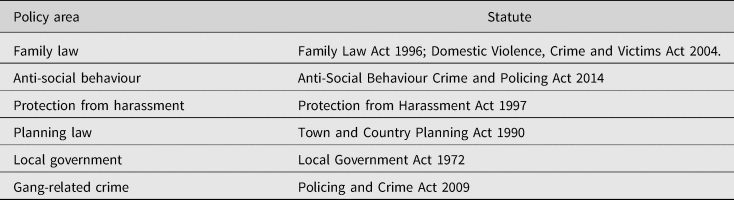
First, family law has seen a significant increase in the reach of injunctions. For many years statutes have provided the power – originally between wives and husbands, but now for a broader range of family members – to seek injunctions. The current law is found in the Family Law Act 1996. Part IV of the Act creates a range of orders regulating access to the family home. As Kay argues, the act significantly ‘widened the categories of person’ entitled to apply for protection and ‘increased the extent of that protection’, particularly for applications to the court dealing with ‘an alleged breach of an order or undertaking’.Footnote 18 In addition, a non-molestation order under section 42 prohibits molestation by associated family members. The Domestic Violence, Crime and Victims Act 2004 made breach of a non-molestation order a criminal offence.Footnote 19
Secondly, anti-social behaviour – an area of longstanding policy concern among successive governments for more than 25 years. Many of the policy responses have been focused on social housing. The Housing Act 1996, section 152 introduced a power for local authorities and later all social landlords to apply for an injunction prohibiting anti-social behaviour in their housing. The Anti-Social Behaviour Order (ASBO) was introduced by the Crime and Disorder Act 1998 and was broader than the housing injunction. The ASBO targeted everyone across any space. This was followed by the broader-ranging Anti-social Behaviour, Crime and Policing Act 2014, which replaced both the housing injunction and the ASBO. Section 1 allows a range of public organisationsFootnote 20 to apply for an injunction in the High Court or the county court in cases of anti-social behaviour,Footnote 21 and the court may, if it considers it just and convenient, grant the injunction to prevent the respondent from engaging in anti-social behaviour.Footnote 22 Anti-social behaviour is defined in section 2 as:
(a) conduct that has caused, or is likely to cause, harassment, alarm or distress to any person,
(b) conduct capable of causing nuisance or annoyance to a person in relation to that person's occupation of residential premises,Footnote 23 or
(c) conduct capable of causing housing-related nuisance or annoyance to any person.Footnote 24
An injunction may include not only prohibitions but also require positive action.Footnote 25 If there is a requirement, then a person to supervise complicance will be identified in the injunction.Footnote 26 Early research by Demetriou on the move to civil injunctions notes that this ‘shift to a purely civil response’ has been met with ‘scepticism by many local enforcement agents’ about the effectiveness of injunctions in preventing anti-social behaviour.Footnote 27
Thirdly, protection from harassment. The Protection from Harassment Act 1997 originally only included powers of the police to take action against those harassing others. However, in 2005 the Act was amended to allow victims to apply to the High Court or county court for an injunction.Footnote 28 In terms of cases reported in the High Court, there is clear use of the section by corporations, whether private or public.Footnote 29
Fourthly, planning law. The Town and Country Planning Act 1990, section 187B gives local planning authorities the power to apply for an injunction for any actual or apprehended breach of planning control.Footnote 30 A search of cases on the use of the power indicates regular use against Gypsies and Travellers (an issue we return to below).
Also at the local authority level, the Local Government Act 1972 grants wide-ranging injunctive powers. Section 222 is a general power for local authorities to ‘prosecute, defend, or appear in any legal proceedings’, and in the case of civil proceedings they may ‘institute them in their own name’ if it is ‘expedient for the promotion and protection of the interests of the inhabitants of their area’. Before the law was relaxed, the powers were used to injunct shops breaching the Sunday trading laws.Footnote 31 More recently the concern about anti-social behaviour led to ‘gang injunctions’ made under section 222Footnote 32 and there are examples of it being used to seek injunctions against protestors,Footnote 33 GypsiesFootnote 34 and sex workers.Footnote 35
Finally, there is the narrower category of ‘gang injunctions’. In 2009 new powers were given to the police and local authoritiesFootnote 36 to apply for an injunction in case of ‘gang-related violence’, or ‘gang-related drug-dealing activity’.Footnote 37 This was a response to the decision in Birmingham City Council v Shafi Footnote 38 on the limits of the Local Government Act 1972, section 222. The injunction can prohibit a range of behaviour.Footnote 39 An unsuccessful challenge to the civil nature of these injunctions was made in Birmingham City Council v Jones.Footnote 40
This short overview of the different powers to make injunctions demonstrates a hotchpotch of common law and statutory powers. Some are open to any claimant in a civil matter, while others are only open to specified public bodies. Similarly, defendants may range from individuals (whether named or notFootnote 41), to corporations and public bodies.Footnote 42 The powers also potentially overlap.Footnote 43 In addition, some injunctions may also concern potentially criminal matters.Footnote 44 A further alternative for property owners is to evict trespassers.Footnote 45
It is not clear why legislators have adopted injunctions rather than other remedies. An alternative is the two-step hybrid behaviour order, granted under civil evidential rules and the breach of which is a criminal offence.Footnote 46 The ASBO was a form of this sort of order and is unusual in being repealed. A recent report from Justice suggests that momentum for introducing new orders shows no signs of slowing.Footnote 47
However, in terms of actions by local authorities, there is evidence that this use of injunctions (using a range of injunction powers) has become the ‘go-to’ legal remedy. There are now several cases where local authorities have used these types of injunctions, including borough-wide prohibitions. As was acknowledged in Bromley London Borough Council v Persons Unknown,Footnote 48 the widespread use of injunctions at the local authority level is ‘aimed squarely at the gypsy and traveller community’,Footnote 49 pointing to a total of ‘38 of these injunctions in place nationwide’.Footnote 50 In Wolverhampton City Council and Others v London Gypsies and Travellers and Others Footnote 51 the Supreme Court noted:
Although the appeal arises in the context of unlawful encampments by Gypsies and Travellers, the issues raised have a wider significance. The availability of injunctions against newcomers has become an increasingly important issue in many contexts, including industrial picketing, environmental and other protests, breaches of confidence, breaches of intellectual property rights, and a wide variety of unlawful activities related to social media. The issue is liable to arise whenever there is a potential conflict between the maintenance of private or public rights and the future behaviour of individuals who cannot be identified in advance. Recent years have seen a marked increase in the incidence of applications for injunctions of this kind.
On the other hand, in 2019 Stavros Demetriou predicted that for ASBIs:
… given the limited availability of resources and the reservations expressed by local enforcement agents about this shift to a purely civil response, it is interesting to examine whether this will result in the de facto abolition of the injunction.Footnote 52
It is difficult to know whether there are more or less injunctions being made by the courts, as there is no public data that counts the number of injunctions made, whether of statutory injunctions or all injunctions. Our focus in this paper is the breach of injunctions and we now turn to the law on this and the data on committal which is available.
2. The relevant law on contempt
Civil contempt involves disobedience of a court order by a person involved in litigation.Footnote 53 Civil contempt is available for a range of actions, including breach of an injunction or breach of an undertaking given to the court. Before any sanction can be applied, the court must be satisfied to the criminal standard of proof that the person: (i) having received notice of the order did an act prohibited by it; (ii) intended to do the act; and (iii) had knowledge of all the facts which would make doing the act a breach of the order.Footnote 54 If that standard is met, the principal sanctions for a civil contempt are imprisonment, fine and seizure of goods.Footnote 55 As the editors of Arlidge point out, ‘Parliament has frequently failed to make specific provision for contempt when passing general sentencing legislation.’Footnote 56 Accordingly, a number of alternatives to imprisonment are not available to the court, such as community sentences.
Turning to decisions to imprison, the starting point is the power in the Contempt of Court Act 1981. Section 14(1) of that Act removed the unlimited power of civil courts to imprison for contempt and provides a fixed maximum sentence of two years. As an alternative, section 14(4) and (4A) allow for the courts to make a hospital order or guardianship order under section 37 of the Mental Health Act 1983 or an interim hospital order under section 38 of that Act in the case of a person suffering from mental disorder within the meaning of that Act who could otherwise be committed to prison for contempt of court. However, it is not clear how the court will make that decision as there is no power to order or require any pre-sentence information.Footnote 57
A number of cases have considered the basis on which the courts should imprison for breach of an injunction. The task of the court is different from sentencing in criminal cases. This is because the objectives underlying penalties are different from those for crime:Footnote 58
The length of the committal has to depend upon the court's objectives. There are two objectives always in contempt of court proceedings. One is to mark the court's disapproval of the disobedience to its order. The other is to secure compliance with that order in the future.Footnote 59
Further, the appropriate period of custody should be the least period which the seriousness of the offender's breaches can properly justify.Footnote 60
Many of the reported cases emphasise the difficulty of comparing cases because the circumstances surrounding contempt cases are very varied.Footnote 61 However, in Willoughby,Footnote 62 the Court indicated that the committal order should reflect the aggravating and mitigating features of the breaches. Aggravating features:
include deliberate flouting of the court's order on repeated occasions and in breach of a suspended order for imprisonment. Mitigating features may comprise personal inadequacy, admissions of breach, a low level of anti-social behaviour and efforts to reform.Footnote 63
The differences from criminal sentencing have also made the courts wary of using Sentence Council guidelines designed for criminal cases. In Lovett, the Court of Appeal stated:
… save in special circumstances (e.g. when the breach itself is a criminal offence), the current Sentencing Council guidelines can only be relevant in the very broadest and generalised sense. The maximum penalty available to the civil court is far shorter than that for a criminal breach of a criminal behaviour order, which is 5 years. The differences between the two systems are great enough that as a general rule, if a sentence contemplated in a civil court was one which was the same or more severe than what would be derived from the Sentencing Council guidelines, it is likely to be wrong.Footnote 64
As we will discuss below, committal for breach of injunctions linked to protests are among the cases we identified. This potentially raises particular issues around the human rights to protest, including Articles 10 and 11 of the European Convention on Human Rights and Fundamental Freedoms. The courts have acknowledged that other matters are at stake in sentencing protestors and that there can be a ‘moral difference’ between ‘ordinary law-breakers’ and protestors which, in some circumstances, can justify a more benign sentencing regime.Footnote 65 However, as Breen makes clear, this only goes so far. The Court of Appeal cited the President of the King's Bench in National Highways Ltd v Ana Heyatawin:Footnote 66
In some contempt cases, there may be scope for the court to temper the sanction imposed because there is a realistic prospect that this will deter further law-breaking or, to put it another way, encourage contemnors to engage in the dialogue described in Cuadrilla with a view to mending their ways or purging their contempt. However, it is always necessary to consider whether there is such a prospect on the facts of the case. In some cases, there will be. In some cases, not. Moreover, it is important to add, that ‘there is no principle which justifies treating the conscientious motives of the protestor as a licence to flout court orders with impunity’: Attorney General v Crosland [2021] UKSC 15, at [47].
The court may suspend the sentence.Footnote 67 In Cuadrilla Bowland Ltd,Footnote 68 the Court of Appeal suggested that ‘where an act of civil disobedience constitutes a criminal offence or contempt of a court order which is so serious that it crosses the custody threshold, it will nonetheless very often be appropriate to suspend the operation of the sanction on condition there is no further breach during a specified period of time’. More generally, Hale Footnote 69 included the following principles on suspension:
If imprisonment is appropriate, the length of the committal should be decided without reference to whether or not it is to be suspended. A longer period of committal is not justified because its sting is removed by virtue of its suspension.
Suspension is possible in a much wider range of circumstances than it is in criminal cases. It does not have to be the exceptional case. Indeed, it is usually the first way of attempting to secure compliance with the court's order.
The length of the suspension requires separate consideration, although it is often appropriate for it to be linked to continued compliance with the order underlying the committal.
With these principles in mind, we turn to the reported data on the sentencing decisions.
3. Data for the paper
The data in this paper is based on decisions that are made available on the Courts and Tribunals Judiciary website.Footnote 70 Following a committal hearing, CPR 81(8) states:Footnote 71
The court shall be responsible for ensuring that where a sentence of imprisonment (immediate or suspended) is passed in contempt proceedings under this Part, that judgment is transcribed and published on the website of the judiciary of England and Wales.
The Civil Justice Council report indicated some doubt that this rule was being met.Footnote 72 In Lovett v Wigan Borough Council Footnote 73 one of the defendants complained of a delay in the decision being transcribed and placed on the judiciary website. The Court stated: ‘No temporal requirement is provided for in the rules. Nevertheless, the court must plainly undertake its responsibility in a timely fashion…’.
Our database also suggests, certainly up to the end of 2022, that this is still not happening, with some courts in large cities not reporting any cases: a situation that seems unlikely (see below). In addition, we have sought out other data on committals. That also suggests that CPR rule 81(8) is not being adhered to in some cases. To give an example, at the beginning of this paper we provided a short precis of the case of Floyd Carruthers.Footnote 74 There is no record of the case on the Courts and Tribunals Judiciary website. Further, in some cases in our database, it is recorded that a previous hearing has ordered a suspended sentence for a breach, but that earlier breach is not listed on the Courts and Tribunals Judiciary website.
However, it is the only data available, and the numbers are large enough to create a useful database. We created a spreadsheet of all cases from 1 January 2020 to 31 December 2022 where the recorded outcome of the committal was a sentence of imprisonment, whether immediate or suspended. The total number of cases was 263. In creating the database, we excluded committals that did not include a breach of an injunction. So, cases of breaches of other court orders (eg failure to return children, making false allegations to the court, failure to return documents) were not included.
The details provided in each case summary are very varied across the sample. As a minimum, each case provided the length of the sentence and whether it was suspended or not, the Court sentencing the defendant, and the gender of the defendant.Footnote 75 In very few cases (n = 8) although the decision was to imprison, the length of the sentence and/or whether it was suspended was not recorded.
Where available, the following data was also recorded:
• the type of applicant (ie whether the applicant was a local authority, social landlord, the police, etc);
• the power under which the injunction was made;
• whether the defendant had been remanded in custody;
• the nature of the breach (ie the action complained about that was a breach of the injunction);
• the vulnerability of the defendant;
• whether the defendant was represented.
For this paper we have focused on: (a) the types of injunctions and applicants where the defendant was imprisoned; (b) the geography of courts making decisions; (c) the outcomes and consistency of sentencing decisions; (d) the gender of defendants; and (e) whether defendants were represented or not.
4. Analysis of the data
(a) The types of injunctions and applicants
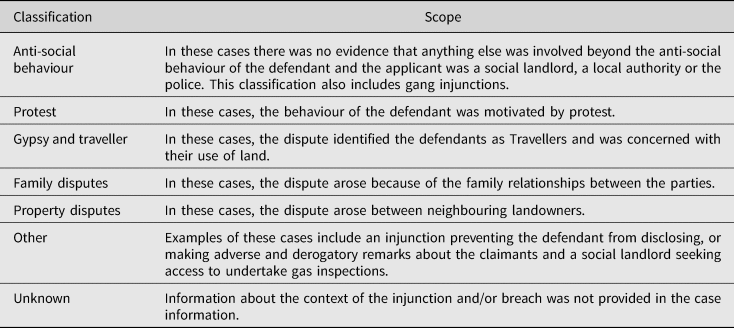
As mentioned above, there are a variety of legal basis for an injunction. For instance, in a protest case a claimant – depending on their status – may use injunctions rooted in trespass, the Anti-Social Behaviour, Crime, and Policing Act 2014, section 1, the Local Government Act 1972, section 222 or the Protection from Harassment Act 1997, section 3A. In many cases in the database the court does not specify the power under which the injunction was made. Rather than classifying cases by the legal power the injunction was made under, we have created a classification based on the substantive nature of the dispute. This was usually clear from the terms of the injunction and the nature of the parties. Although there was uncertainty in some cases, we were able to classify all bar 5% (n=12) of cases. The classification is set out in Table 2, followed by a pie chart showing the spread across the sample in Figure 1.
A summary of the classification of case type
Count of type of case

As Figure 1 shows, the majority of cases were ASBIs – 76% of all cases. The total of sentences of imprisonment for breach of an ASBI was 196 spread over three years. Of course, it is much lower than the average 1,749 adults sent to prison per year for breach of an ASBO under the Crime and Disorder Act 1998.Footnote 76 However, this suggests that Demetriou was wrong in his prediction that a purely civil response would result in the de facto abolition of the injunction.Footnote 77
We were surprised that there was only one family case in the database. Research on family violence remedies suggests that the use of civil remedies has declined for a range of reasons.Footnote 78 Of course, the criminal nature of non-molestation injunctions means that there will not be committal proceedings for these cases.Footnote 79 Other injunctions, such as occupation orders, are less common. In 2022 non-molestation orders formed 84% of orders applied for and 95% of orders made, whilst occupation orders comprised 16% and 5% of the totals respectively.Footnote 80 In total 2,096 occupation orders were made.Footnote 81 Nonetheless, it appears unlikely that there was only one case ending with a committal and a prison sentence and it may be that cases in the family courts were not being reported.
We also recorded the claimants under the following categorisation:
• local authority;
• social landlord;
• police;
• company;
• individual;
• charity/church;
• unknown.
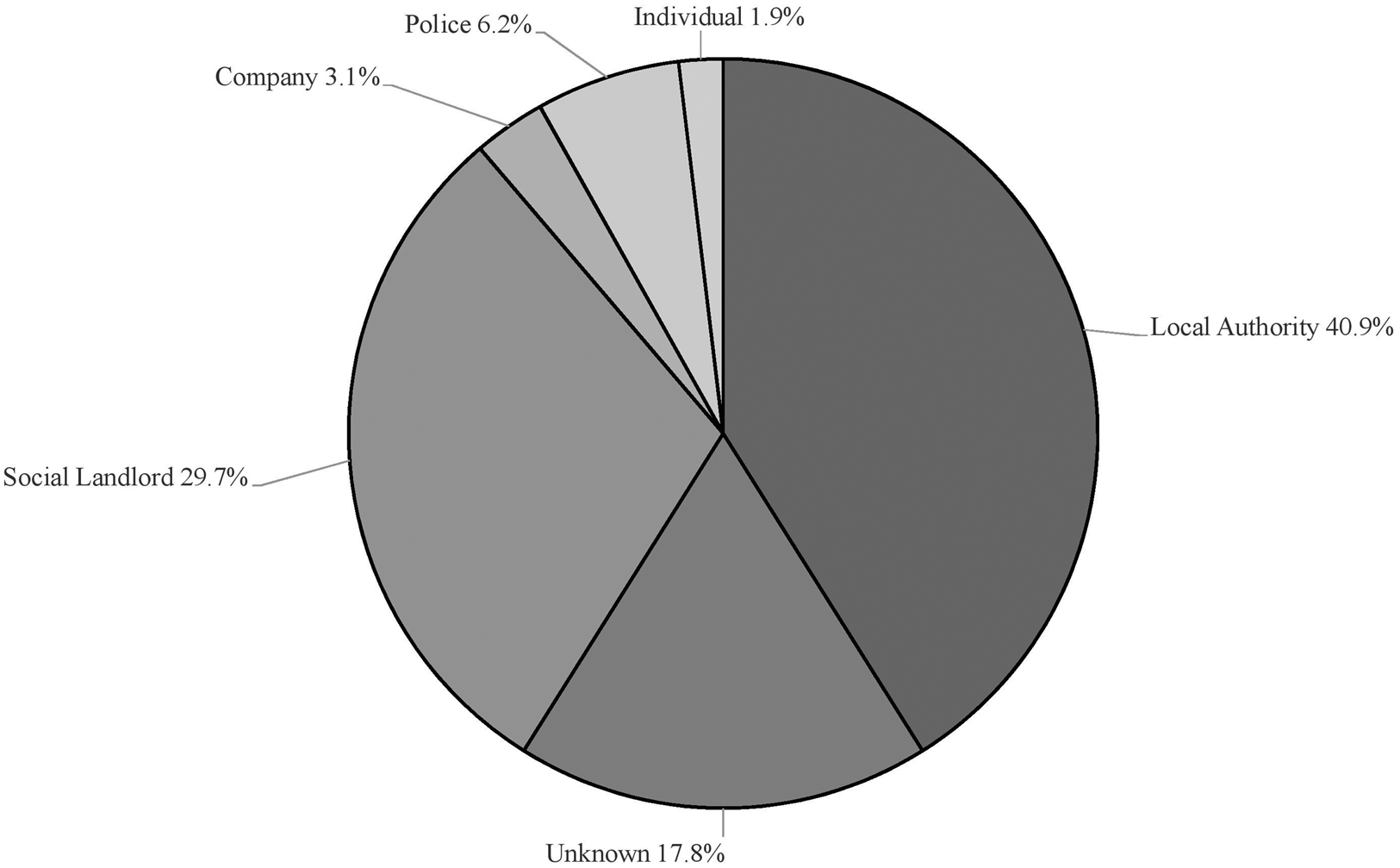
Here there are a larger number of unknown cases (18%: n=46), where the claimant type is unreported.
As Figure 2 demonstrates, the most active claimants were local authorities. As well as anti-social behaviour committals, they were involved in protest and Traveller cases. The type of case brought by claimants varied significantly. Table 3 shows a cross-tabulation between the claimant type within the sample and the type of case.
Types of claimants
Cross-tabulation between the type of claimant and type of case
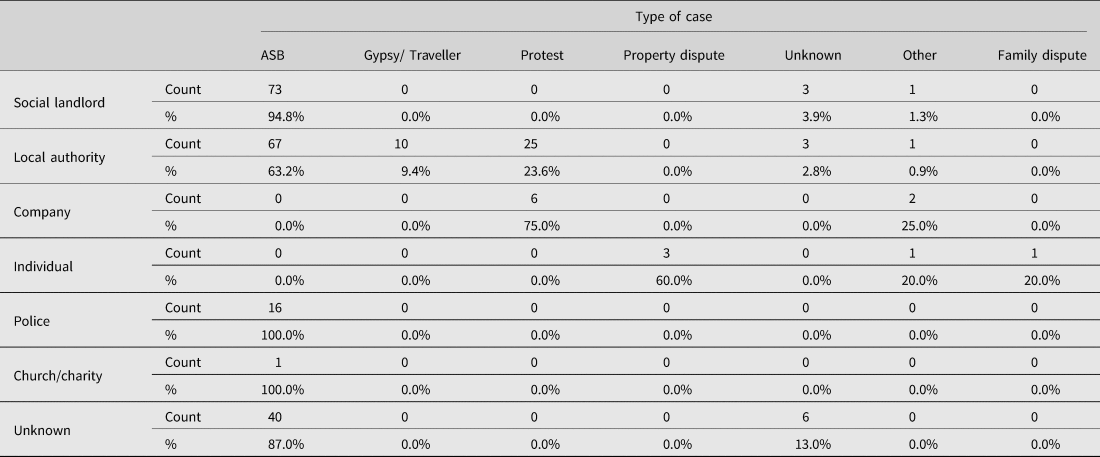
Although the cell counts are small across most of the cross-tabulation, this data illustrates three key trends within the dataset. First, for social landlords and the police, by far the largest majority of cases (95% and 100% respectively) concerned anti-social behaviour. Secondly, local authorities had a wider variety among their caseload – with around a quarter (24%) concerning protest and 9% Gypsy and Travellers. Thirdly, all of the cases brought by companies concerned protests.
(b) The geography of courts making decisions
The court in which the case is heard depends on the choice of the claimant and the Civil Procedure Rules. The court for the committal will be set by the court in which the injunction proceedings are commenced. There was data on the location of the court for all but three cases. One case was an appeal in the Court of Appeal reducing the sentence of a protester.Footnote 82 All the others were first-instance committal hearings either in the High Court or the county court.
The High Court is limited to cases of high worth, or cases with complex facts, legal issues, remedies or procedures involved, and/or where the case raises an issue of importance to the public in general.Footnote 83 There are a number of cases in the High Court in the database (n=40) – in London (n=16), Birmingham (n=23) and Manchester (n=1). Almost all the High Court cases were either protest or Gypsy and Travellers cases.Footnote 84
Turning to the county court cases they are predominately anti-social behaviour cases – none of the High Court cases dealt with that issue. A claim in the county court may be made to any County Court hearing centre.Footnote 85 Applicants will likely choose to start proceeding in a court close to the locale of the dispute. As the map (Figure 3) indicates, most of the courts have a small number of cases (n=1–5). However, there are a number with notably high levels of cases – for instance, Cardiff (n=25), Liverpool (n=16), some London courts (Clerkenwell and Shoreditch n=16), and Manchester (n=15). No doubt this is partly explained by the size of the population in those areas. However, we would speculate they also indicate that certain claimants – whether local authorities, social landlords or the police – are more active in using anti-social behaviour or gang injunctions than others.
Map showing the county courts included in the sampleFootnote 86
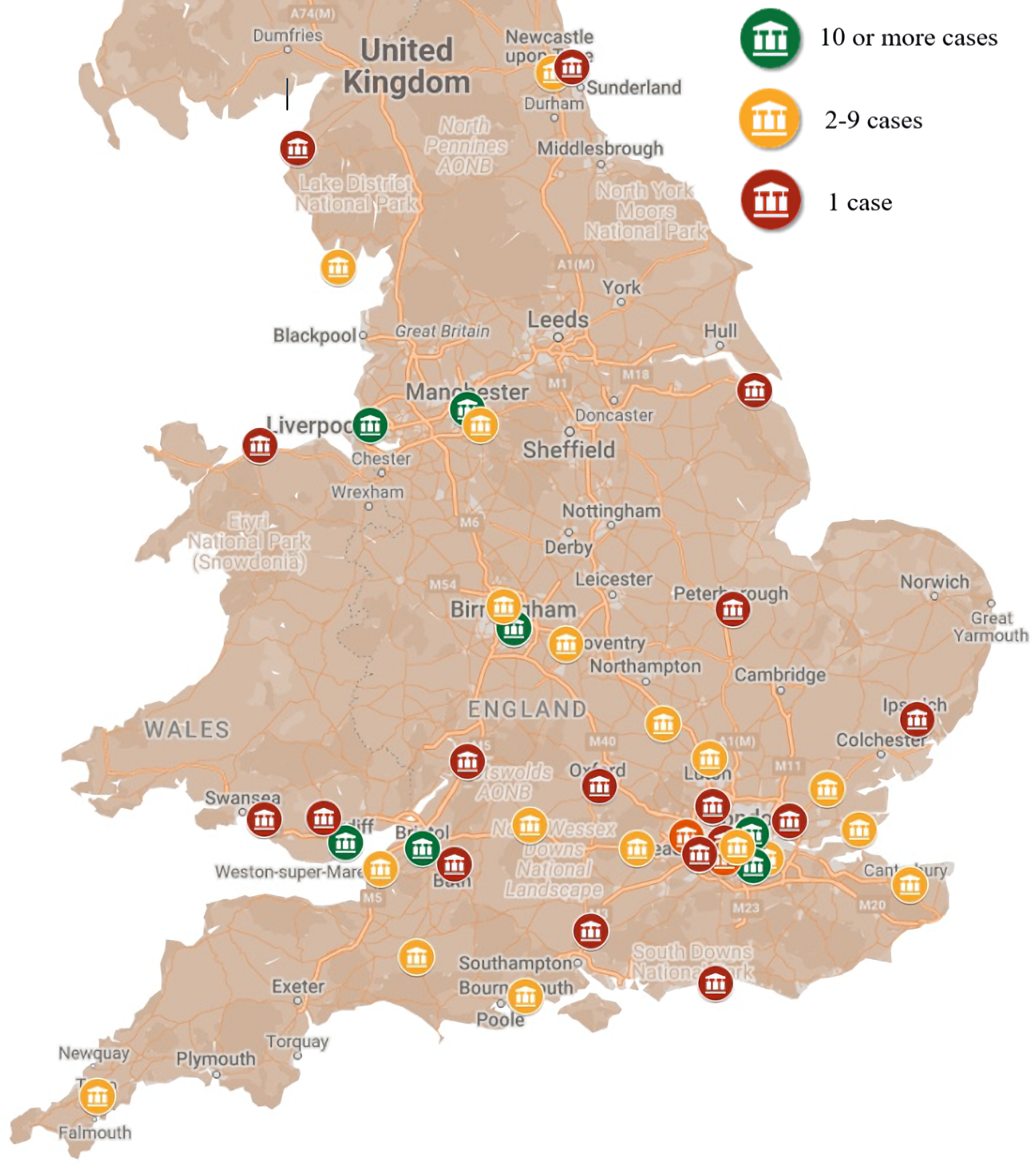
We have continued to track cases through 2023 and a few further courts have recorded one committal leading to imprisonment. Notably, Leeds had three recorded. What is striking is that some large cities, such as Sheffield and Nottingham, have no recorded committal hearings leading to a sentence of imprisonment up to 2022. In 2023 Sheffield had one case. There are two potential reasons for this. One is a failure by the court to comply with CPR 81(8) and publish the decision. This assumes that suitable cases have taken place. The second potential reason is that there have been no cases to report. This may arise at different points of the process: potential claimants do not apply for injunctions; or if they do apply for an injunction, they do not apply for committal (whether because there is no breach or for other reasons); or, finally, they may apply for committal but the court does not sentence the defendant to imprisonment.
At the moment the data does not indicate which of these two possible reasons applies. We think it is unlikely that there have not been any cases leading to committal in these cities and the first reason – failure by the court to comply with CPR 81(8) – is the likely explanation for the complete absence of any cases.
(c) Sentencing decisions – outcomes and consistency
We were interested in the length of sentence and the nature of the sentencing. As the cases discussed above show, the higher courts have avoided providing detailed advice on sentencing for the lower courts, preferring principles. This is because of the difficulty of comparing cases when the circumstances surrounding contempt cases vary so much.
Across the sample, the longest sentence was 730 days and the shortest was half a day; the average was 95 days and the median 60 days. The histogram below (Figure 4) shows the variation across the sample, with the bulk of cases detailing a sentence of fewer than 100 days.Footnote 87
Histogram displaying the spread of sentences across the sample
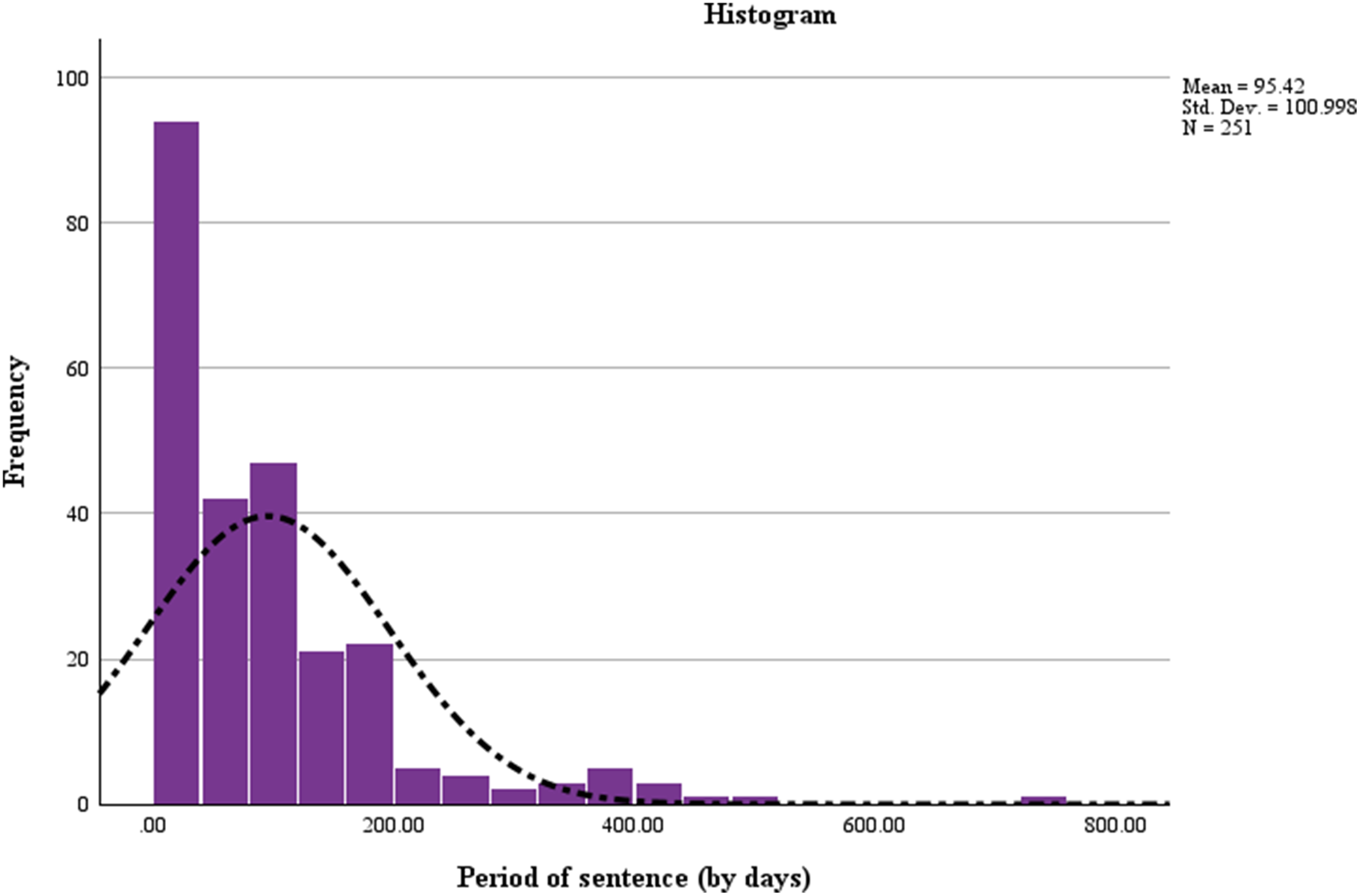
Looking at the longest tariffs (more than 100 days), these included 15 cases where a previously suspended sentence was added to the tariff. There were also more cases where the court committed for a number of breaches of the injunction. The court has the power to make consecutive sentences subject to the limit of two years in the Contempt of Court Act 1981, section 14.Footnote 88
Cross-tabulating the case type against the length of the sentence reveals some patterns within the data. Each case was grouped into four quartiles in respect of sentence length: quartile one represents the cases with the lowest 25% of sentences, while quartile four represents the cases with the highest 25% of cases. Table 4 details the results of this cross-tabulation.
Cross-tabulation between the length of the sentence and the type of case
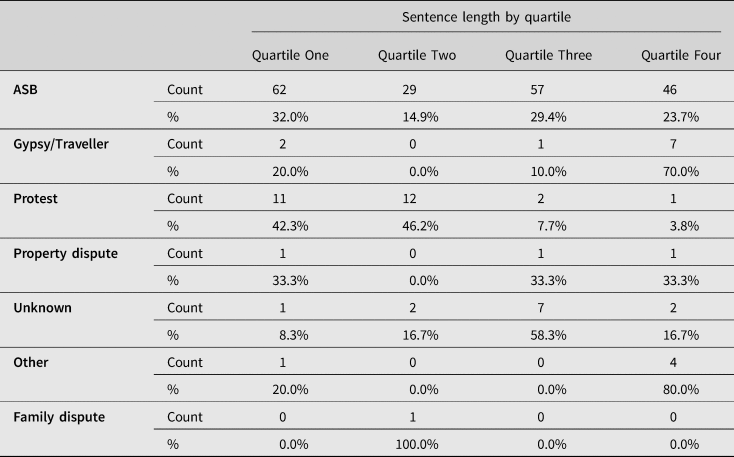
This data demonstrates that Gypsy and Traveller sentences were disproportionately more likely to receive a higher sentence in the sample than other kinds of cases, particularly across anti-social behaviour and protest case types. Indeed, 70% of Gypsy and Traveller cases sat in the highest quartile for sentencing, compared to 24% of ASB cases and 4% of protest cases.
Once the court has decided on the tariff, the judge would consider whether to suspend the sentence.Footnote 89 There was a close split between suspension (46.7%) and immediate imprisonment (49.8%). Again, cross-tabulating suspended and immediate sentences between case types reveals a pattern in the data, see Table 5.
Cross-tabulation between the immediate/suspended sentences and type of case
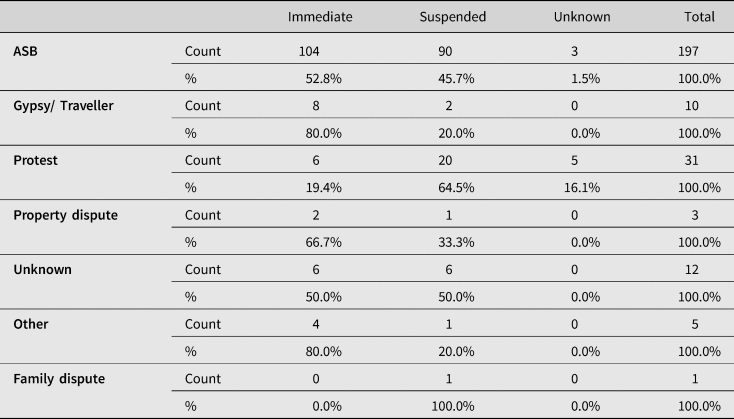
Here, the data illustrates that – in addition to receiving disproportionately higher sentences – Gypsy and Traveller cases were also far more likely to receive immediate, rather than suspended, sentences (80% of cases in the sample). ASB cases also had a significantly high rate of immediate sentencing (around half, at 53%), with rates for protest cases far lower than average (at 19%).
Some injunction powers also include attaching a power of arrest with defendants remanded into custody.Footnote 90 In most cases (n=167) this was not recorded. In 61 cases it was noted. When sentencing in the criminal court, time on remand will be taken into account.Footnote 91 However, there is no provision for deducting time spent on remand in committal proceedings.Footnote 92 Despite this, there were examples of the courts taking into account remand when sentencing.Footnote 93
(d) Gender
Much has been written about the gender differences in sentencing in the criminal courts.Footnote 94 Indeed there is evidence that women are treated more leniently in sentencing.Footnote 95 Amongst the general population of prisoners, the percentage of women has remained stable at 4% of all prisoners.Footnote 96 Looking at the data for ASBOs between 2000 and 2013, 12% of defendants over 18 were female. Women were less likely to receive a custodial sentence for breach of an ASBO than men (50% women; 61% men).Footnote 97
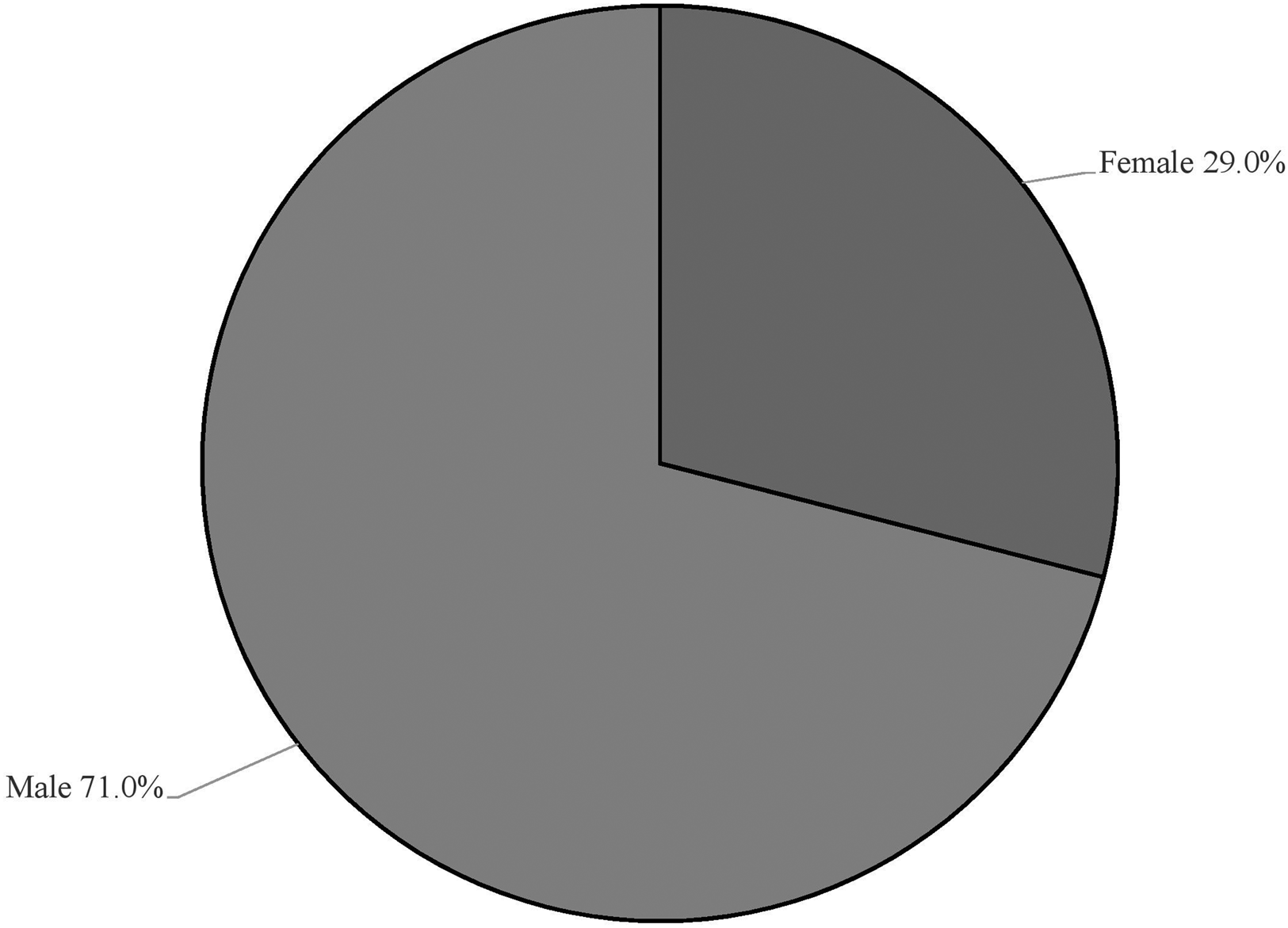
Yet just under 30% of the defendants in the database were female, as detailed in Figure 5. The data on sentences does not show any particular differences between the genders. While women are more likely to be in the first quartile of sentences (37.5% women; 28% men) they are also most likely to be in the fourth quartile (29.2% women; 22.3% men). There was a slight difference between whether the sentence was suspended (50.7% women; 45.1% men). Although these numbers are not completely comparable to those for the prison population or ASBOs they raise questions about the use of injunctions against women and the sentencing for breaches.
Gender by classification
(e) Whether defendants are represented
The final issue we wanted to explore was whether defendants were represented or not in the committal hearing. Any committal application is treated as ‘quasi-criminal’.Footnote 98 Non-mean-tested representation is availableFootnote 99 and there is an obligation on the court to ensure that it is made available.Footnote 100 Lack of legal representation for a defendant in committal proceedings represents a serious procedural flawFootnote 101 and a breach of the common law principle of fairness and of ECHR, Article 6(3)(c). However, the Civil Justice Council report states that, concerning ASBIs and committals, there is
… a very worrying and consistent account from the Judiciary (including through feedback from the Judicial College injunctions and committals module), supported by the very limited available data and as confirmed by the Legal Aid Practitioners Group, although legal aid may technically be available, there are areas of the country where it is extremely difficult (if not impossible) to find solicitors who will accept instructions to advise and represent in relation to injunction applications or committals under the 2014 Act: ‘advice deserts’.Footnote 102
Turning to our database, representation was one of the data points with the highest number of unknowns (n=161). Where the data was known, 55 defendants were not represented and 42 were. Table 6 details a cross-tabulation by case type, showing that rates of unknown cases were spread across the entirety of the sample.
Cross-tabulation between the type of case and extent of representation
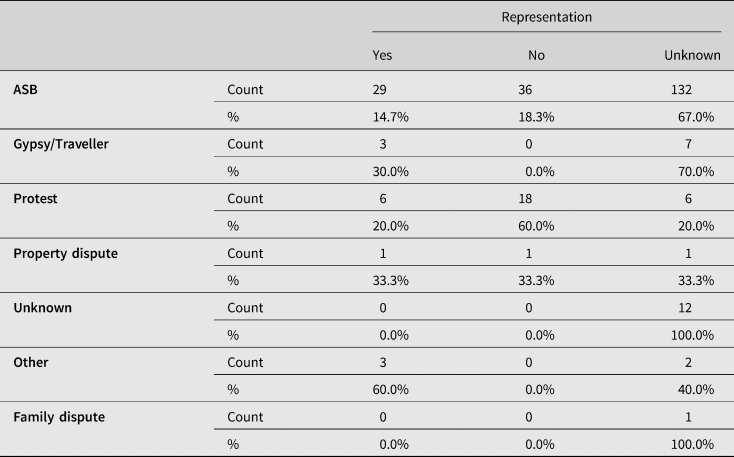
In summary, our analysis reveals a concerning landscape in the realm of legal representation for defendants in committal hearings. Despite the technical availability of legal aid, the phenomenon of ‘advice deserts’ profoundly affects access to legal representation, particularly in certain regions and case types. Our database further underscores this issue, showing a significant number of cases with unknown representation status and a notable disparity between represented and unrepresented defendants. This disparity, as detailed in Table 6, varies considerably across different case types, highlighting the complex and uneven nature of legal representation in the current system.
Conclusions
We believe this is the first research on the empirical evidence about committal procedures for breach of injunctions in the UK. We have a concern that both academia and the policy community are not focused on committal. Civil academic lawyers are not interested in the penalties for injunctions, while criminal lawyers and criminologists are only interested in orders that lead to criminal proceedings. Because of this, sentencing for injunctions falls between the cracks. We acknowledge the limits of the data we analyse in this paper, but despite this, we are of the view that it raises several important questions and demonstrates the need for ongoing academic research on the issue.
First, there is the geography of cases. How far are the differences between county courts due to failures by the courts to comply with rule 81(8) of the Civil Procedure Rules? Or do the differences represent very different practices by applicants, particularly local authorities (the largest group of applicants)? Stavros Demetriou's prediction, that the ASBI will ‘result in the de facto abolition of the injunction’Footnote 103 for anti-social behaviour, has not turned out to be true for several local authorities and social landlords.
In its report on ASBIs the Civil Justice Council Working Party ‘discovered widespread and serious concern about the inconsistency of penalties imposed for breach of orders made under the 2014 Act’.Footnote 104 Its research review of 50 cases evidenced ‘a lack of consistency of approach to the imposition of a penalty for breach/es’.Footnote 105 This larger study covering a range of different types of injunctions demonstrates that there are some differences between the types of injunctions, but the data drawn on in this study does not enable us to explain why the range of sentences within types of injunctions is so large. Judges sometimes provide reasons for the decision, but in the majority of cases there is no explanation for the sentence.
Turning to the different types of injunctions, we are concerned by the higher sentencing for Gypsy and Traveller injunctions compared to other injunctions. Of course, in protest cases, there are the Article 10 and 11 issuesFootnote 106 that might soften sentences. But for Gypsies and Travellers, there are Article 8 issues to consider too.Footnote 107 So why are the sentences higher than other types of injunctions? There is evidence of both harsher policingFootnote 108 of Gypsies and Travellers and higher rates of incarceration.Footnote 109 James concludes:Footnote 110
legislation and policy have framed, determined, and perpetuated their marginalization, and how their subsequent securitization as a community of risk has meant that they have been over-policed as offenders and under-supported as victims.
Our data suggests that committal proceedings for breach of an injunction are yet another example of discrimination against this community.
Finally, our study confirms the findings of the Civil Justice Council report: it is clear that defendants are being routinely sent to prison without legal representation at the committal hearing. This was particularly true in county courts dealing with ASBIs. This practice raises serious concerns about the fairness and integrity of the judicial process. This alarming trend calls for immediate attention and action.
Taken together, these findings detail a seemingly widespread, but very much under-interrogated, phenomenon: imprisonment for breach of injunctions. In the first detailed interrogation of this issue, analysis of our database of 263 committal for contempt decisions demonstrates the wide range of penalties applied, the (far) higher rates of sentencing imposed in Gypsy and Traveller cases, and geographical blindspots in reported cases suggested a likely failure in some localities to comply with rule 81(8) of the Civil Procedure Rules. The courts are sentencing, but without the full range of sentencing options, without some of the usual procedures in criminal courts, and with minimal guidance. In setting out these findings, this paper is a call to arms for legal scholars – both civil and criminal – to turn greater attention to penalties for breach of an injunction.


 Open access

