

1. Introduction
Carbonate complexes are extensively developed on the Sibumasu Terrane (Metcalfe, Reference Metcalfe1984, Reference Metcalfe2017a) in the western part of the Malay Peninsula (west of the Palaeo-Tethyan Bentong-Raub Suture Zone) ranging in age from Ordovician to Triassic. Extensive Palaeozoic limestones and dolostones in the Kinta Valley region of Perak in the Malay Peninsula form part of these carbonate complexes, and these have been subject to karstification and are now exposed in mogote limestone hills and in the valley floor beneath alluvial deposits and have been historically exposed in alluvial tin mines. These limestones have been subjected to regional tectonic metamorphism and to thermal metamorphism by Triassic granites. Limestones in the Kinta Valley, Perak, have been variably referred to in the historical literature as the ‘Kinta Limestone’ or the ‘Chemor/Kanthan Limestone’ and ‘Kampar Limestone’ in the Chemor and Kampar areas, respectively, and range in age from Silurian to Early Permian (Metcalfe, Reference Metcalfe2017b). Limestone, dolostones and marbles exposed in the Chemor area of the Kinta Valley were referred to as the Kanthan Limestone (after Gunong Kanthan) by Metcalfe (Reference Metcalfe, Hills, Henderson and Bamber2002), and this term is used in this paper for the carbonate sequences in the Kanthan area. Other Kinta Valley limestones form part of the Palaeozoic sequences to the west of Kampar which were formerly exposed in open cast tin mines (Suntharalingam, Reference Suntharalingam1968; Metcalfe, Reference Metcalfe2017a). Devonian, Carboniferous and Permian conodonts have been recovered from surface outcrops of the Kanthan Limestone (Alexander & Müller, Reference Alexander and Muller1963; Lane et al. Reference Lane, Muller and Ziegler1979; Metcalfe, Reference Metcalfe1979, Reference Metcalfe1981a, Reference Metcalfe1983, Reference Metcalfe, Hills, Henderson and Bamber2002, Reference Metcalfe2017b) and more recently from limestones in boreholes near Sungai Siput north of Kanthan and at Malim Nawar a few kilometres north-west of Kampar (Tsegab et al. Reference Tsegab, Sum, Gatovsky, Hunter, Talib and Kassa2017). The first Permian conodonts in Malaysia were reported from a single sample from the Kanthan Limestone at Gunong Kanthan by Metcalfe (Reference Metcalfe1981a). This poorly preserved fauna included ‘Neogondolella’ bisselli (Clark and Behnken) and ‘Anchignathodus’ (Hindeodus) minutus (ElIison) and was interpreted as lateWolfcampian (= Artinskian) in age. Extensive sampling of limestones and dolostones in the Palaeozoic sequence west of Kampar (Suntharalingam, Reference Suntharalingam1968) did not yield any conodonts (Metcalfe, Reference Metcalfe2017b). Based on the small Permian conodont fauna recovered from Gunong Kanthan by Metcalfe (Reference Metcalfe1981a), additional sampling was undertaken in 2002 at Gunong Kanthan aimed at obtaining additional Permian conodont material, and this paper reports the results of that subsequent study.
2. Geological, tectonic and stratigraphic setting
2.a. Geological, tectonic and palaeogeographical setting
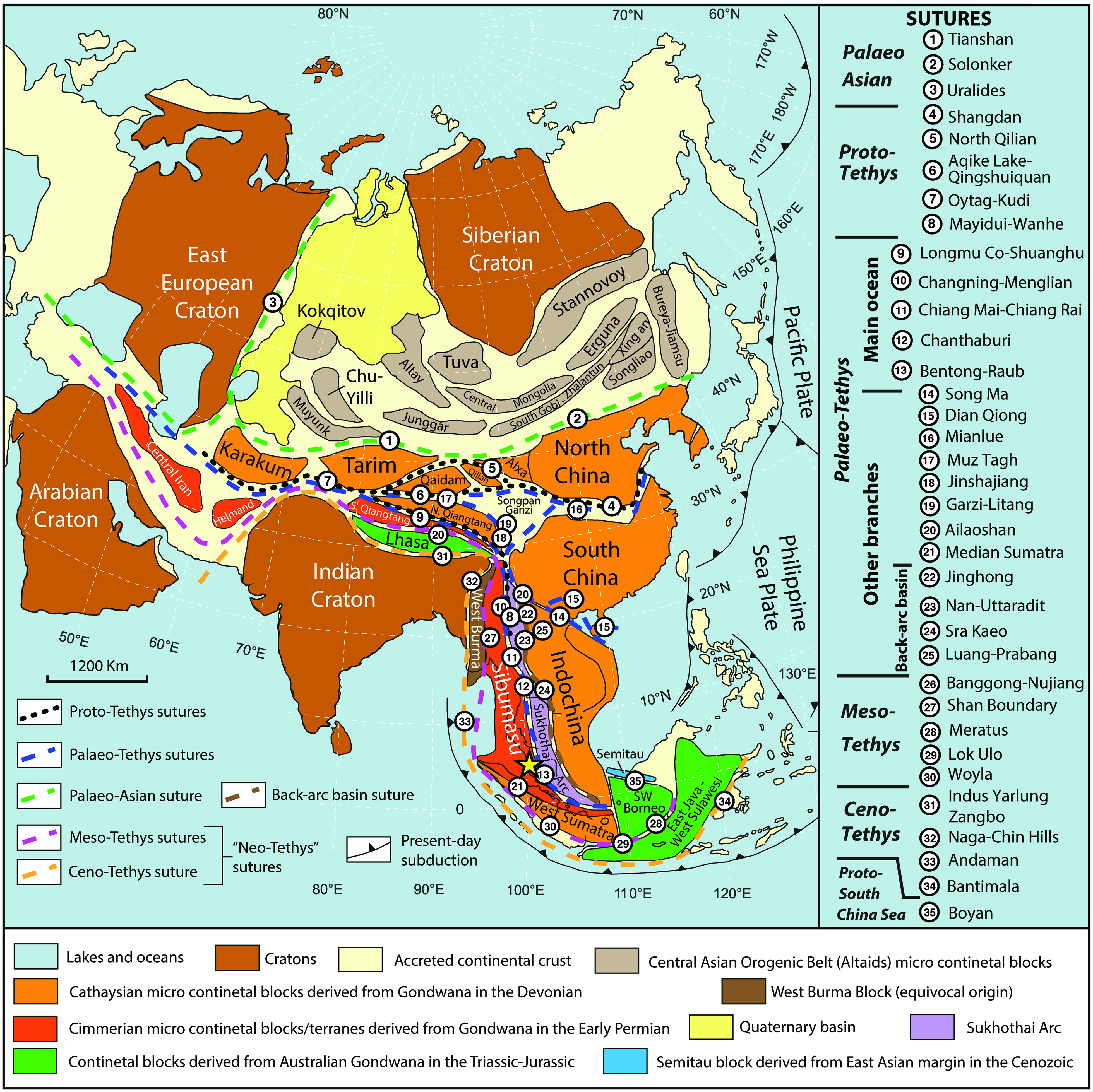
East Asia comprises a huge collage of allochthonous continental blocks and volcanic arcs bounded by suture zones that represent the remnants of closed ocean basins (Metcalfe, Reference Metcalfe2021; Fig. 1). The Sibumasu Terrane (Metcalfe, Reference Metcalfe1984) forms the eastern part of the Cimmerian ribbon continental strip that separated from Australian Gondwana in the Cisuralian (Early Permian), subsequently migrated northwards and collided with proto-Asia in the Middle-Late Triassic (Sengor, Reference Şengör1979, Reference Şengör1984; Metcalfe, Reference Metcalfe, Audley-Charles and Hallam1988, Reference Metcalfe2000, Reference Metcalfe2013a, Reference Metcalfe2017a, Reference Metcalfe2021; Morley, Reference Morley2018). The studied Kanthan Limestone at Gunong Kanthan yielding the Late Kungurian conodonts is located on the Sibumasu Terrane in Perak State, Malay Peninsula (Fig. 2).
Continental blocks and principal Tethyan suture zones of Asia. After Metcalfe (Reference Metcalfe2013a, Reference Metcalfe2021) and Zhao et al. (Reference Zhao, Wang, Huang, Dong, Li, Zhang and Yu2018). Gunong Kanthan locality is represented by the yellow star.
Geological map of the Malay Peninsula showing location of Gunong Kanthan. After Tate et al. (Reference Tate, Tan and Ng2009) and Metcalfe (Reference Metcalfe2013b).

The Kanthan Limestone forms part of the western belt of the Malay Peninsula (Fig. 2) and was deposited in a relatively deep continental slope environment (Metcalfe, Reference Metcalfe2017b; Tsegab et al. Reference Tsegab, Sum, Gatovsky, Hunter, Talib and Kassa2017; Tsegab & Sum Reference Tsegab, Sum and Aiello2019) on the northern (present eastern) margin of the Sibumasu Terrane that formed part of the Gondwana margin up to the Early Permian and separated from Gondwana in the Artinskian (Figs. 2, 3, and Supplementary Figure 1).
Cartoon showing the tectonic setting of the Malay Peninsula during Early–Middle Devonian, Carboniferous and Permian times (after Ueno & Hisada Reference Ueno and Hisada1999; Metcalfe Reference Metcalfe2000; Sone & Metcalfe Reference Sone and Metcalfe2008; Metcalfe, Reference Metcalfe, Hall, Cottam and Wilson2011a, Reference Metcalfe2011b; Searle et al. Reference Searle, Whitehouse, Robb, Ghani, Hutchison, Sone, Ng, Roselee, Chung and Oliver2012; Metcalfe, Reference Metcalfe2013a; Ng et al. Reference Ng, Chung, Robb, Searle, Ghani, Whitehouse, Oliver, Sone, Gardiner and Roselee2015a, Reference Ng, Whitehouse, Searle, Robb, Ghani, Chung, Oliver, Sone, Gardiner and Roselee2015b; Metcalfe, Reference Metcalfe2017b).

During the Sakmarian, the Sibumasu Terrane formed part of the western Australian Gondwana margin but by early Artinskian times the terrane had begun to separate and migrate northwards from Gondwana with the opening of the Meso-Tethys Ocean. The Malay Peninsula part of Sibumasu was located at moderately high (35–40 degrees south) palaeo-latitudes in the Sakmarian to Kungurian time interval (Supplementary Figure 1).
2.b. Geographical location, stratigraphical setting and sample locations
2.b.1. Geographical location
The Kanthan Limestone forms part of the Palaeozoic sequences of the Sibumasu Terrane in the Kinta Valley region of western Malay Peninsula (Figs. 2, 4) and has on overall age range from Silurian to Early Permian (Ingham & Bradford, Reference Ingham and Bradford1960; Suntharalingam, Reference Suntharalingam1968; Lane et al. Reference Lane, Muller and Ziegler1979; Metcalfe, Reference Metcalfe1979, Reference Metcalfe1981a, Reference Metcalfe1983, Reference Metcalfe1984, Reference Metcalfe, Hills, Henderson and Bamber2002, Reference Metcalfe2017b; Lee et al. Reference Lee, Leman, Hassan, Nasib and Karim2004; Fontaine & Ibrahim, Reference Fontaine and Ibrahim1994; Lee, Reference Lee, Hutchison and Tan2009). Conodont material presented in this paper was recovered from a section measured at Gunong Kanthan in 2002 east of a section previously measured in 1978 (Fig. 4).
Location of Gunong Kanthan, Perak, Peninsular Malaysia and location of sections sampled for conodonts in 1978 (see Metcalfe, Reference Metcalfe1979, Reference Metcalfe1981a, Reference Metcalfe, Hills, Henderson and Bamber2002, Reference Metcalfe2017b) and 2002 (results presented in this paper). After Metcalfe (Reference Metcalfe, Hills, Henderson and Bamber2002).

2.b.2. Stratigraphical setting
The studied Kanthan Limestone crops out in the Kinta Valley, Perak, Peninsular Malaysia, and was deposited on the continental margin/slope of the Gondwana-derived Sibumasu Terrane which is separated from the Sukhothai Arc (East Malaya Block) by the Palaeo-Tethys Bentong-Raub Suture Zone (Fig. 5).
Representative stratigraphic columns for the Sibumasu Terrane and East Malaya Block (Sukhothai Arc). Modified after Metcalfe (Reference Metcalfe2000, Reference Metcalfe2013b) and Meor et al. (Reference Meor, Aung, Becker, Noor, Ng, Azman and Mustaffa2014). Red arrow and yellow star indicate the sampled horizon.
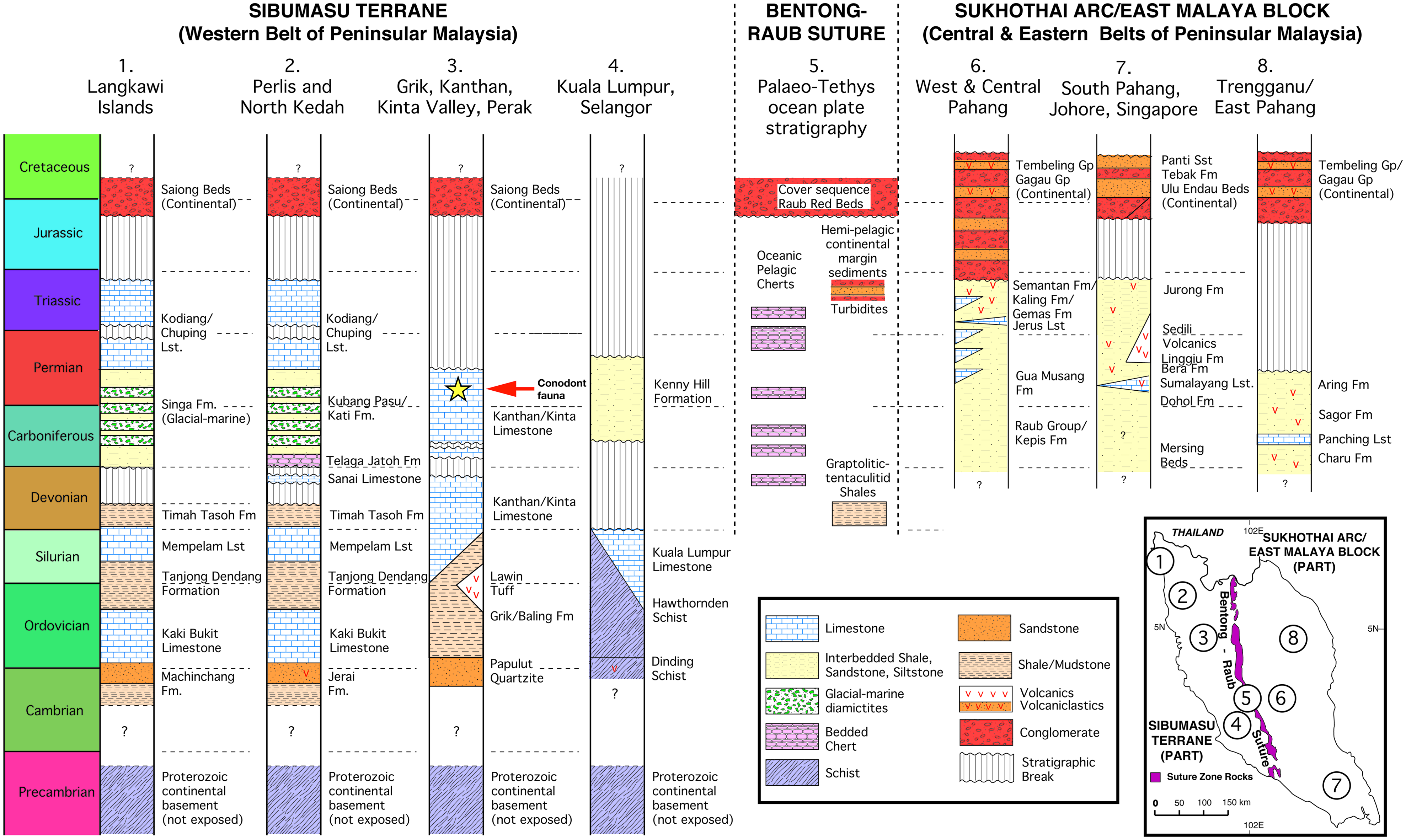
The Kanthan Limestone overlies the Ordovician-Silurian siliciclastic Grik and Baling formations (which include the Lawin tuff). The presence of re-worked conodonts in the middle (Devonian-Carboniferous) part of the limestone indicates the presence of non-sequences (Metcalfe, Reference Metcalfe, Hills, Henderson and Bamber2002). The Kanthan Limestone is unconformably overlain by continental redbeds, the Saiong Beds, of late Jurassic-Cretaceous age.
2.b.3. Structural geology
The sampled sequence forms part of the eastern limb of a large N-S trending anticline (Fig. 4). The core of the anticline is formed by Devonian limestones, and the eastern flank includes faulted packages of Carboniferous and Permian strata. Deformation includes syn-sedimentary faults and slump folds on which have been superimposed Indosinian tectonic folding and faulting and ductile high-temperature folding and shearing related to Late Triassic-Early Jurassic granite emplacement (Choong et al. Reference Choong, Pubellier, Abdelaziz and Chow2016); see Fig. 6 for some examples. Major faults are represented by thick breccia zones (Fig. 6).
Sequence of limestones and breccias measured at Gunong Kanthan in 2002 showing sample locations and field photos. Note that two major breccia horizons represent fault zones that separate two Lower Permian limestone sections (0–60 m and 98–160 m) from an out of sequence block of Carboniferous limestones (75–86 m) from the otherwise Lower Permian strata. (a) Thick bedded limestones and location of sample GK4; (b) faults and folds at 30–34 m and location of sample GK5; (c) bedded laminated limestones and location of sample GK7; (d) sheared fault breccia at 60–61 m; and (e) slump folded interval between 132 and 135 m and location of sample GK17.

2.b.4. Sample locations
Twenty samples were collected from a sequence of limestones and breccias measured in 2002 located on the eastern flank of the anticline at Gunong Kanthan (Fig. 4). The sampled sequence comprises 160 m of strata which generally dips steeply (70–75 degrees east but in places vertical). There are two major fault zones represented by thick breccia horizons that separate an out of sequence sliver of Carboniferous limestones from the otherwise Lower Permian limestones (Fig. 6). The sampled limestones also exhibit some minor folds and faults, some of which may represent slumps and soft-sediment deformation (Fig. 6).
The sampled limestones include dark-grey thin-bedded shaley limestones, dark grey to black bedded laminated limestones, paler grey bedded and more massive limestones. The limestones are dolomitized to variable degrees and exhibit multiple phases of dolomitization from early diagenetic through various stages of replacement dolostones related to fracture systems and hydrothermal fluids (Hui et al. Reference Hui, Nagarajan, Ramkumar, Ng, Taib, Mathew, Sautter, Siddiqui and Poppelreiter2022). Limestone breccias recorded in the sampled section are highly sheared and contain angular clasts and some discontinuous limestone beds and are interpreted here as major fault zones. The discontinuous limestone beds in the breccia zones only yielded a few fragmentary conodont elements and could not be specifically dated.
3. Conodont faunas, ages, colour, textural alteration and taxonomic notes
3.a. Faunas and ages
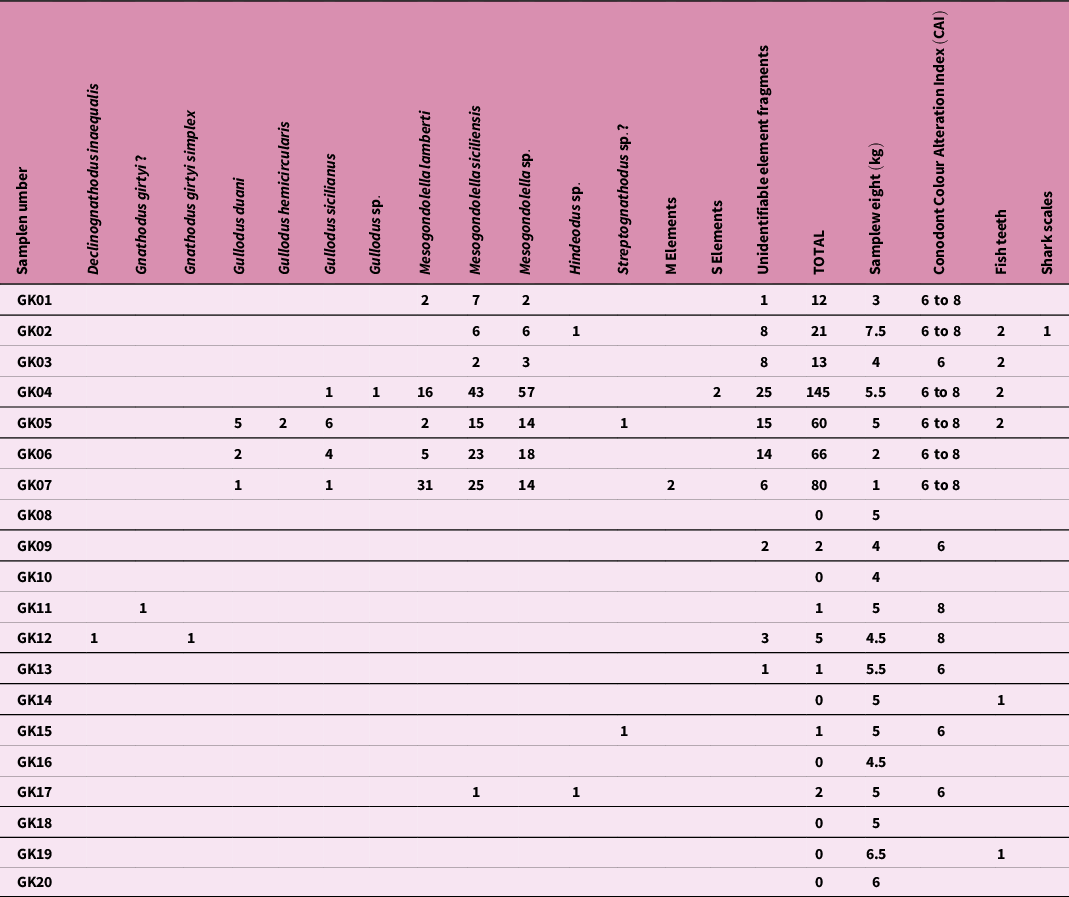
Fourteen of the 20 samples collected yielded conodonts. Preservation is variable with all conodonts showing both metamorphic colour and textural alteration due to both regional tectonism and thermal heating as previously reported at Gunong Kanthan by Metcalfe (Reference Metcalfe, Hills, Henderson and Bamber2002, Reference Metcalfe2003). Recovered faunas are mainly of P1 elements and of low diversity. Conodont abundances are variable but generally low from less than 1 element per kilogram up to 26 per kilogram (Table 1).
Conodont elements and other microfossils recovered from the studied sequence.
3.a.1. Carboniferous conodonts
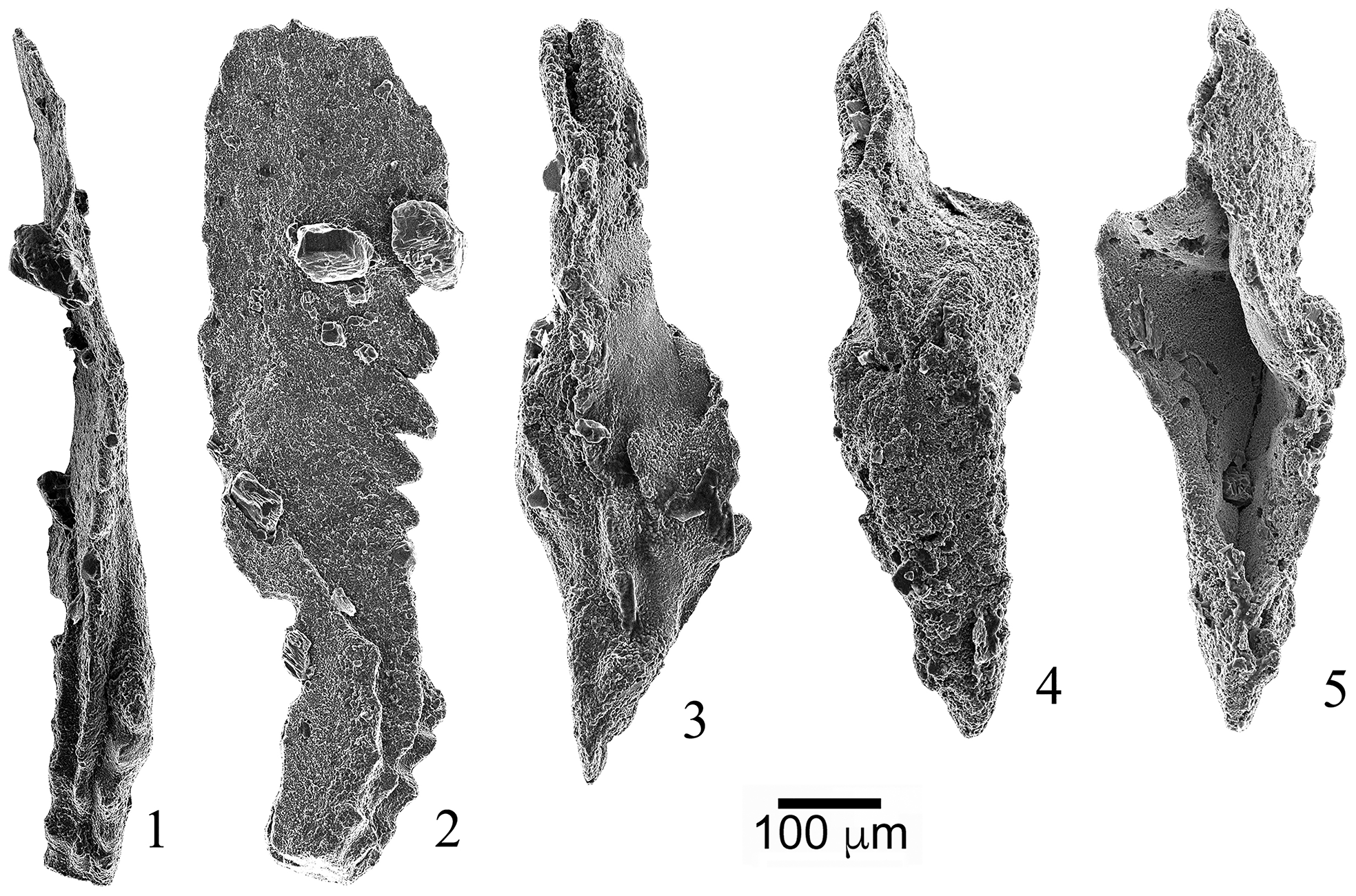
Samples GK11 and GK12 (Fig. 6 and Table 1) yielded just a few conodont elements, but these include Gnathodus girtyi simplex, Gnathodus girtyi? and Declinognathodus inaequalis (Fig. 7). The co-occurrence of these taxa indicates a basal Pennsylvanian (early Bashkirian) age (Fig. 8). Similar Carboniferous faunas with such co-occurrences were reported from Gunong Kanthan by Metcalfe (Reference Metcalfe1979, Reference Metcalfe, Hills, Henderson and Bamber2002, Reference Metcalfe2017b).
Basal Pennsylvanian (basal Bashkirian) P1 element conodonts from the out of sequence Carboniferous limestones (see Fig. 6 ). 1, 2, Declinognathodus inaequalis (Higgins), oral and inner lateral views of specimen GK12/1, sample GK12. 3, Gnathodus girtyi simplex Dunn, oral view of specimen GK12/2, sample GK12. 4, 5, Gnathodus girtyi?, oral and basal views of specimen GK11/1, sample GK11.
Evolution of the nodose Declinognathodus group and related species at the Mississippian-Pennsylvanian boundary. After Hu et al. (Reference Hu, Qi and Nemyrovska2019a, Reference Hu, Qi, Qie and Wang2019b).

3.a.2. Permian conodonts
Permian conodonts have been recovered from limestones to the west (0–60 m) and east (98–160 m) of the out of sequence Carboniferous block bounded by major fault breccia zones (Figs. 4, 6). Limestones within the 0–60 m limestone package yielded moderately abundant conodonts, whereas the limestones from 98 to 160 m yielded very few conodonts (Table 1).
The co-occurrence of Gullodus duani, Gullodus hemicircularis, Gullodus sicilianus, Mesogondolella lamberti and Mesogondolella siciliensis in samples GK01 to GK07 indicate a late Kungurian age for the package of limestones represented by these samples (Fig. 6) and represent the Mesogondolella lamberti International Conodont Zone and the broadly equivalent Mesogondolella siciliensis Regional Conodont Zone (Henderson, Reference Henderson2018; Lambert et al. Reference Lambert, Wardlaw and Henderson2007; Yuan et al. Reference Yuan, Zhang, Qiao, Xu, Ju and Shen2022); see Fig. 9. Similar Late Kungurian faunas have been reported from the E-Lert Formation of Thailand (Burrett et al. Reference Burrett, Udchachon, Thassanapak and Chitnarin2015), from Laibin, South China (Sun et al. Reference Sun, Liu, Yan, Li, Chen, Bond, Joachimski, Wignall, Wang and Lai2017), from the Sibumasu Terrane in eastern Myanmar (Yuan et al. Reference Yuan, Aung, Henderson, Zhang, Zaw, Cai, Ding and Shen2020) and from the South Qiangtang Block in Tibet (Yuan et al. Reference Yuan, Zhang, Qiao, Xu, Ju and Shen2022).
Late Cisuralian and early Guadalupian international and correlative regional conodont zonations. Grey band indicates the biostratigraphic horizon of the Kanthan Limestone late Kungurian conodont fauna presented in this paper. After Henderson (Reference Henderson2018). Stage boundary high-precision U-Pb isotopic ages are from Shen et al. (Reference Shen, Shen, Wu, Zhang, Zhang, Wang, Hou, Yuan, Zhang, Liu, Liu, Zhang, Shi, Wang and Feng2022).
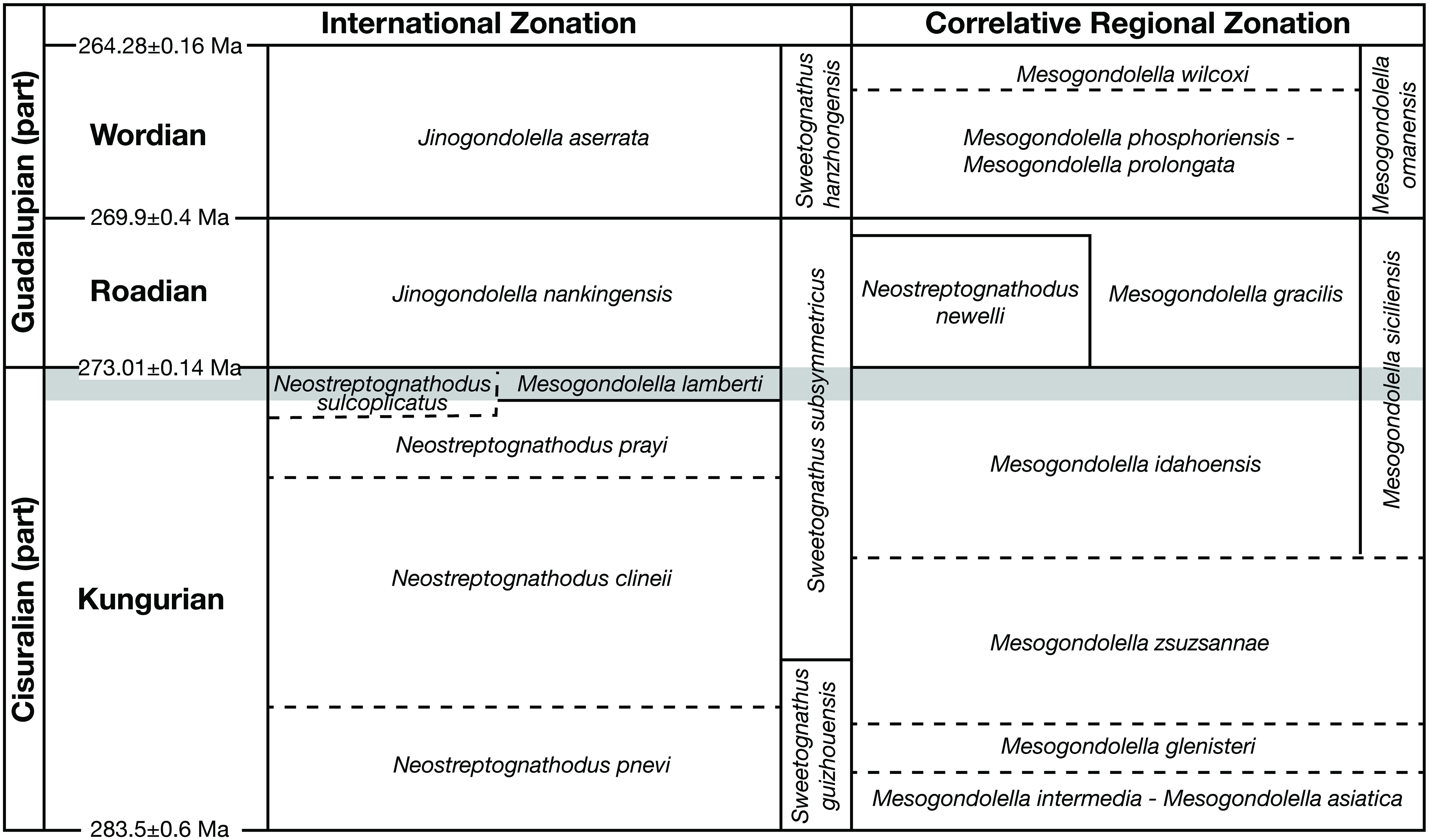
Limestones from 98 to 160 m yielded only three conodont elements. The occurrence of Mesogondolella siciliensis together with Hindeodus sp. indicates a probable Late Kungurian age representative of the Mesogondolella siciliensis Regional Conodont Zone.
3.b. Conodont colour and textural alteration
Conodont elements exhibit colours ranging from dark grey to white representing Colour Alteration Indices (CAIs) from 6 to 8 (Epstein et al. Reference Epstein, Epstein and Harris1977; Rejebian et al. Reference Rejebian, Harris and Huebner1987) consistent with those reported previously from the Kanthan Limestone (Metcalfe, Reference Metcalfe, Hills, Henderson and Bamber2002, Reference Metcalfe2003). Textural alteration of the conodonts includes cracking and pitting (e.g. Fig. 12; 1–5), partial dissolution (e.g. Fig. 12; 5), folding (e.g. Fig. 13; 12, 13, 17, 19) and boudinage (e.g. Fig. 13; 18) consistent with both thermal and regional metamorphism. See Metcalfe (Reference Metcalfe2003) for further details.
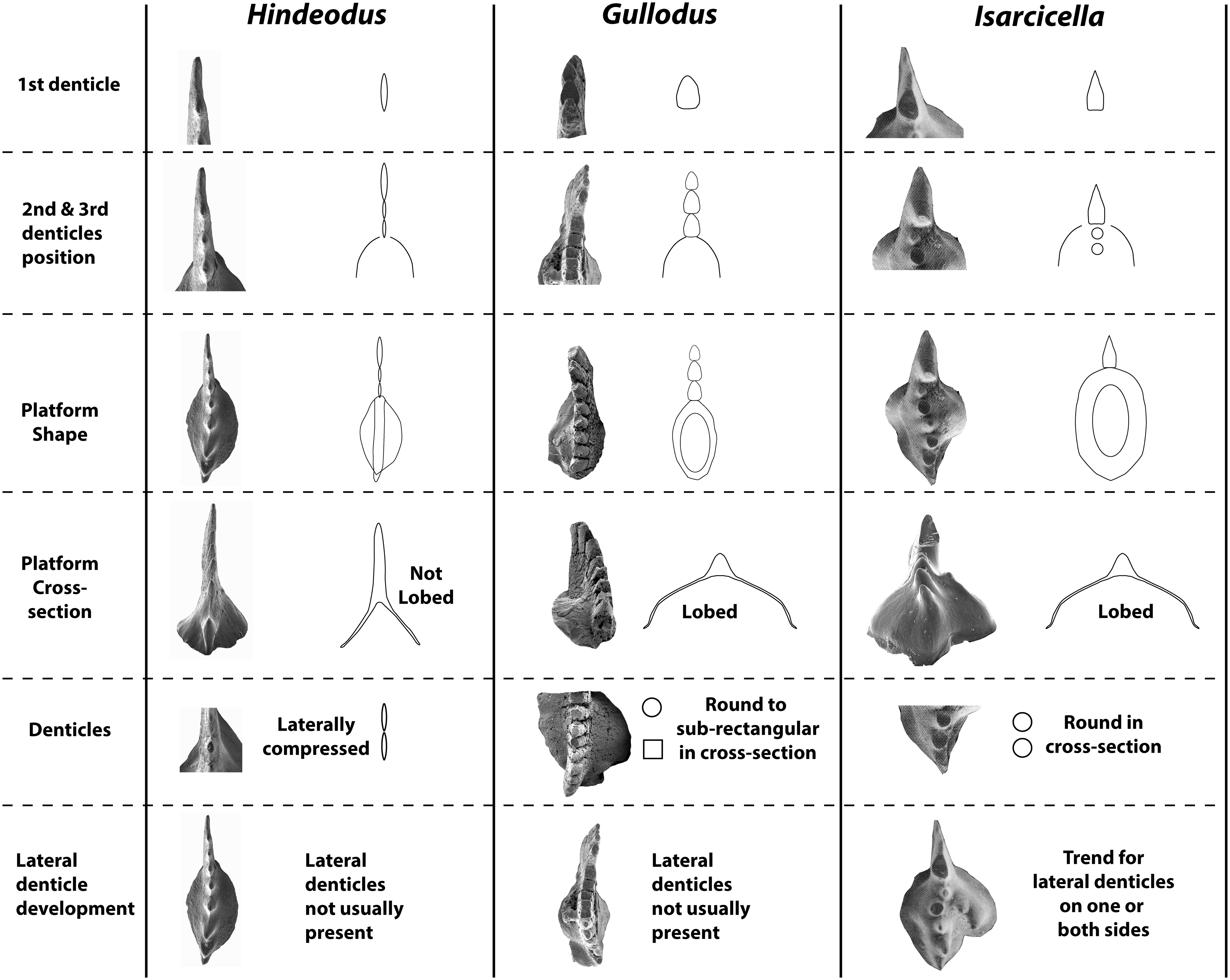
Proposed criteria to distinguish between the genera Hindeodus, Gullodus and Isarcicella (Partly after Metcalfe & Crowley, Reference Metcalfe and Crowley2020). Note: 1st denticles of some P1 elements may have one or more small anterior accessory denticles and are not necessarily the cusp of the element.
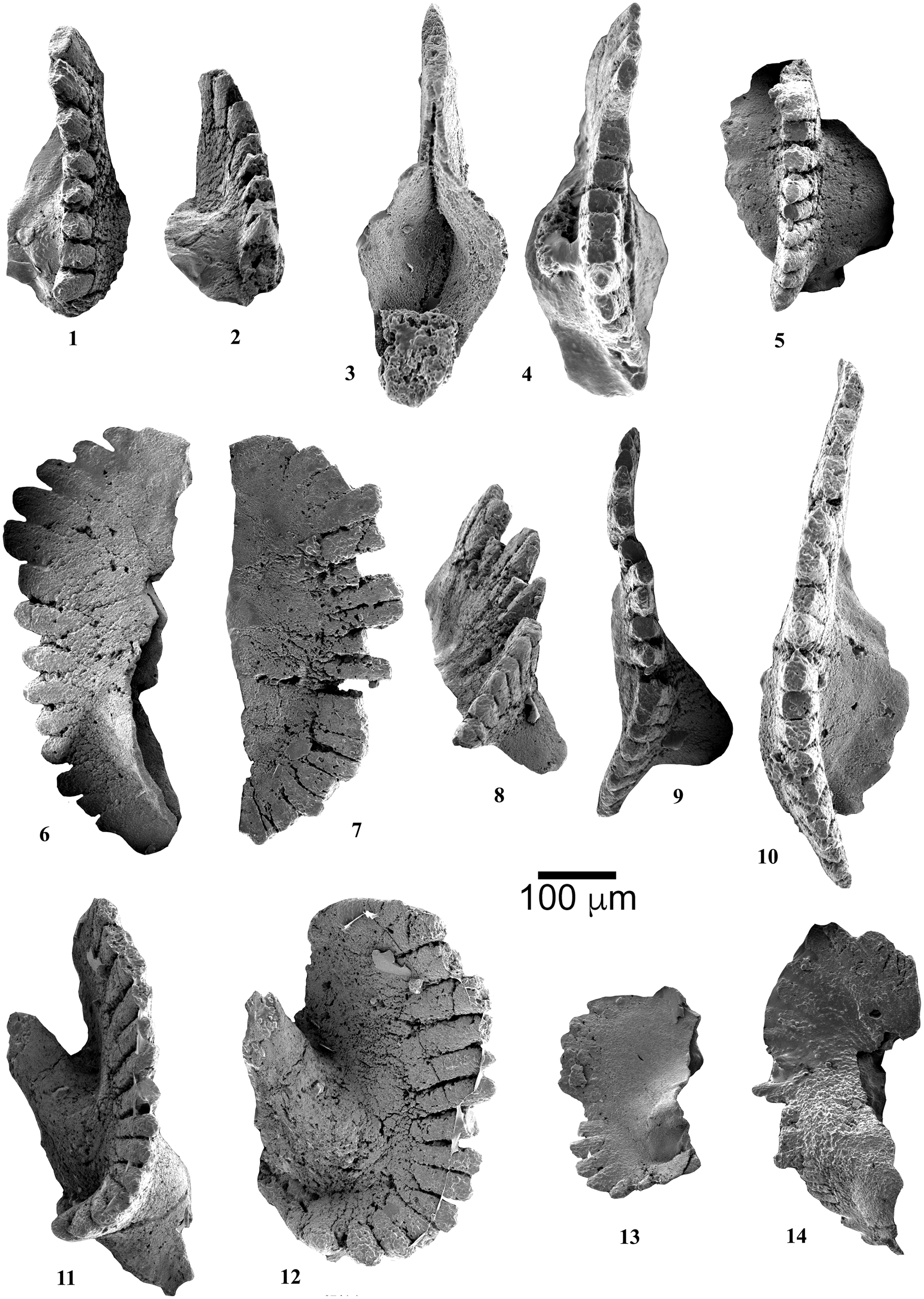
Late Kungurian Gullodus P1 element conodonts from the western (lower 0–60 m) part of the sampled sequence (see Fig. 6 ). 1–5, Gullodus duani Mei et al. (Reference Mei, Henderson and Wardlaw2002); 1, 2, oral and posterior views of specimen GK5/1, sample GK5; 3, 4, basal and oral views of specimen GK5/2, sample GK5; 5, oral view of specimen GK5/19, sample GK5. 6–10, Gullodus sicilianus (Bender & Stoppel, Reference Bender and Stoppel1965); 6, lateral view of specimen GK5/13, sample GK5; 7, 8, lateral and posterior views of specimen GK7/4, sample GK7; 9, oral view of specimen GK5/4, sample GK5; 10, oral view of specimen GK5/6, sample GK5. 11–13, Gullodus hemicircularis Kozur (Reference Kozur1993); 11, 12, oral and inner lateral views of specimen GK5/14, sample GK5; 13, lateral view of specimen GK5/18, sample GK5; and 14, Gullodus sp., lateral view of specimen GK4/20, sample GK4.
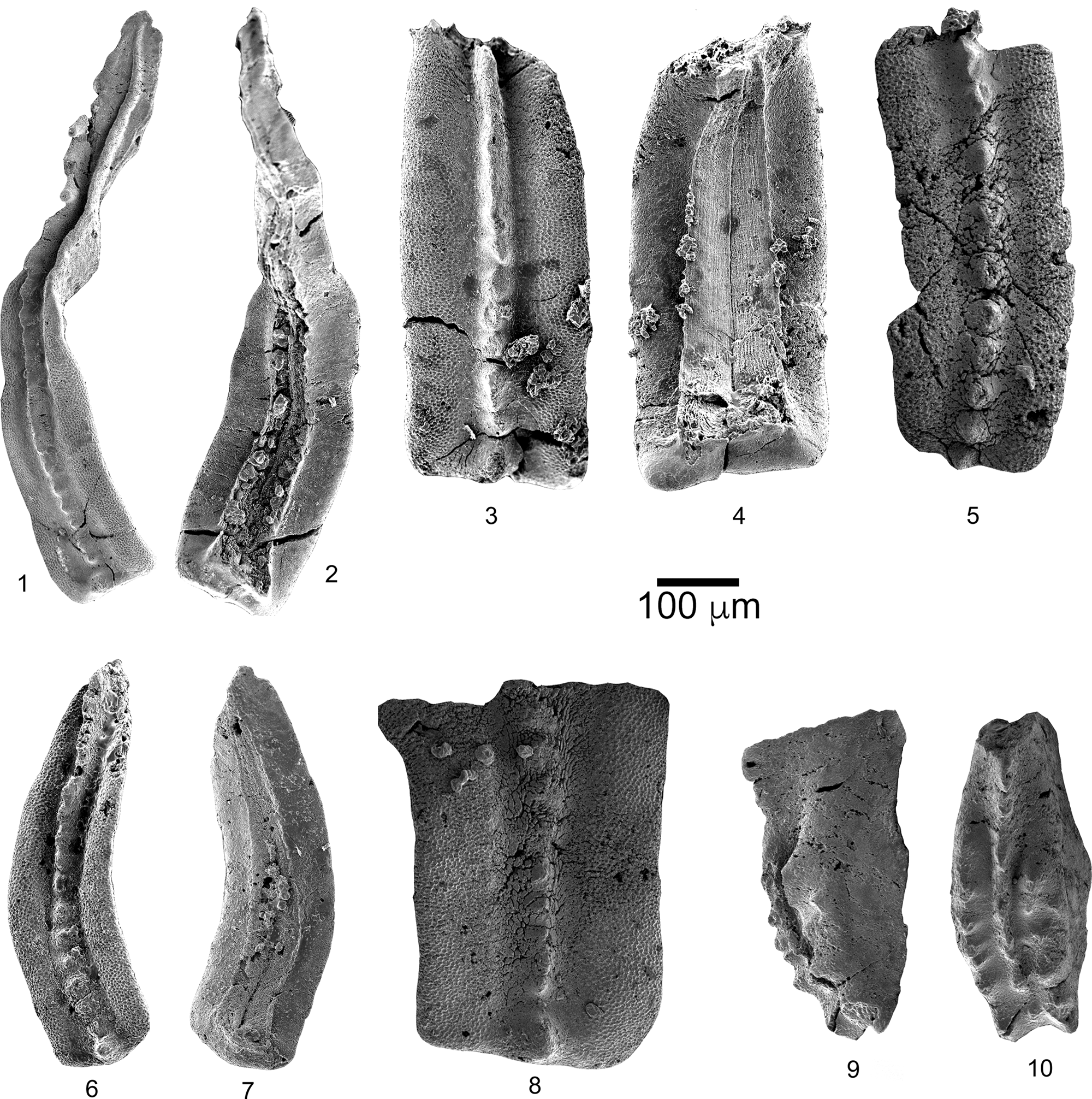
Late Kungurian Mesogondolella lamberti and Streptognathodus sp.? P1 element conodonts from the western (lower 0–60 m) part of the sampled sequence (see Fig. 6 ). 1–8, Mesogondolella lamberti Mei and Henderson (Reference Mei, Henderson, Hills, Henderson and Bamber2002); 1, 2, oral and basal views of specimen GK4/5, sample GK4; 3, 4, oral and basal views of specimen GK4/6, sample GK4; 5, oral view of specimen GK7/6, sample GK7; 6, 7, oral and basal views of specimen GK4/3, sample GK4; 8, oral view of specimen GK4/19, sample GK4; and 9, 10, Streptognathodus sp.? inner lateral and oral views of specimen GK5/2, sample GK5.
3.c. Taxonomic notes
Declinognathodus inaequalis (Higgins, Reference Higgins1975)
Synonomy, diagnosis and description: See Higgins (Reference Higgins1975), Nemyrovska (Reference Nemyrovska1999) and Hu et al. (Reference Hu, Qi and Nemyrovska2019a)
Material: 1 P1 element (GK12/1) from sample GK12.
Remarks: Declinognathodus inaequalis was first established as a sub-species of Idiognathoides noduliferus by Higgins (Reference Higgins1975) and then subsequently re-classified as a species of Declinognathodus (e.g. Riley et al. Reference Riley, Varker, Owens, Higgins and Ramsbottom1987; Sanz-Lopez et al. Reference Sanz-Lopez, Blanco-Ferrera, Garcıa-Lopez and Sanchez de Posada2006, Reference Sanz-Lopez, Blanco-Ferrera and Sanchez de Posada2013; Hu et al. Reference Hu, Qi and Nemyrovska2019a, Reference Hu, Qi, Qie and Wang2019b). It is the oldest nodose morphotype of the Idiognathoides noduliferus s.l. group, the first appearance of which is used to recognize the base of the Pennsylvanian (base Bashkirian) at the mid-Carboniferous GSSP at Arrow Canyon, Nevada, USA (Lane et al. Reference Lane, Brenckle, Baesemann and Richards1999). Recent studies have proposed that Declinognathodus inaequalis should be specifically used to globally recognize and correlate the mid-Carboniferous boundary (Hu et al. Reference Hu, Qi and Nemyrovska2019a, Reference Hu, Qi, Qie and Wang2019b).
Gnathodus girtyi simplex Dunn (Reference Dunn1965)
Synonomy, diagnosis, description and discussion: See Dunn (Reference Dunn1965) and Higgins (Reference Higgins1975).
Material: 1 P1 element (GK12/2) from sample GK12.
Remarks: This is a well-established sub-species that straddles the Mississippian-Pennsylvanian (mid-Carboniferous) Boundary (Higgins, Reference Higgins1975; Metcalfe, Reference Metcalfe1980, Reference Metcalfe1981b; Lane et al. Reference Lane, Brenckle, Baesemann and Richards1999; Hu et al. Reference Hu, Qi, Qie and Wang2019b).
Genus Gullodus Kozur (Reference Kozur1993)
Original Diagnosis (Kozur, Reference Kozur1993): Spathognathodiform element with short to moderately long anterior blade that bears 3–6 broad denticles. In the anterior part of the anterior blade, one to two small denticles are present. The following two denticles are large, and the third or fourth denticle is the largest one. After the largest denticle two smaller, but also broad denticles may be present.
The posterior blade is somewhat to very much longer than the anterior one. It consists mostly of numerous (more than 10, mostly 13–15) small triangular denticles of nearly equal size. Only in the stratigraphically oldest form the posterior blade has 7, rather long subtriangular denticles. Under the entire posterior blade, a large cup is present. Basal cavity strongly expanded. Under the posterior blade, a broad basal furrow is present that becomes narrower against the anterior end of the blade.
Emended Diagnosis (Sun et al. Reference Sun, Liu, Yan, Li, Chen, Bond, Joachimski, Wignall, Wang and Lai2017): Spathognathodiform elements with a medium to long anterior blade and a posteriorly positioned, strongly expanded basal cavity. Denticles occur on the blade and above the basal cavity and are in most cases without ornamentations. Denticles are generally 10–18 in number, and those above the basal cavity can be expanded and form a carina-like structure or narrow transverse ridges. Small coalesced denticles are sometimes developed on the anterior edge forming an ‘anterior blade’. Length/height ratio is between 1.5 and 3. Basal cavities are expanded and non-ornamented and occupy 1/3 to 2/3 of the full body.
Emended Diagnosis (This paper): Spathognathodiform elements with a medium to long anterior blade and a posteriorly positioned, strongly expanded basal cavity. Denticles occur on the blade and above the basal cavity and are in most cases without ornamentation. Denticles are generally 10–18 in number, and those above the basal cavity can be expanded and form a carina-like structure or narrow transverse ridges. The cusp and subsequent few denticles have a pear-shaped cross-section. Other denticles are round to sub-rectangular in cross-section and not laterally compressed. Small coalesced denticles are sometimes developed on the anterior edge forming an ‘anterior blade’. Length/height ratio is between 1.5 and 3. Basal cavities are expanded and lobed, non-ornamented and occupy 1/3 to 2/3 of the full body.
Remarks: The genus Gullodus was first established by Kozur (Reference Kozur1993) who designated Gnathodus sicilianus Bender and Stoppel (Reference Bender and Stoppel1965) as the type species. Kozur (Reference Kozur1993) also described a new species, Gullodus hemicircularis and designated the specimen figured as Hindeodus? sp. by Van Den Boogaard (Reference Van Den Boogaard1987, p. 25, Fig. 10e) as the holotype specimen. The hindeodid genera Gullodus, Hindeodus, Pseudohindeodus and Isarcicella are all similar, and some species have been assigned to different hindeodid genera by different authors using different criteria. Sun et al. (Reference Sun, Liu, Yan, Li, Chen, Bond, Joachimski, Wignall, Wang and Lai2017) proposed a new amended diagnosis for the genus Gullodus as they regarded the original Kozur diagnosis as inadequate in recognizing the difference between Hindeodus and Gullodus. In the amended diagnosis, the main features considered diagnostic of Gullodus are a medium to long anterior blade, a posteriorly positioned, strongly expanded basal cavity, a length/height ratio of between 1.5 and 3 and expanded non-ornamented basal cavities that occupy 1/3 to 2/3 of the full P1 element. The cross-sectional shape of denticles, used by Metcalfe and Crowley (Reference Metcalfe and Crowley2020) to distinguish between Hindeodus (laterally compressed denticles) and Isarcicella (round peg-like denticles), was not considered as a criteria by Sun et al. (Reference Sun, Liu, Yan, Li, Chen, Bond, Joachimski, Wignall, Wang and Lai2017) in distinguishing hindeodid genera. The denticles of Gullodus are round to sub-rectangular in cross-section and not laterally compressed (Fig. 10), and this characteristic is here considered important following Metcalfe and Crowley (Reference Metcalfe and Crowley2020). This has been taken into account in the amended diagnosis presented in this paper to help distinguish the genus from Hindeodus. It is here proposed that the Permian-Triassic genera Gullodus, Hindeodus and Isarcicella can be distinguished from each other using critical criteria and characteristics of the P1 elements, including position of the 1st denticle, location of 2nd and 3rd denticles, platform shape, platform cross-section, denticle shape in cross-section, and lateral denticle development (Fig. 10).
Occurrence: Sicily, South China, Malay Peninsula, NE Thailand, Timor,
Stratigraphic range: Kungurian to Capitanian
Gullodus duani Mei et al. (Reference Mei, Henderson and Wardlaw2002)
(Fig. 11; 1–5)
Synonomy, diagnosis and description: See Mei at al. (Reference Mei, Henderson and Wardlaw2002) and Sun et al. (Reference Sun, Liu, Yan, Li, Chen, Bond, Joachimski, Wignall, Wang and Lai2017).
Material: eight P1 elements (five from sample GK5; two from sample GK6; one from sample GK7).
Remarks: Gullodus duani was first established by Mei et al. (Reference Mei, Henderson and Wardlaw2002). A diagnosis was provided, but a full description of the new species was not presented. The species was recorded from the Guadalupian Maokou Formation, South China. Sun et al. (Reference Sun, Liu, Yan, Li, Chen, Bond, Joachimski, Wignall, Wang and Lai2017) recorded the species from the uppermost Wordian to middle Capitanian at Tieqiao, South China, and proposed a Gullodus duani Interval Zone of Wordian-Capitanian age. Occurrence of this species in the late Kungurian here reported from the Sibumasu Terrane of Malaysia significantly extends the age range of this species.
Occurrence: Sicily, South China, Malay Peninsula.
Stratigraphic range: Kungurian to Capitanian
Gullodus hemicircularis Kozur (Reference Kozur1993)
(Fig. 11; 11–13)
Diagnosis: See Kozur (Reference Kozur1993).
Material: eight P1 elements (five from sample GK5; two from sample GK6; one from sample GK7).
Occurrence: Sicily, South China, Malay Peninsula, NE Thailand, Timor.
Stratigraphic range: Kungurian to Capitanian
Remarks: This species was re-interpreted to belong to Hindeodus by Sun et al. (Reference Sun, Liu, Yan, Li, Chen, Bond, Joachimski, Wignall, Wang and Lai2017) but is here retained in the genus Gullodus because it does not have laterally compressed denticles on the P1 element that are diagnostic of species of Hindeodus (Fig. 10). Some elements identified as Hindeodus gulloides (Kozur & Mostler, Reference Kozur and Mostler1995) by Burrett et al. (Reference Burrett, Udchachon, Thassanapak and Chitnarin2015, Fig. 6, j–m) are here regarded as probable Gullodus hemicircularis, but unfortunately no oral views were provided. Burrett et al. (Reference Burrett, Udchachon, Thassanapak and Chitnarin2015) commented on the transitional nature of these forms between Gullodus and Hindeodus.
Gullodus sicilianus (Bender & Stoppel, Reference Bender and Stoppel1965)
(Fig. 11; 6–10)
Original diagnosis (in German): See Bender and Stoppel (Reference Bender and Stoppel1965).
Material: 12 P1 elements (1 from sample GK4; 6 from sample GK5; 4 from sample GK6 and 1 from sample GK7).
Occurrence: Sicily, South China, Malay Peninsula, Timor.
Stratigraphic range: Kungurian to Wordian.
Remarks: Gullodus sicilianus (Bender & Stoppel, Reference Bender and Stoppel1965) is a rare taxon known mainly from the Wordian (Roadian) of the Tethys realm (Kozur, Reference Kozur1993, Reference Kozur1995). Its occurrence in the Late Kungurian of Malaysia extends the known range of this species. The species differs from Gullodus duani in that the carina extends to the end of the cup, and it has a higher blade and larger size (Mei et al. Reference Mei, Henderson and Wardlaw2002)
Mesogondolella lamberti Mei and Henderson (Reference Mei, Henderson, Hills, Henderson and Bamber2002)
(Fig. 12; 1–8)
Diagnosis (from Mei & Henderson Reference Mei, Henderson, Hills, Henderson and Bamber2002): Pa element of young and adult specimens has a small cusp that is only slightly bigger than the posterior denticles, an anterior blade with largely fused denticles, and a platform with the middle and posterior parts usually parallel-sided and anterior part tapering evenly towards anterior and thus straight-sided. The apparatus is as the same as that constructed by Orchard and Rieber (Reference Orchard and Rieber1999) for Neogondolella and has a bifurcate Sc 1 element in which one of the bifurcate processes consists of only one denticle.
Diagnosis (from Lambert et al. Reference Lambert, Wardlaw and Henderson2007): A species of Mesogondolella characterized by a P1 element with a moderate cusp of circular to elongate circular cross-section, a moderate-height to low blade, roughly parallel posterior lateral margins, and a thin brim on larger specimens.
Synonomy, description and discussion: See Mei and Henderson (Reference Mei, Henderson, Hills, Henderson and Bamber2002) and Lambert et al. (Reference Lambert, Wardlaw and Henderson2007).
Occurrence: West Texas, South China, Oman, British Columbia, Malay Peninsula.
Stratigraphic range: Kungurian to Wordian.
Remarks: Designation of this taxon as a species of Mesogondolella (Lambert et al. Reference Lambert, Wardlaw and Henderson2007) rather than a sub-species of Mesogondolella idahoensis (Mei & Henderson Reference Mei, Henderson, Hills, Henderson and Bamber2002) is here supported.
Mesogondolella siciliensis (Kozur, Reference Kozur1975)
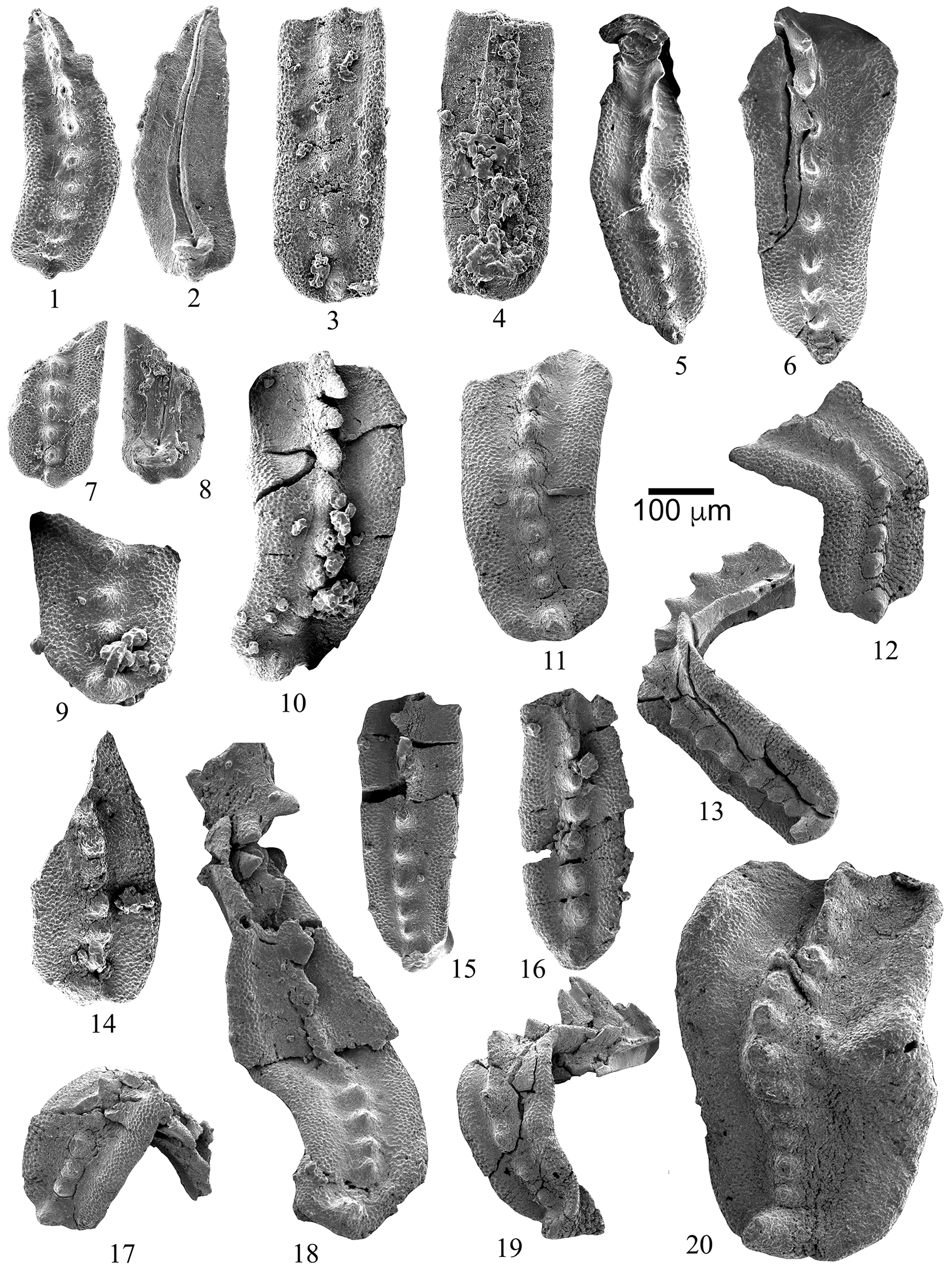
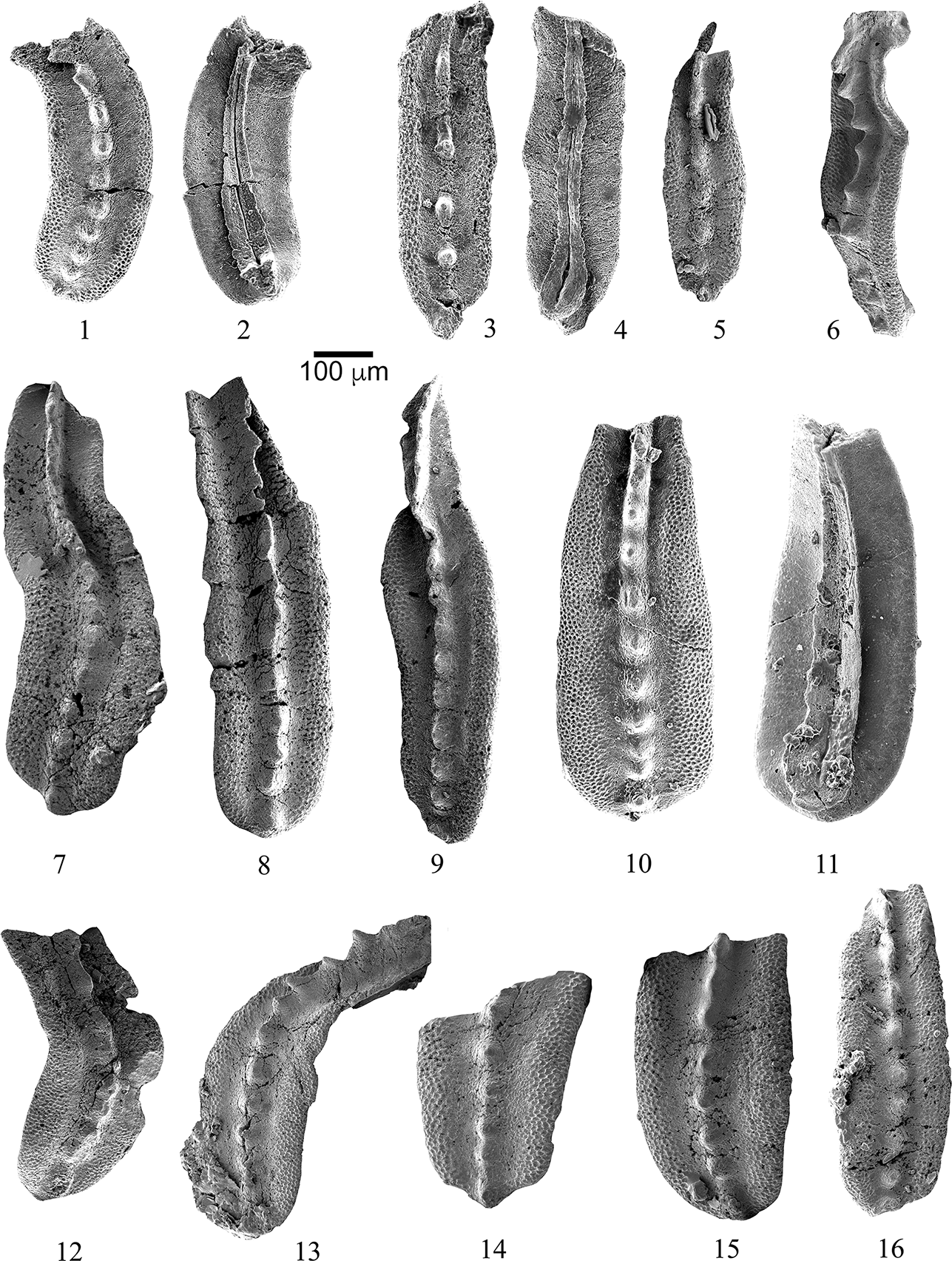
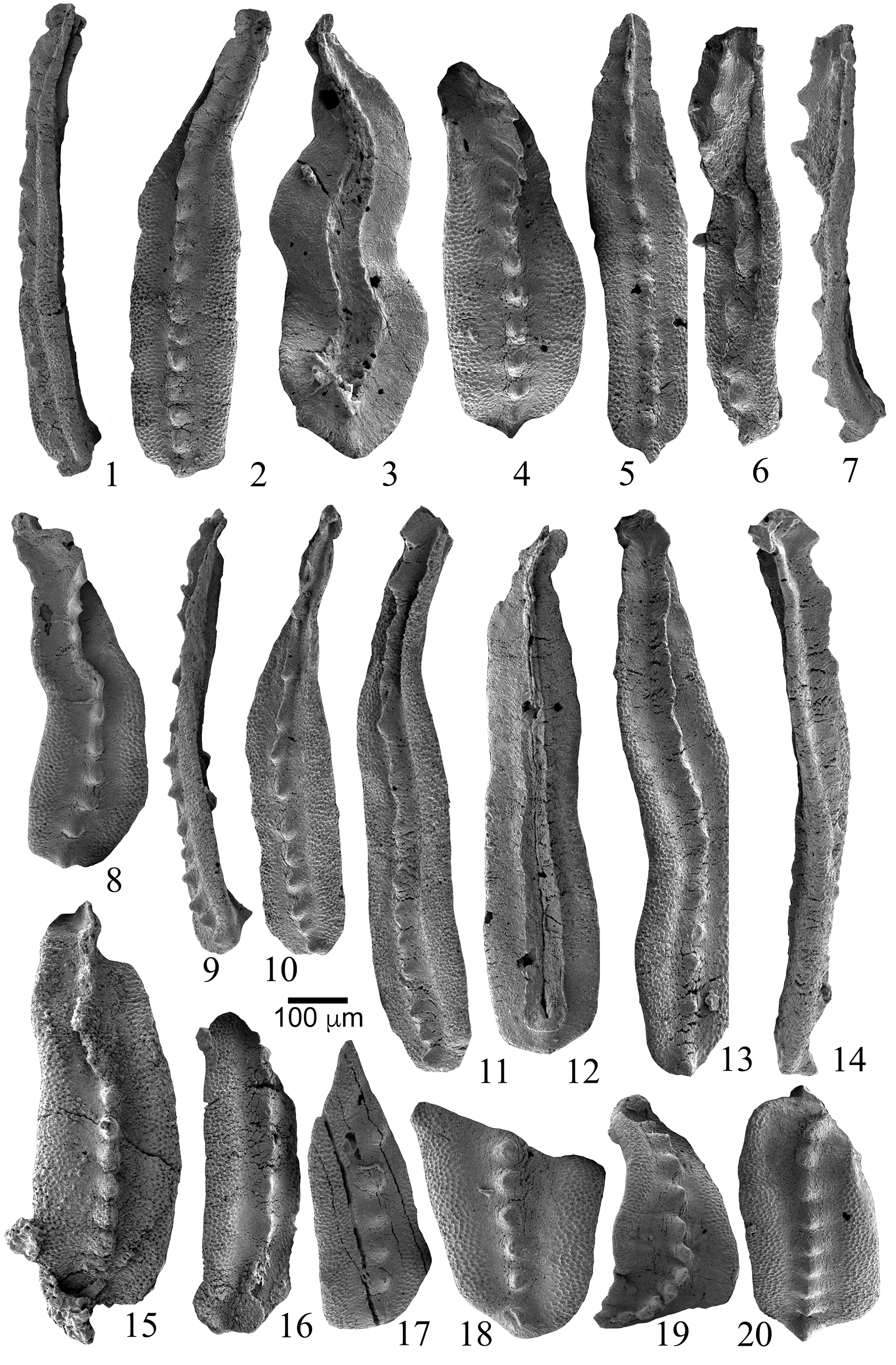
(Fig. 13; 1–20; Fig. 14; 1–16; Fig. 15; 1–20)
Late Kungurian Mesogondolella siciliensis (Kozur, Reference Kozur1975) P1 element conodonts from the western (lower 0–60 m) part of the sampled sequence (see Fig. 6). 1, 2, oral and basal views of specimen GK2/3, sample GK2; 3, 4, oral and basal views of specimen GK3/3, sample GK3; 5, oral view of specimen GK4/1, sample GK4; 6, oral view of specimen GK4/5, sample GK4; 7, 8, oral and basal views of specimen GK3/4, sample GK4; 9, oral view of specimen GK4/3, sample GK4; 10, oral view of specimen GK4/6, sample GK4; 11, oral view of specimen GK4/18, sample GK4; 12, oral view of specimen GK4/12, sample GK4; 13, oral view of specimen GK4/11, sample GK4; 14, oral view of specimen GK4/2, sample GK4; 15, oral view of specimen GK4/23, sample GK4; 16, oral view of specimen GK4/24, sample GK4; 17, oral view of specimen GK4/22, sample GK4; 18, oral view of specimen GK4/7, sample GK4; 19, oral view of specimen GK4/14, sample GK4; and 20, oral view of specimen GK4/8, sample GK4.
Late Kungurian Mesogondolella siciliensis (Kozur, Reference Kozur1975) P1 element conodonts from the western (lower 0–60 m) part of the sampled sequence (see Fig. 6). 1, 2, oral and basal views of specimen GK4/4, sample GK4; 3, 4, oral and basal views of specimen GK4/2, sample GK4; 5, oral view of specimen GK5/3, sample GK5; 6, oral view of specimen GK5/12, sample GK5; 7, oral view of specimen GK5/22, sample GK5; 8, oral view of specimen GK5/11, sample GK5; 9, oral view of specimen GK5/5, sample GK5; 10, 11, oral and basal views of specimen GK5/3, sample GK5; 12, oral view of specimen GK5/15, sample GK5; 13, oral view of specimen GK5/16, sample GK5; 14, oral view of specimen GK5/17, sample GK5; 15, oral view of specimen GK5/7, sample GK5; and 16, oral view of specimen GK5/10, sample GK5.
Late Kungurian Mesogondolella siciliensis (Kozur, Reference Kozur1975) P1 element conodonts from the western (lower 0–60 m) part of the sampled sequence (see Fig. 6). 1, 2, oral and basal views of specimen GK7/1, sample GK7; 3, basal view of specimen GK7/3, sample GK7; 4, oral view of specimen GK7/4, sample GK7; 5, oral view of specimen GK7/14, sample GK7; 6, 7, oral and inner lateral views of specimen GK7/15, sample GK7; 8, oral view of specimen GK7/8, sample GK7; 9, 10, inner lateral and oral views of specimen GK7/10, sample GK7; 11, oral view of specimen GK7/12, sample GK7; 12, basal view of specimen GK7/13, sample GK7; 13, 14, oral and inner lateral views of specimen GK7/18, sample GK7; 15, oral view of specimen GK7/9, sample GK7; 16, oblique oral view of specimen GK7/5, sample GK7; 17, oral view of specimen GK7/7, sample GK7; 18, oral view of specimen GK5/20, sample GK5; 19, oral view of specimen GK5/9, sample GK5; and 20, oral view of specimen GK7/16, sample GK7.
Synonomy: See Kozur (Reference Kozur1975) and Mei and Henderson (Reference Mei, Henderson, Hills, Henderson and Bamber2002).
Emended Diagnosis (from Mei & Henderson Reference Mei, Henderson, Hills, Henderson and Bamber2002): A species of Mesogondolella in which the Pa element of young and adult specimens has a small cusp that is equal to or only slightly bigger than the posterior denticles, an anterior blade with high and largely fused denticles, and a platform that is usually widest around the middle part. The posterior denticles are more discrete than the anterior ones. The apparatus is the same as that constructed by Orchard and Rieber (Reference Orchard and Rieber1999) for Neogondolella, but the Sc1 element does not have a bifurcate anterior process.
Occurrence: Sicily, Oman, South China, West Texas, Baker Terrane in Oregon, USA, Malay Peninsula, NE Thailand.
Stratigraphic range: Late Kungurian.
Remarks: Carinal denticles of M. siciliensis are discrete unlike those in Mesogondolella lamberti and M. idahoensis which are fused at their bases.
Streptognathodus sp. ?
(Fig. 12, Figs 9, 10)
Remarks: Two poorly preserved P1 elements tentatively assignable to Streptognathodus were recovered, one from sample GK5 and one from sample GK15. The element from sample GK15 is too poorly preserved to warrant illustration or discussion. The specimen from sample GK5 (specimen GK5/2), is a poorly preserved, broken P1 element and poor preservation precludes unequivocal specific assignment. The presence of Streptognathodus in sample GK5 together with late Kungurian conodonts is anomalous. The genus Streptognathodus does not extend above the Sakmarian (Henderson, Reference Henderson2018), and this specimen must therefore be re-worked from older upper Carboniferous or Asselian/Sakmarian sediments. Re-worked conodonts are already well documented in the slope-deposited Carboniferous limestones of the Kanthan Limestone (Metcalfe, Reference Metcalfe, Hills, Henderson and Bamber2002, Reference Metcalfe2017b), so re-working of older conodonts in the Permian is plausible and not unexpected.
4. Conodont biofacies and biogeography
4.a. Carboniferous conodonts
The small Carboniferous fauna reported here includes Gnathodus girtyi simplex, Gnathodus girtyi? and Declinognathodus inaequalis which are regarded as representing a deep-water (basinal) biofacies and are cosmopolitan species (Hu et al. Reference Hu, Qi and Nemyrovska2019a, Reference Hu, Qi, Qie and Wang2019b). The occurrence of these conodonts in the Kanthan Limestone interpreted to have formed on the continental margin/slope of the Sibumasu Terrane located along the Australian Gondwana margin is consistent with the inferred depositional setting (Fig. 3).
4.b. Permian conodonts
4.b.1. Biofacies
Gullodus was interpreted as a shallow-water conodont genus and restricted to the upper part of reef slopes but absent on Permian carbonate platforms or in intraplatform shallow basins by Kozur (Reference Kozur1993, Reference Kozur1995). It is interesting to note that species of Gullodus occur in the Kanthan Limestone with Mesogondolella siciliensis, regarded as a pelagic, open-sea conodont by Kozur (Reference Kozur1993) who also noted its co-occurrence with shallow-water conodonts in the platform-slope-derived Socio Limestone blocks of Sicily (Di Stefano & Gullo, Reference Di Stefano and Gullo1997). Mesogondolella lamberti, also common in the Kanthan Limestone fauna, is also regarded as a pelagic, open-sea conodont.
4.b.2. Palaeobiogeography
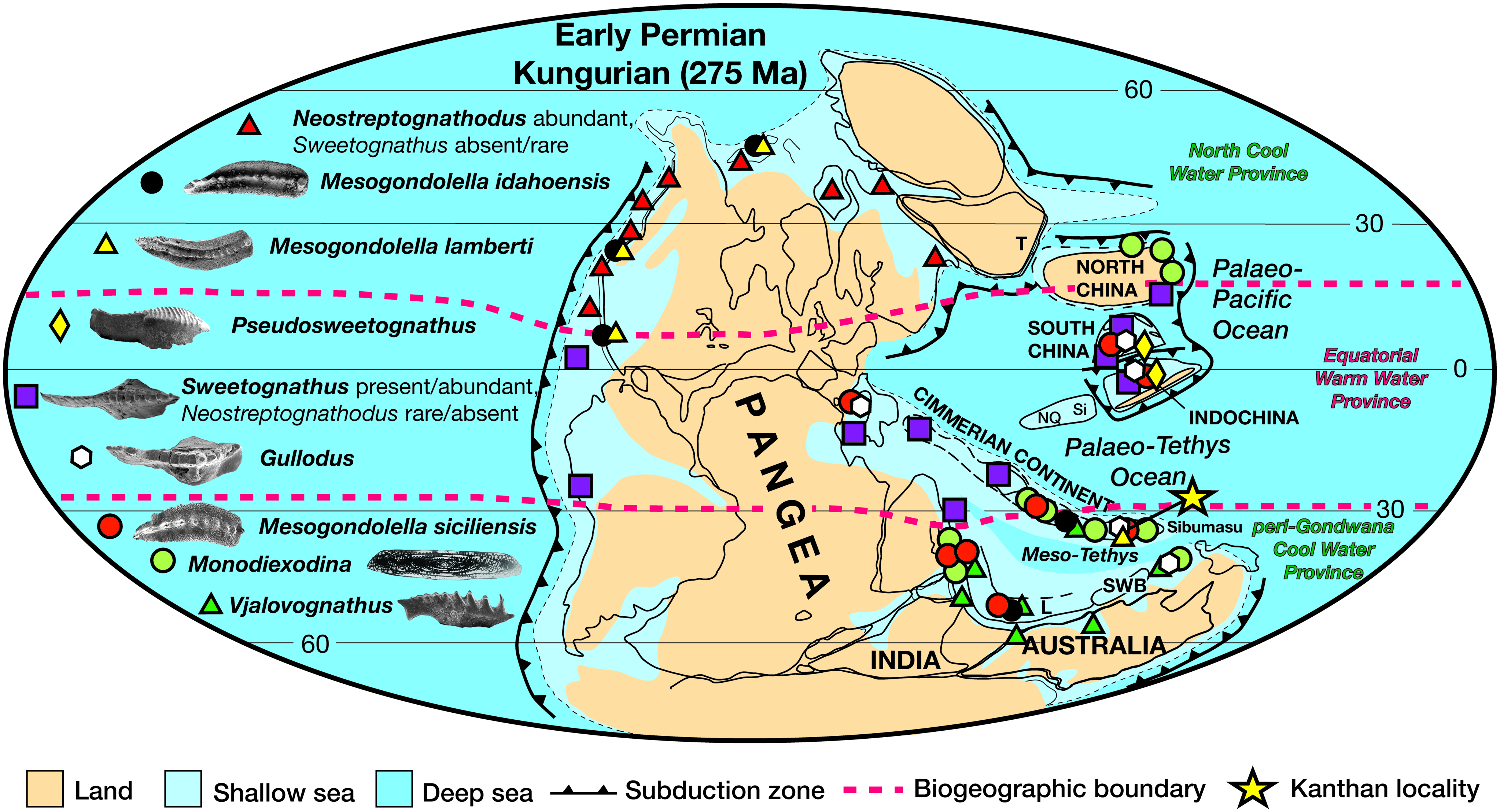
Early Permian conodonts show distinct latitudinal (largely temperature-controlled) provinciality (Fig. 16) with North Cool Water, Equatorial Warm Water and southern peri-Gondwana Cool Water provinces recognized (Mei & Henderson, Reference Mei and Henderson2001). The North Cool Water Province is characterized by abundant Neostreptognathodus and a general absence or rare occurrence of Sweetognathus. The Equatorial Warm Water Province is characterized by abundant Sweetognathus and a general absence or rare occurrence of Neostreptognathodus. Pseudosweetognathus appears to be restricted to the eastern Palaeo-Tethys of this province. The southern peri-Gondwana Cool Water Province is characterized by the distinctive cold-water genus Vjalovognathus (Metcalfe & Nicoll, Reference Metcalfe, Nicoll and Brock1995; Nicoll & Metcalfe, Reference Nicoll and Metcalfe1998) which is restricted to this southern hemisphere province. Mesogondolella idahoensis exhibits an antitropical distribution, occurring in both the North Cool Water and peri-Gondwana Cool Water provinces but not in the Tethyan Equatorial Warm Water Province. Occurrences in West Texas are in a location that appears, based on palaeogeograhic reconstructions, to be in a low-latitude warm climate location which seem anomalous (Fig. 16). Further taxonomic studies on the West Texas faunas or the tectonic setting of that location might resolve this issue. The antitropical distribution of Mesogondolella idahoensis is mirrored by the cool-water foraminifera genus Monodiexodina. Mesogondolella lamberti also shows an antitropical distribution. Mesogondolella siciliensis is commonly found in the southern peri-Gondwana Cool Water Province and in the Equatorial Warm Water Province but has not been recorded in the North Cool Water Province, suggesting that other factors in addition to temperature may be controlling its distribution. The occurrence of Mesogondolella siciliensis cannot be used as an unequivocal indication of warm or tropical ecological conditions. The co-occurrence of ‘warm-water’ and ‘cool-water’ conodont faunas in the same samples from deep-water carbonates in Guangxi, South China (Zhang et al. Reference Zhang, Henderson, Xia, Wang and Shang2010) demonstrates this. The genus Gullodus occurs in both the Equatorial Warm Water and southern peri-Gondwana Cool Water provinces (Fig. 16) but has so far not been reported from the North Cool Water Province. The late Kungurian conodont fauna reported here from the Kanthan Limestone of the Sibumasu Terrane does not contain any Sweetognathus nor any associated fusulinids and represents the southern peri-Gondwana Cool Water Province which is consistent with the palaeogeographic position of the fauna on the Sibumasu Terrane located at about 35 degrees South latitude based on multidisciplinary data. The occurrence of Mesogondolella lamberti in the fauna demonstrates the antitropical distribution of this biostratigraphically important species (Fig. 16). The late Kungurian fauna with M. siciliensis and co-occurring Sweetognathus subsymmetricus and Sweetognathus guizhouensis together with fusulinids on the South Qiangtang Block (Yuan et al. Reference Yuan, Zhang, Qiao, Xu, Ju and Shen2022) indicates a warmer water setting within the Equatorial Warm Water Province reflecting a lower latitudinal position for South Qiangtang. The eastern Cimmerian continental strip therefore straddles the boundary between the Equatorial Warm Water and peri-Gondwana Cool Water provinces (Fig. 16).
Early Permian conodont biogeographic provinces plotted on a Kungurian palaeogeographic reconstruction showing the palaeobiogeographic distribution of key conodont genera and species. Partly after Mei and Henderson (Reference Mei and Henderson2001, Reference Mei, Henderson, Hills, Henderson and Bamber2002), Mei et al. (Reference Mei, Henderson and Wardlaw2002), Metcalfe and Sone (Reference Metcalfe and Sone2008), Metcalfe (Reference Metcalfe2013a, Reference Metcalfe2021) and Yuan et al. (Reference Yuan, Zhang, Shen, Henderson, Zhang, Zhu, An and Feng2015, Reference Yuan, Aung, Henderson, Zhang, Zaw, Cai, Ding and Shen2020, Reference Yuan, Zhang, Qiao, Xu, Ju and Shen2022). SWB = South West Borneo; NQ = North Qiangtang; Si = Simao; L = Lhasa; T = Tarim.
5. Conclusions
-
(1) Late Kungurian (Lower Permian) conodonts are described for the first time from the Sibumasu Terrane of Malaysia.
-
(2) The late Kungurian fauna includes Gullodus duani, Gullodus hemicircularis, Gullodus sicilianus, Mesogondolella lamberti and Mesogondolella siciliensis, and the co-occurrence of these represent the Mesogondolella lamberti International Conodont Zone and the broadly equivalent middle part of the Mesogondolella siciliensis Regional Conodont Zone.
-
(3) A fault bounded package of limestones also yielded a small basal Pennsylvanian (basal Bashkirian) fauna that includes Gnathodus girtyi simplex, Gnathodus girtyi? and Declinognathodus inaequalis.
-
(4) A new proposal for distinguishing species of the hindeodid genera Gullodus, Hindeodus and Isarcicella utilizing characteristics of the P1 elements, including position of the 1st denticle, location of 2nd and 3rd denticles, platform shape, platform cross-section, denticle shape in cross-section, and lateral denticle development, is here presented.
-
(5) The Kanthan Limestone late Kungurian fauna represents the southern peri-Gondwana Cool Water Province and supports palaeogeographic reconstructions placing the Sibumasu Terrane in moderate southern palaeolatitudes in the Kungurian.
Supplementary material
To view supplementary material for this article, please visit https://doi.org/10.1017/S0016756823000328
Acknowledgements
Access to the studied quarry sections was kindly granted and facilitated by Pan Malaysia Cement and LaFarge Cement. I thank Masatoshi Sone for assistance with field sampling and for valuable discussions. Research grants from the University of Malaya, Universiti Kabangsaan Malaysia, University of New England, Australia, and the Australian Research Council have supported conodont and tectonic studies in Malaysia and SE Asia. I thank Editor Dr. Bas Van de Schootbrugge and two anonymous reviewers for their helpful comments and suggestions.
Conflicts of interest
The author declares none.


 Open access

