





Management Implications
Although this work reflects features associated with the model species and study site, it carries important implications for ecological restoration and biodiversity conservation. First, we showed that there may be a threshold of invasive alien plant cover beyond which the production of viable seeds drops drastically. Identifying this threshold (here around 30% to 40%) will provide a measurable target for restoration efforts. Second, because seed production and viability were negatively affected by invasive alien plant species that reach the canopy rather than those in the understory, the former should be prioritized in control measures aiming to promote the production of viable seeds (e.g., for ex situ conservation programs). Third, this study demonstrated that certain invasive alien plant species (here Furcraea foetida) inhibit seed germination through soil-mediated effects, emphasizing the need to account for both above- and belowground impacts in management plans. Removing problematic species and incorporating facilitative ones such as other native or endemic plants that increase germination success (here Poupartia borbonica) into restoration actions may therefore make native seedlings more likely to emerge and establish.
Introduction
Invasive alien plant species are widely recognized for their capacity to alter key ecosystem processes and properties, including soil characteristics (Castro-Díez et al. Reference Castro-Díez, Vaz, Silva, van Loo, Alonso, Aponte, Bayón, Bellingham, Chiuffo, DiManno, Julian, Kandert, La Porta, Marchante and Maule2019), nutrient cycling (Vilà et al. Reference Vilà, Espinar, Hejda, Hulme, Jarošík, Maron, Pergl, Schaffner, Sun and Pyšek2011), disturbance regimes (Brooks et al. Reference Brooks, D’Antonio, Richardson, Grace, Keeley, DiTomaso, Hobbs, Pellant and Pyke2004), water availability (Levine et al. Reference Levine, Vilà, Antonio, Dukes, Grigulis and Lavorel2003), and pollination networks (Morales and Traveset Reference Morales and Traveset2009). By modifying these processes, invasive alien plants can interfere in the establishment of native plants and, consequently, affect plant community structure and assembly (Pearson et al. Reference Pearson, Ortega, Eren and Hierro2018). Despite these well-documented impacts, relatively little is known about how the sum of these changes translates into reproductive success of native plant species, a crucial component of their fitness.
Several case studies suggest that invasive alien plants may negatively influence seed production in native species, often through indirect effects on pollination. In the United States, shading by invasive alien plant species such as Amur honeysuckle [Lonicera maackii (Rupr.) Maxim.; Caprifoliaceae] and crownvetch (Coronilla varia L.; Fabaceae) was found to decrease seed production of native plant species such as spotted geranium (Geranium maculatum L.; Geraniaceae) and bluejacket (Tradescantia ohiensis Raf.; Commelinaceae), respectively, through reduced pollinator visitation (McKinney and Goodell Reference McKinney and Goodell2010; Molano-Flores Reference Molano-Flores2014). On the island of Mauritius (southwest Indian Ocean), the removal of invasive alien plants, mainly strawberry guava (Psidium cattleyanum Sabine; Myrtaceae) led to higher fruit production of two endemic tree species, Eugenia pollicina J.Guého & A.J.Scott (Myrtaceae) and Psychotria borbonica (J.F.Gmel.) Razafim. & B.Bremer (Rubiaceae), likely due to greater pollinator abundance in restored sites (Monty et al. Reference Monty, Florens and Baider2013). However, the fruit production of four other tree species, including the endangered species Tabernaemontana persicariifolia Jacq. (Apocynaceae), did not vary between weeded and invaded forests. One of the only studies that demonstrated an impact of plant invasions on the fruit production of a threatened plant species was conducted on the island of Tahiti (French Polynesia, South Pacific Ocean). There, the number of fruits of the endangered endemic shrub Psychotria speciosa G.Forst. (Rubiaceae) decreased with increasing density of the invasive alien velvet tree (Miconia calvescens DC.; Melastomataceae) (Meyer et al. Reference Meyer, Florence and Tchung2003). Possible impact mechanisms include competition for light and habitat alteration associated with soil erosion and landslides. However, these mechanisms were not explicitly tested in the experimental design of the study.
Beyond seed production, invasive alien plants can also affect post-dispersal stages. In Australian arid woodlands, the seed viability of bramble acacia (Acacia victoriae Benth.; Fabaceae) doubled in sites where the invasive alien buffelgrass (Cenchrus ciliaris L.; Poaceae) had been removed, and the germination rate for dead finish bark (Acacia tetragonophylla F.Muell.; Fabaceae) was faster in weeded plots (Edwards et al. Reference Edwards, Schlesinger, Ooi, French and Gooden2019). Similarly, a combined direct seeding and weed removal experiment in a lowland tropical rainforest on Reunion Island (southwest Indian Ocean) revealed an increase in the emergence rate of endemic tree seedlings in weeded plots compared with invaded plots, potentially due to reduced allelopathy (Albert et al. Reference Albert, Franc, Solesse, Strasberg and Flores2024). Despite these scattered findings, no study has yet simultaneously examined how invasive alien plants influence seed production, viability, and germination, three key dimensions of plant reproductive success (Morgan Reference Morgan1999).
In this study, we aimed at testing the influence of invasive alien plants on the reproductive success of the Benjoin [Terminalia bentzoe (L.) L.f. subsp. bentzoe; Combretaceae], a critically endangered tree endemic to the islands of Reunion and Mauritius. First, we assessed whether the production and viability of seeds collected in the field were influenced by the abundance of invasive alien plants in the different forest strata. Second, we conducted a germination experiment to test for soil-legacy effects of plant invasions on the germination success of T. bentzoe subsp. bentzoe. Based on the existing body of knowledge, it is expected that the production and viability of the species’ seeds will decrease with increasing abundance of invasive alien plants and that their soil legacy will negatively affect germination success.
Materials and Methods
Study Site
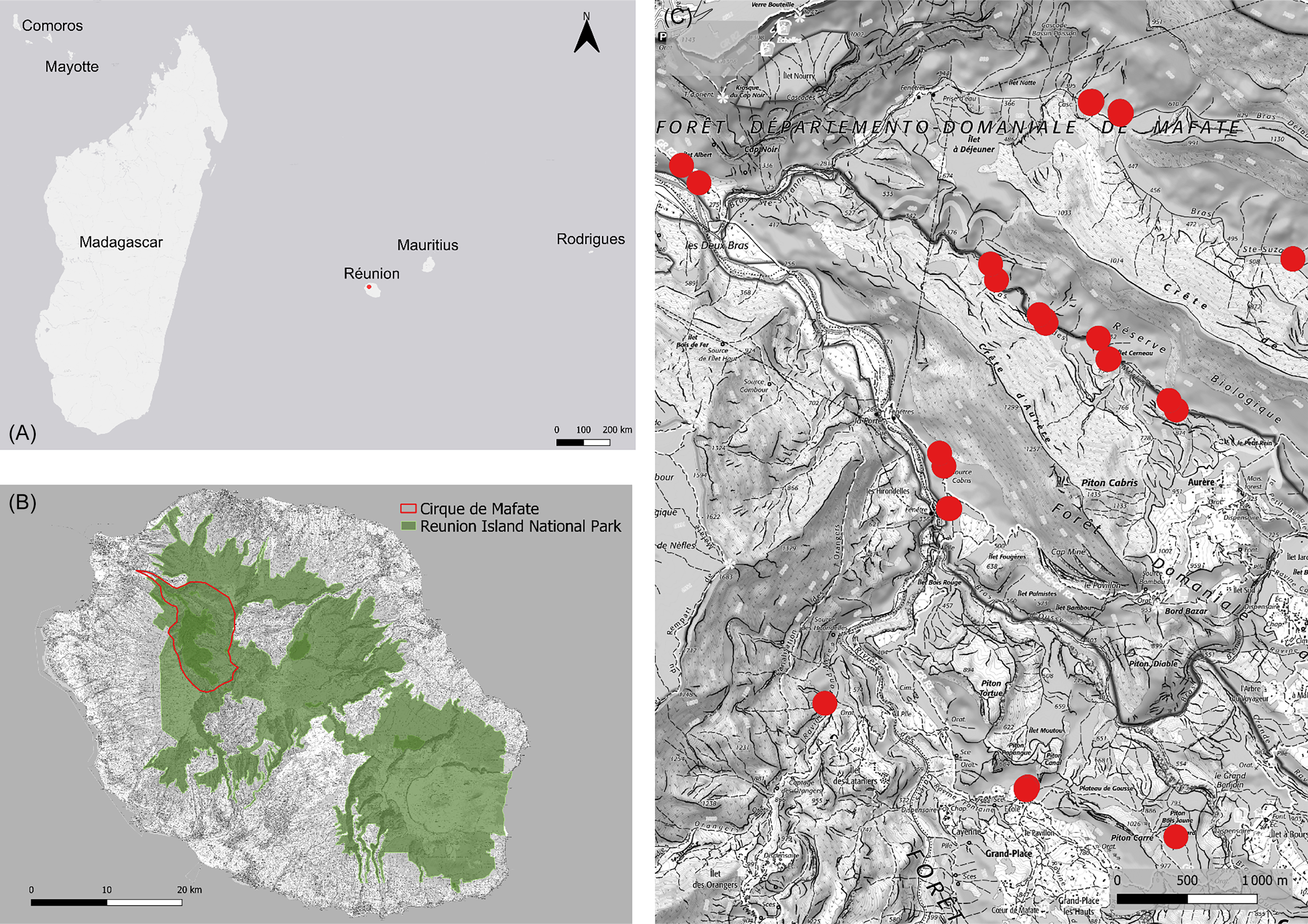
Reunion is a volcanic island that is part of the Mascarene archipelago, along with Mauritius and Rodrigues (Figure 1). It is the youngest (2 to 3 million yr old), largest (2,512 km2), and highest (3,070 m asl) of the three islands. Its climate is tropical and characterized by two seasons: a warm and rainy austral summer marked by cyclones and tropical storms (December to April) followed by a relatively cool and dry austral winter (May to November). Rainfall ranges from ca. 500 mm yr−1 on the leeward coast to >8,000 mm yr−1 on the windward coast (Réchou et al. Reference Réchou, Flores, Jumaux, Duflot, Bousquet, Pouppeville and Bonnardot2019).
Study site. Location of Reunion Island in the southwest Indian Ocean (A), of Cirque de Mafate in Reunion Island (B), and of sites where seeds of Terminalia bentzoe subsp. bentzoe were enumerated and collected (red dots) (C).

The vegetation of the island is organized according to a gradient of elevation, coupled with that of rainfall. Eight major vegetation types have been defined (Cadet Reference Cadet1980), including the seasonally dry tropical forest of the west coast, which was severely destroyed after the European colonization of the island in the 17th century and now persists only in the form of highly fragmented patches invaded by alien plants (Galland Reference Galland1991; Hoarau et al. Reference Hoarau, Rhumeur, Marie, Mallet, Triolo, Flores, Strasberg and Pouteau2025; Strasberg et al. Reference Strasberg, Rouget, Richardson, Baret, Dupont and Cowling2005).
This study was conducted in the core of the Reunion National Park, in Cirque de Mafate (Figure 1), which harbors about one-third of the island’s remaining dry forest relics (Triolo Reference Triolo2008), and the largest known T. bentzoe subsp. bentzoe subpopulation. The most abundant invasive alien plants in the study area include high-climbing hiptage [Hiptage benghalensis (L.) Kurz; Malpighiaceae], trees such as white leadtree [Leucaena leucocephala (Lam.) de Wit; Fabaceae] and soft bollygum [Litsea glutinosa (Lour.) C.B.Rob.; Lauraceae], shrubs such as lantana (Lantana strigocamara R.W. Sanders; Verbenaceae) and yellow trumpetbush [Tecoma stans (L.) Juss. ex Kunth; Bignoniaceae], and large rosette-forming succulent Mauritius hemp [Furcraea foetida (L.) Haw.; Asparagaceae].
Study Species
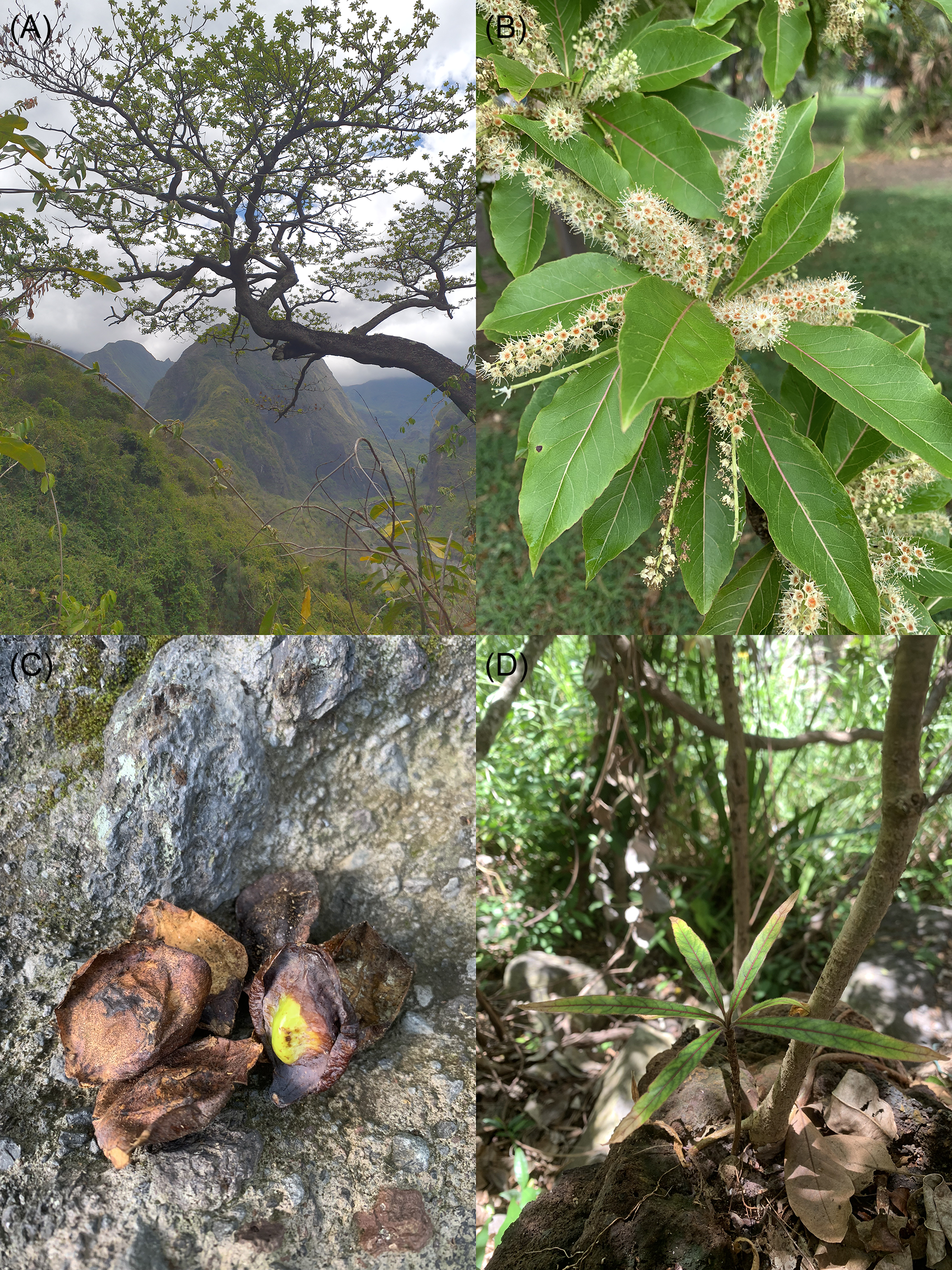
Terminalia bentzoe include two subspecies: bentzoe, endemic to Reunion and Mauritius, and rodriguesensis, endemic to Rodrigues (Wickens Reference Wickens1976). It is a relatively large tree (up to 30 m; Figure 2A) whose bark is used in traditional medicine for its anti-microbial and anti-inflammatory properties (Dorla et al. Reference Dorla, Grondin, Hue, Clerc, Dumas, Gauvin-Bialecki and Laurent2019). Terminalia bentzoe has one-seeded dry fruits with two wings, which suggests that they can be dispersed by wind (Figure 2C). They were also probably dispersed by vertebrates that are now extinct on Reunion Island but, on Mauritius, fruits of T. bentzoe subsp. bentzoe are still consumed by the Greater Mascarene flying fox (Pteropus niger), one of the last large native frugivores still present (Nyhagen et al. Reference Nyhagen, Turnbull, Olesen and Jones2005; Reinegger et al. Reference Reinegger, Oleksy, Bissessur, Naujeer and Jones2021). Moreover, fruits of a congeneric species, Terminalia boivinii Tul., are consumed by the Aldabra giant tortoise (Aldabrachelys gigantea) in the Seychelles (Falcón et al. Reference Falcón, Moll and Hansen2020).
Whole tree (A), inflorescences (B), fruits (C), and seedling (D) of Terminalia bentzoe subsp. bentzoe. Photo credits: AR (A) and HAA (B, C, D).

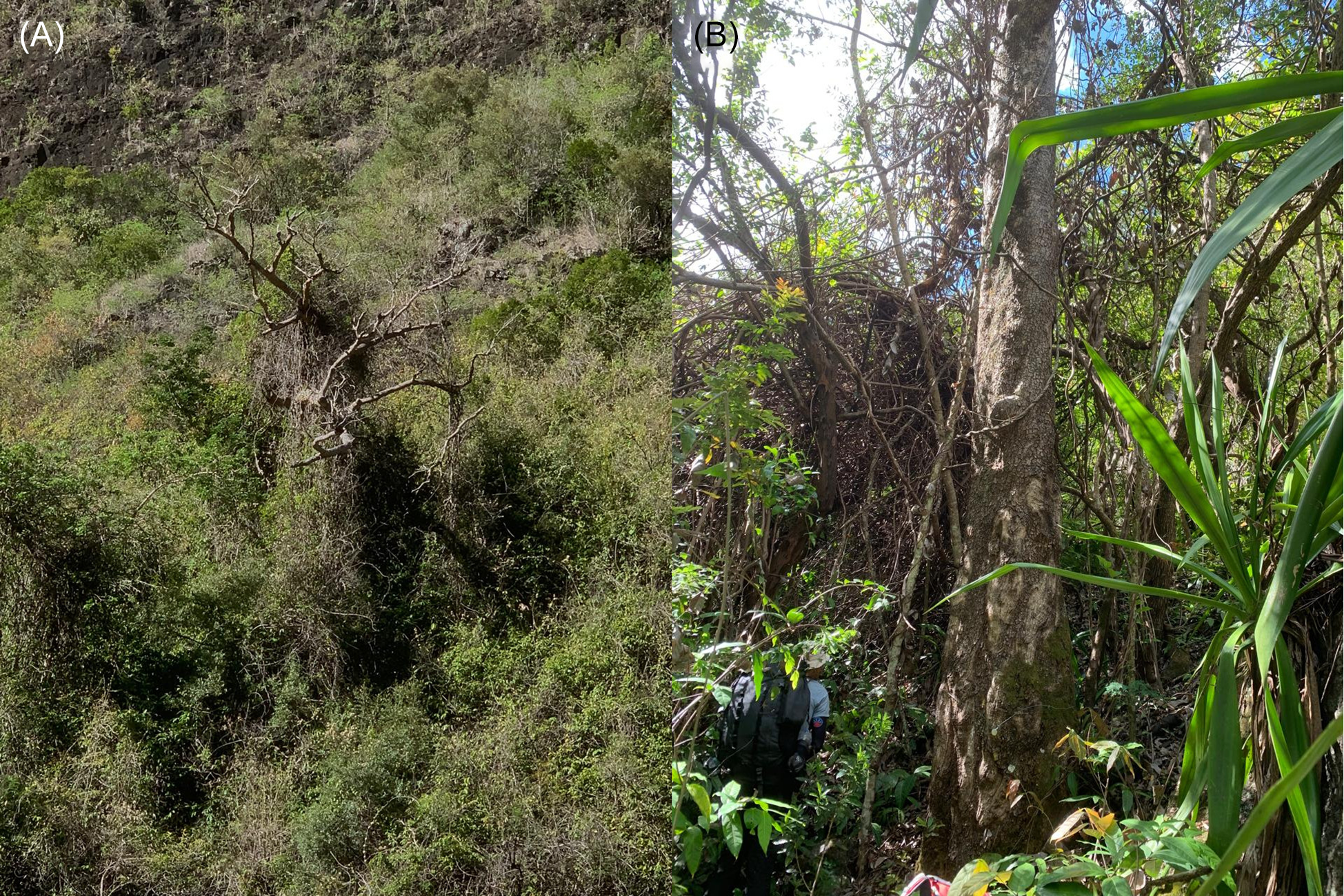
Fewer than 250 adult individuals of T. bentzoe subsp. bentzoe remain in the wild on Reunion Island. With an annual recruitment rate of only 0.06 juveniles produced per reproductive plant, the species suffers from a severe lack of regeneration (Hoarau et al. Reference Hoarau, Rhumeur, Marie, Mallet, Triolo, Flores, Strasberg and Pouteau2025). As a result, T. bentzoe subsp. bentzoe is classified as critically endangered according to the IUCN Red List of Threatened Species (IUCN French Committee et al. 2023). Current threats include habitat loss and degradation by invasive alien plants like H. benghalensis (Figure 3A), bark stripping for medicinal use (Figure 3B), and inbreeding and genetic erosion (Mallet et al. Reference Mallet, Rhumeur, Lavergne and Picot2024). Terminalia bentzoe subsp. bentzoe, along with five other woody species from lowland dry forest remnants of Reunion Island, is included in the “Plan national d’actions en faveur des espèces ligneuses des reliques de la bande adlittorale xérophile de La Réunion” (Mallet et al., Reference Mallet, Rhumeur, Lavergne and Picot2024). Such a national action plan aims at monitoring the last populations of the focal species, restoring viable populations and their habitats, and informing concerned stakeholders, decision makers, and the public.
Threats to Terminalia bentzoe subsp. bentzoe in Cirque de Mafate. Dead individual invaded by the alien liana Hiptage benghalensis (A) and still living individual also threatened by invasive alien plants with scars from barking on the trunk (B). Photo credit: HAA.

Seed Production
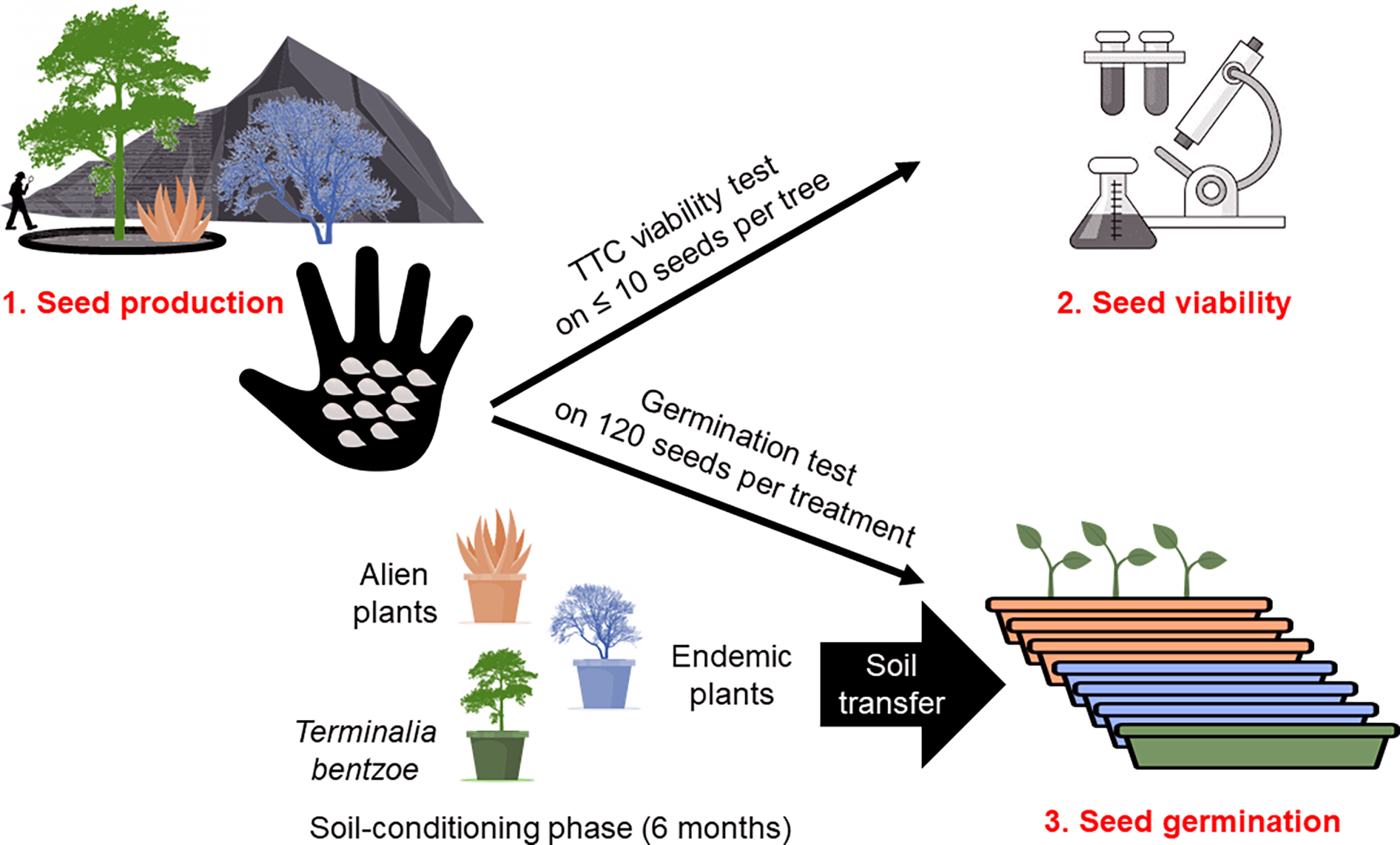
Terminalia bentzoe subsp. bentzoe seeds were collected in the field, under the canopy of 34 reproductive individuals (i.e., at least one-seventh of the remaining wild adults on Reunion Island) between January and April 2025 (Figure 4). The sampling time per individual was proportional to its canopy surface (ranging from 5 to 23 min) to ensure comparable sampling effort per unit area. Seeds were stored in paper envelopes at room temperature in a dry environment. The abundance of invasive alien plants around each tree was estimated as the percentage cover within the vertical projection of T. bentzoe subsp. bentzoe canopy in four vegetation layers: liana layer (H. benghalensis > 5 m), tree layer (non–H. benghalensis > 5 m), shrub layer (1 to 5 m) and herbaceous layer (<1 m) (Supplementary Figure S1).
Conceptual diagram representing the main steps of this study. TTC, 2,3,5-triphenyl-2H-tetrazolium chloride.

Seed Viability
A tetrazolium seed viability test was carried out (Figure 4). This test is based on the ability of metabolically active cells to reduce 2,3,5-triphenyl-2H-tetrazolium chloride (TTC) salt. Collected seeds were halved longitudinally to extract the embryo. The seed coat was incised or split to expose the internal tissue and the “half-seeds” were placed in a 0.1% (w/v)1g L-1 TTC solution and incubated at 30 C in the dark for 24 h. After seeds were rinsed with distilled water, viability was evaluated under a microscope: seeds showing full red or light red staining were scored as viable; unstained or partially stained seeds were scored as nonviable. When more than 10 seeds were collected from an individual, viability was assessed for a random subsample of 10 seeds. The total number of viable seeds was then estimated as the product of total seeds collected and viability rate. When fewer than 10 seeds were available, all seeds were tested.
Seed Germination
To test the potential influence of invasive alien plants on seed germination in T. bentzoe subsp. bentzoe, seeds were planted in soils previously used to grow different plant species for six months: (1) the three most abundant invasive alien plant species in the T. bentzoe subsp. bentzoe subpopulations of Cirque de Mafate: F. foetida, H. benghalensis, and L. leucocephala; (2) three Mascarene endemic tree species found in the vicinity of T. bentzoe subsp. bentzoe subpopulations of Mafate: Polyscias cutispongia (Lam.) Baker (Araliaceae), Poupartia borbonica J.F.Gmel. (Anacardiaceae), and Volkameria heterophylla Poir. (Lamiaceae); and (3) T. bentzoe subsp. bentzoe itself (Figure 4). Soils were composed of 7:16 of potting soil (Teragile, APEX Franchises, La Chapelle-sur-Erdre, France), 7:16 of horticultural compost (Teragile, APEX Franchises, La Chapelle-sur-Erdre, France), and 2:16 of sifted coconut fiber. After the soil-conditioning phase, these soils were transferred to seven seed trays. Before sowing, fruits were manually depulped (wing and, if possible, part of the fruit envelope) to extract the seed, soaked in room-temperature water for 1 to 2 h and rinsed repeatedly until the water ran clear. This pretreatment promotes dormancy breakage and can at least double germination rates (CIRAD 2008). In each tray, 120 T. bentzoe subsp. bentzoe seeds randomly selected from all collected seeds were sown in April 2025. Seed trays were placed on a table in a greenhouse and were assigned to random positions. The number of seeds that had germinated was counted twice a week for 6 wk. The use of the single tray per treatment was motivated by a limited quantity of preconditioned soil and by the fact that we wanted to avoid mixing preconditioned soil with other substrates (e.g., sand or vermiculite), which could attenuate soil-legacy effects. In return, this setup carries a risk of artifacts induced by the tray identity (e.g., if one of the trays was contaminated by a fungal infection).
Statistical Analyses
Generalized linear models were used to study the relationship between the number of seeds as response variable and invasive alien plant cover as explanatory variable. Two models were built: (1) one for seed production with the number of viable and nonviable seeds as response variable; and (2) one for seed viability with the number of viable seeds as response variable. A negative binomial distribution was preferred to a Poisson distribution to account for overdispersion of the count data (the variance exceeding the mean).
Significance of the results of germination experiment was evaluated by randomization tests. This analysis aimed at determining whether the germination rates observed for each seed tray were higher or lower than expected by chance. In this respect, we randomly assigned n germinated seeds to the seven trays, where n is the total number of seeds that germinated in all trays, and repeated the operation 9,999 times to obtain a random distribution of germination rates. A P-value was then calculated for each seed tray to examine whether the observed proportion of germinated seeds significantly differs from the distribution of proportions obtained randomly. The difference was considered significant if the observed value fell below the 2.5th percentile or above the 97.5th percentile. The R package infer was used to estimate P-values (Couch et al. Reference Couch, Bray, Ismay, Chasnovski, Baumer and Cetinkaya-Rundel2021).
Results and Discussion
Relationship between Abundance in Invasive Alien Plants and Seed Production and Viability
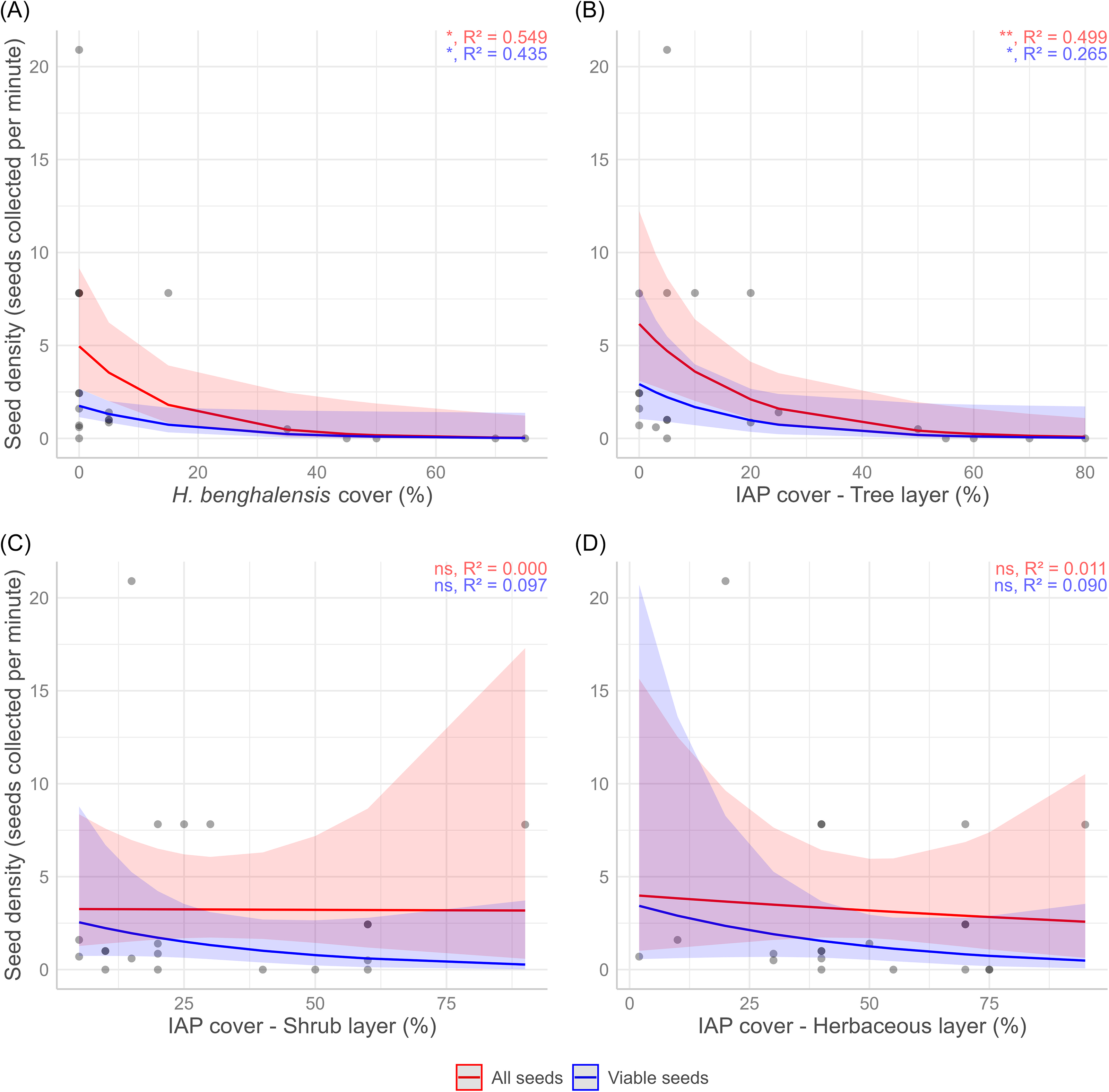
In total, 1,767 T. bentzoe subsp. bentzoe seeds were collected, representing an average of 52 seeds per adult tree (Supplementary Table S1). Seed collection rates ranged from 0 to 20 seeds min−1, with an average of 5 seeds min−1. For eight trees, we did not find any seeds within the allocated time. Seed density of T. bentzoe subsp. bentzoe was negatively associated with the cover of H. benghalensis in the liana layer (P-value < 0.05; R2 = 0.549) and that of invasive alien trees (P-value < 0.01; R2 = 0.499) (Figure 5). Seed density averaged 5 to 6 seeds min−1 when the highest vegetation strata were not invaded and became close to nil above a cover of 30% to 40% for H. benghalensis and invasive alien trees. In contrast, no significant relationship was detected with the cover of invasive plants in lower vegetation strata.
Relationship between the coverage of invasive alien plants (IAP) in different vegetation strata and the production of viable and nonviable Terminalia bentzoe subsp. bentzoe seeds (All seeds) and of viable seeds only (Viable seeds). Coverage is expressed as a percentage and seed production as the number of seeds collected per minute. The shaded areas on both sides of the colored lines cover the 95% confidence intervals. Level of significance: ns indicates P-value ≥ 0.05; *0.05 > P-value ≥ 0.01; **0.01 > P-value ≥ 0.001; ***P-value < 0.001.

The tetrazolium test showed that, among the 26 reproductive individuals, viability rates ranged from 0% to 60% depending on the seed set, with an average of 23%. Densities of viable seeds alone mirrored those of all seeds in terms of response to plant invasions, with a decreasing tendency up to a 30% to 40% cover threshold for H. benghalensis and invasive alien trees beyond which T. bentzoe subsp. bentzoe did not produce seeds and an absence of significant correlation with abundance in invasive shrub and herbaceous species. However, the values were lower, averaging 2 to 3 seeds min−1 when the canopy was not invaded, and the relationships with the cover of H. benghalensis (P-value < 0.05; R2 = 0.435) and that of invasive alien trees (P-value < 0.05; R2 = 0.265) were slightly weaker.
Unlike shrubs and herbs, trees and lianas reach the canopy and may therefore exert stronger competition for light, a key resource for reproduction (Cabin et al. Reference Cabin, Weller, Lorence, Cordell, Hadway, Montgomery, Goo and Urakami2002). Moreover, invasive alien trees most likely explore the same soil horizons as T. bentzoe subsp. bentzoe and may therefore compete against each other for water and nutrients. Thus, by reducing resource availability, invasive alien trees and H. benghalensis could inhibit photosynthesis and other primary metabolic processes resulting in lower allocation to reproduction by T. bentzoe subsp. bentzoe.
Additional mechanisms could also contribute. The dense canopy cover of invasive alien trees and H. benghalensis might disrupt pollination networks by reducing the frequency or efficiency of pollinator visits, as suggested for other native species affected by biological invasions (Albrecht et al. Reference Albrecht, Padrón, Bartomeus and Traveset2014; Herron-Sweet et al. Reference Herron-Sweet, Lehnhoff, Burkle, Littlefield and Mangold2016; Vanparys et al. Reference Vanparys, Cawoy, Mahaux and Jacquemart2011), including endemic species (Kueffer et al. Reference Kueffer, Daehler, Torres-Santana, Lavergne, Meyer, Otto and Silva2010; Monty et al. Reference Monty, Florens and Baider2013). Furthermore, H. benghalensis can cause significant damage by climbing on T. bentzoe subsp. bentzoe, potentially leading to tree strangulation and, ultimately, collapse (Figure 3). To what extent decreased seed production and viability are a direct consequence of plant invasion (e.g., through disrupted pollination services) or a symptom of poor health conditions (e.g., due to strong resource competition or mechanical constraints) or both remains to be clarified.
Effect of Invasive Alien Plants on Seed Germination
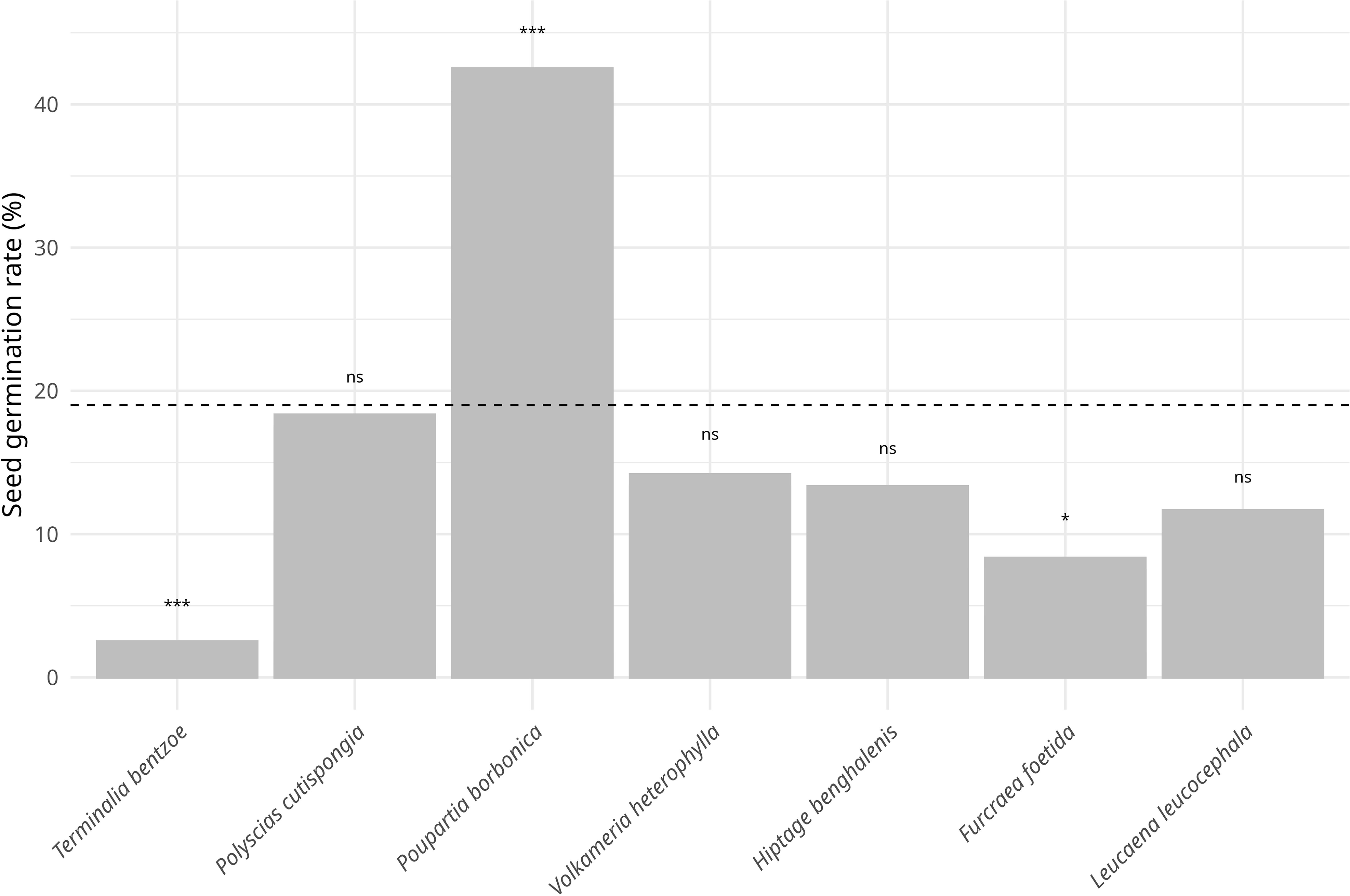
Germination of the T. bentzoe subsp. bentzoe seeds sown in the seven seed trays began in the third week after planting, with almost no new seed germination after 6 wk (Supplementary Figure S2). A total of 133 seeds out of the 840 sown germinated, giving an average germination rate of 16% (i.e., 19 seeds per tray). Germination rates were significantly lower than expected by chance in soils conditioned by the invasive alien succulent plant F. foetida (8%; P-value < 0.05) and by T. bentzoe subsp. bentzoe itself (3%; P-value < 0.001), and significantly higher in the soil conditioned by the endemic tree P. borbonica (43%; P-value < 0.001) (Figure 6). Germination rates in soils previously cultivated with other alien or endemic species did not differ significantly from expected under random assignment.
. Germination rate of Terminalia bentzoe subsp. bentzoe seeds in seed trays containing soils in which other plants had previously been grown for 6 mo. The dotted horizontal line indicates the average for the seven seed trays. Significance level of a randomization test: ns indicates P-value ≥ 0.05; *0.05 > P-value ≥ 0.01; **0.01 > P-value ≥ 0.001; ***P-value < 0.001.

Both F. foetida and P. borbonica may modify soil resources and microbial communities, thereby affecting symbioses essential for the emergence of native seedlings (Reinhart and Callaway Reference Reinhart and Callaway2006). Furcraea foetida, in particular, is considered an efficient bioreducer capable of depleting soil organic nutrients required for seed germination (Sitrarasi et al. Reference Sitrarasi, Nallal, Razia, Chung, Shim, Chandrasekaran, Dwiningsih, Rasheed, Alkahtani, Elshikh, Ovi and Ravindran2022). Moreover, invasive alien plants can release allelopathic compounds that inhibit seed activation (Hierro and Callaway Reference Hierro and Callaway2003). Further investigation based on chemical analyses of soil nutrients and volatile organic compounds would help clarify the relative importance of these mechanisms.
Evidence of Self-Inhibition
In addition to the negative impact of invasive alien plants on reproductive success, our results suggest a self-inhibition of T. bentzoe subsp. bentzoe seed germination, even more significant than the inhibitory effects of selected invasive alien plant species. This process has been widely documented in the literature, including in other threatened endemic tree species such as Camphora migao (H.W.Li) Y.Yang, Bing Liu & Zhi Yang (Lauraceae) (Huang et al. Reference Huang, Chen, Liu, Li, Wu and Tong2019), although its ecological significance remains unclear. Among suggested hypotheses, self-inhibition might promote seed dispersal away from parent plants to reduce intraspecific competition or delay germination until the rainy season, when autotoxins present in the soil are leached out (Singh et al. Reference Singh, Prasad, Reddy and Sparks2013). Self-inhibition in T. bentzoe subsp. bentzoe could also represent an evolutionary advantage in island environments, given their biotic specificities. For instance, intraspecific competition is thought to be exacerbated on oceanic islands due to the relatively depauperate composition of their floras (Carlquist Reference Carlquist1974). Another typical insular syndrome is a loss of dispersal ability following island colonization (e.g., seed awns have been reduced in size and number in most species of the genus Bidens L. on Pacific islands), which increases the likelihood for seeds to accumulate under the canopy of the parent plants and compete with them (Carlquist Reference Carlquist1966). Today, this self-inhibition may represent another factor contributing to the high extinction risk of T. bentzoe subsp. bentzoe, along with human-induced habitat loss, overexploitation, and biological invasions.
We showed that among the multifaceted impacts of invasive alien plants is the ability to reduce the reproductive success, including seed production, viability, and germination, of native plants, although the exact underlying mechanisms remain elusive. Available data supporting plant invasions as a major cause of plant extinctions are relatively sparse (Pouteau et al. Reference Pouteau, van Kleunen and Strasberg2023). This does not mean that such cases are anecdotal (Gurevitch and Padilla Reference Gurevitch and Padilla2004). Rather, it reflects the inherently slow and gradual nature of plant extinctions, which is likely to be exacerbated for large tree species with long generation times (Downey and Richardson Reference Downey and Richardson2016). Our results are therefore of key importance insofar as they show that plant invasions can induce an extinction debt (time-delayed extinction of species following an environmental impact) due to disrupted regeneration.
Supplementary material
To view supplementary material for this article, please visit https://doi.org/10.1017/inp.2026.10039
Acknowledgments
We are grateful to Pauline Feaud, Léa Marie, and Julien Triolo (Office National des Forêts) for providing their updated list of T. bentzoe subsp. bentzoe subpopulations in Mafate and developing the sampling design used in this study. We thank Élise Amy, Camille Danger, and Henri Hoarau (CBN-CPIE Mascarin) for their help in the field, lab, and greenhouse experiment, respectively. We also thank Margaux Rojat and Yohan Simon (IRD-AMAP) for setting up the soil-conditioning phase. We acknowledge the Reunion National Park and the DEAL (Direction of the Environment, Development and Housing) for providing special authorizations to collect protected plants (DIR-I-2021-187 and DEAL/SEB/UBIO/2022-05).
Funding statement
This research was supported by the French National Research Agency through the EDENE project (ANR-22-CE32-0006) and the French Ministry of Ecological Transition through the “Plan national d’actions en faveur des espèces ligneuses des reliques de la bande adlittorale xérophile de La Réunion.”
Competing interests
The authors declare no conflicts of interest.


 Open access

