


Introduction
Exotic winter annual grasses, such as medusahead [Taeniatherum caput-medusae (L.) Nevski] and downy brome (Bromus tectorum L.) are negatively impacting millions of hectares of U.S. grasslands (Davies and Svejcar Reference Davies and Svejcar2008; DiTomaso Reference DiTomaso2000; Nafus and Davies Reference Nafus and Davies2014; Sperry et al. Reference Sperry, Belnap and Evans2006). Herbicides are sometimes used alone (Shinn and Thill Reference Shinn and Thill2002; Ward and Mervosh Reference Ward and Mervosh2012) or combined with seeding (Morris et al. Reference Morris, Monaco and Rigby2009; Owen et al. Reference Owen, Sieg and Gehring2011; Whitson and Koch Reference Whitson and Koch1998) or prescribed fire (Calo et al. Reference Calo, Brause and Jones2012; Kessler et al. Reference Kessler, Nissen, Meiman and Beck2015) in efforts to replace these invaders with more desirable vegetation.
Management Implications
Invasive winter annual grasses such as T. caput-medusae and B. tectorum currently dominate expansive areas of the western United States. Herbicides are sometimes used to control these weeds with the goal of increasing production of forage species and other desirable species. Recent studies have shown that growth regulator herbicides applied just before heading can nearly eliminate invasive annual grass seed production. This opens the possibility that growth regulators could be used to deplete the short-lived seedbanks of invasive annual grasses. In this study, we evaluated this possibility by applying the growth regulator aminopyralid to T. caput-medusae just before heading in spring. Applications were also made PRE in fall to allow comparisons with this currently recommended approach for managing T. caput-medusae with aminopyralid. When applied within about 10 d of heading, a relatively low aminopyralid rate of 55 g ae ha−1 reduced T. caput-medusae seed production by about 80% in two experiments and 100% in six experiments. The year after application, these reductions in seed production translated into T. caput-medusae cover reductions of near 100% in all experiments, and reduced T. caput-medusae cover led to increased forage grass cover. The currently recommended approach of applying aminopyralid in fall provided less consistent results, even when applied at the much higher rate of 245 g ae ha−1. In terms of cost, weed control, and forage production, aminopyralid applied at 55 g ae ha−1 just before heading appears to be the best currently available herbicide option for managing T. caput-medusae in annual grasslands. In perennial grasslands where T. caput-medusae is also problematic, preheading treatments could prove even more effective, because risks of aminopyralid damage are presumably lower with perennial than annual forage grasses.
Herbicides used to manage invasive annual grasses include the photosynthesis inhibitor tebuthiuron; the amino acid synthesis inhibitors rimsulfuron, glyphosate, and imazapic; and the recently developed cellulose biosynthesis inhibitor indaziflam (Sebastian et al. Reference Sebastian, Nissen and Rodrigues2016a, Reference Sebastian, Sebastian, Nissen and Beck2016b, Reference Sebastian, Fleming, Patterson, Sebastian and Nissen2017a). These herbicides can suppress invasive annual grasses for 1 to 3 yr. However, these herbicides can damage desired annual forage grasses growing with invasive annual grasses (Jeffries et al. Reference Jeffries, Gannon, Brosnan and Breeden2016; Kyser et al. Reference Kyser, DiTomaso, Doran, Orloff, Wilson, Lancaster, Lile and Porath2007), and with the possible exception of indaziflam (Sebastian et al. Reference Sebastian, Sebastian, Nissen and Beck2016b, Reference Sebastian, Fleming, Patterson, Sebastian and Nissen2017a), the damage risks extend to perennial forage grasses as well (Lym and Kirby Reference Lym and Kirby1991; Monaco et al. Reference Monaco, Osmond and Dewey2005).
Before recent testing, the growth regulator class of herbicides, which includes aminopyralid, dicamba, and picloram, was not considered for invasive annual grass control, and these herbicides were instead used exclusively for managing broadleaf weeds (Enloe et al. Reference Enloe, Lym, Wilson, Westra, Nissen, Beck, Moechnig, Peterson, Masters and Halstvedt2007; Lym and Messersmith Reference Lym and Messersmith1990; Seefeldt and Conn Reference Seefeldt and Conn2011). Recent testing revealed aminopyralid applied pre-emergence (PRE) has activity against B. tectorum and T. caput-medusae (Kyser et al. Reference Kyser, Peterson, Davy and DiTomaso2012b; Sebastian et al. Reference Sebastian, Nissen, Sebastian, Meiman and Beck2017b). Compared with photosynthesis inhibitors and amino acid synthesis inhibitors, growth regulators tend to be less toxic to both seedling and well-established desirable perennial grasses (Lym and Kirby Reference Lym and Kirby1991; Lym and Messersmith Reference Lym and Messersmith1985; Sheley et al. Reference Sheley, Duncan, Halstvedt and Jacobs2000; Shinn and Thill Reference Shinn and Thill2004). In addition to having PRE activity, growth regulators applied POST between jointing and heading stages have recently been shown to greatly reduce seed production of the invasive annual grasses T. caput-medusae, B. tectorum, and field brome (Bromus arvensis L.) (Rinella et al. Reference Rinella, Haferkamp, Masters, Muscha, Bellows and Vermeire2010a, Reference Rinella, Masters and Bellows2010b, Reference Rinella, Masters and Bellows2013, Reference Rinella, Bellows and Roth2014). The herbicides cause development of abnormal seeds lacking endosperm and the ability to germinate (Rinella et al. Reference Rinella, Haferkamp, Masters, Muscha, Bellows and Vermeire2010a).
Taeniatherum caput-medusae and other invasive annual grasses have relatively short-lived seedbanks (Burnside et al. Reference Burnside, Wilson, Weisberg and Hubbard1996; Hulbert Reference Hulbert1955; Smith et al. Reference Smith, Meyer and Anderson2008), so T. caput-medusae seeds produced by the current generation of plants are important for maintaining population sizes (Young et al. Reference Young, Trent, Blank and Palmquist1998). In this study, we tested the hypothesis that using aminopyralid to reduce T. caput-medusae seed production in the current generation of plants would reduce cover in the subsequent generation. In California annual grasslands, we applied aminopyralid in spring just before T. caput-medusae heading, and then we measured seed production and cover of this species as well as three desirable nonnative forage grasses [wild oat, Avena fatua L.; soft brome, Bromus hordeaceus L.; and Italian ryegrass, Lolium perenne L. ssp. multiflorum (Lam.) Husnot]. These forage grasses tend to finish producing seed before T. caput-medusae begins producing seed (McKell et al. Reference McKell, Wilson and Kay1962), and we attempted to limit damage to forage grass seeds by applying aminopyralid in the interval between forage grass and T. caput-medusae seed production. We also applied aminopyralid the fall preceding spring treatments to allow comparisons between this currently recommended PRE timing and our novel preheading timing (Kyser et al. Reference Kyser, Peterson, Davy and DiTomaso2012b; Miller et al. Reference Miller, Miller, Peterson, Oneto, Kyser and DiTomaso2014).
Materials and Methods
Site Descriptions
Eight experiments were conducted in California, USA (Table 1). The “A” run of experiments, 1A, 2A, 3A, and 4A, began fall 2013, and the “B” run of experiments, 1B, 2B, 3B, and 4B, began fall 2015. Experiments with the same number (e.g., 1A and 1B) were relatively close together and relatively far from other experiments (Table 1). Experiments 1A and 1B were in central California, and all other experiments were in north-central California. Soils were loams at 1A, 1B, 4A, and 4B, and gravelly loams elsewhere. Besides T. caput-medusae, undesirable species were sparse. One to three of the primary forage grasses A. fatua, B. hordeaceus, and L. perenne occurred at each site, and some sites also supported additional grasses (e.g., Hordeum spp. and Phalaris spp.) and forbs (Erodium spp. and Trifolium spp.) desirable as forage.
Site and treatment details for a study of herbicide effects on annual grasslands.

a Abbreviations: B, boot stage, inflorescence was enveloped by the flag leaf, the last leaf to develop; E, heading stage, inflorescence had just become visible; F, flag leaf stage, last leaf was visible; H, headed stage, entire inflorescence was visible, anthesis had occurred, and inflorescences were senescing.
Experimental Design
We evaluated a no-herbicide control and five herbicide treatments: aminopyralid applied at a (1) medium (123 g ae ha−1) or (2) high (245 g ae ha−1) rate in fall or at a (3) low (55 g ae ha−1), (4) medium, or (5) high rate the following spring. Treatments were applied to 6 by 12-m plots arranged in randomized complete block designs with four replications. Herbicides were applied using 11002 AIRX and 8002 flat-fan nozzles (Teejet® Technologies, Glendale Heights, IL) on sprayers calibrated to deliver 109 to 188 L ha−1. Fall treatments occurred before T. caput-medusae, A. fatua, L. perenne, and B. hordeaceus emergence, except for Experiment 4A, where a low number of T. caput-medusae plants had emerged. Spring treatment timings are provided in Table 1.
Data Collection
The first and second growing season following fall herbicide treatments, percent cover by species was visually estimated within three randomly placed 1.0 by 1.0-m frames (except 0.3 by 0.3-m frames in Experiment 1A). First growing season cover was measured near peak standing forage before applying spring treatments; May 16 to May 28, 2014 in the first run and May 5 to June 17, 2016 in the second run. Second growing season cover was measured near peak standing forage; April 23 to May 25, 2015 in the first run and May 10 to May 26, 2017 in the second run.
To assess seed viability, 20 randomly selected seed heads were harvested from each plot within 10 d of when T. caput-medusae seeds had matured. When present, 10 to 20 seed heads (depending on availability) of A. fatua, L. perenne, and B. hordeaceus were also harvested. After being stored in paper bags at 20 C for 6 mo, seed heads were threshed, and T. caput-medusae awns were removed. For each combination of plot and species, up to 200 randomly selected seeds (depending on availability) were placed on 15 by 100-mm petri dishes (≤33 seeds dish−1) on filter paper supported by polyurethane foam disks. Distilled water was supplied continuously to the filter paper via a cotton wick inserted in a hole in the center of the disc. Cool-white fluorescent bulbs (PAR=28 µmol m−2 s−1) supplied a 12-h light period, and light and dark temperatures were 21 and 15 C, respectively. Seeds were recorded as germinable and were discarded if radicle and coleoptile lengths exceeded 5 mm within 30 d.
Data Analysis
Response variables were logit-transformed percent viable seed production of T. caput-medusae, A. fatua, L. perenne, and B. hordeaceus and log-transformed percent cover of these same species as well as forbs and other desirable forage grasses. We modeled the responses with linear mixed-effects models. Tobit versions of the models were used, because our seed production and cover data sets were mixtures of zeros and continuous values (Chib Reference Chib1992). The models were fit using a FORTRAN program that implements methods of Chib (Reference Chib1992). For cover responses, fixed effects were experiment, measurement time (first vs. second growing seasons following fall herbicide treatment), herbicide treatment, experiment by measurement time, and herbicide by measurement time, and random effects were block and experiment by herbicide by measurement time. For seed responses, fixed effects involving measurement time were omitted, and experiment by herbicide by measurement time was replaced with experiment by herbicide as a random effect.
Results and Discussion
Cover the First Growing Season following Fall Treatments
Spring treatments were applied at the end of the growing season when biomass production of all major species was nearly complete. Consequently, spring treatments did not have the potential to substantially impact plant cover the first growing season.
Taeniatherum caput-medusae
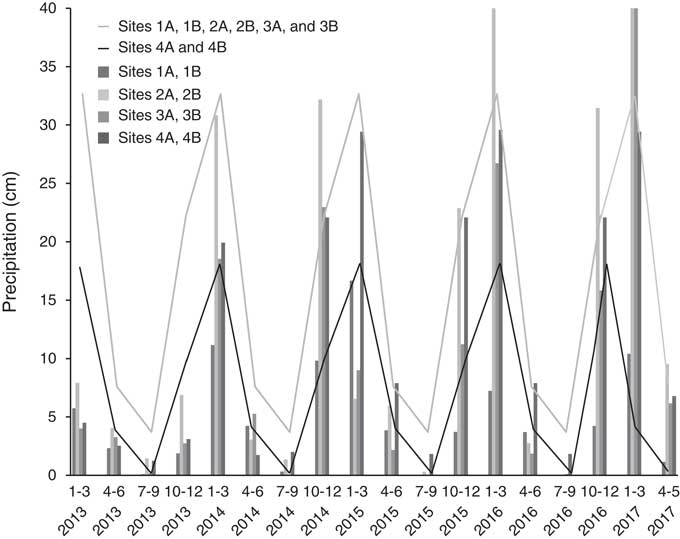
In the first run (Run A of Figure 1), fall treatments reduced T. caput-medusae cover in two of four experiments. In the second run (Run B of Figure 1), fall treatments caused more consistent, pronounced reductions in T. caput-medusae cover. Cover reductions were less pronounced in the first run than the second, because dry conditions during fall 2013 led to low T. caput-medusae emergence and cover in 2014 (Figure 2).
Point estimates (dots) and 95% confidence intervals (bars) estimating cover of the grass weed Taeniatherum caput-medusae and three desired forage grasses the first growing season after fall herbicide treatments. Plots received no herbicide (C) or medium (M; 123 g ae ha−1) or high (H; 245 g ae ha−1) rates of aminopyralid in 2013 (Run A) or 2015 (Run B). Within a run, species, and site, confidence intervals that do not share letters are significantly different (P>0.05).

Precipitation within 3-mo intervals within individual years (bars) and averaged over 30 yr (lines). A single line was used to represent Sites 1, 2, and 3, because values were similar.
Forage Grasses
Effects of aminopyralid applied in fall on B. hordeaceus varied from negative (four experiments) to neutral (three experiments) to positive (one experiment), while effects on A. fatua were neutral to slightly positive (Figure 1). Aminopyralid effects on L. perenne were minor in the first run, while the medium rate increased L. perenne cover roughly 10% to 15% in the second run.
Forbs and Other Grasses
Aminopyralid applied in the fall negatively impacted desirable forbs in the three experiments in which forbs were fairly abundant (Experiments 1A, 4A, and 4B). No-herbicide control values in these experiments ranged from 16% (9%, 27%) to 26% (16%, 41%), and treated values ranged from 0.2% (0.1%, 0.7%) to 3% (1%, 8%) [point estimate (95% CI)]. Besides the three main forage grasses, other desirable forage grasses were generally sparse regardless of treatment.
Cover and Seed Production the Second Growing Season following Treatments
Taeniatherum caput-medusae
Aminopyralid applied in the fall had minor effects on T. caput-medusae seed production, with the exception of the high rate in Experiment 1A (Figure 3). In the first run, fall treatments effects on T. caput-medusae cover were either unmeasurable due to wildfire (Experiment 2A) or were minor due to drought (Experiments 1A and 3A) or lack of herbicidal control (Experiment 4A) (Figure 3). In the second run, fall treatments caused sharper reductions in T. caput-medusae cover (Figure 3).
Point estimates (dots) and 95% confidence intervals (bars) estimating percent viable seed production and cover of a winter annual grass weed following herbicide treatments. In Run A, aminopyralid was applied in fall 2013 or spring 2014, and seed production and cover, respectively, were assessed in spring 2014 and 2015. In Run B, aminopyralid was applied in fall 2015 or spring 2016, and seed production and cover, respectively, were assessed in spring 2016 and 2017. Plots received no herbicide (C) or low (L; 55 g ae ha−1), medium (M; 123 g ae ha−1), or high (H; 245 g ae ha−1) rates of aminopyralid. Within a run and site, confidence intervals that do not share letters are significantly different (P>0.05).

Aminopyralid applied in the spring drastically reduced viable T. caput-medusae seed production (Figure 3). In six of eight experiments, every aminopyralid rate reduced viable seed production to nearly zero. In the first run, aminopyralid nearly eliminated T. caput-medusae cover in Experiment 4A, which was the only experiment that supported appreciable T. caput-medusae the year after spring treatments (Figure 3). In the second run, aminopyralid applied at any rate in spring nearly eliminated T. caput-medusae cover (Figure 3).
Forage Grasses
Aminopyralid applied PRE in the fall had little impact on the viability of desired forage grass seeds, and fall treatments tended to modestly increase forage grass cover (Figures 4–6). Aminopyralid applied in the spring reduced desired annual grass seed production considerably, especially at higher rates, but reduced seed production did not translate to reduced cover (Figures 4–6). Instead, aminopyralid applied in the spring tended to increase desired grass cover, with the magnitude of the increase depending on species and experiment (Figures 4–6). Bromus hordeaceus was the desired grass showing the most consistent, marked increases in cover (Figure 5).
Point estimates (dots) and 95% confidence intervals (bars) estimating percent viable seed production and cover of a desired forage grass following herbicide treatments. In Run A, aminopyralid was applied in fall 2013 or spring 2014, and seed production and cover, respectively, were assessed in spring 2014 and 2015. In Run B, aminopyralid was applied in fall 2015 or spring 2016, and seed production and cover, respectively, were assessed in spring 2016 and 2017. Plots received no herbicide (C) or low (L; 55 g ae ha−1), medium (M; 123 g ae ha−1), or high (H; 245 g ae ha−1) rates of aminopyralid. Within a run and site, confidence intervals that do not share letters are significantly different (P>0.05).

Point estimates (dots) and 95% confidence intervals (bars) estimating percent viable seed production and cover of a desired forage grass following herbicide treatments. In Run A, aminopyralid was applied in fall 2013 or spring 2014, and seed production and cover, respectively, were assessed in spring 2014 and 2015. In Run B, aminopyralid was applied in fall 2015 or spring 2016, and seed production and cover, respectively, were assessed in spring 2016 and 2017. Plots received no herbicide (C) or low (L; 55 g ae ha−1), medium (M; 123 g ae ha−1), or high (H; 245 g ae ha−1) rates of aminopyralid. Within a run and site, confidence intervals that do not share letters are significantly different (P>0.05).

Point estimates (dots) and 95% confidence intervals (bars) estimating percent viable seed production and cover of a desired forage grass following herbicide treatments. In Run A, aminopyralid was applied in fall 2013 or spring 2014, and seed production and cover, respectively, were assessed in spring 2014 and 2015. In Run B, aminopyralid was applied in fall 2015 or spring 2016, and seed production and cover, respectively, were assessed in spring 2016 and 2017. Plots received no herbicide (C) or low (L; 55 g ae ha−1), medium (M; 123 g ae ha−1), or high (H; 245 g ae ha−1) rates of aminopyralid. Within a run and site, confidence intervals that do not share letters are significantly different (P>0.05).

Forbs and Other Grasses
Except for Experiments 1A, 1B, and 4A, desirable forbs were sparse the second growing season following treatments. At Site 1A, spring treatments reduced desirable forb cover from 56% (31%, 78%) to between 17% (6%, 38%) and 28% (12%, 54%). At Site 4A, spring and fall treatments reduced desirable forb cover from 21% (9%, 44%) to between 0.2% (0.1%, 0.7%) and 8% (3%, 21%). At Site 1B, spring and fall treatments increased desirable forb cover from 0.5% (0.2%, 2%) to between 2% (0.8%, 7%) and 10% (4%, 25%). In addition to increasing cover of the three main forage grasses (Figures 4–6), spring and fall treatments caused small increases in other desired annual forage grasses at Sites 1A and 1B.
Spring treatments nearly eliminated T. caput-medusae seed production in six of eight experiments (Figure 3). In the other two experiments with less complete reductions in seed production, T. caput-medusae was partially headed at the time of treatment (Table 1), and some seeds may have escaped herbicide effects by maturing before treatment. Spring treatments reduced T. caput-medusae cover to nearly zero at all five experimental sites that supported high T. caput-medusae cover the year after treatment (Figure 3).
Compared with the current approach of applying aminopyralid in fall (Kyser et al. Reference Kyser, Peterson, Davy and DiTomaso2012b; Miller et al. Reference Miller, Miller, Peterson, Oneto, Kyser and DiTomaso2014), applying it in spring provided better control of T. caput-medusae. The data indicate this in two ways. First, our fall and spring treatments targeted the same generation of plants at two different growth stages (fall = PRE, spring = preheading), and Figure 3 shows that targeting plants preheading maintained more complete, consistent control of T. caput-medusae at the study’s end. However, the Figure 3 data correspond to one and two growing seasons following spring and fall treatments, respectively. Comparing spring and fall treatments on a more equal footing (each one growing season after application), requires comparing Figures 1 and 3. Data presented in Figures 1 and 3 were not gathered the same growing season, so some caution is required in comparing these figures, but the data nevertheless provide fairly strong evidence that spring treatments outperformed fall treatments one growing season after application. Comparisons to past research further indicate spring treatments should be expected to outperform fall treatments. In particular, Miller et al. (Reference Miller, Miller, Peterson, Oneto, Kyser and DiTomaso2014) found fall aminopyralid treatments sometimes provided only about 50% reductions of T. caput-medusae, which contrasts sharply with the near 100% reductions we observed with spring treatments (Figure 3).
In spring, lower aminopyralid rates can be used to manage T. caput-medusae: the 55 g ae ha−1 spring treatment was only slightly less effective than the 123 and 245 g ae ha−1 spring treatments (Figure 3). Moreover, compared with fall applications at 123 and 245 g ae ha−1, spring applications at 55 g ae ha−1 provided greater reductions in T. caput-medusae cover (Figure 3). Additionally, Kyser et al. (Reference Kyser, Peterson, Davy and DiTomaso2012b) applied aminopyralid at multiple rates in fall, and only the highest rate of 245 g ae ha−1 provided T. caput-medusae reductions comparable to what we observed with the 55 g ae ha−1 rate applied in spring. In addition to being more expensive than the 55 g ae ha−1 rate, the 245 g ae ha−1 rate has the added disadvantage of being labeled only for applications to areas <0.2 ha.
Compared with fall treatments, spring treatments were more beneficial to forage grasses. The first growing season after treatment, fall treatments sometimes reduced annual forage grass cover (Figure 1), but this was never the case with spring treatments (Figures 4–6). At final measurement, both spring and fall treatments tended to increase forage grasses, but spring treatments sometimes caused larger increases, particularly for B. hordeaceus (Figure 5). Importantly, because spring treatments maintained better T. caput-medusae control at final measurement (Figure 3), these treatments are more likely to maintain elevated forage grass cover beyond our study period.
Although spring treatments never reduced forage grass cover, they sometimes reduced forage grass seed production (Figures 4–6). This was somewhat unexpected, because we believed forage grass seeds were fully developed and thus insensitive to aminopyralid at the time of spring treatments. It appears aminopyralid damaged seeds that were still developing at the time of treatments (Rinella et al. Reference Rinella, Kells and Ward2001).
Aminopyralid tended to reduce desired forb cover in the three experiments with relatively abundant desired forbs. Whereas aminopyralid applied at any timing has potential to damage many forbs and shrubs, DiTomaso and Kyser (Reference DiTomaso and Kyser2015) found aminopyralid effects on forbs dissipated over a period of a few years in our study system.
In terms of T. caput-medusae control and annual grass forage production, aminopyralid applied preheading in spring compares favorably with other herbicide options. Glyphosate often provides excellent control of T. caput-medusae (Kyser et al. Reference Kyser, Creech, Zhang and DiTomaso2012a). However, glyphosate provided only 61% control in one experiment (Kyser et al. Reference Kyser, Wilson, Zhang and DiTomaso2013b), and it is not clear that glyphosate applications could be timed to control T. caput-medusae without damaging annual forage grasses in our study system. Like glyphosate, imazapic can provide excellent control of T. caput-medusae (Davies and Sheley Reference Davies and Sheley2011; Jeffries et al. Reference Jeffries, Gannon, Brosnan and Breeden2016; Kyser et al. Reference Kyser, DiTomaso, Doran, Orloff, Wilson, Lancaster, Lile and Porath2007; Sheley et al. Reference Sheley, Carpinelli and Morghan2007, Reference Sheley, Bingham and Davies2012a, Reference Sheley, Vasquez, Chamberlain and Smith2012b; but see Kyser et al. Reference Kyser, Peterson, Davy and DiTomaso2012b; Monaco et al. Reference Monaco, Osmond and Dewey2005), but this herbicide poses serious risks to annual forage grasses (Jeffries et al. Reference Jeffries, Gannon, Brosnan and Breeden2016; Kyser et al. Reference Kyser, DiTomaso, Doran, Orloff, Wilson, Lancaster, Lile and Porath2007). Two other herbicides, rimsulfuron and sulfometuron methyl, have provided inconsistent control of T. caput-medusae (Kyser et al. Reference Kyser, Peterson, Davy and DiTomaso2012b, Reference Kyser, Wilson, Zhang and DiTomaso2013b; Miller et al. Reference Miller, Miller, Peterson, Oneto, Kyser and DiTomaso2014; Monaco et al. Reference Monaco, Osmond and Dewey2005). The new herbicide indaziflam poses injury risks to the annual forage grasses of our study system (Jeffries et al. Reference Jeffries, Gannon, Brosnan and Breeden2016; Sebastian et al. Reference Sebastian, Nissen and Rodrigues2016a).
Effectively timing spring preheading applications may be challenging in some cases. Greenhouse research has found aminopyralid applied anytime between post-vernalization seedling and heading stages nearly eliminates T. caput-medusae seed production (Rinella et al. Reference Rinella, Bellows and Roth2014). However, in our system, seedling to internode elongation stages for T. caput-medusae correspond with vulnerable boot to heading stages for annual forage grasses. Therefore, there is an approximately 14-d spring period when aminopyralid can be used without risking severe reductions in annual forage grass seed production. Also, effectively timing spring applications for T. caput-medusae control will require managers to identify grass species and growth stages. Moreover, if there is substantial variability in T. caput-medusae growth stages at the time of application, this could compromise control, though our study suggests this is not a major issue. In addition to annual grasslands, T. caput-medusae is a prevalent invader of perennial grass systems (Davies and Svejcar Reference Davies and Svejcar2008), and reduction of perennial forage grass populations is much less likely than reduction of annual forage grasses, because perennial grasses rely less on seed production and more on vegetative propagation for population maintenance and growth. Instead of being depleted, perennial grasses typically increase after aminopyralid and other growth regulators are used to manage weedy species (Gramig and Ganguli Reference Gramig and Ganguli2015; Lym and Messersmith Reference Lym and Messersmith1985; Sheley et al. Reference Sheley, Duncan, Halstvedt and Jacobs2000).
Taeniatherum caput-medusae often co-occurs with the invasive annual forb yellow starthistle (Centaurea solstitialis L.). Taeniatherum caput-medusae and other invasive annual grasses often proliferate after herbicides are used to control C. solstitialis and other invasive forbs (DiTomaso et al. Reference DiTomaso, Kyser, Miller, Garcia, Smith, Nader, Connor and Orloff2006; Ortega and Pearson Reference Ortega and Pearson2010). Aminopyralid is very effective against C. solstitialis (Kyser et al. Reference Kyser, Peterson, Orloff, Wright and DiTomaso2011, Reference Kyser, Hazebrook and DiTomaso2013a), and it should be possible to simultaneously target C. solstitialis and T. caput-medusae by timing applications to periods when both species are susceptible. Both species are susceptible in fall, but the high aminopyralid rates and inconsistent T. caput-medusae control in fall are discouraging (Kyser et al. Reference Kyser, Peterson, Orloff, Wright and DiTomaso2011; Miller et al. Reference Miller, Miller, Peterson, Oneto, Kyser and DiTomaso2014). When T. caput-medusae is at the highly susceptible preheading stage, C. solstitialis is generally at the rosette stage, and low aminopyralid rates have provided 80% to 100% control of C. solstitialis rosettes (Kyser et al. Reference Kyser, Peterson, Orloff, Wright and DiTomaso2011). In addition to simultaneously targeting T. caput-medusae and C. solstitialis, it should be possible to use aminopyralid and other growth regulator herbicides to simultaneously target other pairs of invasive annual grasses and broadleaf weeds, such as B. tectorum and spotted knapweed (Centaurea stoebe L.) (Mangold et al. Reference Mangold, Orloff, Parkinson and Halstvedt2015; Rinella et al. Reference Rinella, Masters and Bellows2013).
Unlike PRE applications, preheading applications can be optimized spatially and temporally. When precipitation is low following fall PRE aminopyralid applications, T. caput-medusae is poorly controlled (Miller et al. Reference Miller, Miller, Peterson, Oneto, Kyser and DiTomaso2014), because low precipitation leads to low germination (Young et al. Reference Young, Trent, Blank and Palmquist1998), and soil-applied herbicides do not kill nongerminated seeds (Mueller-Warrant Reference Mueller-Warrant1999). Preheading applications overcome this limitation by allowing managers to time applications to periods when T. caput-medusae populations are vulnerable; that is, periods when precipitation has stimulated germination and thereby depleted the seedbank (Young et al. Reference Young, Trent, Blank and Palmquist1998). Another benefit of preheading applications involves the high spatial variability of T. caput-medusae abundances. Because preheading applications occur when T. caput-medusae patches are easily detected, these applications allow managers to apply herbicide only where needed. This ability for real-time assessment is not available with PRE treatments. Taken together, the consistent weed control provided by low rates, the relatively large benefits to forage grasses, and the ability to optimize treatments spatially and temporally appear to make aminopyralid applied preheading the most attractive herbicide option for managing T. caput-medusae.
Acknowledgments
Thank you to Andy and Sally Cox of the Cox Ranch, Clay and Dusty Daulton of the Daulton Ranch, George and Linda Meyer of the Meyer Ranch, and Dash Wiedhofer of the Audubon Bobcat Ranch for their gracious cooperation in conducting this research.



