





Introduction
Understanding an utterance such as “interesting movie!” when the speaker is visibly disengaged and uninterested requires bridging the gap between what the speaker literally says (i.e., the movie is interesting) and what they intend to communicate to their conversation partner (i.e., disappointment that their expectation of watching an interesting movie was not met). Interpreting nonliteral language, particularly verbal irony, can be challenging because cues to the intended meaning can be subtle and the literal meaning can be contradictory and require suppression. Previous research has shown that irony is one of the most complex pragmatic phenomena. Children younger than six years of age (Falkum & Köder, Reference Falkum and Köder2020), as well as clinical populations such as individuals with autism spectrum disorder (e.g., Caillies et al., Reference Caillies, Bertot, Motte, Raynaud and Abely2014; Martin & McDonald, Reference Martin and McDonald2005; Wang et al., Reference Wang, Lee, Sigman and Dapretto2006), are known to struggle with ironic meanings.
A classic explanation for why irony may be harder to process than literal language is that the listener needs to first detect that a literal interpretation is incongruous with the context and subsequently infer the ironic interpretation the speaker intends to convey (Grice, Reference Grice1975). Other theories conceptualize irony as a form of pretense or echo (Clark & Gerrig, Reference Clark and Gerrig1984; Wilson & Sperber, Reference Wilson, Sperber, Wilson and Sperber2012). To grasp the meaning of “interesting movie!”, for instance, would require the listener to recognize that the speaker is “echoing” or “pretending to entertain” the belief that the movie would be great, while simultaneously expressing a dismissive attitude toward that (from their current perspective) ludicrously false belief.
While ensuing theoretical accounts have stressed that various phrase-, context-, and reader-related factors can speed up activation of ironic relative to literal meanings (e.g., Gibbs, Reference Gibbs1994; Giora, Reference Giora2003; Katz & Ferretti, Reference Katz and Ferretti2001; Pexman, Reference Pexman2008; Sperber & Wilson, Reference Sperber and Wilson1981), the role of individual differences in irony processing requires more research (see review by Kałowski et al., Reference Kałowski, Zajączkowska, Branowska, Olechowska, Siemieniuk, Dryll and Banasik-Jemielniak2023). Evidence suggests that theory of mind and mentalizing skills (e.g., Filippova & Astington, Reference Filippova and Astington2008; Nilsen et al., Reference Nilsen, Glenwright and Huyder2011), i.e., cognitive abilities related to understanding and attributing mental states, as well as emotion understanding (e.g., Jacob et al., Reference Jacob, Kreifelts, Nizielski, Schütz and Wildgruber2016; Nicholson et al., Reference Nicholson, Whalen and Pexman2013), positively affect irony comprehension. Other sources of individual differences related to executive functions or executive attention abilities (i.e., domain-general cognitive processes essential for managing and regulating thoughts and behavior), also seem to play a role in irony processing, yet evidence to date is limited. Research on children’s irony development suggests that working memory (WM), inhibitory control, and inferential reasoning abilities, as well as overall cognitive abilities, facilitate irony comprehension (Caillies et al., Reference Caillies, Bertot, Motte, Raynaud and Abely2014; Filippova & Astington, Reference Filippova and Astington2008; Godbee & Porter, Reference Godbee and Porter2013). However, it remains unclear whether executive attention abilities are also particularly taxed in the processing of irony by adults. Additionally, there is conflicting evidence regarding the role of WM in this context (Olkoniemi & Kaakinen, Reference Olkoniemi and Kaakinen2021), while the role of fluid intelligence (Gf)—another key component of executive attention—has been largely overlooked.
To gather new, more fine-grained insights into the basic cognitive mechanisms involved in the processing of irony, we designed an eye-tracking reading experiment exploring the roles of working memory as well as fluid intelligence in neurotypical adults.
The comprehension of irony
While irony is sometimes defined broadly as including jocularity, sarcasm, hyperbole, rhetorical questions, and understatements (e.g., Gibbs, Reference Gibbs2000; Recchia et al., Reference Recchia, Howe, Ross and Alexander2010), we use a narrower definition of irony as it is unclear whether these different communicative phenomena all rely on the same cognitive mechanisms. We focus on instances of irony where a speaker says something literally positive such as “this is great” or “interesting movie” to express a critical, mocking, or contemptuous attitude toward that thought (Clark & Gerrig, Reference Clark and Gerrig1984; Wilson & Sperber, Reference Wilson, Sperber, Wilson and Sperber2012).
Multiple studies and a variety of research methodologies demonstrate that ironic utterances lead to differential processing compared to literal utterances. Event-related potential studies show greater N400 or P600 amplitudes for ironic phrases, two components linked with the identification of inconsistencies between linguistic utterances and the surrounding context in pragmatics, thus suggesting more effortful meaning integration as compared to literal phrases (Cornejol et al., Reference Cornejol, Simonetti, Aldunate, Ibáñez, López and Melloni2007; Filik et al., Reference Filik, Leuthold, Wallington and Page2014; Regel et al., Reference Regel, Coulson and Gunter2010, Reference Regel, Gunter and Friederici2011; Spotorno et al., Reference Spotorno, Cheylus, Van Der Henst and Noveck2013). Findings from fMRI studies show that irony causes greater brain activity, with respect to both locality and magnitude of activation (Akimoto et al., Reference Akimoto, Sugiura, Yomogida, Miyauchi, Miyazawa and Kawashima2014; Bosco et al., Reference Bosco, Parola, Valentini and Morese2017; Obert et al., Reference Obert, Gierski, Calmus, Flucher, Portefaix, Pierot, Kaladjian and Caillies2016; Shibata et al., Reference Shibata, Toyomura, Itoh and Abe2010; Spotorno et al., Reference Spotorno, Koun, Prado, Van Der Henst and Noveck2012), while complementary findings from reading studies demonstrate that a phrase such as “this is useful” is read significantly more slowly when intended in an ironic versus a literal sense (Dews & Winner, Reference Dews and Winner1999; Giora et al., Reference Giora, Fein and Schwartz1998). Further data from eye-tracking show that this irony reading cost emerges in late measures, such as total reading time (Au-Yeung et al., Reference Au-Yeung, Kaakinen, Liversedge and Benson2015; Filik et al., Reference Filik, Leuthold, Wallington and Page2014, Reference Filik, Howman, Ralph-Nearman and Giora2018; Filik & Moxey, Reference Filik and Moxey2010), and regression likelihood, as readers are more likely to go back to reread ironic as opposed to literal phrases (Kaakinen et al., Reference Kaakinen, Olkoniemi, Kinnari and Hyönä2014; Olkoniemi et al., Reference Olkoniemi, Ranta and Kaakinen2016; Olkoniemi, Johander, et al., Reference Olkoniemi, Johander and Kaakinen2019). Reading studies incorporating explicit comprehension questions further report reduced accuracy for ironic compared to literal utterances (e.g., Kaakinen et al., Reference Kaakinen, Olkoniemi, Kinnari and Hyönä2014; Olkoniemi et al., Reference Olkoniemi, Ranta and Kaakinen2016; Olkoniemi, Johander, et al., Reference Olkoniemi, Johander and Kaakinen2019; Olkoniemi, Strömberg, et al., Reference Olkoniemi, Strömberg and Kaakinen2019). As late eye-tracking reading measures are believed to capture meaning integration processes and reanalysis (Conklin et al., Reference Conklin, Pellicer-Sánchez and Carrol2018), the collective findings suggest that irony is resolved in later stages of processing, often after laborious reanalysis (i.e., regressive rereading), with processing costs being evident in both implicit (reading behavior) and explicit (overt comprehension) measures.
Notably, the irony processing cost can be mitigated by certain factors. For instance, frequently encountering a phrase in an ironic sense can lead to a default ironic interpretation of said phrase, thus facilitating its comprehension (Filik et al., Reference Filik, Leuthold, Wallington and Page2014; Giora, Reference Giora2003; Giora et al., Reference Giora, Givoni and Fein2015). Context and cultural expectations can further modulate processing effort and speed, making irony considerably faster to read, and at times even faster than literal phrases (Katz et al., Reference Katz, Blasko and Kazmerski2004; Ronderos et al., Reference Ronderos, Tomlinson and Noveck2023; Spotorno & Noveck, Reference Spotorno and Noveck2014). This suggests that (at least part) of the irony processing cost observed in aforementioned studies can be offset by stronger phrasal and contextual cues. Importantly, beyond these influences, individual differences stemming from variability in executive attention abilities could explain some of the observed differences in the processing and comprehension of irony.
Executive attention and irony processing
Executive attention (alternatively referred to as attention control, or under different frameworks as executive function) is paramount to most models of higher-order cognition (e.g., Atkinson & Shiffrin, Reference Atkinson and Shiffrin1968; Baddeley, Reference Baddeley1998; Draheim et al., Reference Draheim, Tsukahara, Martin, Mashburn and Engle2021; Posner & DiGirolamo, Reference Posner, DiGirolamo and Parasuraman1998; Shipstead et al., Reference Shipstead, Harrison and Engle2016). It refers to the ability to control one’s thoughts and behavior for task performance purposes, such as resisting distraction from unrelated external events (e.g., disruptive noises during work), or unrelated internal thoughts (e.g., thinking about lunch during a morning meeting).
Traditionally, the more deconstructive approach to executive function assumes that mechanisms such as WM, inhibition, and shifting tap into domain-specific aspects of attention control (e.g., Friedman & Miyake, Reference Friedman and Miyake2017; Miyake et al., Reference Miyake, Friedman, Emerson, Witzki, Howerter and Wager2000). However, the validity of these constructs has come under scrutiny, as many studies under this framework have failed to find a (strong) association between different tasks designed to measure the same constructs, casting doubts on the psychometric validity of both the constructs themselves and the tasks used to measure them. For instance, low intercorrelations have been reported between distinct inhibition tasks (Paap et al., Reference Paap, Johnson and Sawi2015; Rey-Mermet et al., Reference Rey-Mermet, Gade and Oberauer2018; Rouder & Haaf, Reference Rouder and Haaf2019), implying that inhibition operations employed in one task are different from those employed in another.
An alternative approach has emerged, which posits that executive attention is a domain-general construct. Under this approach, attention control is (at least partly, if not fully) mediated by two main functions: working memory and fluid intelligence. Working memory is assumed to be responsible for maintaining relevant information active during processing (as well as maintaining attention to the task), while fluid intelligence is responsible for information disengagement once this has been proven to be irrelevant or incorrect for the problem at hand (Burgoyne & Engle, Reference Burgoyne and Engle2020; Engle, Reference Engle2002, Reference Engle2018; Shipstead et al., Reference Shipstead, Harrison and Engle2016). The cognitive tasks developed or adapted under this framework, by Engle and collaborators, have better psychometric properties and reliability compared to previous tasks developed under the more traditional executive function framework (Draheim et al., Reference Draheim, Tsukahara, Martin, Mashburn and Engle2021, Reference Draheim, Tshukara and Engle2023). This is because these tasks eliminate, among other things, confounds from speed-accuracy trade-offs, and correlate to a greater extent with both WM and fluid intelligence, thus lining up with a more unitary, general-purpose attention control system (Draheim et al., Reference Draheim, Mashburn, Martin and Engle2019, Reference Draheim, Tsukahara, Martin, Mashburn and Engle2021).
For our study, we adopt this domain-general view of executive attention to investigate its potential involvement in the processing of irony. When phrases are not markedly ironic (Giora, Reference Giora2003; Giora et al., Reference Giora, Givoni and Fein2015), processing irony can demand significant attentional resources, as it requires overcoming a literal-compositional interpretation by taking into account contextual factors (Gibbs, Reference Gibbs1994; Katz et al., Reference Katz, Blasko and Kazmerski2004) and speaker attitudes (Utsumi, Reference Utsumi2000). We therefore hypothesized that both irony comprehension and processing may depend on individual attentional capacities. Below, we discuss the constructs of WM and fluid intelligence in more detail, exploring their potential impact on the comprehension of ironic utterances.
Working memory
Working memory is a limited-capacity system where memory and attention interact to facilitate the simultaneous processing and storage of information (Baddeley & Hitch, Reference Baddeley and Hitch1974). Greater WM capacity comes with processing advantages as it can simultaneously accommodate larger pieces of information, as well as improve one’s ability to maintain attention to the task by ignoring both internal and external distractors (Engle, Reference Engle2018). For successful reading comprehension, WM is important for several reasons. A reader needs to direct and maintain attention to the text, allocate attentional resources to the mechanics of reading (oculomotor control, decoding, word recognition, etc.), as well as to higher-level processes such as retaining pertinent textual information active in memory to form mental representations of the content (Martin et al., Reference Martin, Shipstead, Harrison, Redick, Bunting and Engle2020; Shin, Reference Shin2020). These representations are then subject to constant updating from further incoming input, as the reader gathers new pieces of information from subsequent parts of the text and engages in an ongoing integration process (Burgoyne et al., Reference Burgoyne, Jessie, Martin, Mashburn, Tsukahara, Draheim, Engle, Schwieter and Wen2022). Indeed, a strong correlation between WM and reading comprehension has consistently shown that better WM predicts better comprehension (Butterfuss & Kendeou, Reference Butterfuss and Kendeou2018; Carretti et al., Reference Carretti, Borella, Cornoldi and De Beni2009; Daneman & Carpenter, Reference Daneman and Carpenter1980; Turner & Engle, Reference Turner and Engle1989).
Unlike in general reading comprehension, the role of WM in the processing of verbal irony (during reading) has only recently begun to attract attention. It could be argued that WM may facilitate the processing of written irony, as the reader would need additional attentional resources to register a discrepancy between the context and the literal meaning of an ironic utterance, requiring additional meaning disambiguation and selection processes. Some eye-tracking studies have shown that readers with greater WM capacity read ironic phrases significantly more slowly in early measures, and specifically during first-pass reading (Kaakinen et al., Reference Kaakinen, Olkoniemi, Kinnari and Hyönä2014; Olkoniemi et al., Reference Olkoniemi, Ranta and Kaakinen2016), while readers with reduced WM go back (regress) to reread ironic phrases after they have read later parts of the text (Olkoniemi et al., Reference Olkoniemi, Ranta and Kaakinen2016; Olkoniemi, Johander, et al., Reference Olkoniemi, Johander and Kaakinen2019). These findings would suggest that greater WM capacity leads to faster irony detection during reading, although notably this is not accompanied by faster reading times. Instead, earlier detection seems to initiate ambiguity resolution at an earlier timepoint. Lower WM capacity, on the other hand, may yield compensatory strategies and reanalyzes, as indicated by the tendency to reread ironic phrases.
However, the role of WM in irony processing is not firmly established, as some studies failed to find an effect altogether (Olkoniemi, Strömberg, et al., Reference Olkoniemi, Strömberg and Kaakinen2019; Parola & Bosco, Reference Parola and Bosco2022). Olkoniemi, Strömberg et al. (Reference Olkoniemi, Strömberg and Kaakinen2019) considered whether low task demands arising from stimuli with short contexts might explain the absence of an observed effect, although Parola and Bosco (Reference Parola and Bosco2022) failed to find an effect despite using longer contexts.
These findings, therefore, cast some doubts as to whether WM is always particularly taxed during irony comprehension, over and above what is required for the processing of literal utterances. The degree of its involvement may, for instance, depend on utterance “defaultness” (Giora et al., Reference Giora, Givoni and Fein2015), with markedly ironic phrases requiring fewer WM resources relative to more ambiguous, context-dependent phrases. Overall, the conflicting evidence creates a need for further investigation into the role of WM in irony processing.
Fluid intelligence
Fluid intelligence, the other component of executive attention, relates to one’s ability to solve novel problems and reason with novel information (Cattell, Reference Cattell1943; Horn & Cattell, Reference Horn and Cattell1966), where being able to disengage irrelevant information, such as disproven hypotheses or incorrect solutions, can free up attentional resources (Engle, Reference Engle2018). These resources can then be redirected toward assessing viable options, thus maximizing both task performance and chances of success. With reference to reading, fluid intelligence may help the disengagement of activated, but contextually inappropriate meanings (e.g., the nontarget meaning(s) of a polysemous word), or with the disengagement of textual representations that are invalidated in later parts of the text. Although underexplored as an aspect of reading comprehension, recent findings showcase that fluid intelligence strongly correlates with reading comprehension, while WM may not have a direct influence beyond its association with fluid intelligence (Martin et al., Reference Martin, Shipstead, Harrison, Redick, Bunting and Engle2020). That is, the correlation between WM and reading comprehension was found to be accounted for by variance that WM shared with fluid intelligence.
Indeed, under this framework of executive attention, WM and fluid intelligence are believed to be correlated (yet distinct) constructs (Kane et al., Reference Kane, Hambrick and Conway2005; Oberauer et al., Reference Oberauer, Schulze, Wilhelm and Süß2005), as they both rely on the same ability to control attention: WM to maintain and fluid intelligence to disengage information. For instance, when solving a problem, one would need to keep a working hypothesis active in memory (e.g., Engle, Reference Engle2018), while hypothesis testing itself also requires keeping track of a prediction (i.e., probable solution) to be compared against available evidence (Mashburn et al., Reference Mashburn, Burgoyne and Engle2023). Similarly, in complex WM tasks that include not only a memory but also an unrelated processing component (e.g., a judgment task designed to tax the processing system), elements of fluid intelligence, particularly the ability to disengage, are crucial. For example, one would need to quickly disengage resources from the judgment task, in order to focus and perform well on the recall (memory) component. Nevertheless, as WM and fluid intelligence are still considered distinct mechanisms, if fluid intelligence exerts independent influence on the processing of irony, as it appears to be the case in reading comprehension (Martin et al., Reference Martin, Shipstead, Harrison, Redick, Bunting and Engle2020), its effects should be visible irrespective of WM influences.
Interestingly, some preliminary findings have already linked fluid intelligence with the ability to detect ironic praise (i.e., negative statements expressing positive attitudes) in aptitude tests (Bruntsch & Ruch, Reference Bruntsch and Ruch2017), but it remains to be seen whether and to what extent fluid intelligence influences the on-line processing of irony, and particularly of ironic criticism (i.e., positive statements expressing negative attitudes), which is the most common form of ironic language use (Kreuz & Link, Reference Kreuz and Link2002). For our purposes, it could be argued that fluid intelligence may facilitate the processing of irony because of overall better problem-solving abilities, or because of an enhanced ability to disengage nontarget meanings, which would make the disengagement of the literal meaning of ironic utterances more efficient. Furthermore, assuming that problem-solving operations would be mobilized once a “problem” has been identified, we would expect fluid intelligence to influence processing only after irony has been detected, or at least as soon as the literal meaning is understood to be inappropriate in the context and in need of reconsideration. Therefore, unlike WM whose effects might appear early during processing, fluid intelligence might affect later processing stages that tap into more comprehensive disambiguation and meaning integration processes. Any effects should therefore emerge in measures like total reading time and regression likelihood, which incorporate rereading and reanalysis as part of meaning integration processes, or in comprehension questions that explicitly tap into the interpretation of irony. However, as we have argued with respect to WM, in cases of more default ironic meanings, or where context is strong enough to directly activate an ironic meaning, fluid intelligence might not play a significant role, as problem-solving skills would not be required as much (i.e., no alternative hypotheses need to be considered or discarded).
The present study
From the discussion above, it appears that both components of executive attention might play a role in the processing of irony, especially when utterances do not render an ironic reading by default but are instead subject to contextual inferences. In this study, we examine the extent to which WM and fluid intelligence may influence the on-line reading and comprehension of verbal irony. To investigate this, we designed an eye-tracking while reading task that involved reading stories containing (the same) target phrases intended ironically or literally. We considered both early and late eye-tracking reading measures (e.g., first-pass reading time, total reading time, regression probability), as well as accuracy and response time to explicit comprehension questions. Working memory capacity and fluid intelligence were used as predictors in analyses. Supplementary Materials including stimuli, data, analysis code, and model outputs are available here: https://osf.io/4f7xm/.
If WM is indeed involved in the processing of irony (an effect that cannot be taken for granted based on previous findings), higher WM capacity may speed up the detection of irony, potentially resulting in longer first-pass reading times as readers contemplate an alternative meaning earlier during processing. Higher fluid intelligence, on the other hand, may affect irony processing in later stages of processing after irony has been detected, indicating an involvement in meaning disambiguation (i.e., activation and selection of ironic meaning and disengagement of competing nontarget ones) and meaning integration through the engagement of general problem-solving skills. Therefore, higher fluid intelligence may be evident in late measures such as total reading time and regression probability, although it is difficult to predict the direction of the effect (e.g., faster reading times/fewer regressions vs. longer reading times/more regressions) as successful problem-solving may be susceptible to speed-accuracy trade-offs: i.e., spending more processing time for more accurate problem-solving. On the other hand, it is also possible that greater fluid intelligence may speed up processing because of increased problem-solving efficiency relative to lower fluid intelligence.
The aims of this study were threefold. First, we sought to establish a role of WM in the processing of irony, and second, to examine if fluid intelligence is also an important predictor. Third, we explored whether these constructs influence processing independently at different stages, reflecting distinct involvement in meaning activation, and ultimately in meaning selection and integration in the context.
Methods
Participants
Sixty native speakers of Norwegian took part in the main experiment, conducted at the Socio-Cognitive Laboratory at the University of Oslo. Three of them were removed from analyses due to camera calibration problems, leaving 57 participants in total (mean age = 23.19, SD = 3.88, females = 38; males = 19). All participants were Norwegian native speakers, between 18 and 35 years of age, and without known cognitive or language impairments. Participants provided informed consent and received compensation in the form of a gift card for their participation. Ethical approval for the study was granted by the Norwegian Agency for Shared Services in Education and Research (SIKT; reference number 478374; project preregistration: https://osf.io/xhd7g).
Pilot study and power analysis
Sample size was determined based on power analyses conducted on pilot data. For the pilot study, we recruited eleven participants who fulfilled the inclusion criteria. Power analyses were carried out via model simulations on a comprehensive variety of different measures: first pass and total reading time of target phrase region, regression probability to context region, and response accuracy to inference questions on irony. Model structures were specified as in the main analyses and simulations were computed using mixedpower (Kumle et al., Reference Kumle, Võ and Draschkow2018) in R, version 4.2.2 (R Core Team, 2023). Simulations were compared using three different sample sizes (30, 60, and 100 participants), with the critical t/z value set at 2, and single simulations set to 1000 (Kumle et al., Reference Kumle, Võ and Draschkow2021). The outcome of the power analyses confirmed that 60 participants provided enough power (≥0.8) to reliably detect an effect if existent, with no notable differences between the 60- and 100-participant groups. It is worth mentioning, however, that effects of the power analysis were not always on par with those of the main analyses, likely due to the much smaller number of observations. This sample size is similar to those of previous similar studies (e.g., Kaakinen et al., Reference Kaakinen, Olkoniemi, Kinnari and Hyönä2014; Olkoniemi et al., Reference Olkoniemi, Ranta and Kaakinen2016; Olkoniemi, Johander, et al., Reference Olkoniemi, Strömberg and Kaakinen2019).
Materials
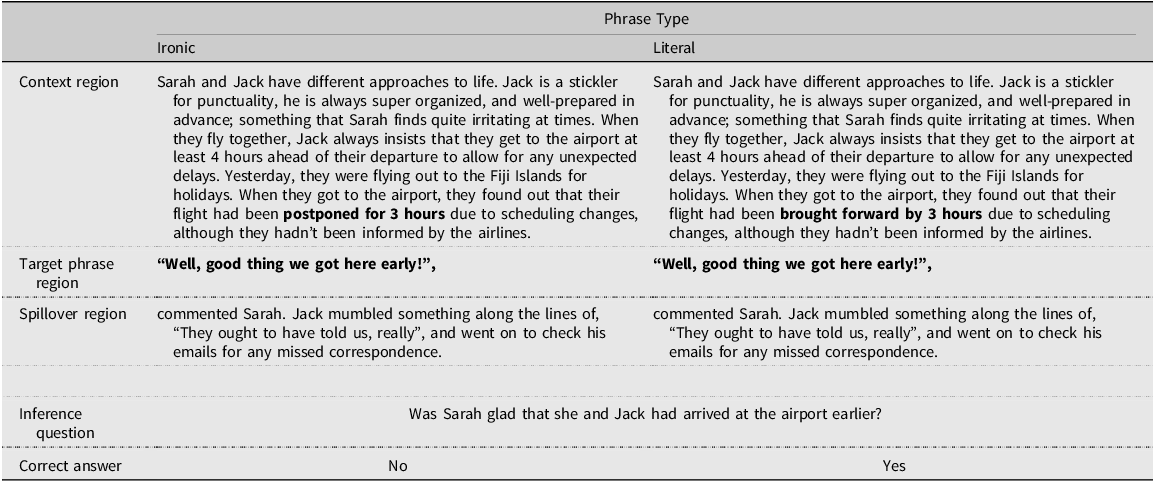
The eye-tracking reading task included twenty-four pairs of stories (N = 48) written in Norwegian. The stories were on average 721.24 characters long (SD = 47.56) and always described a situation involving one or two fictional characters. At some point, one character would utter a phrase (referred to as target phrase) that would be intended ironically in the irony condition (N = 24), and literally in the literal condition (N = 24). Each story was split into three Regions of Interest: (a) the context region, which included all text leading up to (but not including) the target phrases, (b) the target phrase region, and (c) the spillover region (all the content directly following the target phrases and up to the end of the story). The target phrase and spillover regions were identical across conditions, whereas the context region contained (minimal) phraseological differences, which were necessary to convey the intended meaning of the target phrases (i.e., literal vs. ironic). For example stimuli translated from Norwegian to English, see Table 1. Twelve filler stories with a similar structure, some containing untruthful statements or statements that required complex inferences, were included to minimize irony’s markedness.
Example stimuli stories and inference questions across Phrase Type (Ironic and Literal), translated to English

Note: Biasing contextual information in the context region, and the target phrases are presented in bold in the examples above but were in no way demarcated for participants.
All story pairs were accompanied by (the same) two YES/NO comprehension questions. Question 1 tapped into general content comprehension, while Question 2 tapped into the interpretation of the target phrases. The second required drawing inferences about the implicit feelings/thoughts/intentions of the speaker who uttered the target phrase in each story (see example inference question in Table 1), thus, the correct answer would depend on the condition. Question 2 will be henceforth referred to as inference question. Inference questions were phrased in such a way as to elicit a good balance of negative and positive answers in the irony versus the literal condition. Filler stories were also accompanied by two questions of the same kind.
To ensure the stories successfully warranted the intended meaning of the target phrases in each condition, we normed them via two counterbalanced rating questionnaires, where only one version from each pair appeared in either questionnaire. Thirty-one participants who did not take part in the eye-tracking study (mean age = 34.87, SD = 15.61, females = 19, males = 12) rated how ironic versus literal the target phrases were in their respective story contexts on a Likert scale from 1 (literal) to 7 (ironic). The same participants rated the stories for naturalness, also on a Likert scale from 1 (very unnatural) to 7 (very natural). The norming data confirmed that target phrases in the irony condition were rated as significantly more ironic (M = 6.41, SD = 0.57) than (the same) target phrases in the literal condition (M = 1.96, SD = 0.91; t(48) = 20.18, p < 0.001), but all stories were rated to be equally natural (M Ironic = 5.33, SD = 0.36; M Literal = 5.35, SD = 0.52; t(48) = 0.14, p = 0.89). Another 17 participants (mean age = 33.88, SD = 15.27; females = 14) rated the target phrases in isolation (i.e., without their story contexts) on a Likert scale from 1 (literal) to 7 (ironic). The results showed that without context the phrases were considered literal (M = 2.24, SD = 0.89), thus excluding a default ironic interpretation.
Procedure
The whole experimental procedure lasted approximately 60 minutes and consisted of an eye-tracking reading task (ca. 40 minutes) and two cognitive tasks (ca. 20 minutes in total) tapping into WM capacity and fluid intelligence, respectively. Participants always started with the reading task, while the order of the administration of the cognitive tasks was counterbalanced across participants to account for fatigue effects.
Eye-tracking reading task
To track participants’ eye-movements while reading, we used an SR Research EyeLink 1000+ desktop-mounted eye-tracker, with a sampling rate of 1000 Hz (SR Research, Ontario, Canada). Participants were seated in front of a computer monitor and a chin- and forehead-rest was used to minimize head movement and ensure better calibration. Calibration was performed using a nine-point grid, and recalibration was performed after breaks and whenever necessary.
The stories were divided into two counterbalanced lists using a Latin square design, so that each participant read a given target phrase only once, in either the irony (12 stories) or the literal condition (12 stories). The same 12 filler stories were used in both lists. Target phrases were never placed at the end of a sentence/line to avoid influence from wrap-up or saccadic programming operations. Participants were instructed to read the stories as fast as possible but for comprehension, to avoid unnecessary rereading wherever possible, and to press ENTER after reading each story. At that point, the story disappeared from the screen and participants were (sequentially) presented with the two comprehension questions. To answer the questions, participants were instructed to use the corresponding keys for YES/NO on the keyboard. Once the comprehension questions were answered, there was a drift correction before the next story appeared on the screen. The stories were presented in full on “one screen” at a time using triple line spacing, in black font (Courier New, size 16) over a white background. The order of the stories was randomized per participant.
Working memory task
To measure participants’ WM capacity, we used Foster et al.’s (Reference Foster, Shipstead, Harrison, Hicks, Redick and Engle2015) shortened version of the Symmetry Span task (henceforth referred to as SSPAN). The task was translated into Norwegian at our lab. In this task, participants alternate between performing an irrelevant distractor task (i.e., judgment task) and a target memory task. The distractor task involves judging whether a geometrical pattern is symmetrical along the vertical axis, while the memory task involves retaining in memory and recalling which cell within a blank grid turned red. The distractor task alternates with the block presentation for a varying number of alternations, with a single block turning red within the grid upon each presentation. At the end of this alternating sequence, participants view a blank grid and must click on the locations of the red blocks in the order they had appeared within the sequence. The number of the to-be-remembered red cells varied by trial, ranging from two to five. The task consisted of three blocks, each block yielding a maximum of 14 points (42 in total). The task is scored for the total number of items correctly recalled. This is a complex span task as it involves a distractor (processing component) as well as a recall (memory) component. We chose this type of WM task because it is a nonverbal task and has been found to modulate the processing of sarcasm (a subtype of irony) in previous work (Olkoniemi, Johander, et al., Reference Olkoniemi, Johander and Kaakinen2019).
Fluid intelligence task
To measure participants’ fluid intelligence, we used a computerized version of Raven’s Advanced Progressive Matrices (APM III; Pearson, 2015). This is a nonverbal task containing 23 items/problems. Each item consists of a black-and-white geometric pattern with a piece missing. Participants need to identify which one out of the 8 options provided below correctly completes the pattern. Participants were given 10 minutes to solve as many problems as they could. The task was scored for the total number of correct answers.
Results
All data analyses were carried out in R version 4.3.1 (R Core Team, 2023). As an index of WM capacity, we calculated SSPAN task partial scores (where score credit is also given to partially correct items, for instance, when a participant could recall the location and sequence of some but not all of the cells that turned red in the grid; Conway et al., Reference Conway, Kane, Bunting, Hambrick, Wilhelm and Engle2005), using the englelab package (Tsukahara, Reference Tsukahara2022). As an index of fluid intelligence, we calculated Raven’s scores as percentage of correct answers. The descriptive statistics for both cognitive tasks are provided in Table 2.
Participants’ scores on the SSPAN (working memory) and Raven’s (fluid intelligence) tasks

Note. SSPAN scores reflect raw partial scores while Raven’s scores are presented in percentages. Both variables were centered before analyses.
For the reading task, we examined both early and late eye-tracking measures. Specifically, for the target phrase and spillover regions, we examined first-pass reading time (duration of all fixations during first pass) and first-pass gaze duration (duration of all fixations and refixations during first pass), both early measures, as well as late measures: i.e., go-past reading time (duration of all fixations and refixations in the region of interest including time spent revisiting previous regions), and total reading time (duration of all fixations and refixations). Additionally, for the target phrase region and the context region, we examined regression probability (i.e., how likely it was for these regions to be revisited from subsequent parts of the text), also a late measure. We did not analyze reading time measures for the context region as effects would be influenced by lexico-syntactic differences (e.g., differences in word frequency, word length, and polarity), given that this region varied slightly across Phrase Type. Regressions reflect late processing stages typically associated with reanalysis or meaning integration (global comprehension) and as such they are less susceptible to influences from lower-level lexico-syntactic variations. For the comprehension task, we examined both accuracy and response time to the inference questions (i.e., Question 2), as these tapped into the interpretation of the target phrases. Response accuracy to general content questions (i.e., Question 1) on both filler and experimental items was high (81% and 87%, respectively), demonstrating that participants were attentive to the reading task. Eye-tracking data loss due to camera tracking issues or the removal of outliers ranged between 0.44 and 3.00% across various eye-tracking measures and regions of interest.
The data were analyzed using mixed-effects models and the lme4 package, version 1.1-34 (Bates et al., Reference Bates, Maechler, Bolker and Walker2014). As fixed effects in all models, we specified Phrase Type (a two-level factor: Irony vs. Literal), Raven’s scores and SSPAN scores, both continuous variables and henceforth referred to as fluid intelligence and WM scores, respectively, and Trial Index (i.e., trial presentation number, also a continuous variable). Trial Index was included as a control variable to account for learning/fatigue effects as the experiment progressed. We further specified an interaction between Phrase Type and both fluid intelligence and WM scores to check whether these predictors were particularly implicated in the processing of irony. Phrase type was effect-coded (using contr.sum()in R) with the literal condition being set as the reference level. Fluid intelligence and WM scores, as well as Trial Index, were centered and scaled. There was no indication of collinearity between fluid intelligence and WM scores (r = 0.28 and κ = 1.33) and the variance inflation factor values of all fixed effects in the models reported were low (i.e., below 5). We therefore included both scores as predictors in the models.
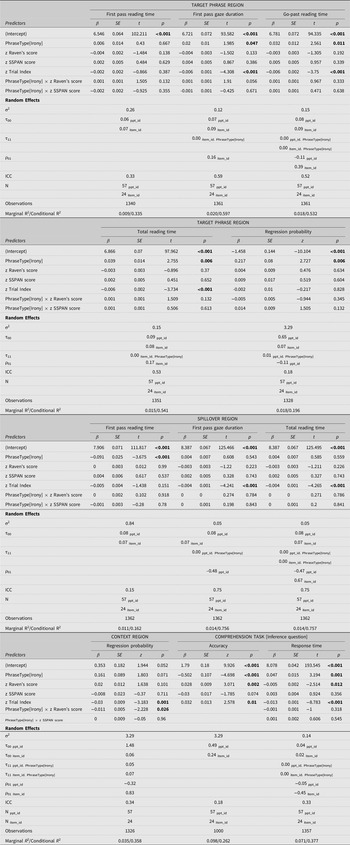
Maximal models included by-participant and by-item correlated random intercepts and slopes for Phrase Type and Trial Index. For items, we further specified random intercepts of fluid intelligence and WM scores in interaction with Phrase Type and Trial Index. We selected final models with a simplified random effect structure that did not lead to convergence issues or singular fits, first by removing interactions between random effects, and subsequently by removing random effects whose variance estimates were 0. Below we report only significant effects, but the complete outputs of the final models are provided in the appendix (Table A1). As we were primarily interested in potential effects of fluid intelligence and WM scores, models in which either of these predictors was significant were compared to null models lacking the respective predictor as a fixed effect. Full and null model comparisons were performed using anova() in R.
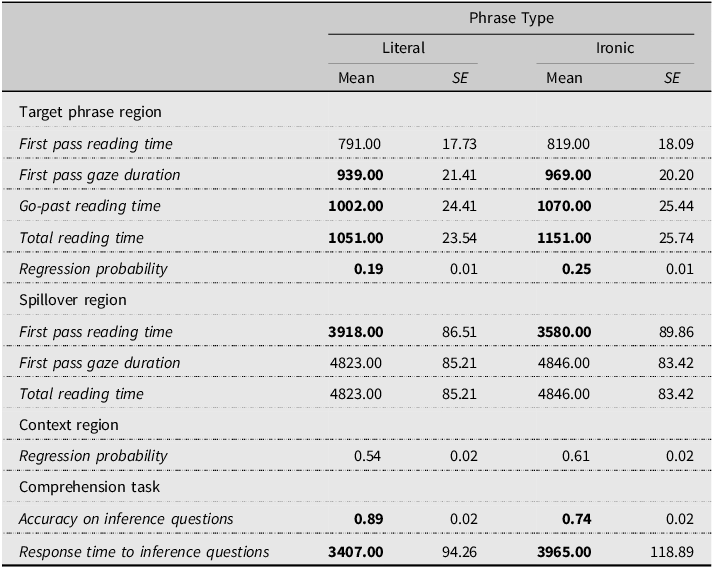
All reading and reaction time measures were log-transformed and analyzed with linear mixed-effects models to normalize distribution. Binary measures (i.e., regression probability and accuracy on inference questions) were calculated using logistic regression (Jaeger, Reference Jaeger2008). Means across Phrase Types are provided in Table 3.
Mean reading times and regression probability across regions of interest and explicit comprehension measures, collapsed across Phrase Type

Note. Reading and Response time means are reported in milliseconds, while Accuracy and Regression probability as probability 0–1. Values in bold denote a significant difference across Phrase Type based on model outputs.
Eye-tracking reading measures
In the target phrase region, Phrase Type was significant in the first-pass gaze duration (β = 0.02, SE = 0.01, t = 1.98, p = 0.047), go-past reading time (β = 0.03, SE = 0.01, t = 2.56, p = 0.01), total reading time (β = 0.04, SE = 0.01, t = 2.75, p = 0.006), and regression probability (β = 0.22, SE = 0.08, z = 2.72, p = 0.006), showing that reading times were significantly slower and regression probability significantly higher for ironic as opposed to literal phrases. In the spillover region, Phrase Type was only significant in the first-pass reading time (β = −0.10, SE = 0.02, t = -3.67, p < 0.001), whereby reading times were faster in the irony as opposed to the literal condition. This likely reflects a processing trade-off, as ironic phrases elicited more and longer fixations in the target phrase region compared to literal phrases. In the context region, Phrase Type was not significant in regression probability (p = 0.07). Trial index was significant in most models (see appendix, Table A1 for coefficients), indicating that reading times or regression probability reduced as experience with the experiment increased.
Comprehension task measures
A coding error in building the experiment resulted in having to exclude half the responses from the literal (but not the irony) condition in the accuracy modelFootnote 1 . This model was then simplified to allow convergence by removing interactions between Phrase Type and fluid intelligence as well as WM scores. Phrase Type was significant in both the accuracy (β = −0.57, SE = 0.17, z = −3.23, p = 0.001) and response time to inference questions (β = 0.05, SE = 0.01, t = 3.19, p = 0.001), with accuracy being significantly lower and response time significantly slower in the irony as opposed to the literal condition. Again, Trial Index was significant, leading to increased accuracy and faster response time over the course of the experiment. Of note, Phrase Type was not significant in response accuracy on the general story comprehension question (β = 0.20, SE = 0.31, z = 0.65, p = 0.51) and comprehension scores were (equally) high in both conditions (MLITERAL = 0.87, MIRONY = 0.87).
Fluid intelligence effects
Fluid intelligence was significant as a main effect in the accuracy (β = 0.03, SE = 0.01, z = 3.07, p = 0.002) and response time (β = −0.005, SE = 0.002, t = −2.51, p = 0.01) to inference questions: as fluid intelligence increased, accuracy increased and response time became faster. There was a significant interaction between fluid intelligence and Phrase Type in regression probability to the context region (β = −0.01, SE = 0.005, z = −2.29, p = 0.026): as fluid intelligence increased, regression probability decreased in the irony condition. The same interaction was also approaching significance in the first-pass gaze duration of the target phrase region (β = 0.001, SE = 0.001, t = 1.91, p = 0.056), whereby as fluid intelligence increased, reading times in the irony condition increased.
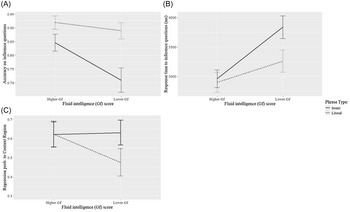
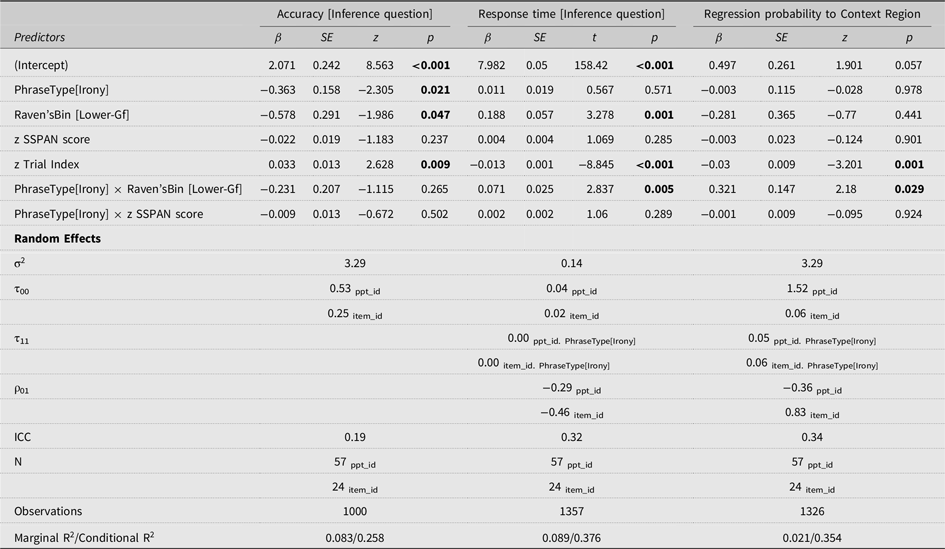
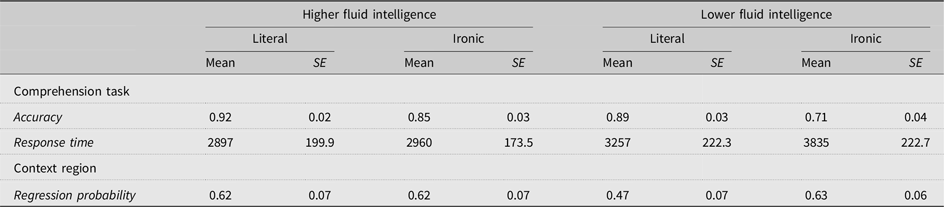
To facilitate the interpretation of these data and to conduct further pairwise comparisons, the same models were rerun using a recoded variable for fluid intelligence. Specifically, this predictor was recoded as a factor, namely Raven’s bin, with 2 levels: Higher-Gf (where Raven’s score ≥ mean (Raven’s score); N = 28) and Lower-Gf (where Raven’s score < mean (Raven’s score); N = 29). Higher-Gf was set as the reference level. Marginal means and model outputs are provided in the appendix (Tables A2 and A3), while main trends are illustrated in Figure 1. Pairwise contrasts and marginal means were estimated using emmeans() package (Lenth, Reference Lenth2018), with a Bonferroni p-value adjustment.Footnote 2 For brevity, below we only report pairwise contrasts that reached significance and were of interest to the discussion.
Graphs illustrating interactions between levels of fluid intelligence (Higher-Gf and Lower-Gf) and levels of Phrase Type (Ironic and Literal), for accuracy on inference questions (Panel A), response time to inference questions (Panel B), and regression probability to the context region (Panel C). Error bars represent Standard Error and the means illustrated are the Marginal Means as calculated directly from the models.

For accuracy on inference questions, pairwise contrasts confirmed that Lower-Gf readers were significantly less accurate in the irony as opposed to the literal condition (p < 0.0001), while Higher-Gf readers did not reliably differ between the two conditions (p = 0.12). Furthermore, Lower-Gf readers were significantly less accurate than Higher-Gf readers in the irony condition (p = 0.03), but there was no difference in accuracy between Higher- and Lower-Gf readers in the literal condition (p = 1.00; Figure 1, Panel A).
In response time to inference questions, Lower-Gf readers were significantly slower than Higher-Gf readers in the irony condition (p < 0.001), but there was no difference between Higher- and Lower-Gf readers in the literal condition (p = 0.52; Figure 1, Panel B). For Higher-Gf readers, response time was not significantly modulated by Phrase Type (p = 1.00), while Lower-Gf readers were significantly faster in the literal condition (p < 0.001).
For regression probability to the context region, pairwise contrasts demonstrated that Lower-Gf readers were significantly more likely to generate a regression in the irony as opposed to the literal condition (p = 0.03), while regression probability for Higher-Gf readers was not modulated by Phrase Type (p = 1.00; Figure 1, Panel C).
Working memory effects
We did not find any significant effects of WM score in any of the implicit or explicit measures examined.
Discussion
In this study, we investigated whether WM and fluid intelligence, the two main components of executive attention, distinctively modulate the processing of irony, a complex pragmatic phenomenon that often requires the consideration of various contextual factors to infer the intended meaning. In an eye-tracking reading experiment, adult participants read stories containing ironic or literal phrases and answered questions targeting their interpretation. Participants’ WM capacity and fluid intelligence were estimated via two separate psychometric tasks, the scores of which were used as predictors in analyses. The results revealed a null effect of WM, while fluid intelligence affected both implicit and explicit measures, indicating involvement in the processing and comprehension of irony. Readers with higher fluid intelligence were significantly faster and more accurate in their responses to inference questions targeting ironic statements, while readers with lower-fluid intelligence exhibited higher regression probability to the context region in the irony as opposed to the literal condition. Before discussing these findings in more detail, we first review general trends pertaining to the processing of irony.
The processing of irony
In line with previous literature, our findings demonstrate that verbal irony incurs a processing cost (e.g., Au-Yeung et al., Reference Au-Yeung, Kaakinen, Liversedge and Benson2015; Filik et al., Reference Filik, Leuthold, Wallington and Page2014, Reference Filik, Howman, Ralph-Nearman and Giora2018; Kaakinen et al., Reference Kaakinen, Olkoniemi, Kinnari and Hyönä2014; Olkoniemi et al., Reference Olkoniemi, Ranta and Kaakinen2016; Olkoniemi, Johander, et al., Reference Olkoniemi, Johander and Kaakinen2019). Compared to literal phrases, ironic phrases elicited significantly longer reading times in first-pass gaze duration, go-past, and total reading time, and were significantly more likely to yield a regression, indicating a greater need for reanalysis (Conklin et al., Reference Conklin, Pellicer-Sánchez and Carrol2018). This processing cost may reflect initial or stronger activation of the literal meaning, which then needs to be discarded. Alternatively, it could be attributed to increased mentalizing effort in inferring the speaker’s ironic intent.
The findings from the explicit comprehension task paint a similar picture: response times were significantly slower and accuracy significantly lower when inference questions tapped into the understanding of ironic as opposed to literal utterances. This was despite the high accuracy of the general content questions across both conditions. Accuracy on the inference questions depended on successfully discerning the mental states (e.g., feelings/beliefs) of the fictional story characters who uttered the target phrases, which were not explicitly stated in the text in either the literal or the irony condition. The significant cost observed in the irony condition, therefore, suggests an irony-specific challenge, since deriving similar inferences in the literal condition was evidently easier.
Previous literature suggested that irony is resolved in later stages of processing, as processing costs (if observed) do not occur in early eye-tracking measures, but rather in late ones (e.g., Au-Yeung et al., Reference Au-Yeung, Kaakinen, Liversedge and Benson2015; Filik et al., Reference Filik, Leuthold, Wallington and Page2014, Reference Filik, Howman, Ralph-Nearman and Giora2018; Filik & Moxey, Reference Filik and Moxey2010). In line with this, we did not find an effect of Phrase Type in the first-pass reading time of target phrases. However, we did find an effect in first-pass gaze duration (i.e., duration of all fixations and refixations during first pass), which we still consider an early measure. We therefore take our findings to indicate that irony may be detected and processed earlier than previously assumed.
The (null) effect of working memory
The main purpose of the study was to investigate to what extent executive attention abilities influence the interpretation of irony. We hypothesized that greater WM capacity would lead to earlier irony detection and processing, while lower WM capacity would lead to increased reanalysis, two effects reported in some (but not all) previous studies (Kaakinen et al., Reference Kaakinen, Olkoniemi, Kinnari and Hyönä2014; Olkoniemi et al., Reference Olkoniemi, Ranta and Kaakinen2016; Olkoniemi, Johander, et al., Reference Olkoniemi, Strömberg and Kaakinen2019). Contrary to our predictions, we did not find a significant effect of WM in any of the measures investigated.
One could argue that the conflicting results in the literature are due to differences in the choice of WM task. Some previous studies, for instance, have used digit (Parola & Bosco, Reference Parola and Bosco2022) or reading span tasks (Kaakinen et al., Reference Kaakinen, Olkoniemi, Kinnari and Hyönä2014; Olkoniemi et al., Reference Olkoniemi, Ranta and Kaakinen2016), both of which provide an index of verbal WM capacity. In these tasks, participants are required to maintain a sequence of numbers or a word active in memory and then orally repeat it at the end of each trial. Despite the theoretical similarities between digit and reading spans, however, only the latter has so far produced significant effects in the processing of irony (e.g., in Kaakinen et al., Reference Kaakinen, Olkoniemi, Kinnari and Hyönä2014; Olkoniemi et al., Reference Olkoniemi, Ranta and Kaakinen2016), yet not consistently across the studies in which it was employed (see Olkoniemi, Strömberg, et al., Reference Olkoniemi, Strömberg and Kaakinen2019). The task employed in the present study tapped into spatial as opposed to verbal WM, as participants were required to recall which cells within a matrix turned red and in which order, after performing an (unrelated but cognitively taxing) judgment task and provide their answers by clicking the corresponding boxes in sequence. Given the inconsistencies produced by verbal WM tasks in previous studies, it seems unlikely that our null finding can be explained by our task tapping into spatial WM. In fact, Olkoniemi, Johander et al. (Reference Olkoniemi, Johander and Kaakinen2019) found that scores from a Symmetry Span task, such as the one employed in the current study, were more reliable (and the only significant) predictors in the processing of sarcasm, whereas scores obtained from a (verbal) reading span task were not.
A potential reason accounting for the lack of an SSPAN effect, as opposed to Olkoniemi, Johander et al. (Reference Olkoniemi, Johander and Kaakinen2019), could be the different reading tasks employed. Olkoniemi, Johander et al. (Reference Olkoniemi, Johander and Kaakinen2019) used a mask versus no-mask reading paradigm, in which the text was either replaced by x’s once read (mask condition) or remained visible (no-mask condition). Readers with lower (visuospatial) WM were more likely to reread sarcastic utterances and produce shorter first-pass rereading times in the no-mask condition, where the text was still available. Readers with higher (visuospatial) WM, on the other hand, initiated regressions to the location of sarcastic utterances even in the mask condition, when the text was no longer visible. This suggests that readers with higher visuospatial WM were able to use the location of the text as a successful cue for content recall. Given that in our reading task, the text was always visible, SSPAN effects may not have emerged because readers were always able to reread content without having to store text content or its location in WM.
Additionally, it seems unlikely that our null WM effect can be explained by low task demands, as suggested by Olkoniemi, Strömberg, et al. (Reference Olkoniemi, Strömberg and Kaakinen2019). Participants were required to read 36 stories (including fillers) with an average length of 730 characters, extract and retain key information active in memory, pertaining to the gist of the text, character names, and attitudes as the stories disappeared from the screen ahead of the comprehension task. They were further required to infer characters’ attitudes and beliefs based on the interpretation of the target phrases, which were no longer accessible to them, by relying on their WM. We are therefore confident that our reading task was demanding enough to detect potential WM effects.
We cannot of course exclude the possibility that some of the variance attributable to WM may have been captured by our fluid intelligence measure. As we discussed in the Introduction, WM and fluid intelligence are believed to be correlated but separable constructs (Kane et al., Reference Kane, Hambrick and Conway2005; Oberauer et al., Reference Oberauer, Schulze, Wilhelm and Süß2005), both relying on the same ability to control attention. In the SSPAN task, for example, a participant would need to quickly disengage from the symmetry judgment task (processing component), in order to perform well on the recall part (memory component). In line with this, we found a mild, positive correlation between our WM and fluid intelligence scores, without however evidence of collinearity in the models. Following the suggestions of a reviewer to explore this issue further, we conducted post-hoc mediation analyses using the lavaan package (Rosseel, Reference Rosseel2012) in R. Specifically, we explored whether fluid intelligence acted as a significant mediator for WM in models where fluid intelligence was significant. The analyses indeed indicated a significant and complete mediation effect on accuracy and response time to inference questions, and regression probability to context (with indirect effects at ps ≤ 0.002). Conversely, and as expected, direct effects between WM and the dependent variables were not significant in any of the models (ps ≥ 0.07), in line with the main analyses. These results therefore further support the argument that WM may not exert additional (or direct) influences beyond the common attentional control captured by fluid intelligence. At the same time, these strong mediation effects suggest an indirect involvement. Interestingly, this finding lines up with Martin et al.’s (Reference Martin, Shipstead, Harrison, Redick, Bunting and Engle2020), who also observed an indirect effect of WM through fluid intelligence, in predicting successful reading comprehension (measured as accuracy on passage comprehension questions).
Future studies could further investigate the (direct or indirect) role of WM in irony processing in populations with limited or impaired WM capacity. Such investigations could clarify whether there is a detectable minimal requirement for WM capacity that is essential for processing verbal irony and whether this requirement differs compared to equivalent literal phrases.
The effect of fluid intelligence
To our knowledge, the role of fluid intelligence in the on-line processing of irony has not been previously investigated. We hypothesized that greater fluid intelligence would influence irony processing because of better problem-solving skills and more effective disengagement of the literal meaning, at least when utterances are not by default interpreted ironically. We further hypothesized that fluid intelligence would influence offline responses and late reading measures since problem-solving skills would be mobilized after irony (i.e., the “problem”) had been detected. Our results support these predictions. We found that fluid intelligence modulated both accuracy and response time to inference questions, as well as regression probability to the context region.
Readers with lower fluid intelligence were significantly more likely to revisit the context region after encountering an ironic than a literal phrase. In contrast, readers with higher fluid intelligence were unaffected by Phrase Type, although overall regression probability was relatively high. Arguably regressions to the context in readers with lower fluid intelligence reflect compensatory strategies, as part of dealing with the higher demands of irony processing, some of which may emerge from a literal-first interpretation. Conversely, those readers with higher fluid intelligence may reflect strategic processing, whereby regressions in both conditions were used to confirm derived interpretations, to achieve greater accuracy in the comprehension task. It is worth pointing out, however, that even for readers with higher fluid intelligence, fully integrating irony was costly as late eye-tracking measures in the target phrase region (i.e., go-past, total reading time, and regression probability) consistently showed a processing cost for irony, without a facilitative (or otherwise) effect of fluid intelligence.
In the offline comprehension task, greater fluid intelligence led to significantly more accurate and significantly faster response times to inference questions in the irony condition, relative to lower fluid intelligence. No differences between higher- and lower-fluid intelligence readers were observed in the literal condition, suggesting that fluid intelligence is particularly important to the comprehension of irony. The comprehension of literal language should not engage problem-solving or disengagement mechanisms to the same degree, since, unlike irony, it does not typically invoke disambiguation processes and hypotheses testing. Except for instances of polysemy or homonymy, for example, literal language does not involve consideration of alternative interpretations. Therefore, arriving at the correct answer to comprehension questions is comparatively easier and faster.
Finally, we found a marginal effect in the first-pass gaze duration of ironic phrases, an early reading measure. Readers with higher fluid intelligence tended to exhibit slower first-pass gaze durations in the irony as opposed to the literal condition, implying that greater fluid intelligence may be involved in the early detection and processing of ironic meanings. However, this finding should be considered with caution given the p-value of the effect (p = 0.056).
From the above discussion, it appears that lower fluid intelligence can lead to problems in comprehension of irony, which results in extensive reanalysis of available information. Moreover, when irony was concerned, the accuracy of readers with lower fluid intelligence suffered about 30% of the time, even though they allowed for extra time when responding to inference questions. On the other hand, greater fluid intelligence can improve comprehension accuracy and speed, and lead to more efficient strategic processing.
Returning to our hypothesis, and assuming that fluid intelligence relates to problem-solving skills and the ability to disengage irrelevant information, there are three, not mutually exclusive possibilities that may account for the present data. First, poorer problem-solving skills might make it more difficult for readers to derive or bring alternative solutions (in this case ironic meanings) to the necessary activation threshold. Second, poorer disengagement skills might result in greater activation of irrelevant information, causing interference during processing. Here, interference could stem from over-activating the literal meaning of an ironic utterance, or from an inability to effectively discard it. In general, adequate attention control in reading reduces adverse effects related to mind-wandering, and those resulting from distracting, outdated, and irrelevant information (Christopher et al., Reference Christopher, Miyake, Keenan, Pennington, DeFries, Wadsworth, Willcutt and Olson2012; Hasher et al., Reference Hasher, Zacks and May1999). Specifically, with insufficient attention control, readers may experience difficulty in blocking irrelevant information (e.g., Borella et al., Reference Borella, Carretti and Pelegrina2010; De Beni & Palladino, Reference De Beni and Palladino2000; McVay & Kane, Reference McVay and Kane2012), and nontarget meanings (e.g., Gernsbacher, Reference Gernsbacher1990, Reference Gernsbacher1993; Gernsbacher et al., Reference Gernsbacher, Varner and Faust1990; Gernsbacher & Faust, Reference Gernsbacher and Faust1991), thus directly impacting reading proficiency and skill (Butterfuss & Kendeou, Reference Butterfuss and Kendeou2018). For instance, even sometime after reading ambiguous words in disambiguating sentences (e.g., he dug with the spade, where spade can have the meaning of “shovel” (target) or “one of the four suits of playing cards” (nontarget)), less skillful readers experienced sustained interference from nontarget meanings. This was indicated by their inability to judge probe words associated with nontarget meanings (e.g., ace for “spade”) as semantically irrelevant (Gernsbacher et al., Reference Gernsbacher, Varner and Faust1990). Our data extend these findings by suggesting that disengagement mechanisms inherent in fluid intelligence are also important to the processing of verbal irony. These mechanisms potentially reduce interference from nontarget literal interpretations of ironic utterances, at least when a literal interpretation is the first one to be accessed.
Third, and in line with our interpretation of the regression analysis, it is possible that readers with lower fluid intelligence resorted to compensatory strategies because of fewer attentional resources. This behavior resembles what has been previously reported for readers with lower WM, who reportedly initiated more lookbacks (i.e., regressions) to ironic than literal phrases (Olkoniemi et al., Reference Olkoniemi, Ranta and Kaakinen2016; Olkoniemi, Johander, et al., Reference Olkoniemi, Johander and Kaakinen2019). Our findings suggest that fluid intelligence is a more important and reliable predictor in the processing and comprehension of irony, and potentially a mediator for WM. Once this factor is accounted for, variability in WM may not further modulate processing in a direct way. Therefore, our hypothesis that WM and fluid intelligence would both influence irony processing in an independent manner, was only partly confirmed given the null or indirect at best effect of WM.
To better understand the role of executive attention in the processing of irony as well as other pragmatic phenomena, future studies should aim to utilize more comprehensive measures of fluid intelligence and WM. In the present study, we relied on one task per construct which was necessary to avoid overly long testing times or multiple sessions for participants. Ideally, fluid intelligence and WM capacity should be assessed with multiple tasks to boost construct validity, potentially by extracting latent factors (Draheim et al., Reference Draheim, Mashburn, Martin and Engle2019). To compensate for this limitation at least partially, we have made sure to select cognitive tasks with attested internal and external validity (Draheim et al., Reference Draheim, Tsukahara, Martin, Mashburn and Engle2021, Reference Draheim, Tshukara and Engle2023). It is worth mentioning that modified attention control tasks with good psychometric properties and significantly shorter administration time have recently emerged, which might offer a promising avenue for future research (see Burgoyne et al., Reference Burgoyne, Tsukahara, Mashburn, Pak and Engle2023).
Conclusion
Our study advances the larger enterprise in experimental pragmatics aiming to map the cognitive and affective foundations of nonliteral language processing, by investigating the cognitive mechanisms involved in the comprehension of irony. Specifically, our findings indicate a significant role of fluid intelligence in the processing of irony in both implicit and explicit comprehension measures, while the role of WM was found to be indirect at best. We argue that fluid intelligence aids the processing of irony by offering better problem-solving skills or better disengagement of literal meanings, allowing for more efficient and accurate processing and integration of ironic interpretations. Based on our findings, future studies on the processing of nonliteral language should consider assessing fluid intelligence as an important individual-difference variable, since it varies with developmental stage and overall cognitive abilities. This might cast new light on why young children and certain clinical populations exhibit specific challenges in understanding irony and other types of nonliteral language.
Replication package
Supplementary Materials including stimuli, data, analysis code, and model outputs are available here: https://osf.io/4f7xm/.
Acknowledgments
We would like to thank Curtis Sharma and David Thornton for proof-reading an earlier version of this article; Cecilie Rummelhoff and Camilla Lee for translating the stimuli stories to Norwegian; and Cecilie Rummelhoff, Fatemeh Montazerikafrani, Valerie Borey, Ellen Margrethe Ulving, and Ola Trondsson Eidet for their help with recruitment and data collection.
Funding
This work was supported by a FINNUT grant from the Research Council of Norway (project no. 315368) awarded to FK.
Competing interests
The author(s) declare none.
Appendix
Model outputs of main analyses

Model outputs of additional models run with Raven’s score as a two-level factor (lower and higher fluid intelligence)

Marginal Means and Standard Errors of model outputs run with Raven’s score as a two-level factor (lower- and higher fluid intelligence)



 Open access

