


Descriptive representation, which occurs when voters are represented by an elected official who shares their demographic characteristics, has often been used to explain Black voters’ strong preference for candidates of the same race. Existing research finds that many Black voters perceive co-racial representatives as more trustworthy, hands-on, and communicative compared to their White counterparts (Broockman Reference Broockman2014; Tate Reference Tate2004). For these reasons, the prevailing assumption is that, when seeking political support from Black voters, in-group representatives should be rewarded electorally compared to their White counterparts. But should we assume that this preference for descriptive representatives is always the case? Are there any circumstances under which we might see Black voters giving more support to a White politician over a Black one? These questions gain external validity when we consider the ongoing success of Memphis congressman Steve Cohen, who has consistently demonstrated his commitment to the Black community in meaningful ways, even while facing viable Black candidates in a majority-Black congressional district (Brown Reference Brown2009).
Moreover, while neither Cory Booker nor Kamala Harris were universally rejected by Black voters, their 2020 presidential campaigns revealed the limits of descriptive representation as currently theorized. Many political observers presumed both candidates, and implicitly much of the descriptive representation literature, to have an advantage among Black voters by virtue of shared racial identity (Berman Reference Berman2019). Yet their campaigns failed to gain traction with Black constituencies relative to White candidates like Joe Biden and Bernie Sanders. This mismatch between theoretical expectation and empirical reality signals the need for a more nuanced account of how Black voters evaluate candidates. Harris’s candidacy, in particular, was read through multiple, intersecting lenses: her prosecutorial record raised concerns about her commitment to racial justice, while her identity was also understood in relation to her South Asian heritage, her interracial marriage, and her role as the mother of White stepchildren. Booker, for his part, faced questions about authenticity and whether his rhetoric sufficiently prioritized Black communities. Although race may open the door, it does not guarantee support as Black voters are discerning, and descriptive ties alone do not override concerns about substantive commitment. This paper contributes to that evolving conversation by challenging the presumption of automatic co-racial support and illuminating the evaluative criteria Black voters bring to bear even when considering Black candidates.
With the current body of work on Black voter representation, these questions are difficult to answer. Despite the fact that Black voters do spend much of their political energy supporting White candidates and politicians, particularly at the state and national levels, we know very little about what informs their choices to support White candidates. Moreover, given the diversity of candidates, particularly within the Democratic Party, who seek support from Black voters, it is important to understand when and why the rewards often associated with descriptive representatives may not be applied in every electoral context.
In this paper, we argue that the limits of descriptive representation are found when a Black representative’s commitment to the group is called into question. We contend that Black voters presume that descriptive representatives understand the racial group’s norms and expectations, and govern according to that understanding, and are subsequently provided with positive evaluations when they meet those expectations. However, when descriptive representatives show themselves to be working against the group’s interest, they are punished with lower evaluations. In these moments where the commitment of a descriptive representative is questioned, but a White politician’s commitment to working on behalf of the group is clear, Black voters will evaluate White candidates more positively than Black candidates.
To test this argument, we employ a survey experiment to empirically assess how the race of the candidate conditions how Black voters might evaluate the political positions taken by the candidate, particularly when she is viewed as behaving in a way that is harmful to the group. We also examine how political candidates are evaluated relative to one another, holding constant everything except for the race of the candidate. We find that when Black and White politicians take the same stance on a policy, in this case one pertaining to hairstyles in school, Black voters punish and reward the candidates equally. Moreover, there is evidence that the preference often shown to descriptive representatives is most pronounced when Black and White politicians take the same stance. In these cases, Black representatives are more positively evaluated. However, as we theorize, when a White politician is seen as working for the group, he receives more positive evaluations relative to when a Black candidate takes a neutral stance on an issue affecting Black people or is seen as not working in the group’s interest.
This paper’s contribution is varied. First, we offer an important perspective on how Black voters evaluate White candidates, which few works within political science have done despite the fact that Black voters vote for White candidates often. Secondly, we provide important parameters for understanding the effect and influence of descriptive representation, which has been the most prominent body of literature to explain why Black voters choose certain candidates. Finally, we emphasize the importance of Black voters’ political pragmatism in choosing candidates to support and affirm existing work on the mechanism of community commitment and its importance. As candidates continue to recognize the power and potency of Black support, there is no doubt that we will see stronger and more explicit appeals being made to Black voters. However, research also tells us that Black representatives, particularly those seeking broad support, may not be able to make strong racialized appeals for fear of lessening support among White voters. This leaves room for White candidates to garner more substantial support than might be suggested in existing literature on descriptive representation.
Why Are Black Candidates Generally Preferred by Black Voters?
The goal of this study is to investigate the limits of affective rewards often given to descriptive representatives by Black voters. But in order to fully understand the circumstances under which Black voters might have a stronger preference for White representatives, we must first look at the work on descriptive representation to understand what informs Black voters preference for same race representatives.
Jane Mansbridge (Reference Mansbridge1999) maintains that “descriptive representation can “forge bonds of trust” between legislator and constituent, enhancing the “feeling of inclusion,” which, in turn, makes “the polity democratically more legitimate in one’s eyes” (629). Katherine Tate (Reference Tate2004) corroborates that Black individuals being represented by a co-racial representative is extremely salient because it represents the inclusion and progress achieved for African Americans in the U.S political system (15). Specifically, Katherine Tate (Reference Tate2004) suggests that Black voters’ strong preference for Black politicians stems from the perception that they are more trustworthy, helpful, and hands-on in the community than White representatives.
In the midst of the work seeking to determine whether descriptive representatives are rewarded because of their shared identity with their constituents, another body of work investigates how voters distinguish between descriptive representatives. Indeed, Dovi (Reference Dovi2002) claims that “representatives and members of historically disadvantaged groups must mutually recognize each other,” and “possess strong mutual relationships” with the subgroup with which they identify (Dovi Reference Dovi2002, 735). By “mutually recognize” Dovi means that the voters must acknowledge the politician as a member of their identity group, and the politician must recognize her/his constituents as members of the group with which (s)he identifies (736). She contends that those representatives who are seen as not being inclusive of all members of a group (i.e., LGBTQ+, religious minorities, intravenous drug users, etc.) are less preferable. This argument makes it clear that there are circumstances in which descriptive representatives may be less preferable than others, and that the conditions under which they are less representative are based on how they treat members of their descriptive group.
While Claudine Gay’s foundational work (2001) demonstrates that Black voters are willing to support White candidates when they perceive those candidates as aligned with group interests, this paper explores the boundaries of that support by directly comparing evaluations of both Black and White candidates under varying conditions of perceived commitment. In doing so, it extends Gay’s framework by examining not only whether support exists, but under what conditions that support shifts, particularly when Black voters are presented with a choice between descriptive and non-descriptive candidates. This design offers new insight into how Black voters weigh race and substantive advocacy, and when descriptive representation may be insufficient to secure support.
Wamble (Reference Wamble2024) builds on this work by providing his community commitment signaling framework and finds that Black voters have a set of expectations that are used to determine whether they prefer a representative over another. He shows that Black voters want candidates who are committed to placing the group’s interest above their own personal interest. Those candidates who are able to communicate that commitment are seen as more preferable and more likely to receive positive evaluations from Black voters. Taken together, what is clear is that voters tend to have a strong preference for their in-group representatives, this is particularly true for Black voters. Moreover, every descriptive representative is not privy to those rewards, and those who operate outside of the expectations of the group are seen as less preferable and less likely to reap the rewards often discussed in the descriptive representation literature.
While the idea that voters may punish representatives who fail to advocate on their behalf is broadly applicable, the literature on descriptive representation has primarily focused on the positive implications of shared racial identity, trust, enthusiasm, and symbolic empowerment, rather than their potential liabilities. What is missing from this scholarship is an exploration of the expectations that come with shared identity and what happens when those expectations are violated. The literature offers little room for the idea that Black voters might punish in-group representatives who are perceived as not working for the community. This paper helps fill that gap. By showing that Black voters do evaluate Black representatives critically, especially when those representatives appear inattentive to group interests, this work introduces a necessary and overdue nuance: that descriptive representation has limits, and that perceptions of substantive commitment shape those limits.
Black Voters’ Evaluations of White Candidates
By exploring the circumstances in which White representatives can garner support from Black voters over their Black counterparts. Much of the narrative surrounding how Black voters select representatives focuses on the relationship they have with co-ethnic candidates. As shown in the review of existing literature above, scholars have provided important insight into the thought process, namely that Black voters are more strategic in their selection of candidates, and that this selection process extends beyond the surface level similarity of skin color.
Though this is an important line of inquiry, there is very little work that gives evidence to show how Black voters evaluate White candidates. (Burge, Wamble, and Cuomo Reference Burge, Wamble and Cuomo2020) show us that when appeals that rely on racial stereotypes are made to Black voters from Black and White representatives, there is surprisingly little change in how they evaluate the White candidate. Moreover, Wamble (Reference Wamble2024) shows us that White candidates who use signals of past sacrifice for the Black community to communicate some sense of commitment are more positively evaluated than those White candidates who do not signal commitment. Taken together these two works offer an important, but incomplete understanding as to how Black voters view White candidates, which leaves us with questions about the strategy Black voters employ when making these choices, and under what circumstances we might see them garner more support than their Black counterparts.
When Will Black Voters Choose Descriptive Representatives over White Ones?
Following the lead of Wamble (Reference Wamble2024), we assert that the evaluations given to candidates from Black voters are not solely tied to the candidate’s race but are contingent on their perceived commitment to the interests of the Black community. This means that when a candidate, regardless of race, is seen as working in the interest of the racial group, she will be rewarded. However, when a candidate’s behaviors and appeals suggest that they will or have worked against the interest of the group, they will be punished with lower evaluations from Black voters.
However, if our assertion is true, why is it that scholars often find such a strong preference for Black descriptive representatives among Black voters? We posit that Black voters believe that same race representatives will understand the group’s expectations for commitment and accountability that is discussed in White and Laird (Reference White and Laird2020) and Wamble (Reference Wamble2024) and will be more willing to legislate with the group’s best interest in mind or be held accountable to the group if they do not. Thus, descriptive representatives are given the benefit of the doubt manifesting in higher evaluations relative to White representatives because of their presumed understanding of their duty as in-group members and political representatives to place the group’s interest first.
We contend this benefit of the doubt for same race politicians will manifest in higher baseline evaluation for Black representatives over White ones. We expect to see more positive evaluations for Black representatives than their White counterparts when their appeals to Black voters are the same (H1). Put another way, when a Black candidate and a White candidate are both seen as working for the group, Black voters will evaluate the Black politician more positively out of a stronger presumption of commitment to prioritizing the group’s interest. It is more difficult for White representatives to cue the same level of understanding and accountability because Black voters have no reason to believe they know what the group expects as they are less likely to be privy to the social interactions that enforce the understandings of the group’s expectations.
When Will Black Voters Choose White Representatives over Black Ones?
We believe, however, that there are limits to the preference given to co-ethnic representatives. Just because Black representatives receive the benefit of the doubt does not, we argue, mean that they will always be the recipients of these positive evaluations. As pragmatic political actors, Black voters are not going to just give Black candidates positive evaluations no matter what they do. Scholars show us that Black voters make meaningful distinctions between potential representatives based on how they appeal to the racial group (Canon Reference Canon1999; Stout Reference Stout2015; Stout Reference Stout2020; Burge, Wamble, and Cuomo Reference Burge, Wamble and Cuomo2020a; Burge, Wamble, and Laird Reference Burge, Wamble and Laird2020b; Wamble Reference Wamble2024).
We take this to mean that there will be circumstances where the variation in evaluations from Black voters may leave room for a White representative to fare better than Black descriptive representatives. White and Laird (Reference White and Laird2020) tell us that Black people use social sanctions to keep in-group individuals from working against the interest of the group, and we expect to see something very similar when Black voters perceive that a representative is acting outside the desires of Black voters.
The preference for candidates perceived as “working for the group” is rooted in the historical experience of exclusion and marginalization that has shaped Black political behavior in the United States. For generations, Black voters have navigated a political system that seldom prioritized their interests, even when inclusion was nominally extended. As a result, substantive advocacy, a demonstrable commitment to addressing racial inequality, protecting civil rights, and improving material conditions have become central evaluative criteria. This history has also fostered a kind of political pragmatism: Black voters are willing to support candidates who may not look like them if those candidates can be trusted to fight for their community. When faced with a choice between a co-racial candidate who appears detached from group concerns and a non-Black candidate who signals alignment, many Black voters prioritize the latter. This framework challenges the assumption that shared identity alone drives political support, underscoring the importance of perceived investment in the community.
In this vein, we contend that representatives, Black or otherwise, are not immune to punishment when they are perceived as not working in the interest of the group. Burge, Wamble, and Laird Reference Burge, Wamble and Laird2020b find this to be true when they show that Black candidates who rely on stereotypical appeals to Black voters are more likely to anger Black people and be punished with negative evaluations relative to their White counterparts. These findings offer evidence that Black candidates can be negatively affected based on the way they present themselves to Black individuals.
While, as we stated, White candidates will have a steeper hill to climb to convince Black voters of their commitment, it is not impossible because the desire Black voters have is not tied solely to the race of the candidate, but rather to whether she is seen as being committed to working in the group’s interest. We argue that if a White candidate is perceived as working for the group and a Black candidate is not, they will be more positively rewarded. If a White candidate is seen as working against the group they will be punished in a similar fashion relative to when they do not send a signal of commitment or when they are seen as working in the group’s interest. We expect the direction of the evaluations based on when the candidate is seen as meeting the expectations of the group and working in its interest and when he is not to be the same regardless of the race of the candidate (H2). White candidates can receive more positive evaluations when compared to Black candidates whose commitment is called into question or less than clear and that of the White candidate is not.
Method
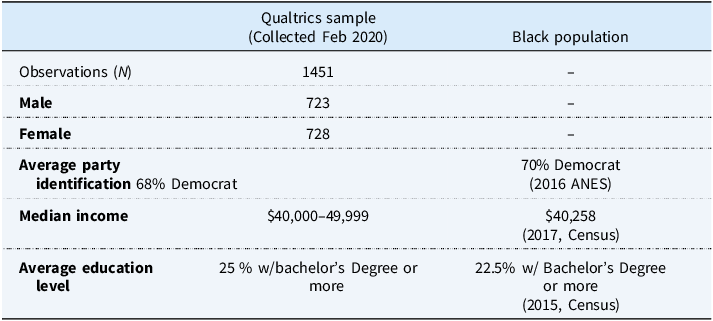
With this in mind, we employ an original Qualtrics survey experiment to test our hypotheses about Black Americans’ evaluations of Black and White political elites, conditional on whether they believe the representative is taking a stance favorable to the in-group, in this case, Black people. In this survey experiment, as shown in Table 1, we randomly assign 1,451 self-identified Black respondents to one of six conditions (as illustrated in Table 2), whereby a fictional representative named Michael Williams makes a statement regarding a local high school’s decision to bar students with dreadlocks from participating in commencement ceremonies.
We selected the surname Williams for all conditions. According to the 2010 U.S. Census, Williams was the third most common surname in the United States and was almost evenly split across racial groups, with approximately 46% of bearers identified as non-Hispanic White and 48% as non-Hispanic Black (U.S. Census Bureau 2016, “What’s in a Name?”). Surname data from the 2020 census have not yet been released, so the 2010 figures provide the most recent available evidence. Using a common and racially balanced surname minimizes the risk that respondents attach strong racial, ethnic, or regional associations to the name itself. Moreover, keeping the surname constant across conditions ensures that observed differences can be attributed to the experimental manipulation rather than to features of a particular name.
The use of a school policy on locs as the experimental treatment was not intended to suggest a uniformity in Black opinions about hair or to imply that all Black individuals are affected by such policies in the same way. Instead, this policy issue was chosen because it reflects a real and ongoing area of political debate that has prompted significant legislative responses, including the CROWN Act, which seeks to ban hair-based discrimination. Natural Black hairstyles have historically been targeted for regulation and remain a salient site of discrimination. At the same time, they are not as politically charged as other domains of racialized discrimination, such as policing or welfare. This positioning means that respondents are unlikely to approach the issue without any priors, but those priors are not as deeply entrenched or partisan as in more heavily politicized domains. This makes hair an especially useful case for a conservative test: if we observe movement in response to this domain, we would expect such effects to be even larger in more polarizing areas of racialized policy.
Cases such as that of a Black Texas teen who was denied the opportunity to walk at graduation unless he cut his locs have drawn national attention (NBC News 2020). The salience of hair discrimination lies not in aesthetic preference, but in the way such policies enforce Eurocentric beauty standards as conditions for access to education, employment, and civic participation. The timeliness of this issue further strengthens its relevance: the Creating a Respectful and Open World for Natural Hair (CROWN) Act has been introduced and adopted in multiple states and at the federal level, reflecting both the persistence of hair-based discrimination and the salience of ongoing legislative efforts to address it (Brown and Lemi Reference Brown and Casarez Lemi2021; Donahoo and Smith Reference Donahoo and Smith2019). Scholarship underscores the historical and contemporary significance of Black hair as a political site (Greensword Reference Greensword2022; Nkimbeng et al. Reference Nkimbeng2023). In each of the conditions, we randomly vary the race of Michael Williams so that he appears as either a Black or a White man. We also vary the type of statement he makes regarding the high school’s policy. With respect to the latter, the representative is shown either making a strong statement in favor of the policy (Work Against Condition), against the policy (Work For Condition), or taking a neutral stance in which he does not publicly disavow nor embrace the policy (Control Condition). Respondents are shown a mock newspaper article whose headline reads, “Democratic Legislator addresses the barring of Black students from graduation exercises over dreadlocks.”
In the main body of the text, Michael Williams makes one of the three statements. In the control condition, he states that “My colleagues in the State House and I are committed to working with the students’ parents and the school to address all concerns,” taking a position that neither supports nor rejects the high school’s decision to bar students with dreadlocks from participating in commencement exercises. In the “work for” condition, Williams states, “I do not support the decision. The school’s dress code on hairstyle and length is not uniformly applied to all students. It disproportionately discriminates against Black students.” Here, Williams explicitly acknowledges the racially discriminatory aspect of the rule and publicly disavows the decision. Finally, in the “work against” condition, Williams expresses his support for the decision in stating, “I support the decision. The school’s dress code on hairstyle and length is uniformly applied to all students of all races. There is no injustice being done to Black students.” This statement finds Williams expressing a view that, because the decision does not explicitly discriminate on the basis of race, it should not be considered unjust. Once again, Williams was shown to be either a Black or a White man, consistent with how he was presented to respondents in the mockup Wikipedia prior to entering the survey experiment.
We employ a number of post-treatment measures to assess respondents’ evaluation of Michael Williams given his position on the dreadlocks ban. More specifically, we are interested in whether respondents Williams’s response to the policy met their expectations of him, given what they learned about him (through the fictional Wikipedia page) prior to reading his public statement regarding the policy. This measure serves as our key dependent variable. From there, we ask respondents to evaluate Michael Williams further through the use of a feeling thermometer rating (where Williams can be rated on a scale from 0–100, with 0 being the extreme dislike and 100 being extreme like), as well as measures of representativeness and the perceived ability of Williams to represent the group’s interests.
Results
The analyses presented in this results section utilize ordinary least squares (OLS) regression to estimate the effects of candidate race and group commitment on a range of evaluative outcomes. All models include standard demographic controls such as respondent age, gender, region, education level, partisanship, respectability politics, and ideology (see appendix for full models). The dependent variables discussed consist of individual and composite candidate evaluation measures, specifically, perceived trustworthiness, likeability, commitment to the Black community, and overall willingness to support the candidate. All tables display unstandardized OLS regression coefficients with standard errors in parentheses, and statistically significant results are indicated using conventional thresholds (p < .05, p < .01).
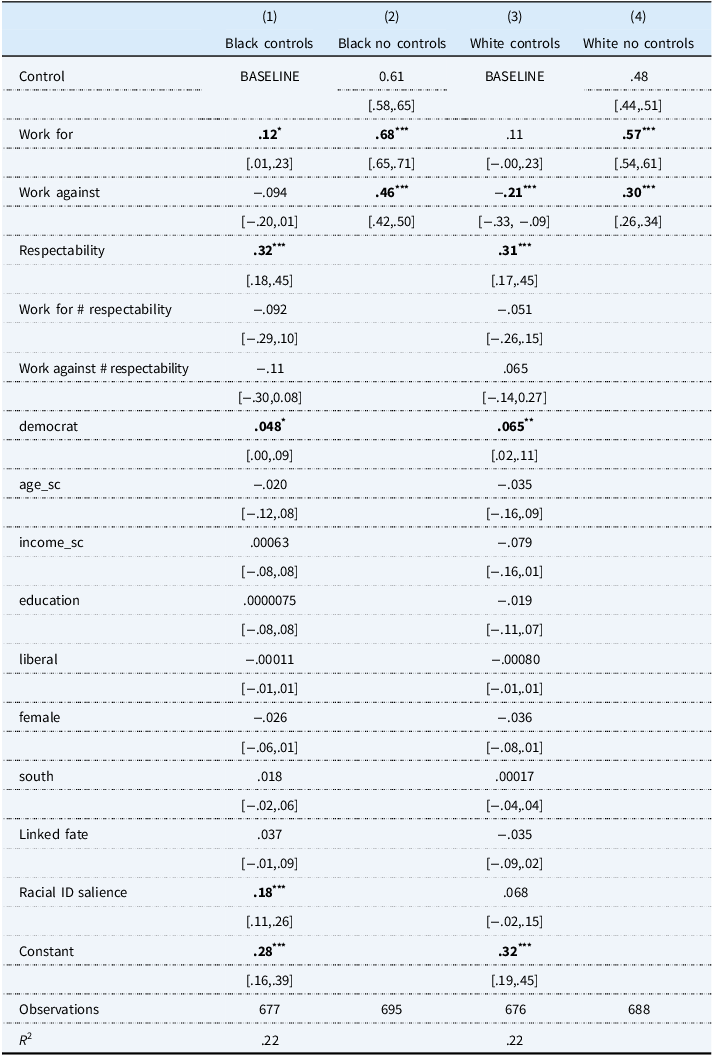
We operationalize respondents’ perceptions of whether the candidate is working for or against the racial group by measuring the belief that the candidate is committed to the interest of the Black community. As shown in Figure 1, when both Black and White candidates stand against the policy that would bar a young man from graduating because of his hairstyle, Black voters see them as the most committed when compared to their relative controls and the conditions in which they support the policy. This finding confirms our suspicion that Black individuals are gleaning important information about a candidate, outside of their skin color, and potentially using that information to inform their decisions. From the brief statements presented in these conditions, Black voters are able to determine when the candidate is for the group and when he is not. In short, the findings in Figure 1 offer proof that our treatments effectively communicated the candidate’s position not only on the policy but as a representative for the Black community.
Average experimental effect on perceptions of candidate’s commitment to the black community.

Importantly, the perception of being committed to the racial group is not uniformly applied to Black candidates or denied for White candidates. If, as one might assume, given some of the work on how Black people make assessments of candidates that regardless of the policies they support, Black voters will believe that co-racial candidates are committed to the Black community. Instead, there are meaningful differences (p > .05) in how committed a candidate is believed to be based on his stance on the policy. However, Black candidates within every condition are, relative to their White counterparts, seen as more committed in each condition (p < .00 for each condition). This affirms that even when the statements are exactly the same Black people are more inclined to see Black politicians more favorably.
That said, it is also evident that when a White politician stands against the policy barring the young man from attending his graduation and a Black politician is in favor, the White politician is seen as more committed to the group (p < .00). This finding supports our general supposition that there are confines on when Black politicians and candidates get more support than their White counterparts. This meaningful evidence that Black politicians are not always seen as more committed to the racial group relative to White politicians expands the way we understand how Black voters approach descriptive representation. Indeed, these results suggest that, despite the preference for in-group representation demonstrated within each condition, Black politicians must also support policies that are seen as uplifting the group to optimize the support Black voters are willing to give them.
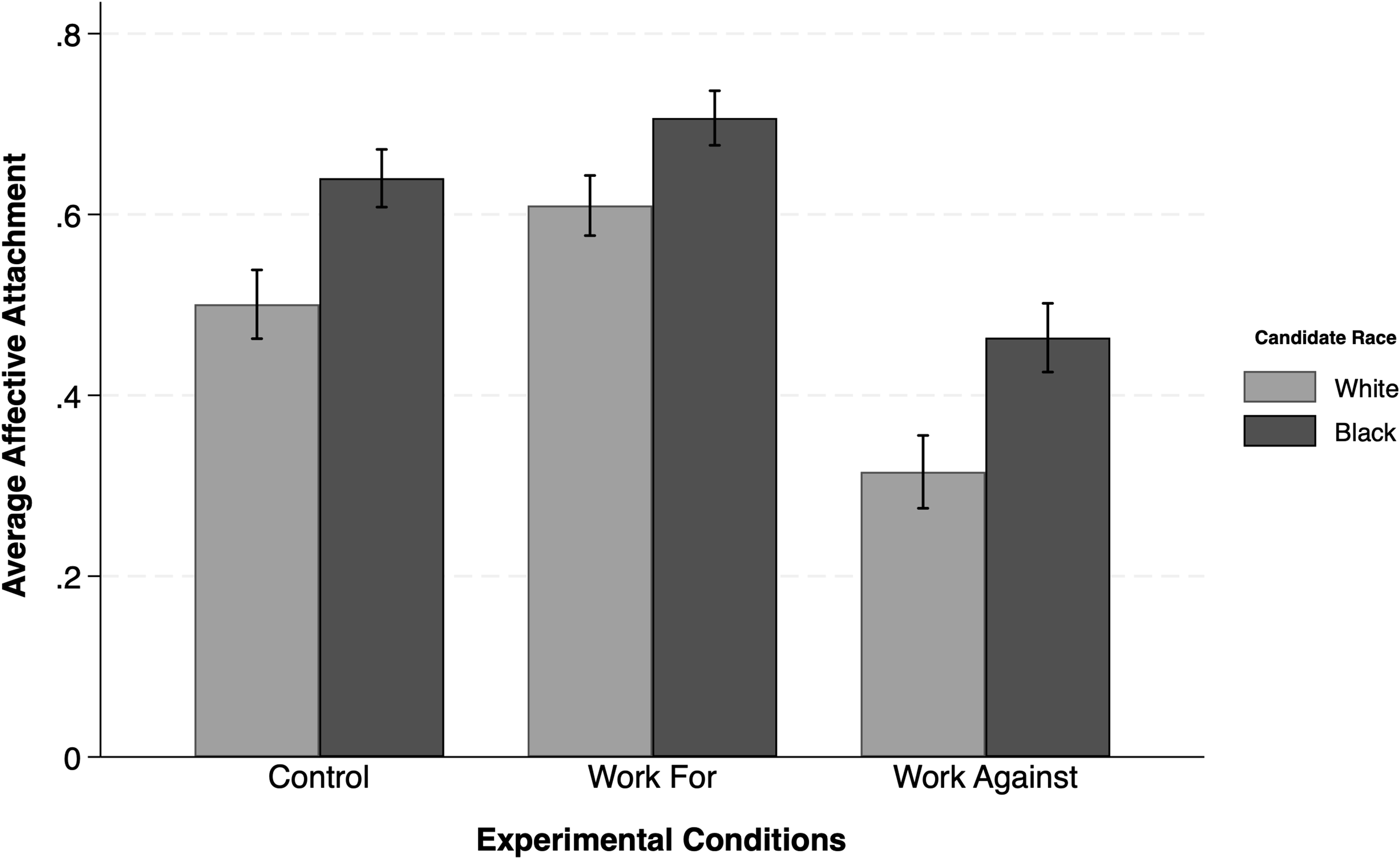
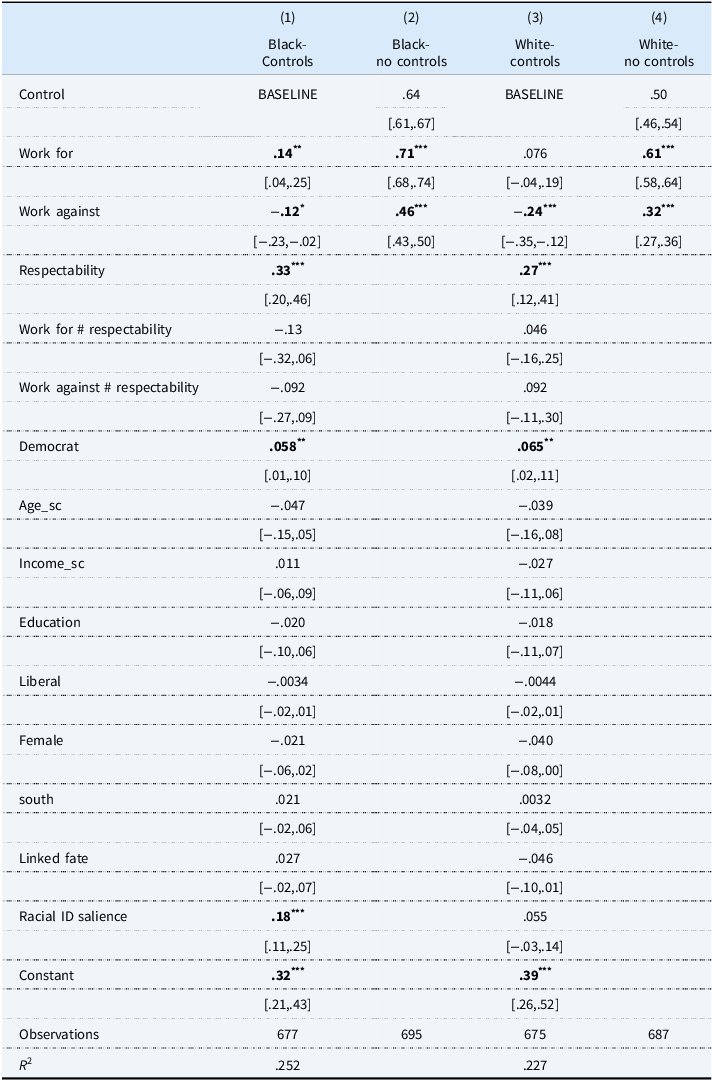
Much of the work on descriptive representation focuses on the empirical effects of being represented by an in-group member, particularly in relation to respondents’ affective evaluations. The composite measure was created by averaging the four scores for each respondent for measures of perceived trustworthiness, genuineness of concern, ability to represent the Black community, and perceived helpfulness.Footnote 1 These variables were chosen because they were used in the work of Katherine Tate (Reference Tate2004) when assessing Black voter evaluations of Black representatives (XX). The results show that, compared to their respective controls, both Black and White candidates receive a significant increase in affective assessment when they are perceived as working for the group specifically, when they criticize a policy regarding a young man’s hairstyle as problematic and racially prejudiced. Conversely, when either the Black or White candidate defends the policy, arguing that it is not discriminatory, both experience a significant decline in their affective assessment.
Additionally, the Black candidate consistently has a higher baseline evaluation, and his affective assessments are larger than those of his White counterpart when they express identical views. However, when comparing the Black candidate seen as working against the group to the White candidate working for the group, the White candidate receives a higher affective assessment. This suggests that Black politicians are not always perceived more positively than their White counterparts. Instead, White politicians can surpass Black politicians in affective assessment, but only when the Black politician is seen as opposing the group’s interests. This is a critical contribution because it highlights that descriptive representation, the preference for a representative who shares the voter’s identity, is not absolute.
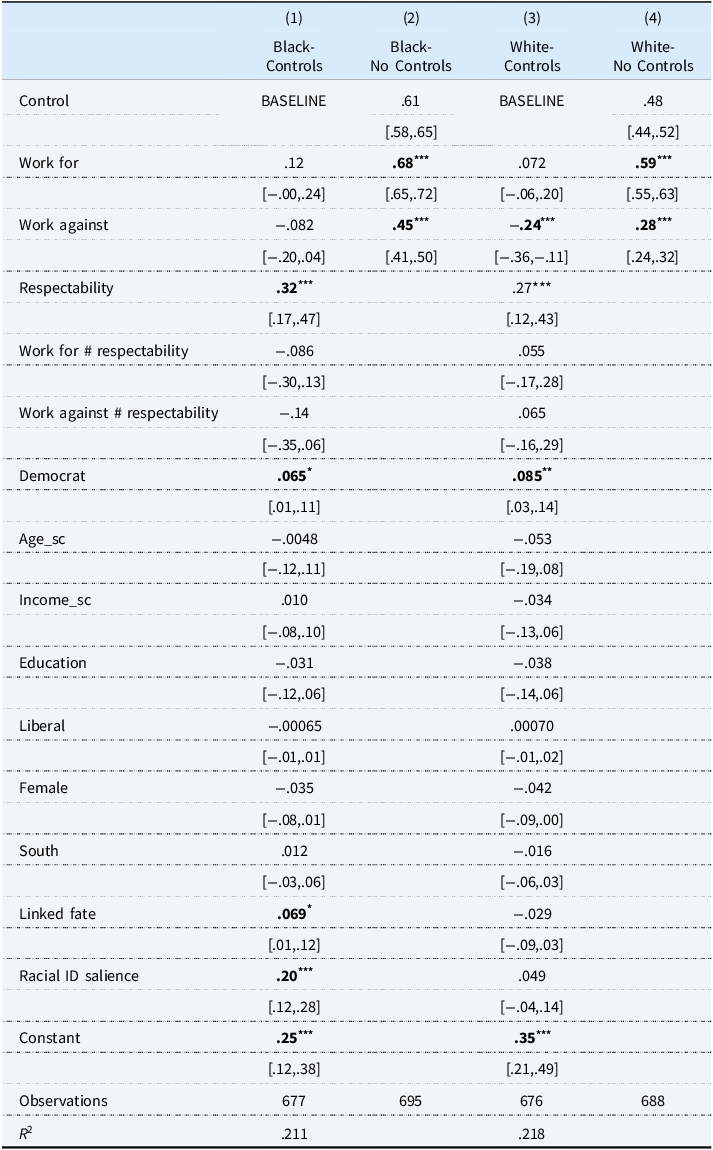
Regardless of the condition they are in, when Black and White candidates make the exact same claims, Black candidates Figure 3 solidifies the finding that respondents offer the Black politician a higher baseline in their willingness to support him than those respondents who read about the White politician. These findings match with many of the assumptions drawn from existing work on descriptive representation that are rarely shown in contexts where Black candidates are not already in office. To further confirm the reality that support for in-group politicians should not be assumed, we see respondents’ willingness to support the politician is not consistently high for either the White candidate or his Black counterpart. Indeed, these results show that when a candidate, regardless of race, is perceived as working against the group’s interest by denying the allegations of racial impropriety in the hairstyle policy, he receives, relative to the control condition, lower evaluations. In the context of the Black candidate, this provides important information about the circumstances under which Black individuals’ evaluations of co-racial candidates can be diminished. It also suggests that while Black voters might, in fact, penalize Black political elites when they behave in ways that are not in-line with in-group expectations, there seems to be a certain degree of deference with which they are willing to show Black politicians, as compared to White politicians.
The experimental effect on respondents’ affective attachment to the candidate.

Average experimental effect on willingness to support Michael Williams by candidate race.

As we can see, in each condition, that respondents in each of the conditions were more likely to say that Williams met their expectations when he was presented as a Black man relative to when he was presented as a White man suggests that, all else equal, Black voters tend to hold in-group politicians in higher regard than their out-group counterparts, a finding that is consistent with existing work on descriptive representation (Tate Reference Tate2004).
The results presented in Figure 4 show a consistent pattern with respect to Black voters’ evaluations of the two candidates. To reiterate, in the control condition, Democratic Legislator Michael Williams neither endorsed nor rejected the policy in question, which held that students with dreadlocks would be unable to participate in commencement. In the “work for” condition, Williams is on the record stating that he did not support the policy, while in the “work against” condition, Williams expresses his support for the policy. In line with our expectations, a greater share of respondents in both “work for” conditions say that Michael Williams met their political expectations relative to those in the control conditions. On the other hand, respondents in both “work against” conditions were less likely to say that Michael Williams met their expectations, as compared to those respondents in the control conditions. These results present a clear trend: Irrespective of how Michael Williams was depicted racially, voters were more likely to say that he met their political expectations when he publicly disavowed the no-dreadlocks policy, as compared to when he did not take a stance one way or the other. Conversely, when Michael Williams expressed his support for the policy, respondents were more likely to say that he did not meet their political expectations, relative to when he presented himself as agnostic towards the issue in question. These results confirm our second hypothesis, which is that the directions of evaluations will be consistent across conditions, irrespective of how Williams is presented racially.
Respondents’ evaluations of whether Williams met expectations.

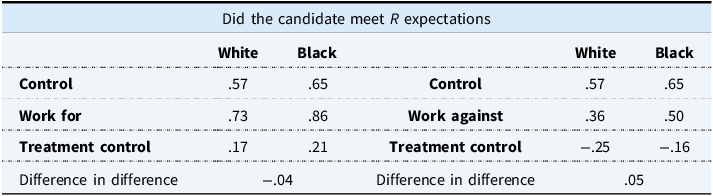
In order to gauge the relative “reward” that Michael Williams received for working on behalf of the group (and, later, the relative “penalty” for working against the group) we conduct a difference-in-differences analysis and find no meaningful differences in the magnitude of the rewards or punishment that the Black Michael Williams received relative to the White Michael Williams. Table 3 indicated that while it is true that a greater share of respondents (86%) stated that Michael Williams met their expectations when he was presented as a Black man, as compared to when he was presented as a White man (74 percent), the relative “reward” was not statistically significant. To determine this figure, we calculated the difference between the proportion of respondents who stated that Michael Williams met their expectations in the control group (66 percent when he was presented as Black, versus 57 percent when he was presented as being White) and the proportion of respondents in the “work for” condition who said the same (86 and 74). That amounts to Williams receiving a “reward” of 20 points for working for the group when he is presented as being a Black candidate, and 17 points when he is shown as White. We then calculate the difference of the two “rewards” (20 and 17 points), which shows that there is a net “reward” of 3 points in favor of the Black candidate. Once again, however, this difference was not statistically significant. These results suggest that while Black politicians enjoy higher baseline support among Black voters, all else being equal, it is not necessarily the case that they will receive a more generous “reward” for working for the ground, simply because of their race.
Characteristics of qualtrics sample & comparison general black population

3×2 Michael Williams’s political statement

Difference in difference analysis in whether the candidate met R’s expectations

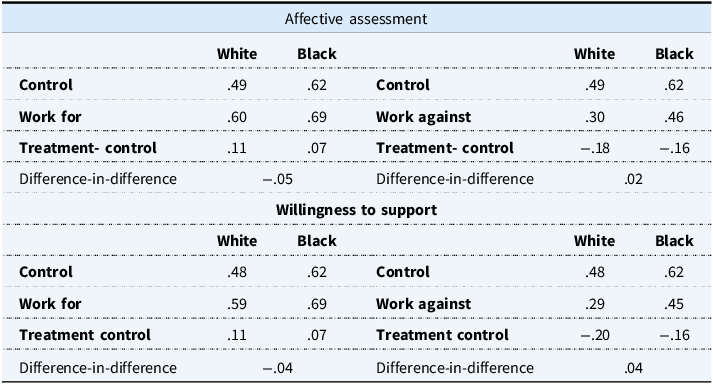
Difference in difference analysis in evaluations of black and white candidate

While these data suggest that Black voters might prefer in-group candidates to out-group candidates when both candidates are viewed as being politically similar, they also present clear scenarios under which descriptive candidates may not be preferred. More specifically, the results of the experiment show that Black voters might view out-group candidates (in this case, White candidates) more favorably than the in-group alternative when the latter is viewed as behaving in a way that is antithetical to the group, and the former behaves in a way that is amenable to the group’s interests. This finding underscores two important points. First, it suggests that there might be scenarios in which descriptive and substantive representation is in tension, even when partisanship is not a factor. If in-group candidates provide the former (descriptive representation) but not the latter (substantive representation), then conditions might be favorable for out-group candidates to make inroads with Black voters. Second, and relatedly, it captures the conditions under which Black voters might, in fact, be inclined to support White candidates. These findings call into question the prevailing assumption that Black voters will necessarily support an in-group candidate if given the opportunity to do so. Above all, however, it speaks to the political pragmatism of Black voters in that descriptive representation, while important, is not in itself enough for political elites to secure the support of Black voters (Wamble Reference Wamble2024).
Williams enjoys greater support among respondents when he is presented as being a Black man. More specifically, the number of respondents who answered that Williams met their political expectations when he expressed his opposition to the no-dreadlocks policy was greater when he was presented as being a Black man, relative to when he was shown to be a White man. The same trend holds for when Williams is shown as being supportive of the rule or, in other words, is viewed as working against the group. Although Williams’s evaluations are decidedly more negative when he is perceived as working against the group, Black voters lend more support when he is shown as a Black man.In-Group Preference Tested: Difference-in-Difference Analys
So far, the results clearly indicate that while Black people prefer in-group representation, this preference is not fixed. In certain situations where Black politicians are seen as working against the group’s interests, and White politicians are seen as working for the group, the presumed strong desire for in-group representation diminishes. However, questions remain about whether the effect of being perceived as working for or against the group is influenced by the race of the candidate. Put another way, do Black politicians receive a greater reward for working for the group than White politicians do? Conversely, is the punishment White politicians face for working against the group greater than that faced by Black politicians?
To address this, the results from a difference-in-difference analysis, shown in Tables 3 and 4, provide clear evidence. In terms of respondents’ affective assessments of the politician and their willingness to support him, there is no meaningful difference in the effect of the candidate’s race on the reward or penalty they receive based on their stance on the hairstyle policy. In short, this means that while Black people may have a strong baseline preference for Black politicians, Black politicians are not significantly more likely to receive overly positive evaluations for supporting policies that align with the group’s interests, such as calling out prejudicial behavior, than White politicians are for doing the same.
This finding is important because it challenges assumptions about how Black people assess politicians. While there is a clear and consistent preference for Black politicians, they are not rewarded more than their White counterparts for simply doing what the group expects. This contributes to our understanding of the limits of descriptive representation by highlighting the pragmatism of Black voters. Ultimately, what matters most is not the candidate’s race but their actions. While Black voters may prefer a Black politician, being Black does not automatically earn rewards that haven’t been earned, nor does being White result in automatic penalties for opposing the group’s interests. Black voters are equitable in their assessments, even when they prefer one candidate over another.
Conclusion & Discussion
The question this paper seeks to answer is found in the title of this work – Does it Matter if a politician is Black or White? The answer presented here is both yes and no. One of the primary assumptions in the literature on descriptive representation is that Black people have a much stronger in-group preference for Black representatives than for White ones. Generally, scholarship finds that, relative to their White counterparts, Black individuals are more likely to support, feel represented by, and feel empowered by same-race representation. However, numerous anecdotes challenge this assumption, revealing that it does not consistently predict Black political behavior. Drawing on newer research that highlights the nuance and strategic thinking among Black voters, this study explores the boundaries of the assumptions presented in descriptive representation literature.
These findings have significant implications for how we understand descriptive representation. While much of the literature has concentrated on the symbolic and motivational power of shared identity, this study uncovers a more nuanced and strategic calculation at play. Black voters do not uniformly support co-racial candidates; rather, they actively evaluate whether candidates, regardless of their race, exhibit a genuine commitment to the interests of the Black community. The extent of the observed effects indicates that perceived group advocacy can significantly influence candidate evaluations, sometimes even overshadowing the anticipated advantages of shared identity. These results challenge the idea that shared identity alone ensures political support and encourage scholars to reevaluate how representation operates in racially diverse electoral contexts.
Using an experimental test, we find that the support suggested by existing literature for Black representatives from Black voters is not absolute. Instead, it is contingent on the belief that Black representatives will work for the group more effectively than White politicians. In contexts where Black voters perceive that a Black politician does not prioritize the group, they are less inclined to support them and more inclined to support a White politician who is perceived to be working for the group. This finding is a significant contribution to the field of descriptive representation, as it shows that while there is strong evidence of in-group preference among Black voters, this preference has limits. These limits are tied to the desire for effective representation, which does not always align with selecting candidates who simply look like them.
This insight provides a stronger context for understanding why politicians like Steve Cohen, John Ossoff, and Joe Biden have been selected by Black voters, sometimes over Black politicians. Even within the ranks of Democrats, Black voters seek to optimize their representation by choosing politicians not just based on racial identity but on their perceived commitment to working for the group. Moving forward, it is important to consider this dynamic in analyzing Black political behavior, as race is often oversimplified in existing scholarship. This oversimplification leads to assumptions about Black voters that suggest a lack of sophistication, when, in reality, Black voters are extremely strategic and intentional in their choices, paying attention to specific information that allows for a deeper understanding of their behavior.
This work also underscores the importance of experimental methods, as observational data does not allow for a meaningful assessment of this dynamic. Observational studies typically focus on politicians who have already been elected, making it difficult to identify the mechanisms driving Black voter support. Our findings also indicate that Black voters do not make strong distinctions between Black and White candidates, suggesting that even the presumption of in-group favoritism has its limits. While Black politicians may initially be given the benefit of the doubt, the experimental treatments show that being perceived as working for or against the group significantly impacts how these candidates are evaluated. In other words, being Black does not automatically boost a politician’s evaluation or support in terms of their policy positions relative to White individuals.
Overall, this paper provides strong evidence that Black voters, like most voters, simply want politicians who will effectively represent their racial group in the ways they desire. While race is an important factor, it is not the sole determinant, and merely resembling Black voters is insufficient to gain their support. More is required, and Black voters will work to ensure that, regardless of a politician’s race, they are the kind of representative that aligns with their interests.
Funding statement
The manuscript being submitted did not receive any external funding but was paid for using my research funds from the Department of Political Science at George Washington University.
Appendix A
Models that correspond with Figure 1. Average Experimental Effect on Perceptions of Candidate’s Commitment to the Black Community

Columns 1 and 3 are OLS coefficients; Columns 2 and 4 are means.
95% confidence intervals in brackets.
* p <.05, ** p <.01, *** p <.001.
Models that correspond with Figure 2. The experimental effect on respondents’ affective attachment to the candidate

Note: Columns 1 and 3 are OLS coefficients; Columns 2 and 4 are means.
95% confidence intervals in brackets.
* p <.05, ** p <.01, *** p <.001.
Models that correspond with Figure 3. Average experimental effect on willingness to support Michael Williams by candidate race

Note: Columns 1 and 3 are OLS coefficients; Columns 2 and 4 are means.
95% confidence intervals in brackets.
* p <.05, ** p <.01, *** p <.001.





 Open access

