




The COVID-19 pandemic has increased the state’s direct participation in the governments of regions in decentralized states. However, despite extraordinary circumstances, the Catalan and Scottish governments kept pro-independence parties in office as a result of regional elections in 2021. The Catalan and Scottish regional elections in 2021 confirmed pro-independence regional governments. First, the Scottish National Party (SNP) retained its leadership by adding one seat to their previous results, and the Scottish Greens received two additional seats. The SNP and the Greens won 72 of the 129 seats in parliament, and for the first time in post-devolution Scotland, two parties agreed on a pro-independence coalition. It is worth mentioning that despite the COVID-19 pandemic, voter turnout in the Scottish election reached 63.5%, the highest ever for a Scottish Parliament election. Second, three political forces in Catalonia emerged as leaders in 2021: the Socialist Party of Catalonia with 33 seats (23.04%), the ERC (in English, Republican Left of Catalonia) with 33 seats (21.3%), and Junts (in English, Together for Catalonia) with 32 seats (20.04%). After tough negotiations, the ERC and the Junts formed a pro-independence coalition government with the support of the Popular Unity Candidacy (CUP).
In recent years, nationalist parties in Scotland and Catalonia have become more popular, as evidenced by the results of the general and regional elections of the last decade. Catalonia evidenced an increase in the popularity of regionalist parties after 2010 and until the outbreak of the COVID-19 pandemic. Since 2010–2012, Catalonia has experienced a shift toward secessionist positions, particularly after the Convergence and Union (CiU) party transitioned to supporting independence. As a result, the Catalan nationalist camp has been dominated by regionalist-independentist forces, including the CiU, ERC, the CUP, and then Junts. In 2010, the CiU minority government came to power in Catalonia, and two years later, it officially adopted a pro-independence stance. This shift was reflected in the composition of the Catalan Parliament in 2012 and 2015, which were dominated by pro-independence forces. In 2015, the general result for nationalist parties in regional elections was more than 45%. Together with the autonomist Democratic Union of Catalonia, nationalist forces collectively received around 50%. In 2017, despite the relative majority obtained by the unionist party Ciudananos (in English, Citizens), the regionalist parties came together to form the government. In the 2017 regional elections, nationalist forces received more than 45%, and in the 2021 regional elections, for the first time in history, they won more than 50% of the vote.
At present, the Scottish nationalist camp consists of the SNP, the Alba Party, and the Scottish Green Party. At the same time, the SNP occupied and continues to occupy a hegemonic position in this camp. SNP is the main political actor in Scotland, stimulating debate about the region’s independence. This is a center-left party advocating the separation of Scotland from the UK. The SNP became the leading political force in Scotland in 2007 when it won a relative majority in regional elections for the first time in history and formed a minority government for the first time. In 2011, the party won the absolute majority of seats in the Scottish Parliament. The 2016 and 2021 regional elections have confirmed its dominant role in Scottish politics, even though it has needed the support of the Scottish Greens to have a majority in parliament.
It is worth highlighting that 2021 electoral campaigns took place under unique conditions, as the COVID-19 pandemic has affected how parties have interpreted their anti-COVID measures in their main policy domains. This research focuses on the strategies used by regionalist parties to achieve electoral success and how such strategies produce this outcome. In other words, our research concentrates on A) which strategies were used by regionalist parties; B) what factors influenced their strategic choices and how the critical event (COVID-19 pandemic) affected them; and C) how these strategic choices produced the creation of regionalist party coalitions. This study analyzes the two dimensions of party competition (territorial and economic), focusing on party positioning, selective emphasis, and framing of their economic and territorial demands.
The novelty of our study is manifold. First, we used the materials of two elections and electoral campaigns that have not yet been studied (2021). These elections took place in the same year under similar circumstances (the COVID-19 pandemic). These circumstances theoretically should complicate the strategic choices of regionalist parties because the central state increased its role in managing regional territories, which is why the radical territorial demands (independence) have unlikely to be salient due to the “rally around the flag” effect (Baekgaard et al. Reference Baekgaard, Christensen, Madsen and Mikkelsen2020). On the contrary, the electoral programs of regionalist parties had clear demands for independence, and based on these demands, they formed post-electoral coalitions. In the Scottish case, it happened for the first time in post-devolution history.
Second, we focus on the content analysis of manifestos and media electoral campaigns; for example, the content analysis of manifestos was conducted through several datasets and approaches, including FraTerr (Elias et al. Reference Elias, Basile, Franco-Guillén and Szöcsik2021), Ethnonationalism in Political Competition (EPAC; Zuber and Szöcsik Reference Zuber and Szöcsik2018), and the Regional Manifesto Project (Alonso, Gomez, and Cabeza Reference Alonso, Cabeza and Gómez2013). In this research, we use the Regional Manifesto Project to understand the position and saliency of regionalist parties, which are part of the larger strategic toolbox. To understand issue framing, this research analyzes the electoral campaigns of regionalist parties with an emphasis on framing the territorial and economic dimensions of electoral speeches. In other words, we synthesize the content analysis of manifestos and electoral campaigns to confidently define the strategies of regionalist parties.
Third, we contribute to the discussion with supporters of the approach whereby regionalist parties tend to use a two-dimensional strategy in their political competition (Alonso, Cabeza, and Gomez Reference Alonso, Cabeza and Gómez2015).
This article is organized as follows. First, we review the relevant literature on the conceptualization of regionalist parties and party competition. Second, we introduce an analytical framework for studying these strategies. Finally, we present the results of case studies. Then, we compare the results in the discussion section and draw a general conclusion on the parties’ strategies and the factors influencing them.
Literature Review
This study relies on the conceptualization of regionalist parties in more general terms. Regionalist parties (RPs) are considered a manifestation of the political will of the periphery to represent their forces in the state system (Massetti and Schakel Reference Massetti and Schakel2015, 866). In this regard, the critical issue for such parties is the promotion of the territorial dimension and the requirement for a greater degree of self-government. RPs can be conceptualized as a type of political party that exists only in a state’s particular sub-territory and sets up the protection of its region as its core political objective (Massetti and Schakel Reference Massetti and Schakel2015).
Dandoy (Reference Dandoy2010) provided a typology of regionalist parties based on their self-government objectives. As such, he distinguished between protectionist, decentralist, and secessionist regionalist parties. Protectionist regionalist parties defend the separate identity of the region, including linguistic, religious, or cultural distinctiveness. They fight for access and participation in national political life and agree with the current state structure. Decentralist regionalist parties demand decentralization of the internal order of the state. They challenge the balance of power between center and region and seek more autonomous rights and powers within the state. Secessionist parties aim to part the region from the host state. Within secessionist parties, we find independentist parties, i.e., regionalist parties that want to establish an independent state within the borders of their region or territorial entity. Catalan (Junts and ERC) and Scottish (SNP and Scottish Greens) parties are regionalist-independentist parties.
Party competition is an imminent feature of the modern political system. Party competition is defined as “an institution in which parties strategically cooperate or contest as political actors to gain political power” (Franzman Reference Franzmann2011, 320). That is, any political party must decide whether to cooperate or compete. In the latter case, the political party must choose the right strategy to outplay its opponent.
Political parties contest and cooperate at different levels, especially in multidimensional political systems such as Spain and the UK. Terrière and Bouteca (Reference Terrière and Bouteca2021) delve into the political behavior of regionalist parties in office at the national level. The authors highlighted that the path to regional autonomy normally runs through the national political arena (Terrière and Bouteca Reference Terrière and Bouteca2021, 13). Yet using novel dataset that consists of a large sample of ministerial posts (N=1880), they came to the conclusion that the access of peripheral elites to the executive branch of the state apparatus is not a guarantor of policy success. In that sense, national level is important because regionalist parties may put pressure on national parties with the aim of staging confrontation with the state. However, their primary objective in party competition is to capture the office at the regional level, while actively advocating for regional autonomy and challenging the authority of the state in order to protect regional interests.
The conceptualization of party competition at the regional level with RPs provides an outbidding model, where outbidding competitions set up ethnicity as a reference category of exclusion (Chandra Reference Chandra2005). In these terms, ethnic parties install the protection of a particular ethnic group as a core political objective and use “mobilizing strategies” by positioning themselves on the territorial dimension of politics (Zuber Reference Zuber2013, 760). According to this logic, ethnic parties try to maximize votes by taking the most radical position in the territorial dimension (Zuber and Szöcsik Reference Zuber and Szöcsik2015). However, the ethnic component as the reference category is rarely explicitly demanded by the RPs, which are eager to become mainstream parties at the regional level to obtain votes (Field Reference Field2016). This fact forces them to adopt territorial and economic strategies to fit regional demands better.
The existing territorial conflicts between Spain and Catalonia and the UK and Scotland have a clear national component (Sanjaume-Calvet and Riera-Gil Reference Sanjaume-Calvet and Riera-Gil2020; Brown Swan and Cetra Reference Brown Swan and Cetrà2020), the nature of which varies. On the one hand, Catalan political dynamics have been related to the ethnic outbidding model (Barrio and Field Reference Barrio and Field2018); on the other hand, state-wide parties in the UK rely on a plurinational conception of the British state, which implies a relatively flexible form of Britishness (Brown Swan and Cetra Reference Brown Swan and Cetrà2020). Scottish parties that favor independence concentrate on relative economic gains rather than ethnic exclusiveness (Elias Reference Elias2019). Both Catalan and Scottish societies are ethnically heterogeneous, which is also true for Spain and the UK; this is why the adjective “ethnic” in strict terms does not apply to these cases. Instead, the political nation is conceived as “a political subject open to the evolution and the reclassification of its identity attributes” (Sanjaume-Calvet and Riera-Gil Reference Sanjaume-Calvet and Riera-Gil2020, 88). In sum, the outbidding model helps to understand the dynamics of party competition at the regional level, although the ethnic component does not play a key role in defining the strategies of RPs, which are involved in outbidding competitions by position on the territorial dimension and in selective emphasis on territorial vis-à-vis economic domains.
The 2021 regional elections in Catalonia and Scotland have brought about a new context in party competition. The COVID-19 pandemic not only defined the mode of elections but also influenced electoral rhetoric. More generally, the COVID-19 pandemic falls into the critical event category, such as a drastic economic crisis, war, the threat of foreign invasion, and natural disasters. An event can be called “critical” if it is “contextually dramatic” and “often gets sustained coverage in the media” (Pride Reference Pride2002, 161). Critical events stimulate national governments to adopt centralized policy measures to tackle these events (Sanjaume-Calvet and Grau Creus Reference Sanjaume-Calvet and Creus2021).
General literature suggests that the COVID-19 pandemic has complicated the territorial demands of pro-secessionist political forces. First, it has created opportunities to reinforce state nationalism due to the “rally around the flag” effect (Baekgaard et al. Reference Baekgaard, Christensen, Madsen and Mikkelsen2020). Second, states have preferred centralized management of the pandemic, and, subsequently, the central state has increased its power in the regionalized territorial model (Sanjaume-Calvet and Grau Creus Reference Sanjaume-Calvet and Creus2021). Third, the pandemic has created a window of opportunities to increase the counter-secessionist politics linked to it (Parker Reference Parker2020). This means that RPs should consider the COVID-19 dimension in their electoral strategies. The conceptualization of political parties’ strategic choices comes from spatial and salience theories. In short, spatial theory expects parties to take part in a contest by positioning themselves on political dimensions (Downs Reference Downs1957), while salience theory adds the possibility for them to make a selective emphasis on political issues to contest each other (Riker Reference Riker1986). Decentralized systems complicate the strategic behavior of political parties because they challenge them to coordinate party actions across levels of governance (Stefuriuc Reference Stefuriuc2009). Apart from the national level, these systems have a regional level, where party competition is also important. To describe this distinction, Hepburn uses the metaphor of a small world, stipulating that
These small worlds have distinctive party systems reflecting the efforts of regional parties to reflect the electorate’s values. However, there are also differences resulting from the structure of the states in which the “small worlds” are embedded, the capacity of the region to legislate, and the dominance of political ideologies. (Reference Hepburn2010, 528)
RPs do not always concentrate exclusively on territorial demands. To place sufficient electoral pressure on competitors (especially on established, state-wide parties), RPs expand their electoral appeal and talk about other issue dimensions (Elias Reference Elias2019, 4). In particular, strong pressure is placed on the economic dimension; consequently, RPs are forced to compete on two dimensions: territorial, which is the principal, and economic, which is critical for competing parties in elections (Elias Reference Elias2019).
Classical theories of coalition formation consider ideological distance in the economic dimension as a condition (Filipova Reference Filippova2021). Tronconi (Reference Tronconi2015) confirms that both policy dimensions matter: the smaller the distance between parties on the center-periphery and left-right axes, the more chances there are to make a coalition. Coalition potential may depend on the type of government (minority or majority). If an RP has a majority government at a regional level, it is less likely to make a coalition, whereas a minority government increases this possibility because the RP needs support to realize its agenda (Field Reference Field2016). Regionalist parties emphasize the territorial dimension over the economic. This is why territorial preferences are key for regionalist parties to agree to a coalition. However, the economic dimension proximity also plays a role in coalition formation, as Tronconi (Reference Tronconi2015) notes.
Elias, Szöcsik, and Zuber (Reference Elias, Szöcsik and Zuber2015) theorize RPs’ electoral strategy choices. In the context of competition in more than one dimension, RPs have a strategic toolbox consisting of issue positioning, selective issue emphasis, and issue framing. Issue positioning expects parties to assume controversial positions on a given issue. Issue emphasis refers to prioritizing an issue that is more favorable to them and downplaying those that are less favorable. Issue framing expects parties “to frame a new issue in terms of the ideological dimension that is most important to them or which they can lay the strongest claim to ‘own’” (Elias Reference Elias2019, 5). Combining all the tools, Elias, Szöcsik, and Zuber (Reference Elias, Szöcsik and Zuber2015) elaborated on four strategies: a one-dimensional strategy by which parties selectively emphasize and position their core dimension and ignore the economic one; a blurring strategy, which adopts contradictory positions on the secondary economic dimension; a subsuming strategy, by which parties frame economic issues in core territorial terms; and a two-dimensional strategy, when a party simultaneously emphasizes territorial and economic dimensions (Elias, Szöcsik, and Zuber Reference Elias, Szöcsik and Zuber2015, 844–846). The theoretical literature suggests that the competition structure and previous electoral experience define the strategic choices of regionalist parties (Elias Reference Elias2019).
First, the presence of a strong regionalist competitor should theoretically radicalize territorial demands and lead to clear issue positioning and saliency of territorial demands (Zuber Reference Zuber2013). However, regionalist parties may avoid paying too much attention to claims for more regional authority in their programs. Second, if the party’s strategic choice brought about electoral success in previous elections, the regionalist party is expected to use it again.
Analytical Framework
This research explores how episodes in which the central state rapidly expands its policy-making powers vis-à-vis substate units affect the electoral strategies of regionalist parties. The pandemic is one example of a critical event that changes the internal balance of power between the central state and substate units. One response would be that the critical event (COVID) forced regionalist parties to justify independence claims in socioeconomic terms where COVID arguments are used as an extension of these categories (H1).
Rovny (Reference Rovny2015) argues that the issue structure of the political space in which political parties compete can constrain their strategic choices. While parties try to influence the issues being contested in an election through their strategic actions, they must also operate in a context where some issues are deemed more important than others (Elias, Szocsik, and Zuber Reference Elias, Szöcsik and Zuber2015). Socioeconomic argumentation (conceptualization derived from Elias et al. Reference Elias, Basile, Franco-Guillén and Szöcsik2021) allows linking the economic and territorial positions of regionalist parties. This line of argumentation gives the possibility of framing independence as a necessary step in resolving socioeconomic problems. This argument coincides with the anti-center rhetoric, which the region should blame for economic problems. The COVID-19 pandemic has amplified this line of argument. In that sense, the critical event as a COVID-19 pandemic changes the electoral strategy of regionalist parties, requiring it to include the COVID-19 issue into their territorial and economic claims.
On the other hand, this research expects some continuity in the strategic choices of regionalist parties, even in the face of critical events. For example, factors such as the competition structure and previous electoral background should still play a role in defining strategies (Elias Reference Elias2019). Moreover, the regionalist parties’ coalition potential is shaped by their proximity to the territorial domain (Tronconi Reference Tronconi2015).
Another proposition on the strategic choices of regionalist parties is to deal with their electoral background and ideological position. Based on the theoretical literature, H2: Subsuming strategy is used in center-oriented parties with a strong electoral background while the two-dimensional strategy is used by flank parties with a minor electoral background.
Center-oriented parties stay close to the center in terms of economic demands. These parties balance their economic demands between left and right positions. Having a strong electoral background, these parties are forced to be cautious in radicalizing their economic demands because they want to stay in the mainstream at the regional level, especially if a party is in the government (Elias and Mees Reference Elias and Mees2017). Flank parties take clear left or right positions in the economic domain. Being minor in electoral competition, these parties experience less electoral pressure and have more room to adopt a clearer and more radical stance in both economic and territorial domains. Subsuming strategy is set in the middle between two-dimensional and blurring strategies, and it is expected that subsuming or blurring strategies are likely to be adopted by the more center-oriented parties (Massetti and Schakel Reference Massetti and Schakel2015).
Methods and Research Design
The analysis of parties’ manifestos is done using the Regional Manifesto Project (RMP) approach (for an explanation of the approach, see the Appendix), which allows measuring the selective emphasis and positioning of RPs using the content of their electoral programs (What is the RMP? 2021). The RMP is not the only approach to examine the positioning and framing of RPs. The FraTerr dataset evaluates the territorial demands of RPs and how they are framed (Elias et al. Reference Elias, Basile, Franco-Guillén and Szöcsik2021), which uses the same scope of raw sources by concentrating on the qualitative analysis of parties’ manifestos. The results of our research were compared with the general findings of the FraTerr analysis for robustness purposes.
The operationalization of position, salience, and blurring allows the researcher to identify political parties’ strategies. The one-dimensional strategy defines the situation when the regionalist party gives saliency mainly to the territorial dimension, setting aside the economic one (Elias, Szöcsik, and Zuber Reference Elias, Szöcsik and Zuber2015). The two-dimensional strategy clearly defines the RP’s position along the economic and territorial scales, giving importance to these two dimensions (Elias, Szöcsik, and Zuber Reference Elias, Szöcsik and Zuber2015). This blurring strategy implies that the regionalist party adopts a blurred position along the economic dimension. Following the approach of Alonso, Cabeza, and Gomez (Reference Alonso, Cabeza and Gómez2015), the blurring of the position on the secondary dimension exists when the indicator is below 0.5. The regionalist party emphasizes both dimensions in the case of a 20–80 proportion ratio between economic and territorial dimensions. When this proportion is not reached, the regionalist party ignores the secondary dimension (Alonso, Cabeza, and Gomez Reference Alonso, Cabeza and Gómez2015, 863). The operationalization of the subsuming strategy requires a qualitative rather than a quantitative approach. Elias, Szöcsik, and Zuber (Reference Elias, Szöcsik and Zuber2015, 845) define this strategy as framing issues associated with the second dimension in core dimension terms. For RPs, economic issues are framed in terms of national identity discourse, which represents “the concrete argument used by political actors to define, represent, and justify their position on a specific dimension” (Basile Reference Basile2015, 890).
The analysis of issue framing is conducted inductively by examining the content of The Herald and La Vanguardia newspapers to understand how RPs frame their agenda in the media. In order to analyze the electoral campaigns, these sources should be daily, comply with quality newspaper standards, and have a decent circulation in respective regions. The Herald and La Vanguardia are two well-known daily regional newspapers frequently cited in academic literature as a source of factual political information (see Elias Reference Elias2019 and Dekavalla Reference Dekavalla2016 for The Herald; and Basta and Barrio Reference Basta and Barrio2023 and Portos Reference Portos2020 for La Vanguardia). La Vanguardia had the highest readership in Catalonia at the end of 2020 (CEO 2020). The Herald is also among the most-read newspapers in Scotland (Eurotopics 2023). The content was summarized into frame categories, which are similar to the conceptualization of RMP (Table 1). This convergence allowed us to empirically link the analysis of issue positioning and selective emphasis from manifestos with issue framing from electoral campaign rhetoric. Several frames are identified.
Frames of electoral campaign rhetoric
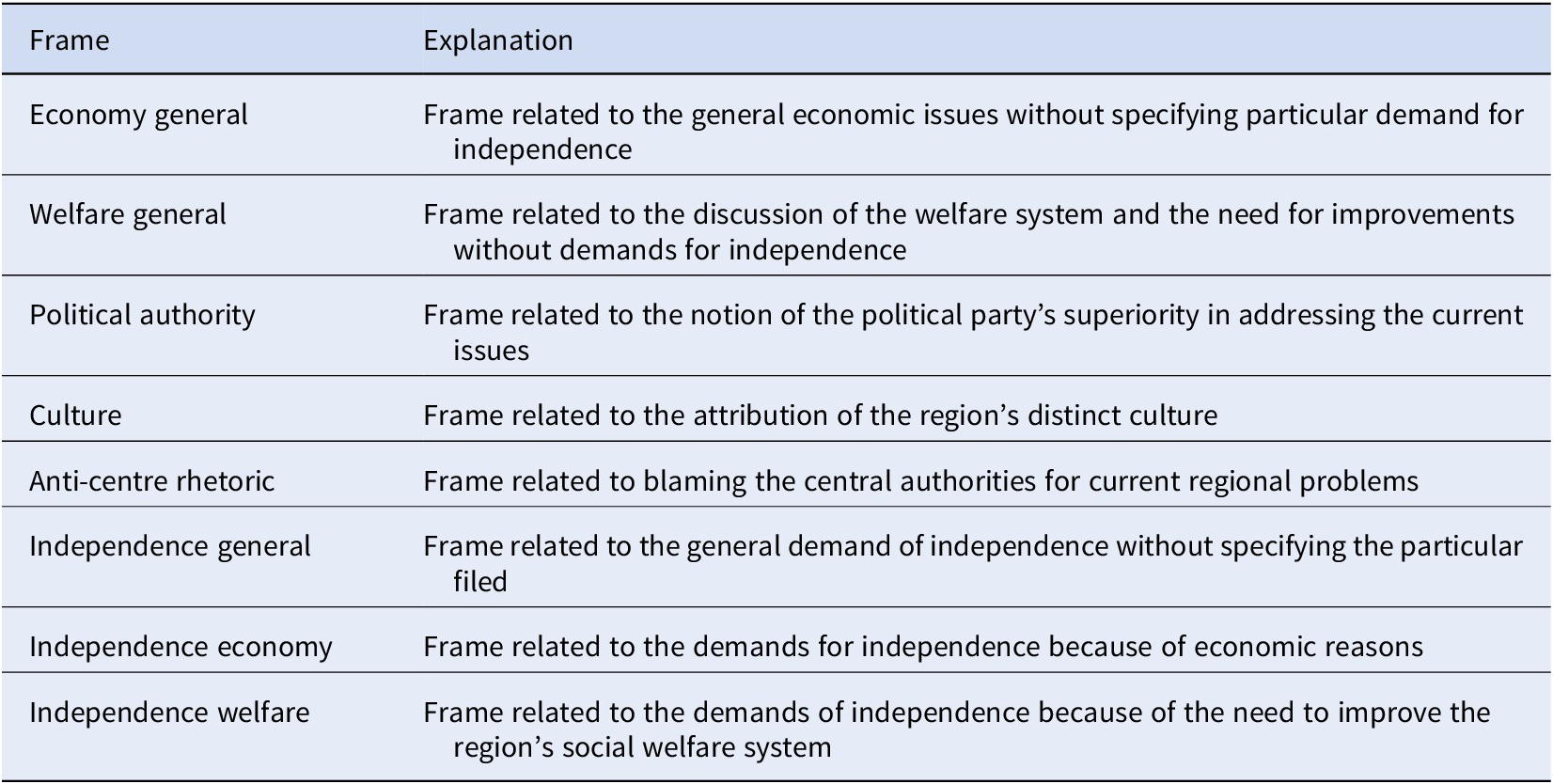
Our timeframe includes the period from the beginning of the electoral campaigns in Scotland and Catalonia. In Catalonia, the electoral campaign began on January 29, 2021, in Scotland on March 25, 2021. In general, we have analyzed 4 manifestos using the Regional Manifesto Project (RMP) approach. We analyzed 216 newspaper articles for the Scotland case and 103 for the Catalonia case.
The coding process for both manifestos and media content was performed by independent coders; at least two specialists independently performed the content analysis of the same document, and the inter-coder reliability was higher than 80%. During the final revision, all inconsistent codes were discussed to develop common ground. The coded manifestos of the Catalan parties were received directly from the RMP researchers.
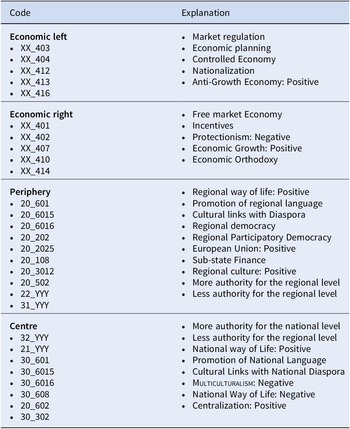
Table 2 lists the codes assigned to a particular category or dimension. Compared with Alonso, Cabeza, and Gomez’s (Reference Alonso, Cabeza and Gómez2015) approach, some modifications were made. The left economic dimension was enriched with the “Anti-Growth Economy: Positive” code. The idea of an anti-growth economy is that economic growth can cause environmental or social harm, whereas sustainable economic growth fits the left-wing ideological stream (Guinan and O’Neill Reference Guinan and O’Neill2019). Alternatively, the “Economic Growth: Positive” code was added to the economic rights dimension.
References of the codes and positioning
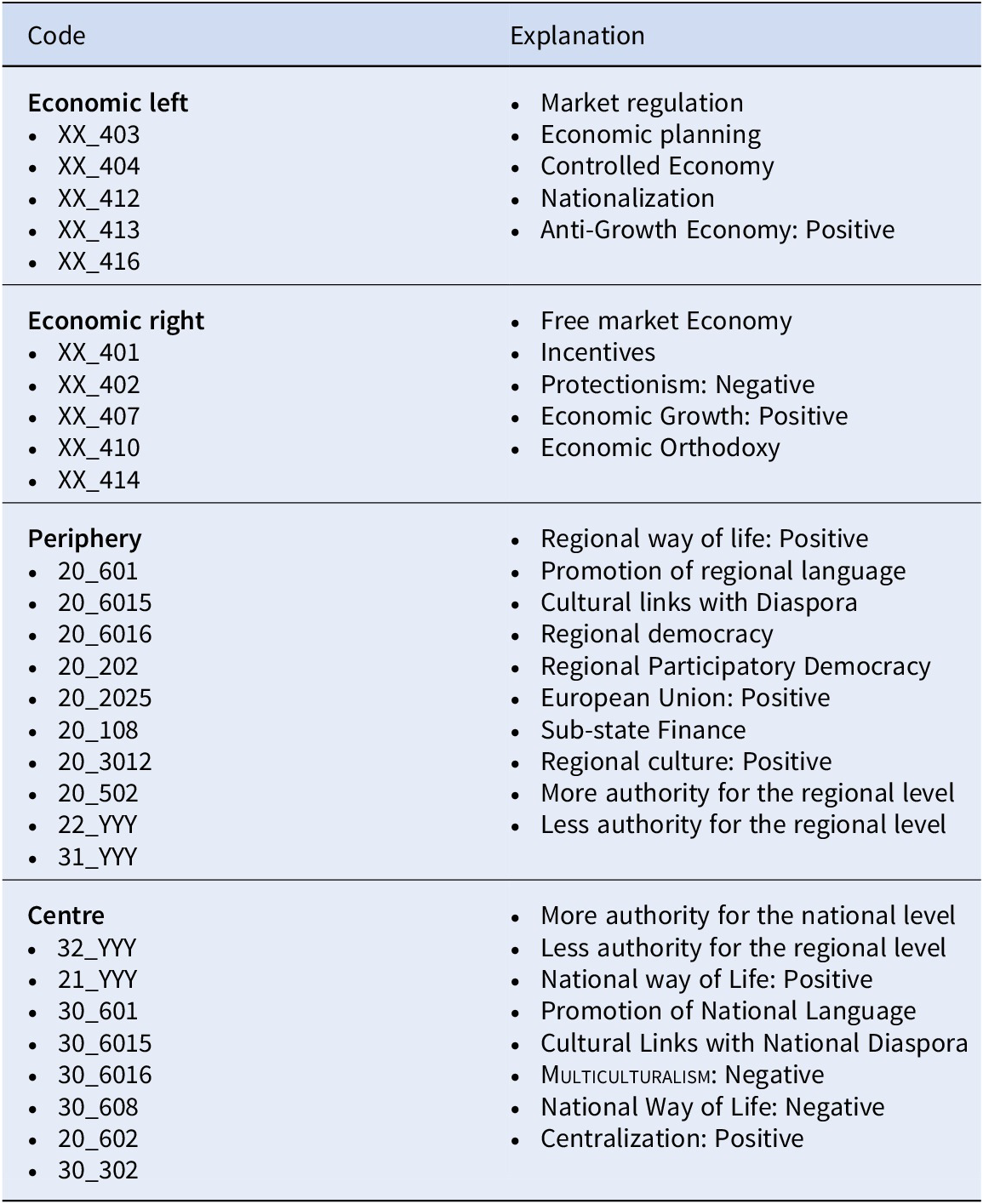
Source: Alonso, Volkens, Cabeza, and Gómez (Reference Alonso, Volkens, Cabeza and Gómez2020).
Considerable changes were made to the peripheral dimensions. “Regional democracy” and “Regional Participatory Democracy,” as well as “Sub-state finance,” enlarged the periphery dimension. The Catalan and Scottish RPs supported the idea of an independence referendum and additional regional powers, including economic powers. Finally, “Regional Culture: Positive” defends the funding of cultural and leisure facilities and encourages cultural mass media and worthwhile leisure activities. The support of cultural infrastructure and activities promotes regional culture and is part of peripheral rhetoric.
The analysis of the manifestos’ results revealed three indicators: the saliency of the territorial and economic dimensions, the positioning of the party on both dimensions, and the blurring of the dimension. If parties blur on the secondary dimension, the analysis of public electoral campaigns helps distinguish between blurring and subsuming strategies.
The Catalan and Scottish cases represent a widely reliable sample for studying regionalist party strategies. First, these regional elections allow an analysis of the impact of COVID-19 on the strategic choices of political parties. Second, these cases were reliable for comparative purposes. The Catalan case demonstrates strong competition between two regionalist parties that ended up with a coalition. In contrast, the Scottish case represents the dominant regionalist party competition against state-wide parties, which ended up with a coalition with a minor regionalist party. An intra-case comparison was conducted to understand the structure of the competition.
The selection of the regionalist parties for this study was straightforward. ERC and Junts are the strongest regionalist parties in Catalonia, which finally formed a regional government. The SNP and Scottish Greens are two regionalist parties that also succeeded in forming a coalition government. In both cases, there were more regionalist parties to take part in elections, but the final result was the main criterion to choose parties for analysis.
The Catalan and Scottish cases have received considerable attention in the literature on secessionism in Europe, especially in the light of party competition (Sanjaume-Calvet and Riera-Gil Reference Sanjaume-Calvet and Riera-Gil2020; Elias Reference Elias2019; Cetra and Harvey Reference Cetrà and Harvey2019), and they are two of the most prominent in the EU. Major RPs demanding independence obtained parliamentary majorities; in the recent regional elections, they confirmed their pro-independence stance, and the COVID-19 pandemic did not change the general line of their demands as well as the popular support for their programs. Catalonia and Scotland are interesting case studies that could be used to gain a more general understanding of party competition in liberal democracies, especially between parties with secessionist demands. These parties must compete with state parties to obtain electoral victory.
Scotland
The leading role of the SNP at the current stage was confirmed in 2007, when the party enjoyed the majority government for the first time in history. The territorial demand for independence remained at the core of their political agenda, and even after failing to win the 2014 independence referendum, their general line did not change drastically. The second life of this demand created Brexit. Generally, people in Scotland voted to remain in the EU, but the rest of the UK’s population decided to leave. This fact was addressed by the leader of the SNP, Nicola Sturgeon, to talk about “serious change in material circumstances” (Scottish National Party 2016, 23); in other words, she explicitly proclaimed the bid for a second independence referendum. The 2021 parliamentary elections in Scotland were seriously affected by the ongoing COVID-19 crisis, which also directly influenced the electoral campaign of political parties, as each party had to incorporate the COVID-19 agenda into their social, economic, and political dimensions.
Manifesto Analysis
In terms of the territorial dimension, both the SNP and the Scottish Greens put considerable pressure on the regional level (Figure 1). More than 80% of the total manifesto content is concerned with this level; however, neutral demand prevails within this category (Scottish Greens Reference Greens2021; Scottish National Party 2021).
Frequency of territorial code, the SNP, and the Scottish Greens
Source: Scottish National Party 2021; Scottish Greens Reference Greens2021

This observation is in line with an analysis of the manifestos of previous regional elections. The regional level is the main target for these types of elections; however, the manifesto should not be too radical to attract many voters. Most of the quasi-sentences refer to the regional level without explicit claims for more power.
Another similarity is the attention paid to the welfare category in the political dimension (Figure 2), which both parties have as the leading category in their manifestos. In the light of the COVID-19 crisis, this positioning seems like a predictable response; in particular, the social dimension is problematic to the extent that the parties considered in the analysis are not “right,” judging by the social dimension, but left. This thesis is confirmed in a study by Benoit and Daubler (Reference Däubler and Benoit2022), where it is noted that the welfare category contributes much less to distinguishing between left and right parties. The social dimension is a valence category, rather than one of positioning, in the ideological spectrum (Alonso, Cabeza, and Gomez Reference Alonso, Cabeza and Gómez2015, 863).
Accumulated share of the political dimension, the SNP, and the Scottish Greens
Source: SNP Manifesto 2021; the Scottish Greens manifesto Reference Greens2021

The structure of the manifestos shows the similarity between both parties. Welfare, the Economy, and Social Groups occupy the first three places in the manifestos in terms of frequency, which confirms the intention to play on social issues.
Table 3 summarizes the results of saliency and party positioning analyses. The SNP and Scottish Greens consider the territorial domain a more salient issue, and the manifestos confirm a clear pro-periphery stance. The analysis failed to find any reference to pro-center demands in either case.
Analysis of electoral manifestos, SNP, and Scottish Greens
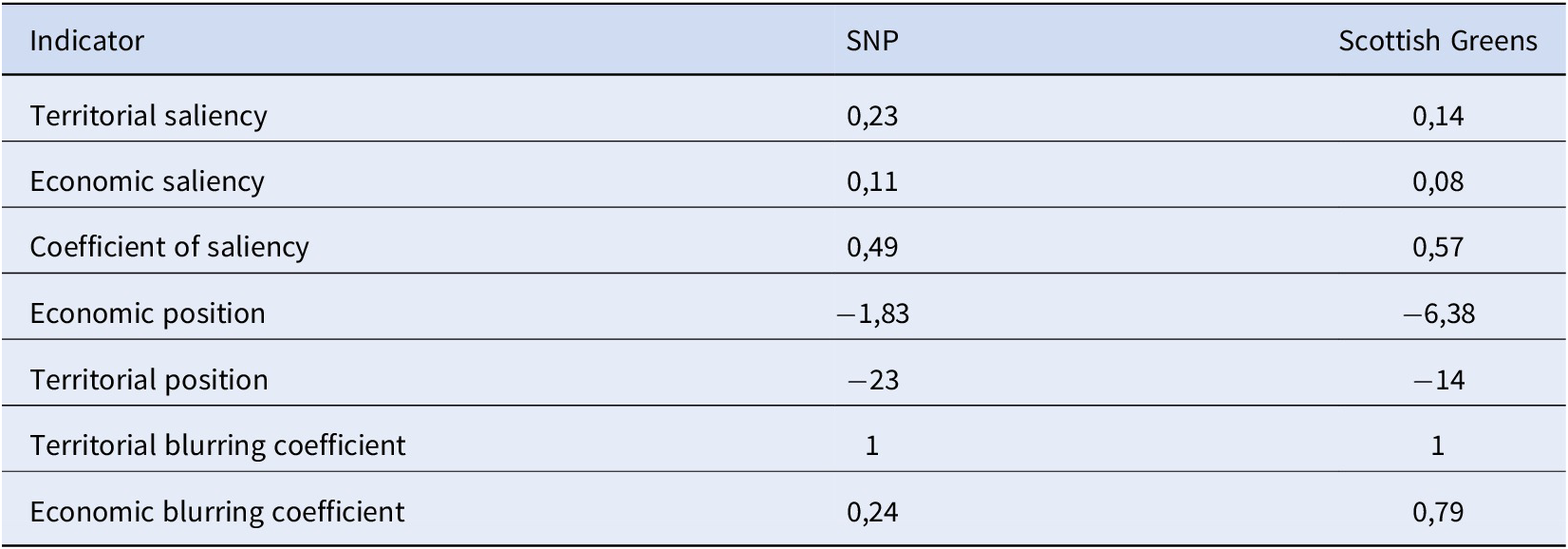
Source: SNP electoral manifesto 2021; Scottish Greens electoral manifesto Reference Greens2021.
The economic dimension of the SNP manifesto is split between right and left positions. The left economic claims are slightly outreach the counterclaims; however, such a small margin allows us to argue that the SNP blurs on the economic scale because the indicator of the difference between the right and left economic scales reaches only 0.24. The economic position of Scottish Greens differs from that of the SNP stance. Despite having the left position as the SNP, the Scottish Greens manifesto shows a much clearer vision because of the left-wing quasi-sentences vis-à-vis the right-wing ones. In sum, the manifesto analysis conceptualizes that the SNP gives more saliency to territorial demands; it has a clear pro-periphery position and blurs the secondary dimension. The Scottish Greens position themselves on both economic and territorial scales and give more salience to territorial demands.
The main similarity between the SNP and Scottish Greens lies in their bids for independence. Both parties argue for a second independence referendum as soon as the COVID-19 situation allows. It is not the first time these parties align on the matter – both parties were included in the “Yes” campaign leading up to the 2014 independence referendum. Environmental concerns occupied the leading space in both parties’ manifestos, with environmental protection leading to political demands in Scottish Greens’ manifestos. The SNP manifesto has this code as the second most frequent after the welfare state extension. The Scottish Greens pledged to prohibit oil and gas development, while the SNP adopted a slightly softer approach, claiming to accumulate oil and gas revenues to foster net transition.
However, issue positioning and salience are only part of RPs’ strategic toolbox. A variety of strategies is required to examine issue framing. Political parties may not only play the political game by clearly emphasizing the relevant dimension, but they also need to deal with the second dimension (the economic one), as the analysis shows. An analysis of issue framing should account for the recognition of RPs’ strategic choices.
Media Analysis of Electoral Campaign
The electoral campaign started on March 25, 2021, with the bid for independence framed as an anti-center rhetoric. The SNP and Scottish Greens clearly stated their desire for the independence referendum, and Sturgeon claimed that “the recovery should be in Scotland’s hands – not Boris Johnson’s’” (Bol and Gordon Reference Bol and Gordon2021, 4). Scottish Greens co-leader Harvie said, “For Greens, the purpose of independence is giving Scotland the ability to make the big economic choices about how we are going to invest in the future” (Rodger Reference Rodger2021, 5).
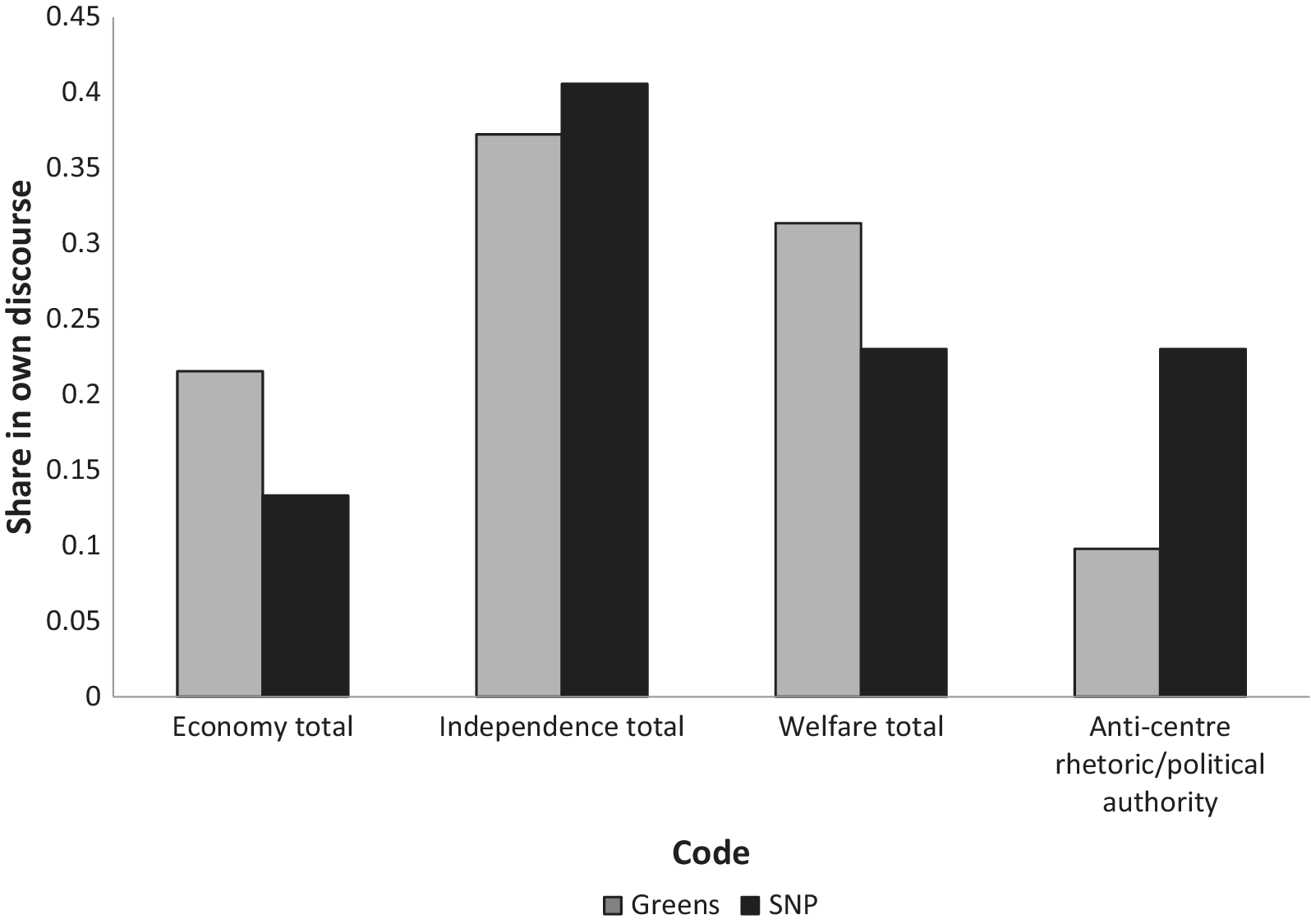
The frequency analysis of frames confirms that both the SNP and Scottish Greens concentrate on independence demands more than on other issues (Figure 3). In addition to the content analysis of manifestos, the structure of demand looks very similar. The only difference is that SNP plays a greater role in anti-center rhetoric than Scottish Greens.
SNP and Scottish Greens’ frames – general orientation
Note: Economy total and welfare total are equivalents of economy general and welfare general frames.
Source: Compiled by authors based on The Herald’s analysis
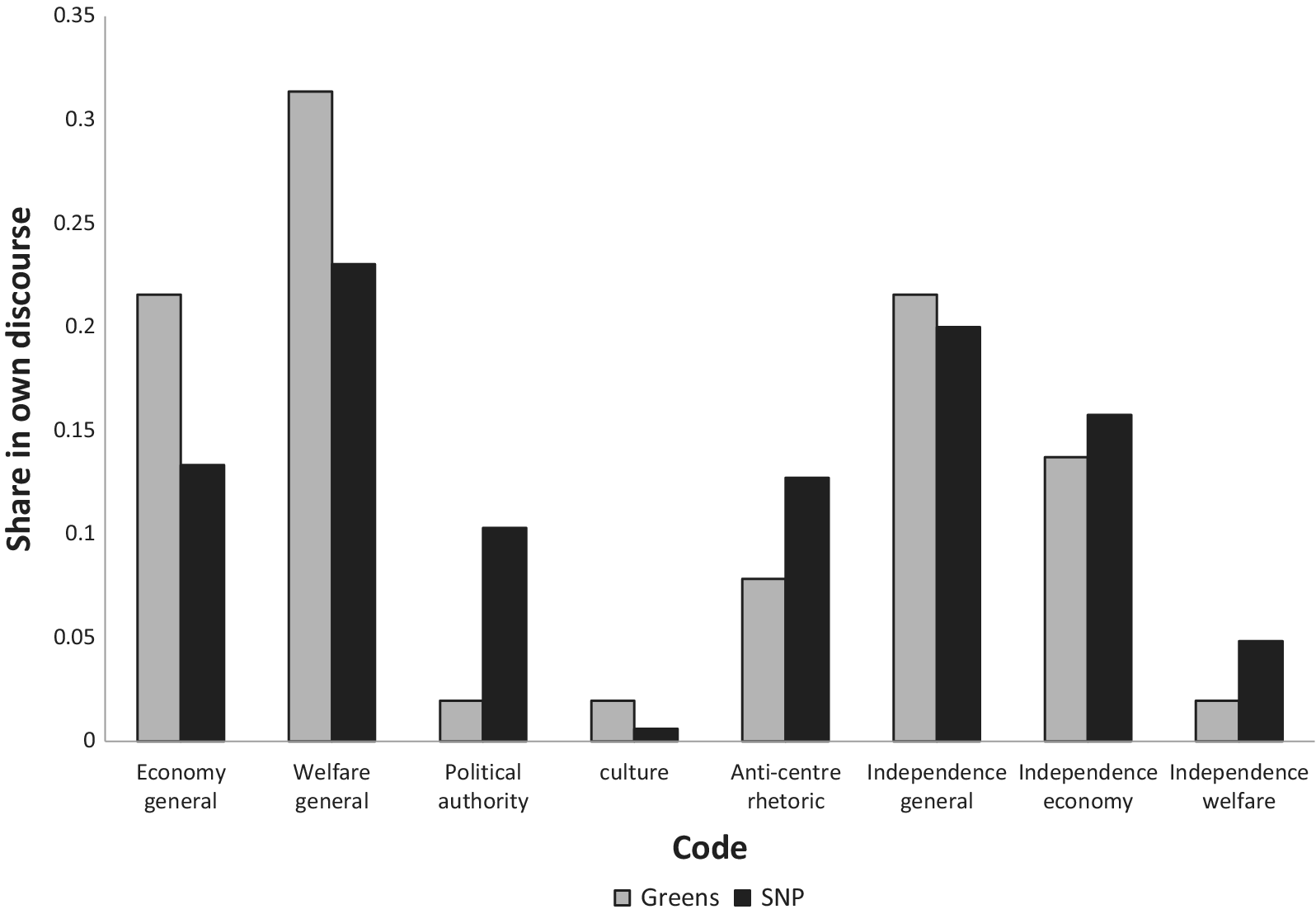
The composition of independence demands accounts for the understanding that the economic dimension is subsumed into territorial dimensions (Figure 4). The general demand for independence is followed by economic justification. Welfare demands dominate the discourse in the media as well as their manifestos; however, their role in the context of independence remains marginal.
SNP and Scottish Greens’ overall issue orientation, the proportion of frames
Source: Compiled by authors based on The Herald’s analysis
These results confirm that the welfare category is a valence. All parties predominantly demand “left” resolutions to the current problem, and the COVID-19 crisis has put even more pressure on political parties to pay attention to the welfare category. Sturgeon claimed that
It is time to end the scandal of child poverty and this will help do it. It is a down payment on what will be possible when we have the full powers over tax and social security that only independence can deliver. (The Herald Scotland 2021, 6)
This notion subsumes the welfare demand in a pro-independence line. Compared to general welfare demands, the subsumed frame remains weak. The SNP’s discourse strategy lies in the recognition of the welfare dimension’s non-radicalization; the SNP crystallized their left and pro-independence stance but decided not to give salience to it. The radicalization of the welfare category, especially in terms of the COVID-19 crisis, could undermine the independence line, and focusing on “left” welfare demands seems to be a more attractive strategy. Scottish Greens has adopted a similar approach. The visibility of their pro-independence welfare demands remains very low; in contrast, their general welfare demands occupy a central place in political campaigns.
The comparison of pro-independence and general economic demands confirms the importance of this dimension in political competition. The SNP’s independence economic demands outreach the general ones, while Scottish Greens’ discourse demonstrates their parity with a small margin in favor of general demands.
The SNP subsumed economic recovery into its pro-independence agenda. Sturgeon stated that “independence is not a distraction from recovery. It is essential to secure a recovery that is made here in Scotland” (Gordon Reference Gordon2021, 1). Scottish Greens has adopted a similar position. The co-leader of the Scottish Greens Harvie proclaimed, “For Greens, the purpose of independence is to give Scotland the ability to make big economic choices about how we are going to invest in the future” (Rodger Reference Rodger2021, 5).
The economic dimension became a battleground for demand for independence. Even between the SNP and Scottish Greens, the extent of economic scale differs. The Scottish Greens presumably adopted a more radical approach by stating that their “vision for independence is bolder than that of the SNP’s. Independence is not our endgame; we believe in creating a new, fairer, greener Scotland, and independence is only the first step” (Harvie Reference Harvie2021, 3). They attempted to present independence as an intermediate instrument for a better economic future. Similarly, the SNP considers independence a necessary step to ensure economic prosperity, with SNP member Kate Forbes stating that “the SNP will continue to argue for Scotland to have the full powers we need to build the kind of recovery and economy that we require” (Bol Reference Bol2021, 10). In both cases, independence is required to achieve a better economic future.
In summary, the territorial dimension was salient in the media campaign, and both the SNP and Scottish Greens avoided radicalizing welfare demands in terms of a pro-independence position. The welfare dimension mainly played a role in the out-of-territorial field despite minor links between positioning and pro-independence demands, and the economic field was subsumed into territorial demands more clearly. The frequency of economic independence frames confirms that both parties frame independence in economic terms, and the main difference in strategies lies in the importance of anti-center rhetoric. The SNP, as a historically leading party in Scotland, capitalized on the anti-Tory and anti-Westminster rhetoric, which, considering the last three elections in Scotland, has been a successful strategy. The Scottish Greens, on the contrary, did not play much on anti-center rhetoric – rather, they concentrated on economic demands; the reason is that despite being on the side of the SNP in terms of territorial demands, they had to compete with the SNP in the economic dimension. The SNP was unlikely to consider Scottish Greens a threat to their majority. Their campaign was more anti-centered, meaning that the Scottish Labor and Conservatives were the main targets. Scottish Greens had to find an alternative to the SNP’s economic stance.
Catalonia
Since 2012, after the transition of the nationalist Democratic Convergence of Catalonia to secessionist positions, the complete dominance of pro-independence forces has been established in the Catalan nationalist camp.
The ERC is the oldest existing Catalan party and the only party that has supported the idea of an independent Catalan nation throughout its existence. This party enjoyed the leading position in Catalonia after the 2017 regional election; and similar to the SNP, the territorial demand for independence remains at the core of its political agenda. Even after the 2017 referendum of independence, its general line did not change drastically. The main goals of the ERC are the territorial independence of the Catalan nation; the building of a democratic state that would become part of the European Union; and the protection of the environment, human rights, social progress, and national solidarity of the Catalans. As in Scotland, the 2021 parliamentary elections in Catalonia were seriously affected by the ongoing COVID-19 crisis, with each party having to incorporate the COVID-19 agenda into their social, economic, and political dimensions. The Junts was another big political force formed in Catalonia to openly campaign for full independence from Spain. The primary goal was to achieve independence in Catalonia.
Manifesto Analysis
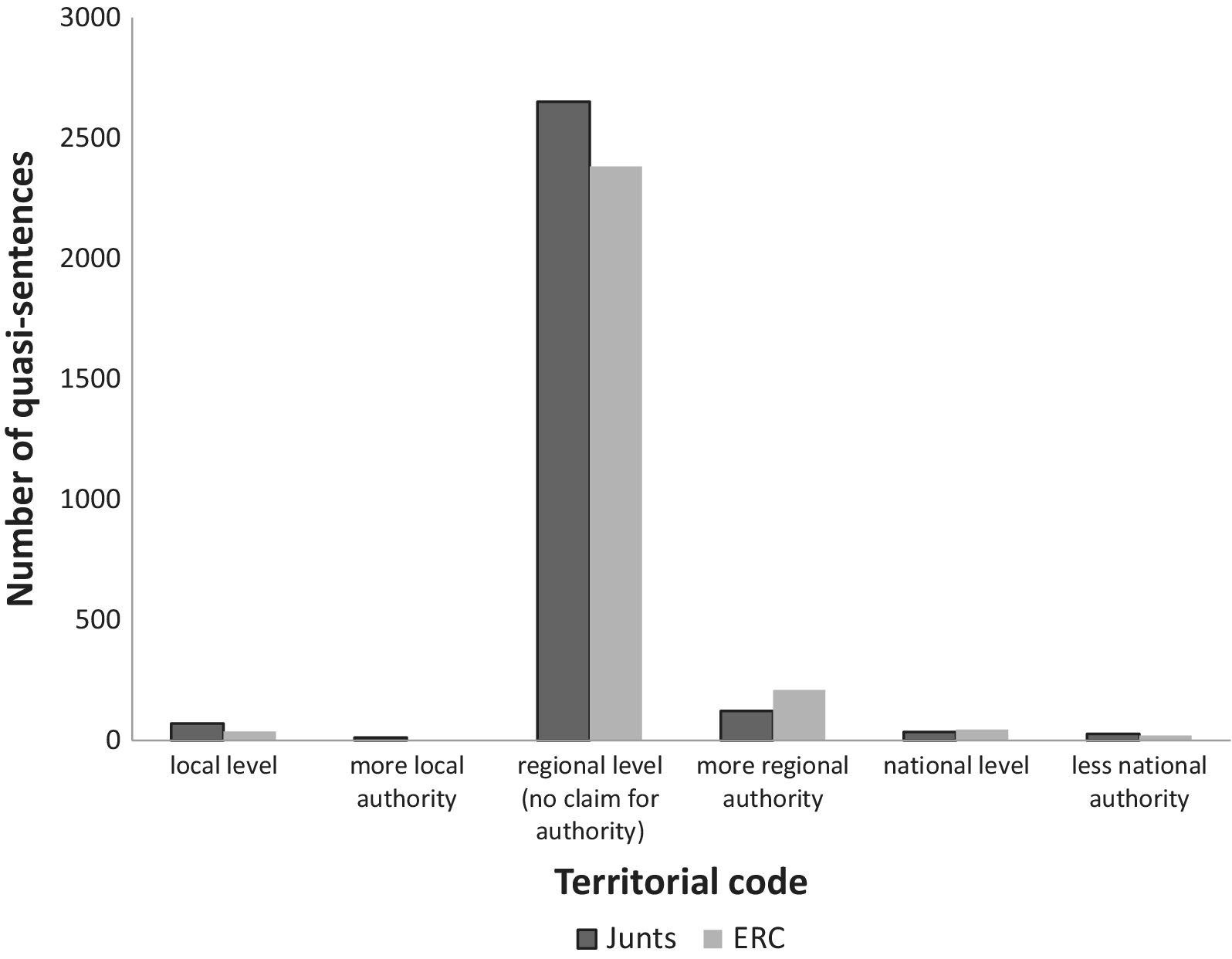
In terms of the territorial dimension, both the ERC and Junts put considerable pressure on the regional level, and more than 80% of their manifestos’ total content is concerned with this level (Figure 5). Neutral demands prevail within this category in the June and ERC programs.
ERC and Junts’ frequency of territorial code
Source: Junts electoral manifesto 2021; ERC electoral manifesto 2021
An interesting difference deals with the welfare and economic categories in the political dimension (Figure 6). The ERC has the economy category as the leading one in its manifesto, whereas Junts gives more saliency to welfare. This situation is adequate for Spain because the country suffered harsh global economic and COVID crises that affected its social sphere and economy. In light of these crises, this positioning appears to be a predictable response, similar to that of Scottish parties.
Accumulated share of the political dimension, ERC, and Junts
Source: Junts electoral manifesto 2021; ERC electoral manifesto 2021

The structure of manifestos shows us the similarity of both parties, with a small difference: Welfare, Economy, and Fabric of Society occupy the first three places in the manifestos in terms of frequency. These findings confirm the intention to play on social issues.
The analysis of saliency demonstrates that the ERC considers the territorial domain as a more salient issue, including a clear periphery stance (Table 4). The economic dimension is clearly left positioned, and the same is true for Junts’ territorial positioning and saliency. The economic positioning of the Junts differs from that of the ERC. Despite having the left position as the ERC, Junts’ manifesto shows blurred vision.
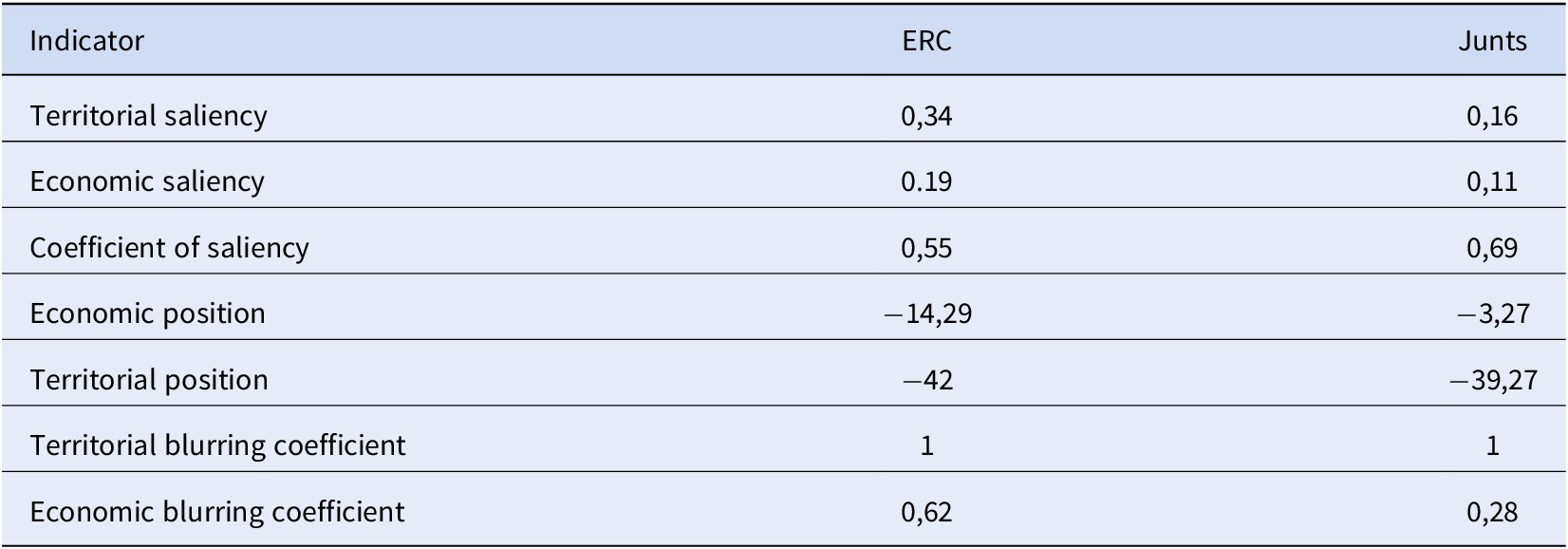
In sum, the manifesto analysis conceptualizes that the ERC, which has a clear periphery position and a clear left position in the secondary dimension, gives more saliency to territorial demands. Junts has a clear peripheral position and gives more salience to territorial demands, but it also blurs the secondary dimension. Welfare and quality of life occupy the leading space in the Junts’ manifesto, while the economy leads to political demands in the ERC’s manifesto. Junts’ manifesto has this code as the second most frequent after the welfare dimension. In summary, the manifesto analysis as well as in the Scottish case clarifies the issue positioning and salience of the RPs. In both cases, parties are left in the economic dimension and have clear peripheries in terms of territorial demands.
Media Analysis of Electoral Campaign
The electoral campaign started on January 29, 2021, with the bid for independence framed as an anti-center rhetoric. The ERC asked “for the vote to prevent Illa,” a Spanish politician and served as Minister of Health of Spain from 2020 to 2021, “from agreeing with the ‘fascist Vox.’” Moreover, during its campaign, the ERC called on its electorate “to confront the extreme right movement” (Quitian Reference Quitian2021), while Junts depicted “independence as the path to social progress” (Quitian Reference Quitian2021). The frequency analysis of frames confirms that both the ERC and Junts, as well as the SNP and Greens, concentrate on independence demands more than on other issues (Figure 7).
The general orientation of Junts and ERC frames
Note: Economy total and welfare total are equivalents of economy general and welfare general frames.
Source: Compiled by authors based on La Vanguardia analysis

The composition of independence demands accounts for the understanding that economic and welfare dimensions are subsumed into the territorial dimension. General demands for independence are followed by economic and welfare justifications (Figure 8), and general welfare demands dominate over independence welfare discourses.
Overall issue orientation, Junts and ERC, the proportion of frames
Source: Compiled by authors based on La Vanguardia analysis

These results confirm the welfare category as valence, as the Scottish case demonstrates. The ERC and Junts predominantly demand “left” resolutions to the current problem, which fits into the logic of Spain’s political development. The COVID-19 crisis put even more pressure on political parties to pay attention to the welfare category, and Junts highlighted that independence is a way to social welfare.
The ERC’s discourse strategy lies in recognizing the welfare and economic dimension’s non-radicalization. The ERC highlighted its left and pro-independence stance but decided to give salience to the competition with the center and promoted anti-center rhetoric. Junts subsumes economic and welfare demands into a pro-independence line. Compared to general welfare and economic demands, the subsumed frame remains weak. The visibility of Junts’ pro-independence welfare demands is lower than that of the ERC; in contrast, its general economic demands play a central role in its political campaign. The comparison of pro-independence and general economic demands confirms the importance of this dimension in political competition. The ERC’s general independence demands outweigh economic ones.
The economic and anti-center dimensions became a battleground for independence demands. The extent of the economic scale differed between the ERC and Junts. The Junts presumably adopted a more radical approach and presented economic issues as a way to improve economic development in the long term. The ERC similarly placed independence in place of necessary steps to combat the center and promote anti-center rhetoric. The ERC’s Junqueras argues that it is more important to compete against the center-oriented party and “discards Junts to compete against PSC in the metropolitan area” (Tort Reference Tort2021). Moreover, the ERC is presented as the party capable of competing against center-oriented parties and political forces: it is “seen as the only one capable of rivaling Illa in the red belt” (Tort Reference Tort2021). To contextualize, Salvador Illa Roca is a Spanish politician who served as the Minister of Health of Spain from 2020 to 2021. He was also criticized by nationalist forces.
In summary, the territorial dimension is salient in media campaigns. The ERC included the anti-center rhetoric into the pro-independence line, while the Junts subsumed the economic and welfare demand into secessionist demands. The main difference in strategies lies in the importance of issue positioning. For the ERC, it was more important to promote the idea of independence in general, while the Junts prioritized economic and welfare issues.
Discussion
RPs in Catalonia and Scotland entered coalitions based on their territorial positions. The Scottish government had the SNP-Scottish Greens coalition, and the Catalan government had an agreement between the ERC and the Junts. The regional level occupies almost all territorial references in their manifestos; however, they are dominated by neutral regional quasi-sentences; moreover, all parties avoid radicalizing their electoral programs. The proportion between the territorial and economic domains signals that no dimension is left aside. In other words, the economic and territorial domains receive considerable attention to exclude the possibility of a one-dimensional strategy. The COVID-19 crisis extended the economic and welfare categories, as all RPs had to incorporate their anti-COVID-19 measures into their main policy domains. COVID-19 also affected the territorial issue; although the SNP argued that the second independence referendum would be possible after the end of the COVID-19 crisis in Scotland, this issue did not dominate either category.
The content analysis of the manifestos confirms that no regionalist party used the one-dimensional strategy, but all RPs experienced pressure from state-wide ones and had to deal with both the economic and territorial domains in the competition. All the RPs had a left-wing economic position. In these cases, the territorial domain played an important role in the formation of a regionalist coalition. Unlike the SNP and the Junts, Scottish Greens and ERC had a clear left economic position. Considering their clear peripheral position, we can conclude that these parties employed the two-dimensional strategy in these elections – a strategic choice not new for the ERC, which already employed it in the successful 2012 elections to enter the coalition with the CiU (Convergencia and Unio). In both cases, the coalition agreed upon territorial premises.
SNP and Junts decided to blur the economic dimension in their manifestos. Junts are the successor of the CiU in Catalan politics, and both Junts and SNP have traditionally blurred the economic dimension. For example, the SNP blurred the economic dimension of the 2011 and 2016 elections. There are two explanations for the economic positioning of these parties. First, Scottish Greens and ERC were used to represent more radical left economic demands. Second, both parties have historically been considered minor regionalist forces. Scottish Greens’ electoral power is incomparable with the SNP, and the ERC received fewer seats than the leading CiU party in the Catalan elections. Junts and the SNP have tried to be mainstream parties at the regional level, desiring to catch all the independentist supporters as well as the more moderate voters. To do so, they blurred the economic dimension to represent themselves as centrist parties.
The analysis of these parties’ electoral campaigns underlines the importance of the issue of independence. All RPs placed independence at the forefront of their electoral campaign, and general independence demands dominated general welfare and economic issues in all cases. Indeed, the framing of independence demands differed. Junts and SNP mainly framed them in terms of economic issues, and the economic dimension was subsumed into their bids for independence. Subsuming the welfare category played a marginal role in their programs. The ERC presented itself as the main anti-center force. General independence demands played a much higher role in their campaign than in the Junts’ campaign. The ERC avoided extensively framing the economic category as independence, and the welfare independence demands played a role similar to the economic ones. This observation confirms the two-dimensional strategy because the anti-center and general independence rhetoric outplayed the rest of the framing. Scottish Greens also placed general independence demands at the forefront of their campaign; however, they almost completely avoided framing the welfare category as independent. The anti-center rhetoric played a smaller role; the Scottish Greens left this strategy to the SNP, which capitalized on it and occupied the niche of the standoff with the central state. Scottish Greens found it difficult to play in this field.
The latter case confirms the importance of political structure in the strategic choices. SNP is a dominant party in Scotland, historically competing against state-wide parties. The anti-center rhetoric of blaming Westminster for inadequate economic policies and welfare cuts led to electoral success in 2007, 2011, and 2016. While the SNP saw Labour and Conservatives as the main opponents in the elections, the Scottish Greens were mainly out of their focus. The Scottish Greens played against both the SNP on the economic scale and the state-wide parties in the territorial domain, and the two-dimensional strategy was the only choice to sustain the double pressure. They decided to concentrate on economic issues in terms of their demands for independence.
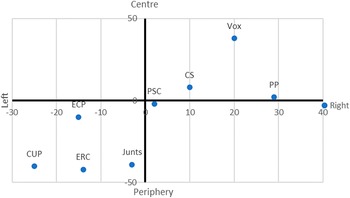
Catalan competition was the main rivalry between the three left-wing parties: Junts, ERC, and PSC (Figure 9). The PSC was the main target for both RPs in terms of the economic domain; the ERC employed anti-center rhetoric to outplay the PSC on the economic flank, and finally, Junts decided to concentrate on the more radical and clear links between independence and future economic prosperity. However, extensive competition was observed between the ERC and the Junts. As further political negotiations suggested, both territorial and economic issues were contested between these parties. The two-dimensional strategy of the ERC led to the extensive framing of anti-center messages, and the subsuming strategy of Junts was an attempt to contest the ERC as the main pro-independence party for the electorate.
Party positionings on territorial and economic domains, 2021 regional elections in Catalonia
Source: Regional Manifesto project (ECP – En-Comu Podemos, CS – Ciudadanos, PP – Partido Popular)

In summary, the electoral strategies of RPs are affected by competition structure. Two-dimensional strategies were employed by the Scottish Greens and ERC, and a subsuming strategy choice was made by the SNP and Junts.
Conclusion
The regional elections in 2021 were contextualized by the ongoing COVID-19 crisis that put pressure on both the social and economic dimensions. Regionalist parties strive to become mainstream parties in their region. H1 confirms that the COVID-19 issue did not change the positioning of the RPs in Scotland and Catalonia regarding the territorial domain. The results demonstrated partial agreement with the FraTerr approach. In terms of territorial demands, our analysis confirms that independence demands are the main targets of RPs. At the same time, the framing of these demands differs. Unlike the FraTerr project, which argues that political frames are more widely used, our research indicates the salience of socioeconomic frames (in FraTerr terms). The difference is explained by the COVID-19 context, because the FraTerr project at the time of our research collected data up to 2018. This fact means that critical events changed the framing of independence claims in favor of socioeconomic argumentation, where the anti-crisis measures are linked to independence claims.
H2 was confirmed because SNP and Junts used a subsuming strategy, whereas ERC and Scottish Greens employed a two-dimensional strategy. The analysis of party manifestos confirmed that SNP and Junts blurred the economic dimension and stayed in the center-left position. The ERC and Scottish Greens had clear left-flank positions in the economic domain.
Despite this critical event, the research finds some continuity in the strategic choices of RPs. First, RPs avoid radicalizing their territorial demands, even if they have a strong regionalist competitor. Most territorial claims are neutral in the parties’ manifestos. Second, the competition structure and previous experience influence the strategic choices of regionalist parties to which they react differently. The SNP employed a subsuming strategy during the electoral campaign, and economic blurring was dictated by the quest to stay in the mainstream. The SNP framing relied on anti-center rhetoric and subsuming economic issues into territorial demands – a kind of strategy that had shown its effectiveness in previous electoral campaigns. Moreover, the SNP played the anti-center rhetoric in their contest with state-wide parties because the Scottish Greens failed to be a balanced regionalist opponent. Scottish Greens employed a two-dimensional strategy. As a minor player at the regional level, they decided to pay more attention to general independence demands to distinctively play on both issues. The two-dimensional strategy was a response to the contest between the SNP and state-wide parties in light of the small electoral capital.
The ERC played a two-dimensional strategy, deciding to avoid the radicalization of welfare and economic demands and including them into independence. The ERC had the PSC as the main economic opponent employed anti-center rhetoric to compete with the challenges brought about by state-wide parties. This strategy was a response to the electoral pressure of the Junts and PSC. Junts decided to use the subsuming strategy, which historically led them to succeed in previous elections. Junts saw the ERC as the main challenger and potential partner and chose to subsume the economy and welfare categories into independent challenges, adopting more radical independence demands. This observation confirms that the ERC is the main electoral target of pro-independence voters.
Third, the SNP decided to enter a coalition agreement with another pro-independence party, the Scottish Greens, for the first time; similarly, after hard negotiations, the ERC and Junts finally agreed to a coalition with independentist demands. In any case, the RPs decided to join forces and create coalitions based on their territorial demands, thereby setting their economic disparities. However, overcoming such disparities is not a critical issue because all coalition parties remain on the same side of the economic spectrum.
In summary, it can be observed that, in the case studies, subsuming and two-dimensional strategies were chosen based on different considerations. In one case, the two-dimensional strategy was the reaction to simultaneous pressure from state-wide and more powerful RPs; in another case, it was the response to compete with both electorally strong regionalist and state-wide opponents. The subsuming strategy was chosen to reinforce the anti-center stance and underline the importance of territorial demands for a better economic future; similarly, the same strategy was the response to the competition for pro-independence voters with another strong regionalist competitor.
The analysis results have several implications. Firstly, complementing previous studies conducted by Elias (Reference Elias2019) and Elias and Mees (Reference Elias and Mees2017), this work highlights the importance of continuity and competition structure in the strategic choices of regionalist parties. Secondly, the frame analysis of electoral programs confirms the need for a more nuanced approach to conceptualizing party strategies as previously anticipated by Elias, Szocsik, and Zuber (Reference Elias, Szöcsik and Zuber2015). In addition to the economic dimension into core territorial demands, regionalist parties may also frame welfare dimensions and general anti-center rhetoric as part of their competition along the territorial axis. Moreover, the environmental dimension may play a decisive role in issue saliency for some parties like the Scottish Greens which consider independence as an instrument to get a “green future.” In this sense, we can argue about subsuming independence into environmental demands. Finally, the analytical utility of considering regional elections through the prism of critical events is demonstrated, as parties always have to adapt their strategies to the political context. Hence, previous regional elections that occurred during the financial crisis of 2008 and austerity politics in 2010s could supplement the analysis, as well as the upcoming regional elections that may take place amidst the inflation and energy crisis.
Acknowledgements
The authors express their gratitude to Prof. Emanuele Massetti and two anonymous referees for the suggestions.
Supplementary material
The supplementary material for this article can be found at http://doi.org/10.1017/nps.2023.65.
Disclosure
None.





 Open access

