


Introduction
Education has emerged as an increasingly central social divide in contemporary electoral politics, but its attitudinal underpinnings are disputed. Most researchers have argued that divisions over socio‐cultural conflicts around immigration and supranational authority are responsible for the rise of an education cleavage anchored by radical right, green and liberal parties (Bornschier, Reference Bornschier2010; Ford & Jennings, Reference Ford and Jennings2020, p. 300–302; Hooghe & Marks, Reference Hooghe and Marks2018; Stubager, Reference Stubager2010). However, economic inequality along educational lines is as sharp as ever, stoking renewed scholarly interest in the effects of education on attitudes towards redistribution (Bullock, Reference Bullock2020; Gelepithis & Giani, Reference Gelepithis and Giani2020; Marshall, Reference Marshall2015, Reference Marshall2019; Mendelberg et al., Reference Mendelberg, McCabe and Thal2017).
We can more fully understand the education cleavage by integrating recent insights on the measurement of redistribution attitudes, which distinguish between attitudes about the proper scope of the welfare state and perceptions about the deservingness of welfare state beneficiaries (Cavaillé & Trump, Reference Cavaillé and Trump2015; Laenen, Reference Laenen2020; Van Oorschot, Reference Van Oorschot2000). Traditional models of political economy view education as a labour market asset and therefore predict that the relatively secure educated oppose redistribution out of self‐interest, while the precarious less‐educated support it. In contrast, a conception of education as a marker of social status suggests that the less‐educated may be more inclined than status‐secure university graduates to draw harsh boundaries against welfare state beneficiaries as a means to maintain social esteem. These theoretical approaches imply divergent effects of education on two separate subdimensions of redistribution attitudes: preferences towards the responsibilities of the welfare state and attitudes towards the deservingness of the needy.
Analyses of the 2016 European Social Survey (ESS) data from 15 Western European countries demonstrate these contrasting effects. First, the validity of the welfare state and deservingness subdimensions finds support in principal component analyses. Subsequent ordinary least squares (OLS) regression analyses reveal that, on average, higher levels of education are associated with relative opposition to state responsibility for maintaining living standards, but also with perceptions that those receiving help from the welfare state are more deserving. By contrast, low levels of education are associated with the opposite pattern; on average being more favourable towards social provision by government, but also more likely to consider welfare state beneficiaries as shirkers gaming the system.
What implications does this have for the education cleavage in electoral politics? KHB mediation analyses allow for the decomposition of education effects and estimation of the extent to which these two types of redistribution attitudes explain educational divides in voting. Decomposing the effects of education on vote choice reveals that deservingness perceptions are a particularly substantial mediator of education effects on vote choice for radical right and green parties, whose voters are the most educationally distinctive. The evidence that attitudes towards the scope of the welfare state mediate the effects of education on vote choice is more mixed. However, welfare state support does play a role in explaining education effects on vote choice between proximate party families competing in political space, notably between radical right and conservative parties.
This paper makes two main contributions. First, it applies recent insights on the multidimensionality of redistribution attitudes to resolve conflicting evidence about the relationship between education and redistribution attitudes. Second, it demonstrates how divergent redistribution attitudes contribute to the emergent education cleavage in electoral politics. Less educated voters, who tend to see welfare state beneficiaries as undeserving, are disproportionately attracted to the radical right. Highly educated voters, who have the most positive perceptions of welfare state beneficiaries on average, are disproportionately likely to support green parties. This helps to explain why green and radical right voters represent the poles of the educational divide, the attitudinal basis of which is usually understood to be socio‐cultural rather than redistributive (Dolezal, Reference Dolezal2010; Hooghe & Marks, Reference Hooghe and Marks2018; Stubager, Reference Stubager2010). In post‐industrial economies, divisions between those with high and low education over the welfare state and its beneficiaries are a significant, complementary explanation for the rise of an educational cleavage, alongside conflicts over immigration and transnationalism.
Why it matters: The educational divide in post‐industrial politics
A prominent vein of scholarship asserts that advanced democracies are undergoing the rise of a new structural cleavage between winners and losers of post‐industrial change (Hooghe & Marks, Reference Hooghe and Marks2018; Kriesi, Reference Kriesi1998). Differences in educational endowments lie at the core of this divide (Häusermann & Kriesi, Reference Häusermann, Kriesi, Beramendi, Häusermann, Kitschelt and Kriesi2015; Margalit, Reference Margalit2012; Stubager, Reference Stubager2009, Reference Stubager2010). The well‐educated are relatively well‐equipped to succeed in competitive internationalized and increasingly skill‐intensive labour markets. Those with less education suffer greater insecurity and worry more about the prospect of competition from immigrants, both in the labour market and over welfare state resources. What this educational divide means for the politics of redistribution, however, is unclear.
Despite the link between education and economic security, less‐educated working class voters have increasingly moved away from social democratic parties and into ‘proletarianized’ parties of the radical right (Betz, Reference Betz1994; Harteveld, Reference Harteveld2016; Houtman et al., Reference Houtman, Achterberg and Derks2008; Kitschelt, Reference Kitschelt1994; Oesch & Rennwald, Reference Oesch and Rennwald2018; Rydgren, Reference Rydgren2013). Highly educated professionals, on the other hand, have become a key constituency of left‐wing parties in many countries (Häusermann, et al. Reference Häusermann, Picot and Geering2012, p. 228; Piketty, Reference Piketty2018). Political realignments along educational lines are often attributed to the increasing salience of immigration and supranational integration, which divide those with high and low levels of education (Hooghe & Marks, Reference Hooghe and Marks2018, p. 7–8; Kriesi et al., Reference Kriesi, Grande, Lachat and Dolezal2008; Lancaster, Reference Lancaster2021; Teney et al., Reference Teney, Lacewell and De Wilde2014). However, in an era of rising inequality and precarity, distributional conflict is far from over. Contestation over the welfare state has morphed rather than disappeared, reshaping coalitions in distributive politics (Beramendi et al., Reference Beramendi, Häusermann, Kitschelt and Kriesi2015; Gingrich & Häusermann, Reference Gingrich and Häusermann2015; Häusermann et al., Reference Häusermann, Picot and Geering2012; Kitschelt & Rehm, Reference Kitschelt and Rehm2014).
Unpacking redistribution: Education effects in a multidimensional context
A central theme in the social policy literature is that welfare states not only redistribute resources but also insure individuals against risk (Gingrich & Ansell, Reference Gingrich and Ansell2012, p. 1627). We would thus expect that the risks individuals face in the labour market affect their support for redistribution. Particularly in the context of the knowledge economy, researchers have found that education and skills are not only associated with higher income but also with lower risk of unemployment (e.g., Kapstein, Reference Kapstein2002; Powell & Snellman, Reference Powell and Snellman2004). By virtue of its insurance function, education appears to reduce individuals’ support for redistribution (Alesina & Giuliano, Reference Alesina, Giuliano, Bisin and Benhabib2011; Busemeyer, Reference Busemeyer2014; Iversen & Soskice, Reference Iversen and Soskice2001; Moene & Wallerstein, Reference Moene and Wallerstein2001; Rehm, Reference Rehm2009, Reference Rehm2011).Footnote 1
Bullock (Reference Bullock2020) makes an important contribution by leveraging exogenous changes in compulsory secondary education requirements across US states to identify the causal effects of education on support for redistribution, government responsibility for living standards and welfare. He finds that education is negatively associated with support for government redistribution and responsibility for living standards, but is not associated with opposition to welfare or attributing poverty to laziness. Bullock interprets this as evidence that education effects redistribution attitudes primarily via the channel of economic self‐interest.
Recent literature further demonstrates the value of analyzing different dimensions of redistribution attitudes to explain the changing social structure of distributional conflict (e.g., Beramendi et al., Reference Beramendi, Häusermann, Kitschelt and Kriesi2015; Garritzmann et al., Reference Garritzmann, Busemeyer and Neimanns2018; Gingrich & Häusermann, Reference Gingrich and Häusermann2015). So far, this work has mostly focused on how income and occupational class affect different aspects of redistribution preferences.Footnote 2 I build on this comparative research by analyzing how the educational divide that is increasingly reshaping the political landscape relates to two particular subdimensions of redistribution attitudes across 15 Western European countries. These subdimensions distinguish between redistribution attitudes that prime different psychological mechanisms of self‐interest and moral judgement.
Cavaillé and Trump (Reference Cavaillé and Trump2015) argue that issues of ‘redistribution from’ the rich involve questions about the state's responsibility to meet generalized social needs and reduce inequality, evoking ‘self‐oriented’ considerations of individuals’ relative economic positions and whether they would personally benefit from social programs and efforts to reduce inequality. Since the psychological mechanism triggered is one of self‐interest, these issues divide high earners who will bear the brunt of taxes used to finance redistribution from low earners who would be the primary beneficiaries of it (ibid. 148).
Hypothesis 1 is consistent with the same self‐interest‐based logic as the classic political economy model: because education is an important labour market asset, on average, those with higher levels of educational attainment should oppose a more expansive role for government in providing economic security and reducing inequality (H1).
Hypothesis 1: Education is negatively associated with support for the welfare state.
By contrast, issues of ‘redistribution to’ the poor or disadvantaged prime mechanisms of social affinity and empathy (Cavaillé & Trump, Reference Cavaillé and Trump2015, p. 148). Instead of inward‐facing calculations of personal benefit or cost, individuals’ views on deservingness reflect (a) whether or not they view the needy as worthy of help, and (b) whether they view the act of helping recipients as just and unproblematic, or instead view social assistance through the lens of moral hazard.Footnote 3
One might expect the economically secure not to blame poverty on the unfairness of a social structure within which they prosper, but instead on the individual failings of benefit recipients. However, empirical research consistently finds that more affluent people are less likely than their poorer counterparts to blame poverty on personal failings. Bullock's (Reference Bullock1999, p. 2076) study of Americans’ attitudes towards welfare finds that the poor were more likely to attribute welfare recipients’ situation to laziness, relative to middle class respondents. Van Oorschot (Reference Van Oorschot2006, p. 34) similarly notes that ‘it is often found that those in lower socio‐economic positions have more negative views of, e.g. unemployed people and people on benefit’. At the other end of the economic spectrum, Rueda (Reference Rueda2017) argues that the wealthy are more sensitive to altruistic concerns than the poor, since their relative security gives them greater latitude to take non‐material considerations into account in forming attitudes towards redistribution.
One potential explanation for this counter‐intuitive relationship between economic standing and perceptions of the vulnerable lies in how the psychological pressures of status insecurity can sharpen negative evaluations of stigmatized groups (Elchardus & Spruyt, Reference Elchardus and Spruyt2012; Fiske, Reference Fiske2011; Ridgeway, Reference Ridgeway2019). Crucially, when it comes to social status, people tend to be last‐place averse (Cavaillé, Reference Cavaillé2014; Reference Kuziemko, Buell, Reich and MichaelKuziemko et al., 2014). Lower status groups are particularly strongly motivated to defend the status order to maintain their continued separation from stigmatized populations at the very bottom of status hierarchies (Gidron & Hall, Reference Gidron and Hall2017, Reference Gidron and Hall2020; Lamont, Reference Lamont2000). Indeed, social psychologists have argued that ‘if low status groups cannot construct a positive social identity, then group members may resort to denigrating outgroups of similar status in an attempt to raise the relative status of their in‐group by lowering the status of a perceived competitor’ (Kuppens et al., Reference Kuppens, Easterbrook, Spears and Manstead2015, p. 1261).
There is reason to believe these status dynamics are particularly strongly linked to education. The advent of mass higher education has strengthened its social legitimacy as a measure of worth. Despite contemporary increases in inequality, meritocratic narratives present academic attainment as the path for individuals to achieve social mobility in spite of their backgrounds (Bourdieu, Reference Bourdieu1984). As a result, education is closely associated with an individual's place in contemporary status hierarchies (Fiske, Reference Fiske2011; Ridgeway, Reference Ridgeway2019).
As the ranks of the university educated have increased, the subjective social status of those with lower levels of education has fallen (Gidron & Hall, Reference Gidron and Hall2017, p. S74, Reference Gidron and Hall2020; Spruyt & Kuppens, Reference Spruyt and Kuppens2015). Often, lower status groups can combat social stigma by forming their own positive in‐group identities. However, the less‐educated struggle to pursue this strategy. Their low status is socially legitimated, and the absence of educational attainment offers little material with which to build positive group identification (Kuppens et al., Reference Kuppens, Easterbrook, Spears and Manstead2015). Less‐educated people might thus instead adopt negative views of welfare beneficiaries’ deservingness in an effort to distance themselves from their membership in a low‐status group (Fiske, Reference Fiske2011, p. 102–103; Jost & Banaji, Reference Jost and Banaji1994; Stubager, Reference Stubager2009; Tajfel & Turner, Reference Tajfel, Turner, Worchel and Austin1986). The relatively secure social status of the highly educated, meanwhile, obviates the need to stigmatize benefit recipients in order to maintain social esteem. I thus hypothesize that increases in education are also associated with positive perceptions of recipients’ deservingness (H2).
Hypothesis 2: Education is positively associated with favourable perceptions of benefit recipients’ deservingness.
Implications of welfare state and deservingness attitudes for education effects on vote choice
Education is increasingly powerful, not only in shaping attitudes, but also as a structural divide in contemporary party politics (Bornschier et al., Reference Bornschier, Häusermann, Zollinger and Colombo2021; Häusermann & Kriesi, Reference Häusermann, Kriesi, Beramendi, Häusermann, Kitschelt and Kriesi2015; Hooghe & Marks, Reference Hooghe and Marks2018; Langsæther & Stubager, Reference Langsæther and Stubager2019; Stubager, Reference Stubager2010). This perspective suggests that attitudes partly mediate the effect of education on voting behaviour; structurally rooted groups in conflict develop distinct attitudes and preferences which are reflected in their vote choice. If there are indeed significant differences in welfare state support and perceptions of deservingness across educational groups, we can expect them to have implications for voting patterns by education, since there is evidence that these attitudes are themselves a significant predictor of vote choice (Attewell, Reference Attewell2021).
In terms of theoretical expectations, then, a political economy perspective on the education cleavage suggests that the relative economic security of the higher educated should predispose them to vote for liberal and conservative parties which oppose an expansive and egalitarian welfare state (H3a).
Hypothesis 3a: Welfare state attitudes mediate the positive effect of education on voting for liberal and conservative parties.
Conversely, the relatively economically precarious lower educated should be more likely to vote for radical left and social democratic parties which are supportive of state responsibility for maintaining decent living standards (H3b).
Hypothesis 3b: Welfare state attitudes mediate the negative effect of education on voting for radical left and social democratic parties.
A perspective which instead views educational attainment as conferring or diminishing status has different implications for vote choice. Status insecurity and feelings of relative deprivation are associated with voting for radical right parties (Elchardus & Spruyt, Reference Elchardus and Spruyt2012; Gidron & Hall, Reference Gidron and Hall2017; Suryanarayan, Reference Suryanarayan2019). Such parties offer scapegoating narratives centred not only on ethnic minorities, but also the unemployed, who they cast as undeserving benefit scroungers (Afonso & Rennwald, Reference Afonso, Rennwald, Palier, Schwander and Manow2018; Busemeyer et al., Reference Busemeyer, Rathgeb and Sahm2021; de Koster et al., Reference Koster, Achterberg and Waal2012; Rathgeb, Reference Rathgeb2021). As a result, the status insecurity of the lower educated should motivate them to vote disproportionately for radical right parties who offer their voters a positive relative comparison with stigmatized welfare state beneficiaries.
Hypothesis 4a: Deservingness perceptions mediate the negative effect of education on voting for radical right parties.
Conversely, the highly educated are not status insecure and lack motivation to draw sharp downwards boundaries against the needy. High levels of education promote discomfort with strict moral hierarchy and denigration of outgroups, and so may be associated with a greater tendency to perceive poverty as due to structural rather than individual failings. Disproportionately high‐education green voters have been shown to be ideologically supportive of redistribution, even if their relative affluence renders their material incentives towards redistribution more mixed (Bremer & Schwander, Reference Bremer and Schwander2019; Röth & Schwander, Reference Röth and Schwander2021). However, there is evidence that deservingness perceptions are more strongly predictive of green voting than welfare state attitudes (Attewell, Reference Attewell2021). Their relative status security and more positive perceptions of the needy may thus partly explain the tendency of the highly educated to vote for green parties (Dolezal, Reference Dolezal2010).
Hypothesis 4b: Deservingness perceptions mediate the positive effect of education on voting for green parties.
Data and methods
The 2016 ESS is an appropriate dataset to test these hypotheses because it includes an extensive battery of questions on redistributive preferences and attitudes across a range of countries (European Social Survey Round 8 Data, 2016). In particular, I analyze 15 Western European countriesFootnote 4 from the dataset in order to examine the relationship between education and attitudes towards redistribution. Below I explain the operationalization of the different variables; full descriptive statistics can be found in Supporting Information Appendix 1.
Dependent variables: Deservingness perceptions and welfare state support
The first set of dependent variables of interest measure attitudes towards redistribution. Previous cross‐national research on attitudes towards redistribution often relies on a single question which directly asks respondents about their support or opposition to government redistribution of incomes. This is understandable because most cross‐national survey datasets lack multiple questions on attitudes towards redistribution which are consistently repeated over time. However, this operationalization is both theoretically and empirically problematic if attitudes towards redistribution are multidimensional (Cavaillé & Trump, Reference Cavaillé and Trump2015, p. 146).
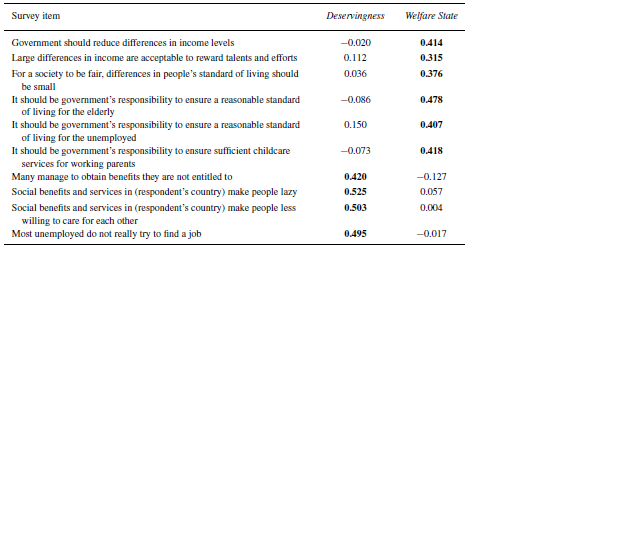
I thus use principal component analysis (PCA) with varimax rotation to analyze the structure of redistribution attitudes.Footnote 5 Table 1 displays the two strongest components I call deservingness and welfare state, corresponding to Cavaillé and Trump (Reference Cavaillé and Trump2015)’s ‘redistribution to’ and ‘redistribution from’, respectively.Footnote 6Deservingness explains about 24 per cent of the variance in redistribution attitudes, while welfare state explains about 23 per cent of the variance in redistribution attitudes. Both variables are standardized with a mean of 0 and a standard deviation of 1, so their effects can be more easily compared.
Rotated factor loadings

Note: this table reproduces the factor analysis from Attewell (Reference Attewell2021). Strongest factor loadings in bold.
Questions that load most strongly onto the deservingness component ask respondents to make judgements about people who receive social benefits and services and the effects of government assistance on recipients’ sense of personal and social responsibility.Footnote 7 This theoretical framework suggests these questions should tap respondents’ social affinity with benefit recipients. Higher values of deservingness indicate more positive views towards benefit recipients.
Questions that load most strongly onto the welfare state component concern attitudes towards inequality and the scope of government responsibility in social and economic policy. Questions of government responsibility should provoke a calculation of self‐interest, in which respondents ask themselves whether or not they would personally benefit from redistribution. Higher values on welfare state indicate support for government responsibility for providing social services and reducing inequality.
Dependent variable: Vote choice
The second dependent variable of interest is vote choice, which is operationalized by grouping political parties into party families which share historical and ideological traditions, namely conservative, social democratic, radical right, liberal, green and radical left. Details on the coding of party families, including a full list of parties, appear in Supporting Information Appendix 3.
Key independent variable: Education
The central independent variable is Education. It uses the cross‐nationally harmonized International Standard Classification of Education (ISCED) measure to capture the respondents’ highest level of educational attainment. It ranges from less than a lower secondary education, to lower secondary, lower tier upper secondary, upper tier upper secondary, advanced vocational, lower tertiary and finally a higher tertiary degree. This measure allows for a more fine‐grained understanding of the effects of education on redistribution which can capture non‐linearities in the relationship.
Controls
In keeping with other literature on attitudes towards redistribution, I also include a series of controls: female gender, religiosity (operationalized as never, rarely or weekly church attendance), rural/urban location (an ordinal measure ranging from the reference category of farm or country village, town or small city and suburbs, to big city) and age. In the main models, I do not control for income and class in order to avoid post‐treatment bias, or ‘overcontrol’ (Elwert, Reference Elwert and Morgan2013); since these follow partly from education, they would be mediators, rather than confounders of educational effects on attitudes and vote choice.
Modelling
The analysis proceeds in two steps. First, I model deservingness perceptions and welfare state attitudes as a function of Education in OLS regressions, controlling for potential confounders.
Next, I assess the extent to which the educational divide in electoral politics is mediated by welfare state and deservingness attitudes. I employ the KHB method, a form of mediation analysis designed for non‐linear probability models (Breen et al., Reference Breen, Karlson and Holm2013; Breen et al., Reference Breen, Karlson and Holm2018; Kohler et al., Reference Kohler, Karlson and Holm2011). This method allows the researcher to estimate the amount of a given predictor's effect on a dichotomous outcome which is mediated via another variable, to generate meaningful measures of statistical uncertainty for mediation effects, and to compare the relative strength of different mediators.Footnote 8 While the KHB method can be employed with various types of non‐linear probability models, I use logistic regression, since I model vote choice as a binary outcome of voting for a given party family versus all other party families. These logistic regressions include the same prior set of controls for age, gender, religious attendance and rural/urban location. For my purposes, the KHB method allows for the decomposition of direct and indirect effects (via attitudes) of education on vote choice, to assess their relative magnitude and test their statistical significance.
All models include country fixed effects to account for unobserved characteristics of individual countries, as well as standard errors clustered at the country level to account for autocorrelation of errors at the country level. Survey responses are weighted by combining the ESS's post‐stratification weights and population weights to account for differential selection probabilities within each country as well as differences in population size across countries, in keeping with ESS recommendations (Kaminska, Reference Kaminska2020).Footnote 9
Analyses
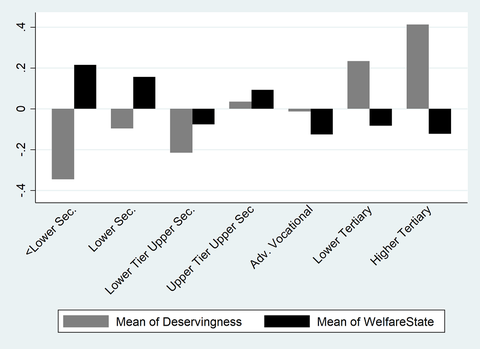
For descriptive purposes, Figure 1 displays the uncontrolled means of deservingness and welfare state across educational groups. The lowest educational group has both the most negative deservingness perceptions and the highest average welfare state support on average, but this relationship slowly reverses for increasingly higher levels of education. The tertiary educated represent nearly the opposite pattern: this group has by far the most positive perceptions of deservingness but also displays moderate opposition to the welfare state. Building upon Cavaillé’s (Reference Cavaillé2014, p. 199) finding for Great Britain, breaking down redistribution attitudes into subdimensions reveals educational groups across Western Europe to be cross‐pressured.
Mean deservingness and welfare state by education [Colour figure can be viewed at wileyonlinelibrary.com]

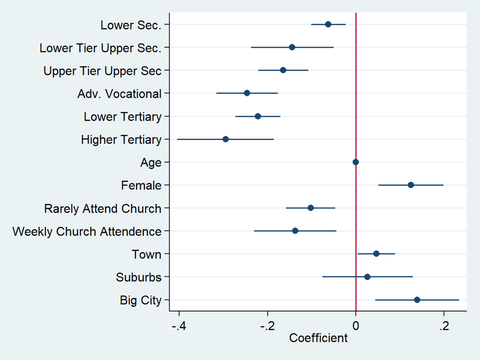
Figure 2 shows an OLS model predicting welfare state attitudes under controls. The results of Model 1 show the relationship between education and support for the welfare state is negative and statistically significant, under controls. All educational groups are less supportive of welfare state relative to the reference category of those with less than a lower secondary education. Effects range from an average reduction of about 0.08 standard deviation units in support for welfare state for lower secondary educated respondents relative to the reference category, to an average reduction of 0.33 standard deviation units for those with a higher tertiary education relative to the reference category. This offers support for Hypothesis 1 in line with the expectations of the political economy model.
Model 1, determinants of welfare state support [Colour figure can be viewed at wileyonlinelibrary.com]

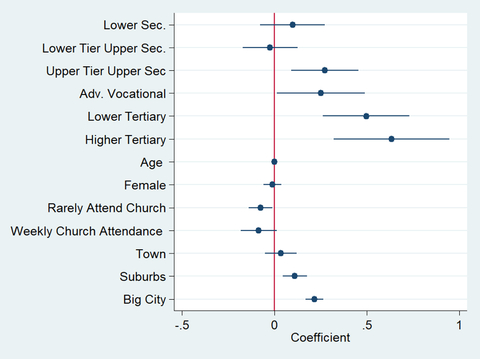
Figure 3 reports the results of a model estimating the determinants of deservingness. The results of Model 2 show that education is strongly and statistically significantly associated with more positive perceptions of deservingness relative to the reference category of less than a secondary education, even after controlling for age, church attendance and rural/urban location. Specifically, those with a lower tertiary education are on average 0.48 standard deviation units more positive and those with a higher tertiary education are on average 0.61 standard deviation units more positive on deservingness relative to the least educated. This finding is consistent with Hypothesis 2.
Model 2, determinants of deservingness perceptions [Colour figure can be viewed at wileyonlinelibrary.com]

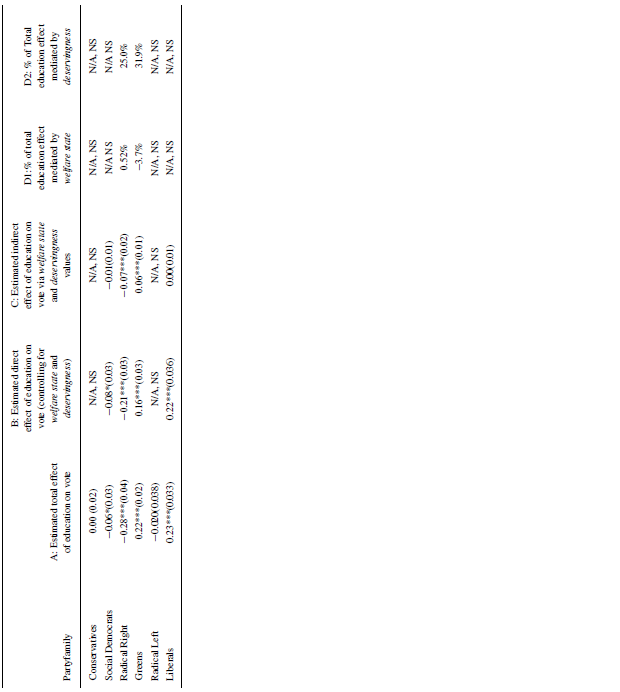
Table 2 below displays the results of logistic regressions predicting vote choice, and KHB mediation analyses decomposing direct effects of education on vote choice from indirect effects of education via welfare state attitudes and deservingness perceptions. Coefficients represent the change in the log odds of voting for a given party family associated with a one‐unit increase in education. Here, my measure of education operationalizes the ISCED measure continuously for ease of interpretation (otherwise, direct and indirect effects would have to be displayed separately for each education category relative to reference category). For my purposes, the key information is contained in Column A, which shows the total effects of education on vote choice for a given party family, Column C, which shows the statistical significance of indirect effects and Columns D1 and D2, which estimate the percentage of total education effects on vote choice mediated by the attitudes of interest.
Direct and indirect effects of education on vote choice

Note: Coefficients derived from logistic regression models predicting vote choice. *p = 0.05, **p = 0.01, ***p = 0.001, standard errors in parentheses. N/A, NS = Not applicable, total or indirect effects are not significant and thus are not decomposed.
Recall that earlier analyses found education to be negatively associated with welfare state support and positively associated with deservingness perceptions. Hypothesis 3a predicted the relatively negative welfare state attitudes of the higher educated would be associated with a greater propensity to vote for free‐market conservative and liberal parties, while Hypothesis 4a predicted the relatively positive welfare state attitudes of the lower educated would be associated with a greater propensity to vote for radical left and social democratic parties.
Column A in Table 2 shows that education is not statistically significantly associated with voting for conservative or radical left parties – for these parties, there is no education effect to decompose. Education is positively and statistically significantly associated with voting for liberal and green parties, and negatively associated with voting for social democratic and, to a much stronger degree, radical right parties. In Column D1, however, we see that welfare state attitudes are not a substantial mediator of education effects for these party families – indirect effects are not statistically significant for liberal and social democratic parties, while for radical right and green parties they are substantively quite small.Footnote 10 In sum, the higher educated are not on average more likely to vote for conservative or liberal parties as a result of their relative opposition to the welfare state – this lack of mediated education effects via welfare state attitudes is evidence against Hypothesis 3a. Education is not associated with radical left voting at all, while indirect effects of education on social democratic voting via welfare state support are not statistically significant, evidence against Hypothesis 3b.
Column D2, however, shows substantial mediation effects of education via deservingness perceptions on voting for the greens and the radical right, parties which exemplify the educational divide in electoral politics. The decomposition of education effects shows that deservingness perceptions explain about 32 and 25 per cent of the total education effect on voting for green and radical right parties, respectively. This is evidence consistent with Hypotheses 4a and 4b. This finding is noteworthy, as these are educationally distinctive parties whose electoral bases are often understood primarily through the opposition of those with low and high levels of education on socio‐cultural issues rather than issues of redistribution (e.g., Dolezal, Reference Dolezal2010; Stubager, Reference Stubager2010). Overall, these findings suggest that the indirect effect of education on vote choice via deservingness perceptions is generally much stronger than those via welfare state support.
However, it is possible that welfare state attitudes as well as deservingness perceptions are an important mediator of education effects on vote choice in more fine‐grained comparisons between adjacent party families competing in political space. Oesch and Rennwald (Reference Oesch and Rennwald2018) conceive of contemporary party competition in Europe as one in which left, right and radical right ‘poles’ engage in bilateral competition over specific social constituencies. As the growth of radical right parties has increasingly challenged the centre‐right, electoral competition between the two has become an area of increasing scholarly focus (Gidron & Ziblatt, Reference Gidron and Ziblatt2019; Pardos‐Prado, Reference Pardos‐Pardo2015; Webb & Bale, Reference Webb and Bale2014). Abou‐Chadi et al. (2021) and Abou‐Chadi and Immergut (Reference Abou‐Chadi and Immergut2019) find that conservative parties often lose economically insecure and relatively pro‐redistribution voters to radical right parties, particularly when conservative governments embrace retrenchment of pensions. While this previous work focuses on intra‐Right competition over occupational classes, we can also ask whether welfare state and deservingness attitudes help to explain the educational divide in vote choice between the centre‐right and radical right.
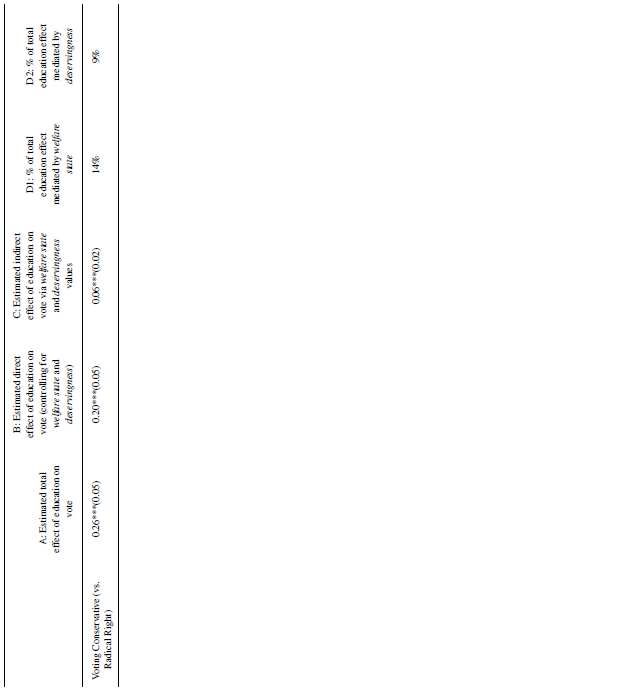
Table 3 repeats the KHB mediation analysis procedure in a logistic regression model predicting voting for the centre‐right versus radical right. Column A indicates that education has a strong positive effect on voting for conservative parties over radical right parties. Column C shows that these education effects are partially mediated via welfare state attitudes and deservingness perceptions. In Columns D1 and D2, we see that an estimated 14 per cent of the total effect of education on vote choice is mediated by welfare state attitudes, while 9 per cent of the total effect of education is mediated by deservingness perceptions. In other words, while welfare state attitudes do not mediate education effects in predicting voting for conservative parties versus all other party families, they do appear to mediate educational differences in vote choice within the political Right.
Direct and indirect effects of education on conservative versus radical right voting

Note: N = 5,122. Pseudo R2 = 0.18.
Alternative explanations and robustness checks
This section addresses four potential counterarguments. The first is that different socialization experiences stemming from parental background, rather than education itself, drive the observed education effects on redistribution attitudes. In Supporting Information Appendix 4.1, I control for parental educational attainment and father's occupation in two models predicting attitudes. The results show that education effects on welfare state attitudes (but not deservingness perceptions) shrink under these controls, but education remains a substantial and statistically significant predictor of these attitudes after controlling for parental background.
A second argument is that socialization within institutions of higher education accounts for lower support for the welfare state among the highly educated, rather than the economic effect of education on reducing economic risk. Indeed, recent research suggests that instructors may transmit ideas related to the efficiency costs of redistribution or that concentrations of affluent students promote economic conservatism on campuses (Gelepithis & Giani, Reference Gelepithis and Giani2020; Mendelberg et al., Reference Mendelberg, McCabe and Thal2017). Supporting Information Appendix 4.2 shows that the effect of education on welfare state support remains robust in augmented analyses that assess the potential confounding role of higher education socialization by controlling for anti‐redistributive norms hypothesized to be inculcated on campuses.Footnote 11
A third counterargument may be that redistributive conflict along educational lines is driven by conflict about types of social policy rather than the scope of welfare state benefits and services. In this view, the highly educated support social investment policies such as childcare and training designed to facilitate labour market participation, while those with lower levels of education instead support passive consumption policies such as pension and unemployment benefits (e.g., Beramendi et al., Reference Beramendi, Häusermann, Kitschelt and Kriesi2015; Garritzmann et al., Reference Garritzmann, Busemeyer and Neimanns2018; Häusermann et al., Reference Häusermann, Kurer and Schwander2015). Supporting Information Appendix 4.3 decomposes the welfare state measure in consumption and investment policy areas, and shows that education is negatively associated with support for both social consumption and social investment policies.
Finally, Supporting Information Appendix 5 (Appendix Table 7) adds controls for socio‐cultural attitudes often theorized to mediate the effect of education on vote choice (Hooghe & Marks, Reference Hooghe and Marks2018; Stubager, Reference Stubager2010). Indirect effects on radical right and green voting via deservingness perceptions are robust in KHB mediation models controlling for attitudes towards immigration and European integration. Nevertheless, I acknowledge that it is possible that there are unobserved confounders that might affect estimates of mediation effects, and the cross‐sectional nature of the data limits my ability to address issues of possible reverse causality.
A further strength of the KHB method is its ability to compare the relative strength of multiple mediators. This allows me to compare the strength of deservingness perceptions and welfare state attitudes as mediators of education effects on vote choice, compared to socio‐cultural attitudes traditionally understood as fundamental to the education cleavage. Supporting Information Appendix 5 (Appendix Table 8) shows that estimated indirect effects of education on voting green via deservingness perceptions are modestly stronger than those via immigration attitudes, and substantially stronger than those via European integration attitudes. For radical right voting, the magnitude of indirect education effects via deservingness perceptions are about half as strong as those via immigration attitudes, but are virtually identical in strength to those via European integration attitudes. Supporting Information Appendix 5 (Appendix Table 9) further replicates this procedure to compare the strength of mediators of education effects on conservative versus radical right voting. The results show that mediation effects via welfare state attitudes on voting for conservative parties over radical right parties are somewhat over half as strong as those via immigration attitudes and stronger than those via European Union (EU) integration attitudes and deservingness perceptions.
In sum, the effects of education on vote choice via welfare state support and deservingness perceptions are robust to several plausible alternative explanations, such as parental background, investment or consumption preferences and socio‐cultural attitudes toward immigration and the EU. This paper does not claim that attitudes other than the welfare state support and deservingness perceptions are irrelevant to educational differences in vote choice. Rather, these findings suggest these two redistributive subdimensions are mechanisms linking education to vote choice, in addition to these other influences.
Discussion
This paper contributes to the literature in two ways. First, it draws on scholarship in sociology and social psychology to argue that education represents a status divide, and not only a divide rooted in economic risk or socio‐cultural attitudes. Status differentials between those with lower and higher levels of education mean they differ in their proclivity to sharply demarcate themselves from the needy in order to maintain their own social esteem. While material insecurity pushes the lower educated towards support for a more encompassing welfare state, status insecurity inclines them towards harsher judgements of welfare state beneficiaries. I find that higher levels of education are on average associated with more positive attitudes towards the deservingness of welfare state beneficiaries compared to less‐educated individuals,Footnote 12 but are also associated with more negative attitudes towards the scope of the welfare state, in keeping with the political economy literature.
Second, the paper assesses to what extent educational divides over redistribution contribute to the emergent education cleavage in electoral politics. Less educated voters, who on average see welfare state beneficiaries as undeserving, are disproportionately attracted to the radical right; highly educated voters who on average have the most positive perceptions of welfare state beneficiaries are disproportionately likely to support green parties. Results of KHB mediation analyses corroborate that different perceptions of deservingness of welfare state beneficiaries explain in part why green and radical right voters represent the poles of the education cleavage.
Evidence on the role of attitudes towards the scope of the welfare state in mediating educational effects on vote choice is more mixed. However, welfare state attitudes are found to mediate education effects in a more fine‐grained analysis of vote choice between competing party families, specifically conservatives and the radical right. Differences in attitudes on both the welfare state and deservingness subdimensions help to explain why on the Right, the lower educated vote disproportionately for radical right parties over conservative parties, potentially consistent with research arguing that these voters are characterized more strongly by welfare chauvinist attitudes than outright hostility to redistribution (van der Waal et al., Reference Van der Waal, Achterberg and Houtman2010).
In sum, education has typically been understood as a structural divide linked to parties primarily competing on the socio‐cultural, rather than the economic dimension (Kriesi et al., Reference Kriesi, Grande, Lachat, Dolezal, Bornschier and Frey2006; Stubager, Reference Stubager2009, Reference Stubager2010). However, this appears partly to be a function of how redistribution attitudes are measured. A deservingness/welfare state framework suggests that the educational divide in party politics is also an expression of redistributive conflict, but in a multidimensional way. These results suggest that education is associated with vote choice both directly and indirectly, via differences in attitudes not just about the proper scope of the welfare state, but even more strongly about the deservingness of welfare state beneficiaries themselves.
As educationally distinctive radical right and green parties continue to gain ground electorally, scholars have begun to focus on their impacts on social policy both in and outside of government (Abou‐Chadi & Immergut, Reference Abou‐Chadi and Immergut2019; Afonso & Rennwald, Reference Afonso, Rennwald, Palier, Schwander and Manow2018; Chueri, Reference Chueri2020; Röth & Schwander, Reference Röth and Schwander2021). This paper helps clarify the contours of redistribution attitudes held by the core social support groups of these parties, with consequences for both their welfare state agendas and the constraints imposed by the opinions of their voters. With their success in attracting a lower‐education base of voters, radical right parties may risk greater backlash from their base for supporting the retrenchment of welfare state programs (Afonso, Reference Afonso2015). However, the particularly negative perceptions of welfare state beneficiaries in the eyes of their voters may give radical right parties leeway to pursue certain kinds of spending cuts if framed around punishing benefit cheating by the undeserving (Chueri, Reference Chueri2020). Conversely, green parties’ growing success among highly educated voters with the most positive views of the needy, ties them to an electoral base that may be particularly averse to the kinds of negative conditionality frequently imposed upon the poor and unemployed.
To further contextualize and explore these results, more research is needed. When groups are cross‐pressured across two attitudinal dimensions, the relative salience of each dimension becomes crucial for vote choice. Prior research into this question has often focused on how cross pressures between socio‐cultural and economic attitudes are resolved in vote choice (Gidron, Reference Gidron2020; Lefkofridi et al., Reference Lefkofridi, Wagner and Willman2014). However, the findings of this paper suggest a new way in which this also applies to the alignment of different social groups in redistributive conflicts. Since, on average, educational groups take internally conflicted positions in terms of deservingness perceptions and welfare state support, future research examining what drives changes in these subdimensions’ relative salience over time can help us better understand the evolution of the education cleavage.
Acknowledgements
I thank the Editors of the European Journal of Political Research and three anonymous reviewers for their highly productive comments over the course of the review process. I express my gratitude to Gary Marks, Liesbet Hooghe, Rahsaan Maxwell, Marc Hetherington and Jan Rovny for their crucial feedback on this piece as members of my dissertation committee. I am also grateful to Leah Christiani, Eroll Kuhn, Andreas Jozwiak, Lucy Britt, Kaitlin Alper and Sean Norton for their helpful comments on drafts at various stages of this article's development.
Open access funding provided by Universitat Zurich.
Online Appendix
Additional supporting information may be found in the Online Appendix section at the end of the article:
Supplementary material
Supplementary material
Supplementary material


 Open access

