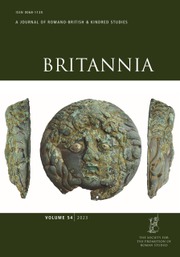


Part 1: The Mosaic in its Archaeological Context
By Jennifer Browning, John Thomas and Jeremy Taylor
In the Summer of 2020, during the COVID lockdown restrictions, a family’s walk across their farmland in Rutland began a series of events leading to what has been hailed as one of the most important archaeological discoveries from Roman Britain in a century.
After noticing an unusual scatter of pottery, tile and oyster shells in one area, the landowner’s son Jim Irvine followed up with a search of satellite imagery and recognised cropmarks apparently showing a rectangular building with two clear apsidal features at its southern end and a single larger apse on the northern end, as well as an adjoining structure on the north-west corner.
These cropmarks had been photographed in June 2018 and made widely available via Google Earth earlier in 2020, when they were reported to Leicestershire County Council (LCC) Historic and Natural Environment Team and the site was added to the county’s Historic Environment Record as a possible Roman villa. His interest piqued, Jim carried out a small investigation at the northern end of the building, close to the single apsidal end, to confirm his suspicions that the cropmarks indicated walls. Rather than finding walls, however, his excavation partially revealed an area of mosaic floor which he immediately reported to LCC as an important discovery.Footnote 1
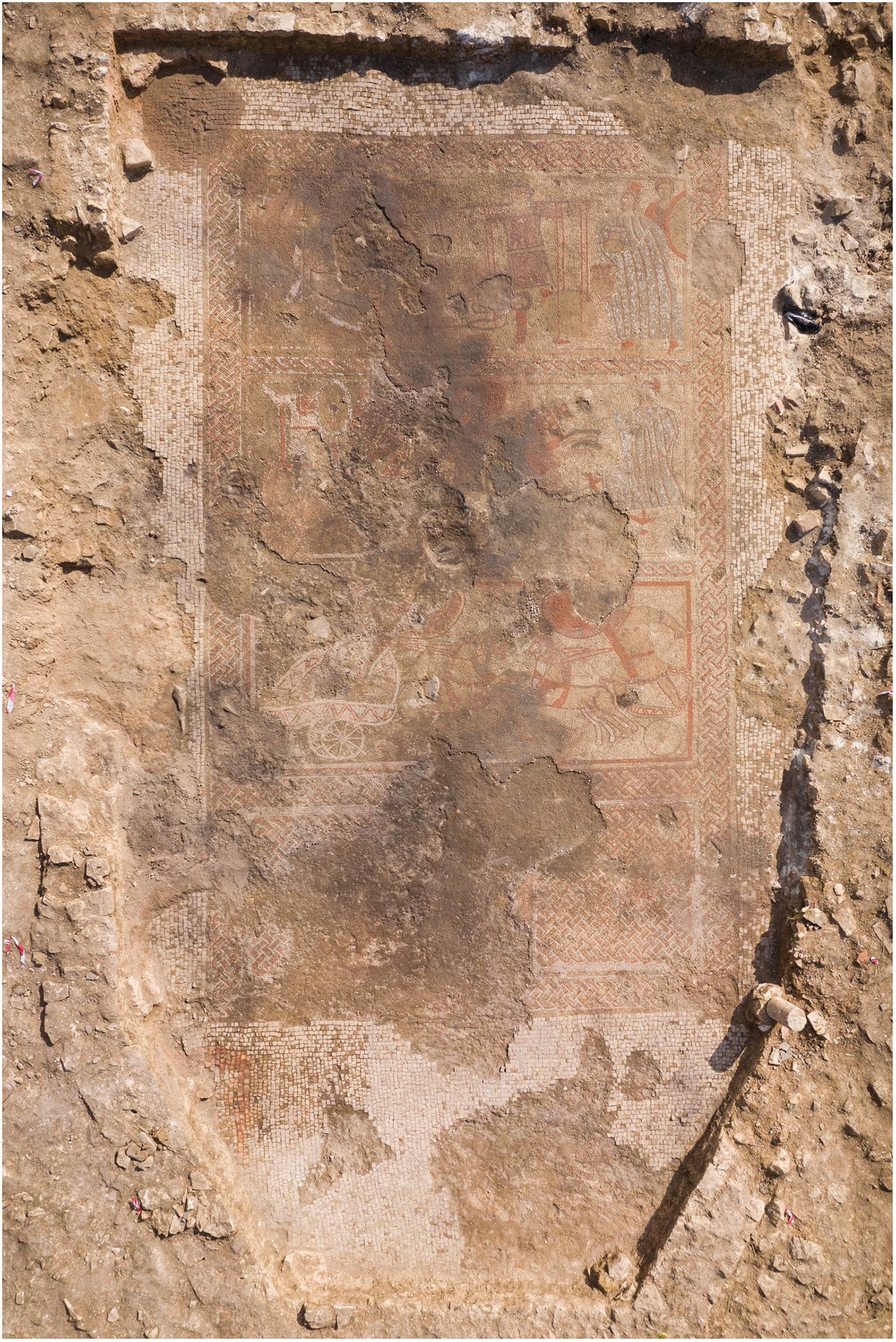
A subsequent site visit by LCC archaeologists established that the mosaic was well preserved and lay at a relatively shallow depth below ground level. Enough was open to see that it included a series of figurative panels divided by guilloche frames, with a four-strand guilloche defining the outer band and a border of larger tesserae (Fig. 1). It was clear by this point that the discovery was of great significance. After consultation between the landowner, LCC and Historic England, a programme of work was agreed to assess the nature, extent and preservation of the archaeology on the site and allow for a more detailed consideration of how it could be protected and managed in the future.
Complete Ketton mosaic within the floor plan of the triclinium with apse (© Historic England).
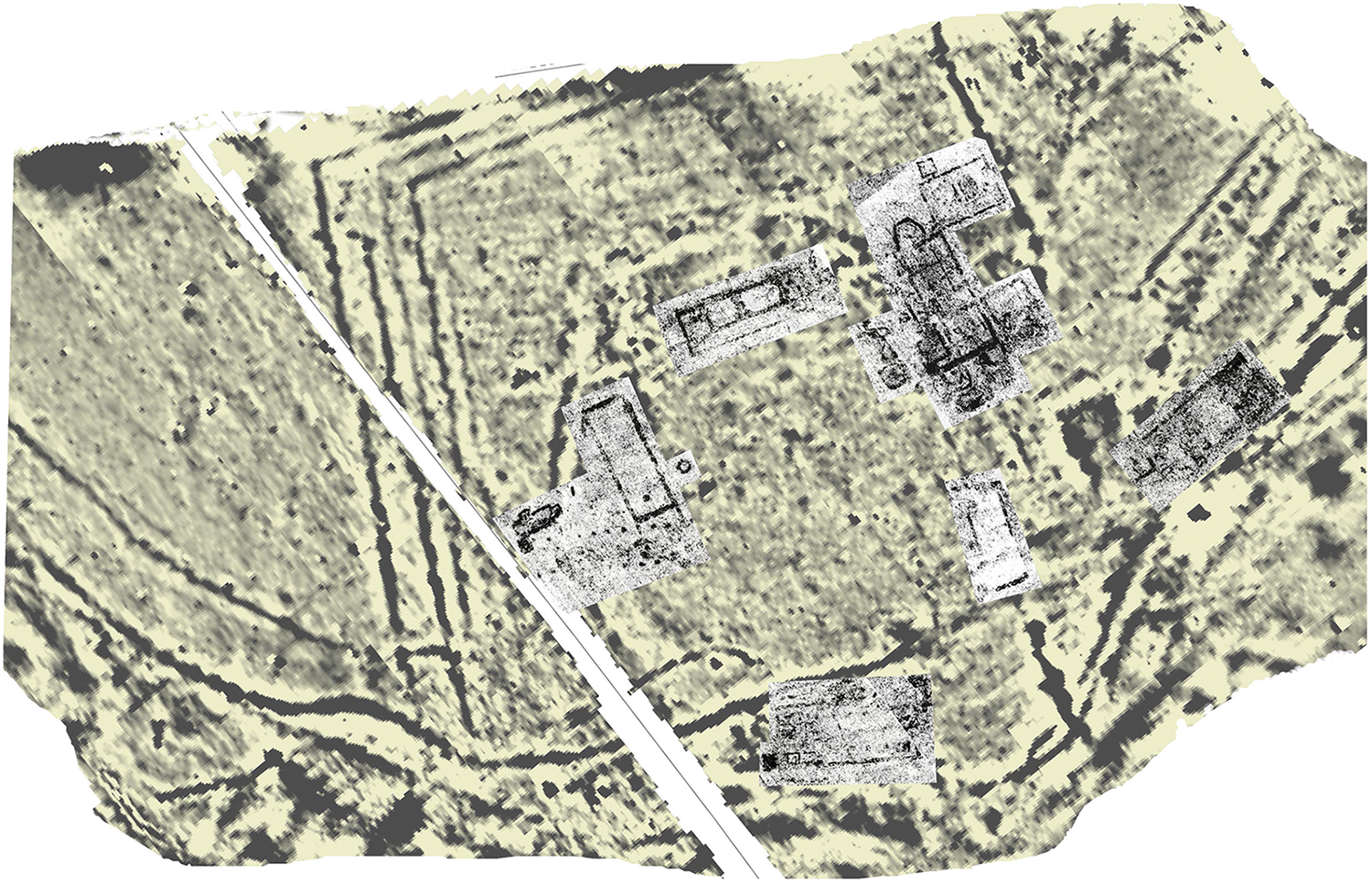
Initial fieldwork, carried out by University of Leicester Archaeological Services (ULAS), with support from Historic England, consisted of a programme of remedial excavation, cleaning and recording of the exposed area, before the mosaic was covered back over. This included a detailed record of the mosaic, including the imagery depicted, recording of the trench sections and excavation and sampling of any remaining deposits above the mosaic to help understand the remains in their immediate and wider context. This was followed by two stages of geophysical survey, carried out by SUMO Survey Services, including a magnetometer survey across two adjacent fields farmed by the landowner, followed by Ground Penetrating Radar (GPR) survey of a targeted area. The fields proved highly responsive to geophysical survey and produced excellent results, revealing in remarkable detail the plan of a comprehensive villa complex with aisled halls, possible bathhouses and other buildings arranged around an open space or courtyard, all contained within a ditched enclosure (Fig. 2). The complex itself lay on south-sloping ground overlooking a pronounced loop in the course of the adjacent River Chater.
Combined results of the magnetometry (general background) and the ground penetrating radar (inset boxes) surveys showing the extent of the villa complex (© SUMO/ULAS).
A programme of trial trenching was also undertaken, guided by the results of the magnetic survey, in order to evaluate further the condition of archaeological deposits across the site. This steered away from the villa building and focused on the peripheral areas of the site, including ditch systems identified by the geophysics. Finally, a series of test pits was excavated across the site following consultation with Historic England and Worcestershire Archaeology. These used the interim GPR data to check the depth and nature of selected archaeological features, but were primarily aimed at areas without archaeology to examine the depth and characteristics of soil profiles across the topography of the two fields. The test pit assessment was intended to assist in the preparation of a scheduling description and to inform a management plan for the monument.
In September 2021, the University of Leicester returned to complete the excavation of the mosaic room, fully exposing the pavement so it could be recorded in its entirety. This work was directed by ULAS as part of a training and research project with undergraduate students from the School of Archaeology & Ancient History (SAAH) at the University of Leicester and a small number of local volunteers. The excavation team spent two weeks carefully removing soil and rubble layers that lay above the mosaic. As more of the floor was uncovered, it was confirmed that the mosaic depicted scenes from the Trojan War, featuring a duel between the Greek hero Achilles and Hector, prince of Troy — a subject that had never before been seen on a British mosaic.
Despite areas of damage from later activity, the mosaic proved to be spectacular, measuring around 10×5.3m in extent, and the imagery was remarkable, narrating a story over three panels in a dynamic, almost comic-book style (Figs 3, 7 and 8, below). The floor is thought to have been laid in a triclinium (dining room) or audience chamber, at the northern end of a large villa building, with the images arranged so as to be viewed consecutively from the apse.
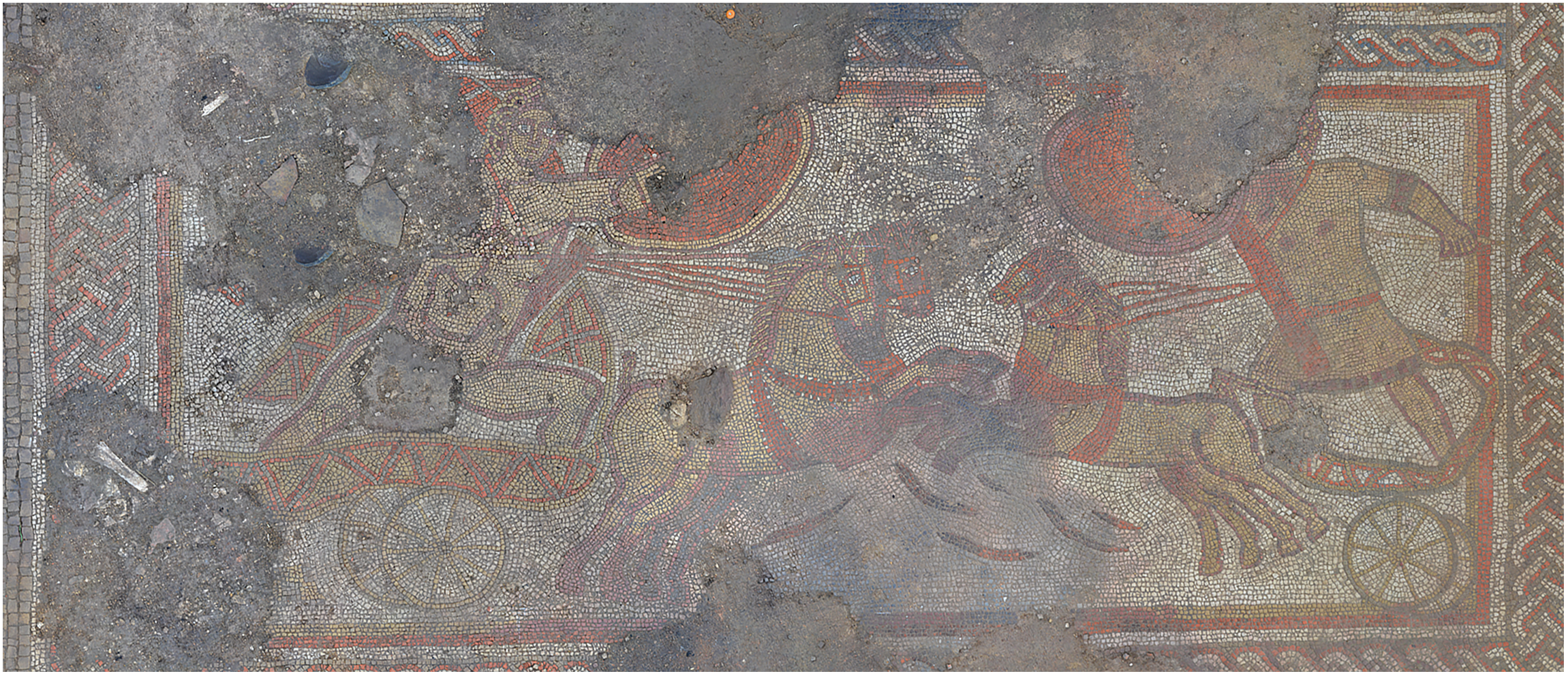
The duel between Achilles and Hector (Panel 1, bottom) (© ULAS).
Pottery and coins discovered during the excavation of the mosaic suggest that it was in use in the later fourth century a.d., but further work on the wider villa complex in 2022, as part of a collaborative project between the University and Historic England, has provided indications that occupation of the site started earlier. It is also clear that activity persisted in the triclinium after the mosaic had gone out of use and forthcoming radiocarbon dating should shed some interesting light on when this change occurred.
The rare mosaic and surrounding villa complex have now been protected as a Scheduled Monument by DCMS on the advice of Historic England. This protection recognises the exceptional national importance of this site and ensures that the remains are legally protected from unauthorised works or unlawful activities.
The project has now entered its post-excavation phase and all of the information that has been gathered since 2020 is being assessed with a view to publishing an account of the findings in the not-too-distant future. It is hoped that eventually there will be a permanent display featuring images of the mosaic and artefacts from the excavations at Rutland County Museum in Oakham.
Part 2: The Narrative and Iconography of the Ketton Mosaic
By Jane Masséglia
Following the discovery and recording of the mosaic, attention naturally turned to its decorative scheme and iconography. As initial publications have already described,Footnote 2 the mosaic comprises four superimposed registers (Fig. 1), intended to be viewed sequentially from the north end of the room, and each delineated by a thick frame of guilloche in cream, red and grey-blue tesserae. The first register, set within the apse and closest to the diners, comprises two square panels of guilloche-work, either side of a largely lost central square panel. Above this are the three remarkable figurative registers, which brought the mosaic to international attention. Each depicts, in sequence, key moments in the death and ransom of Hector, prince of Troy, at the hands of the Greek hero Achilles. Associations between the images and specific Trojan narrative traditions were quickly made, with several contenders championed across different news outlets and by various commentators — namely Homer’s Iliad, Aeschylus’ Phrygians and a lost late Roman narrative in Latin.Footnote 3 What follows here is an exploration of the iconography, through both the literary traditions and the visual antecedents which brought this narrative to Ketton.
Panel 1: The duel between Achilles and Hector (Fig. 3)
The first scene, at the bottom of the triptych, depicts the dramatic moment that the Greek Achilles and Trojan Hector meet in single combat, an engagement precipitated by Achilles’ anger at Hector’s killing and despoliation of the young Greek hero Patroclus. Here the two heroes are, effectively, ‘jousting’ with spears from lightweight bigae pulled by energetic horses, which calls to mind the popular racing motifs of other fourth-century mosaics.Footnote 4 Achilles lunges from the left in the dramatic ‘heroic diagonal’, behind his famous horses Xanthos and Balaios, and agonistically nude but for his billowing red cloak (much damaged) to indicate momentum. His face is enlivened with pale eyes of blue-grey tesserae, and a hair style reminiscent of Alexander the Great, with large curls around his face and nape of the neck.
Both men are afforded equivalent equipment to suggest an equal contest: each has a spear, oval shield and a sword in a red scabbard strapped diagonally across the body. But Achilles is clearly intended to be the key figure here: he and his horses are conspicuously larger than Hector and his team, and he is afforded the preferential frontal orientation and heroic styling. His horses’ harnesses are decorated with pale ‘studs’ which Hector’s team lacks, and his chariot is more carefully articulated with its golden, horseshoe-shaped box and twin wheels beneath. By contrast, Hector is clothed and orientated away from the viewer. Unfortunately, the mosaic is irreparably damaged at the top right of this panel, but enough remains to show that we would have seen his face in profile under red-brown hair. His horses are more diminutive than Achilles’ and the mosaicist has struggled to articulate his chariot within the remaining space (suggesting that Achilles was laid first). The compressed box of Hector’s chariot is missing its distinctive horseshoe-shape, and the misaligned wheels invert the perspective at the bottom right.
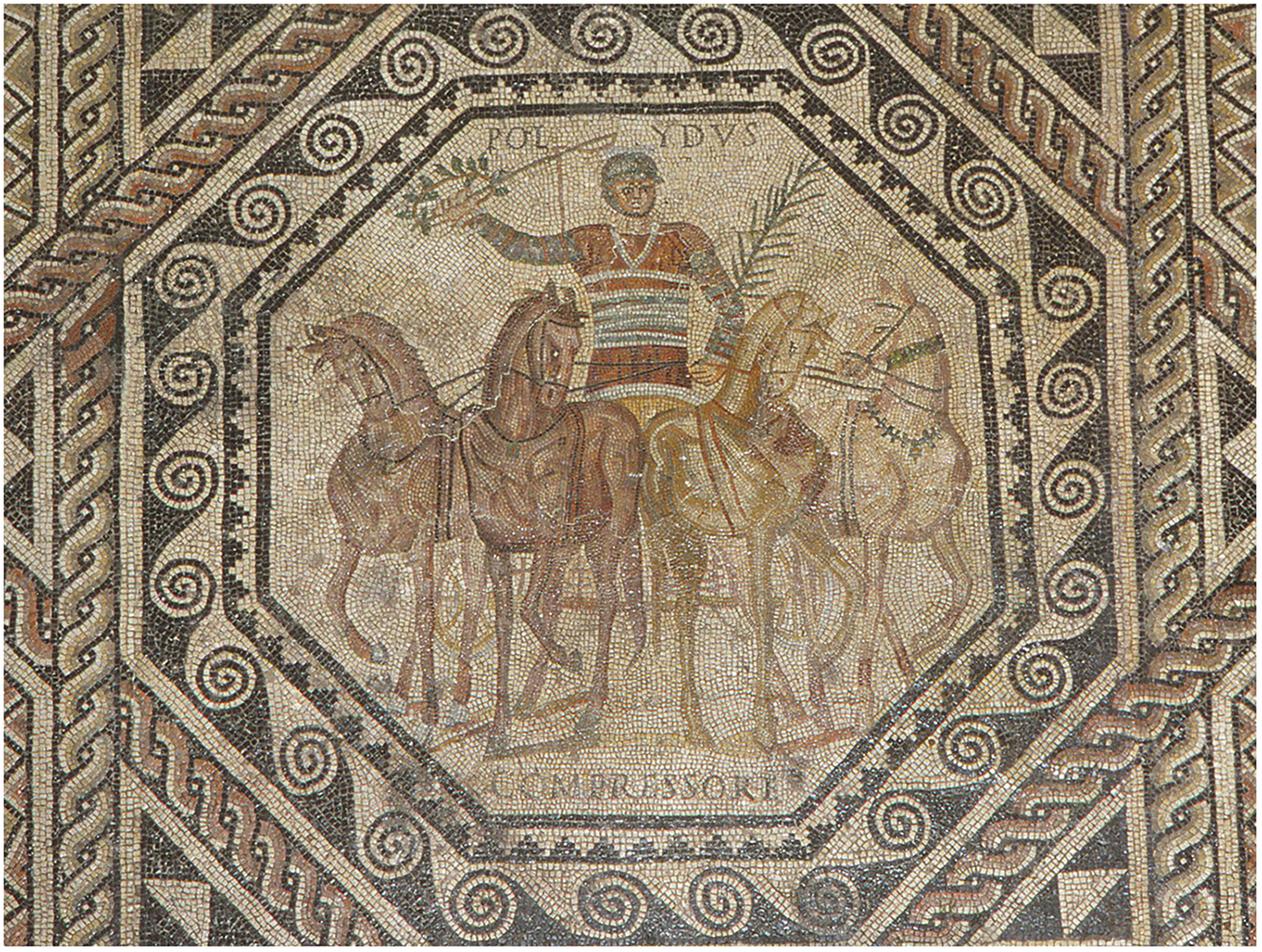
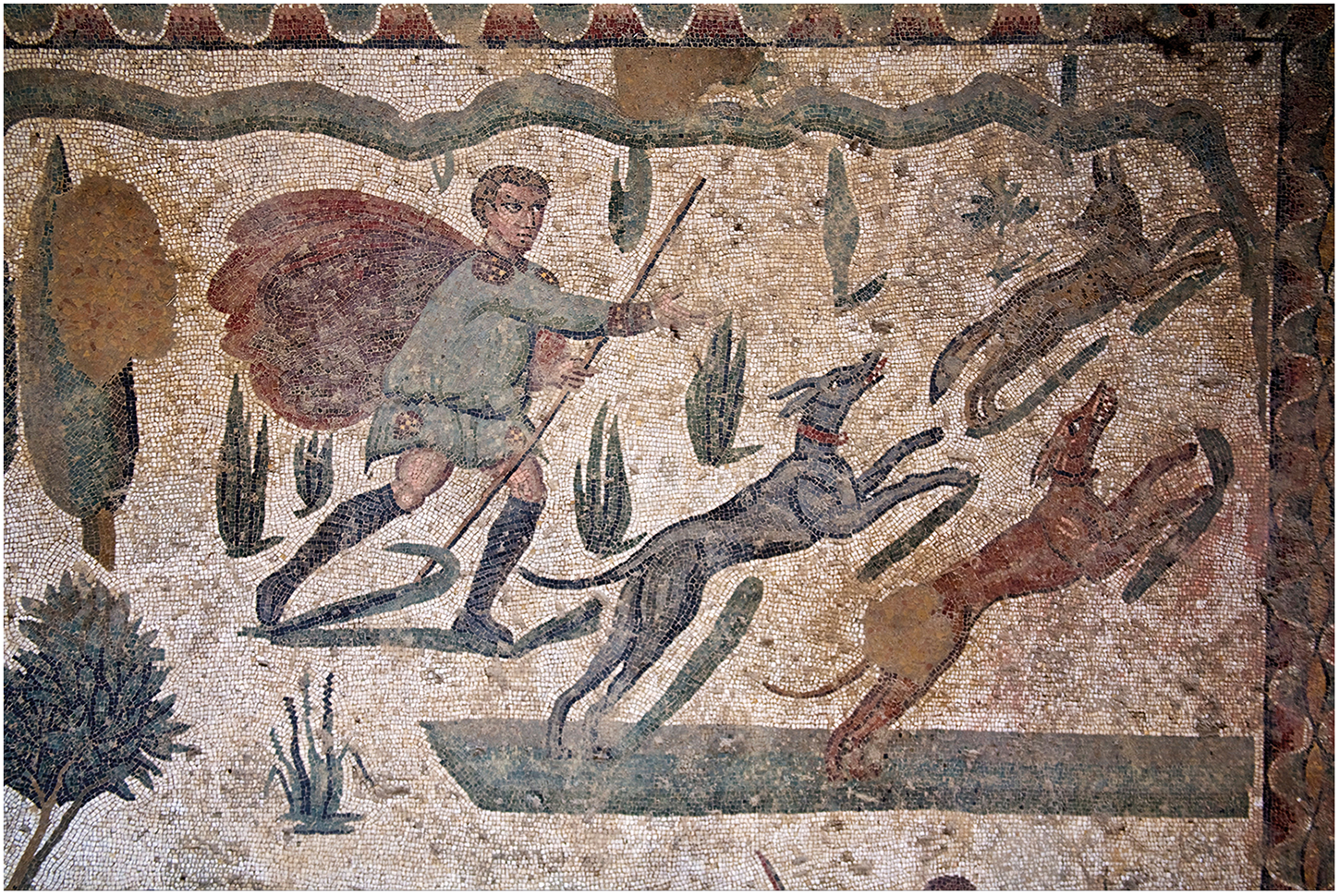
But while details of the composition may be imperfect, damaged or ambiguous, the narrative is unmistakable. The action is enhanced by the simplicity of the background where two intentionally placed motifs stand out: the first is a small yellow, humped object behind the wheels of Achilles’ chariot, partially lost in an area of damage and currently unidentifiable (a Greek tent? Troy?). The second is a series of painterly red marks beneath the rearing horses which, at first sight, suggest mountains or waves. But both of these are unlikely for technical reasons: they require us to see the red stripes as shadows and the white space between them as solid matter. This technique is out of keeping with the rest of the mosaic where shapes are thickly outlined. Nowhere else is matter conjured by negative space. Neither is there a surviving convention of ‘go-faster stripes’ or of billowing dust in depictions of chariots.Footnote 5 Instead, Cosh and Neal’s tentative alternative suggestion, that these red marks are the mosaicist’s attempt to render shadows beneath the horses, seems to me to be the right one, and is a visual tradition in mosaics which elsewhere includes searing red, brown or black stripes denoting both short and long shadow lengths (compare the marks beneath the horses’ feet in the Polydus mosaic, Fig. 4). More similar still to Ketton are the segmented shadows beneath the leaping dogs in a fourth-century hunting mosaic in the Villa Romana del Casale in Sicily (Fig. 5), which follow beneath the animals’ rearing bodies and appear to lose contact with the ground.
Short red-brown shadows beneath the feet of a chariot team, Polydus Mosaic, third century a.d., Trier inv. 1962,412 (© CM Dixon/Heritage Images/Alamy Stock Photo).
Detail of mosaic from the ‘Room of the Little Hunt’, fourth-century Villa Romana del Casale, near Piazza Armerina, Sicily, in situ (© Peter Barritt/Alamy Stock Photo).
The dragging of Hector (Panel 2, middle) (© ULAS).
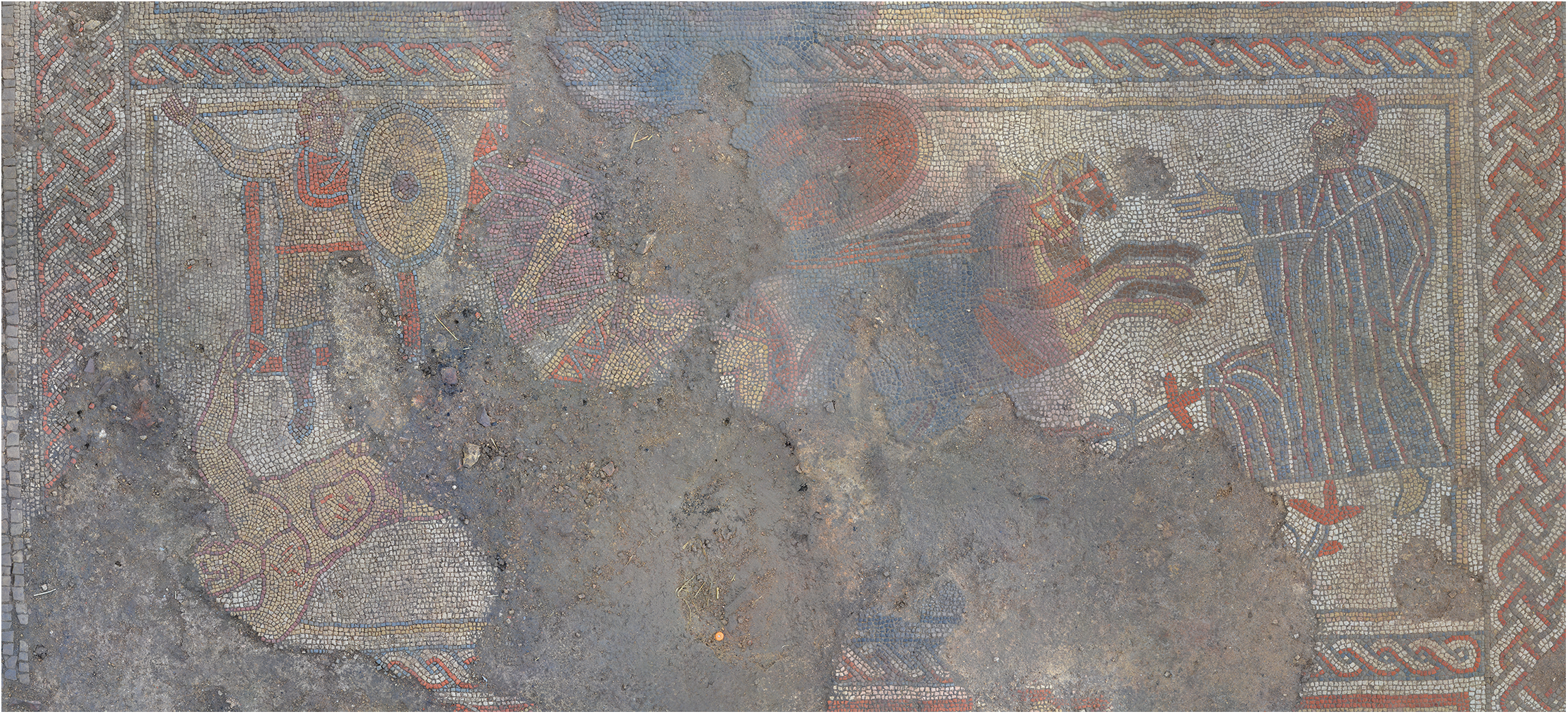
Panel 2: The dragging of Hector (Fig. 6)
In the second scene, we find Achilles venting his anger towards Hector for the death of Patroclus, through a ritualised ‘outraging’ of his body.Footnote 6 He commands the centre of the frame, again posed in ‘heroic diagonal’ on his two-horsed chariot, while a flailing Hector hangs down from the rear, attached by his feet. Damage prevents us from seeing this attachment, whether pierced at the tendon in the Homeric traditionFootnote 7 or tied at the ankle. Missing tesserae have also rendered invisible the torso and head of Achilles, but enough remains to suggest a replication of his depiction in Panel 1 (Fig. 3). Indeed, the mosaicist has also supplied his right hand with a spear in a similar ‘jousting’ position to the duel scene, although it is not clear whether this is an intentional iconographic choice (perhaps to underscore the restoration of his panoply), or unreflective copying of the first design. One conspicuous difference is the colour of his shield, now the red shield with pink rim which Hector held in the previous scene. This surely must be a reference to the original shield of Achilles — borrowed by Patroclus, spoliated by Hector, used in their duel, and now returned to its original owner — a satisfying narrative detail for an eagle-eyed guest.
At the right-hand side of the composition, the mosaicist has depicted a bearded figure, his arms outstretched, palms uppermost, and his right knee raised beneath his tunic to indicate running. This is the figure of Hector’s father, Priam, supplicating Achilles for the return of his son’s body. As king of Troy, Priam has been rendered with an imaginative exoticism, with his long tunic striped with red and white, and a red Phrygian cap. Here we instinctively understand the manipulation of space for narrative effect: Priam is not literally running directly into a collision with Achilles’ horses. The mosaic synthesises events occurring synchronously inside and outside Troy.Footnote 8
Behind the remains of Achilles and above Hector’s prostrate body, we see a figure with a long red cloak and yellow shield standing at the top left, performing an expansive gesture of celebration (?). Considering the overall composition and the mosaicist’s inclusion of a ‘filler’ figure in Panel 3 (Fig. 7), it seems most likely that this is the figure of a celebrating (but unidentified) Greek, a counterpoint to the supplicating Priam on the right. One final figure, the partially preserved figure of a snake-like creature, rising beneath the rearing horses of Achilles, is the subject of more detailed discussion below.
The ransom of Hector (Panel 3, top) (© ULAS).
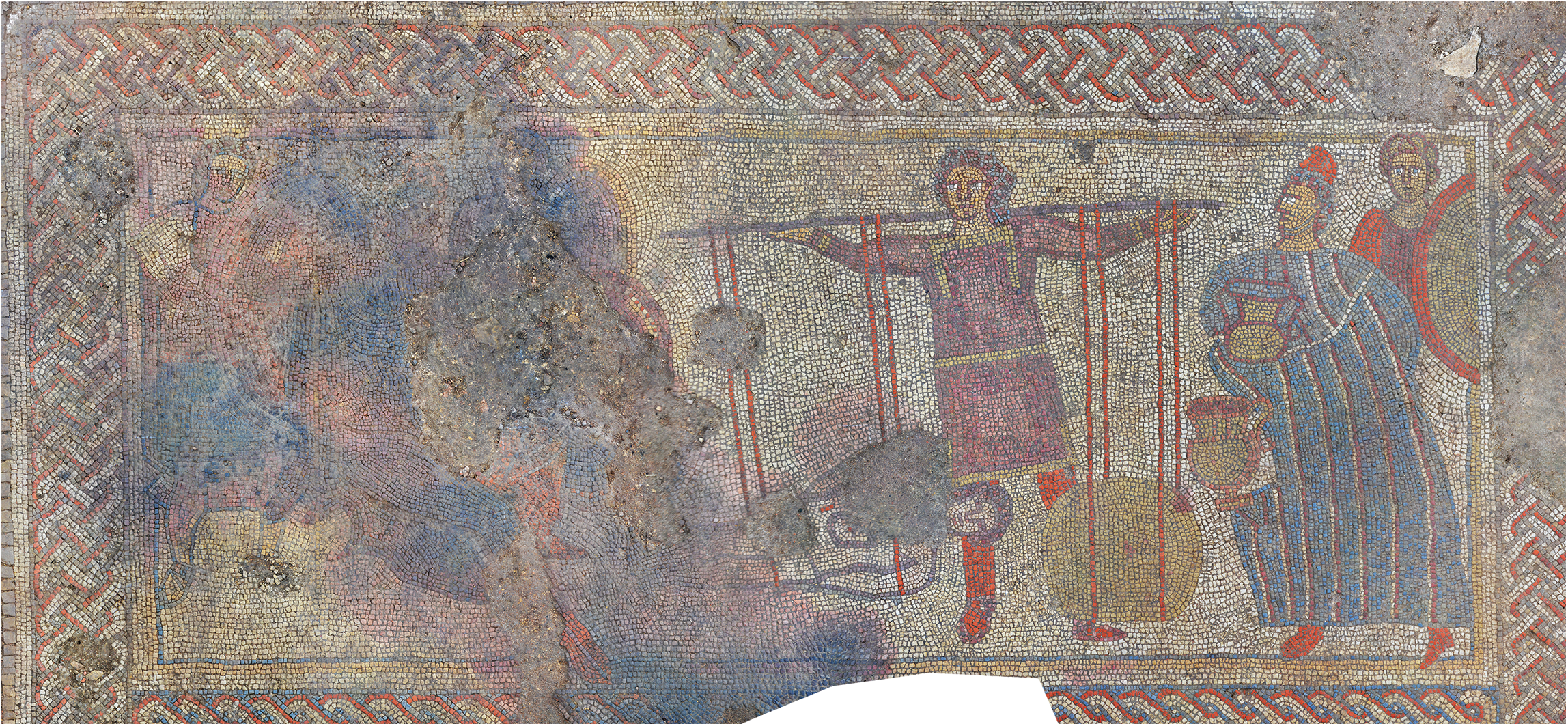
Panel 3: The ransom of Hector (Fig. 7)
The final scene depicts the ransom of Hector. The left side of the panel is badly damaged with both missing and blackened tesserae, the result of a fire during later occupation. But, as Jennifer Browning’s outline shows, the orientation of the tesserae nonetheless reveals the figures since the mosaicist articulated the figures in outline before filling in internal details and the background. This means that we are able to reconstruct with confidence the figure of an enthroned Achilles, perhaps again with shades of Alexander the Great in his guise as keraunophoros,Footnote 9 and his two bodyguards behind (Fig. 8).Footnote 10
Outline of seated Achilles and bodyguards within burnt area, following orientation of tesserae. Ketton Panel 3 (reconstruction by Jennifer Browning).
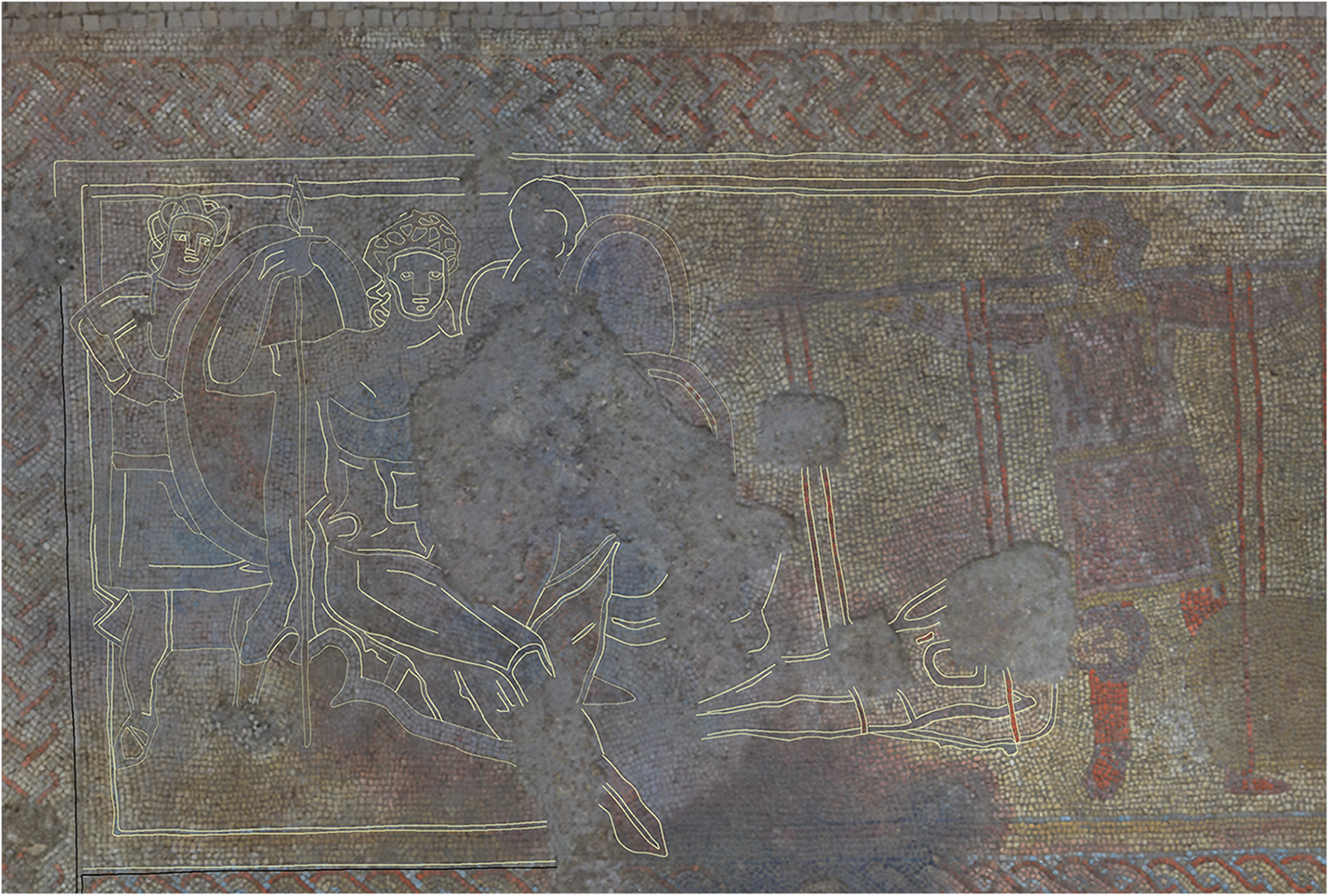
At the right of the scene we see Priam approaching, this time holding two golden vessels. His arms and hands are obscured by his voluminous tunic, but a line of white tesserae running from his left shoulder suggests his left arm holding a small amphora against his body, while holding out a jug (?) above his right knee. Behind him, the floating torso of an armed man probably represents his own bodyguard.
In the centre of the scene are the figures which caused the greatest surprise on the mosaic’s discovery: we see a standing figure in a red-brown tunic and red leggings, carrying the beam of huge weighing scales across his shoulders. In the right-hand pan, to which Priam is about to add his two gold vessels, is a large gold platter. In the left-hand pan, we see balanced the rigid corpse of Hector. This is the ransom of Hector’s body for his literal weight in gold.
Having examined the three figurative panels, we can now turn to what inspired them. It does not, of course, necessarily follow, because the Trojan War is a popular literary theme, that all art depictions can be associated with a specific text. In the case of the Ketton mosaic, however, there are several significant features in its design choices and narrative details which point to a specific literary tradition.
Ruling out the Iliad
The supremacy of Homer in the modern reception of the Trojan War narrative led to understandable references to the Iliad in many reports when the discovery of the mosaic was first announced.Footnote 11 But inspection of the three scenes reveals significant divergence from the Iliadic version of events, which makes its association untenable. An example from each of the three panels can illustrate the principle:
1. In Panel 1 (The duel, Fig. 3), the two heroes fight from the back of chariots. The Iliadic tradition has chariots only as a means to ferry heroes to battle, and requires additional charioteers.Footnote 12 In Iliad 22, Achilles and Hector’s duel takes the form of a protracted chase around Troy on foot, with references to the distances they run, their manner of running and the speed of their feet,Footnote 13 while they also duel on foot in late Archaic/early Classical Greek painted pottery.Footnote 14 Indeed, the incompatibility of fighting while simultaneously steering a chariot is explicitly mentioned in the Iliad. Footnote 15
2. In Panel 2 (The dragging of Hector, Fig. 6), the mosaicist has depicted abrasions across Hector’s torso using red tesserae. But in the Iliad, Apollo intervenes to protect Hector’s body and ‘pitying the man, guarded his skin from any lacerations even in death, and covered him completely with a golden aegis, so that he [Achilles] would not tear his skin as he was dragging him about’ (24.18–21).
In these two cases, we can see that narrative features of the Iliadic tradition are not observed in the mosaic. But we could argue that they represent artistic licence or embellishments by the mosaicist. The inclusion of the chariots might be the result of contemporary fashions in the depiction of the heroes, or the widespread fourth-century passion for charioteer mosaics like those from the Piazza Armerina and Horkstow.Footnote 16 Likewise, the abrasions on the body of Hector could be visual flourishes by a mosaicist not intimately familiar with particular lines of the Iliad. But a significant divergence in Panel 3 makes it unambiguous that we are not dealing here with a depiction of Homer’s Iliad.
In this scene, we have a ransom of Hector’s weight in gold. In the Iliad, the ransom which Priam brings in exchange for his son’s body comprises 12 robes, 12 cloaks, 12 blankets, 12 white cloaks, 12 tunics, 10 talents of gold, two tripods, four lebes and one Thracian cup (24.228–35). The assembled goods are then packed into a wicker box and transported to Achilles by mule-cart (24.265–6). Although gold is among these items, the Iliadic ransom prioritises textiles as the prestige materials from Priam’s stores. And there is no weighing process, no scales in Iliad 24.
Significantly, however, the idea for this motif is counterfactually described earlier in the Iliad with a very different narrative function. During the prolonged foot-chase of Book 22, Achilles vents his anger for the death of Patroclus by telling Hector, in colourful detail, how he plans to treat his body once he has killed him. Among these threats, we find the following (Iliad 22.348–351):
ὡς οὐκ ἔσθ᾽ ὃς σῆς γε κύνας κεφαλῆς ἀπαλάλκοι,
οὐδ’ εἴ κεν δεκάκις τε καὶ εἰκοσινήριτ᾽ ἄποινα
στήσωσ᾽ ἐνθάδ’ ἄγοντες, ὑπόσχωνται δὲ καὶ ἄλλα,
οὐδ’ εἴ κέν σ᾽ αὐτὸν χρυσῷ ἐρύσασθαι ἀνώγοι
Δαρδανίδης Πρίαμος
there’s no-one who’ll keep the dogs away from your head, not even if they bring here and set out a ransom ten or twenty times [your value], and promising extra; not even if Priam, son of Dardanus, orders that your self [i.e. your body weight] be redeemed in gold.
So not only does the Ketton mosaic not show the ransom which the Iliad describes, but it depicts precisely the method of ransom that the Iliadic Achilles explicitly says he would never accept. This simultaneously rules out the Iliad in its original Greek and Latin-language translations as the direct inspiration for the Ketton mosaic.Footnote 17
The ‘weighing of Hector’ motif: parallel images
While the weighing scales depicted in the Ketton mosaic were unexpected, they are not unprecedented. Their use in the ransom of Hector is depicted in a number of art objects, across a great range of media of varying geography and chronology. It is perhaps this spread, crossing academic regional and historical specialisms, which has concealed its frequency.Footnote 18 Table 1 and composite Fig. 9a–f summarise examples known to me at the time of writing. Of these examples, it is notable that only two (d and e) come from officially ‘Latin’ contexts, while the remaining five are from all over the Greek-speaking world. The earliest known image of the scales is currently the fifth century b.c., and the latest the sixth–seventh a.d. However unusual their appearance on the Ketton mosaic may have appeared to us initially, it is clear that this was not a ‘niche’ iconographic choice in antiquity. We are seeing a widespread and enduring alternative ransom narrative which was in circulation alongside the more familiar (to us) Homeric version. What is the origin of this alternative plot device?
a–f. Details of objects listed in Table 1. (a With permission of Royal Ontario Museum; b © Album/Alamy Stock Photo; c Photo: David Gill; d With permission of the Bibliothèque nationale de France; e © Francesco Lorenzetti/Alamy Stock Photo; f After Weitzmann Reference Weitzmann1979, 235).
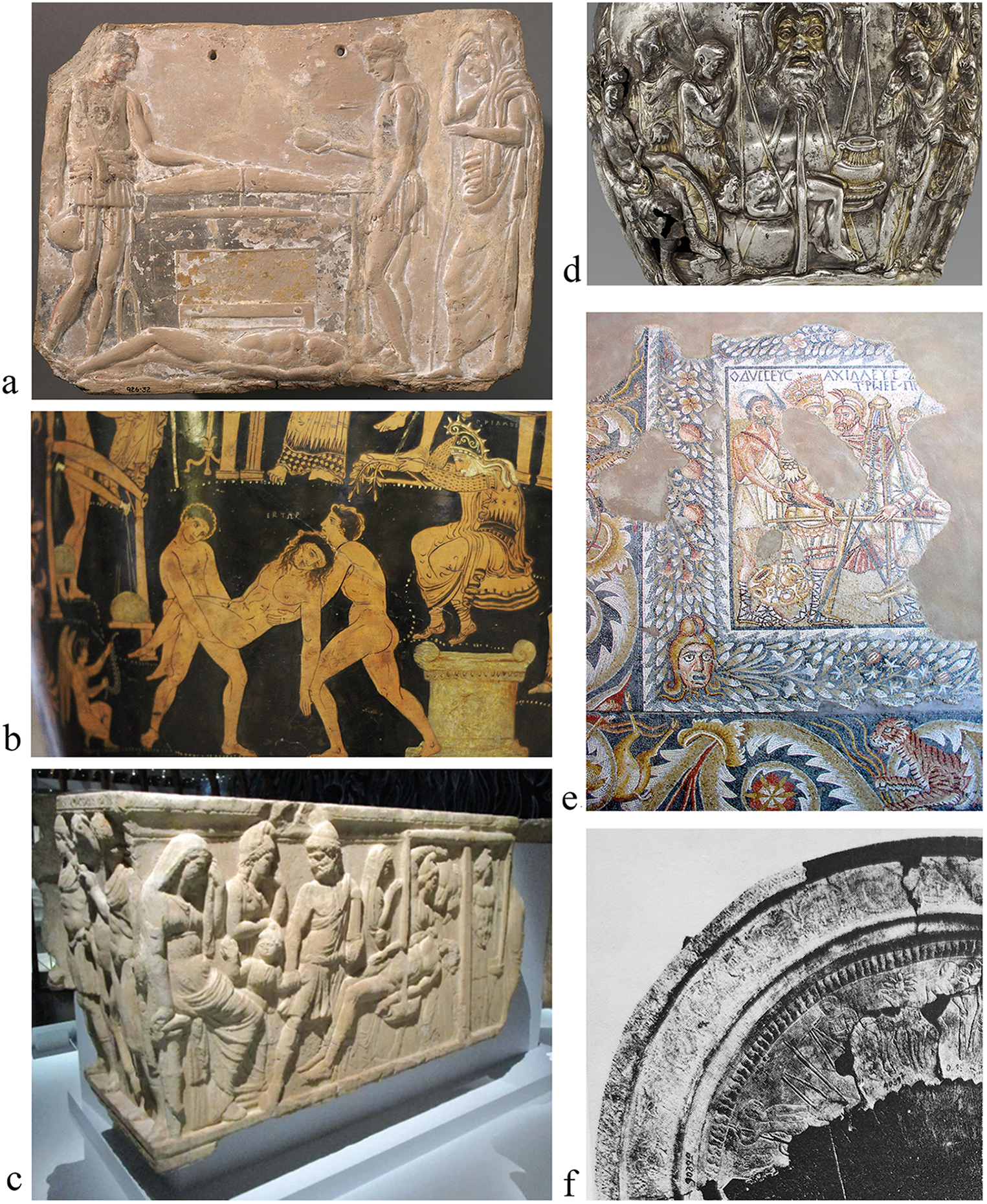
Art objects depicting the weighing of Hector.
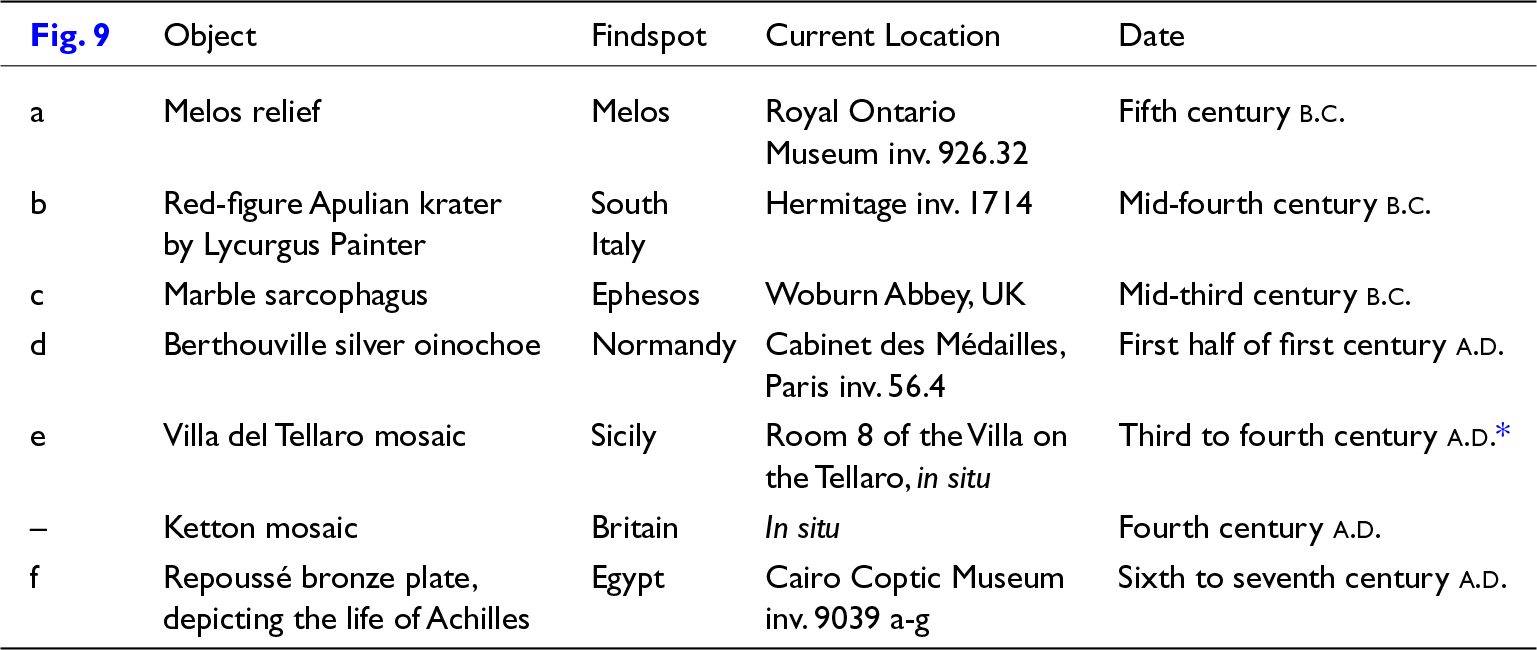
* Coins beneath the mosaic provide a terminus post quem of a.d. 346: Dunbabin Reference Dunbabin1999, 143. R.J.A. Wilson Reference Wilson2016, 26–62 is the essential account of the mosaic in its villa context and Lancha Reference Lancha1997, 265–7 for comparative iconography from the Roman West.
The ‘weighing of Hector’ motif in texts
The tenth-century manuscript, Marcianus Graecus Z. 454 [=822], more commonly known as Venetus A, is one of the most valuable copies of the Iliad to have survived. Not only does it contain the text of the epic poem, but it is heavily annotated with scholia.Footnote 19 These marginal and interlinear additions are the product of several scholiasts, combined and transmitted through the tenth-century copyist. Helpfully, four of these scholiasts are named in the manuscript, all of whom are known (and datable) individuals: Didymus from the first century b.c., Aristonikos from the first century a.d., Nikanor from the early second and Herodian from the later second century a.d. In addition to annotations made by these named four, Venetus A also preserves interlinear comments from another tradition (the so-called ‘D Scholia’), derived from the third-century a.d. commentator Porphyry, and from another tradition known as the ‘bT’ scholia.Footnote 20
Among these annotations, we find the answer to our question about the weighing of Hector. Accompanying the text of Book 22 (Fig. 10), where Achilles taunts Hector that he would not return his body, ‘not even’ for his weight in gold, we find the following comment on line 351:
οὐδ’ εἴ κέν σ’αὐτὸν χρυσῶι ἐρύσασθαι ἀνώγοι Δαρδανίδης Πριαμος … ὅτι ὑπερβολικῶς λέγει. δὲ Αἰσχύλος ἐπ’ ἀληθείας ἀντίσταθμον χρθσὸν πεποίκε προς τὸ Ἕκτορος σῶμα ἐν Φρυξίν.
[Regarding the passage] ‘not even if Priam, son of Dardanos, should bid that you be ransomed for gold’, he [Achilles] says this rhetorically [hyperbolikōs]. But Aeschylus actually does do a weighing of Hector’s body for gold in The Phrygians. Footnote 21
Detail of Venetus A 289r, showing Scholiast A’s comments on the weighing of Hector (my underlining) (Biblioteca Marciana, Open Access).

This Phrygians of Aeschylus, written in the early fifth century b.c., is only fragmentary today,Footnote 22 but is well attested among ancient authors, and was evidently familiar enough to Athenian audiences for Aristophanes to mention it by name and refer explicitly to its famous weighing scene.Footnote 23 It was similarly named explicitly in the second century a.d. by Julius Pollux,Footnote 24 in the third century a.d. by Athenaeus,Footnote 25 in the fifth century a.d. by Johannes StobaeusFootnote 26 and by Hesychius in the fifth to sixth century a.d. who glosses some of the more unusual words from the text.Footnote 27 The enduring association in the late Roman mind between the weighing motif and a tragedy (rather than an epic poem, for example) is underscored by the presence of the tragic mask directly adjacent to the weighing scene in the mosaic from the Villa Romana del Casale on the Tellaro we have already seen (Fig. 9d). More emphatic still, this tragic mask wears a Phrygian cap — surely a concise visual formula for Phrygians beside the Aeschylean scales.Footnote 28 And while Wilson’s observation is true, that there is ‘not a scrap of evidence to suggest that revivals of any Greek drama, in the form of an entire play, were performed in the Greek East any later than the late second century a.d.’,Footnote 29 it does not take into account the continued interest in Greek tragedies as texts for private study across the empire. Indeed, the enduring literary interest in these plays into the Medieval period is precisely what underpins the survival of our extant Aeschylus, Euripides, Sophocles, Aristophanes and the rest, not to mention their various receptions into later literature.
Significantly, several of the ancient commentators give Phrygians an alternative title: The Ransom of Hector, suggesting this was its defining narrative element.Footnote 30 Since the early nineteenth century, the play has been largely accepted as the last instalment of Aeschylus’ Achilleis trilogy,Footnote 31 which comprised:
Myrmidons (about the death of Patroclus)
Nereids (about Achilles’ new armour, brought by Thetis)
Phrygians (a.k.a. The Ransom of Hector)
These three plays were first identified as a trilogy by Welcker on the basis of their sequential treatment of Achilles’ resolve on, and enactment of, revenge. While together they do present a satisfying story arc, it should be noted that such a grouping remains conjectural. Not only are other groupings possible,Footnote 32 but we cannot rule out tragedies as stand-alone productions.Footnote 33 The historical validity of Welcker’s Achilleis grouping does not, however, change the arguments here. What matters is that Aeschylus presented various episodes within the Trojan War cycle as self-standing narratives, and that the Phrygians (a.k.a. the Ransom of Hector) would not have significantly duplicated narrative elements of the plot from Myrmidons, Nereids, or any other Aeschylean production.
That Phrygians established the new, un-Iliadic plot device of the weighing scales in the early fifth century b.c. explains the first appearance of the weighing scene in the art of the same period and not before (see Table 1), while its continued popularity in various media corresponds to this plot device’s enduring familiarity.Footnote 34 In addition to a legacy in the visual arts, we can also detect its reception into later literature (both Greek and Latin),Footnote 35 by a review of the extant texts which explicitly describe the ransom of Hector (Table 2, rightmost column). At least six surviving post-Aeschylean texts allude to his being ransomed in this manner.
Overview of surviving literary accounts of the treatment and ransom of Hector.

* Greensmith Reference Greensmith2020, 24–34.
In the same way that we see references to Aeschylus’ Phrygians enduring into the Medieval period, we can also detect the enduring influence of the ‘Aeschylean variant’ of the ransom narrative (i.e. the literal weighing of Hector for gold) in its appearance in both Dracontius’ Christian meditations on the nature of the soul in Romulea 9 of the fifth century a.d. and the Excidium Troiae of the sixth, both composed long after the creation of the Ketton mosaic. In trying to gauge how familiar the Aeschylean variant may have been to the wider reading public, the text of the Periochae Homeri Iliados et Odyssiae of, most likely, the fourth century a.d. is especially instructive. This text purports to provide very short summaries of each book of Homer’s Iliad and Odyssey, as a crib for a broader Latin-language readership. In their summary of Iliad 24, the author of the Periochae writes et Iris cohortatur <Priamum> ut auro filium rependat exanimum (‘Iris too encouraged Priam to weigh out his dead son for gold’). The Aeschylean variant must have become very firmly embedded in the cultural repertoire of Trojan War stories if an author claiming to be summarising the Iliad incorrectly recalled it as the Homeric version of the ransom of Hector in Book 24!
So, if the Periochae Homeri Iliados et Odyssiae is a text of comparable date, written in Latin, which mentions the weighing of Hector’s body, could this be the text which inspired the Ketton mosaic? Unfortunately not, for two reasons. And the first concerns a snake.
The snake at the dragging of Hector
In early discussions of the mosaic, both within and outside the excavation team, the fragmentary image of a rearing serpent-like creature beneath Achilles’ horses in Panel 2 (Fig. 6) was met with some uncertainty.Footnote 36 I myself was guilty of hedging my bets in an early video commentary on the iconography, describing the animal as ‘a pistrix, or sea monster’,Footnote 37 perhaps an allusion to the nearby River Scamander.Footnote 38 More careful comparison with the form and prone posture of other marine creatures (including pistrices) in Romano-British mosaics, however, has subsequently revealed my error.Footnote 39 The animal’s crest and finials do not indicate a marine creature, but are entirely in keeping with both Roman and Medieval depictions of ‘supernatural’ snakes.Footnote 40 In the same video commentary, I tentatively made an alternative suggestion which I now believe to be correct:
Proposition 1: The snake means ‘at the tomb of Patroclus’
This identification requires us to compare much older images, and from a firmly Greek context: depictions of the dragging of Hector in Attic vase painting from the early fifth century b.c. Here we see the same compositional format we find at Ketton, from Hector’s prostrate body on the left to the snake beneath the horses’ hooves on the right. The meaning of the snake in these vase images is helpfully spelled out in those with painted labels. Our finest surviving example of the type is a black-figure hydria by the Antiope group, made in Athens and now in the Museum of Fine Arts, Boston (Fig. 11). Here the painter has labelled both the body of Hector and the white tumulus of Patroclus’ funerary mound (ΠΑΤΡΟΚΛΩ). Springing from the top of the tomb is the fully armed eidolon of the dead warrior, and at its base a bearded (and so ‘heroic’ or supernatural) snake. This is the tutelary snake that can be found depicted by both fountain houses and tombs in Greek art and particularly associated with liminal spaces.Footnote 41 This same visual formula is repeated on many vases from the same period (e.g. Fig. 12). In all cases, the snake is framed by a simply outlined mound (the burial tumulus) and functions as a location marker: in these images, Achilles is dragging Hector’s body around the tomb of Patroclus.Footnote 42 The appearance of the snake in the same position in the Ketton mosaic, albeit with fourth-century visual styling, has significant implications.
Hydria, Boston 63.473 Antiope Group, c. 510 b.c., showing the snake at the burial mound of Patroclus (© MFA Boston).

Attic neck-amphora, BM inv. 1842,0314.2, c. 520–500 b.c., showing snake at the burial mound of Patroclus (© The Trustees of the British Museum).

The ‘Euripides Line’
If we return to Table 2 and the surviving accounts of the Trojan War, we can see that there is a stark division in the narrative traditions concerning the dragging of Hector’s body: in the Iliad, Achilles drags Hector’s body around the tomb of Patroclus, but from the time of Euripides’ Andromache onwards, the tradition irrevocably shifts so that the event occurs around the walls of Troy. Euripides’ habit of adapting familiar mythological narratives and introducing novel variants is well attested in scholarship,Footnote 43 and before the discovery of the Ketton mosaic, his Andromache had already been identified as one of his more creative treatments.Footnote 44 Euripides’ revision of the location, from Patroclus’ tomb to beside the walls of Troy, creates an entirely new emotional effect: Hector’s widow, Andromache, addressing the city directly, compares the city’s defilement by Achilles’ activities with her own enslavement by the Greeks. This emotional parallel would not be possible if the action took place at Patroclus’ tomb by the Greek camp. An examination of our other extant Trojan War stories shows that this shift in location was so quickly embedded into the narrative tradition that the older version (around the tomb of Patroclus) appears to have subsequently dropped completely out of use in new retellings.Footnote 45 This then leads us to our second proposition:
Proposition 2: Euripides’ Andromache (c. 428–425 b.c.) is a terminus post quem for the ‘around the walls of Troy’ variant
In a striking parallel of this break in the narrative traditions, we also find an important difference in visual depictions of the dragging of Hector. Up to c. 475 b.c., the motif of the burial tumulus (with or without the rearing snake) dominates the visual record.Footnote 46 After this, there is a lacuna in surviving depictions of the dragging scene, after which it reappears in Roman art situated (whenever a location is suggested)Footnote 47 outside the walls of Troy. This is rendered with architectural details such as monumental blockwork, crenellations and even the faces of Hecuba and Priam watching from above (Fig. 13).Footnote 48 We can see that the same shift had occurred in Romano-British visual culture from an intaglio from Northumberland (Fig. 14), showing the tiny shape of Achilles’ chariot dragging the body of Hector in front of an elaborate cityscape of towers and turrets. At some point between the early Classical period and the first century a.d., the visual tradition had relocated the dragging from the tomb of Patroclus to the walls of Troy. Although the lacuna makes it impossible to say with certainty, it seems likely that this shift in visual iconography is related to the same changes we see in the texts, and that Euripides’ Andromache precipitated this pervasive shift.Footnote 49
Detail of a silver oinochoe from the Berthouville treasure, showing Achilles dragging Hector around the walls of Troy in the post-Euripidean variant, first century a.d., CdM Paris inv. 56.5 (= Chabouillet 2805) (Photo: Marie-Lan Nguyen, Creative Commons).

Yellow-orange glass intaglio from House 31 at Hartburn, Northumberland, of imperial date (?) (Photo: M. Henig, with permission, in Jobey Reference Jobey1973, pl. 5).

A note on Döhle’s Achilleis theory of Attic vases
A sidebar to the origins of the snake motif in fifth-century pot-painting is the work of Bernhard Döhle, who in 1967 demonstrated the relationships between the textual fragments, scholia and even a joke in Aristophanes’ Frogs, all relating to Aeschylus’ Myrmidons, and the sudden popularity of Athenian painted vases depicting a tightly wrapped Achilles receiving an embassy led by Odysseus. These un-Iliadic images appear quite suddenly in the early fifth century b.c. and wane similarly quickly.Footnote 50 His conclusion was that the decorative choices of Athenian pot painters were inspired by Aeschylus’ Myrmidons at the time it was performed. By a similar logic, albeit with fewer textual fragments to assist him, Döhle argued that the sudden revival in images of Thetis and her Nereids bringing arms to Achilles in early fifth-century painted pottery was likewise connected to the production of Aeschylus’ Nereids. Footnote 51 That Aeschylean tragedies could influence Athenian pot painting has since been firmly embedded into scholarly discussions, and painted iconography remains the principal evidence for the plot of Nereids.Footnote 52
Döhle was committed to the idea of the Achilleis trilogy proposed by Welcker, and in arguing for the influence of Myrmidons and Nereids on Athenian vase paintings, he regretted the lack of evidence for the third instalment, Phrygians. Footnote 53 Cautiously, I would note that the Athenian vases showing the snake beneath the rearing horses of Achilles as he drags the body of Hector have a similar sudden boom in popularity in the early fifth century, and then fall away again.Footnote 54 Like the tightly wrapped figure of Achilles in the Myrmidons-inspired pots, the snake detail is not a strictly Iliadic motif, but something apparently new. Its appearance on the Ketton mosaic in conjunction with the famously Aeschylean weighing scene may suggest that the snake may be a specifically Phrygian-inspired detail, one which Döhle could not have recognised in the 1960s without comparative evidence. This suggestion is, I will concede, as fragile as it is tantalising. Without further comparanda to confirm the hypothesis, the most we can say securely is that the weighing scene and the snake motif share an early fifth-century, Athenian origin, which has its origins before the ‘Euripides Line’.
One suspect remains
We are, then, looking for a narrative tradition which must meet these narrative criteria:
• Achilles drags Hector’s body around the tomb of Patroclus (not the walls of Troy)
• Hector’s body is weighed for gold
Furthermore:
• the surviving textual evidence suggests that this narrative combination predates Euripides’ Andromache
• the boom in Attic vase paintings with the same ‘tomb of Patroclus’ composition, suggests this narrative tradition was well-known in the early fifth century and in Attica
On the first two essential criteria alone, Aeschylus’ Phrygians is the only candidate still in play (see Table 2). It also aligns with the two further ‘likelihoods’. I have already outlined above the range of references to Aeschylus’ Phrygians by both Greek and Latin authors, from the fifth century b.c. onwards. What is extant only as a fragmentary and marginal work had evidently left a considerable narrative legacy in antiquity. But another crucial point is the particular and narrow ‘slice’ of the events that have been selected for the Ketton mosaic. The Trojan Cycle is a narrative tradition of many parts, comprising both Homeric episodes, such as the ransom of Briseis and the competition for the arms of Ajax, and non-Homeric episodes, such as Achilles’ love of Polyxena,Footnote 55 the Trojan horse and the fall of Troy, etc. Texts like the Ilias Latina and other Latin-language Trojan War stories that might seem more likely inspiration in fourth-century KettonFootnote 56 include too much and the wrong things to align with the mosaic. The narrative tradition underpinning our mosaic presents the treatment and ransom of Hector’s corpse as a complete story arc.
A small point also remains about the depiction of blood on Hector’s body in the Ketton mosaic. As already mentioned, it may simply be an artistic flourish by the mosaicist and inconsequential as an identifying feature. And yet the tradition of Hector’s body being damaged while being dragged by Achilles is specifically mentioned in many texts. In the first century a.d., Ovid’s Penelope describes a lacer Hector (Her. 1.36), while in the fifth century a.d., the disintegrating corpse of Hector is central to Dracontius’ exploration of body versus soul in his Romulea 9 (a lacerum cadaver throughout).Footnote 57 But there is evidence too that this non-Homeric variant was not a later Roman development, but another detail shared by Aeschylus’ Phrygians: among the scraps of original text that have survived in quotation in multiple sources,Footnote 58 is this evocative metaphor which Athenaeus (2.36) confirms was ‘on the topic of Hector’:
ἁνὴρ δ’ἐκεῖνος ἦν πεπαίτερος μόρων
That man was riper than blackberries. Aesch. Fr 264 R (= 248 M)Footnote 59
In the use of πέπων, we have a body not ‘ripe’ in the positive sense, but an adjective also used by Hermippus (30) for an abscess about to burst.Footnote 60 This is a body swollen and discoloured. This narrative, in which Hector’s body is damaged by dragging, was enduringly and idiomatically linked to Aeschylus’ Phrygians.
Exploring three routes of transmission
Having laid out the evidence that Aeschylus’ Phrygians was the ultimate inspiration for the narrative evoked in the Ketton mosaic, we can now consider how this story might have been transmitted to late Roman Britain. For completeness, I present three routes here as Options A, B and C, each representing a transmission process which already has an established base of scholarly support.Footnote 61 The inclusion of all three is not born of indecision, but because these hypotheses draw on orthodoxies and scholarly debates from within specialised sub-disciplines which (as I have discovered) are not always easy for outsiders to evaluate. What follows, then, is not simply relevant to Ketton, but may be of future service to colleagues confronted with narrative art of this kind.
A note on mosaics and manuscript illumination
For both Options A and B, it is essential to lay out something of the scholarly traditions surrounding the transmission of illustrated manuscripts, and why Ketton has already been connected with that milieu in publication:Footnote 62
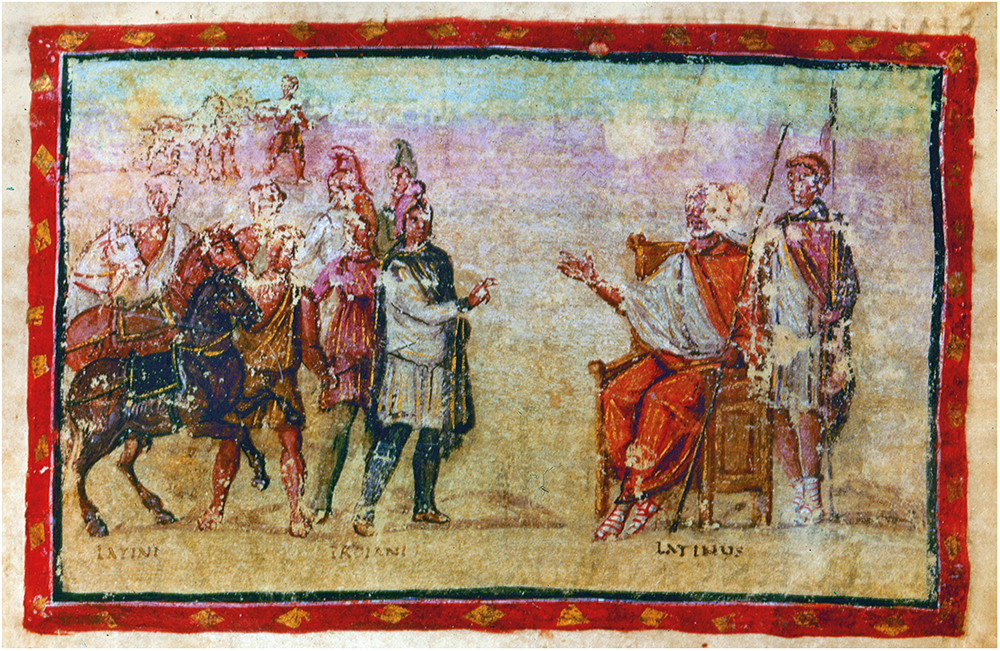
The triclinium in which the Ketton mosaic sits is similar to that at Lullingstone:Footnote 63 the apsidal end, with its flanking panels of geometric designs, would have accommodated the diners, who would have looked down the length of the decorated floor. Comparisons with other fourth-century scenes from Greek mythologyFootnote 64 (e.g. Boxford) and epic (e.g. Low Ham’s Aeneid)Footnote 65 have highlighted the familiarity in Roman Britain of displaying both generic and text-specific classical narratives to visitors through floor mosaics. But the Ketton mosaic displays a distinctive composition: it does not display the rotational symmetry which would allow diners reclining in various orientations to enjoy the scenes from different vantage points.Footnote 66 Its strict verticality and wide rectangular panels closely resemble framed manuscript illustrations. Comparison with surviving late Roman codices is striking: we find the same rectangular fields, reflecting the width of the codex page, with expressive figures boxed by plain frames (e.g. Fig. 15, the Ambrosian Iliad, and Fig. 16, the Vatican Virgil, texts in Greek and Latin respectively). It is not simply the presence of a frame which suggests similarity with illustration in the main text of early codices (for frames appear in many media), but the proportions, the linear arrangement of four to five principal figures, and the dramatic interaction of the human protagonists.
Ambrosian Iliad miniature 34, showing the capture of Dolon (Iliad 10. 372–464), c. a.d. 450–500, Milan, Biblioteca Ambrosiana, Cod. F. 205 inf. 1019 (© The Picture Art Collection/Alamy Stock Photo).

Illuminated panel from the Vatican Virgil, fourth to fifth century a.d. Latinus grants horses to the Trojan envoys, Aeneid 7. 249–285 (Cod. Vat. lat. 3225, fol. 63r) (© GRANGER - Historical Picture Archive/Alamy Stock Photo).
One particular example, the Vergilius Romanus (Fig. 17), shares the same red and yellow frame as Panel 1 of the Ketton mosaic, as well as the tendency towards minimal background, and widely spaced figures with narrow heads in profile, long fingers and stocky bodies articulated with dark lines. Too important to reduce to a footnote here is the contested origin of the Vergilius Romanus. In 1979, Henig suggested the manuscript was the product of Roman Britain or Gaul, based on the style of the images, in which he was followed by Dark,Footnote 67 while Grabar remarked on its ‘rustic’ and Weitzmann on its ‘provincial’ qualities.Footnote 68 If it were of British or Gallic origin, the implications for the Ketton mosaic would be considerable,Footnote 69 but unfortunately all manuscript specialists appear to be united in their rejection of the proposal on all fronts (including the parchment quantity and quality, letter forms and historical centres of production)Footnote 70 and positively in favour of others: Cameron thought it most likely the product of Constantinople or Ravenna, for Wright it was Rome and for Rosenthal, Palmyra via Dura Europos and Ravenna.Footnote 71 Its date of production is no less contested, with advocates of the fourth, fifth and sixth centuries.Footnote 72 But even if the Vergilius Romanus is not British, and even if it postdates the Ketton mosaic, the general similarities in style, articulation of the human body, heavy outlines, minimalist background and pied frames is nonetheless of interest to art historians. In the 1970s, Rosenthal remarked, in his own emphatic italics: ‘The style of the Vergilius Romanus, however, has no continuation in the West and in this respect exists in an almost embarrassing isolation.’Footnote 73 The Ketton mosaic may be the precursor to this style, not existing in isolation but part of a wider trend circulating within the empire in Late Antiquity, even in Roman Britain.
Illuminated panel from the Vergilius Romanus, fourth to fifth century a.d. The shepherds Corydon, Thyrsus and Meliboeus, Eclogues 7 (Cod. Vat. lat. 3867, fol. 16v) (© Biblioteca Apostolica Vaticana).

If the reader accepts that the mosaic is influenced in any way by manuscript illumination, then the Ketton mosaic immediately has a monumental claim as the oldest known, securely located evidence of a familiarity with manuscript illustration in a Romano-British context, albeit an indirect one. At present, the earliest known illustrated manuscripts from the British Isles are the seventh-century Codex Usserianus Primus currently held in Trinity College DublinFootnote 74 and the Book of Durrow. On the mainland, our earliest extant evidence is from mid-seventh-century Northumbria,Footnote 75 and later-seventh-century Jarrow with the Codex Amiatinus,Footnote 76 with only a short leap until the Lindisfarne Gospels of the early eighth century.Footnote 77 In geographical terms, no other illustrated codex has survived within the orbit of Ketton which dates before the tenth and eleventh centuries,Footnote 78 despite their established place in elite display much earlier on the continent.Footnote 79 There is a great gap in our evidence of books-with-pictures in Britain before early Medieval Christian contexts.Footnote 80
A link between mosaics and illustrated classical texts is by no means a new observation.Footnote 81 What matters to Options A and B is how literal a reflection of manuscript illustration the Ketton mosaic may be. Simply put, was it copied from a de luxe illustrated codex, perhaps the possession of the villa owner, Footnote 82 as has been proposed for the Boxford Mosaic?Footnote 83 If so, then the question necessarily arises: which text was the Ketton mosaicist looking at? Options A and B, which both endeavour to identify an illustrated text, follow a method of transmission that we might call the ‘Weitzmann hypothesis’ after the proposals first laid out in Kurt Weitzmann’s Reference Weitzmann1947 Illustrations in Roll and Codex. Characteristically, Weitzmann’s approach prioritises literary texts in the transmission of narrative images, hypothesising the existence of now lost illustrated Hellenistic papyri, which bridge the gap between the period in which the complete original Greek texts circulated, and the later Roman period where illustrated codices first appear.Footnote 84 It is through illustrated texts, he argues, that narrative scenes were transmitted to other, ‘less prestigious’, media. The enduring influence of Weitzmann’s work on Classical archaeology means that we must engage with it seriously. Options A, B and C not only represent differing theories that have already been mooted for the Ketton mosaic, but also represent three degrees of adherence, from the most ‘Weitzmannian’ to the least.
OPTION A: The Ketton mosaic is based on an illustrated text of Aeschylus’ Phrygians
The hypothesis that the Ketton mosaicist might have had access to just such a lost codex of Aeschylus’ Phrygians has, at first glance, great appeal: we know this text to be the origin of the weighing motif and meets the requirements of the pre-Euripidean ‘snake’ variant. We have many references to this text in the scholia after the mosaic was made, even as late as the twelfth century, and Hesychius displays a knowledge of specific words and phrases from Phrygians for which he gives glosses and translations.Footnote 85 If looking for an author whose prestige might inspire such a monumental mosaic, Aeschylus fits the bill (in a way that Dionysius and Timesitheus, both authors of lost Ransom of Hector plays, do not);Footnote 86 and the contemporary fourth-century mosaic from Sicily depicting the weighing (Fig. 9e) places this scene directly besides a tragic mask wearing a Phrygian hat. If the Sicilian Tellaro mosaic can so clearly connect a tragedy on a Phrygian theme with a weighing scene, why should we look further than Aeschylus’ Phrygians? Taking into account what we know about the overall plot of the tragedy, Option A requires a text with a sufficient magnification on the death and ransom of Hector to support illustrations of events which, in other sources, occur too close together to warrant separate illustrations. Framed codex illustrations take up a good deal of the page and must be evenly spaced within passages of text. In Phrygians (1000–1500 lines long, judging by Aeschylus’ extant tragedies) there would have been the narrative space to spread these three (and any other) illustrations across the whole. In the late Roman, Latin-language Periochae for example, the dragging and the ransoming episodes occur within the same 90 lines of the text. They are too close to have commanded their own separate, framed illustrations in a manuscript.
That Option A focuses on a play, and that only one of the scenes (Panel 3, the weighing scene) could be directly performed on stage, is not problematic. Neither is the absence of tragic masks. Manuscript illustrations can evoke what is being verbally relayed in the text,Footnote 87 and art images inspired by tragedies do not usually allude to the staging.Footnote 88 Just as with other Attic tragedies, descriptions of ‘unstageable’ moments could be expected from the Chorus and messenger.Footnote 89 Aeschylus famously brought the whole bay of Salamis, filled with the warring Greek and Persian fleets, onto the stage in his Persians in a messenger speech.Footnote 90 The dragging of Hector’s body and the snake rearing up beneath the galloping horses are just as possible in the text of a tragedy as the on-stage weighing scene.
The ‘Greekness’ of Phrygians should also not be a barrier in a Romano-British context. We should also consider the logical difficulty in accepting that the Romano-British élite may have had enough Greek to read Homer, as a ‘mainstay’ of élite education, but not any other Greek text (!).Footnote 91 Auxiliary documents to support readers of difficult texts flourished in the Roman period,Footnote 92 and we know that the fourth-century magistrate and poet Ausonius was educated in both Latin and Greek, and that there were several Greek teachers (both teachers of Greek and teachers who were Greek) among the celebrated professores at his home university of Bordeaux.Footnote 93 Alison John has already comprehensively debunked the myth of a ‘Greekless’ Gaul in Late Antiquity and rightly pointed to evidence which reveals not only Greek education, but an enduring class of Greek-educated literati in that ‘Latin’ western province.Footnote 94 We know that fourth-century bilingual objects from the Western Provinces did indeed reach Britain,Footnote 95 and we even have a fragmentary fourth-century mosaic from Roman Aldborough of a Muse, with the location ΕΛΗΚΩΝ (Mount Helicon) picked out in black tesserae.Footnote 96 Evidence from RIB Online, including Greek names and Greek script,Footnote 97 similarly shows a capacity for multilingualism and migration in Roman Britain, even in the fourth century a.d.,Footnote 98 and a Greek-speaking villa owner is not so outlandish. Although Greek education in the Roman West may have been in decline, it was not dead.Footnote 99
But, neat and attractive as this solution appears, it also poses a number of significant difficulties: while Weitzmann wrote confidently that ‘Aeschylus and Sophocles, too, were illustrated, though never on the same scale as Euripides’, this was only a hypothesis based on tragic iconography on Hellenistic Megarian bowls and other non-textual media.Footnote 100 Among all extant illustrated texts from classical antiquity, whether preserved in libraries or among the Egypt-specific context of papyrological finds, we have no illustrated tragedy, by any author in Greek or Latin. We have illustrated epics, and illustrated comic texts, but not tragedies.Footnote 101 More specifically still, we have no evidence of Phrygians either being performed or even circulating as a text after its production in the fifth century b.c. The popularity of that particular play appears to have waned quickly, and Aeschylus was the least popular of the three great Athenian tragedians by the Roman period. As Finglass has noted, the relative difficulty of Aeschylus’ Greek was a likely factor in his decline, especially when compared to the more linguistically accessible and subsequently better-preserved works of Euripides.Footnote 102 By the third century a.d., Aeschylus is barely mentioned at all by the Latin grammarians, and by the Byzantine period, his lifetime’s works had dwindled to only three widely known canonical texts, the so-called Byzantine Triad of Prometheus Bound, Seven Against Thebes and Persians. Footnote 103 Some readers may consider these objections an absence of evidence, rather than evidence of absence.Footnote 104 That Dio Chrysostom could claim in the early second century a.d. to have read a copy of Aeschylus’ Philoctetes while staying at a friend’s villa,Footnote 105 and the fact that the scholar Demetrius Triclinius, in the early fourteenth century, uncovered two unfamiliar Aeschylean tragedies (Agamemnon and Eumenides),Footnote 106 do suggest that some lesser-known plays could and did linger on in some library collections.Footnote 107 It is wickedly difficult for us to perceive the patterns of these plays’ survival;Footnote 108 but we cannot overlook that there is no known parallel for an illustrated tragedy, nor any known text of Phrygians surviving into the fourth century,Footnote 109 let alone in Roman Britain.Footnote 110 The fragments we do have, compiled by scholars like Mette, are built from quotations (often identical ones) in other authors, not papyrological copies of the play.Footnote 111
Finally, there is the question of how familiar the scholia and indeed Hesychius needed to be with a complete text in order to comment upon it. As Alan Cameron explored in his monograph Greek Mythography in the Roman World (2004), there is ample evidence that many late Roman commentators and scholiasts of earlier Greek texts were indebted to, even sometimes wholly reliant on, intermediary documents rather than originals. We even have examples of misunderstandings, not of the original texts, but of other commentators’ remarks about those texts.Footnote 112 In summary, favourite quotations, interesting items of vocabulary and the overall plot of Phrygians could have outlived the full text, required for an illustrated codex, by many centuries.
OPTION B: The Ketton mosaic was inspired by illustrations in Roman texts which reworked the Aeschylean narrative
As an alternative to Aeschylus’ Phrygians, we might consider instead the possibility of a later, even Latin-language text.Footnote 113 This instantly resolves the problem of the textual endurance of Phrygians, and we do know that the Trojan War continued to be a staple literary theme in Latin literature (see Table 2). We also have surviving fragments of named Latin-language dramatists who wrote on promisingly proximate themes: Gnaeus Naevius’ (c. 270–c. 210 b.c.) The Trojan Horse and The Departure of Hector may not be quite the right narrative fit, but Ennius’ (239–169 b.c.) Trojan War tragedies do indeed include an Achilles, a Ransom of Hector and an Andromache, the fragments of which include descriptions of Achilles taking a stance with his shield held out in front, some bloody fighting, descriptions of his supernatural horses, and reference to his return of Hector’s body to Priam.Footnote 114 The Latin playwright Accius (170–c. 86 b.c.), we know, wrote his own version of Myrmidons for which Aeschylus can have been the only literary model,Footnote 115 and Wartelle helpfully summarises the known texts of Accius which may have had Aeschylean antecedents. Unfortunately, Phrygians is not among them.Footnote 116
These Latin literary texts bring us chronologically closer to Ketton, and into a language that might seem a more natural fit for the late Romano-British Midlands. But they are not without their own very considerable problems: first is the objection levelled at Option A, that there is no surviving evidence that manuscripts of tragedies were ever illuminated. Secondly, if the text of Ketton was linked to any of the three known tragedians mentioned above, it would be drawing on texts of Hellenistic date, whose endurance into the fourth century as complete texts, let alone illustrated texts, is no more secure than that of Phrygians. Footnote 117 We have Dracontius’ exploration of Achilles’s treatment of the body of Hector and his final ransom by weighing (Romulea 9), but this post-dates Ketton. If we are to argue that the mosaic was influenced by later Roman literature, we are in the methodologically unstable (but not untenable) position of advocating for a text which adheres very closely to the early fifth-century b.c. Aeschylean variant in plot details and narrative arc (in a way that all surviving later texts do not), and was both popular and prestigious enough to command inclusion in an illustrated codex and inspire a huge mosaic in the East Midlands, but of which no other source, scholion or commentator, makes mention. Such a text, simultaneously influential, learned, prestigious and yet completely invisible is a possible but problematic solution.
A different category which might provide an alternative answer is not the ‘high’ literary texts of Latin verse, but diverse forms of mythography that circulated widely in the Roman West. This eclectic corpus of texts which may be grouped together within the genre includes diegeses (potted plots), hypotheses (summaries to aid the reading of the full text), paraphrases and other auxiliary commentaries.Footnote 118 Such mythographies, produced in both Greek and, to a lesser extent, Latin,Footnote 119 were popular and influential in the transmission of much older stories into Late Antiquity. But as visual models for the Ketton mosaic, they are more dubious: although they circulated widely, we have no evidence of these ‘auxiliary’ texts commanding an illustrated codex in their own right in the fourth century,Footnote 120 and in the case of hypotheses, the genre is predicated on the survival of the more complex original text they elucidate.Footnote 121 As a means of narrative transmission, mythographies may indeed be an important part of the cultural foundations of the Ketton mosaic, but as a visual model, they are unlikely to be the immediate source.
Indeed, the ‘greater’ and ‘lesser’ Weitzmann approach of both Option A and B, which sees manuscript illustration as the principal driver behind the narrative designs at Ketton, unfortunately requires a good deal of speculation about illustrated texts we do not have, in an environment we do not know they circulated.Footnote 122 A third avenue of investigation may prove fruitful here, one which prioritises demonstrable, rather than hypothesised, visual antecedents.
OPTION C: The Ketton mosaic is an artistic confection of pre-existing visual motifs
A third, quite different, approach is that the design of the Ketton mosaic should not be tied directly to a particular illustrated codex at all.Footnote 123 Instead, its design may have had a primarily visual, rather than literary driver. Although the term ‘pattern-’, ‘copy-’ or ‘model-book’ is often used to describe the vehicle for such visual influences,Footnote 124 it is important to stress the variety of ways in which visual motifs were transmitted from person to person in antiquity, including papyri, wooden pinakes and the assembled visual culture of paintings, metalwork and sculptureFootnote 125 which can embed certain motifs into cultural memory. For this reason, I prefer the ‘pattern repertoire’ to describe the physical and mental assemblage of visual references that an artist may have inherited. Unlike Options A and B, which have the challenging requirement of literary texts which we cannot securely locate, Option C is demonstrably relevant with identifiable pre-existing visual models within all three of the main panels of the Ketton mosaic.
Panel 1 (the Duel) makes use of a model of the Trojan prince, shared by a recurring image in the provincial coinage of second- and third-century Ilium, helpfully labelled ‘Hector’ (Fig. 18a–b).Footnote 126
a. Hector in his chariot (detail of Panel 1) (© ULAS). b. Coin of Marcus Aurelius from Ilium, 161–2 a.d., with reverse showing Hector on his chariot, facing left, and legends reading ΕΚΤΩΡ and ΙΛΙΕΩΝ, RPC 4.2.84 (RPC online, https://rpc.ashmus.ox.ac.uk).

The two renderings are not identical: the details of his tunic are superficially different, and more significantly, Hector’s right arm in the coin is raised to hold a flaming torch with which to burn the Greek ships, a different Trojan War episode altogether.Footnote 127 But this left-facing figure with shield and spear, on his un-Homeric biga with two rearing horses, is clearly the same design being followed two centuries later at Ketton.
Likewise, the opposing figure of Achilles in his chariot is not an original invention at Ketton, but a familiar motif in a variety of media. The right-facing horse-team is driven by a victorious charioteer in a first-century Ostian wall-painting,Footnote 128 by Nike on second-century brick stampsFootnote 129 and cupids on second- and third-century stone sarcophagi.Footnote 130 But perhaps the closest parallel comes, yet again, from a ‘Hector’ on the reverse dies of second- and third-century Ilium, albeit with fewer horses (Fig. 19a–b), another example of shared visual references between imperial die-cutters in Asia Minor and late Romano-British mosaicists.Footnote 131
a. Achilles in his chariot (detail of Panel 1) (© ULAS). b. Coin of Commodus from Ilium, 180–2 a.d., with reverse showing Hector on his chariot, facing right, and legends reading ΕΚΤΩΡ and ΙΛΙΕΩΝ, RPC 4.2.120. RPC online, https://rpc.ashmus.ox.ac.uk).

In Panel 2 (The Dragging of Hector), we have already explored some of the compositional similarity between the Ketton mosaic and the fifth-century Attic painted pot in the British Museum (Fig. 20a–b). But there is more overlap than simply the snake beneath the chariot group. From left to right both designs share the same basic elements: a standing figure with one arm outstretched, a circular shield, Hector’s body, Achilles’ chariot, rearing horses, the snake and a running figure facing left with arms outstretched in supplication. As with the models shared by the coins of Ilium, there are still significant stylistic and compositional differences: the number of horses at Ketton is two, while in fifth-century pot paintings four; Automedon the charioteer is missing (as he is from Panel 1) and his shield is transferred to the figure in yellow with his arm raised; this figure is a soldier at Ketton but King Priam on the pot; and there is a similar shift in identity of the running figure, who is the goddess Iris on the pot, but received at Ketton as Priam. The specific details of people and things may vary, but they are clearly composed on the same basic elements and are clearly drawn from the same visual schema. This points to a process of multi-media artistic transmission between an Attic pot and a Romano-British mosaic which spans eight centuries.Footnote 132
a. Interior detail of Panel 2 (© ULAS). b. Detail of Fig. 12.
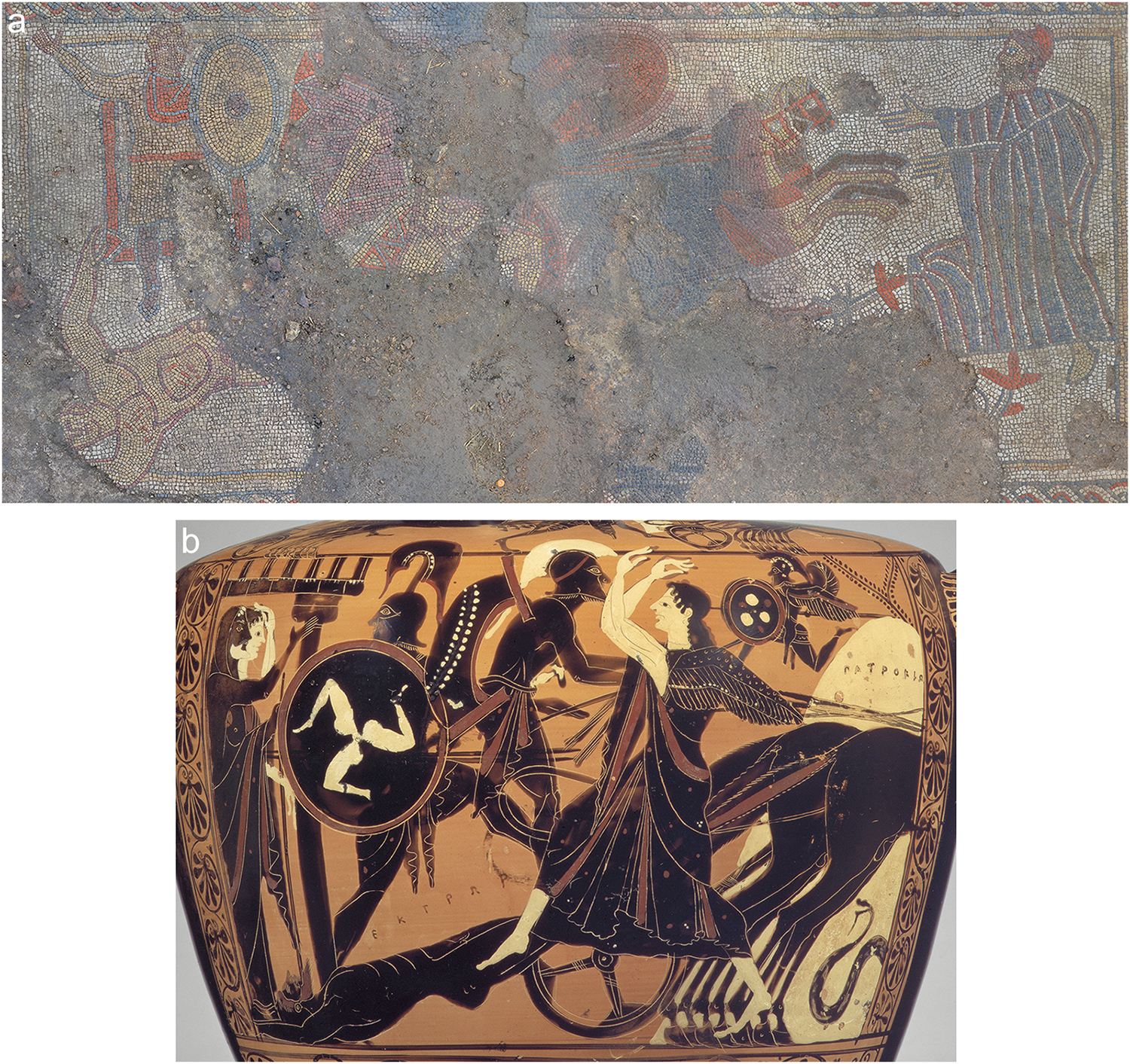
And the very same can be said about Panel 3 (The Ransom, Fig. 21a), albeit with a different point of comparison. In addition to the familiar motif of the enthroned divinity/Hellenistic dynast which underpins the damaged image of Achilles,Footnote 133 the weighing scene itself strikingly parallels the oinochoe from the Berthouville treasure (Figs 9d and 21b) which, while stylistically in keeping with its own second-century Gallo-Roman origins, shares an identical compositional scheme as the Ketton design with its fourth-century minimalism and late Roman costumes.Footnote 134
a. Interior detail of Panel 3 (the weighing of Hector) (© ULAS). b Nineteenth-century line drawing of the Berthouville cup (as Fig. 9d) (Babelon Reference Babelon1916, pl. 6, reproduced in Lapatin Reference Lapatin2014, fig. 31).

From left to right in both compositions, we see armed Greek soldiers standing behind the seated Achilles. He sits in three-quarter view, his left knee raised and the curve of his shield visible behind it. Next, Hector lies in the leftmost pan of the scales, the fulcrum of which is a male face (in the Berthouville jug this is the masklike face of a gilded protome; at Ketton, the face of a Trojan soldier). The large gold dish in the right-hand pan of the scales is not mirrored between the two compositions (although the Ketton design does share this detail with the even earlier fourth-century b.c. Apulian volute krater by the Lycurgus Painter, Table 1, b, and Fig. 9b). On the right Priam stands in his full-length chiton and Phrygian cap, with his Trojan bodyguards (condensed to a single half-figure at Ketton) behind him, giving the overall design a loosely symmetrical arrangement of protagonists and soldiers either side of the weighing scales. When viewed in schematic rather than stylistic terms, we can see again that the Ketton mosaic is visually indebted to a design which had already been circulating in a different time and place, in this case in second-century Gaul.
Taken together, it seems more persuasive that these artists in varied media (notably metalwork by the imperial period), in different centuries and in different places, were working from a shared heritage of models, for which an illustrated codex is not necessary. But Option C does more than invite the identification of the visual antecedents of the mosaic. Because the Ketton mosaic is a compilation of three separate scenes, not a single, stand-alone composition, we should ask how it is that these different patterns should all end up together. We must necessarily accept that someone at Ketton had access to all these elements at the time the mosaic was designed. The story behind the Ketton mosaic is not simply a visual bricolage to make up three exciting Trojan scenes. The mosaic is bounded by the narrative of the death and ransom of Hector, and two of the panels use visual models chosen to serve the narrative variant which originated in the fifth century b.c.: the pre-Euripidean snake in Panel 2 and the weighing scales from Phrygians in Panel 3. We have evidence not just of very old visual models, but also the preservation of very old narrative traditions not related to the Iliadic account.
But perhaps most important of all is Panel 1, showing the duel between Achilles and Hector (Fig. 3). This is a different case. It does not match the other two panels in the antiquity of its visual references, and there is good reason to suppose that it was not derived from an ancient text — another blow for a Wietzmannian theory of transmission. No extant self-standing ‘Ransom of Hector’ text begins with the duel itself. Hints in the fragments of Aeschylus’ Phrygians imply that the play began with Hector already dead,Footnote 135 and exactly the same scenario was used in the fifth century a.d. (after the Ketton mosaic was made) by Dracontius in his Romulea 9. A conventional emphasis appears to have been placed on changing Achilles’ mind about the treatment of a dead Hector. The composition of Panel 1 is also, in its visual pedigree, unlike the other two: we have no parallel for the kind of ‘jousting’ we see at Ketton or even the use of chariots in direct combat at Troy.Footnote 136 Indeed, Hector’s ineffectually half-raised spear and the flaming torch in the coin of Ilium (Fig. 18b) reveal that this motif is borrowed from a different narrative sequence altogether – the ‘Burning of the Ships’. The unique attempt to use shadows beneath the horses’ feet in Panel 1 (a visual gesture, as we have seen, familiar in horse-racing mosaics and wall-paintings) also suggests that this panel has a different origin to the other two — a different branch of the pattern repertoire. And, as if further to underscore the ‘otherness’ of its design, it has a different-coloured frame to that around the other two panels. The Ketton mosaic, then, combines two panels which are linked together in textual and visual traditions with a fifth-century b.c. Greek ‘Ransom of Hector’ story, and one of more recent invention from the ‘Burning of the Ships’ episode, adapted to make a narrative whole.Footnote 137 The distinctive frames around the scenes, then, are to bind the various motifs into a recognisable and attractive compositional format by mimicking a framing convention shared by high-status codices, in the same way that a filigree gold frame around a modern picture gives a nod to more prestigious ‘gallery art’.
Conclusion
The Ketton mosaic offers so many avenues for study, and here we have only explored its iconographic choices. In presenting three options for their origin, I have tried to summarise the scholarly traditions into which the mosaic may be drawn, while acknowledging how limited we are by the absence of evidence in some areas. New discoveries may, naturally, change the interpretations but, on the basis of what we currently have, Option C seems to me the most persuasive. That I have reservations about the role of illustrated codices (Options A and B) in this particular case should not be understood as denying the role of literature in general in the transmission of this story to Ketton, nor as a denigration of the cultural milieu of late Roman Britain. On the contrary, of the three conclusions which follow, two attest to the mosaic’s cultural pedigree in its own time, while the third underscores its central importance to academic discussions about the circulation of complex mythological narratives in the wider ancient world.
1. The prestige of Greek culture
The first observation is the striking Greekness of the subject matter, not simply as a Trojan War narrative, but one which had retained Aeschylean and fifth-century b.c. influences. The mosaic is evidently a composite of new and old visual patterns, but it is extremely likely that the impetus for the villa owner’s showpiece triclinium was their identification with a literary milieu in which later Roman audiences read stories about the death and ransom of Hector.Footnote 138 The enduring appeal of the weighing scene in particular, even into very late antiquity, shows how the Aeschylean variant was fixed and re-fixed in the cultural imagination through both text and image (see Tables 1 and 2) — and not necessarily together — as part of the cultural fabric of the wider Roman Empire.Footnote 139 The mask in the Villa del Tellaro mosaic (Fig. 9e) tells us that the plot was still associated with a ‘Phrygian tragedy’ in the fourth century a.d., and the snake motif at Ketton, originating in the fifth century b.c., shows us that there were attempts to preserve its classical Greek associations.
What the villa owner was hoping to achieve in commissioning such a ‘Greek’ mosaic is a tantalising consideration.Footnote 140 The choice of Achilles as the main subject is not, in itself, a distinctive one. It comes from a period in which Achilles was a popular topic in both the visual and literary arts, and increasingly singled out as the lead character in Trojan War narratives.Footnote 141 But as a display of cultural currency, the choice of narrative in the Ketton mosaic is potent. Whether the owner was conscious of its Aeschylean origins, or aware of a more recent retelling, or only familiar with Trojan War stories in broad strokes, the decision to commission a mosaic on this size, in this format, and on this subject, is a powerful example of philhellenic cultural aspiration and display. If the reader also agrees that the frames around each scene borrow from the elite visual language of codex illumination (without necessarily requiring the presence of an actual illustrated codex at Ketton), then we must also acknowledge the villa owner’s willingness to espouse the prestige of contemporary literary culture and the mosaicist’s familiarity with the general appearance of such codices.Footnote 142 The Ketton mosaic, then, blends the prestige of the past with the prestige of its present. Its style is of its own time, but intensely classical, even philhellenic, in content.Footnote 143 There is no doubt that the fourth century saw a notable change in Britain’s orientation towards ‘the classical’,Footnote 144 but the mosaic shows that the waning of Greek culture was neither instant nor total.Footnote 145
2. Access to literary and visual models
A second observation is the necessity of reference materials in the creation of the Ketton mosaic, be they the literary texts (whatever the language or genre) that preserved the popularity of the Aeschylean variant of the Ransom of Hector, or the patterns which underpinned its visual composition. This is especially valuable in the context of Roman Britain, where physical evidence for such documentation is comparatively rare.
And we must take the implication of figurative reference materials, this ‘pattern repertoire’, seriously.Footnote 146 The antiquity and ‘international’ pedigree of some of the narrative and visual references available to the designer of the Ketton mosaic is extraordinary: we see motifs previously in the hands of pot painters in Attica, die-cutters in Ilium, and repoussé metalworkers in Gaul. Our first surviving example of ‘our’ Hector in his biga is from the late second century a.d., perhaps 200 years before the mosaic, while Panel 2, the dragging scene, is indebted to a composition first produced 800 years previously. The preservation of this latter motif is especially surprising, and evidently a testament to the tenacity of the tomb of Patroclus variant in one branch of the repertoire when most other authors and visual artists had relocated the dragging of Hector elsewhere (Table 2).
The demonstrable evidence that the Ketton mosaic contains visual motifs already used in other media, in other places and in many other previous centuries, shakes the Weitzmann hypothesis of illustrated texts as the main vehicles for narrative images.Footnote 147 These must have travelled by more portable means: a pattern repertoire comprising documents, small objects and (most portable of all) the human memory.Footnote 148 The pots, coins and metal cups on which we have seen them come from workplaces characterised by fire, dust, paint and other forms of creative mess — hardly places for direct consultation of precious illustrated literary texts. Instead, the design of the Ketton Mosaic reveals an ability to draw on deep wells of cultural reference, a visual heritage from right across the Classical world and back into its history.Footnote 149 Whether the local mosaicists already possessed these schemas or were able to access a repository elsewhere is a tantalising question.
3. Mythography as a visual genre
A final point is the mosaic’s evident place within a cultural genre we might call ‘visual mythography’. Recognising a single visual model is interesting in its own right, but to recognise a combination of related models necessarily blurs the sharp distinction between the text-based genre of ‘mythography’, as presented by Cameron, and the visual genre of ‘pattern repertoire’: that Panels 1 and 2 both draw on a non-Homeric, early fifth-century version of the narrative cannot be the result of chance. The dragging scene and the weighing scene must have been marked within the pattern repertoire as belonging together, whether by an explanatory label or physical proximity. This implies the existence of linked sequences of related mythical models for reference by artists, be they mosaicists, wallpainters, metalworkers, sculptors or even (in a reversal of the Weitzmann hypothesis) illustrators of codices.Footnote 150 Weitzmann himself demonstrated that the creators of his Megarian bowls and ivory caskets were familiar with narrative sequences,Footnote 151 and just such a composite of separate sequential motifs has already been detected in the iconography of Pelops in the Boxford mosaic.Footnote 152 These have been explained as reflections of codex illustrations, but the evidence presented here shows that mythological sequences had long been circulating in the pattern repertoire of other media. Illustrated codices are more likely the inheritors, not the origin, of some of these sequential narrative models, and the frames around the three panels at Ketton show how readily they could be adapted to different media and fashionable new formats.
We should give visual artists a greater share in the usually literary genre of ‘mythography’, since such a collection of motifs, sometimes sequential, sometimes self-standing, is just that. It places greater emphasis on image than text but, nonetheless, functions as a means by which multiple episodes from stories, even quite specific versions of those stories, could endure and spread in the visual arts, even when an illustrated or even complete associated literary text may not have been available or even relevant. The potential for the Ketton mosaic to illuminate our understanding of late antique habits in transmitting text and image is precious indeed. Most valuable of all is that such a culturally significant monument should be only a few feet beneath the soil on a farm in the East Midlands. It speaks emphatically of a Roman Britain engaged with the wider empire. The choices behind the Ketton mosaic point to a villa owner and mosaicist with access to both narrative traditions and visual conventions which are anything but parochial. It is a mosaic mythography 800 years and thousands of miles in the making.
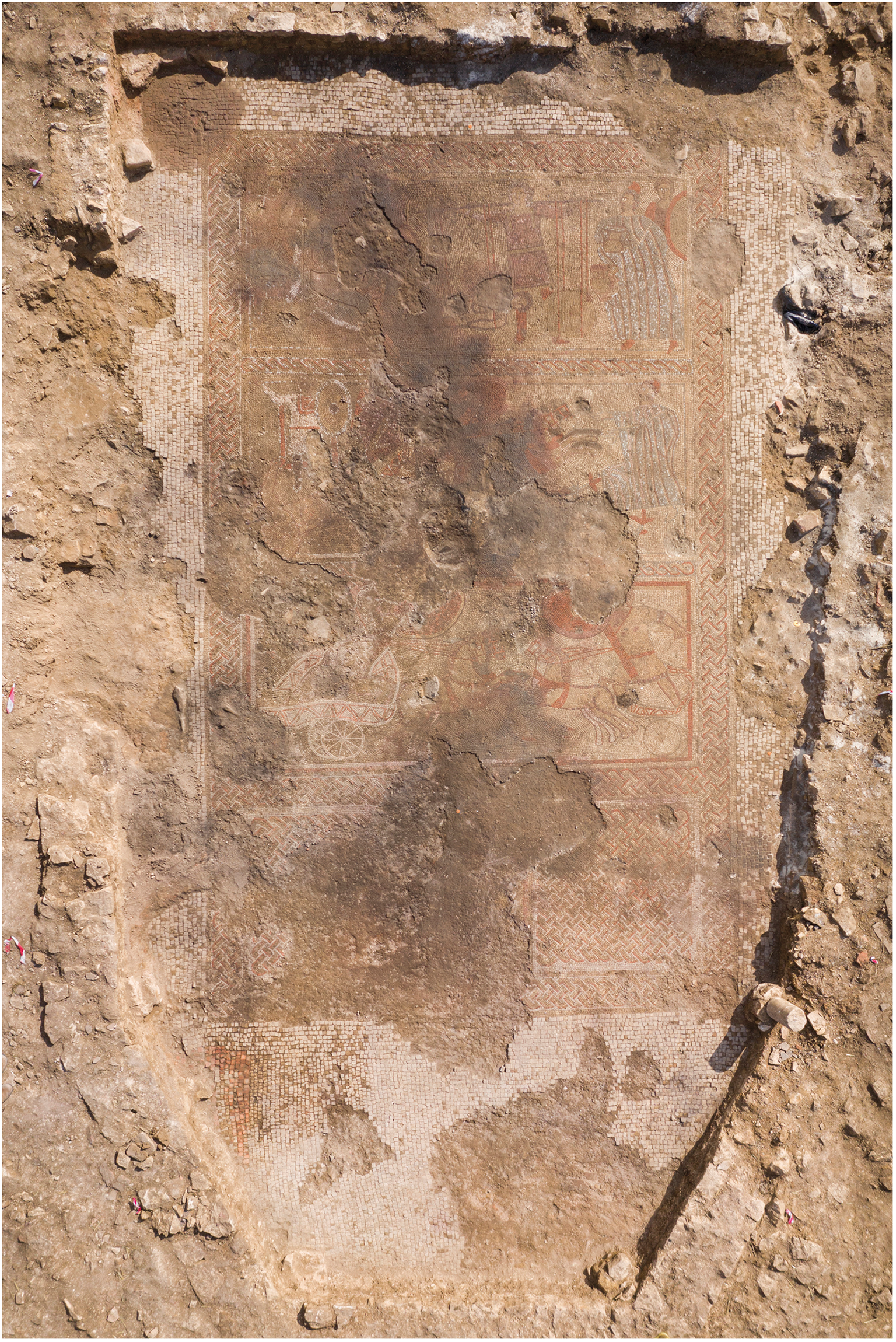
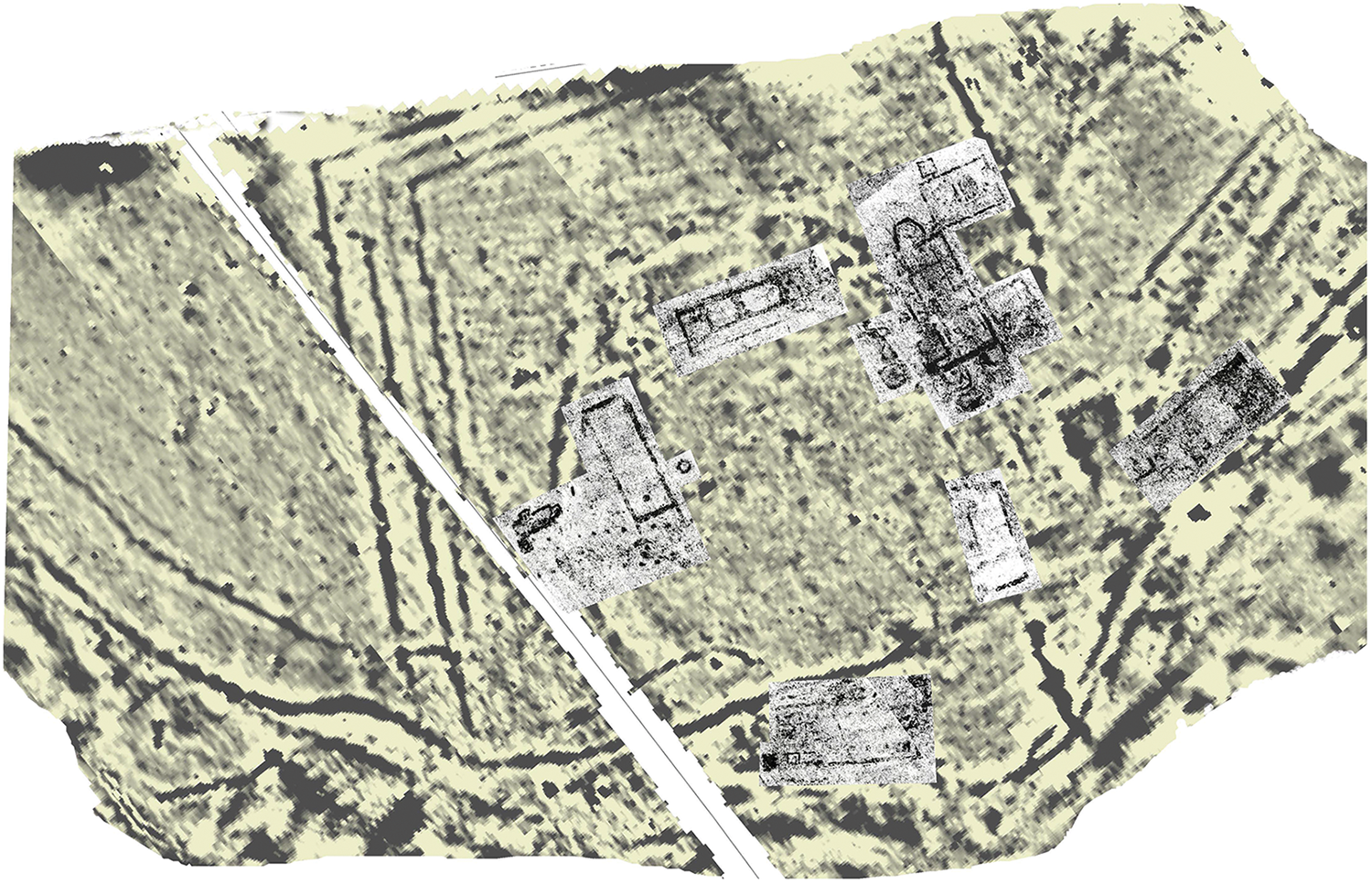
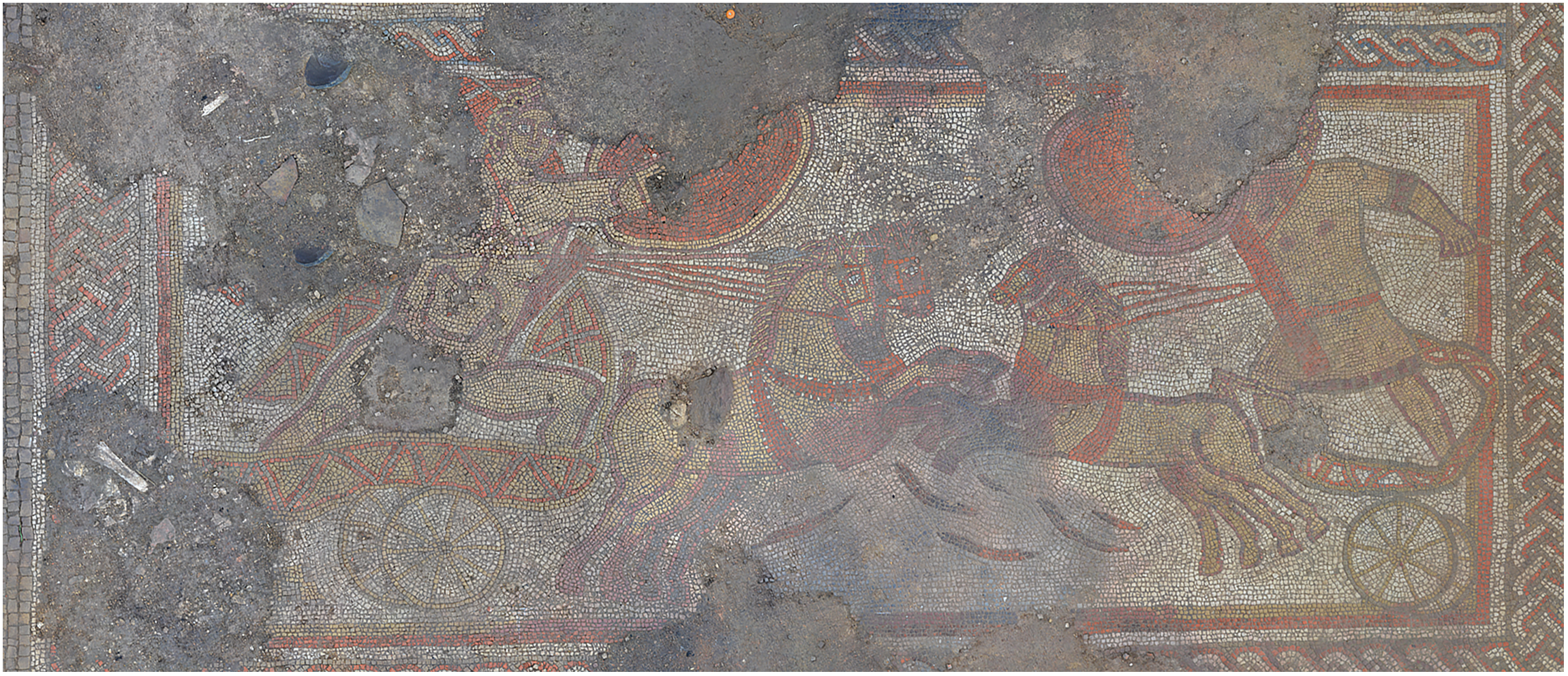


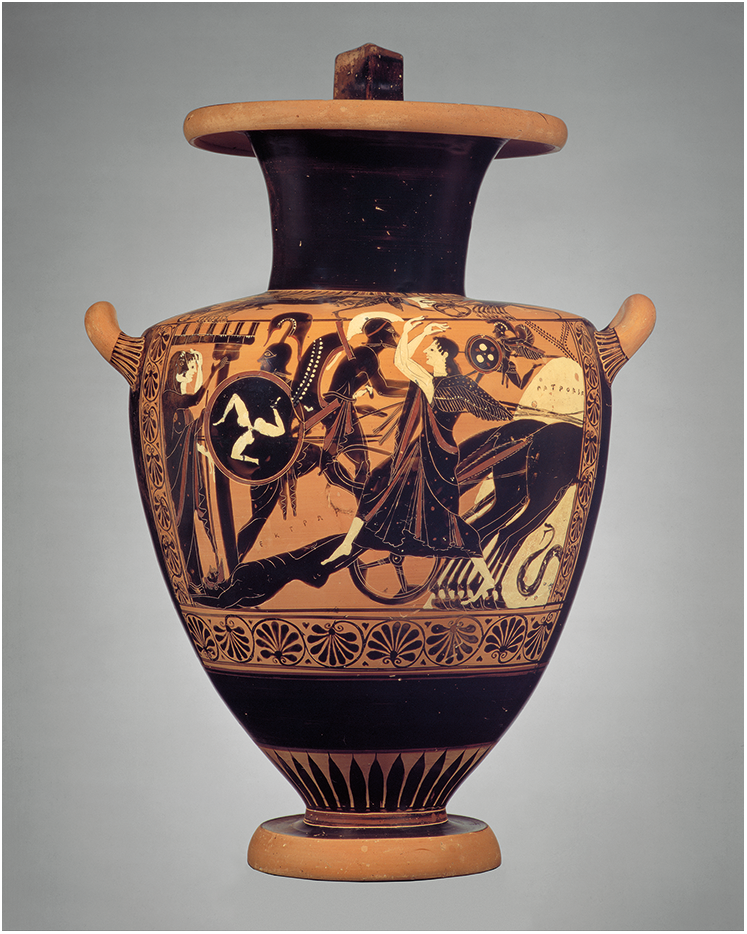

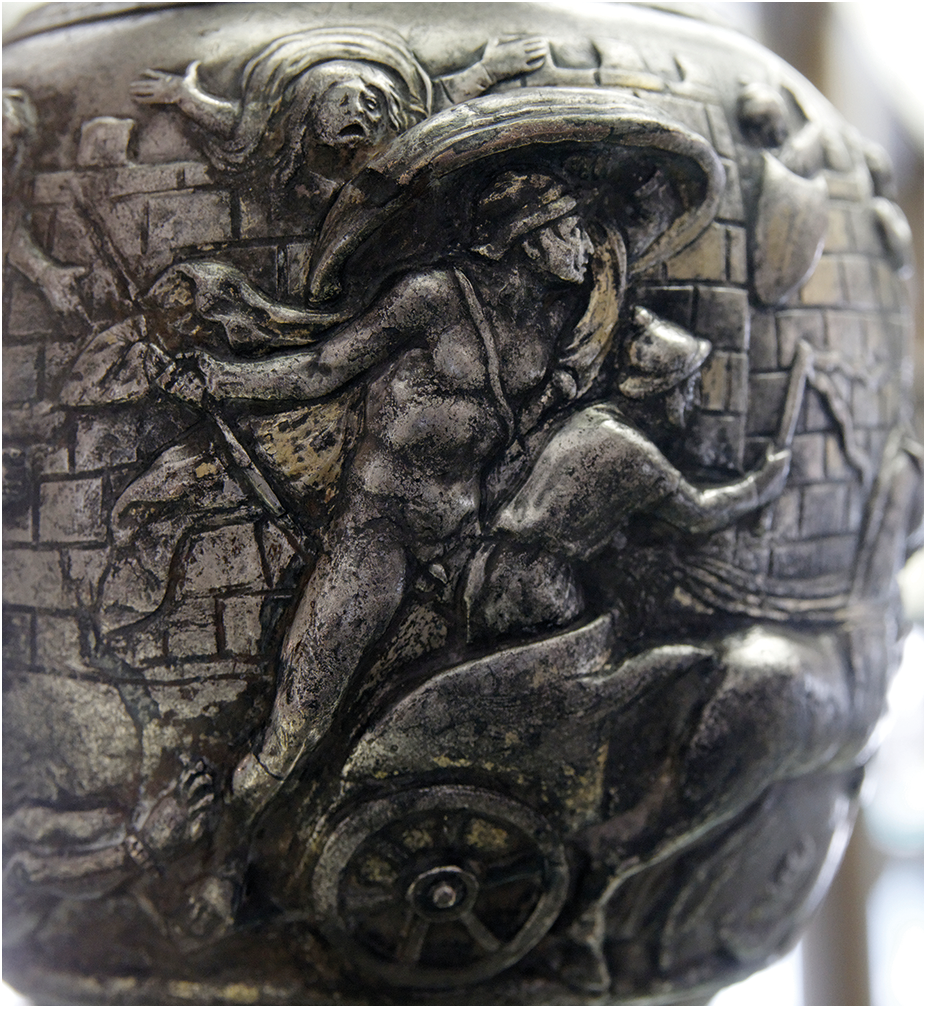

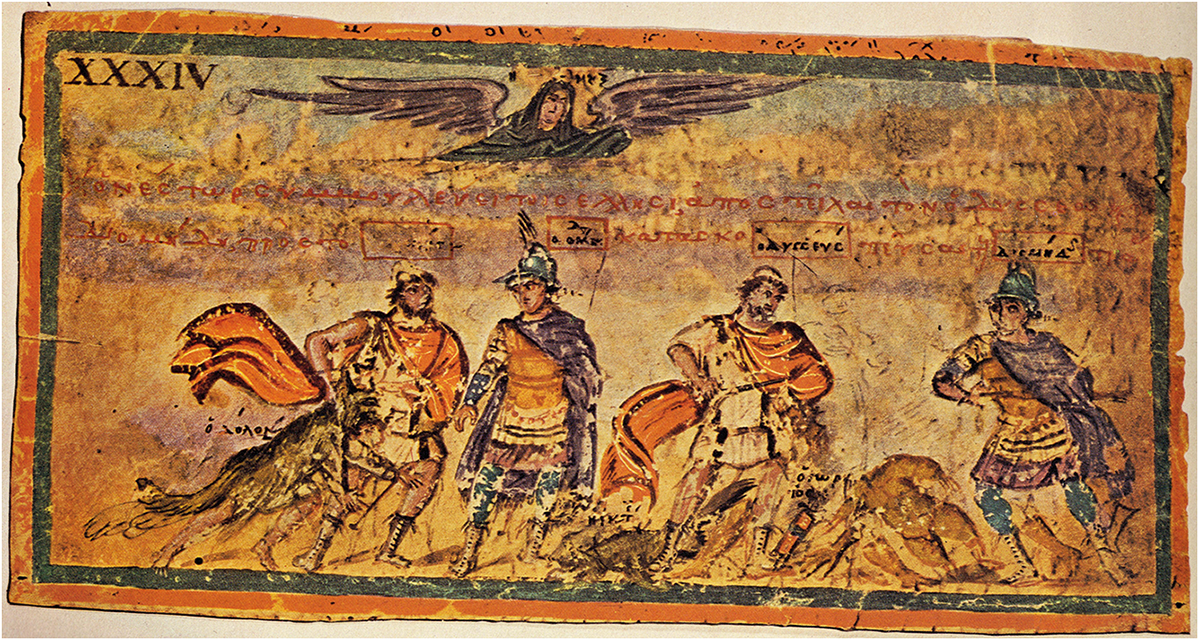


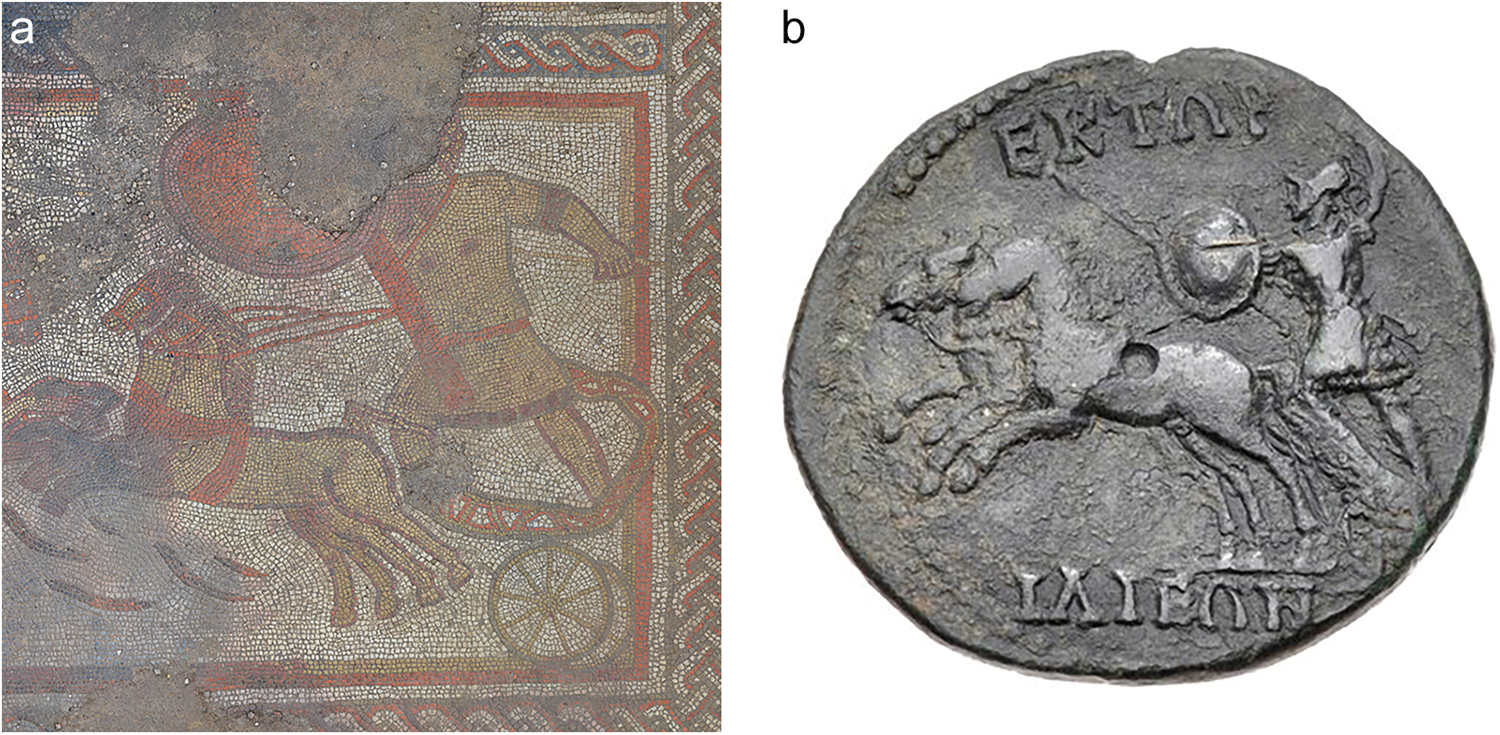


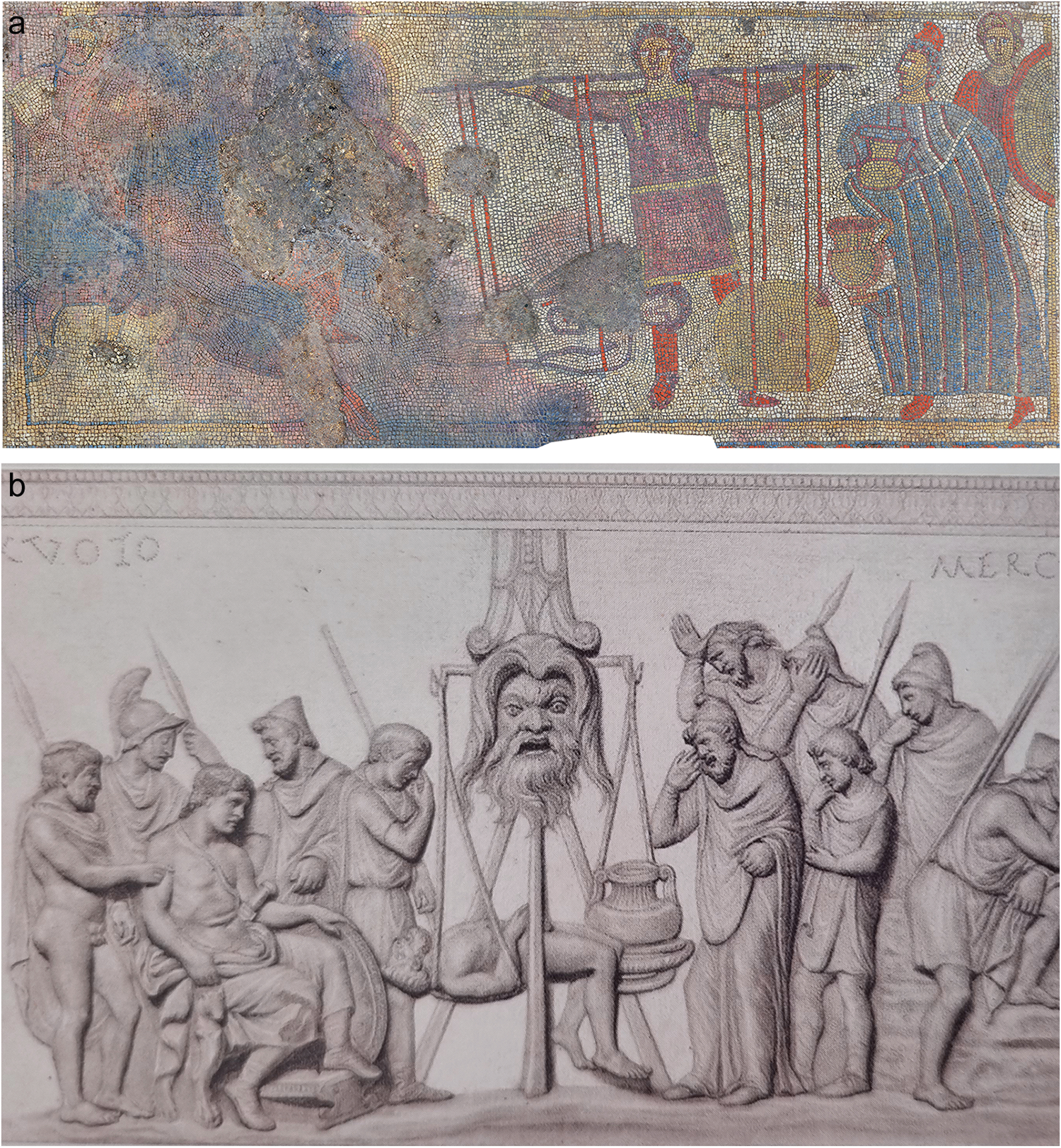

 Open access

