





Introduction
Why do some countries have more rigorous political finance regimes than others? Why do some countries offer public funding to political parties and others do not? Are the answers to these questions largely contextual or are there more general explanations? If we can answer these questions at some level of generality, then we have a basis for understanding when and how political finance reforms should be proposed. This, in turn, offers at least the potential to bolster democratic competition and guard against corruption. In recent decades, there has been an increase in the quantity of research into money and politics in relation to, among other topics, the interaction of different channels of political exchange between politicians and funders (Weschle Reference Weschle2022), the effects of public funding and other interventions (Hummel, Gerring and Burt Reference Hummel, Gerring and Burt2021), developing a normative basis for policy recommendations (Bonotti and Nwokora Reference Bonotti and Nwokora2023), and assessing gender bias in campaign finance (Sudulich, Trumm and Makropoulos Reference Sudulich, Trumm and Makropoulos2025). Overall, the research area remains ‘under-theorized’ (Scarrow Reference Scarrow2007: 193), with progress towards an understanding of the sources of variation in political finance regimes rather limited (for some exceptions, see Horncastle Reference Horncastle2025; Lipcean and Casal Bértoa Reference Lipcean and Casal Bértoa2024; Norris and van Es Reference Norris and van Es2016; Nwokora Reference Nwokora2014).
In this article, we develop a novel theoretical framework to explain the differing politics that lay behind public and private party funding reform. We combine a general approach to the logic of decision-making in political institutions (the veto-player theory) with two contributions to the political finance literature, Koß (Reference Koß2010) on public funding and Scarrow (Reference Scarrow2004) on reform. We theorise how the likelihood of a consensus among veto players on political finance reform depends on whether the stakes are framed as positive-, zero-, or negative-sum and integrate the consideration of the similarity of parties’ finances, party goals, and scandals. To test our theory, we implement a nested analysis design which incorporates large-N and small-N stages (Lieberman Reference Lieberman2005). Using a global dataset, we show that more veto players are associated with a greater likelihood of public funding, but not with a more rigorous regime in terms of private income, spending limits, and oversight. Included as ‘plausibility probes’ (see Gerring Reference Gerring, Box-Steffensmeier, Brady and Collier2008; Levy Reference Levy2008), supplementary case studies of the Netherlands and Botswana support the main findings of our large-N analysis.
This article comprises five parts. First, we review the relevant literature. Second, we develop our theoretical framework and hypotheses. Third, we introduce the nested research design that underpins our study. Parts four and five implement each stage of analysis, while part six concludes.
Literature
In recent decades, the political finance literature has moved beyond descriptive case studies to examine the effects of regulations on private and public funding (Booth and Robbins Reference Booth and Robbins2010; Casal Bértoa, Molenaar, Piccio et al. Reference Casal Bértoa, Molenaar, Piccio and Rashkova2014a; Hummel, Gerring and Burt Reference Hummel, Gerring and Burt2021; Mendilow and Rusciano Reference Mendilow, Rusciano and Naßmacher2001; Piscopo, Hinojosa, Thomas et al. Reference Piscopo, Hinojosa, Thomas and Siavelis2022; Potter and Tavits Reference Potter and Tavits2015; van Biezen and Casal Bértoa Reference van Biezen, Casal Bértoa, Fernandes, Magalhaes and Pinto2022; van Biezen and Kopecky Reference van Biezen and Kopecky2007; van Biezen and Rashkova Reference van Biezen and Rashkova2014), developing normative assessments of best practice (Bonotti and Nwokora Reference Bonotti and Nwokora2023; Casal Bértoa, Heapy-Silander and Lynge Reference Casal Bértoa, Heapy-Silander and Lynge2024) and increasing gender equality in elections (Muriaas, Wang and Murray Reference Muriaas, Wang and Murray2020; Sudulich, Trumm and Makropoulos Reference Sudulich, Trumm and Makropoulos2025). Though works are often limited to a geographical context or a single element of the financing regime (Casal Bértoa Reference Casal Bértoa2017; Casas-Zamora Reference Casas-Zamora2005; Katz and Mair Reference Katz and Mair1995; Lipcean and McMenamin Reference Lipcean and McMenamin2024; Piccio Reference Piccio2024; Pierre, Svasand and Widfeldt Reference Pierre, Svasand and Widfeldt2000; Tonhäuser and Stavenes Reference Tonhäuser and Stavenes2020; van Biezen and Rashkova Reference van Biezen and Rashkova2014), general works are becoming more common (Horncastle Reference Horncastle2022; Lipcean and Casal Bértoa Reference Lipcean and Casal Bértoa2024; Norris and van Es Reference Norris and van Es2016; Nwokora Reference Nwokora2014).
The literature on political finance reform has developed a range of insights and hypotheses, but there is little understanding of how applicable these may be outside of the contexts from which they were induced. Horncastle (Reference Horncastle2025) identifies four themes in the literature: (i) strategy-oriented studies focus on the strategic goals of actors in the reform process (La Raja Reference La Raja2008; Scarrow Reference Scarrow2004); (ii) scandal-oriented studies tie into literature on public opinion and political finance reform (see May Reference May2024; Nwokora Reference Nwokora2015; Primo and Milyo Reference Primo and Milyo2020) and emphasise exogenous shocks relating to corruption and financing controversies (Grant Reference Grant2005; Piccio Reference Piccio2014; Weekers, Maddens and Noppe Reference Weekers, Maddens and Noppe2009); (iii) party-oriented studies explain financing reforms by shifts in the organizational structures of parties (Hopkin Reference Hopkin2004; Katz and Mair Reference Katz and Mair1995; van Biezen Reference van Biezen2004) and; (iv) institution-oriented literature examines how variations in the shape and structure of democratic institutions align with different approaches to political finance regulation (Horncastle Reference Horncastle2022; Pinto-Duschinsky Reference Pinto-Duschinsky2002; van Biezen Reference van Biezen, LeDuc, Niemi and Norris2010; Wiltse, La Raja and Apollonio Reference Wiltse, La Raja and Apollonio2019). We prioritise institutions but build the other three perspectives into our theoretical discussion below.
Within the institutional literature, many have argued that institutional history (Power Reference Power2017) and legal origin (Norris and van Es Reference Norris and van Es2016; Wiltse, La Raja and Apollonio Reference Wiltse, La Raja and Apollonio2019; Clift and Fisher Reference Clift and Fisher2004) influence the extent of political finance regulation. Scholars frequently find British, and British colonial, exceptionalism, as these nations tend to have lower levels of regulation and less public funding (Fisher Reference Fisher2009; Power Reference Power2017). Many have explored whether particular institutions, such as presidential systems, strong courts, or majoritarian electoral systems are associated with political finance regimes (Ewing and Issacharoff Reference Ewing and Issacharoff2006: 6–7; Horncastle Reference Horncastle2022; Koß Reference Koß2008; Norris and van Es Reference Norris and van Es2016; Pinto-Duschinsky Reference Pinto-Duschinsky2002; Scarrow Reference Scarrow2011; Smilov Reference Smilov, Toplak and Smilov2007; van Biezen Reference van Biezen, LeDuc, Niemi and Norris2010; Wiltse, La Raja and Apollonio Reference Wiltse, La Raja and Apollonio2019). Others have suggested that policy diffusion plays a role, particularly in contexts of multi-level governance (see, for example, Pierre, Svasand and Widfeldt Reference Pierre, Svasand and Widfeldt2000; Smirnova Reference Smirnova2018; Taylor and Vanhooren Reference Taylor and Vanhooren2021; Tonhäuser and Stavenes Reference Tonhäuser and Stavenes2020; Weekers, Maddens and Noppe Reference Weekers, Maddens and Noppe2009).
Notwithstanding the strengths of all the works cited above, we take a more detailed look at the works of Koß and Scarrow. Moving beyond ‘mono-causal explanations’ of institutionalist literature (Casal Bértoa Reference Casal Bértoa2012: 478), these two authors combine a wide theoretical scope with a more detailed and process-oriented approach to political finance reform. Koß (Reference Koß2010) argues that subsidies are more likely to be introduced when numerous veto opportunities exist because ‘parties, regardless of their organizational characteristics, face different incentives in different institutional settings’ (Strøm Reference Strøm1990: 579). In consensus systems with numerous veto points, policy-seeking parties are more likely to cooperate on public funding, as there exists a ‘pressure for actors to take consensual decisions’ (Koß Reference Koß2010: 43). Koß argues that incumbents are more likely to legislate in response to scandals when few veto opportunities exist, and less likely to do so when numerous veto opportunities are at play. Where incumbents have fewer constraints on their activities, Koß argues that they are much more likely to implement policies that the public favour, since there is more room for ‘communicative discourse’ between government and civil society. When government action is highly constrained, however, policy development processes are dominated by competing interests of rival parties, making government much less permeable to external pressures. Scarrow (Reference Scarrow2004) distinguishes between parties that view political finance reform in terms of revenue maximisation and those that take an electoral economy approach, in which finances are considered relative to competitors and in relation to their contribution to election campaigns. Koß applies his theory through a qualitative comparative analysis of three countries, while Scarrow uses examples from the UK and Germany. By contrast, we develop a theory that generates probabilistic predictions to be tested on a global sample.
Our work is situated in the tradition of new institutionalism, which holds that institutions matter. They have an effect beyond that of the political forces that brought them into being. More specifically, we are interested in how political institutions affect policy, in our case, decisions on the regulation of political finance. In this respect, the veto-players perspective is attractive because, unlike other approaches to categorising political institutions, it focuses on the ease with which political systems can take decisions (Tsebelis Reference Tsebelis1995, Reference Tsebelis2002). The more veto players, the harder it is to make and reverse decisions. This interacts with players’ preferences: the likelihood of a decision is the product of the number of veto players and their polarisation. In addition, the concept of a veto player is relatively easy to measure, making it suitable for studying large numbers of countries.
Theory
We present our theory of political finance reform in two stages. First, we state and justify our hypotheses. Second, we show that these are robust to variations in assumptions about how parties conceive their interests in political finance and how similar their financial situations are. We also consider the politics of a carrot-and-stick reform, in which public funding and greater regulation are introduced together (Scarrow Reference Scarrow2011). Our hypotheses draw on Koß’s emphasis on veto players. Our analysis of theoretical robustness draws more from Scarrow’s work on how parties conceive their interests in political finance reform, but we also engage with party goals and how different party systems respond to scandals, again as emphasised by Koß. More generally, we take inspiration from a range of scholars.
Theoretical statement
The introduction of public funding, a major change to political competition, usually requires a consensus among the principal competitors. Political systems with more veto players, out of necessity, are more used to developing a wide consensus on policy. Therefore, our first hypothesis is as follows:
Hypothesis 1: The more veto players in a political system, the more likely it is to have introduced public funding.
Public funding is not the only feature of the political finance regime. International IDEA (2020) identify three additional regulatory categories: Bans and limits on private income, regulation of spending, and reporting, oversight and sanctions. In what follows, we will refer to these as PSO. Reforms of PSO are major changes in the terms of political competition and should also necessitate a political consensus. Accordingly, the same relationship with veto players should apply:
Hypothesis 2: The more veto players in a political system, the more regulated PSO will be.
This argument chimes with the model of Andrews and Montinola Reference Andrews and Montinola(2004), who show that ‘as the number of veto players in government increases, their ability to collude on accepting bribes decreases; therefore, their incentive to vote on legislation strengthening the rule of law increases’. Nevertheless, there are two major differences in the politics of the introduction of public funding and the adoption of PSO reforms. First, the likelihood of parties gaining from the two reform processes is very different. Public funding has the potential to be a positive-sum game, in which all parties win, as all receive extra income. By contrast, PSO regulations, whether constraints on income, limits on spending, or oversight requirements, tend to reduce income, making their introduction a negative-sum game, where everybody loses. If only one veto player calculates they will lose, the decision will not be made. Therefore, in a potentially negative-sum game, the greater the number of veto players, the less likely a decision is to be made. Second, the distribution of gains and losses is more unequal and more uncertain in the politics of PSO adoption than it is with public funding. Parties vary in their membership and in their relationship with donors, such as businesses, trade unions, and wealthy individuals. Therefore, their income will be impacted very unevenly by bans, limits, and disclosures. Tighter controls on union donations are likely to disadvantage left of centre parties (Power Reference Power2017), while strict donation limits are more likely to impact those parties that adopt an elite funding model, as they ‘primarily limit the giving capacity of affluent citizens as opposed to citizens with low incomes’ (Flavin Reference Flavin2015: 79). There is a similar asymmetry for restrictions on business donations (McMenamin Reference McMenamin and Boatright2015).
Public funding is distributed according to criteria that reflect some notion of equality, such as equal amounts per party, equal amounts for each voter, or equal amounts for each seat. The contrast in predictability is even greater. Parties can tell in advance how much they will be due under a new public funding formula, but they cannot tell with any certainty how much bans, limits, and disclosures will affect them. Moreover, parties can calculate exactly how much their competitors will receive in public funding but will be even less sure of the impact of new regulations on their competitors’ private income than on their own. The relative inequality and unpredictability are analogous to polarisation in Tsebelis’ account of veto players. The greater the inequality and unpredictability, the more negative the impact of an increase in the number of veto players on the likelihood of a decision. We therefore hypothesise the following:
Hypothesis 3: Veto players will be more strongly associated with public funding than with greater PSO regulation.
The veto players in our argument are political parties or their members occupying national representative institutions. This means there are further observable implications of our theory. First, the hypothesised effects should be stronger to the extent that institutions matter. Democracies are political systems where political actors ultimately submit themselves to rules. So, each of our hypotheses should be more strongly borne out in democracies than in non-democracies:
Hypothesis 1.1: The association between veto players and public funding is stronger among democracies than among non-democracies.
Hypothesis 2.1: The association between veto players and PSO is stronger among democracies than among non-democracies.
Hypothesis 3.1: The difference in association between veto players and public funding and veto players and PSO is greater among democracies than among non-democracies.
Second, the hypothesised relationships should be more strongly associated with variations in veto players in national representative institutions, as opposed to wider conceptions of veto players including judicial and sub-national actors.
Hypothesis 1.2: The association between veto players in national representative institutions and public funding is stronger than that between wider conceptions of veto players and public funding.
Hypothesis 2.2: The association between veto players in national representative institutions and PSO regulation is stronger than that between wider conceptions of veto players and public funding.
Hypothesis 3.2: The difference in association between veto players and public funding and veto players and PSO regulation is greater among national representative veto players than among wider conceptions of veto players.
Theoretical robustness
In this section, we analyse the effect on our hypotheses of different assumptions about, and scenarios of, political finance reform. We see three basic ways of thinking about the parties’ interests in political finance reform: absolute financial, relative financial, and political. In the absolute financial view, parties seek to increase their income. In the relative financial perspective, the parties seek to improve their finances compared to their competitors. The political view looks at a party’s orientation towards policy, office, and elections and how systems react to scandal. The first of these approaches is Scarrow’s revenue-maximising perspective. Her electoral economy perspective combines the relative financial and political perspectives (Scarrow Reference Scarrow2004: 655–656). While this combination works well in her case studies, we are trying to generate predictions for numbers of veto players across a global dataset and, therefore, have chosen to make sharper distinctions. We also follow her emphasis on the extent to which parties have similar financial situations (Scarrow Reference Scarrow2004: 657).
First, we look at public funding, according to whether the parties take an absolute financial perspective or consider their finances relative to other parties and whether the parties have similar or different financial situations. Since public funding is a form of income, a similar situation here means the income and expenditure of the parties, and any gap between the two. Under the absolute financial perspective, the introduction of public funding is a positive-sum game. The total income of the parties will be greater once the reform has been introduced and all can share in the gains. A consensus on public funding should be possible, whether the parties have similar financial situations or not. If they have similar financial needs, public funding can be equally beneficial to the parties. If they have different financial requirements, even though some will gain more than others, all will gain something. Public funding is normatively constrained to justify the allocation according to democratic criteria, chiefly vote and seat shares. This means that the distributions of public funding, if not necessarily strictly proportional, are disproportional within certain parameters. Using the Political Party Database (Poguntke et al. Reference Poguntke, Scarrow, Webb, Allern, Aylott, Bardi, Costa-Lobo, Cross, Deschouwer, Eneydi, Fabre, Farrell, Gauja, Kopeký, Koole, Verge Mestre, Müller, Pedersen, Rahat, Szczerbiak and van Haute2016), Hanretty and McMenamin (Reference Hanretty and McMenamin2024) show that the distribution of public funding among thirty countries is, on average, neutral between larger and smaller parties. The proportionality norm makes it easier to generate a consensus on a particular formula. Moreover, parties can plug their current or hypothetical vote and seat numbers into the formula to see how it would affect them. The predictability of the effect of public funding on parties’ finances also makes it easier to reach a consensus.
If the parties take a relative financial approach, public funding becomes a zero-sum game: one party’s gain is a relative loss for other parties. A consensus on public funding should be more difficult, given that parties will not accept greater gains for their competitors than for themselves. However, if parties also value absolute gains, they may be able to construct a public funding scheme that preserves the relative situation of the parties. This will be easier if they have similar financial situations but should also be possible if the parties face a range of different financial realities. A deal that preserves the relative status quo and offers absolute gains to all, is more likely if the finances of the parties correlate with shares of votes and/or legislative seats. This is because public funding systems are normatively constrained to justify the allocation of funds according to democratic criteria.
The strength to the association between veto players and public funding varies according to how parties view their finances and how similar their financial situations are. We can place the scenarios in order of the strength of the association as follows: Absolute approach and similar finances, absolute approach and different finances, relative approach and similar finances, relative approach and different finances. Nevertheless, under all scenarios, there are incentives to develop a consensus on public funding.
We now turn to PSO regulations, which primarily restrict private income. Since PSO regulations constrain private funding, their introduction is a negative-sum game when financial situations are considered absolutely. The total income of parties will be less after their introduction than before; it is more difficult to reach a consensus about a reduction in income than an increase. The amounts and sources of private funding tend to be different across parties and are often only weakly correlated with votes and seats. Dependence on corporate or trade-union donations varies across parties, with business often supporting liberal or conservative parties and trade-unions donating to social democratic parties. Dependence on large donors is also different across parties, although there is less likely to be an ideological pattern. Disclosure should affect parties differently, partly because of different profiles of size of donation and type of donor, but also because of variations in the social desirability of donating to different parties. Given parties are unlikely to have identical total expenditures and identical spending needs, limits on spending will also affect them variously. Even enforcement should have a differential impact, as parties will engage in different levels and types of evasion and abuse. However, the financial diversity of party systems varies cross-nationally. The differential impact of political finance regulations is consistent with cross-national data from Tomashevskiy (Reference Tomashevskiy2015) and case studies on the United Kingdom (McMenamin Reference McMenamin2020), Germany (McMenamin Reference McMenamin2012), and Australia (McMenamin Reference McMenamin and Boatright2015), as well as Ireland before stricter regulations were introduced (McMenamin Reference McMenamin2013a). The differences between parties are more subtle in the US and were in Canada before stricter regulations (McMenamin Reference McMenamin2013b). Because parties rarely occupy similar positions regarding private funding sources and amounts, reaching consensus is difficult: the effects of PSO regulations are hard to predict. Parties must anticipate how bans, limits, disclosure, and enforcement will influence donor behaviour toward themselves and competitors. Moreover, interventions in one area of political finance often produce complex second-order effects (Weschle Reference Weschle2022). Though this uncertainty further impedes consensus, agreement becomes more attainable if parties evaluate their finances relatively rather than absolutely. While it is unrealistic to design regulations that increase overall income, parties may still support reforms that preserve their relative financial positions and thus maintain the relative financial status quo before the reform.
Table 1 summarises this discussion. The numbers in the cells are ordinal: the larger the number the easier we think it would be to establish a consensus on a given type of political finance reform, given the parties’ view of their finances and the similarity of their financial situations. The easiest scenario is to introduce public funding when finances are considered absolutely and parties have similar financial situations. The next most conducive to consensus is the same scenario, except that finances are considered relatively. Then comes, public funding among parties with similar financial situations that view their finances relatively. From a relative perspective, we think it should be equally difficult to establish a consensus on public funding and other PSO regulations among parties with different finances. Finally, the most difficult scenario is to introduce PSO regulation when finances are considered absolutely and parties have different financial situations.
Ease of constructing a consensus on political finance reforms

Overall, regardless of assumptions about how financial interests are calculated and how different party finances are, the logic of our three principal hypotheses stands. Public funding and PSO regulation are major changes to political competition that should require a consensus typical of systems with more veto players (Hypotheses 1 and 2), but it is easier to form a consensus on public funding than PSO regulation (Hypothesis 3).
So far, we have considered political finance reform as narrowly financial. This is an empirically reasonable assumption: it is of little direct interest to the public and is rarely salient in most political systems. Of course, the financial approach is also theoretically tractable. Finally, nevertheless, we look at how politics might, or might not, bring parties to a different position than their financial interest would imply. This can be considered statically, as politics in ordinary time, or dynamically, in a scandal that brings about an extraordinary salience of political finance for parties and the public. In ordinary political time, parties seek some combination of policy, office, and electoral gains. Policy-oriented parties are more likely to see political finance in absolute terms, as more money helps develop an organisation that can generate and analyse policy alternatives. Electoral-focused parties are more likely to see political finance relatively since they are fixated on the electoral contest (Scarrow Reference Scarrow2004: 658). The more veto players there are the more likely parties are to be policy-focused and the fewer there are the more likely parties are to emphasise elections above all else (Koß Reference Koß2010). This means that considering party orientation bolsters the prediction that countries with many veto players should be able to develop a consensus on public funding (Hypothesis 1) or political finance regulation (Hypothesis 2). Policy orientation and an absolute view of finances should also bolster Hypothesis 3, as it means PSO regulation will be a negative sum game and veto players an obstacle to its introduction.
However, political finance reform often occurs in extraordinary periods. During a scandal, parties may be prepared to sacrifice their financial interests to win, or limit their losses of, public support. Where there are many veto players, scandals are likely to be less important than where there are few. When there are many parties, electoral systems are likely to be relatively proportional and parties are likely to be policy-oriented, both of which mean they are less likely to be sensitive to changes in public support. Public funding is harder to introduce in response to a scandal than PSO measures, as the public will want to punish, not reward, political transgressors. Therefore, the politics of scandals should boost the amount of PSO regulation in countries with fewer veto players. Of course, politics, especially during scandals, can be creative, so it will also generate many exceptions to the generalisations offered here. In conclusion, considering party goals in ordinary political time, bolsters our three principal hypotheses. By contrast, we think the politics of scandals works in the opposite direction. The politics of ordinary time and scandals tend to cancel each other out: taking a more political view of party finances leaves our hypotheses intact.
Research design: Nested analysis
Following Lieberman (Reference Lieberman2005), we employ both large-N and small-N approaches. In the first phase, we use large-N statistical models for cross-sectional hypothesis testing. We develop two ‘plausibility probe’ case studies in the second phase (see Gerring Reference Gerring, Box-Steffensmeier, Brady and Collier2008; Levy Reference Levy2008). First, we conduct the initial large-N stage of the design. We open by discussing the data used to build each model and continue by presenting the results of hypothesis testing in relation to: (i) political constraints and public funding, and (ii) political constraints and PSO regulation. In doing so, we find strong evidence of a relationship between political constraints and public funding, but no significant evidence of a similar relationship relating to PSO regulation.
Following this, we present the small-N stage of analysis. We begin by outlining the case selection criteria, in which we pick two ‘on the line’ cases from our principal regression model (Lieberman Reference Lieberman2005). By selecting on the independent variable, we identify the Netherlands and Botswana as cases. Using these nations to further probe our theoretical model, our two cases outline shifts in the evolution of the political constraints-public funding relationship over time and the politics of PSO regulation. While these case studies are limited in scope, they play a key role in supporting observations drawn from our large-N statistical analysis and offer insights that complement our primary empirical approach. Replication materials for our quantitative analysis are available at: http://doi.org/10.7910/DVN/EG9REZ.
Large-N analysis: Cross-sectional hypothesis testing
To test our first hypothesis, we use logistic regression with a dependent variable taken from the International IDEA Political Finance Database (International IDEA 2020). We use the variable titled ‘are there provisions for direct public funding to political parties’ coded into a ‘yes/no’ indicator of subsidy use.Footnote 1 To test hypotheses relating to PSO regulation, we use OLS regression with a dependent variable taken from the ‘Regulation of Political Finance Indicator’ (RoPFI) dataset (Horncastle Reference Horncastle2022). The RoPFI provides a comparative measure of all forms of political finance regulation – including private income, expenditure, public funding, disclosure, and enforcement – in 180 nations, accurate as of 2020. Using the International IDEA data as a foundation, the RoPFI is constructed using Multiple Correspondence Analysis, which provides a single quantitative indicator of regulation levels, and Model Based Clustering, which categorises nations as ‘Unregulated’, ‘Partially Regulated’, and ‘Strongly Regulated’. Based on 45 different types of regulation (see Horncastle Reference Horncastle2022: 5), the RoPFI data solely captures the de jure state of regulations within each case, does not make any normative assessments of best practice, and does not consider issues of (non-)compliance.Footnote 2
In our analysis, we use the continuous measure to account for variation in the level of PSO regulation. While use of regulatory indices inevitably leads to data loss, they represent a useful tool for comparative literature and have been used by similar studies in our subject area (Potter and Tavits Reference Potter and Tavits2015; Rashkova and Su Reference Rashkova and Su2020; Whiteley Reference Whiteley2014). Subsequent case studies allow us to offset any loss in detail by focusing on specific reforms, rather than the overall level of regulation. While we use this variable to test hypotheses relating to PSO, the RoPFI is an aggregated index of all areas of the funding system. This includes information on public funding, however these make up just 7 of the 45 regulation types contained within the index. As a robustness check, we replicated the RoPFI with the exclusion of public funding variables. Comparisons with the original RoPFI showed a near perfect correlation (see online Appendix 1). To increase replicability, we used the original index.
We operationalise the level of constraint on government action with data from the Political Constraint Index (POLCON) Dataset (Henisz Reference Henisz2022). POLCON is designed to estimate the extent to which a change in the preferences of any one actor may lead to a change in government policy. It incorporates information on the number of institutional veto players, data on partisan alignments, and the party composition of legislatures, to produce two indices: POLCON III measures institutional and partisan veto points at the national/federal level, while POLCON V adds data relating to sub-national legislatures and the judicial branch.Footnote 3 In both instances, higher figures on the indicator represent a greater level of political constraint. POLCON III allows us to test our primary hypotheses (H1 and H2), while comparison of models using each measure allows us to test our supplementary hypotheses, which suggest a stronger relationship between constraints and regulation in national representative institutions, than in wider contexts.
The veto-players theory is much more convincing as a cross-case interaction argument than an intra-case main effect argument. It is not plausible that there was a global increase in veto players, which brought about an increase in the adoption of direct public funding for political parties. Instead, countries with higher numbers of veto players were more likely to adopt direct public funding of parties in response to trends also experienced by countries with fewer veto players that did not opt for public funding. Two of the common trends were domestic: the decline of party membership and increased scrutiny of elites, leading to less money from member fees and less tolerance for (secret) reliance on big donors. The third was the increasingly strong international norm of more regulated and publicly-funded political finance. Although, institutions can and do change over time, they are sticky (Wiltse, La Raja and Apollonio Reference Wiltse, La Raja and Apollonio2019: 4, 8). We can do an initial check on the validity of POLCON III, by contrasting the levels of intra-and cross-case variation. Restricting to democracies since 1960: the standard deviation between cases is 0.17 and within cases it is 0.12. If we look at the period since 1980, the contrast sharpens: 0.18 versus 0.1. In other words, there are much bigger differences between countries than there are within countries over time, which means institutions are relatively stable. This provides some initial reassurance that our cross-sectional quantitative data can test our hypotheses. Our case studies will also probe whether associations in, and inferences from, the 2020 dataset are consistent with the historical record.
In all models, we add five additional variables. First, we use the ‘Boix-Miller-Rosato’ (BMR) dichotomous measure of democracy (Boix, Miller and Rosato Reference Boix, Miller and Rosato2013; Miller, Boix and Rosato Reference Miller, Boix and Rosato2022). We code states into ‘non-democracy’, ‘established democracy’, and ‘new democracy’ categories, based upon the first year that the country was coded as a democracy by BMR. New democracies are defined as those which transitioned since the Polish elections of 1989. This variable allows us to test H1.1 and H2.2, which theorise a stronger effect in democracies, and accounts for the observation that newer democracies – particularly in Europe – tend to regulate parties more stringently than established democracies (Casal Bértoa, Piccio and Rashkova Reference Casal Bértoa, Piccio, Rashkova, van Biezen and Napel2014b; Hopkin Reference Hopkin2004; van Biezen Reference van Biezen2003; van Biezen and Borz Reference van Biezen and Borz2012). Second, we include a corruption proxy, as prior research has identified empirical links between corruption and political finance (see, for example, Casas-Zamora Reference Casas-Zamora2005; Hummel, Gerring and Burt Reference Hummel, Gerring and Burt2021; Pinto-Duschinsky Reference Pinto-Duschinsky2002). We select the Kaufmann and Kraay (Reference Kaufmann and Kraay2020: 4) ‘Control of Corruption’ indicator, which captures ‘the extent to which public power is exercised for private gain’. As the variable measures the level of control that a nation has over these types of corruption, higher values equate to less corruption.
Third, we use legal system origins, as categorized by La Porta, Lopez-de Silanes, Shleifer et al. (Reference La Porta, Lopez-de Silanes, Shleifer and Vishny1999: 268–276), to control for the previously observed ‘British exceptionalism’ in political finance (Fisher Reference Fisher2009; Power Reference Power2017). We create a dummy variable for ‘English legal origin’, and use ‘other’ as the reference category. Fourth, we include a control for ‘continent’, since regional organizations are often able to influence the practice of their members (see Norris and van Es Reference Norris and van Es2016: 207; Tonhäuser and Stavenes Reference Tonhäuser and Stavenes2020). In doing so, we use ‘Europe’ as the reference category. Finally, we include a logged measure of population drawn from the United Nations Population Division (2024). This accounts for the notion that ‘larger jurisdictions are likely to generate more political money, and present greater regulatory challenges’ than smaller polities (Ewing and Issacharoff Reference Ewing and Issacharoff2006: 6), as well as the observation that small states are much less likely to regulate party finances (Horncastle Reference Horncastle2022). Finally, we exclude countries without officially non-partisan elections (Micronesia, Nauru, Palau, Tonga, Tuvalu, and the Marshall Islands) as they are outside the scope of our theory.
Political constraints and public funding
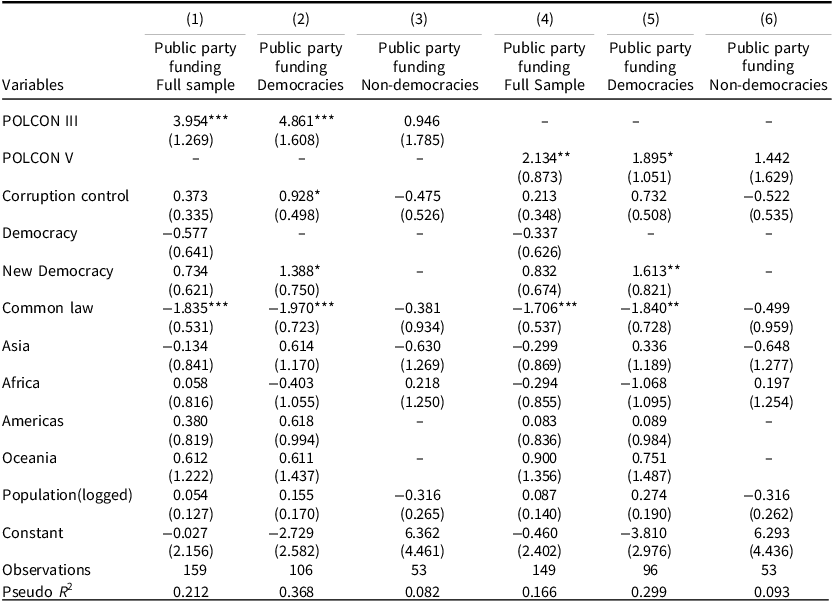
Table 2 shows the results of our public funding models: they are logistic regressions with the IDEA measure of public funding of political parties as the dependent variable. The models provide strong support for H1. In the global sample (Model 1), there is a strong and highly statistically significant association between political constraints and public party funding. When restricted to democracies only (Model 2), the coefficient for political constraints is almost twenty-three % larger. For the sample of non-democracies (Model 3), the coefficient shrinks massively and is not close to statistical significance. The difference between the POLCONIII coefficients in Models 2 and 3 is statistically significant.Footnote 4 Therefore, this table also provides strong support for H1.1, the idea that political institutions explain the existence of public party funding better among democracies than non-democracies.
Models 4 to 6 test H1.2 by replacing POLCON III with POLCON V. The results are once again clearly consistent with our hypothesis. The coefficient on political constraints in Model 4 is 54% the size of its equivalent in Model 1, both of which test the global sample. In Model 5, the relevant coefficient is only 39% the size of its counterpart from Model 2; these models relate to democracies only, adding to the evidence that national representative institutions are the ones that matter for the adoption of public funding. It also further bolsters the idea that the relationship between institutions and political finance is much stronger for democracies: the contrast between the two measures of political constraints is much greater within the democratic sample. Finally, we look at the non-democratic sample. Model 6 does not show a statistically significant association between political constraints and the existence of public party funding.
Public party funding and political constraints

Standard errors in parentheses ***p < 0.01, **p < 0.05, *p < 0.1.
The only other variable that explains public party funding in more than two models is the dummy for British-style legal origin. Countries built on a Common Law system are significantly less likely to have public party funding in the whole dataset, and for democracies, only for both versions of POLCON. Such a finding strengthens claims of a previously observed ‘British Exceptionalism’ in party financing (Fisher Reference Fisher2009; Power Reference Power2017). A significant relationship is identified in relation to age of democracy, with new democracies more likely to have public party funding than older democracies in Models 2 and 5. Corruption control shows significant effects in one model; however, this is only at the 0.1 level. Remarkably, the six equations report no regional or population effects. The model of the whole dataset reports a modest pseudo r-squared of 0.21, but the democracies-only model posts a larger figure of 0.37.
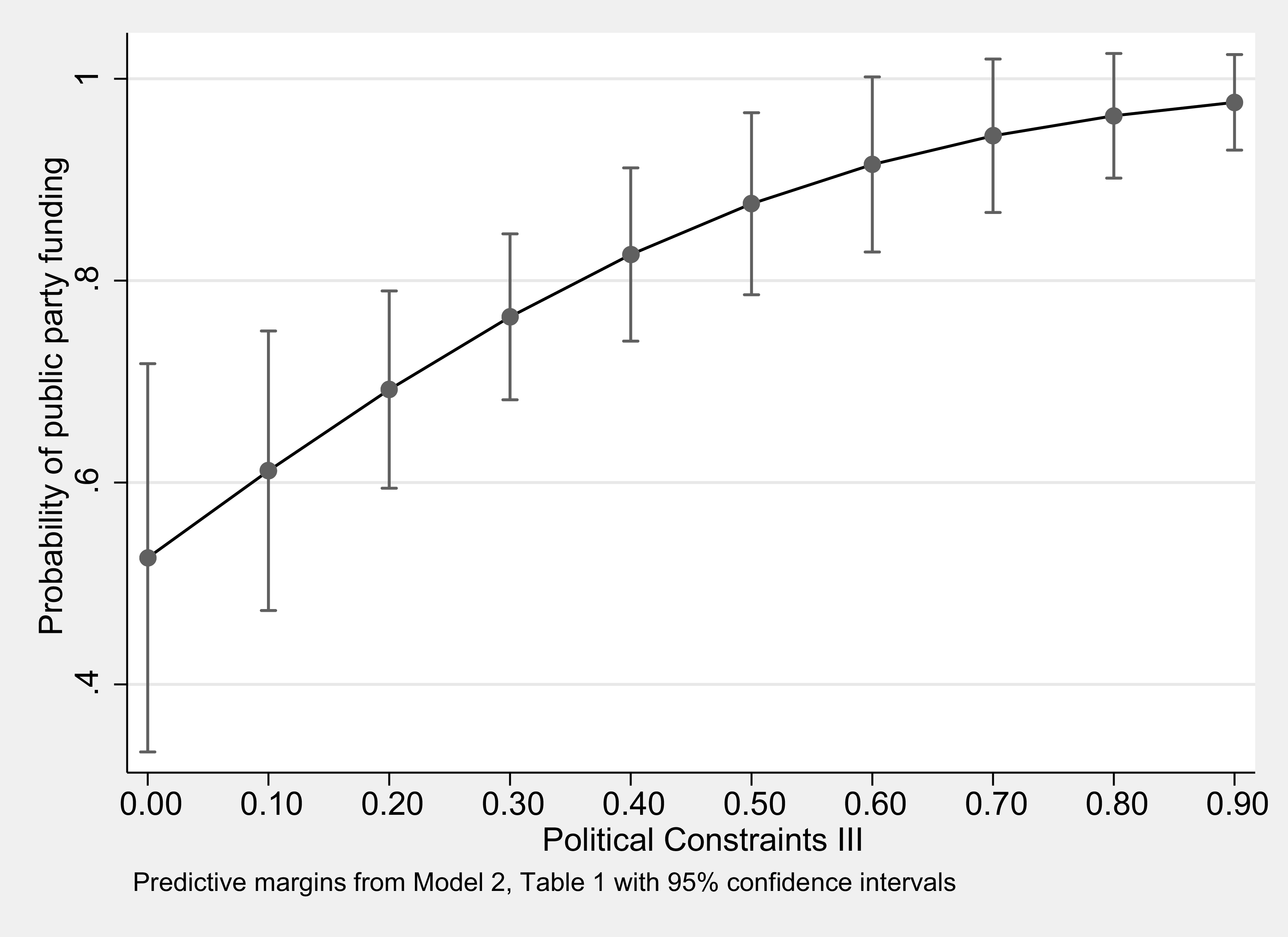
Figure 1 plots the predictive margins from Model 2, Table 2. In other words, it graphs how the probability of public party funding varies over levels of political constraints. Since most countries have some form of public party funding, the model implies that public party funding is likelier than not, even when there are no political constraints. However, across the full range of political constraints that increases to virtual certainty. Once the level of political constraints passes 0.6, which is just below the maximum in our sample, the estimates are statistically indistinguishable (at the 0.05 level) from 1, meaning that the model cannot separate political systems with political constraints between 0.6 and 0.9, as they are all very likely to have public party funding. As the level of political constraints decreases the confidence interval steadily widens. Indeed, when there is no political constraint the confidence interval is over 0.3. While unconstrained systems (scoring zero) are quite common, countries scoring between zero and 0.3 are rare.
Political constraints and the probability of party funding.
Note: Predictive margins from Model 2, Table 2.

Political constraints and PSO regulation
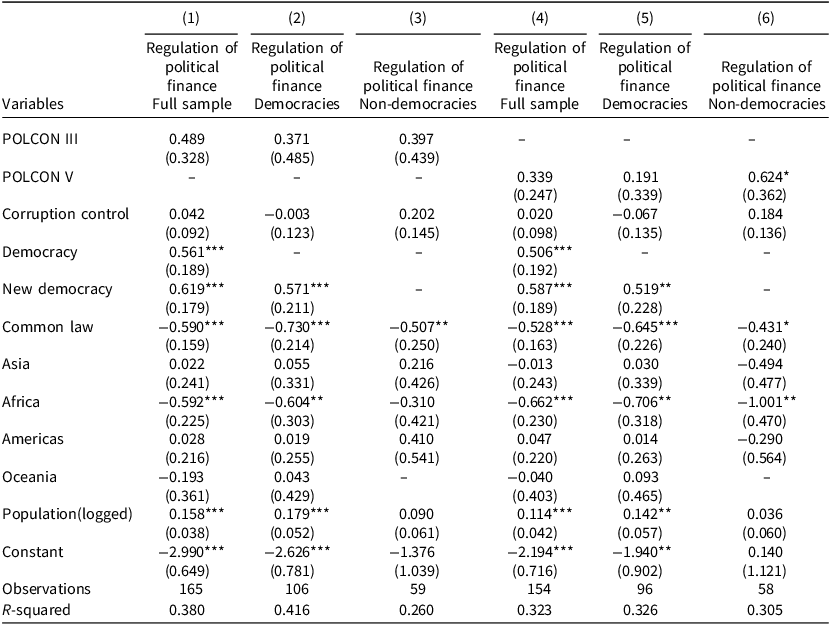
Next, we move to H2 and test the relationship between political constraints and PSO regulation. Presented in Table 3, our OLS regressions reject the hypothesis. The association between political constraints and the regulation of political finance is insignificant in each of the three models using POLCON III. Only Model 6 indicates an association between POLCON V and political finance regulation; however, this is at the low significance level of 0.1. Since POLCON V includes judicial institutions, this may reflect Andrews and Montinola’s (Reference Andrews and Montinola2004) conclusion that more veto players are associated with a greater commitment to the rule of law. Indeed, democracy is significant in both equations where it features. New democracies also have higher levels of regulation in the four relevant models. Given the rejection of H2, we do not test H2.1 and H2.2, since both are contingent on an observed relationship between political constraints and funding regulation. The rejection of H2 also provides evidence in support of H3: there is a stronger association between political constraints and the adoption of public party funding than there is between political constraints and the overall regulation of political finance.
Bans and limits on private income, regulation of spending, and reporting, oversight and sanctions (PSO) and political constraints

Standard errors in parentheses ***p < 0.01, **p < 0.05, *p < 0.1.
In contrast to public party funding, our control variables make a substantial contribution to the explanation of PSO regulation. Common Law is significant in all equations (albeit only at the 0.1 level in Model 6). African countries have less PSO regulation in five out of six models. A greater population is associated with more PSO regulation in all models, save those for non-democracies. The R-squared values vary narrowly from 0.26 to 0.42, slightly better than the best of the public funding models.
Adding to these results, we include numerous robustness tests in the online Appendices. In Appendix 2, we control for whether a state had fewer than a million inhabitants – this makes little difference. In Appendix 3, we ran our models again without those countries that exceeded the mean standard deviation of POLCON III by one standard deviation. This excludes those with more volatile political institutions on the assumption that the remaining observations of the independent variable are more valid as predictors for political decisions that were probably taken well before 2020. This excluded almost 26% of observations, but we still see a strong association between POLCON III and the presence of public funding for political parties in the full sample. This association disappears when we restrict to democracies only and we end up with only eighty-one observations. Interestingly, the model testing the relationship between POLCON III and PSO demonstrates a positive and significant association when excluding volatile institutions, suggesting that the relationship between constraints and PSO may be mediated by institutional volatility. Having found a robust association between public funding and political constraints, we proceed with the small-N plausibility probe studies.
Small-N analysis: Plausibility probes
In relation to public funding, we have a model that is theoretically coherent and statistically supported. According to the logic of model-testing small-N analysis, we should pick well-predicted cases that vary in relation to the independent variable (Lieberman Reference Lieberman2005: 444). In our context, then, this means a case with very high political constraints and a low residual from Model 2 (see Table 1) and a case with very low political constraints and a low residual. Well-predicted cases with large differences in political constraints will, of course, virtually inevitably mean that one has public funding and the other does not. In relation to PSO regulation, we have a more tentative theory, as to why countries with high political constraints might combine public funding with low regulation, but not as to why countries without public funding might have high levels of PSO regulation. It is important to remember that we do understand PSO regulation reasonably well, in terms of the diffusion of regulation to new democracies, the liberal tradition of Common Law, as well as generally low levels of regulation in African and smaller countries. So, our case with public funding, should have only moderate or low regulation. Moreover, this level of regulation should be lower than our equation predicts. Our data is from 2020, and we seek to inspect the historical record for our case studies. Therefore, we will exclude countries with a record of institutional volatility. We do this by filtering out countries that had a standard deviation of more than one standard deviation over the mean in POLCON III since 1980. Overall, we seek cases that meet the following criteria:
-
Case 1: High level of political constraints, low (absolute) residual from Model 2 in Table 1, low or moderate PSO regulation, and a large negative residual from Model 2 in Table 2, less than one standard deviation over the mean standard deviation in POLCON III since 1980.
-
Case 2: Low level of political constraints, and a low (absolute) residual from Model 2 in Table 1, less than one standard deviation over the mean standard deviation in POLCON III since 1980.
Appendix 4 presents the data necessary to apply these criteria. The Netherlands is at the bottom of the table. It is the most politically constrained political system in the dataset. It is also the best predicted case (the lowest absolute residual for the equation that predicts public funding among democracies). It has a low level of PSO regulation (in the bottom twenty-five out of eighty-eight). Finally, its level of regulation is weakly predicted (seventh most under-predicted). Botswana is at the top of the table. It is one of twenty unconstrained political systems, and its absence of public funding is the second best predicted of all those observations. Its absolute residual from the public funding equation is just larger than Belize’s. However, Belize has a much larger residual for the PSO equation.
We think of these case studies as plausibility probes: not as strong as hypothesis-testing case studies, but with more impact on our evaluation of hypotheses than illustrative case studies. We will probe the plausibility of our findings in relation to H1 and H3. First, we check the qualitative validity of the quantitative measures we have used in relation to both countries. Second, we will identify the period in which the relevant reforms were made, proposed, or failed. Third, we consider the consistency of our theory with the interpretations of country-expert scholars and commentators and whether they emphasise any of our control variables. Fourth, and most importantly, we explore the mechanism connecting political constraints to outcome. Therefore, with respect to H1, in the Netherlands, we will check whether public funding was introduced by consensus among veto players; whether the issue was treated as a positive or a zero-sum game; whether the finances of the parties were relatively similar; whether the parties were policy-, office-, or election-oriented; and, finally, whether the politics of reform were transformed by a scandal. In Botswana, we will review whether the same mechanisms prevented the introduction of public funding in the absence of veto players. With respect to H3, we will investigate whether veto players acted through the same mechanisms to limit PSO regulation in the Netherlands.
The Netherlands: High constraints and public funding
We begin with a validity check on whether the Netherlands in fact combines public funding of parties with a relatively low level of PSO regulation. The Netherlands has a relatively liberal political finance regime: [as of 2017] ‘there appears to be no ban on donations from foreign entities, corporations, trade unions or anonymous donors. There are also no limits on the amount that donors may donate to political parties’ (European Public Accountability Mechanisms 2017). Public funding is allocated according to seats in the lower house, the number of members, and a base amount. However, these institutional basics need to be qualified by two aspects of practice. First, there is a longstanding norm of not relying on corporate funding, such that even modest donations are relatively rare. Second, the Party for Freedom is not registered as a political party, only as a parliamentary group. This means that the founder and leader Geert Wilders maintains a very high level of control, but the Party for Freedom does not receive direct party funding. The Party for Freedom is still subject to disclosure regulations, which show its dependence on foreign funding (Kroet Reference Kroet2017).
Next, we need to identify the relevant period for the introduction of public funding. The Netherlands was not late to debates about direct public funding of political parties, but it was relatively late to provide it. Party research institutes first received state funding in 1970 (Koole Reference Koole and Alexander1989: 205). However, it was not until 1999 that the central parties were awarded public funding, with a formula calculated in proportion to the number of seats, and a matching funds system linked to party membership. Even then, they were constrained to using it for a relatively narrow set of purposes (Koole Reference Koole, van Biezen and Napel2014: 59). In 2004, a new law allowed parties to use their public funding for general purposes, including electioneering (Koole Reference Koole, van Biezen and Napel2014: 61). Owing to the type of funding provided, therefore, 1999 can be most accurately described as the date at which direct public party funding was introduced in the Netherlands.
There is a strong secondary literature on Dutch political finance, with which we can compare our own theory. In three detailed pieces, Ruud Koole emphasises two broad arguments to explain the trajectory of Dutch political finance, which was unusual not just in being relatively late to provide direct funding of parties, but also in the relatively low incomes of the parties. First, a tradition of hostility to state intervention in political parties prevented direct public funding (Koole Reference Koole and Alexander1989: 211, 215). During the era of pillarization, parties legitimised and funded themselves through their members who were in turn linked to very strong religious and socio-economic sub-cultures. The sub-cultures were separate pillars independent of each other and the state. Second, the breakdown of the pillarized society weakened the parties and created a financial problem for them (Koole Reference Koole1990: 52), leading to pressure for public funding. Instead of direct party funding, the Netherlands preferred to subsidize parties indirectly through their parliamentarians (Koole Reference Koole1990: 60) and associated organisations. Dubious accounting tricks were accepted to increase the amount of money channelled through the associated organisations (Koole Reference Koole and Alexander1989: 207; Koole Reference Koole1990: 54). Hostility to state intervention is shared with some (notably the Anglo-Saxon) countries. The decline of parties is one of the factors we point to above. The other two factors are mentioned but not stressed by Koole. In relation to tolerance of elite funding, Dutch parties seem to have taken very little money from businesses and rich individuals (Koole Reference Koole and Alexander1989: 206–207). Even in the absence of regulation and in an ongoing political finance squeeze, there was a very strong norm against this. Koole does point to pressure from the Council of Europe and GRECO, but not until the Twenty-First Century (Koole Reference Koole, van Biezen and Napel2014: 62, 64).
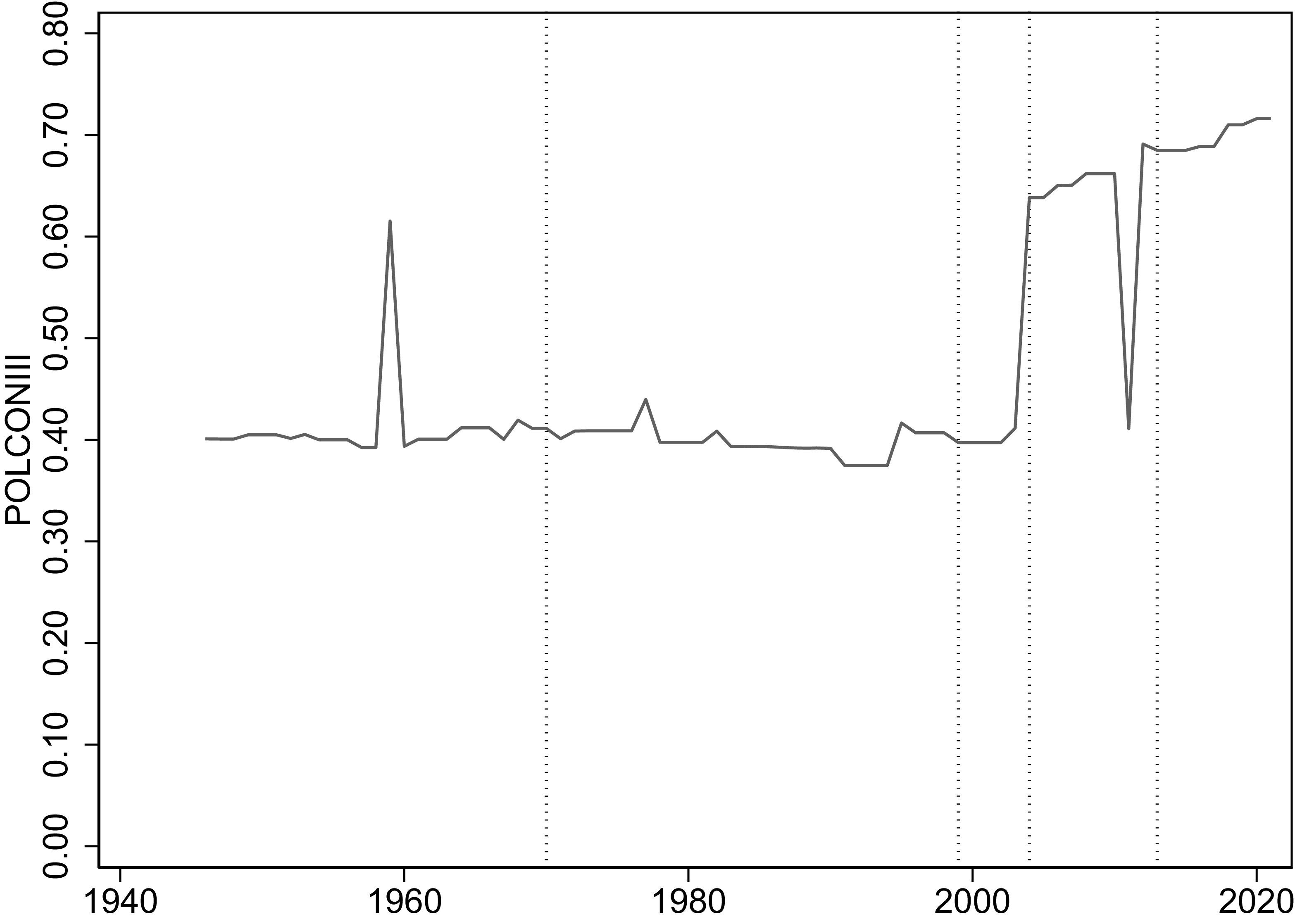
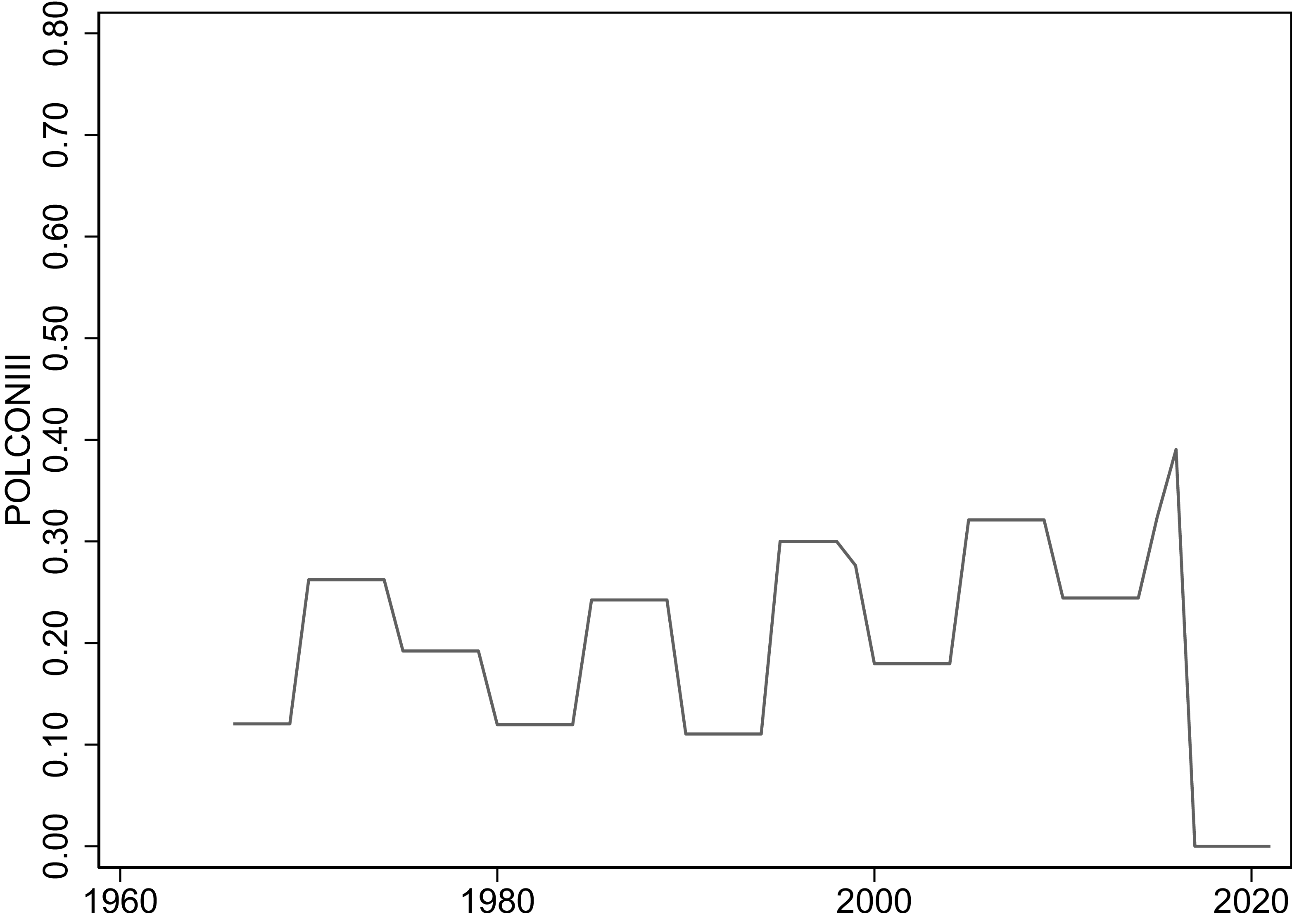
We now move on to the mechanisms outlined in our theory. The Netherlands has had a highly constrained political system since the establishment of democracy and, so, should have been a relatively likely case for public funding since the beginning of the global age of direct public funding in the 1960s. In our dataset, the Netherlands has virtually the highest level of POLCON III. As Figure 2 shows, for most of the period since 1945 until 1999, it had a much lower score of around 0.4, which still represents the sixty-first percentile. Thereafter, there was a leap to a much higher level of political constraints, which has been sustained until today. Therefore, if public funding did not already exist, it was even more likely to be introduced in 2004 and after. It was in this very year that Dutch parties gained the right to use their public funding for any purpose, even election campaigns; nevertheless, the pressure had been building up for many years previously.
Political constraints in the Netherlands (1945–2021).
Note: The vertical reference lines refer to major political finance reforms. 1970: State funding for central parties, 1999: Direct state funding for political parties, 2004: Parties permitted to use state funding for electioneering, 2013: Minor adjustment to transparency requirements.

Koole takes it for granted that public funding in the Netherlands required a consensus from across the political system (Koole Reference Koole, van Biezen and Napel2014: 65). The Netherlands is one of the most highly constrained countries in our dataset; a position which intensified at the turn of the century (see Figure 2). Though we do not generally regard the veto-players theory as an intra-case argument, this may help to explain the political finance reforms of 2004 and 2013. Koole several times refers to parties raising the idea of direct funding but abandoning it due to the absence of support (Koole Reference Koole1990: 53–54). Therefore, the introduction of public funding may have been enabled by a shift away from election-orientation and towards policy-and office-orientation in relation to political finance. Given the highly proportional political system and complicated coalition governments, the Netherlands is a case where parties would generally be thought of as relatively policy-oriented. He never mentions Dutch parties trying to assemble a minimal coalition to pass public funding reforms. Neither does he mention parties considering or resisting it based on narrow partisan interests or values. So, it looks like finances were not considered relatively. The emphasis on the voluntarist tradition and the weakening of the parties are basically pressures against, and for, consensus on public funding that applied across the political spectrum, so finances were relatively similar in a basic sense. Overall, then, at least at the time of the major public funding reform, the Netherlands seems to have been close to a most likely case according to our theory.
We will now explore hypothesis three and what mechanism may have prevented the constrained Dutch political system from introducing strong PSO regulation. We theorised that it is harder for veto players to form a consensus on PSO reforms than it is on public funding, as such reforms tend to be a negative-sum game, and the effects are unequal and hard to predict. In 2013, the parties agreed on a minor increase in transparency at the national level, because of clashing positions on potential reforms. The liberal-conservative People’s Party for Freedom and Democracy (VVD) wanted to retain unlimited donations and a low administrative burden on parties, while the Labour Party (PvdA) wanted an annual cap of €50,000 on donations and a prohibition on gifts from abroad. Although large donations have been rare, the VVD as a party that was pro-business and usually in government may have wanted to keep the option open. They might also have wanted to maintain good relations with the Party for Freedom, which was then supporting the government in parliament. The final law was spearheaded by the centre-right Christian Democratic Appeal (CDA) and the VVD with support from across the political spectrum, with the exception of the Party for Freedom (Koole Reference Koole, van Biezen and Napel2014: 63). The Party for Freedom surely saw this as a zero-sum game in which they had lost. The relative absence of consensus, seeing the issue in relative terms as a zero-sum game and the different situations of the parties all contrast with the politics of public funding as we hypothesised. However, the weakness of the reform seems to have been partly due to the office-and policy-orientations of the centrist parties, which our framework implies would have facilitated more substantive PSO reform.
Botswana: Low constraints and no public funding
Our second plausibility probe, Botswana, has a substantially different profile. Whereas the Netherlands is a former colonial power, Botswana was a colony of the British Empire until the mid-1960s. As one of the most sparsely populated nations in the world, most parties struggle to campaign across the entire nation and, accordingly, voter apathy is high. This feeds into funding patterns; as parties cannot rely on small-scale voluntary donations, they often solicit large donations from domestic and foreign elite ‘friends and businesspeople’ (Good Reference Good and Butler2010: 90; Molomo and Sebudubudu Reference Molomo, Sebudubudu and Maundeni2005). This model has emerged from the complete absence of public funding, as well as the lack of any PSO controls. The only forms of regulation, including candidate spending limits of P50,000 (circa US$4600) and associated disclosure requirements, are ineffective and lack formal mechanisms for enforcement (Good Reference Good and Butler2010; Ookeditse and Makhumalo Reference Ookeditse and Makhumalo2022). Contained as minor provisions within the 1968 Electoral Act, these reforms were passed as part of the transition toward independence. As these types of regulation broadly mirror British legislation of the period (Fisher Reference Fisher2009), they are most likely explained by the nation’s colonial heritage. No subsequent changes have been made.
Since gaining independence, the Botswana Democratic Party (BDP) has dominated the electoral arena. The BDP held a parliamentary supermajority for all but four years between 1965 and 2024, when it lost control of government for the first time. Despite only recently experiencing its first electoral turnover, the nation has grown into ‘one of the most exemplar democracies in Africa’ (Casal Bértoa and Sanches Reference Casal Bértoa and Sanches2019: 9). The continued dominance of the BDP is reflected in Figure 3, which shows low levels of constraint on the government at all times between 1966 and 2020. The lack of constraint is partially driven by the BDP’s electoral dominance, but also by the structure of Botswanan democratic institutions. Sebudubudu, Maripe, Botlhomilwe et al. (Reference Sebudubudu, Maripe, Botlhomilwe and Malia2013: 38) note that, while the nation’s constitution imbues a formal separation of powers, ‘the executive is more powerful than the other two organs’, while Good (Reference Good and Butler2010: 87) describes the relationship between Parliament and President as ‘highly inequitable’. In contrast to the bicameral Parliament of the Netherlands, where legislative coalitions drive the policy development process, Botswana’s unicameral legislature is a ‘toothless parliament that has been relegated to the status of a mere registration chamber’ (Sebudubudu, Maripe, Botlhomilwe et al. Reference Sebudubudu, Maripe, Botlhomilwe and Malia2013: 54).
Political constraints in Botswana (1966–2021).

Such patterns are apparent in the nation’s approach to public funding and PSO control. Molomo and Sebudubudu (Reference Molomo, Sebudubudu and Maundeni2005: 152) document that, while the introduction of public funding and PSO regulations have been raised by opposition parties in Parliament, the BDP failed to engage on these issues. This point is exemplified by President Festus Mogae’s retort that subsidies would contribute to ‘the sustenance of political formations whose objectives tend to be questionable’, in response to an African Union report that recommended public funding (cited in Good Reference Good and Butler2010: 94). Our theory suggests that this position is driven by the lack of constraint on government, which is further reflected in the absence of any rules preventing the government from using state resources for political purpose (Casal Bértoa and Sanches Reference Casal Bértoa and Sanches2019). Given that the introduction of public funding would provide additional resources for all parties, we can assume that the BDP saw the issue in terms of a zero-sum game. With the incumbent holding such a dominant position in terms of its finances (Molomo and Sebudubudu Reference Molomo, Sebudubudu and Maundeni2005), the BDP clearly saw no benefit in building the relative position of their opponents. In one account of funding patterns within the nation, Good notes that the present system benefits the incumbent, which:
Gain[s] from the absence of public funding for parties in a double sense: private funding considerably advantages only the ruling party, while the lack of state support weakens the opposition (Good Reference Good and Butler2010: 92).
Under scenarios when competitors have substantial differences in their finances, parties operating under a relative financial position are unlikely to construct a consensus on public funding (see Table 1). As our theory assumes that consensus building is a prerequisite to the introduction of public funding, political and institutional contexts that allow the incumbent to operate free from constraint – as outlined in Figure 3 – go some way toward explaining the lack of public funding in Botswana.
Conclusion
We have presented a global test of the relationship between political constraints and political finance regulation. We find an association between the presence of public funding for parties and higher political constraints, especially among democracies, and especially if constraints are narrowly construed as the national executive and legislative institutions. This is consistent with the notion that public funding is more likely to be introduced if there is a consensus to do so across the political spectrum. Our case studies of Botswana and the Netherlands support this interpretation. By contrast, we do not find an association between political constraints and the regulation of private income, spending, and oversight (PSO). We argue that the nature of the bargaining over any, or all, of these issues is very different to the introduction of public funding. Public funding can be a positive-sum game and future payoffs are easy to calculate accurately. The politics of PSO regulation is more likely to be a negative-sum game and future payoffs are difficult to predict. Bans, limits, and enforcement institutions are likely to affect some more than others. The effects of new rules on donors and party organisations are hard to anticipate. In this context, more veto players do not facilitate the construction of a consensus, it just means a veto is more likely to be wielded. Our case study of the Netherlands again provides some evidence in favour of this contrast.
There are some limitations to our work. Most obviously, we only observe political finance regulation at one time point, at an unknown period after reforms were introduced. There are two aspects to this: intra-case variation and the accuracy of the measurement of our independent variable. We consider the former to be less important. Theoretically, we do not see variation in political constraints over time within a case as the source of different political finance arrangements. Instead, countries experienced relatively similar pressures to regulate political finance and responded differently according to their level of political constraints. This argument is likely to be even more complex for the zero-sum game of political finance regulation, than it is for the positive-sum game of introducing public funding. Regulations that impact PSO would seem to be more often a reaction to a scandal than public funding and, therefore, subject to more idiosyncratic interactions with political institutions. Given the time lag, the level of political constraints in our dataset is likely to have changed since key political finance reforms were introduced. We mitigate this problem in two ways. First, we show that political institutions are sticky in the sense that cross-case variation is much greater than intra-case variation. Second, we check the historical record for our two case studies.
A further limitation relates to the measurement of our dependent variables. IDEA record the presence or absence of public funding of political parties. There are massive differences in the amounts of public funding (Lipcean and McMenamin Reference Lipcean and McMenamin2024) and how it is distributed (Hanretty and McMenamin Reference Hanretty and McMenamin2024). Horncastle (Reference Horncastle2022) has shown that the major difference between political finance systems is the extent of regulation. However, the Regulation of Political Finance Indicator ignores a lot of variation in the way political finance is regulated. Finally, our model is parsimonious, which is entirely appropriate to a global test, but is less useful in understanding individual cases. Additional studies may probe relationships further to examine whether the theory holds under varied public funding models.
Nevertheless, our research has concrete implications for reformers and those advising them, and we make numerous contributions to political finance, party systems, and veto points literature. Empirically, we identify a strong relationship between political constraints and implementation of public funding and, in doing so, develop a theoretical explanation that draws upon previous literature relating to consensus building and political constraint. We explain the different politics of public funding and PSO reform and provide empirical evidence to support this distinction. In sum, our study provides a strong point of reference to link a historically isolated and under-theorized research area – that of party finance – to wider branches of literature pertaining to democratic institutions, legislative processes, and decision-making.
Supplementary material
The supplementary material for this article can be found at https://doi.org/10.1017/S1475676526101091
Data availability statement
McMenamin, Iain, 2025, ‘Replication Data for: Political Constraints, Public Party Funding, and the Regulation of Political Finance: A Global Study’, http://doi.org/10.7910/DVN/EG9REZ, Harvard Dataverse, V1, UNF:6:d8jhBdGOipyveF0SvKDb2w== [fileUNF]
Acknowledgements
We thank the three anonymous viewers for their insightful comments on our work. A previous version of this paper was presented at the 2024 ECPR General Conference in Dublin. We thank attendees for their input.
Funding statement
No specific funding was received.



 Open access

