




Square chant notation emerged in France and England around 1200, and over several centuries spread to become the dominant form of chant notation across Western Europe. This shift was gradual: square features began to appear prior to 1200 – for example, in Aquitanian notation – and although square notation became popular, other chant notations were also used into the late Middle Ages, such as the continued use of Hufnagel notation in Germany.Footnote 1 Its influence extended beyond chant, forming the basis for the modal and later mensural notation of song and polyphony; even with the advent of printing, square chant notation perdured. The number of extant books displaying square chant notation is immense. Understanding how these books were made and by whom is an integral part of comprehending the music they contain. Palaeographical study can reveal, for example, how carefully a manuscript was made – shown by the alignment of text and music, the visual clarity of the words or pitches, the deliberate or rushed ductus. Such study can reveal how well a notator was able to handle the material he was copying – whether he could alter abbreviations and note groupings, or, by contrast, whether he was unable to deal with ambiguity, suggesting an unfamiliarity with or lack of literacy in the music or script. In addition, careful examination of the music writing can sometimes reveal the sorts of decisions that copyists had to make before and while copying the notation, such as the need to master and adapt to different page layouts or the choice of particular clefs. Above all, a palaeographer must be able to identify and differentiate between scribal hands in order to make judgements about the abilities of individual scribes, the material they copied, the division of labour, the sequence of copying and so on.
Despite the longevity and geographical spread of square chant notation, palaeographic studies are far fewer in number than they are for earlier notations, in particular families of neumatic notations.Footnote 2 With minimal visual differences between square notation scripts, it has perhaps been presumed that there was little need or little possibility for palaeographical study. Instead, analysis of square notation has often concentrated on its rhythmic interpretation, primarily in relation to polyphony.Footnote 3 One of the first major studies to examine the palaeography of square chant notation in a comprehensive manner is Diane Droste's unpublished Ph.D. thesis on the notation of Sarum chant books in the British Isles between 1225 and 1500.Footnote 4 Droste charted the changes in the notation of Sarum chant over time and in different ‘schools’, thus associating certain notational features with particular times or places. Italian chant has received similar treatment by Giacomo Baroffio, who identified palaeographical trends over the thirteenth to sixteenth centuries.Footnote 5 Likewise, a palaeographical study of the twelfth- and thirteenth-century song repertory of the British Isles – like chant, a (largely) monophonic repertory copied in square notation – was the subject of Samantha Blickhan's Ph.D. dissertation.Footnote 6 Further investigations of square chant notation have examined the emergence, growth and evolution of the notation, and the concurrent development of the musical stave.Footnote 7 Despite these important studies, a methodology by which individual square notational hands can be identified, distinguished and described remains a desideratum.
This article will first describe some of the features of square chant notation that can be useful for distinguishing different notators. This approach draws on a broader study of Dominican chant books in thirteenth-century Paris. It is grounded in a detailed examination of sixteen notators across three large authoritative compendia or ‘exemplars’ of Dominican liturgical books (Rome, Archivum Generale Ordinis Praedicatorum, Basilica di Santa Sabina, XIV L 1; London, British Library, Additional 23935; and Salamanca, Archivo Histórico Dominicano de la Provincia de España, Convento de San Esteban, SAL.-CL.01) and then tested against a handful of further thirteenth-century Dominican chant books (in particular Paris, Bibliothèque de l'Arsena 193–194; Paris, Bibliothèque nationale de France, Département de la musique, Rés. 1531; Oxford, Blackfriars Priory, MS 1; Lawrence, Kansas, Kenneth Spencer Research Library, J4:2; and Philadelphia, Free Library, Lewis E 158).Footnote 8 An exhaustive study of all chant books copied with square notation would be a near-impossible task, and square notation scripts outside of the sphere of thirteenth-century Parisian Dominican chant books may well vary in ways not described here. Nevertheless, the features identified in the following sections can typically be found in manuscripts containing square notation outside the Dominican context, and thus this methodology may provide a useful starting point for studying other forms of square chant notation, and even to some extent the square notation of polyphony. In the second part of the article, this methodology will be applied to the key chant books within the Dominican ‘exemplar’ now held in Rome, Santa Sabina, XIV L 1 (hereafter ‘Sabina L1’), demonstrating both the process of identifying specific notators and the value of this form of study.
A palaeography for square chant notation
In any palaeographical study, the most useful elements of the script are those that vary to the greatest degree, for these are more likely to exhibit individualising characteristics.Footnote 9 This is true even in square chant notation, which at first glance appears highly regular: it is not the note shapes constructed from regular square strokes, but rather the notational elements not formed of squares, such as clefs and custodes, that prove the most likely to be distinctive. Thus, rather than comprehensively describing each neume type, the following discussion treats the features most useful to the task of differentiating among and between writers, presenting them in order from most useful to least useful, starting with the F-clef.
The goal of this approach is not to define the exact form of any particular feature, but rather to gauge the normal range of variability for each writer – that is, the extent of diversity that might reasonably occur within one scribe's notation without implying that more than one person was at work. There will always be a certain degree of variation due to many factors, such as the surface of the parchment, the cut of the pen, the working conditions and pure whim. The size of the notation may also influence its appearance: the greater the size, the greater the potential for adding decorative elements. For example, in the thirteenth-century Dominican gradual, Oxford, Blackfriars, MS 1, the staves are relatively large measuring circa 15mm, and the mi sign (resembling a natural) often contains decorative marks (see Figure 1). This would have been too detailed to replicate on a smaller scale. As such, the absence of this level of decoration would not necessarily be indicative of a different notator at work in a smaller book – or a lower-grade book. Overall, whatever the repertory, it is helpful to study several samples of the notation in order to get a sense of the normal range of possibilities. From there, it is possible to detect if a specific notator's work has conspicuous or atypical characteristics.
Decorated mi sign in Blackfriars 1, p. 8.

Table 1 details the terminology that will be used in this article. I will identify certain positions on the stave by means of the pitch; for example, E-space, F-line. When discussing groups of notes, I will use the terms clivis, torculus and so on.Footnote 10 A selection of the three- and four-note neumes used in Dominican books are illustrated later in Example 12; for a full list of these terms and their form in square notation, see Table IV.1.1 in David Hiley's Western Plainchant.Footnote 11 All the hand-drawn examples in this article (Examples 1–16) are copied from forms found in the three Dominican exemplars (Sabina L1, BL 23935 and Salamanca SAL.-CL.01), unless otherwise specified. I have, however, taken the liberty to modify only one element of the notation at a time. For instance, in Example 1 I demonstrate the various forms of serifs (small subsidiary strokes) found on F-clefs in the Dominican exemplars, but without modifying any of the other strokes. This is done in order to draw attention to the differences in serif shapes without the distraction of other simultaneous changes.
Terminology

a Other terms that could have been used here include ‘spur’, ‘finial’ and ‘spica’. However, each of these has a more complex meaning, implying for example some degree of decoration or intentionality. I have chosen the term ‘hairline extension’ for its neutrality. I thank Michael Gullick and Tessa Webber for their advice regarding which term to use here.
F-clefs
The F-clef is the single most useful feature to examine when attempting to identify a notational hand, and many of the sixteen notators of the Dominican manuscripts studied here had a distinctly individual manner of drawing the F-clef. F-clefs tend to be particular to each notator because they have three components that can vary: the serif(s) on the left of the stem, the strokes to the right of the stem and the stem itself. The only limitation of focusing on F-clefs is that they are not always present in shorter passages of music.
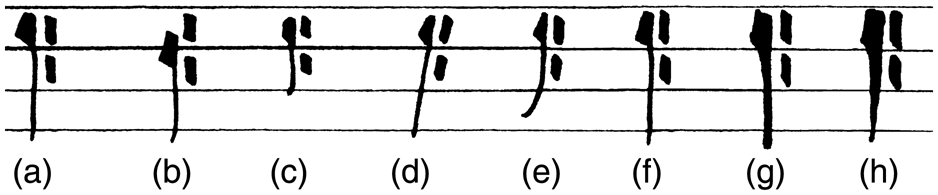
The F-clef can have one serif on the left of the stem (Example 1a), or sometimes two (Example 1b), or more rarely none at all. Notators tended to be consistent in the number of serifs they drew, and also in their positioning of these serifs: two serifs are usually positioned on either side of the F-line (Example 1b); a single serif may be positioned in the G-space (Example 1a), with the F-line running through the centre of the serif (Example 1c), sitting on the F-line (Example 1d), or more rarely in another position. Serifs may be perpendicular to the stem (Example 1d), or may be oblique (Examples 1a, 1b and 1c). Sometimes it is possible to discern whether the serif was drawn in a distinct pen movement from the downwards stem, that is, in two strokes (Example 1e), or whether the serif and stem were drawn in one continuous movement of the pen (Example 1f). The length of the serif (and thus also its shape) can vary widely within each notator's normal practice, particularly with regard to the oblique serifs; this feature of the serif is therefore not useful for comparison.
Serifs on F-clefs.

A further form of differentiation can be established with regard to the strokes drawn to the right of the stem. Indeed, each notator tended to draw such strokes in one of three different manners: curved (Example 2a), oblique (Example 2b), or parallel to the stave lines (Example 2c). Curved strokes have less definition on the upper right corner, and they often descend into a hairline stroke. Most strokes are centred within the spaces on either side of the F-line (Example 2d), but some notators resisted this trend; for example, by placing the lowest stroke on the F-line instead of in the E-space (Example 2e), or by drawing strokes very close to the F-line (Example 2f).
Strokes on F-clefs.

The stem itself can also prove useful in attempting to distinguish notators. It is quite common for the stem to descend the full length of the stave (Example 3a). There were notators who drew shorter stems, however, for example beginning at the F-line (Example 3b), or stopping before the B-line (Example 3c). Further, though the F-clef stem is often perpendicular to the stave, some notators had a preference for an F-clef that tilts forward (Example 3d), or for a tail that curves as it descends (Example 3e). The thickness of the stem is less helpful as an indicator: it is more difficult to analyse visually because the minute dimensions make measurements and comparisons difficult. In addition, the thickness of the stem can vary within the F-clefs of a given notator, according to the angle at which the pen was held; even a slight change in angle can make a noticeable difference in the thickness of the stroke and thus these features do not necessarily indicate a different hand. Nonetheless, some notators were relatively consistent in the thickness of their F-clef stems, which could be thin (Example 3f), thicker (Example 3g) or tapering downwards (Example 3h).
Stems on F-clefs.
One final feature helpful for differentiating notators is the position of the F-clef in relation to the stave. While typically the clef is found on the stave (Example 4a) – perhaps between the double bounding lines of the page rulings, if present – the F-clef could also be drawn before the stave, sometimes with the strokes of the clef drawn on the stave itself (Example 4b). This reflects varying practices in the positioning of the clef in different locations and traditions. In the twelfth century in Italian and Aquitanian traditions, and in notations which used a dry-point clef (perhaps with one or more coloured lines), it was normal for the clef to sit in the space before the start of the stave. In England, the clef tended to be placed immediately before the stave, often contiguous to it. Over the course of the thirteenth century, across notations which used a four-line stave, it became common for the clef to be placed on the stave itself.Footnote 12 When such manuscripts were ruled with double bounding lines, the clef may sit between these two lines. Of course, not all manuscripts had carefully ruled staves: in some, the starting point of each stave-line varied from stave to stave and line to line, and the placement of the clef was not always consistent.
Position of F-clefs.

Overall, the degree of complexity in the form of the F-clef makes it particularly useful to the task of differentiating notating hands. Since the serifs, strokes and stem can each be drawn in various directions and positions, the permutations are numerous and the opportunity for individuality is great. This makes the F-clef a first point of call for identifying and distinguishing hands.
Custodes
Perhaps the next most informative aspect of notation for differentiating between scribes is the custos, a sign placed at the end of a stave to indicate the first pitch of the following stave. The main caveat is that not all notators and traditions used a custos, and sometimes custodes were inserted by a mixture of later hands, presumably users of the book. However, where a custos can be seen to have been inserted in a consistent manner, it was very likely to have been drawn as part of the original book production, by the same person that copied the notation. Custodes can take a variety of different forms: in thirteenth-century Dominican manuscripts, it is usually in the shape of a tick (Example 5a); other forms outside the Dominican tradition include a downward longa (Example 5b) and a form somewhat resembling a sideways two or tilde (Example 5c), among others.
Custos shape.

There were a variety of ways in which the ‘tick’ form of the custos could be drawn, making some notators’ custodes distinctive or at least distinguishable. The most obvious features of the custos are the size and angle of its tail. The angle varies anywhere from 0° to circa 80° from the vertical axis (Examples 6a and 6b, respectively), and the note head is usually perpendicular to the tail. The tail itself can range from a short stub (Example 6c) to a long extravagant sweep (Example 6d). Depending on the notator, the tail of the custos might be very regular or rather less consistent. Even when the form is less consistent, it is still possible to determine the type of custos that a given notator tended to use: variation within a certain range can be a defining characteristic which distinguishes one notator from another.
Custos size and angle.

A close examination of the manuscript page can also reveal the ductus of the custos, that is, the order and direction of the pen strokes. The direction of the pen movement can be identified by the trailing off of the ink, or by overlapping strokes at the juncture implying that the pen has been lifted. The custos could have been drawn in two separate pen movements, with the pen lifted between the note head and tail (Example 7a), following the norms of gothic textual script, in which angled strokes were drawn in a downwards direction. However, there also appear to be cases where notators did not follow the typical stroke direction and instead drew the tail of the custos upwards, as evidenced by the trailing off of ink towards the upper end of the tail. This would have been easiest to perform when the angle of the tail approached the horizontal axis, and could be achieved in two conjoint strokes, with the pen changing direction at the juncture between the note head and tail (Example 7b), or in one continuous sweep (Example 7c). Consequently, custodes with roughly the same form (e.g., angle, size) may have been produced in three different ways, and since notators tended to stick to the same pen movements, this difference gives a further means by which similar-looking hands may be distinguished.
Ductus of custodes.

Liquescence
Liquescence is a form of articulation from one syllable to the next, in which the final sound of the first syllable is semi-vocalised. This particularly occurs on diphthongs and liquid or nasal consonants (l, r, m and n), and more rarely on d, t and s. In square chant notation, liquescence is typically shown by adding an extra tail, upwards if the liquescent pitch is above the preceding pitch and downwards if the liquescent pitch is below. The following discussion refers to the two-note liquescent neumes where the second pitch is semi-vocalised (i.e., the rising epiphonus and descending cephalicus), but the same principles usually apply to liquescent forms of longer neumes. The rarity of liquescent note forms, especially of the ascending variety (epiphoni), makes them less useful for the purposes of identification. However, their forms can be quite distinctive, so if they are present, they can play a role in differentiating between notators.
Notes which have a liquescent pitch below that of the main note (cephalici) have a downward stem and tail enclosing a note head in the centre. Where this is a descent by step, there are three principal forms in Dominican manuscripts: the main note is square/rectangular and parallel to the stave lines, with a hairline tail descending vertically (Example 8a); the main note is a downward oblique stroke often with some degree of definition on the upper right corner, from which the hairline tail descends (Example 8b); or the stroke of the main note curves downwards, with the tail tapering away and sometimes curling under the main note (Example 8c). Some notators use both square and oblique or, alternatively, curved and oblique forms of the cephalicus neume. The lengths of the stems and tails also appear to vary considerably within the work of certain individuals.
Descending liquescence (cephalicus).

When the interval between the two pitches descends by more than a step, the pitch of the liquescent note is often given. Notators of the square cephalicus often drew a small rectangular stroke for the lower pitch (Example 9a). The tail of the curved cephalicus may culminate in a circular form (Example 9b), or a short oblique stroke (Examples 9d), which was also used with oblique forms (Example 9c). Some notators placed this liquescent pitch on the left of the tail, that is, under the main note head (Examples 9b, 9c and 9d), whereas others placed it to the right of the tail (Example 9a). It should also be mentioned that some notators did not indicate the pitch of the lower note, drawing the same form as for a descent by step (Example 9e). Since Example 9e is indistinguishable from Examples 8a, it only becomes apparent that a notator used this form for descents of a third when one knows that a given liquescent would normally be pitched at an interval wider than a second.
Liquescence descending by a third or more.

In an ascending liquescence (epiphonus), the main note can similarly be square (Example 10a), an oblique stroke (Example 10b), or a curved stroke (Example 10c). This form has at least one upwards stem/tail (Examples 10e or 10f) and often two (Example 10d). The stem(s) may take the form of a stub-like hairline extension (Example 10g). In certain Sarum manuscripts, the epiphonus takes on a more cursive form, resembling the shape found in earlier forms of notation (Example 10h).Footnote 13 The ductus can often be discerned: the tail could have been drawn in a continuous movement of the pen from the note head upwards (Examples 10c and 10i), or the notator could have lifted the pen and drawn the tail downwards, sometimes leaving a tell-tale hairline extension at the juncture (Example 10j). There is often some degree of variation in the form of the epiphonus within the work of individual notators, presumably because the symbol was so rarely used that notators did not develop a stable, regular manner of executing it (whereas the more common cephalicus form seems to vary less within each notator's repertoire, at least in the manuscripts I have studied).
Ascending liquescence (epiphonus).

Neumes
Although the variety of note forms makes them less straightforward to analyse, neumes or ligatures encompassing several notes can provide a trove of information regarding the basic preferences of individual notators. The drawback in considering neumes and ligatures is that extended melismas with several grouped notes are not always present in the chant. Such melodic flourishes are infrequent, for example, in the notated formulae for psalm tones, and even in more melodic passages, such as psalm antiphons, where the chant is syllabic. Neumes therefore cannot always be relied upon for the identification of notational hands.
Assuming that passages with extended groups of notes are available, however, one of the main features that can distinguish the work of one notator from another is the form of the scandicus flexus, that is, any four-note group with the melodic contour low–high–higher–low. Certain notators always joined up these four notes, creating one single form of four consecutive note heads linked by stems at their closest corners (Example 11a). Other notators, however, split the four pitches into two forms: a pes (two ligated pitches with the pattern low–high) and a clivis (two ligated pitches with the pattern high–low) (Example 11b). In Dominican manuscripts of the thirteenth century, it was rare for a single notator to write the pattern in both of these two ways. Furthermore, notators who drew these four notes in one interconnected shape tended to also draw extended note groups in ‘compound neumes’ built up of several note heads (and oblique strokes) joined together by stems (e.g., Example 11c). Similarly, notators who preferred to separate the group into a pes and clivis tended to show a preference for using shorter two- or three-note neumes in general and such notators only drew shapes of four or more notes for the torculus resupinus (low–high–low–high) and for neumes containing diamond-shaped puncta (Example 11d).
Note groupings.

The shape of specific neumes can sometimes also be used to distinguish the work of an individual notator. Most Dominican notators used the same basic forms for their neumes, as shown in Example 12. However, occasionally a notator had an idiosyncratic manner of drawing one neume or another. For example, the highest pitch of a pes subbipunctus (low–high–low–lower) is normally drawn as a square note head (Example 12f). However, the main notator in the Dominican exemplar used in Spain (Salamanca, San Esteban, SAL.-CL.01) had no qualms beginning the descent with an oblique stroke resembling a rhomboid (Example 13a). Changes are not necessarily always so dramatic: in drawing the scandicus (three rising notes), for example, the main notator of Sabina L1 (discussed in detail later) preferred to draw the middle note head as a downward oblique stroke (Example 13b). The scandicus itself was sometimes drawn consisting of a punctum and a pes (Example 12a), and sometimes with a pes followed by a virga (Example 12b). Certain notators appear to have preferred one form of the scandicus, although both forms seem to have been used by most notators. Overall, it can be helpful to examine several examples of the notation in order to become familiar with the standard neume shapes, and thus detect where one notator had an idiosyncratic preference.
Typical neume forms in Dominican notation, a and b: scandicus; c: climacus; d: porrectus; e: torculus; f: pes subbipunctis.

Unusual neume forms.

C-clef
Most C-clefs were drawn in a fairly similar manner and there tends to be considerable variation within the work of individual notators, making it sometimes difficult or fruitless to attempt to pin down a mannerism or to distinguish hands by C-clefs alone. In particular, the extent of curvature in the upper and lower strokes of the C-clef can vary a great deal within a single notator's hand – for instance, Examples 14a and 14b could easily be the work of a single notator even though the shapes are quite different. However, occasionally a notator had a distinctive style of C-clef that can be used profitably for distinguishing the work of different scribes. For example, certain notators may have been consistent in drawing oblique or curved strokes or a combination of the two (e.g., Examples 14a, 14b). In addition, these strokes may reveal other conspicuous writing habits: strokes may be angled in a certain direction (compare Examples 14b and 14c); one stroke may be longer than the other (Example 14d); the clef may be tilted (Example 14e); the strokes may be notably close together forming a compartment, or far apart (Examples 14f or 14g); or the clef may be more rounded, resembling the letter form (Example 14h).
C-clefs.

Accidentals
Some notators made distinctive choices in the shape of their accidentals. However, like custodes, accidentals were often added by later users of books, in which case they are irrelevant to the task of differentiating the work of the original notators. Nonetheless, where accidentals were drawn in a regular, consistent fashion, it can be presumed that they were probably the work of one person, most likely the notator who executed the notes themselves.
Accidentals.

There are two common forms of the mi sign that were used to cancel flats: one shaped like a modern sharp sign (Example 15a) and the other shaped like a natural sign (Example 15b). No notators that I have examined used both natural and sharp shapes. More rarely, an h-shaped sign was used (Example 15c), sometimes in conjunction with the natural shape. The form of the mi sign is a simple means to distinguish the work of individual notators, but with only three possible variants it cannot be the sole feature by which a notator is defined. The flat or fa sign usually has either an upright stem and lobe (Example 15d) or takes an oblique form (Example 15e), but since many notators used both forms, the fa sign is not a particularly helpful feature unless the notator was consistent. The size of the accidentals can also be distinctive: fa signs often cover two stave-spaces and mi signs three (Example 15f), but certain notators drew the accidentals in a distinctive manner by writing the sign within a single space of the staff (Example 15g).
Hairline extensions
Hairline extensions (small protrusions extending from neume forms) can be found both on single notes and on multi-note neumes at the junctures between notes and stems, such as the pes (Example 16d). Hairlines are occasionally also present on certain clefs. A hairline extension in the form of a tail on a single note head can transform it from a punctum to a virga. In earlier, particularly adiastematic, notations, the virga (Example 16a) and punctum (Example 16b) were employed to clarify the pitch relationship of single notes, with higher pitches indicated by virgae, and lower pitches by puncta; in polyphonic notation the same forms came to have a rhythmic significance, indicating a long and breve, respectively. However, in many square chant notation contexts (where pitch is indicated by the position on the stave) notators did not differentiate between the virga and punctum, instead using both interchangeably without any correlation to pitch or rhythm.Footnote 14 For this reason, I use virga and punctum to indicate the shapes drawn (respectively with and without a tail) without implying any pitch signification. Some notators gave the virga a deliberately long tail (Example 16b), while others drew a less prominent, shorter tail or a hairline extension (Example 16c).
Hairline extensions.

Some notators had their own peculiarities in forming the note heads, a fact which left its mark in the form of hairline extensions. For example, some placed a line at the end of the punctum with hairline extensions protruding from the note head (Example 16e), while others went further, tracing lines on both sides of the punctum, leaving four tell-tale hairline extensions (Example 16f). This would appear to be a very laborious manner of writing notation, and may perhaps be an attribute of a music scribe who was not practised at copying notation for long periods of time.
Aspect: quality of presentation
Finally, the quality of the presentation is perhaps the most elusive element of the notation to pin down, since quality cannot be determined by a single characteristic. Nonetheless, the aspect or overall impression of the page can give an idea about the notator and his or her working habits. It can be useful to observe whether vertical lines are actually vertical and parallel to one another; whether there is a tilt to the general axis of the notation (leaning to the left or more commonly right); whether the notator had a conspicuous mannerism in drawing note heads – long, short, concave and so on; and whether there is a regularity to the notation, or whether the aspect is more ‘higgledy-piggledy’ in form.
Identifying square chant notators in practice
To put this abstract list of notational characteristics into context, I will analyse the music hands in the principal chant books of one of the ‘exemplar’ manuscripts of the Dominican liturgy, Sabina L1.Footnote 15 Several exemplars, or authoritative books, were issued shortly after a revised version of the Dominican liturgy was approved in 1256. Each exemplar was a compendium of fourteen individual books required for various aspects of liturgical celebration, including an antiphoner, a gradual, a processional and a pulpitarium – a book particular to the Dominican order containing the solo portions of chant sung by a cantor or cantors at the pulpit.Footnote 16 Although I have identified at least six individual notators working across the fourteen books of Sabina L1, palaeographic analysis of the notation demonstrates that these four chant books have one main notator in common. Figure 2 shows the main notator's work in context, and Table 2 isolates the individual forms discussed.
Main chant notator, Sabina L1 fol. 234r.

Characteristics of identified notators

The notator of the chant books drew F-clefs with a single oblique serif that is placed on the F-line, two curved strokes and a stem that spans the full stave (see Figure 2, left column, first six staves). Custodes were drawn in two strokes, sometimes leaving a small hairline extension at the juncture between the note head and tail. Although the tail changes from being close to vertical to slightly more tilted from the second stave of fol. 234r onwards (see Figure 2), it seems that this is nonetheless the work of a single notator, given the consistency that can be observed across all other features of the notation.Footnote 17 The cephalicus has a curved note head and relatively short tail (see Figure 2, left column, first stave, over ‘montem’). When the liquescent note is greater than a step below, this is indicated by a rounded form to the left of the tail – under the main note head. The epiphonus has a curved note head, and the stem and tail are of approximately equal height (see Table 2). In terms of neumes, extended groups of notes tend to be notated in several two- or three-note groups; however, the four-note scandicus flexus was also used. The scandicus is distinctive: the middle note head was often drawn obliquely downwards, and the upper note often sits slightly to the right, rather than vertically above the middle note (e.g., Figure 2, left column, fourth stave, over ‘odoris’). The C-clef is not noteworthy since it is fairly variable and takes the same form drawn by several other notators: the upper stroke is usually oblique, and the lower stroke curls upwards (e.g., Figure 2, left column, final four staves). The fa sign is quite narrow, relatively short (under two spaces high), drawn with a thin nib throughout and the lobe is usually open. The mi sign is quite small, usually in the form of an ‘h’ or ‘natural’ (both accidentals can be seen in Figure 2, right column, final stave). Other than single notes, most note heads do not display hairline extensions. Overall, the notation tilts slightly to the right, and the irregular appearance of the vertical lines dividing phrases makes the page seem messy.
Despite the presence of at least six notators working across this 500-folio manuscript, it is significant that the copying of the principal chant books – the antiphoner (fols. 231r–323r), the gradual (fols. 323r–369r), the pulpitarium (fols. 370r–392r), and the processional (fols. 60v–65v) – was all entrusted to a single notator, who also completed the tonary which prefaces the psalter (fols. 66r–70v). The work of notating the remaining books, such as supplying the modus legendi in the three lectionaries, would have been far less onerous. That the vast majority of this manuscript was notated by a single person suggests that this notator was chosen specifically for the task, perhaps because he was a chant specialist and/or a highly skilled notator. Leaving all the work to one main scribe may also suggest that time pressure was not a factor (since it would have been quicker to have the chant books copied simultaneously by separate notators).
In addition to the main chant notator, a second hand can be seen intervening on a select number of folios across the chant books: on fol. 320r of the antiphoner, fols. 352v, 366r–v, 367r and 369r of the gradual, and fols. 370r, 374r, 377r, 380v, 383v and 384r of the pulpitarium.Footnote 18 This notator's work can be distinguished by the F- and C-clefs, custodes and shapes of certain neumes (see Figure 3 and Table 2). The F-clef is short (the thin stem spans the G-space to the C-space), it often tilts slightly forward, and its serif and strokes are all slightly descending oblique strokes, with the serif on the F-line and the strokes close to the F-line (Figure 3, final stave). The C-clef is recognisable by its elongated, straight upper stroke (Figure 3, penultimate stave). Both clefs sit before or at the beginning of the stave. The custos is very distinctive with a short hairline extension on the upper left side of the note head. The epiphonus takes a similar form to the custos; the cephalicus is usually oblique in form, with a marked change of direction in the upper right corner (see Table 2). This second notator was happy to create compound neumes. The first note head in descending two-note groups, such as the clivis, is often angled downwards; however, it does not slope into the descending stem, indeed the change of direction is marked – sometimes with a hairline extension (see Figure 3, final stave, over ‘dei’). Overall, the notation presents quite a rigid impression on account of many hairline extensions and sharp angled corners. The note heads are small and boxy, the vertical lines often tilt and they are not always straight.
‘Overseer’, Sabina L1 fol. 377r (whose work starts from ‘Petre amas me’, third stave on left and extends into lower margin).

This second notator appears to have had the role of a corrector or overseer, and indeed he may have served in an editorial capacity throughout the manuscript, for he can be seen intervening across the antiphoner, gradual, pulpitarium, collectar, missal and Gospel lectionary. He provided numerous marginal additions (supplying passages unintentionally omitted by the original notator) as well as longer items within the text proper, which presumably the main chant notator had been unable to supply, perhaps owing to a lack of a suitable model. The exemplar was intended to be a manuscript against which other liturgical books were meant to be checked in order to guarantee uniformity of liturgical practice across the order. Consequently, the fact that someone was entrusted with ensuring that Sabina L1 was correct and complete is not surprising. In some cases, the lack of certain items from the main notator's work may be due to individual fallibility (e.g., Figure 3 may well be a case of eye skipping, for it appears that material has been erased on the original final two staves of the column). However, other omissions may shed light on the material that the main notator had (or did not have) available to copy from: this could well be the case on fol. 366r–v, where within the writing frame (and with no change of text hand) the overseer supplied the notation for the sequence for the feast of St Augustine, on staves that had presumably been left blank by the main notator. Little is known about how the Dominican liturgical revision was put together – what exemplar was used to create Sabina L1 – but this evidence of initial omissions may provide some clues as to the process of assembling the liturgical material to create the authorised form of the Dominican liturgy.
A further corrector can perhaps be seen working in the margin of fol. 377v of the Pulpitarium, adding a missing Responsory for the Office of St Lawrence (Figure 4). His distinctively short F-clef cannot be easily matched with other notators in the manuscript. Folio 377v is the only place in which his work appears, perhaps an indication that he was instead an early user of the manuscript, inserting a missing portion of chant. Without a larger sample of text it is difficult to be certain, but it would appear that the text hand was likewise not one of the twelve main text scribes of the manuscript.Footnote 19
Second corrector, Sabina L1, fol. 377v.

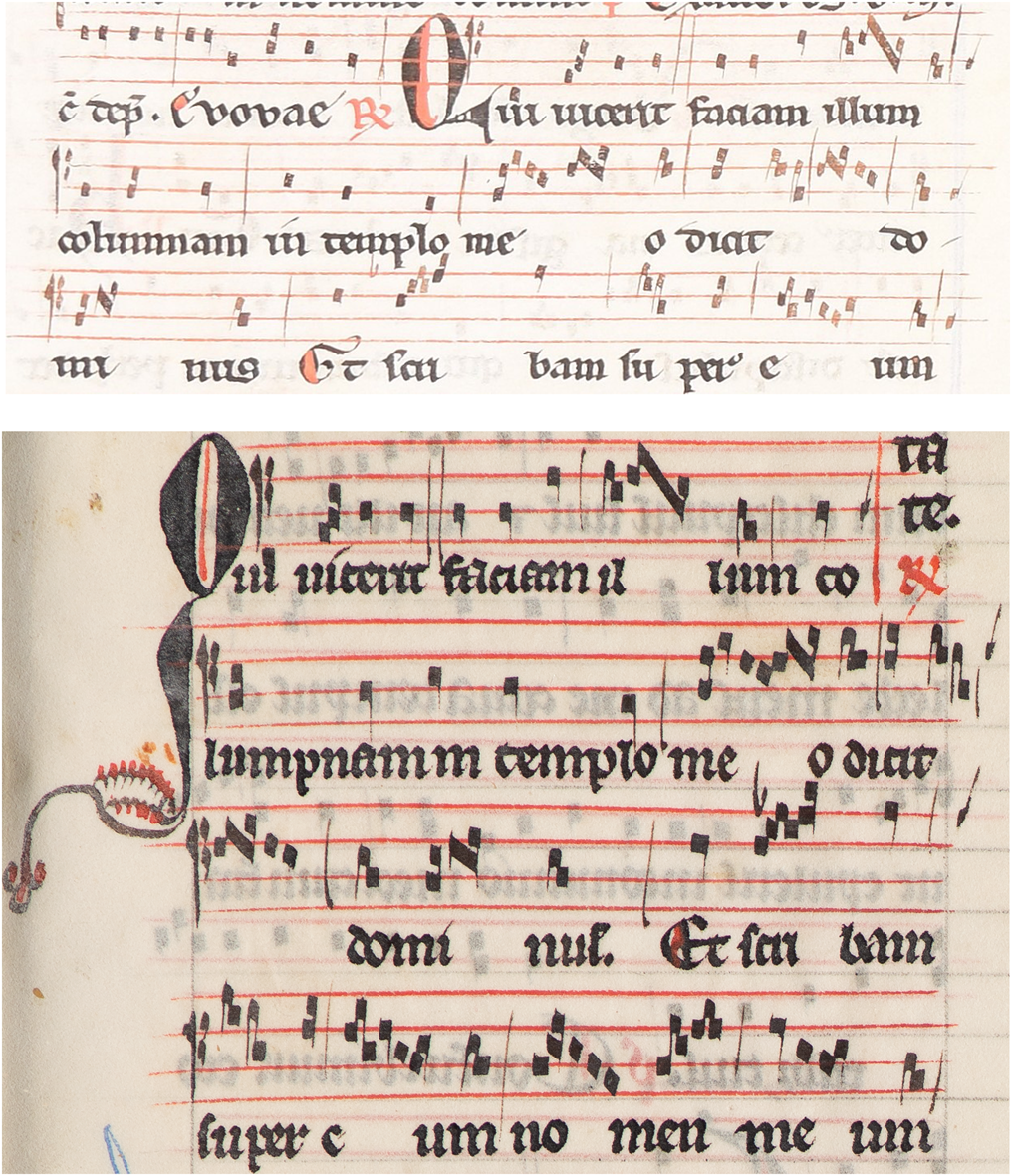
It is possible that part of another Dominican manuscript, Paris, Bibliothèque de l'Arsenal 193–194, was also notated by the main chant notator of Sabina L1. Within this two-volume notated winter breviary, copied in Paris perhaps in the third quarter of the thirteenth century, the psalter, sanctoral, common of saints and temporal were each copied by a different notator, all of whom display similar features to the exemplar's main chant notator. The four notators of Arsenal 193–194 and the main Sabina L1 notator all use an F-clef with a single oblique serif on the F-line and two curved strokes, a curved descending liquescence with the liquescent pitch placed under the main note head, and a manner of drawing the scandicus in which the middle note was often angled downwards. The sanctoral in particular (fols. 56–129 of Arsenal 193) seems to have the same messy, uneven aspect to the notation as that of the main notator of Sabina L1 (see Figure 5). Consequently, it is distinctly possible that the same notator copied this part of the Dominican breviary as well as the chant books of the Dominican exemplar (Sabina L1). If so, he would have copied the same material in Sabina L1 and Arsenal 193, although of course the material he copied in Sabina L1 was far more extensive, copying not only the sanctoral office chants but also the other office chants, the Mass chants and the solo portions of chant in the Pulpitarium. Either way, it would appear that the four notators of Arsenal 193–194 and the main chant notator of Sabina L1 worked in close company with one another, influenced each other's styles, and all were engaged in the copying of Dominican books. It may be the case that they had all received the same training and/or trained one another. For the production of Sabina L1 and Arsenal 193–194, they may been working within the same writing space, likely a room within the priory of St Jacques that was set apart from the Dominican friars and supervised by an overseer of scribes.Footnote 20
Perhaps the same notator in Sabina L1 (above) and Arsenal 193 (below).
Concluding thoughts
The palaeographical study of square chant notation can be challenging because of the script's high degree of regularity, appearing uniform and perhaps even unremarkable at first glance. Nevertheless, a holistic consideration of square chant notation can reveal idiosyncratic characteristics within the notation. Focusing on elements of the notation other than the standard neume forms can be particularly helpful for identifying individual notators. In addition to their form, the ductus, relative size and position of elements such as accidentals, custodes and clefs can be quite revealing. For this reason, it is useful to consider square chant notation in relation to the stave, in order to gauge their size, proportions and position, rather than to study note shapes in the abstract.
The preceding features can be found in square notations from a variety of periods and locations, and so while this study has focused on thirteenth-century Dominican books, the methodology may provide a useful, practical starting point for approaching the palaeography of any sample of square notation, be it chant, song or polyphony. To advance this field of study further, it would be worth establishing the extent to which notators of other repertoires display conspicuous writing habits at these same key points, and/or whether there may be other factors that can aid in distinguishing between individuals, thus adding to the toolbox available to those of us working with music copied in square notation.
The value of studying individual notators in this way is that it allows us to understand more fully how the music was handled in the process of book-copying. For example, the books studied here were produced within the milieu of the thriving Parisian book trade, and yet the work of notators at this time in Paris was not documented. Through palaeographical study, it is possible to identify a significant number of notators active in Paris around 1260. Beyond simply distinguishing individual notators, close observation of scribal habits reveals the values of those Dominicans for whom the books were produced (emphasising uniformity and correctness), uncovers part of the process behind assembling the revised liturgy, identifies the different roles that were assigned to individual notators, and points to a network of notators working on similar Dominican manuscripts and influencing each other's styles. Despite its seemingly impenetrable uniformity, square notation, when examined in this manner, has the potential to provide a wealth of further contextual information about the books in which it was employed. Further palaeographical study of square notation in this and other contexts has a great deal to offer those interested in better understanding the preservation and dissemination of chant and music during the period.


 Open access

