

First discovered in 1976,Reference Johnson, Webb and Lange 1 Ebola virus disease (EVD) is caused by a virus in the Filoviridae familyReference Kiley, Bowen and Eddy 2 that attacks the organs of the body, often causing hemorrhaging. 3 Although the natural reservoir host is not known for certain, researchers postulate that an outbreak begins when a person comes into contact with an infected animal, typically primates or fruit bats, and thus becomes infected. 4 EVD is transmitted through blood or bodily fluids, contaminated objects, and infected primates or fruit bats. 4 The incubation period ranges from 2 to 21 days, with initial symptoms that mirror those of influenza. 4 The virus can be transmitted anytime during the incubation period and thereafter, including through deceased bodies. This virus has the potential to spread rapidly. Since its initial outbreak decades ago, other cases have been reported over time,Reference Georges, Leroy and Renaut 5 , Reference Okware, Omaswa and Zaramba 6 but the recent outbreak in 2014–2015 has been the largest and longest lasting to date.Reference Nyenswah, Fahnbulleh and Massaquoi 7 In countries with widespread transmission, as of January 23, 2015, there were 21,797 cases (13,602 laboratory confirmed) and 8675 deaths. 8
Media coverage about the outbreak has been extensive, but there is a paucity of research related to the content of the information contained in this coverage. Our recent cross-sectional study examined print coverage from the 3 most popular newspapers in the United States.Reference Basch, Basch and Redlener 9 The most popular topics were cases in the United States and Africa, but information was lacking about precautionary measures.Reference Basch, Basch and Redlener 9 Public concern mounts during times of crisis, and the recent EVD outbreak has been no exception. A recent poll in the United States ranked Ebola among the top 3 health care concerns of citizens.Reference Saad 10
Media has an important role to play in education about public health in general and in times of public health crisis in particular. Social and mobile media are critical communication channels for increasing awareness and interest among various population segments. A 2011 study indicated that 71% of online adults use sites that have a video-sharing platform like YouTubeReference Moore 11 (YouTube, LLC, San Bruno, CA), and video sharing is increasing.Reference Duggan 12 However, there are large gaps in our understanding of the ways in which widely accessed social media sites are used during times of public health crisis. In the present study, therefore, we identified the 100 most widely viewed videos about EVD on YouTube and coded their source, content, and characteristics.
METHODS
Ebola was used as the keyword in the search term. Videos were sorted by popularity and then screened for relevance. A total of 180 videos were viewed to yield the goal of 100. Videos in a language other than English were excluded (n=31). Another 49 were excluded for irrelevant content such as a song containing the word Ebola.
Two authors (CHB and RH) sampled 10 EVD videos by convenience, which were used to inductively generate content coverage categories. Adding categories for the source, length, and date uploaded further developed the coding instrument, which was pilot tested by the 2 authors with 10 additional videos. The same authors independently coded all 100 videos. Interrater reliability for coding of content coverage categories was demonstrated by using Cohen’s kappa and was found to be 0.98.
The first step in coding was to identify the source of the video. “Consumer videos” were defined as those posted by an individual with no professional credentials or established organizational affiliation. Conversely, “professional videos” were defined as those posted by either an individual with professional credentials or established organizational affiliations such as a nonprofit or health organization. “Network television” was defined as clips uploaded from shows on network television that were not news based but were largely entertainment based. “Television-based news clips” were from a broadcast television network. “Internet-based news” was any news clip created specifically from an Internet-based site. The “government” category was any video uploaded by a government agency. The “print or radio” category included those videos created by a traditional radio or print outlet.
The following descriptive information was gathered for each video: source, year uploaded, length, and total number of views as of December 9, 2014. Content categories were created and coded dichotomously (yes or no): general and specific modes of disease transmission; death toll in West Africa; number of cases in West Africa; quarantine; anxiety of EVD infection; public fear; comedy skit/parody; danger for health care personnel; conspiracy theory; need for medical help and resources in West Africa; EVD pranking; need for international cooperation; EVD is a hoax; treatment; need for financial aid in West Africa; need for training of heath care personnel; the United States is not prepared; need for the United States to allocate more funds to domestic disaster preparedness; need for coordination between local, state, and federal governments; and number of beds in the United States ready for containment. Descriptive analyses of the video and content characteristics were performed in Matlab version R2012b. These analyses included calculating frequencies and percentages, means and standard deviations, Kruskal-Wallis one way analysis of variance analyses, and 95% confidence intervals (CIs). This study was determined not to be human subjects research by the institutional review board at William Paterson University.
RESULTS
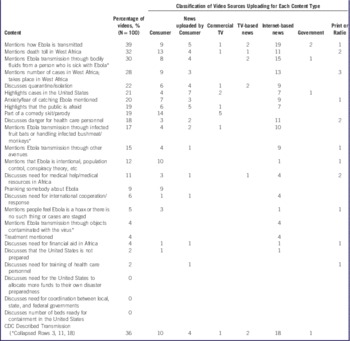
Over one-third of the videos mentioned how EVD was generally transmitted (39%), with 30% mentioning bodily fluids; 17% mentioning infected fruit bats, monkeys, or handling infected bushmeat; 15% mentioning transmission through other avenues such as a deceased body; and 4% mentioning transmission through objects (Table 1). The death toll in West Africa was mentioned in 32% of the videos. Cases in the United States (21%), fear (19%), and anxiety (20%) were highlighted in about one-fifth of the videos, whereas 19% were comedy skits, and a smaller percentage were about a conspiracy theory (12%) or hoax (5%). There was little mention of treatment (4%) and no mention of the need for US funding of disaster preparedness; coordination between local, state, and federal governments; or beds ready for containment.
Percentage of 100 Most Widely Viewed Ebola YouTube Videos by Content Coverage

To assess the quality of information in the videos, we focused specifically on those that addressed transmission details consistent with information released by the Centers for Disease Control and Prevention (CDC). The CDC specifically states that the virus can be spread to others through direct contact with (1) blood or body fluids of a person sick with Ebola, (2) objects that have been contaminated with the virus, or (3) infected fruit bats or primates. 4 Table 1 shows the classification of video sources uploading videos containing each information type. We collapsed information categories related to each of the 3 CDC-described transmission modes (rows 3, 11, and 18, indicated by *) and found that 36% of the videos mentioned accurate transmission information, the majority of which came from Internet-based news (18 videos) and consumer (10 videos) sources.
The 100 videos, 90 of which were uploaded in 2014, were viewed more than 73 million times (range: 146,528 to 6,107,978 views). There were 48 consumer videos, with the next largest source being Internet-based news (29%). Descriptive statistics identified no significant differences in view number between video source type with the exception of a significantly higher number of views for consumer videos (854,627.8; 95% CI: 494,517.0-1,214,738.6) than for commercial television videos (363,648.2; 95% CI: 262,471.2-464,825.2) (Table 2). Nonparametric analysis of view number across video source type found no significant differences (Kruskal-Wallis p=0.9701).
Length and Number of Views of 70 Popular Ebola Videos Posted on YouTubeFootnote a

a Abbreviation: CI, confidence interval.
The mean length of the videos was approximately 8 minutes (range, 0.1 to 49.5 minutes). Television-based news was found to have a significantly lower video mean duration (1.5 minutes; 95% CI: 1.0-2.0) compared with consumer videos (5.8 minutes; 95% CI: 4.6-6.9), news clips uploaded by a consumer (14.1 minutes, 95% CI: 2.3-25.9), and Internet-based news videos (9.0 minutes; 95% CI: 5.0-13.0). Although there were descriptive differences in video length across source types, nonparametric analysis found no significant differences in video length on the basis of video source (Kruskal-Wallis P=0.1663).
DISCUSSION
The videos in our study were viewed more than 73 million times, most of which occurred in 2014. The wide variety of topics on EVD warrants mention. Video content ranged from providing information about transmission to messages that EVD was a conspiracy. It is noteworthy that the number of views was significantly higher for consumer videos than for commercial television videos. To the extent that public health professionals are aware of the nature and content of messages being so widely viewed, rebuttal videos or further educational content can be created to clarify misconceptions. Very few of the most widely viewed videos were related to the response to EVD and what was needed. This could be a medium for outlining ways in which stakeholders could help those in need.
Only 2 of the videos included in this sample of popular videos were uploaded from a government source (one was ranked 14th most popular and the other was ranked 76th). Government agencies such as the CDC have embraced social media in recent years. Future efforts could be spent on creating social media communications that are widely viewed and using strategies that appeal to the masses, such YouTube videos, to increase awareness and interest about public health issues and to safeguard and promote the nation’s health. Social media channels may also be useful for educating the public about ways to bolster preparedness in the nation and globally.
The limitations of this study include the cross-sectional design, the inclusion of only videos in English, and the absence of further information on the viewers. Knowing the country of origin and including videos in other languages would be important in understanding whether different countries had different messages. In addition, we did not ascertain the validity of message content. Nevertheless, this study begins to fill a gap in current knowledge. With 1 billion unique users a month, YouTube clearly has potential to reach a vast audience. 13
Naturally, with this magnitude of reach there are possibilities for both enhancing education as well as spreading misinformation and contributing to hysteria. Sandman and Covello highlight obstacles to risk communication effectiveness.Reference Covello and Sandman 14 Among these obstacles are complex and incomplete information, distrust of the source, selective reporting by the media, factors that influence processing of risk information, insistence for scientific certainty, discounting contradictory beliefs, and how the magnitude of risk is judged.Reference Covello and Sandman 14 To the extent that these obstacles can be addressed through thoughtful, formative research when providing information to the public about emergent health issues like the EVD outbreak, this could lead to a clearer perception of what one’s level of risk is and adequate measures to take in limiting these risks.