





Introduction
The recruitment of study participants by general practitioners (GPs) is a general concern in primary care research because of time constraints, lack of staff and training. In addition, GPs worry about the impact on their relationship with the patient for participation in research and withhold from engaging in recruiting patients for research (Ross et al. Reference Ross, Grant, Counsell, Gillespie, Russell and Prescott1999; van der Windt et al. Reference van der Windt, Koes, van Aarst, Heemskerk and Bouter2000; Yallop et al. Reference Yallop, McAvoy, Croucher, Tonkin and Piterman2006; van der Wouden et al. Reference van der Wouden, Blankenstein, Huibers, van der Windt, Stalman and Verhagen2007; van den Brink et al. Reference van den Brink, Hummel, Lemstra, Berger, Dekker and Blanker2020). Participating GPs often fail in recruiting patients due to low relative incidence of the disease of the study, forgetfulness or time investment (van der Windt et al. Reference van der Windt, Koes, van Aarst, Heemskerk and Bouter2000; van den Brink et al. Reference van den Brink, Hummel, Lemstra, Berger, Dekker and Blanker2020). However, once patients are identified, the next hurdle is the inclusion of the patients themselves. The process of including children as participants in clinical research is especially challenging because informed consent from both parents is needed (Nelson et al. Reference Nelson, Skinner, Guarda, Choudhury, Sideris, Barnum, Ten Haagen, Heyward and Bailey2013). Other factors influencing participation of children and adolescents are the sociodemographic status of the parents, severity of the disease, the study’s characteristics, expectations, and benefits of the intervention studied (Bencheva et al. Reference Bencheva, Mann, Rombey, Pieper and Schmiedl2024).
Poor recruitment leads to extended periods of data collection in more than half of the studies (van der Wouden et al. Reference van der Wouden, Blankenstein, Huibers, van der Windt, Stalman and Verhagen2007), and discontinuation in 11% of randomized controlled trials (RCTs) involving patients (Kasenda et al. Reference Kasenda, von Elm, You, Blümle, Tomonaga, Saccilotto, Amstutz, Bengough, Meerpohl, Stegert, Tikkinen, Neumann, Carrasco-Labra, Faulhaber, Mulla, Mertz, Akl, Bassler, Busse, Ferreira-González, Lamontagne, Nordmann, Gloy, Raatz, Moja, Rosenthal, Ebrahim, Schandelmaier, Xin, Vandvik, Johnston, Walter, Burnand, Schwenkglenks, Hemkens, Bucher, Guyatt and Briel2014; Speich et al. Reference Speich, Gryaznov, Busse, Gloy, Lohner, Klatte, Taji Heravi, Ghosh, Lee, Mansouri, Marian, Saccilotto, Nury, Kasenda, Ojeda-Ruiz, Schandelmaier, Tomonaga, Amstutz, Pauli-Magnus, Bischoff, Wollmann, Rehner, Meerpohl, Nordmann, Wong, Chow, Hong, Mc Cord-De Iaco, Sricharoenchai, Agarwal, Schwenkglenks, Hemkens, von Elm, Copsey, Griessbach, Schönenberger, Mertz, Blümle, von Niederhäusern, Hopewell, Odutayo and Briel2022). One solution to enhance recruitment is by using media, e.g. with flyers, newspapers, and paid advertisements on social media platforms (Akard et al. Reference Akard, Wray and Gilmer2015; Tsaltskan et al. Reference Tsaltskan, Sanchez Baez and Firestein2023). This approach offers a large and broad reach including hard-to-reach populations, can accelerate inclusion, and reduce recruitment costs (Ngune et al. Reference Ngune, Jiwa, Dadich, Lotriet and Sriram2012; Whitaker et al. Reference Whitaker, Stevelink and Fear2017; Tsaltskan et al. Reference Tsaltskan, Sanchez Baez and Firestein2023; Tomiwa et al. Reference Tomiwa, Wong, Miller, Ogungbe, Byiringiro, Plante and Himmelfarb2024). However, relying on (social) media may reduce practitioner engagement and exclude individuals without internet access, potentially affecting the reliability and generalisability of study results (Wilson et al. Reference Wilson, Delaney, Roalfe, Roberts, Redman, Wearn and Hobbs2000; Ngune et al. Reference Ngune, Jiwa, Dadich, Lotriet and Sriram2012; Frandsen et al. Reference Frandsen, Thow and Ferguson2016; Laws et al. Reference Laws, Litterbach, Denney-Wilson, Russell, Taki, Ong, Elliott, Lymer and Campbell2016; Topolovec-Vranic and Natarajan Reference Topolovec-Vranic and Natarajan2016; Tomiwa et al. Reference Tomiwa, Wong, Miller, Ogungbe, Byiringiro, Plante and Himmelfarb2024).
An example of a study with recruitment issues is our RCT investigating the (cost-)effectiveness of hypnotherapy in children with functional abdominal pain (FAP) and irritable bowel syndrome (IBS) in primary care. A review showed that practitioner engagement, simplified processes, and minimal workload could boost recruitment efforts (Ngune et al. Reference Ngune, Jiwa, Dadich, Lotriet and Sriram2012). However, recruiting children by GPs was problematic despite our efforts to minimize workload and actively engage GPs with study visits, telephone calls and newsletters. Therefore, recruitment was extended by also recruiting children with FAP and IBS via media, including social media. In this study, we aim to compare demographic, clinical and psychosocial characteristics of children with FAP or IBS who are recruited by their GP versus via media.
Methods
Study design and setting
This ancillary study used baseline data from an RCT evaluating the (cost)effectiveness of home-based guided hypnotherapy plus care as usual versus care as usual alone in children with FAP or IBS in primary care. Its study protocol has been described and published in detail (Ganzevoort et al. Reference Ganzevoort, Fokkema, Mol-Alma, Heida, Van der Veen, Vermeulen, Benninga, Vlieger, Berger and Holtman2023). From November 2020 to September 2023, children were recruited by 94 GPs from 49 practices in the Northern part of the Netherlands. As from July 2022, children were additionally recruited via media because of slow recruitment rates (Figure 1). Media recruitment consisted of spreading information via local schools, different interest groups (e.g., parents and IBS groups), local media (e.g., newspapers and radio), and social media posts (e.g., Facebook, Instagram, Twitter and LinkedIn). From December 2022, this strategy was extended by paid advertisements on Meta (i.e., Facebook and Instagram) throughout the entire country. Detailed information on the advertisements is provided in Supplement 1. The trial protocol and an amendment including extended recruitment strategy were approved by the Medical Ethics Review Committee of the University Medical Center Groningen (METc2020/237). This trial has been registered in ClinicalTrials.gov (ID: NCT05636358).
Recruitment trajectory of the trial over time. During the first part of the trial, children were recruited by general practitioners only. During the last part of the trial depicted in the dark area, children were also recruited via media. The red line indicates the start of paid advertisements via social media.

Study population
Children were eligible for the trial when they were aged 7–17 years and when their GP suspected FAP or IBS. Exclusion criteria were a concomitant underlying organic gastrointestinal disease, abdominal symptoms treated by a paediatrician, intellectual disability, having a psychotic disorder, a history of hypnotherapy in the past year, and insufficient knowledge of the Dutch language. All children, irrespective of recruitment strategy, were checked on eligibility criteria by their GP. GPs sent the study eligibility criteria forms to the researchers, and the researchers sent information and consent forms to children and parents, and contacted them by phone.
Baseline characteristics
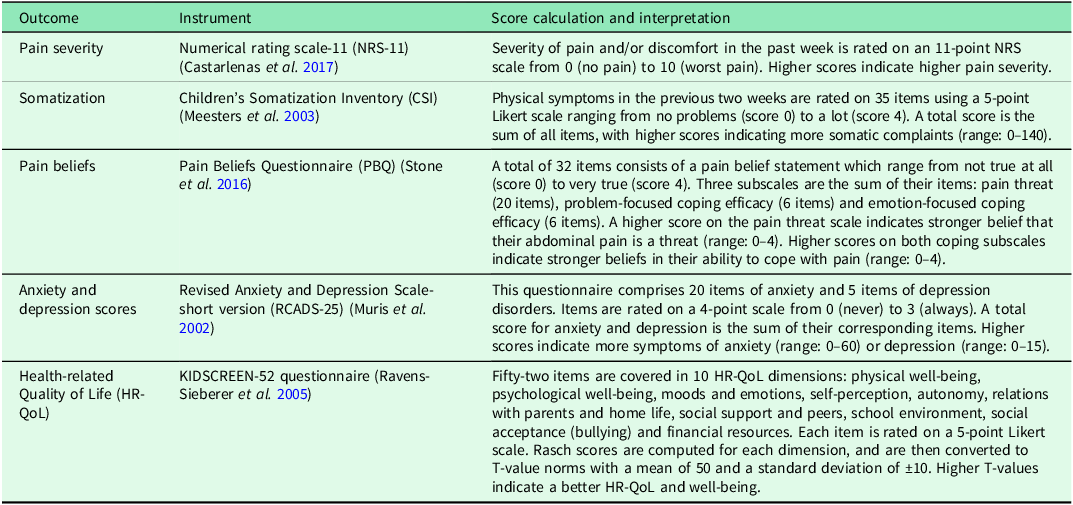
Baseline characteristics included demographic, clinical, and psychosocial patient characteristics. These were noted during intake meetings and filled out in questionnaires administered before randomization. Demographic characteristics included gender and age. Clinical characteristics included abdominal pain symptom duration, a diagnosis based on Rome IV criteria (Hyams et al. Reference Hyams, Di Lorenzo, Saps, Shulman, Staiano and van Tilburg2016), history of treatment by a paediatrician, pain severity, and somatization scores. Psychosocial characteristics included school absenteeism in the past three months, pain beliefs, anxiety and depression scores, and health-related quality of life (HR-QoL). Details of the outcomes and instruments are presented in Table 1.
Details of outcomes and measurement instruments

Data analysis
The characteristics of participants in the two recruitment groups were described as proportions for categorical data. Normally distributed continuous data were expressed as mean with standard deviation. For data with non-parametric distribution, median and bootstrapped 95% confidence intervals (CIs) with 1000 repetitions were reported.
Results
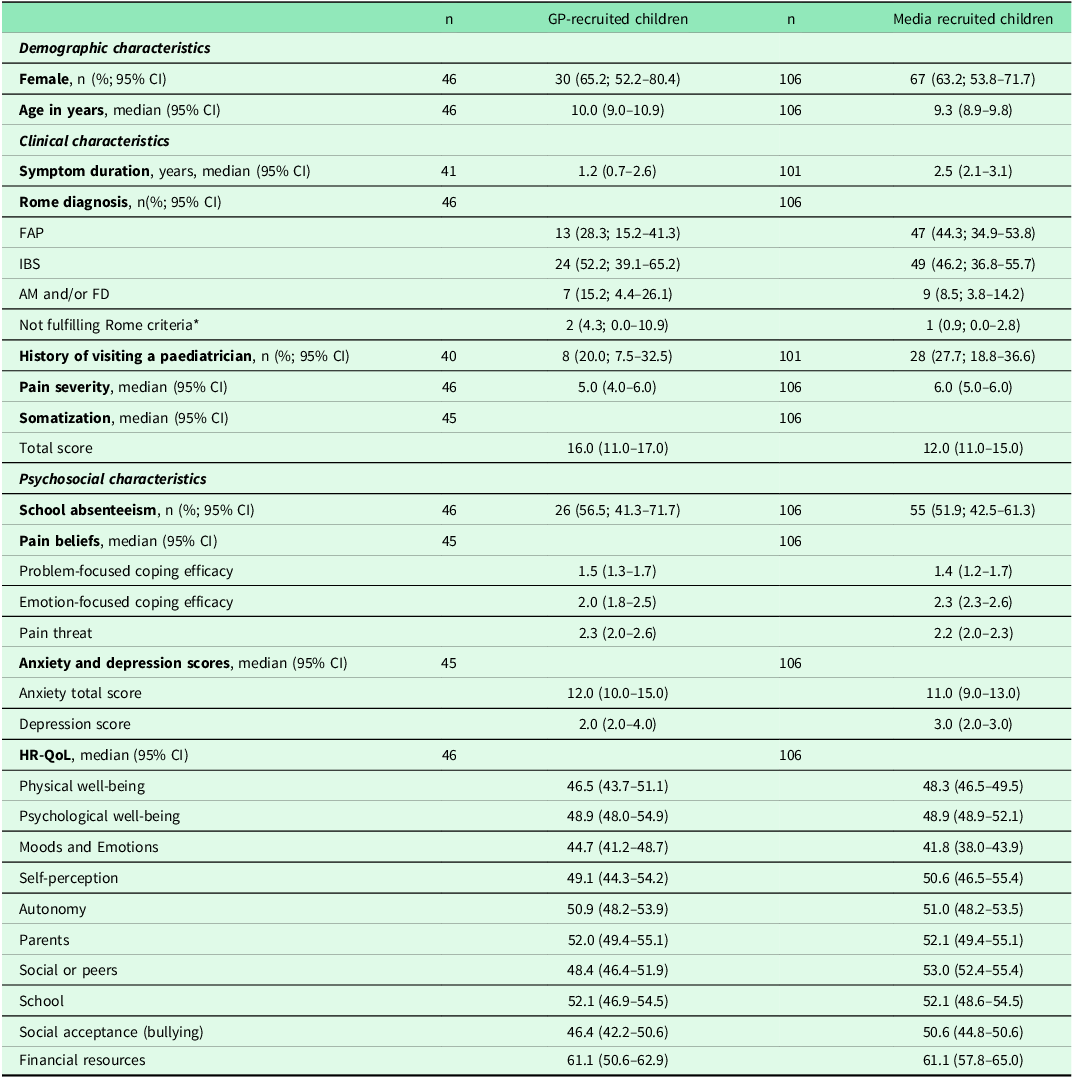
A total of 152 children were included in the RCT, of which 46 by GPs (from 26 practices, range 1–4 per practice) and 106 via media. The most effective strategy turned out to be paid advertisements via Facebook and Instagram, reaching children from across the entire country (Figure 1). Overall, children recruited by GPs and children recruited via media had comparable demographic, clinical and psychosocial characteristics. However, children recruited via media had higher median duration of abdominal pain symptoms (2.5 years, 95% CI 2.1–3.1) compared to children recruited by their GP (1.2 years, 95% CI 0.7–2.6). The proportion of children with FAP according to Rome criteria was higher in children recruited via media (47/106, 44.3%, 95% CI 34.9–53.8), compared to children recruited by their GP (13/46, 28.3%, 95% CI 15.2–41.3). All patient characteristics are presented in Table 2.
Baseline characteristics of children
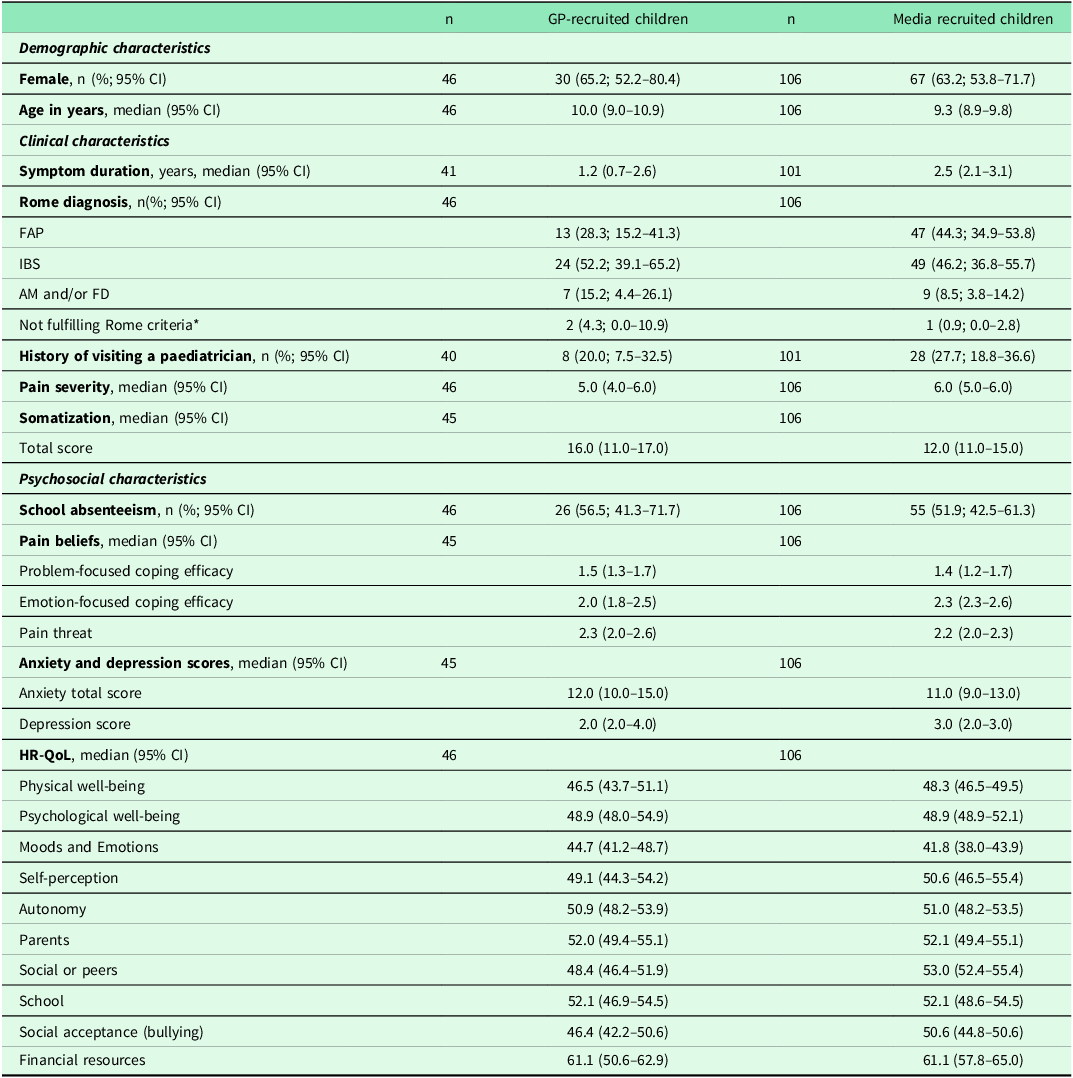
GP = general practitioner; 95% CI = 95% confidence interval; FAP = functional abdominal pain; IBS = irritable bowel syndrome; AM = abdominal migraine; FD = functional dyspepsia; HR-QoL = heath-related quality of life. *Three children did not fulfil Rome criteria (reported 2–3 days of abdominal pain in past 2 months, required ≥4).
Discussion
Summary
This study showed that media recruitment and in particular paid social media advertisements, can help attain sample size. Sample characteristics may differ because of different recruitment strategies. This study found differences between groups on abdominal pain symptom duration and diagnosis, with a larger duration and more Rome diagnoses of FAP seen in children who were recruited via media. However, other demographic, clinical and psychosocial characteristics were comparable between groups.
Strengths and limitations
One strength is that this study used baseline data which were almost complete. This yielded a large sample size and waived the need to impute data which induces uncertainty. Another strength of this study was that all children were checked by their GP on eligibility criteria, thereby enhancing practitioner engagement. The RCT was not designed to compare patient characteristics based on recruitment strategy. Therefore, a limitation of this study is the possibility that relevant patient characteristics such as parental influences and socioeconomic status were not taken into account.
Comparison with existing literature
A longer abdominal pain symptom duration in children recruited via media compared to GP-recruitment can be explained because they were not actively recruited by GPs and therefore did not recently visit their GP for FAP or IBS. Based on parent report during recruitment calls, some children had consulted a GP in the past, while others had not, though this was not systematically measured with questionnaires. The reasons for not consulting a GP could include dissatisfaction with previous healthcare provided, believing the GP has nothing to offer, or simply learning to cope with the pain over time. Many children are open to alternative treatment and encountering or actively seeking for solutions could make them more willing to respond to this study, especially in those with long-lasting duration of symptoms (Vlieger et al. Reference Vlieger, Blink, Tromp and Benninga2008). It is unknown how abdominal pain symptom duration impacts treatment effect and how relevant these differences are. We expect it to be minimal because earlier evidence whether symptom duration affects prognosis is contradictory (Gieteling et al. Reference Gieteling, Bierma-Zeinstra, van Leeuwen, Passchier and Berger2011), and other characteristics in this study were similar between groups. However, a secondary multivariable analysis in a hospital-based study evaluating efficacy of hypnotherapy suggested that shorter symptom duration could be a predictor of treatment success at 12 months (Rutten et al. Reference Rutten, Vlieger, Frankenhuis, George, Groeneweg, Norbruis, Tjon, van Wering, Dijkgraaf, Merkus and Benninga2017). Given the longer symptom duration in the media group, the overall treatment effect could be attenuated. We suggest performing a subgroup analysis by recruitment strategy, as it may not only relate to differences in symptom duration but also reflect unknown baseline characteristics that could affect prognosis or treatment response.
Children recruited via media showed a higher prevalence of FAP compared to those recruited via GPs. We hypothesize that children with changes in defaecation pattern, typical of IBS, are more likely to consult their GP, whereas children with FAP may be less likely to seek medical attention and thus more likely to be reached through media recruitment. However, a hospital-based study evaluating the efficacy of hypnotherapy found no significant effect of diagnosis on treatment success in children with abdominal pain-related disorders of gut-brain interaction (Rutten et al. Reference Rutten, Vlieger, Frankenhuis, George, Groeneweg, Norbruis, Tjon, van Wering, Dijkgraaf, Merkus and Benninga2017). Therefore, despite the differences in diagnoses between the recruitment groups, we do not expect this to influence the treatment outcomes in our RCT.
Anxiety, depression and HR-QoL scores in both groups were comparable to those found in Dutch and European community samples (Muris et al. Reference Muris, Meesters and Schouten2002; Ravens-Sieberer et al. Reference Ravens-Sieberer, Gosch, Rajmil, Erhart, Bruil, Duer, Auquier, Power, Abel, Czemy, Mazur, Czimbalmos, Tountas, Hagquist, Kilroe and Kidscreen Group2005). Compared to a paediatric sample, children in this study had lower somatization scores which were more comparable to those in a community sample (Meesters et al. Reference Meesters, Muris, Ghys, Reumerman and Rooijmans2003). This emphasizes that although children have abdominal pain in primary care, its impact on somatic symptoms and psychosocial characteristics is limited.
This study adds to the literature that Facebook advertisements are effective in recruiting children and adolescents in primary care (Amon et al. Reference Amon, Campbell, Hawke and Steinbeck2014). Our results are in agreement with other studies performed in primary care evaluating the effect of media recruitment compared to GP-recruitment on patient characteristics in adults. Two studies in adult women in primary care found no relevant differences in sociodemographic and clinical characteristics (Laws et al. Reference Laws, Litterbach, Denney-Wilson, Russell, Taki, Ong, Elliott, Lymer and Campbell2016; van der Worp et al. Reference van der Worp, Loohuis, Flohil, Kollen, Wessels and Blanker2020). A systematic review found that online recruitment strategies often lead to differences in age, gender and education in adults, but we did not observe such differences in our study (Brøgger-Mikkelsen et al. Reference Brøgger-Mikkelsen, Ali, Zibert, Andersen and Thomsen2020). Furthermore, our study showed that media recruitment in primary care effectively enhanced study engagement without major changes in the intended study sample characteristics. It enabled broad national reach and, despite financial investment, reduced the recruitment period, making it efficient and potentially cost-effective. Families without internet access may have been missed. While their children might also benefit from hypnotherapy, they would more likely require in-person treatment rather than an online intervention.
Implications for research
Difficulties in recruiting children for trials in primary care could be overcome by using broader recruitment strategies such as media. Future studies could use such recruitment strategies from the start to gain sufficient sample sizes and statistical power, and to reduce the chance of extended study periods or discontinuation. In addition to reducing the burden on GPs to actively recruit participants for research, media recruitment may facilitate nationwide inclusion and improve cost-efficiency. These aspects could enhance the efficiency and effectiveness of future studies in primary care and help address the paediatric research gap.
Supplementary material
The supplementary material for this article can be found at https://doi.org/10.1017/S1463423625100315
Acknowledgements
The authors would like to thank all the participants who participated in this study. We also thank Adriëlla van der Veen and Romy Lammens for their efforts in recruitment and data collection.
Funding statement
This project was funded by ZonMw, Dutch Organisation for Health Research and Development (project number 852002035). ZonMw was not involved in the design of this study nor in the data collection, data analyses, interpretation of the outcomes, or the writing of this manuscript.
Competing interests
None.
Ethical standards
Written informed consent was obtained from all participants involved in the study. The trial protocol and an amendment including extended recruitment strategy were approved by the Medical Ethics Review Committee of the University Medical Center Groningen (METc2020/237). The authors assert that all procedures contributing to this work comply with the ethical standards of the relevant national and institutional guidelines on human experimentation (University Medical Center Groningen) and with the Helsinki Declaration of 1975, as revised in 2008.



 Open access

