




Historians have long recognized that China’s centralized bureaucratic state emerged both earlier and on a larger scale than comparable systems elsewhere.Footnote 1 Some of the core institutions of this system, established even before the first imperial dynasty, the Qin, persisted throughout the imperial period. One such institution was the division of China proper into thousands of contiguous counties (xian 縣), each administered by one or more centrally appointed officials responsible for fiscal, judicial, and security duties.Footnote 2
In a much-cited quote, G.W. Skinner observed that the number of county-level units among unified Chinese dynasties had hovered around 1,250 throughout the imperial period and varied surprisingly little from the times of the Punic Wars to the eve of World War I:Footnote 3
the record shows a remarkable stability in the number of county-level units throughout imperial history. Taking the approximate figure that applied during the heyday of each dynasty, we find 1,180 in Han, 1,255 in Sui, 1,235 in T’ang, 1,230 in Sung, 1,115 in Yüan, 1,385 in Ming, and 1,360 in Ch’ing.
Skinner took this observation further, proposing that it holds significant implications for understanding China’s political and developmental trajectories. According to him, the number of county-level units served as a bellwether for the breadth and reach of the Chinese state. The fact that existing counties were routinely abolished as new ones were set up, keeping the overall number effectively unchanged, pointed to the presence of enduring forces that prevented the imperial Chinese state from expanding its administrative apparatus. Considering that China’s population steadily grew from 60 million in 180 to 425 million in 1850, an unchanging number of county-level units signifies “a secular decline in governmental effectiveness from mid-T’ang on to the end of the imperial era, a steady reduction in basic-level administrative central functions from one era to the next.”Footnote 4
Despite widespread historical objections to the notion of an immutable China, Skinner’s proposition that an invisible, low ceiling persistently limited the number of county-level units has, notably, found acceptance among many experts. Shiba Yoshinobu refers to it as an “unsolved mystery” that the number of counties from the Song to the Qing dynasties remained fixed at 1200–1300.Footnote 5 In his authoritative account of the rise and endurance of Neo-Confucianism in China, Peter Bol draws on Skinner’s characterization to argue that between 750 and 1050, China experienced “an overall decline in governance” and a divergence between its economic and administrative networks due to the unresponsive nature of county numbers in relation to population growth and the proliferation of market towns.Footnote 6 Harriet Zurndorfer, in a recently published essay, also posits that the proliferation of market towns from the Song onward led to a disconnect between administration and commerce.Footnote 7
However, the argument is not without its critics. Conrad Schirokauer and Robert Hymes argue that the lack of state expansion was not solely due to technological limitations but also resulted from negotiations and compromises between the Chinese state and its elites.Footnote 8 Ruth Mostern critiques Skinner for overlooking dynamic changes in the spatial structure of prefectures, which were situated above the counties.Footnote 9 Focusing on the Southern Song, Sukhee Lee points out that Skinner fails to consider the expansion of the Pacification Commission (xuanfusi 宣撫司) and the Military Commission (zhizhisi 制置司) as well as the presence of administrators in some market towns.Footnote 10
We build on these insights to reassess Skinner’s claim about the decline in basic-level administrative intensity from the Tang through the Qing. We find that, if we set aside statutory status and interpret a county as a basic-level territorial administration unit—just as Skinner himself did—the number of county-level units during at least one major dynasty, the Northern Song (960–1127), far exceeds Skinner’s proposed range of 1,180–1,385 units.Footnote 11 By our estimate, there were more than 1,800 basic-level administrative units in Song China, which implies a broader reach of the Song state and greater variability in the number of basic-level administrative units in imperial China than Skinner portrayed.
Our estimate for the Song dynasty is substantially larger because there is an inherent limitation in Skinner’s use of the number of de jure counties—xian and other administrative units of equivalent nominal rank—to measure the intensity of “basic-level administrative central functions.”Footnote 12 His premise is sound for the Ming (1368–1644) and Qing dynasties (1636–1912) when xian and other xian-level units were indeed the only basic-level territorial administration units. But during the Song dynasty, the picture is murkier.
Alongside the xian, the Song state established a variety of other field administration units, including towns (zhen 鎮), stockades (zhai 寨), fortifications (bao 堡), walled settlements (cheng 城), land passes (guan 關), fords (jin 津), production centers (chang 場), and so on. These territorial units were below the xian in administrative rank. However, a closer examination of the historical record reveals that a subset of these units: (1) were territorial jurisdictions with demarcated boundaries and registered households, (2) were staffed by one or more centrally appointed officials, (3) were responsible for collecting taxes from and providing public services to the residents, and (4) reported directly to the prefecture (zhou 州). This subset of jurisdictions, like the xian, executed basic-level administrative central functions under the direct supervision of the prefecture. If the objective is to measure the state’s physical presence at the local level, then these alternative territorial administration units need to be brought into the discourse.
In this article, we focus on the zhen, which administered urban households and could be found in almost every corner of Song China.Footnote 13 We demonstrate that out of the 1,891 zhen documented predominantly in the Song official geographical treatise Yuanfeng jiuyu zhi 元豐九域志 (The Yuanfeng Treatise of the Nine Regions, hereafter the Yuanfeng Treatise),Footnote 14 compiled in 1085 to provide a geographic account of the empire at the end of Emperor Shenzong’s reign, about 30 percent fulfilled the four abovementioned criteria of having demarcated boundaries and registered households, being staffed by appointed imperial officials, collecting taxes and providing public services, and reporting directly to the prefecture. This subset of zhen is represented as red dots in Figure 1.Footnote 15 Our estimate of more than 1,800 basic-level administrative units in Song China is derived by adding these approximately 560 zhen to the 1,135 xian and 176 other xian-level units in the mid-1080s.Footnote 16
County-level units and administrative towns staffed by imperial officials in the Song, Ming, and Qing dynasties. Administrative towns staffed by quasi-officials are not included in Panel A. Base map source: CHGIS 2016; administrative towns based on the Yuanfeng Treatise, Jin shi, Song shi, and Song huiyao (see note 15).

More important than revising upward the number of basic-level administrative units in Song China, this finding underscores the sophistication of the Song territorial administration. Studies of urban management in Ming–Qing China have revealed that an overwhelming majority—more than 95 percent—of urban settlements, including market towns, lacked a permanent bureaucratic presence.Footnote 17 Consequently, the Ming–Qing counties were predominantly rural in outlook, providing urban services mainly to residents of the county seat, if such services were provided at all.Footnote 18 Some studies have argued that this stands in contrast to some early modern states, such as Tokugawa Japan, where urban magistrates (machi-bugyō 町奉行) administered towns and cities, and rural magistrates (daikan 代官) governed the countryside.Footnote 19 However, this distinction does not apply to Song China, which was in fact ahead of its time in recognizing and addressing the distinct characteristics—and therefore the administrative needs—of rural and urban populations.
The differing approaches to territorial administration between the Song and the Ming–Qing states are reflected in the subtle shift in the meaning of the term zhen. In the context of Ming–Qing China, zhen was largely synonymous with the term shi 市 or the compound term shi-zhen 市鎮, describing market towns that typically lacked formal bureaucratic oversight. As Faure’s study on Foshan illustrates, the Ming–Qing zhen was “commercially a town, but politically a xiang” (rural canton; 鄉).Footnote 20 In contrast, in Song China the two terms had distinct connotations: a zhen was a state-administered town, with its establishment and abolishment recorded in the Song State Compendium (Song huiyao 宋會要) under the category “Administrative Geography” (fangyu 方域); while a shi indicated a market town without direct state involvement, typically smaller in scale. The distinction underscores that the Chinese experience in field administration is more intricate and varied than snapshots from either 1500 or 1800 might suggest.
Tellingly, it is not uncommon for contemporary researchers to overlook this subtlety and assume that all market towns had always lacked direct state presence.Footnote 21 Among those who recognize the administrative role of the Song zhen, most have not delved deeper, focusing instead on examining it within the framework of urban history, especially on its roles as a market and an urban settlement.Footnote 22 Important exceptions include Kawakatsu Mamoru, who demonstrates that the zhen carried administrative functions during the Song–Yuan period, and Maemura Yoshiyuki, who investigates Song zhen administrators with the commission (chaiqian 差遣) of “routine local administrative affairs” (yanhuo gongshi 煙火公事).Footnote 23
To the best of our knowledge, there has yet to be a systematic investigation of sub-prefectural administration in Song China in the English literature;Footnote 24 to date, the most comprehensive work on Song territorial administration is Mostern’s in-depth study of the prefecture, the primary unit that the Song state used to spatially organize itself.Footnote 25 Hartwell notes that the prefecture was eclipsed by the emergence of large, regional-sized provinces post-Song.Footnote 26
This article builds on these studies to examine the layer beneath the prefecture that directly administered the people. In doing so, it reassesses a prevailing view in urban history that identifies the Tang–Song Transition as a watershed when the disconnect between administrative and economic urban networks—so evident in late imperial China—first emerged. According to this view, economically significant cities or towns in the Tang dynasty often doubled as prefectural or county seats, and it was from the Song onward that a proliferation of private commercial centers led to a divergence between sites of administration and centers of commerce.Footnote 27 By demonstrating that economically important towns with tax quotas also functioned as basic-level administrative units in Song China, this study suggests that the extent to which urbanization and commercialization developed independently of state administration was more limited, and occurred later, than previously assumed.
The paper also engages with the scholarship on fiscal history in Song China. Paul Smith’s insightful inquiry into the tea and horse trade in Song Sichuan demonstrates a degree of bureaucratic activism and commercial interventionism that exceeded later dynasties.Footnote 28 Recent research has shown that, unlike the Ming and Qing dynasties, which maintained comparatively lower taxation levels and derived approximately three-quarters of their revenue from land taxes, the Song state imposed heavy taxes, particularly on commerce and consumption, which accounted for over 60 percent of its revenue.Footnote 29 We complement this scholarship by shedding light on the institutional foundation that made the high tax regime and expansionary economic policies of Song China feasible. Our findings suggest that the state activism of the Song era was embedded in, and supported by, a network of field administration nodes—not only the seats of prefectures and counties, but also zhen and other sub-prefectures—that was more extensive than observed in subsequent periods of imperial China. These nodes provided security, fire protection, dispute resolution, and other basic public goods to their residents in return for the taxes they paid, without which the Song high tax regime would not have been sustainable.
The rise of the administrative town
The emergence of the Song town could be traced to the late Tang and Five Dynasties that preceded the establishment of the Song state. Specifically, it was rooted in the convergence of two significant historical developments: the flourishing of rural markets outside the county and prefecture seats after the disintegration of the early Tang official market system, and the establishment of garrison towns (waizhen/xunzhen 外鎮/巡鎮) in response to the An Lushan 安禄山 Rebellion (755–763).Footnote 30 The first development created an impetus for the Chinese state to extend its administrative network beyond the conventional precincts of prefectural and county seats, while the second furnished the mechanism for such an expansion.
The garrison town, the predecessor of the administrative town, emerged from the polycentric political system that dominated China for two centuries following the An Lushan Rebellion. During this era, regional military governors wielded extensive civil, military, personnel, and financial powers within their domains. In a situation that bears some parallels to early modern Europe, where “war made the state, and the state made war,”Footnote 31 these warlords established garrison towns at strategic locations and appointed loyal military subordinates as garrison commanders to safeguard their positions against rival governors and central government incursions.Footnote 32
Garrison towns were strategically located at four types of sites: prefectural seats, county seats, militarily important locations, and economic centers, particularly market towns.Footnote 33 Over time, a symbiotic relationship developed between the markets and the garrisons. The markets and nearby residents were taxed to financially support the garrison troops, which, in turn, incentivized the troops to maintain peace and order in the market and protect their source of revenue.Footnote 34
By the Five Dynasties, garrison commanders had developed civil-administrative capabilities not possessed by their late Tang predecessors.Footnote 35 They assumed roles in policing, judicial proceedings, and tax collection, thereby redefining garrison towns into administrative units. This expansion of functions brought them into direct competition with counties, which represented the established civil-administrative system.
In their bid to recentralize power, the sovereigns of the late Tang and the Five Dynasties made repeated attempts to have garrison commanders report to court-appointed prefects instead of the autonomous regional military governors, and to rationalize the territorial administrative structure.Footnote 36 Nonetheless, these processes were only completed when the Song dynasty pacified China and ended the two centuries of warlordism. The ensuing demilitarization led to the abolishment of garrison towns that were located in the prefectural and county seats,Footnote 37 while garrisoned market towns were repurposed and retained as civil administrative units, thereby completing the transformation of garrison towns into administrative towns.
Territorial administration of Song China
Song and Ming–Qing
In Ming–Qing China, territorial administration outside the capital followed a straightforward three-tier hierarchy. At the base was the county (xian 縣), widely regarded as the basic building block of the governing hierarchy, along with other county-level units.Footnote 38 Above the county level was the prefecture, which served as an intermediary administrative unit, while the province constituted the highest tier of this structure (Figure 2).
Structure of territorial administration in the Song and Ming–Qing dynasties.

By comparison, the administrative structure during the Song dynasty was more intricate. The Song equivalent to the Ming–Qing province was the circuit. However, despite some superficial similarities,Footnote 39 the circuit did not possess comparable authority. Each circuit was overseen by several mutually independent intendants, each tasked with a distinct set of functions: taxation, defense, judicial matters, or agriculture. Rather, the primary unit of territorial administration during the Song dynasty was the prefecture, which functioned as a miniature administrative body representing the central government within its territorial boundaries. As Mostern explains, “the three hundred-some prefectures were the regime’s stable and executive political face outside the court.”Footnote 40 Prefectures held significant civil, fiscal, and even military authority. They directly communicated with the court and exercised direct jurisdiction over counties and various sub-county units.
These sub-county units constitute another distinctive feature of the Song administrative structure. Unlike in Ming–Qing China, when counties formed the basic building blocks of formal administration outside the capital city, the Song state established not only counties but also a variety of sub-county field entities performing fiscal, defense, mining, or other production functions.
In official records such as the Yuanfeng Treatise, these units were listed under the counties to which they belonged. However, in practice, they were often directly accountable to the prefecture rather than the county.Footnote 41 The prefecture, rather than the county, exercised bureaucratic oversight over the sub-county officials. The prefect was responsible for conducting annual appraisals of all sub-prefectural officials,Footnote 42 while the vice prefect performed quarterly reviews.Footnote 43 Additionally, officials responsible for fiscal affairs within the prefecture’s territory, including those from counties, towns, and other administrative units, were required to submit revenue data directly to the prefecture for verification.Footnote 44
Among the various types of sub-county units, it is in the towns that we find the most compelling evidence suggesting they were considered by the Song state as basic units of territorial administration. A clear example of this comes from the imperial maps produced by the government. The Northern Song state required prefecture governments to routinely compile maps to capture specific socio-economic and administrative information within each prefecture; these prefectural maps were in turn used to generate empire-wide maps.Footnote 45 In 1071, the Shenzong emperor appointed Zhao Yanruo 趙彦若 as chief director of a state project to produce “All-under-Heaven Maps of Prefectures [zhou-fu-jun-jian], and Counties and Towns [xian-zhen]” ("Tianxia zhou fu jun jian xian zhen tu" 天下州府軍監縣鎮圖), which Zhao delivered two years later.Footnote 46 Although the maps produced by Zhao and his team have long been lost, the title of the project suggests that the Song state visualized counties and towns as basic cells forming the larger prefecture, and, by extension, the empire.
In 1075, Zhao Yanruo was appointed again, this time to compile The Maps of the Nine Regions (Jiuyu tu 九域圖). When Zhao resigned, the task was taken over by Wang Cun, whose work culminated in the Yuanfeng Treatise. The Yuanfeng Treatise was a landmark work, documenting not only the historical evolution of territorial administration but also detailed information on sub-county units, including zhen. Footnote 47
Other imperial directives, too, occasionally hinted at the Song state’s perception of towns as functionally equivalent to counties. For instance, a late tenth-century edict allowed prefectures to retain fiscal reserves equivalent to up to three years of their budgets, while towns and counties could retain reserves for up to two years, or one year if distant.Footnote 48 Another illustrative example appears in Chaoye Leiyao 朝野類要, a Southern Song publication that explains bureaucratic terminology and jargon. In the entry on the term qinmin 親民 (“close to the people”), the author Zhao Sheng noted that town and stockade supervisors were also considered qinmin officials.Footnote 49 Traditionally, qinmin referred to imperial officials responsible for direct interaction with the populace. By identifying zhen supervisors as qinmin, this source affirms their official capacity during the Song dynasty.
Three tiers of administrative towns
To be sure, not all towns possessed authority or responsibilities comparable to those of a county. Although there was no explicit tiered system for towns, they can be classified into three tiers based on the commissions of their appointed supervisors, which indicate varying degrees of power and responsibility.Footnote 50 The commissions were influenced by a range of factors from population and commercial activity levels to geographical location, reflecting the importance of a town in the eyes of the state.Footnote 51
Town administrators across all three tiers were responsible for collecting taxes and providing urban public goods.Footnote 52 However, the specifics of tax collection, the scope of public goods provided, and the authority vested in these officials varied. For first-tier towns, the Song state assigned their supervisors the commission of “routine local administrative affairs.” These officials were typically appointed by the Bureau of Administrative Personnel (shenguan yuan 審官院), selected from candidates who were qualified to serve as county magistrates and who had completed at least one term as a task supervisor (jiandang 監當).Footnote 53
Depending on their standing in the administrative hierarchy, these officials could be further subdivided into two sub-tiers. The upper sub-tier comprised town supervisors of the administrative class (jingchao guan 京朝官). Like county magistrates with the same titular grade, these town supervisors were authorized to adjudicate crimes punishable by up to one hundred blows by the heavy stick.Footnote 54 The lower sub-tier, in contrast, comprised officials of lower grade drawn from the executory class (xuanren 選人) or from among the minor military servitors (xiao shichen 小使臣). While they were permitted to adjudicate legal cases, it appears that their authorization was restricted to lesser crimes punishable by the light stick (xiaozhang 小杖).Footnote 55
Towns of the second tier were staffed by court-appointed officials who were assigned to handle daily administrative affairs and collect taxes. These officials, appointed by the Bureau of Executory Personnel (liunei quan 流內銓) or by the Court of the Three Ranks (sanban yuan 三班院), held the commission of task supervisors.Footnote 56 In addition to tax collection, their responsibilities encompassed a range of tasks including maintaining compliance with fire regulations, enforcing the law, and implementing various state policies, such as preventing smuggling and disbursing famine relief. A key distinction between these officials and those in the first tier was their more limited punitive authority: they were only authorized to administer punishments of no more than 10 blows with the light rod.Footnote 57
Unlike the first two tiers, towns in the third and final tier had no court-stipulated commercial and liquor tax quotas and, consequently, no tax-inspecting officials. Oversight was provided by garrison commanders (zhenjiang 鎮將), a legacy role inherited from the regional commandant system (jiedu shi 節度使) of the Late Tang and Five Dynasties. Contrary to their title, these Song garrison commanders were not military officers but rather powerful and wealthy local individuals appointed by the prefectural government to act as quasi-officials.Footnote 58 They were granted local tax-farming rights (maipu 買撲) and in return, were responsible for maintaining local public security (see Table 1).Footnote 59
The three tiers of towns in Song China

One could consider all towns in Song China as de facto county-level units, based on the premise that the three tiers of towns, each with varying degrees of authority and direct control from above, served as state outposts responsible for taxation and public security. By this interpretation, there were 3,200 county-level units, or approximately 1,300 xian and xian-level units and 1,891 towns, in late eleventh-century China.
However, if we adopt a more stringent definition that requires a county-level unit to be staffed by at least one centrally appointed career official directly accountable to the prefect, then only towns of the upper two tiers should be considered. There were approximately 560 towns meeting the definition. Accordingly, the total number of basic-level administrative units during Song China’s height would be approximately 1,860, which is still 50 percent higher than the historical average of 1,250 county-level units for unified Chinese dynasties spanning two millennia.
Our estimate of 560 first and second-tier towns is based on the identification of towns with court-stipulated commercial tax quotas, given that third-tier towns practiced tax farming and lacked such quotas. The Yuanfeng Treatise provides a snapshot of all towns in 1085;Footnote 60 while the Song State Compendium lists tax quotas for each commercial tax station in 1077.Footnote 61 By matching town and tax station names within each prefecture in these records, we estimate that 553 to 569 towns listed in the Yuanfeng Treatise fall into the upper two tiers, which we round to 560. This leaves 1,331 towns belonging to the third tier.Footnote 62
Estimating the exact number of towns in the first and second tiers is more challenging. Existing historical records do not provide a comprehensive list of towns overseen by officials with the commission “routine local administrative affairs,” i.e., the first tier towns. Among those explicitly mentioned in the records, Daning 大寧 (Nanxiongzhou 南雄州) had one of the lowest commercial tax quotas, at 992 strings.Footnote 63 Assuming that all towns with tax quotas at or above this level, like Daning, belonged to the first tier, we estimate 256 towns in the first tier and 313 in the second. Although these estimates are imprecise, the exact split between the first and second tiers matters less than their collective contrast with the third tier. What sets the first two tiers apart is their role as extensions of central authority, headed by imperial officials vested with judicial and civil administrative responsibilities.
Figure 3(A) provides a snapshot of administrative towns of all three tiers, as recorded in the 1085 Yuanfeng Treatise. Figure 3(B) maps the towns with centrally appointed officials, that is, those of the first two tiers. Their density was markedly higher in northern China, where the capital Bianjing was located, compared to the more populous south.Footnote 64 Beyond the capital region, a particularly dense clustering is evident in the circuits of Hebei and southern Shaanxi. Both were militarily strategic areas. In Hebei, autonomous regional governors had been especially concentrated during the late Tang and Five Dynasties, and under the Northern Song the region continued to shield the capital from potential Khitan invasions. By contrast, southern Shaanxi supported the ongoing campaigns against the Tanguts, particularly from the 1040s onward. A secondary cluster lay along the route connecting the capital with the Lower Yangtze region, where the Grand Canal was crucial for transporting grain from the surplus-producing southeastern China to the capital and beyond. The clustering of centrally appointed towns in these regions thus reflected not only demographic and economic realities but also fiscal-military priorities: by securing the movement of grain and supplies, they sustained both the capital and the armies.Footnote 65
Spatial distribution of administrative towns in 1085. Towns of Tiers 1 and 2 were staffed by imperial officials, while Tier-3 towns were headed by quasi-officials. Data compiled from the Yuanfeng Treatise, Jin shi, Song shi, and Song huiyao (see notes 14 and 15). Base map source: CHGIS 2016.

The spatial distribution of third-tier towns presents a markedly different pattern. With the important exception of Sichuan, these towns were relatively evenly distributed across the empire. Sichuan, however, stood out for its particularly high density of third-tier towns. This configuration can be traced in part to geography and the administrative legacy of the warlord era. Ringed by mountains and accessed only through a handful of narrow corridors, the Sichuan Basin was well suited to a mesh of garrison towns and stockades placed at passes, bridges, and river crossings, enabling the projection of authority and the securing of movement at relatively low cost.Footnote 66 Rather than dismantle this militarized infrastructure after the conquest of Sichuan, the Song state—confronted with the Wang Xiaobo–Li Shun uprising of the late tenth century and the perceived continuation of social instability in its aftermath—chose to preserve it as a means of safeguarding political control and social order.Footnote 67
Functions of administrative towns with imperial officials
We now focus on towns of the upper two tiers and demonstrate that the centrally appointed officials of these approximately 560 towns did more than just collect taxes. As territorial administrators, they enforced state laws, provided public goods to the local populations, handled official documents, and communicated directly with chief administrators of other jurisdictions.
Urban control and extraction
Unlike in Ming–Qing China, the Song state differentiated households into urban (fangguo hu 坊郭戶) and rural (xiangcun hu 鄉村戶) categories based on their residence, and these households were administered differently. Urban households were taxed on their real estate, rather than agricultural land, and were largely exempt from corvée labor; they bore a disproportionate share of the financial burdens imposed by the state’s monopolies on liquor, salt, and tea.Footnote 68 Importantly, residents of towns, like those in prefectural and county seats, were classified as urban households.Footnote 69
Furthermore, as an integral part of the governing hierarchy, towns played a crucial role in managing state monopolies, which primarily targeted the urban sector. Towns facilitated the production and sale of monopoly goods and addressed issues such as smuggling.Footnote 70 For the liquor monopoly, town officials, like officials in the county seats, were responsible for administering the monopoly within the restricted zone, which was defined as the area within ten li 里 from the boundaries of the town or county seat.Footnote 71 In the case of salt and tea monopolies, like the prefecture and county seats, the towns served as distribution centers for these goods. The performance of their officials was evaluated based on the volume of salt or tea sold in their jurisdictions.Footnote 72
Fire regulation
Historically, fire prevention and control constituted an essential component of urban management, and indeed, it stood as one of the foremost responsibilities of the Song town. An imperial ordinance (ling 令)Footnote 73 on urban fire regulations explicitly stipulated that town officials, like those in the prefectures and counties, were responsible for organizing the population and maintaining fire protection equipment for the public:
In prefecture seats, county seats, towns, and stockades, every ten households are to be organized into one guard [jia 甲], headed by one family as chief. A card recording every household should be signed by the families, stamped by the government, and preserved by the chief. When a fire takes place, the chief should lead the other nine representatives in the same guard to fight the fire. After the fire is put out, the chief does a roll call according to the card in front of the official. Use official funds to purchase appropriate quantities of firefighting equipment. The officials should ensure the upkeep of the equipment, and repair or replenish it when damaged or lost.Footnote 74
An imperial edict (chi 敕) further specified the punishments for officials in prefectures, counties, and towns alike, should they fail in their responsibilities to fight a fire and protect property:
If a fire breaks out in the prefecture seat, the director-general [dujian 都監] must immediately organize the firefighting, while the vice prefect supervises. Failure to comply renders them both punishable with eighty strokes by the heavy stick … In subordinate jurisdictions of the prefecture, the vice magistrate and sheriff (if the fire occurs in rural markets outside the prefectural seat or in counties, including metropolitan counties adjacent to the prefectural seat), and town or stockade officials (if the fire occurs in a town or a stockade) are to be held accountable under the same rules as the director-general.Footnote 75
Law enforcement
Under Song statutes, first-tier town supervisors commissioned with “routine local administrative affairs” were authorized to adjudicate lawsuits.Footnote 76 A case in 1114 saw the fiscal commissioner of Liangzhe 兩浙 Circuit suggesting that the town administrator of Meixi 梅溪 in Huzhou be given this commission to address the high crime rate in the town.Footnote 77 In 1082, the same commission was conferred to the administrator of the newly established Xiangshan 香山 Town in Guangzhou 廣州, so local residents could seek litigation without traveling far.Footnote 78 An 1178 edict further confirmed the judicial responsibility of the position, stressing that understanding the legal codes was a prerequisite for titular military officers to be appointed to it.Footnote 79 This suggests that town administrators, including those appointed from the lower echelons of the Song civil service system, such as the minor military servitors and the executory class, were entrusted with the responsibility of making legal decisions as part of their daily duties.
Officials in second-tier towns possessed more limited legal authority, yet they were still empowered to preside over minor legal cases. Additionally, they were responsible for carrying out regular legal and regulatory interventions to ensure the enforcement of state laws and regulations within their jurisdictions. For instance, an official recommendation from the Ministry of Justice in 1200 proposed the circulation of woodblocks containing edicts (chi), ordinances (ling), regulations (ge 格), and specifications (shi 式) compiled by the court to all counties and towns twice a year. This measure aimed to facilitate the resolution of disputes, as officials in the county and town were in closest proximity to the people.Footnote 80
The recommendation is substantiated by a case recorded in The Enlightened Judgements (Qingming ji 清明集). In the town of Ruikou 汭口 of Xinzhou 信州 during the Southern Song, a boat race led to a deadly altercation with thirteen casualties.Footnote 81 Song laws had prohibited some types of boat racing due to gambling concerns, and violators could face up to one year of penal servitude.Footnote 82 The town administrator, a minor military servitor, failed to prevent the illegal boat race and did not intervene when the dispute turned violent. Consequently, he was transferred out as punishment, highlighting that law enforcement as well as the management of civil affairs were part of the town administrator’s job scope.
Official communications
We conclude this section with an incident recounted by Su Shi 蘇軾 (1037–1101). In 1091, while serving as the prefect of Yingzhou 潁州, Su Shi lodged a complaint with the imperial court, highlighting the actions of various officials in the neighboring circuit of West Huainan 淮南西 that were causing delays in rice shipments to his prefecture. Su Shi mentioned reaching out to the judicial and fiscal commissioners of Huainan Circuit, Guangzhou 光州, Gushi 固始 County, and Zhugao 朱皐 Town for assistance in expediting grain shipments. Among them, only the officials of Zhugao town responded, stating that they were adhering to a directive from the circuit judicial commissioners prohibiting the transportation of more than one shi of rice across the Huai River.Footnote 83
Su Shi’s account brings two pertinent points to the fore. Firstly, the town held the responsibility of implementing policies, regulations, and directives from higher authorities. Secondly, the written correspondence between Su Shi and the administrator of Zhugao Town serves as evidence that the town functioned as a formal node within the bureaucratic administrative network. As part of their daily routine, town administrators engaged in written communication with other bureaucrats in different locations. This included receiving instructions, addressing complaints and requests, providing information, and fulfilling their role as court-appointed administrators and custodians of their respective territorial jurisdictions.
Two case studies in the Southern Song: Ganshui 澉水 and Shijing 石井
We now delve into two case studies, Ganshui and Shijing. Both were administrative towns during the Song dynasty that lost this status by the Ming. We trace how administrative presence shaped their irrigation management and town defense, respectively.
The first case study examines Ganshui, notable for being the only town with an extant Song gazetteer. Situated at the mouth of Hangzhou Bay (Figure 4), Ganshui originated as a garrison town during the Tang dynasty and was repurposed as an administrative town at the start of the Song dynasty.Footnote 84 While previous studies have emphasized its role in urbanization or elite culture,Footnote 85 we focus on its administration functions, particularly the management of its irrigation system by drawing on gazetteers from both the Song and Ming dynasties.
Ganshui Town.

The irrigation system of Ganshui was uniquely shaped by its topography, characterized by elevated terrain along the coast compared to the hinterland, which necessitated irrigation to connect the coastal town with inland areas. During the Song era, local communities excavated an artificial lake and river channels to supply water to the town and to link it to its hinterland.Footnote 86
Nevertheless, this system faced constant threats from individuals attempting to divert water away from the lake. During a drought in 1249, some residents erected a dam to hoard water for their own use, blocking the town’s only waterway to the hinterland. In response to public outcry, a town official initiated the dismantling of the private dam.Footnote 87 This effort appeared successful. The Song Ganshui gazetteer records that the irrigation system continued to function reliably, ensuring a steady water supply for drinking and agriculture and serving as a cornerstone of Ganshui’s prosperity.
In the post-Song era, Ganshui lost its status as an administrative center and, like other towns in China, was no longer governed by an imperial official. During the Ming period, the irrigation system deteriorated as the lake frequently dried out.Footnote 88 Between the late fourteenth and mid-sixteenth centuries, the local population submitted at least seven requests to the state to refurbish the irrigation system by dredging the lake and the river system, and to penalize individuals who built private dams upstream.Footnote 89 Although each request was approved by the imperial court or provincial officials, little action was taken.
One of these requests took place in 1445. The court approved the proposal to revamp the water conservation system. However, implementation did not commence until fourteen years later. Furthermore, the reconstruction was not completed. Despite the mobilization of over 20,000 laborers, the project was abruptly halted due to severe winter weather and was not resumed.Footnote 90
Thirteen years later, local village heads and elders initiated a request to restart the previously abandoned project. However, no official maintenance work was carried out. Instead, the provincial government delegated the responsibility for maintaining the irrigation system to Haiyan 海鹽 County. Eventually, the task was handed over to a county subofficial. Lacking sufficient authority, the subofficial effectively shifted the onus of lake management and repair back onto local community leaders.Footnote 91
In the 1530s, Dong Yun 董澐 (1457–1533), a notable Ganshui literati and the father of the Ming Ganshui gazetteer’s compiler, attributed the persistent irrigation issues to the state’s failure to curb individuals illegally diverting water. He noted that this problem was exacerbated by Ganshui’s geographical remoteness from the prefectural and county seats.Footnote 92 His observation suggests that the loss of administrative status was one of the culprits behind Ganshui’s irrigation crisis and broader economic decline.
To be sure, Ganshui hosted a significant naval force during the Southern Song and a military battalion in the Ming.Footnote 93 In both periods, the military presence may have influenced the state’s activities in the town in ways that complicate our analysis. We therefore turn to our second case study, Shijing, a town under Quanzhou 泉州 in present-day Fujian (Figure 5). Established in 1130 to administer two local markets engaged in overseas trade, Shijing was a first-tier town whose administrator held penal authority to maintain peace and order.Footnote 94 Among its earliest administrators was Zhu Song 朱松 (1097–1143), the father of the philosopher Zhu Xi 朱熹 (1130–1200).Footnote 95 In 1156 the town supervisor built a fortress to shield the residents from pirate attacks.Footnote 96
Shijing Town.

During the Ming dynasty, Shijing, like Ganshui, lost its formal administrative standing. Subsequently, the town was administered as a rural entity under the jurisdiction of Jinjiang 晉江 County and was renamed Anping 安平 or Anhai 安海, both translating to “Peace and Tranquility.” When piracy threats escalated in the mid-sixteenth century, the county magistrate—hampered by the town’s distance from the county seat—was compelled to depend on local leaders to organize communal self-defense.Footnote 97 In 1558, the prefect of Quanzhou tasked the magistrate of Jinjiang with the reconstruction of the Song fortress, but the magistrate did not complete the project due to ongoing piracy. Ultimately, the fortress was rebuilt under the leadership of a local literatus, Ke Shiqing 柯實卿.Footnote 98 From 1606 onward, a vice prefect was assigned to oversee the town’s maritime defense, but his visits to the town were sporadic at best.Footnote 99 By the end of the Ming dynasty, Anhai town had become one of the principal bases for Zheng Zhilong 鄭芝龍 (1604–1661), a famed maritime smuggler and father of the Ming loyalist Koxinga (1624–1662).
Historical accounts suggest that, during the Song dynasty, town administrators played a central role in managing overseas trade and overseeing the construction of the first fortress. In contrast, in the Ming dynasty, defense against piracy depended heavily on communal self-organization and the leadership of local elites. While a thorough assessment of this shift requires further study, it is evident that the presence of administrative oversight was crucial in shaping local outcomes, as also seen in the case of Ganshui.
The evolution and decline of administrative towns
In her study of Song prefectures and counties, Ruth Mostern notes that, whereas most imperial dynasties concentrated adjustments to administrative units in their early years, the Song state continued this process throughout much of its history.Footnote 100 In the case of Song towns, changes to their status generally took three forms: (1) abolition—the complete removal of administrative status; (2) conversion to or from other administrative units such as counties, stockades, fortifications, or production centers; and (3) the creation of new towns from previously non-administrative settlements, such as market settlements (shi 市).
In the early Northern Song, the state abolished many garrison towns it inherited from the late Tang and Five Dynasties. The remaining towns, converted into civil administrative units, seem to have continued declining in number. Huzhou provides a telling example: according to its gazetteer, the prefecture initially had twenty-four towns, which fell to sixteen by 1004 and to six by the time of the Yuanfeng Treatise in 1085.Footnote 101 This pattern suggests that the number of towns in the dynasty’s first decades was considerably higher than in 1085.
The other two forms of change—conversion and new creation—are better documented in the surviving historical record. Figure 6A shows that the conversion of towns to or from other units was concentrated in the New Policies era (1068–1085) and the subsequent Yuanyou regency (1086–1094), reflecting the ebb and flow of reform. This pattern raises an important question: since the Yuanfeng Treatise was compiled in 1085, the final year of Shenzong’s reign and the close of the New Policies era, do the towns it records provide a reliable snapshot of the mid-to-late Northern Song, or was the figure inflated by reformist activism?
(A) Number of towns converted to and from other administrative units. (B) Number of towns newly established from non-administrative settlements. Data compiled by the authors, available at https://tinyurl.com/TownsConversion and https://tinyurl.com/TownsCreated.

Closer examination suggests the former. During the New Policies era, 101 countiesFootnote 102 and six stockades or fortifications were converted into towns, while 12 new towns were created, yielding 119 in total. Although this is a significant number, it remains small compared with the 1,891 towns at the time of the Yuanfeng Treatise. Moreover, 83 of these 119 survived the Yuanyou retification, pointing to stability rather than inflation.
As Figure 6B shows, the creation of twelve entirely new towns under Shenzong was not exceptional compared to earlier periods. The pattern suggests that throughout the Northern Song the state consistently sought to extend its reach in response to demographic growth and urban development. Some towns emerged from expanding populations and the fiscal opportunities they generated, such as Hanchengcun 韓城村 (location unknown) and Yansi 巖寺 in Huizhou 徽州, both linked to revenues from the liquor monopoly. Others were established to fill a governance vacuum in areas remote from administrative centers, as in Xiangshan 香山 of Guangzhou, Masha 麻沙 of Jianzhou 建州, and the previously noted Shijing of Quanzhou. New towns also served to consolidate state presence in peripheral regions, exemplified by the seven towns founded in Minzhou 岷州 during Shenzong’s westward campaign. These towns proved relatively stable: of the 126 new towns created from non-administrative settlements between 960 and 1276, only nineteen, or 15 percent, were later abolished, while four were promoted to counties. This durability underscores the overall stability of the town system.
Another notable pattern in Figure 6B is the sharp decline in the number of new towns created in the Southern Song compared with the Northern Song: of the 126 new towns founded across the two dynasties, 115 were created in the Northern Song and only eleven in the Southern Song. Loss of northern China to the Jurchens cannot alone account for the collapse: even after accounting for the Southern Song’s reduced territory, town creation fell more than territory contracted. Moreover, the number of towns in southern China likely declined during the Southern Song, driven in particular by a significant wave of abolitions in Sichuan.Footnote 103 In Southeast China, the number of towns also stagnated, if not declined, despite sustained commercial expansion and the growth of rural markets from the eleventh century to the thirteenth century.Footnote 104
Several factors might have contributed to this development. A popular explanation is the growing influence of local elites during the Southern Song. These elites increasingly took on responsibilities previously held by centrally appointed officials, thereby reducing the state’s reliance on bureaucratic structures for maintaining social control.Footnote 105
Another, less discussed factor was a top-down transformation in the Song structure, marked by the creation of four superprovincial directorates-general (zongling suo 總領所) in response to persistent military tensions with the Jurchens.Footnote 106 Exercising executive control over multiple circuits, these directorates-generals anticipated the emergence of a new administrative entity—the province—during the Yuan dynasty. Meanwhile, the prefecture saw its authority increasingly assumed by the circuit and the directorate-general, diminishing its status to that of a subordinate unit. This consolidation of power at higher levels of administration likely reduced the incentive to establish new towns in response to evolving local demands and circumstances.
These arguments, however, should not be overstated. Evidence from the Qingyuan tiaofa and The Enlightened Judgements, together with the case studies discussed earlier, indicates that administrative towns in the Southern Song remained active and important in grassroots governance. In Sichuan, where third-tier towns were especially numerous, the decline in the number of towns was arguably part of a longer-term trend that began in the early Northern Song, when the state gradually absorbed and consolidated the thousands of towns it had inherited from the late Tang and Five Dynasties into its territorial hierarchy. Unlike other regions, where reorganization was already in full swing during the Northern Song, in Sichuan this process gained momentum only in the Southern Song. The decline, therefore, reflected not the irrelevance of towns but a continuation of a broader reorganization on a delayed timeline.
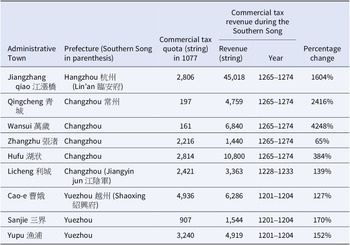
Fiscal evidence lends some support to this interpretation. It is well established that during the Southern Song, commercial tax revenues in the prefectures and counties of the Lower Yangtze grew substantially over the 1077 Northern Song quotas.Footnote 107 As Table 2 shows, towns in these areas followed the same trend. Although part of this increase reflects price inflation, it nevertheless points to commercial growth and effective fiscal extraction. This suggests that the slowdown in new town creation may have been offset by greater administrative intensity in those that remained.
Commercial tax revenues in Lower Yangtze towns

Sources: Qian Yueyou 潛説友, Xianchun Lin’an zhi 咸淳臨安志 (1830 edition), 100 juan in vol. 4 of Song Yuan fangzhi congkan, 59.17a; Shi Nengzhi 史能之, Xianchun Piling zhi 咸淳毗陵志, 30 juan in vol. 3 of Song Yuan fangzhi congkan, 24.8b–9a; Zhu Yu 朱昱, Chongxiu Piling zhi 重修毗陵志 (1484 edition), Zhongguo fangzhi congshu Huazhong difang 中國方志叢書·華中地方 (Taipei: Chengwen chubanshe, 1983), vol. 423, 7.25a; Shi Su 施宿 et al., Jiatai Kuaiji zhi 嘉泰會稽志 (1808 edition), 20 juan in vol. 7 of Song Yuan fangzhi congkan, 5.17b–18b.
Taken together, these findings call for caution in interpreting the Northern-to-Southern Song transition. The prevailing narrative portrays the Northern Song as uniquely proactive in extending state power and the Southern Song as retreating from day-to-day administration. Viewed through the lens of towns, the contrast appears less clear-cut. Administrative towns retained their identity and functions throughout the Southern Song and only disappeared after the Mongol conquest. The “full circle”—in which the imperial state first expanded beyond walled cities and then reverted to them—was not completed until after 1279. The likely decline in southern China’s town numbers during the Southern Song may thus reflect consolidation and intensification rather than simple retreat, complicating the sharp dichotomy that often frames the history of the two dynasties.
Conclusion
During the first half of the Tang dynasty’s three-century rule, the state heavily regulated trade and commerce within administrative centers. Over time, however, driven by population growth and sociopolitical changes, this rigid, state-controlled system began to crumble during the Tang–Song transition, as freer markets proliferated beyond the prefecture and county seats.Footnote 108
Influenced by Skinner’s observation that the number of county-level units in China remained relatively stable over time, a considerable body of literature contends that the Chinese state could neither forestall these changes nor expand beyond the traditional administrative centers to keep pace with such developments. Consequently, from the Song dynasty onward, there was an overall retreat of state influence in day-to-day life.Footnote 109
This study presents a more complex process. During the Tang–Song transition, administrative towns emerged, extending the formal institutions of the state beyond the traditional walled administrative centers. That they did not endure beyond the Song dynasty does not negate the fact that, for five centuries after the An Lushan rebellion, the Chinese state adapted more responsively to rapid socioeconomic changes than earlier accounts have recognized.
This reinterpretation calls for closer scrutiny of Skinner’s use of county counts as a proxy for state penetration. While this measure provides an analytically useful starting point, our evidence reveals two ways in which it can be misleading in the Song context. First, apparent stability in county numbers can conceal the proliferation of other sub-prefectural units—most notably administrative towns during the Northern Song. Second, limited extensive growth (in the number of administrative units) can obscure intensive growth, as in the Southern Song, when commercial tax revenues per town in the Lower Yangtze rose substantially.
We present evidence that approximately 560 of the 1,891 towns in the late eleventh century were overseen by imperial officials tasked with meeting court-mandated tax quotas, administering justice, maintaining local order, and performing other civil functions typically associated with county administration in the Chinese historical context. These towns, therefore, should be considered basic-level administrative units, comparable in function—if not in formal status—to xian and xian-level units. This finding suggests that Song China maintained at least 1,800 basic-level administrative units, significantly higher than the average of around 1,250 de jure county-level units among unified dynasties in imperial China. This indicates a larger state and a greater capacity for direct local control during the Song.
Our estimate of 1,800 is a conservative one, as it focuses exclusively on towns and omits other sub-prefectural entities unique to the Song dynasty, particularly stockades (zhai). Historical records indicate that some stockades were also administered by imperial officials tasked with civil administrative functions, i.e., qinmin officials.Footnote 110 In addition, recent research has identified walled settlements (cheng) as another integral element of Northern Song territorial administration.Footnote 111 A more comprehensive assessment that includes these and other sub-prefectural units would likely raise the total well beyond 1,800.
Recent scholarship suggests that Ming–Qing China’s territorial administration was more expansive than previously considered, primarily because subordinate county officials (zuoza 佐雜), such as patrolling inspectors, were often deployed in market towns and cantons to maintain public order.Footnote 112 If this criterion—the presence of officials responsible for public order—is applied to the Song dynasty, a significant upward revision of the estimated number of basic-level administrative units would be warranted. At a minimum, the 1,331 lowest-tier towns overseen by garrison commanders would satisfy this standard. In addition, patrolling inspectors and county sheriffs who were deployed beyond the prefectural and county seats, particularly during the Southern Song period, would also need to be included.Footnote 113 While such adjustments would undoubtedly raise our estimate, their broader significance may be limited, as these subordinate officials functioned primarily as county outposts and exercised a restricted range of administrative responsibilities.
On a final note, the findings of this paper do not imply that the Song dynasty’s extension of formal administration beyond prefectural and county seats—particularly through the appointment of imperial officials with legal authority in towns—necessarily resulted in a superior governance system compared to the Ming and Qing dynasties. While the Song emphasized direct administration and formal governance, the Ming and Qing relied more heavily on informal mechanisms, such as self-governing bodies and the co-option of local elites to address collective issues. This informal approach may have given the local population, or at least certain groups within it, greater bargaining power with the state.Footnote 114
Formal and informal governance systems are characterized by different strengths and weaknesses, and their relative effectiveness depends on the specific challenges and historical contexts each era presents.Footnote 115 We hope future scholarship will continue to explore how these different approaches to governance evolved and operated, thereby enriching our understanding of the broader trajectory of imperial governance in China.
Acknowledgements
We are grateful to the editor, the associate editor, and two anonymous referees for their helpful comments. Early versions of this project were presented at seminars and conferences at Harvard University, Northwestern University, the London School of Economics, Peking University, and Shanghai Jiao Tong University, and we thank the participants for their valuable feedback. We also thank Zhang Aijia for excellent research support.
Competing interests
The authors declare none.



 Open access

