


Introduction
The landscape of biomedical research has shifted dramatically over the past two decades, with complex scientific challenges demanding increasingly collaborative and interdisciplinary approaches [Reference Wuchty, Jones and Uzzi1,Reference Jones, Wuchty and Uzzi2]. Team science, defined as scientific collaboration across disciplines and knowledge domains, has become essential for addressing the multifaceted challenges in translational research [Reference Stokols, Hall, Taylor and Moser3,Reference Börner, Contractor and Falk-Krzesinski4]. Research teams now encompass a broad range of stakeholders, including industry partners and community members and groups, each bringing distinct expertise, perspectives, and priorities spanning multiple research institutions and contexts. The growth in size and complexity raises unique scientific, logistic, and operational challenges, such as transparent decision-making, fair and accurate allocation of credit, and timely and effective communication, that can impede scientific progress and impact research outcomes [Reference Bennett, Gadlin and Levine-Finley5,Reference Hall, Stokols and Moser6].
Several academic institutions have developed team science consultation services [Reference Wooten, Calhoun and Bhavnani7,Reference Spring, Hall, Moller and Falk-Krzesinski8] to address these challenges. These established programs typically offer consultations with academic research teams that provide ongoing support from early intervention and planning in team formation through research stages and on to sustainability [Reference Bennett, Maraia and Gadlin9]. For example, Stanford’s Team Science Consultations offer facilitation of strategic planning and leadership coaching, while UCLA’s Team Science services focus on enhancing interdisciplinary collaboration through structured interventions. Similarly, the University of Washington’s Team Science Core supports project management and team-building strategies workshops. While some emphasize translating empirical findings from the science of team science into practical solutions for research teams, few report outcomes of their consultation services. To address this gap, we report qualitative outcomes from a real-time consultation program and discuss our experience in the context of emerging team science literature [Reference Gigliotti, Weidner and Jansen19].
Building on these existing models while introducing innovative elements, we describe our experience developing the Team Advice and Consultation Service (TACS), a program designed to address the specific needs of translational research teams at our academic medical center and institution (Columbia University Irving Medical Center, n.d)). Launched as part of our Team Expertise and Management Support (TEAMS) Resource, TACS provides real-time consultations, recognizing the highly contextual nature of team dynamics and emergent challenges. While many established services emphasize structured workshop formats [Reference Vogel, Stipelman, Hall and Nebeling10], TACS focuses on personalized, case-specific consultation approaches. This approach allows for nuanced attention and flexibility in addressing individual team needs, circumstances, and priorities. Following established best practices in the field, TACS prioritizes early-stage training in team formation and development while extending support across teams’ developmental trajectory, from initial formation through maturity [Reference Falk-Krzesinski, Börner and Contractor11].
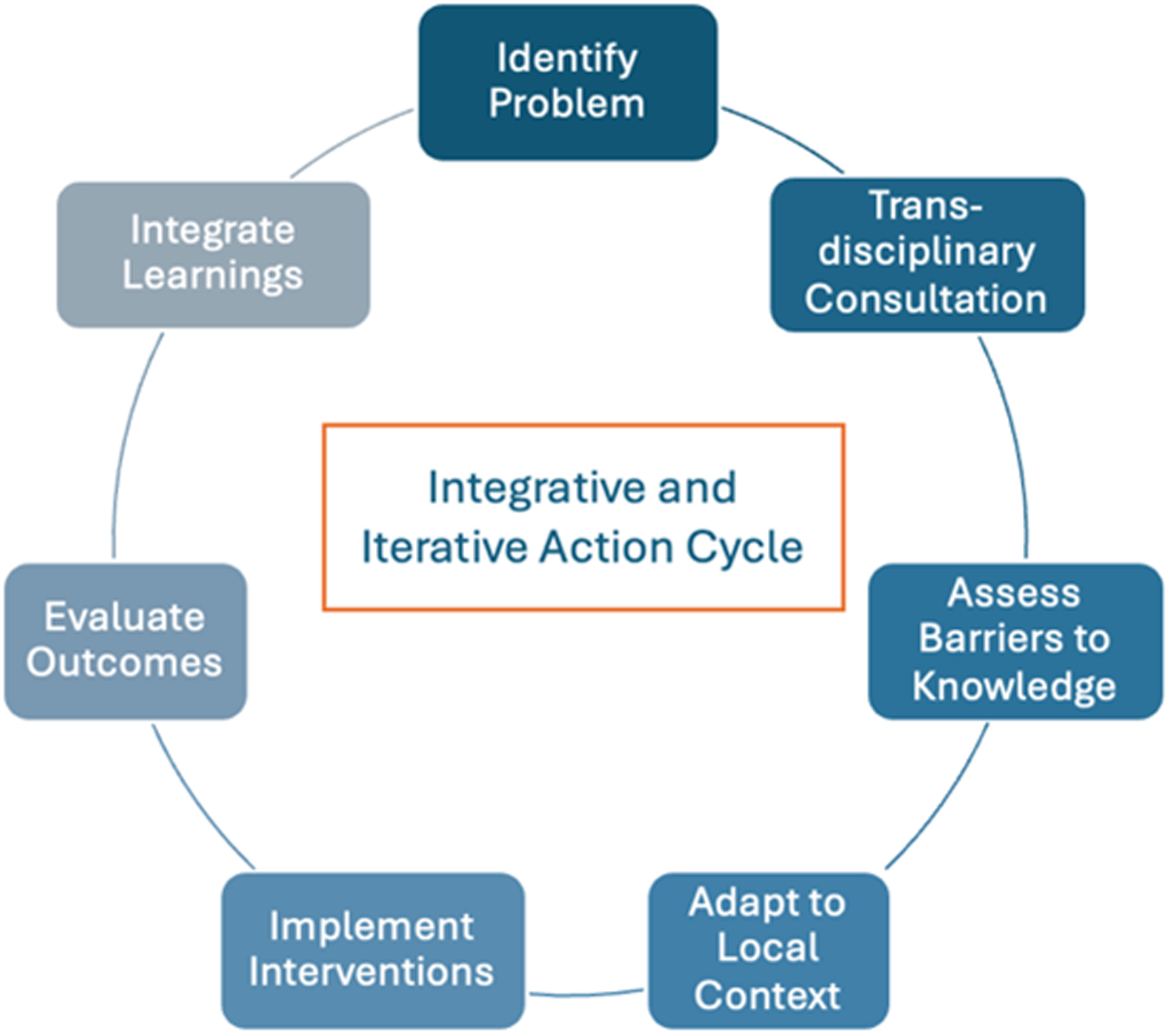
TACS distinguishes itself from existing programs through its explicit grounding in two theoretical models: the Knowledge to Action (KTA) framework and transdisciplinary innovation. The KTA framework conceptualizes knowledge translation as a dynamic process involving both knowledge creation and action cycles, emphasizing the importance of context and stakeholder engagement in moving research into practice [Reference Graham, Logan and Harrison12]. This framework posits that successful knowledge implementation requires systematic attention to local adaptation, barrier assessment, and sustained knowledge use. Transdisciplinary innovation theory complements this by providing a conceptual foundation for understanding how diverse knowledge domains can be effectively integrated to generate novel solutions to complex problems. This framework emphasizes the importance of transcending disciplinary boundaries to create new conceptual frameworks and methodological approaches [Reference Stokols, Frodeman, Klein and Mitcham13] [Reference Stokols, Misra, Moser, Hall and Taylor14]. The integration of these theoretical perspectives provides a robust foundation for team science consultation by combining KTA’s structured approach to knowledge implementation with transdisciplinary innovation’s insights into cross-disciplinary knowledge synthesis. This integrated theoretical framework suggests that effective team science support must address both the practical challenges of implementing evidence-based collaborative practices and the conceptual challenges of fostering genuine transdisciplinary integration (see Figure 1). By grounding consultation services in these complementary theoretical frameworks, TACS establishes a comprehensive approach to understanding and addressing the multiple dimensions of team science challenges.
Knowledge to Action transdisciplinary innovation framework.

This article describes our experience implementing this theoretically grounded, flexible consultation service. Through analysis of consultation cases and outcomes, we aim to contribute to the growing understanding of how institutions can effectively support team science while addressing gaps in current knowledge about team science support services [Reference Hall, Vogel, Stipelman, Stokols, Morgan and Gehlert15]. Our findings provide insights into both the common challenges faced by translational research teams and effective strategies for addressing these barriers and supporting team science in academic medical centers.
Methods
The Team Expertise and Management Support or TEAMS is a resource within the Irving Institute for Clinical and Translational Research, home to Columbia University Irving Medical Center’s Clinical and Translational Science Award (CTSA) hub. The primary goals of TEAMS are to enhance team formation, collaboration, productivity, and sustainability. As part of the TEAMS resource, we developed the consultation service TACS to nurture a collaborative clinical and translational research ecosystem. TACS is founded on the recognition that knowledge translation (1) is not a one-way flow of information; (2) is a cyclical process that requires continuous feedback and refinement; and (3) requires adaptation and tailoring of research findings to specific users and local context.
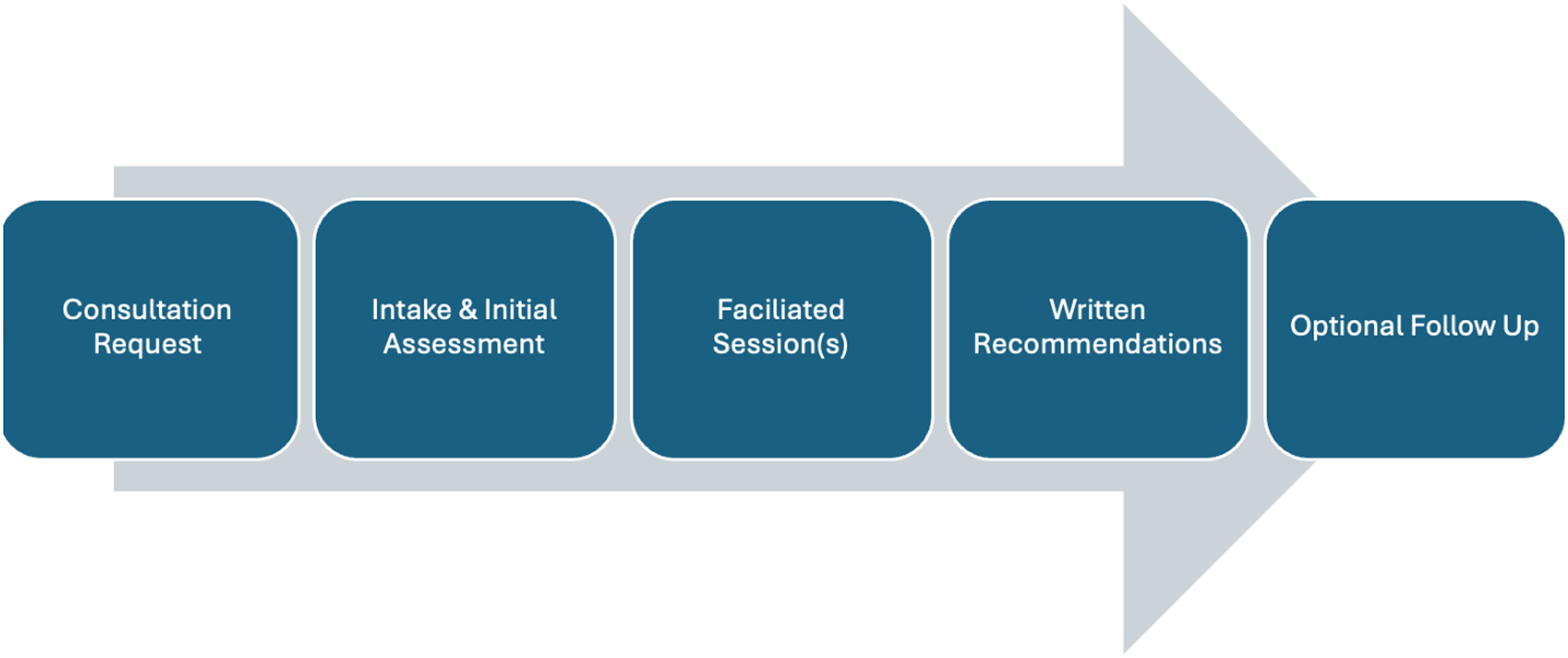
The TACS workflow begins with a consultation request, followed by intake and initial assessment, during which the consult team clarifies the request and scope of support. The process then proceeds to one or more facilitated session(s) with the requesting team. These sessions inform the development of written recommendations, which are provided to the team following the consultation. An optional follow-up may be scheduled at the request of the consulting or participating team to support implementation or continued reflection (see Figure 2). TACS was created to identify and address a range of team science issues, including identifying potential collaborators with specific expertise, onboarding and integration of team members, navigating questions of intellectual property and data ownership, allocation of credit and approaches to authorship, team leadership and communication, and engagement with non-academic partners, including communities, commercial entities, and non-profit organizations. The TACS process is designed as early research development service providing real-time discussion, analysis, and resolution of team science issues in research and clinical settings. It was developed as a process to identify in real time the barriers faced by translational teams, to address these challenges, and to disseminate these learnings into ongoing trainings of our translational workforce and more broadly in the team science literature.
Team advice and consultation service (TACS).

Over the 2023–2024 academic year, seven teams used TACS. Consultees included a range of academic professionals, from medical students to associate professors, representing diverse fields such as clinical psychiatry, pediatrics, medicine, and neurological sciences. The majority of applicants were junior faculty, assistant, and associate professors, with some consults also submitted by students and staff. Consultations were facilitated by TACS members comprising of faculty and experienced program staff with experience in translational research, including CTSA operations. Typical consults included at least two facilitators and at least one faculty who participated in all of the consults. These were conducted either during regularly scheduled TACS team meeting times or during times that allowed for confidential small group sessions when requested by our consultees. Some consultees engaged TACS as one-time events, while other engagements involved multiple consultations. Data for this study were collected through detailed notes and summaries of each consultation session. Qualitative analysis of the consultation topics was performed to identify key themes and challenges faced by translational research teams.
Consultations were independently coded using a literature-informed codebook (SSL and SO): organizational structure, management, communication, and conflict and iteratively refined to incorporate emergent codes. Disagreements were resolved by discussion until consensus. We then conducted a thematic analysis to identify recurrent patterns and illustrative cases (SSL and SO).
This project reflects a programmatic quality improvement of a pilot of an internal consultations program and does not constitute human subjects research. Institutional Review Board (IRB) approval was not sought. Analyses use aggregate, de-identified information without team- or person-identifiers.
Results: Key topics addressed in team science consultations
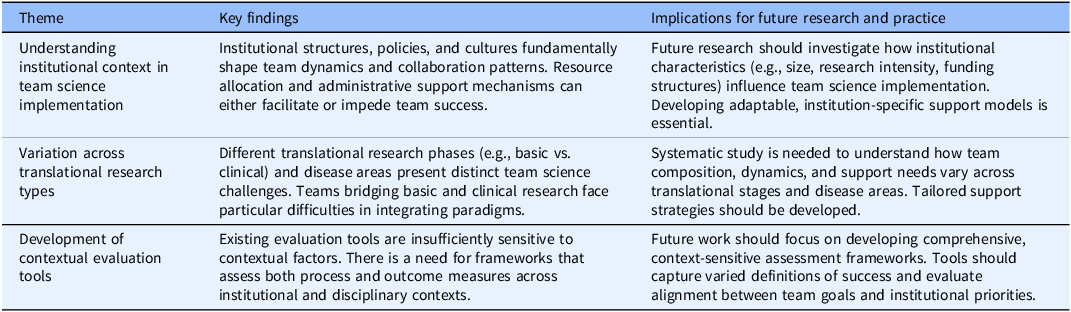
Across consultations with seven translational research teams, we identified five primary categories of team science challenges addressed through our service: organizational complexity, team leadership and management, team dynamics and communication, authorship and credit allocation, and conflict resolution. These consultations, which ranged from single sessions to multiple meetings over several months, provided insights into the complex challenges facing translational research teams. A summary of these results is in Table 1.
Summary of key findings for future directions

Organizational and structural issues
Organizational challenges emerged as a prominent theme, particularly among early-career investigators in clinical departments. Junior faculty members frequently encountered difficulties navigating the complex infrastructure required for translational research. In one notable case, an assistant professor in psychiatry sought guidance on establishing a multi-site clinical trial team. The investigator faced challenges coordinating across three institutions, each with different administrative requirements and IRB and financial approval processes. Through consultation, we helped develop a structured approach to managing these administrative complexities, including suggestions for communication channels and development of standardized operating procedures.
Multiple Principal Investigator (MPI) and Co-Investigator (Co-I) arrangements presented another major organizational challenge. Teams struggled with establishing effective decision-making processes when leadership was shared across disciplines. One team, combining expertise from pediatrics and biostatistics, required assistance in developing a management structure that respected leadership goals related to maximizing data acquisition in the context of clinical participant burden. The consultation process led to the recommendations for a structured plan that clearly delineated areas of authority while maintaining collaborative decision-making for cross-cutting issues.
Team management planning emerged as a critical need, particularly around member transitions and departures. Teams sought guidance on creating comprehensive management plans that could clearly delineate responsibilities and establish protocols for knowledge transfer and data access when members leave the institution. For example, a research group requested help developing an offboarding structure that would address the complex challenges of data stewardship after departure, including determining appropriate levels of continued data access, ensuring data security, and maintaining compliance with funding agency requirements. Key challenges included establishing protocols for archiving member-specific datasets, managing shared data repositories, and determining post-departure data use rights while protecting sensitive research information. The resulting plan included detailed transition workflows, documentation requirements for departing members, data transfer and access protocols, and clear guidelines for maintaining both project continuity and data integrity after member transitions.
Team dynamics and communication
Team dynamics presented complex challenges that often required multiple consultation sessions to address effectively. In one case, a newly formed translational research team in medicine sought help creating an environment that could effectively bridge basic science and clinical perspectives. The consultation process focused on developing shared vocabulary and establishing regular forums for cross-disciplinary dialogue.
Communication emerged as a critical factor in team success. Teams struggled to find the right balance and frequency of communication across different team members and roles. One large team implemented a tiered communication structure based on our recommendations: weekly meetings for core team members and trainees, monthly full team meetings, and quarterly strategic planning sessions. This structure was supplemented by clear guidelines for email communication and use of project management tools. These structures target team climate, which is linked to satisfaction, authorship practices, and data sharing in interdisciplinary teams [Reference Settles, Brassel, Soranno, Cheruvelil, Montgomery and Elliott20].
Making team members feel valued proved particularly challenging in large, complex projects. Consultations addressed strategies for recognition and engagement, especially for team members working on specialized aspects of projects who might feel disconnected from the broader research goals. One team implemented regular “research in progress” sessions where all team members, from research assistants to senior investigators, could present their work and receive feedback.
Authorship and credit allocation
Authorship issues proved to be among the most sensitive challenges requiring consultation. Teams sought guidance on creating fair and transparent authorship policies that could accommodate diverse types of contributions. For example, in one case, a team developing a complex intervention study needed help establishing criteria for authorship that could recognize both research contributions and essential clinical implementation efforts that directly informed the work.
Several consultations addressed specific authorship disputes that had created team tension. One particularly complex case involved disagreement over author order among multi-institutional team members who had made different but substantial contributions to a project. The consultation process discussed clear criteria for evaluating contributions and facilitated development of a co-first author arrangement that appropriately recognized each contributor’s role.
Conflict resolution
Conflict resolution emerged as a critical area requiring multiple consultations with team members over an extended period. Teams sought help when interpersonal or professional conflicts began to impact research progress. In one case, tensions between basic science and clinical team members created communication barriers that threatened project timelines. Through facilitated discussions and development of shared goals, the team identified key areas of conflict, including decision-making authority and ownership over aspects of the research. Several consultations addressed conflicts that arose from unclear expectations or perceived inequities in workload distribution and issues related to relative power. One team required assistance when conflict emerged between senior and junior investigators over project direction and credit allocation. The consultation process helped establish clear communication channels and development of explicit agreements about decision-making processes and recognition of contributions.
These findings highlight the complex and interrelated nature of team science challenges in translational research. While each theme represents a distinct category of challenges, our consultations revealed significant overlap and interaction between these areas. Successful intervention often required addressing multiple aspects of team function simultaneously, with particular attention to how changes in one area might impact others; for example, decisions about data curation impacted downstream data harmonization efforts. Path dependencies reflect the complexity of team collaboration.
Discussion
The pilot suggests that a theoretically grounded, real-time consultation model can address recurrent collaboration barriers and translate team-science evidence into practical, context-specific approaches for translational teams. Our findings support the applicability of KTA and transdisciplinary innovation to structure support for translational research teams.
The KTA framework’s emphasis on iterative knowledge translation proved particularly relevant in addressing organizational and structural challenges. As Graham et al. suggest, the adaptation of knowledge to local context is crucial for effective implementation [Reference Graham, Logan and Harrison12]. This was evident in how different teams required unique organizational solutions based on their institutional contexts and team compositions. The framework’s cycle of identifying problems, adapting knowledge, and monitoring outcomes was particularly valuable in developing and refining team management plans. Targeting climate via cadence, integration practices, and shared language is consistent with evidence that climate mediates effects on satisfaction, authorship, and data sharing [Reference Settles, Brassel, Soranno, Cheruvelil, Montgomery and Elliott20].
The transdisciplinary innovation framework [Reference Stokols, Frodeman, Klein and Mitcham13] provided crucial insights into team dynamics and communication challenges. The framework’s emphasis on antecedent conditions helped identify key factors influencing team readiness for collaboration. This was particularly evident in cases where teams struggled to bridge disciplinary boundaries, reflecting what Hall et al [Reference Hall, Stokols and Moser6]. describe as the “cultural” challenges in transdisciplinary collaboration.
Our findings on organizational challenges align with recent literature on team science implementation. The struggles of early-career investigators with institutional infrastructure reflect what Bennett and Gadlin describe as the “structural barriers” to team science [Reference Bennett and Gadlin16]. However, our results suggest that these challenges are particularly acute in multi-institutional collaborations. The success of structured management approaches in multi-PI arrangements supports Börner et al.’s findings on the importance of formal coordination mechanisms in large research teams [Reference Börner, Contractor and Falk-Krzesinski4]. Our results extend this work by demonstrating how such mechanisms must be tailored to specific institutional contexts and team compositions.
The communication challenges we observed support Thompson’s assertion that effective communication is fundamental to team science success [Reference Thompson17]. However, our findings suggest that communication needs to evolve with team size and complexity, requiring more sophisticated structures than previously described in the literature. The tiered communication approach represents an adaptation of Klein’s models of team communication to the specific needs of translational research teams [Reference Klein, O’Rourke, Crowley, Eigenbrode and Wulfhorst18]. This extends existing theoretical frameworks by demonstrating how communication structures must also adapt to disciplinary differences.
While the KTA framework addresses knowledge sharing broadly, it is limited in fully capturing the complexities of managing sensitive research data across institutions. This suggests a need for theoretical expansion to address modern data-sharing challenges in team science.
The authorship challenges we encountered align with what Stokols et al [Reference Stokols, Frodeman, Klein and Mitcham13]. describe as “recognition systems” in team science. However, our results suggest that authorship issues in translational research are more complex than current frameworks acknowledge, particularly when bridging clinical and basic science contributions.
Limitations
This exploratory analysis is based on a small sample of consultations with seven teams at a single academic medical center that may limit generalizability. Our findings should be interpreted as hypothesis-generating and as a foundation for future, larger-scale evaluation studies in other institutional contexts or team science environments. Moreover, our analyses rely on qualitative notes from a programmatic pilot; future research could incorporate systematic evaluation of long-term impacts and multi-site comparisons.
Future directions
Our experience with TEAMS highlights several critical areas for future research and development in team science support. Three priorities emerge as particularly important for advancing the field.
Understanding institutional context in team science implementation
The influence of institutional context on team science effectiveness requires deeper investigation. Future research must examine how different institutional structures and policies shape the implementation and success of team science initiatives. The role of institutional culture proves particularly significant, as it fundamentally shapes team dynamics and patterns of collaboration. Research should investigate how resource allocation and administrative support mechanisms either facilitate or impede team science success. Methods for adapting team science support services to specific institutional environments represent another crucial area for investigation. Key questions include examining how institutional characteristics such as size, research intensity, funding structures, and administrative organization influence team science needs and outcomes. This research is crucial for developing more effective institution-specific support models that can be sustainably implemented within existing organizational frameworks.
Variation across translational research types
Different types of translational research present unique team science challenges that warrant systematic study. Future research should explore how team composition and dynamics vary across different phases of translational research. Of particular importance is understanding the specific challenges faced by teams bridging basic and clinical research, as these teams often encounter unique obstacles in integrating different research paradigms and methodologies. Research should also address how team science needs vary across different disease areas and research methodologies, as these differences can significantly influence team effectiveness and required support structures.
Development of contextual evaluation tools
There is a critical need for sophisticated evaluation tools that can assess team science support while accounting for contextual factors. Future work should focus on developing comprehensive assessment frameworks that integrate both quantitative and qualitative measures. These frameworks must account for team composition and career stage while remaining sensitive to institutional and disciplinary contexts. Furthermore, they should incorporate methods for evaluating both process and outcome measures to provide a complete picture of team effectiveness. Context-sensitive outcome measures must account for varying definitions of success across different types of translational research. These measures should consider institutional resources and constraints while capturing both short-term and long-term impacts of team science initiatives. Tools for assessing the alignment between team goals and institutional priorities are particularly important for demonstrating the value of team science support services.
Conclusion
We describe the development and implementation of TACS, a structured consultation service for addressing team science challenges in translational research. Analysis of consultations with seven teams during 2023–2024 revealed five critical areas requiring support: organizational structure, team dynamics and communication, authorship allocation, and conflict resolution. These findings highlight common challenges within an academic medical center and demonstrate the role of consultation services in advancing collaborative research. A key contribution of TACS is its integration of theoretical frameworks to guide practice. The Knowledge to Action and Transdisciplinary Innovation models shaped tailored, context-sensitive solutions and supported cross-disciplinary integration. By grounding consultations in these frameworks, TACS linked conceptual models with real-world team needs, enabling both immediate problem-solving and the cultivation of sustainable collaborative practices. Our experience underscores the value of theoretically informed, responsive consultation services in supporting the complex work of team science.
Author contributions
Sandra Soo-Jin Lee: Conceptualization, Supervision, Writing-original draft; Sheila Marie O’Byrne: Project administration, Writing-review & editing; Kayla Zalcgendler: Writing-review & editing; Zainab Abedin: Writing-review & editing; Harley Lynch: Writing-review & editing; Michelle McClave: Writing-review & editing; Rachel C. Shelton: Writing-review & editing; Michael Rosenbaum: Investigation, Writing-review & editing; Harold Pincus: Writing-review & editing; Muredach P. Reilly: Funding acquisition, Writing-review & editing; Daichi Shimbo: Writing-review & editing.
Funding statement
This publication was supported by the National Center for Advancing Translational Sciences, National Institutes of Health, through Grant Number UL1TR001873. The content is solely the responsibility of the authors and does not necessarily represent the official view of the NIH.
Competing interests
N/A.

 Open access

