

Introduction
Autism spectrum disorder (ASD) and attention-deficit/hyperactivity disorder (ADHD) are both neurodevelopmental disorders which share genetic heritability and often coexist in adults diagnosed with ADHD and vice versa. (Solberg et al. Reference Solberg, Zayats, Posserud, Halmøy, Engeland, Haavik and Klungsøyr2019; Antshel & Russo Reference Antshel and Russo2019). Despite the overlap between the two disorders, phenomenological and pathophysiological differences indicate that these conditions are distinct as demonstrated by functional MRI studies. (Tamon et al. Reference Tamon, Fujino, Itahashi, Frahm, Parlatini, Aoki, Castellanos, Eickhoff and Cortese2024). In addition, their co-existence is also supported by emerging biological data in both children with ADHD and those with ASD as they develop into adulthood; for example, in both groups diffusion tensor imaging studies demonstrate increased overlapping corpus callosum tract abnormalities (Zhang et al. Reference Zhang, Fu, Lai, Zhao, Liu and Cao2023). Prior to DSM-5, the presence of one diagnosis effectively precluded the other, thus there was an under-recognition of the coexistence of ADHD and ASD populations (Hoogman et al. Reference Hoogman, van Rooij, Klein, Boedhoe, Ilioska and Li2022) and by extension an inadequate research and service level focus despite evident clinical need.
Previous studies, particularly those in children, estimated the co-occurrence rates of ADHD and ASD, by examining the prevalence of ASD in ADHD samples and its corollary. Those prevalence rates vary extensively, for example, 20–50% of children with ADHD meet criteria for ASD and 30–80% of ASD children meet criteria for ADHD. (Rommelse et al. Reference Rommelse, Altink, Fliers, Martin, Buschgens, Hartman, Buitelaar, Faraone, Sergeant and Oosterlaan2009). Such prevalence estimates are lacking in the adult population.
In addition, those with co-occurring symptomatology of ADHD and ASD were characterised as having poorer functioning, lower quality of life and different comorbidities compared to those with ADHD alone. (Umeda et al. Reference Umeda, Shimoda, Miyamoto, Ishikawa, Tachimori, Takeshima and Kawakami2019; Yerys et al. Reference Yerys, McQuaid, Lee and Wallace2022; Solberg et al. Reference Solberg, Zayats, Posserud, Halmøy, Engeland, Haavik and Klungsøyr2019).
The accurate identification of ADHD is particularly important given that effective treatment in the form of medication is available in contrast to ASD where no specific medication treatment has demonstrated efficacy. The increasing use of ADHD medication worldwide (Raman et al. Reference Raman, Man, Bahmanyar, Berard, Bilder and Boukhris2018) which includes stimulants (e.g., methylphenidate or amphetamine) and non-stimulants (e.g. atomoxetine) underscores the importance of accurate diagnosis. (Cortese et al. Reference Cortese, Adamo, Del Giovane, Mohr-Jensen, Hayes, Carucci, Atkinson, Tessari, Banaschewski, Coghill, Hollis, Simonoff, Zuddas, Barbui, Purgato, Steinhausen, Shokraneh, Xia and Cipriani2018). Due to the paucity of rigorous data to accurately inform clinical estimates as to coexistence of ADHD and ASD in adults, particularly given the considerations relating to availability of highly effective ADHD medication treatments, we performed the present study with three aims: a) to screen a sample of adults diagnosed with ADHD by using the Autism Spectrum Quotient (AQ-10) (Allison et al. Reference Allison, Auyeung and Baron-Cohen2012) to estimate the prevalence of possible autism spectrum disorder; b) to compare those screening positive in the AQ-10 (score 6 and above) to those scoring negative in terms of functionality, quality life and clinical outcome; and (c) to explore the effects of ADHD medication and the other examined variables on the three main outcomes (clinical, quality of life, and functionality).
Methods
Design of the study
Prospective longitudinal, observational, pragmatic study.
Setting
Consecutive outpatients attending an Adult ADHD clinic were approached for participation. The adult ADHD clinic is a tertiary level service which accept referrals from the Adult Mental Health Services (AMHS) in line with the Irish Health Service Executive (HSE) model of care (HSE 2020). This Model of Care directs that patients are fully assessed in AMHS and screened with the Adult ADHD Self-Report Scale (ASRS) (Kessler et al. Reference Kessler, Adler, Ames, Demler, Faraone, Hiripi, Howes, Jin, Secnik, Spencer, Ustun and Walters2005), and Wender Utah Rating Scale (Ward et al.Reference Ward, Wender and Reimherr1993) scales. Those with clinical indications for ADHD who screen positive on both scales are referred to the ADHD Adult Clinic for further clinical diagnostic assessment and treatment.
Inclusion-exclusion criteria
All referred patients who consented were eligible for inclusion. Exclusion criteria for participation in the research were people a) who did not meet the criteria for an ADHD diagnosis b) with severe learning disability, or severe brain injury, and c) not able to speak or read in the English language and not able to complete the self-report questionnaires.
Procedure
Patients who fulfilled the inclusion criteria and consented had an initial assessment on the same day. They then continued to attend the ADHD clinic on a regular 3 monthly basis for a maximum of approximately one year with review appointments comprising psychometric evaluations and medication adjustments as described.
Measurements/scales
Demographics
Demographic data provided by the participant included age, gender, marital status (cohabiting, married, separated, single), years of education, living conditions (alone, with others, with parents, with their own family) occupation (elementary, professional, pensioner, sales and customer services, students, unemployed) and current employment status (employed, unemployed, student).
Diagnosis
Diagnosis was made according to DSM-5 criteria which was facilitated using the Diagnostic Interview for Adult ADHD (DIVA 5), a semi-structured instrument which is well-validated. (Ramos-Quiroga et al. Reference Ramos-Quiroga, Nasillo, Richarte, Corrales, Palma, Ibáñez, Michelsen, Van de Glind, Casas and Kooij2019). In addition, all participants had a clinical psychiatric evaluation based on DSM-5 criteria. The psychiatrist used all available information which included collateral history from parents or other family members (where possible), detailed semi-structured neurodevelopmental history. and was not blind to the administered scales, including DIVA 5.
Medications for ADHD
ADHD medication status was classified in four categories a) stimulants which include methylphenidate/ lisdexamphetamine, b) non-stimulants which include atomoxetine c) others which includes the alpha-2a agonist guanfacine and the antidepressants vortioxetine, duloxetine, venlafaxine, bupropion and a fourth category d) no ADHD medication.
Autism spectrum quotient (AQ-10)
The AQ-10 is a short version of the of the fifty-item scale (AQ-50). It consists of 10 items with each item phrased as a statement for which the respondent rates the degree of agreement or disagreement on a four-point Likert response (definitely agree, slightly agree, slightly disagree, definitely disagree). Four items are positively phrased and so the scores are reversed for these items. For adults, a cutoff point of six and above showed hight specificity and sensitivity for ASD and generally the psychometrics of the scale have been reported as very good (Allison et al. Reference Allison, Auyeung and Baron-Cohen2012; Lundin et al. Reference Lundin, Kosidou and Dalman2019). Given that the AQ-10 is a screening scale and not a clinical diagnostic tool hereafter those with scores of 6 and above are referred to as displaying ‘traits’ of ASD (as opposed to having a definitive diagnosis of ASD).
Adult ADHD clinical outcome scale (ACOS)
ACOS is a clinician-rated scale specifically designed to measure clinical outcomes in adults with ADHD (Adamis et al. Reference Adamis, Singh, Coada, Wrigley, Gavin and McNicholas2024). It measures symptoms, comorbidities, and risk-taking behaviours, in addition to functionality in the two weeks prior to assessment. The scale consists of 15 items, and each item is rated on a five-point Likert scale from 0 = no problem to 5 = very severe problem. It has shown strong psychometric properties including high concurrent validity, interrater reliability, intraclass correlation coefficient, sensitivity to clinical change and high correlation between clinician and patient ratings. (Adamis et al. Reference Adamis, Singh, Coada, Wrigley, Gavin and McNicholas2024). Higher scores indicate poorer outcome.
Adult ADHD Quality of Life Questionnaire (AAQoL)
AAQoL was developed and validated to measure quality of life in patients with ADHD (Brod et al. Reference Brod, Johnston, Able, Swindle, Hartung C.M., Stevens and Lefler2006). The psychometrics of the scale have been investigated, and validity and reliability are demonstrated across studies (Matza et al. Reference Matza, Van Brunt, Cates and Murray2011; Brod et al. Reference Brod, Adler, Lipsius, Tanaka, Heinloth and Upadhyaya2015; Gjervan et al. Reference Gjervan, Torgersen and Hjemdal2019). It consists of 29 items with each item rated by participants on a five-point Likert scale ranging from 1 to 5. It yields a total score (based on all items) and four subscale scores: life productivity, psychological health, life outlook, and relationships. After reversing scores and transforming them to a scale from 0 to 100, higher scores indicate better quality of life.
Weiss Functional Impairment Rating Scale (WFIRS)
Weiss Functional Impairment Rating Scale (WFIRS) is a self-reported scale and consists of 69 items which cover seven domains of functioning (family, work, school, life skills, self-concept, social, and risks). There is a four-point Likert rating scale for each item ranging from zero (never or not at all) to three (very often, very much). Mean scores can be calculated by omitting items with a missing or ‘not applicable’ response (Weiss, Reference Weiss, Adler and Wilens2015). The total mean scores of WFIRS ranges from 0 to 3 and a higher total mean score (or on each domain/subscale) indicates greater functional impairment. The psychometrics for this scale is characterised as good and it has been widely used in research and clinical practice (Canu et al. Reference Canu, Hartung, Stevens and Lefler2020; Weiss et al. Reference Weiss, McBride, Craig and Jensen2018).
Ethics
The Local Research Ethics Committee approved the study. The procedures and rationale for the study were explained to all participants and each participant gave written informed consent.
Statistical analysis
Statistical analysis was conducted using the IBM (SPSS) v25. In considering the first aim of the study, descriptive statistics are reported. Continuous variables are reported as means plus standard deviation, while categorical variables are reported as counts and percentages. Where continuous variables are non-normally distributed the median, minimum, maximum and Interquartile Range (IQR) are reported. Comparison between the two groups, ADHD vs ADHD plus ASD traits, (second aim of the study) was conducted with a parametric (t-tests) for the normally distributed variables and with a non-parametric test (Mann–Whitney test) for the non-normally distributed variables gathered at the first assessment. For the longitudinal analysis, mixed-effects linear models were employed, with the dependent variable being one of the outcome measures in each model (ACOS, AAQoL, WFIRS). Independent variables included demographics, medication status, presence of ASD traits (yes/no), ADHD subtypes/presentations, and their two-way interactions, all treated as fixed effects. Participants were treated as random effects to account for within-subject correlation. These models accommodate the dependency and correlation of repeated observations within individuals. An identity covariance structure was applied for random effects, and a diagonal structure for repeated measures. Model selection was guided by minimising Akaike’s Information Criterion (AIC), iteratively removing non-significant variables and interactions. Little’s Missing Completely At Random (MCAR) test was conducted to determine whether the pattern of missing data (e.g., dropouts) was systematic. Non-significant p-values (p > .05) indicated that the data were MCAR, meaning the missingness was independent of both observed and unobserved data.
Results
Descriptive statistics
Participants
One hundred and sixty-five participants (n= 165) were diagnosed with adult ADHD according to DSM-5 criteria and consented to the study. The mean age was 29.68 (SD:9.87), median = 27, minimum = 18, maximum = 58, IQR = 16. Of them (n = 165), 88 (53.3%) were females. The majority had combined ADHD presentation (n= 102, 61.8%), followed by inattentive presentation (n= 61, 37%) with very few hyperactive/ impulsive only presentation (n= 2, 1.2%).
Assessments and missing data analysis
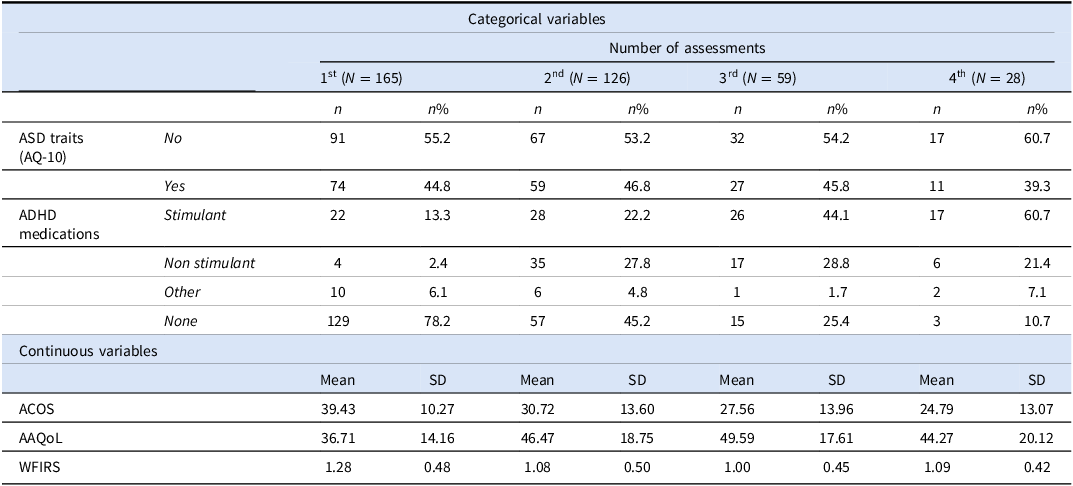
The 165 participants had three or more assessments regularly approximately 3 monthly (for about one year). In total there were 378 assessments distributed as following (dropouts): second assessment 126, third assessment 59, and fourth assessment 28. (see also Table 2). Evaluation of missing data with Little’s MCAR test indicated that the missing values were Missing Completely At Random (MCAR, χ2 = 27.153, df: 19, p= 0.101), meaning that there is no systematic way that the data are missing (no bias).
Rates of ASD traits in the sample
A cut off score of 6 or greater on the AQ-10 self-report questionnaire was used to categorise participants into ADHD with ASD traits or not. N= 74 (44.8%) of the participants fell into the category of ADHD with comorbid ASD traits. For clarity, these are referred to as ADHD/ASD and ADHD groups.
Bivariate statistics at first assessment
Differences in socio-demographic variables between ADHD/ASD and ADHD group
No significant statistical difference was found between the two groups in terms of gender (χ 2 = 0.28, df:1, p= 0.867), marital status χ 2 = 2.232, df:3, p= 0.526), living circumstances (χ 2 = 3.179, df:3, p= 0.385), age (Mann–Whitney U = 3364, z= 0.079, p= 0.937) and years of education (Mann–Whitney U = 1615.5, z= 0.525, p= 0.600). In contrast, occupation showed no significant differences between the two groups (χ 2 = 10.44, df:5, p= 0.064) overall, but inspection of the adjusted residuals showed that those with ADHD only had more often professional jobs and were less likely to be unemployed compared with those with ADHD/ASD (adjusted residuals >2). Similarly, people with ADHD/ASD had lower education levels compared to those with ADHD (χ 2 = 13.289, df:5, p= 0.021).
Differences in quality of life and functionality variables between those with ADHD/ASD traits and those with only ADHD
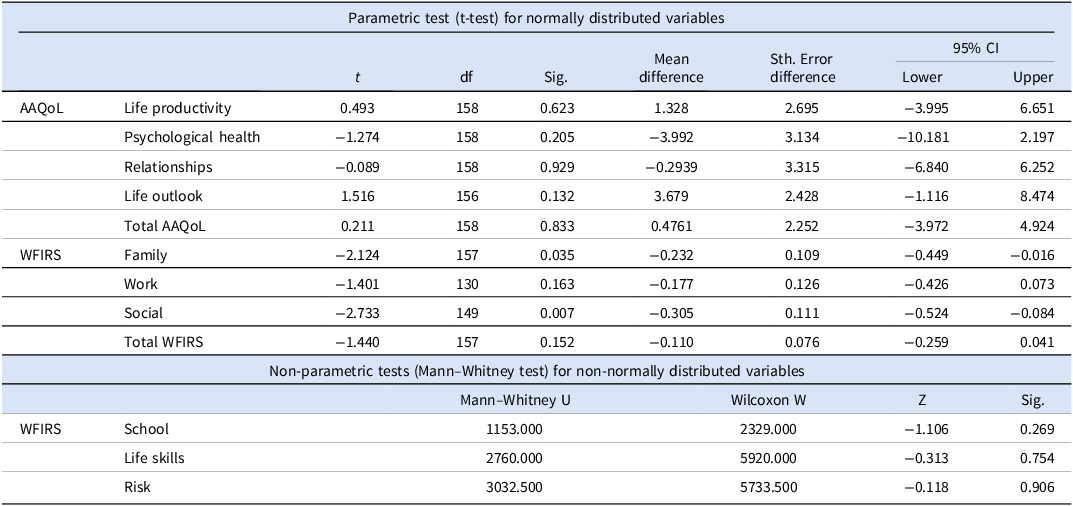
The two groups (ADHD and ADHD/ASD) were examined as to variables concerning quality of life (AAQoL) and functionality (WFIRS) in their totals and subscales at first (initial) assessment. In Table 1 the results of the comparison (t-test for normally distributed variables, and Mann–Whitney test for the non-normally distributed variables) are presented.
Comparison of ADHD and ADHD/ASD traits groups in terms of quality of life (AAQoL) and functionality (WFIRS)

ASD, Autism Spectrum Disorder; ADHD, Attention-Deficit/Hyperactivity Disorder; AAQoL, Adult ADHD Quality of Life Questionnaire; WFIRS, Weiss Functional Impairment Rating Scale.
The table above indicates that the significant differences between the two groups were in family functioning and social functioning. In both variables participants with ADHD/ASD traits had significant worse functioning compared to those with ADHD alone. For the other subscales and total scales (AAQoL, WFIRS) no significant differences between the two groups were found.
Other differences between ADHD/ASD and ADHD, in clinical outcome scale (ACOS), ADHD presentations (inattentive, combined, hyperactive/ impulsive) and number of mental comorbidities
No significant differences were found in the ACOS scale (t= −0.996, df:145, p= 0.321), in ADHD presentations (χ 2 = 0.033, df:2, p= 0.984) and in the number of other mental comorbidities between the two groups (Mann–Whitney U= 2048, z = −0.431, p= 0.666)
Longitudinal analysis (mixed effects linear models)
To address the third aim of the study (whether there were differences in the responses between those with ADHD and those with ADHD/ASD) on the 3 outcomes- clinical outcome, quality of life and functionality, longitudinal analyses were performed using mixed effect models for each one of the main outcomes. In Table 2 the descriptive statistics at each assessment are presented.
Distribution of categorical variables (ASD traits, ADHD medications) and continuous (ACOS, AAQoL and WFIRS) across the assessments

ASD, Autism Spectrum Disorder; ADHD, Attention-Deficit/Hyperactivity Disorder; AQ-10, Autism Spectrum Quotient; ACOS, Adult ADHD Clinical Outcome Scale; AAQoL, Adult ADHD Quality of Life Questionnaire; WFIRS, Weiss Functional Impairment Rating Scale.
Clinical outcome (ACOS)
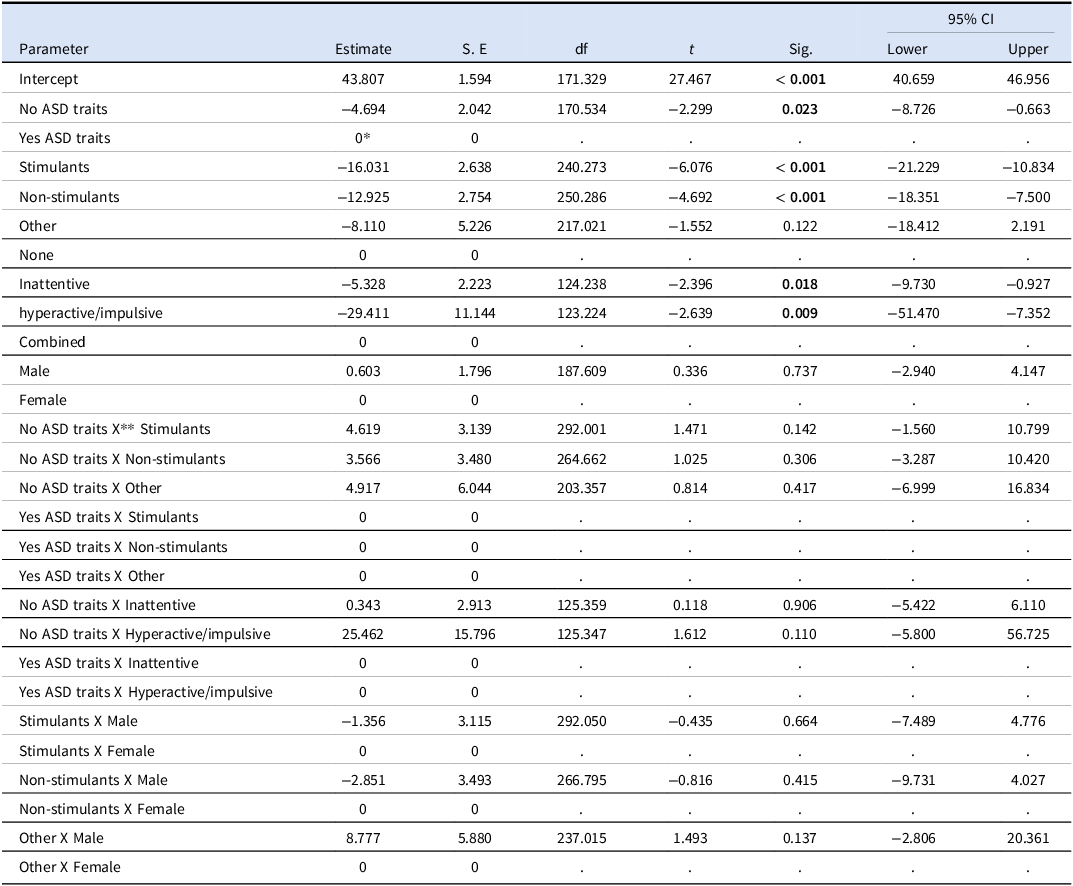
In the initial model, the ACOS was the dependent variable, and independent variables were the demographics (age, gender), ADHD subtypes/presentations, (predominantly inattentive, predominantly hyperactive/impulsive, and predominantly combined), ADHD medications (stimulants, non-stimulants, others, and no medications), ASD traits (no/yes) and all the 2-way interactions. The above variables were treated as fixed effects in the model while participants were treated as random effects. After dropping the non-significant variables, and with guidance, the Alkaile Information Criterion (AIC) (lower AIC indicating a better model) the final parsimonious model is presented in Table 3. The residuals of the last model did not depart from the assumption of normal distribution. Table 3 shows that the statistically significant effect in the clinical outcome (ACOS) is presence of ASD traits, medications, and subtype of ADHD. The other demographic variables age and gender did not have significant effects or interactions. However, some of these variables contributed to the final model and so were retained (lower AIC). Age was dropped as it did not have any effect (significant or not). Table 3 thus indicates that those with only ADHD had better outcomes during the time compared to those with ADHD/ASD traits. Those on stimulant or non-stimulants medication (atomoxetine) had significantly better clinical outcome compared to those without medications, and those with inattentive and hyperactive/impulsive presentations had better outcomes compared to those with combined presentation. Regarding the latter, it is important to note that only 2 participants had hyperactive/impulsive presentation and thus a statistical artefact may have impacted the results.
Estimates of the fixed effects during the time on the dependent variable ACOS score

ASD, Autism Spectrum Disorder; ADHD, Attention-Deficit/Hyperactivity Disorder; ACOS, Adult ADHD Clinical Outcome Scale.
The sign minus (−) or plus (+) in front of the estimates indicate the direction of relationship. E.g. the negative of the no ASD traits indicate lower scores in ACOS (better outcome).
In Bold are the statistically significant values.
*The parameter is set to zero because is the reference parameter. **The X: indicates the interaction between the variables.
Quality of life (AAQoL)
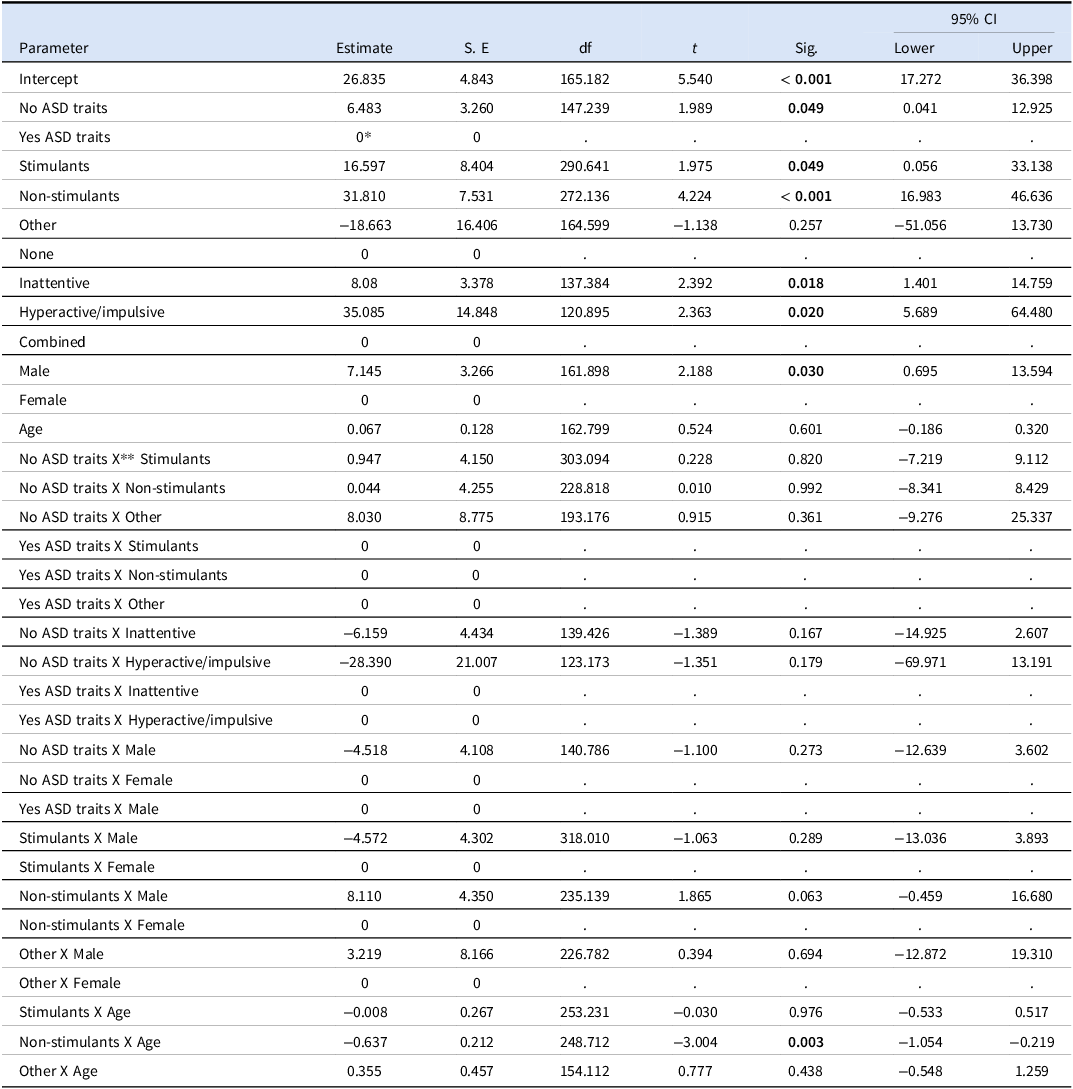
AAQoL was used as the dependent variable and the independent variables were the same as above together with the 2-ways interactions. Following the same procedure as above (dropping the nonsignificant variables and testing for lower AIC and normality of the residuals) the final parsimonious model is the one presented in Table 4. Table 4 demonstrates that those without ASD traits have significant (although marginally) better quality of life compared to those with ASD traits. In addition, those on stimulants (marginally) and those on non-stimulants have better quality of life compared to those without medications. Similarly, as with clinical outcomes those with inattentive and hyperactive/impulsive presentations had better quality of life compared to those with combined presentation across the time. In addition, males had better quality of life compared to females. The interactions between the variables did not have significant effect on the quality of life except the interaction of non-stimulants (atomoxetine) with age. With increasing age those on atomoxetine had poorer quality of life compared to others.
Estimates of the fixed effects during the time on the dependent variable AAQoL

AAQoL, Adult ADHD Quality of Life Questionnaire; ASD, Autism Spectrum Disorder; ADHD, Attention-Deficit/Hyperactivity Disorder.
The sign minus (−) or plus (+) in front of the estimates indicate the direction of relationship. E.g. the positive of the no ASD traits indicates higher scores in AAQoL (better quality of life).
In Bold are the statistically significant values.
*The parameter is set to zero because is the reference parameter, **The X: indicates the interaction between the variables.
Functional impairment (WFIRS)
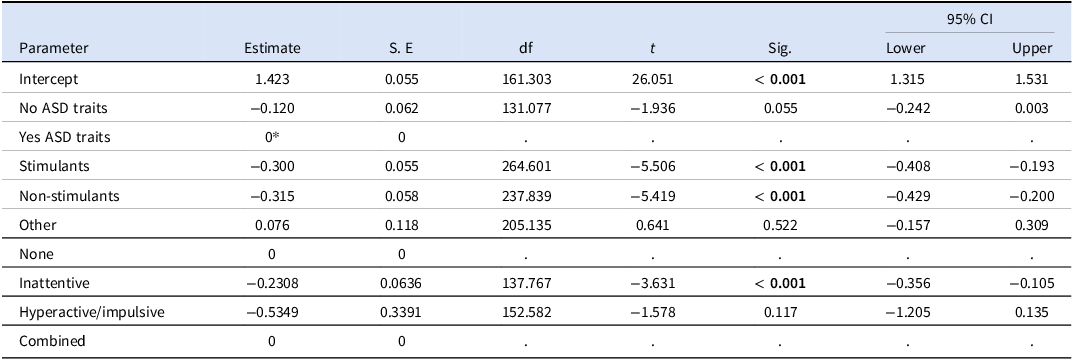
In this model the WFIRS scores was the dependent variable. The model presented in Table 5 is the parsimonious model. As can be seen from the table, those on stimulants or non-stimulant medications had better functionality compared to those not taking medication. Similarly, those with inattentive presentation had better functionality compared to those with combined presentation. However, the functionality of those with ADHD compared to those with ADHD plus ASD traits was not significantly different across time.
Estimates of the fixed effects during the time on the dependent variable WFIRS

WFIRS, Weiss Functional Impairment Rating Scale; ASD, Autism Spectrum Disorder.
The sign minus (−) or plus (+) in front of the estimates indicate the direction of relationship. E.g. the negative estimate in stimulants indicates better functionality (lower scores in WFIRS).
In Bold are the statistically significant values.
*The parameter is set to zero because is the reference parameter.
Given the established social difficulties associated with ASD together with the fact that the bivariate statistics had shown a significant difference at initial assessment the social subscale of WFIRS was examined longitudinally. People with ADHD/ASD traits had significantly worse functionality in social skills compared to those with only ADHD (t= −2.923, p= .004). Similarly, as in the previous model, those on medication, both stimulant medications (t= −2.753, p= 0.006) and on non-stimulant (atomoxetine) had better social skills during the timeframe studied, compared to those without medication (t = −2.954, p= 0.003). Those with inattentive presentation had better social functionality compared to those with combined presentation (t = −3.875, p = <0.001).
The above rationale also formed the basis for examining the family subscale of WFIRS. Again, those with ADHD/ASD traits performed less well in family skills across the timeframe under study compared to those with only ADHD (t= −3.070, p= 0.003). The effects of the other variables (stimulants, non-stimulants, and inattentive presentation) remained significant as in the total WFIRS above. The last three analyses indicates that the measure of total functioning remains consistent across the timeframe under study (although marginally p= 0.055), but family functioning and social skills are significantly more impaired in those with ASD traits compared to those without.
Discussion
The findings of this study indicate that nearly 45% of those diagnosed with ADHD in an adult ADHD clinic also display ASD traits. Furthermore, longitudinal analyses (of approximately 1-year follow up) demonstrate that people with ADHD/ASD traits have worse clinical outcomes, quality of life, social skills and family functioning compared to those with ADHD only. Although the effects of ADHD medications (stimulants and atomoxetine) were significant in the three examined outcomes across the timeframe under study, the interaction of medication with the ASD variable had no significant effect on the outcomes. Also, ADHD presentation (subtypes) had a significant effect on the clinical outcome and quality of life (those with inattentive and hyperactive/impulsive presentation had better clinical outcomes and quality of life compared to those with combined presentation). These findings will be considered in detail below.
Firstly, the finding of 45% of patients with ADHD also displaying ASD traits may be considered surprisingly high despite some previous studies showing similar percentages. However, ADHD and ASD are two of the most prevalent neurodevelopmental disorders in childhood with many continuing into adulthood. Approximately 5–7% of children globally have ADHD (Polanczyk et al. Reference Polanczyk, Willcutt, Salum, Kieling and Rohde2014), which reduces to 2–5% among adults (Kooij et al. Reference Kooij, Bejerot, Blackwell, Caci, Casas-Brugue and Carpentier2010). Prevalence rates for ASD are also increasing and estimated to affect 1 in 36 children (2.77%) in the United States (Maenner et al. Reference Maenner, Warren, Williams, Amoakohene, Bakian and Bilder2023). The co-occurrence of these two common neurodevelopmental disorders has been recognised for many years, with studies indicating that around 60% of children with ADHD also exhibit traits consistent with ASD (Davis & Kollins Reference Davis and Kollins2012). A retrospective study of children/adolescents with ADHD from the Swedish National Patient Register showed comorbid rates of autism in 46.1% sample (Giacobini et al. Reference Giacobini, Ahnemark, Medin, Freilich, Andersson, Ma and Ginsberg2023). Similarly, a retrospective study examining a claims database in Japan found rates of ASD to be the most common comorbidity, occurring in 54.4% of children with ADHD. (Okada et al. Reference Okada, Sotodate, Ogasawara-Shimizu and Nishigaki2024).
In clinical samples of youth, reported rates of ASD in ADHD range from 65–80%. (Rommelse et al. Reference Rommelse, Altink, Fliers, Martin, Buschgens, Hartman, Buitelaar, Faraone, Sergeant and Oosterlaan2009; Mattingly et al. Reference Mattingly, Wilson, Ugarte and Glaser2021; Zhong & Porter Reference Zhong and Porter2024). Although less well studied in adults, comorbidity is thought to be lower than in children, with rates varying widely depending on the sample and diagnostic methods used (Kentrou et al. Reference Kentrou, de Veld, Mataw and Begeer2019; Mattingly et al. Reference Mattingly, Wilson, Ugarte and Glaser2021). In the Swedish register, rates in adults dropped to 20.7% in those aged 18 years or older. (Giacobini et al. Reference Giacobini, Ahnemark, Medin, Freilich, Andersson, Ma and Ginsberg2023) and in the Japanese claims study, rates dropped to 22% (Okada et al. Reference Okada, Sotodate, Ogasawara-Shimizu and Nishigaki2024) One possible explanation for this discontinuity is the growing demands for social adaptation and the use of executive functioning skills in adulthood, which may make the presentation of co-occurring ADHD and ASD less apparent, or less diagnostically significant, over time (Hartman et al. Reference Hartman, Geurts, Franke, Buitelaar and Rommelse2016; Orm et al. Reference Orm, Øie, Fossum, Andersen and Skogli2021). However, this hypothesis is speculative, and the current literature lacks sufficient high-quality, replicated data to provide a definitive explanation. It is also of note that the above studies are retrospective, from registers and that other clinical samples of adults report rates of 59.5% (Kentrou et al. Reference Kentrou, de Veld, Mataw and Begeer2019). Furthermore, our study found that almost half of adults with ADHD screening positively on the ASD measure thus indicating the presence of ASD traits. Whilst the higher rate may be falsely elevated by the use of a screen rather than an in-depth clinical interview for ASD, it aligns with other research suggesting that the coexistence of ASD and ADHD increases with age (Visser et al. Reference Visser, Rommelse, Greven and Buitelaar2016; Zhang et al. Reference Zhang, Fu, Lai, Zhao, Liu and Cao2023).
Furthermore, the model of care employed at the clinic where this research was conducted may have introduced some degree of bias in the sample. Our clinic is a specialist tertiary centre for adult ADHD, and patients referred to this clinic are typically those with more prominent clinical ADHD symptoms; individuals with dominant ASD traits and only mild ADHD symptomatology may not be referred. Given that the most prominent ADHD cases are more likely to be seen in this clinic, it could lead to a lower rate of co-occurring ADHD and ASD traits in the clinic population than in the general population. In addition, it is equally possible, given the stark lack of appropriate ASD services at local and national level in Ireland together with the higher functional impairment of those with co-existing ADHD and ASD a higher number of those with ASD may have been referred to the ADHD clinic thus increasing the percentage of comorbidity. As such service provision arrangements and/or functionality may influence referral patterns potentially biasing comorbidity rates within the clinic sample. Further longitudinal research is needed to explore the prevalence of ADHD and ASD within child cohorts and both condition continuity and service transition in adulthood.
Despite the lack of similar studies in clinical samples of adults and thus the paucity of accurate data to inform clinical interpretation, the findings of the present study signal that the co-existence of ASD symptoms in adults with ADHD is clinically highly relevant. The clinical impact of the dearth of accurate data is underscored by previous research which has shown that the diagnosis ADHD might delay the diagnosis of ASD in children and adolescents by an average of about 3–6 years (Miodovnik et al. Reference Miodovnik, Harstad, Sideridis and Huntington2015; Wei et al. Reference Wei, Hsu, Huang, Bai, Su, Li, Lin, Tsai, Pan, Chen and Chen2021; Kentrou et al. Reference Kentrou, de Veld, Mataw and Begeer2019), but not in adults (Kentrou et al. Reference Kentrou, de Veld, Mataw and Begeer2019). Considered together these results emphasise the need to develop clinically accurate, relevant practical, timely and scalable multidimensional and multidisciplinary procedures to assess autism spectrum disorder not only in child and adolescent services but also in adult specialist clinics for ADHD.
In addition, the longitudinal analyses demonstrated that people with ADHD and coexisting ASD traits have worse clinical outcomes, quality of life, social skills and family functioning compared to those with ADHD only, but no differences were found in overall functionality. Given that the main features of ASD relate to challenges with communication and interaction with people and the presence of repetitive, restricted behaviour, interests, or activities, (APA 2013) the finding of social skills and family functioning impairment is to be expected and in line with multiple previous studies (Wang et al. Reference Wang, Xu, Ji, Zhang, Du, Li, Luo and Li2019). This is also the case with quality of life (Theodoratou, Reference Theodoratou2024). Previous studies predominantly in children and adolescents have also demonstrated results in line with the findings of the present study (Joshi et al. Reference Joshi, Faraone, Wozniak, Tarko, Fried, Galdo, Furtak and Biederman2017; Capp et al. Reference Capp, Agnew-Blais, Lau-Zhu, Colvert, Tye, Aydin, Lautarescu, Ellis, Saunders, O’Brien, Ronald, Happe and McLoughlin2023).
Interestingly, previous studies report that children and adolescents with ASD and ADHD are more likely to have predominantly combined presentation of ADHD (e.g. Joshi et al. Reference Joshi, Faraone, Wozniak, Tarko, Fried, Galdo, Furtak and Biederman2017; Zablotsky et al. Reference Zablotsky, Bramlett and Blumberg2020) but in our study this was not the case, as no differences were found across the subtypes. However, there is scatter in previous findings with some studies demonstrating no difference (Nydén et al. Reference Nydén, Niklasson, Stahlberg, Anckarsater, Wentz, Rastam and Gillberg2010; Krakowski et al. Reference Krakowski, Cost, Anagnostou, Lai, Crosbie, Schachar, Georgiades, Duku and Szatmari2020). As highlighted previously, one of the subtypes (hyperactive/impulsive) in the current study had only two participants which limits the reliability of any inferences drawn. However, it is worth emphasising, that this low number is in line with the expected low rate in adulthood; moreover, even in childhood as the rate of hyperactive/impulsive subtype is low, estimated at 6–8% of the total ADHD population (Gibbins et al. Reference Gibbins, Weiss, Goodman, Hodgkins, Landgraf and Faraone2010). Thus, given that hyperactivity is reduced with age it is reasonable to infer that the prevalence of hyperactive/impulsive subtype in the current sample is representative. Regarding the subtypes, the inattentive presentation had better outcomes (clinical, quality of life and functionality) compared to the combined presentation which is in line with similar results reported from previous studies which were cross sectional (Sobanski et al. Reference Sobanski, Brüggemann, Alm, Kern, Philipsen, Schmalzried, Heßlinger, Waschkowski and Rietschel2008; Gibbins et al. Reference Gibbins, Weiss, Goodman, Hodgkins, Landgraf and Faraone2010; Mak et al. Reference Mak, Chan, Chan, Tang, Lai, Wong, Leung, Hung, Lam and Lee2020; Meyer et al. Reference Meyer, Alaie, Ramklint and Isaksson2022). Since the combined subtype includes both symptom clusters relating to inattention and hyperactivity it may be reasonable to predict that clinical outcomes, functionality, and QoL would be more negatively impacted.
Finally, the results demonstrate that the effects of ADHD medications (stimulants and atomoxetine) had a significant direct effect on all the three examined outcomes across the timeframe under study which was statistically independent of the interaction of medication with ASD status. This means that despite the use of ADHD medications, those with ASD symptoms did not have significant improvement in the measured outcomes and perhaps the effects of ADHD medications (if any) were minimal. Indeed, a recent meta-analysis of the effect of ADHD related medications in ASD symptomatology (irritability, and self-injury) reported small effects of ADHD medications on irritability, and no clear evidence of any effect on self-injury; there was some evidence that atypical antipsychotics may result in a reduction in self-injury, although the evidence is uncertain (Iffland et al. Reference Iffland, Livingstone, Jorgensen, Hazell and Gillies2023).
Strengths and limitations of the study
This study has several strengths. It is one of very few longitudinal, pragmatic studies examining the prevalence of ASD traits in adults with ADHD and their long-term outcomes, providing valuable insights into the coexistence of these conditions. It also highlights the importance of considering both ADHD and ASD in clinical practice, particularly in terms of a need for more comprehensive treatment strategies than those focusing solely on ADHD symptoms.
However, there are some limitations to consider. First, the referral pathway to the specialist ADHD clinic may have resulted in a sample with attenuated ASD traits, potentially leading to an underestimation of the true rate of co-occurrence. Conversely, the limited availability of appropriate ASD services for adults may contribute to increased referral rates among individuals with more pronounced ASD features, thereby introducing a sampling bias that could inflate the estimated prevalence of co-occurring traits. Secondly, while ASD traits were screened for, no formal clinical assessment was conducted, which means the findings are based on screening tools and may be influenced by false positives or false negatives. Additionally, the small sample sizes in some of the categories (e.g., ‘hyperactive/impulsive’ and ‘Other’ medication categories) could lead to type II errors, limiting the generalizability of findings relating to those categories. Lastly, only pharmacological interventions for ADHD were considered, with no ASD-specific or behavioural interventions, potentially giving the impression that ADHD medication alone is sufficient treatment, which may not be the case for all individuals.
Despite these limitations, the study provides an important contribution to understanding the prevalence and treatment of co-occurring ADHD and ASD in adults. However, larger, more diverse samples with comprehensive clinical assessments are needed in future research to provide more robust data and a clearer understanding of the coexistence of these disorders in adulthood, as well as the outcomes of simultaneous treatment.
Implications of the study
One key clinical implication of this study is the delayed diagnosis of both ADHD and possible ASD. In most of our sample, ADHD was first diagnosed in adulthood, prompting the consideration of ASD, despite both being neurodevelopmental disorders typically present from early childhood. The American Academy of Pediatrics recommends routine developmental surveillance and ASD-specific screening at 18 and 24 months. However, these practices remain exceptions (Dai et al. Reference Dai, Miller, Ramsey, Robins, Fein and Dumont-Mathieu2020). In Ireland, the ‘Maskey report’ has led to reluctance among parents to refer children to CAMHS and hesitancy among doctors to prescribe medications, limiting access to evidence-based treatments (Bond et al. Reference Bond, Ong and McNicholas2024). Consequently, delayed diagnoses of neurodevelopmental disorders contribute to suboptimal outcomes in adulthood and present further sociocultural barriers to early intervention.
This study also highlights important implications for the newly established specialist Adult ADHD clinics, which are not yet equipped to assess and treat co-occurring conditions like ASD. At a national level, there is a need to shift policies and practices to support integrated service provision, avoiding diagnostic silos. Those changes have already been suggested in the Sláintecare Report (Oireachtas Committee, 2017). In reality these new services are still very much in their infancy and as it currently stands there are limited ADHD specialist clinics for adults which are difficult to access and where they do exist often, they have long waiting lists. Irrespective of the national policies and service provisions our findings suggest that individuals with both ADHD and ASD may require different interventions and levels of support, as they face worse outcomes compared to those with ADHD alone. Given the lack of robust, longitudinal data, further research is needed to confirm these findings and improve long-term care strategies for individuals with both disorders.
Conclusions
The present study highlights a high potential for co-existence of ASD traits in adults attending ADHD clinics, emphasising the need for increased awareness of this comorbidity in clinical practice. Our findings suggest that those with both ADHD and ASD traits experience worse longitudinal outcomes than those with ADHD alone. The implications of these findings are both clinical and policy related. At a national level, there is an urgent need to ensure that services are equipped to identify and treat the full spectrum of neurodevelopmental disorders, including co-occurring ADHD and ASD. This is crucial for improving outcomes and providing multimodal and comprehensive care, ensuring that all individuals receive the appropriate, integrated care they need.
Financial support
This research received no specific grant from any funding agency, commercial or not-for-profit sectors.
Competing interests
None.
Ethical standard
The authors assert that all procedures contributing to this work comply with the ethical standards of the relevant national and institutional committee on human experimentation and with the Helsinki Declaration of 1975, as revised in 2008. The study protocol was approved by the Research Ethics Committee Sligo University Hospital.

 Open access

