


INTRODUCTION
‘Birkebeinerrittet’ is one of the world's largest mountain bike races, taking place every year in the mountains in the southeast of Norway. The track is 95 km and around 19 000 participants are expected each year, divided into two races on consecutive days. The main event takes place on Saturday and hosts around 14 000 participants.
Similar races in previous years have been associated with outbreaks of gastrointestinal illness, both in Norway [Reference Kapperud1, Reference Stuart2] and other countries (T. Bruun et al., unpublished observations), and exposure to mud is one of the identified risk factors for illness, even in different settings such as a music festival [Reference Cramping3]. Campylobacter is a common pathogen associated with these outbreaks [Reference Kapperud1, Reference Stuart2].
The Birkebeinerrittet track crosses an area where many grazing animals are present. Faeces from grazing animals can contain enteropathogens [Reference Hofshagen, Heier and Hauge4] and in wet and muddy conditions, mud splashes to the face during cycling may cause infection. In 2009, the race took place under severe weather conditions, with heavy rainfall during the previous days. That year, an outbreak of gastrointestinal illness affected an estimated 3800 participants, resulting in one of the largest diarrhoeal outbreaks in Norway, with significant media coverage and a heavy socioeconomic toll (more than 2500 days of absence from work). A retrospective cohort study using web-based questionnaires was performed after the race in order to identify any potential common sources (T. Bruun et al., unpublished observations). No single food or drink item was identified as the source; however, mud splashes to the face were associated with gastrointestinal illness [odds ratio (OR) 6·3, 95% confidence interval (CI) 3·7–10·6]. The study also showed that spitting out the first sip when drinking from a bottle or ‘camelbak’ and using mudguards had some protective effect.
Based on the findings from the 2009 study, the organizers recommended that the participants use mudguards and spit out the first sip of water from drinking bottles during the race in 2010. They also implemented environmental control measures, by draining parts of the track and spreading gravel in the areas more prone to get muddy, and asking sheep-owners to gather their animals earlier than the previous year, so fewer animals were close to the tracks.
In 2010 around 19000 people registered to take part in the races that took place on 27–28 August. Although slightly colder, weather conditions were similar to the previous year. The average temperature was 13·1 °C in 2009 and 10·1 °C in 2010. Rainfall during the 5 days preceding the races was 43·7 mm in 2009 and 36·6 mm in 2010.
We conducted a retrospective cohort study to describe the knowledge and the use of the proposed preventive measures among participants and where they received information. Our aim was also to compare the findings with those from the previous year regarding illness, and assess risk or protective factors associated with gastrointestinal disease.
METHODS
We conducted a retrospective cohort study that included all participants of the Birkebeinerrittet 2010. Data were collected using a web-based questionnaire (a modified version of the one used in 2009) and included questions on demographics (age, gender, residence), about the bike race (when they started, total cycling time, falls, etc.), sources of information and use of preventive measures (mudguards, spitting the first sip, etc.), and symptoms (type, length, doctor's appointment, length of sick leave, etc.).
Two weeks after the race, the link to the electronic web-based questionnaire (QuestBack) was sent to the email addresses of all participants of the Birkebeinerrittet 2010. Duplicate, invalid or undeliverable email adresses were removed from the list provided by the organizers. A reminder email was sent to non-responders 5 days after the initial questionnaire.
Participants who had also participated in the previous year's race became a sub-cohort and were also asked questions to allow comparison of track conditions in 2009 and 2010.
Data from the study conducted in 2009 (T. Bruun et al., unpublished observations) were used to compare and describe any changes in the use of preventive measures.
For the analytical study, a case of gastrointestinal illness was defined as a participant in Birkebeinerrittet 2010 who had self-reported diarrhoea within 10 days after the race. Participants who reported recent diarrhoeal illness in household contacts were excluded, as well as participants who reported diarrhoea the same day of the race, to exclude probable exercise-induced diarrhoea. Respondents who did not finish the race, did not race at all or raced in both Friday and Saturday races were excluded in order to increase specificity of the exposures.
Statistical analyses
Data were imported from QuestBack online servers into MS Excel and the statistical analyses was performed using Stata v. 10.0 (StataCorp., USA). Univariate analyses was conducted for all the risk factors. We calculated attack rates (AR) and risk ratios (RR) with 95% CIs for the binary exposures and ORs with 95% CIs for risk factors categorized in more than two groups. Backward manual multivariable logistic regression analysis was performed, using exposures with P values <0·2 in the univariate analyses. Exposures with P values <0·05 were retained in the final model.
Environmental investigations
Mud samples were collected from the track and analysed for faecal indicator bacteria by a local environmental laboratory.
RESULTS
From the 18004 valid emails sent to participants we gathered 12465 online replies, resulting in a response rate of 69·2%. After implementing the exclusion criteria, 11721 respondents remained eligible for the study.
Most of the participants were male (84·2%) and 56·2% were aged between 35 and 49 years. The main race on Saturday had 9131 (77·9%) participants and the race on Friday had 2590 (22·1%) participants.
Illness
There were 1808 (15·4%) participants who reported being sick. Of these, 636 participants reported gastrointestinal symptoms and, according to the case definition for our study, there were 572 cases of gastrointestinal disease.
Of those fitting the case definition, 104 reported being sick for more than 7 days, and 201 reported needing at least 1 day of sick leave, leading to a total of 460 work days being lost. Only 46 participants sought medical attention, and of those, 19 provided stool samples, with seven of them being positive for Campylobacter, one positive for Salmonella, three were negative and eight results unavailable.
Most of the gastrointestinal disease cases had symptom onset within 2 days after the race (Fig. 1).
Cases of gastrointestinal disease, by day of onset of symptoms.

Preventive measures and exposures
During the race, participants drank from several sources: ‘camelbaks’ were used by 63% of participants, 57% reported having drinking bottles on the bike and 57% reported drinking from cups or cartons. Some reported drinking water (44·8%), but most reported drinking other hydrating solutions (84·2%).
The number of participants adopting preventive measures increased from the previous year (Table 1).
Proportion of reported use of individual protective measures (mudguard use and spitting out the first sip of the bottle) in Birkebeinerrittet participants in 2009 and 2010
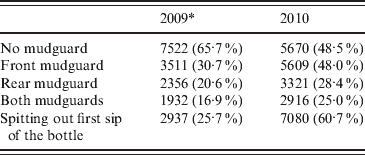
* Data from the 2009 study (T. Bruun et al., unpublished observations).
Track conditions
Most participants (89·6%) reported mud splashes to the face, while 62·9% reported mud splashes to the mouth. Most participants (55·8%) also reported spending at least half of the race ‘cycling on the wheel’ (close behind other participants).
From the subcohort of 6791 (58·4%) participants who had participated the year before, around half stated conditions on the track were quite similar to the conditions during the 2009 race. However, 42·4% reported fewer animals close to the track, 35·8% of participants reported that there was less mud on the track and 29·5% reported that they got less mud in the face during the race.
Information sources
When asked if, and from where, they received information on preventive measures before the race, most participants reported finding it through the organizers' website (81·8%) or through newspapers (60·1%). Other sources of information were friends/colleagues (36·0%), television (30·3%) or web forum (12·9%). Only 3·4% reported that they had not seen any information on preventive measures.
Use of mudguards was higher in those who had received information on preventive measures than in those that had not received information. The use of mudguards was highest in those who had accessed information from the organizers' website (52·6%) or through newspapers (53·2%). Of those who said they had received no information, only 37·2% reported using mudguards.
Analysis of risk and protective factors
From the univariate analysis of the risk factors it can be observed that participating in the race on Saturday had a risk ratio of 3·08 as compared to cycling on Friday.
The risk was also higher for participants reporting mud in the face (2·85), or in the mouth (2·21). The lack of mudguards also presented an increased risk: 1·87 for no rear mudguard and 1·83 for not having a front mudguard.
The results from the univariate analyses for the binary risk factors are shown in Table 2.
Results from the univariate analyses of risk factors for gastrointestinal illness in Birkebeinerrittet participants in Norway in 2010

AR, Attack rate; RR, risk ratio; CI, confidence interval.
Two variables (age and start time) were categorized in three categories. Regarding age, using the >50 years old age group as reference, participants aged between 35 and 50 years had an OR of 1·55 (95% CI 1·19–2·01) and those aged <35 years had an OR of 2·23 (95% CI 1·69–2·96). Regarding start time, using those starting between 07:00 and 09:59 hours as reference, participants starting between 10:00 and 12:59 hours presented an OR of 0·70 (95% CI 0·59–0·84) and participants starting between 13:00 and 15:59 hours had an OR of 0·64 (95% CI 0·44–0·94).
After performing multivariable analysis, results show that Saturday's race had a higher risk as well as having mud in the mouth, spitting out the first sip of the bottle, not using a front mudguard, and being younger. On the other hand, starting later was associated with lower risk.
The final multivariable model is presented in Table 3.
Results from the logistic regression model of risk factors for gastrointestinal illness in Birkebeinerrittet participants in Norway in 2010

aOR, Adjusted odds ratio; CI, confidence interval, ref., reference group (OR = 1).
Environmental investigation
Laboratory results from the muddy water samples yielded very high counts of presumptive E. coli (>16000 c.f.u./ml in ten samples). No further analyses were performed.
DISCUSSION
Considering that the weather conditions were similar in 2009 and 2010, the significant decrease in cases with gastrointestinal disease in 2010 seems to indicate that the implementation of control measures was effective. As shown in previous studies, exposure to mud significantly increases the risk of developing gastrointestinal disease. Therefore, any measures that aim at reducing mud exposure will have a protective role.
It is difficult to assess the impact of the individual preventive measures vs. the environmental control measures the organizers implemented. We have no objective data to assess if the environmental measures (draining and spreading gravel in muddy areas, keeping grazing animals away from the track) were effective, but participants reported fewer animals close to the track and a reduction in mud, leading to a reduced risk of contaminated mud splashes to the face compared to the previous year. The OR for developing gastrointestinal disease by getting mud in the mouth was also lower in 2010 than in 2009, which might be a proxy for the reduced contamination of the mud (given the environmental control measures that were put in place).
Considering the individual preventive measures, it is noteworthy that there was a clear increase in the use of mudguards among participants. These improvements (in both the front and rear mudguards) will reduce the amount of mud in the face. Cycling ‘on the wheel’ is also more likely to cause mud splashes in the face. The fact that more than half of the participants ‘cycle on the wheel’ together with less than 30% of them using back mudguards increases the likelihood of splashing mud on the cyclist following.
Participants who reported receiving information on recommended measures (either from the organizers' website or from newspapers) were more likely to have installed mudguards. Considering these are the most common sources of information, this is particularly important and a comprehensive media communication strategy should be put in place.
Younger participants were at higher risk of developing disease. This might be explained by the fact that younger participants adopt a more ‘aggressive’ behaviour on the track. This may also explain the protective effect of starting later, since faster (and therefore, more ‘aggressive’) participants are entitled to start earlier. A similar explanation may account for the fact that participants in Saturday's main competitive event had a higher risk than Friday's participants. Other issues that might have influenced the higher risk is the fact that it rained more on Saturday and that there were many more participants on the track. Moreover, the race on the day before might have worsened the conditions of the track, increasing the risk for participants on Saturday.
There are some limitations to the study. These include factors which we did not register or may be unknown factors which can be confounders but are difficult to measure and register. For example, risk factors concerning food items were not included in this study due to the fact that they were thoroughly analysed in the study the year before, yielding no significant risk factors and that the food items usually eaten (raisins, fruits, buns) are unlikely to be the source of the outbreak. However, it cannot be discounted that some cases of illness were due to food consumption. Other potential confounders concerning potential sources unrelated to the bike race, such as travel history and pet ownership were not recorded, but those who reported recent diarrhoeal illness in household contacts were excluded.
Regarding the increased risk for no rear mudguard, this probably does not directly reduce mud exposure; however, one explanation may be that participants are more likely to cycle ‘on the wheel’ with people they know, and that people who know each other or cycle in groups are more likely to use the same equipment. Spitting out the first sip was also shown to be a risk factor for illness in our study. This finding does not support the 2009 study where spitting the first sip was found to be a weak protective factor. We do not believe that this is a plausible risk factor, but rather that it may be due to residual confounding. One possible explanation could be that those more heavily exposed to mud in the face were also more prone to spitting.
The study had a high response rate, indicating that the internet is an efficient tool for the investigation of outbreaks in computer-literate populations [Reference Griffiths5]. This clearly is the case, given the fact that registering for the race can only be done online. Participants in this particular event are committed and engaged in every aspect of the race and they wanted to provide as much information as possible (including helpful comments submitted, which are not reported here).
The methods used in this study are the same as used in the previous year, so the findings are comparable and, based on the data gathered from the 2009 study, usual risk factors for gastrointestinal disease in other settings, such as food, were not included. Comparison with other similar studies is, however, hindered by the fact that the case definition for gastrointestinal disease was not standardized and reporting diarrhoea can be interpreted differently by different individuals.
Laboratory results showed high faecal contamination in mud samples. We have no results from 2009 for comparison, but faecal coliforms and E. coli are commonly used in water quality testing to detect faecal contamination. These organisms are present in high numbers in the gastrointestinal tract of almost all warm-blooded animals, and are therefore used as indicator bacteria for the likelihood of the presence of pathogens. Although no further laboratory investigations were conducted, it is likely that it would be possible to isolate the pathogens that were detected in stool samples from ill participants.
Considering that the attack rate was more than three times lower in 2010 than in the same race in 2009, it is possible that the preventive measures taken in the 2010 race were responsible for this improvement.
Recommendations
Considering that exposure to faecally contaminated mud is a risk factor, all environmental measures that can reduce mud exposure and contamination should be considered. These include removing grazing animals from near the track or designing tracks in areas where there are no such animals and reducing muddy areas (by draining of mud, spreading gravel or diverting seepage water from such areas).
Since the study shows that recommendations were followed by participants, in future events a communication strategy should be designed, focused on the advantages of preventive measures and reducing risk behaviour. The younger age group should be targeted with special care. Birkebeinerrittet participants are a very engaged population, so these conclusions might not apply to the general population.
As a way of reducing the risk of gastrointestinal disease, the use of mudguards should be recommended. While front mudguards can help reduce risk for the individual participant, rear mudguards are more important in reducing the risk in cyclists following. Organizers may consider making the use of mudguards compulsory according to weather and track conditions.
As diarrhoeal illness is common after this type of sporting event, efforts to decrease the risk of illness are important. In our study we observed a large decrease in illness in 2010 compared to 2009 after implementing environmental control measures and issuing advice on preventive measures to the participants. These measures appear to have been effective in reducing illness and should be considered in both the environmental area, as well as in individual behaviour.
Considering the participants in these events are usually highly cooperative and motivated, studies specifically addressing remaining questions provide an open field of research.
ACKNOWLEDGEMENTS
The authors are grateful to the EPIET programme coordinators for reviewing and scientific advice; Tone Bruun for providing the data for the 2009 study and data analysis tools; and Emily MacDonald for helpful review of the manuscript.
DECLARATION OF INTEREST
None.



