


Introduction
The economic crisis that started in 2008 has led to growing unemployment and shrinking economic growth across Europe and the rest of the world (De Grauwe & Ji Reference Grauwe and Ji2013). Almost ten years on, there is great variation in the economic conditions of different European nations. Particularly in those countries worst hit by economic recession, large protests took place as European governments were blamed for the deteriorating conditions (Rüdig & Karyotis Reference Rüdig and Karyotis2013; Giugni & Grasso Reference Giugni and Grasso2015a; Grasso & Giugni Reference Grasso and Giugni2013, Reference Grasso and Giugni2016). All these observations raise important questions with respect to the relationship between protest behaviour and micro‐ and macro‐level deprivation. They also motivate an interrogation of the nature of the link with a perceived imbalance between expected standards of living and the realities of current economic conditions as a result of the economic crisis.
The literature on social movements has been split between those emphasising the importance of resources for political involvement and those instead seeing grievances as an important spur for action. Since the 1970s, objective material conditions and deprivation have largely been dismissed as explanations for political action (Useem Reference Useem1998; Buechler Reference Buechler, Snow, Soule and Kriesi2004). Earlier scholars such as Smelser (Reference Smelser1962), Gurr (Reference Gurr1970) and to some extent Piven and Cloward (Reference Piven and Cloward1977) had seen negative material conditions, expressed in grievances, as the precondition spurring individuals to contentious political action. However, the main strands of research on mobilisation emerging since then, including ‘resource mobilisation theory’ (RMT) (e.g., McCarthy & Zald Reference McCarthy and Zald1973), political process (e.g., Tilly Reference Tilly1978; McAdam Reference McAdam1982; Kriesi et al. Reference Kriesi1995) and new social movement theory (Touraine Reference Touraine1981; Melucci Reference Melucci1989) have viewed material hardship as largely unimportant or only relevant to the extent that social movements could frame it in ways to mobilise action.
The sudden rise of protest movements during the recent economic crisis has brought to the fore once more the question of whether grievance theories may play a role in explaining collective action. Scholars have started to re‐examine the impact of grievances on protest behaviour (e.g., Rüdig & Karyotis Reference Rüdig and Karyotis2013; Bernburg, Reference Bernburg2015). However, most studies only examine the effect of these factors on mobilisation from either an individual or a macro‐level perspective, but do not consider the interaction of individual and contextual level factors (Kern et al. (Reference Kern, Marien and Hooghe2015) is a recent exception, but here change in economic conditions is examined and the focus is not protest specifically). To address this gap in the literature, we examine the interplay of micro‐level grievances and macro‐level factors for protest behaviour. In particular, we argue that the extent of the effect of individual deprivation on protest is conditional upon the presence of contextual macroeconomic and policy factors which broaden out perceived political opportunities.
The high levels of variation in the current economic contexts of European nations and the differences in policy responses across national governments provide an excellent test case for investigating these macro‐micro interactions. While subjective perceptions of relative deprivation have been shown to be important for mobilisation to contentious political action (Klandermans et al. Reference Klandermans, Stekelenburg and der Toorn2008), we argue that individuals also take cues from the general economic environment and that state policies will also have an impact on mobilisation (see Giugni and Grasso (Reference Giugni and Grasso2015b), for example, in relation to the environmental movement). We theorise that the impact of feelings of relative deprivation on engagement in protest activities is moderated by macroeconomic and political contextual factors (Giugni & Grasso Reference Giugni and Grasso2016). To investigate this proposition we analyse data from an original cross‐national survey conducted in 2015 in the context of the ‘Living with Hard Times’ (LIVEWHAT) project [grant agreement number 613237] coordinated by the University of Geneva (Marco Giugni) and funded by the European Commission under the auspices of the 7th Framework Programme. We specify multilevel models with cross‐level interactions and show that micro‐level deprivation interacts with contextual factors to spur protest behaviour. In what follows, we first review previous research, then detail the data and methods used in our study, present our results and finally discuss their wider implications for the discipline and for theorising about protest in times of crisis.
Previous research
As citizens struggle to cope with the negative effects of the economic crisis, attention has been drawn to related issues of fairness and the distribution of resources in society. Recent years have seen a growth in studies on inequality (Nolan & Whelan Reference Nolan and Whelan2011; Musterd & Ostendorf Reference Musterd and Ostendorf2013; Dorling Reference Dorling2014; Piketty Reference Piketty2014; Atkinson Reference Atkinson2015). While less has been written on the political ramifications of these developments, some social movement scholars have recently sought to ‘bring capitalism back into protest analysis’ (Della Porta Reference Della Porta2015). With the economic crisis still unfolding and growing inequality across the globe, it is time to re‐examine the debate in political science, sociology and social movement studies over whether deprivation leads to an increase or a decrease in protest participation.
Grievance theories see material deprivation as instrumental to social movement mobilisation (Useem Reference Useem1998; Buechler Reference Buechler, Snow, Soule and Kriesi2004). Various feelings such as psychological strain, alienation and other negative emotions are understood to emerge from it, leading people to challenge the political order (Opp Reference Opp1988). Kornhauser's (Reference Kornhauser1959) mass society theory emphasised concerns over anomie and egoism present in Emile Durkheim's classic work and suggested that the breakdown of mid‐level groups and social anchors would lead individuals to gravitate to collective behaviour as one of the only few available sources of social belonging in modernity. Smelser (Reference Smelser1962) combined strain and breakdown theories focusing on dissolution of social cohesion during periods of change into a structural‐functionalist theory of collective behaviour. An important variant in the grievance tradition is relative deprivation theory (Gurr Reference Gurr1970). Here the strain is understood at the individual level and pertains to comparisons either with some reference group or oneself against past or future selves (Buechler Reference Buechler, Snow, Soule and Kriesi2004). Relative deprivation theory in particular emphasises the gap between expectations and experienced reality (Geschwender Reference Geschwender1968; Davies Reference Davies1962).
While stressing the primacy of perceptions of illegitimate deprivation, Thompson (Reference Thompson1971) and Scott (Reference Scott1976) also saw a role for structural breakdown in explanations of protest. Piven and Cloward (Reference Piven and Cloward1977) combined political factors and the stress of structural changes wrought by the Great Depression in their explanation of social unrest. While some elements of strain and breakdown theories persisted in these works and those of Useem (Reference Useem1980), Goldstone (Reference Goldstone1986, Reference Goldstone, Goldstone, Gurr and Moshiri1991a, Reference Goldstone1991b) and Snow et al. (Reference Snow1998), among others, a large number of scholars challenged grievance‐related explanations as they did not seem particularly useful to make sense of the new social movements emerging since the 1960s–1970s. For example, Tilly et al. (Reference Tilly, Tilly and Tilly1975) emphasised group solidarity as the key factor explaining collective action. More generally, resource mobilisation theory emphasised the rationality of social movements as following the patterns of more institutional types of action (McCarthy & Zald Reference McCarthy and Zald1973, Reference McCarthy and Zald1977; Oberschall Reference Oberschall1973; Tilly Reference Tilly1978). Since grievances were understood as constant over time they were discounted as explanatory factors for mobilisation and the focus moved on to that which varied – that is, resources (McCarthy & Zald Reference McCarthy and Zald1977). Individual‐level studies also supported resource‐based accounts, and education, occupation and income were seen as major drivers of participation (Verba et al. Reference Verba, Schlozman and Brady1995).
One of the clearest challenges to the idea that grievances led to protest came from political process theory (Tilly Reference Tilly1978; McAdam Reference McAdam1982). Political opportunity structures, central to this approach, were understood in terms of the institutional features of the political system and the set‐up of the configurations of power relative to challengers such as social movements. Political process theory emphasised the importance of resources and political opportunities, but also the subjective dimension of protest and framing (Eisinger Reference Eisinger1973; Kitschelt Reference Kitschelt1986; Tarrow Reference Tarrow1994; McAdam Reference McAdam, McAdam, McCarthy and Zald1996; Kriesi Reference Kriesi, Snow, Soule and Kriesi2004; Meyer Reference Meyer2004). The key insight was perhaps the suggestion that the subjective understanding of the status quo as something that could be challenged provided the rational basis for protest (McAdam Reference McAdam1982). For example, McVeigh (Reference McVeigh2009) noted how declining power altered individuals’ perceptions of their circumstances and provided opportunities for constructing new mobilising frames.
While the emphasis tends to be placed on the social construction of grievances as critical for protest (Klandermans et al. Reference Klandermans, Stekelenburg and der Toorn2008), some prominent studies have noted how ‘objective’ grievances can also be relevant (Snow et al. Reference Snow1998; McVeigh Reference McVeigh2009). Snow et al.’s ‘disruption of the quotidian’ framework emphasises the role of interference with normal routines in the tradition of Piven and Cloward (Reference Piven and Cloward1977). Disruptions could be nuclear disasters or threats to the neighbourhood. Deprivation that leads to changes in routines can become a quotidian disruption (Snow & Soule Reference Snow and Soule2009). Protest could result from deprivation without an equal decline in expectations (Thomassen Reference Thomassen and Jennings1989).
More recently, the economic crisis has spurred further studies of the impact of economic hardship on political participation. However, none of these studies looks specifically at the relationship between protest and relative deprivation, and most of them focus on just the individual or macro‐level, and thus cannot test for cross‐level interactions between the two. Caren et al. (forthcoming) use newspaper reports of contentious acts across 157 countries during 1960–2001 and find a significant negative relation between contentious acts and economic growth. Laurence and Lim (Reference Laurence and Lim2012) show that the economic crisis depressed volunteering in the United States and the United Kingdom (see also Clarke & Heath Reference Clarke and Heath2014; Lim & Laurence Reference Lim and Laurence2015). Using 2004 International Social Survey Programme data, Dodson (Reference Dodson2015) finds evidence that the mobilising effects of economic uncertainty are strongest among the most vulnerable. Kern et al. (Reference Kern, Marien and Hooghe2015) use European Social Survey data for 2002–2010 to show a direct effect of unemployment change between 2009 and 2010 on a scale measure of non‐institutionalised participation. However, they find no significant cross‐level interaction for ‘double‐deprivation theory’ (Foster & Matheson Reference Foster and Matheson1995: 1168): the expectation that in countries particularly hit by the crisis ‘the personal becomes political’ so that individuals who suffer become particularly motivated to action.
In this article we build on the idea from political process theory that grievances matter to the extent that they are socially constructed and subjectively perceived in order to develop our argument that deprivation felt by individuals in times of crisis will be more likely to lead to protest behaviour under certain contextual conditions, or political opportunities. Following Bermeo and Bartels (Reference Bermeo, Bartels, Bermeo and Bartels2014), we suggest that the policies implemented by national governments may also interact with individual‐level relative deprivation to spur political action. This argument develops from political opportunity theory since policies are an important component of political opportunities (Meyer Reference Meyer2004).
Our argument, we hope, also contributes to the literature by examining how economic and political factors configuring the political opportunity structures in turn interact with deprivation to enhance the protest potential of grievances. Case studies of marginalised groups such as the homeless (Snow et al. Reference Snow, Soule and Cress2005), militias (Van Dyke & Soule Reference Dyke and Soule2002), the Ku Klux Klan (McVeigh Reference McVeigh2009) or the unemployed (Giugni Reference Giugni2008) provide mixed support for the influence of economic threat on mobilisation. Research to date has examined how institutional structures allow marginalised groups such as the unemployed opportunities to mobilise (Chabanet & Faniel Reference Chabanet and Faniel2012; Giugni Reference Giugni2008). Studies have shown that mobilisation of the unemployed is higher where cultural contexts support it and where elites are more open to these types of demands. Generally, contexts characterised by higher levels of social spending are contexts more encouraging of the protest of those who are relatively more deprived. Higher levels of social spending denote more social democratic political cultures where inequality and poverty are constructed as social and political problems. In turn, this leads individuals to understand their deprivation as susceptible to political solutions through political participation. On the other hand, liberal or neoliberal contexts tend to be characterised by more individualised understandings of poverty, thus depressing protest action. Taken together, these considerations contribute to the theoretical argument that we develop and test in this article in keeping with the political opportunity approach that suggests that the effect of individual relative deprivation will be emphasised under certain contextual dynamics.
To summarise, we expect that relative deprivation will spur engagement in protest activism to a greater extent where it occurs in concomitance with macro‐level external conditions in terms of more open political opportunity structures. The former could be seen to be reflected in high unemployment rates or slow economic growth, while the latter can be seen in particular in higher levels of social spending or higher rates of taxation. We understand these conditions to be conducive to the politicisation of individual deprivation, thus spurring political action to a greater degree than simply the direct effect. By developing and testing a theory on the interrelation between relative deprivation, macroeconomic context and political opportunity structures our research also heeds the calls to develop scholarship on micro‐macro linkages for explaining protest (Opp Reference Opp2009).
Data and methods
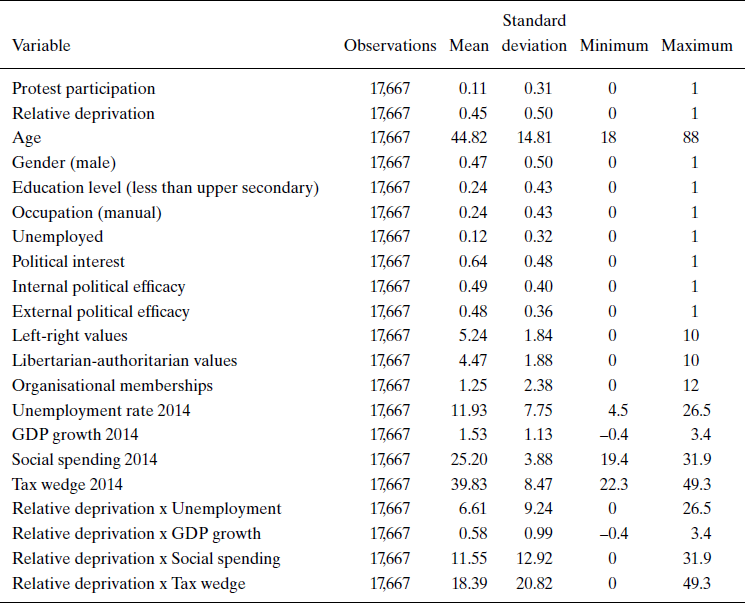
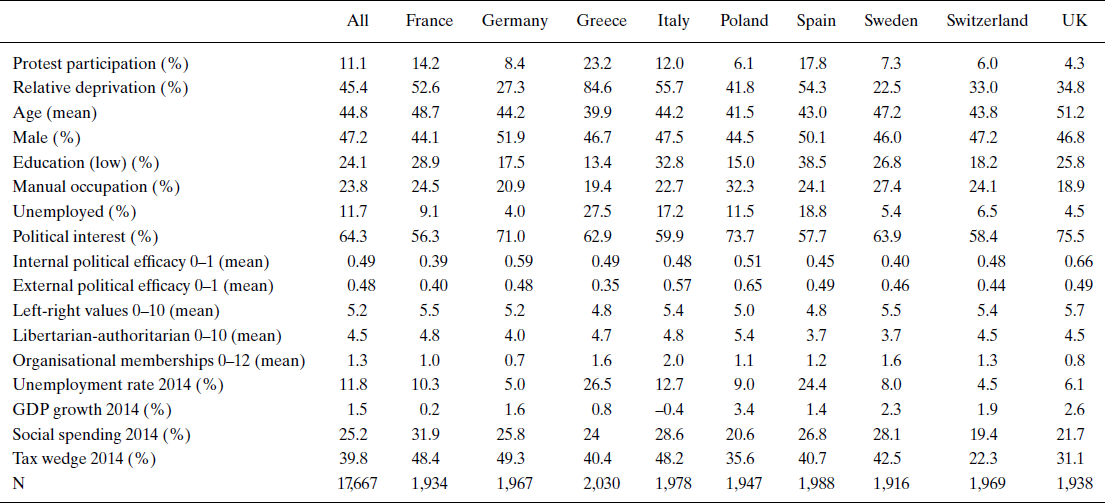
We use data from an original cross‐national survey (N = 18,370) conducted in 2015 in the context of the ‘Living with Hard Times’ (LIVEWHAT) project funded by the European Commission under the auspices of their 7th Framework Programme. The survey was conducted in each of the nine European countries included in the project (France, Germany, Greece, Italy, Poland, Spain, Sweden, Switzerland and the United Kingdom) by a specialised polling agency (YouGov) using online panels with the methodologies available in each country and quota balanced in order to match national population statistics in terms of region, sex, age and education level. We also include macro‐level data from 2014 from the World Bank on unemployment and gross domestic product (GDP) growth as well as from the Organisation for Economic Cooperation and Development on government social spending and tax wedges. Descriptive statistics for all the variables are presented in Table 1. Once all missing values are removed, the final sample is 17,667 (Ns for each country are reported in Table 2).
Variable descriptive statistics

Variable distributions, by country

Our dependent variable is a dichotomous one, measuring whether someone had participated in protests in the last 12 months. Since studies have shown that protest participation has features distinct from other types of political action that could reasonably be classed in the ‘unconventional’ realm (Grasso Reference Grasso2011, Reference Grasso2014, Reference Grasso2016), we do not create scales of activities but rather focus on this ‘modal’ expression (Tarrow Reference Tarrow, McAdam, McCarthy and Zald1996) of social movement activism, also as exemplified by the anti‐austerity demonstrations taking place as a result of the crisis. As an alternative, scales for non‐institutional participation (e.g., Kern et al. Reference Kern, Marien and Hooghe2015) could be problematic, particularly at the cross‐national level, since they include very different types of political action that are likely to have different relationships with deprivation. Additionally, some actions, such as petitioning, are extremely popular whereas other forms, such as demonstrating, are practiced by much smaller fractions of the population. Moreover, since we want to understand the impact of the economic context in 2014 on participation in 2015, we limited the indicator to participation in the last year. Table 2 shows the proportion of individuals that said they had demonstrated in the last 12 months in each country. As we can see, there is a reasonable degree of variation, part of which appears to be related to the severity and extent of the crisis. Countries where the crisis had deeper effects saw greater levels of protest (e.g., Greece).
The key independent variable for subjective feelings of relative deprivation is retrospective to the last five years so that the deterioration of conditions relative to expectations should have at least begun to occur prior to protest participation in the last 12 months and, as such, the time‐ordering of independent and dependent variables respects the requirements of causality. Respondents were asked whether they felt that the economic situation of their household was much better or much worse than it was five years ago. We dichotomise this measure following previous research (Rüdig & Karyotis Reference Rüdig and Karyotis2013) in a dummy for whether individuals felt the economic situation of their household had become worse. Table 2 also shows the proportion of individuals who said the economic situation had become worse in each country. Here too, there is a good amount of variation.
Our key macroeconomic variables aim to examine both negative and positive indicators of economic context. On the one hand, high unemployment levels are perhaps the most pernicious consequence of the current economic crisis in Europe. Countries like Greece and Spain, where unemployment is highest, are those that in general have suffered the most from the current economic crisis. On the other hand, we also examine GDP growth as this is perhaps the clearest measure that a country is doing well and is coming out of recession. Both variables are taken for 2014 in order to examine conditions prior to participation but not too far back in time.
On the policy side, we include two measures: the government expenses for social policies (as a percentage of the GDP) and the tax wedge (as a percentage of labour cost). These two variables reflect also a definition of austerity policies as reducing government spending, especially in the social realm, and increasing taxation, especially on labour. Most importantly for our present purpose, they are meant to capture the output side of political opportunity structures. Again, both variables are taken for 2014.
We also include in our models the usual sociodemographic controls (for more information, see Grasso et al. Reference Grasso2016; Grasso Reference Grasso2013; Dunn et al. Reference Dunn, Grasso and Saunders2014; Saunders et al. Reference Saunders2012): age, gender (male), education level (less than upper secondary), occupation (manual) and employment status (whether the respondent is unemployed). Furthermore, we include a number of controls for political attitudes and resources: political interest, internal and external political efficacy (the external political efficacy scale is reversed), left‐right values, libertarian‐authoritarian values, and number of organisational memberships (descriptive statistics and distributions by country for all dependent and independent variables are provided in Tables 1 and 2).
Our dependent variable is measured at the individual level but we have independent variables at both the individual and the country levels. Moreover, we are interested in the interactions between these two levels since our argument refers to differences in how individual subjective feelings of deprivation relate to individuals’ protest behaviour according to country‐level economic and political contexts. For this reason, we specify multilevel models with random intercept coefficients to take into account the two‐level nature of the data (country and individual). This model is useful to correct for the within‐country dependence of observations (intra‐class correlation), and adjusts both within and between parameter estimates in relation to the clustered nature of the data (Snijders & Bosker Reference Snijders and Bosker1999). Since our dependent variable is dichotomous, we estimate logistic multilevel models with a Gaussian link function.
Findings
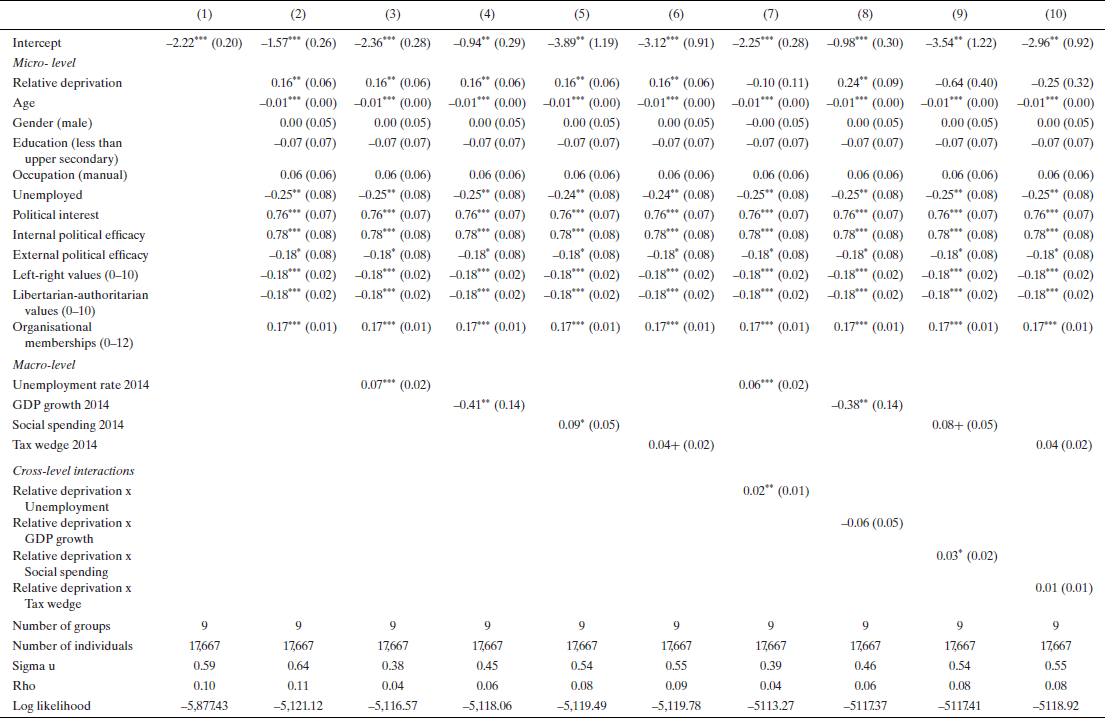
We specify ten models reported in Table3: model 1 is the empty model; model 2 includes the key individual‐level independent variable measuring relative deprivation and only the individual‐level control variables; model 3 includes the first macro‐level indicator – unemployment rate in 2014; model 4 includes GDP growth in 2014; model 5 includes social spending in 2014; and model 6 includes tax wedge in 2014. Models 7–10 include, in turn, each of the four macro‐level variables from models 3–6 and the relevant cross‐level interaction with individual relative deprivation.
Multilevel logistic regression models predicting protest participation (last 12 months)

Note. Standard errors in parentheses. +p ≤ 0.10; *p ≤ 0.05; **p ≤ 0.01; ***p ≤ 0.001.
Model fit improves with the inclusion of the individual‐level variables as signalled by the reduction in log likelihood. There is also an improvement with the inclusion of the macro‐level factors and their cross‐level interactions with relative deprivation, particularly unemployment in models 3 and 7. Across models 1–6 (models 7–10 include cross‐level interactions) relative deprivation has a positive effect on protest participation. Model 2 including all the individual‐level controls shows that there is no significant effect of low education level or having a manual occupation on participation. However, being unemployed has a negative and significant effect across models. In other words, at the individual level there is very little evidence for grievance theory: being unemployed reduces chances of demonstrating (this also goes against the predictions of biographical availability in some specifications). Also in line with the resources/SES and civic voluntarism model (Verba et al. Reference Verba, Schlozman and Brady1995), having a greater political interest, having stronger internal and external efficacy (the direction of the items in the scale is negative so the effect of external efficacy is also positive), being more left‐wing (relative to right‐wing) and also being more libertarian (relative to more authoritarian) all have a significant and positive effect on protest; as expected, organisational membership also has a strong positive effect.
What happens when we consider the macro‐level economic factors? When the first contextual variable – unemployment – is included in model 3, we can see that there is a positive and significant effect of this macroeconomic context variable on demonstrating. Individuals in countries with higher unemployment are more likely to have engaged in protests in the last 12 months. At first glance, this provides some evidence for grievance theory: at the macro‐level, countries with worse economic conditions are more likely to experience protest. However, the inclusion of this macro‐level variable in model 3 does not remove the individual‐level effect of relative deprivation found previously. Subjective feelings of relative deprivation still have an impact regardless of whether individuals are living in countries with high or low unemployment levels. This suggests that individuals examine their own household situation with respect to their expectations of where they should have been and this mechanism operates independently of wider comparisons.
When GDP growth is included in model 4, there is a negative and significant direct effect of this economic context variable on protest. Individuals in countries with lower GDP growth are more likely to have engaged in protests in the last 12 months. Again, this might be seen as providing evidence for grievance theory: at the macro‐level, countries with lower levels of economic growth are more likely to experience protest. However, the inclusion of this macro‐level variable in model 4 does not remove the individual‐level effects found previously. Subjective feelings of relative deprivation still have an impact regardless of whether individuals are living in countries with high or low GDP growth. Once more, this supports the idea that individuals primarily examine their own household situation with respect to their expectations of where they should have been and that wider comparisons do not explain away the effect of subjective feelings of relative deprivation.
Turning to macro‐level political factors, we observe a similar pattern as for the economic context. When social spending is included in model 5, it has a positive effect on demonstration activities. We interpret this as signalling more open political opportunity structures. Again, the inclusion of this macro‐level political factor does not erode the effect of relative deprivation, meaning that the latter still has an impact regardless of whether individuals are living in countries with diverse levels of spending.
When including tax wedge in model 6 there is a small but significant (p ≤ 0.10) effect: the greater the tax wedge, the greater the protest. This is in line with Bermeo and Bartels’ (Reference Bermeo, Bartels, Bermeo and Bartels2014) hypothesis that people react to austerity policies rather than directly to the negative effects of the economic crisis. At the same time, however, the inclusion of this macro‐level factor once again does not change the effect of relative deprivation. In other words, the latter plays a role net of this measure.
The main goal of this research, developing on previous work in the literature, was to combine the individual‐ and macro‐level perspectives on protest mobilisation in times of crisis. To extend this framework, models 7–10 include cross‐level interactions between each of our macro‐level variables and relative deprivation at the individual level in turn. Our results, as presented in model 7, show that in countries with higher unemployment rates, the effect of feelings of relative deprivation on participation is increased. This suggests that individual‐level subjective perceptions of relative deprivation are amplified by the wider national economic context. Individuals feeling that their conditions have deteriorated in the last five years in countries such as Greece or Spain are likely to have experienced worse deterioration than individuals in countries such as Germany and Switzerland that have had less negative experiences of the recent economic crisis. These results thus show that while deprivation at the individual level has a positive effect on protest participation regardless of the economic context, at higher levels of unemployment the effect of deprivation is magnified relative to contexts with lower unemployment. In turn, this suggests that this type of contextual fact may serve to politicise individual deprivation, as we discuss in more detail in the final section.
We find this conditional effect also for the political context in terms of the political opportunity structure offered by social democracies with more extensive welfare states. These results are shown in model 9. In contrast, neither GDP growth (model 8) nor tax wedge (model 10) condition the effect of individual relative deprivation in this respect while they do have a direct effect on protest participation.
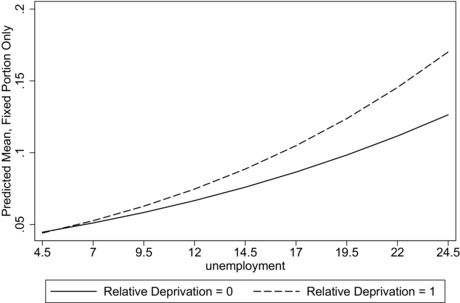
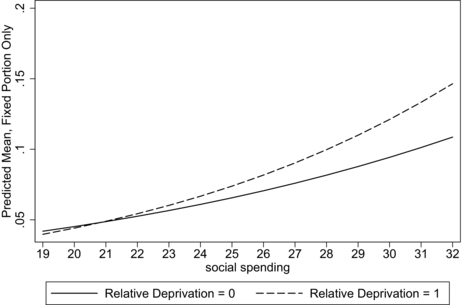
Model 7, with one cross‐level interaction for relative deprivation and unemployment, showed that the coefficient for relative deprivation is –0.10 and not significant, which means that there is no difference between those who are relatively more or less deprived when the unemployment rate is 0. The positive and statistically significant coefficient for the interaction term between relative deprivation and unemployment (0.02) suggests that the gap between those who are relatively more or less deprived increases as unemployment goes up. For every percentage point increase in the unemployment rate, the gap in the log‐odds of protesting increases by 0.02. At what point do the relatively deprived start protesting at higher levels than those who do not feel deprived? These estimates suggest that the two groups start departing when unemployment reaches a level of 5 per cent (i.e., –0.10/0.02 = –5) – that is, quite low. For social spending, in model 9, the positive and statistically significant coefficient for the interaction term between relative deprivation and social spending (0.03) suggests that the gap in protesting between those who are relatively more or less deprived also increases as social spending rises. For every percentage point increase in social spending, the gap in the log‐odds of protesting between the two groups increases by 0.03; the relatively deprived start protesting at higher levels than those who are less deprived when social spending is over 21.33 per cent of GDP (–0.64/0.03 = –21.33).
To visualise these patterns more clearly, Figures 1 and 2 plot the cross‐level interaction effects between relative deprivation and both unemployment and social spending, in turn. These graphs clearly show that the effect of personal deprivation is amplified in contexts of high unemployment (i.e., above 5 per cent) and in contexts where there are relatively higher levels of social spending as a proportion of GDP (i.e., greater than 21.33 per cent). We interpret both these findings in light of political opportunity structure theory: a situation of high unemployment opens up the political space for individual levels of deprivation to become understood at a more collective level and therefore to become the basis for political mobilisation. Similarly, for social spending, we argue that contexts where social spending is higher are already contexts where the opportunity structure, with respect to protest, is more open. In countries where social spending is lower, neoliberal approaches to welfare and the individualisation of poverty and deprivation tend to be normalised. On the other hand, in contexts where social spending is higher there tends to be a greater receptivity to understanding poverty and inequality as social and political problems that can be redressed through collective action.
Plot of the cross‐level interaction between relative deprivation and unemployment (adjusted predictions model 7).

Plot of the cross‐level interaction between relative deprivation and social spending (adjusted predictions model 9).

Discussion and conclusion
Our study shows the value of examining the cross‐context conditionality of grievances and opportunities for individual‐level protest participation. We show that individuals who feel that their conditions have deteriorated are more likely to take to the streets. We thus find evidence supporting Snow et al.’s (Reference Snow1998) thesis that the mismatch between current standards of living and expectations has some role to play for mobilising individuals, net of their objective economic position in society. This is an important result since it shows that when understood in subjective and relative terms grievances do have an impact on mobilisation. Linking these subjective feelings to the wider economic and political context, we find that not only do individual‐level feelings of relative deprivation have a direct effect on the propensity to have protested in the last year, but that this effect is greater in contexts characterised by either higher unemployment rates or higher levels of social spending. We interpret both findings in terms of their role for opening up political opportunities for protest among those who felt a deterioration of living standards in the current crisis. While grievance theories and political opportunity approaches appear to be at odds with each other, the significant results for the cross‐level interactions between relative deprivation and macro‐level factors show that context conditions the extent of the effect of individual deprivation on political action. We argue that this evidence for contextual influences on the effect of individual‐level deprivation for protest can be interpreted in terms of political opportunity theory.
Both grievances and political opportunities, if specified correctly, are shown to contribute to our understanding of political action. Indeed, the results of this study illustrate how it is their dynamic interaction which explains differential protest behaviour. More specifically, our findings show that in contexts of higher unemployment, deprived individuals protest at higher rates than less deprived individuals. We understand higher levels of unemployment as providing a context where individuals are more likely to understand their own relative deprivation in a politicised way. For example, higher unemployment is more likely to become discussed as a wider social ill affecting society and therefore leading individuals, and particularly those who feel deprived, to become more likely to realise that deteriorating living standards are not just their own, individualised private problem, but rather a generalised, national one shared by many others in different forms (e.g., as loss of income, loss of employment, having to make cut backs in consumption, etc.). In this way, a context of higher unemployment can play a role in politicising private lived experience, resulting in outward political action. We argue that individuals take cues from their wider environment and that these lead them to become more likely to act on their subjective feelings of deprivation by taking to the streets to protest against the government. On this reading, a visibly deteriorated economic context is understood as providing fertile ground for the subjective understanding of one's deprivation as something that can be challenged and redressed collectively and politically.
Our results also show that the difference between citizens who feel that their conditions deteriorated and those who do not, in terms of taking to the streets, are greater in contexts marked by higher levels of social spending. We interpret this finding by a similar logic. In times of crisis in particular, contexts with higher levels of social spending are those where political opportunities for protest would be perceived as more open, thus leading the more deprived to be more likely to take the streets. Our results show how individuals in more social democratic arrangements appear to be more likely to react politically when they feel that the crisis has impacted them negatively. These findings support the results of scholarship suggesting that welfare state provisions and citizenship rights represent critical resources for groups organising for collective action. While specific case studies have shown that the mechanism relates to the movement in question – for example, the mobilisation of the unemployed is linked to the extent of unemployment benefits (Giugni Reference Giugni2008), whereas the mobilisation of immigrants is linked to the type and level of citizenship rights (Giugni & Passy Reference Giugni and Passy2004; Koopmans et al. Reference Koopmans2005) – here we generalise this finding to show that the welfare state, as captured by higher levels of social spending, encourages mobilisation.
In more neoliberal contexts characterised by lower levels of social spending, on the other hand, those who feel deprived are more likely to understand their situation in individualised terms and therefore to be less likely to be spurred to collective, political action. While both the deprived and less deprived are less likely to take to the streets in countries with less generous levels of social spending, citizens who feel more deprived in more generous welfare states are more likely to take to the streets than citizens who feel less deprived. We suggest that this is because more generous welfare states are more receptive to their demands since issues relating to material deprivation are more widely understood as political problems needing collective solutions, not personal concerns that should be privately dealt with. While other studies provide some evidence that welfare states could be demobilising (e.g., Dodson Reference Dodson2015), our study with data from 2015 suggests the opposite. Further studies should explore this question in even greater detail and develop analyses to further disentangle which individual‐ and aggregate‐level factors interact with welfare state provisions to explain the individual‐level decision to become engaged in protest.
The findings of our study emphasise the importance of examining the macro‐level economic and political contexts alongside individual‐level deprivation, resources, attitudes and networks for understanding the wider drivers of protest action. This is in line with previous research showing that the mobilisation of resource‐poor groups is more likely when economic conditions have deteriorated (Baglioni et al. Reference Baglioni2008; Piven & Cloward Reference Piven and Cloward1977). More generally, our results suggest that individuals respond rationally to the experience of crisis, both at the individual and aggregate levels, by expressing their voice politically though protest. Feelings of deprivation are an important spur to the voicing of what could easily be seen as increasing grievances in times of crisis and we show that these individual‐level influences are amplified under given contextual circumstances. Our study has highlighted, in particular, that at least in the context of economic crisis, protest behaviour is higher among those individuals that have felt a deterioration in their circumstances. This is net of all other characteristics that could be reasonably expected to foster protest behaviour at the individual level.
At the aggregate level, we have also shown that protest is also higher in contexts with lower GDP growth and a higher tax wedge, but these types of contexts did not amplify the impact of individual relative deprivation on protest behaviour. On the other hand, contexts characterised by greater unemployment and higher social spending levels also experienced higher levels of protest while at the same time also increasing the impact of individual‐level relative deprivation. Protest in times of crisis is thus shown to be more prevalent among individuals who feel deprived in contexts with higher and therefore likely more politicised unemployment levels and more open political opportunity structures afforded by the welfare state. By extension, this means that there are more political responses to the crisis where the political opportunity conditions exist for the political expression of grievances among more deprived groups. On the one hand, higher levels of unemployment appear to lead individual problems of deprivation to become more clearly collectivised in the popular and political imagination; on the other hand, higher levels of social spending, suggesting a greater concern for the economic welfare of citizens and particularly the more marginalised and more deprived groups, appear to provide the legitimatisation and political space for the demands of protestors in times of crisis.
Our study has shown that the extent to which individuals will mobilise in demonstrations during times of crisis depends on their feeling a deterioration in their living standards and also on the ways in which the wider environment contributes to the framing of opportunities (Gamson & Meyer Reference Gamson, Meyer, McAdam, McCarthy and Zald1996). This further suggests that protest mobilisation is borne out of the complex interaction of factors at different levels, in turn impacting on each other. Research tends to be split between those examining individual‐level influences on protest behaviour and those examining macro‐level relations. Our findings suggest that, besides looking for direct effects of the micro‐ and macro‐level on protest, greater attention needs to be paid to their dynamic interaction for understanding the decision to become politically active, particularly in times of economic crisis.
Acknowledgements
This article presents results obtained from the analysis of data collected within the project ‘Living with Hard Times: How Citizens React to Economic Crises and Their Social and Political Consequences’ (LIVEWHAT). This project was funded by the European Commission under the 7th Framework Programme (grant agreement no. 613237). This project is coordinated by Marco Giugni at the University of Geneva. Maria Grasso at the University of Sheffield provided the scientific supervision for the cross‐national survey. An earlier version of this research was presented at the LIVEWHAT International Conference in Geneva on 14–16 October 2015 and at the University of Oxford’s Nuffield College Politics Seminars on 29 October 2015. The authors are grateful to all those who provided feedback as well as the journal editors and the anonymous referees for their useful suggestions. All remaining errors are our own and the usual disclaimers apply.

 Open access

