





Introduction
Over the past decades in Europe, populist radical right (PRR) parties and politicians have increased electoral support (Turner, Reference Turner2024). Since the 1960s, PRR vote shares in national and European parliament elections have more than doubled (Inglehart and Norris, Reference Inglehart and Norris2016). For example in the Netherlands, PRR vote shares increased from 5.9% in 2006 to 21.2% in 2025. In Germany, the PRR party Alternative Für Deutschland’s (AfD) vote share increased from 4.7% in 2013 to 20.8% in 2025.
The growing influence of PRR parties has significant implications for public policy, particularly in the domains of health and welfare (Falkenbach and Greer, Reference Falkenbach and Greer2018). For example, Falkenbach and Greer argue that PRR parties prioritise immigration and national security over public health. These parties also reflect their nativist values in proclaiming welfare chauvinist policies for the ‘deserving’, i.e. native citizens and those who pay taxes (Rathgeb and Busemeyer, Reference Rathgeb and Busemeyer2022), while more quietly supporting the implementation of welfare cuts for all (Rinaldi et al., Reference Rinaldi and Bekker2021). Understanding the reasons for PRR voting might inform responsive income and health policies that may counteract the antidemocratic sociopolitical movement.
Currently, research has identified multiple explanations for the rise of PRR parties. For example, Vaughan (Reference Vaughan2024) studied how religious secularisation affects support for far-right parties. The author argues that Europe has been secularising over the past decades, and that this process overlaps with the rise of PRR parties. In more secularised societies, such as The Netherlands, PRR attracts voters by using a nationalist and anti-immigration rhetoric. In more religious countries, such as Hungary and Italy, PRR parties motivate voters with a religious nationalist rhetoric. Another study has attributed the rising popularity of PRR parties to alienation of conservatives from progressive cultural changes, otherwise known as the cultural backlash theory (Inglehart and Norris, Reference Inglehart and Norris2016).
Among these explanations, persistent and/or rising inequalities are potentially key factors undergirding support for PRR parties. Income inequality and related economic factors, such as relative deprivation and economic insecurity, are commonly examined in relation to PRR voting (Jetten and Mols, Reference Jetten, Mols and van Prooijen2021; Sudbrack and Downes, Reference Sudbrack and Downes2025). In recent years, different forms of inequalities have persisted and even grown in Europe. Income inequalities have increased but also have become more complex since the 1970s (Acemoglu and Autor, Reference Acemoglu, Autor, Ashenfelter and Card2011). Not only have income inequalities increased between practical skilled workers (often those who graduated high school) and theoretically skilled workers (often those with a university degree), but also within these groups. For example, the technological developments of the past decades created demand for technically skill-workers, increasing their income. High demand can create higher incomes for practical skilled workers, while a large supply of theoretically skilled workers face lower incomes due to increased competition (Acemoglu and Autor, Reference Acemoglu, Autor, Ashenfelter and Card2011).
In addition, research suggests that health, particularly poor health and dissatisfaction with health systems, may increase the likelihood of voting for PRR parties (Kavanagh et al., Reference Kavanagh, Menon and Heinze2021; Kavanagh and Menon, Reference Kavanagh and Menon2024). The relationship between health and voting is well established and not subject to debate (Brown et al., Reference Brown, Raza, Pinto and Pinto2020; Kavanagh and Menon, Reference Kavanagh and Menon2024; Shore et al., Reference Shore, Rapp and Stockemer2020). While these studies primarily examine how health influences personal efficacy and voter participation, the impact of health on the formation of political preferences – particularly support for PRR parties – remains largely unexplored. Kavanagh et al., (Reference Kavanagh, Menon and Heinze2021) found support for the notion that worse health predicted PRR voting, specifically through disappointment with the health system. The study, however, did not include the role in health inequalities. In Europe, both between countries and within country health inequalities are present today, with those in disadvantaged socio-economic positions facing worse self-reported health and an increased risk of non-communicable diseases (Forster et al., Reference Forster, Kentikelenis and Bambra2018). Mackenbach et al. (Reference Mackenbach, Valverde Jé, Artnik, Bopp, Brønnum-Hansen, Deboosere, Kalediene, Kovács, Leinsalu, Martikainen, Menvielle, Regidor, Rychtaříková, Rodriguez-Sanz, Vineis, White, Wojtyniak, Hu and Nusselder2018) found that relative health inequalities have increased across Europe, particularly in Eastern Europe between 2002 and 2014, although absolute inequalities have decreased. How are health inequalities, distinctly from income inequalities, related to PRR voting? At the same time, PRR policies may further entrench inequalities, for example by restricting access to welfare and healthcare for minority groups (Bambra and Lynch, Reference Bambra and Lynch2021).
Taken together, inequalities appear to be central to both the causes and consequences of PRR voting. However, study findings, particularly relating to income inequality, are inconsistent across contexts (e.g. Bergh and Kärnä, Reference Bergh and Kärnä2022). Further, individual studies offer competing explanations as to why or how inequalities might be related to PRR voting. To understand where the balance of evidence lies on inequalities’ relationship to PRR voting in Europe, we conducted a scoping review of the literature to understand (1) whether and (2) why income and health inequalities are related to PRR voting.
Methods
To understand whether and why income and health inequalities are related to PRR voting behaviour, we conducted a scoping review. This is most suitable review type for our research question, as we aim to identify and map evidence of studies done on this topic (Pollock et al., Reference Pollock, Evans, Menghao Jia, Alexander, Pieper, de Moraes Érica, Peters, Tricco, Khalil, Godfrey, Saran, Campbell and Munn2024). We conducted the scoping review in accordance to the guidelines of the Joanna Briggs Institute (JBI), following the next steps: (1) identifying the research question, (2) identifying relevant studies, (3) study selection, (4) charting the data and (5) collating, summarising and reporting the results (Peters et al., Reference Peters, Godfrey, McInerney, Munn, Tricco, Khalil, Aromataris, Lockwood, Porritt, Pilla and Jordan2020).
Search strategy
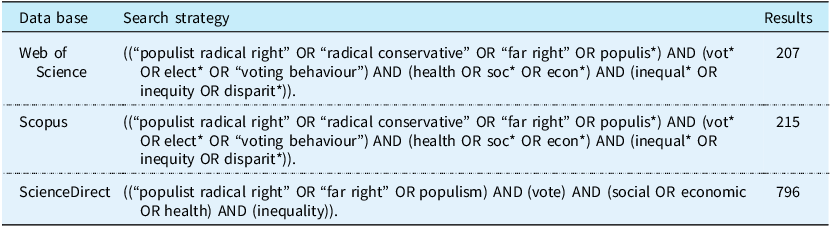
The literature search was performed in the databases Web of Science, Scopus, and ScienceDirect. The search strategy aimed to find studies which explained PRR voting behaviour outcomes through income and health inequalities. The search strategy was developed iteratively until it yielded a relevant number of articles. Two researchers collaboratively developed the search strategy, discussing and adjusting search terms and combinations based on iterative assessments of the generated outputs. The full search strategy is depicted in Table 1. For ScienceDirect, the search term was too broad as a maximum of 8 terms was allowed. The database also does not support wildcards, so the asterixis were removed. For this reason, the search strategy for this database was slightly adjusted.
Search strategies in the databases Web of Science, Scopus and ScienceDirect

Study selection
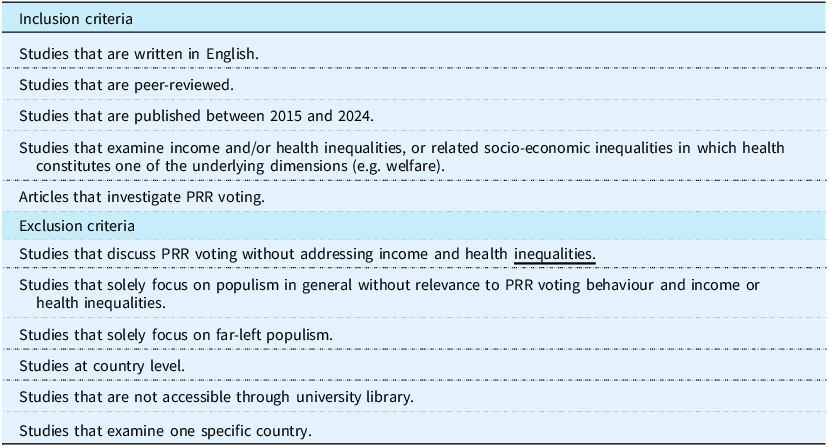
For the selection of the articles, selection criteria were developed (Table 2). Papers had to report on original studies or literature reviews, be written in English, peer-reviewed and published between 2015 and 2024. Content-wise, articles had to focus on voting for populist and/or far-right political parties and how this is related to income and/or health inequality or related socio-economic inequalities in which health constitutes one of the underlying dimensions (e.g. welfare). Studies were excluded if they did not specifically address inequalities. Studies that solely focussed on populism in general without relevance to PRR voting behaviour and income or health inequalities were excluded. Studies solely on far-left populism were also excluded. Since this study aims to unravel the relationship between income and health inequalities and PRR voting behaviour at the individual level, studies at country level were excluded. If studies were not accessible through the Wageningen University Library, they were excluded as well. Lastly, we excluded country-specific studies as we aimed to focus on general mechanisms rather than context–bound results.
Inclusion-and exclusion criteria for article selection scoping review
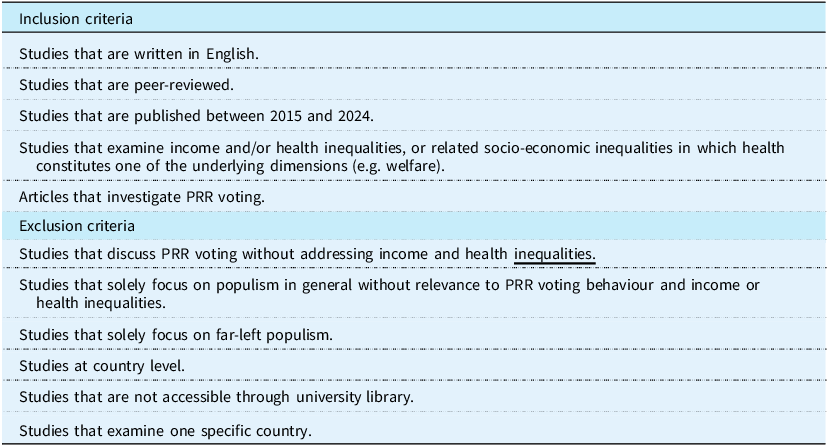
The main geographical location of the study was Europe. However, studies which did not specify a location (e.g. studies using theoretical modelling) were included. Since we aimed to provide a broad overview of studies examining inequalities and PRR voting there were no restrictions on study designs.
The selection process consisted of three steps: (1) title, (2) abstract and (3) full text screening. The first round of screening was done within each database, where studies that did not meet the criteria were excluded based on their title. Articles that were selected during the first round were exported and merged into Excel to remove duplicates. The second round of screening was done in Excel, and reasoning of inclusion or exclusion were added to the file. After the second round of screening, the Excel file was copied and articles excluded in round two were removed, followed by the full text screening. Again, reasoning for inclusion or exclusion was included in the file to ensure transparency. The study selection was carried out by one researcher, and a subsample was jointly reviewed with the second author to verify the relevance of articles for inclusion and the reasoning for article exclusion.
Study selection steps
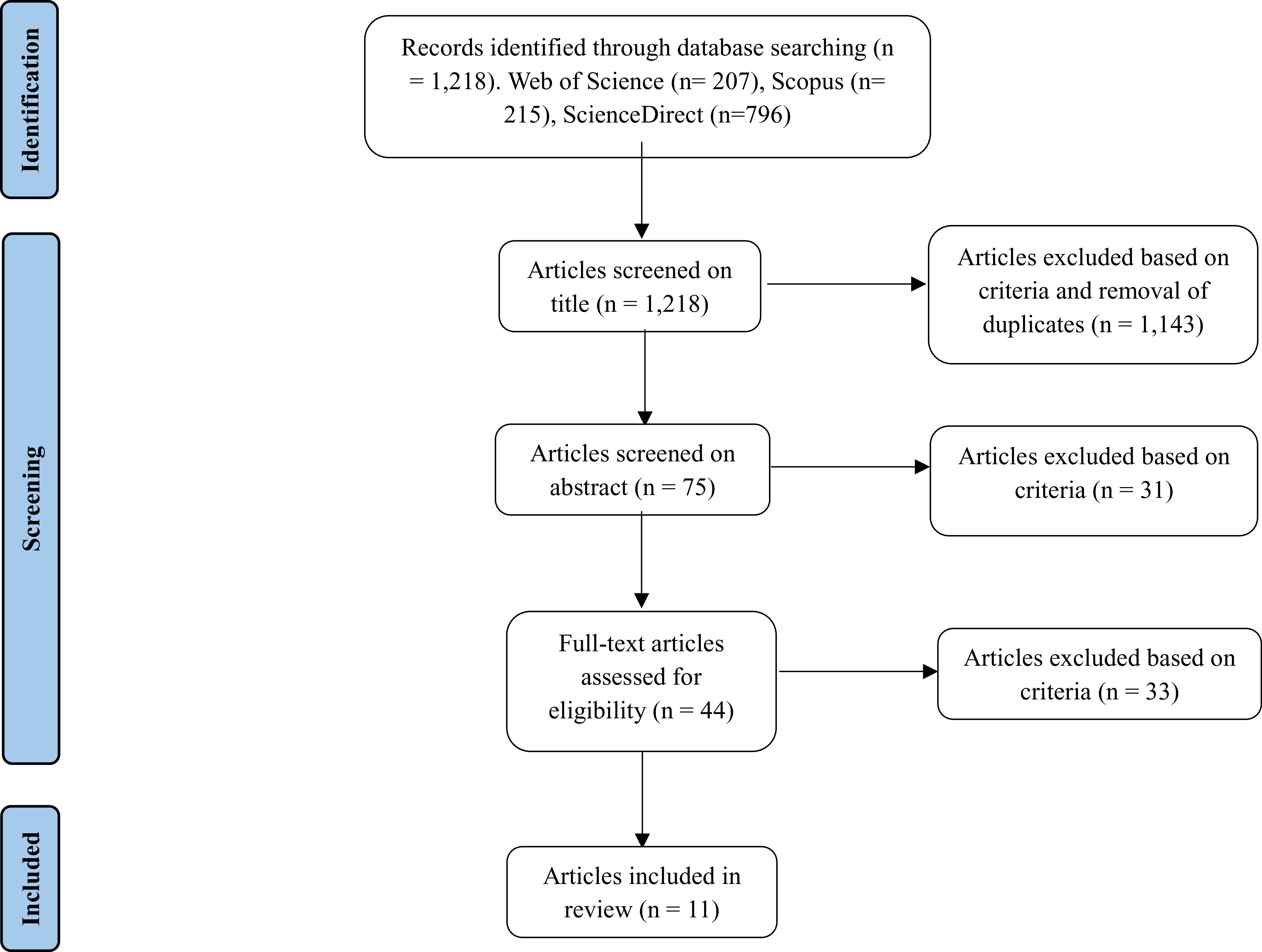
The study selection process is presented in Figure 1, following the PRISMA flow diagram (Page et al., Reference Page, McKenzie, Bossuyt, Boutron, Hoffmann, Mulrow, Shamseer, Tetzlaff, Akl, Brennan, Chou, Glanville, Grimshaw, Aørn, Lalu, Li, Loder, Mayo-Wilson, McDonald, McGuinness, Stewart, Thomas, Tricco, Welch, Whiting and Moher2021). A total of 1,218 studies was retrieved from the three databases: 207 from Web of Science, 215 from Scopus, and 796 from ScienceDirect. During the initial round of screening, title screening, 1,143 articles were excluded. The remaining 75 articles were assessed based on their abstract, which led to the exclusion of another 31 studies. During the last round, articles were assessed based on full text. This round of full text screening led to the exclusion of 33 studies. Ultimately, 11 studies were included in the scoping review.
PRISMA flowchart.

Data extraction and analysis
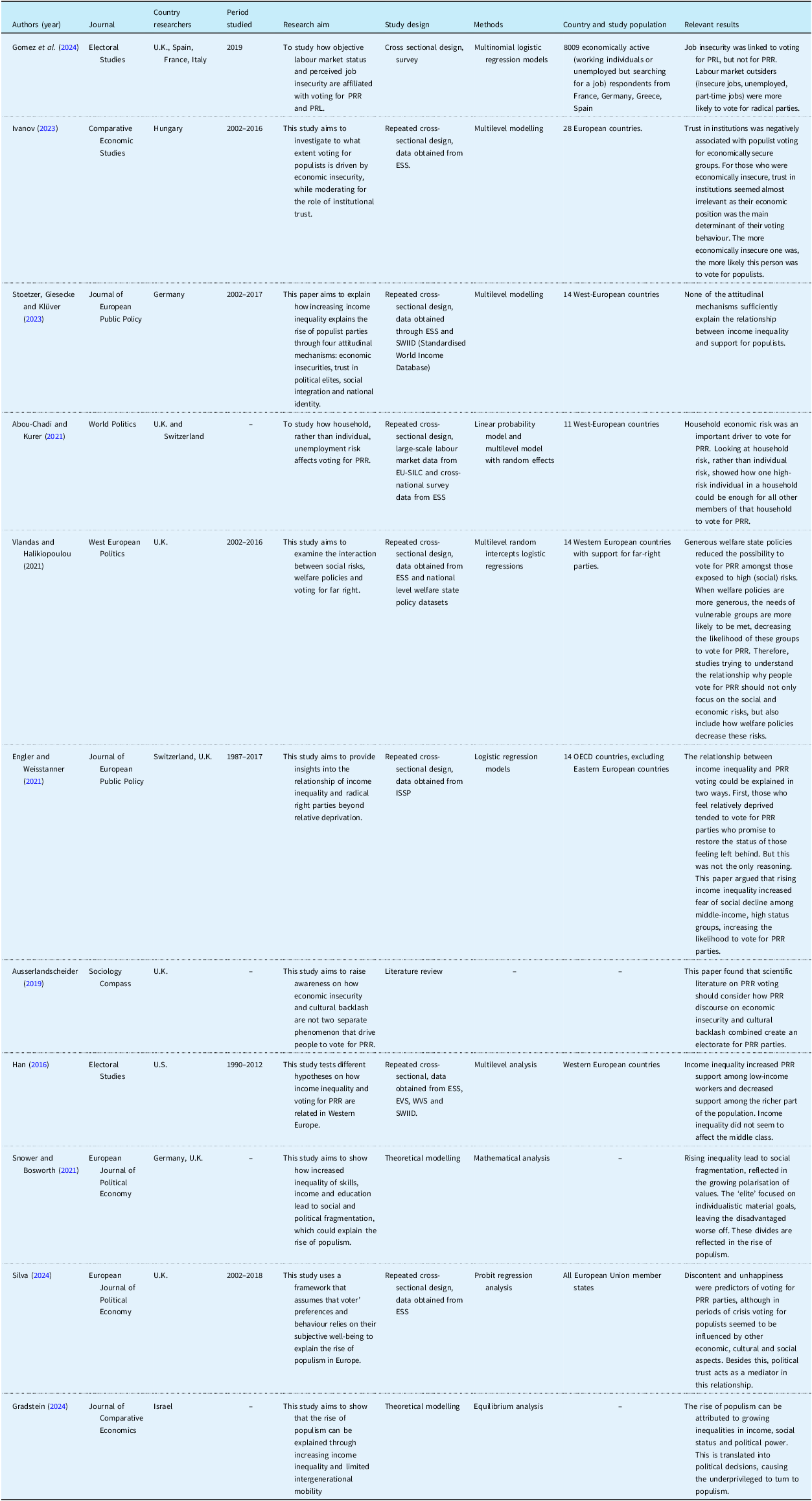
The first step of the analysis was data extraction. From each study, the following data were extracted: author(s), year of publication, the researchers’ country of employment, period studied, research aim, study design, methodology, study population and key findings. These data have been summarised in a table to provide an organised overview of the study characteristics. As described in JBI’s scoping review manual (Peters et al., Reference Peters, Godfrey, McInerney, Munn, Tricco, Khalil, Aromataris, Lockwood, Porritt, Pilla and Jordan2020), we have descriptively mapped the findings to discover whether and how inequalities play a role in shaping PRR voting preferences. Data was collected and organised into categories before described in the results section. These categories included two main categories: ‘income inequality’ and ‘welfare and well-being’. Income inequality had the following sub-categories: Social status loss and relative deprivation, economic insecurity, institutional distrust, social fragmentation, and cultural backlash. ‘Welfare and well-being’ had no subcategories, since only two studies were found for the category.
Results
Desciptive analysis
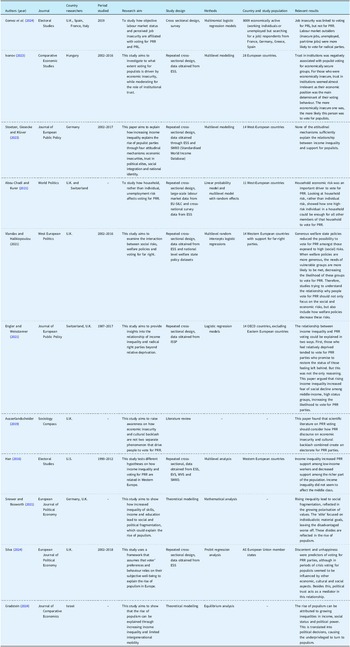
The selected articles come from a diverse range of journals, including political science, economic and sociological journals. Most papers are relatively recent and use data from 2016 onwards, except for Han (Reference Han2016) which draws on data from 1990–2012. The recency of papers is beneficial as older studies might not be suitable to explain the recent rise of PRR. In terms of methodology, the majority of studies use quantitative approaches, relaying on large existing datasets such as the ESS, ISSP or SWIID. One study is a literature review and two employ theoretical modelling. None of the studies use qualitative methods. Table 3 provides an overview of all studies.
Overview of studies included on how income and health inequalities influence voting for PRR parties
Qualitative analysis
The following section presents what the existing literature reveals about the relationship between income and health inequalities and PRR voting behaviour. Our review found support for income inequality shaping PRR voting, although we found diverse pathways of how income inequality plays role in shaping PRR voting preferences. We did not find studies that examined the role of health inequalities in PRR voting. However, we did find two studies on well-being and welfare policies. Although these studies did not specifically investigate whether health inequalities influenced PRR voting, they addressed broader dimensions of well-being and inequalities.
Income inequality and PRR: evidence of a complex pathway
Nine of the selected studies focused on income inequality and (relative) economic position in relation to PRR voting behaviour. Seven articles argued that income inequality contributed to PRR support, while two studies did not find support for this relationship. They all reported on diverse pathways that resulted from income inequalities. Social status loss, relative deprivation, economic insecurity, institutional distrust, social fragmentation, and social fragmentation all seemed to be the pathways that explain how income inequalities contribute to PRR voting.
While Engler and Weisstanner (Reference Engler and Weisstanner2021) and Han (Reference Han2016) show that lower-income populations were more prone to support PRR parties than the richer part of the population, Engler and Weisstanner (Reference Engler and Weisstanner2021) further argued that PRR voting was not confined to economically marginalised groups. Rather, both relative deprivation among lower-income groups and perceived social status loss drove people to vote for PRR parties. While lower-income groups may have felt left behind (relative deprivation), middle-income and high-status groups feared downward movement on the social ladder and turned to PRR.
Several studies further suggest that economic insecurity operates beyond individual circumstances. Abou-Chadi and Kurer (Reference Abou-Chadi and Kurer2021) examined unemployment risk and PRR voting and argued that unemployment risk affecting one household member could influence the entire household’s PRR support. In addition, the authors emphasised that this effect may extend to social networks beyond the household. Interactions with other family members, friends or colleagues facing economic risk could influence someone to support PRR parties, although to a lesser extent than interaction with household members. Building on this perspective, Ivanov (Reference Ivanov2023) showed that the impact of economic insecurity on PRR voting differs according to individuals’ socio-economic position. Among economically insecure individuals, institutional (dis)trust had little to no effect on their voting behaviour, suggesting that for this group, economic insecurity is the primary driver of populist support. Contrarily, for the more financially stable group, trust in institutions played a more important role in shaping political preferences. In this case, one’s financial situation seemed less relevant in voting decisions, while institutional (dis)trust was more important. The study showed that, for the economically stable group, the likelihood to vote for populists decreased with institutional trust.
Gradstein (Reference Gradstein2024) and Snower and Bosworth (Reference Snower and Bosworth2021), discuss how increasing income inequalities lead to polarised values and policy preferences, driving low-income groups to vote for PRR. According to Snower and Bosworth (Reference Snower and Bosworth2021), the economic ‘elites’ turn to individualistic values. On the other hand, the ones in disadvantaged economic positions turn to ‘communitarian goals’ as they are underprivileged in two ways. First, they increasingly lag in the competition for status goods, or goods that are scarce and, because of this, hold high social standing. Secondly, they experience fewer social benefits since the elite withdraws from community activities. The authors refer to this phenomenon as ‘social fragmentation’. The disadvantaged group, often practical skilled or low-income workers, have turned to populism which allows for more closed policies – such as trade protectionism, strict immigration policies and nationalist policies. Gradstein (Reference Gradstein2024) further suggests that the high social status group is more capable to translate their political preferences to implementable policies than the lower-status group because they have more political power. Rather than to trust in the educated elites to make the policy decisions, Gradstein argues that low status groups are driven to make their own, possibly less informed political decisions. The feeling of being excluded or unheard in political decision making is what drives members of the low status groups to turn to populism, according to this argument.
Ausserladscheider’s (Reference Ausserladscheider2019) literature review ties arguments for economic insecurity to arguments for cultural backlash. Economic insecurity explains how economic changes, crises and technological innovation negatively affected groups in insecure socio-economic positions, those disadvantaged due to increased income inequalities. Cultural backlash refers to the resentment that arises among more conservative individuals who feel threatened by progressive cultural changes. Ausserladscheider (Reference Ausserladscheider2019) concluded that existing research on the rise of PRR overlooks how economic and cultural explanations are interconnected. The author argued that both economic and cultural explanations combined create an electorate for PRR parties.
Two studies did not find evidence for the relationship between income inequality and PRR voting. Gomez et al. (Reference Gomez, L.Ramiro., Cugnata and Aja2024) studied the relationship between job insecurity and the rise of radical parties in Western democracies. They found that perceived job insecurity strongly predicted voting for PRL but not for PRR, while objective job insecurity had inconsistent effects across countries. Explaining the inconsistencies in outcomes, the authors argued that studies who did find support for these relationships used different research designs. Interestingly, this study also looked at control variables, such as age, education, gender and migrant background, showing that their influence on PRR voting varied per country. This may indicate that PRR voting behaviour is dependent on contextual factors and differs between countries.
Similarly, Stoetzer et al. (Reference Stoetzer, Giesecke and Klüver2023) found no evidence for the idea that income inequality lead to an increased PRR vote share. The authors tested four attitudinal mechanisms related to income inequality which could explain the relationship between income inequality and PRR voting: economic insecurities, distrust in political elites, lagging social integration and national identity prioritisation. Their analysis revealed that none of these mechanisms adequately explains the impact of income inequality on PRR voting. Only distrust in elites could give a partial explanation for the relationship. However, the authors acknowledge some methodological deficiencies, such as the measurements of the attitudinal mechanisms, which could have caused this contradicting outcome.
Well-being and welfare policies
We did not find papers on how health inequalities specifically explain the rise of PRR. However, the search strategy identified two papers that studied the influence of welfare policies and well-being on PRR voting. Although welfare and well-being represent broader concepts than health, they encompass health and health services or benefits. Welfare policies specifically adopt redistributive mechanisms to stabilise or reduce inequalities between groups in society. Therefore welfare and wellbeing could serve as proxy indicators of health inequalities. Vlandas and Halikiopoulou (Reference Vlandas and Halikiopoulou2022) examined the moderating role of welfare state policies in addressing inequalities, particularly the insecurities that may drive certain, more vulnerable, social groups to support PRR parties. The study distinguished different groups: the unemployed, pensioners, low-income workers, employees on temporary contracts, individuals in large families and individuals who are disabled or permanently sick. The results suggested that social welfare policies reduced the likelihood of these social groups to vote for PRR parties. This means that the extent to which certain vulnerable social groups experienced insecurities is influenced by the extent to which their needs are met through social policies. Therefore, welfare state retrenchment, reducing overall access and quality of services and benefits and increasing differences between groups in the past decades might have contributed to the rise of PRR parties. The researchers conclude that welfare state policies directed at a broader range of vulnerable social groups might effectively reduce support for PRR parties.
Secondly, Silva (Reference Silva2024) has studied how perceived well-being relates to support for radical right populists. Subjective well-being was operationalised by health, life satisfaction and happiness. The study also focused on the role of attitudes towards income inequalities, and how these shaped one’s well-being. The author argued that the perception of being negatively impacted by inequalities would negatively affect one’s perceived well-being. The study found that life dissatisfaction was related to populist support, although the strength of this link varied across periods and appeared to be mediated by other economic, cultural and social factors as well as by levels of political trust. Although they did not find support for the role of health and happiness in PRR support it is questionable whether health, life satisfaction and happiness can be treated as separate mechanisms.
Summary
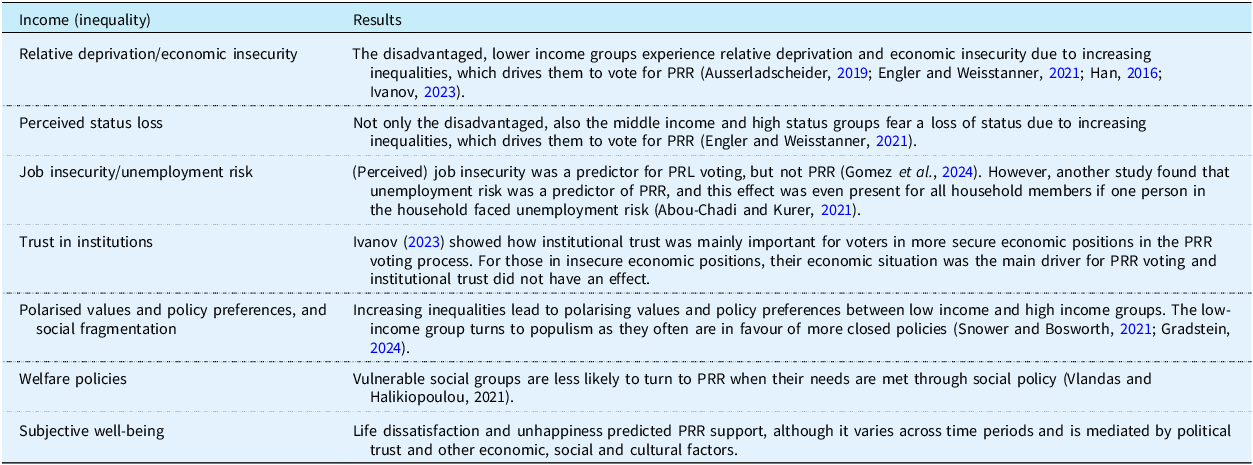
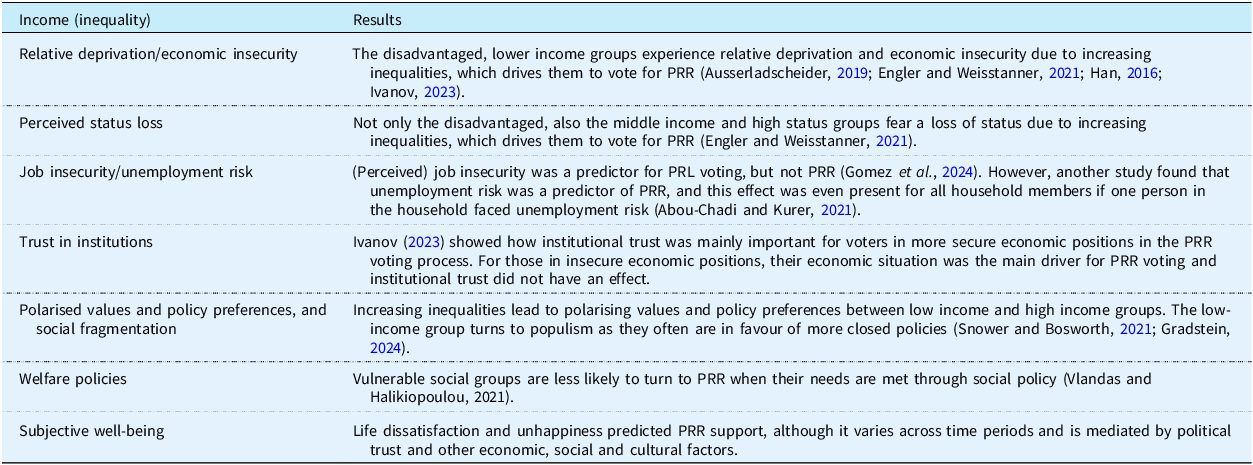
The scoping review generated several insights. First, income inequality and its effect on PRR voting have been widely studied, while health inequalities remain underrepresented in the PRR voting literature. Seven studies on income inequality and PRR show a complex relationship supporting the notion that income inequality predicts PRR voting, while two studies did not find support for this idea. Studies on welfare policy and perceived well-being showed that while health as an indicator of well-being could not be linked to PRR voting separately, welfare policies are likely to reduce unmet needs, thereby potentially rebuilding trust and reducing support for PRR. Results of the scoping review are summarised in Table 4.
Summary of the effects of income and health inequalities on PRR voting
Discussion
To understand the rise of PRR in many European democracies over the past two decades, this study explored the relationship between income and health inequalities on the one hand and PRR voting behaviour on the other hand. We will consecutively discuss the contribution of our review to existing and lacking evidence on whether and how income and health inequalities can explain PRR voting behaviour; the position of our findings in relation to theories on causal pathways to PRR voting; methodological reflections and research recommendations.
Our results indicate that seven out of eleven papers studying this relationship found that income inequality was related to PRR voting. According to the papers in our sample, the pathways by which income inequality contributes to PRR voting include indicators of perceived rather than real inequalities such as relative deprivation, perceived (social) status loss among middle- and high-income groups, unemployment risk and economic insecurity. Besides income and health inequalities we also found evidence on the role of social fragmentation and cultural cleavages in PRR voting as manifested in a conservative backlash on progressive values and the position of the state in society. Lastly, we found that life dissatisfaction increased the likelihood of voting for PRR, and generous and accessible welfare policies could reduce PRR voting.
Theoretical reflections
These findings on the role of health and income inequalities in PRR voting are corroborated by theories on social hierarchies, in which people perceive themselves at risk of being left behind or relatively deprived. Our findings tie theories on social hierarchies to theories on PRR voting. First of all, a key explanation for rising inequalities, income inequalities in particular, are the increased social hierarchies created by inequalities (Gidron and Hall, Reference Gidron and Hall2019). Greater income inequality likely renders a larger share of the population feeling socially marginalised, and not able to fully participate in society. People who feel socially marginalised, in turn, are more likely to vote for parties on the far right or far left of the political spectrum. Although our review did not find evidence, health inequalities are in theory likely to add pressure to these social hierarchies.
Secondly, social hierarchies interact with level of trust in political, economic and health institutions, which is based on experiences people had with these institutions (McManus, Reference McManus2021). People may increasingly feel dissatisfied with their economic situations, which arises when their economic needs are unmet and they believe that meeting these needs is the government’s responsibility (Faggian et al., Reference Faggian, Modica, Modrego and Urso2021). In terms of health services, poor health and unmet healthcare needs have been found to be associated with low satisfaction with health institutions (Batbaatar et al., Reference Batbaatar, Dorjdagva, Luvsannyam, Savino and Amenta2017; Chambers-Richards et al., Reference Chambers-Richards, Chireh and D’Arcy2022). Kavanagh and Menon (Reference Kavanagh and Menon2024, 23) theorised that ‘economic anxieties may interact with health-related anxieties, feeding one another and potentially intensifying the public’s democratic dissatisfaction’. Dissatisfaction, in turn, translates into lower trust and confidence in the health system (Schwei et al., Reference Schwei, Kadunc, Nguyen and Jacobs2014) and the political system in general (Christensen and Lægreid, Reference Christensen and Lægreid2014). In our review sample, Silva (Reference Silva2024) likewise suggested that life satisfaction plays a role in shaping PRR voting preferences. We would expect the economic and health-related anxieties to directly influence one’s life satisfaction. In this sense, life satisfaction may be a mediating factor that translates economic and health-related insecurities into political preferences for PRR.
Vlandas and Halikiopoulou (Reference Vlandas and Halikiopoulou2022) suggested that governments can address the (actual or perceived) risk of social marginalisation and economic insecurity through accessible and well-developed welfare policies. From a broader theoretical perspective, such responses may take two complementary forms. On the one hand, these involve strengthening institutions for representation in decision-making that enable real influence in decision-making. On the other hand, policies can focus on improving access and quality of arrangements for redistributive welfare. Together, in addressing feelings of marginalisation these dimensions highlight the importance of governmental and public service quality and policy performance.
Methodological reflections
While this study provides valuable insights, it also has certain limitations. To begin, focusing exclusively on studies that examine inequalities may explain why we did not identify any research on the relationship between health and PRR support, whereas Kavanagh et al. (Reference Kavanagh, Menon and Heinze2021) did find several studies addressing this link. Furthermore, strict exclusion criteria were applied to studies published before 2015. Given the rapid evolution of political mechanisms and voter preferences, older studies may fail to reflect current political dynamics. This likely contributes to the limited number of relevant studies available that examine how health inequalities influence voting behaviour for PRR parties.
Future research
Our study represents a next step in understanding the multicausal and interlinked pathways to PRR voting. Despite the theories and plausible pathways discussed, studies examining health inequalities as a distinct variable and their influence on support for PRR parties are currently lacking. This gap is noteworthy, given the well-established link between health and political participation (Brown et al., Reference Brown, Raza, Pinto and Pinto2020; Kavanagh and Menon, Reference Kavanagh and Menon2024; Shore et al., Reference Shore, Rapp and Stockemer2020), and it suggests that the potential role of health inequalities in shaping political preferences remains insufficiently understood.
Additionally, the literature would particularly benefit from more explicitly distinguishing between the roles of perceived and objective inequalities in shaping PRR voting behaviour. Our findings suggest that perceived inequalities, in social, economic and cultural assets and risk, may contribute significantly to the causal pathways to PRR voting. This is especially the case for groups moving between high and low income, who have something to lose and face a threat of loss of control, as well as the stress and anxieties associated with it.
Conclusion
This review provides a more comprehensive understanding of the complex pathways on why and how income inequalities relate to voting for PRR parties in Europe. We found that income inequality is contributing to PRR voting. According to the papers in our sample, the pathways by which income inequality contributes to PRR voting include indicators of perceived rather than real inequalities such as social status loss among middle and high income groups, relative deprivation among low income groups, economic insecurity, institutional distrust, social fragmentation, and cultural backlash. These findings tie theories on social hierarchies, in which people perceive themselves at risk of being left behind or relatively deprived, to theories on PRR voting. These potential risk perceptions of marginalisation and deprivation cause anxiety and stress and likely drive a portion of people to vote for PRR parties. While social hierarchies can lead to health problems related to anxiety and stress, more research is needed to analyse whether and how pre-existing health inequalities can add pressure to the rise of social hierarchies, institutional distrust and PRR voting. There are indications that public policies enhancing government performance on reducing income and health problems through welfare redistribution might increase public trust and reduce support for PRR parties.
Acknowledgements
We thank Dr. Anja Boevé for her comments and suggestions on earlier drafts.
Financial support
This research received no external funding.
Competing interests
The authors declare none.
AI statement
AI was used to assist with language editing. The authors take full responsibility for the content of the manuscript.

 Open access

