







1. Introduction
The creation of the most complete and representative sample of galaxies in the nearest volume of the universe provides an important observational basis for testing various cosmological models on small scales. This sample, limited by a distance of $\sim$
10 Mpc, was systematically created over the course of recent decades. This has been facilitated by the emergence of increasingly in-depth surveys of large sky areas in optical and radio ranges. Data on distances, radial velocities, luminosity, and other characteristics of nearby galaxies are collected in the Updated Nearby Galaxy Catalogue (UNGC), (Karachentsev, Makarov, & Kaisina Reference Karachentsev, Makarov and Kaisina2013), which is regularly updated with new objects. Currently, the Local Volume (LV) galaxy database, available at http://www.sao.ru/lv/lvgdb, contains more than 1500 galaxies. Among them, about 90% dwarf galaxies have a luminosity lower than the luminosity of the Large Magellanic Cloud (LMC).
$\sim$
10 Mpc, was systematically created over the course of recent decades. This has been facilitated by the emergence of increasingly in-depth surveys of large sky areas in optical and radio ranges. Data on distances, radial velocities, luminosity, and other characteristics of nearby galaxies are collected in the Updated Nearby Galaxy Catalogue (UNGC), (Karachentsev, Makarov, & Kaisina Reference Karachentsev, Makarov and Kaisina2013), which is regularly updated with new objects. Currently, the Local Volume (LV) galaxy database, available at http://www.sao.ru/lv/lvgdb, contains more than 1500 galaxies. Among them, about 90% dwarf galaxies have a luminosity lower than the luminosity of the Large Magellanic Cloud (LMC).
The most recent and significant source of population growth for the LV is DESI Legacy Imaging Surveys (Dey et al. Reference Dey2019), which covers about 1/3 of the entire sky. Using data from this multi-colour survey, we have found 98 new candidates to the LV members in regions of the known nearby groups (Karachentsev & Kaisina Reference Karachentsev and Kaisina2022; Karachentsev, Kaisina, & Karachentseva Reference Karachentsev, Kaisina and Karachentseva2023a; Karachentseva et al. Reference Karachentseva, Karachentsev, Kaisina and Kaisin2023), as well as in the general field in direction to the Local Void (Karachentsev et al. Reference Karachentsev, Karachentseva, Kaisin and Kaisina2023b). Most of these new dwarf galaxies were discovered in the northern hemisphere of the sky. The appearance of the tenth version of the DESI surveys (DR10) provided us the opportunity to continue searching for nearby dwarf galaxies in the southern sky. The results of our efforts are the subject of this article.
2. Searching for dwarf satellites around bright southern galaxies
We have not included in our programme a survey of the vicinity of the very nearby galaxies: NGC 55, NGC 253, NGC 300, Cen A, and M 83, since these regions have been studied in detail by other authors using DESI survey and images obtained with large telescopes (Okamoto et al. Reference Okamoto2024; Crnojević et al. Reference Crnojević2019; Crosby et al. Reference Crosby, Jerjen, Müller, Pawlowski, Mateo and Lelli2024a; Müller, Jerjen, & Binggeli Reference Müller, Jerjen and Binggeli2015; Müller et al. Reference Müller, Pawlowski, Revaz, Venhola, Rejkuba, Hilker and Lutz2024; Martnez-Delgado et al. Reference Martnez-Delgado2021; Martinez-Delgado et al. Reference Martinez-Delgado, Stein, Pawlowski, Makarov, Makarova, Donatiello and Lang2024; Mutlu-Pakdil et al. Reference Mutlu-Pakdil2022; Jones et al. Reference Jones2024a; McNanna et al. Reference McNanna2024; Sand et al. Reference Sand2024).
A list of galaxies around which we conducted our searches is presented in Table 1. Its columns contain: (1) – name of the host galaxy; (2) – equatorial coordinates of the galaxy in degrees; (3) – galaxy integral luminosity in the K-band, expressed in the Sun luminosity units; (4) – distance to the galaxy in Mpc; (5) – the method by which the distance was determined: TRGB – by the tip of the red giant branch, SN – by the luminosity of supernovae, TF – by the Tully-Fisher relationship (Tully et al. Reference Tully2013) between the 21-cm line width and luminosity of a galaxy; (6) — the number of new candidates for satellites around the host galaxy that we have found; (7) – the size of the square in degrees within which the search for dwarf galaxies was conducted. The centre of the square coincided with the host galaxy, and the square sides were oriented along RA and Dec.
Southern host galaxies in the Local Volume.

Reproduction of images of 11 nearby dwarf galaxy candidates from the DESI Legacy Imaging Surveys, found near the southern LV galaxies of sub-Milky Way luminosity. Each image size is $2^{\prime}\times 2^{\prime}$
. North is at the top, east is on the left.
$2^{\prime}\times 2^{\prime}$
. North is at the top, east is on the left.

For each host galaxy, we estimated the virial radius of its halo using the relation
 \begin{equation} (R_v/215\,\textrm{kpc}) = (M_T/10^{12}\times M_{\odot})^{1/3},\end{equation}
proposed by Tully (Reference Tully2015). Here, the total mass of the galaxy halo, $M_T$
, was determined from its integrated K-band luminosity as
$M_T$
, was determined from its integrated K-band luminosity as
 \begin{equation} M_T/L_K=32\times M_{\odot}/L_{\odot}.\end{equation}
As Karachentsev & Kashibadze (Reference Karachentsev and Kashibadze2021) have shown, only $\sim2/3$
of the group members are located within the virial radius, and the rest of the group population is distributed between
$\sim2/3$
of the group members are located within the virial radius, and the rest of the group population is distributed between $R_v$
and the radius of the zero-velocity sphere
$R_v$
and the radius of the zero-velocity sphere $R_0\simeq 3R_v$
, which separates the group volume from the general expanding field of galaxies.
$R_0\simeq 3R_v$
, which separates the group volume from the general expanding field of galaxies.
Searches for new companions around large galaxies have mostly been undertaken inside the virial radius of the galaxy halo (Carlsten et al. Reference Carlsten2022). We conducted a wider search, covering a $2R_v$
square centred on the galaxy under consideration. The median luminosity of the galaxies in our sample is
$2R_v$
square centred on the galaxy under consideration. The median luminosity of the galaxies in our sample is $\log(L_K/L_{\odot}) =9.47$
, which corresponds to the LMC luminosity.
$\log(L_K/L_{\odot}) =9.47$
, which corresponds to the LMC luminosity.
When searching for new satellites around a host galaxy, we focused on low surface brightness objects with a major angular diameter $a \unicode{x003E} 20^{\prime\prime}$
. Preference was given to dwarf galaxies with a hint of granular structure and a weak brightness gradient towards the centre. We also took into account the environment of the satellite candidate in order to exclude, if possible, cases of association of the dwarf with a more distant group of galaxies. For each candidate for the Local Volume objects, the maximum apparent angular diameter, apparent axial ratio, and morphological type were determined.
$a \unicode{x003E} 20^{\prime\prime}$
. Preference was given to dwarf galaxies with a hint of granular structure and a weak brightness gradient towards the centre. We also took into account the environment of the satellite candidate in order to exclude, if possible, cases of association of the dwarf with a more distant group of galaxies. For each candidate for the Local Volume objects, the maximum apparent angular diameter, apparent axial ratio, and morphological type were determined.
As a result, 40 candidate companions were detected in a total survey area of 320 square degrees around 20 host galaxies. There is a noticeable trend that the number of companions decreases rapidly with decreasing luminosity of the host galaxy. Data from deep searches for satellites conducted with large telescopes (Davis et al. Reference Davis2024; Carlin et al. Reference Carlin2024) show that there is, on average, just under one companion per a host galaxy with a luminosity similar to the LMC luminosity.
Reproduction of images of six nearby dwarf galaxy candidates from the DESI Legacy Imaging Surveys, found near the giant galaxy NGC 6744. Each image size is $2^{\prime}\times 2^{\prime}$
. North is at the top, east is on the left.
$2^{\prime}\times 2^{\prime}$
. North is at the top, east is on the left.

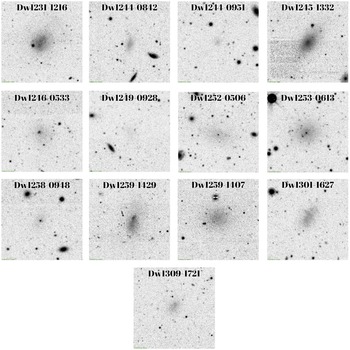
Reproduction of images of 13 nearby dwarfs from the DESI Legacy Imaging Surveys, found in the vicinity of the Sombrero galaxy. Each image size is $2^{\prime}\times 2^{\prime}$
. North is at the top, east is on the left.
$2^{\prime}\times 2^{\prime}$
. North is at the top, east is on the left.

The images of 30 candidates for new members of the Local Volume that we discovered, taken from the DESI Legacy Imaging Surveys, are shown in Figs. 1–3. The first of them contains dwarf galaxies in the vicinity of the southern host galaxies of moderate (sub-Milky Way) luminosity: NGC 628, NGC 1313, NGC 3621, NGC 5068, NGC 7090, and NGC 7424. Figs. 2 and 3 present, respectively, dwarf objects around the high-luminosity galaxies, NGC 6744 and NGC 4594 (‘Sombrero’). In addition to them, we have noted 10 more dwarf galaxies that were known earlier with ESO, PGC, KK, and KKs names, but were not considered as members of the LV. Each image size in Figs. 1–3 is $2^{\prime}\times 2^{\prime}$
. North is up, east is left.
$2^{\prime}\times 2^{\prime}$
. North is up, east is left.
The summary list of 40 supposed dwarf satellites is given in Table 2, which contains the following data: (1) – galaxy name; (2) – equatorial coordinates; (3, 4) – angular diameter in arc minutes and apparent axial ratio of the galaxy; (5) – apparent magnitude of the galaxy in the B- band, determined from g- and r-magnitudes in the DESI survey as $B = g+0.313\times (g - r)+0.227$
, or estimated visually for diffuse objects with a clump-like structure; (6) – morphological type of the dwarf galaxy: Irr – irregular, Im – Magellanic, BCD – blue compact dwarf, Sph – spheroidal, Tr – transitional between Irr and Sph. Below we note some features of the detected dwarf galaxies.
$B = g+0.313\times (g - r)+0.227$
, or estimated visually for diffuse objects with a clump-like structure; (6) – morphological type of the dwarf galaxy: Irr – irregular, Im – Magellanic, BCD – blue compact dwarf, Sph – spheroidal, Tr – transitional between Irr and Sph. Below we note some features of the detected dwarf galaxies.
New candidate dwarf galaxies in the Local Volume.

ESO 472-015. A relatively bright dwarf galaxy with a heliocentric velocity of $V_h = 655\pm46$
km s
$V_h = 655\pm46$
km s $^{-1}$
, at a projected separation of
$^{-1}$
, at a projected separation of $R_p = 90$
kpc from the host galaxy NGC 24, which has
$R_p = 90$
kpc from the host galaxy NGC 24, which has $V_h = 553\pm2$
km s
$V_h = 553\pm2$
km s $^{-1}$
according to HyperLEDA (Makarov et al. Reference Makarov, Prugniel, Terekhova, Courtois and Vauglin2014).
$^{-1}$
according to HyperLEDA (Makarov et al. Reference Makarov, Prugniel, Terekhova, Courtois and Vauglin2014).
PGC 01242. This is a BCD galaxy with a radial velocity of $V_h=670\pm2$
km s
$V_h=670\pm2$
km s $^{-1}$
. The angular size is related to a faint extended halo, which is also clearly visible in the UV-band according to GALEX data (Martin et al. Reference Martin2005).
$^{-1}$
. The angular size is related to a faint extended halo, which is also clearly visible in the UV-band according to GALEX data (Martin et al. Reference Martin2005).
Dw 0128-4116. An irregular dwarf with asymmetric halo.
Dw 0312-6643. This dwarf spheroidal galaxy of the low surface brightness and semi-resolved into stars seems to be a satellite of peculiar spiral galaxy NGC 1313.
Dw 1105-3041, KK 101, Dw 1128-3225. Probable satellites of spiral galaxy NGC 3621.
Dw 1231-1216. A dwarf galaxy with granular structure and faint asymmetric halo; a probable satellite of NGC 4594 (“Sombrero”).
Dw 1245-1332. A dwarf spheroidal galaxy with a radial velocity of $V_{LG} = 783$
km s
$V_{LG} = 783$
km s $^{-1}$
measured by Crosby et al. (Reference Crosby, Mateo, Escala, Jerjen, Müller and Pawlowski2024b).
$^{-1}$
measured by Crosby et al. (Reference Crosby, Mateo, Escala, Jerjen, Müller and Pawlowski2024b).
Dw 1253-0613. A dwarf spheroidal galaxy with granular structure; it belongs probably to a foreground diffuse association of dwarfs near DDO 148.
Dw 1301-1627. A dSph galaxy with granular structure, a probable member of association of dwarfs around DDO 161.
KK 186. A transition type (Tr) dwarf with a granular structure. Together with the four following objects in Table 2, it forms a retinue of the spiral galaxy NGC 5068.
Dw 1321-1935. A nucleated dSph, projected onto a very distant cluster of galaxies.
Dw 1851-6400. A Tr-type dwarf with a granular structure, a probable satellite of the giant spiral galaxy NGC 6744.
Dw 2140-5544. A spheroidal dwarf with a granular structure; located in a dense field of interstellar cirrus.
Dw 2256-4107. A satellite of the spiral galaxy NGC 7424, half-destroyed by the host.
3. Suite of dwarfs around the galaxy NGC 6744
The Sc spiral galaxy NGC 6744 is the most extended object in the LV. Its optical Holmberg’s linear diameter reaches 60 kpc, and its angular momentum is twice that of the Milky Way (Karachentsev & Zozulia Reference Karachentsev and Zozulia2023). Among NGC 6744’s neighbors, seven galaxies in the known catalogues (NGC, IC, ESO) are associated with NGC 6744, judging by their radial velocities. Searches for fainter dwarf galaxies (Karachentseva & Karachentsev Reference Karachentseva and Karachentsev2000 and Karachentsev, Riepe, & Zilch Reference Karachentsev, Riepe and Zilch2020b) led to the discovery of three and two low surface brightness probable companions, respectively. Carlsten et al. (Reference Carlsten2022) and Hunt et al. (Reference Hunt2024) added four more objects to the list of members of the NGC 6744 group. Carlsten et al. (Reference Carlsten2022) estimated their distances from surface brightness fluctuations (sbf). Our searches for dwarf galaxies in the wider vicinity of NGC 6744 revealed eight more new candidates for this group: Dw 1844-6232, Dw 1851-6400, Dw 1851-6511, Dw 1851-6356, Dw 1851-6355, Dw 1903-6405, KKs 73, and KKs 74. The last two of these were known previously but were not included in the LV database.
Suggested members of the NGC 6744 galaxy group.

A summary list of 25 supposed members of the NGC 6744 group is presented in Table 3. Its rows contain: (1) – galaxy name; (2,3) – supergalactic coordinates in degrees; (4) – morphological type; (5) – distance to the galaxy in Mpc; (6) – method by which the distance was estimated; for two galaxies (IC 4824 and ESO 141-042), the distances were determined from their radial velocities in the Numerical Action Method (NAM) model (Shaya et al. Reference Shaya, Tully, Hoffman and Pomarède2017; Kourkchi et al. Reference Kourkchi, Courtois, Graziani, Hoffman, Pomarède, Shaya and Tully2020), which takes into account the local field of peculiar velocities; (7) – projected separation of the galaxy from NGC 6744 under the assumption that all members of the group are located at a radial distance of $D = 9.51$
Mpc, measured by Anand et al. (Reference Anand2021) using the TRGB; (8) – radial velocity of the galaxy relative to the centre of the Local Group; (9) – the total mass of the group estimated via individual members based on their projected separation
$D = 9.51$
Mpc, measured by Anand et al. (Reference Anand2021) using the TRGB; (8) – radial velocity of the galaxy relative to the centre of the Local Group; (9) – the total mass of the group estimated via individual members based on their projected separation $R_p$
and the difference in radial velocities
$R_p$
and the difference in radial velocities $\Delta V$
relative to NGC 6744 from the relation
$\Delta V$
relative to NGC 6744 from the relation
 \begin{equation}M_T/M_{\odot}= (16/\pi)\times G^{-1}\times \Delta V^2\times R_p, \end{equation}
where G is the gravitational constant. This relation assumes a chaotic orientation of the satellite orbits with an average orbital eccentricity $e = 0.7$
(Karachentsev & Kashibadze Reference Karachentsev and Kashibadze2021).
$e = 0.7$
(Karachentsev & Kashibadze Reference Karachentsev and Kashibadze2021).
The perimeter of our search area is shown in Fig. 4. The distribution of supposed members of the NGC 6744 group is presented in supergalactic coordinates to reduce large-scale distortions due to the convergence of meridians in the $\{$
RA, Dec
$\{$
RA, Dec $\}$
system. Previously known members of the group are shown as circles, and objects we have discovered are marked with asterisks. Spheroidal dwarf galaxies without signs of star formation are highlighted with red symbols. The radial velocities of the galaxies (in km s
$\}$
system. Previously known members of the group are shown as circles, and objects we have discovered are marked with asterisks. Spheroidal dwarf galaxies without signs of star formation are highlighted with red symbols. The radial velocities of the galaxies (in km s $^{-1}$
) are indicated by numbers. The large circle centred on NGC 6744 corresponds to the virial radius of the group, 296 kpc or 1.78
$^{-1}$
) are indicated by numbers. The large circle centred on NGC 6744 corresponds to the virial radius of the group, 296 kpc or 1.78 $^{\circ}$
.
$^{\circ}$
.
The distribution of galaxies shows a tendency towards the presence of substructures. The asymmetric distribution of spheroidal dwarf galaxies is noteworthy: all nine Sph objects are located on the right half of the figure. We have not found an explanation for this feature. In general, such asymmetry is not uncommon among galaxy groups. There is quite an extensive literature discussing both observational manifestations of the lopsidedness of satellite galaxy systems (Brainerd & Samuels Reference Brainerd and Samuels2020; Heesters et al. Reference Heesters, Jerjen, Müller, Pawlowski and Jamie Kanehisa2024) and their comparison with the results of numerical simulations of the structure of groups (Pawlowski, Ibata, & Bullock Reference Pawlowski, Ibata and Bullock2017; Wang et al. Reference Wang2021). It is also noteworthy that the distribution of potential satellites around NGC 6744 appears to be flattened in the diagonal direction, reminiscent of the issue of satellite planes seen around the Milky Way, the Andromeda nebulae and other nearby major galaxies (Ibata et al. Reference Ibata2013; Pawlowski & Kroupa Reference Pawlowski and Kroupa2020; Müller et al. Reference Müller2021; Karachentsev & Kroupa Reference Karachentsev and Kroupa2024). The few available velocities even appear consistent with a kinematic trend: higher velocities than the host on the top-left side, lower on the bottom-right side. Future velocity measurements of the remaining supposed members of the group could easily confirm or disprove this assumption.
The galaxy group region around NGC 6744 in supergalactic coordinates. Previously known members of the group are shown as circles, new candidate members are shown as asterisks. Spheroidal dwarf galaxies are indicated by red symbols. The numbers indicate the radial velocity of the galaxies in km s $^{-1}$
. The circle centred on NGC 6744 corresponds to the virial radius of the group of 296 kpc.
$^{-1}$
. The circle centred on NGC 6744 corresponds to the virial radius of the group of 296 kpc.

As follows from the data in the last column of Table 3, the average estimate of the total mass of the NGC 6744 group based on seven satellites is $\langle M_T\rangle=(1.88\pm0.71)\times 10^{12}\,\mathrm{M}_{\odot}$
. With the integrated luminosity of the group
$\langle M_T\rangle=(1.88\pm0.71)\times 10^{12}\,\mathrm{M}_{\odot}$
. With the integrated luminosity of the group $\Sigma L_K =1.17\times 10^{11}\,\mathrm{L}_{\odot}$
, the ratio of the total mass to the total luminosity of the group is
$\Sigma L_K =1.17\times 10^{11}\,\mathrm{L}_{\odot}$
, the ratio of the total mass to the total luminosity of the group is $(16.1\pm6.0)\,\mathrm{M}_{\odot}/\mathrm{L}_{\odot}$
, which is two times smaller than the average ratio
$(16.1\pm6.0)\,\mathrm{M}_{\odot}/\mathrm{L}_{\odot}$
, which is two times smaller than the average ratio $(31\pm6)\,\mathrm{M}_{\odot}/\mathrm{L}_{\odot}$
obtained for the ensemble of 25 groups in the LV (Karachentsev & Kashibadze Reference Karachentsev and Kashibadze2021). This difference is leveled out if we consider only the LV groups with spiral host galaxies, for which the total mass-to-K-luminosity ratio is
$(31\pm6)\,\mathrm{M}_{\odot}/\mathrm{L}_{\odot}$
obtained for the ensemble of 25 groups in the LV (Karachentsev & Kashibadze Reference Karachentsev and Kashibadze2021). This difference is leveled out if we consider only the LV groups with spiral host galaxies, for which the total mass-to-K-luminosity ratio is $(17.4\pm2.8)\,\mathrm{M}_{\odot}/\mathrm{L}_{\odot}$
according to Karachentsev & Kashibadze (Reference Karachentsev and Kashibadze2021).
$(17.4\pm2.8)\,\mathrm{M}_{\odot}/\mathrm{L}_{\odot}$
according to Karachentsev & Kashibadze (Reference Karachentsev and Kashibadze2021).
4. The surroundings of NGC 4594
The galaxy NGC 4594 = M 104 (‘Sombrero’) has the highest luminosity, $\log(L_K/L_{\odot}) = 11.32$
, among the LV population. The distance to it,
$\log(L_K/L_{\odot}) = 11.32$
, among the LV population. The distance to it, $D= (9.55\pm0.46)$
Mpc, has been determined by McQuinn et al. (Reference McQuinn, Skillman, Dolphin, Berg and Kennicutt2016) via TRGB method. The search for satellites around Sombrero was undertaken by various teams (Karachentsev et al. Reference Karachentsev, Riepe and Zilch2020b
; Javanmardi et al. Reference Javanmardi2016; Karachentsev et al. Reference Karachentsev, Karachentseva, Suchkov and Grebel2000; Carlsten et al. Reference Carlsten2022; Crosby et al. Reference Crosby, Jerjen, Müller, Pawlowski, Mateo and Lelli2024a
).
$D= (9.55\pm0.46)$
Mpc, has been determined by McQuinn et al. (Reference McQuinn, Skillman, Dolphin, Berg and Kennicutt2016) via TRGB method. The search for satellites around Sombrero was undertaken by various teams (Karachentsev et al. Reference Karachentsev, Riepe and Zilch2020b
; Javanmardi et al. Reference Javanmardi2016; Karachentsev et al. Reference Karachentsev, Karachentseva, Suchkov and Grebel2000; Carlsten et al. Reference Carlsten2022; Crosby et al. Reference Crosby, Jerjen, Müller, Pawlowski, Mateo and Lelli2024a
).
Carlsten et al. (Reference Carlsten2022) used images obtained with the 3.6 m Canadian-French-Hawaii Telescope to discover 11 new satellites of Sombrero in a region with a radius of 0.6 $^{\circ}$
or
$^{\circ}$
or $\sim$
100 kpc. The belonging of these dwarfs to the Sombrero group was confirmed by measuring their distances using the surface brightness fluctuation (sbf) method. The most significant addition to the number of dwarf galaxies in the Sombrero neighbourhood was given by the study of Crosby et al. (Reference Crosby, Jerjen, Müller, Pawlowski, Mateo and Lelli2024a). Using images obtained with the Subaru Supreme-Cam, they discovered 40 new potential satellites of Sombrero within a circle of
$\sim$
100 kpc. The belonging of these dwarfs to the Sombrero group was confirmed by measuring their distances using the surface brightness fluctuation (sbf) method. The most significant addition to the number of dwarf galaxies in the Sombrero neighbourhood was given by the study of Crosby et al. (Reference Crosby, Jerjen, Müller, Pawlowski, Mateo and Lelli2024a). Using images obtained with the Subaru Supreme-Cam, they discovered 40 new potential satellites of Sombrero within a circle of $\sim$ $2^{\circ}$
radius. Surface photometry was performed for these galaxies and integral properties of the galaxies were determined. Of these 40 dwarfs, 27 were classified as satellites of Sombrero with high confidence.
$2^{\circ}$
radius. Surface photometry was performed for these galaxies and integral properties of the galaxies were determined. Of these 40 dwarfs, 27 were classified as satellites of Sombrero with high confidence.
Looking at a wider region, Karachentsev et al. (Reference Karachentsev, Makarova, Brent Tully, Anand, Rizzi and Shaya2020a), identified 15 supposed satellites of the Sombrero with measured radial velocities. Their average projected separation relative to the Sombrero is 431 kpc, and their radial velocity dispersion is 204 km s $^{-1}$
. Applying relations (1) and (3) to this ensemble of satellites yields an estimate of the total mass of the group of
$^{-1}$
. Applying relations (1) and (3) to this ensemble of satellites yields an estimate of the total mass of the group of $M_T =(15.5\pm4.9)\times10^{12}\,\mathrm{M}_{\odot}$
and a virial radius of
$M_T =(15.5\pm4.9)\times10^{12}\,\mathrm{M}_{\odot}$
and a virial radius of $R_v = 538$
kpc or 3.23
$R_v = 538$
kpc or 3.23 $^{\circ}$
.
$^{\circ}$
.
Using the DR10 data of DESI Legacy Imaging Surveys, we undertook searches for new satellites of Sombrero in the region: RA = [183, 197] $^{\circ}$
, Dec = [
$^{\circ}$
, Dec = [ $-$
5,
$-$
5, $-$
19]
$-$
19] $^{\circ}$
, and found 13 dwarf galaxies presented in Table 2. We also re-examined images of 27 dwarf galaxies from the Crosby et al. (Reference Crosby, Jerjen, Müller, Pawlowski, Mateo and Lelli2024a) list, identified as Sombrero satellites with high confidence. In our estimation, 25 of them look like real members of the Sombrero group. But we considered two galaxies as belonging to the distant background: UGCA 287 due to its estimated distance of
$^{\circ}$
, and found 13 dwarf galaxies presented in Table 2. We also re-examined images of 27 dwarf galaxies from the Crosby et al. (Reference Crosby, Jerjen, Müller, Pawlowski, Mateo and Lelli2024a) list, identified as Sombrero satellites with high confidence. In our estimation, 25 of them look like real members of the Sombrero group. But we considered two galaxies as belonging to the distant background: UGCA 287 due to its estimated distance of $D_{TF} = 20.5$
Mpc (Karachentsev & Nasonova Reference Karachentsev and Nasonova2013), and the galaxy dw 1241-1008 due to its texture.
$D_{TF} = 20.5$
Mpc (Karachentsev & Nasonova Reference Karachentsev and Nasonova2013), and the galaxy dw 1241-1008 due to its texture.
LV galaxies within RA = [183.0 $-$
197.0], Dec = [
$-$
197.0], Dec = [ $-$
5.0,
$-$
5.0, $-$
19.0].
$-$
19.0].

Notes: [1] – (Jones et al. Reference Jones2024b); [2] – present paper;
[3] – Kashibadze, Karachentsev, & Karachentseva (Reference Kashibadze, Karachentsev and Karachentseva2018); [4] – (Carlsten et al. Reference Carlsten2022);
[5] – (Karachentsev et al. Reference Karachentsev, Makarova, Tully, Rizzi and Shaya2018); [6] – (Karachentsev et al. Reference Karachentsev, Makarova, Brent Tully, Anand, Rizzi and Shaya2020a);
[7] – (Carlsten et al. Reference Carlsten, Greco, Beaton and Greene2020); [8] – (McQuinn et al. Reference McQuinn, Skillman, Dolphin, Berg and Kennicutt2016);
[9] – (Karachentsev & Nasonova Reference Karachentsev and Nasonova2013);
It should be noted that the Sombrero group is located near the equator of the Local Supercluster, projecting onto the Virgo Southern Extension filament (Tully Reference Tully1982; Kourkchi & Tully Reference Kourkchi and Tully2017). Many galaxies in this filament have radial velocities close to that of Sombrero $(V_\textrm{LG} = 912$
) km s
$(V_\textrm{LG} = 912$
) km s $^{-1}$
, but are located at distances of 15–20 Mpc, typical for members of the Virgo cluster. The presence of the rich background makes it difficult to single out Sombrero’s satellites.
$^{-1}$
, but are located at distances of 15–20 Mpc, typical for members of the Virgo cluster. The presence of the rich background makes it difficult to single out Sombrero’s satellites.
We selected from the LV database (http://www/lv/lvgdb) the galaxies with distance estimates $D \unicode{x003C} 12$
Mpc, which are located in the square of 14
$D \unicode{x003C} 12$
Mpc, which are located in the square of 14 $^{\circ}$
by 14
$^{\circ}$
by 14 $^{\circ}$
around Sombrero. This region extends over
$^{\circ}$
around Sombrero. This region extends over $2R_v$
, encompassing the bulk of the galaxy halo. A list of 68 of these galaxies is presented in Table 4. Its columns contain: (1) – galaxy name as it indicated in UNGC; (2,3) – equatorial coordinates, J2000.0, in degrees; (4) – galaxy distance in Mpc; (5) – method used to determine the distance; (6) – radial velocity in the Local Group rest frame (in km s
$2R_v$
, encompassing the bulk of the galaxy halo. A list of 68 of these galaxies is presented in Table 4. Its columns contain: (1) – galaxy name as it indicated in UNGC; (2,3) – equatorial coordinates, J2000.0, in degrees; (4) – galaxy distance in Mpc; (5) – method used to determine the distance; (6) – radial velocity in the Local Group rest frame (in km s $^{-1}$
); (7) – morphological type; (8) – references to the distance estimates. All radial velocities are taken from the HyperLEDA (Makarov et al. Reference Makarov, Prugniel, Terekhova, Courtois and Vauglin2014) with the addition of a new radial velocity for UGCA 287 from Crosby et al. (Reference Crosby, Mateo, Escala, Jerjen, Müller and Pawlowski2024b).
$^{-1}$
); (7) – morphological type; (8) – references to the distance estimates. All radial velocities are taken from the HyperLEDA (Makarov et al. Reference Makarov, Prugniel, Terekhova, Courtois and Vauglin2014) with the addition of a new radial velocity for UGCA 287 from Crosby et al. (Reference Crosby, Mateo, Escala, Jerjen, Müller and Pawlowski2024b).
The distribution of the LV galaxies in the considered sky region is presented in Fig. 5. The galaxies of early types (Sph, dE) and late types (Irr, Im, Tr, BCD, S) are shown by red and blue symbols, respectively. Supposed foreground galaxies with $D \unicode{x003C} 7.3$
Mpc are indicated with open circles. The dwarf galaxies we discovered are shown as blue and red asterisks according to their morphological type. The large circle of 3.23
$D \unicode{x003C} 7.3$
Mpc are indicated with open circles. The dwarf galaxies we discovered are shown as blue and red asterisks according to their morphological type. The large circle of 3.23 $^{\circ}$
radius corresponds to
$^{\circ}$
radius corresponds to $R_v$
. The radial velocities of galaxies located outside the dense central zone are indicated by numbers (in km s
$R_v$
. The radial velocities of galaxies located outside the dense central zone are indicated by numbers (in km s $^{-1}$
).
$^{-1}$
).
Distribution of the LV dwarfs around the Sombrero galaxy. The galaxies of early types (Sph, dE) and late types (Irr, Im, Tr, BCD, Sm, Sdm) are shown by red and blue symbols, respectively. Supposed foreground galaxies with $D \unicode{x003C} 7.3$
Mpc are indicated with open circles. The dwarf galaxies we discovered are shown as blue and red asterisks according to their morphological type.
$D \unicode{x003C} 7.3$
Mpc are indicated with open circles. The dwarf galaxies we discovered are shown as blue and red asterisks according to their morphological type.

The distribution of early-type dwarf galaxies shows the expected stronger concentration towards the host galaxy. The distribution of suspected satellites appears somewhat asymmetric. On the right side of this map, outside the virial circle, only one probable satellite of Sombrero has been detected. It is KKSG 27 with $V_\textrm{LG} = 1\,128$
km s
$V_\textrm{LG} = 1\,128$
km s $^{-1}$
.
$^{-1}$
.
In the lower left corner of Fig. 5, a group of foreground galaxies stands out with a typical radial velocity of $V_\textrm{LG}\sim600$
km s
$V_\textrm{LG}\sim600$
km s $^{-1}$
and a distance of
$^{-1}$
and a distance of $D\sim6$
Mpc. This association of dwarf galaxies around DDO 161 likely includes also the two spheroidal dwarfs, Dw 1301-1627 and Dw 1309-1721, we discovered. Three more new Sph dwarfs are located in the upper left part of the figure near DDO 148
$D\sim6$
Mpc. This association of dwarf galaxies around DDO 161 likely includes also the two spheroidal dwarfs, Dw 1301-1627 and Dw 1309-1721, we discovered. Three more new Sph dwarfs are located in the upper left part of the figure near DDO 148 $(V_\textrm{LG} = 1\,170\,$
km s
$(V_\textrm{LG} = 1\,170\,$
km s $^{-1}$
). It remains unclear whether these galaxies are members of the Sombrero group or belong to outskirts of the Virgo cluster. Obviously, for a better understanding the structure and kinematics of the Sombrero group, it is necessary to measure more distances and radial velocities of galaxies in the considered sky region.
$^{-1}$
). It remains unclear whether these galaxies are members of the Sombrero group or belong to outskirts of the Virgo cluster. Obviously, for a better understanding the structure and kinematics of the Sombrero group, it is necessary to measure more distances and radial velocities of galaxies in the considered sky region.
5. Conclusions
We searched for new dwarf companions around 20 southern galaxies of the Local Volume having distances within (4–11) Mpc and $\log(L_K/L_{\odot})$
luminosities in the range of (8.1–11.3). For half of the host galaxies, no new companions were detected in an area inside of two virial radii. We found eight new companion candidates for the spiral galaxy NGC 6744, which is the most extended galaxy in the LV. The population of NGC 6744 group currently includes 25 candidate members. Based on seven supposed satellites of NGC 6744 with measured radial velocities, the total mass of the group is estimated to be
$\log(L_K/L_{\odot})$
luminosities in the range of (8.1–11.3). For half of the host galaxies, no new companions were detected in an area inside of two virial radii. We found eight new companion candidates for the spiral galaxy NGC 6744, which is the most extended galaxy in the LV. The population of NGC 6744 group currently includes 25 candidate members. Based on seven supposed satellites of NGC 6744 with measured radial velocities, the total mass of the group is estimated to be $(1.88\pm0.71)\times10^{12}\,\mathrm{M}_{\odot}$
. The accuracy of determining the total mass of this group may be noticeably increased when measuring radial velocities of its other members.
$(1.88\pm0.71)\times10^{12}\,\mathrm{M}_{\odot}$
. The accuracy of determining the total mass of this group may be noticeably increased when measuring radial velocities of its other members.
Our search for dwarf galaxies in a $14^{\circ}$
by
$14^{\circ}$
by $14^{\circ}$
square centred on M 104 (Sombrero) has resulted in 13 new dwarfs. Most of these are likely associated with the Sombrero itself and with a foreground diffuse group of dwarf galaxies around DDO 161. We also rediscovered 25 of the 27 objects recently found by Crosby et al. (Reference Crosby, Mateo, Escala, Jerjen, Müller and Pawlowski2024b) as members of the Sombrero group with high confidence. A deep 21-cm survey of this region with sufficiently high angular resolution, likes the Wallaby survey (Koribalski et al. Reference Koribalski2020), could elucidate the structure and kinematics of the galaxy ensemble in this intricate sky region adjacent to the Virgo Cluster.
$14^{\circ}$
square centred on M 104 (Sombrero) has resulted in 13 new dwarfs. Most of these are likely associated with the Sombrero itself and with a foreground diffuse group of dwarf galaxies around DDO 161. We also rediscovered 25 of the 27 objects recently found by Crosby et al. (Reference Crosby, Mateo, Escala, Jerjen, Müller and Pawlowski2024b) as members of the Sombrero group with high confidence. A deep 21-cm survey of this region with sufficiently high angular resolution, likes the Wallaby survey (Koribalski et al. Reference Koribalski2020), could elucidate the structure and kinematics of the galaxy ensemble in this intricate sky region adjacent to the Virgo Cluster.
Acknowledgements
We are grateful to an anonymous referee for constructive comments, in particular for drawing our attention to the peculiarity of the configuration of satellites around the NGC 6744. This work has made use of DESI Legacy Imaging Surveys data, the HyperLEDA, and the revised version of the Local Volume galaxies database.
Data availability statement
The data on which this work is based is publicly available and is detailed in the corresponding tables of the manuscript.
Funding statement
This work was supported by the Russian Science Foundation grant 24–12–00277.




 Open access

