

Introduction
Apex courts that operate not only as exclusively constitutional courts but instead have jurisdiction over some civil, criminal, and public law issues are called “diffused” or “American-style” apex courts. And while these courts generally have discretionary dockets, the strength of that discretion varies. For instance, the U.S., Canada, and Australia have nearly complete docket control, whereas India, Japan, and the Philippines retain some mandatory jurisdiction but still filter aggressively which cases receive full review. Likewise, procedures for exercising that discretion vary. Yet, scholarly attention and particularly empirical studies, have focused primarily on the United States Supreme Court’s certiorari process. The High Court of Australia (hereafter the High Court) is similar to the U.S. Supreme Court in ways that enable comparison—the Australian Constitution was, in part, inspired by the U.S. Constitution, and both grew out of the British common law system. Yet, there are differences in institutional design pertaining to docket control that are worth studying, both to better understand another apex court in a Western liberal democracy and to better understand how the U.S. Supreme Court’s institutional features shape case selection and outcomes.
The High Court is the final court of appeal in Australia. Appellants seeking to have their case heard by the High Court must first apply for special leave to appeal. Just as the Supreme Court uses certiorari to exercise tight control over its docket (Baum Reference Baum1977; Caldeira et al. Reference Caldeira, Wright and Zorn1999), the High Court uses the special leave process as a mechanism that “enables the Court to control the volume and nature of the appeals that it hears” (Mason Reference Mason2000, p. 784). Whereas the United States Supreme Court grants only 5% of certiorari applications (Spaeth et al. Reference Spaeth, Epstein, Martin, Segal, Ruger and Benesh2024), the High Court grants special leave to appeal in 12% of applications.
Recent empirical studies of other aspects of decision-making on the High Court of Australia indicate that the Justices are influenced by strategic considerations, such as intra-court power dynamics and amplifying or diminishing doctrinal impact (Jacobi et al. Reference Jacobi, Robinson and Leslie2023). However, beyond these elementary descriptive statistics, little is known about how the High Court determines its agenda. In contrast to the United States, for which a large literature exists on the factors that influence whether the Supreme Court grants petitions for certiorari (see, e.g. Feldman & Kappner Reference Feldman and Kappner2017; Grant et al. Reference Grant, Hendrickson and Lynch2012; Mak et al. Reference Mak, Sidman and Sommer2013; Narechania Reference Narechania2025; Smith Reference Smith2001), there are virtually no studies that have systematically explored the factors associated with whether the High Court of Australia grants special leave to appeal. The few extant empirical studies are limited to providing broad overviews of the characteristics of the litigants and their legal representatives (Stewart & Stuhmcke Reference Stewart and Stuhmcke2019), whether special leave to appeal hearings are decided via oral argument or on the briefs (referred to as the “papers”) (Stewart & Stuhmcke Reference Stewart and Stuhmcke2020), and examining whether the ideological preferences of the Justices influence whether the special leave application is successful (Leslie et al. Reference Leslie, Jacobi, Robinson and Smyth2026).
One of the most influential theories used to explain how Justices on the U.S. Supreme Court select cases to hear is cue theory (Tanenhaus et al. Reference Tanenhaus, Schick, Muraskin, Rosen and Schubert1963). Given that the decision as to whether to grant certiorari is an exercise of uncertainty, the Justices look for cues that a case is worthy of their attention (Tanenhaus et al. Reference Tanenhaus, Schick, Muraskin, Rosen and Schubert1963; Teger & Kosinski Reference Teger and Kosinski1980; Ulmer et al. Reference Ulmer, Hintze and Kirklosky1972). Cue theory has been applied to examine the relevance of several potential cues for how the Supreme Court selects the cases that it hears, but little attention has been given to the role of lower court dissent as a salient cue. While dissension, either “among the judges of the court immediately below, or between two or more courts and agencies in a given case” was one of four cues originally proposed by Tanenhaus et al. (Reference Tanenhaus, Schick, Muraskin, Rosen and Schubert1963), few studies have explored it since. Studies that have considered the role of lower court dissent on how the Supreme Court sets its agenda typically treat it as a control variable while focusing on the relevance of some other factor, as one of many factors potentially influencing whether the Court grants certiorari, and/or discuss it in passing in a couple of sentences (see, e.g. Black & Owens Reference Black and Owens2009; Bonica et al. Reference Bonica, Chilton and Sen2025; Caldeira et al. Reference Caldeira, Wright and Zorn1999; Caldeira & Wright Reference Caldeira and Wright1988; Mak et al. Reference Mak, Sidman and Sommer2013; Perry Reference Perry1991; Smith Reference Smith2001).Footnote 1 There are no studies that specifically examine dissent on the court below as a salient cue and explore potential mediators and moderators as the primary contribution of the study. Hence, we lack studies that have theorized why and how dissent on the lower court is a cue.
We extend cue theory by addressing why and how dissent on the lower court is a cue. We address the why by defining lower court dissent as an indicator of the complexity of a case. We theorize that, given the time constraints Justices face, case complexity is a salient cue in case selection. We address the how by theorizing how the direct relationship is mediated by the ideological composition of the High Court and special leave panel size, and moderated by lower court panel size and the importance of the jurisdiction from which appeal is being sought.
We contribute to the existing literature on agenda setting in two ways. First, we extend the small extant literature on how the High Court uses special leave to set its agenda by examining the role of disagreement in the court below on whether the High Court grants special leave to appeal. This extends our understanding of agenda setting on final appellate courts outside the U.S., for which relatively little is known and for which recent research has called for more studies (Werneck et al. Reference Werneck Arguelhes, Hartmann, Epstein, Grendstad, Sadl and Weinshall2024). Second, we extend cue theory through a detailed study of the role of dissent on the court below as a relevant cue.
One of the advantages of using data on special leave to appeal in the High Court as a vehicle to extend understanding of the role of dissent on the court below as a cue is that like many appellate courts outside the U.S., including Canada, Israel, and the U.K., the High Court varies the size of panels hearing applications, depending on cues about a case’s complexity.Footnote 2 In contrast to the U.S. Supreme Court, where all nine Justices decide cases and only grant certiorari if at least four vote to hear a case, in the High Court of Australia, rotating panels of up to three Justices decide whether to grant special leave applications. Thus, we are specifically able to consider the mediating role of the High Court special leave panel size in instances in which there has been a dissent on the Court below.
We find that in cases in which there was dissent on the court below, there is approximately a three-fold increase in the likelihood of special leave success. If there is dissent on the court below, the predicted probability that the High Court will grant special leave to appeal is 23.4%, compared to 10.6% if the court below was unanimous. We find support for the hypotheses that the relationship between dissent on the court below and the likelihood that special leave to appeal is granted is mediated by High Court special leave panel size, and moderated by lower court panel size. We do not find support for the hypothesis that the ideological composition of the panel mediates the relationship. We also do not find support for the hypothesis that the jurisdiction from which special leave is sought moderates the relationship.
Our findings are important—both the positive and null findings—because they help answer a foundational question in the study of political institutions: why certain issues, and not others, gain the attention of policymakers (Baumgartner & Jones Reference Baumgartner and Jones2015). Who or what influences whether an issue is on the political agenda, as well as the institutional decision to address a particular policy issue, is a question of agenda setting. The process of agenda setting, then, determines which issues are addressed by the political decision makers and, thus, raises critical questions about access to power in institutions (Dowding & Martin Reference Dowding and Martin2017). As such, agenda setting is intrinsically linked with questions relating to democratic legitimacy. By controlling the capacity to participate in political institutions, decision makers act as gatekeepers to political power, strengthening the role of some citizens and weakening the role of others (Wood & Waterman Reference Wood and Waterman1991).
Research on legislative and executive agenda setting demonstrates the influence of lobby groups, the media, political parties, and the public on policy agendas. Similarly, studies in the process of agenda setting on apex courts, almost exclusively in the context of the United States Supreme Court (Flemming Reference Flemming2004; Baird & Jacobi Reference Baird and Jacobi2009; Bustos & Jacobi Reference Bustos and Jacobi2019) and the Supreme Court of Canada, have shown that, like agenda setting in the legislature and executive, the decision to permit or deny access to the judicial agenda is based on systematic patterns of influence (Boucher & Segal Reference Boucher and Segal1995; Caldeira et al. Reference Caldeira, Wright and Zorn1999; Feldman & Kappner Reference Feldman and Kappner2017; Mak et al. Reference Mak, Sidman and Sommer2013). Our findings contribute to these literatures and to more general models of judicial decision-making in courts that control their own dockets, particularly outside North America.
A brief overview of special leave to appeal to the High Court of Australia
The High Court sits at the apex of the Australian legal system. It has final jurisdiction over both federal and state law and is the final arbiter of the Australian Constitution via concrete judicial review. The court comprises the Chief Justice plus six Puisne Justices (equivalent to Associate Justices in the United States).Footnote 3 The Court may hear cases en banc, or as panels with a minimum of three Justices per hearing.
Since 1984, special leave to appeal to the High Court is required for all appeals from state and territory supreme courts and from the Federal Court of Australia.Footnote 4 In deciding whether to grant special leave, the overarching question that the Court asks is whether the appeal involves “some point of general importance.”Footnote 5 The Court has wide discretion to decide what is of “general importance.”Footnote 6 Nevertheless, Section 35A of the Judiciary Act is intended to provide some guidance as to the factors the High Court should consider when deciding whether to grant special leave. Satisfying one or more of the criteria in Section 35A of the Judiciary Act is generally regarded as an essential prerequisite for the application for special leave to be granted (Tokley Reference Tokley2017). When deciding whether to grant special leave, Section 35A of the Judiciary Act begins by stating “the High Court may have regard to any matters that it considers relevant.” The provision then proceeds to state
it shall have regard to whether … the application … involve[s] a question of law that is of public importance, … [involves] differences of opinion between different courts, or within the one court, as to the state of law … [or] the interests of the administration of judgment
require it to intervene. To qualify as being of sufficient general importance, “it is not sufficient that mere error be demonstrated or that a contestable point is raised. It must be established that if the error is left to stand, a state of unsatisfactory incoherence in the law will exist” (Wickham Reference Wickham2007, p. 156).
Applications for special leave are initially examined by a panel of up to three Justices, based on written submissions from the parties (“on the papers”). Although there is no formal guidance as to how the composition of panels is determined, in practice the Chief Justice allocates Justices to panels (Leslie et al. Reference Leslie, Jacobi, Robinson and Smyth2026). Most Justices have their associates prepare written memoranda to clarify and elucidate the issues in the written submissions (Kirby Reference Kirby2007; Leigh Reference Leigh2000). If the panel decides to grant or refuse special leave on the papers, orders are published in open court with brief formal reasons. Reasons given for refusing special leave are not binding, but rather are intended to provide “guidance,” constitute “dicta,” or have “persuasive value” for lower courts (Jones Reference Jones2013).
Alternatively, the panel may list the application for oral hearing. Listing an application for oral hearing is merely a step in the decision-making process and does not constitute a grant of special leave. While there is no formal guidance in the High Court Rules as to the circumstances when an application will be listed for oral hearing, former High Court Justice Michael Kirby states: “if there is the slightest possibility that oral argument could change our inclination, or that a point might have been missed in the courts or tribunals below by the applicant, we will … direct it to be listed for oral hearing” (Kirby Reference Kirby2007, p. 745). Oral hearings are typically heard by video link with the Justices sitting in Canberra and the legal representatives in a courtroom in the state from which appeal is sought (Kirby Reference Kirby1999). Oral hearings are generally short, with each party permitted a maximum of twenty minutes to present their case and the applicant allowed a reply of five minutes.Footnote 7 The Court may decide to hear from one party only if the outcome is clear, subject to procedural fairness (Hayne Reference Hayne2004).Footnote 8
Theoretical framework and hypotheses
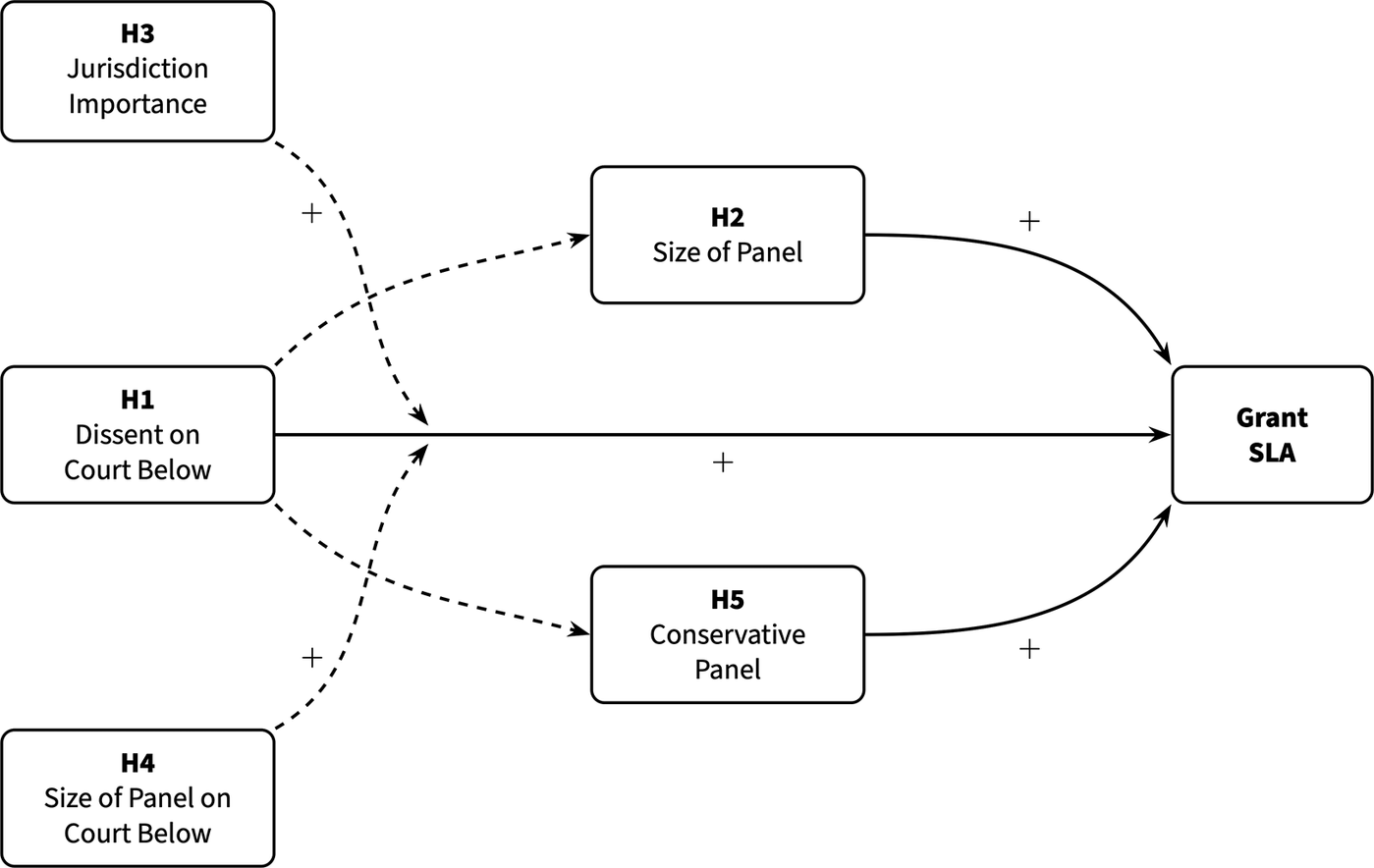
In Figure 1, we set out the theoretical framework we seek to test, together with the hypotheses and expected directions of the effects. Foundationally, we hypothesize that dissent on the court below has a direct positive effect on the likelihood that special leave to appeal is granted. Secondarily, we hypothesize that this direct relationship is mediated by the size and ideological composition of the panel hearing the special leave application, and the importance and size of the jurisdiction from which leave to appeal is being sought.
Theoretical Framework.

Direct effect of dissent in the court below on the likelihood special leave is granted
When first proposing cue theory, Tanenhaus et al. (Reference Tanenhaus, Schick, Muraskin, Rosen and Schubert1963) suggested that dissent on the court below was one of four main cues that the U.S. Supreme Court may pay attention to when deciding whether to grant certiorari. The literature more broadly on the factors that the U.S. Supreme Court considers when selecting the cases it hears has also considered dissent on the court below to be a cue that Justices look to, although typically it is treated as a control variable (Caldeira & Wright Reference Caldeira and Wright1988; Perry Reference Perry1991; Ulmer Reference Ulmer1983; Caldeira et al. Reference Caldeira, Wright and Zorn1999).
Opeskin and Appleby (Reference Opeskin and Appleby2020, p. 928) argue that “a grant of special leave often speaks to the complexity and uncertainty of the legal issues involved.” An indicator of complexity and uncertainty is disagreement in the court from which the applicant seeks to appeal. The direct relevance of disagreement in the court below is explicitly recognized in Section 35A of the Judiciary Act, which refers to “differences of opinion … within the one court, as to the state of law” as a relevant consideration for the Court to consider.
Lefstin (Reference Lefstin2007) described how dissent signifies the existence of “hard cases” or “indeterminacy in the law,” which is a cue to the Justices that Supreme Court review is needed. Consistent with cue theory, Caldeira and Wright (Reference Caldeira and Wright1988, p. 1115) suggest that “dissent … signal[s] ferment in the lower courts and suggest[s] a problematic outcome, one perhaps worthy of a closer look.” Others posit that dissent can act as a cue from lower court judges that a case is worthy of reconsideration by the superior court. Daughety and Reinganum (Reference Daughety and Reinganum2006) model the decision by an appeals court judge to dissent strategically (but truthfully) to signal cases as worthy of reconsideration by the court above. Epstein et al. (Reference Epstein, Landes and Posner2011) model the benefits and costs associated with judicial dissent. In their model, the higher court granting certiorari represents a benefit.
In the Australian context, former High Court Justice Michael Kirby (Reference Kirby2007, p. 745) states: “Obviously, if one of the judges in the intermediate court has dissented, either generally or on a particular point, this will attract immediate attention.” Kirby (Reference Kirby2007) suggests that dissent on the court below may be a cue that the application for special leave may involve a question of law that is of public importance under Section 35A of the Judiciary Act. Epstein et al. (Reference Epstein, Landes and Posner2011) suggest that when judges dissent, they often draw attention to matters of public policy and/or suggest the need for law reform, consistent with the case being of public importance. Dissenting judgments contain a higher proportion of academic, law reform, and other secondary authorities canvassing broader public interest considerations (Smyth Reference Smyth2009).
To summarize, previous authors have described dissent on the court below as being a cue to the Court because disagreement on the court below has been taken to signify variously complexity, uncertainty, the existence of a hard case, or a problematic outcome worthy of a closer look. We do not see these ways of describing signals to the Court captured in dissents as being inconsistent with each other. For the purposes of the article, we adopt the position that dissent on the court below is a cue because it signals complexity. In doing so, we note that hard cases or cases representing problematic or uncertain outcomes are likely to raise complex issues of law. The Court is looking for cues that applications for special leave contain complex issues of law needing its attention.
Why might time-constrained Justices rely on dissent as a signal of complexity when deciding whether to grant special leave? We suggest three reasons.
First, the existence of dissent on the court below is easy to identify. All the Justices, or their associates/law clerks, need to do is review the special leave application.
Second, it is typically highlighted to the Justices in the written and oral submissions accompanying the special leave application. Tokeley (2017) notes that in cases in which there is dissent, applicants for special leave to the High Court will often couch their arguments in the terms of the dissenting judgment on the court below.
Third, their associates/clerks are very likely to bring the existence of a dissent on the court below to the Justices’ attention.Footnote 9 Caldeira and Wright (Reference Caldeira and Wright1988), for example, point out that law clerks in the United States Supreme Court are known to write memoranda based on dissenting opinions in the court below to highlight the case for the applicant.
Lower court dissent is likely to be a particularly salient cue where the Justice in dissent on the court below is an expert or particularly well recognized in the area of law that is the subject of the appeal. A well-known, relatively recent, Australian example is Pell v The Queen,Footnote 10 in which the applicant for special leave to the High Court was George Pell, an Australian Cardinal of the Catholic Church, who was appealing a conviction of child sexual abuse. Pell’s conviction in the County Court of Victoria was initially upheld by the Court of Appeal in Victoria by a majority of two to one, but with a dissent by Weinburg JA. While the two Justices in the majority (Ferguson CJ and Maxwell P) did not have much experience with criminal trials, Weinberg JA was a criminal law specialist and former Commonwealth Director of Public Prosecutions.Footnote 11 Following exceptional public interest in the case, Gordon and Edelman JJ referred the application for special leave to the High Court to the Full Court for argument as on an appeal. The Full Court unanimously agreed with the reasoning of Weinberg JA, upholding the appeal and quashing the conviction.Footnote 12
If dissent on the court below is a cue to the Justices that the case is likely to raise complex issues of law, this suggests the following hypothesis:
H1: The High Court will be more likely to grant special leave to appeal when there has been a dissenting judgment on the Court from which the applicant seeks leave to appeal.
The mediating role of panel size
As discussed, in the High Court, the size of the panels hearing applications for special leave varies depending on cues about a case’s complexity. Most applications for special leave to appeal are heard by a panel of two Justices. Former High Court Justice, Michael Kirby, states: “Sometimes three Justices will sit, particularly if the case is important or the result of the application appears problematic” (Kirby Reference Kirby1999, p. 229).
There are several reasons why the Court might use dissent on the Court below as a cue to assemble a panel of three Justices to hear the application. One reason is that the Court has limited resources. Hence, it looks for cues as to how it should decide how to allocate those resources, including the time of the Justices, to decide on the most complex matters (Alarie et al. Reference Alarie, Green and Iacobucci2015). A second reason is that larger panels reduce the risk that the majority in lower court decisions in which there was a dissenting judgment overlooked something in complex cases (Kirby Reference Kirby1999). Third, larger panels increase the likelihood that there will be diverse perspectives. Hunter (Reference Hunter2015) documents how judges with diverse perspectives are more likely to challenge each other’s assumptions, leading to more rigorous internal debate and better decision making, which is particularly important in complex cases. Fourth, a dissenting judgment on the court below is a cue that the case may attract the scrutiny of the public (Zilis Reference Zilis2015). Pell v The Queen, which we discussed above, is one recent example in the High Court. In such instances, larger panels increase the legitimacy of the decision, signaling to the public that the court decision to take the case reflects broad judicial agreement (Smyth Reference Smyth, Epstein, Grendstad, Sadl and Weinshall2024).
Given that applications for special leave that raise issues of general importance are more likely to be heard by three Justices, and that raising an issue of general importance is the test for special leave being granted, we expect that applications heard by three Justices will be more likely to be successful. These factors suggest the following hypothesis:
H2: The likelihood that the High Court will grant special leave when there is a dissent on the Court below is mediated by High Court special leave panel size: the High Court is more likely to hear special leave applications in cases in which there has been dissent in panels of three and the Court is more likely to grant special leave when the application is heard by a panel of three.
The moderating role of the importance of the jurisdiction
We hypothesize that the importance of the jurisdiction from which appeal is sought will moderate the direct effect of whether there is a dissent on the court below on whether to grant special leave, such that there will be a higher likelihood of granting special leave when there is dissent in an intermediate court of appeal in a more important jurisdiction.
Within the context of cue theory, there are several reasons why the effect of dissent as a cue will be reinforced in more important jurisdictions. Bustos and Jacobi (Reference Bustos and Jacobi2019) develop a model showing that a higher court is more likely to grant certiorari in cases that will most significantly shape future lower court case outcomes in the direction the higher court prefers. The effect of dissent as a cue will be reinforced in more important jurisdictions, given that other state supreme courts will likewise look to these courts for precedent. In the United States, for example, the most important state jurisdictions, such as California and New York, receive more out-of-state citations than other state courts (Caldeira Reference Caldeira1983; Choi et al. Reference Choi, Gulati and Posner2008). By addressing division on these courts, they can also address development of law in follower jurisdictions.
The importance of the jurisdiction from which leave to appeal is sought speaks to the relative complexity of the legal issues that the jurisdiction faces (Opeskin & Appleby Reference Opeskin and Appleby2020). In particular, more important jurisdictions are likely to hear cases involving legal issues in developing and new areas of the law which, because of their novelty, are more likely to raise complex issues, reinforcing dissent as a cue. When these courts decide cases in developing and new areas of the law, particularly where there is division on the court, the High Court may want to intervene to settle the issue in a way consistent with its preferences and prevent a potentially wrong decision from spreading to other states.
Furthermore, the quality of the Bench in more important jurisdictions will, on average, be higher because in more important jurisdictions there will be larger bars from which to select judges. If better legal minds are disagreeing on the issue being litigated, this will reinforce the existence of a dissenting judgment as a cue that the issue raises complex legal issues.
In Australia, New South Wales and Victoria are the two most important jurisdictions. The Courts of Appeal in these states are “leaders” among the intermediate state appellate courts: they are the biggest suppliers of coordinate citations to other State Courts of Appeal, accounting for almost three-quarters of coordinate citations over the period 1905 to 2005 (Smyth & Mishra Reference Smyth and Mishra2010).Footnote 13 Further, Smyth and Mishra (Reference Smyth and Mishra2010) demonstrate that the importance of the Courts of Appeal in these two states is positively correlated with the reputation of their Bench (proxied by the number of High Court judges that have been appointed from those states), socioeconomic diversity (proxied by the State’s population), and legal capital (proxied by the number of pages of the official law reports of the State Supreme Courts). Traditionally, not only have most of the High Court Justices come from these two states, but a study of “appointments that might have been” found that most of the notable people who came close to being appointed through the Court’s history were from New South Wales or Victoria (Simpson Reference Simpson, Blackshield, Coper and Williams2001).
Psychologists have demonstrated that familiarity can also serve as a salient cue (see, e.g. Metcalfe et al. Reference Metcalfe, Schwartz and Joaquim1993). Sutton and Jones (Reference Sutton and Jones2018, p. 175) attribute the fact that the U.S. Supreme Court grants certiorari in more federal cases than state cases, in part, to:
The current audience for certiorari petitions also shares a federal court vantage point. All but one of the Justices hails from a federal circuit court and not one of them is an alum of a state court. That experience may make the Justices more familiar with federal judges than with state court judges, perhaps making them more likely to appreciate a majority or dissenting opinion by a known rather than an unknown judge or an opinion from a known rather than a less well known court. Familiarity may breed confidence in some certiorari petitions over others… . U.S. Supreme Court law clerks … hail almost exclusively from federal court clerkships, perhaps creating a similar dynamic.
In the period that we study, two-thirds of the High Court Justices were from New South Wales or Victoria. Several of the Justices sat in the Courts of Appeal in these states before being elevated to the High Court and were senior members of the Bar in these states before that. Thus, these Justices are not only likely to be more familiar with the Courts of Appeal in their home states, but with the Justices writing the majority and dissenting judgments.
New South Wales and Victoria are the most populous states and have the majority of commerce and manufacturing, accounting for over half (54%) of economic output in Australia (RBA, 2025). Hence, the Courts of Appeal in these two states also tend to hear the most complex cases and are on the cutting edge of adjudicating on new legal problems.
These considerations suggest our third hypothesis:
H3: The likelihood that the High Court will grant special leave when there is a dissent on the Court below will be moderated by the importance of the jurisdiction from which special leave to appeal is being sought. Given that Victoria and New South Wales are the most important jurisdictions, there will be a higher likelihood of granting special leave when there is dissent in either the New South Wales or Victoria Court of Appeal.
The moderating role of lower court panel size
Cue theory indicates that lower court dissent can provide important information about case complexity. When dissent exists on relatively large panels, there is reason to question the reliability of the judgment; when dissent arises in cases with a smaller panel size, there is even more reason to question the outcome. In cases with smaller panel size, the cue that lower court dissent provides is reinforced because there is less confidence that the issues have been fully thought through and a greater danger that “a point might have been missed” (Kirby Reference Kirby2007, p. 745). If such a cue is present, we expect that High Court special leave panels will grant special leave to clarify a controversial point of law:
H4: The likelihood that the High Court will grant special leave when there is a dissent on the Court below will be moderated by lower court panel size: there will be a larger effect of dissent when lower court decisions are heard by smaller panels.
The mediating role of the ideological composition of the panel
Studies find that the United States Supreme Court is more likely to grant certiorari and review the decisions of the court below when it deviates from its ideological preferences (Cameron et al. Reference Cameron, Segal and Songer2000; Mak et al. Reference Mak, Sidman and Sommer2013; Beim & Rader Reference Beim and Rader2024). Dissenting opinions have been regarded as a signal that the court below could be deviating from the Supreme Court’s preferences (Tanenhaus et al. Reference Tanenhaus, Schick, Muraskin, Rosen and Schubert1963; Ulmer Reference Ulmer1983; Cross Reference Cross2005; Hettinger et al. Reference Hettinger, Lindquist and Martinek2006; Mak et al. Reference Mak, Sidman and Sommer2013). While the High Court of Australia has traditionally not been regarded as being as political as the U.S. Supreme Court, recent studies have established that ideological preferences of the Justices influence decision-making on the High Court of Australia in cases decided on the merits (Leslie et al. Reference Leslie, Robinson and Smyth2021; Robinson et al. Reference Robinson, Leslie and Sheppard2022; Jacobi et al. Reference Jacobi, Leslie and Robinson2024). We posit that if there is dissent on the court below, this acts as a cue to the Chief Justice that the lower court may be deviating from the ideological preferences of the High Court and provides an incentive to assemble a conservative panel to review the application.
We utilize an ex ante measure of the perceived ideology of all Justices of the High Court of Australia sitting on the Court between 1995 and 2019, created by analyzing and coding the content of 7,900 paragraphs of media coverage across eight Australian newspapers (Ostberg & Wetstein Reference Ostberg and Wetstein2007; Segal & Cover Reference Segal and Cover1989; Robinson et al. Reference Robinson, Leslie and Sheppard2022). In the High Court of Australia, the Chief Justice selects the panels that decide special leave applications (Leslie et al. 2025). While there is little systematic evidence that panels are selected ideologically, one counter example was Chief Justice Murray Gleeson, who tended to select right-leaning panels particularly for immigration appeals. As such, if the High Court is responding to lower court dissents as cues of deviation from its own preferences, this could manifest in a conservative panel being selected more often, enabling a fuller review of the decision. This suggests our fifth hypothesis as follows:
H5: The likelihood that the High Court will grant special leave when there is a dissent on the Court below is mediated by the ideological composition of the panel hearing the application: the Chief Justice is more likely to select a conservative panel to hear the special leave application in cases in which there has been dissent on the court below and, in turn, more conservative panels are more likely to grant special leave to appeal.
Data and methods
Our data for special leave applications are compiled from the High Court of Australia’s records for special leave application decisions (2008–present) and from High Court Transcripts (2003–present).Footnote 14 Case characteristics and detail codings are adapted from the Supreme Court Database (Spaeth et al. Reference Spaeth, Epstein, Martin, Segal, Ruger and Benesh2024) and the High Court of Australia Database (Robinson & Leslie Reference Robinson and Leslie2024), and include the date of the decision, case issue and issue sub-area, the place of application, the jurisdiction under which the court grants special leave applications, the Justices selected to decide the special leave application, and the outcome.
Table 1 provides an overview of disposition of special leave to appeal applications over the period 2003 to 2018. Our dataset contains 8,405 special leave to appeal applications over this period. The success rate was the same (12%) under each of the three Chief Justices (Gleeson, French, and Kiefel).Footnote 15 Table 2 shows the success rate according to whether there was dissent on the court below. When there was dissent on the court below, 38.1% of special leave applications were granted; when there was no dissent on the court below, just 10% of special leave applications were granted. Cases coded “Unknown” had appellate proceedings, but dissent status could not be verified; they are retained in descriptive tables but excluded from regression models. Table 3 shows the success rate according to High Court special leave panel size. When the special leave application was heard by one Justice, the success rate was 0.6%; when the application was heard by two Justices, the success rate was 9%, and of the applications heard by three Justices, the success rate increased to 40.7%.
Summary Statistics—Special Leave Applications

Summary Statistics—Success by Lower Court Dissent

Summary Statistics—Success by Panel Size

To examine the direct effect of dissent on the court below on whether the application for special leave is successful (H1), we use logistic regression in which we regress whether the application was successful (Yes = 1) on whether there was dissent on the court below (Yes = 1), controlling for fixed effects (year, primary issue area, and the case’s source state) and a potential confound (lower court panel size). As an alternative to logistic regression, we also estimate a linear probability model (Ordinary Least Squares), and the results are qualitatively the same.
To examine whether the ideological composition of the panel and High Court special leave panel size mediate (H2, H5) the direct effect of dissent rate on the court below on whether special leave is granted, we apply a causal mediation analysis with post-estimation resampled confidence intervals using the R mediation package’s mediate function (Tingley et al. Reference Tingley, Yamamoto, Hirose, Keele and Imai2014). The mediation analysis evaluates whether the effect of dissent in the court below on the grant of special leave operates directly, and/or indirectly through two features of the deciding panel: its size (H2) and its ideological composition (H5). The method decomposes the total effect of a treatment variable into an average direct effect (ADE) and an average causal mediation effect (ACME), which captures the pathway through which the treatment influences the outcome.
The mediation estimation proceeds in two stages. First, we specify models for the mediators, predicting High Court special leave panel size (H2) and panel ideology (H5) as functions of the lower-court dissent rate and relevant covariates. Second, we fit an outcome model for the probability of special leave grant, including dissent, the mediator, and their interactions. Using the coefficients from these models, we then simulate counterfactual scenarios for each case in the data: for example, comparing the predicted outcome when dissent is fixed at a low level, but the mediators are set to the values they would have taken had dissent been high. This contrast identifies the indirect effect via the mediators. Conversely, shifting dissent while fixing the mediators at their “low-dissent” values identifies the direct effect. The difference between the two counterfactual outcome distributions, averaged across the sample, yields the ACME and ADE, respectively, while their sum recovers the total effect.
Because the outcome is modeled with a nonlinear link, the mediation effects cannot be reduced to products of regression coefficients. We therefore employ the mediate function from the R mediation package (Tingley et al. Reference Tingley, Yamamoto, Hirose, Keele and Imai2014), which implements a simulation-based algorithm to estimate these counterfactual quantities and construct confidence intervals via resampling. This procedure provides both point estimates and uncertainty intervals for the direct and mediated pathways, enabling us to assess the substantive contribution of panel ideology and panel size to the effect of dissent on the grant of special leave.
Finally, to examine moderation effects (H3, H4), we employ an interaction term between lower court panel size and dissent, and jurisdiction and dissent.
Results
Direct effect of dissent in the court below on the likelihood special leave is granted
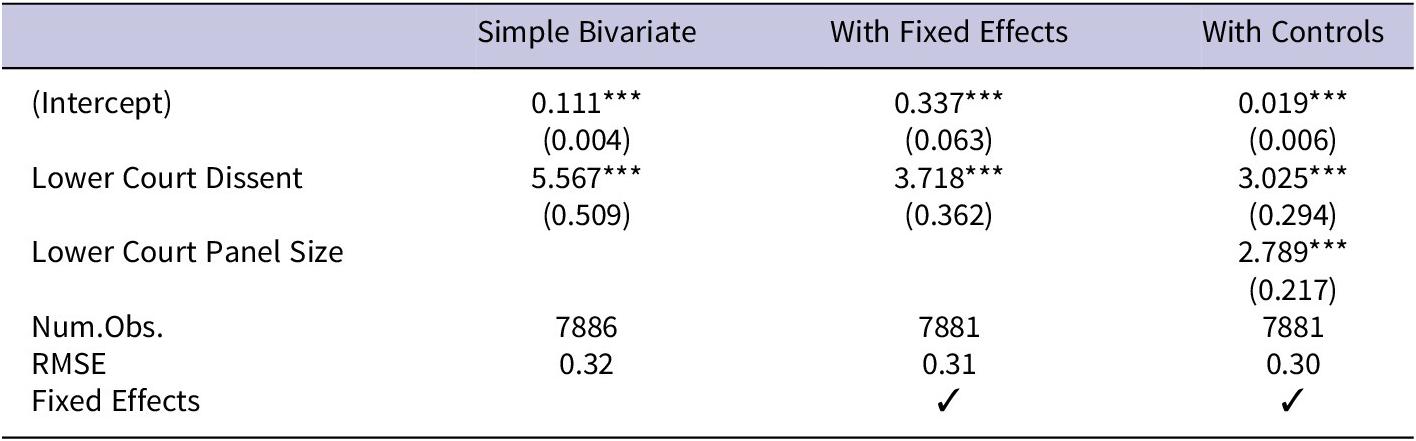
Table 4 presents the results of a logistic regression model in which the likelihood of special leave to appeal being granted is regressed on whether there was dissent on the court below. Coefficients are exponentiated to give odds ratios. If there was dissent on the court below, then there is approximately a three-fold increase in the likelihood of special leave success.
Logistic Regression Models of Special Leave Success

Note: p < 0.1, * p < 0.05, ** p < 0.01, *** p < 0.001. Coefficients are exponentiated to give odds ratios. For example, an odds ratio of 2 indicates a two-fold increase in the likelihood of special leave success. Year, primary issue area, and case source state fixed effects included in some models but omitted from display. Cases without a lower court decision or where lower court dissent could not be determined were omitted.
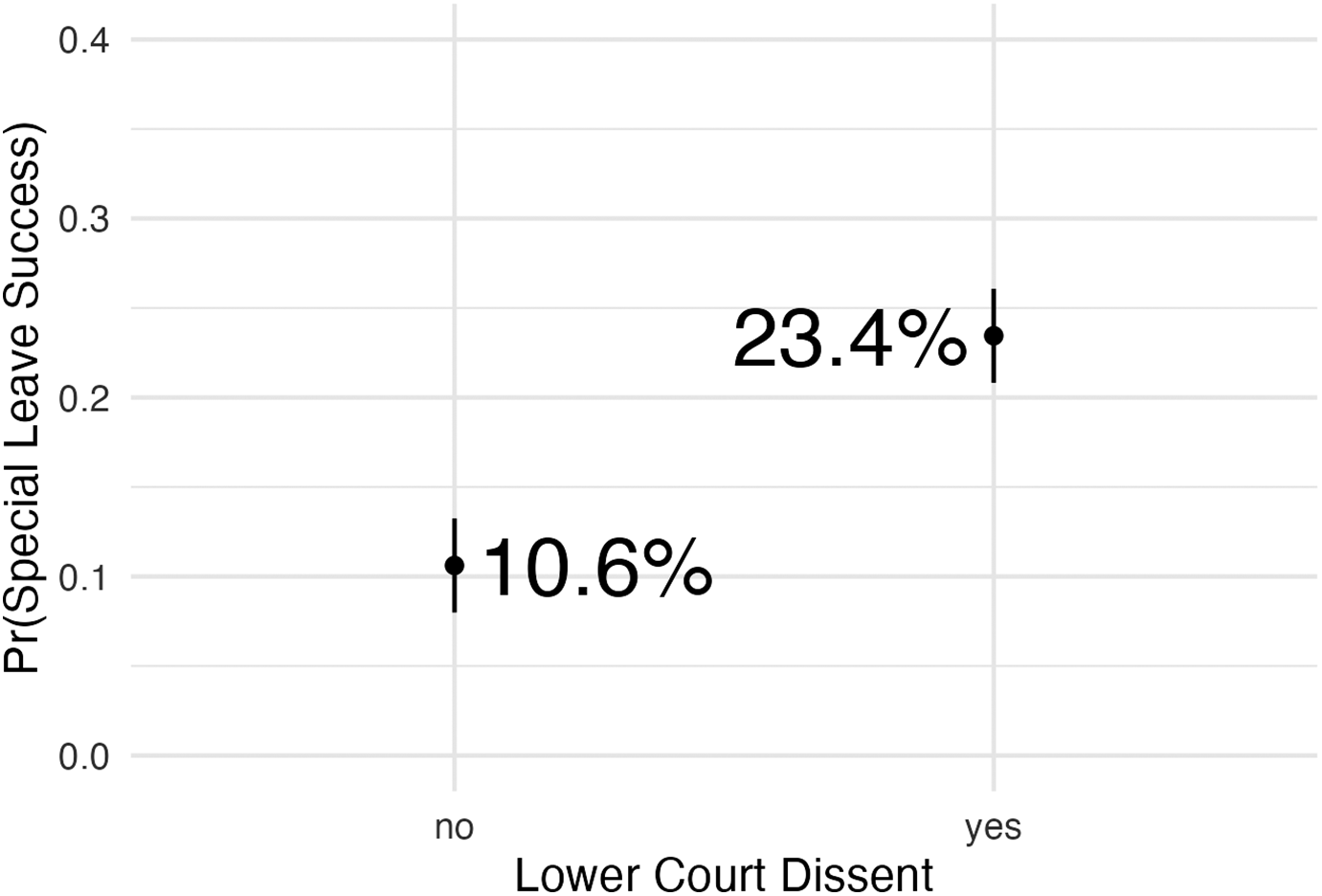
Figure 2 presents the predicted probabilities of lower court dissent on special leave success with 95% confidence intervals, accounting for controls and fixed effects. To calculate an average marginal effect as implied by column (3) in Table 4, we calculate the predicted difference in probability at the observation level, given the linear probability model using the marginaleffects::comparisons in R. This creates two probability calculations per observation using the linear predictors of the model (one with lower court dissent, and one without). The differences between these model predictions are then averaged out across the whole sample. This gives us an average marginal effect of 0.128 (95% CIs: 0.102–0.155) or 12.8 percentage points more likely, given a dissent in the lower court. Equivalently, special leave success is on average 2.21 (95% CIs: 1.93–2.489) times more likely given a lower court dissent. To create predicted probabilities, we solved the system a-b = 0.128 and a/b = 2.21 to give $ {a}_{dissent}= $
0.234 and
$ {a}_{dissent}= $
0.234 and $ {b}_{nodissent}= $
0.106. Assuming symmetrical confidence intervals, we give the predicted probabilities in Figure 2. Thus, if there is dissent on the court below, it is predicted that the probability that special leave will be granted is 23.4%, but if the court below is unanimous, the predicted probability of success is 10.6%.
$ {b}_{nodissent}= $
0.106. Assuming symmetrical confidence intervals, we give the predicted probabilities in Figure 2. Thus, if there is dissent on the court below, it is predicted that the probability that special leave will be granted is 23.4%, but if the court below is unanimous, the predicted probability of success is 10.6%.
Predicted Probabilities of Lower Court Dissent on Special Leave Success with 95% Confidence Intervals, Accounting for Controls and Fixed Effects.

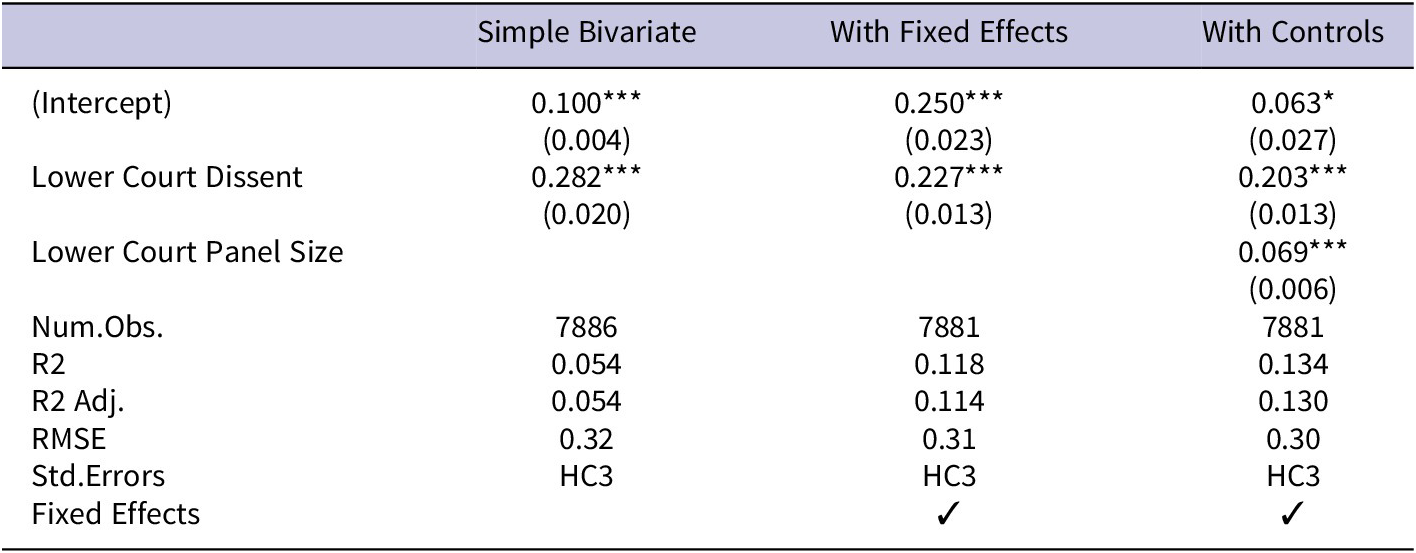
Table 5 presents the results from a linear probability model estimate, which has a simpler interpretation. The coefficient on dissent in the lower court in column (3) suggests that the total marginal effect is larger, at 0.203 or 20.3 percentage points. Taken together, the results in Tables 4 and 5 and Figure 2 are consistent with H1.
Linear Probability Regression Models of Special Leave Success

Note: p < 0.1, * p < 0.05, ** p < 0.01, *** p < 0.001. Standard errors are reported using a Heteroscedasticity-consistent (HC3) sandwich estimator. Year, primary issue area, and case source state fixed effects included in some models but omitted from display. Cases without a lower court decision or where lower court dissent could not be determined were omitted.
The mediating role of High Court special leave panel size
In Table 6, to examine whether High Court special leave panel size mediates the relationship between dissent on the court below and the likelihood that special leave to appeal is granted, we apply a causal mediation analysis with post-estimation resampled confidence intervals using the R mediation::mediate function. The function calculates marginal effects averaged across all units in our dataset, in a manner which is analogous to the marginal effects calculated for the direct effect.Footnote 16 All results were significant (p <0.001), showing a small but significant mediation effect. The results show a total marginal effect of 0.134 (95% CIs: 0.106–0.162), of which 0.119 (88.8%) was the direct effect attributable to the effect of lower court dissent, and 0.015 (11.2%) attributable to the mediator, special leave panel size. The results in Table 6 are consistent with H2.
Causal Mediation Analysis of the Effect of Lower Court Dissent on the Likelihood of Special Leave Being Granted Where High Court Special Leave Panel Size Is the Mediator

Note: Causal mediation analysis with quasi-Bayesian Confidence Intervals. Simulations: 1,000 simulations. Seed = 42.
One interpretive limitation of the mediation result warrants explicit acknowledgment. The causal mediation framework we employ rests on the sequential ignorability assumption, which requires both that the treatment (lower court dissent) is independent of potential outcomes and mediator values conditional on covariates, and that the mediator (High Court panel size) is independent of potential outcomes conditional on the observed treatment and covariates (Imai et al. Reference Imai, Keele and Tingley2010). The second condition is potentially threatened here. Panel size is assigned by the Chief Justice partly in response to complexity signals which also predict lower court dissent and special leave success. Because the Chief Justice’s overall assessment of case importance simultaneously shapes panel assignment and the likelihood of granting leave, the mediator cannot be treated as unconfounded conditional on treatment and covariates alone. The mediation result should therefore be read as descriptively consistent with the theoretical pathway in H2 rather than a causally identified estimate of the indirect effect. This concern does not affect our primary finding: the direct effect of lower court dissent on special leave success does not pass through the mediator and is robust across specifications.
The moderating role of the importance of the jurisdiction
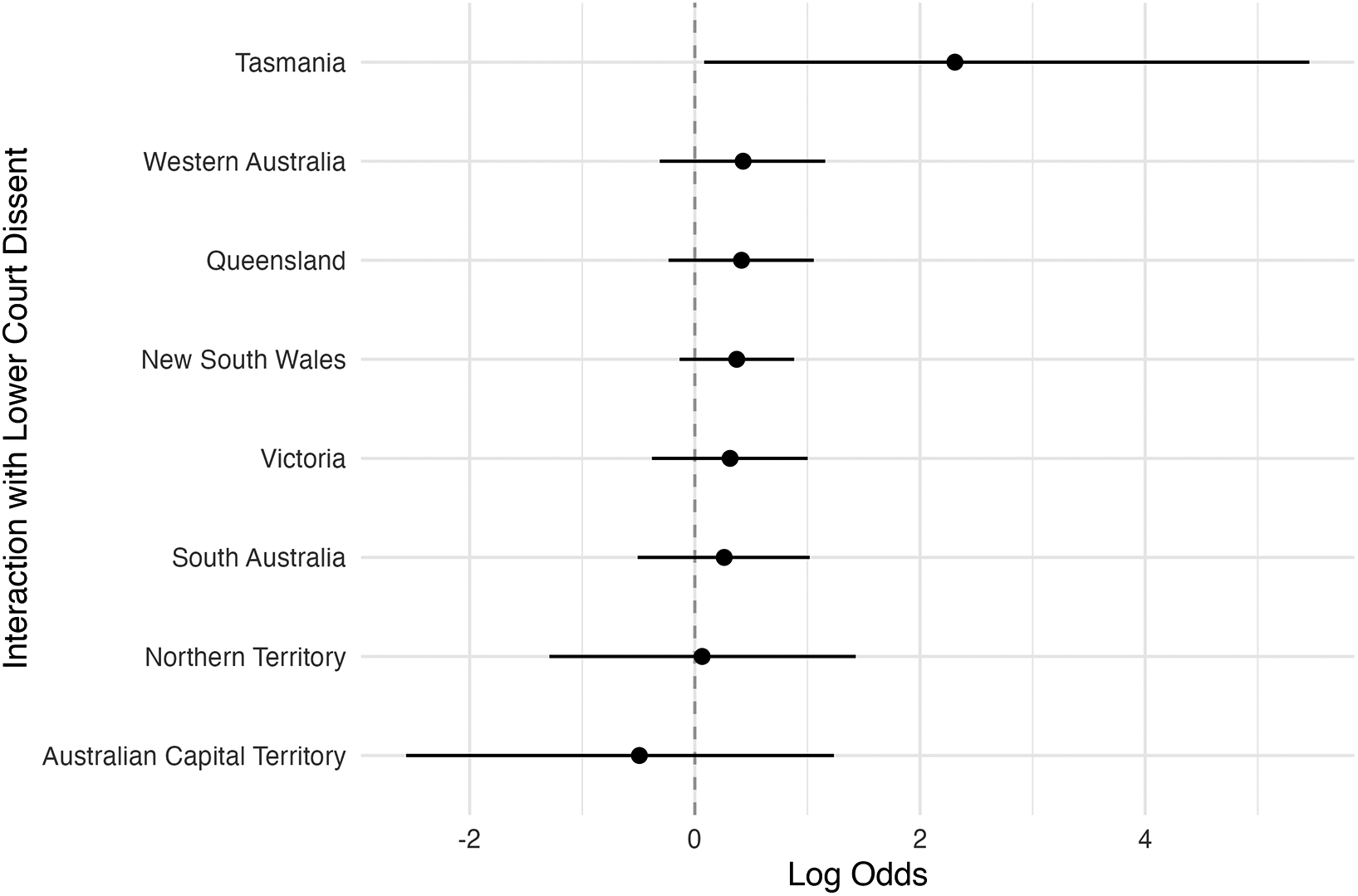
To examine whether the importance of the jurisdiction from which special leave to appeal is sought moderates the relationship between dissent on the court below and the likelihood that special leave to appeal is granted, in Figure 3 we plot the raw interaction coefficients between dissent and jurisdiction, together with their confidence intervals. Note that cases originating in federal jurisdiction are the baseline category and form the point of comparison for the coefficient plot. None of the interaction terms is significant, suggesting our findings are not consistent with H3.
Moderating Effect of State of Origin.

The moderating role of lower court panel size
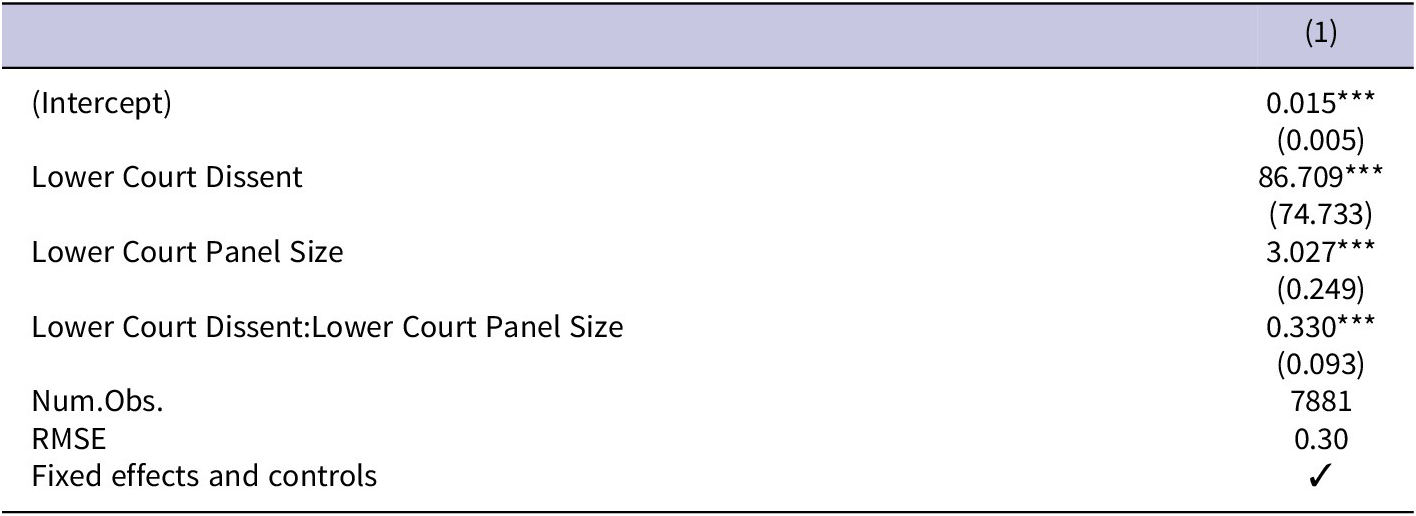
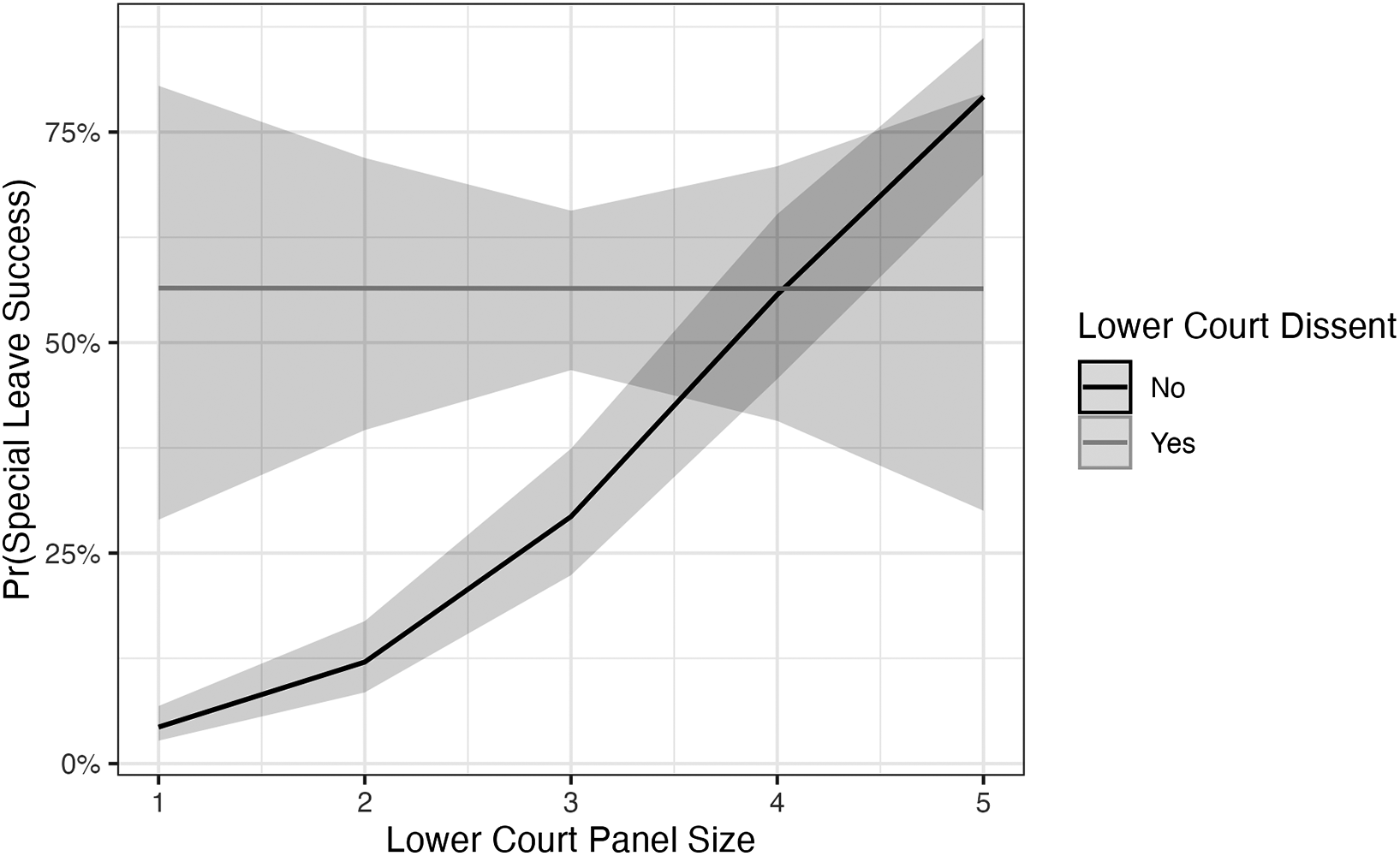
In Table 7 and Figure 4 we show the interaction of lower court panel size and lower court dissent. We find strong evidence for a moderation effect, consistent with H4. This is not a perfect test because some lower courts are relatively inflexible on how many Justices they allow for a full case hearing. However, our state and issue area fixed effects account for this variance, and we present a within-unit change inference. While special leave grant becomes more likely as the panel size of the lower court increases, a dissent at any panel size is statistically and substantively significant. Here, the interpretation is that the High Court notices and acts on dissent, even when the lower court panel size (and hence case significance) is low.
Logistic Regression of the Interaction between Lower Court Panel Size and Lower Court Dissent

Note: p < 0.1, * p < 0.05, ** p < 0.01, *** p < 0.001. Coefficients are exponentiated to give odds ratios. For example, an odds ratio of 2 indicates a two-fold increase in the likelihood of special leave success. Standard errors of log odds coefficients are given in parentheses. Year, primary issue area, and case source state fixed effects included in some models but omitted from display. Cases without a lower court decision or where lower court dissent could not be determined were omitted.
Moderating Effect of Lower Court Panel Size.

The mediating role of the ideological composition of the panel
In Table 8, we examine if the ideological composition of the panel mediates the relationship between dissent on the court below and the likelihood that special leave to appeal is successful. Consistent with expectations, we find that there is indeed a positive association between lower court dissent and ideology, with conservative panels being more likely after a lower court dissent (b = 0.167, se = 0.058). However, there is no evidence of a mediated effect through panel ideology. The results show a total marginal effect of 0.129 (95% CIs: 0.102–0.157), of which 0.129 (99.9%) was the direct effect attributable to the effect of lower court dissent, and 0 (0.1%, 95% CI: –0.8 to 1) attributed to the mediator. Thus, H5 is not supported in that dissent on the court below is what causes conservatives to be more likely to grant the special leave applications.
Causal Mediation Analysis of the Effect of Lower Court Dissent with a Special Leave Panel Ideology Mediator

Note: Causal mediation analysis with quasi-Bayesian Confidence Intervals. Simulations: 1,000 simulations. Seed = 42. Ideology measured using ex-ante scores from Robinson et al. (Reference Robinson, Leslie and Sheppard2022).
Discussion and Conclusion
The results above go a long way to improving the understanding of when special leave will be granted in the High Court of Australia, a jurisdiction that is similar to the U.S. Supreme Court but with different institutional levers available in this process, particularly to the Chief Justice. The most foundational test was to determine the direct effect of a dissent in a lower court on the decision of the High Court panel over whether to review the case. Hypothesis 1 was strongly supported, and the effect was substantively considerable, with a two- to three-fold increase in the likelihood of special leave review following a dissent. This provides a strong indicator of what shapes High Court decision-making and agenda setting. It also provides support for one of the foundational elements of cue theory, as applied in a jurisdiction other than the U.S.: that judges superior in the judicial hierarchy will look to signals from judges lower in the hierarchy, who have already dealt with a case, to determine its importance.
In addition, we sought to extend understanding of dissent on the court below as a cue by theorizing, and empirically testing, whether there are also indirect effects of lower court dissents on the decisions of special leave panels, in various forms. First, since at the High Court of Australia there is discretion over the size of the panel determining special leave, larger panels can be a sign of greater attention being paid to the decision below, creating potentially a higher chance that special leave will be granted. This effect (H2) was statistically significant across specifications. Perhaps unsurprisingly, the substantive effect was smaller than for the direct effect of lower court dissent. But it nevertheless provides support for the notion that, even before a High Court decision is made over a case outcome, and indeed even before a decision to grant special leave, there are indications of the Court’s general predisposition toward the case at hand, indicated by the level of judicial resources put toward hearing whether the case is worthy of further consideration. Thus, this finding is consistent with both cue theory and understandings of judicial resource constraints and preferences for minimizing work on less salient issues, consistent with the literature in the U.S. (Perry Reference Perry1991; Posner Reference Posner1993).
An equivalent measure of the significance given to the case ex ante at the lower court level, as measured by lower court panel size, is also a highly significant predictor of special leave success. This suggests that lower courts are for the most part engaging in similar efficient resource allocation. However, when inserted as a moderating variable interacting with lower court dissent, we find that the effect of dissent is far stronger for smaller lower court panels than for larger lower court panels. This is a further suggestion that dissent operates as a powerful cue indicating complexity and the need for further review, even when—at first glance—a case might not have appeared of any great salience to the court below.
In contrast, another hypothesized mediating effect, the importance of the jurisdiction from which special leave is being sought, was not consistently significant. The final indication of the significance of lower court dissent on the decision to grant special leave at the High Court is the seeming power of the lower court dissent to act as a signal of ideological divergence within the judicial hierarchy. This hypothesis was tested at a very general level, in terms of predicting conservative panels as being more likely to be selected to hear cases where there was dissent on the court below, and more likely to grant special leave, given the overall conservative tendency of the High Court in the decade studied here. Despite this noisy method of testing, we find some positive evidence of the aggregate effect predicted, although not all. Conservative panels are indeed more likely to be chosen after a lower court dissent, but not more likely to then opt to grant special leave. This provides support that Chief Justices act strategically, but not evidence that the panel is influenced by ideology in the same way. While it is possible this could be because Chief Justices are more strategic—perhaps with both a skewed selection process rewarding more ambitious and strategic actors, or a product of the different institutional role of the Chief Justice—the inconsistency in findings could reflect measurement error.
It is perhaps safest to conclude that while we have shown a very large effect in the power of lower court dissent overall, in both a large direct effect and smaller but mostly significant indirect effects, some of the non-results and mixed results suggest that the mechanism of influence is not always straightforward or clear. While we have, as much as possible, distinguished direct and mediating effects on High Court special leave panel decision-making, some or all of these influences may also affect the existence of a lower court dissent. For example, the positive result on panel size in terms of direct effect could be a product of the Chief Justice selecting bigger panels for more important, more polarizing cases, which also affect the chances of there being a dissent in the lower court in the first place, as well as the dissent itself acting as a cue to the High Court judges. The fact that we find a similar effect for the size of the lower court panel suggests that each stage in the judicial hierarchy could be studied equally closely, with some similar results.
Overall, this indicates that lower court dissent is important and potentially a good instrument, but there is a limit on how much we can understand High Court action without also a detailed study of what influences lower court decision-making. That does not yet exist in the Australian context and is certainly beyond the scope of this article, but this article helps point the way forward and is part of the growing empirical literature of Australian judicial decision-making. This, in turn, contributes to our understanding of U.S. Supreme Court decision-making and agenda setting and that of other similar, American-style apex courts with diffuse ambits and broad discretion over their agendas.
Data availability statement
The complete dataset can be found at the Australian Data Archive (https://doi.org/10.26193/HGCK1S) or at: https://aushighcourtdatabase.org. Replication materials for this article are available at the Journal of Law and Courts Dataverse: https://doi.org/10.7910/DVN/IIZPY3.






 Open access

